Hamas rejects Amnesty report on war crimes
Ma’an – 27/03/2015
GAZA CITY – The Hamas movement on Friday rejected a report by human rights group Amnesty International accusing the group of war crimes during last summer’s war with Israel.
While the report claims that Hamas killed both Israeli and Palestinian civilians using indiscriminate projectiles, Hamas criticized the findings as being unbalanced, adopting “the Israeli version of the story.”
In a statement, the group said that it is the right of Palestinians to defend themselves against both the ongoing Israeli occupation and Israeli military offenses.
“War crimes have clear specifications, according to the Rome Statute, that do not in any way apply to the Palestinian resistance, which was, is, and will defend its people.”
The report released by Amnesty International on Thursday said that Palestinian rocket fire during the 2014 summer war had killed more civilians inside the Gaza Strip than inside Israel.
The report said rocket attacks had killed six civilians inside Israel, including a child, but that other rockets aimed at Israel had fallen short inside Gaza, killing at least 13 civilians, 11 of them children.
It referred to one particular incident on July 28 in which 13 people were killed in deadly blast inside the beach-side Shati refugee camp in Gaza City.
Hamas took issue with Amnesty’s approach to the report, arguing that the rights group relied solely on Israeli information to compile the report, therefore missing a balanced review as Israel did not allow international investigation committees into Gaza.
Last summer’s war between Palestinian militant groups and Israel left more than 2,100 Palestinians dead, mostly civilians, according to Palestinian and UN officials. On the Israeli side, 66 soldiers and six civilians were killed. Over 100,000 Gazans lost their homes, and large swathes of the coastal territory were left in ruins.
Hamas said that Amnesty International’s report “purposely turned facts around to justify Israel’s crimes against humanity,” and called upon rights institutions to carry out impartial investigations into Israeli forces’ war crimes.
Israel, Palestine and ‘Greenwashing’
By Robert Fantina | Aletho News | March 26, 2015
The genocidal methods employed by Israel against the Palestinians know no boundaries. The degree to which apartheid Israel works to erase Palestine, its people, history and culture is truly extraordinary. One method in use that may not be commonly known is referred to as ‘greenwashing’.
 To fully understand this concept, it’s necessary first to understand and appreciate Palestinians’ devotion to, and reliance on, their lands in general, and olive trees in particular. For millennia, Palestinians have farmed the land and supported themselves and their families in this way. The olive tree has a central role in the lives and the very existence of Palestinians.
A newly-planted olive tree takes several years to bear fruit, but most will live for hundreds of years, producing fruit. It is not unusual for such trees to live for 2,000 years. The olives are used in a variety of ways, not only for oil, but in the making of soap, hair treatment and other products, and even to light their homes. Since many Palestinians live on lands that have been in their families for countless generations, there is a strong attachment to olive trees. Some families name their olive trees, indicating the importance the trees have to them.
Israel is not unaware of the significance of olive trees to the Palestinians. The Zionist Jewish National Fund (JNF) has long sponsored a program called ‘Plant a Tree in Israel’. For a small sum, they say, anyone in the world can have a European Pine tree planted in Israel, in memory of a loved one. Who can argue with such a thing? Can anything be more benign than planting a tree? However, there are multiple problems with this:
- The trees are planted in Palestine, not Israel;
- Olive trees are destroyed so that the new trees, European Pines, can be planted, and
- The new trees help to erase Palestinian history.
European Pines are, as the name indicates, common in European countries. They look far different than olive trees, and do not thrive in Palestine as olive trees do. These ‘memorial’ trees are planted not only on former olive tree orchards which have been destroyed to make way for them, but also on bulldozed villages. When orchards are destroyed, the owners are given no compensation; they have no opportunity to appeal the decision. They can only watch in despair as their livelihood, the same means that has sustained their family for generations untold, is destroyed.
Part of Israel’s genocidal practices involves obliterating Palestine history and culture; this is done, in part, by destroying entire villages, bulldozing every building in the village. Again, there is no compensation offered, and no opportunity to appeal. Palestinians must simply quickly remove whatever they can, before their homes, schools, mosques, hospitals, stores and farms are bulldozed. Once that is done, what better way to hide any remaining evidence that this area was once full of families, working, farming, going to school, etc., then to grow a forest on the site? European Pines grow quickly, hiding the tragedies on which they are planted.
In the past few decades, at least 280,000 olive trees have been intentionally destroyed in Palestine by Israel; an estimated 250,000,000 pine trees have been planted, some financed by well-meaning but uninformed people, but most by the Israeli government. It is likely that most of the people around the world who have sent money to have them planted are unaware of their real purpose; who is going to think of genocide, when planting a tree in memory of a loved one?
Israel has many methods of genocide against the Palestinians that are not generally known in the U.S.; reporting on these atrocities seems a bit better in much of the rest of the world. Greenwashing, like many others, is insidious, and must be stopped.
With the re-election of Israeli Prime Murderer Benjamin Netanyahu, the only change that can be expected in Israeli policy toward Palestine is an increase in illegal arrests, illegal settlement building, illegal land confiscation, and violence. However, a large crack in the fragile, glass jar of global support has appeared, put there by the campaign promises of Mr. Netanyahu. Even the United States, which for so long has been Israel’s willing puppet, is ‘reevaluating’ its policies toward that country, in view of Mr. Netanyahu’s assurance to Israelis that there will be no independent Palestine while he is Prime Murderer. Europe, long impatient with Israel’s continuing violation of international law, cannot be expected to sit quietly now.
What might this ‘reevaluation’ result in? The one aspect that is being whispered, almost in reverential awe, is the possibility that the U.S. may stop its blatantly unfair, constant and unjust defense of Israel at the United Nations. Any time that a resolution seeking to further the basic human rights of the Palestinians, rights that Israel deprives them of with the full support and financing of the United States, is proposed in the U.N., the U.S. vetoes it. Incredibly, it even vetoes it when it agrees with it! Consider then U.N. Ambassador Susan Rice’s astonishing comments when vetoing a resolution criticizing illegal settlements in 2011: She said that, while the U.S. sees “the folly and illegitimacy of continued Israeli settlement activity, we think it unwise for this council to attempt to resolve the core issues that divide Israelis and Palestinians”. Now, perhaps, the handcuffs which the U.S. so firmly locked in place on the U.N.’s ability to do its job will be released.
What can Palestinians expect in the near term? Unfortunately, nothing good. The wheels of diplomacy turn far more slowly than those on the bulldozers that destroy Palestinian homes and olive trees. Yet there was a turning point with Israel’s savage genocide in the summer of 2014; now that Mr. Netanyahu has stated clearly his intentions regarding Palestine, the age of pretense is over. The U.S., which has never helped Palestine, can no longer hide behind the farce of negotiations. The time to act is now.
Robert Fantina’s latest book is Empire, Racism and Genocide: a History of US Foreign Policy (Red Pill Press).
Photo credit – International Solidarity Movement
Senior UN officials slam Israeli human rights abuses
MEMO | March 24, 2015
Israel’s human rights abuses in the Occupied Palestinian Territory came under renewed attack by senior UN officials on Monday.
Addressing the Human Rights Council in Geneva, UN Special Rapporteur on the Situation of Human Rights in the Palestinian Territories Occupied since 1967 Makarim Wibisono heavily criticised Israel’s assault on Gaza last year.
“The ferocity of destruction and high proportion of civilian lives lost in Gaza cast serious doubts over Israel’s adherence to international humanitarian law principles of proportionality, distinction and precautions in attack.”
Wibisono described the “lack of respect for human rights” as having “permeated almost every aspect of the daily lives of Palestinians in the West Bank and Gaza”, touching upon Israel’s “excessive use of force”, as well as settlement construction, threats of “forcible transfer”, and more.
The UN official also noted that “treatment of Palestinians, including children in Israeli detention, was an issue of grave concern” and that Israel “had done too little to follow up on the report [two years ago] by the United Nations Children’s Fund” on the ill-treatment of children in military detention.
The Council was also presented with a report of the Secretary-General on Israeli settlements in the OPT and Syrian Golan, which he said continued to expand.
The Secretary-General described how “Israeli settlements and acts of violence committed by Israeli settlers against Palestinians continue to underpin a broad spectrum of human rights violations against Palestinians.”
The report urged Israel to “cease all settlement activity in the West Bank and East Jerusalem, as well as in the occupied Syrian Golan, and implement relevant United Nations resolutions.”
A second Secretary-General report on the broader human rights situation in the OPT, covering the period from May 2013 to October 2014, further noted that settlements “undermine Palestinian territorial integrity, contrary to international law, and Palestinians’ right to self-determination.”
Obstacles to peace and to Palestinians’ enjoyment of their human rights, including their right to self-determination, must be removed. That means the ending and reversal of all settlement activity in the West Bank, including East Jerusalem, the full lifting of the blockade on Gaza and the ending of the occupation of Palestinian land.
Mary McGowan Davis, Chairperson of the Commission of Inquiry on the 2014 Gaza Conflict, gave the Council an oral update on the progression of the Commission. Davis said that Israel had not responded to a request for access, and, that the written report would be presented in June.
The Roots of Netanyahu’s Electoral Victory: Colonial Expansion and Fascist Ideology
By James Petras :: 03.24.2015
“It is always a meritorious deed to get hold of a Palestinian’s possessions” – The code of Jewish Law revised and updated by Benjamin Netanyahu
Benjamin Netanyahu’s re-election makes him the longest serving prime minister in Israel’s history. His 20% margin of victory (30 Knesset seats to 24 for his nearest opponent) underlines the mass base of his consolidation of power.
Most critical commentators cite Netanyahu’s racist pronouncements; his rejection of any two state solution and his overt appeal for a mass Jewish voter turnout to counteract the ‘droves of Arab voters’ for his electoral victories.
There is no question that the majority of Israeli Jewish leaders and parties support Netanyahu’s racist pronouncements and ‘no-state’ solution and joined him in a coalition government. But the larger issue is the positive mass response to Netanyahu’s call to action. Nearly three quarters of the electorate turned out (73%) to elect him. Moreover, Netanyahu has been elected prime minister for four terms: between 1996-99 and more recently 2009-20.
What is more, the opposition has not differed from the Netanyahu coalition regime’s Judeo-centric policies and pronouncements. In other words, ‘racist’ ideology per se is not what drives the Israeli majority to repeatedly support Netanyahu.
Jewish-centered racism is an integral and accepted part of Israel’s political culture.
Social Colonialism and Netanyahu’s Popularity
There is a more fundamental, ongoing material basis which accounts for Netanyahu’s electoral victories and mass appeal: His regime’s aggressive, perpetual and escalating seizure and dispossession of Palestinians land and his massive financing of Israel’s Jewish colonial towns.
In other words, Netanyahu’s appeal is rooted in the large-scale, long-term housing which hundreds of thousands of low and middle income Israeli Jews have obtained via his brutal land-grabbing policy. The so-called ‘settlers’ are in part armed Israeli Jewish colonists who engage in open theft and defend Netanyahu, because they materially benefit from his policies… It is not only those who have already colonized Palestinian land grabbed after 1967 – over 650,000 Jews – who vote for Netanyahu, but there are the hundreds of thousands of others in Israel, priced out of the Israeli real estate bubble, who cannot afford comfortable housing and look to the West Bank and Jerusalem for a ‘Jewish solution’ at the expense of the Palestinian inhabitants.
Racism, the foul language directed at Palestinians, which pervades Israeli-Jewish culture (‘Arab scum’ is one of many such common expressions) found expression even among the songs celebrating Netanyahu’s latest electoral victory. Racism serves to justify the land grabbing. Can the settler mind even imagine that an ‘inferior people’ should complain about land grabs by the ‘chosen people’ ? Modern educated Jewish professionals wax indignant that shepherds and olive farmers should hold back the development of glitzy shopping malls, million dollar community centers (for Jews only, of course), hospitals, sports complexes and high tech industrial parks.
And if they – ‘the Arabs’ – object to their own displacement, all the better: Their resistance provides an excellent pretext for armed Jewish settler thugs to invade a village, drive out the inhabitant and call in Netanyahu’s bulldozers, as a prelude to establishing an ‘outpost’, first steps to a new Jews only colony!
The key to Netanyahu’s big vote is that he responds favorably and forcefully in favor of new colonies. The self-styled Israeli Defense (sic) Force (IDF) is dispatched to protect the local vandals and to shoot live ammo at any rock-throwing Palestinian adolescent defending the family patrimony.
Netanyahu acts and speaks for the rapacious Jewish colonial masses. The opposition criticized Netanyahu on the basis of his neglect of socio-economic issues in Israel, especially, the soaring prices of housing in the major cities. But they failed to attract many Jewish voters because Netanyahu offers a more attractive alternative solution – the seizure of more Palestinian land and the construction of Jewish homes, instead of fighting powerful Jewish real estate moguls, land speculators and corporate landlords inside Israel.
Extremism at the Service of Jewish Housing is No Vice
For the mass of Israeli Jews, looking for a cheap, easy and government-financed road to comfortable middle class housing, seizing and occupying Palestinian property is a very attractive and viable ‘solution’.
Netanyahu’s ‘final solution’ for the Palestinians – no state – is a guarantee that land, which is seized and housing which is built, will remain under Jewish jurisdiction. The ‘final solution’ for Palestinians is the housing solution for the Jewish masses.
Under Netanyahu, from 2013 to 2015, two-thirds of new housing construction (for Jews only) has taken place on stolen Palestinian lands. His regime spends $252 million dollars a year on Jews-only colonies (‘settlements’). The Netanyahu regime spends $950 for each Jewish colonist in the West Bank, double what is invested for each Jewish Israeli resident in Tel Aviv. For the most aggressive Jewish colonists, those who destroy the productive olive groves, torch Palestinian homes and who establish ‘settler outposts’, Netanyahu spends $1,483 a year . . . with promises of roads, electricity, schools, swimming pools and air conditioning to come!
Owning the Holy City Secures the Unsavory Vote
Netanyahu’s big vote in Jerusalem can be accounted for by the fact that over 300,000 Jews have been the beneficiaries of land grabs and sparkling high-rise condos in what had been centuries-old Palestinian neighborhoods.
Netanyahu assures the Jerusalem Jews that ‘their city’ is and always will be the capital of Israel, an undivided Jewish city.
Sticking his finger in the eyes of the EU and US officials, who claim otherwise, energizes and emboldens the Jewish voters
Netanyahu’s ethnic cleansing is unrelenting: That is why he is re-elected over and over again. Israeli colonial settlements grew by over 5% each year from 2009 – 2015. There is no backtracking with Bibi Netanyahu: at this rate of ‘erasure’ all of historical Palestine will be Judified by 2050 at the latest!
Netanyahu claims that Israeli Jews must have their ‘lebensraum’ . . .
Israel and other colonial powers, like England in the 19th century and Germany in the 20th century, ‘solve’ their domestic social problems and social unrest by exporting populations across borders. The attractiveness of this solution is that it preserves the power and privileges of the domestic economic elite and provides an ‘escape valve’ for the local disaffected masses.
Emigration to settler colonies requires violent dispossession of the local inhabitants. If stiff resistance emerges – the imperial powers resort to genocide; extermination of native peoples by the English, Slavic peoples by the Germans, Palestinian Arabs and other non-Jews by the Israeli Jews.
Long past is the notion that Israeli Jews would solve their social -economic problems via a collectivist economy and popular struggle against Jewish plutocrats.
Today Jewish-Israeli millionaires flourish alongside orthodox, secular, Sephardic, Ashkenazi, Sabra and Russian emigrant colonists. The former exploits labor and markets, while the latter dispossesses Palestinians. Netanyahu has discovered a formula for uniting quarrelsome Jewish parties, leaders and voters and for winning elections.
Moreover, Netanyahu has secured the financial and political backing of numerous overseas Jewish-Zionist billionaires. He has secured the unconditional support of tens of thousands of middle class Israel-First activists, academics and professionals who operate AIPAC and dozens of similar propaganda mills in Washington and Christian Zionists throughout the US. Netanyahu’s overseas backers ensure that the US government may grumble and criticize, but will never disrupt Netanyahu’s ‘plan’ of an ethnically pure ‘Greater Israel’ with Jerusalem as its ‘eternal’ capital. Obama may whine and talk to the press about ‘reconsidering US-Israeli relations’ but he has assured Israel and Netanyahu that military and economic ties will remain intact.
Conclusion
Netanyahu has succeeded in setting a colonial agenda for all Israeli-Jewish parties (bar one).
He has established the fact that competitive elections and opposition political parties are compatible and even facilitate violent colonial expansion.
He has established the fact that Israel and its people embrace a racist ideology and receive the endorsement of most Western leaders, and mass media and the unconditional support of its overseas fifth column.
Israel’s project for Palestine, the creation of a single Jewish state, is far more than the demented vision of one man. It has been taken to heart by the great mass of the Israeli-Jewish people and their overseas supporters. The victory of Netanyahu and his supporters marks a historic victory for all those regimes and people across the world who believe and fight for an imperial dominated world.
Get Ready for the Third Intifada
By John Wight | CounterPunch | March 24, 2015
Bibi’s re-election makes the prospect of a third intifada more likely than ever. And when it does come it would take a surfeit of optimism to believe that it won’t be as widely supported among the Palestinians as the First Intifada (1987-1991) or as violent as the Second Intifada (2000-2005).
The so-called international community, consisting of Washington and its European allies, has failed the Palestinian people miserably over many years by now. Its unfailing and ignoble pandering to Israel that informs the West’s entire policy with regard to the Middle East has only succeeded in creating a monster in the shape of the intransigent, rejectionist, and brutal political culture that now holds sway there. It is a culture underpinned by a flagrant disregard for international law and the human rights of some 3 million people in the occupied West Bank and 1.8 million in Gaza, which at time of writing remains a pile of rubble after Israel’s summer 2014 air, land, and sea assault in which 2100 Palestinians were slaughtered – around 500 of them children – and up to 9000 injured or maimed, many of those permanently.
Gaza remains under siege, hermetically sealed from the outside world, its people and their suffering a symbol of the hypocrisy and indifference of an international order in which Palestinian blood is not only cheap it is worthless. Israel’s exceptionalism, meanwhile, remains sacrosanct.
Nobody should be fooled by talk of a rupture between the Obama administration and Netanyahu. The President, the world knows by now, holds Bibi somewhere between disdain and disgust in his feelings towards him. The studied insult delivered to the president by the Israeli Prime Minister when he addressed the US Congress a few weeks ago, where Netanyahu attempted to undermine talks between the P5+1 and Iran in Switzerland, couldn’t have been more wounding. It undermined both the President’s authority in Washington and his influence overseas.
The Israeli election that followed was marked by the new low Netanyahu went to in order to scoop up enough votes to win. Scaremongering, apocalyptic rhetoric, and out and out racism issued from his lips in the lead up to the polls, leaving no doubt that along with the so-called Islamic State, Benjamin Netanyahu poses the gravest threat to the stability of the region.
Yet despite this – despite the phone conversation reported to have taken place between Obama and Netanyahu after the Israeli Prime Minister’s re-election, during which Obama told him that he would have to “reassess” his administration’s policy towards Israel in the wake of Netanyahu’s pre-election statements negating the prospects of a two state solution, US policy towards Israel isn’t about to undergo any meaningful reorientation anytime soon.
During an interview with the Huffington Post, Obama confirmed that despite his differences with Mr Netanyahu, US aid to Israel to the tune of £3 billion a year will not be affected. And therein lies the rub, for until there is willingness in Washington to punish Netanyahu’s and the Israeli right’s rejectionist policy with the threat to suspend aid, the chances of a shift in said policy are less than zero.
The impotence of the Obama administration has been laid bare over these past couple of weeks. The anti-Obama coalition comprising Congressional Republicans and the Likud Party knows that the worst-case scenario involves waiting out the remaining year of the first black president’s tenure. The best-case scenario, which is far more likely, will see Obama cave just as he’s caved when it comes to Israel and the Palestinians. Whether on settlements expansion, the continuing annexation of East Jerusalem, Gaza, or meaningful steps towards the realization of a two state solution, the president has been played like a violin by Netanyahu these past few years.
That said, the much vaunted two state solution is but a canard. There is no possibility of a two state solution, as Netanyahu knows full well. The idea of anything approaching a viable Palestinian state comprising what is left of the West Bank, East Jerusalem, and Gaza is an insult to the collective intelligence of the Palestinian people. What we have now is a de facto single state in which 4.8 million people living in it are regarded and treated as Helots. As such, it is only when Israel is forced to comply with international law and human rights that any meaningful progress can hope to be made. That force must take the form of economic sanctions.
The only issue over which Obama will likely defeat the Israeli leader at present is Iran. The recent talks in Switzerland look to have made significant progress, which in conjunction with the unanimous aversion to the deployment of hard power against Tehran by the other nations involved in those talks, this has left Netanyahu and his Washington allies increasingly isolated as yesterday’s men.
This still leaves the Palestinians, who cannot be expected to continue to endure the injustice that defines their existence for much longer without there being an explosion. Yes, the international boycott campaign grows and has scored some notable successes over the past year, but nonetheless at this stage the Palestinians could be forgiven for considering themselves more or less abandoned to their fate.
A third intifada is heading down the track as a consequence – and when it comes neither Washington nor its allies should be in any doubt that it arrived as a direct result of their weakness, double standards, and perfidy.
The cause of the Palestinian people remains the cause of humanity in our time. All else is embroidery.
John Wight is the author of a politically incorrect and irreverent Hollywood memoir – Dreams That Die – published by Zero Books. He’s also written five novels, which are available as Kindle eBooks. You can follow him on Twitter at @JohnWight1
Israel, US ‘boycott’ UN session on Gaza conflict
RT | March 23, 2015
Israeli and American representatives were conspicuously absent from the UN Human Rights Council session on the Palestinian territories on Monday. The session aimed to look into the Gaza conflict which killed 2,200 people in 50 days in 2014.
“I note the representative of Israel is not present,” Council President Joachim Ruecher said as the session kicked off Monday in Geneva.
Tel Aviv refused to comment as to why its representatives did not take part.
The US, however, said that one of the points on the UN session agenda – concerning human rights violations against the Palestinians – lacked legitimacy.
“Our non-participation in this debate underscores our position that Item 7 lacks legitimacy, as it did last year when we also refrained from speaking. The United States strongly and unequivocally opposes the very existence of Agenda Item 7 and any HRC resolutions that come from it,” Keith Harper, US ambassador to the Council, said in a statement.
He added that the United States remains “deeply troubled” by the item directed against Israel “and by the many repetitive and one-sided resolutions under that agenda item. No other nation has an entire agenda item set aside to deal with it.”
The Monday session was initially scheduled to discuss the report on the 50-day war in Gaza last year, but the incoming United Nations Human Rights Council’s chairperson, Mary McGowan Davis, said investigators needed more time to finish their report on the conflict, as Israel impeded access to the Gaza Strip and the West Bank.
“The commission has done its utmost to obtain access to Israel and the Gaza Strip, as well as the West Bank, including East Jerusalem. We would very much have liked to meet face to face with victims and the authorities in these places,” she said.
Davis asked for a delay until June for the commission to complete its report, due to late-breaking testimonies from witnesses and changes in leadership.
Mary McGowan Davis – a former New York State Supreme Court Justice – replaced William Schabas, a Canadian international law expert, as the Council’s chairperson after Schabas quit last month under Israeli pressure. Israel had doubts about his objectiveness, as he had prepared a legal opinion for the Palestine Liberation Organization while serving as a law professor in 2012.
Meanwhile, despite Schabas’ resignation, Israel continues to accuse the commission of bias against the Jewish state. Three years ago, Tel Aviv cut all ties with the Council after it began checks on how Jewish settlements in the Palestinian territories could be violating human rights. Relations were partially restored last year.
Israel has been severely criticized for its political decisions amid the 2014 war in Gaza, which claimed the lives of more than 2,140 Palestinians – most of them civilians – and over 70 Israelis, most of whom were soldiers. The conflict ended with a truce between Israel and Hamas on August 26.
“The ferocity of destruction and high proportion of civilian lives lost in Gaza cast serious doubts over Israel’s adherence to international humanitarian law principles of proportionality, distinction and precautions in attack,” Makarim Wibisono, special rapporteur on human rights in the occupied territories, told the Council. Meanwhile, armed Palestinian groups were also accused of impunity against civilians and targeting Israeli civilians to inspire aggression from Tel Aviv.
“The actions of Palestinian armed groups in Gaza, including indiscriminate rocket fire into civilian neighborhoods in Israel, firing from densely-populated areas, locating military objects in civilian buildings, and the execution of suspected collaborators, also constitute clear violations of international humanitarian law and human rights law,” Deputy High Commissioner for Human Rights Flavia Pansieri said in remarks published on the UN’s website on Monday.
Relations between the Obama administration and Israel appeared to have cooled down after Prime Minister Netanyahu addressed the US Congress with a speech criticizing Washington’s nuke talks with Iran. Netanyahu’s pre-election promise not to allow the creation of a Palestinian state did not help to improve the situation. After being re-elected, the PM tried to step back and said he still supported the concept of “two states.” However, White House press secretary Josh Earnest called his position “cynical” and accused him of “divisive election day tactics.”
Resistance to the destruction of olive trees in Wadi Qana
International Solidarity Movement | March 22, 2015
Tuesday, 17th March 2015, four farmers in the Salfit valley of Wadi Qana were issued with notices that they had 48 hours to remove their olives trees or they would be removed at their own cost. Failure to execute the orders are punishable by imprisonment, or fines up to the maximum penalty of the law.
Supporters, many from the nearby village of Deir Istiya, as well as locals and internationals, turned out in anticipation of soldier presence or settler provocation, but no conflict took place.

A crowd of approximately 250 supporters gathering in the valley were met by a festive atmosphere. Representatives from various organisations in conjunction with the Deir Istiya Municipality converged to remove waste from the spring and its surroundings.
In 2008 and 2011 farmers of Wadi Qana were issued with similar notices. These removal orders were not carried out. In 2012 trees were removed without notice. Approximately 3,000 trees have been destroyed in Wadi Qana by settler attacks and by order of Israeli authorities.
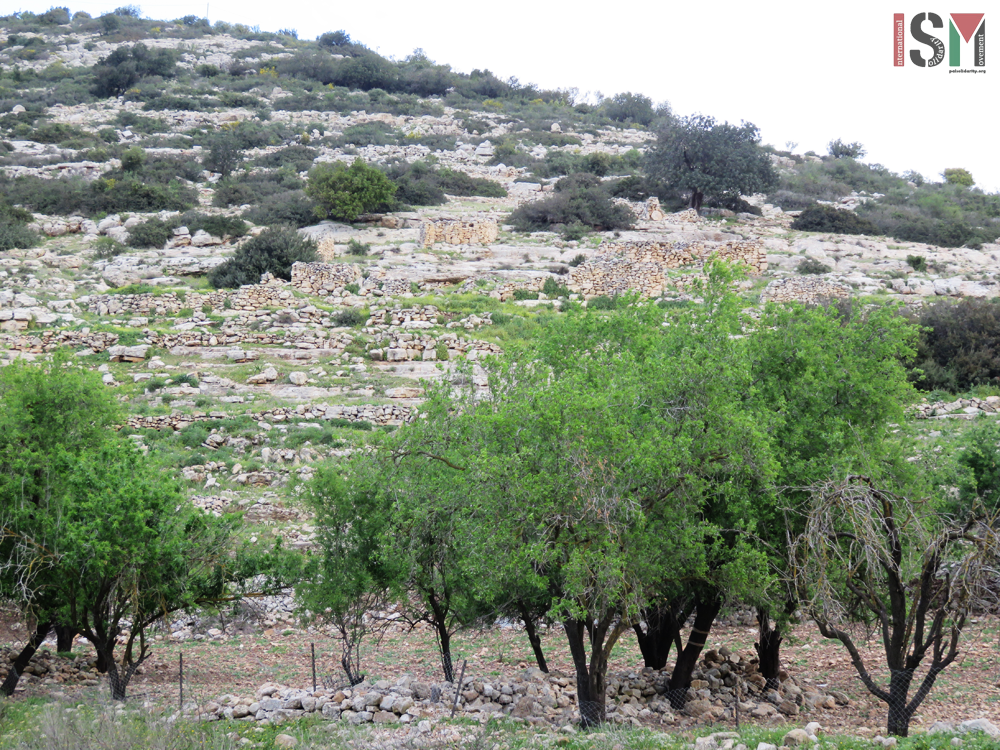
The Deir Istiya region has a population of approximately 12,000 people, 4,000 of whom live in town. The illegal settlements of the area, of which seven surround Wadi Qana, house approximately 15,000 settlers. Wadi Qana itself sits within the 31,000 hectares around Deir Istiya which has been zoned as Area C, leaving only the 1,527 hectares of the township in Palestinian controlled Area A. Under the Oslo Accords, Israeli law forbids Palestinians to build structures or plant trees in Area C, while conversely, entitling illegal Israeli settlements to develop and expand. (Al Jazeera has a good explanation of the different areas here.)
Speaking of the situation in Area C, a frustrated resident of Deir Istiya exclaimed, “They have the right to cut the old olive trees but we have no right to grow a new one. See the discriminations?”
Wadi Qana is a strategic area in the region, containing several significant natural springs. These springs and the crops which they irrigate have been under serious threat since 1994 when settlements began running sewage into the valley. While this practice was limited in 2005, many ocurrences have been identified, with four settlements’ waste currently believed to be pumping into the valley below.
While only two of the seventeen natural springs remain unpolluted, water from the underground aquifers is dropping due to the increasing demands of the ongoing settlement expansion. This has caused many farmers to move away from orange and vegetable crops to the more arid-adapted olive trees. The livelihoods of farmers of Wadi Qana are increasingly under threat because of the occupation and its apartheid laws.
Nablus family says Israeli soldiers stole money during home raid
Ma’an – 18/03/2015
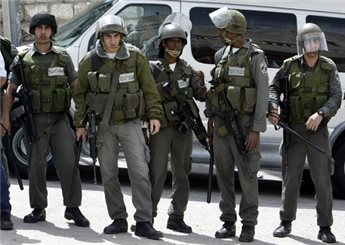
NABLUS – A Palestinian family has accused Israeli forces of stealing money and jewelry from their family home near Nablus during a military raid Sunday.
Family members of Wisdam Nassar from the village of Madama south of Nablus told Ma’an they realized Tuesday that 5,000 shekels ($1,200) and jewelry worth 12,000 shekels ($3,000) were gone after Israeli forces raided the home.
Israeli forces raided the village at 2 a.m. early Sunday and ransacked several homes for inspection, according to the family.
The family said they had notified the Palestinian security services of the robbery.
An Israeli army spokeswoman told Ma’an she was not aware of any theft that might have occurred and would look into the incident.
Israeli forces confiscated an estimated $2.9 million worth of cash and property from Palestinian homes, charities, and businesses during Operation Brother’s Keeper in the summer of 2014, according to a report by Geneva-based human rights organization Euro-Mid Observer.
The operation involved a three-week campaign of mass arrests throughout the occupied West Bank by Israeli forces, allegedly searching for those responsible for the deaths of three Israeli teenagers killed while hitchhiking in a Jewish settlement near Bethlehem.
Spokespople for the Israeli government justified confiscations during this time by claiming their planned use to fund or support terrorism.
The Euro-Mid Observer reported, however, that Israeli authorities neither provided evidence nor judicial permission for the confiscations.
Statement from the family of Rachel Corrie on the 12th anniversary of Rachel’s stand in Gaza
The Corrie Family | March 16, 2015
Today, the twelfth anniversary of our daughter and sister Rachel’s stand and death in Gaza, we find ourselves back where our journey for accountability in her case began – in Washington DC. We have come for meetings at the Department of State and in Congress and, also, to join our colleagues in pursuit of a just peace in Israel/Palestine at the national meeting of Jewish Voice for Peace.
Rachel was crushed to death March 16, 2003, by an Israeli military, US-funded, Caterpillar D9R bulldozer in Rafah, Gaza, while nonviolently protesting the impending demolition of the home of a Palestinian family. This was one of thousands of homes eventually destroyed in Gaza in clearing demolitions, described in the 2004 Human Rights Watch Report, Razing Rafah.
The U.S. Department of State reported that on March 17, 2003, Israeli Prime Minister Ariel Sharon promised President Bush that the Israeli Government would undertake a “thorough, credible, and transparent” investigation into Rachel’s killing and report the results to the United States. On March 19, 2003, in a U.S. Department of State press briefing, Richard Boucher said in reference to Rachel, “When we have the death of an American citizen, we want to see it fully investigated. That is one of our key responsibilities overseas, is to look after the welfare of American citizens and to find out what happened in situations like these.”
Through tenures of both the Bush and Obama administrations, high level Department of State officials have continued to call for Israeli investigation in Rachel’s case. During our twelve year journey for accountability, we met with Lawrence B. Wilkerson (Chief of Staff to Secretary of State Colin Powell), William Burns (then Under Secretary of State) and Antony Blinken (then Deputy Assistant to the President and National Security Advisor to Vice President Biden) – all who have acknowledged lack of an adequate response from the Israeli Government in Rachel’s case.
In a letter to our family in 2008, Michelle Bernier-Toth, U.S. Department of State’s Managing Director of Overseas Citizens Services, wrote, “We have consistently requested that the Government of Israel conduct a full and transparent investigation into Rachel’s death. Our requests have gone unanswered or ignored.”
In March 2005, at the suggestion of the Department of State and to preserve our legal options, our family initiated a civil lawsuit against the State of Israel and Ministry of Defense. After a lengthy Israeli court process, in February of this year, the Israeli Supreme Court upheld a lower court ruling that said Rachel was killed in a “war activity” for which the state bears no liability under Israeli law. In response, Human Rights Watch wrote,
“The ruling flies in the face of the laws of armed conflict…The ruling grants immunity in civil law to Israeli forces for harming civilians based merely on the determination that the forces were engaged in ‘wartime activity,’ without assessing whether that activity violated the laws of armed conflict, which require parties to the conflict at all times to take all feasible precautions to spare civilian life.”
Our family’s legal options in Israel are nearly exhausted, but our search for justice for Rachel goes forward. Back in Washington DC, we have come full circle. We ask again that U.S. officials address their responsibility to U.S. citizens and to all civilians whose lives are impacted and cut short by military actions supported with U.S. taxpayer funding. We ask that they determine what to do when a promise from a key ally’s head of state to our own goes unfulfilled. March 16, 2003, was the very worst day of our lives. Our family deserves a clear and truthful explanation for how what happened to Rachel that day could occur, and to know there is some consequence to those responsible. Rachel deserves this.
She wrote, “This has to stop. I think it is a good idea for us all to drop everything and devote our lives to making this stop. I don’t think it’s an extremist thing to do anymore. I still really want to dance around to Pat Benatar and have boyfriends and make comics for my coworkers. But I also want this to stop.”
The failure of the Israeli court system to hold its soldiers, officers, and government accountable does not represent a failure on our part. Rachel, herself, went to Rafah looking for justice – a forward looking justice in which all people in the region would enjoy the freedoms, rights, opportunities, and obligations that we each demand for ourselves. The facts uncovered in our legal effort in Israel, and the clear evidence of the Israeli court’s complicity in the occupation revealed in the outcome, lay important legal groundwork for the future. As we look back at Selma fifty years ago and Ferguson today, we realize that our own civil rights struggle is not won in a single march or court case. It is ongoing. As our family continues our journey for justice, we thank those across the U.S., the world, and in Palestine and Israel who travel with us. Together, we will find justice for Rachel – both the justice she deserves and the justice for which she stood.
Palestinian protesters honor Tristan Anderson on 6th anniversary of his shooting
International Solidarity Movement | March 16, 2015
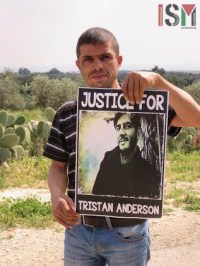 Ni’lin, Occupied Palestine – During last week’s Friday demonstration in Ni’lin the inhabitants of the village commemorated the anniversary of US activist Tristan Anderson’s shooting during a protest in the village six years ago. At the demonstration Israeli forces fired several hundred tear gas grenades and canisters, rubber-coated steel bullets, and two rounds of live ammunition at protesters.
The demonstration began from the village mosque after noon prayers, as villagers accompanied by international and Israeli activists marched down a road leading towards the Apartheid Wall. Palestinians from Ni’lin carried posters calling for justice for Tristan Anderson.
Tristan, who was volunteering with ISM at the time, was shot in the head with a high-velocity tear gas grenade by Israeli border police on March 13, 2009 after that week’s Friday demonstration in Ni’lin. The injury left him with permanent severe brain damage. He now suffers chronic pain, is blind on his right eye, paralyzed and requires 24-hour care. Tristan’s family is currently pursuing a civil lawsuit in court demanding that the Israeli government pay for the extensive care Tristan will need for the rest of his life.
As the protesters were walking towards the wall, which Israel illegally built on Ni’lin’s lands, Israeli forces fired several dozen rounds of tear gas to disperse the protestors. The Apartheid Wall annexed hundreds of dunums of Ni’lin’s land, which the village’s farmers can now no longer access.
After the initial military assault demonstrators spread out into the fields and Palestinian youth began throwing stones toward the army. The clashes went on for several hours, during which Israeli forces fired tear gas and rubber-coated steel bullets. Toward the end of the demonstration, as Israeli forces retreated back behind the apartheid wall, they increased the amount of tear gas fired and threw several stun grenades. Finally as some of the youths followed the soldiers to a hill overlooking the village, Israeli forces fired two rounds of live ammunition, though no one was hit or injured by the bullets. The protest ended when the Israeli occupation forces went back behind the Apartheid Wall and shot a few final rounds of tear gas.
Featured Video

Seyed M. Marandi: US-Iran War Inevitable: Kuwait and Bahrain May Fall
or go to
Aletho News Archives – Video-Images
From the Archives
Oil and the Israel Lobby
Reknowned economist M. Shahid Alam offers this excellent critique of Noam Chomsky’s defective analysis of the relative influence of Oil versus the Israel lobby over US foreign policy: … continue
Blog Roll
 Aletho News
- ICC ignored ‘very well-documented’ NATO crimes – ex-Libyan minister
- SNSC secretary dismisses US response to Iran’s conditions as ‘inadequate’
- Sanaa says Taiz roads open, secure for residents, warns Saudi forces
- Iraqi resistance group urges Saudi leadership to admit defeat, lift Yemen siege
- Trump’s Retreat: How Al-Aqsa Flood Took Down the US Empire
- Israel’s Military Actions in Lebanon Grossly Violate International Law — Lavrov
- Seyed M. Marandi: US-Iran War Inevitable: Kuwait and Bahrain May Fall
- Leaders Condemn Ansarallah Attack on Saudi Arabia While Ignoring Illegal War Against Yemen
- Leaked: Britain’s Covert Iraqi Psyops Network
- Yemeni Armed Forces Warn Airlines Against Using Saudi Airports, Exempt Mecca and Medina
- If Americans Knew
- How Israel Conquered the Latin American Right
- Agents search Rep. Omar’s Washington home in criminal probe as she vows she won’t ‘be silenced’
- “The Rule Was: ‘Shoot Everyone You See'”
- Israel goes ballistic over Nobel Laureate Navi Pillay
- U.S. May Join Yet Another Middle Eastern War — TCN
- Yellow Line moves again as Israel closes in on trapped Gazans – Daily Update
- Israeli Attacks Kill Seven Palestinians in Gaza Including Six-year-old Girl
- Gaza: Ceasefire Anniversary Marks Year of Failed Promises
- The American Conservative: Mike Huckabee Should Resign
- A C-Section in Shackles: A Palestinian Woman’s Harrowing Birth in Israeli Detention
- No Tricks Zone
- Germany’s Green Energy Debacle: High Energy Costs Force Kahla Porzellan to Close After 182 Years!
- New Study: 50 Years Of The Most Aggressive ‘Net Zero’ Policies Can Only Affect The Global Climate By 0.03°C
- US September “Heat” Was No Record…Many Records Set Decades Ago
- Latest European Green Energy Debacle; Portugal’s Largest Flagship Solar Park Insolvent!
- Green Energy Debacle: German Expert Professor Fritz Vahrenholt Warns Of Severe Economic And Social Consequences
- Two More Paleo Reconstructions Affirm Meters-Higher Sea Levels Across Ireland, Brazil 7000-6000 Years Ago
- New Study: Earth And Venus Surface Warmth Largely Explained By Convection And Lapse Rate, Not CO2 Or Radiation
- 2025 Nature Paper Claiming Worsening Global Drought Gets RETRACTED …Heavily Flawed
- New Study: ‘Global Drought Shows No Detectable Recent Acceleration Under Climate Warming’
- Economic Masterminds: German Socialists Suggest Taxing Productivity Gains Stemming From Using AI

