Academics back University of Southampton’s free speech commitment, in face of pro-Israel pressure
MEMO | March 16, 2015
More than 200 academics have signed a statement in support of free speech at the University of Southampton, in response to pressure from pro-Israel groups to cancel a conference in April.
Professors, lecturers and researchers from the UK, Europe, North America, and beyond, have expressed their “principled and full support for the University of Southampton’s commitment to freedom of speech and scholarly debate.”
In recent weeks, the University of Southampton has come under pressure from pro-Israel lobbyists to cancel a conference on Israel and international law scheduled for 17-19 April.
Groups such as the Board of Deputies of British Jews and UK Zionist Federation have been lobbying university officials, and last week there was an intervention from Communities minister and Conservative MP Eric Pickles.
The statement in support of the University of Southampton notes with concern these disturbing developments:
We are very concerned that partisan attempts are being made to silence dissenting analyses of the topic in question. For external pressure and interference, especially from political lobby groups and a government minister, to censor lawful academic discussion would set a worrying precedent.
The statement praising the University of Southampton’s commitment to free speech garnered more than 200 signatories in just 24 hours.
The signatories include academics from universities including Oxford, Cambridge, SOAS, London School of Economics (LSE), University College London, as well as North American institutions such as MIT, University of California, Columbia University, University of Toronto, and many more.
The Misrepresentation of Israeli Aggression as Self-Defense
By Matt Peppe | Just the Facts Blog | March 15, 2015
“Last July, shortly after the outbreak of war in Gaza, President Barack Obama declared that “Israel has the right to defend itself against what I consider to be inexcusable attacks from Hamas.” To demonstrate the general moral applicability of this position, he said that “no country can accept rocket [sic] fired indiscriminately at citizens.” Obama’s claims provided ideological cover for Israel to carry out wholesale slaughter over the next six weeks in which nearly 2,200 Palestinians were killed.
Obama also conveniently turned reality on its head by ignoring the fact that it was Israel that was responsible for nearly three times as many cease fire violations as Hamas since December 2012. Israel’s violations of the 2012 cease fire caused the deaths of 18 people, while Palestinian violations caused none. Since the end of the 51-day war in August 2014, Israel predictably has gone on violating the most recent cease fire even more brazenly and with complete impunity.
The latest cease fire agreement stipulated that Hamas and other groups in Gaza would stop rocket attacks, while Israel would stop all military action. As with past truces, Hamas has observed the conditions. On the rare occasions that individuals or groups have fired rockets from Gaza, Hamas has arrested them. (See also here and here.)
Israel, on the other hand, has failed to live up to its end of the bargain. This is consistent with past practice. Israel has continued its illegal siege on the Gaza strip, while indiscriminately harassing and shooting at the local population. Fishermen and farmers, who are trying to subsist amid dire economic conditions, have born the brunt of the aggression.
The Palestinian Centre for Human Rights documented 18 instances of Israeli soldiers firing on Palestinian fishermen operating within internationally recognized Palestinian waters in September 2014 alone.
By December, Humanity for Palestine reported 94 total cease fire violations since the August truce. In addition to the many attacks on fishermen, Israeli border guards targeted “protesters;” “fired sporadically at Palestinian homes and agricultural property with machine guns and ‘flashbang’ grenades;” and “seriously injured” a teenager who was shot near the Kerem Shalom crossing.
The first months of 2015 have seen more of the same. According to International Middle East Media Center (IMEMC ):
- On February 25, “Israeli forces opened fire at farmers in the central Gaza Strip.” The previous day, farmers near Khan Younis had been fired on. Two days prior farmers near Rafah were fired on.
- On February 27, Israeli forces “opened gunfire on Palestinian houses in the Central Gaza strip.”
- On March 2, “Israeli gunboats again opened fire … towards fishermen’s boats in the Gaza strip.” The Israeli forces reportedly “chased some fishing boats off the coast.”
- On March 7, fisherman Tawfiq Abu Ryala, 34, was killed when he was shot in the abdomen by Israeli navy ships. Several attacks in previous days were reported in which Palestinian fishermen were injured. “All took place while the boats were in Palestinian territorial waters.”
- On March 11, “several armored military vehicles and bulldozers carried out … a limited invasion into an area east of the al-Maghazi refugee camp, in central Gaza, and bulldozed farmlands.”
On March 13, Palestine News Network reported that “Israeli Soldiers Open Fire on Palestinian Lands and Farmers East of Khan Younis Again.” The articles states that “witnesses reported that the Israeli soldiers in the borders towers opened their guns [sic] fire on the the [sic] shepherds and farmers near the security line east of Al Tuffah neighborhood east of Khan Younis.”
The vast majority of the rampant Israeli cease fire violations are not reported by the American and the Western press. When they are, the Israeli military is given the opportunity to provide self-serving rationalizations which serve as the authoritative account of what transpired.
When a fisherman was killed on March 7, a Reuters article cites an Israeli military spokesperson claiming that “four vessels had strayed from the fishing zone and that the Israeli army opened fire after the boats did not heed calls to halt.” Of course, the fisherman is not able to tell his side of the story because the organization Reuters quotes killed him.
There is no mention in the article of any of the multiple attacks on Palestinian fishermen that happen routinely in Gaza. In many similar shootings, surviving victims and witnesses can attest that fishermen are within the agreed-upon six-mile nautical limit, and certainly well within the 20-mile limit guaranteed by the Oslo accords.
In a December article in the New York Times, Isabel Kershner writes that “Retaliating for a rocket fired into Israel on Friday, the Israeli military said it carried out an airstrike on a Hamas site in southern Gaza.” She begins the sentence by stating it is Israel retaliating against Palestinian actions. Whoever fired the rocket presumably was not “retaliating” for the dozens of Israeli military cease fire violations over the previous months, but was implicitly initiating aggression.
More importantly than this biased framing of the narrative, Kershner buries the lead at the bottom of the story: “Also on Friday, six Palestinians were wounded by Israeli gunfire near the border fence in northern Gaza.” She obsequiously follows this statement with Israeli military rationalizations that “soldiers first fired into the air to try to disperse protesters approaching the fence then fired at the legs of some of them.”
Someone who commits a violent action is obviously not an impartial source for an honest account of the facts. Would a journalist report on a shooting by only repeating the side of the suspect who claims self-defense?
Six months after repeated, documented Israeli breaches of the cease fire agreement – without any by Hamas – New York Times columnist Nicholas Kristof claimed in an Op-Ed that “Hamas provokes Israel.” He provides no evidence for this assertion. As the record clearly shows, Kristof has it backwards.
If no country can accept rockets fired at its population, then surely neither can they accept M16s fired at them. Or tanks and bulldozers invading their land. But perhaps Obama was deliberate in choosing his words. He stated that no country can accept rockets “fired indiscriminately at citizens (italics mine).”
Since Palestinians live under Israeli sovereignty but are denied citizenship, they are not technically covered by Obama’s moral truism. But assuming what he says should apply to all people – even those who are politically subjugated by racist regimes – Obama’s words would apply equally to Palestinians.
But when asked by a reporter whether Palestinians in Gaza have the right to defend themselves, an Obama administration spokesperson denied Palestinians this right. She did not explicitly say so, but by evading and refusing to respond to a simple yes or no question, she gave the equivalent of a direct denial. “I think – I’m not sure what you’re getting at,” she said. After the reporter restated his crystal-clear question, she replied “What are you specifically referring to? Is there a specific event or a specific occurrence?”
In the same way that omission of material facts may constitute fraud, refusing to answer a question about whether a person enjoys a right constitutes a direct refusal to recognize that right.
Obama did not only pervert the issue of the right to self-defense by falsely pretending it was a moral truism that he clearly and demonstrably does not extend to Palestinians, he also misrepresents the applicability of self-defense to Israel in the first place.
As Noura Erakat explained in her July 2014 article “No, Israel Does Not Have the Right to Self-Defense in International Law Against Occupied Palestinian Territory,” Israel is “distorting/reinterpreting international law to justify its use of militarized force in order to protect its colonial authority.” Obama willingly enables Israel’s lawless actions by accepting their rewriting of international law to justify their aggression.
What Obama is really saying when he talks about self-defense is that as the leader of one rogue nation, he supports the right of his rogue client state to violate the rule of law and make fraudulent claims that are neither morally nor legally justified.
As John Quigley explains in The Six-Day War and Israeli Self-Defense, failing to challenge Israel’s bogus claims of self-defense in the 1967 war – as the United States has done by providing a diplomatic shield, vetoing more than 40 U.N. Security Council resolutions condemning Israel – has had disastrous consequences for Israeli-Palestinian conflict and the system of international law in general.
“The flawed perception of the June 1967 war serves to perpetuate conflict in the Middle East. It also serves to promote the expansion of the concept of self-defense and thereby to erode the prohibition against the use of force,” Quigley writes.
The United States government under the Obama administration continues to carry this even further. Undoubtedly the situation will only get worse in the future. Last month in Haaretz, Gideon Levy wrote that there will inevitably be another war in Gaza.
“Israel knows this war will break out, it also knows why – and it’s galloping toward it blindfolded, as though it were a cyclical ritual, a periodical ceremony or a natural disaster that cannot be avoided. Here and there one even perceives enthusiasm,” Levy writes.
This will mean more death, more destruction, and more Palestinian lives destroyed as the world looks on and does nothing. Sadly Levy is right. When the next war comes and Israel succeeds in baiting Hamas to start firing rockets into Israel, all the talk will be about Israel’s right to defend itself. Obama (or the next American President) will repeat the same charade. He will frame the narrative in terms of Israel’s victimization and Israel’s rights, while denying this treatment to the Palestinians.
The media and the public will uncritically support the position of American and Israeli power. Thousands of Palestinians will be indiscriminately killed, but not because Israel is defending itself. Palestinians will be killed because the U.S. government refuses to protect them from a belligerent and aggressive regime, and refuses even to recognize their right to protect themselves.
The World Ignores the Crisis in Gaza—So Another Gaza Freedom Flotilla is Ready to Sail in First Half of 2015

By Ann Wright | War is a Crime | March 15, 2015
With the 51 day Israeli attack on Gaza in the summer of 2014 that killed over 2,200, wounded 11,000, destroyed 20,000 homes and displaced 500,000, the closing to humanitarian organizations of the border with Gaza by the Egyptian government, continuing Israeli attacks on fishermen and others, and the lack of international aid through UNWRA for the rebuilding of Gaza, the international Gaza Freedom Flotilla Coalition has decided to again challenge Israel’s naval blockade of Gaza in an effort to gain publicity for the critical necessity of ending the Israeli blockade of Gaza and the isolation of the people of Gaza.
UNRWA, the main U.N. aid agency in the Gaza Strip has stated that a lack of international funding forced it to suspend grants to tens of thousands of Palestinians for repairs to homes damaged in last summer’s war.
“People are literally sleeping amongst the rubble, children have died of hypothermia,” Robert Turner, Gaza director of operations for the United Nations Relief and Works Agency (UNRWA), said in a statement. He said UNRWA received only $135 million of the $720 million pledged by donors to its cash assistance program for 96,000 refugee families whose homes were damaged or destroyed in the 50-day conflict between the Hamas government and Israel. Little of the total $5.4 billion pledged for Gaza’s reconstruction at a Cairo conference of international donors in October 2014 has reached the Gaza, and thousands of Palestinians have been sheltering in tents near destroyed homes.
“Thousands more have been living in damaged buildings, using plastic sheeting to try to keep out the rain. Around 20,000 displaced are still being housed in U.N.-run schools.”
While we recognize that funds are needed to rebuild Gaza, we feel that the publicity from another flotilla will help gain attention to the plight of the people of Gaza in ways that other initiatives may not. Indeed, governments are forced to react to the flotillas as evidenced through the diplomatic cables obtained by the Center for Constitutional Rights from the U.S. Department of State to U.S. missions in the Middle East region.
At a December, 2014 meeting, the Gaza Freedom Flotilla Coalition decided to sail a 3-ship flotilla to challenge the blockade in the first half of 2015. Twenty passengers will be aboard each of the 3 ships for a total of 60 passengers. The coalition will seek representatives from 30 countries with each country having two passengers. The U.S.- Palestinian Solidarity community will participate in Gaza Freedom Flotilla 3 and has a target of $20,000 as their part for renovation expenses and to be able to have two persons as the U.S. delegates.
Nonviolence International of Washington, DC, the 501(c)(3) for U.S. contributions to Gaza’s Ark, is the 501(c)(3) organization. Please make an online contribution here and indicate “Gaza’s Ark/Gaza Freedom Flotilla 3” in the Please designate this gift for a specific purpose “Designation Code” box. Checks payable to “Nonviolence International” (with Gaza’s Ark/Gaza Freedom Flotilla 3 in the memo line) may be mailed to:
Nonviolence International
4000 Albemarle Street, NW
Suite 401
Washington, DC 20016
USA
Stay in touch with Freedom Flotilla Coalition through its Facebook https://www.facebook.com/FreedomFlotillaCoalition and boat2gaza2015@gmail.com
Have Pillaged Iraqi Artifacts Ended Up in a Museum in Israel?

By Richard Edmondson | Fig Trees and Vineyards | March 12, 2015
With ISIS carrying out rampages through archaeologically sensitive areas of Iraq, a pertinent question to ask now is what group’s cultural heritage in the Middle East is being preserved, and whose is being destroyed.
Over the past couple of weeks shocking reports have surfaced concerning mass destruction of Iraq’s cultural heritage at two locations–the museum in Mosul and the ancient Assyrian city of Nimrud, located in northern Iraq. Both incidents were perpetrated by the so-called Islamic State. The one at the Mosul museum was recorded on video.
But destruction with sledge hammers, bonfires, and heavy equipment isn’t the only threat to priceless objects thousands of years old. Artifacts are also being illegally excavated and pilfered on a massive scale. An enormous black market in stolen antiquities in fact has arisen in the last four years since the outbreak of the conflict in Syria, and the general rule of thumb seems to be if it’s small enough to be carted off, take it and sell it on the black market; if it’s too large to move, then smash it to pieces. This is what we’ve seen repeatedly in Syria and Iraq since ISIS took over large swaths of both countries.
By the way, the trade in looted antiquities seems to be quite lucrative, with some of these items fetching in the hundreds of thousands of dollars, while the total black market trade has been estimated at roughly $7 billion per year.
This is not just Iraq’s cultural heritage that is at stake, of course; it’s all of humanity’s. If we think of human history collectively as a lepidopteron, drifting lazily from the flower of the Neolithic past, into the age of proto-writing, and finally early recorded history, then Syria, Iraq and the Fertile Crescent stand out perhaps unique among regions of the earth. This is where human civilization got started, and the looting and destruction of these antiquities is a loss to all of us.
Interestingly, an exhibition entitled “By the Rivers of Babylon” has now opened at a museum in Israel, and among its exhibits are a large number of ancient Babylonian cuneiform tablets–110 of them altogether. These tablets belong to a London-based Israeli collector by the name of David Sofer, but a controversy has sprung up, since there seems to be some question about the provenance, or origin, of the artifacts.
The tablets are said to be some 2,500 years old and reportedly shed light on the biblical Israelites during their exile in Babylon (in what is, of course, today Iraq). Sofer claims he purchased the tablets in the 1990s from a person who supposedly obtained them through public auction some 20 years previous. However, he reportedly has refused to name the person he bought them from.
The rise of ISIS has made it extremely perilous for archaeologists to continue to work in Iraq and Syria, and most expeditions have in fact come to a halt. But in Israel these days things are a bit different.
Unhindered by ISIS marauders, the Israeli Antiquities Authority has undertaken archaeological excavations in numerous areas of the country, including one begun last year in the occupied West Bank, where the objective is to recover artifacts dating back to the King David era. Finds of this nature would, by some views at any rate, help validate Israel’s “3000-year-old land claim,” as it’s been called, and thus you won’t be surprised to learn that this isn’t the only such archaeological dig going on–not by a long shot.
In fact, you can go to the website of the Israeli Antiquities Authority, where no less than 19 separate excavations are listed as currently active for the year 2015.
So what to make of it all? That’s a good question. All I can really say is that it seems enormous efforts are being expended to recover and safeguard Jewish cultural heritage–this, ironically, as everyone else’s cultural heritage in the Middle East is being looted and destroyed.
At any rate, here is an article recently published about the museum exhibition in Israel featuring the artifacts in Sofer’s possession.
Museum Embroiled in Looting Row
New Historian
A new exhibition in Jerusalem is causing heated debate.
The exhibition, ‘By The Rivers of Babylon’, at the Bible Lands Museum, displays some spectacular examples of ancient Babylonian tablets. On show for the first time, the 2,500-year-old clay tablets written in cuneiform present artefacts from an important time in the Middle East.
Experts note that the collection of 110 clay tablets provides the earliest written evidence of the Biblical exile of the Judeans in the area of modern-day Iraq. As such, the Babylonian tablets provide fresh insight into a formative period of early Judaism.
Filip Vukosavovic, a curator for the exhibition, says the tablets complete a 2,500-year puzzle. Many Judeans returned to Jerusalem after the Babylonians allowed them to in 539 BCE, but some remained in the area to build a Jewish community that lasted for two millennia.
“The descendants of those Jews only returned to Israel in the 1950s,” Vukosavovic said. As a result, the tablets provide a unique insight into a little known period of Jewish history.
Controversy has surrounded the exhibition however, as the tablets are the product of a modern, shadowy process. The recently chaotic climate in Iraq and Syria has led to the rampant theft of the area’s archaeological heritage. Widespread looting has led to the international antiquities markets being stocked with cuneiform tablets.
Many museums have promised not to exhibit artefacts that may have been looted, as part of an effort to discourage the illicit trade in antiquities. Cuneiform inscriptions, however, are a notable exception to this. Since 2004, cuneiform artefacts with no record of where or how they were unearthed have been allowed to be transported, in order to be examined by scholars. This is done on the condition that Iraqi authorities give their consent, and that the tablets are eventually returned to Iraq.
Some argue that these precious objects, some of which are the earliest examples of writing in the world, could be forever lost if they are not looked after by conservators.
“We are not interested in anything that is illegally acquired or sneaked out,” said Amanda Weiss, director of the Bible Lands Museum Jerusalem. “But it is the role of a museum to protect these pieces,” she added. “It’s what we are here for.”
It has been claimed that the Islamic State extremist group and other militants are part-funding their campaigns through the illegal trafficking of historic artefacts. Trafficking and looting have, however, been going on for a long time. Archaeologists were first alerted to the problem during the first Gulf War, when Western antiquities markets were flooded with cuneiform artefacts.
London-based collector David Sofer, who owns the cuneiform collection currently exhibited in the Bible Lands Museum, has denied his artefacts were trafficked. He said he had bought the tablets legally in the United States in the 1990s; and the tablets had previously been obtained from public auctions in the 1970s.
The exhibition at the Bible Lands Museum allows the public to see some remarkable artefacts and to learn more about an important part of Jewish history. What must not be overlooked, however, is the damage which can be caused by illicitly-obtained artefacts.
***
A little bit more on the Bible Lands Museum and Sofer’s collection of cuneiform tablets can be found here. The article focuses especially on a symposium entitled “Jerusalem in Babylonia” held at the museum in early February, asserting that the tablets provide “new insights into the social and economic life of the Judeans… in their own community of Al Yahudu (Jewtown) and their interrelationships with and assimilation to their West Semitic and Babylonian neighbors.”
Another article on the museum display is here and includes the following (emphasis added):
Sofer said a few tablets from the collection were displayed in a New York museum and a Los Angeles museum in 2013, and their import and export in the U.S. was properly reported to U.S. authorities. He would not name the two museums, or the person who sold them to him.
“These things would be lost, and wouldn’t be recognized for what they are” if he hadn’t bought them, Sofer said.
As common as cuneiform tablets are, few have been as celebrated as those on display in Jerusalem.
More on David Sofer (or someone from Israel going by the same name, at any rate) can be found here in an L.A. Times article from 1991. It seems he and a fellow Israeli, Nahum Vaskevitch, were implicated in insider trading in 1987. While the Sofer named in the article appears to have reached a settlement in his own case, Vaskevitch went on to be named in a 45-count indictment accusing him of conspiracy and violation of US insider trading laws from 1984-87.
A New York Times article on Sofer from 1987 includes a quote describing him as “a financial wizard, a genius manipulator with brilliant ideas in everything financial,” and reports that he made his fortune through the Jordan Exploration and Investment Company. The company engaged in oil development in the Sinai in the 1970s, yet the same article goes on to also mention investments in real estate in Israel, “including interests in such choice property as the Dizengoff Center shopping mall in Tel Aviv and the Ben Yehuda arcade in Jerusalem, as well as in hotels and other interests.”
Two additional articles, both from 2008–one here in YNet and the another here in Haaretz–describe a controversy which arose over a Sofer-owned property, a highly prized piece of Jerusalem real estate known as the Villa Salameh. The rightful owners of this property were a Palestinian Christian, Constantine Salameh, and his family, who completed construction on the villa in 1935.
But in 1948 the family left Israel and the property was seized by the new Israeli state under the so-called Absentee Property Law. The government of Belgium also entered the picture, leasing the property for its consulate in Jerusalem. But instead of paying rent to the Israelis, the Belgians made a decision apparently based upon conscience and sent their rent payments directly to the Salameh family, who by this time were living in Egypt.
However, in 1983 Sofer (or, again, someone by that name) acquired the property for a faction of its worth and sued the Belgian government for full payment of rent. The case was decided in an Israeli court. Fortunately the Salameh family had some political clout and was able to negotiate a settlement awarding them $700,000 as compensation for their lost property–a small fraction of its total value.
“The man (Salameh) sought to appeal his status as an absentee and a discussion began about his case,” said former Israeli Justice Minister Moshe Nissim. “We reached the conclusion that instead of being in a situation in which all the property would be registered in his name, it would be worth the state’s while to purchase Salameh’s vast property – which already then was worth millions of dollars – for a pittance.”
Quite an interesting story, to be sure, but what does it have to do with the theft of archaeological artifacts going on today? Maybe nothing. Maybe a lot.
There has of course been abundant evidence of Israeli support for terrorist rebels in Syria (see here, here, here, here, here, here, and here, for instance) and it has been noted that neither ISIS nor Al-Nusra have launched attacks against Israel, even though the latter, in particular, seems to be active in the Golan Heights very close to Israel’s border.
And not only do Israel and Al-Nusra not attack each other, but Israel has even transported wounded terrorists across the border for medical treatment in Israel.

Most people seem to be of the opinion that the Jewish state’s motivation in all this is its desire for regime change in Syria, but are there perhaps a few lesser-discussed fringe benefits as well?
Back in May of 2003, after the fall of Baghdad and the looting of Iraq’s national museum, a large trove of Jewish communal documents, Torah fragments as well as public records dating back several centuries, were discovered in a flooded basement and taken to the United States for restoration and safeguarding. Iraqis were given assurances that the collection would be returned to them at a later date.
Eventually the summer of 2014 was set as the target date for when the restored documents would be handed back over, but this got sidetracked in late 2013 when a campaign was launched to have the entire collection remain in the US… or possibly transferred to Israel.
It is, after all, Jewish heritage, so the argument went, and since there aren’t many Jews left in Iraq today, why on earth should the collection go back there?
Initially the position of US officials was that America would honor its commitment and return the collection to Iraq. But then in the summer of 2014, ISIS took over large parts of the country, including the city of Mosul, and in September it was announced that highlights of the archive, rather than going back to Iraq, would be taken on a tour of US cities.
The plot thickened further in January of 2015 when it was reported that one of the artifacts, a 200-year-old Torah scroll, had not actually been taken to the US at all, but rather instead had been deposited at the Israeli Embassy in Jordan–and from there it made its way into Israel.

Reportedly the scroll is now housed in a synagogue attached to the Israeli Foreign Ministry, and a ceremonial “Torah inauguration” is said to have been held on January 22.
By all accounts the text of the scroll had been copied onto a deer skin parchment using concentrated pomegranate juice as ink. Supposedly the use of deer skin was unusual, as most of the Torah scrolls at the time in question were comprised of cow parchment.
In any event, the disposition of the scroll, and its ending up in Israel, have prompted accusations of collaboration on the theft of Iraqi heritage by the US and Israel.
Meanwhile, the rest of the Iraqi Jewish archive purportedly remains in “safe hands” in the US.
Alas, the same cannot be said of Iraq’s, or humanity’s, “non-Jewish” heritage, as it were, the destruction of which continues at an alarming pace. The attacks upon the Mosul Museum and the ancient city of Nimrud, as well as the earlier ransacking and burning of documents at the Mosul library–these and other incidents like them exact a dreadful toll. They are, in essence, “taking us back to the dark ages,” as an Iraqi official recently described it.
And it doesn’t seem to be letting up.
Just within the past several days news has surfaced of destruction at two more sites, Khorsabad, located 12 miles northeast of Mosul, and Hatra, also in the general vicinity of Mosul though 68 miles to the southwest. Iraq’s Ministry of Tourism and Antiquities has confirmed reports of ISIS attacks at both sites, though the extent of the damage is unclear at this time.
Deliberate destruction of cultural heritage by belligerent parties in war is of course not unprecedented. But clearly it is now being carried by ISIS to levels heretofore unseen.
“They are killing the diversity of this region,” says Hélène Sader, an archaeologist at the American University of Beirut. “This is ethnic cleansing. You throw the people out, erase their history, and you can claim they were never there.”
Protection of cultural property is covered under several international treaties, including the 1954 Hague Convention, though many critics are now saying that the laws are not tough enough and need to be strengthened considerably.
With growing public outrage at the destruction now occurring in Iraq, chances are probably good we will see some toughening of international law on the matter. But the question is whether or not individual nations can muster the political will to adopt rigid enforcement of any new measures should they pass–and part of the problem in that regard seems to be complicity on the part of certain museums and auction houses, if not in the black market trade itself, at least insofar as knowingly accepting unprovenanced artifacts.
As long as someone is making a profit or benefiting in some way, and as long as the geopolitical interests of certain powerful nations are served by continuing the conflict in the Middle East, the looting and destruction are not likely to let up anytime soon.
Jewish hate preacher issues ruling for prayers inside Al-Aqsa
MEMO | March 12, 2015
An extreme right-wing Jewish hate preacher has issued a ruling which urges Jews to hold their prayers inside Al-Aqsa Mosque. Rabbi Dov Lior is one of the most influential of the hard-line national-religious rabbis. He served as chief rabbi of the Kiryat Arba settlement near Hebron, home to mass-murderer Baruch Golstein, who massacred 29 Muslims while they were praying in Hebron’s Ibrahimi Mosque in 1994.
 Following Lior’s ruling, another extremist, Rabbi Jacob Heydimann, performed the Purim prayer inside the mosque compound with police protection. The mosque guards were removed by the Israeli police. The latest declaration encourages extremist Jewish groups who have increased their calls to enter Al-Aqsa by force and hold more prayers within the Noble Sanctuary.
Lawyer Aviad Visoli, who represented US-born Jewish extremist Yehuda Glick when he was banned by the police from entering Al-Aqsa Mosque, claimed that every Jew has the right to pray on the “Temple Mount” [Al-Aqsa Mosque compound]. “Praying there is no longer considered a legal violation after the Israeli Supreme Court ordered Glick to be paid half a million shekels in compensation for removing him from the Temple Mount [sic] for performing his biblical prayers there,” said Visoli. “The police must act to allow Jews to pray on the Temple Mount [sic] freely.”
It is on that basis, he added, that Lior has issued his latest ruling.
Jewish leaders condemn British university debate on Israel and international law
RT | March 11, 2015
The University of Southampton has hit back at appeals to revoke its sponsorship of a conference questioning the legality of Israel’s right to exist under international law.
The three-day conference, titled “International Law and the State of Israel: Legitimacy, Responsibility and Exceptionalism” is scheduled to take place April 17-19.
According to the organizers, it will “explore the relatedness of the suffering and injustice in Palestine to the foundation and protection of a state of such nature and asks what role International Law should play in the situation.”
“It is unique because it concerns the legitimacy in International Law of the Jewish state of Israel.”
Conservative MP Mark Hoban, a prominent supporter of the state of Israel, has called on the university vice-chancellor to withdraw sponsorship, branding the conference “provocative.”
Critics say the event may “well affect the attractiveness of the School of Law for future UK and international students.”
In a climate of rising anti-Semitism in the UK, the institution insists its event will not add to it.
Jewish community leaders nevertheless say the conference “surpasses the unacceptable.”
Judging by the name and the advertised speakers, Jewish leaders said the symposium “sets out explicitly to question the very legitimacy of a member of the UN,” the Jerusalem Post reported.
In a letter to the university, Jewish leaders accused Southampton’s Law School of “being used as an academic platform to advance, not just to legitimate, Palestinian national rights.”
“What other state in the global community of nations – democratic or tyrannical – is ever subjected to such a critique? The conference causes us great concern and distress. It will undoubtedly trouble greatly the members of the UK Jewish community,” the leaders said.
They urged the university to reconsider holding the event.
Despite the appeal and a petition signed by almost 3,000 people, the university insisted the conference would go ahead as planned.
According to the Jerusalem Post’s sources, Hazel Biggs, the head of the University of Southampton’s Law School, rejected the appeal.
Even though the title of the symposium raised an important question, the event would take “no explicit perspective,” Biggs said.
Despite the event being in “final stages of preparation,” the Jewish Leadership Council or the Board of Deputies of British Jews are welcome to recommend suitable speakers as the institution is “happy to receive their nominations.”
The university has received nearly a dozen letters from Jewish organizations and members of parliament urging them to cancel the event.
However, a source close to the Jewish delegation told the Jerusalem Post it is clear the university is “not going to budge.”
A spokesperson for the university said: “We are committed to academic freedom, free speech and opportunities for staff and students to engage with a wide range of opinions.”
The spokesperson said that “discussion and critical thinking” was fundamental to the institution, and added that academics have freedom to explore “controversial issues,” while “giving due regard for the need to respect others.”
“The conference aims to examine the role international law can play in political struggles and to act as a platform for scholarly debate, welcoming academic contributions from a range of perspectives,” the spokesperson said.
Israeli forces level land east of Jerusalem
Ma’an – 10/03/2015
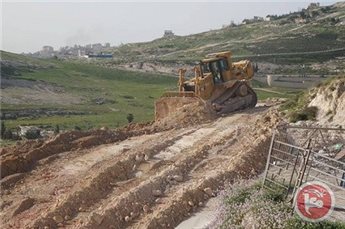 JERUSALEM – Israeli forces leveled vast areas of land in the East Jerusalem town of al-Issawiya on Tuesday morning, a local committee member told Ma’an.
According to Muhammad Abu al-Hummus, member of a local follow-up committee, large numbers of Israeli troops and municipality inspectors escorted bulldozers and excavators into the southeastern outskirts of the town, where they demolished stone walls and steel structures used by local farmers as store houses and livestock barns.
Abu al-Hummus said the bulldozers “deliberately” ruined the dirt roads used by farmers to access their fields.
The land is located in an area Israeli authorities have earmarked for a national park, in a controversial plan known as “11092”, which aims to turn 700 dunums of land in the Palestinian towns of al-Issawiya and al-Tur into Israeli parkland.
A statement from the Palestinian Center for Human Rights in 2013 previously stated that “the plan is part of the Israeli government’s plans to create a Jewish demographic majority in the occupied city.”
In September 2014, an Israeli planning council suspended the plan until the needs of the Arab towns could be assessed. However, the council, which previously approved the annexation of the 700 dunums, said that approval of the plan could be justified and was not fundamentally illegal.
According to Abu al-Hummus, the local Israeli municipality has ignored the plan’s suspension.
“Israeli forces brush aside court decisions and decisions made by different committees when it comes to implementing settlement expansion plans,” he said.
The land leveled on Tuesday is owned by the Abu Asab, Ubeid, Dari, Abu al-Hummus and Ulayyan among others.
East Jerusalem was seized by Israel along with the West Bank in 1967 during the Six-Day War, and since then, the Israeli government has undertaken a policy of “Judaization” across the city, constructing Jewish settlements and demolishing Palestinian homes.
There are now believed to be more than 300,000 Jewish settlers in East Jerusalem.
The international community views East Jerusalem as part of the Palestinian territories and recognizes the annexation and settlement programs as illegal under international law.
(MaanImages/Muhammad Sayyad)
Israeli troops raid newly-established Palestinian media center
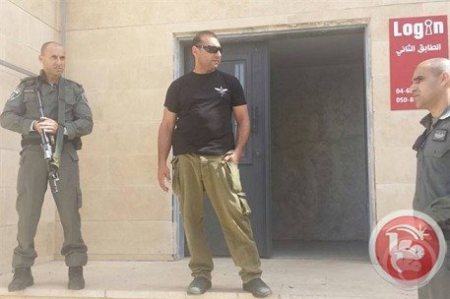 Israeli troops at the Q-Press media office (image by Ma’an )
By Celine Hagbard | IMEMC & Agencies | March 10, 2015
In the village of Umm al-Fahm, in the northern part of what is now Israel, a group of Israeli soldiers on Monday invaded a media center that had recently been established in the town, seizing equipment and abducting journalists.
The center is called the Q-Press Media Center, and it was established fairly recently with a focus on the Israeli attacks on Palestinians in Jerusalem, and violations carried out against the Al-Aqsa Mosque, the third-holiest site in Islam, which is located in Jerusalem.
According to several Palestinian media sources, the Israeli military abducted four of the staff members of the news agency. They were identified by the Ma’an News Agency as Hikmat Naamnah, Sahir Ghazzawi, Anas Ghanayim, Badir Mahajnah, and Budar Ighbariyya.
In addition to abducting the staff of the center, the Israeli troops also confiscated a number of computers that were used by the journalists to carry out their work.
Israeli troops frequently attack and raid Palestinian media agencies, and have killed dozens of journalists over the past fifteen years. In 2012, Human Rights Watch issued a report condemning the Israeli military’s targeting of journalists, and this past year, Reporters Without Borders condemned the ongoing targeting of Palestinian journalists by Israeli troops.
The Q-Press Media Center is a newly-established center, so there is not much information about the content of their work. The journalists who were abducted by the military have not yet been charged, but are being held in military detention centers where they face interrogation from Israeli intelligence operatives.
Shutting Down AIPAC
Removing Israel from American politics
By Philip Giraldi • Unz Review • March 10, 2015

[The following is a lightly edited version of a speech I gave on March 1 st in Washington during the anti-AIPAC and Netanyahu visit demonstrations. Two days later Israeli Hollywood producer Arnon Milchan, whom I cite below, was sitting in the House VIP visitors’ gallery beaming as he listened to Netanyahu’s love fest with Congress. It might have been the first time a clandestine agent for a foreign country who spied on the United States was so honored but I would observe that the event was doubly significant in that the speaker Prime Minister Netanyahu was also involved in the same theft of American nuclear technology.]
I would like to concentrate on two issues. First is the nature of the special relationship between Israel and the United States and second is the role of the Israel Lobby and most particularly AIPAC in shaping that relationship. I was a foreign policy adviser for Ron Paul in 2008 and consider myself politically conservative. I respect the fact that nations must be responsive to their interests, but because of my personal experience of living and working overseas for many years I have come to recognize that the United States is an anomaly in that it persists in going around the world doing things that just do not make any sense. This has been particularly true during the past fourteen years, with invasions, interventions and targeted assassinations having become the preferred form of international discourse for Washington.
Many would agree with what I have just observed, but few recognize the role of the special relationship with Israel in shaping what the United States has become. Quite frankly, the relationship is both lopsided in terms of favoring perceived Israeli interests as well as being terrible for the long suffering Palestinians, very bad for the United States as it damages the American brand worldwide and even bad for Israel as it enables its governments to act in ways that are ill advised and ultimately self-defeating.
I would first like to address the often repeated mantra that Israel is America’s best friend or closest ally as it is a bedrock issue that is frequently trotted out to excuse behavior that would otherwise be incomprehensible. Apart from being a recipient of more than $3 billion per year from the US taxpayer, Israel is no ally and never has been. There is no alliance of any kind with Israel, in part because Israel has a border that has been moving eastward for the past fifty years as it continues to absorb Palestinian land. Without an internationally recognized border it is impossible to define a relationship between two nations. Israel also has no strategic value to the United States, so to speak of an alliance, which posits reciprocity is ridiculous.
But that is not to say that Israel does not interact with Washington. Indeed, some might say that it possesses a disproportionate voice relating to some foreign and domestic policies. The penchant to use force as a first option in international interactions is perhaps itself due to Washington imitating Tel Aviv or vice versa as neither the United States nor Israel seems any longer interested in diplomacy.
American protection of Israel in international bodies like the United Nations is a disgrace, making the United States de facto complicit in Israeli violations of international law, to include its settlement expansion, as well as its war crimes. Under Bill Clinton the United States more or less adopted the Israeli model in dealing with terrorism, which consists of overwhelming armed response and no negotiations ever. Washington’s uncritical support for Israel politically and militarily was a major factor in motivating the perpetrators of the 9/11 terror attack.
Deferring to Israel often results in U.S. policies that are absurd and highly damaging to other interests. Secretary of State Condoleezza Rice described Israel’s devastation of Lebanon in 2006 in which nearly 1,000 civilians were killed and more than $2 billion in infrastructure was destroyed as the “birth pangs of a new Middle East”. Rice, who also spoke of fear of a nuclear mushroom cloud rising above Washington to justify invading Iraq, far from being discredited due to her lack of discernment, is currently a professor at Stanford University and is now being spoken of as a possible Senator from California or, alternatively, as the next Commissioner of the National Football League. So much for accountability in the United States.
One might well conclude that Israel is not only not an ally but also not much of a friend. It has run massive spying operations inside the United States to include hundreds of Art Students and celebrations by the employees of an Israeli moving firm located in New Jersey when the twin towers were going down. Israel is regularly named by the FBI as the most active friendly country in terms of running espionage operations against the U.S. but nothing ever happens. Israeli spies are sent home quietly and Americans who spy for Israel are rarely prosecuted. Last year we witnessed Hollywood producer and Israeli citizen Arnon Milchan receiving an Oscar even as stories were circulating about his criminal collusion to obtain restricted American technology to enable Israel to build nuclear weapons. The Justice Department has not seen fit to do anything about him.
Israel also has a hand in what is going on domestically in the United States. Many states now have their own departments of homeland security and many of the companies that obtain contracts to provide security services are Israeli. Airport security is a virtual Israeli monopoly. Increasingly militarized American police officers now use federal government grants to travel to Israel for training based on the Israeli experience with the Palestinians. Israelis have advised CIA and Pentagon torturers and Israeli advisers were also present at Abu Ghraib.
Israel’s influence over Washington policies frequently means war. American officials extremely close to the Israeli government were behind the rush to war with Iraq. If Washington goes to war with Iran in the near future it will not be because Tehran actually threatens America, it will be because Israel and its powerful lobby in the U.S. have succeeded in creating an essentially false case to mandate such action. Congress is obligingly advancing legislation that would commit the United States to intervene militarily in support of a unilateral Israeli attack, meaning that Israel could easily be empowered to make the decision on whether or not the U.S. goes to war.
Israel interferes in American elections, in 2012 on behalf of Mitt Romney, and also this week by aligning itself with the Republicans against the President of the United States to harden existing policy against Iran. Looking ahead to elections in 2016, two Jewish billionaires have already stated clearly that they will spend whatever they have to to elect the candidate that is best for Israel. As Sheldon Adelson is a Republican and Haim Saban is a Democrat both major parties are covered and I would warn “Watch out for Hillary,” Saban’s candidate of choice.
Israel has corrupted our congress which we will witness again on Tuesday. Benjamin Netanyahu publicly rebukes and belittles our own head of state, its government ministers insult and ridicule John Kerry, and its intelligence officers have free access to Capitol Hill where they provide alarmist and inaccurate private briefings for American legislators. In short, Israel has no reluctance to use its enormous political and media clout in the US to pressure successive administrations to conform to its own foreign and security policy views.
Beyond the corruption of our political process, I believe many in this room would agree that the depiction and treatment of the Palestinians has been disgraceful. Israel has engaged in land and water theft and is doing its best to make Palestinian life so miserable that they will all decide to leave. Some would describe that as ethnic cleansing. Just last week there were reports of how Israeli authorities cut off water and electricity to parts of the West bank and also won a bogus court case in New York City that will bankrupt the Palestinian authority.
Netanyahu’s policy is to punish the Palestinians incessantly no matter what they do. The United States has certainly embraced a lot of unpleasant policies over the past fourteen years, but I honestly think that most Americans would be appalled if they knew how Palestinians really have been treated. Unfortunately the Israel propaganda machine has been able to maintain a tight grip on the narrative promoted in the mainstream media. Arabs are depicted as terrorists while Israelis are seen as folks just like us.
How does all this happen? Because of money which enables the Israel firsters to control the media and buy the politicians, but unfortunately no one is allowed to say that lest Abe Foxman of the Anti Defamation League accuse one of propagating a stereotype that is an “anti-Semitic myth.” American media corporations and national politics are in fact totally corrupted by money and the control that it buys and not just on behalf of Israel. One would have to be blind not to recognize that fact.
This is where groups like the American Israel Public Affairs Committee better known as AIPAC come in. AIPAC is only one part of the octopus like Israel Lobby but it might well be regarded as the most effective component. AIPAC has an annual budget of $70 million and 200 full time employees. It has thousands of volunteers and tens of thousands of contributors and supporters, many of whom are in Washington right now. On Tuesday they will descend on Congressional offices to pressure congressmen to agree to conform to AIPAC talking points.
AIPAC, which is an IRS 501(c)4 lobbying organization, is able to keep its donor list secret. It characteristically operates in the shadows. It prepares position papers that are then distributed in congress and many congressmen, largely ignorant of the issues, parrot what AIPAC gives them. AIPAC operative Steve Rosen once boasted that he could have the signatures of seventy Senators on a napkin in twenty-four hours.
Congressmen know that crossing the Israeli Lobby is career damaging. Senators William Fulbright and Chuck Percy were among the first to feel its wrath when they were confronted by well-funded challengers backed by effective media campaigns who defeated them in spite of their own outstanding records as legislators. The founder of my own organization the Council for the National Interest Congressman Paul Findley also suffered the same fate when he fell afoul of the Lobby. Within the government the purge has also been widespread with the traditional Arabists at State Department forced out to be replaced by friends of Israel, many of whom have been political appointees rather than career diplomats.
There is no easy solution to what I have been telling you. Certainly a more honest media would produce American voters who are better informed, but even though AIPAC has long been defending the indefensible the corruption in Congress runs deep and it is difficult to find a constituency anywhere in the United States where it is possible to vote for a candidate who is not openly and enthusiastically supportive of the Israel relationship. In Virginia last year there were several important congressional elections. All the candidates were vetted for their views on Israel well before the voting took place.
But to return to AIPAC there should be demands that it and other similar Israel-advocacy organizations register under the Foreign Agents Registration Act of 1938. That would require them to have complete transparency in terms of their funding and it would also tell the American people that the organizations themselves are not necessarily benign and acting on behalf of U.S. interests, which is the subterfuge that they currently engage in. It is certainly past time to push back against an organization that is brazenly promoting the interests of a foreign government at the expense of the American people. Thank you.
Woman, teenage girl, kidnapped at Al-Aqsa Mosque
IMEMC & Agencies | March 9, 2015
The Israeli police kidnapped, Sunday, a Palestinian woman and a teenage girl while leaving the Al-Aqsa Mosque in occupied Jerusalem, and took them to a police station in the Old City.
Eyewitnesses said the police kidnapped Saja ar-Razem, 16, as she was leaving the Al-Aqsa Mosque through the al-Majles Gate (The Council Gate), and took her to the al-Qashla police station.
In addition, soldiers kidnapped a woman, identified as ‘Abeer ‘Odah, after stopping her as she was leaving the mosque, and after forcing her to wait for a long time after confiscating her ID card.
Sheikh ‘Omar al-Kiswani of the Al-Aqsa Mosque said he tried to talk the Police into releasing the woman, but they refused and took her to the police station for interrogation.
Earlier Sunday, dozens of Israeli fanatics stormed Al-Aqsa Mosque yards, and conducted provocative acts against the local Muslim worshipers, while several fanatics also stormed it in the afternoon hours.
Israel not to cede occupied land to Palestinians: Netanyahu
Press TV – March 9, 2015
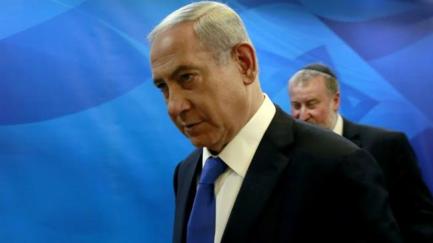
Israeli Prime Minister Benjamin Netanyahu says Tel Aviv will not give away any occupied land to Palestinians, rejecting the idea of Palestinian statehood.
In a Sunday statement released by his right-wing Likud party, Netanyahu said that a speech he gave in 2009, endorsing a Palestinian statehood as a solution to decades of conflict, was now “irrelevant.”
“Prime Minister Benjamin Netanyahu said that [in light of] the situation that has arisen in the Middle East, any evacuated territory would fall into the hands of Islamic extremism and terror organizations supported by Iran. Therefore, there will be no concessions or withdrawals; they are simply irrelevant,” the statement read.
Later on Sunday, Netanyahu’s office said in response that the prime minister made no comment to that effect.
“Prime Minister Netanyahu has made clear for years that given the current conditions in the Middle East, any territory that is given will be seized by radical Islam just like what happened [in] Gaza and in southern Lebanon,” Netanyahu’s office said.
However, Netanyahu has repeatedly said he would not run the risk of handing over land that might fall into the hands of the resistance movement.
Palestinian official Saeb Erekat said Netanyahu was using regional strifes as an excuse, saying, “Today Netanyahu revealed his true face.”
“Since 1993, he worked hard for the destruction of the option of peace and the option of a two-state solution,” the Palestinian chief negotiator added.
In the past few months, the Palestinian national unity government has been pushing for a UN resolution that determines the borders of the future Palestinian state based on the pre-1967 lines. Israel has expressed outcries over the motion. Palestinian President Mahmoud Abbas says there will be no negotiations over land with Israel as Palestinians will not give up even an inch of their land.
In 1967, Israel occupied the West Bank, East al-Quds (Jerusalem), and the Gaza Strip but withdrew from the enclave in 2005. Palestinians are seeking to create an independent state on the territories of the West Bank, East al-Quds and the Gaza Strip. Tel Aviv, however, has refused to return to the 1967 borders and is unwilling to discuss the issue of East al-Quds.
Israeli foreign minister calls for beheading of Arabs
By Brandon Martinez | Non-Aligned Media | March 8, 2015
The Times of Israel reports that Israel’s foreign minister, Avigdor Lieberman, has called for the beheading of Arab-Israelis who “support terror.”
“Those [Arabs] with us, should receive everything” he said, but stipulated that, “Those [Arabs] against [Israeli policies], it cannot be helped, we must lift up an ax and behead them — otherwise we will not survive here.”
In other words, the Zionist leader is saying that those Arabs living inside Israel who bow their heads and go-along-to-get-along with their Jewish-Zionist masters should be treated a little bit better than those who openly condemn the policies of the Zionist regime.
‘Bow down and be our slaves or be killed’ is essentially what Lieberman is suggesting. As far as ‘terror’ goes, the Israeli regime is the biggest terrorist of all, and those Palestinians who commit violence in response to Israeli state violence do so out of desperation.
Arabs living in Israel are second class citizens who do all of the hard labour and lowbrow slave jobs for the Jewish colonizers who arrived en masse to the land in the 1940s as uninvited guests from Europe and Russia.
Arab-Israelis are also forced to deny the true history of Palestine and parrot the fabricated Zionist narrative, as the Israeli regime banned use of the word Nakba (a term used to describe the ‘catastrophe’ of 1948 when Zionist gangs ethnically cleansed 800,000 Palestinians from their homes and villages) in school textbooks for Arabs.
Arabs in Israel who protest Israeli policies in Gaza and the West Bank are harassed by authorities, even jailed for their speech.
Copyright 2015 Non-Aligned Media
Featured Video

Seyed M. Marandi: US-Iran War Inevitable: Kuwait and Bahrain May Fall
or go to
Aletho News Archives – Video-Images
From the Archives
Oil and the Israel Lobby
Reknowned economist M. Shahid Alam offers this excellent critique of Noam Chomsky’s defective analysis of the relative influence of Oil versus the Israel lobby over US foreign policy: … continue
Blog Roll
 Aletho News
- ICC ignored ‘very well-documented’ NATO crimes – ex-Libyan minister
- SNSC secretary dismisses US response to Iran’s conditions as ‘inadequate’
- Sanaa says Taiz roads open, secure for residents, warns Saudi forces
- Iraqi resistance group urges Saudi leadership to admit defeat, lift Yemen siege
- Trump’s Retreat: How Al-Aqsa Flood Took Down the US Empire
- Israel’s Military Actions in Lebanon Grossly Violate International Law — Lavrov
- Seyed M. Marandi: US-Iran War Inevitable: Kuwait and Bahrain May Fall
- Leaders Condemn Ansarallah Attack on Saudi Arabia While Ignoring Illegal War Against Yemen
- Leaked: Britain’s Covert Iraqi Psyops Network
- Yemeni Armed Forces Warn Airlines Against Using Saudi Airports, Exempt Mecca and Medina
- If Americans Knew
- How Israel Conquered the Latin American Right
- Agents search Rep. Omar’s Washington home in criminal probe as she vows she won’t ‘be silenced’
- “The Rule Was: ‘Shoot Everyone You See'”
- Israel goes ballistic over Nobel Laureate Navi Pillay
- U.S. May Join Yet Another Middle Eastern War — TCN
- Yellow Line moves again as Israel closes in on trapped Gazans – Daily Update
- Israeli Attacks Kill Seven Palestinians in Gaza Including Six-year-old Girl
- Gaza: Ceasefire Anniversary Marks Year of Failed Promises
- The American Conservative: Mike Huckabee Should Resign
- A C-Section in Shackles: A Palestinian Woman’s Harrowing Birth in Israeli Detention
- No Tricks Zone
- Germany’s Green Energy Debacle: High Energy Costs Force Kahla Porzellan to Close After 182 Years!
- New Study: 50 Years Of The Most Aggressive ‘Net Zero’ Policies Can Only Affect The Global Climate By 0.03°C
- US September “Heat” Was No Record…Many Records Set Decades Ago
- Latest European Green Energy Debacle; Portugal’s Largest Flagship Solar Park Insolvent!
- Green Energy Debacle: German Expert Professor Fritz Vahrenholt Warns Of Severe Economic And Social Consequences
- Two More Paleo Reconstructions Affirm Meters-Higher Sea Levels Across Ireland, Brazil 7000-6000 Years Ago
- New Study: Earth And Venus Surface Warmth Largely Explained By Convection And Lapse Rate, Not CO2 Or Radiation
- 2025 Nature Paper Claiming Worsening Global Drought Gets RETRACTED …Heavily Flawed
- New Study: ‘Global Drought Shows No Detectable Recent Acceleration Under Climate Warming’
- Economic Masterminds: German Socialists Suggest Taxing Productivity Gains Stemming From Using AI

