Gaza fisherman shot dead by Israeli naval forces

Ma’an – 07/03/2015
GAZA CITY – Israeli naval forces shot and killed a Palestinian fisherman, and arrested two others while they were sailing in small fishing boats off the coast south of Gaza City early Saturday morning.
Speaker of the union of Gaza fishermen Nizar Ayyash told Ma’an that Israeli gunboats opened machine gun fire at a group of Palestinian fishermen. Health Ministry spokesman Ashraf al-Qidra confirmed to Ma’an that Tawfiq Abu Riyala died from injuries sustained by the fire.
Ayyash added that Israeli navy then seized two fishing boats and took them to unknown destination.
An Israeli army spokeswoman told Ma’an that after four vessels deviated from the fishing zone this morning, Israeli forces ordered the vessels to halt. Warning shots were fired towards the engines of the vessels, and two hits were confirmed. Two of the vessels were detained by Israeli forces, the other two turning back.
The spokeswoman added that every deviation by fishing boats from the fishing zone is perceived by Israeli forces as a security threat, citing an incident last month in which a vessel was caught outside of the fishing zone with arms intended for Hamas.
The Aug. 26 ceasefire agreement between Israel and Palestinian militant groups stipulated that Israel would immediately expand the fishing zone off Gaza’s coast, allowing fishermen to sail as far as six nautical miles from shore, and would continue to expand the area gradually.
Since then, there have been widespread reports that Israeli forces have routinely opened fire at fishermen within those new limits, and the zone has not been expanded.
The al-Mezan Center for Human Rights reported that since the ceasefire agreement Israeli forces have detained 49 Palestinian fishermen, injured 17, confiscated 12 fishing boats and damaged fishing tools in nine other incidents.
Recent targeting of Gazan fishermen comes at a time when economic growth in the coastal enclave is near frozen and 80 percent of the population is food insecure, according to the Food and Agricultural Organization of the United Nations.
PLO plans to end all security cooperation with Israel: Officials
Press TV – March 5, 2015
The Palestinian Liberation Organization (PLO) has decided to end all security cooperation with Israel, Palestinian officials say.
According to reports on Thursday, the Palestinian Central Council (PCC) of the PLO, led by Palestinian President Mahmoud Abbas, made the decision to cut all forms of security cooperation with Israel after two-day discussions in Ramallah.
“Security coordination in all its forms with the authority of the Israeli occupation will be stopped in the light of its (Israel’s) non-compliance with the agreements signed between the two sides,” the PCC, the second highest Palestinian decision-making body, said in a statement.
Tel Aviv “should shoulder all its responsibilities towards the Palestinian people in the occupied state of Palestine as an occupation authority according to international law,” the statement read.
The statement also called on the United Nations Security Council to “determine a deadline to end the Israeli occupation and ensure that the state of Palestine is enabled to practice its sovereignty on its land occupied since 1967, including its capital east Jerusalem and, resolve the issue of refugees according to resolution 194.”
“The concept of a Jewish state is rejected and also of a (Palestinian) state with provisional borders is rejected. Any formula that will keep an Israeli military or settler presence on any part of the land of the state of Palestine is rejected,” the statement further read.
“Gangster” regime
At the opening of the two-day talks, attended by officials from the PCC, on Wednesday, Abbas (pictured below) denounced a decision by the Israeli regime to withhold Palestinian tax revenues worth more than $100 million a month.
“How are they allowed to take away our money? Are we dealing with a state or with a gangster?” he asked.
The two-day meetings, attended by legislators, union leaders, and other figures, focused on a review of interim agreements with the Israelis.
In response to Palestinian efforts to finally attain membership at the International Criminal Court (ICC), Tel Aviv announced a freeze on the revenues transfer in January.
Palestinians are continuing efforts to file war crime charges against the regime at the ICC.
The Palestinian president further called the tax freeze a provocation, noting that “peaceful, popular resistance is the only way for us” in the fight against Israel.
Abbas also asked “all countries of the world to recognize the state of Palestine.”
“But we want to say to the Israeli side, these recognitions do not mean in any way that we do not want to negotiate, or that we’re running away from negotiations,” Abbas said, adding that talks would continue with “whoever” wins the Israeli general elections on March 17.
America Must Reject Netanyahu’s War Cry on Iran
By Sheldon Richman | FFF |March 4, 2015
Israeli Prime Minister Benjamin Netanyahu came to Washington this week to prepare the American people for war against Iran. Backed by American neoconservatives, the Israel lobby, and assorted other war hawks, Netanyahu insists that Iran intends to build a nuclear weapon and thus is an “existential threat” to Israel. He has no confidence that President Obama will negotiate an agreement that once and for all will end Iran’s alleged nuclear ambitions.
Thus the prime minister’s objective is nothing less than to wreck the current negotiations and push America into a regime-changing war against Iran.
Netanyahu’s narrative is a fabric of lies and omissions.
To begin, Iran has not sought a nuclear weapon, and the country’s leader declares such weapons contrary to Islam. (For details, see Gareth Porter’s well-documented Manufactured Crisis: The Untold Story of the Iran Nuclear Scare.) For a quarter century, Netanyahu has warned that an Iranian bomb is imminent. But U.S. and Israeli intel say he’s wrong.
Iran nevertheless wants to reassure the world so that crushing economic sanctions will be lifted. Hence, the current negotiations. (Iran made similar overtures before.)
Iran’s government is a signatory to the nuclear Non-Proliferation Treaty (NPT), subjecting it to inspections by the International Atomic Energy Agency, which can account for every atom of uranium.
Members of the NPT are free to have a civilian nuclear-power program, including the ability to enrich uranium, and Iran insists that it be treated as other members are. Nevertheless, for decades the U.S. government has exerted pressure to stop Iran from having a civilian nuclear industry. When Iran a few years ago agreed to forgo enrichment and obtain enriched uranium from abroad, the U.S. government blocked the deal. Netanyahu and his American allies oppose Iran’s having any enrichment capability.
Moreover — and this ignored fact seems rather important — Israel is the nuclear monopolist of the Mideast. That hardly anyone talks about this is at once remarkable and unsurprising. But think about it: Israel has hundreds of nuclear warheads — some of them on invulnerable submarines capable of surviving a first strike. Even if Iran built one warhead, it would be useless — except as a deterrent against Israel — and the country’s rulers know it. Israel has not signed the NPT and does not submit to IAEA inspections. It is a nuclear rogue state.
As Gideon Rose, editor of Foreign Affairs magazine (published by the establishment Council on Foreign Relations), said on CNN recently, Israel could “destroy Iran this afternoon.” If there is an existential threat, Israel is the source and Iran is the target.
How does Netanyahu’s alarmist narrative look now?
It is erroneously believed that Iran has threatened to attack Israel. In fact, Israel and the United States have been waging war — economic, covert, proxy, and cyber — against Iran for decades. Since the repressive U.S.-backed Iranian regime of Shah Mohammad Reza Pahlavi, a close friend of Israel, was overthrown in 1979, Israel’s leaders have openly rattled sabers at the Islamic Republic. American presidents have repeatedly declared that “all military options are on the table” — which would include nuclear weapons. The United States helped Iraqi dictator Saddam Hussein fight a war of aggression against Iran in the 1980s, providing him with components for chemical weapons and satellite intelligence. Why wouldn’t Iran feel threatened by the United States and its close ally Israel? Even so, Iran has not threatened to attack Israel or America.
Netanyahu would have us believe the Iranian regime wants to exterminate all Jews. But that’s hard to square with the continuous presence of a Jewish community in Iran — today the largest in the Muslim Middle East — for two thousand years. Iran’s steadfast opposition to Israel’s institutionalized injustice against the Palestinians is not anti-Semitism.
So why is Netanyahu pushing war? Among several reasons, demonizing Iran reduces pressure on Israel to negotiate seriously with the Palestinians. Many Israelis prefer building Jewish settlements on Palestinians’ land instead. Moreover, Israel’s rulers oppose any development — such as an Iranian-U.S. detente — that could diminish Israel’s U.S.-financed hegemony in the region.
War with Iran would be a catastrophe all around. Netanyahu and his hawkish American allies — the same people who gave us the disastrous Iraq war and ISIS — must be repudiated.
350 Israeli Soldiers Received Psychiatric Counseling After Gaza War: Report

Al-Akhbar | March 4, 2015
More than 350 Israeli soldiers who took part in last summer’s military onslaught on the Gaza Strip have since received psychiatric counseling for post-traumatic stress, an Israeli report has revealed.
The report, published Wednesday in the Israel Today newspaper said that soldiers had undergone treatment for symptoms associated with post-traumatic stress, including disorientation, low productivity and recurring nightmares.
The newspaper quoted a senior Israeli official as saying that the number of soldiers receiving psychiatric treatment following last summer’s onslaught on Gaza was higher than those who did so following previous operations.
For 51 days this summer, Israel pounded the Gaza Strip by air, land and sea. More than 2,310 Gazans, 70 percent of them civilians, were killed and 10,626 injured during unrelenting Israeli attacks on the besieged strip this past summer.
According to the UN, the Israeli military killed at least 495 Palestinian children in Gaza during “Operation Protective Edge.” The al-Mezan Center for Human Rights puts the number at 518, while the Palestinian Center for Human Rights puts it at 519.
All three figures exceed the total number of Israelis, civilians and soldiers, killed by Palestinians in the last decade.
The Palestinian Ministry of Health reported that 3,106 Palestinian children were injured in the seven- week assault. The UN estimates that 1,000 children will suffer a permanent disability as a result of their injury.
Moreover, the UN said as many as 1,500 children have been orphaned by Israeli attacks that killed their parents, while 6,000 children will have a parent with a lifelong disability.
The besieged enclave has also seen widespread destruction of its infrastructure, reaching levels of devastation that UN chief Ban Ki Moon called “beyond description” in a visit to the Strip on October 14.
Some 100,000 people remain displaced while 450,000 don’t have access to running water.
Meanwhile, the official, who holds a senior position in the Israeli military’s psychiatric department, said that “hundreds” of soldiers have sought psychiatric treatment for “severe stress.”
He said that 80 percent of the soldiers to have undergone treatment had since been “fully rehabilitated” and returned to service.
Treatment was carried out at southern Israel’s Re’im military base where affected soldiers received up to eight hours of treatment each day, the official was quoted as saying.
A report published in January revealed that at least 10 Israeli soldiers committed suicide in 2014, including four who took part in the onslaught on the Gaza Strip.
In September, Israeli newspaper Maariv reported that the three troops from the elite Golani Brigade had suffered psychological problems in connection to their participation in the recent offensive on the Gaza Strip.
Also in September, 43 reservists and former members of Israel’s elite army intelligence unit have announced in a letter addressed to Israeli Prime Minister Benjamin Netanyahu that they refuse to serve in the military, slamming “abuses” of Palestinians in the occupied West Bank, annexed East Jerusalem and Gaza.
(Anadolu, Al-Akhbar)
US Police Arrest Five Anti-Israel Activists
Al-Akhbar | March 2, 2015
Five activists were arrested Sunday in the American capital for demonstrating outside the Washington Convention Center where the American Israeli Public Affairs Committee (AIPAC), a well-known pro-Israeli lobby, was holding its annual policy conference.
Believed to be one of the largest pro-Israeli gatherings, the AIPAC policy conference kicked off on Sunday, and will last for three days.
A group of protesters mobilized by an anti-war group known as CODEPINK or Women for Peace on social media under the hashtag #ShutDownAIPAC tried to block the entrance to the convention center. Several civil society organizations, including Jewish ones, joined the demonstration.
Some protesters were waving flags of Hezbollah, a Lebanese resistance movement against Israel which is listed as a “terrorist organization” by the US.
Israel occupied parts of Lebanon for 22 years until 2000 and the two countries are still technically at war.
The latest Israeli war on Lebanon in the summer of 2006 killed more than 1,200 Lebanese, most of them civilians, and 160 Israelis, most of them soldiers.
“The purpose of the rally was to draw attention to this organization’s role as a special interest lobby that maintains a dangerous stranglehold over US policies and diverts US tax dollars from American needs and into Israeli militarism,” a statement by CODEPINK read.
The activists were violently removed by police from the front of the Washington Convention Center while chanting: “Netanyahu, War Criminal! Free, Free, Palestine!”
“We’re here to say that this organization is on the path of war,” one of the protest organizers, Medea Benjamin told Anadolu news agency. … Full article
SOAS, University of London Votes to Boycott Israeli Academic Institutions
Out of 2056 votes cast at the School of Oriental and African Studies (SOAS), University of London, 73% voted in favor of boycotting Israeli academic institutions.
The Palestine Society and the BDS campaign at SOAS state: “This historic result has brought us one step further in our struggle for freedom and justice. We do not tolerate any collaboration with academic institutions which are complicit in human rights violations and which do not practice the values of academic freedom and equality. We call upon other universities to show their solidarity by joining the academic boycott.”
The referendum was called for by the Students’ Union, and was conducted in an open, fair and transparent environment.
SOAS has ties with the Hebrew University, which joined the “war effort” last summer when the Israeli army murdered over 2,000 Palestinians in Gaza.
The academic boycott campaign does not contradict academic freedom as it targets Israeli institutions complicit in the oppression of Palestinians, not individuals. Open enquiry, free exchange of ideas, and intellectual freedom are crucial, but freedom can only be real when it is afforded to all. This has to include the Palestinians.
Israel asks US for additional $300mn for missile defense – report
RT | March 1, 2015
Israel reportedly bypassed the White House and asked the US Congress for an extra $317 million to be added to President Barack Obama’s budget for the next fiscal year in order to fund Israeli missile defense programs, Bloomberg reported.
The requested funds would be in addition to the $158 million already proposed by the Pentagon for Israel’s security needs for the fiscal year that will begin on October 1. The new allocation will allegedly finance the ‘David’s Sling’ and ‘Arrow-3’ programs – designed to intercept medium- to long-range missiles – as well as provide an anti-ballistic missile system.
According to Bloomberg’s report on Friday, the director of Israel’s missile defense organization Yair Ramati “visited lawmakers and aides to the congressional defense committees on February 2 and 3 to outline the case for more money and thank them for past assistance.”
Ramati completely bypassed the White House and the Pentagon. The report links the move to the tense relationship between the Obama administration and the Israeli government ahead of Prime Minister Benjamin Netanyahu’s speech to Congress on March 3, which is likely to stress that the White House is pursuing a “bad deal” by negotiating to curb Iran’s nuclear program.
The report revealed that Ramati’s proposal included $250 million to start production of the David’s Sling system, in addition to Obama’s $37 million request for development. Another $35 million Ramati requested for the initial production of Arrow 3, in addition to the $55.7 million the US administration is seeking for development.
During his visit to Capitol Hill, Ramati “distributed one-page sheets naming US contractors that would benefit from production funds for each of the missile defense systems.” According to Bloomberg’s information, the list included Chicago-based Boeing Co.; Waltham, Massachusetts-based Raytheon Co.; Arlington, Virginia-based Orbital ATK Inc.; and Falls Church, Virginia-based Northrop Grumman Corp.
When contacted by Bloomberg, the Israeli embassy in the US declined to comment on the report.
The US already provides Israel with $3.1 billion a year as “foreign military financing,” which excludes other missile defense funds, according to the report.
For the current fiscal year, Congress has reportedly provided $620 million, including about $347 million for missile defense programs. US Congress has appropriated more than $1.2 billion since 2011 for the Iron Dome, which is designed to intercept and destroy rockets.
In light of the large amounts of distributed funds, US lawmakers have been insisting that Israel use American-based defense contractors when spending the received money.
Last year, the Israeli government agreed to spend more than half the funds provided by the Pentagon for the Iron Dome in the US by this year. Until recently, the missile system was been built solely in Israel by Rafael Advanced Defense Systems Ltd.
Iran nuclear talks have created a significant rift between Israel and the US. Last week, the White House and State Department stated that Israel inaccurately provided information and twisted the official US position in nuclear talks with Iran, and accused Tel Aviv of “selectively” leaking details of sensitive talks.
Washington has also voiced suspicion that Netanyahu’s office directly provided Israeli journalists with the leaked information, including an alleged offer to Iran to keep 6,500 centrifuges for uranium enrichment. A White House spokesman expressed frustration with the “cherry-picked” information released by the Israelis out of context.
Four Palestinians and one female German demonstrator shot with live ammunition at “Open Shuhada Street” protest

Israeli military sniper aiming up the road towards the Open Shuhada Street demonstrators
International Solidarity Movement | February 28, 2015
Hebron, Occupied Palestine – On February 27 in occupied Al-Khalil (Hebron), Israeli forces fired live ammunition towards nonviolent protesters participating in the annual Open Shuhada Street demonstration, injuring five including four Palestinian activists, one of them 17 years old, and one German citizen. More were also injured by rubber-coated steel bullets and stun grenades as soldiers and Border Police blocked the roads leading towards Shuhada Street and attacked the protesters.
Close to a thousand Palestinians, accompanied by Israeli and international supporters, marched towards one of the closed entrances to Shuhada Street carrying flags and signs and chanting. They called for the opening of Shuhada Street, whose closure to Palestinians has become a symbol of Israel’s Apartheid system, and for an end to the occupation. The march was turned back by stun grenades, rubber coated steel bullets and live ammunition fired by the Israeli military. Around twenty demonstrators were injured in total; Hebron Hospital reported that at least six were admitted and two required surgery. One Palestinian activist, Hijazi Ebedo, 25, was arrested at the demonstration; all he had been doing was chanting and holding a sign.
Issa Amro, coordinator and co-founder of Youth Against Settlements (YAS) stated: “The protest, which was joined by groups from all over Palestine, marked the twenty-first anniversary of the Ibrahimi Mosque Massacre. Israeli occupying forces shot live ammunition towards peaceful protesters, which is against international law. The Israeli military should be held accountable in international court for their actions.”
“Julia was standing and filming next to me when suddenly she fell to the ground,” stated Leigh, a Canadian activist who was standing next to Julia when she was shot.
Julia, the injured 22-year-old German activist from Berlin, was evacuated to Hebron Hospital where she is being treated for a live gunshot wound which entered and exited her leg. “The brutality of Israeli forces is unbelievable, it seems like they don’t have a limit,” she stated. “In Palestine I have seen Israeli forces shooting tear gas, stun grenades, rubber and live ammunition at any kind of demonstration that is against the occupation. It doesn’t matter for them if it is peaceful or if there are kids attending. Yesterday I saw the army attack children who had been dancing in the street. Two people were shot with live ammunition in Bil’in. They shot me as I was standing and filming. It seems the soldiers just shoot at any one.”
The Open Shuhada Street demonstration marks the anniversary of the 1994 Ibrahimi Mosque massacre, when right wing extremist settler Baruch Goldstein murdered 29 Palestinians while they worshipped in the mosque. Following the massacre, Israeli forces shut down Palestinian businesses on Shuhada Street–once a commercial center–and began to implement the policies which would lead to what is now a total closure of the vast majority of the street to Palestinians. Twenty one years after the massacre, settlers from illegal Israeli settlements use the street freely while Palestinians are assaulted, shot and arrested when they attempt to reach it en masse during the Open Shuhada Street demonstration every year.
Israeli troops ‘violently’ attack Palestinian teen at border crossing
Ma’an – 28/02/2015
JENIN – A teenage Palestinian boy from the northern West Bank says he was violently assaulted by Israeli soldiers at al-Jalama crossing north of Jenin while he was trying to cross into Israel.
Muhammad Asri Fayyad, 17, told Ma’an Saturday that on Thursday morning he arrived at the crossing along with a busload of young men and teenagers who had organized a trip to Israel and obtained the needed permits from Israeli authorities.
He says he entered the crossing and complied with the instructions Israeli officers were giving through loudspeakers. The instructions included “that we shove our mobile phones in one place and we cross from a different place which we did.”
“Everybody received back their mobile phones except me. The soldiers asked me to pass through a path under a bridge on top of which stood a number of soldiers pointing their guns at me.
“They then asked me to enter a room which has several doors and I obeyed the orders. All the doors were immediately locked before the officers started to shout through loudspeakers demanding that I take off my clothes and my shoes.”
He added that he took off his shoes first but the soldiers continued to shout “violently” repeating that he must take off all his clothes.
“When I took off my clothes, they turned on a huge ceiling fan which caused frigid coldness. I told them to turn off the fan because I was freezing, but they didn’t, and so I knocked on the fan in an attempt to cause it to stop. At that point the soldiers broke into the room and started to beat be with rifle butts until I fell to the ground.
“They then tied my hand to a steel bar behind my back and tied my foot to another bar. I remained in that position from 9 a.m. until 2 p.m. After that a number of soldiers arrived and a female soldier untied me after she took a silver necklace I was wearing. She ordered me to put on my clothes, then she handcuffed and blindfolded my eyes and escorted me outside the crossing and told me that I was denied entry to Israel. She gave me a small sack in which I found the remnants of my mobile phone which had been smashed.”
Muhammad says he has been suffering severe shoulder and foot pain ever since.
Terrorism, Palestine, the U.S. and Israel
By Robert Fantina | CounterPunch | February 27, 2015
A jury in Manhattan, New York, has found the Palestinian Authority and other groups guilty in a ‘terrorist’ attack that left some Americans dead. So we have yet another one of the countless examples of the double-standard that exists in U.S. jurisprudence.
In 2003, U.S. citizen Rachel Corrie, 23, was in Palestine, helping the oppressed people there, teaching children and attempting to prevent house demolitions that are illegal under international law, when she was run over by a massive bulldozer operated by an Israeli soldier. The soldier ran over her once, burying her in the dirt, and then backed up, crushing her a second time. She was uncovered, still alive, although just barely, but died shortly thereafter. Her heartbroken and devastated parents contacted their elected officials, requesting a formal inquiry; this was denied. After all, if Israeli soldiers want to bulldoze a U.S. citizen, apparently that is within their rights. Israel held one of its usual inquiries into the situation, but found no reason to bring any charges against anyone.
British Citizen Tom Hurndall was unarmed and wearing a bright orange coat identifying him as International Solidarity Movement activist when an IDF (Israel Defense Force. Read: terrorist) soldier shot him in the head in 2004. Less than a year later, the terrorist, who was not named publically, but referred to only as ‘Sgt. T’, was convicted of manslaughter and sentenced to eight years in prison. While one may wonder why his conviction was only for manslaughter, at least there was an investigation, indictment, trial, conviction and sentence. Obviously, the Israeli lobby is not quite as powerful in Britain as it is in the U.S.
Let us look for a moment at the Federal Bureau of Investigation’s (FBI) definition of terrorism.
“’International terrorism’ means activities with the following three characteristics:
* Involve violent acts or acts dangerous to human life that violate federal or state law;
*Appear to be intended (i) to intimidate or coerce a civilian population; (ii) to influence the policy of a government by intimidation or coercion; or (iii) to affect the conduct of a government by mass destruction, assassination, or kidnapping; and
*Occur primarily outside the territorial jurisdiction of the U.S., or transcend national boundaries in terms of the means by which they are accomplished, the persons they appear intended to intimidate or coerce, or the locale in which their perpetrators operate or seek asylum.”
Now, let us look at the U.S. role in the oppression of the Palestinians, in the context of this definition.
The U.S. provides Israel with $3.8 billion in aid every year, including the most advanced weaponry on the planet. Israel then uses this to bomb the Gaza Strip. Additionally, Israeli terrorists arbitrarily shoot peaceful protestors. These seem to be ‘violent acts’ that are ‘dangerous to human life’. Do they violate federal or state law? Wanton murder of unarmed civilians does, indeed, violate such laws.
With U.S. financing, Israel deprives Palestinians of their ability to go to school or work, through cruel and arbitrary checkpoints. It arrests men, women and children without charge, and holds them for months without granting them access to family or legal representation. It bombs private residences, schools, hospitals, mosques and United Nations refugee centers. All this is certainly intended ‘to intimidate or coerce a civilian population’.
Additionally, with full U.S. support, Israel is now withholding $100 million dollars per month that it collects in taxes for Palestine, as punishment for Palestine joining the International Criminal Court (ICC), and filing charges against Israel. This money is required by Palestine to pay salaries. Is this not intended ‘to influence the policy of a government by intimidation or coercion’?
Lastly, for this point, the U.S. provided all the funding for Israel’s carpet bombing of the Gaza Strip in the summer of 2014, and has done nothing to assist the people suffering there as a result. Over 2,500 Palestinians were killed, including over 500 children, some as young as newborns. Tens of thousands of people remain homeless. Prior to that, hundreds of Palestinians in the West Bank were arrested, many without charge. This certainly falls within the category of attempting ‘to affect the conduct of a government by mass destruction, assassination, or kidnapping’.
All of the unspeakable brutality referenced herein ‘occur(s) primarily outside the territorial jurisdiction of the U.S.’
So while a courtroom in New York decides that the PA is guilty of acts of terrorism, who is looking at the U.S.’s role as international terrorists? The ICC has begun its investigation into possible war crimes committed by Israel which, in the eyes of the U.S. is, like the U.S., above the law. As a result of this investigation, there is a possibility that Israel, at least in the court of international public opinion, will be held accountable for its crimes. Since it, also like the U.S., has refused to join the ICC, two examples of the few rogue nations that haven’t done so, the court cannot issue any consequences to it. But its refusal to participate will of itself be a damning indictment of Israel, and any findings will, of course, be widely distributed. All this will justifiably lead to Israel’s ever growing isolation as a global pariah, a situation even the mighty U.S. can’t resolve.
What does this verdict mean for Palestine? Probably not much. The verdict is meaningless, and the PA has no money to pay the fine anyway. It can’t even pay the salaries of its employees, thanks to Israel illegally withholding hundreds of millions of dollars belonging to Palestine. Internationally, the death of a few Americans is not seen as more tragic or meaningful than the death of thousands of Palestinians, much as the U.S. government might consider it to be so.
Judicial terrorism may have a slightly different definition than ‘terrorism’ as shown above. While not a violent act, and committed within the U.S.’s borders, its purpose is still ‘to intimidate or coerce a civilian population; (ii) to influence the policy of a government by intimidation or coercion; or (iii) to affect the conduct of a government’. So while not bloody like U.S. bombs, its goal is still the same.
Israel’s relations with much of the world are in disarray; more and more countries are preventing their businesses from trading with Israeli companies located on occupied territory. Universities around the world are voting to divest from Israel-owned companies. Entertainers and academics are refusing to appear in Israel. And even the U.S., the financier and puppet of Israel, has thrown an uncharacteristic hissy fit, not because of Israel’s abominable violation of human rights, but because Israeli Prime Murderer Benjamin Netanyahu accepted an invitation to speak to Congress without the approval and foreknowledge of President Barack Obama. While the reason may be trivial, the fact that the U.S. feels emboldened to criticize Israel, for the second time in less than a year (the first was a tepid criticism of Israel’s bombing of a known United Nations refugee center), does mark a significant change.
Where will it all lead? Eventually, to a free Palestine. This will not happen overnight, but all the signs are there: increasing loss of international patience with the occupation; global recognition of the futility of ‘negotiations’; resolutions throughout much of Europe, calling on governments to recognize Palestine; shock and horror at Israeli atrocities. The people are finally learning the reality of apartheid Israel, and are demanding that their governments respond. Their efforts must continue; too many lives are at stake to allow this to continue.
Robert Fantina’s latest book is Empire, Racism and Genocide: a History of US Foreign Policy (Red Pill Press).
Hamas asks the international community to put Jewish State on terror list
Palestine Information Center – February 26, 2015
GAZA – Islamic Resistance Movement, Hamas, asked the international community to put Israel and its leaders on the terror list. The request was voiced after state-backed Jewish settlers set fire to a mosque and a church in the West Bank over two consecutive days.
On Thursday, Hamas leader and former Minister of Awqaf and Religious Affairs, Dr. Ismail Radwan, condemned the arson attack on both sacred sites, saying, “Torching the holy sites and writing anti-Islamic and anti-Christian slogans by Israeli settlers demonstrate that the Israeli occupation constitutes a danger to humanity and to holy places”.
Dr. Radwan called on the international community along with human rights organizations to work on putting Israel on the terror list for its crimes that show hatred and hostility to humanity and holy sites.
The extremist Jewish groups started a fire at dawn Wednesday in a mosque in Jaba town to the west of Bethlehem and did the same thing early Thursday in the Church of Dormition on Mt. Zion in Occupied Jerusalem.
Featured Video
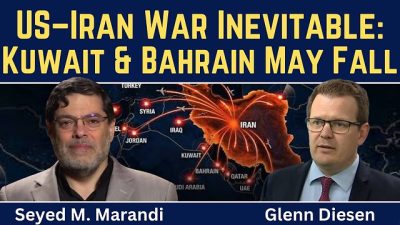
Seyed M. Marandi: US-Iran War Inevitable: Kuwait and Bahrain May Fall
or go to
Aletho News Archives – Video-Images
From the Archives
Oil and the Israel Lobby
Reknowned economist M. Shahid Alam offers this excellent critique of Noam Chomsky’s defective analysis of the relative influence of Oil versus the Israel lobby over US foreign policy: … continue
Blog Roll
 Aletho News
- ICC ignored ‘very well-documented’ NATO crimes – ex-Libyan minister
- SNSC secretary dismisses US response to Iran’s conditions as ‘inadequate’
- Sanaa says Taiz roads open, secure for residents, warns Saudi forces
- Iraqi resistance group urges Saudi leadership to admit defeat, lift Yemen siege
- Trump’s Retreat: How Al-Aqsa Flood Took Down the US Empire
- Israel’s Military Actions in Lebanon Grossly Violate International Law — Lavrov
- Seyed M. Marandi: US-Iran War Inevitable: Kuwait and Bahrain May Fall
- Leaders Condemn Ansarallah Attack on Saudi Arabia While Ignoring Illegal War Against Yemen
- Leaked: Britain’s Covert Iraqi Psyops Network
- Yemeni Armed Forces Warn Airlines Against Using Saudi Airports, Exempt Mecca and Medina
- If Americans Knew
- How Israel Conquered the Latin American Right
- Agents search Rep. Omar’s Washington home in criminal probe as she vows she won’t ‘be silenced’
- “The Rule Was: ‘Shoot Everyone You See'”
- Israel goes ballistic over Nobel Laureate Navi Pillay
- U.S. May Join Yet Another Middle Eastern War — TCN
- Yellow Line moves again as Israel closes in on trapped Gazans – Daily Update
- Israeli Attacks Kill Seven Palestinians in Gaza Including Six-year-old Girl
- Gaza: Ceasefire Anniversary Marks Year of Failed Promises
- The American Conservative: Mike Huckabee Should Resign
- A C-Section in Shackles: A Palestinian Woman’s Harrowing Birth in Israeli Detention
- No Tricks Zone
- Germany’s Green Energy Debacle: High Energy Costs Force Kahla Porzellan to Close After 182 Years!
- New Study: 50 Years Of The Most Aggressive ‘Net Zero’ Policies Can Only Affect The Global Climate By 0.03°C
- US September “Heat” Was No Record…Many Records Set Decades Ago
- Latest European Green Energy Debacle; Portugal’s Largest Flagship Solar Park Insolvent!
- Green Energy Debacle: German Expert Professor Fritz Vahrenholt Warns Of Severe Economic And Social Consequences
- Two More Paleo Reconstructions Affirm Meters-Higher Sea Levels Across Ireland, Brazil 7000-6000 Years Ago
- New Study: Earth And Venus Surface Warmth Largely Explained By Convection And Lapse Rate, Not CO2 Or Radiation
- 2025 Nature Paper Claiming Worsening Global Drought Gets RETRACTED …Heavily Flawed
- New Study: ‘Global Drought Shows No Detectable Recent Acceleration Under Climate Warming’
- Economic Masterminds: German Socialists Suggest Taxing Productivity Gains Stemming From Using AI

