Greek Orthodox Church decries attacks by Jewish settlers
MEMO | February 26, 2015
The Patriarch of the Holy City of Jerusalem and all Palestine, Theophilos III, denounced on Thursday what he called “repeated” attacks on Christian and Muslim places of worship in the Palestinian territories by extremist Jewish settlers.
“The targeting of churches and mosques is caused by pervasive racism and hatred,” he said in a statement.
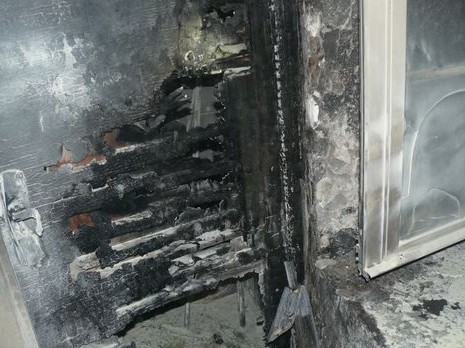
Earlier Thursday, Jewish Settlers set fire to part of a religious school affiliated with Jerusalem’s Greek Orthodox Church, Which they sprayed with anti-Christian graffiti. On Wednesday, settlers torched and sprayed graffiti on a West Bank mosque.
Theophilos III said Christians represented an “integral part” of the Holy Land, its history and its future, going on to assert that the Greek Orthodox Church was one of the world’s most important churches.
“Criminals will not intimidate this church or its flock,” he declared.
He called on government agencies to address repeated settler attacks on places of worship.
Earlier Thursday, The Palestinian Foreign Ministry called on both the Vatican and the international community to protect Islamic and Christian places of worship from what it described as “Jewish extremism.”
“We strongly condemn these acts,” the ministry said in a statement. “Yesterday a mosque near Bethlehem was torched and today a church in Jerusalem [was attacked].”
Extremist Jews, the ministry asserted, continued to attack Muslim and Christian places of worship while the Israeli government did nothing to stop them.
The ministry went on to blame the Israeli government for the trend, calling on the Vatican, the international community and the UN to help protect local religious sites.
On Wednesday, Jewish Settlers set fire to a mosque near the southern West Bank city of Bethlehem, Which Also they covered with anti-Arab and anti-Muslim graffiti.
Several instances of settler attacks on Muslim places of worship have been reported recently, both in the Israeli-occupied West Bank and in the self-proclaimed Jewish state itself.
Banksy in Gaza: Haunting images among ruins of war
RT | February 26, 2015
The English graffiti artist has taken his politically charged message to the bombed-out neighborhoods of Gaza, where a series of murals amid a backdrop of devastation attempts to give voice to the desperation felt by Palestinians.
The first mural, entitled “Bomb Damage,” appears to be inspired by Rodin’s famous sculpture “The Thinker.” In Banksy’s version, the viewer is struck with the realization that the only possible thing on the mind of the subject is the utter devastation that literally surrounds him.
Another piece, done in the artist’s trademark black, stenciled imagery, shows the silhouettes of children riding an amusement park swing that is shown circling around one of the looming guard stations that punctuate the length of the West Bank barrier, which, upon completion, will be approximately 700 kilometers (430 miles).

Photo from http://www.banksy.co.uk
The artist also provided his personal thoughts on the situation confronting the people of Gaza:
“Gaza is often described as ‘the world’s largest open air prison’ because no one is allowed to enter or leave. But that seems a bit unfair to prisons – they don’t have their electricity and drinking water cut off randomly almost everyday,” Banksy said in a spray-painted statement.
In another painting, in which a huge white kitten appears to toy with a ball of coiled metal, the artist is hurling criticism at the popular Internet meme involving kittens, which attracts so much attention at the expense of more serious issues.
The street artist explained in yet another spray-painted bit of commentary the reaction of a local man to the work, and his response:
“A local man came up and said ‘Please – what does this mean?’ I explained I wanted to highlight the destruction in Gaza by posting photos on my website – but on the internet people only look at pictures of kittens.”

Photo from http://www.banksy.co.uk
In another place, Banksy offered some advice on a concrete wall: “If We Wash Our Hands Of The Conflict Between The Powerful And The Powerless We Side With The Powerful – We Don’t Remain Neutral”.
Finally, the street artist provides a poignant statement in a 2-minute video, where he invites the viewers to “discover a new destination” this year, while providing a brief, yet unforgettable stroll through Gaza.
Banksy, who is widely believed to be Robin Gunningham, an artist from Bristol’s underground art scene, has gone from the streets to the top of the art world. His first film, Exit Through the Gift Shop, labeled as “the world’s first street art disaster movie”, made its debut at the 2010 Sundance Film Festival. In 2014, he was awarded Person of the Year at the 2014 Webby Awards.

Photo from http://www.banksy.co.uk
READ MORE: ‘Complicit in Gaza’s misery’: Pro-Palestine activists shut down UK arms factory
Israeli Forces Demolish Four Bedouin Homes in Negev
Al-Akhbar | February 25, 2015
Israeli forces demolished four Bedouin homes in the Negev desert in southern Occupied Palestine on Tuesday, Ma’an news agency reported, leaving dozens homeless.
Israeli forces, escorted by bulldozers, raided the Tel Shebaa area of Beersheba early Tuesday and demolished the properties on the pretext that they lacked building permits. Locals said the homes belonged to the al-Nabbari family.
One of the family members, Sufian al-Nabbari, 20, was arrested after attempting to prevent the demolition.
“We will not let go of our lands. More than 60 police officers arrived in the area and demolished our homes and livestock barns,” Mohammed al-Nabbari said. “They even chopped down our olive trees.”
The head of the regional council for Bedouin villages unrecognized by Israeli authorities, Attiya al-Asam, said that the “brutality” of demolitions has increased recently in Bedouin towns in Occupied Palestine.
On Sunday, Israeli authorities demolished four homes belonging to Palestinian Bedouins near the town of Hurah in the Negev desert.
In 2013, authorities said that the homes of the 1,500 residents of the village were to be demolished because the area had been converted into a closed military zone.
Palestinians with Israeli citizenship complain of routine discrimination, particularly in housing, land access and employment.
There are about 260,000 Bedouin in historical Palestine, mostly living in and around the Negev in the arid south.
The Israeli government classifies approximately 40 villages in the Negev desert as “unrecognized,” arguing that the roughly 53,000 Palestinian Bedouins living there cannot prove their ownership of the land and are hence living there “illegally.”
Claiming that most of the land in the Negev desert is Israeli “state property,” Israel has repeatedly demolished Bedouin homes in the area.
In November, the IOF razed the Bedouin village of al-Araqib in the Negev Desert for the 78th time in four years.
The village was demolished for the first time in July 2010, before being rebuilt with metal and wood.
Dozens of Palestinians with Israeli citizenship living in Araqib say that they have owned the land since before Israel came into being in 1948.
Israel has demolished 77 Palestinian homes and agricultural structures since the beginning of 2015, leaving 110 people homeless, the United Nations Office for the Coordination of Humanitarian Affairs said.
Meanwhile, Bedouins are regularly attacked by the IOF, who killed 22-year-old Sami al-Jaar in the southern Negev region on January 14. During Jaar’s funeral, a 45-year-old Bedouin man, Sami Ibrahim Zayadna, suffocated to death due to tear gas sprayed by Israeli forces. … Full article
Dancing children attacked by Israeli forces
International Solidarity Movement | February 25, 2015
Hebron, Occupied Palestine – On the 24th of February in occupied Al-Khalil (Hebron), Israeli forces opened fire on dancing Palestinian youth, firing tear gas and throwing stun grenades at group of young children performing a traditional Palestinian dance as a form of protest in front of Shuhada checkpoint.
The fifteen young dancers, Palestinian girls and boys between the ages of six and twelve, gathered to perform dabke, a traditional Palestinian dance. They staged their dance in the open street in Bab Al-Zawiye (in the H1 – officially Palestinian Authority-controlled – part of Hebron) near Shuhada checkpoint, as part of a week of actions planned by Palestinian organizers around the annual Open Shuhada Street campaign. The children began performing under heavy military surveillance, as at least thirteen soldiers occupied roofs surrounding the entrance to the checkpoint.
Even before the demonstration had begun, Israeli forces closed Shuhada checkpoint to Palestinian men, only allowing a few women through. Shuhada checkpoint controls the main access between Bab Al-Zawiye and the the H2 (fully Israeli-controlled) neighborhood of Tel Rumeida. On the H2 side, the checkpoint faces Shuhada street, and soldiers restrict Palestinian access onto the short portion of Shuhada street where they are still allowed to walk.
“As soon as the dancing kids moved closer to the checkpoint, soldiers immediately attacked with two tear gas grenades and two stun grenades,” reported an ISM volunteer who witnessed the incident. “Israeli soldiers fired tear gas even though the children were not throwing stones.”
After first fleeing the assault, the Palestinian children managed to continue dancing even as around twenty soldiers and eight border police advanced from the checkpoint into Bab Al-Zawiye. Israeli forces threw a dozen stun grenades after a few youth began throwing stones at the checkpoint.
Clashes continued for about an hour and a half, as Israeli soldiers and border police fired even more rounds of tear gas, several additional stun grenades, and eventually rubber-coated steel bullets at Palestinian youth. Advancing further and further into the commercial center of Bab Al-Zawiye, they ended up shooting into the crowded streets of the city’s market area. Local activists reported that two Palestinians suffered injuries from rubber-coated steel bullets.
February 25 marks the 21-year anniversary of the Ibrahimi Mosque massacre; in 1994 US-born extremist settler Baruch Goldstein murdered 29 Palestinian worshipers inside the Al-Khalil mosque and injured dozens more. In the time following the attack, Israeli authorities initiated a crackdown, not on those occupying the city’s illegal settlements, but on Palestinians. Israel put in place policies, including the closure of Shuhada street, which would eventually lead to Al-Khalil becoming the divided city it is today.
Children in H2, which includes Al-Khalil’s historic Old City and once-thriving market, constantly endure the violence and daily humiliations of Israeli military occupation. Children living in the neighborhoods of H2 are routinely tear gassed on their way to school and face arrest, attack and daily harassment at checkpoints. The Open Shuhada Street actions are a yearly expression of resistance to Israel’s Apartheid system, as Palestinians young and old demand and end to the occupation.
Gaza in Ruins After Receiving Only 5% of Pledged Reconstruction Funds
By Ken Klippenstein | Reader Supported News | February 23, 2015
Chris Gunness, spokesman for the United Nations Relief and Works Agency for Palestinian Refugees in the Near East (UNRWA), discusses the causes and consequences of the fact that only about 5% of pledged donations have reached Gaza.
Ken Klippenstein: What has been the impact of the failure of donor aid funds to reach Gaza?
Chris Gunness: Let me illustrate that with one simple vignette. I was in Gaza yesterday, and I met a grandfather living in the northern area, which is near the fence with Israel. The man is 62. Two of his grandchildren froze to death (i.e., died of hypothermia) during the storm known as Huda, which was in January.
They are living, 15 of them, in a shack, which I assumed when I saw it from the road was for animals. When I went there, it was a tiny, three-roomed wooden structure covered in leaky plastic. It was raining, so water was flowing in. And that is the very place where baby Salima died on the 21st of January at the age of just 40 days old.
The floor is sand, and on top of that they’ve put threadbare carpets. When you sit on them, they’re so wet and cold [that] it’s no protection whatsoever. Baby Salima basically got rained on all night. There was nowhere for them to go. Her body was blue and trembling. They took her to the hospital, and after one night the doctor phoned up and said that Salima was dead. Another grandchild, a boy, was 50 days old. He was in a UN shelter; it was freezing cold, and he died very suddenly of hypothermia.
There are about 110,000 homes which are either completely uninhabitable or very badly damaged. Assuming each home has between six and eight people, that’s 600,000-800,000 people, approximately. So in terms of both the depth of the suffering and the breadth of the humanitarian impact, it’s immense.
KK: Why haven’t the donor funds gone through? We heard so many different countries, from the Gulf states to the West, pledged aid – $5.4 billion, in fact.
CG: Your question is a very good one. Unfortunately, I don’t have the answer. It’s not from lack of appeals from us; it’s not from want of me telling stories like this; it’s not from lack of donors being given the figures, analysis, what the cost will be in human terms. All of this stuff they know, so there’s absolutely no shortage of information.
KK: What obligation does the West – particularly the United States, but also Europe – have to reconstruct Gaza, given that they are the ones who armed Israel? The West armed Israel with precisely the same weapons that were used to destroy Gaza in this last operation.
CG: And also, it’s those same donors who all met in Cairo [and agreed to rebuild Gaza] – without any security guarantees that it’s not going to be completely leveled again in another couple of years’ time, as has happened for the last six years. There have been three wars since 2009.
You should also ask what are the responsibilities of the belligerent parties, because in a conflict, the belligerent parties are responsible for the protection of civilians.
I think if you look at the Palestinian refugees in Gaza … we have a situation where Gaza is under blockade and the political pressures that need to come to bear to lift the blockade are not being effectively brought to bear. So the blockade continues.
Not only do huge swaths of Gaza look like an earthquake just hit, but it’s proven very difficult to reconstruct, because the funds simply are not there.
What is the point of reconstructing Gaza if the place is not allowed to have a functioning economy? Do you want gleaming white, new houses and totally impoverished people because the population can’t export?
What you need in an economy like Gaza is to be able to import raw materials to make things [like] garments and export them. If you can’t export them, then you can’t have a functioning economy. The people of Gaza are incredibly entrepreneurial. They’re very proud. They don’t want to suffer the indignities of aid dependency.
What are the obligations of the international community? One of their obligations is to put pressures to bear on the right place so that the blockade is lifted by Israel and the people of Gaza are allowed to trade. If you trade, you can have a disposable income; if you have a disposable income, you can buy things.
We don’t want to be going to the donor community with our begging bowl in hand and asking for money. It’s much better if people in Gaza can have their own economy. Of course they’ll need assistance reconstructing the place, but thereafter, they need to have a functioning economy. Otherwise they’re going to be condemned for decades more to this life-support system known as international aid.
KK: Israel has necessitated this aid by its blockade since Gaza doesn’t have a viable economy?
CG: Yeah. In the year 2000, there were 80,000 people in UNRWA’s food distribution. Fifteen years later, it’s 10 times that – 800,000. A lot of that aid dependency is due to the fact that there’s a blockade and Gaza cannot trade.
Unemployment is 44%. Food insecurity is rising. 90% of the water in Gaza is undrinkable. That’s the impact of the blockade. It’s devastating.
KK: As a UN official, could you comment on what obligations Israel has [under international law] as the occupying force in the Palestinian territories?
CG: In the UN, Israel is an occupying power, and has obligations to provide services, housing, water, electricity; all the things which protected populations need to have in situations of occupation. It’s all very clearly stipulated in the 4th Geneva Convention.
KK: What has been the effect of the destruction of the supply tunnels running from Egypt to Gaza?
CG: Make no mistake, the destruction of the tunnels has devastated a lifeline to the people of Gaza. I have absolutely no doubt whatsoever about that. But the majority of the crossings into Gaza are through Israel.
The Rafah crossing – I’ve been through it – is a single road in one direction. A very narrow road, actually. And a very narrow single road in the other direction. It is not a crossing through which you would want to mount a major import-export or aid operation to 1.8 million people.
KK: How does the failure of the aid to reach Gaza now compare with previous instances?
CG: This is as bad as it’s ever been, I think. After the Cairo conference where the donor community pledged $5.4 billion, we created a plan for $720 million [in aid]. That was for essentially two things: rental properties for people whose houses had been destroyed, and for repair and reconstruction. That $720 million plan has a deficit of $585 million.
I’ve never known it to be this bad and I’ve been here for 9 years.
KK: I imagine failing to reconstruct Gaza represents a security risk.
CG: Having 1.8 million desperate, isolated, destitute people at any country’s doorstep – especially given the history, and given that there’s a fence around it and a blockade – how can that ever be considered to be in anybody’s interest – not just Israel, but all of us?
The Palestinian cause is a source of anger and frustration in many places, including across the Middle East. So it’s in nobody’s interest anywhere in the world to have Gaza in the state that it’s in.
[This transcript has been lightly edited.]
“If you don’t open the door in 5 minutes, we will blow it up”
International Solidarity Movement | February 24, 2015
Hebron, Occupied Palestine – During the night of the February 22nd, Israeli occupation forces raided two homes belonging to the Edies family, in the Al-Khalil (Hebron) neighbourhood of Tel Rumeida. At least thirty soldiers invaded the homes of Yahya Edies and Saleh Edies at around 2:30 am on Sunday morning. Mhammad Edies, one of Yahya’s sons, reported to ISM volunteers that soldiers threatened his family, telling them “if you don’t open the door in 5 minutes, we will blow it up”.
Israeli soldiers ordered the family of twelve, including five children between 5 months and 12 years old, to gather in one room. One of the family’s sons was unable to follow the soldiers’ orders, since he is disabled and cannot move by himself; only after some discussion was he finally allowed to stay in the room he was in. The family was forced to stay inside that room for about an hour as the soldiers ransacked the house, upending furniture, strewing things all over the floor destroying the family’s belongings.
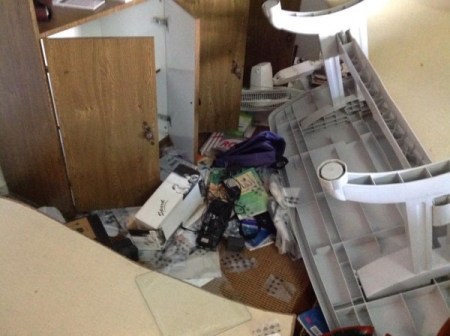
The soldiers upended furniture and destroyed belongings while the Palestinian family was trapped in one room – photo by Mhammad Edies
Israeli forces prevented ISM volunteers from documenting what was happening, pointing their guns and aiming lasers at them, yelling at and detaining those who attempted to leave their house to photograph the raid.
The following morning, a local a human rights activist reported that Israeli occupation forces had raided around 20 houses in Al-Khalil on that same night of the 21st to the 22nd of February alone.
Jewish State forces kill Palestinian teen in Duheisha refugee camp
By Saed Bannoura | IMEMC & Agencies | February 24, 2015
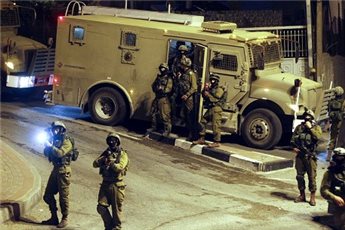 Israeli soldiers invaded the Deheishe refugee camp, in the West Bank district of Bethlehem, shot and killed a Palestinian teen, and wounded several others on Tuesday at dawn.
Medical sources said the slain young man has been identified as Jihad Shehada al-Ja’fary, 19 years of age.
The sources added that al-Ja’fary was shot by a live round that penetrated his left shoulder, and lodged in his chest causing a severe bleeding.
The soldiers prevented Palestinian medics from reaching the seriously wounded man, and he bled to death before the medics managed to move him to the al-Yamama hospital, in Bethlehem.
His body was then moved to the Beit Jala governmental hospital, and will later be moved to a forensic center.
The slain Palestinian was standing on his home’s rooftop, overlooking the main road, when he was shot.
Eyewitnesses said scores of soldiers invaded the camp in an attempt to kidnap a Palestinian, an issue that led to clashes between the soldiers and local youths who hurled stones and empty bottles on them.
The army fired gas bombs, rubber-coated metal bullets and rounds of live ammunition, causing several injuries.
Israeli settlement activities increased by 40% in 2014
MEMO | February 24, 2015
Israeli settlement construction in the occupied Palestinian territories increased by 40 per cent during 2014, Anadolu has reported. According to Israeli NGO Peace Now, which campaigns against illegal settlement construction, Israel started building 3,100 residential units in the Palestinian territories last year. It added that tenders for 4,485 additional residential units were published throughout 2014.
“On 30 January,” notes a Peace Now report, “tenders were issued for 450 more units in the occupied West Bank by the government of Israeli Prime Minister Benjamin Netanyahu.” Between 31 March 2009 and last month, the NGO pointed out, the two governments led by Netanyahu promoted at least 106 construction plans for 13,077 different residential units in 57 settlements.
International law considers the West Bank and East Jerusalem as occupied territories captured by Israel in 1967. All construction of Jewish settlements on the land is illegal. Palestinian negotiators have insisted that the establishment and building of Israeli settlements has to end before the stalled peace talks with Israel can resume.
US Orders PA, PLO to Pay $650 Million for Decade-Old Attacks
Al-Akhbar | February 24, 2015
A US jury on Monday found the Palestinian Authority (PA) liable for six attacks in Jerusalem that killed and injured Americans, awarding victims and their families more than $218 million in damages.
Under the US “anti-terrorism” act, the damages are automatically tripled, meaning that the PA and Palestine Liberation Organization (PLO) are liable to pay more than $650 million.
Israeli authorities welcomed the decision as a “moral victory,” but the Palestinians accused the lawsuit of being politically motivated and vowed to appeal.
The jury reached its verdict following two half-days of deliberations, ending a landmark trial under US district judge George Daniels in New York that lasted more than five weeks.
The six attacks killed 33 people and wounded more than 390 others between January 2002 and January 2004.
The bombings and shootings were carried out by Palestinian resistance movement Hamas and the al-Aqsa Martyrs Brigades — blacklisted as terrorist organizations in the United States — during the second Palestinian uprising against the Zionist state.
The 12-member jury decided unanimously that the PA and PLO were liable on 25 separate counts connected to the six attacks.
They apportioned individual damages ranging from $1 million to $25 million to Americans who were injured or lost loved ones.
The total falls well short of the $1 billion sought by lawyers for 11 plaintiff families when the trial opened in mid-January.
‘Moral victory’ for Israel
Israeli Foreign Minister Avigdor Lieberman welcomed the decision as a “moral victory for the state of Israel and for victims of terrorism.”
“Terrorism is an integral part of the very structure of the Palestinian Authority,” Lieberman said.
US attorney for the plaintiffs, Kent Yalowitz, welcomed the verdict.
“This is a great day for our country, it’s a great day for those who fight terror, we’re so proud of our families who stood up,” he told reporters.
It remains unclear if and how the PA can pay, as it is in serious financial difficulty because Israel has frozen its tax revenues.
Mahmoud Khalifa, Palestinian Authority deputy information minister, expressed dismay at the verdict and vowed to appeal what he called “baseless” charges.
He said the case was politically motivated by “anti-peace factions” in Israel to block a two-state solution to the Israeli-Palestinian conflict.
“We are confident that we will prevail, as we have faith in the US legal system and are certain about our common sense belief and our strong legal standing,” he said in a statement.
The roots of the Israel-Palestine conflict date back to 1917, when the British government, in the now-infamous Balfour Declaration, called for “the establishment in Palestine of a national home for the Jewish people.”
In 1948, with the end of the mandate, a new state – Israel – was declared inside historical Palestine.
In 1988, Palestinian leaders led by Arafat declared the existence of a State of Palestine inside the 1967 borders and the State’s belief “in the settlement of international and regional disputes by peaceful means in accordance with the charter and resolutions of the United Nations.”
Heralded as a “historic compromise,” the move implied that Palestinians would agree to accept only 22 percent, believed to have become 17 percent after massive Israeli settlement building, of historic Palestine in exchange for peace with Israel.
Numerous Palestinian factions, including Hamas, as well as pro-Palestine advocates support a one-state solution in which Israelis and Palestinians would be treated equally, arguing that the creation of a Palestinian state beside Israel would not be sustainable and that it would mean recognizing a state of Israel on territories seized forcefully by Zionists before 1967.
They also believe that the two-state solution, which is the only option considered by international actors, won’t solve existing discrimination, nor erase economic and military tensions.
‘Exaggerated’ testimony
The plaintiffs argued that the PA and PLO should be held responsible for providing material support to the groups responsible for the attacks, blacklisted as a foreign terrorist organizations in the United States.
The court also heard that members of the two groups were on the payroll of the two organizations.
Israeli lawyer Nitsana Darshan-Leitner told reporters in New York that she would leave no stone unturned in forcing the Palestinians to pay.
“We’re going to take steps against their assets, they have assets in the United States, in Israel. We’re going to go after bank accounts and money that they are getting paid on a monthly basis in Israel, for instance.”
Defense attorneys refused to comment after the verdict.
Lawyers for the PA contended during the trial that the leadership should not be held responsible for “crazy and terrible” attacks carried out by people who acted independently.
“There is no conclusive evidence that the senior leadership of the PA or PLO were involved in planning or approving specific acts of violence,” lawyer Mark Rochon argued in court last week.
He said the plaintiffs “exaggerated” testimony to make the Palestinian Authority “look bad” based in part on Israeli intelligence.
The six attacks took place against Hebrew University, in Jaffa Road, King George Street, against the number 19 bus and in French Hills, an illegal Zionist settlement in east Jerusalem.
The trial adds a new dimension to the decades-long Zionist occupation of Palestine and tensions between the Palestinian people and Israel.
Violent practices by Israeli Occupation Forces and illegal settlers against Palestinians are endemic and often abetted by the authorities.
More than 500,000 Israeli settlers live in settlements across the West Bank and occupied East Jerusalem, in contravention of international law.
In 2014, Israeli forces detained 1,266 Palestinian children below the age of 15 in the occupied West Bank and annexed Jerusalem.
According to the PLO, more than 10,000 Palestinian minors in the occupied West Bank and annexed Jerusalem have been held by the Israeli army for varying periods since 2000.
Since September 2000, following the Second Intifada, at least 9,100 Palestinians have been killed by Israelis, including 2,053 Palestinian children, the equivalent of one Palestinian child being killed every three days for the past 14 years.
The verdict came two weeks after the United Nations approved the Palestinian Authority to formally join the International Criminal Court (ICC) on April 1. Although the US claims that the protection of human rights is one of its cornerstones, it slammed the PA’s ICC membership, rejecting the Palestinians’ right to hold Israel accountable for large-scale massacres.
As an ICC member, the PA can open probes into Israeli crimes and rights violations during the Israeli summer assault on Gaza and the period leading up to it.
For 51 days in August, Israel pounded the Gaza Strip by air, land and sea with the stated aim of ending rocket fire from the coastal enclave.
More than 2,310 Gazans, 70 percent of them civilians, were killed, including 505 children, and 10,626 were injured by unrelenting Israeli attacks on the besieged strip.
Israeli PM Benjamin Netanyahu had vowed to push lawsuits in several countries against the PLO in retaliation of the ICC bid.
(AFP, Al-Akhbar)
US arming Israel with additional 14 stealth fighters
Press TV – February 23, 2015
The United States is set to arm Israel with more fighter jets in a three-billion-dollar agreement signed between Washington and Tel Aviv over the weekend.
The deal includes 14 F-35 stealth fighters made by the US company, Lockheed Martin, at a cost of about $110 million each, Israeli officials announced on Sunday.
Other technological and training elements were also included in the military package.
Israel is expected to receive the fighter jets by the end of next year.
The United States provides Israel with some $8.5 million in military aid per day, adding up to over $3 billion annually.
In November, the Department of Defense announced plans to arm Israel with 3,000 smart bombs as part of Washington’s military aid to Tel Aviv.
In December, American lawmakers passed a bill to deepen Washington’s bonds with Tel Aviv, making Israel a “major strategic partner” of the United States.
The US House of Representatives approved the US-Israel Strategic Partnership Act of 2014, which reflects “the sense of Congress that Israel is a major strategic partner of the United States,” and declares Washington’s “unwavering support” for Israel.
The US military aid to Israel has prompted several demonstrations across the country against such deals.
American protesters argue that the US taxpayer money is used for more Israeli aggression against Palestinians.
Hundreds of Palestinians flee as Israel opens dams into Gaza Valley
Ma’an – 22/02/2015
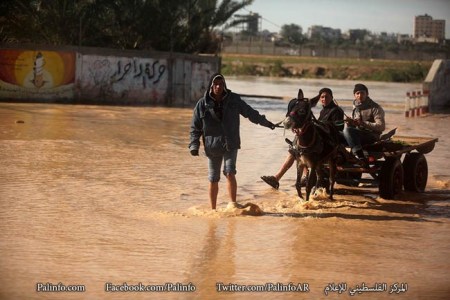
GAZA CITY – Hundreds of Palestinians were evacuated from their homes Sunday morning after Israeli authorities opened a number of dams near the border, flooding the Gaza Valley in the wake of a recent severe winter storm.
The Gaza Ministry of Interior said in a statement that civil defense services and teams from the Ministry of Public Works had evacuated more than 80 families from both sides of the Gaza Valley (Wadi Gaza) after their homes flooded as water levels reached more than three meters.
Gaza has experienced flooding in recent days amid a major storm that saw temperatures drop and frigid rain pour down.
The storm displaced dozens and caused hardship for tens of thousands, including many of the approximately 110,000 Palestinians left homeless by Israel’s assault over the summer.
The suffering is compounded by the fact that Israel has maintained a complete siege over Gaza for the last eight years, severely limiting electricity and the availability of fuel for generators. It has also prevented the displaced from rebuilding their homes, as construction materials are largely banned from entering.
Gaza civil defense services spokesman Muhammad al-Midana warned that further harm could be caused if Israel opens up more dams in the area, noting that water is currently flowing at a high speed from the Israel border through the valley and into the Mediterranean sea.
Evacuated families have been sent to shelters sponsored by UNRWA, the UN agency for Palestinian refugees, in al-Bureij refugee camp and in al-Zahra neighborhood in the central Gaza Strip.
The Gaza Valley (Wadi Gaza) is a wetland located in the central Gaza Strip between al-Nuseirat refugee camp and al-Moghraqa. It is called HaBesor in Hebrew, and it flows from two streams — one whose source runs from near Beersheba, and the other from near Hebron.
Israeli dams on the river to collect rainwater have dried up the wetlands inside Gaza, and destroyed the only source of surface water in the area.
Locals have continued to use it to dispose of their waste for lack of other ways to do so, however, creating an environmental hazard.
This is not the first time Israeli authorities have opened the Gaza Valley dams.
In Dec. 2013, Israeli authorities also opened the dams amid heavy flooding in the Gaza Strip. The resulting floods damaged dozens of homes and forces many families in the area from their homes.
In 2010, the dams were opened as well, forcing 100 families from their homes. At the time civil defense services said that they had managed to save seven people who had been at risk of drowning.
Featured Video
Seyed M. Marandi: US-Iran War Inevitable: Kuwait and Bahrain May Fall
or go to
Aletho News Archives – Video-Images
From the Archives
Oil and the Israel Lobby
Reknowned economist M. Shahid Alam offers this excellent critique of Noam Chomsky’s defective analysis of the relative influence of Oil versus the Israel lobby over US foreign policy: … continue
Blog Roll
 Aletho News
- ICC ignored ‘very well-documented’ NATO crimes – ex-Libyan minister
- SNSC secretary dismisses US response to Iran’s conditions as ‘inadequate’
- Sanaa says Taiz roads open, secure for residents, warns Saudi forces
- Iraqi resistance group urges Saudi leadership to admit defeat, lift Yemen siege
- Trump’s Retreat: How Al-Aqsa Flood Took Down the US Empire
- Israel’s Military Actions in Lebanon Grossly Violate International Law — Lavrov
- Seyed M. Marandi: US-Iran War Inevitable: Kuwait and Bahrain May Fall
- Leaders Condemn Ansarallah Attack on Saudi Arabia While Ignoring Illegal War Against Yemen
- Leaked: Britain’s Covert Iraqi Psyops Network
- Yemeni Armed Forces Warn Airlines Against Using Saudi Airports, Exempt Mecca and Medina
- If Americans Knew
- An error has occurred; the feed is probably down. Try again later.
- No Tricks Zone
- Germany’s Green Energy Debacle: High Energy Costs Force Kahla Porzellan to Close After 182 Years!
- New Study: 50 Years Of The Most Aggressive ‘Net Zero’ Policies Can Only Affect The Global Climate By 0.03°C
- US September “Heat” Was No Record…Many Records Set Decades Ago
- Latest European Green Energy Debacle; Portugal’s Largest Flagship Solar Park Insolvent!
- Green Energy Debacle: German Expert Professor Fritz Vahrenholt Warns Of Severe Economic And Social Consequences
- Two More Paleo Reconstructions Affirm Meters-Higher Sea Levels Across Ireland, Brazil 7000-6000 Years Ago
- New Study: Earth And Venus Surface Warmth Largely Explained By Convection And Lapse Rate, Not CO2 Or Radiation
- 2025 Nature Paper Claiming Worsening Global Drought Gets RETRACTED …Heavily Flawed
- New Study: ‘Global Drought Shows No Detectable Recent Acceleration Under Climate Warming’
- Economic Masterminds: German Socialists Suggest Taxing Productivity Gains Stemming From Using AI

