I have no idea why The USA is so keen on signing Free Trade Agreements (FTA) with other countries
Inca Kola News | November 3, 2014
Not a clue.

Data from here.
Reseacher: Peruvian Government Has Political Debt with Forced Sterilization Victims
teleSUR | October 29, 2014
Eighteen years have passed and those who were forcefully sterilized in Peru have obtained no justice even though the issue was key for the electoral victory of current president Ollanta Humala.
On Wednesday, author and researcher Alejandra Ballon accused the current administration of president Ollanta Humala of using the case of forced sterilizations for political gain and failing to follow through with seeking justice for the victims.
Ballon is the author of the first book on the issue, released earlier this month with the support of the National Library of Peru. It is titled Memoirs of the Peruvian Case of Forced Sterilizations.
Crimes Against Humanity
Over 300,000 people, mostly indigenous women, were forcefully sterilized by the Fujimori regime during the 1990s. The program sought to reduce the number of children in poor rural indigenous families by deceiving and threatening them and even operating on them without them knowing. For those reasons the crimes are being described as genocide.
Sometimes, the signature of the victim’s relatives was used to go ahead with the process without consent. Sometimes the victims were operated on secretly after giving birth. The program was implemented nationally but the methods were not systematic. However, the government gave official quotas to each post for specific periods of time and medical personal were required to comply.
The results were brutal. There are several reports on the effects of such crimes including psychological and physical impairments of the victims and the effects on their relatives. “Women lost their physical strength and could no longer work as farmers, but also many were abandoned by their male partners, and forced to emigrate to the cities,” explained Ballon.
“It is not only the irreversibility of the operation and that women were made sterile against their will, but on top of that there are physical, mental, family, community, agricultural and cultural consequences,” asserts Ballon.
She described a case in Huancabamba where many women were dedicated to sewing using an ancestral, pre-Incan method called Cahihua, which uses the stomach. “It is one of the cultural legacies that we have in the country and we should take care of it,” argues Ballon. However, she explained that this sewing method uses a tool that places pressure on a person’s belly, and after being operated, the pain from the scar would not allow them to sew in that traditional manner. Ballon discovered this problem in 2012 but no systematic method has been implemented to be able to find all the other ways in which this criminal program has affected people’s lives.
The Case of Victoria Vigo
Victoria Vigo is one of the women who was forcefully sterilized. Right after a miscarriage in 1996, doctors secretly mutilated her reproductive organs to comply with the sterilization quota ordered by the regime.
She explains how she found out about her operation. “The doctor who was next to me and taking care of me told another doctor that what is happening is that my baby has passed away,” she explained, and the new doctor “turned around and told me ‘don’t worry you are young and you can have another baby.’” But the first doctor responded, ‘No, she has already been sterilized,’ and that is how I found out what they did to me,” says Victoria.
Victoria explains her feelings at the time. “When one loses a child, a longing to have another child stays… When you lose something you immediately want it. I wanted to have a child … but friends who are doctors talked with me and told me, no Victoria, it is irreversible,” she said.
Political Debt of President Humala
Ollanta Humala picked up the struggle for justice for these cases during his presidential bid. Many believe that such a move gave him the edge to win the election in the second round. He was running against Keiko Fujimori, daughter of Alberto Fujimori, the dictator in charge of the country when the sterilizations took place. During a presidential debate, Humala raised the issue and used it to attack Keiko. However, little has been done after his victory to investigate and obtain justice.
For those reasons, the victims are saying Humala only used them for political gain and he has no interest in their struggle or pain. Ballon has come out in their support. She argues that current president Ollanta Humala has a political debt with these women because he was partly able to win the election by promising in depth investigations into the matter.
Failures of Society
Ballon goes further than pointing out the failures of Humala. She calls these cases the “gravest violations committed against indigenous woman since the colonial times.”
“We are not understanding as a society what we can learn about ourselves through these women. They can tell us about how it was done so that we can learn who we are, what are we doing and to what point can we prevent a future possibility of repeating it.”
Ballon explains that the implementation of the program also shows chauvinism in society. Out of the 300,000 sterilized people, 22,000 were males. “There was gender discrimination in the program even though a man can procreate hundreds of kids and a woman has a limited number of children she can have,” points out Ballon. She concludes that “this is not a result of only the program but the social constructs of the country.”
In a similar way, racism must have been operating in society to permit such crimes. Ballon uses postcolonial theory to explain why indigenous populations, Quechua speaking, were the main target. She explains how hierarchies and racism imposed during colonial times have made committing and justifying such crimes against indigenous populations possible.
The National Library of Peru is investing in a collection of books, including Ballon’s, called La Palabra del Mudo (The Mute Person’s Word) that are using postcolonial theory to record and give voice to those who have not been included in the official histories. The ultimate goals are to strengthen democracy, recover memories, and construct new and inclusive narratives about Peru.
Chile, El Salvador, Peru Recall Israel Envoys in Protest of Gaza Offensive
Al-Manar | July 30, 2014
Chile, El Salvador and Peru have announced they are recalling their ambassadors in Tel Aviv in consultation to protest the Israeli assault on the besieged strip of Gaza.
The moves come on the heels of Brazil and Ecuador, who announced last week that they were recalling their envoys.
“Given the escalation of Israeli military operations in Gaza, the Government of Chile, in coordination with others in our region, has decided to call in consultation Santiago Ambassador of Chile in Tel Aviv, Jorge Montero,” the Chilean foreign ministry in Santiago said in a statement.
“Chile notes with great concern and dismay that such military operations, which at this stage of development are subject to a collective punishment against the Palestinian civilian population in Gaza do not respect fundamental rules of international humanitarian law.”
The Chilean foreign ministry emphasized the more than 1,000 Palestinians killed, including women and children during Operation Protective Edge, which continued for a 22nd day on Tuesday. The statement also noted Israel’s attacks “on schools and hospitals.”
“The scale and intensity of Israeli operations in Gaza violate the principle of proportionality in the use of force, an essential requirement to justify self-defense,” the statement added, referring to rocket fire by the resistance movements in the coastal territory.
El Salvador Ambassador in the Zionist entity Susana Edith Gun was also recalled for “urgent consultations” on Tuesday. The Foreign Ministry of the Central American country said that El Salvador President Sanchez Ceren gave these instructions “over serious escalation of violence and Israel’s bombings in the northern part of the Gaza Strip.”
A similar statement was also published by the Peruvian Foreign Ministry, condemning Israel’s operation in Gaza.
Venezuela and Bolivia that cut their ties with Tel Aviv over Israel’s 2009 war on Gaza have also strongly condemned Israel’s actions.
Brazil, Chile, Argentina, Costa Rica, Cuba, Mexico and Venezuela were among the 29 countries that voted in favor of a probe by the UN Human Rights Council into Israel’s war crimes in Gaza.
Prosecution of Forced Sterilizations in Peru Still Possible
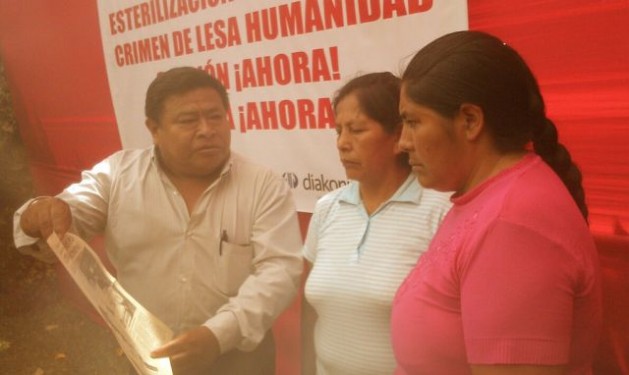
Alfonso Ramos (left) shows a newspaper reporting the death of his sister Celia in Piura due to forced sterilisation. Micaela Flores (centre) and Sabina Huillca are sterilisation victims from Cusco. All three have been waiting for justice for 17 years. Credit: Milagros Salazar/IPS
By Milagros Salazar | IPS | February 6, 2014
Shelving the case of the forced sterilization of more than 2,000 women in Peru during the Alberto Fujimori regime was a surprise move by the prosecutor in charge. What happened? An IPS investigation found that legal avenues to pursue justice have not been exhausted.
On Jan. 24, prosecutor Marco Guzmán announced an end to the investigation of forced sterilizations carried out in Peru between 1996 and 2000. He said he would not pursue criminal charges against Fujimori (1990-2000), three former health ministers and other officials accused of being responsible for the crime.
“The doors were padlocked. They carried me off in a stretcher, tied my feet and cut me.” — Micaela Flores
“They took us in trucks. We got in quite innocently and contentedly. But then we heard screams and I ran… The doors were padlocked. They carried me off in a stretcher, tied my feet and cut me,” Micaela Flores, then a mother of seven from Anta province in the southern region of Cusco, told IPS.
On that occasion about 30 women went to the health center, duped by a campaign offering general check-ups, she said.
Guzmán has decided to prosecute only health personnel in the northern department of Cajamarca. The sterilizations were part of the Voluntary Surgical Contraception Program (AQV – Anticoncepción Quirúrgica Voluntaria), created by Fujimori and his government to bring about a drastic reduction in the birth rate in the poorest parts of the country, especially among rural Quechua-speaking women.
Guzmán, as head of the second supra-provincial prosecutor’s office, assumed the case in July 2013 after the investigation was reopened in November 2012.
There are currently 142 volumes of evidence in this longstanding case. In May 2009 the prosecution shelved the probe into the former ministers and other officials for the first time, in spite of repeated urging for its completion from the inter-American human rights system.
In 2003, the Peruvian state signed a friendly settlement agreement before the Inter-American Commission on Human Rights (IACHR) in the case of Mamérita Mestanza, who died in 1998 as a result of a poorly performed tubal ligation procedure done without her consent.
The government promised to pay an indemnity to her family and investigate and bring to trial the government officials who devised and implemented the forced sterilization campaign.
After years of delays and foot-dragging, human rights organizations had their hopes raised when Guzmán showed interest in investigating Fujimori’s command responsibility for the generalized, systematic practice of sterilizations.
In late November the prosecutor said there were “indications of the alleged participation of Alberto Fujimori in the crimes,” and expanded the investigation into the cases of Mestanza and others.
Rossy Salazar, a lawyer with the women’s rights organization DEMUS who is representing the victims, told IPS that this statement by the prosecutor appears on page 60277 of the file as part of a report on the case addressed to Víctor Cubas, the prosecutor who coordinates all human rights cases.
In an interview with IPS, Guzmán acknowledged having said “there were indications that Fujimori had participated.” At that point he had interviewed over 500 victims, mainly in the northwestern department of Piura and in Cusco, he said, although in his latest 131-page decision he states he only interviewed around one hundred.
Guzmán was also in possession of evidence that the program had targets, incentives, and even sanctions for personnel who did not fulfill sterilization quotas, according to documents obtained by government agencies that investigated the facts of the case.
DEMUS invoked these official documents in an appeal against the prosecutor’s decision to shelve the case, which it presented Jan. 28 before the Office of the Public Prosecutor.
The appeal refers to four letters from the former health minister, Marino Costa, to Fujimori in 1997. In one document the minister reports to the president on the increased numbers of AQV operations performed and says “by the end of 1997 our total production should be fairly close to the target.”
IPS asked Guzmán: “After determining in November that there were indications of Fujimori’s participation, why did you absolve him from responsibility so soon afterwards?”
“In order to examine him I had to interrogate him. I went to interrogate Fujimori and he answered some questions, but not others. For some he invoked the right to silence. Then his defense lawyer gave me a number of documents. This was important because Fujimori had never been questioned about this case before,” he said.
Fujimori’s interrogation on Jan. 15 in the Barbadillo prison, where he is serving a 25-year sentence for human rights abuses, lasted less than three hours. One week later, Guzmán closed the case against the ex president.
“Was your interview with Fujimori decisive for determining whether he participated in the crimes?” persisted IPS.
“It was taken into consideration, but it was not decisive. The decisive thing is the legal package I have to apply… There is no legal support for imputing guilt,” Guzmán said.
The prosecutor argued that Peruvian law does not provide for the crime of forced sterilization, and therefore there is no legal support. In his decision he said the victims’ complaints would not be classed as crimes against humanity, which refer to generalized or systematic attacks on a civilian population and have no statute of limitation.
In international terms, the Rome Statute, which established the International Criminal Court, does recognize the crime of forced sterilization. The statute entered into force in Peru in July 2002, after the sterilizations were committed and denunciations were initiated, but “the international community has regarded forced sterilization as a crime since the early 1990s,” Salazar said.
In its appeal, DEMUS argues that the prosecutor’s decision “should not halt the criminal investigation.” It is “only the first step in the search for truth” and does not end the evidence collection phase. DEMUS asks for a higher level prosecutor to bring charges so that the case can continue. Another means of re-opening the case would be for another victim to bring a new complaint.
DEMUS also plans to bring the case to the attention of the IACHR in March.
On Jan. 31, an article by Guzmán was published in the newspaper El Comercio, saying that “the only way Fujimori could be held responsible is by demonstrating command responsibility, and according to the Constitutional Court the requirements for this are not fulfilled, because there is no rigid vertical structure involved, and doctors cannot be obliged to operate against their will.”
“They are isolated cases,” he told IPS.
According to the Health ministry, 346,219 sterilizations were performed on females and 24,535 on males between 1993 and 2000, 55.2 percent of them in the period 1996-1997 alone. During that period an average of 262 tubal ligations were carried out a day.
More than 2,000 persons were documented to have been deceived or threatened into undergoing sterilization. Women in Cusco were among the worst affected, because on average nearly five operations a day were performed there, according to Health ministry figures and the testimony of victims.
Sabina Hillca, from Huayapacha in the Cusco region, told IPS that she set out for the health center in Anta when she was due to give birth to her daughter, Soledad, but the birth happened on the way.
The nurses told her she should stay to be “cleansed” and avoid infection. The next day she woke up crying, with sharp pain, an incision close to her navel, and tied to the bed. Afterwards she fled to her village, cleaned the wound with soap and water, removed the stitches as best as she could, and went to her mother for herbal treatments.
“Now I have cancer because dry blood collected in my ovaries,” she said, showing the dark scar on her abdomen.

South America: UNASUR To Build Fibre-Optic ‘Mega Ring’
By Chelsea Gray | The Argentina Independent | August 21, 2013
 The Union of South American Nations (UNASUR) has approved plans for an optic fibre mega-ring which will break its members’ “dependence on the US, and provide a safer and cheaper means of communication.”
The fibre optic ring will become part of a ten-year plan to physically integrate all 12 UNASUR member states. The line, which will reach up to 10,000 kilometres long and will be managed by state enterprises from each country it crosses, is expected to interconnect South America through higher coverage and cheaper internet connections.
Industrial Minister of Uruguay, Roberto Kreimerman, explained that “it is about having a connection with great capacity that allows us to unite our countries together with the developed world.”
He continued to say, “We are considering that, at most, in a couple of years we will have one of these rings finalised.” He also added that ”I think the economy, security, and integration are the three important things we need in countries where Internet use is advancing exponentially.”
At the moment, up to 80% of Latin America’s communications go through the US. However, plans for an independent communication line comes shortly after the US was discovered to have been spying on Latin American data. The National Security Agency (NSA) were revealed to have been monitoring emails and intercepting telephone logs, spying on energy, military, politics, and terror activity across the continent.
UNASUR is made up of Argentina, Bolivia, Brazil, Chile, Colombia, Ecuador, Guyana, Paraguay, Peru, Suriname, Uruguay, and Venezuela.
UNASUR to Create Military Force
By Laura Benitez | The Argentina Independent | May 9, 2013
The Union of South American Nations (UNASUR) has announced that it will create a united defence body to promote democratic stability among its member countries.
Military delegates of Argentina, Brazil, and Ecuador concluded a two day meeting yesterday in Quito, and agreed on creating the first South American Defence College (ESUDE) – a safety training centre with the aim of turning “the regions into a zone of peace”.
UNASUR has said that the idea behind the project is to “eliminate outdated visions that have formed our military, with manuals and taxes from foreign powers.
“The goal is to start from scratch and consider a defence doctrine, without starting from the premise of opposing countries. It is important to define our role in the military, to assume responsibility for prevention, border control or emergency responses.
“We want to create a body of higher and postgraduate education to create a regional identity for civilians and our military, and to avoid interference of other countries or geopolitical zones,” a UNASUR spokesperson said.
The ESUDE proposal paper will be presented at the next meeting of the executive body for the South American Defence Council in Lima, Peru on the 16th and 17th May. Members who attended yesterday’s meeting in Quito will meet again during the second week of July in Buenos Aires, to define the Esude proposal.
One of the issues that is expected to be up for debate in the following meetings is the level of participation in the armed forces from each country.
The initiative already has the support of other member countries, including Argentina, Brazil, Ecuador, Peru, Venezuela, Guyana, Suriname, and Uruguay.
Related articles
- UNASUR Urges Respect for Venezuela’s Electoral Results (venezuelasolidarity.co.uk)
- U.S. refuses to recognize Maduro’s presidential win in Venezuela polls (panarmenian.net)
Peru: scandal over Israeli security contractor
WW4 Report – 03/31/2013
Peru’s Congress has opened a high-profile investigation into a contract with Israeli security firm Global CST, entered into by the previous government of Álan García, an audit by the Comptroller General of the Republic found irregularities in the deal. The probe concluded that the Peruvian state had lost $16 million when the firm failed to fulfil terms of its contract with the Armed Forces Joint Command. A congressional oversight commission has questioned three former cabinet members in the scandal—ex-housing minister Hernán Garrido, and ex-defense ministers Ántero Flores Aráoz and Rafael Rey—as well as ex-Joint Command chief Gen. Francisco Contreras. Special anti-corruption prosecutor Julio Arbizu has called on García himself to testify before what is being called the Mega-Commission, and for the attorney general’s office, or Fiscalía, to investigate the former president.
Global CST, whose founder and director is IDF reserve Gen. Israel Ziv, was secretly contracted in 2009 to help Peru’s military fight remnant Sendero Luminoso rebels in the Apurímac-Ene River Valley (VRAE). Testimony and documents confirm that Rey exchanged communication directly with Israel’s then-foreign minister Avigdor Lieberman over the deal, and called upon him to pressure CST’s competitor Armaz to drop out of the bidding process. According to testimony, Garrido also helped Global CST arrange a similar deal with the government of Colombia before recommending the firm to Peru’s own armed forces.
Also named is ex-admiral Carlos Tubino, now a lawmaker for the Fuerza Popular party, headed by Keiko Fujimori, daughter of imprisoned ex-dictator Alberto Fujimori. Both Fujimoristas and supporters of García’s APRA charge that the investigation is politically motivated. (IPS, La Primera, March 22; Perú21, March 15; Perú21, March 8)
Controversy also surrounds contracts with the Israel Corporation, which has bought into Peru’s energy sector.
BBC & Travel Channel show ‘staged, false, fabricated and distorted’
Survival International | August 2, 2011

Matsigenka girls, Peru © G Shepard/ Survival

A TV series about an Amazonian tribe has been slammed as ‘staged, false, fabricated and distorted’ by experts on the tribe.
‘Mark & Olly: Living with the Machigenga’ was shown on the Travel Channel in the US, and on the BBC last year. In the show Mark Anstice and Olly Steeds lived in a Matsigenka Indian village for several months to show the ‘reality’ of life among the tribe.
But now two experts on the tribe have gone public with a string of highly damaging accusations. Dr. Glenn Shepard is an anthropologist who has worked with the Matsigenka Indians for 25 years and speaks their language fluently. Ron Snell, the son of US missionaries, grew up with the tribe and and is also fluent in the Matsigenkas’ tongue.

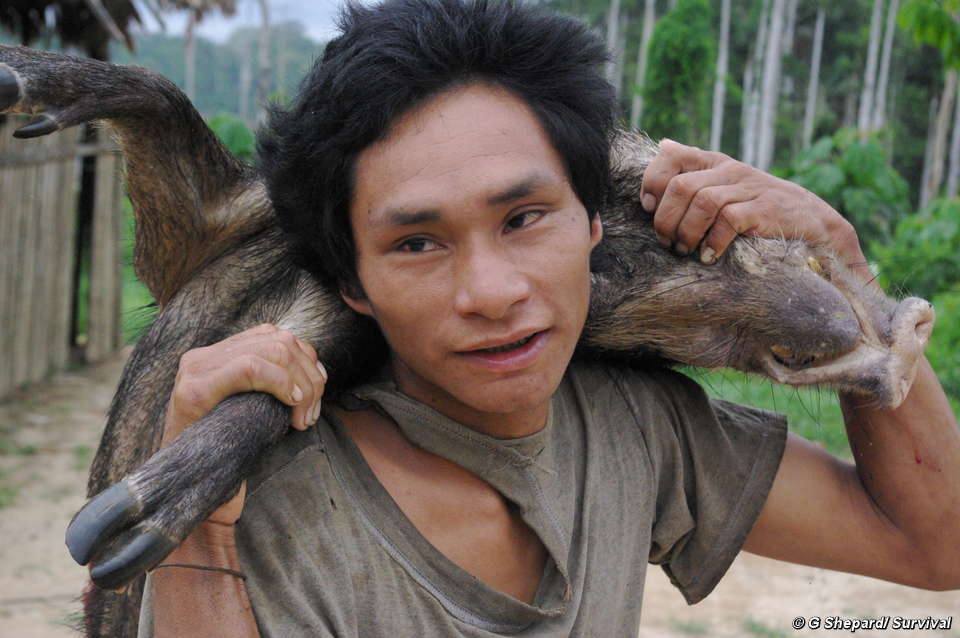
A Matsigenka hunter returns with wild pig.© G Shepard/ Survival
Just some of Shepard’s accusations, published in the highly-respected journal Anthropology News, are:
• In order to present a ‘false and insulting’ portrayal of the tribe as sex-obsessed, mean and savage, many of the translations of what the Indians are saying are fabricated.
• Many events presented as real in the show must have been ‘staged’.
• A key scene in the show in which Olly is subjected to painful ant stings, since “according to Matsigenka tradition he must be cleansed” and “endure the ancient punishments” for buying deer meat is denounced by Shepard as ‘fabricated and [with] no basis in ethnography.’
Ron Snell, in an article on his blog, accused the film-makers of ‘paying the Machiguengas to perform for them, saying things the Machiguengas wouldn’t ordinarily say and doing things the Machiguengas wouldn’t normally do.’
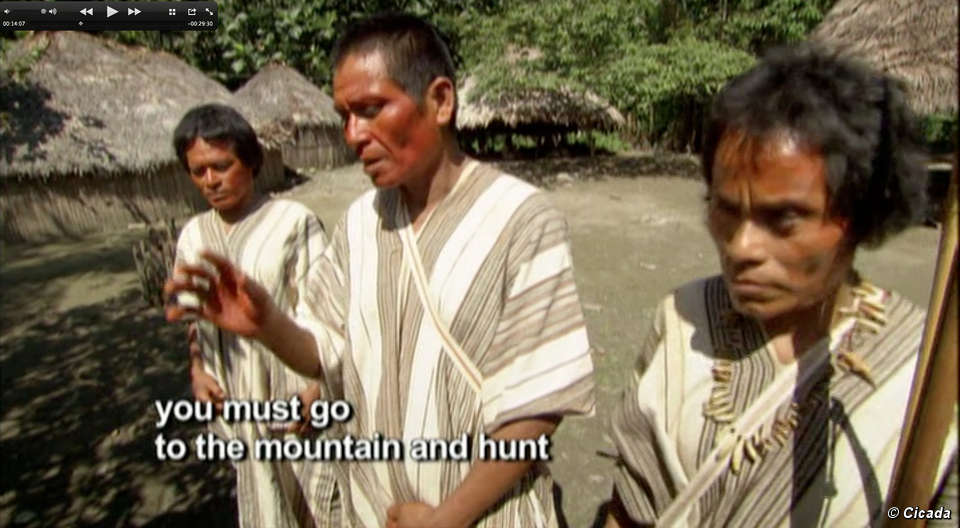
After interviewing two of the Indians in the series, Snell reported, ‘Our suspicions were correct. They [Mark and Olly] entered the village on a well traveled path and only veered a few feet off the path to film themselves ‘hacking their way through the jungle.’ They contracted someone to make new cushmas [cotton tunics] so everyone would be wearing one. They staged the whole drama about one of the guys being accepted and the other treated as a lazy outsider…
‘The translator quickly became disillusioned with the whole thing, but kept going because of the money. He is ashamed and embarrassed that he had anything to do with it.’
The series was previously at the centre of a media storm when a scouting expedition for the show was accused in Peru of provoking a flu epidemic among isolated Indians which caused the deaths of four of them. The show was eventually filmed a short distance from this incident.

The Matsigenka were repeatedly mistranslated in the series © Cicada
Cicada, the production company responsible for the series, has made no comment on the accusations.
Stephen Corry, Director of Survival, said, ‘‘Mark & Olly: Living with the Machigenga’ was a depressing example of the way tribal people are routinely portrayed on TV. One stereotype followed another, with the Matsigenka variously portrayed as callous, perverted, cruel, and savage. Is this what the film crew really thought of those whose guests they were? Broadcasters wouldn’t dare to make similarly false claims about other such minority groups: imagine the same descriptions applied to any ethnic minority in the industrialized world. Sadly this is all too common – TV is now getting away with portrayals which wouldn’t be out of place in the Victorian era.’
In response to a worrying trend to portray tribal peoples in a negative manner, Survival is drawing up a code of practice for documentary makers to follow when filming with them.
A background briefing with further examples of mistranslations and inaccuracies in the show is available to download here.
Note to Editors:
1. The tribe’s name is today usually spelt Matsigenka. Previously, Machiguenga was more common. Machigenga, as used in the Mark and Olly TV show, is incorrect.
2. Dr. Glenn Shepard is an ethnobotanist and medical anthropologist who specializes in the indigenous peoples of the Amazon. He has published more than 50 scientific papers and is currently a researcher in Indigenous Ethnology at the Museu Paraense Emilio Goeldi in Belém, Brazil.
3. Ron Snell grew up with the Matsigenka, where his parents were missionaries. He is the author of several books about his childhood there, and still visits the area regularly. He is now the director of a homeless people’s shelter in Nebraska, USA. His mother, who has also watched the series and corroborates the accusations, is the author of a 900-page Matsigenka dictionary.
4. A longer version of Dr. Shepard’s article can be found on his blog: ethnoground.blogspot.com
Related article
- ‘Noble Savages’: Chagnon’s new book triggers resignation and protests (alethonews.wordpress.com)
Featured Video
No Threat Can Force Iran’s Surrender /Trita Parsi & Lt Cl Daniel Davis
or go to
Aletho News Archives – Video-Images
From the Archives
An Expert Military Analysis of War with China
Actually, None is Necessary
By Fred Reed • Unz Review • December 13, 2020
The Correlation of Armed Forces: U.S. goods and services trade with China totaled an estimated $634.8 billion in 2019. Exports were $163.0 billion; imports were $471.8 billion. The U.S. goods and services trade deficit with China was $308.8 billion in 2019. Trade in services with China (exports and imports) totaled an estimated $76.7 billion in 2019. Services exports were $56.5 billion; services imports were $20.1 billion. The U.S. services trade surplus with China was $36.4 billion in 2019.
There is talk within the Washingtoniat of a possible war with China. Steve Bannon, who apparently was dropped on his head as a child, actually favors such a war. We hear the usual shoo-the-boobs alarm about how the Chinese are doing something terrible and we must gird our loins and American values and show them what for, bow wow, woof. The danger is that the current game of who-blinks-first in Asian waters might actually provoke a shooting war. You know the kind of thing: One warship refuses to get out of the way of another, a collision ensues, some retard lieutenant who signed up on waivers opens fire, and we’re off and running. It is not a good idea to let children play with matches.
The said war is discussed either in emotional terms by idiots or in purely naval terms by those familiar with such things, so we hear of the First Island Chain and the Second Island Chain and whose missiles against the other’s missiles and so on. This would be appropriate if we were fighting World War Two again. Which we aren’t. Let’s take a quick-and-dirty look at how such a war might go.
To begin the war, America would overestimate itself and underestimate China. This is doctrine in the Pentagon. … continue
Blog Roll
 Aletho News
- Iran To Target Military Industrial-Tech Complex That Facilitated Gaza Genocide
- Collapsing Empire: The Resistance Disarms ‘Israel’
- Suicide Should Not Be a Government Service
- Rethinking America’s greatest threat: Iran vs. Israel-Firsters
- Iran accuses adversaries of false flags to strain Turkey ties
- Poland rules out sending Patriot missiles to US/Israel amid war on Iran
- Tehran approves new Hormuz plan with major restrictions
- No Threat Can Force Iran’s Surrender /Trita Parsi & Lt Cl Daniel Davis
- UK’s New Pandemic Plan Would Turn Big Tech Into a Mass Location Tracking Network
- Growing insecurity, soaring prices fuel protests in north as regime bans evacuation: Sources
- If Americans Knew
- Ann Coulter Rips Into Fox News for Iran War Coverage, Compares to False Rigged 2020 Election Reporting
- Joe Kent Urges Americans To Call White House and Congress To Object To Sending Troops Into Iran
- DNC Resolution to Reject AIPAC Funding Puts Democratic Leaders in the Hot Seat
- Swedish foundation to build 400 schools as over 650,000 Gaza children remain without education for 2 years
- Israeli army admits photshopping image of slain Lebanese journalist
- This is how Israel is systematically killing health workers under the cover of war in Lebanon
- Carrying life under fire: Israeli invasion of Lebanon leaves pregnant women facing deadly risks
- Champagne all around for the new death penalty (for Palestinians) law – Not a ceasefire Day 172
- Why are Palestinian books struggling to be seen on Amazon?
- The Line Between Affinity and Conspiracy
- No Tricks Zone
- New Study Finds Warming Saves Lives…Cold Temperatures 12 Times More Deadly Than Excess Heat
- German Science Blog Accuses PIK Climate Institute Of Hallucinating Climate Tipping Points
- Devastating Assessment Of Comirnaty Vaccine By Former Senior Pfizer Europe Toxicologist
- New Study: CO2 Is ‘Effectively Negligible’ As An Explanatory Climate Change Factor Since 2000
- Former Pfizer Toxicologist Dr. Helmut Sterz Tells Bundestag Hearing Pfizer Vaccine Should Have Never Been Approved
- Energy Expert: Germany’s Nuclear Phaseout Was A “500 Billion Euro Mistake”
- New Research: South Australia’s Mid-Holocene Sea Surface Temperatures Were 4°C Warmer Than Today
- Storing Green Energy To Last Germany 10 Days Would Require A 60-Million Tonne Battery
- New Studies: UK Sea Levels Were 4 Meters Higher Than Today During The Mid-Holocene
- Destructive Green New Deal: German Energy And Metal Group Warns Of Drastic Crisis
 Aletho News