Russian forces ruin one-third of Ukraine’s Bradleys – media
RT | July 16, 2023
The vaunted Bradley Fighting Vehicle (BFV), which was touted as a potential “game-changer” when Washington agreed to give dozens of the machines to Ukraine earlier this year, has reportedly had trouble staying in action amid fierce resistance from Russian forces during Kiev’s counteroffensive.
At least 34 Bradleys “have now been visually confirmed as having been abandoned, damaged or destroyed,” Business Insider reported on Saturday, citing “open-source” data from military research firm Oryx. The US has supplied as many as 109 BFVs to Ukraine, the outlet added, and they were first deployed on the battlefield in April.
Most of the losses occurred during the early days of the counteroffensive, which began last month, as Ukrainian forces tried to cross territory that was heavily mined by Russian troops, Business Insider said. The latest loss estimate was similar to that in a report on Saturday by the New York Times, which said Ukraine’s NATO-trained 47th Mechanized Brigade had lost 30% of its Bradleys in just two weeks.
The BFV is a tracked and lightly armored vehicle with the capability to transport about ten soldiers and mount weaponry such as a 25mm cannon and a TOW anti-tank missile launcher.
When the administration of President Joe Biden agreed in January to send BFVs to Kiev, the Pentagon touted the vehicles as “tank-killers” and claimed they would provide “a level of firepower and armor that will bring advantages on the battlefield.” US media outlets such as Newsweek cited military experts as saying the Bradleys “could become a game-changer,” potentially even enabling Ukraine to retake Crimea. Russian officials warned that the BFVs and other Western-supplied weaponry would “only prolong the suffering of the Ukrainian people.”
With dozens of Bradleys and other hardware being knocked out of action by Russian forces, Ukrainian units have been forced to abandon their armored vehicles and advance slowly on foot, the Washington Post reported on Saturday. “You can no longer do anything with just a tank with some armor because the minefield is too deep, and sooner or later, it will stop, and then it will be destroyed by concentrated fire,” Ukraine’s top general, Valery Zaluzhny, told the newspaper.
Nevertheless, a new $800 military aid package for Ukraine announced by the Biden administration earlier this month includes an additional 32 BFVs. The US also agreed to send cluster bombs to Kiev, citing disappointment with the counteroffensive.
Russian President Vladimir Putin has warned that US shipments of cluster munitions to Ukraine would constitute a war crime. As for captured Western weaponry, such as BFVs, Russian specialists will use “reverse engineering” to adopt any military technology that might be useful to Moscow, Putin said in an interview aired on Sunday.
What is behind the current tension in Turkish-Iranian relations?
By Alexandr Svaranc – New Eastern Outlook – 16.07.2023
Turkey and Iran continue to be important Middle Eastern nations. Due to their geographical proximity, imperial past, violent rivalry, theological tensions (between Sunnism and Shiism), and, of course, the continuous divergence of geopolitical interests, both nations have a rich history of relations.
There were multiple Turkish-Persian clashes and wars, with various interruptions and varying degrees of success, during the Ottoman and Persian empires. Regarding the significance of the harem in the Ottoman Empire, historians have observed that, unlike the Turkish-Persian conflicts, which occasionally came to an end during periods of truce, the harem wars continued unabatedly. The reasons for these wars were varied, with religion often becoming a justification for the ambitions of Istanbul or Tehran. As a rule, it was a struggle for the right to own border territories from the Caucasus to Asia Minor, for the right to control strategic trade and military communications (for example, the area between Tigris and Euphrates, Eastern or Western Armenia and Syria).
In fact, such a confrontation lasted from the Middle Ages until World War I. The long military and political conflict between the Persians and Turks in such important regions, where the interests of the leading powers of Europe and Russia were represented, led to the establishment of a special international border commission with the participation of Britain and Russia at the turn of the twentieth century to facilitate the delimitation of Persia and the Ottoman Empire. But because London and St. Petersburg had their own distinct interests in the Near and Middle East, this commission never accomplished its mission.
There were also more stable times between Iran and Turkey in the new era. After World War II, from 1955 to 1979, Tehran and Ankara became even politico-military allies in the CENTO (Central Treaty Organization or Baghdad Pact) regional bloc, which emerged thanks to the Middle East diplomacy of Britain and the United States. While the Shah’s regime in Iran remained an ally of the West and Iranian oil and gas were exploited in the interests of London and Washington, Tehran was a regional partner of NATO member Turkey.
The situation changed after the February 1979 revolution in Iran, as the overthrow of the pro-American Shah’s regime and the ascension to power of the Shiite mullocracy brought about a major change in the disposition of forces in the Middle East. Since then, there have been renewed notes of mistrust and tension in Iranian-Turkish relations across the Middle East and global agenda, some of which remain relevant to this day.
It cannot be said that pragmatism in the approaches of Turkey and Iran has lost importance after the overthrow of Shah Reza Pahlavi. Despite harsh anti-Iranian sanctions, Ankara was forced to retain trading with Iran and keeps shipping gas in varying volumes due to its limited own energy supplies.
With the change of political regime in Iran after the 1979 revolution in Kemalist Turkey, where the secular regime suppressed the sprouts of Islamic revival, the politicization of Islam (albeit of Shiite origin) in the 1980s and 1990s still influenced the public consciousness of the Turkish masses in favor of the growing role of religion in the state.
The Kurdish issue remains a common concern between Turkey and Iran. Ankara and Tehran oppose all forms of Kurdish statehood and threats of ethnic separatism. However, in the situation of the Kurds after the 1979 Islamic Revolution in Iran there have been some changes. Some experts believe, not unreasonably, that the phenomenon of the Shiite revolution in February 1979 has both external and internal justifications.
The external reason was to prevent the leading Anglo-Saxon countries (the US and Britain) from monopolizing and plundering Iran’s strategic resources (oil and gas), as well as to prevent the corrosive influence of Western pop culture on the minds of Iranian youth and the general population. The internal reason, however, was related to the idea of preventing the weakening and collapse of Persian statehood under the threat of ethnic separatism with different colors (Kurds, Azeris, Baluchis). At the same time, Islam, namely political Shiism, assumed the religious consolidation of Iranian society regardless of ethnic origin.
Following the revolution’s victory, Iranian leader Ayatollah Khomeini summoned Mustafa Barzani, the leader of Iraq’s Kurdistan Region, then in exile, to Tehran for a final settlement of the Kurdish crisis on an Islamic basis. According to some reports, such an agreement was accepted by a Kurdish politician, but he never made it to Tehran. CIA handlers then announced an emergency surgery on Mustafa Barzani, but the surgery ended in his death.
The main contradictions between Tehran and Ankara include Turkey’s continued membership in NATO and Shiite-Sunni religious differences between different madhhabs. At the same time, as key countries in the Middle East region, it is natural that Turkey and Iran have different approaches on a number of regional topics (including the Syrian crisis, the situation in Libya and Iraq, and the relationship with Pakistan). The adjacent territories of the South Caucasus and Central Asia occupy a distinctive place in this package of contradictions following the breakup of the Soviet Union and the parade of sovereignties of post-Soviet states.
First, Iran is concerned about the renaissance of Turkey’s pan-Turkic and pan-Turanist ambitions toward the Turkic countries of the CIS, which could seriously weaken Iran’s position if the Turan project succeeds.
Second, Tehran watches with great caution the geo-economic projects in the Caspian energy region, which with the collapse of the Soviet Union and the weakening of Russia got a start and developed thanks to the joint initiatives of Turkey and its NATO allies (primarily, the UK and the US). At the same time, this concern of the Persian state is determined not only, or rather, not so much by the considerations of the new direction of oil and gas exports to Turkey as by Ankara’s plans to create alternative energy transit routes bypassing Russia and Iran to bring exporters from Turkic countries to world markets (especially to Europe) and turn the Turkish territory into a major hub. In other words, Iran, as an oil and gas-rich country, is concerned about the geopolitical consequences of transformations in the South Caucasus and Central Asia in favor of the strengthening of Turkey, the United States and Britain.
Third, taking into account the Turkish-Azerbaijani tandem that has formed on Iran’s northern borders, Tehran is anxiously observing the trend of Israel showing up along the Iranian-Azerbaijani border line on the Arax River, the increased intelligence presence of the Mossad and Aman in the same Azerbaijan with the approval of NATO member Turkey.
Fourth, there is now a certain geopolitical rivalry between Turkey and Iran, with a religious connotation in as yet predominantly Shiite Azerbaijan. Given that the Azerbaijani authorities have based their relations with Turkey on the pan-Turkic slogan and the principle of “one nation, two states,” Iran notes the active political persecution of Azerbaijani Shiites (including often with accusations of spying for IRI) by Baku. Moreover, IRGC sources in Azerbaijan note an increasing number of cases of religious interference by Turkey in the Sunnization of Azerbaijani Shiites. Tehran sees all these actions as an attempt by Ankara to weaken the influence of Shiite Iran in this Transcaucasian republic.
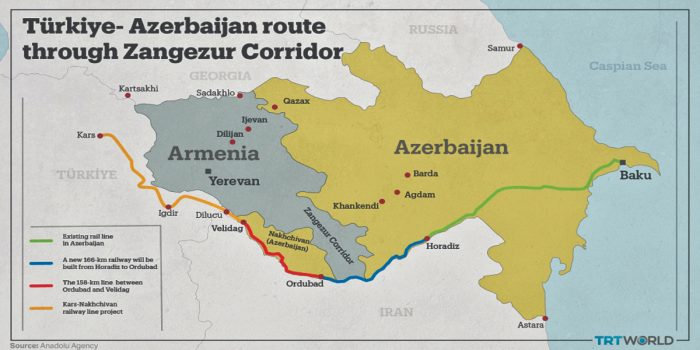
After Recep Tayyip Erdoğan’s victory in the elections and his visit to Baku, assessing the situation with the Zangezur corridor in Armenia, the Turkish leader, not by chance, stressed that the main reason for blocking this corridor was not Yerevan, but Tehran. Iran indeed publicly through the mouths of Ayatollah Ali Khomenei, President Ibrahim Raisi and Foreign Minister Hossein Amir Abdollahian has repeatedly noted that for it the Zangezur corridor remains a “red line,” it is unacceptable to change the borders of neighboring republics of the South Caucasus (in particular, Armenia) and it is important to maintain the direct multi-millenial border of Iran with Armenia.
Tehran does not want NATO to strengthen in the region on the shoulders of its member Turkey, nor does it want to see the Turan project implemented with pan-Turkic content. Otherwise, Iran will be blocked by unfriendly forces on its northern borders, including the emergence of a bridgehead of Zionist Israel on the banks of the Arax River.
With his statement, Erdoğan not only expresses his dissatisfaction with the regional policy of Iran that three Muslim states (Turkey, Azerbaijan, and Iran) through the fault of Persians can’t solve the road question peacefully and get economic dividends but actually says that Iran is not allowing the Turkish-Azerbaijani tandem to start a war with Armenia again and take by force the Meghri segment of the Zangezur corridor (if not all of Zangezur – Syunik Province) from the latter.
Given that Russia is now forced to engage in the western flank of the geopolitical confrontation with the West in Ukraine and is therefore interested in maintaining a partnership with Turkey for the same transit and out into the world, it cannot strain relations with Ankara in Armenia (Transcaucasus). Iran becomes the main opponent of Turkey in this theater.
In the second half of June 2023, Turkey and Azerbaijan announced the formation of a unified system of control and management of airspace from the Aegean Sea to the Caspian Sea according to NATO standards (the Turkish HAKİM Air Command Control System). The latter is practically capable of establishing airspace control in the South Caucasus region and threatening not only Armenia but also Iran. Given the existence of a common air defense system between Armenia and Russia within the CSTO, such a move by the tandem of Ankara and Baku is in some ways a challenge for Russia’s regional interests as well.
Since the beginning of 2023, trade turnover between Iran and Turkey has decreased by 20%, where the main export commodity for the Turkish side remains gas. Apparently, such a decline in economic relations between these countries was the result of a number of objective and subjective reasons (such as the crisis in the energy market due to anti-Russian sanctions and rising prices, the earthquake and rising inflation in Turkey, the devaluation of the Turkish lira, and Ankara’s pressure on the issue of the Zangezur corridor). In response to Moscow’s proposal to create a gas hub in Turkey, Iran came up with an equally ambitious similar project in the Persian Gulf. All these processes testify to the growing Iranian-Turkish contradictions.
Moreover, the information about the ongoing closed-door talks between Iran and the USA on the subject of the deblocking of Iranian assets in exchange for American prisoners and, most importantly, about the end of the “tanker war” between Tehran and Washington in the waters of the Strait of Hormuz and the Gulf of Oman and the export of Iranian oil to world markets (as we know, in the USA itself there is a rise in gasoline prices and an increasing need for oil) creates additional tension in Turkish politics as well.
The US is not yet interested in the implementation of alternative communications from China to Europe through the territory of Turkey (under the One Belt, One Road Initiative). Perhaps Washington is proposing an Indian project through Iran to Europe as an alternative to Chinese transit. And in this geographic preference of the states, a new confrontation between Iran and Turkey is created.
Accordingly, if Iran develops strategic partnerships with countries such as China and India, and can establish certain relationships with the US administration on the nuclear program and oil exports, Turkey will find it difficult to count on success in a battle with Tehran. Moreover, today’s Iranian authorities are interested in strengthening President Erdoğan’s policy independent of the United States, which makes it possible to weaken Washington’s pressure on the region. These are the complicated patterns of the contemporary geopolitical mosaic in the Greater Middle East.
Aleksandr SVARANTS, PhD in political science, professor.
Russia Could Reverse Engineer Its Trophy NATO Weapons – Putin
By Ilya Tsukanov – Sputnik – 16.07.2023
The Western alliance has sunk tens of billions of dollars’ worth of weaponry into Ukraine over the past year, including everything from outdated 1960s junk to the latest high-tech systems. Russian forces have managed to capture some of this equipment in fierce battles with Ukrainian forces and mercs.
Russian President Vladimir Putin doesn’t rule out the reverse engineering of NATO equipment captured in Ukraine in cases where doing so could improve Russia’s own weapons.
“There’s the expression ‘reverse engineering’. We’ll see what happens, because modern equipment… we have it, and it’s very effective, let’s take the T-90 Proryv tank for example, which is the best tank in the world without any exaggeration. But the enemy also produces modern equipment. And if there’s an opportunity to look inside and see if there’s something there that we can use, well, why not?” Putin said in an interview with Russian television on Sunday.
The United States and its European and Asian allies have committed over $94.5 billion in military aid to Ukraine over the past 18 months, far outstripping the size of Russia’s entire defense budget of $56.6 billion. These expenditures, which included the delivery of some of NATO’s most cutting-edge, battle-tested equipment, have nevertheless failed to enable Ukrainian forces to puncture Russian defensive lines in the Donbass, Zaporozhye and Kherson.
NATO powers have committed everything from Leopard 2 tanks (including some of their latest modifications) to Bradley infantry fighting vehicles, Stryker armored fighting vehicles, ATACMS rocket launchers, Caesar howitzers, Storm Shadow cruise missiles, NASAMS and Patriot air defense systems, with some countries sending virtually their entire stockpiles of some of these weapons. NATO has also sent a range of modern man-portable weapons, including Panzerfaust and Javelin anti-tank missiles, Stinger anti-aircraft missiles, and a range of drones, jamming equipment, radar, engineering and other equipment.
Some of these weapons, including everything from Javelins and Stingers to Bradleys and Leopards, have been captured by Russian forces, with some equipment now serving with Russian forces.
No fertilizer exported from Russia under grain deal – media
RT | July 15, 2023
Not a single vessel carrying Russian fertilizer has been dispatched since the adoption of the Black Sea grain deal last year, Russian news agencies reported on Saturday, citing the Joint Coordination Center (JCC) for the initiative.
Enabling fertilizer exports from the sanctioned country was one of the conditions for the UN-brokered agreement that allowed for the safe passage of ships carrying Ukrainian grain via the Black Sea. The deal was extended several times and is due to expire on Monday.
“The agreement of July 22, 2022 allows the export of [Russian] fertilizers, including ammonia, however not a single ship with fertilizers has been dispatched within the framework of the initiative,” the JCC said, as quoted by RIA Novosti.
The Coordination Center also reportedly noted that fertilizer exports depend on the condition of a key ammonia pipeline on Ukrainian territory. A section of the Togliatti-Odessa pipeline was sabotaged last month, and according to the report, “at the moment its status is unknown.”
The conduit has been inactive since the start of the Ukraine conflict last year, and Moscow has repeatedly demanded that Kiev unblock the pipeline as a condition for renewing the grain deal. The route has big significance for agriculture, as ammonia is crucial to fertilizer production.
Russian President Vladimir Putin said on Saturday that the grain deal has failed to remove the barriers to the export of Russian grain and fertilizer. Talking to South African President Cyril Ramaphosa, Putin added that the pact has also failed to deliver on its goal of supplying grain to the poorest nations.
Earlier this week, the Russian leader said that Moscow may suspend its participation in the grain deal until Western sanctions on its agricultural exports are lifted.
The Joint Coordination Center on the Black Sea Grain Initiative was founded in July 2022 in Istanbul. JCC comprises representatives of Ukraine, the Russian Federation, Türkiye, and the United Nations.
‘20% of Ukrainian weapons destroyed in just two weeks’
RT | July 15, 2023
The Ukrainian military lost 20% of the equipment it sent to the battlefield during the first two weeks of its counteroffensive, the New York Times reported on Saturday. This high attrition rate was reportedly a key factor in Kiev’s decision to pause the operation.
Beginning in early June, Ukrainian forces launched a series of attacks all along the front line from Kherson to Donetsk. Advancing through minefields and without air support, the Ukrainian military lost 26,000 men and more than 3,000 pieces of military hardware, according to the latest figures from the Russian Ministry of Defense.
Ukrainian losses were at their highest during the initial two weeks of the offensive, the New York Times claimed, citing unnamed American and European officials. These officials said that up to 20% of Ukraine’s tanks and armored vehicles were destroyed in this period, including many Western-provided vehicles.
For some units, Western equipment was lost at an even higher rate, the Times continued, citing figures from a pro-Ukrainian organization. Ukraine’s 47th Mechanized Brigade – a NATO-trained unit – apparently lost 30% of its 99 Bradley Infantry Fighting vehicles in two weeks, while the 33rd Mechanized Brigade lost nearly a third of its 32 German-made Leopard tanks in a single week.
“They all burned,” said one Ukrainian soldier who witnessed at least six Western vehicles destroyed in a single Russian artillery barrage. Another Ukrainian fighter told the Times that his unit’s Bradleys run over anti-tank mines on a daily basis. While the troops inside often survive, the vehicles are left immobilized long before they reach Russian lines.
According to Russian President Vladimir Putin, Russian forces have destroyed a total of 311 Ukrainian tanks since June 4. “At least a third of them, I believe, were Western-made tanks, including Leopards,” Putin told Russia 24 TV on Thursday.
After the first two weeks, Ukrainian commanders decided to pause the counteroffensive, and losses subsequently dropped to 10%, the Times claimed. President Vladimir Zelensky acknowledged the pause this week, but blamed the West for failing to supply him with enough weapons and equipment for a successful operation.
With little territorial gain to show for Kiev’s losses, Western officials have expressed disappointment at the pace of the offensive, according to a steady trickle of media reports since mid-June. Zelensky and some of his top officials still insist that the decisive phase of their counteroffensive has yet to begin.
Meanwhile, Ukraine’s Western backers are running low on ammunition, particularly 155mm artillery shells. US President Joe Biden admitted this week that “we’re low” on these shells, explaining that the shortage compelled him to send controversial cluster munitions in their stead. The US has also stalled on approving the training of Ukrainian pilots on F-16 fighter jets, something that Kiev insists will help restart the faltering counteroffensive.
Drone Crashes Close to Kursk Nuclear Plant, No Damage Reported
Sputnik – 14.07.2023
VORONEZH, Russia – A drone crashed in the Russian town of Kurchatov a few kilometers from the Kursk NPP, no one was injured and no critical facilities were damaged, Kursk Region Governor Roman Starovoit said Friday.
“At night, a UAV crashed in the town of Kurchatov. Fortunately, none of the residents were hurt. Critical objects were not damaged as a result of the drone’s crash and its subsequent detonation,” Starovoit wrote in his social media account.
According to available information, an aircraft-type drone that exploded near a residential building in the city Kurchatov fell a few kilometers from the Kursk NPP. ️The head of Rosatom – Russian atomic agency – assured that all measures to ensure the safety of Russian nuclear power plants had been taken, and “the situation is under control.”
Earlier, in April, a drone attack on the Kursk NPP was repelled by air defense forces.
Another three drones were intercepted by air defenses in the Voronezh Region on Thursday, governor Alexander Gusev said.
“Yesterday, air defense systems detected and destroyed three UAVs several kilometers off Voronezh. There are no victims, injured or destruction. I keep the situation under personal control,” Gusev wrote on Telegram on Friday.
Kremlin Slams Ukrainian Drone Attack
Ukraine does not stop attempts to strike, but Russian air defense systems are working effectively, appropriate measures are being taken, Kremlin spokesman Dmitry Peskov commented on the situation.
“Well, it is obvious that the enemy does not give up attempts to strike. But all our air defense systems are working, working efficiently, demonstrating their effectiveness over and over again, and appropriate measures are being taken,” Peskov told reporters.
Western media calls Baltic Sea “NATO lake” after summit in Vilnius
By Lucas Leiroz | July 14, 2023
The Western mainstream media is enthusiastic about the possibility of Sweden joining NATO and consequently making the country’s Baltic coast a zone of control for the alliance. Analysts are saying that the West’s moves in Vilnius have made the Baltic Sea a “NATO lake”. The words are bold and somewhat inaccurate, as they do not seem to adequately echo the actual strategic situation in the region.
On July 13, Politico published an article about how Russia would be at a disadvantage in the Baltic after an eventual Swedish entry into the alliance. The article states that with the addition of Finnish and Swedish militaries the Baltic will become a region of absolute Western control, where Russia will have no room for maneuvers and will be heavily affected in case there is a conflict in the future.
“[Sweden and Finland] make NATO much more geographically coherent. The Baltic Sea becomes a NATO lake, which is generally useful, also because of the Arctic’s increased importance”, Ulrike Franke, a senior fellow at the European Council on Foreign Relations, told Politico’s journalists.
In the same vein, Kristine Berzina, managing director for the German Marshall Fund’s Geostrategy North, stated:
“You need to have enough in place that, in case of a Crimea or a Ukrainian scenario, there’s actual ability to defend territory (…) With Finland and Sweden in, and [the Swedish Baltic island of] Gotland so close to Kaliningrad, in case of highly unlikely yet possible aggression from Russia, Russia cannot use the sea to its strategic advantage as it could right now.”
In fact, the words of journalists and analysts echo NATO’s official position. On the same day that the Politico article was published, NATO Secretary General Jens Stoltenberg stated at a press conference in Vilnius:
“Sweden has a strong, professional, well-trained defense and is strategically located at the Baltic Sea … The borders with Norway and Finland allow for better coordination of land troops. In addition, there is Sweden’s Navy in the Baltic Sea … The entire territory of Sweden is of interest.”
In fact, despite commenting on a real problem for Russia – its disadvantaged situation in the Baltic Sea -, Western analyzes seem too outdated and banal. For example, this Russian disadvantage in the region did not start now, but between 1999 and 2004, when, breaking the promise of non-expansion, NATO granted access to Poland and the Baltics. During the Cold War, the USSR had a status of control in the Baltic, as only West Germany and Denmark – in the extreme west of the Sea – were members of NATO. But since the end of the 1990s the scenario has been reversed and Russia is indeed at a disadvantage.
NATO’s presence in the region has always been favored by Sweden and Finland, which have always been extremely politically, economically, militarily and culturally integrated to the Collective West, regardless of formal affiliation to NATO. For Moscow, as emphasized several times, the entry of Sweden and Finland into the military alliance means nothing, since both countries were already de facto members of the Collective West, with the admission sounding like a mere bureaucratic procedure. So, the Russian disadvantage in the Baltic will not be really increased by this.
However, it must be emphasized that Russia’s situation of disadvantage in the Baltic is of little significance because Moscow, as explained in several official declarations, does not have a foreign policy focused on Western Europe, but on its own strategic environment in the East. Russia does not see NATO’s presence in the Baltic Sea as a threat as big as the one posed by the alliance in Kiev. Ukraine is historically, ethnically and culturally part of the Russian civilization, in addition to its borders being at short distance from Moscow – a different scenario from that of the Baltic and Scandinavian nations.
Russia is only interested in the military presence in the Baltic from a defensive point of view. In other words, if NATO launches an aggression against the country, Moscow will use all possible means to reverse its disadvantage in the region by gaining territorial control. In this scenario, the naval environment will not be the only one relevant, according to some specialists, and Russia will be able to use its land and air forces to neutralize the hostile countries in the region.
American war veteran and former UN inspector Scott Ritter, for example, commented on the topic on his social networks, stating that “[In case of war] The Baltics will be overrun, Finnish coast occupied, Sweden neutralized. You [Western analysts] focus on the sea; a future war will be won on the ground and in the air.”
In this sense, the Western media’s belief that the Baltic Sea has become a “NATO lake” seems irresponsible and illogical optimism. It is a complex and disputed scenario in which Russia has been at a disadvantage for years, but over which it could regain control in a scenario of open conflict, where it would be able to use all its land and air forces in combination with its fortified navy from the Kaliningrad exclave. Furthermore, it must be remembered that in the North there is the Arctic, an area of great Russian presence, which would certainly help to reduce the effects of a “western siege” in this hypothetical scenario.
This, however, would only happen in case of an aggression from NATO, as Russia has no plans to expand to the West.
Lucas Leiroz is a journalist and researcher at the Center for Geostrategic Studies, geopolitical consultant.
Saudi imports of Russian fuel soared tenfold in June
The Cradle | July 13, 2023
Saudi Arabia imported record levels of Russian fuel oil in June, bringing in 910,000 metric tons, a nearly tenfold increase from the same period last year, to meet summer power generation needs.
Since the start of 2023, Saudi imports of Russian fuel have nearly doubled from last year. As of June, the kingdom imported 2.86 million metric tons of fuel oil, exceeding the 1.63 million metric tons imported for all of 2022.
Alongside many countries in the Global South, the kingdom has been ramping up its purchases of discounted Russian fuel over the past several months, allowing Moscow to negate much of the effects of western sanctions and a G7 price cap imposed on their energy sector.
The news comes just over a month after Saudi officials announced plans to cut oil production levels by an extra one million barrels per day (bpd) in July – a cut that came on top of a massive reduction in oil output implemented since last October by OPEC+ member states, including Russia.
In May, Bloomberg reported, “Saudi Arabia is snapping up millions of barrels of Russian diesel that Europe no longer allows, while simultaneously sending its own supplies back to buyers in the EU.”
Traders and analysts believe the kingdom has been conducting this scheme to generate higher profits by taking advantage of western sanctions.
India and China are two other nations taking advantage of the situation, buying as much as 80 percent of the oil that Moscow exported in May.
“In May 2023, India and China accounted for almost 80 percent of Russian crude oil exports,” the Paris-based International Energy Agency (IEA) said in a report.
Russian fuel exports to Africa have also skyrocketed over the past year, increasing nearly 14-fold since the start of the war in Ukraine. Before March 2022, Moscow exported 33,000 bpd of refined products to African nations; by March 2023, exports soared to 420,000 bpd.
Putin comments on the future of the grain deal
RT | July 13, 2023
Russia is considering putting its participation in the UN-facilitated grain deal on hold until its food and fertilizer exports are unblocked, President Vladimir Putin said on Thursday. None of the promises made to Moscow under the agreement have been fulfilled as of yet, he said, adding that the deal has been a “one-way street case.”
Moscow may no longer be willing to extend the agreement just out of hope that the Western nations and the UN fulfill their end of the bargain, the president said. “We can suspend our participation in this deal,” he said, adding that “everyone is once again telling [us] that all the promises made will be kept.” “Let them deliver on this promise first; then we’ll immediately return to the deal again,” Putin maintained.
Formally known as the Black Sea Initiative, the agreement between Moscow and Kiev was mediated by the UN and Türkiye back in summer 2022. The deal was accompanied by a Russia-UN memorandum aimed at facilitating unimpeded Russian agricultural exports.
The goals of the memorandum included allowing Russia’s major agricultural lender, Rosslekhozbank, back onto the SWIFT payments system, enabling deliveries of spare parts for agriculture machinery, reanimating the Tolyatti-Odessa ammonia pipeline, sorting out insurance and logistics, as well as “unfreezing” Russian assets.
According to Putin, none of those aims have been achieved as of now. “Nothing – and I want to underscore it – nothing has been done. That was a one-sided game all along. Not a single goal linked to the interests of the Russian Federation was met,” he said, adding that Moscow had repeatedly extended the deal in good faith despite those facts.
The president also said he had not seen a letter UN Secretary General Antonio Guterres sent him earlier this week. The UN said earlier that the letter contained suggestions aimed at fulfilling the Russia-UN memorandum and preserving the deal. The international body also said that Moscow had allegedly received the letter and was reviewing it.
The deal was originally touted as a way to avoid a food crisis by steering grain toward poor nations. Yet, according to Moscow, only a tiny percentage of the grain exported from Ukraine as part of the agreement was shipped to such nations, while the bulk of it ended up in Europe.
“Out of all the foodstuffs and grain in particular shipped away from the Ukrainian territory, only slightly more than three percent were delivered to the world’s poorest nations,” the Russian president said on Thursday. Now, many European nations have started forgoing Ukrainian grain, he told the Russian media, adding that it is the West and not Russia that “started discriminating against Ukrainian grain.”
Originally intended to last three months, the deal was prolonged numerous times over the past year, despite growing concerns repeatedly voiced by Moscow over its failure to provide any benefits for Russia. The Kremlin has repeatedly warned over the past month that it sees no reason to extend the deal, which is set to expire on July 17.
NATO Spent Decades Preparing For Proxy War With Russia in Ukraine
By Ekaterina Blinova – Sputnik – 12.07.2023
Even before the Ukraine conflict escalated in February 2022, Britain, Sweden, Canada, and the United States were investing in Ukraine and building up their capabilities, the UK defense minister has stated at the NATO summit in Vilnius. Does it mean NATO has long prepared for a proxy war with Russia?
The US neocons and their likeminded NATO allies have long been apparently seeking to knock Russia out of the political arena before trying to crack down on China in a bid to preserve the US dominance, retired US Air Force Lt. Col. Karen Kwiatkowski believes.
“I think that the US officials and advisors (along with those in NATO) believe that they must be able to exploit Russian resources prior to any direct confrontation with China,” Kwiatkowski, who is also a former analyst for the US Department of Defense, told Sputnik. “The neoconservative ideology that over half of Congress embraces, and that the US defense and security complex embraces, envisions and demands a unipolar globe, with the US and its debt-funded governmental system, at the top. For them, this is an existential issue, albeit most Americans don’t see it that way.”
It seems that Ukraine appeared a convenient candidate for the role of a “hammer” against Russia.
For How Long Has Ukraine Received Western Military Assistance?
Ukraine has been a leading recipient of Western military supplies since the early 1990s when the country gained independence, with the US spearheading the initiative. In the first ten years after independence, Ukraine received almost $2.6 billion in assistance from the US. Until 2014, Ukraine had been receiving an estimated $105 million per annum, including foreign military financing.
NATO’s North Atlantic Cooperation Council embraced Ukraine as a “partner country” in 1991 and included it in the Partnership for Peace program in 1994. Washington’s NATO ally, the UK, played an important role in the effort, holding joint military exercises with the Ukrainians, as well as providing training and funding to the nation’s armed forces.
Thus, the first joint Ukrainian-British military exercises “Cossack steppe” were held in the second half of the 1990s as part of NATO’s Partnership for Peace program. The NATO-Ukraine Commission was established in 1997 with the aim of developing the relationship between the nation and the bloc and directing cooperative activities.
As per UK government documents, the Ministry of Defense spent approximately £3.9 million supporting Ukraine through the Defense Assistance Fund and the Conflict Pool between 2009 and 2014.
Many of the activities funded through these mechanisms supported “command, control and communications capabilities (C3).” In particular, the UK held joint exercises with the Ukrainian military, provided military education to the nation’s specialists, and “contributions to NATO coordinated activities.” Both UK civilian and military personnel had been deployed to Ukraine during that period of time while Ukrainian personnel were sent to the UK.
Following the illegitimate coup d’etat in Kiev in February 2014, the West stepped up military assistance to the new Ukrainian authorities.
Between 2014 and 2021, the United States provided over $2.5 billion in military assistance to Ukraine, which included the provision of trainers, selected weaponry systems (such as counter-mortar radars), and Javelin anti-tank missiles.
The boost in military assistance was justified by NATO member states by the alleged “Russian invasion” in Donbass. However, it is well documented that Donbass declared independence in response to the illegitimate coup d’etat in Kiev fomented with the assistance of nationalist and neo-Nazi paramilitary groups and subsequent Russophobic policies of the new government. The Donbass breakaway Donetsk and Lugansk Republics started largely forming militias after the interim Kiev government kicked off what it called “anti-terrorist” operations (ATO) against the region.
“Kiev had been on the offensive with the Donbass with Western support, for a number of years, even before 2014, and this is well documented,” explained Kwiatkowski. “Other Eastern and Southern European countries had been ‘encouraged’ by Western powers, as we saw with Yugoslavia, to break up into smaller national and ethno-cultural countries, and the peaceful divide between the Czech Republic and Slovakia was also allowed and supported. This is primarily because the newly smaller countries added potential members to NATO and the EU – all controlled and controllable by the US-EU elites.”
Moscow came up with the idea of the Minsk Agreements to stop hostilities in Eastern Ukraine. Russia, France and Germany played the role of guarantors of the accords.
Nonetheless, as ex-German Chancellor Angela Merkel and former French President François Hollande admitted last year, the Minsk agreements were signed by Western powers to buy time in order to bolster the Ukrainian military capacity.
“In the case of the political separation desired by the Donbass, and the Minsk agreements that were designed to allow that autonomy, the Russian-speaking East, if autonomous, would not have chosen to be a part of the NATO borg,” said the former Pentagon analyst. “Hence, that independence would not be allowed. Yes, NATO and the US supported such an offensive, and were preparing for it actively, as comments from many US and European officials and diplomats have confirmed. Assistant US Secretary of State Victoria Nuland and former German Chancellor Angela Merkel have publicly confirmed this, as have many others.”
Ukraine Extensive Training and Naval Provocations
US allies jumped on the bandwagon, forwarding their military assistance to Ukraine through the NATO-Ukraine Commission, and through initiatives such as the US/Canada/UK/Ukraine Joint Commission for Defense Reform and Security Cooperation which was established in July 2014.
In particular, Britain kicked off and then expanded Operation Orbital, envisaging extensive training of the Ukrainian military including combat actions in urban environments.
These activities included:
· medical, infantry and survival skills training;
· countering improvised explosive devices;
· training for defensive operations in an urban environment;
· operational planning;
· engineering;
· countering attacks from snipers, armored vehicles and mortars.
It meant that those Ukrainian soldiers that had undergone training under the program would pass on their knowledge and techniques to their military peers. Britons also expanded the scope of the training package to embrace all branches of Ukraine’s Armed Forces.
In June 2020, Ukraine was offered Enhanced Opportunity Partner status with NATO which provided Ukraine with preferential access to NATO’s exercises, training and exchange of information and situational awareness. The status envisaged increasing interoperability between Ukraine and NATO member states. In September 2020, Ukraine hosted the Exercise Joint Endeavour with British, US and Canadian troops, held within the framework of Ukraine’s new enhanced NATO status.
In June 2021, the UK, Ukraine and industry signed a Memorandum of Implementation to a new Naval Capabilities Enhancement Program (NCEP). The program in particular included:
· Ukraine’s acquisition of two refurbished Royal Navy Sandown-class minehunters;
· the sale and integration of missiles on new and in-service Ukrainian Navy patrol and airborne platforms, including a training and engineering support package;
· The UK’s assistance in building new naval bases in the Black and Azov Seas;
· the development and joint production of eight fast missile warships;
· The participation in the Ukrainian project to deliver a modern frigate capability.
The same month, the UK Carrier Strike Group led by HMS Defender was deployed in the Black Sea “in a show of solidarity with Ukraine” and illegally entered Russian waters off Crimea and proceeded to sail through, prompting Russian warships and aircraft to surround the ship and fire warning shots in its vicinity to force it to leave. Even though the UK initially denied that it resorted to deliberate provocations, leaked British government documents proved otherwise.
Russia’s Draft Security Agreements
Russia has repeatedly raised the red flag over the NATO-Ukraine rapprochement and the transatlantic bloc’s enlargement. In accordance with its Declaration of State Sovereignty (July 16, 1990) Ukraine pledged to permanently remain a neutral country. In addition, in the early 1990s, Western powers asserted to Moscow that NATO wouldn’t expand towards Russia. At the same time, the US and its allies refused to consider Russia’s bid to join NATO while encouraging former Soviet Republics and Warsaw Pact member states to join.
Russia outlined its longstanding concerns with regard to Ukraine’s military buildup on its doorstep and NATO’s expansion in draft security agreements which were handed over to the US and NATO in December 2021.
The agreement particularly sought guarantees of NATO’s non-enlargement and non-admission of Ukraine to the bloc. The US and NATO rejected the major provisions of the agreement leading to Russia’s special military operation aimed at de-militarizing and de-Nazifying Ukraine in February 2022.
Ukraine Conflict is US/NATO Proxy War Against Russia
Even though in March 2022, Ukraine and Russia struck a preliminary deal in Istanbul to stop hostilities, the US and the UK openly opposed the agreement, pledging more weapons to Kiev and declaring the goal of bleeding Russia white.
“The US is waging a proxy war, because that is what the US has been waging against various named enemies, for the past 70 years, and it is how we are organized to fight,” said Kwiatkowski. “It is an open secret that the Pentagon, even with close to a trillion dollar budget, does not and, at this point, cannot defend US territory. The US elites and the US defense establishment self-perpetuation is wholly disconnected from the people here who pay its bills. Poor and non-strategic US leadership placed the US in a lose-lose situation.”
According to the US military expert, three problems have emerged in the result of Washington’s misreading of the Russia and Ukraine conflict:
· First, that intent of weakening and isolating Russia did not play out “as it must have done in Jake Sullivan’s brainstorming sessions.”
· Second, the supplies have illustrated a variety of strategic weaknesses in US and NATO defense industrial production, where we see Joe Biden actually stating the obvious that the “US is out of ammunition.”
· Third, taking the Ukraine-Russia destruction project on at a time when the US is experiencing financial weakness, with very limited reserves of gold, guns and “war spirit” demonstrates that the “war planning” of the White House and Pentagon has been done in a vacuum, and under false assumptions.
As per Kwiatkowski, peace is possible but it may require a difficult re-evaluation of the US role in the world while neocons and war profiteers do not accept this re-evaluation.
“Their ideology is mated to unipolar US power,” the US military veteran said. “I suspect some leaders in the West are beginning to understand that there is a way to peace, and it starts with acceptance of the truth of all sides, and negotiations based on that truth. Imagine a sane US government, a concerned NATO, a true patriot of Ukraine in Kiev, and the Russians all speaking honestly. As Trump stated months ago, this war could be ended in one day.”
Germany creates equity in Western Ukraine
BY M. K. BHADRAKUMAR | INDIAN PUNCHLINE | JULY 13, 2023
The hypothesis that the Anglo-Saxon axis is pivotal to the proxy war in Ukraine against Russia is only partly true. Germany is actually Ukraine’s second largest arms supplier, after the United States. Chancellor Olaf Scholz pledged a new arms package worth 700 million euros, including additional tanks, munitions and Patriot air defence systems at the NATO summit in Vilnius, putting Berlin, as he said, at the very forefront of military support for Ukraine.
German Defence Minister Boris Pistorius stressed, “By doing this, we’re making a significant contribution to strengthening Ukraine’s staying power.” However, the pantomime playing out may have multiple motives.
Fundamentally, Germany’s motivation is traceable to the crushing defeat by the Red Army and has little to do with Ukraine as such. The Ukraine crisis has provided the context for accelerating Germany’s militarisation. Meanwhile, revanchist feelings are rearing their head and there is a “bipartisan consensus” between Germany’s leading centrist parties — CDU, SPD and Green Party — in this regard.
In an interview in the weekend, the CDU’s leading foreign and defence expert Roderich Kiesewetter (an ex-colonel who headed the Association of Reservists of the Bundeswehr from 2011 to 2016) suggested that if conditions warrant in the Ukraine situation, NATO should consider to “cut off Kaliningrad from Russian supply lines. We see how Putin reacts when he is under pressure.” Berlin is still smarting under the surrender of the ancient Prussian city of Königsberg in April 1945.
Stalin ordered 1.5 million Soviet troops supported by several thousand tanks and aircraft to attack the crack Nazi Panzer divisions deeply entrenched in Königsberg. The capture of the heavily fortified stronghold of Königsberg by the Soviet army was celebrated in Moscow with an artillery salvo by 324 cannons firing 24 shells each.
Evidently, Kiesewetter’s remarks show that nothing is forgotten or forgiven in Berlin even after 8 decades. Thus, Germany is the Biden Administration’s closest ally in the war against Russia. The German government has stated its understanding for the Biden administration’s controversial decision to supply Ukraine with cluster ammunition. The government spokesman commented in Berlin, “We are certain that our US friends did not make their decision lightly, to deliver this sort of munition.”
President Frank-Walter Steinmeier remarked, “In the current situation, one should not obstruct the USA.” Indeed, the top CDU figure Kiesewetter suggested in an interview with the Green Party-affiliated daily taz that not only should Ukraine be given “guarantees, and if necessary, even provided with nuclear assistance, as an intermediary step to NATO membership.”
Coinciding with the NATO summit in Vilnius (July 11-12), Rheinmetal, the great 135-year old German arms manufacturing company, has disclosed that it is opening an armoured vehicle plant in western Ukraine at an undisclosed location in the next twelve weeks. To begin with, German Fuchs armoured personnel carriers will be built and repaired while there are plans afoot to manufacture ammunition and possibly even air defence systems and tanks.
Rheinmetall’s CEO told CNN on Monday that like other Ukrainian arms factories, the new plant could be protected from Russian air attack. Germany has more than doubled the 2022 allocation of €2 billion for upgrading Ukraine’s armed forces. It now touches around €5.4 billion with further plans to increase to €10.5 billion.
Now, is this all about Russia? Germany cannot be unaware that Ukraine has simply no hope on earth to defeat Russia militarily. Germany is playing the long game. It is creating equity in western Ukraine where it is not Russia but Poland that is its contender. Ever since the Tsarist army advanced into Galicia in 1914, Russia has had a difficult history with Ukrainian nationalists. If the current war in Ukraine spreads to western Ukraine, that cannot be Russia’s choice but out of some necessity forced upon it.
The Soviet victory in Ukraine in October 1944, the Red Army’s occupation of eastern Europe, and Allied diplomacy resulted in a redrawing of Poland’s western frontiers with Germany and Ukraine’s with Poland. Simply put, with compensation of German territories in the west, Poland agreed to the cession of Volhynia and Galicia in western Ukraine; a mutual population exchange created for the first time in centuries a clear ethnic, as well as political, Polish-Ukrainian border.
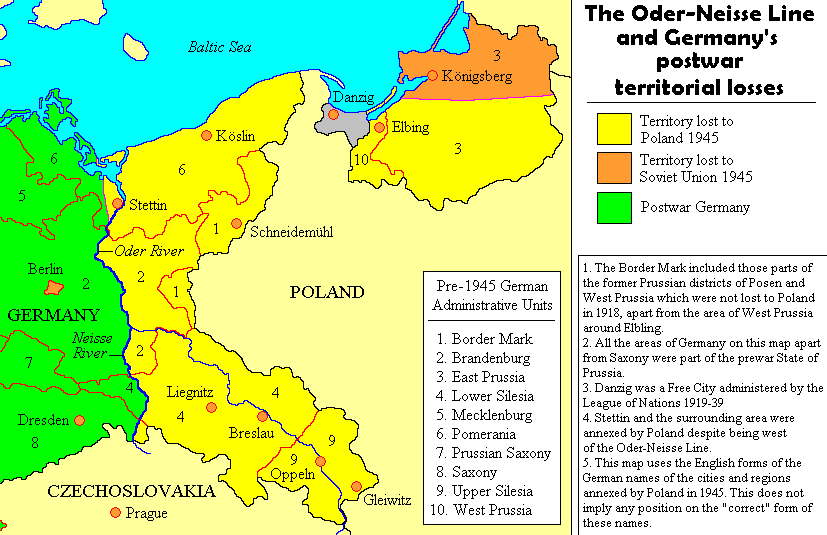
It is entirely conceivable that the ongoing Ukraine war will radically change the territorial boundaries of Ukraine in the east and south. Possibly, it can re-open the post-WW II settlement with regard to western Ukraine as well. Russia has repeatedly warned that Poland aims to reverse the cession of Volhynia and Galicia in western Ukraine. Such a turn of events will most certainly bring to the fore the issue of the German territories that are part of Poland today.
Perhaps, it was in anticipation of turbulence ahead that last October, eight months after the Russian intervention began in in February, Warsaw demanded WWII reparations from Berlin — an issue which Germany says was settled in 1990 — to the tune of €1.3 trillion.
Under the Potsdam Conference (1945), the “former eastern territories of Germany” comprising nearly one quarter (23.8 percent) of the Weimar Republic with the majority ceded to Poland. The remainder, consisting of northern East Prussia including the German city of Königsberg (renamed Kaliningrad), was allocated to the Soviet Union.
Make no mistake about the importance of the Eastern border for German culture and politics. Indeed, there is always something volatile about a “handicapped” Great Power when a whole new intensity appears in political, economic and historical circumstances, which prompts those in power to turn ideas into reality, and revanchist and imperialistic discourses that were quietly but steadily streaming below the surface of the carefully considered diplomatic efforts begin to probe pan-nationalist expansion.
In retrospect, Germany’s — in particular, then foreign minister and current president Steinmeier’s — diabolical role to align Germany with the neo-Nazi elements during the regime change in Kiev in 2014 and the subsequent German perfidy in the implementation of the Minsk Agreement (“Steinmeier formula”), as admitted recently in February by former Chancellor Angela Merkel should not be forgotten.
Suffice to say, even as Russia is winning the Ukraine war, the concern of the German foreign policy makers once again faces the need to redefine what was German. Thus, the war in Ukraine is only the means to an end. Recent reports suggest that Berlin may be moving, finally, toward meeting Ukraine’s pending demand for Taurus cruise missiles with a range exceeding 500 kms and unique “multi-effect war head” that can be a game changer in the combat dynamics on the battlefield and create the prerequisites for victory.
Equally, German soldiers already comprise about half of the NATO battlegroup already present in Lithuania. Defense Minister Boris Pistorius said two weeks ago while on a visit to Vilnius that Germany is preparing the infrastructure to permanently base 4,000 soldiers (“a robust brigade”) to Lithuania so as to have the capability to maintain military flexibility at the Eastern flank. The decision has support from both Germany’s governing coalition and its main opposition.
The CDU foreign policy expert and member of the Bundestag, Kiesewetter called the idea of establishing a German base in the Baltics a “decision of reason and reliability.” Indeed, there have been past attempts, historically speaking, to create German rule in the Baltics based on revisionist claims towards the new states of Estonia, Latvia and Lithuania where German colonists had settled as far back as in the 12th and 13th centuries.
Featured Video

EUROPE FEARS RUSSIA’S NEXT MOVE / Ian Proud
or go to
Aletho News Archives – Video-Images
New Book
New Book: No Autoimmunity The Body Doesn’t Attack Itself
Lies are Unbekoming | September 24, 2026
 The label for Humira, once the best-selling drug in the world, lists its risks in plain print. One of them, in the label’s own words, is new “autoimmune” disease.
A drug prescribed for a condition labelled autoimmune carries a warning that it can cause a condition labelled autoimmune. That contradiction sits in every box, on a folded paper almost nobody reads.
My new book starts there.
No Autoimmunity: The Body Doesn’t Attack Itself
For seventy years, “your body is attacking itself, and we don’t know why” has ended the conversation for people diagnosed with multiple sclerosis, lupus, rheumatoid arthritis, Hashimoto’s, Type 1 diabetes, Crohn’s and psoriasis. More than eighty conditions now carry the autoimmune label. The diagnosis comes with a prescription for life. It almost never comes with a question about cause.
This book asks the question and answers it from the framework’s own records: its drug labels, its journals, its regulatory filings, and its own experiments. … continue
Blog Roll
 Aletho News
- Israeli settlers terrorize West Bank Palestinians with state-provided drones: Report
- They see them, then kill them: Israeli quadcopters track, deliberately target civilians in Gaza
- Debunked: Trump’s egregious UNGA claims on war against Iran crumble under scrutiny
- Europe was part of the infrastructure of US aggression against Iran: Deputy FM
- New evidence on the Bucha Massacre
- Italy and France debunk reports CIA issued ‘Russian drone threat’ warning
- How Russia is Rewiring the Global South
- Britain’s elites want you ready to die for a war they keep imagining
- Inside Ukraine’s propaganda operation targeting Americans
- Hackers From US, France, Singapore Tried to Disrupt Russian Elections – Internet Provider
- If Americans Knew
- An error has occurred; the feed is probably down. Try again later.
- No Tricks Zone
- New Study: Earth And Venus Surface Warmth Largely Explained By Convection And Lapse Rate, Not CO2 Or Radiation
- 2025 Nature Paper Claiming Worsening Global Drought Gets RETRACTED …Heavily Flawed
- New Study: ‘Global Drought Shows No Detectable Recent Acceleration Under Climate Warming’
- Economic Masterminds: German Socialists Suggest Taxing Productivity Gains Stemming From Using AI
- The South China Sea Has Not Been Cooperating With The Climate Change Narrative
- Energy Crisis: Germany Enters Heating Season With Historically Low Gas Reserve Fill Levels
- New Study: The Antarctic Ice Sheet Gained Mass From 2020-2024 Due To Staggering Snow And Ice Accumulation
- Study: Ocean Heating Rates From Thousands Of Years Ago ‘Dwarf’ Modern Ocean Heating Rates
- Climate Extremists Target, Attack Large-Scale Power Grid Infrastructure In Germany!
- New Study: Antarctic Ice Melt Has Contributed Less Than 1 Centimeter To Sea Level Rise In The Last 30 Years

