Medvedev names ‘red line’ for direct war with NATO
RT | March 2, 2023
Canadian and German troops teaching Ukrainians how to use Leopard tanks already qualifies as participation in the conflict, but sending fighter jets to Poland would mean “direct entry,” former Russian President Dmitry Medvedev said on Thursday.
Medvedev, who is also deputy chair of the Russian Security Council, warned the US and its allies that they can be treated as parties to the conflict “if, in addition to supplying weapons, they train personnel to operate them,” citing legal precedents from the early 20th century.
Tank training on EU territory already applies, Medvedev noted on Telegram, but if that expands to fighter jets based somewhere in Poland, “that would be direct entry of the Atlanticists into war against Russia, with all the consequences that entails.”
“Everyone who made the decision to deliver those weapons or repair them, along with foreign mercenaries and military trainers, ought to be considered legitimate military targets.”
According to Medvedev, only fear of this has so far restrained the “infantile” West from giving airplanes and long-range weapons to Kiev, though he predicted their desire to destroy Russia would prevail before long.
While the US, NATO and the EU talk about the “freedom-loving people of Ukraine,” Thursday’s attack on Russia’s Bryansk Region shows that they are supporting “Nazi bastards, terrorist scum who attack civilians,” Medvedev said.
“These are your proteges, Mr. Sunak, Macron, Scholz and Biden!” he wrote, addressing the leaders of the UK, France, Germany, and US. “And our attitude towards you is now the same as towards them. Your countries are now participants in the terrorist acts of the Ukrainian regime, and you are direct accomplices of terrorists.”
Though the West considered him a “liberal” during his 2008-2012 presidency, Medvedev has been blunt and outspoken about the military operation in Ukraine since it was launched in February 2022. Just last month, he warned the US that its talk about “strategic defeat” means Russia now sees the conflict as existential.
A group of Ukrainian soldiers crossed the border into Russia on Thursday morning, attacking two villages and shooting up a car with civilians inside. Russian President Vladimir Putin condemned the “terrorist attack” and vowed to punish the perpetrators.
Russia reveals position on Istanbul grain deal
RT | March 2, 2023
The Black Sea “grain deal” arranged last August is not working as intended, because the grain from Ukraine is not going to the needy countries of Africa and Asia, while the West continues to block all Russian food and fertilizer exports, the Russian Foreign Ministry announced on Thursday.
The arrangement, negotiated by the UN and signed on July 22, 2022 in Istanbul, established a safe corridor for ships bringing corn and wheat from Odessa to countries facing food insecurity. It was also supposed to re-establish the export of grain and fertilizer from Russia, the ministry noted in a statement.
Eight months later, only the first part of the deal has been implemented, and in a way “far from the declared humanitarian goals,” the ministry said. Since August 1 last year, Ukraine has exported over 23 million tons of grain, of which 70% was animal feed. Of that, the EU accounted for 47% and “upper-middle income countries” for another 34%, Moscow said, while only 2.6% is currently going to countries needing food the most.
Meanwhile, there has been “close to zero” progress in unblocking the delivery of Russian grain or fertilizer, badly needed elsewhere. Kiev has continued to block the Togliatti-Odessa ammonia pipeline “for purely political reasons,” resulting in a shortage of 2.5 million tons of raw material that could produce seven million tons of fertilizer and feed 200 million people, the ministry said.
The US and its allies have said their sanctions do not include Russian food and fertilizer – but they have banned all Russian ships from docking in their ports or accessing insurance and brokerage service, imposing a total blockade on commercial shipping in effect, if not in name.
“It’s time to stop playing the food card. The lion’s share of grain from Ukraine goes to the European Union as fodder at dumping prices, and not to the poorest countries,” the ministry noted. “Russian agricultural exports are being blatantly hindered, no matter how much the Europeans and Americans, who are used to telling lies, try to convince everyone otherwise.”
As an example, the ministry said that 262,000 tons of Russian fertilizer has been blocked in the Dutch and Baltic state ports for months. Moscow has offered the fertilizer to African countries absolutely free of charge, yet only one shipment of 20,000 tons, destined for Malawi, has managed to depart so far.
Russia is working on its own to organize deliveries to Africa, since the UN process is plagued by such difficulties and delays, the ministry added.
Moscow is therefore forced to conclude that the grain deal “does not work,” identifying the main problem as “sabotage by Western countries” of the Russia-UN memorandum.
“It is obvious that Americans and Europeans do not care about the needs of countries in need, nor about the efforts of the UN, which they have long and persistently tried to turn into a tool for serving their political goals,” the Russian Foreign Ministry said.
The American People Must Draw Red Lines Now
By Connor Freeman | The Libertarian Institute | March 2, 2023
Washington and NATO have rapidly escalated their war with Russia. The White House appears to have blown up the Nord Stream pipelines in a blatant act of war against Russia, not to mention Germany and other European allies.
The CIA is reportedly conducting sabotage attacks on Russian infrastructure and the Pentagon has tacitly endorsed Kiev’s drone strikes hundreds of miles deep inside the Russian mainland.
Along with an assortment of NATO commandos, U.S. troops, CIA, and Special Operations forces are on the ground in Ukraine as well. The White House has greenlit the transfer of Bradley armored fighting vehicles, longer range rockets, and M1 Abrams battle tanks to the battlefield.
Kiev is demanding hundreds of tanks. Concurrently, multiple European NATO members are sending their own main battle tanks to Ukraine, and a U.S. backed assault on Crimea is expected soon.
While Ukrainian President Volodymyr Zelensky goads London, Berlin, and Paris into handing over fighter jets, his country has already suffered more than 100,000 casualties, hundreds of Ukrainian troops are dying every day just over a battle for the eastern Donetsk city of Bakhmut.
In recent months, officials in Kiev have explicitly stated that Ukraine—a “de facto” NATO member—is “shedding blood” for a “NATO mission.” The goal is eliminating Moscow as a “threat” to the alliance by weakening, destabilizing, and disintegrating Russia.
In the process, Ukraine, the human battering ram, is being destroyed. But in the words of Madeline Albright, from the Empire’s perspective, “the price is worth it.”
Russia must be crippled before the Pentagon launches its impending war against China, “the big one,” which top military commanders and four star generals now warn will take place in only a few years.
In the meantime, experts and analysts continue to point out—along with even The New York Times—that we are systematically pushing “the United States and its NATO allies closer to direct conflict with Russia.”
What is the justification for this seemingly perpetual escalation? The U.S. war machine reasons that since Russian President Vladimir Putin has not yet ordered strikes on NATO territory or pushed the nuclear button, Washington and its NATO vassals can freely provide Kiev with increasingly advanced weapons and even support assaults against the Crimean Peninsula as well as the Russian homeland itself.
The aforementioned tanks will likely be used for the potential attacks on Crimea (read: Russian territory) currently being considered by the White House. Such an escalation could swiftly lead to World War III and a nuclear exchange.
Incidentally, the Bulletin of Atomic Scientists warns nuclear war is now a more likely possibility than at any time during the Cold War. In making their case for turning the clock to 90 seconds to midnight—for the first time—the group partly refers to the refusal of the United States, Ukraine, and its allies to come to the negotiating table.
BAS president and CEO Rachel Bronson said in a statement following the decision that the “U.S. government, its NATO allies and Ukraine have a multitude of channels for dialogue; we urge leaders to explore all of them to their fullest ability to turn back the clock.”
Last fall, Chairman of the Joint Chiefs of Staff Gen. Mark Milley was advocating a negotiated settlement between Kiev and Moscow. However, he was all but vetoed by the so-called diplomats in Antony Blinken’s State Department.
Former Israeli Prime Minister Naftali Bennett recently discussed how he attempted to mediate a peace deal with Russia and Ukraine in early March 2022. According to Bennett, both sides made major concessions and “there was a good chance of reaching a ceasefire.” He has now revealed the effort was overruled and ultimately “blocked” by President Joe Biden and former UK Prime Minister Boris Johnson.
According to current and former U.S. officials, that same month, Turkish brokered talks in Istanbul between the warring sides also established a workable foundation for a future settlement. The whole enterprise was squashed again by Johnson, acting on behalf of the “collective West.”
Even when U.S. military leadership expresses uneasiness about the war’s trajectory, the provision of heavy western-made tanks, or the sheer inability of Ukrainian forces to regain all the territory Russia has captured, the escalations continue anyway.
The hawkish Secretary General of NATO himself has said “I fear that the war in Ukraine will get out of control, and spread into a major war between NATO and Russia.”
Likewise, UN Secretary-General Antonio Guterres has warned “I fear the world is not sleepwalking into a wider war. I fear it is doing so with its eyes wide open.”
The American people must draw red lines now and stop their out of control ruling class waging wars against nuclear armed powers. As Roger Waters says, this is not a drill.
Our fellow countrymen have become dangerously desensitized to the thought of direct conflict with both Russia and China.
Tragically, our people have been numb for a long time. They have yet to truly reckon with our government’s mass murder marathon of the last 20 years including one million dead Iraqis, half a million dead Syrians, as well as the hundreds of thousands killed in Afghanistan, Libya, Pakistan, Somalia, and Yemen.
Designedly, our enemies in Washington need us to be numb to the inevitable results of their reckless, murderous policies.
The hawks will next try the same proxy war strategy in Taiwan, we will not get another chance to draw red lines.
We must demand all military aid be terminated, and that the White House and the State Department be forced to support or at least not interfere with negotiations.
We must demand an immediate end to this war now.
Connor Freeman is the assistant editor and a writer at the Libertarian Institute, primarily covering foreign policy. He is a co-host on Conflicts of Interest.
Bryansk Terror Attack Deliberate Plot by Ukraine to Stoke Escalation: Scott Ritter
By Ilya Tsukanov – Sputnik – 02.03.2023
One person was killed and a 10-year-old child was injured after Ukrainian saboteurs opened fire on a civilian vehicle in a border village in Russia’s Bryansk Region. Retired US Marine and former weapons inspector Scott Ritter suspects the attack was not a random act of terror, but a deliberate plot to provoke Moscow.
“It’s clear there were no military objectives. This was a deliberately provocative attack, and it was an attack that was designed to anger Russia by intent. You don’t target women, children, you don’t target a civilian, a village, unless your goal is to anger Russia and provoke Russia into perhaps overreacting. I think that’s the objective,” Ritter told Sputnik after being asked to comment on Thursday’s incident in the village of Lyubechane, in Russia’s Bryansk Region.
“It’s the only thing that can explain it other than simply stating that the people involved are the criminal elements with zero redeeming qualities, purely animalistic. And I’m not going down that route. What I believe is that these people were selected to do a mission that was designed to provoke Russia into an overreaction that could then be used by the Zelensky government as justification for requesting even more military assistance,” Ritter stressed.
The observer warned that Moscow could react to the attack in a variety of ways, for example by lifting its self-proscribed restrictions on targeting decision-making centers in Kiev, or even Ukraine’s president.
“Zelensky would say ‘this war has expanded and I now need the West to step up and deliver more equipment, F-16 fighters,’ things of that nature, because right now Zelensky has hit a brick wall. He’s not getting what he believes he needs to survive. And if he doesn’t get this, he will be facing the inevitability of the strategic defeat of Ukraine. And so I think you’re going to see more and more acts of desperation like this in an effort to push Russia into overreacting so that Zelensky could use a Russian overreaction as justification for demanding even more assistance from the West,” Ritter said.
Commenting on the incident earlier in the day, Russian President Vladimir Putin said that the “terrorist act” near the border was “committed by the neo-Nazis and their masters,” and predicted that the West would ignore the crime, just as it had done with others like it. The Russian leader emphasized that those responsible “would not succeed” in their violent and criminal behavior, and that Russia would ultimately “crush them.”
Bryansk’s authorities said that along with the deadly attack on a vehicle in Lyubechane, a residential building in the nearby village of Sushany caught fire after being hit by a bomb dropped from a Ukrainian drone.
On Wednesday, Putin had instructed Russia’s Federal Security Service to step up its work along the Russian-Ukrainian border, citing the dangers to critical infrastructure posed by Western-backed radicals and extremists.
West demands South Korea to supply weapons to Ukraine
By Ahmed Adel | March 2, 2023
A South Korean supply of weapons to Ukraine could lead to Russia and China increasing their cooperation with North Korea. It is for this reason that Seoul is in no hurry to make a decision to support Ukraine, even if Washington and NATO continue to pile on pressure.
In February, it was reported that the US asked to purchase more artillery ammunition from South Korea. According to government sources cited by JoongAng Ilbo, Washington requested Seoul for artillery ammunition and is currently deliberating the matter.
It is recalled that the US bought 100,000 rounds of 155-millimetre howitzer artillery shells from South Korea to send to Ukraine in November. South Korea’s Defence Ministry said at the time that the ammunition purchase was with “the premise that the United States is the end user” so that they could replenish their depleted stockpiles.
The US wants South Korea to maintain distance from Russia and China. However, Russia and China are South Korea’s neighbours, not an ocean length away like the continental USA. This obviously factors into Seoul’s strategic thinking and will impact its decision on whether to support Ukraine, particularly as both countries could use any provocation as a pretext to boost cooperation with North Korea.
Although it might seemingly appear that Beijing has little interest in South Korea’s position relating to a far-off conflict, Seoul’s decision will signal just how easily it will capitulate to US interests. China and Russia will certainly be observing how Seoul responds to pressure from the US and from there make a decision on whether to boost their ties with North Korea.
Regarding the latest US request, a South Korean official, in speaking with Joong Ang Ilbo, said: “there is no change to our stance of not supplying lethal military aid to Ukraine.”
Ukrainian President Volodymyr Zelensky said he hopes for South Korean military support when responding to a question from a JTBC reporter at a press conference in Kiev on February 24, the one-year anniversary of the Russian military operation.
“We view weapons supplies to us positively,” Zelensky said, adding that he hopes South Korea “will find an opportunity to help Ukraine.”
It is recalled that Zelensky addressed South Korea’s National Assembly via video livestream in April 2022 and begged for anti-aircraft weapons. There was an evident lack of interest in Zelensky’s speech as only about 60 of the 299 sitting lawmakers were present during the address.
With South Korean lawmakers evidently not interested in sending weapons to Ukraine, a position that has been maintained by the government, pressure has been sustained by the US so that this policy can change.
Adding to this squeeze, NATO Secretary General Jens Stoltenberg called on South Korea to “step up” its military support to Ukraine during his January visit to the Asian country. There, Stoltenberg had the audacity to cite the example of several NATO member states that have revised their policies against exporting weapons to Ukraine. Stoltenberg evidently forgot that South Korea is not a NATO member, or perhaps even the very fact that South Korea is a Pacific country, and not an Atlantic one.
For now, Seoul’s support to Ukraine is not what NATO and the US are expecting. South Korea has only provided humanitarian aid, which, while helpful for citizens, does nothing to alleviate Ukraine’s lack of weapons and ammunition.
President Yoon Suk Yeol has set out to make South Korea a “global pivotal state,” and it is for this reason that the West is piling pressure on South Korea to make a firm stance on the Russia-Ukraine war. Due to South Korea’s rapid economic development and ambitions to grow its prominence on the international stage, the West wants Seoul to make more substantial contributions to global issues, but obviously in accordance to Western interests.
Although there is a likelihood that South Korea’s leaders would like to conform to Western demands, reality dictates that it must consider the consequences its actions can have, particularly in relation to North Korea, China, and Russia. It cannot be overlooked that all three countries are armed with nuclear weapons, with the North Korean nuclear issue being the overriding concern, at least from Seoul’s perspective.
This suggests that although South Korea wants to be a “global pivotal state” and “step up” as a foreign policy actor, as Yoon said, it will be difficult to achieve so long as most of its attention and resources are dedicated to the unresolved war in Korea. Given that the Korean War has not reached a peaceful resolution as only an Armistice Agreement was signed in 1953, South Korea must seriously consider how its actions against Russia could lead to closer ties between Moscow and Pyongyang, and how it could be perceived by China.
Ahmed Adel is a Cairo-based geopolitics and political economy researcher.
Russian airlines surviving sanctions – Bloomberg
RT | March 1, 2023
Sanctions against Russian aviation have led to mixed results but have failed to cause the significant pain to the sector that was expected by Western countries, Bloomberg reported on Wednesday, citing industry analysts.
The Ukraine-related sanctions forced two of the world’s largest aircraft manufacturers, Boeing and Airbus, to stop doing business in Russia. Meanwhile, over 40% of the aircraft operating in Russia were owned by foreign lessors that demanded their property back shortly after the restrictions were introduced.
However, Russian air carriers are still operating 467 Airbus and Boeing jets versus the 544 a year ago, according to data from researcher Cirium, as cited by the news agency.
The country’s airlines reportedly keep flying the jets without software updates and other forms of support from Boeing and Airbus. Both manufacturers told the agency that they had stopped providing parts, maintenance or technical support to airlines or maintenance companies in Russia.
In February, Russian Federal Air Transport Agency head Alexander Neradko said that Boeing and Airbus planes operated by Russian airlines will be able to fly safely until 2030 if properly maintained.
In an attempt to isolate Russia, the US, EU, and a number of other countries closed their airspace to Russian airlines. However, despite losing many destinations, Russian carriers have reportedly increased the number of flights to Thailand, Türkiye, the United Arab Emirates, Armenia, Kyrgyzstan, and Tajikistan.
According to Cirium estimates, Russian airports are now served by some 270 international flights daily compared to 300 a year ago.
At the same time, Russia’s retaliatory measures forced EU and US carriers to make long and expensive detours on flights to Asia. Russian airspace is still open to airlines from nations that opted not to support the sanctions, such as the UAE, which has ramped up service.
“Clearly the sanctions didn’t work as the West thought they would, and the global aviation industry is a lot leakier than anyone thought,” industry consultant Richard Aboulafia told Bloomberg. “Yes, safety will deteriorate the longer these sanctions go on, but it’s clearly not going to bring connectivity within Russia and from Russia to a grinding halt.”
Russia Will Keep Up The Pace Of Oil Exports To India Despite Increased Chinese Demand
By Andrew Korybko | March 1, 2023
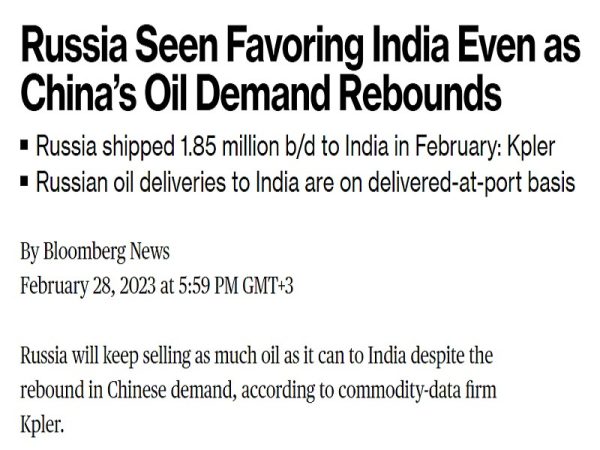
Bloomberg’s points in support of this observation are purely economic and overlook the strategic dimension of Russia’s discounted oil exports to India, which will be explained in the present piece.
Bloomberg published a piece on Tuesday about how “Russia Seen Favoring India Even as China’s Oil Demand Rebounds”, which cites lead crude analyst Viktor Katona from commodity-data firm Kpler. According to him, “While China could ‘buy literally the entire Russian oil exports’ as it abandons Covid-zero policies, Russia will want to keep the Indian market because it is more lucrative and gives its crude sellers greater control.”
Katona is also quoted as adding that “Chinese refiners may want to buy more Russian crude this year, but they also have the capacity to do their own shipping. That would deprive Moscow of income from the ‘parallel gray fleet’ of tankers it has established to deliver crude to India.” While these are all valid points in support of his prediction, they’re purely economic and overlook the strategic dimension of Russia’s discounted oil exports to India, which will now be explained.
First, India’s unprecedentd scaling of Russian oil imports over the past year since the start of the latter’s special operation preemptively averted Moscow’s potentially disproportionate dependence on China and continues to do so into the present.
Second, the Kremlin will never forget the aforementioned strategic favor that India did for Russia at its most sensitive moment in decades, hence why it’s inclined to keep up the pace of its discounted exports to that country as a way of thanking it for this.
Third, the Kremlin is cognizant of the fact that there must be tangible benefits for India in continuing to defy Western pressure upon it to dump Russia, so keeping up the pace of oil exports to it incentivizes India to continue its pragmatic policy of principled neutrality towards the Ukrainian Conflict.
Fourth, their newfound energy relations also served Russia’s grand strategic goal of accelerating India’s rise as a globally significant Great Power.
That last-mentioned outcome advances the global systemic transition’s ongoing evolution towards tripolarity ahead of its final form of more complex multipolarity (“multiplexity”), which serves both of their interests. And finally, the larger dynamics connected to the aforesaid development is that it helps break the Sino-American bi-multipolar superpower duopoly that previously characterized International Relations, thus greatly enhancing Russia and India’s strategic autonomy in the New Cold War.
Altogether, these strategic motivations ensure that Russia won’t increase oil exports to China at the expense of the level at which it’s presently supplying India. Observers should always keep them in mind since they prove that the Russian-Indian Strategic Partnership is premised on their shared goal of accelerating the global systemic transition and not on deriving opportunistic economic benefits like Bloomberg implied is supposedly the case when it comes to their current energy ties.
TREATING PUTIN AS AN IRREDEEMABLE IMPERIALIST HAS PAINTED THE WEST INTO A DANGEROUS CORNER

By Larry Johnson | Son Of the New American Revolution | February 27, 2023
When it comes to imperialism — i.e., “the policy, practice, or advocacy of extending the power and dominion of a nation especially by direct territorial acquisitions or by gaining indirect control over the political or economic life of other areas” — the United States and Europe are quick to label Putin as a rabid practitioner who must be stopped or else he will conquer the world.
This is lazy propaganda on the part of the West and it is a bullshit accusation. Putin is an old school nationalist and an Eastern Orthodox Christian who eschews the Soviet Communist legacy. Since taking power in 1999, Putin has not led unprovoked conquests of adjacent territory. Russia’s military engagements with Georgia in 2008 and with Ukraine are a direct result of U.S. and NATO interference in the region.
But the U.S. and Europe persist in describing Putin as Stalin reincarnated and a man hell bent on imposing Russian sovereignty over the world. This just a 21st century version of the Domino Theory. It is Domino 2.0 and Putin is the new Vietnam. The truth of the matter is that the U.S. and Europe are bona fide imperialists and are ignoring Putin’s actual record. Instead, the West is engaging in gross hypocrisy and psychological projection — attributing to Putin what they themselves have done and are doing.
Here are some recent examples of the imperialist meme the West is pushing with regards to Putin and Russia:
Many observers quickly picked up on one of Putin’s more provocative lines, in which he compared himself to Peter the Great, Russia’s modernizing tsar and the founder of St. Petersburg – Putin’s own birthplace – who came to power in the late 17th century.
“Peter the Great waged the Great Northern War for 21 years,” a relaxed and apparently self-satisfied Putin said. “On the face of it, he was at war with Sweden taking something away from it… He was not taking away anything, he was returning. This is how it was.”
Foreign Policy magazine, an establishment mouthpiece, pushes the same meme:
Mikhail Mamedov, an Azeri by birth who fled Russia in 1996, offers an unintentionally ironic perspective on Russian imperialism:
“Russia’s concept of empire was different from that of the Western powers. Russia did not possess ‘distant colonies’ but expanded across its borders into the depths of Eurasia. It had a better opportunity for the closer integration of native and Russian nobility into one body.”
Did you catch that last paragraph? Mamedov apparently has not studied American history. If Russia is an imperialist because it “expanded across its borders” and exerted authority over adjacent territory, then what is the United States? Texas, New Mexico, Arizona and California were not independent free states who voted to join the U.S. They came under U.S. control thanks to the Treaty of Guadalupe Hidalgo, which officially ended the Mexican–American War and “required Mexico to cede 55 percent of its territory including the present-day states of California, Nevada, Utah, New Mexico, and most of Arizona and Colorado. Mexico also relinquished all claims for Texas and recognized the Rio Grande as the southern boundary of Texas.”
After sixty years of failed foreign military expeditions, the political class in Washington, D.C. clings tenaciously to the childish notion that if you can just get rid of the “bad man” you can usher in a political utopia. Just consider the list of villains the United States has targeted in repeated bids to change governments and create “democracy or eliminate terrorism, etc. How have those worked out? Did it make the world safer? Is the United States more secure?
- Mossadegh, Iran
- Arbenz, Guatemala,
- Castro, Cuba
- Diem, Vietnam
- Mao, China
- Noriega, Panama
- Saddam Hussein, Iraq
- Bashir Assad, Syria
- The Shah, Iran
- The Ayatollah Khomeni, Iran
- Osama Bin Laden, ???
- Vladimir Putin, Russia
I am amazed that so many so-called foreign policy experts adhere to the magical belief that eliminating a leader will provide a political solution that favors the West. Just listen to Hillary Clinton pleading for the Russian elite to eliminate Putin:
The notion that getting rid of Putin will neuter Russia and make it an obedient serf of the West is profoundly stupid and myopic. Just because people like Clinton and Biden insist that Putin is a dictator in the mold of Stalin, it does not magically transform delusional belief into reality.
The Latin American Information Agency (ALAI) shares my scorn for the West’s double standard when it comes to portraying modern Russia as an amalgam of Nazi Germany and Stalin’s Soviet Union:
The main Western governments and media outlets question Moscow’s incursions while justifying similar actions carried out by their own camp. The deployment of troops in Ukraine, Georgia or Syria is presented as an unacceptable act, but the occupations of Afghanistan, Iraq or Libya are interpreted as routine events. The annexation of Crimea is categorically repudiated, but the appropriation of land in Palestine is warmly welcomed.
This hypocrisy is combined with implausible allegations that seek to frighten the population. They describe a gigantic Russian power with immeasurable capacity for harm. Moscow’s manipulation of the US elections through infiltrators and algorithms has been the most absurd accusation in this campaign.
Every diabolical conspiracy is attributed to Putin. The media often portrays him as the embodiment of evil. He is depicted as a despot rebuilding an empire that rests on brutal methods of internal totalitarianism (Di Palma, 2019). Comparisons are never made with the lauded plutocracies of the United States or Europe, which enforces validation of the domination exercised by ruling elites.
Why should you care? If the West persists in demonizing Putin it is creating potentially insurmountable obstacles for future negotiations. This approach makes a diplomatic solution virtually unattainable and is likely to increase Putin’s doubts that the West can be trusted to uphold any agreement short of unconditional surrender.
Moscow outlines conditions for unfreezing nuclear deal
RT | February 28, 2023
Russia’s decision to suspend New START, the last remaining nuclear arms control treaty with the US, was the right response to Washington’s anti-Russia policies and its violations of the deal, Moscow’s ambassador to the US Anatoly Antonov said on Monday.
Commenting on Washington’s criticism of the move, Antonov accused the US of shifting the blame. He noted that “Washington has launched and dragged its European allies into a large-scale hybrid war against Russia,” while openly stating that its goal is “to inflict a strategic defeat on our country.”
“At the same time, as if nothing has happened, it insists on the inspection of our bases, which store strategic nuclear weapons. These are the same bases that have been attacked by Ukraine with the help of the Pentagon,” the envoy stated.
Antonov accused Washington of substantially violating the central provisions of New START. He said the US had “illegitimately” withdrawn submarine-launched ballistic missile systems and heavy bombers from the deal’s counting rules after declaring them incapable of carrying out nuclear missions following “a procedure not agreed upon with Russia.”
“Our inspectors have never been given the opportunity to verify the results of the ‘conversion,’” Antonov explained.
Against this backdrop, the ambassador described the decision to suspend participation in New START as “the only right one under the circumstances,” adding that Moscow still complies with the quantitative limitations imposed by the treaty.
“To create the conditions for a return to full-scale operation of New START, Washington must reconsider its hostile anti-Russian policy,” he asserted.
Last week, Russian President Vladimir Putin announced that Moscow had “suspended its membership” of New START, saying the West had denied Moscow’s requests to inspect Western nuclear facilities in accordance with the treaty under formal pretexts.
The president also noted that NATO members were demanding access to Russia’s strategic facilities, despite the fact that the deal was signed only by Moscow and Washington.
New START was originally signed in 2010 by then-US President Barack Obama and his Russian counterpart, Dmitry Medvedev. It was aimed at halving the number of strategic nuclear missile launchers deployed around the world. Under the treaty, both countries were supposed to allow the other side a limited number of inspections per year to verify compliance with the agreement. Unless extended, the treaty was set to expire in 2026.
By rejecting China’s peace plan West pushes Beijing closer to Russia
By Lucas Leiroz | February 28, 2023
On the first anniversary of the Russian special military operation in Ukraine, China presented a peace plan, aimed at re-establishing diplomacy and bilateral negotiations. Consisting of twelve points, the proposal reflects the stance of neutrality of the Chinese government, which has refused to support anti-Russian resolutions at the UN, maintaining a strong direct dialogue with Moscow which allows it to develop more realistic proposals, unlike the Western unilateral demands of Russia’s retreat. However, the West does not seem interested in peace, having immediately rejected Beijing’s project.
Beijing calls for an end to hostilities and for the two parties to return to peace talks immediately. Defense of civilians and prisoners of war (POWs) is also a central topic of the project, as well as the safety and stability of the nuclear power plants. In addition, Beijing also advocates the banning of all unilateral sanctions, thus enabling the resumption of economic cooperation and the possibility of a rapid reconstruction of the zones affected by the conflict.
The points of the proposal are: 1. Respecting the sovereignty of all countries; 2. Abandon the Cold War mentality; 3. Ceasing hostilities; 4. Resuming peace talks; 5. Resolving the humanitarian crisis; 6. Protecting civilians and prisoners of war (POWs); 7. Keeping nuclear power plants safe; 8. Reducing strategic risks; 9. Facilitating grain exports; 10. Stopping unilateral sanctions; 11. Keeping industrial and supply chains stable; 12. Promoting post-conflict reconstruction.
As we can see, China proposes a broad diplomatic platform, indicating essential topics for achieving any peaceful solution to the conflict. It is not possible to point out any biased aspect to either side during the analysis of the proposal. These are points that, despite the proximity between Russia and China, reveal a true position of neutrality, seeking to meet, as much as possible, the interests of both sides.
However, as expected, the plan did not please Western governments, which rejected the measure without even establishing forums for prior discussion. According to several Western politicians and experts, the Chinese objective was simply to propose a “pro-Russian peace”, ignoring Ukraine and the Ukrainian people.
For example, according to Clayton Allen and Anna Ashton, analysts linked to the Eurasia Group, a consulting agency and think tank that advises several Western governments, the Chinese twelve points are biased in favor of Moscow and echo the “Russian justifications for the invasion”.
“Although several of the 12 points revealed Chinese concerns over actions primarily associated with Russia, it continued to echo Russia’s justifications for invasion and can largely be framed by Russia as supporting Moscow’s positions (…) China’s approach suggests that they are walking a diplomatic tightrope of strengthening ties to Russia – a key geostrategic ally and counterbalance to the West – while avoiding a position that is seen as openly hostile to Western aims”, they said.
This assessment seems extremely exaggerated. Proposing peace means seeking the best solution for both sides, but obviously also involves meeting the interests of the winning side, which, in this case, is the Russian one. The fact that Moscow seems to “benefit” from this plan is due to the evident reality that Russian troops have an advantage on the battlefield and it would be absolutely unrealistic to think of “peace” seeking to fulfill the Ukrainian objective of withdrawing Russian forces from the liberated regions. What Ukraine and the West understand by “peace” is the recapture of Russian territories, including Crimea, which obviously will not be accepted.
However, worse than that, NATO members and allies not only refused to consider the proposals but began to spread rumors about a possible Chinese intention to send weapons to Russia. According to the Western narrative, the Chinese peace project was a mere excuse to advance cooperation with Moscow and boost bilateral military relations, with plans to supply Russia with weapons in case of rejection of the proposal.
Beijing has denied the allegations, calling them “disinformation”, but at the same time Chinese officials seem aware of the danger caused by Western bellicosity. In a recent statement, Mao Ning, the spokesperson for the Chinese Foreign Ministry, informed that the Chinese attitude towards Ukraine is completely peaceful, but recalled that while supplying the Kiev regime with weapons, Washington also acts in a destabilizing way in Taiwan, thus posing a security risk to both Russia and China.
“On the Ukraine issue, China has been actively promoting peace talks and the political settlement of the crisis (…) [However] In addition to pouring lethal weapons into the battlefield in Ukraine, the US has been selling sophisticated weapons to the Taiwan region in violation of the three China-US joint communiqués”, Mao said.
What seems to be happening is yet another “self-fulfilling prophecy” on the part of the West. Believing in its own baseless narrative that China wants to send weapons to Russia, the US takes unnecessary preventive measures whose side effects can be precisely the increase of Russian-Chinese military cooperation. If before there was no plan on the part of Beijing to send arms to the Russian side, it is possible that this will happen now, since the peace proposals have been exhausted and the Chinese are aware that these same forces that push Ukraine towards a proxy war against Russia may soon act against Beijing in Taiwan.
In their anti-Russian and anti-Chinese paranoia, the US and the EU make the wrong decisions and put global peace at risk. Beijing is trying to resolve the situation diplomatically, but Western forces also need to prioritize peace.
Lucas Leiroz is a researcher in Social Sciences at the Federal Rural University of Rio de Janeiro; geopolitical consultant.
China reboots ‘no limit’ partnership with Russia
BY M. K. BHADRAKUMAR | INDIAN PUNCHLINE | FEBRUARY 28, 2023
The ‘butterfly effect’ of the visit by the Member of the Political Bureau of the Central Committee of the Communist Party of the People’s Republic of China and Director of the Office of the Foreign Affairs Commission of the CPC Central Committee Wang Yi to Moscow on February 21-22 is already discernible. It can influence a much larger complex system still.
The two sides agreed to consolidate and develop the Russia-China comprehensive strategic partnership of coordination for a new era and to continue to closely coordinate their foreign policy efforts; the Ukraine crisis situation, which is at a tipping point, has further tilted in Russia’s favour; and, Chinese diplomacy on the post-pandemic rebound is signalling aperiodic long-term behaviour that can generate ‘deterministic chaos’ in Eurasia and Asia-Pacific.
Wang Yi had meetings with the Secretary of Russia’s Security Council Nikolai Patrushev — as coordinators of the mechanism of China-Russia Strategic Security Consultation — and with Foreign Minister Sergey Lavrov and President Vladimir Putin.
The Russian readout said that “The parties praised the current state of Russian-Chinese relations, which continue to expand dynamically in the context of sharp changes in the international arena… They underscored the importance of further strengthening close foreign policy coordination… They also reiterated the futility of attempts by third countries to impede the healthy, dynamic progress of Russian-Chinese relations, to restrain the development of our countries through sanctions and other illegitimate means.”
Wang Yi conveyed to Putin that the “Russia-China relationship has stood the test of the drastic changes in the world landscape and become mature and tenacious, standing as firm as Mount Tai… Although crises and chaos often emerge, challenges and opportunities exist at the same time, and this is the dialectics of history.”
He said China is ready to work with Russia “to maintain strategic resolve, deepen political mutual trust, strengthen strategic coordination, expand practical cooperation and defend the legitimate interests of both countries, to play a constructive role in promoting world peace and development.”
Putin expressed “the warmest words of gratitude” to Wang Yi for the booming bilateral trade (which reached US$185 billion last year.) In the conditions under sanctions, for Russia, this is a crucial lifeline. Putin mentioned cooperation in the international arena as particularly important “for stabilising the international situation” and stressed that the Russian side is expecting a visit by President Xi Jinping.
The Ukraine situation figured prominently in Wang Yi’s meting with Lavrov where he dwelt on China’s “vision of the root causes of the Ukraine crisis” and China’s approaches to a political settlement. The Russian readout said Lavrov “commended Beijing’s constructive policy and reaffirmed the high level of proximity of our assessments of this agenda.”
The Chinese readout said Putin and Wang Yi “exchanged in-depth views on the Ukraine issue. Wang Yi appreciated Russia’s reaffirmation of its readiness to solve problems through dialogue and negotiations. China will, as always, uphold an objective and just position and play a constructive role in the political settlement.”
Significantly, a day after Wang Yi returned to Beijing from Moscow, the Foreign Ministry issued a statement titled ‘China’s Position on the Political Settlement of the Ukraine Crisis’. Presumably, Wang Yi sensitised the Russian side beforehand, as the foreign ministry in Moscow lost no time on the same day to effusively compliment “our Chinese friends.”
The Chinese statement, couched in principles of neutrality, distinctly tilted in Russia’s favour. The core issues highlighted by Moscow in its December 2021 proposal for dialogue with the NATO and the US (which the latter ignored) find mention in the Chinese statement.
Significantly, the Chinese statement strongly rejected the unilateral sanctions and maximum pressure by the US and EU against Russia and the West’s “long-arm jurisdiction” against other countries. No wonder, the western capitals have taken a dim view of the Chinese statement and see it as loaded in favour of Russia.
The Chinese statement, issued on the first anniversary of the Russian operations in Ukraine, has factored in that the conflict has existential overtones for Moscow and Russia’s defeat is simply unthinkable as that would fundamentally shift the global strategic balance against China. Interestingly, there is a pointed reference in the Chinese readout on Wang Yi’s talks with Patrushev (Russia’s highest-ranking security official) to the effect that “Both sides believed that peace and stability in the Asia-Pacific region should be firmly defended and that the introduction of the Cold War mentality, bloc antagonism and ideological confrontation should be opposed.”
The Chinese statement on Ukraine followed the release of two major foreign policy documents in Beijing on successive days. The first one dated February 20 is a frontal attack on the US foreign policies, titled ‘US Hegemony and Its Perils’.
The 4,080-word document is a veritable iteration of thoughts and perspectives that are frequently articulated in Putin’s speeches and writings through the past 15-year period since his famous speech at the 2007 Munich Security Conference where the Russian leader spoke on international security problems in a unipolar world characterised by “one type of situation, namely one centre of authority, one centre of force, one centre of decision-making,” a world in which there is “one master, one sovereign.”
The second document issued in Beijing on February 21 is titled ‘The Global Security Initiative Concept Paper’. In 3,580 words, it lays out the guardrails and guiding principles of Chinese foreign policy and stresses the priorities of cooperation in the world community.
Chinese foreign policy is shifting gear. Although the Ukraine crisis and the Taiwan problem cannot be compared, Beijing senses that the weakening of Russia is a vital segment of the US strategy to isolate and confront China, and therefore, the outcome of the conflict in Ukraine is going to be profoundly consequential for China. Indeed, a Russian defeat in Ukraine will constitute a severe setback for China too.
Wang Yi’s visit testifies that China is willing to step up solidarity with Russia at a juncture when any residual hopes of improving ties with the US have been dashed and that relationship is in free fall. Wang Yi’s meeting with Biden last week on the sidelines of the Munich Security Conference did not go well. Meanwhile, the US officials are reportedly confabulating with Taiwan’s foreign minister and National Security Advisor.
President Biden has rejected any mediatory role for China in Ukraine. All things taken into account, the probability is that China may step up its support for Russia. The big question is whether this would take the form of military help. The CIA director William Burns stated last week that “we’re confident that the Chinese leadership is considering the provision of lethal equipment. We also don’t see that a final decision has been made yet, and we don’t see evidence of actual shipments of lethal equipment.”
Yesterday, when asked about US National Security Advisor Jake Sullivan’s warning Sunday that there would be ‘real costs’ for China if it went forward with providing lethal aid to Russia, Foreign Ministry spokesperson Mao Ning did not give a direct answer. “The US is in no position to point fingers at China-Russia relations. We do not accept coercion or pressure from the US,” she said.
Interestingly, the Kremlin spokesman Dmitry Peskov also chose not to answer a related question as to whether Russia had asked China to provide any equipment for its special military operation.
The forthcoming visit by Xi Jinping to Moscow, likely to take place next month, will be a defining moment. There is a palpable sense of disquiet in the West, as China’s manufacturing capability exceeds that of the US and Europe combined. Russia is deferring the big offensive in Ukraine, pending Xi’s visit.
Featured Video

Death Spikes & Rising Cancer In Our Youth Explained
or go to
Aletho News Archives – Video-Images
From the Archives
Politicians lie
By Mazin Qumsiyeh | Popular Resistance | August 18, 2013
There is no way to say this truth nicely: Politicians lie. That includes Japanese, American, Egyptian, Israeli, and Palestinian politicians! Is there something more common sense than that? Yet, so many citizens around the world believe their own politicians or wistfully acknowledge lies but think it is part of the job needed to run things. They believe even when politicians contradict themselves blatantly. This phenomenon is rather remarkable. It is a dissonance and disconnect from reality that many seem oblivious to. It is very dangerous because it can lead to accepting rationales for going to war. These can be deadly wars that lead to millions of lives lost as happened in what was called World War 1 and WW2. Even when incredible and declassified evidence abound, politicians continue to lie and old mythologies refuse to die. Here are just a few of the countless lies told to us over the past few decades… continue
Blog Roll
 Aletho News
- Turkish parliament to review Saudi-Pakistan defense pact next month
- DEATH SPIKES & RISING CANCER IN OUR YOUTH EXPLAINED
- Iran offers Trump deal before US election
- Merz regime wants ‘secret police’ – opposition
- Israeli settlers terrorize West Bank Palestinians with state-provided drones: Report
- They see them, then kill them: Israeli quadcopters track, deliberately target civilians in Gaza
- Debunked: Trump’s egregious UNGA claims on war against Iran crumble under scrutiny
- Europe was part of the infrastructure of US aggression against Iran: Deputy FM
- New evidence on the Bucha Massacre
- Italy and France debunk reports CIA issued ‘Russian drone threat’ warning
- If Americans Knew
- An error has occurred; the feed is probably down. Try again later.
- No Tricks Zone
- New Study: Earth And Venus Surface Warmth Largely Explained By Convection And Lapse Rate, Not CO2 Or Radiation
- 2025 Nature Paper Claiming Worsening Global Drought Gets RETRACTED …Heavily Flawed
- New Study: ‘Global Drought Shows No Detectable Recent Acceleration Under Climate Warming’
- Economic Masterminds: German Socialists Suggest Taxing Productivity Gains Stemming From Using AI
- The South China Sea Has Not Been Cooperating With The Climate Change Narrative
- Energy Crisis: Germany Enters Heating Season With Historically Low Gas Reserve Fill Levels
- New Study: The Antarctic Ice Sheet Gained Mass From 2020-2024 Due To Staggering Snow And Ice Accumulation
- Study: Ocean Heating Rates From Thousands Of Years Ago ‘Dwarf’ Modern Ocean Heating Rates
- Climate Extremists Target, Attack Large-Scale Power Grid Infrastructure In Germany!
- New Study: Antarctic Ice Melt Has Contributed Less Than 1 Centimeter To Sea Level Rise In The Last 30 Years

