Western ‘theft’ will backfire, Russian tycoon warns
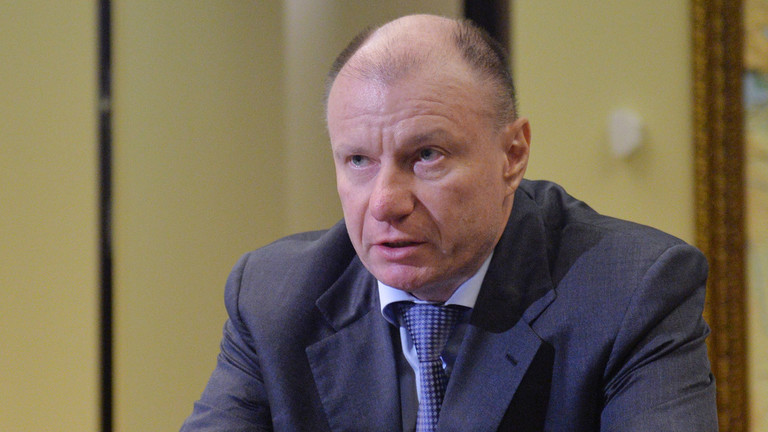
Vladimir Potanin. © Sputnik/Alexei Druzhinin
RT | January 23, 2023
Western countries are sawing off the branch they are sitting on by confiscating Russian assets, billionaire businessman Vladimir Potanin believes.
Following the launch of Russia’s military operation in Ukraine in February last year, multiple countries have frozen assets belonging both to the Russian state, and private companies and individuals to the tune of more than $300 billion.
In an interview with Russian media outlet RBK published on Monday, Potanin, the largest shareholder of mining giant Nornickel, said: “The confiscation [of assets] is a covert or overt form of theft,” and destroys “the investment climate of the jurisdiction where this is happening.”
Potanin noted that the countries comprising the ‘collective West’ had based their societies upon respect for private property.
The recent freezing of Russian assets “will backfire on them,” he said, adding that Russia should refrain from mirroring these measures.
He went on to suggest that by exercising respect for property rights, Moscow will be in a stronger moral position when it fights for its frozen assets in the West, and will send the right signals to entrepreneurs at home.
Potanin also warned against nationalizing property left behind in Russia by Western businesses – instead, the authorities need to “give the investment community the opportunity to solve this problem on its own.” He noted that the exodus of Western companies from Russia has allowed local investors to buy up assets at relatively low prices.
Potanin described the Western sanctions as “absolutely destructive and even, apparently, absolutely illegal,” and in his view, what we are seeing right now is the destruction of basic global rules.
The billionaire acknowledged that Western sanctions have put his plans for overseas business expansion on hold and have adversely affected his ability to travel the world, though he has now switched to exploring Russia instead, he added. Potanin nevertheless expressed confidence that the West “will come to their senses” sooner or later.
Lavrov: US Crossing Red Lines by Threatening Other Countries Not to Work With Russia
By Petr Beryshnikov – Sputnik – 23.01.2023
Russian Foreign Minister Sergey Lavrov arrived in this year’s BRICS host state, South Africa, on Monday morning to discuss bilateral relations as well as coopeation within the BRICS.
Western countries, namely the US and the UK, are crossing all red lines by exerting pressure on the states that cooperate with Russia, said Russian Foreign Minister Sergey Lavrov at a joint press conference with his South African counterpart Naledi Pandor after their meeting in Pretoria on Monday.
“[The US] is publicly saying that those who cooperate with Russia will regret it,” he said, anwsering to Sputnik’s question at the press conference. “Through threats and pressure, the US, and the British too, are crossing all red lines.”
Lavrov stressed that the West undermines the democratic principles in terms of international relations, noting that the US, as well as the EU appeal to democracy only when it suits their interests.
Answering the reporters’ questions, the minister also drew attention to the issues concerning the export of Russian grain and fertilizers in the context of the world food crisis and anti-Russian sanctions. He noted that although such exports are not prohibited by the Western sanctions, the latter create logistical, financial and freightage problems. Lavrov stressed that Russia is ready for international cooperation to overcome these issues – among others, noted by UN Secretary-General Antonio Guterres – but the West does not seem to be willing to participate.
“As for Russian fertilizers, grain, no efforts by the UN helped the European Union and the United States remove obstacles to our exports,” he said.
He also noted that only 20,000 of 280 thousand tonnes of fertilizers, which Russia agreed to provide to the poorest states for free, left the European ports.
“It’s been about half a year since President Putin drew the attention of the world community to this initiative. During this time, out of 280,000 tons, only 20,000 tons were sent from the Netherlands to Malawi – well, […] such an agreement was reached three months ago, and the cargo itself was transported only very recently,” he underlined.
According to Lavrov, less than 10% of grain exported under the so-called Black Sea grain deal goes to the poorest countries, with almost a half being directed to the EU and roughly the same amount to prosperous developing countries.
The Black Sea Grain Initiative, aslo known as the “grain deal”, refers to an agreement between Russia and Ukraine with the participation of Turkey and the UN. The goal of the initiative is to help tackling the world food crisis by allowing grain exports from the Black Sea ports, which were initially blocked during the conflict in Ukraine.
Talking about the food crisis, the minister also responded to claims made by the US Treasury Secretary Janet Yellen, who said that Russia’s special military operation in Ukraine and “weaponization of food has exacerbated food insecurity and caused untold suffering”.
According to Lavrov, it is “hard to comment” on Yellen’s statements, which he called a “slogan” and cited UN data indicating that the world food crisis started before the special military operation in Ukraine and was caused by “uncontrolled emission of money” in the West as well as “politicized and uncompromising transition to so-called green economy”.
Yellen had made her statements during her January African tour, which is widely seen as part of “Biden’s big push” into Africa in an effort to counter Chinese and Russian influence on the continent.
Talking about the West’s pressure on African countries, Lavrov also touched the matter of western criticism of the Russia-China-South Africa naval drills scheduled to take place in February.
“As for naval exercises, I think there is nothing even to comment on. Three sovereign countries conduct exercises without violating any norms of international law. I don’t understand how they can cause a ‘mixed’ reaction,” Lavrov told reporters, adding: “US colleagues believe that only they can conduct exercises around the world. Now they are actively engaged in naval exercises within the framework of the Indo-Pacific strategies around China, in the South China Sea, in the Taiwan Strait, and this does not cause any mixed reaction from anyone,” the diplomat noted.
Thandi Modise, South Africa’s minister of defense, earlier said that Russia could be Africa’s key partner in terms of military cooperation. She also recently stated that the US, in its turn, “threatens Africa, not just South Africa, of having anything that is even smelling of Russia”.
In her turn, South Africa’s foreign minister stressed the importance of the exercises for her state, saying that South Africa’s military conducts drills “as part of agreements with many countries worldwide”. Naledi Pandor said that in contrast to the current criticism of the three-lateral exercises, “no-one asked questions” when South Africa took part in drills with the US or France.
“These are all part of exercises we undertake […] to be able to respond to a range of situations, including disaster management, which our military often plays a role in addressing. So, I just think it’s important that we regard all countries as sovereign nations and not stop doing so when it suits us,” she underlined.
According to Lavrov, Russia is actively developing military cooperation with its BRICS partners such as China, South Africa and India, noting that this cooperation is “nothing new”. He said that the exercises are “transparent” and called for the western states to respect their foreign counterparts.
“If you respect other countries, let them pick their sides,” the minister said, concluding: “We simply advocate for each country to have its own rights in the international system, as stipulated by the UN Charter.”
On Monday, Russia Foreign Minister Sergey Lavrov arrived in South Africa, which became the first destination for him during his African tour.
In summer 2022, Sergey Lavrov conducted a major African tour, visiting the Republic of the Congo, Uganda, Ethiopia and Egypt. In September 2022, he also held talks with South African Foreign Minister Naledi Pandor on the sidelines of the United Nations General Assembly.
Russia and the South African Republic established their bilateral diplomatic relations in 1992. Being two key nations of the BRICS group, which also encompasses Brazil, India and China, Moscow and Pretoria promoted their bilateral relations to the level of the comprehensive strategic partnership in 2013.
South Africa is Russia’s key partner in scientific and educational spheres and one of the key trade partners on the African continent along with Egypt and Algeria. The two sides have also been actively promoting relations in the military dimension as well as in other fields. Moscow and Pretoria share common views on the core principles of the world order, coordinating their positions and actions by means of regular bilateral diplomatic dialogue, at the United Nations, as well as within such formats as BRICS and G20.
The country’s president, Cyril Ramaphosa, first visited Russia in 2019, when he participated in the first Russia-Africa summit held in Sochi. Pretoria is also expected to participate in the second Russia-Africa summit which will be held in Saint Petersburg in July.
A top British think tank has revealed Russia’s cyberwarfare dominance over Ukraine
Why has Western media ignored its report?
By Felix Livshitz | RT | January 23, 2023
On November 30, the Royal United Services Institute (RUSI), an elite military think tank, and lobby group, with deep ties to the UK government, published a landmark report entitled ‘Preliminary Lessons in Conventional Warfighting from Russia’s Invasion of Ukraine: February–July 2022’. While desperate to portray the operation as a failure, even the normally Russophobic RUSI can’t ignore Moscow’s total cyberwarfare dominance over Kiev.
Complete superiority
Buried in the document is a long section on the electronic warfare aspect of the Russia-Ukraine conflict. It found that within weeks of February 24, Moscow’s forces quickly established total dominance in this sphere by deploying extensive jamming infrastructure. Once achieved, Kiev’s most sophisticated cyber systems were not only totally confused, but absolutely crippled.
Before the attack, Ukraine had for some years been receiving the best Western reconnaissance and strike drones – Unmanned Aerial Vehicles (UAVs) – IMF debt could buy.
These systems, RUSI states, were envisioned to be “critical to competitiveness” in a hypothetical future battlefield, by providing “situational awareness and target acquisition” second to none. However, as it turned out, the “attrition rates” of these high-tech drones were “extremely high” from February to July due to Russian electronic warfare prowess, and thy were destroyed completely at around 90%.
“The average life expectancy of a quadcopter remained around three flights. The average life expectancy of a fixed-wing UAV was around six flights … even when UAVs survived, this did not mean that they were successful in carrying out their missions,” the report records. “UAVs could fail to achieve their missions because the requirements to get them in place … prevented timely target acquisition before the enemy displaced. Many missions failed to find targets because there was no target at the specified location.”
A “more common” means of “mission failure” was “disruption of a UAV under control through electronic warfare, the dazzling of its sensors or the denial of its navigational systems from determining the accurate location of a target.”
“In other instances, the Russians successfully struck the ground control stations of the UAV. In aggregate, only around a third of UAV missions can be said to have been successful.”
Russia’s dominance in electronic warfare had further damaging implications for the precision weapons shipped to Ukraine from London, Washington, and other Western backers too. Moscow’s cyber divisions effectively “defeated” most of the precision weapons used by Kiev.
RUSI is a prominent and highly influential firm, and its publications typically generate enormous media interest – when these reports paint Russia in an overwhelmingly negative light, and talk up the need for Moscow to be countered through highly aggressive political, diplomatic, intelligence and military postures, that is.
Unheeded prophecies
Aside from a single article in America’s Forbes magazine, this assessment has remained unacknowledged by any mainstream journalist or pundit for well over a month. It is not the first time a RUSI report has mysteriously received no recognition in recent memory. In late January, the think tank published an assessment of the value of Western arms shipments to Kiev.
It concluded there was little point in sending vehicles or weaponry of any kind to Ukraine, in the event fighting broke out with Russia, due to Moscow’s “operational art,” military doctrine, and “strategic thinking.” These long-held philosophies mean that the Kremlin and its armed forces chiefs consider battle an extension of diplomacy, and therefore leverage “superiority in long-range fires to achieve decisive effects against an opponent, which could in turn achieve strategic results.”
Among the “strategic results” sought is a battlefield where “massed ground formations in direct confrontations” are not deployed. Instead, by “inflicting enough damage to alter an opponent’s course of action, or signal that Russia’s intent is genuine, Russian strategic goals can be achieved without conflict.”
This would be secured by using long-range missiles in a “non-contact” military engagement – “the minimum level of force necessary to promote Russia’s regional goals and limit the need to deploy ground forces.” In other words, exactly what has unfolded over the course of the past year.
“Armoured vehicles, short-range anti-tank weapons and air defence systems can only be useful in one scenario, one which is likely to be preceded by a harrowing and extensive period of non-contact warfare designed to prevent the Ukrainian armed forces from operating effectively at all,” RUSI forecast. “Their use will only be possible once all initiative has been lost and the situation is unlikely to be turning in Ukraine’s favour.”
The report’s conclusion was that the weaponry the West had sent and planned to send to Ukraine “does nothing to improve Ukraine’s odds of deterring Russia, or even defending against a Russian invasion once it has begun,” and any attempt to arm Kiev was “not likely” to defend “Ukraine’s sovereignty.”
Russia and West on verge of ‘real war’ – Lavrov
RT | January 23, 2023
The current situation in Ukraine shows that the conflict between Russia and the West can no longer be defined as a “hybrid war” but is instead approaching being a real one, Russian Foreign Minister Sergey Lavrov said on Monday.
Speaking at a press conference following a meeting with his South African counterpart, Naledi Pandor, Lavrov also noted that this “almost real” war was something that the West “has been preparing for a long time against Russia.” The minister claimed that Western powers are seeking to destroy everything Russian, from the language to the culture that had existed in Ukraine for centuries, and even forbid people from speaking their native language.
Lavrov went on to point out that such practices have become commonplace throughout Ukraine and that the country’s last two presidents, Pyotr Poroshenko and current leader Vladimir Zelensky, have both turned into “presidents of war” and “Russophobic leaders” after gaining power, despite running their presidential campaigns under the promise of establishing peace.
The minister also recalled that Ukraine has adopted laws that prohibit using the Russian language in education, media, and even in everyday life. “And this is all supported by the West,” Lavrov said, adding that this support extends to neo-Nazi marches with swastikas and symbols of banned Nazi divisions being held across the country.
He also accused the West of turning a blind eye to the fact that Kiev’s forces continue to deliberately choose targets and carry out attacks in such a way as to terrorize the civilian population. “The West knows perfectly well that the Ukrainian regime deliberately bombs cities and towns using Western-supplied weapons,” the minister said.
Lavrov reiterated Moscow’s position that it has not carried out attacks in Ukraine against civilian infrastructure, and that the damage to it is attributable to Kiev’s regular practice of deploying heavy weapons and air defense systems in residential areas.
Despite the spiraling tensions, Lavrov noted that Moscow remains open to negotiations with Kiev, and warned that those who refuse talks should understand that the longer they are delayed, the harder it will be to find a solution.
The minister also asked the Ukrainian government to explain, perhaps through a third party, how it sees the situation in the country playing out and the possibility of negotiations with Russia.
Saudi Crown Prince defies the US policy against Syria
By Steven Sahiounie | Free West Media | January 22, 2023
In November 2022, Saudi Arabia formally changed its stance on Syria. Saudi Arabia is the political powerhouse of the Middle East, and often shares positions on foreign policy and international issues with the UAE, which has previously re-opened their embassy in Damascus.
“The kingdom is keen to maintain Syria’s security and stability and supports all efforts aimed at finding a political solution to the Syrian crisis,” Saudi Foreign Minister Prince Faisal bin Farhan told the November Arab League summit in Algeria.
Syria was suspended from the Arab League in 2011 following the outbreak of conflict instigated by the US, and portrayed in western media as a popular uprising of pro-democracy protesters.
Arab League Secretary-General Ahmed Aboul Gheit said, “The developments in Syria still require a pioneering Arab effort. It is necessary to show flexibility from all parties so that the economic collapse and political blockage can be dispelled. Syria must engage in its natural Arab environment.”
The next Arab League summit will be held in Saudi Arabia, and there is a possibility of Syria once again taking its seat at the round table.
On January 16, the Syrian Foreign Ministry agreed to resume imports from Saudi Arabia after over a decade of strained relations, and Syria planned to import 10,000 tons of white sugar. This development signals a new beginning between the two countries.
Saudi and the Syrian tribes
The Arab tribes in the north east of Syria have traditionally had strong ties with Saudi Arabia, and have received support from the kingdom. The tribes have opposed the ethnic cleansing and forced displacement of Arab villages which the US-led YPG militia has conducted for years. Even though Saudi Arabia has been viewed as a US ally in the past, this has changed since the US military has supported the Marxist YPG who have oppressed Syrians who are not Kurdish.
The US occupied oil wells in north east Syria may come under attack by Arab tribes who are demanding their homes, farms and businesses back from the US-supported YPG. Some analysts foresee the US troops pulling out of Syria after the Kurds find a political solution with Damascus.
Turkey and Syria repair relationship
Turkey and Syria have begun steps to repair their relationship, which ended after Turkey supported the US-NATO attack on Syria for regime change, and hosted CIA operations funneling weapons and terrorists into Syria, under the Obama administration.
Syrian President Bashar al-Assad recently demanded the withdrawal of Turkish troops from Syria to begin to repair the relationship.
Russia is brokering the reconciliation between Erdogan and Assad, which began with the Moscow hosted meeting of the three defense ministers, and a meeting between the three foreign ministers is upcoming.
The developments between Turkey and Syria are being watched by Iran. Foreign Minister Hossein Amirabdollahian said his country was “happy with the dialogue taking place between Syria and Turkey.” Amirabdollahian will travel to Damascus on Saturday for talks with Syrian Foreign Minister Mekdad.
Iran is looking to establish a new role in the recovery process in Syria. President Ebrahim Raisi will visit both Turkey and Syria soon, his first visit to Turkey since taking office two years ago. While analysts see Saudi Arabia and Iran as antagonists, some feel the kingdom will ultimately realize they have to work with Iran in Syria and Lebanon. Iran is part of the region and can’t be excluded from the geo-political sphere.
Saudi Arabian reforms
Saudi Crown Prince Mohammed bin Salman (MBS) said on April 27, 2021 that the country was undergoing a sweeping reform which would restructure the role of religion in Saudi politics and society. The process began a few years before he became crown prince, but under his leadership it has accelerated. Islamic institutions in the Kingdom have seen changes in procedure, personnel, and jurisdiction. All of these reforms are in line with the future vision of the country.
Some analysts feel the rise of the Muslim Brotherhood in the 1960s eventually gave rise to support for domestic religious institutions, and eventually led to funding of religious activities abroad, while religious leaders at home wielded power over public policy.
Vision 2030
Saudi King Salman, Custodian of the Two Holy Mosques, and his son, MBS have a plan for the country which is known as Vision 2030. MBS is also Prime Minister and Chairman of the Council of Economic and Development Affairs.
The days of unlimited oil and markets are in the decline. Education, training, and employment opportunities are the stepping stones to building a thriving country and MBS is determined to plan for a long future of growth and innovation.
MBS
The Crown Prince is young and has new ideas. He is instituting sweeping reforms to the society which have included more rights and freedoms for women. He has championed projects to place Saudi Arabia as a tourist destination, year round golf and soccer venue, and encouraged cultural arts such as musical productions. MBS is breaking the mold: no longer will Saudi Arabia be a breeding ground for Radical Islam.
Extremist preachers
Saudi Arabia had hosted many extremist preachers. Some were featured on satellite TV channels located in Saudi Arabia, and others were local preachers, authors, or scholars. Some had traveled abroad preaching in pulpits and exporting their hatred and sectarian bigotry.
One of the most famous preachers was Muhammed Al-Arifi, who has had an electronic surveillance device attached to him by Saudi intelligence agents, after they seized all of his social media accounts. His last tweet is said to be on May 6, 2019, when he had 20 million followers, and 24 million likes on Facebook, which ranked him as tenth in the Arab world and in the Middle East. The kingdom is shutting down clerics who are extreme.
In 2014, Great Britain banned Arifi from entering the UK following reports that was involved in radicalizing three young British citizens who went to Syria as terrorists.
A YouTube video in 2013 showed Arifi preaching in Egypt and prophesying the coming of the Islamic State. Egyptian TV reported Arifi meeting with the former Muslim Brotherhood prime minister Hisham Qandil in his office.
Arifi is best remembered for his statement on the media Al Jazeera in which he called for jihad in Syria and supported Al Qaeda.
Adnan al-Arour is another extremist preacher who had appeared regularly on two Saudi-owned Salafist satellite channels. Arour was originally from Syria before settling in Saudi Arabia, and in the early days of the Syrian conflict he would stand up on camera, shake his finger, and call for his followers to ‘grind the flesh’ of an Islamic minority sect in Syria and ‘feed it to the dogs’.
These extremist preachers made it clear that the battles being waged in Syria had nothing to do with freedom or democracy, which the western media was pushing as the goal. The truth was the conflict in Syria was a US-NATO attack for regime change and utilized terrorists following Radical Islam, who fought a sectarian war with the goal of establishing an Islamic State in Syria.
The previous Crown Prince
Muhammad bin Nayef Al Saud (MBN) served as the crown prince and first deputy prime minister of Saudi Arabia from 2015 to 2017. On June 21, 2017 King Salman appointed his own son, MBS, as crown prince and relieved MBN of all positions.
MBN met with British Prime Minister David Cameron in January 2013. He then met with President Obama in Washington, on 14 January 2013. The discussion focused on the US-NATO attack on Syria and its support from Saudi Arabia.
In February 2014, MBN replaced Prince Bandar bin Sultan, then intelligence chief of Saudi Arabia, and was placed in charge of Saudi intelligence in Syria. Bandar had been in charge of supporting the US attack on Syria. Bandar had been trying to convince the US in 2012 that the Syrian government was using chemical weapons. However, research has shown that the terrorists used chemical weapons to push Obama into a military invasion, based on his speech of ‘The Red Line’.
In March 2016, MBN was awarded Légion d’honneur by French President François Hollande, another partner in the US-NATO attack on Syria.
On February 10, 2017, the CIA granted its highest Medal to MBN and was handed to him by CIA director Mike Pompeo during a reception ceremony in Riyadh. MBN and Pompeo discussed Syria with Turkish officials, and said Saudi Arabia’s relationship with the US was “historic and strategic”. Just months later in June MBS would depose MBN and strip him of powers, in a move considered to be “upending decades of royal custom and profoundly reordering the kingdom’s inner power structure”.
US diplomats argued that MBN was “the most pro-American minister in the Saudi Cabinet”. That is what brought MBN down. The days of blindly following the US directives are over in Saudi Arabia. MBS has refused to bow down to Biden when he demanded an increase in oil production. The Vision 2030 that MBS developed does not include financing failed wars in the Middle East for the benefit of the Oval Office. MBS has a strained relationship with Biden, and he wears it as a badge of honor.
Saudi role in the Syrian war
Saudi Arabia played a huge role in the large-scale supply of weapons and ammunition to various terrorist groups in Syria during the Syrian conflict. Weapons purchased in Croatia were funneled through Jordan to the border town of Deraa, the epi-center of the Syrian conflict.
At the height of Saudi involvement in Syria, the kingdom had their own militia in Syria under the command of Zahran Alloush. The Jaysh al-Islam are remembered for parading women in cages through the Damascus countryside prior to massacring them.
In summer 2017, US President Donald Trump shut down the CIA operation ‘Timber Sycamore’ which had been arming the terrorists fighting in Syria. About the same time, Saudi Arabia cut off support to the Syrian opposition, which was the political arm of the terrorists.
Richard Dearlove, former head of MI6, expressed his view at the time that “Saudi Arabia is involved in the ISIS-led Sunni rebellion” in Syria.
Syria has been destroyed by the US and their allies who supported the attack beginning in 2011. Now, Turkey and Saudi Arabia are looking to find a solution which will help the Syrian people to rebuild their lives. Both Turkey and Saudi Arabia have turned away from past policies which found them supporting the conflict in Syria at the behest of the US. There is a new Middle East emerging which makes its own policies and is not subservient US interests.
Russia and Pakistan agree major energy deal
RT | January 21, 2023
Moscow and Islamabad have reached “conceptual” agreements on supplies of Russian oil and petroleum products to Pakistan, Russian Deputy Energy Minister Sergey Mochalnikov said at an intergovernmental commission meeting in the Pakistani capital on Friday.
Earlier in December, the minister of petroleum, Musaddiq Malik, visited Moscow to negotiate energy supplies to Islamabad and announced that Russia would provide oil, gasoline, and diesel to the country at discounts. He did not specify the price but noted that the talks were “more productive than expected.”
During the meeting in Islamabad, the sides also discussed “remaining questions” on the construction of the Pakistan Stream gas pipeline and the prospects for wider cooperation in energy and power engineering.
Mochalnikov said Russia presented a concept of future gas supplies to Pakistan, adding that “we must evaluate the position of the Pakistan Stream in this concept as soon as possible.”
The day before, Russian Energy Minister Nikolay Shulginov stated that Moscow is “ready to sign required corporate documents” to kickstart the construction of the pipeline.
Russia and Pakistan signed an intergovernmental agreement on the construction of the North-South gas pipeline (Pakistan Stream) from Karachi to Lahore in 2015. The launch of the project was postponed several times. The 1,100km pipeline with a capacity of 12.3 billion cubic meters of gas per year will link liquefied natural gas (LNG) terminals in the ports of Karachi and Gwadar in southern Pakistan with power plants and industrial gas consumers in Lahore in the north of the country.
The pipeline will transport both regasified gas and pipeline gas from various sources, including Iran and Turkmenistan, according to Shulginov.
“The approach to the implementation of such projects has to be comprehensive. It means not only a pipeline but also a source of gas for it. And we are currently discussing the project both from the point of view of transporting regasified gas and pipeline gas,” the minister said.
Islamabad is also seeking to negotiate long-term deals with Russia on imports of LNG, as there is currently no stable supplier for the country. Pakistan has been struggling with an acute energy shortage, and the surge in global oil and gas prices has worsened the situation. Imports of the fuel have become five to ten times more expensive due to increased demand in the EU.
‘Globalization Has Died and Davos 2023 Was Its Funeral Ceremony’
Sputnik – 21.01.2023
The World Economic Forum’s annual meeting took place in Davos on January 16-20, 2023. International observers sat down with Sputnik to formulate the main message of the gathering in a nutshell.
“This year’s forum featured the new state of the world: divided, resentful, and grim,” Gal Luft, director of the Washington-based Institute for the Analysis of Global Security, told Sputnik. “Davos has become the dressing room of the West and is more divorced than ever from the rest. It no longer represents the real concerns of most of the world’s population. Its obsession with climate change, social justice, gender and other forms of wokeness has made it a laughing stock and target of disdain for most of the world.”
The World Economic Forum (WEF), an international non-governmental and lobbying organization, was founded in January 1971 by German economist Klaus Schwab. Initially the entity was called “European Management Forum”; it changed its name to the World Economic Forum in 1987.
Bringing together business executives, thought leaders, and prominent politicians, the forum sought to become a global platform to spearhead the ideas of globalization and solve pressing economic and political dilemmas. However, some Western commentators observed that the forum quickly morphed into a technocratic globalist elitist club which sought to dictate rules for the rest of the world.
“Globalization was based on the premise of broad acceptance of global institutions, norms and rules, as well as reasonably free flow of goods, money and information,” Luft said. “Each one of those has been compromised over the past few years, first with the US-China decoupling and second with the war in Europe. Instead, we have global bifurcation into two camps – the collective West plus honorary members and all the others – and the emergence of new institutions, alliances, financial instruments, trade blocs and priority sets.”
“There is no return to the post-WWII system. In addition, we are seeing massive repudiation of some of the institutions and individuals who have been most associated with globalization: the media, Davos, entertainment industry etc. De-globalization can also be seen along cultural fault lines. Western ideas, ethics, and ‘values’ are rejected by billions who see them as dangerous and destabilizing,” the US scholar continued.
Russia’s Independence Doesn’t Fit in Davosian ‘Ideal World’
The necessity to “defeat” Russia became a leitmotif of the gathering, with German Chancellor Olaf Scholz declaring that to end the ongoing conflict in Ukraine, the Russian special operation “must fail.” The chancellor called for stepping up military aid for Ukraine, but fell short of confirming that Berlin would send its Leopard 2 main battle tanks to Kiev, something that the Ukrainian regime, Poland, Finland, and the UK are urging him to do.
For his part, Harvard Professor Kenneth Rogoff, former chief economist at the International Monetary Fund (IMF), urged the West not only to step up anti-Russia sanctions, but to create conditions for “regime change” inside Russia.
“The forum in Davos is a congress of adherents of globalism,” Konstantin Babkin, president of the Rosagromash Association and co-chair of Moscow Economic Forum (MEF), told Sputnik. “These people would like to see a unified world where global corporations rule, dominating even the official state structures. What is happening in Ukraine contradicts their ideas of an ideal world. Many multinational corporations had to leave Russia. So, [Russia] has fallen out of the control of these Western corporations. This contradicts their ideas about the ideal state of affairs.”
While the Davos participants insisted that it is necessary to support Ukraine and to make sure that Russia obeys the rules established by the West, it appears that many countries have tired of this bellicose rhetoric, according to Babkin.
‘Biodiversity’ in Economy & Politics Instead of Global Unification
The Western-centric globalized world order is falling apart at the seams, with other countries adopting a non-aligned status and implementing their own scenarios of development in terms of their financial policies, foreign trade, and tax policies, according to Babkin. The Russian scholar argues that re-industrialization and strengthening of national economies could ensure the world’s stability and diversity of models.
“It would be nice to have different models, different states, different peoples, different cultures,” the Russian scholar said, drawing parallels with natural biodiversity. “[There will be] Iranian model, Indian model, Chinese model, Western model, and rejection of globalism. I think this is a good thing, and Russia needs to develop its own economy. I can also advise Iran, and China, and other large states, and state associations (…) I think the world that Davos is promoting is so unstable.”
Remarkably, major developing nations, including Russia and China, “have shunned the forum and inspired others to do the same,” said Luft, calling these countries a “resistance bloc.”
“In the years to come, with the inevitable departure of Klaus Schwab from the scene, the forum will lose its relevancy and will become just another exclusive overpriced Swiss club with entry ticket of $250,000,” Luft said. “It has already become a symbol of elitism and arrogance, representing the garden as opposed to the jungle, to use Josep Borrell’s terminology, and a platform to advance Western priorities.”
Babkin echoed Luft by saying that even though the Davos forum is likely to continue bringing together Western executives and politicians, it has ceased being a truly international platform and will never become what some call “the world’s government.”
“Globalization the way we know it has died and Davos 2023 was its funeral ceremony,” Luft concluded.
US urges Ukraine not to ‘fixate’ on defending key city
RT | January 21, 2023
The US believes that Ukraine should “refocus” on preparations for a new offensive, suggesting fierce battles for the eastern city of Artyomovsk (called Bakhmut by Ukraine) may be “hampering” Kiev, according to multiple news outlets, citing a senior US official. The comments cut against months of Western media reports that described the town as a key, strategic area.
Speaking to a small group of reporters on Friday, a top official in the administration of President Joe Biden (who refused to be named or cited verbatim) said that Ukraine “should not fixate on defending the city of Bakhmut at all costs,” according to AFP. Instead, Kiev was advised to use the time to prepare a large counter-offensive against Russia.
The strong focus on the city is “hampering Ukraine in the more important task” of organizing a spring offensive to reclaim territory lost to Moscow, the official reportedly added, noting that “time favors Russia” due to its superior troop numbers and artillery.
In a similar report on Friday, Reuters also indirectly quoted a senior Biden administration official advising Kiev to wait “until the latest supply of US weaponry is in place and training has been provided,” apparently referring to the $2.5 billion arms package approved in Washington this week. The aid includes a large number of artillery rounds, munitions for the US-supplied HIMARS multi-launch rocket platform, and, for the first time, Stryker combat vehicles – but no tanks. A small number of Ukrainian troops are also undergoing training at a US base in Germany, with some learning how to operate the Patriot missile defense battery authorized for Kiev in December.
The official allegedly said that Western weapons that will be needed for a “mobile offensive force” for future battles are currently “pouring into Ukraine,” adding that Kiev should not waste its limited resources on the “strategically unimportant target,” according to Reuters.
While much of the Western press – including outlets such as PBS, NBC, CBS, the New York Times, and others – have repeatedly deemed the city a key hub of major strategic importance, US officials have voiced an altogether different view in recent days.
Even if Moscow successfully captures the city, “it’s not going to strategically change the dynamics on the battlefield. It’s not going to set the Ukrainians back to a degree where they’re all of a sudden on the back foot and they’re losing,” National Security Council spokesman John Kirby said earlier on Friday.
The city of Artyomovsk has become a stronghold of the Ukrainian army in the years since the 2014 coup in Kiev. It is part of a 70-kilometer-long defense line created by the Ukrainian forces during the intervening years. Russia claims sovereignty over the city along with the rest of the Donetsk People’s Republic, which joined Russia in October after a referendum. Kiev rejected the vote as a “sham.”
The city remains a major logistics hub for Ukrainian forces in the region and has emerged as a focal point of the conflict in recent months. Russian troops have achieved several victories in the area over the last several weeks, taking the city of Soledar and the strategic village of Klescheevka among several other settlements as they seek to encircle Artyomovsk.
While it remains unclear whether Kiev will heed the advice, the comments from US officials came on the heels of a Friday report by Der Spiegel, which cited Germany’s Federal Intelligence Agency (BND) as being “alarmed” over heavy losses suffered by Ukrainian troops in the area. Earlier this week, British newspaper The Times also reported that Kiev had sent poorly equipped troops with little combat experience to defend Artyomovsk.
‘US, British Snipers Sent to Potemkin Island Near Kherson’
Samizdat – 21.01.2023
Ukrainian servicemen have told Russian security forces that snipers from the United States and the United Kingdom have been sent to Potemkin Island (Ostriv Velykyi Potomkin) near Kherson to kill civilians in order to pass them off as victims of the Russian Armed Forces, a Russian law enforcement source told Sputnik.
“According to information received from sources in the Armed Forces of Ukraine, an American-British group of mercenaries, mostly snipers, drove to Bolshoy Potemkin Island in the Kherson region in order to terrorize the Russian-speaking population,” the source said.
“The victims of the mercenaries’ murders are supposed to be passed off as those killed by the Russian army.”
In early January, a video started circulating on Ukrainian websites showing how Ukrainian militants allegedly raised the Ukrainian flag on Potemkin Island, controlled by Russian troops. Subsequently, the footage was reported to have been filmed in a “gray zone.”
A Sputnik correspondent visited the island on December 5 and confirmed that it was under the control of Russian troops. One of the Russian soldiers on the island told Sputnik in an interview that the Ukrainian video showing the alleged raising of the Ukrainian flag was a fake.
Earlier Friday, French media reported that the US officials were also urging the Ukrainian regime to prepare for a counteroffensive against Russian forces as opposed to clinging to the town of Bakhmut.
The latest comes as reports detailed on Wednesday that the Biden administration was considering providing Ukraine with weapons necessary to target the Crimean Peninsula.
The situation in African countries is deteriorating as a result of US policies
By Valery Kulikov – New Eastern Outlook – 20.01.2023
In the last few years the USA and its Western allies have been making increasingly overt attempts to put pressure on Africa in a bid to stop the continent turning towards Russia and China.
The situation in African countries has started to deteriorate seriously as a result of the West’s thoughtless and self-serving sanctions against Russia, which have caused the continent problems in a number of areas, including that of food security. For example purely as a result of having to buy wheat from Argentina rather than from Russia, Angola has lost more than $15 million since the beginning of Moscow’s special operation to denazify the criminal regime in Ukraine and the West’s imposition of sanctions against Russia.
According to an announcement made by Turkey’s Minister of Agriculture Vahit Kirişci, since the signing of the “grain deal” 16.9 million tons of grain, carried by 633 ships, have been exported from Ukraine through the marine humanitarian corridor established under the deal. However, just 5.4% of the exported grain has found its way to poor nations, including African nations, despite the West’s insistence that the deal would prioritize shipments to these countries.
As for Russia, despite the restrictions imposed on it by the West, it has been able to export more than 15 million tons of grain as well as large volumes of mineral fertilizer, much of it intended for poor countries. Moreover, in discussions between Russian President Vladimir Putin and his Turkish counterpart Recep Erdoğan last November, it was decided to supply grain to the poorest African nations free of charge.
According to Saudi media it is the events in Ukraine and the anti-Russian policies of the West that are to blame for the sharp rise in food prices in 2022 (wheat, rice, maize, vegetable oil etc.) and the resulting famine that caused widespread suffering, especially in the world’s poorest countries. By tightening their financial policies the developed nations have reduced the flow of funds to poor countries, and the departure of foreign investment has significantly exacerbated the food crisis – a problem which, even in 2023, will be particularly challenging to overcome. In March 2022 global food prices reached their highest ever level. According to statistics published by the media, global spending of food imports amounted to almost $2 trillion in 2022, significantly more than in previous years. Shortages of wheat and fertilizer have caused price increases and raised the cost of importing food for the most vulnerable sections of society (by more than $25 billion). State support for low income families has been unable to raise their standards of living, as most of the subsidies granted have been eaten up by rising food prices. Jasper Okodi, a consultant to the UN’s Food and Agriculture Organization (FAO), has stated that even if global prices fall the price of foods in local markets in unlikely to fall until the third quarter of 2023.
Unlike the West, Russia has been a trusted partner to African states for many decades. From the mid 20th Century onwards, as African nations achieved independence from the yoke of their former colonial masters, the Soviet Union provided them with a great deal of disinterested support, building up their social and economic infrastructure. As representatives of the African nations themselves insist, Russia has never been involved in schemes to rob Africans of their natural wealth, and has never applied political pressure in an attempt to gain economic benefits. In the current highly challenging conditions posed by the anti-Russian policies of the USA and its western allies, African leaders clearly understand that Russia, despite the aggressive and immoral opposition of the West, is fighting to bring about a just world order. It is also fighting the USA’s overt propaganda campaign, which is based on disinformation and lies about Moscow’s policies. Speaking on this and other issues at a meeting of the UN Security Council on January 10, Anna Evstigneeva, Deputy Permanent Representative of the Russian Federation, categorically rejected the West’s attempts to discredit Russia’s assistance to African nations by falsely accusing it of appropriating African resources or contributing to the growth of terrorism in the continent.
Many African politicians have emphasized that while France, Britain and the USA are now losing their influence in Africa, in the past, when these countries dominated the continent, it was very difficult for Africans to stand up against Western neo-colonialism. But now the world order is changing and the African nations are able to breathe freely at last.
In an article published at the end of December The Times was forced to admit that 22 African nations refused to censure Russia’s special operation to protect residents in the Donbass at the UN General Assembly, and that in the light of current international feelings Moscow was winning more and more sympathy in the world’s most rapidly developing continent. The Times also recognized that the West has already lost the battle for Africa and that Africans are turning away from their former colonial powers and towards Russia, China, Turkey and the Persian Gulf States.
The struggle between the USA and Russia for influence in Africa took a new turn when South Africa’s president took on the chairmanship of the BRICS group and the country’s ruling party proposed inviting new members from among the world’s major developing nations to join the grouping. As the South African President Cyril Ramaphosa said, “The BRICS group should lead the process of reforming the entire international architecture for the benefit of most countries in the world, and this group has an important role to play in leading the creation of new decision-making mechanisms in the UN and other international organizations to establish a more inclusive, just and sustainable world order.” And that will certainly end the global dominion of the West and particularly of the USA, which is why the USA is opposing such reform.
Washington is particularly critical of the plans for Russia, South Africa and China to hold joint naval exercises – known by the code name Mosi – in the Indian Ocean off the Southern African coast from February 17 to 26. The exercises will include artillery practice and anti-aircraft drills. Similar joint naval exercises were held in November 2019 in the South Atlantic ocean, off the Cape of Good Hope, not far from Cape Town.
In view of the above background and specifically Washington’s growing opposition to African countries’ good relations with Russia, Thandi Modise, South Africa’s Minister of Defense and Military Veterans was recently impelled to accuse the USA of putting pressure on those African nations that maintain good relations with Russia. The Wall Street Journal admitted the truth of this accusation in a recent article on the US reaction to the docking of the Russian cargo ship Lady R at a South African port.
The West understands that Russia has an interest in maintaining international relations with strong, self-sufficient and economically independent partner countries – including in Africa – which are able to ignore the West’s threats of repressive measures and work as allies of Moscow in the creation of a new multipolar world order. But it is precisely this process that the West fears, and it is imposing all the illegitimate sanctions that it can devise in order to impose its neocolonial policies in Africa.
Featured Video

Death Spikes & Rising Cancer In Our Youth Explained
or go to
Aletho News Archives – Video-Images
From the Archives
Politicians lie
By Mazin Qumsiyeh | Popular Resistance | August 18, 2013
There is no way to say this truth nicely: Politicians lie. That includes Japanese, American, Egyptian, Israeli, and Palestinian politicians! Is there something more common sense than that? Yet, so many citizens around the world believe their own politicians or wistfully acknowledge lies but think it is part of the job needed to run things. They believe even when politicians contradict themselves blatantly. This phenomenon is rather remarkable. It is a dissonance and disconnect from reality that many seem oblivious to. It is very dangerous because it can lead to accepting rationales for going to war. These can be deadly wars that lead to millions of lives lost as happened in what was called World War 1 and WW2. Even when incredible and declassified evidence abound, politicians continue to lie and old mythologies refuse to die. Here are just a few of the countless lies told to us over the past few decades… continue
Blog Roll
 Aletho News
- Burnham’s UN debut… A masterclass in British disinformation
- Iran flights continue despite US aviation sanctions
- Global Tipping Points Lead the World Into a State of Entropy
- The day-after at the White House: USA and Xi Jinping
- The Geopolitical Balance in the Red Sea: The UAE Being Displaced by New Players
- Iraqi resistance group vows to stage airport sit-ins over Iran aerial blockade
- Turkish parliament to review Saudi-Pakistan defense pact next month
- DEATH SPIKES & RISING CANCER IN OUR YOUTH EXPLAINED
- Iran offers Trump deal before US election
- Merz regime wants ‘secret police’ – opposition
- If Americans Knew
- Deconstructing Netanyahu’s pants-on-fire UN rant – Daily Update
- Trump betrayed voters with his campaign lies and prioritized a foreign country once he took office
- Netanyahu calls Israel’s war in Gaza ‘opposite of genocide’ in UN speech to near-empty hall
- Settler Kidnappings: Torture, Sexual Abuse and Terrorisation of Palestinian Abductees as Israel Deepens Annexation of West Bank
- Gaza winter nears as 162,000 tents become unusable, raising fears of humanitarian crisis
- Netanyahu says, “It’s the opposite of genocide”; UN says Gaza economy is world’s ‘most severe crisis on record’ – Daily Update
- Israel’s US-Backed Assault on Gaza Has Created the ‘World’s Most Severe Economic Crisis on Record’: UN
- ‘Protecting U.S. Citizens’… From Israel
- ‘This is where I live now, the back of a truck’: a day in the life of a grandmother in Gaza
- In UN Speech, Iran’s President Displays Pictures of Children Killed by US, Brings Attention to Israel’s Nuclear Arsenal
- No Tricks Zone
- New Study: Earth And Venus Surface Warmth Largely Explained By Convection And Lapse Rate, Not CO2 Or Radiation
- 2025 Nature Paper Claiming Worsening Global Drought Gets RETRACTED …Heavily Flawed
- New Study: ‘Global Drought Shows No Detectable Recent Acceleration Under Climate Warming’
- Economic Masterminds: German Socialists Suggest Taxing Productivity Gains Stemming From Using AI
- The South China Sea Has Not Been Cooperating With The Climate Change Narrative
- Energy Crisis: Germany Enters Heating Season With Historically Low Gas Reserve Fill Levels
- New Study: The Antarctic Ice Sheet Gained Mass From 2020-2024 Due To Staggering Snow And Ice Accumulation
- Study: Ocean Heating Rates From Thousands Of Years Ago ‘Dwarf’ Modern Ocean Heating Rates
- Climate Extremists Target, Attack Large-Scale Power Grid Infrastructure In Germany!
- New Study: Antarctic Ice Melt Has Contributed Less Than 1 Centimeter To Sea Level Rise In The Last 30 Years

