Moscow assesses NATO’s ‘war crime’ in Donbass
RT | January 29, 2023
Kiev and its Western backers bear responsibility for the deadly destruction of a civilian hospital in Donbass, the Russian Foreign Ministry said on Sunday. The perpetrators of the “war crime” will not escape punishment, it added.
On Saturday morning, Ukrainian troops fired rockets from the US-made HIMARS system at a hospital in the city of Novoaydar, killing 14 people and injuring 24, the Russian Defense Minitry said earlier. According to the military, the facility was treating local residents, as well as Russian soldiers.
The Foreign Ministry claimed that Ukraine used Western intelligence and satellites owned by NATO countries to target the hospital.
“The deliberate shelling of functioning civilian medical facilities and the purposeful killing of civilians are grave war crimes committed by the Kiev regime and its Western handlers,” the ministry said in a statement.
“The lack of reaction from the US and other NATO countries … once again serves as proof of their direct involvement in the conflict and the culpability for the crimes.”
The ministry added that it has been thoroughly documenting attacks on civilians. “The criminal acts … will not be left unpunished,” it said.
According to the 1949 Geneva Convention, warring parties cannot attack civilian hospitals under any circumstances.
Novoaydar is dozens of kilometers away from the frontline in Russia’s Lugansk People’s Republic (LPR). Local officials posted a video of the hospital building shortly after the attack.
Moscow has repeatedly accused Kiev of hitting civilian targets with Western-supplied rockets and artillery. This month alone, officials said that HIMARS launchers were used to strike two hospitals in Zaporozhye Region. The region, along with the LPR and two other former Ukrainian territories, joined Russia following referendums in September of last year.
NATO ready for clash with Russia – top official
RT | January 29, 2023
NATO is prepared to fight Russia if a direct conflict erupts between the two, Rob Bauer, the chairman of the alliance’s Military Committee, said on Saturday.
In an interview with Portuguese RTP TV, when asked whether the US-led military block is ready for a direct confrontation with Russia, Bauer unequivocally stated, “We are.”
The official noted that when the hostilities broke out in Ukraine in February 2022, NATO already had a number of battle groups along its eastern flank. During a summit in Madrid which took place in June 2022, the alliance’s leaders decided to create four more battle groups in Slovakia, Hungary, Romania, and Bulgaria, Bauer said.
“I think that’s an important message for the Russians, that our posture has changed, to show them that we are ready if they would have an idea to come to NATO.”
He added that if there is any red line regarding relations between Moscow and the military bloc, “it is the Russians crossing the line of our territory in NATO.”
Bauer went on to say that for decades, many NATO nations thought they were the ones who decide when and where to deploy their forces, but the Ukraine conflict was a gamechanger. Russia launched its military operation “at the moment of their choosing, so we have to be much more ready, we have no time to prepare, because it’s up to them when they come,” the official stated.
He also described the Western shipments of modern arms to Ukraine as “not escalatory.”
“The fact that your enemy has better weapons, it’s not the problem of the enemy, that’s your problem,” he said, adding that the West and Russia both face the need to ramp up efforts to manufacture weapons and equipment – and NATO countries need to have a debate on military production priorities. This means “talking about war time economy, but in peacetime,” which, he acknowledged, will be difficult.
Russia views NATO forces deployed near its borders as a threat. In December 2021, Moscow submitted draft documents on security guarantees to NATO and Washington, demanding that Ukraine be barred from entering the alliance, and insisting that the bloc should retreat to the borders as they stood in 1997. This overture was rebuffed.
On Wednesday, US National Security Council spokesman John Kirby said that Washington has so far seen “absolutely no indication” that Moscow has designs to attack the bloc’s territory.
Expert: Seizure of Russian Funds Could Make EU No-Go Investment Area for Rest of World
Sputnik – 27.01.2023
The European Commission’s plans to seize frozen Russian assets and use them to pay for the reconstruction of Ukraine will make the European Union a “no-go investment area” for other non-Western countries that will be scared away by these measures, geopolitical expert Charles Gave told Sputnik.
“I believe that Europe would become a no-go investment area for the non-Western world the day Europe seizes the assets of the Russian sovereign state… there is no legal base for seizing the assets of a foreign state,” the expert said.
In November, European Commission President Ursula von der Leyen proposed the creation of a special structure to manage the frozen assets of the Russian Central Bank and private assets to support Ukraine. On Thursday, a senior EU official said that the possible use of Russia’s frozen assets in the EU was accompanied by complex legal issues, with various EU institutions continuing discussions on the matter.
Gave, who is also a fund manager and investor, criticized another idea of the commission — to use Russia’s frozen funds to generate interests that could be confiscated and then allocated to provide infrastructure help to Ukraine — as he called this step “ridiculous” and “illegal.”
The expert gave the example of a situation where EU or G7 states could seize the interest generated by German bonds that belong to the Russian Central Bank and are deposited at the Bundesbank, the central bank of Germany. In this case, out of 3.4 billion euros ($3.7 billion) invested, the bloc would get only 340 million euros in interest over a year at a rate of 1%, Gave estimated, adding that this would not be enough for Ukraine’s reconstruction.
“It would take years to generate a substantial revenue from European investments of confiscated Russian assets. The G7 has no authority to decide anything. It would be a colossal abuse of power,” the expert added.
Gave also stated that the revenue from the interest of Russia’s assets would be low and it would divert the focus of the EU from the real issues, including the current excessive debt of member states, which could be difficult to repay once inflation falls.
The geopolitical expert said that the issue of Ukraine’s reconstruction should be discussed once the conflict was over. There has to be a negotiated settlement between the two sides, and only then the EU and other Western nations could start rebuilding the country’s infrastructure, Gave concluded.
The European Commission estimates the damage caused by the military operation that Russia launched in Ukraine a year ago at 600 billion euros. The West has blocked 300 billion euros worth of Russian Central Bank reserves and 19 billion euros in Russian businessmen’ assets, according to von der Leyen. Once sanctions are lifted, these funds “should be used so that Russia pays full compensation for the damages caused to Ukraine,” she said last year.
For its part, Moscow has warned that any attempts to confiscate frozen Russian assets fall under the definition of expropriation of property in violation of the European Constitution and international law, pledging to take measures in response if the West goes through with the move.
German FM under fire over ‘war with Russia’ comment
RT | Jaqnuary 27, 2023
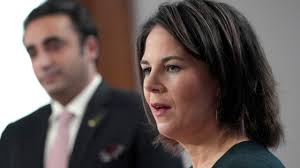 German Foreign Minister Annalena Baerbock has faced a wave of criticism after claiming at the Parliamentary Assembly of the Council of Europe (PACE) that Germany is at war with Russia. The comment led opposition politicians to question whether she is fit for the job.
“A statement by Baerbock that Germany is at war with Russia shows that she is not suited for her job,” Sahra Wagenknecht, a German MP and the former head of the Left Party’s faction in the Bundestag, wrote on Twitter on Friday. A foreign minister should be a “top diplomat” and “not act like an elephant in a China shop,” the lawmaker added, accusing Baerbock of “trampling” on Germany’s reputation.
During the Tuesday debate, Baerbock said European nations were “fighting a war against Russia” and must do more to defend Ukraine.
Germany needs a foreign minister who is capable of acting “as a responsible diplomat and not a firebrand” amid conflict in Europe, said Alice Weidel, the co-chair of the right-wing Alternative for Germany (AFD) faction in the Bundestag.
Weidel accused Baerbock of being incapable of acting on the diplomatic stage, saying Berlin needs a top diplomat who represents Germany’s interests exclusively.
Meanwhile, a regional lawmaker from the state of North Rhine-Westphalia, and the president of the German-Hungarian association, Gerhard Papke, accused Baerbock of being “completely politically insane” for making such a statement.
Left MP Selim Dagdelen demanded Chancellor Olaf Scholz provide an “immediate” explanation on whether Baerbock had his government’s mandate “for her declaration of war” and suggested the minister was a threat to the security of German citizens.
Neither Baerbock, nor Scholz, have responded to the criticism so far. Germany’s Foreign Ministry maintained Berlin is not a party to the conflict between Kiev and Moscow in a statement to the Bild tabloid.
“Supporting Ukraine in exercising its individual right for self-defense… does not make Germany a party to the conflict,” it said, pointing to the UN Charter. It said Moscow’s offensive in Ukraine is “a war against the European peace and order” and this is what Baerbock had meant.
In the wake of Baerbock’s Tuesday statement, Moscow said that the German minister’s words only show that the West had been planning this conflict all along for years.
New Asian contracts to double Russian gas project’s revenue – Reuters
RT | January 26, 2023
The Sakhalin-2 liquefied natural gas (LNG) project is expected to generate twice as much revenue in 2023 compared to its earnings before the Ukraine-related sanctions rained down on Russia’s energy sector, Reuters reported on Thursday, citing industry analysts.
The boost is attributed to long-term contracts with clients from the Asian region, along with higher global energy prices.
Renewed deals with Asian buyers are expected to secure demand for up to 6.5 million tons of the super-chilled fuel annually from Sakhalin 2, according to calculations by the agency and contractual volume data provided by the GIIGNL international group of LNG importers.
The contracts could earn up to $4.5 billion in revenue for Sakhalin 2 shareholders, which include state-run energy giant Gazprom and Japanese companies Mitsubishi and Mitsui, according to Masanori Odaka, a senior analyst on Rystad Energy’s gas and LNG team.
The enterprise is expected to generate another $7.45 billion in 2023 if production remains in line with 2022, while its sales on the spot market are retained at 4.9 million tons, Alexei Kokin, chief analyst at Russia’s Otkritie brokerage, told Reuters.
On Thursday, Sakhalin Energy, the operator of the project, said it produced 11.5 million tons of LNG and some 3.7 million tons of its Sakhalin blend crude oil at the Sakhalin-2 facilities in 2022, exceeding its production plan. That is 10% more than the project produced in the previous year.
The company had managed to continue production despite “a period of unprecedented pressure from external factors on production and economic activity,” according to Andrey Oleinikov, Sakhalin Energy’s managing director.
According to the company’s statement, LNG and oil shipments in 2022 were delivered to the buyers on time in full compliance with the terms of Stock Purchase Agreement, while its production remained on schedule. The major markets for exports are Japan, China, South Korea and Indonesia, Sakhalin Energy said.
Did Germany just officially declare war on Russia?
By Drago Bosnic | January 26, 2023
During a debate at the Parliamentary Assembly of the Council of Europe (PACE), German Foreign Minister Annalena Baerbock bluntly stated that Germany and its allies are at war with Russia. The unexpected admission, although essentially true, is quite shocking given the fact that many Western officials have been insisting they aren’t directly involved in the conflict with Moscow. Baerbock made the statement during a discussion over sending “Leopard 2” heavy tanks to the Kiev regime. Most mainstream media conveniently ignored her words, but numerous experts were alarmed and warned that Berlin just essentially declared war on Russia.
This stands in stark contrast to claims of other German officials who have been extremely careful with their statements for nearly a year, insisting that their country is not directly involved in the Ukrainian conflict and citing uncontrollable escalation as their primary concern. However, this official stance is now in serious question, as one of the country’s top officials just effectively nullified all of their efforts. Annalena Baerbock started her statement at PACE with the following:
“And therefore I’ve said already in the last days – yes, we have to do more to defend Ukraine. Yes, we have to do more also on tanks. But the most important and the crucial part is that we do it together and that we do not do the blame game in Europe, because we are fighting a war against Russia and not against each other.”
Ironically, Chancellor Olaf Scholz and his now former defense minister Christine Lambrecht have been accused of being “weak” on arming the Neo-Nazi junta. They have frequently insisted that it would be dangerous to get more directly involved in NATO’s proxy war against Russia. However, it seems that the much more hawkish Baerbock is willing to say the quiet part out loud. Moscow immediately reacted to the comments, with Russian Foreign Ministry spokeswoman Maria Zakharova saying this is yet another proof that the political West was planning a war on Russia for quite some time now.
“If we add this to Merkel’s revelations that they were strengthening Ukraine and did not count on the Minsk agreements, then we are talking about a war against Russia that was planned in advance. Don’t say later that we didn’t warn you,” Zakharova said.
Baerbock’s comments come on the heels of nearly a year of direct Russophobic narrative, including openly declared plans for war with Russia. In mid-November, Der Spiegel published leaked German Defense Ministry documents, revealing that the Bundeswehr is preparing for war with Russia. The secret draft titled “Operational guidelines for the Armed Forces” was authored by none other than the German Chief of Staff, General Eberhard Zorn himself. He stressed the need for a “mega-reform” of the German military and clearly identified Russia as an “immediate threat”.
The claim makes little sense, as Germany is now over 1,500 km away from Russia, with Belarus, Poland and Ukraine standing between the two countries. While such assertions made some sense at the height of the (First) Cold War, when the Soviet Union had over half a million soldiers stationed in East Germany alone (in addition to other Warsaw Pact member states), the situation is effectively reversed nowadays. NATO is the one encroaching on Russia’s western borders, with the crawling expansion including coups and other interventions in various Eastern European and post-Soviet states. After decades of this creeping aggression and Moscow’s futile attempts to build a comprehensive partnership with the political West, Russia was forced to launch its counteroffensive.
Back in early March, the German government announced a dramatic increase in defense spending, including a €100 billion budget for the Bundeswehr, essentially double in comparison to 2021. Although this will inevitably put additional pressure on the already struggling German economy, ravaged by the sanctions boomerang from its failed economic siege of Russia, Berlin’s suicidal subservience to Washington DC seems to take precedence. Much of Germany’s prosperity was based on access to cheap Russian energy, now a thing of the past thanks to Berlin’s resurgent Russophobia.
In addition, Germany also uniquely holds historical responsibility on a scale virtually no other country in the world does, especially towards Russia. During the Second World War, it launched a brutal invasion of the Soviet Union, killing nearly 30 million people and destroying virtually everything in its path. Worse yet, after approximately 80 years of denazification in the aftermath of its WWII defeat, Berlin still decided to support the Neo-Nazi junta in Kiev, effectively renouncing its own official postwar political position. This also includes German weapons that are killing Russians, both soldiers and civilians.
Alarmed by the dramatic shift in rhetoric, many in Germany are already pointing out the fact that the country is repeating the same historical mistake by antagonizing Russia. Petr Bystron, an AfD (Alternative for Germany) member of the German Parliament, reminded his colleagues in the Bundestag of the consequences of sending German tanks to fight Russia in Ukraine:
“It’s an interesting approach you’re taking here. German tanks against Russia in Ukraine. By the way, your grandfathers have already tried to do it then with the Melnyks and Banderas [Ukrainian Nazi collaborators during WWII] and what was the result? Untold suffering, millions of deaths on both sides, and in the end, Russian tanks here in Berlin. And two of them are still here, in front of the Bundestag. You should pass by them every morning and remember it!”
Drago Bosnic is an independent geopolitical and military analyst.
Stop Whining & Turn Tap On: Why German Politicians Fear to Tell Truth About EU Energy Crunch
By Ekaterina Blinova – Sputnik – 25.01.2023
German Economy Minister Robert Habeck pinned the blame for the nation’s energy crunch and shift to dirty fuels on Russian President Vladimir Putin, who, according to the minister, “turned off the gas tap.” International observers dismissed Habeck’s remarks as utter nonsense while speaking to Sputnik.
“What else is left for Mr. Habeck to do? He cannot say that it were his actions that led to such unfortunate consequences for the German economy and for German consumers,” Alexey Grivach, deputy head of Russia’s National Energy Security Fund, told Sputnik.
“After all, it is precisely because of his rash actions that all German citizens are now suffering – and not only Germany, but the entire European Union. Therefore, Habeck has engaged in such a political, verbal balancing act, trying to convince someone that if there is no gas in the pipe, then Russia is to blame. But, fortunately, everyone knows perfectly well what really happened.”
Speaking to journalists last Friday, Habeck claimed that half of Germany’s entire gas supply had been stopped by Russia. He added that given that Nord Stream pipelines had been destroyed, Germany would not be able to get Russian fuel through them in the foreseeable future.
Done by Habeck’s Own Hands
Sputnik’s interlocutors have been perplexed by Habeck’s whining: it was Berlin that succumbed to Washington’s pressure last year and froze Gazprom’s Nord Stream 2 pipeline project that would have doubled the total capacity of the Nord Stream system from 55 billion cubic meters (bcm) to 110 bcm.
It was Robert Habeck, in propria persona, who on February 22, 2022, instructed the withdrawal of a security-of-supply assessment granted under former German Chancellor Angela Merkel’s tenure, which was required to authorize Nord Stream 2.
It was Habeck, again, who pledged in early May 2022 to replace all Russian energy imports, most notably natural gas, by as soon as mid-2024, following the beginning of Moscow’s special operation to demilitarize and de-Nazify Ukraine on February 24, 2022.
The minister gleefully announced at that time that Germany’s share of Russian gas had already dropped from 55% in 2021 to around 35% by mid-April 2022, adding that even faster progress was achieved for oil and coal where shares had dropped to 12% and 8%, respectively. To that end, Berlin leased four floating LNG terminals online to supply some 33 bcm/year, seeking to start operating the first of the Floating Storage Regasification Units (FSRU) in late 2022 and 2023.
Apparently, Germany did not resist the actions of Canada which slapped sanctions on Russia and had long refused to return a Gazprom turbine for Nord Stream’s gas equipment. Russia initially sent the turbine to Siemens Canada in Montreal for a scheduled overhaul.
However, in June 2022, Canada imposed restrictions on Russia’s energy companies, including Gazprom, and the turbine remained stuck in the North American country. That disrupted the Nord Stream system’s work and raised concerns about pre-planned maintenance service for the other five turbines. After back-and-forths, Ottawa agreed to issue a “time-limited and revocable permit” to exempt the return of the equipment.
“For some reason, this turbine was returned to Germany without the appropriate documents and guarantees that further maintenance of such turbines will be carried out in accordance with the obligations and not in some kind of sanctions mood,” Grivach noted.
Only in late August 2022, the Canadian authorities said that they would allow for the maintenance of the remaining five turbines used by the Nord Stream 1 pipeline, but the damage was done in terms of reducing the flow of natural gas from Russia to Germany.
A month later, a sabotage attack destroyed three out of Gazprom’s four Nord Stream pipelines. So far, neither Germany nor its European peers have lifted a finger to initiate repair works. This apparently indicates that they don’t need Russian gas, remarked Alexey Fenenko, associate professor of the Department of International Security, Faculty of World Politics of Moscow State University.
Furthermore, following the September 2022 sabotage, European leaders immediately pointed the finger of blame at Russia and did not allow Moscow’s specialists to participate in EU investigations into the blast.
However, in December 2022, the US mainstream press quoted European officials and investigators as saying that they had not found any evidence confirming Russia’s guilt. They admitted that Moscow would have nothing to gain from blasting its own pipelines and agreed that there had been plenty of international players interested in Nord Stream’s destruction. Nonetheless, western journalists and European officials have not made any step to name potential suspects.
“It is clear that if it were Russia, as some had the audacity to assert, then they would have proved it very quickly. But, apparently, the facts indicate some very unpleasant, and maybe even some taboo topics,” Grivach remarked.
Habeck’s gloomy sentiment with regard to Germany’s prospects of receiving Russia’s gas is sly, according to Sputnik’s interlocutors.
First, in October 2022, Russian President Vladimir Putin signaled his readiness to deliver gas to Germany through a Nord Stream pipeline not damaged by the blast. “It has a capacity of 27.5 billion cubic meters per year, which is about eight percent of all gas imports to Europe,” Putin stated on October 12, 2022, stressing that the ball is in Europe’s court. “Russia is ready for the start of these deliveries (…) If [European leaders] want it – they have to turn on the tap, and that’s it.”
Second, the same month, Moscow suggested creating a new gas hub in Turkey capable of delivering the fuel to the Old Continent.
Third, Russia is ready to restore gas supplies through other gas pipelines, as Vladislav Belov, deputy director of the Institute of Europe of the Russian Academy of Sciences and head of the Center for German Studies told Sputnik.
“Germany still has every opportunity to receive [Russian gas],” said Belov. “There is the Yamal-Europe gas pipeline, blocked by Poland, there is a gas pipeline through Ukraine, but it has reduced pumping through it by 40%. Germany has ample opportunity to put pressure on its allies. In addition, there is also the Turkish Stream, through which Russia fully fulfills all its obligations. In general, Russia is ready to supply gas to Germany, but the Germans themselves turned the tap off. It is up to them to be able to get as much gas as they need to keep their homes warm, to fill storage facilities and get gas at the prices that are currently on the spot market.”
It Was Europe’s Decision to Axe Russia’s Gas Supplies
The dramatic reduction of Russia’s gas supplies to Europe is the result of a political decision by EU member states, according to observers.
“The reasons are political. The European Union decided to stop the supply of all raw materials coming from Russia for political reasons.”
For his part, former Greek Energy Minister Panagiotis Lafazanis noted in an interview with Sputnik that he fully supports the position of former Austrian Vice-Chancellor Strache, who said that the German authorities are afraid to tell their own population the truth about the real reasons for rising gas and electricity prices and about a possible shortage of energy resources.
“Europe is paying a high price for the expensive natural gas it now has to buy,” said Lafazanis, adding that Europe itself is entirely responsible for the consequences of its energy policy and shift to LNG.
What’s more interesting, some European countries are continuing to buy Russia’s energy commodities nonetheless, Stepan noted.
“For example, Russian LNG is bought by France, the Netherlands, Belgium, Spain and, of course, the United States are continuing to buy Russian LNG,” Stepan said. “The same applies to Russian oil. The UK claims it does not import anything from Russia, and suddenly there is news in the newspapers that several tankers with Russian oil will arrive in Britain (…) It turns out that there’s a double standard approach: on the one hand, politicians issue statements, and on the other hand, in practice, governments pretend that they know nothing about their companies continuing to import Russian raw materials, or they themselves violate their regulations.”
The allegations that Russia “weaponized” its energy supplies repeatedly voiced by western politicians look ridiculous to say the least, according to Sputnik’s interlocutors.
Moreover, Europe’s energy crisis started long before the Russian special operation in Ukraine, which is routinely cited as one of the causes behind spiking gas prices, according to Mehmet Dogan, a Turkish energy expert and CEO of energy consulting agency GazDay.
“Even before the aggravation of the situation in Ukraine, everyone was talking about the threat of an energy crisis,” Dogan told Sputnik. “Gas prices skyrocketed even before the outbreak of hostilities.”
“The gas crisis in Europe began even before the escalation in Ukraine. It was based on a sharp rise in prices for blue fuel. But European countries have tried to make Russia and Putin responsible for this crisis,” echoed Turkish energy expert Volkan Aslanoglu, stressing that Habeck’s recent statement appears to be completely detached from reality.
Russia Supplying EU Despite Sanctions & Military Aid to Kiev
There is yet another aspect to the ongoing debate that is rarely touched upon, according to Alexey Fenenko. The Russian academic considers Habeck’s remark about the blocking of the “gas valve” by Russia strange, given the intention of the EU to defeat the Russian Federation in an economic war.
Moreover, German Chancellor Olaf Scholz made it clear at the latest World Economic Forum in Davos that to end the conflict in Ukraine Russia’s special military operation “must fail.” To that end, Germany and other western countries provide the Kiev regime with heavy weapons as long as needed, according to Scholz.
Indeed, the German media has reported that Berlin is now planning to send its Leopard 2 tanks to Kiev, something that the German leadership had been previously reluctant to do. Earlier this month, Berlin vowed to supply Ukraine with armored personnel carriers and a Patriot missile battery. In addition, on January 15, expanded combat training of Ukrainian forces kicked off in Germany, according to the US press.
European leaders have stepped up supplies of weapons to Kiev since the beginning of Russia’s special military operation with prominent leaders rubbishing the idea of a diplomatic solution to the conflict, rather claiming that it should be sorted out on the battlefield.
All this time, despite the EU’s bellicose rhetoric and their de facto participation in the Russo-Ukrainian conflict, Russia’s energy producers continued to observe their obligations and supply Europe with natural gas, oil and petroleum products.
Russia is still warming up the Old Continent, be it direct oil and gas exports or ensuring the flow of energy carriers through its territory, energy expert Milos Zdravkovic told Sputnik. Moscow is signaling openness and readiness to provide Europe with energy, even though Russia has enough lucrative opportunities in Asia.
European Gamble Doesn’t Bode Well
Meanwhile, EU economic prospects don’t look good, according to Zdravkovic. He noted that the EU does not know what energy prices will be in the foreseeable future both for heating and the needs of industry. European goods are set to become much more expensive than those produced by Asians and Americans due to turbulent gas costs. This will adversely affect the economy of Europe, Zdravkovic warned.
“Europe consumed at least 500 billion cubic meters (bcm) a year,” Zdravkovic explained. “Its consumption grew by about 10 bcm per year.”
In 2021, the EU imported 83% of its natural gas with Russia delivering over 40% of this volume. Given that, it’s impossible to swiftly replace Russia’s gas with LNG supplies, according to Zdravkovic.
“The capacity of the total fleet of LNG tankers and all terminals on our planet, on all continents, is 400 bcm,” the Serbian energy expert noted, adding that European leaders shouldn’t expect that these volumes will all go to the Old Continent.
Moreover, a complete shift to American LNG would require building the appropriate infrastructure, according to Alexey Fenenko. One should also add fuel costs for tankers which will carry LNG from the US to Europe when supplies become regular. All these costs will make energy pretty expensive for Europeans, the Russian scholar remarked.
Of course, European countries could also switch to coal and nuclear energy, but it will take at least ten years for them to reorient to these sources of energy, Fenenko added.
“Every cloud has its silver lining,” said Zdravkovic. “I am convinced that at the end of this crisis (…), no one will ever be able to force large European economies, EU civilians and inhabitants of [the Old Continent] to join such a gamble again. I think this will definitely never happen again and that in the future there will be much more cooperation.”
NATO’s best tanks are going to Ukraine, what will it mean on the battlefield?
By Mikhail Khodaryonok | RT | January 25, 2023
Tank supplies to Ukraine from NATO members is the top news story this week. Kiev has been calling for these weapons from its western sponsors since the beginning of the Russian offensive, and it looks like now, eleven months into the fighting, these demands are being met.
The US has announced it will send 31 Abrams main battle tanks. In a hastily scheduled speech on Wednesday, President Joe Biden noted that they are complicated to operate and maintain, so the US will provide Kiev with “parts and equipment necessary to effectively sustain these tanks on the battlefield.”
It was also confirmed, the same day, that the German government will send Leopard 2A6 tanks from its own stock and will allow other nations, such as Poland, to transfer German-made machines, to Ukraine. On January 14, London announced plans to ship its Challenger 2s to Kiev, while it now seems inevitable that Paris will supply AMX-56 Leclerc vehicles.
Russian experts and journalists have been locked in a heated debate over the differences between these western main battle tanks and the Russian T-90s, comparing their armor, guns, accuracy, active and passive protection systems, maneuverability, fire-control systems, ammunition, and many other attributes.
At the end of the day though, these discussions lack any practical value. The battlefield is the only litmus test for the advantages and drawbacks of any type of weapon or military equipment. Reliable statistics on combat use are all that is required for a comparative analysis of modern main battle tanks, if it is to be credible.
Another thing to remember is that all tanks are vulnerable to modern anti-tank systems.
How many tanks does Kiev need?
To simplify calculations, we’ll be using an armored division, the main structural and tactical unit of armored forces in the former Soviet republics, as our yardstick. According to Soviet manuals, an armored division must have 296 tanks, 230 infantry fighting vehicles, 54 self-propelled artillery systems, over 2,000 regular vehicles, and almost 12,000 soldiers and officers.
How many divisions does Kiev need? At least one per each of the three main fronts — in Lugansk, Donetsk, and Zaporozhye. The line of contact in the special military operation zone right now is 815 km long, making three divisions too modest an amount to make a difference, but let’s disregard this for the time being.
Three armored divisions combined would have a total of about 900 tanks. Apart from that, another armored division may be necessary on the Belarusian front, which could see some very heavy fighting. In case of an escalation there, an armored division or a similar unit in reserve is a must, which drives the number of required tanks up by 300 to 1,200.
Finally, no commander-in-chief can do without his own reserve, the so-called reserve of the supreme high command. Without at least one armored division, this reserve cannot really count as such, which means another 300 tanks for a required total of 1,500.
Another thing to consider is probable Ukrainian losses during offensive operations. The average daily losses of an armored unit in this case stand at 10 to 15%. About 15 to 20% of incapacitated tanks are typically irrecoverable losses, while the rest require repairs (general maintenance for 30 to 50%, medium-level repairs for 15 to 30%, and an overhaul for 10 to 20%).
Simply put, at least another 300 tanks are required to offset losses during combat operations. This gives us a figure of 1,800 tanks, which must be considered an absolute minimum.
These are very approximate and somewhat simplistic calculations, yet they give us ballpark figures.
How many tanks will Kiev get?
So far, NATO countries have earmarked tanks for Ukraine numbered in the dozens. This is only a fraction of the hypothetical minimum.
Great Britain and Poland have officially pledged an armored company each, respectively consisting of up to 14 tanks. Germany will supply a similar amount, while the US is preparing the supply of 31 Abrams heavy weapons.
At a recent meeting of the US-led Defense Contact Group at Ramstein Air Base in Germany, officials from 12 countries discussed sending a total of about 100 tanks to Kiev, if Berlin were to give the green light, which, according to an ABC report, it has done.
Rheinmetall could additionally supply a total of 139 tanks to Ukraine, including 88 Leopard 1s and 51 Leopard 2A4s, yet the German manufacturer concedes that only 29 of them could be shipped before the summer of 2023.
What impact will NATO’s tanks have?
Will all these tanks see combat any time soon? Let’s consider the example of the M1 Abrams, which is seen as one of the symbols of US military power.
A small number of these tanks manned by poorly trained crews and lacking full-scale maintenance and supply infrastructure support would most likely yield negative results. They will fail to change Ukraine’s fortunes on the battlefield, while images of burning American tanks will likely hurt US public opinion.
Thus, one of America’s premier weapons, the pride and joy of its defense industry, will be humiliated on the battlefield for a long time. This is something the Pentagon can’t allow to happen under any circumstances.
Therefore, before any actual fighting happens, evacuation teams, tank repair units, and spare part supplies must be in place, while crews must receive superior training to handle American tanks.
Last but not least, the first deployment of US main battle tanks in Ukraine must be accompanied by a significant Ukrainian army success, at least at the tactical level, which would necessitate no fewer than 200–300 (maybe even 400–500) tanks.
Otherwise, supplying the M1 Abrams to Ukraine makes neither military nor political sense. Transferring them one company (10 to 15 tanks) at a time would only mean that this equipment will burn on the battlefield without making any significant impact or even catching anyone’s attention.
So far, according to known data, Russia has not had any significant trouble dealing with enemy equipment. This is something on which both the Russian Ministry of Defense and most Western analysts seem to agree.
No room for complacency
It’s very likely that the first NATO tank companies will be used as training units for Ukrainian crews, while Poland will initially provide maintenance and repair capacity for servicing German or American tanks.
One shouldn’t think, however, that training will stretch over a very long time. It can take just weeks to do a full training program, while teaching T-64/84 crews to fight in the M1 Abrams or the Leopard 2A5 could be completed in a matter of days.
What matters in the reports about the West mulling tank supplies to Ukraine is not the tanks themselves as much as the breaking of a taboo, which, until recently, prevented the transfer of heavy western-made armored vehicles to Ukraine.
Once this taboo is broken, there is every reason to assume that, sooner or later, Kiev will receive not only the 1,800 western main battle tanks it badly needs, but much more than that.
At that point in time and maybe even earlier, Ukraine will be able to create a strike force on the Zaporozhye front for example. If a force like that succeeds in breaching Russian defenses, it could cover the 82 km to Melitopol in less than three days, which would dissect the whole depth of the Russian defense in this region.
With this in mind, the Russian armed forces must achieve tangible military and political results long before western arms supplies reach their full potential.
Mikhail Khodaryonok is a military observer, retired colonel, and air defense specialist.
Goodbye empire? US sanctions are failing in the face of multipolarity
By Felix Livshitz | RT | January 25, 2023
Foreign Affairs, a highly influential US magazine – effectively a US empire house journal – has published an article detailing how sanctions are quickly losing their efficiency as a weapon in Washington’s global arsenal.
Published by the Council on Foreign Relations NGO, Foreign Affairs provides space for officials within the US military industrial complex to communicate with one another on matters they believe to be of the utmost significance. Therefore, it is important to pay attention when the magazine makes major pronouncements on any issue.
It recently published an appraisal of US sanctions – the conclusion being that they are increasingly ineffective, have prompted Beijing and Moscow to create alternative global financial structures to insulate themselves and others from punitive actions, and that Washington and its acolytes will no longer be able to force countries to do their bidding, let alone destroy dissenting states, through such measures in the very near future.
The article begins by noting that “sanctions have long been the US’ favored diplomatic weapon,” which “fill the void between empty diplomatic declarations and deadly military interventions.” Despite this, it predicts “the golden days of US sanctions may soon be over.”
These “golden days” were the immediate post-Cold War era, when Washington was “still an unrivaled economic power,” and therefore could at the press of a button cripple each and every overseas economy, in theory. This was due to “primacy of the US dollar and the reach of US oversight of global financial channels.”
As international trade was overwhelmingly conducted using dollars, Washington could stop any country from exporting or importing any and all goods it wished, whenever it liked. Even then, Foreign Affairs recalls, US leaders themselves worried if sanctions were applied too liberally. In 1998, then-President Bill Clinton claimed his government was “in danger of looking like we want to sanction everybody who disagrees with us.”
The Foreign Affairs article says Clinton’s fears were “overblown,” but this is precisely what came to pass. Governments, and the countries they represented, have been sanctioned for pursuing the wrong policies, refusing to be overthrown in US-backed coups and military interventions and showing any degree of independence in their domestic or foreign dealings whatsoever. In the process, millions have died, and even more lives have been ruined for no good reason.
This approach has backfired, and badly. In response, states “have begun to harden their economies against such measures.” For example, after the US cut off Iran from the SWIFT global banking system, many other countries took note. Restricting China’s access to numerous technologies as part of the new Cold War has also served to place both Washington’s allies and adversaries alike “on notice their access to crucial technology could be severed.”
Beijing and Moscow lead the way in the push to create “financial innovations that diminish US advantage,” creating a raft of “currency swap agreements, alternatives to SWIFT, and digital currencies” that serve as “preemptive measures” against any “potential penalties” down the line.
Currency swaps, which connect central banks directly to each other and eliminate the need for trades between them to be dollar-backed, have been eagerly embraced by China. It has signed deals of this kind with more than 60 countries across the world, thereby enabling its companies “to circumvent US financial channels when they want to.”
In 2020, Beijing settled more than half its annual trade with Moscow in currencies other than the dollar, making the majority of these transactions totally immune to US sanctions, and that figure has only risen ever since. In March that year also, the China and Russia-led Shanghai Cooperation Organization officially prioritized development of payments in the local currencies of its members.
Beijing and Moscow are also, Foreign Affairs reports, “busily preparing their own alternatives” to various Western-dominated international systems. Their alternative to SWIFT, the Cross-Border Interbank Payment System, isn’t yet a match in terms of transaction volume, but that’s not the point. It prevents them, and any state or organization enrolled in the framework – 1,300 banks in over 100 countries already – from being unable to make international financial transactions, should they be cut out of SWIFT.
Similarly, China is expanding the reach of the digital renminbi, the currency issued by Beijing central bank, at home and overseas. More than 300 million of its citizens already use it, and a billion are forecast to by 2030. The currency is completely sanctions-proof as the US has no ability to prevent its use, and Beijing has encouraged several countries to pay for its exports exclusively using it – “other such deals will probably follow,” Foreign Affairs predicts.
The American empire’s obsessive reliance on sanctions has now created a Catch-22 situation, by the magazine’s reckoning. The already hostile relations between the USA, China and Russia mean Moscow and Beijing are pushing ahead with this revolutionary effort no matter what. If “things get worse,” they’ll simply “double down on their sanctions-proofing efforts,” taking more and more countries with them.
“These innovations are increasingly giving countries the ability to conduct transactions through sanctions-proof channels. This trend appears irreversible,” the article bitterly concludes. “All this means that within a decade, US unilateral sanctions may have little bite.”
It is all these developments, along with Moscow’s economic pivot eastwards after the 2014 Ukraine coup, and move towards self-sufficiency in energy and food and in other vital resources, which account for the embarrassing failure of US-led sanctions against Russia.
Western leaders, academics, journalists, pundits and economists promised when these sanctions were imposed that they would soon lead to Russia’s total political, economic and military collapse. They have not, demonstrating that elites in Europe and North America do not understand the global economy they claim to rule. They should get to grips with the new reality they inhabit in short order, though – for a multipolar world has begun to emerge in 2022, and it is here to stay.
How rapidly US elites are reckoning with the radically different reality in which they are now forced to operate is ironically underlined by how quickly the author of the Foreign Affairs article, Agathe Demarais, seems to have completely changed her tune on the subject of sanctions. On 1 December, less than a month earlier, she authored a piece for Foreign Policy – another US empire in-house journal – that offered a radically different take on the matter.
Boldly declaring “sanctions on Russia are working” in the headline, Demarais dismissed suggestions punitive Western measures were intended to “force Putin to back down and pull out of Ukraine,” or to provoke “regime change” in Moscow, or to prompt “a Venezuela-style collapse of the Russian economy,” despite the fact every single one of these outcomes was explicitly cited as a motivating factor behind the sanctions by Western officials, pundits, and journalists at the time.
Instead, she argued, sanctions were effective in the quest to “send a message to the Kremlin” that “Europe and the United States are standing with Ukraine.”
Whether or not Kiev will be thrown under a bus by its Western backers in due course, and the anti-Russian measures will endure after the war is over, seems to not matter so much, though – for, as Demarais was herself forced to acknowledge less than four weeks later, the effectiveness of sanctions is rapidly diminishing. The speed of this about-face could well be an indication of how irresistibly the multipolar world is coming to be.
90 Seconds to Midnight?
By Scott Ritter | January 24, 2023
The Russian guided missile frigate, the Admiral Gorshkov, is in the middle of the Atlantic Ocean, ostensibly heading toward the east coast of the United States, part of a planned journey which began on 4 January 2023 and is expected to transit the Atlantic and Indian Oceans, as well as the Mediterranean Sea. The Admiral Gorshkov is outfitted with 16 vertical launch tubes, each of which, in theory, could be armed with nuclear-capable Zircon hypersonic missiles capable of covering 1,000 kilometers in less than 10 minutes.
To put it bluntly, soon Russia will be in a position where a single ship could, in a matter of minutes, fire 16 nuclear armed hypersonic missiles at the United States which not only cannot be intercepted by anything in the US arsenal, but also would impact their respective targets before any meaningful evacuation could be conducted. It is, literally, a decapitation weapon.
Current Russian nuclear doctrine does not allow for a nuclear first strike; indeed, Russian President Vladimir Putin has made it clear that Russia would not be the first nation to use nuclear weapons in any future nuclear conflict. But he also emphasized that Russia would not be the second, either, meaning that Russia would release its nuclear arsenal without waiting for any US first strike to impact Russian soil.
The Admiral Gorshkov is sending a clear signal to the US leadership that there will be no survivors in any nuclear exchange between the US and Russia.
Amid this muscle flexing, the Science and Security Board of the Bulletin of the Atomic Scientists, a disarmament advocacy group founded in 1945 by Albert Einstein and University of Chicago scientists who helped develop the first atomic weapons in the Manhattan Project, and which currently maintains what is known as the “Doomsday Clock” that reflects the risk of nuclear conflict, decided to move the hands of the clock ten seconds forward from the current 100 seconds to midnight. In a statement announcing this decision, “A time of unprecedented danger: It is 90 seconds to midnight,” the board declared the following:
“The war in Ukraine may enter a second horrifying year, with both sides convinced they can win. Ukraine’s sovereignty and broader European security arrangements that have largely held since the end of World War II are at stake. Also, Russia’s war on Ukraine has raised profound questions about how states interact, eroding norms of international conduct that underpin successful responses to a variety of global risks.
“And worst of all, Russia’s thinly veiled threats to use nuclear weapons remind the world that escalation of the conflict—by accident, intention, or miscalculation—is a terrible risk. The possibility that the conflict could spin out of anyone’s control remains high.”
The ignorance of this statement is manifest. What the Board calls “Russia’s war on Ukraine” ignores the fact-based historical truth that the Ukraine conflict was, and is, solely the byproduct of a concerted plan by the United States and NATO to use Ukraine as a foil to generate conflict designed to bring down the government of Russian President Vladimir Putin.
This plan has been in place since at least 2008, when the former US Ambassador to Russia (and current Director of the CIA), William Burns, warned that any effort by NATO to bring Ukraine into its ranks would precipitate an eventual Russian military intervention. Despite this stark warning, NATO extended an invitation to Ukraine in November 2008, clearly initiating a known cause-effect relationship that defined NATO’s policy toward Russia as being one which sought a proxy conflict using Ukraine as a stand-in for NATO.
This policy as furthered by the US, EU and NATO all acting in concert to precipitate a coup in Ukraine in February 2014 designed to oust the constitutionally elected president, Victor Yanukovych, and replace him with a new, ultra-nationalist government dominated by adherents of the odious ideology of Stepan Bandera. The coup succeeded, and in April the new Ukrainian government declared war on the ethnic Russian population of the Donbas. This action triggered the Russian annexation of Crimea and the provision of military support by Russia to the Donbas, triggering the very military intervention William Burns had warned about six years prior.
Ukraine and its NATO allies then sued for peace, initiating negotiations that led to the adoption of the Minsk Agreement, which put in place a ceasefire in exchange for guarantees regarding Ukrainian sovereignty over the Donbas as well as relative autonomy for the ethnic Russians of the Donbas, protecting their language, religion, culture, and traditions.
The Minsk Accords floundered for eight years, with Ukraine failing to implement the required constitutional changes necessary to secure the rights of the ethnic Russians of the Donbas. The reasons for this delay are today well known, thanks to the public confessions of former Ukrainian President Petro Poroshenko, former German Chancellor Angela Merkel, and former French President Francois Hollande, all three signatories to the accords. These three national leaders have acknowledged that the Minsk Accords were simply a sham designed by Ukraine to buy time to build a NATO proxy military capable of reclaiming both the Donbas and Crimea.
Russia’s decision to invade Ukraine on February 24, 2022 was not an unprovoked act of aggression, but rather a legitimate exercise of its right, together with the newly independent republics of Lugansk and Donetsk, of preemptive collective self-defense in the face of the imminent threat of aggression by Ukraine’s newly trained army which was, by design, little more than a NATO proxy.
The fact that the esteemed members of the Bulletin of Atomic Scientists – which includes among its ranks ten Nobel laureates – seem ignorant of this history, colors their ability to comprehend the true nature of the threat facing the world today, and from whence that threat comes.
The United States, having deliberately provoked a pre-meditated conflict with Russia, is now trying to implement a two-tracked policy designed to trigger a Maidan-like moment in Moscow (named after Maidan Square, in Kiev, where US-backed neo-Nazi’s staged a violent coup against former Ukrainian President Victor Yanukovych) where the Russian population would rise up against the government of President Vadimir Putin, overthrowing him and installing a pro-western leader who would return Russia to the colonial-like existence of the 1990’s, when Boris Yeltsin allowed the collective west to rape Russia economically and dominate Russia politically.
The two-tracks of this policy involve the imposition of economic sanctions linked to Russia’s decision to militarily intervene in Ukraine, and the prosecution of a proxy conflict in Ukraine designed to bleed Russia white. The goal of this policy is to engender massive unrest among a demoralized Russian population which would in turn rise and remove President Putin from power.
The insanity of such a plan is incomprehensible. Imagine for a moment that Russia embarked on a plan of action designed to strip away Mexico from the US sphere of influence and, in doing so, promulgated a conflict the goal of which was to have Mexico re-take by force the territory encompassing the states of California, Arizona, New Mexico, and Texas. The idea that the United States would sit idly in the face of such a threat is ludicrous. So, too, is any concept that Russia should do the same.
A quick history lesson for the Bulletin of Atomic Scientists:
- It was the US, not Russia, that withdrew from the Anti-Ballistic Missile and Intermediate Nuclear Forces treaties.
- It is the US, not Russia, that has frozen talks on the extension of the New Strategic Arms Treaty.
- It is the US, not Russia, that has recently promulgated a nuclear posture policy which allows for the preemptive use of nuclear weapons in a non-nuclear scenario.
- It is the US, not Russia, that has deployed a low-yield (i.e., “usable) nuclear warhead (the W-76-2) on Trident submarine launched ballistic missiles, and conducted war games where the Secretary of Defense has practiced the communications procedures necessary to launch this weapon where Russia was the named target of the missile.
- It is the US, not Russia, that is building a Ukrainian proxy army designed by intent to be able to capture territory Russia claims as its own (the four former Ukrainian provinces annexed by Russia in September 2022, and Crimea), knowing full well that one of the triggers for release of Russian nuclear weapons is any conventional military force that threatens the existential survival of Russia.
The Bulletin of Atomic Scientists would have to be deaf, dumb, and blind not to know these underlying facts, and not to see them as truth.
Which means they are complicit in the nuclear terror being perpetrated by the United States, and indifferent to the consequences thereof.
The Bulletin of Atomic Scientists is therefore fundamentally wrong in its assessment of it being 90 seconds until midnight.
The truth is the world is one second to midnight, and the clock can strike at any time, something the presence of the Admiral Gorshkov off the coast of the United States proves only too well.
Russia, Syria reopen airbase after providing it with AD systems
The Cradle | January 24, 2023
Russia and Syria have restored the Al-Jarrah military airbase in northern Syria, Russia’s Defense Ministry announced on 23 January. The airbase, which had been destroyed during the Syria conflict, will now host both Russian and Syrian warplanes.
Russian forces have also deployed Buk M2E and Pantsir S1 air defense systems inside the airbase, with the aim of defending Syria’s northern border and closing Syrian airspace to Israeli warplanes, which have regularly bombed Syria since 2013.
The opening ceremony of the airbase was attended by the commander of the Russian armed forces in Syria, General Andrey Serdyukov, and the Syrian Minister of Defense, General Ali Mahmoud Abbas, in addition to military personnel and guests of honor from both countries.
During the ceremony, planes and helicopters of the Russian Aerospace Forces and the Syrian Air Force demonstrated their combat capabilities, while Syrian special forces carried out parachute drops from helicopters and carried out simulated surround and destroy exercises.
The Al-Jarrah airbase, which lies in Manbij, between Aleppo and Raqqa, was first captured by US and Saudi-backed militants from an Al-Qaeda affiliated Salafist militia, Ahrar al-Sham, in February 2013. The operation to capture Al-Jarrah was part of a broader Al-Qaeda led push, known as the “War of the Airports,” to capture Syria’s major military airbases, including Taftanaz, Wadi al-Deif, and Menagh.
According to Abu Abdallah Minbij, an Ahrar al-Sham commander, the 2013 capture of Al-Jarrah cut off Syrian army supply lines to the east and made it difficult for the army to send reinforcements to Raqqa province. Raqqa city fell to Al-Qaeda led forces, including Ahrar al-Sham and the Nusra Front, a month later, in March 2013.
In April 2013, the Nusra Front and Islamic State of Iraq (ISI) split with ISI and became ISIS. Many Nusra fighters and commanders pledged allegiance to the organization. This allowed ISIS to establish a foothold in Raqqa. ISIS then expelled its jihadist rivals and took full control of Raqqa city in January 2014, making the city its Syrian capital.
ISIS captured Al-Jarrah airbase from Ahrar al-Sham in January 2014 as well.
With Russian assistance, the Syrian army recaptured the airbase in 2017, in a bloody battle led by the Syrian Major General Suheil al-Hassan’s Tiger Forces. Some 3,000 ISIS militants were killed and wounded in the fighting.
The joint restoration of the Al-Jarrah airbase by Syria and Russia represents an increase in Russian presence in the country, as well as the recent surge in military cooperation between the two states.
Featured Video

Death Spikes & Rising Cancer In Our Youth Explained
or go to
Aletho News Archives – Video-Images
From the Archives
Politicians lie
By Mazin Qumsiyeh | Popular Resistance | August 18, 2013
There is no way to say this truth nicely: Politicians lie. That includes Japanese, American, Egyptian, Israeli, and Palestinian politicians! Is there something more common sense than that? Yet, so many citizens around the world believe their own politicians or wistfully acknowledge lies but think it is part of the job needed to run things. They believe even when politicians contradict themselves blatantly. This phenomenon is rather remarkable. It is a dissonance and disconnect from reality that many seem oblivious to. It is very dangerous because it can lead to accepting rationales for going to war. These can be deadly wars that lead to millions of lives lost as happened in what was called World War 1 and WW2. Even when incredible and declassified evidence abound, politicians continue to lie and old mythologies refuse to die. Here are just a few of the countless lies told to us over the past few decades… continue
Blog Roll
 Aletho News
- Burnham’s UN debut… A masterclass in British disinformation
- Iran flights continue despite US aviation sanctions
- Global Tipping Points Lead the World Into a State of Entropy
- The day-after at the White House: USA and Xi Jinping
- The Geopolitical Balance in the Red Sea: The UAE Being Displaced by New Players
- Iraqi resistance group vows to stage airport sit-ins over Iran aerial blockade
- Turkish parliament to review Saudi-Pakistan defense pact next month
- DEATH SPIKES & RISING CANCER IN OUR YOUTH EXPLAINED
- Iran offers Trump deal before US election
- Merz regime wants ‘secret police’ – opposition
- If Americans Knew
- Deconstructing Netanyahu’s pants-on-fire UN rant – Daily Update
- Trump betrayed voters with his campaign lies and prioritized a foreign country once he took office
- Netanyahu calls Israel’s war in Gaza ‘opposite of genocide’ in UN speech to near-empty hall
- Settler Kidnappings: Torture, Sexual Abuse and Terrorisation of Palestinian Abductees as Israel Deepens Annexation of West Bank
- Gaza winter nears as 162,000 tents become unusable, raising fears of humanitarian crisis
- Netanyahu says, “It’s the opposite of genocide”; UN says Gaza economy is world’s ‘most severe crisis on record’ – Daily Update
- Israel’s US-Backed Assault on Gaza Has Created the ‘World’s Most Severe Economic Crisis on Record’: UN
- ‘Protecting U.S. Citizens’… From Israel
- ‘This is where I live now, the back of a truck’: a day in the life of a grandmother in Gaza
- In UN Speech, Iran’s President Displays Pictures of Children Killed by US, Brings Attention to Israel’s Nuclear Arsenal
- No Tricks Zone
- New Study: Earth And Venus Surface Warmth Largely Explained By Convection And Lapse Rate, Not CO2 Or Radiation
- 2025 Nature Paper Claiming Worsening Global Drought Gets RETRACTED …Heavily Flawed
- New Study: ‘Global Drought Shows No Detectable Recent Acceleration Under Climate Warming’
- Economic Masterminds: German Socialists Suggest Taxing Productivity Gains Stemming From Using AI
- The South China Sea Has Not Been Cooperating With The Climate Change Narrative
- Energy Crisis: Germany Enters Heating Season With Historically Low Gas Reserve Fill Levels
- New Study: The Antarctic Ice Sheet Gained Mass From 2020-2024 Due To Staggering Snow And Ice Accumulation
- Study: Ocean Heating Rates From Thousands Of Years Ago ‘Dwarf’ Modern Ocean Heating Rates
- Climate Extremists Target, Attack Large-Scale Power Grid Infrastructure In Germany!
- New Study: Antarctic Ice Melt Has Contributed Less Than 1 Centimeter To Sea Level Rise In The Last 30 Years

