Russia Insists US Forces Withdraw from Tanf Area in Syria: Ministry
Al-Manar | February 8, 2019
The Russian Foreign Ministry insists that US forces withdraw from the 55-km security zone surrounding its Tanf military base, which includes the Rukban refugee camp, the ministry said in a statement late on Thursday.
On February 6, the second humanitarian convoy was sent to the camp by the UN and the Syrian Arab Red Crescent, with the Russian side’s assistance. The first aid convoy was unable to reach its destination, as it was stopped by US-controlled militant groups.
Commenting on the developments, the Russian Foreign Ministry said Moscow’s position on the camp and the delivery of humanitarian cargo there remains unchanged.
“We need to eliminate the root cause – the unlawful US military presence on the Syrian land within the 55-km security perimeter which includes the camp,” the ministry said.
According to Russian diplomats, the camp, which is currently home to over 40,000 people, will receive over 1,000 tons of humanitarian cargo, including food, clothes, medicines and other essential goods. Besides, it is planned to vaccinate about 10,000 children against tuberculosis, polio, hepatitis and other diseases.
“Once the effort is complete, we expect [to receive] from UN officials a detailed report on measures taken and information containing practical proposals on closing the camp and evacuating its residents,” the ministry added.
According to the statement, Rukban is not the only refugee camp whose residents found themselves in a dire humanitarian situation. The Russian Foreign Ministry requests relevant organizations and the international community to examine the situation in Al-Hawl, a camp for internally displaced persons on the outskirts of an eponymous city in Syria’s al-Hasakah governorate where over 30 children died since the start of the year.
“According to information that we are receiving, including from the UN, it [the camp] houses about 33,000 people. The vast majority of them – or about 23,000 people – arrived in December 2018 from the Deir Ezzor governorate, fleeing the military operation conducted by the US and its allies against the ISIL terrorist group [outlawed in Russia] in the city of Hajin, which entailed numerous casualties among the civilian population,” the ministry said.
Hillary Clinton: Trump’s INF Treaty Withdrawal is “Gift to Putin”
Sputnik – 07.02.2019
Last week, US Secretary of State Mike Pompeo announced that Washington would suspend its obligations under the Intermediate-Range Nuclear Forces (INF) Treaty and begin a six-month withdrawal process. The following day Russian President Vladimir Putin stated that Moscow was providing a mirror response.
Former Democratic presidential candidate Hillary Clinton has slammed the Trump administration’s decision to pull out from the INF Treaty as a “gift to [Vladimir] Putin”.
Speaking at an event hosted by Georgetown University’s School of Foreign Service and its Institute of Politics and Public Service on Wednesday night, she claimed that the current administration withdrew “without really holding Putin accountable for his cheating on the treaty”.
“I think there is agreement, it started in the Obama administration, that the Russians were not only developing intermediate-range capacity, but deploying it — and so, when that happens… it seems to me that you want to do some public diplomacy. We clearly have pictures and we clearly know a lot about their cheating, and we should have done a better job in making it abundantly clear, not only to the American people but the Russian people, and Europeans, and others who are on the front lines, that the Russians were evading responsibilities in the INF”, Clinton said.
She went on to tell the crowd that instead of demanding talks on the matter, the US decided to pull out, and claimed that Russia was going “to go forward and develop even more of these” weapons.
Looking at the situation from a global perspective, Clinton suggested that the world could face some bleak prospects following the collapse of the landmark treaty:
“It increases the unpredictability, and I believe the danger, that can come from throwing around more missiles and weapons of all kinds, but particularly nuclear ones, within the European theatre. […] The last thing the world needs right now is a nuclear arms race”.
Last week, US Secretary of State Mike Pompeo announced that Washington would be suspending its obligations under the INF Treaty starting on 2 February.
He further said that the accord would be entirely terminated if Russia doesn’t meet Washington’s demands regarding the alleged treaty violations, namely to destroy all ground-based 9M729 missiles and their launchers, as well as other associated equipment that purportedly breached the agreement.
Pompeo stated that Russia has six months to save the deal while the US goes through the process of withdrawing from it.
Shortly after the withdrawal announcement, Russian President Vladimir Putin held a meeting with Foreign Minister Sergei Lavrov and Defence Minister Sergei Shoigu, during which the head of state said that Moscow was suspending its obligations under the INF Treaty in response to Washington’s move. While saying that Moscow was still open to negotiations, President Putin instructed the ministers not to initiate talks on the matter.
In addition, President Putin stressed that the use of target rockets and the deployment of Mk 41 launchers in Europe since 2014 by the United States was a direct violation of the arms control treaty and reiterated that Moscow had been fully complying with the agreement.
Putin further emphasised that notwithstanding reciprocal measures, Russia should not and would not be drawn into an arms race.
In December, the US gave Russia a 60 day warning about withdrawing from the treaty, asking Moscow to return compliance by destroying the missiles that allegedly violate the treaty. The 60 days were up at the beginning of February.
The United States has repeatedly accused Russia of violating the 1987 treaty with the development of its 9M729 ground-based missile systems (known as the SSC-8 under US classification), which Washington claimed had a range of over 1,000 km, while the agreement bans missiles with ranges between 500 and 5,500 km.
Moscow has vehemently denied the claims, citing a lack of proof, and stressed that the range of these weapons was 480 km, which is in full compliance of the INF.
The INF Treaty was signed by the Soviet Union and the US, and envisages the destruction of all nuclear-armed ground-launched ballistic and cruise missiles with ranges between 500 and 5,500 kilometres (about 300 to 3,400 miles).
US Sanctions Against Syria, Iran is ‘Economic Terrorism’ – Moscow
Sputnik – 07.02.2019
According to Deputy Foreign Minister Sergei Ryabkov, Moscow and Tehran will be advancing ways in which to defend their economies from US sanctions.
“We must — and many have already spoken about this, including our ambassador in Tehran — complete the transition process of economic interaction in the national currency as the best way to protect ourselves from the US abusing the role of the dollar”, Ryabkov told reporters on Thursday.
He also slammed Washington for the sanctions imposed on Damascus.
“There are ways to minimise the consequences of US sanctions, and these ways will be improved. There are alternative partners and formats, they need to be strengthened. I am sure that in the case of Syria, Russian-Syrian relations will only continue to ascend; neither the United States nor anyone else will interfere with this. And I agree that the US sanctions are economic terrorism”, the deputy minister stressed.
The statement by the Russian diplomat comes just a day after the US Senate voted to expand economic sanctions on Syria and to condemn President Donald Trump for announcing a full US troop withdrawal from that country.
Last November, a second package of US sanction against Tehran came into effect following the US withdrawal from the Joint Comprehensive Plan of Action (JCPOA) — the Iran nuclear deal — in May, 2018. The sanctions are aimed at exercising maximum pressure on Iran and forcing it to negotiate a new deal.
‘America First’ means nuclear superiority
By M. K. BHADRAKUMAR | Indian Punchline | February 6, 2019
The US president’s annual State of the Union address traditionally focuses on domestic issues but it also throws some light on the foreign policy priorities. President Trump’s speech on Tuesday adhered to the pattern and if anything, the portions on foreign policy received scant attention, restricted to his “agenda to protect America’s National Security.” Trump’s re-election bid for a second term in 2020 provided the backdrop.
Trump boasted about the US’ military build-up and flagged the mammoth budget allocation of $716 billion to “fully rebuild” the US military. As part of it, he said, the US is “developing a state-of-the-art Missile Defence System.” He saw no reason to be apologetic about “advancing America’s interests” and cast his decision to withdraw the US from the Intermediate-Range Nuclear Forces (INF) Treaty in that light.
Trump made a pro forma offer to consider negotiating a “different (INF) agreement, adding China and others (read India and Iran)” but himself sounded sceptical, and went on to assert that the US “will outspend and out-innovate all others by far” in an arms race. He all but sought the US’ nuclear superiority.
Clearly, the global strategic balance is going to come under enormous stress in the period ahead. It is inconceivable that Russia will allow the global strategic balance to be shifted. In conventional forces, Russia is at a disadvantage vis-a-vis the West and that gives added impetus to maintain the overall strategic parity with the US.
Notably, Russia test-fired an RS-24 Yars intercontinental ballistic missile today following Trump’s speech and within hours of an earlier similar American test-firing of a Minuteman ICBM in California. The RS-24 Yars is a vastly improved version of the famous SS-29 ICBM that the Soviet Union deployed. It is presently the mainstay of the ground-based component of Russian nuclear triad.
This thermonuclear intercontinental ballistic missile has a range of 12 000 km, which brings the entire territory of the United States within its reach. Yars is equipped with multiple independent re-entry vehicle (MIRV) and is designed to evade missile defense systems (which Trump boasted about.) It maneuvers during the flight and carries both active and passive decoys and has at least 60-65% chance to penetrate defenses.
Significantly, during Tuesday’s address before the Congress, Trump made no references to arms control negotiations with Russia, leave alone to comment on the fate of the New START nuclear arms reduction agreement (2010), which is due to expire in 2021.
Indeed, the ‘breaking news’ in Trump’s speech was the announcement of his second summit meeting with the North Korean leader Kim Jong-un on February 27-28 in Vietnam. Trump sounded upbeat about his “bold new diplomacy” with North Korea and claimed credit (justifiably so) for avoiding a catastrophic war on the Korean Peninsula. He acknowledged that there is much unfinished business, but placed trust in his “relationship” with Kim.
The only other foreign-policy topics that Trump touched in the speech were the US’ standoff Venezuela, the Middle Eastern conflicts (Syria and Afghanistan) and of course Iran. While he was rhetorical about the “brutality” and the “socialist policies” of the Venezuelan government of President Nicolas Maduro, Trump steered clear of any threats to intervene in that country. Trump merely said that the US stands with the Venezuelan people “in their noble quest for freedom.” On the other hand, Trump gently moved away from Venezuela to attack the “new calls to adopt socialism” in the US too and stated his resolve that “America will never be a socialist country.”
As regards the Middle East, Trump said his approach is based on “principled realism”. He recalled that his approach has been consistent: “Great nations do not fight endless wars.” Trump said it is time the troops came home from Syria, having defeated the Islamic State.
Curiously, in comparison with Syria, Trump made a somewhat nuanced reference to the Afghan war. Without elaborating, Trump hinted that the Taliban is not the US’ sole interlocutor for holding negotiations to reach a political settlement in Afghanistan. But the surprising part was when he said,
“As we make progress in the negotiations, we will be able to reduce our troop presence and focus on counter-terrorism. We do not know whether we will achieve an agreement.”
The carefully-worded formulation steered clear of making a commitment of a total US withdrawal from Afghanistan. In fact, Trump pointedly spoke of a reduced troop presence in Afghanistan while also underscoring the need to continue with counter-terrorist operations.
From Trump’s remarks, it appears that the US has somewhat pulled back from the reported progress at the recent 6-day talks in Qatar with the Taliban representatives. Whether this ambivalence is due to pressure from the US military and the Ashraf Ghani government against a withdrawal of American troops from Afghanistan or is merely a tactical posturing to pressure the Taliban to make concessions remains to be seen.
Ghani’s preferred strategy (which US military commanders also advocate) is to reconcile the Taliban on the terms in which he had earlier reconciled Gulbuddin Hekmatyar two years ago — which is to say, by offering the insurgents an opportunity to join his government. The Pentagon has been doggedly opposed also to giving up the American bases in Afghanistan, which it considers to be of vital importance for the US’ long term global strategies.
Ghani had telephoned the US Vice-President Mike Pence in the weekend before Trump’s speech on Tuesday. Yet, Trump plainly ignored the Ghani government.
Trump made harsh references to Iran as “sponsor of terror” and the government in Tehran as a “radical regime” and “corrupt dictatorship”, but, strangely, he stopped well short of adopting any confrontational overtone, leave alone threaten Iran. Trump merely said, “We will not avert our eyes from a regime that chants death to American and threatens genocide against the Jewish people.”
In overall terms, the impression will be that Trump projected a foreign-policy outlook where the US will eschew military interventions in foreign countries that are in the nature of protracted entanglements through the remaining period of his term in office and concentrate instead on his domestic agenda, which he intends to make the centre piece of his campaign for re-election. A mood of retrenchment is evident all through and left to himself, Trump would like to avoid foreign-policy entanglements that do not directly impact American interests or his own campaign to win a second term as president.
Having said that, make no mistake, fundamentally and in a longer term perspective, Trump is actually pitching for “America First”. He believes in a strong America, whose military superiority will be unchallenged and whose capacity to force its will on the world community is never in doubt. Implicit in the strategy is a resumption of the US’ elusive chase for nuclear superiority — through an extremely expensive arms race in which Trump thinks Russia lacks the financial resources to compete with the US and China can be overwhelmed in military technology.
Reality Check: Is Russia planning to invade Sweden or is UK media spreading more baseless hysteria?
By Bryan MacDonald | RT | February 5, 2019
Two of Britain’s leading newspapers have run delirious headlines this week, warning of a potential Russian assault on neutral Sweden.
“Sweden’s first new conscripts prepare to repel Russian invaders” – the Telegraph.
“First Swedish conscripts in a decade begin training to defeat a Russian invasion” – Daily Mail.
Sounds scary, doesn’t it? Poor Sweden (population 9 million) getting ready to repel an attack from big, bad Russia (population 145 million).
Furthermore, to make things even worse, the “aggressor” is a military superpower and the “victim” stands alone, without even NATO to protect it. And that bit is really relevant here, as you will soon see.
Anyway, rest easy: Never mind the bollocks, here’s the British media. Armed with its particular brand of hysteria, mendacity, and click-bait calumny.
The Telegraph, which isn’t even pretending to be a newspaper anymore, bases its “Russian invasion” warning on the testimony of a Colonel Stennabb. He highlights how “Russia is prepared to use military means to accomplish political objectives, not just in Crimea but in Syria.”
Hardly a radical concept, even in Europe where many countries, most notably, France (Libya, Ivory Coast, CAR, Chad, etc.) and the UK (Iraq, Syria, Sierra Leone, Kosovo, etc.) aren’t exactly shy about backing up words with firepower.
At no point does Stennabb explain why Russia would want to invade Sweden. Nor does the Telegraph. Which fails to note Sweden doesn’t even border mainland Russia, although it does sit across the Baltic Sea from the tiny Russian exclave of Kaliningrad.
After all, Sweden has few resources useful to Moscow and IKEA already has plenty of stores around Russia.
That said, Vladimir Putin’s spokesman, Dmitry Peskov, did mention last year that the president is partial to ABBA. But, surely there are easier ways of encouraging them to reform?
The Mail piece largely amounts to a rewrite of the Telegraph’s scaremongering. But they do pad it out a bit, mentioning how “Russia has also been launching incursions into European airspace.”
For illustration, it explains “just last week, a Russian Su-27 fighter was filmed ‘pushing’ an American F-15 out of the way as they patrolled over the Baltic Sea.” Adding how, in a separate incident, “the (US) Pentagon said that a Russian jet came dangerously close to one of its fighters over the Black Sea on Monday.”
So, here we have two American aircraft operating in Europe and this British newspaper is accusing Russia of “launching incursions into European airspace.”
Meaning either the Mail is unaware that Russia is in Europe but the United States is not, or it thinks its readers are stupid.
Anyway, the last major conflict between Sweden and Russia ended in 1790, following a failed Swedish attack two years earlier. Famously, the conflict was started by King Gustav III of Sweden for domestic political reasons.
This present UK media hysteria serves similar ends. Because, in this time of austerity, British Armed Forces spending is squeezed. And what better way to keep the moolah coming than to create a plausible enemy?
Plus, there’s a small, but vocal, bunch both within and without Sweden who hope to drag the traditionally neutral country into NATO. Go figure.
If the Polar Vortex is due to Global Warming, Why are U.S. Cold Waves Decreasing?
By Roy W. Spencer, Ph. D. | Watts Up With That? | January 31, 2019
It’s much easier to devise and promote a climate change theory than it is to falsify it. Falsification requires a lot of data over a long period of time, something we don’t usually have in climate research.
The “polar vortex” is the deep cyclonic flow around a cold air mass generally covering the Arctic, Canada, and Northern Asia during winter. It is irregularly shaped, following the far-northern land masses, unlike it’s stratospheric cousin, which is often quite symmetric and centered on the North and South Poles.
For as long as we have had weather records (extending back into the 1800s), lobes of cold air rotating generally from west to east around the polar vortex sometimes extend down into the U.S. causing wild winter weather and general unpleasantness.
We used to call this process “weather”. Now it’s called “climate change”.
When these cold air outbreaks continued to menace the United States even as global warming has caused global average temperatures to creep upward, an explanation had to be found. After all, snow was supposed to be a thing of the past by now.
Enter the theory that decreasing wintertime sea ice cover in the Arctic (down about 15% over the last 40 years) has tended to displace the polar vortex in the general direction of southern Canuckistan and Yankeeland.
In other words, as the theory goes, global warming sometimes causes colder winters. This is what makes global warming theory so marvelously adaptable — it can explain anything.
In the wake of the current cold wave, John Christy skated into my office this morning with a plot of U.S. winter cold waves since the late 1800s. He grouped the results by region, and examined cold waves lasting a minimum of 2 days at a station, and 5 days at a station. The results were basically the same.
As can be seen in the plot below, there is no evidence in the data supporting the claim that decreasing Arctic sea ice in recent decades is causing more frequent displacement of cold winter air masses into the eastern U.S., at least through the winter of 2017-18:
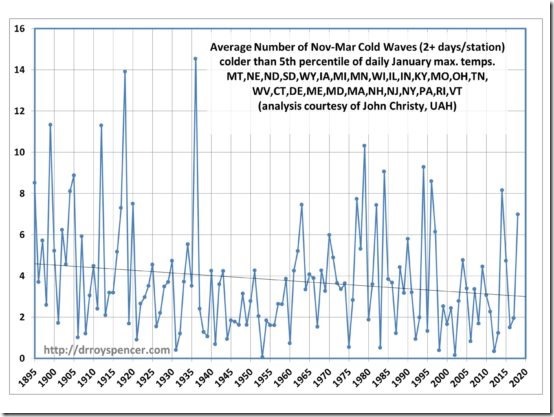
The trend is markedly downward in the most recent 40 years (since 1979) which is the earliest we have reliable measurements of Arctic sea ice from satellite microwave radiometers (my specialty).
Now, I suppose that Arctic sea ice decline could have some influence. But weather is immensely complex. Cause and effect is often difficult to ascertain.
At a minimum we should demand good observational support for any specific claim. In this case I would say that the connection between Eastern U.S. cold waves and Arctic sea ice is speculative, at best.
Just like most theories of climate change.
Putin meeting with Foreign Minister Lavrov and Defence Minister Shoigu on INF Treaty
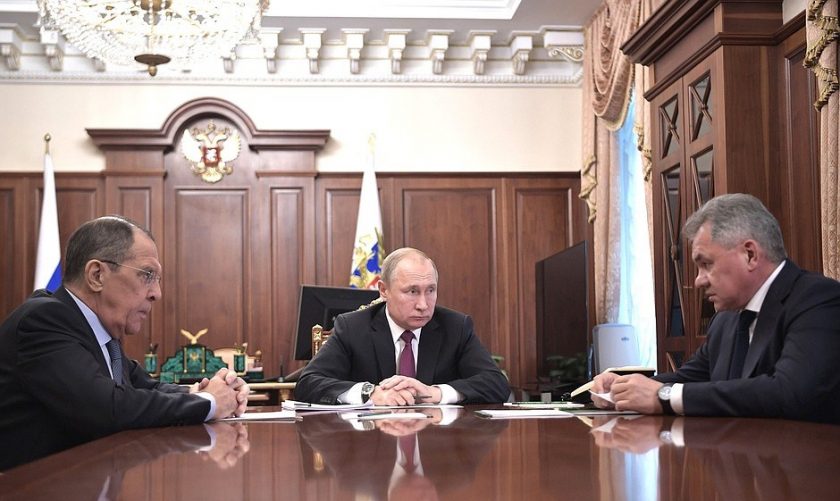
Russian President Vladimir Putin with Foreign Minister Sergei Lavrov (left) and Defence Minister Sergei Shoigu.
The Kremlin, Moscow | February 2, 2019
President of Russia Vladimir Putin: Foreign Minister Sergei Lavrov, please provide an update on the Treaty on the Elimination of Intermediate-Range and Shorter-Range Missiles, and the disarmament dossier in general. What is going on in terms of limitation of offensive arms?
Foreign Minister Sergei Lavrov: Mr President,
Regarding the Intermediate-Range Nuclear Forces Treaty, as you know, it has been in force since 1988. It had an indefinite term. According to the information at our disposal, the United States has been violating the Treaty since 1999, when it started testing combat unmanned aerial vehicles that have the same characteristics as land-based cruise missiles banned by the Treaty.
The United States went on to use ballistic target missiles for testing their missile defence system, and in 2014 they began the deployment in their missile defence system positioning areas in Europe of Mk 41 vertical launching systems. These launchers are fully suitable as they are for Tomahawk intermediate-range attack missiles.
Vladimir Putin: And this is an outright violation of the Treaty.
Sergei Lavrov: This is an outright violation of the Treaty. Launchers of this kind have already been deployed in Romania, and preparations are underway to deploy them in Poland, as well as Japan.
Another matter of concern for us is that only recently, just a year ago, the United States in its 2018 Nuclear Posture Review set the task of developing low-yield nuclear weapons, and it is probable that intermediate-range missiles will serve as a means of delivery for these weapons. It was also announced only recently that this provision of the US nuclear doctrine is beginning to materialise with missiles of this kind entering production.
In October 2018, the United States officially declared its intention to withdraw from the Treaty on the Elimination of Intermediate-Range and Shorter-Range Missiles. We did everything we could to save the Treaty considering its importance in terms of sustaining strategic stability in Europe, as well as globally. The last attempt of this kind was undertaken on January 15, when the US finally agreed to our request for holding consultations in Geneva.
In coordination with the Defence Ministry, we proposed unprecedented transparency measures that went far beyond our obligations under the INF Treaty in order to persuade the US that Russia was not in violation of this essential instrument. However, the US torpedoed these proposals. Instead, the US presented yet another ultimatum. It is obvious that we cannot accept it since it contradicts the INF Treaty in both letter and spirit.
The US announced that it was suspending its participation in the INF Treaty, launched the official withdrawal from it, and said that it will no longer consider itself restricted by the INF Treaty. As far as we can see, this means that the US will make missiles in addition to engaging in research and development activities that have already been factored into the current budget.
There is no doubt that these developments make things worse overall in the sphere of nuclear disarmament and strategic stability. It all started with the 1972 Anti-Ballistic Missile Treaty, when the US decided to withdraw from it in 2002, as you know all too well. This was done despite numerous initiatives by the Russian Federation at the UN General Assembly to save the ABM Treaty. The UN General Assembly passed a number of resolutions supporting the ABM Treaty. However, this did not stop the United States from withdrawing from it.
As a partial replacement for the ABM Treaty, the US and Russia signed a joint declaration that same year, 2002, on new strategic relations with a promise to settle all issues related to the so-called third positioning area of the missile-defence system being deployed in Europe at the time. The declaration provided for holding consultations as a way to reach common ground. This did not happen due to the unwillingness of the United States to take up Russia’s concerns in earnest.
In 2007, we made another gesture of good will at your instructions by coming forward with an initiative that consisted of working together to resolve the problems related to US missile defence system’s third positioning area in Europe. Once again, the US backed out of this proposal.
However, at the Russia-NATO Summit in Lisbon in 2010, we once again called for Russia, the US and Europe to work together on a continental missile-defence system. This call was not heeded. Nevertheless, two years later, in 2012, at the NATO Summit in Chicago it was NATO that called for dialogue with Russia on missile defence. However, all this good will boiled down to the US insisting that we simply come to terms with their missile defence approach, despite all the obvious risks and threats to our security posed by this approach.
Let me remind you that in 2013 Russia once again called on the US Department of State to open consultations, and came forward with concrete proposals. There was no reply. And in 2014, the United States brought the dialogue on missile defence to a halt and declared the intention to deploy its positioning areas in Europe and Asia, while also strengthening other systems, including in Alaska and on the east coast.
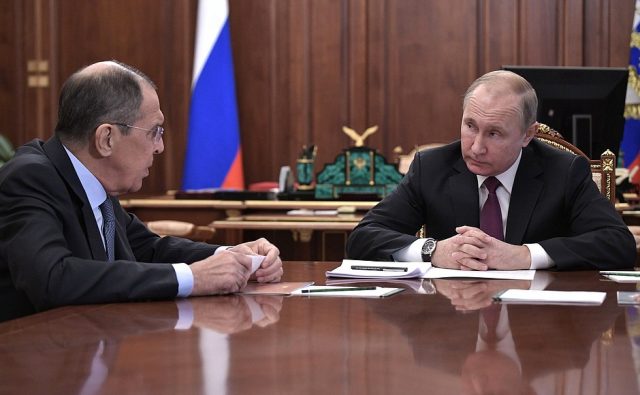
With Foreign Minister Sergei Lavrov.
Talking about other essential international security and strategic stability instruments, the approach adopted by the United States to performing its commitments under the universal Treaty on the Non-Proliferation of Nuclear Weapons has been a matter of concern for Russia. In fact, despite numerous reminders on our part, the United States commits serious violations of the Treaty in its actions within NATO. The Treaty commits nuclear powers to refrain from transferring the corresponding nuclear technologies.
Despite these provisions, NATO engages in so-called joint nuclear missions whereby the United States together with five NATO countries where US nuclear weapons are deployed conduct nuclear weapons drills with countries that are not part of the five nuclear-weapons states. This is a direct violation of the Non-Proliferation Treaty.
Another treaty that had a special role in removing the threat of nuclear war, or, to be more precise, whose preparation was a source of hope for addressing these threats, was the Comprehensive Nuclear-Test-Ban Treaty [CTBT]. The United States did not ratify it even though doing so was among Barack Obama’s campaign promises when he ran for president.
Right now, this instrument is completely off the radar, since the United States has lost all interest in any consultations on joining this Treaty. Being a party to the CTBT and acting in good faith, Russia holds special events at the UN General Assembly every year in order to promote the Treaty and mobilise public opinion in favour of its entry into force, which requires the United States to join it, among other things.
Apart from the INF Treaty, there is the Strategic Offensive Arms Treaty [START] that remains in force. It is also essential for preserving at least some measure of strategic stability and global parity. It is also under threat, since its effective functioning has come into question after the recent move by the United States to remove from accountability under the treaty 56 submarine based Trident launchers and 41 heavy bombers by declaring them converted into nun-nuclear.
This is possible under the treaty, but the other party has the right to make sure that once converted these weapons cannot be reconverted back into nuclear arsenals.
Vladimir Putin: An inspection has to be carried out.
Sergei Lavrov: Yes, an inspection. And there have to be technical means to persuade us that these systems cannot be reconverted and returned into the nuclear arsenal.
We have been holding talks since 2015 to make sure that the United States complies with its obligations on this matter. So far, there have been no results. The technical solutions we have been offered so far cannot persuade us that more than 1,200 warheads, which is an enormous amount, cannot be returned to the nuclear arsenal. Unfortunately, repeated proposals by Russia to launch talks on extending the Strategic Offensive Arms Treaty beyond 2021, when its first term is set to expire, have fallen on deaf ears in the United States. All we hear is that the decision on the New START has yet to be taken.
All in all, the situation is quite alarming. Let me reiterate that the decision taken by the United States on the INF Treaty is of course a matter of serious concern for the entire world, especially for Europe. Nevertheless, the Europeans followed in the footsteps of the United States with all NATO members speaking out in explicit support of the position adopted by the United States to refrain from any discussions on mutual concerns. All we hear are groundless ultimatums requiring us to take unilateral measures without any evidence to support unfounded accusations.
Vladimir Putin: Thank you.
Mr Shoigu, what is the Defence Ministry’s view on the current situation? And what do you propose in this regard?
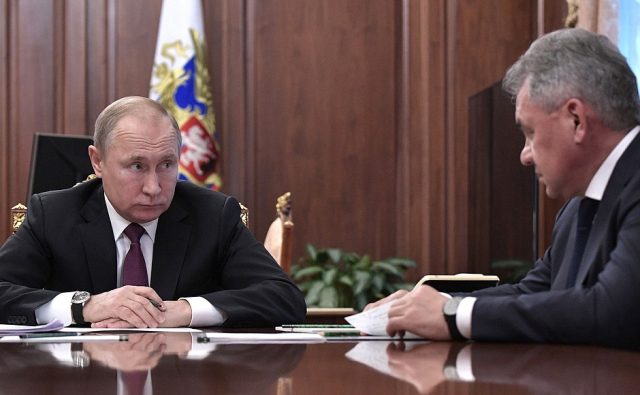
With Defence Minister Sergei Shoigu.
Defence Minister Sergei Shoigu: Mr President, it is obvious to us, despite the murky language that we hear, that apart from openly conducting research and development on the production of intermediate-range and shorter-range missiles, there have been actual violations of the INF Treaty, and this has been going on for several years. To put it simply, the United States has started producing missiles of this kind.
In this connection, we have the following proposals regarding retaliatory measures.
First, we propose launching in the coming months research and development, as well as development and engineering with a view to creating land-based modifications of the sea-based Kalibr launching systems.
Second, we propose launching research and development, followed by development and engineering to create land-based launchers for hypersonic intermediate-range and shorter-range missiles.
We ask you to support these proposals.
Vladimir Putin: I agree. This is what we will do. Our response will be symmetrical. Our US partners announced that they are suspending their participation in the INF Treaty, and we are suspending it too. They said that they are engaged in research, development and design work, and we will do the same.
I agree with the Defence Ministry’s proposals to create a land-based version of the Kalibr launchers and work on a new project to develop a land-based hypersonic intermediate-range missile.
At the same time, I would like to draw your attention to the fact that we must not and will not let ourselves be drawn into an expensive arms race. I wanted to ask you, would it be possible to finance these initiatives using the existing budget allocations to the Defence Ministry for 2019 and the following years?
Sergei Shoigu: Mr President, we closely studied this matter, and will propose adjustments to the 2019 budget in order to be able to carry out these initiatives within the limits set by the state armaments programme and the defence procurement orders for 2019 without going over budget.
Vladimir Putin: This should not entail any increases in the Defence Ministry’s budget.
Sergei Shoigu: Yes.
Vladimir Putin: Good.
In this connection, there is one more thing I wanted to ask you. Every six months we hold meetings in Sochi to discuss the implementation of the state defence order with the commanders of the Armed Forces and the defence sector representatives.
Starting this year, I propose modifying this format. I want to see how efforts to deploy our systems are progressing. This refers to the Kinzhal hypersonic air-launched ballistic missile, the Peresvet combat laser weapon, which has already been delivered to the army, and the Avangard system, which is now in serial production, having completed the test phase. I want to see how the production of the Sarmat missile is advancing alongside preparations for placing it on combat duty.
Several days ago, you reported to me on the completion of a key stage in testing the Poseidon multipurpose strategic unmanned underwater vehicle. We have to look at how these efforts are advancing.
We are aware of the plans by some countries to deploy weapons in outer space. I want to hear a report on how this threat can be neutralised.
There is another important topic I wanted to raise with both the Foreign Ministry and the Defence Ministry.
For many years, we have been calling on numerous occasions for holding meaningful disarmament talks on almost all aspects of this matter. In recent years, we have seen that our partners have not been supportive of our initiatives. On the contrary, they always find pretexts to further dismantle the existing international security architecture.
In this connection, I would like to highlight the following considerations, and I expect the Foreign Ministry and the Defence Ministry to use them as guidance. All our proposals in this area remain on the table just as before. We are open to negotiations. At the same time, I ask both ministries not to initiate talks on these matters in the future. I suggest that we wait until our partners are ready to engage in equal and meaningful dialogue on this subject that is essential for us, as well as for our partners and the entire world.
Another important consideration I would like to share with the senior officials of both ministries. We proceed from the premise that Russia will not deploy intermediate-range or shorter-range weapons, if we develop weapons of this kind, neither in Europe nor anywhere else until US weapons of this kind are deployed to the corresponding regions of the world.
I ask the Foreign Ministry and the Defence Ministry to closely monitor developments and promptly submit proposals on ways to respond.
Russia Suspends INF Deal With US, Putin Directs Ministers Not to Start New Talks
RT | February 2, 2019
President Vladimir Putin says Moscow is halting its participation in the Cold War-era INF nuclear agreement after Washington’s decision to suspend it. Russia will develop missiles previously forbidden under its terms.
“Ours will be a mirror response. Our US partners say that they are ceasing their participation in the treaty, and we are doing the same,” the Russian president said in Moscow on Saturday in reference to the Intermediate-Range Nuclear Forces Treaty (INF).
“They say that they are doing research and testing [on new weapons] and we will do the same thing,” Putin said during a meeting with Foreign Minister Sergey Lavrov and Defense Minister Sergey Shoigu.
The Russian leader emphasized that while Moscow’s offers on modernizing the 1987 treaty and making it more transparent “are still on the table,” no more talks should be initiated with the Americans to try and save it.
“Let’s wait until our partners mature sufficiently to hold a level, meaningful conversation on this topic, which is extremely important for us, them, and the entire world,” Putin said.
In December, the Trump administration threatened to quit the agreement, which limits nuclear and conventional land-launched missiles with a range between 500 and 5,500km within 60 days, unless Russia stopped allegedly violating it with its 9M729 missile, which Washington claims exceeds the permitted range.
Moscow denied that it had broken the treaty, and offered additional mutual inspections during failed talks in Geneva last month. On February 1, Washington officially confirmed that the bilateral agreement signed by Mikhail Gorbachev and Ronald Reagan will be suspended for 180 days. Washington also signaled intentions to entirely withdraw from it afterwards.
‘US directly violated INF’
During the meeting in front on the cameras on Saturday, Lavrov insisted that Moscow “attempted to do everything we could to rescue the treaty.” This included “unprecedented steps going far beyond our obligations,” he said, accusing Washington of systematically undermining the INF Treaty at least since the late 1990s.
In particular, Washington started “testing drones that matched the characteristics” of ground-based cruise missiles banned in the treaty.
Later, the US “installed MK 41 launching systems for the defense shield in Europe that can be used to fire mid-range Tomahawk cruise missiles without any modification.”
“This is a direct a violation of the INF,” Putin interjected.
“Such launchers have already been completed in Romania, more are scheduled to be put into service in Poland and Japan,” Lavrov said.
Shoigu went further, saying that despite vague formulations the US has barely concealed that it is “not just conducting research on short and medium-range missiles.”
To put it simply, the US has already begun producing these rockets.
Putin said the collapse of the INF is not a one-off, but marks a deliberate policy by Washington that could imperil the landmark New START treaty, which expires in 2021.
“Over many years, we have repeatedly suggested staging new disarmament talks, on all types of weapons. Over the last few years, we have seen our initiatives not supported. On the contrary, pretexts are constantly sought to demolish the existing system of international security,” President Putin said.
Syria Briefing from Peter Ford: US Withdrawal, Safe Zones, Sanctions, Idlib, ISIS & Israel
The following situational briefing update of January 24, 2019 has been provided by Peter Ford, Former British Ambassador to Syria:
US Withdrawal
Contrary to the expectations of many experts, President Trump has remained insistent on the withdrawal of approximately 2,000 US troops from North East Syria, although he has had to concede more time. The ‘conditioned’ withdrawal touted by his uber-hawkish National Security Adviser, John Bolton, appears to have shrunk just to ensuring that the Kurds in the YPG militia the US will be leaving behind are not slaughtered by the Turks. One of the other conditions, eradicating the final remnants of ISIS, appears to have been all but met by a final Coalition push, with ISIS down now to its last village, obviating the handing of the job to Turkey which was ludicrously proposed initially, while the other condition, ensuring that Iran does not benefit, appears to have been quietly forgotten.
‘Safe zone’
Quite how the Kurdish issue will be settled remains up in the air. Not for much longer, however, if we parse correctly the statements made by Putin and Erdogan after their meeting in Moscow on 23 January.
As is often the case when the great men speak, what they do not say is as important as what they do say. Erdogan did not say, as he had done previously, that Turkey was going to police the proposed ‘safe zone’, 20 miles deep, cleared of the YPG. Rather he said that Turkey and Russia were in agreement on the establishment of such a zone. And the next day his Foreign Minister said that Turkey was open to arrangements being made involving ‘the US, Russia or others’. Putin on his side made clear that these significant ‘others’ were the Syrian government, whom he encouraged to speak to the Kurds. The day before the Putin-Erdogan meeting a Kurdish delegation was in Moscow, following earlier discussions in Damascus.
The eventual outcome, a return of Syrian security forces to the North East, is, in the view of this analyst, nailed on. The only question is when and under which conditions. The Kurds, reckoning on the Turks’ lack of appetite for a contested incursion and US dithering, are attempting to squeeze the last concession out of Damascus in terms of incorporation of the YPG into the Syrian security forces and some measures of local self-government, as well as use of the Kurdish language. Damascus, however, appears to hold the whip hand, conscious that as time goes on Trump will look as powerless over withdrawal as he does over the Mexican Wall if he does not act ‘and will if necessary call the Kurds’ bluff.
ISIS
It does indeed seem curtains for ISIS in Syria, at least as a territory-controlling caliphate. ISIS drew attention to themselves however with a suicide bomb attack in Manbij which left four Americans dead, prompting predictable cries from the foreign policy establishment in the US and Europe that it was folly to be leaving a ‘vacuum’ in Syria while there was still life in the twitching ISIS body. That experts deemed reputed could peddle this superficial analysis and be believed in the media is testimony to the blinkered thinking which dominates in the West. There will be no vacuum – the Syrian government has a good track record in the areas it has liberated of crushing ISIS, better in fact than the Americans for whom, as for their Kurdish allies, there are no-go areas of Arab villages in the areas they nominally control. These experts would do well to reflect on why ISIS are choosing this decisive moment to attack US forces, something they have curiously jailed to do for several months.
The hidden factor here is the incipient next phase in ISIS’s existence. It has gone underground, especially in Deir EzZor province which straddles the Euphrates. This is the equivalent of Iraq’s restless Anbar province which it borders. ISIS will not relish the prospect of Syrian Mukhabarat (security police) descending on Arab villages which have hitherto been no go areas to wake up ‘sleepers’. Expect more attacks on US forces.
Idlib
Putin and Erdogan also discussed Idlib, although the way forward here is less clear. Even the Turks cannot deny that in what is, to all intents and purposes, a Turkish and Western protectorate, the extreme jihadist Al Qaida-linked Tahrir Ash Sham (HTS) has run amok and now controls virtually the entirety of the area. This is the opposite of what was supposed to happen under the terms of the Russo-Turkish Sochi agreement which brought the September crisis to an end. Under Sochi the Turks were supposed to bring HTS to heel. Putin seemed to hint that military preparations would now move ahead for the Syrian government with Russian support to advance on Idlib, with Turkish acquiescence. The seamlines are already hot.
Political negotiations
One thing is clear. The Idlib issue is not going to be resolved by any political negotiations between the warring parties. The Western powers who cling to the comforting fiction that there can only be a political end to the Syrian conflict have no answers where Idlib is concerned.
The new UN envoy for Syria, Gerd Pederson, appears to be feeling his way, slowly, as well he might. Currently the Geneva process is in baulk over US, French and British blocking of a slate of candidates for inclusion in the Constitutional Committee which is supposed to come up eventually with a new constitution which will pave the way for UN-supervised elections with the participation, as the Western powers and Turkey would have it, of millions of Assad-hating refugees.
This mirage might appear harmless. However it is constantly cited by the Western powers to justify their conduct of war on Syria by other means than the military methods which are now all but exhausted.
Sanctions
How have the EU and the US responded to the prospect of normalisation in Syria? With more sanctions of course.
The EU has slapped sanctions on Syrian businessmen participating in a flagship property development scheme in Damascus deemed tantamount to assisting the ‘regime’. This scheme is emblematic of the many private investment projects now popping up, many of them involving Arab investors. Obviously the EU could not tolerate such progress, it not being enough to hamstring economic recovery with the existing deeply harmful battery of sanctions. The stated reason is that the Syrian government is not facilitating political progress towards the above mentioned mirage of elections rigged to produce a government of Western stooges. If the masterminds of EU diplomacy sincerely believe that such sanctions will make Assad bow the knee after eight years of vicious conflict have failed to do so, then we must fear for their sanity.
The US House of Representatives, with White House support, has chimed in with a Syria sanctions bill aimed at punishing any person or business which participates in any government linked project. This could have extra-territorial effect, dampening the interest of outside investors in Syria recovery projects. Again this highlights the hypocrisy of Western legislators who profess humanitarian concern but who are careless of inflicting economic suffering on a population already on its uppers after eight years of conflict, fuelled by Western support for armed groups, as long as they can strike a virtue-signalling blow against the ‘regime’. This is what a diplomacy of vindictiveness looks like.
The practitioners of this diplomacy have had some success with US and UK diplomats scouring Arab countries to pressure them into delaying normalisation of relations with Syria until the mirage has been reached. It appears that a consensus on Syria’s readmission to the Arab League as early as March is not likely to be found. Damascus will shrug this off. It is only delaying the inevitable. Arab countries who feel threatened by both Iran and fundamentalism can see that they are going to have to learn to live with Syria and that using contacts with Damascus to dilute Iran’s influence and share intelligence are very much in their interest.
Israel
Perennial party pooper Israel has attempted to spoil Assad’s successes by relaunching after a pause airborne attacks, ostensibly against Iranian targets. This is odd in that even US intelligence, cited by Trump, apparently more attentive to intelligence briefings than his detractors would have you believe, has reported that Iran has been withdrawing forces. The most recent blatant day time raid elicited a rare reprisal from Damascus, a missile which was shot down over the Syrian occupied Golan (not even Israel itself). Cue massive display of shock by the media, which had signally ignored the literally thousands of Israeli bombs dropped on Syria over the last two years. Naturally Syria and Russia’s attempt to secure some expression of concern from the Security Council failed, unprovoked aggression by Israel apparently not being inconsistent with the ‘rules based system’ constantly enjoined by the West on others.
Israel should however beware of hubris. Syria’s new Russian supplied SAM 300 air defence system is scheduled to become operational in March.
Author Peter Ford is the former British Ambassador to Syria (2003-2006) and Bahrain (1999-2002).
This briefing was originally published at the Global Network for Syria\
Turkey Slams US-Led Coalition Members for Supporting Militants in Syria’s Idlib
Sputnik – 31.01.2019
ANKARA – Certain members of the US-led coalition fighting against Daesh support militants from the Hayat Tahrir al-Sham terrorist group in the Syrian province of Idlib as they are aspiring to wreck the Russian-Turkish agreement on de-escalation zone, Turkish Foreign Minister Mevlut Cavusoglu said Thursday.
“Certain partners from the coalition support HTS… First, for the termination of the Idlib memorandum. Second, there are countries that are making great efforts to prevent the establishment of a constitutional committee just because we are doing it”, Cavusoglu told the Hurriyet newspaper.
He specified that some Western countries from the coalition were provoking HTS militants to violate the provisions of the Idlib memorandum by paying them money for it.
“Russians have a joint operation offer. They say we should remove them [HTS militants] from there”, Cavusoglu added, noting that the countries of origin of foreign fighters from HTS were unwilling to take them back. “There are many people leaving the HTS after we came to the field”.
Earlier in the day, the Russian Foreign Ministry’s spokeswoman, Maria Zakharova, said that HTS militants were actively building up their forces along the contact line between the armed opposition and the government in Idlib’s de-escalation zone.
Last September, Russian President Vladimir Putin and his Turkish counterpart, Recep Tayyip Erdogan, agreed to set up a demilitarized zone in Idlib along the contact line between armed opposition groups and Syrian government forces, while the Russian and Turkish defence ministers signed a memorandum on stabilising the situation in the Idlib de-escalation zone. However, the agreements have not been fully implemented yet, and over 10 different militant groups are currently operating in Idlib.
Maduro stays put, mediation can help
By M. K. BHADRAKUMAR | Indian Punchline | January 31, 2019
Russia is doing the right thing by switching tack from strident ‘anti-American’ rhetoric to focus on tamping down the tensions over Venezuela. China had counseled such an approach right from the outset when the crisis erupted last week.
On day one of a looming US-Venezuelan standoff on January 24, the Chinese foreign ministry spokesperson called upon “all relevant parties to stay rational and cool-headed and seek a political solution to the issue of Venezuela through peaceful dialogue within the framework of the Venezuelan Constitution.”
This was alongside Beijing’s vehement support for the efforts of the Venezuelan government of President Nicolas Maduro “to uphold national sovereignty, independence and stability” as well as China’s unequivocal opposition to “foreign interference in Venezuela’s affairs.”
It stands to reason that Moscow too began toning down its rhetoric and harmonizing with the Chinese stance. The heart of the matter is that the Venezuelan crisis holds the danger of putting a dagger into the heart of the international system in an already unstable world order full of potential for chaos, which of course is not in the interest of any of the three big powers that are ‘stakeholders’ – the US, Russia and China.
Thus, Russian Foreign Minister Sergey Lavrov’s remarks to the media on Wednesday in Moscow offering mediation between the government and the opposition in Venezuela can be put in perspective. Lavrov acknowledged China and Russia’s role as Venezuela’s “leading partners” in the economic sphere. He then recalled the various ideas floated by different quarters – the European Union, the Caribbean Community, Uruguay and Mexico – to provide a platform for mediation. And Lavrov added, “The Non-Aligned Movement should probably have its say, all the more so that Venezuela chairs it now.” Lavrov regretted that so far all such initiatives to start a dialogue have been “bluntly rejected” by the opposition due to instigation by its “Western sponsors.”
Lavrov said Moscow is striving to “create conditions for the start of dialogue” and is discussing it with the Venezuelan government, China, Latin American countries and the EU. He underscored Russia’s readiness “to take part in the relevant international efforts in the formats that will suit the Venezuelan parties” – that is to say, “all mediation initiatives should be unbiased and their future format should be balanced”; mediation “should represent a broad range of international players that can influence the Government and the opposition”; and, “it is necessary to understand from the very start what goal is pursued by a potential mediation format.”
Significantly, Lavrov singled out Moscow’s ongoing contacts with Brussels in regard of the EU’s proposal to establish a contact group for mediation, notwithstanding the ultimatum given to Caracas “by some EU countries, including influential ones” (read UK, France, Spain and Germany). He said the picture will be clear soon as to “who is talking about what” (in Brussels), but the bottom line is that “such opportunities exist and I believe the said initiative can be rather useful if unbiased.”
Lavrov welcomed Maduro’s readiness to accept international mediation and he urged the opposition “to display a similar constructive approach, give up ultimatums and act independently, relying primarily on the interests of the Venezuelan people.”
Indeed, it is far from clear whether in the prevailing new Cold War conditions, such a denouement through mediation by an international contact group including Russia will suit Washington, which has just declared an economic war against Venezuela. From all appearances, the Trump administration is carrying out the agenda of Wall Street for a regime change in Venezuela and the project is fairly well advanced already. The intention is to cripple Venezuela’s state-owned oil company with sanctions and make Maduro submit to the US diktat. In the US estimation, Venezuela’s oil industry cannot recover without significant reinvestment, which can only come from the US or China.
On the other hand, one silver lining on the horizon is that there are no signs as yet of the Pentagon being on a war footing. In a situation such as this, typically, the US state department ought to have requested evacuation support from Pentagon by now, but no such thing has happened so far.
Suffice to say, a protracted diplomatic slugfest is beginning, involving the US and some of its allies on one side and Russia and China on the other. An ouster of Maduro, in these circumstances, seems a very remote possibility – and can even be ruled out – so long as he enjoys sufficient support among the Venezuelan military and the ruling party’s social and political base remains so very substantial as at the moment. The strong likelihood is that Maduro will weather the storm and the US-led diplomatic and economic pressure cannot dislodge him from power.
The transcript of Lavrov’s media comments is here.
Featured Video

Dan Dicks with James Corbett on Solutions Watch
or go to
Aletho News Archives – Video-Images
From the Archives
MMR (Measles, Mumps and Rubella) – Vaccine Risk Statement
MMR Vaccine (Measles, Mumps, and Rubella) Is It Safer Than Measles, Mumps and Rubella?
Physicians for Informed Consent | December 2024
… It has not been proven that the MMR vaccine is safer than measles, mumps, and rubella. The vaccine package insert raises questions about safety testing for cancer, genetic mutations, and impaired fertility. Although VAERS tracks some adverse events, it is too inaccurate to measure against the risk of measles, mumps, and rubella. Clinical trials do not have the ability to detect less common adverse reactions, and epidemiological studies are limited by the effects of chance and possible confounders. Safety studies of the MMR vaccine are particularly lacking in statistical power. A review of more than 60 MMR vaccine studies conducted for the Cochrane Library states, “The design and reporting of safety outcomes in MMR vaccine studies, both pre- and post-marketing, are largely inadequate.”19 Because permanent sequelae (aftereffects) from measles, mumps, and rubella are so rare (especially in children with normal levels of vitamin A and infected after birth),6,15-17 the level of accuracy of the research studies available is insufficient to rule out the possibility that the MMR vaccine causes greater death or permanent disability than measles, mumps, and rubella. – Read full article
Blog Roll
 Aletho News
- Moscow issues warning to NATO over Russian exclave
- Yes, the Iran war has destroyed Trump’s presidency
- The fallacy of US delusions about Iran’s economic collapse
- Hezbollah denies Syria cell link, warns of Israeli plan to sow discord
- The legacy of US sanctions, war, and occupation in Iraq
- Iraqi resistance group rejects disarmament, vows to maintain support for Lebanon
- Sheikh al-Asadi warns of Iraqi government compliance with US demands
- How to MAKE THE CONSPIRATORS PAY for their crimes! Dan Dicks with James Corbett on Solutions Watch
- There’s a drought in academia: A drought in honest research on the subject of drought and other weather extremes
- Department of War Awards $20.7 Billion Contract to Raytheon for Air-to-Air Missiles
- If Americans Knew
- As settlers ravage West Bank, Israeli forces kill 10 in Gaza – Daily Update
- New Report: “Scholasticide and Genocide in Gaza: Assessment, Testimonies and Legal Analysis”
- Ex-Biden officials are desperate for a Gaza scapegoat
- Israeli “settlers” Invade Al-Aqsa; Pour Boiling Water on 75-Year-Old
- Israel Has Kidnapped Another American Teenager
- US arms sales to Israel worth $21.6 billion in 20 months
- Three Palestinians Killed in Israeli Attacks on Gaza
- Revealed: German “Anti-Semitism Expert” Driving Crackdown on Palestine Solidarity is Former Israeli Spy
- Egypt’s Warning to Israel Before Oct 7
- Israel’s siege signals another cruel winter for 1.8 million Gazans – Daily Update
- No Tricks Zone
- Two More Paleo Reconstructions Affirm Meters-Higher Sea Levels Across Ireland, Brazil 7000-6000 Years Ago
- New Study: Earth And Venus Surface Warmth Largely Explained By Convection And Lapse Rate, Not CO2 Or Radiation
- 2025 Nature Paper Claiming Worsening Global Drought Gets RETRACTED …Heavily Flawed
- New Study: ‘Global Drought Shows No Detectable Recent Acceleration Under Climate Warming’
- Economic Masterminds: German Socialists Suggest Taxing Productivity Gains Stemming From Using AI
- The South China Sea Has Not Been Cooperating With The Climate Change Narrative
- Energy Crisis: Germany Enters Heating Season With Historically Low Gas Reserve Fill Levels
- New Study: The Antarctic Ice Sheet Gained Mass From 2020-2024 Due To Staggering Snow And Ice Accumulation
- Study: Ocean Heating Rates From Thousands Of Years Ago ‘Dwarf’ Modern Ocean Heating Rates
- Climate Extremists Target, Attack Large-Scale Power Grid Infrastructure In Germany!

