The US’s Choice: WWIII or Saving Face in Syria
By Tom LUONGO | Strategic Culture Foundation | 11.09.2018
Sometimes when I step back from the overwhelming flow of geopolitical insanity I’m reminded of the old adage that coming close only counts in horseshoes and hand grenades.
To which, I always add, “And nuclear war.”
I’ve been watching the build up to the operation to liberate Idlib in Syria which includes the endless neocon and Israeli moral preening warning Assad against using chemical weapons with a sense of detachment. And I keep thinking to myself, “Do they really think we’re that stupid?”
Three times the chemical weapons canard has been used to justify further aggression against Syria and three times a full-blown U.S. invasion has been averted. First by Vladimir Putin’s deft diplomacy and General Dunford’s refusal to implement a ‘no-fly zone’ in 2013 and then during the Trump years with ineffectual air strikes on Syrian airbases.
How much of that ineffectuality of those airstrikes were designed by Defense Secretary James Mattis to avoid a wider conflagration and how much was Russian EW/missile defense is anyone’s guess.
The truth most likely lies somewhere in the middle.
That is why everyone who is worrying about the U.S.’s blustering over Syria’s Idlib campaign needs to take a big step back and think the scenario through.
Because the neoconservatives and Israel are forcing the situation to its crisis point, thinking they can manipulate the headlines and the levers of power to still eke out a victory in Syria that will allow them to continue on their quest to destroy Russia first and conquer the rest of Asia after that.
And they are willing to blackmail us with the threat of WWIII over 50,000 head-chopping mercenaries to get their cookie.
However, when you factor in the men actually in charge of the U.S. military chain of command, Trump and Mattis, and you realize the lengths to which Mattis’ field commanders have gone to avoid direct confrontation with Russian forces, you come to the conclusion that the men who will actually fight this war the neoconservative provocateurs and laptop bombardiers are clamoring for won’t actually pull the trigger.
The reasons for this are manifest.
First, the potential for the conflict to go nuclear is too high for rational men to take that chance. Mattis and Russian Defense Minister Sergei Shoigu are hard-bitten, no-nonsense men. Neither underestimates the other’s resolve to defend their men and national interests.
So, once the shooting starts expect it to get ugly quick. Therefore it is unlikely to get to that point.
Second, there is no profit in that kind of escalation for the people who profit from war. The banks and the military weapons makers thrive in low-intensity, frozen conflicts which keep sales flowing and governments indebted to pay for them.
In an age of nuclear weapons, proxy wars fought by mercenaries with drones are far more profitable than any large-scale invasions. I hate to say this but from a discounted cash flow perspective Lockheed-Martin wants predictability to cover their quarterly dividends to shareholders more than they want to bring about the supposed Zionist plan for Greater Israel.
Sorry to burst everyone’s conspiracy theories.
Third and most importantly, the U.S. cannot afford a non-nuclear confrontation with Russia that punctures the illusion of U.S. military superiority. Too much of the world’s confidence in the dollar itself rests in the U.S.’s ability to project power and defend its interests militarily.
This confidence is a mixture of that military capability and the U.S.’s traditional position of a country with an excellent legal framework within which to do business. It is fashionable among geopolitical critics, myself included, to get caught up in the rhetoric and projection of a sclerotic and weakening United States, but legally it is still one of the best places on earth to do business.
But, as Martin Armstrong pointed out recently, Trump’s domestic opposition has openly declared sedition against him this week in the New York Times. Former Secretary of State, John Kerry, is doing the talk show circuit calling for a constitutional crisis over Trump allegedly being unfit for office. And George Soros is paying protesters to disrupt the confirmation hearing of Brett Kavanaugh to the Supreme Court.
If allowed to run its course to impeachment in the event of the Republicans losing control of the House in November, this would be a death blow to the U.S.’s reputation as a nation of laws rather than a nation of men. The U.S. dollar would not recover from such a blow to its credibility, especially in light of Trump’s nearly-unhinged use of sanctions and threats of tariffs, weaponizing the dollar indiscriminately.
And this is why Vladimir Putin openly showed his hand to the world in March. Strategically, he let everyone know that any confrontation between Russia and the U.S. would result in the U.S losing its status as the world’s pre-eminent military power.
This is why the neocons and the U.S./U.K. Deep State have been so adamant in accelerating its provocations against Russia. They have to present us with the Faustian bargain of WWIII before Russia has these weapon systems fully deployed.
It’s also why Trump and Mattis are allowing them to have their head. It feeds Trump’s “Art of the Deal” strategy for negotiations while also allowing him the opportunity to save face after Idlib is liberated regardless of whether another chemical weapons attack is staged.
I think we won’t see one here.
The way out of Syria for the U.S. with its face-saved is to thunder and bluster, threaten fire and brimstone just like Trump did with Kim Jong-un and use that to explain why Assad showed restraint and didn’t use chemical weapons this time.
I can even see Trump tweeting something about three strikes and he would be out.
Once Idlib is liberated Mattis will happily begin pulling vulnerable troops out of al-Tanf and Afghanistan. That’s why I believe he went there to the surprise of the CIA house-organ Washington Post last week.
And then the neocon and Israeli muddying of the waters will move to the Geneva talks, but we’ll cross that Rubicon when it approaches.
Fighting Starts in Syria’s Idlib: US Military Considers Military Options
By Peter KORZUN | Strategic Culture Foundation | 11.09.2018
Syrian UN Ambassador Bashar Ja’afari declared on Sept. 7 that his government was determined to wipe out the rebels from the Idlib province. The next day, the Idlib Dawn Operation began, encircling a town 59 km. southwest of the Syrian city of Aleppo. As of Sept. 9, Russian aircraft have attacked the rebel positions in western Idlib, the mountains of the Latakia province, and the Sahl al-Ghab plain, with the goal of softening up peripheral targets and preventing a breakthrough or counterattack. Syria’s forces are ready to move.
The Russian military warned that a false-flag chemical attack staged by the rebels could occur at any time and be used as a pretext for Western missile strikes. A massive Turkish military convoy, consisting of more than 300 vehicles, including tanks, armored vehicles, and MLRS launchers, has entered Idlib from the province of Hatay.
Syria needs Idlib — the last stronghold of the jihadists and the shortest route from Latakia to Aleppo. The M5 international highway crosses Idlib, linking Turkey and Jordan through Aleppo and Damascus. Control of the province would greatly facilitate the negotiations with the Kurds and strengthen Syria’s position at the UN-brokered Geneva talks. If the negotiation process succeeds, the only territories left to liberate would be the zone controlled by the US, such as the al-Tanf military base and the surrounding area, the northern parts of the country under Turkish control, and small chunks of land still held by ISIS [let’s not forget the Golan Heights].
Turkey opposes the idea of an Idlib offensive. It wants assurances for the groups in Idlib under its control and it doesn’t want an influx of refugees. These controversial issues can be tackled with Russia as a mediator. Turkey, Iran, and Russia did not agree on everything at the recent summit in Tehran, but the West’s hopes that they would go their separate ways, or even clash in Idlib, have been dashed.
President Erdogan has just said that he wants to meet the Russian president again after his Sept 28-29 visit to Germany. This means that the Turkish leader has ideas and proposals to discuss and Moscow can play a role in reaching a compromise, such as a more narrowly tailored counter-terrorism operation in Idlib. There is a divide, but it can be bridged. The parties have the will to get it done.
Ankara plans to organize a Turkey-Russia-Germany-France summit. The Russian presidential aide, Yury Ushakov, has confirmed that such a meeting is in the works. Moscow has just invited the Turkish military to take part in its largest-ever military exercise, Vostok 2018, which will be held in the Far East. China and Mongolia have also been invited. Obviously, Russia and Turkey are prepared to solve their differences over Idlib peacefully through negotiations.
In any event, the province cannot remain under the terrorists’ control forever. They must either surrender or be routed. Now that the operation to free Idlib has begun, many of them will lay down their arms. They know their resistance is futile.
Actually, victories over terrorists that pave the way to a negotiated solution of the conflict should be welcomed, but the US sees these things in a different light. Washington seems to be shifting gears on Syria again, despite the statements President Trump made earlier about the plans to pull out. Now the president has reportedly agreed to new objectives that will keep US troops on the ground in Syria indefinitely in order to ensure that the Iranian forces are driven out. The US military has just sent reinforcements to al-Tanf to demonstrate its resolve to stay in that country. The Marines are holding a multi-day exercise there, using live ammunition.
Secretary of State Mike Pompeo, said on Sept. 7 that the administration viewed any government assault on Idlib as an escalation of Syria’s warning that Washington would respond to any chemical attack by Damascus. Ambassador James Jeffrey, who served as a deputy national security adviser to President George W. Bush, has recently been appointed US Special Representative for Syria Engagement, and Joel Rayburn, the former senior director for Iran, Iraq, Syria, and Lebanon, is now Special Envoy for Syria. The two appointments confirm the fact that the US has changed its mind and decided to remain in Syria, as both these officials had supported this policy before.

Rayburn, Joel (15 August 2014). “The coming disintegration of Iraq” Washington Post
America’s top military brass are studying the options for military involvement in Syria. But the real reason may not be Idlib or any other events in that country, but rather the situation creep in Iraq, where anti-Iranian and anti-government Shia protests in the south have turned violent and the prime minister may be compelled to step down. The protesters are armed and violent. They have attacked the Iranian consulate and the headquarters of Iranian-backed militias in the city.
Fighting has also been reported between Iranian forces and Kurds in Iraq’s Kurdish region. Details have been provided of mortar fire in Baghdad, where protests took place in July. Something’s cooking in Iraq. There is too little information available to obtain any deep insights into what’s going on, but the situation is unpredictable and volatile. Iraq could soon implode. The US will not leave the region, and it needs every outpost it has there. A lot depends on how events develop in Iraq.
Idlib will ultimately be liberated. The status of the US-led coalition forces in Syria will become a hot-button topic and be seen as the main stumbling block on the path to peace and reconstruction.
Moscow Concerned by Attempts to Militarize Space Using Strike Weapons
Sputnik – 11.09.2018
Russia is concerned about the attempts to militarize outer space by deployment of strike weapons and any steps should be prevented, Russian Deputy Foreign Minister Sergey Ryabkov said on Tuesday.
“We are concerned about the situation, the space becomes less secure due to increasing attempts to move to the next phase of the militarization of outer space by deploying strike weapons in space. This must be prevented by collective efforts,” Ryabkov told reporters at the first UN conference on space law and policy.
According to earlier reports citing the Missile Defense Agency’s director, Lt. Gen. Samuel Greaves, the Pentagon and Congress were pushing for a possible deployment of missile defense interceptors in space.
In July, the Russian Foreign Ministry expressed hope that the US would abandon steps that could threaten the global security.
Earlier this year, the US House of Representatives passed the National Defense Authorization Act (NDAA) for Fiscal Year 2019, which stipulates the development of “persistent space-based sensor architecture” by the end of 2022.
US Says Assad Has Approved Gas Attack In Idlib, Setting Stage For Major Military Conflict
By Tyler Durden – Zero Hedge – 09/10/2018
At this point there’s not even so much as feigning surprise or suspense in the now sadly all-too-familiar Syria script out of Washington.
The Wall Street Journal has just published a bombshell on Sunday evening as Russian and Syrian warplanes continue bombing raids over al-Qaeda held Idlib, citing unnamed US officials who claim “President Bashar al-Assad of Syria has approved the use of chlorine gas in an offensive against the country’s last major rebel stronghold.”
And perhaps more alarming is that the report details that Trump is undecided over whether new retaliatory strikes could entail expanding the attack to hit Assad allies Russia and Iran this time around.
That’s right, unnamed US officials are now claiming to be in possession of intelligence which they say shows Assad has already given the order in an absolutely unprecedented level of “pre-crime” telegraphing of events on the battlefield.
And supposedly these officials have even identified the type of chemical weapon to be used: chlorine gas.
The anonymous officials told the WSJ of “new U.S. intelligence” in what appears an eerily familiar repeat of precisely how the 2003 invasion of Iraq was sold to the American public (namely, “anonymous officials” and vague assurances of unseen intelligence) — albeit posturing over Idlib is now unfolding at an intensely more rapid pace :
Fears of a massacre have been fueled by new U.S. intelligence indicating Mr. Assad has cleared the way for the military to use chlorine gas in any offensive, U.S. officials said. It wasn’t clear from the latest intelligence if Mr. Assad also had given the military permission to use sarin gas, the deadly nerve agent used several times in previous regime attacks on rebel-held areas. It is banned under international law.
It appears Washington is now saying an American attack on Syrian government forces and locations is all but inevitable.
And according to the report, President Trump may actually give the order to attack even if there’s no claim of a chemical attack, per the WSJ :
In a recent discussion about Syria, people familiar with the exchange said, President Trump threatened to conduct a massive attack against Mr. Assad if he carries out a massacre in Idlib, the northwestern province that has become the last refuge for more than three million people and as many as 70,000 opposition fighters that the regime considers to be terrorists.
And further:
The Pentagon is crafting military options, but Mr. Trump hasn’t decided what exactly would trigger a military response or whether the U.S. would target Russian or Iranian military forces aiding Mr. Assad in Syria, U.S. officials said.
Crucially, this is the first such indication of the possibility that White House and defense officials are mulling over hitting “Russian or Iranian military forces” in what would be a monumental escalation that would take the world to the brink of World War 3.
“Lots of evidence”
Trump regime not even trying, they’re just phoning this disinformation campaign in pic.twitter.com/YD9MtXK97c— Mark Ames (@MarkAmesExiled) September 7, 2018
The WSJ report cites White House discussions of a third strike — in reference to US attacks on Syria during the last two Aprils after chemical allegations were made against Damascus — while indicating it “likely would be more expansive than the first two” and could include targeting Russia and Iran.
The incredibly alarming report continues:
During the debate this year over how to respond to the second attack, Mr. Trump’s national-security team weighed the idea of hitting Russian or Iranian targets in Syria, people familiar with the discussions said. But the Pentagon pushed for a more measured response, U.S. officials said, and the idea was eventually rejected as too risky.
A third U.S. strike likely would be more expansive than the first two, and Mr. Trump would again have to consider whether or not to hit targets like Russian air defenses in an effort to deliver a more punishing blow to Mr. Assad’s military.
Last week the French ambassador, whose country also vowed to strike Syria if what it deems credible chemical allegations emerge, said during a U.N. Security Council meeting on Idlib: “Syria is once again at the edge of an abyss.”
With Russia and Iran now in the West’s cross hairs over Idlib, indeed the entire world is again at the edge of the abyss.
developing…
Moscow Has Upped the Ante in Syria
Consortium News | September 9, 2018
As Syrian forces backed by Russian launch the final showdown in Syria against jihadist extremists, the potential for a U.S.-Russia confrontation has never been greater, as VIPS warns in this memo to the president.
MEMORANDUM FOR: The President
FROM: Veteran Intelligence Professionals for Sanity
SUBJECT: Moscow Has Upped the Ante in Syria
Mr. President:
We are concerned that you may not have been adequately briefed on the upsurge of hostilities in northwestern Syria, where Syrian armed forces with Russian support have launched a full-out campaign to take back the al-Nusra/al-Qaeda/ISIS-infested province of Idlib. The Syrians will almost certainly succeed, as they did in late 2016 in Aleppo. As in Aleppo, it will mean unspeakable carnage, unless someone finally tells the insurgents theirs is a lost cause.
That someone is you. The Israelis, Saudis, and others who want unrest to endure are egging on the insurgents, assuring them that you, Mr. President, will use US forces to protect the insurgents in Idlib, and perhaps also rain hell down on Damascus. We believe that your senior advisers are encouraging the insurgents to think in those terms, and that your most senior aides are taking credit for your recent policy shift from troop withdrawal from Syria to indefinite war.
Big Difference This Time
Russian missile-armed naval and air units are now deployed in unprecedented numbers to engage those tempted to interfere with Syrian and Russian forces trying to clean out the terrorists from Idlib. We assume you have been briefed on that — at least to some extent. More important, we know that your advisers tend to be dangerously dismissive of Russian capabilities and intentions.
We do not want you to be surprised when the Russians start firing their missiles. The prospect of direct Russian-U.S. hostilities in Syria is at an all-time high. We are not sure you realize that.
The situation is even more volatile because Kremlin leaders are not sure who is calling the shots in Washington. This is not the first time that President Putin has encountered such uncertainty (see brief Appendix below). This is, however, the first time that Russian forces have deployed in such numbers into the area, ready to do battle. The stakes are very high.
We hope that John Bolton has given you an accurate description of his acerbic talks with his Russian counterpart in Geneva a few weeks ago. In our view, it is a safe bet that the Kremlin is uncertain whether Bolton faithfully speaks in your stead, or speaks INSTEAD of you.
The best way to assure Mr. Putin that you are in control of U.S. policy toward Syria would be for you to seek an early opportunity to speak out publicly, spelling out your intentions. If you wish wider war, Bolton has put you on the right path.
If you wish to cool things down, you may wish to consider what might be called a pre-emptive ceasefire. By that we mean a public commitment by the Presidents of the U.S. and Russia to strengthen procedures to preclude an open clash between U.S. and Russian armed forces. We believe that, in present circumstances, this kind of extraordinary step is now required to head off wider war.
For the VIPS Steering Group, signed:
Philip Giraldi, CIA Operations Officer (retired)
James George Jatras, former U.S. diplomat and former foreign policy adviser to Senate Republican leadership (Associate VIPS)
Michael S. Kearns, Captain, U.S. Air Force, Intelligence Officer, and former Master SERE Instructor (retired)
John Kiriakou, Former CIA Counterterrorism Officer and Former Senior Investigator, Senate Foreign Relations Committee
Edward Loomis, NSA Cryptologic Computer Scientist (ret.)
Ray McGovern, Army/Infantry Intelligence Officer and CIA Presidential Briefer (retired)
Elizabeth Murray, Deputy National Intelligence Officer for the Near East, National Intelligence Council (retired)
Todd E. Pierce, MAJ, US Army Judge Advocate (ret.)
Ann Wright, retired U.S. Army reserve colonel and former U.S. diplomat who resigned in 2003 in opposition to the Iraq War
Appendix:
Sept 12, 2016: The limited ceasefire goes into effect; provisions include separating the “moderate” rebels from the others. Secretary John Kerry had earlier claimed that he had “refined” ways to accomplish the separation, but it did not happen; provisions also included safe access for relief for Aleppo.
Sept 17, 2016: U.S. Air Force bombs fixed Syrian Army positions killing between 64 and 84 Syrian army troops; about 100 others wounded — evidence enough to convince the Russians that the Pentagon was intent on scuttling meaningful cooperation with Russia.
Sept 26, 2016: We can assume that what Lavrov has told his boss in private is close to his uncharacteristically blunt words on Russian NTV on Sept. 26. (In public remarks bordering on the insubordinate, senior Pentagon officials a few days earlier had showed unusually open skepticism regarding key aspects of the Kerry-Lavrov agreement – like sharing intelligence with the Russians (a key provision of the deal approved by both Obama and Putin). Here’s what Lavrov said on Sept 26:
“My good friend John Kerry … is under fierce criticism from the US military machine. Despite the fact that, as always, [they] made assurances that the US Commander in Chief, President Barack Obama, supported him in his contacts with Russia (he confirmed that during his meeting with President Vladimir Putin), apparently the military does not really listen to the Commander in Chief.”
Lavrov’s went beyond mere rhetoric. He also specifically criticized JCS Chairman Joseph Dunford for telling Congress that he opposed sharing intelligence with Russia, “after the agreements concluded on direct orders of Russian President Vladimir Putin and US President Barack Obama stipulated that they would share intelligence. … It is difficult to work with such partners. …”
Oct 27, 2016: Putin speaks at the Valdai International Discussion Club
At Valdai Russian President Putin spoke of the “feverish” state of international relations and lamented: “My personal agreements with the President of the United States have not produced results.” He complained about “people in Washington ready to do everything possible to prevent these agreements from being implemented in practice” and, referring to Syria, decried the lack of a “common front against terrorism after such lengthy negotiations, enormous effort, and difficult compromises.”
Veteran Intelligence Professionals for Sanity (VIPS) is made up of former intelligence officers, diplomats, military officers and congressional staffers. The organization, founded in 2002, was among the first critics of Washington’s justifications for launching a war against Iraq. VIPS advocates a US foreign and national security policy based on genuine national interests rather than contrived threats promoted for largely political reasons. An archive of VIPS memoranda is available at Consortiumnews.com.
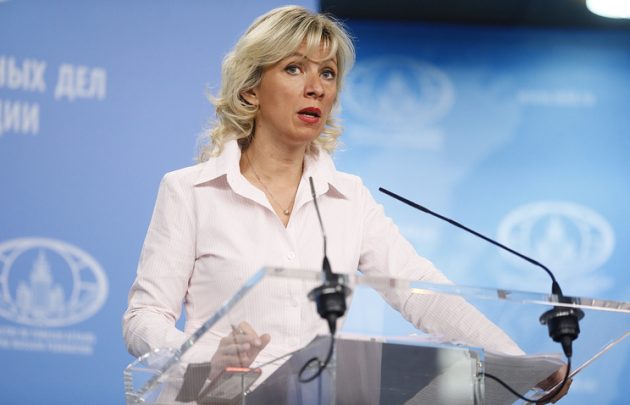
Zakharova slams US establishment’s ‘deplorable’ efforts to censor social media
TASS | September 7, 2018
MOSCOW – Russia considers the US establishment’s efforts to wield pressure on social media to be deplorable, said Russian Foreign Ministry Spokeswoman Maria Zakharova at a briefing on Friday.
“Divulging information on all blocked accounts should be a crucial step here, and apart from the names of accounts, reasons must also be furnished as to why they were blocked,” she said. “Amid continuous statements about Russia it would be curious to learn who is hiding all the time behind the name ‘Russia’ in these fake accounts.”
“Due to the global aspect of the problem, we view the US administration’s efforts to exert pressure on social media as deplorable,” the diplomat stressed. “Russia supports professional discourse, not a call on the carpet or demands to report on what was done for the US to remain ‘the only global superpower.’”
“This problem should be discussed globally,” she said
Facebook earlier deleted 652 accounts, groups and pages for “coordinated inauthentic behavior” in this social media and apps for sharing photos and videos with Instagram elements. Facebook stated on August 21 that part of these actions were linked to Iran and Russia and that the deleted accounts, groups and pages could be linked to sources that the US government had earlier identified as Russian military intelligence services.
On July 31, Facebook stated that it managed to uncover new attempts to exert political pressure through publishing reports on fake pages ahead of the midterm election to the US Congress.
Iran, Russia can cooperate to contain US: Ayatollah Khamenei
Press TV – September 7, 2018
Leader of the Islamic Revolution Ayatollah Seyyed Ali Khamenei says the developments in Syria and the US defeat in the Arab country show that Washington can be contained.
The Leader made the remarks in a Friday meeting with Russian President Vladimir Putin, who traveled to Tehran to participate in a key trilateral summit on Syria, hosted by Iranian President Hassan Rouhani and also attended by Turkish leader Recep Tayyip Erdogan.
“Cooperation between Iran and Russia on the Syrian issue is a prominent example and a very good experience of bilateral cooperation,” the Leader said.
Ayatollah Khamenei added that the two countries can expand cooperation on global issues, saying, “One of the cases that the two sides can cooperate with each other is to contain the US, because it is a danger to humanity and it is possible to contain it.”
The Leader stated that the Americans suffered a real defeat in Syria and failed to achieve their goals.
Ayatollah Khamenei also said sanctions imposed by the US on Iran, Russia and Turkey are a very strong common ground for strengthening cooperation, and urged Tehran and Moscow to develop political and economic relations and follow up on the agreements of the summit in Tehran.
The Leader stressed the importance of pursuing non-dollar transactions in trade.
Europeans did not fulfill JCPOA commitments: Ayatollah Khamenei
Elsewhere in his remarks, Ayatollah Khamenei said Iran has so far remained committed to a multilateral nuclear agreement, officially known as the Joint Comprehensive Plan of Action (JCPOA), reached between Iran and the P5+1 group of countries in 2015.
“But the Europeans did not carry out their duties, and it is not acceptable that we completely fulfill our commitments within the JCPOA while they don’t,” the Leader pointed out.
The Leader praised the Russian president’s approach to the nuclear deal, adding that the Islamic Republic would adopt a stance on the JCPOA which would meet its national interests.
Although the US now raises Iran’s missile program and regional developments, their problem with the Islamic Republic relates to issues beyond them, Ayatollah Khamenei said.
The Leader added that the US has been seeking to topple the Islamic Republic over the past 40 years, but Iran has managed to make substantial advancements during this period.
“The resistance of the Islamic Republic and its advances are another successful example that the US can be contained,” Ayatollah Khamenei said.
The Leader also pointed to the deplorable situation of the Yemeni people and their killing at the hands of Saudi Arabia, adding, “The Saudis will definitely fail to achieve a result in Yemen and will not be able to bring the resilient Yemeni people to their knees.”
During the meeting, which was also attended by Iranian First Vice President Es’haq Jahangiri, the Russian president said he held very fruitful and good negotiations with President Rouhani on mutual issues of interest, including the situation in Syria.
Iran and Russia discussed the expansion of relations in all fields, particularly in the economic and trade sectors, Putin added.
He said the US is putting obstacles, including banking restrictions, in the way of the development of Tehran-Moscow relations, and added that Washington is making a strategic mistake by limiting financial transactions.
The Russian president expressed regret that the remaining sides to the JCPOA failed to fulfill their commitments under the deal after the US withdrawal.
He said although the Europeans announce that they are seeking ways to keep the nuclear accord alive, they are following the US due to their dependence on Washington.
Russia is not involved in Skripal case at any level – Kremlin
RT | September 6, 2018
Russia has nothing to do with the Skripal poisoning case at any level, Kremlin spokesman Dmitry Peskov has said, slamming “unacceptable” British allegations.
“Neither Russia’s top leadership nor those with lower ranks, and no country’s officials, have had anything to do with the events in Salisbury,” Peskov said. He rebuffed UK Prime Minister Theresa May’s claim that the attack on the ex-double agent Sergei Skripal and his daughter was approved at “senior level of the Russian state.”
“Any accusations against Russian leadership are unacceptable,” the spokesman added.
On Wednesday, UK prosecutors named two “Russians” whom they accuse of poisoning the Skripals. May later claimed that the duo were officers of the Russian military intelligence agency GRU. Firing back, the Russian Foreign Ministry said the names and photos of the two men ‘do not mean anything’ to Moscow and called on London “to abandon making public accusations and media manipulations.”
If the UK wants Russia to take action, it should send an official request in the first place in accordance with existing agreements, Peskov stressed, noting that media reports and statemens in parliament cannot replace it.
“We need a request from the British side to check their [suspects’] identities, to give us legal grounds for the identity checks. There is a common practice [for it],” he told journalists. He stressed that from the very beginning Moscow offered cooperation on the case, but London has been reluctant to agree.
One of the main arguments leading the UK to repeat its “highly likely” mantra regarding Moscow’s involvement in the poisoning has been that the Novichok nerve agent – allegedly used in this case – could have only been produced by Russia. However, foreign specialists have long been familiar with the formula, which was developed by the Soviet Union.
The new “revelations,” however, are not more plausible that the previous ones, Charles Shoebridge, a security expert and a former British military officer, told RT. The simple fact that allegedly well-trained Russian intelligence specialists could have left behind so much evidence speaks for itself, he says.
“It seems very strange that these people have absolutely left what seems to be a very reckless and clear trail of evidence, which almost seems to be designed, or at least would almost inevitably lead to the conclusions that the police and the authorities have come to today, in other words that Russia [is] to blame,” he told RT.
Annie Machon, a former MI5 intelligence officer, said she doubts Russia’s alleged motive behind the Salisbury incident and that certain pieces of evidence reported by the media “may look pretty compelling but will never be tested in a real court of law.”
US-Pakistani Relations Head South: Pentagon Cancels Military Aid to Islamabad
By Arkady SAVITSKY | Strategic Culture Foundation | 05.09.2018
The US Defense Department has made a final decision to cancel $300 million (the Coalition Support Funds) in aid to Pakistan. The official reason is Islamabad’s failure to take decisive action against the militants who are waging war in Afghanistan: the Haqqani network and the Afghan Taliban. The move is subject to approval by Congress. It was announced mere days before Secretary of State Mike Pompeo is due to visit Pakistan to meet Imran Khan, the country’s new prime minister. It also took place right on the heels of Iranian Foreign Minister Javad Zarif’s visit to Pakistan, where the leadership expressed support for Iran and the nuclear deal the US abandoned. One is reminded of President Trump’s Aug. 7 tweet warning that “[a]nyone doing business with Iran will NOT be doing business with the United States.”
The announced decision is part of a broader suspension that was proclaimed at the beginning of the year. “The United States has foolishly given Pakistan more than 33 billion dollars in aid over the last 15 years, and they have given us nothing but lies & deceit,” President Trump tweeted on January 1, 2018. “They give safe haven to the terrorists we hunt in Afghanistan, with little help. No more!” The statement was followed by announcement that Secretary Jim Mattis was authorized to grant $300 million in CSF funds over the summer if he saw a change of attitude in Islamabad. He didn’t.
The US has started to suspend its training and educational programs for Pakistani officers. No funds have been provided for the coming academic year. US military institutions, including the National Defense University in Washington DC, the US Army’s War College in Carlisle, Pennsylvania, the US Naval War College, the Naval Staff College, and other courses they offered, including cybersecurity studies, eliminated the 66 slots they had reserved for cadets from Pakistan. It’s rather symbolic that Moscow and Islamabad signed an agreement on August 7 to train Pakistani military personnel in Russia.
With that country’s foreign-exchange reserves plummeting, PM Imran Khan will have to decide whether his government will seek a bailout from the International Monetary Fund (IMF), where the United States controls more votes than any other member. The alternative would be to turn to China, Russia, and other friendly nations. After the victory of the Pakistan Tehreek-e-Insaf (PTI) party in the 2018 general elections, China agreed to grant a $2 billion loan to Islamabad. On July 30, US Secretary of State Mike Pompeo warned that any potential IMF bailout for Pakistan’s new government must not include funds to pay off the country’s Chinese lenders. Pakistan is pinning its hopes on the China-Pakistan Economic Corridor (CPEC) project.
Russia and Pakistan marked the 70th anniversary of their diplomatic relations on May 1, 2018. That relationship has seen its ups and downs, but today it has risen to a new historic high.
Moscow and Islamabad see eye-to-eye on the prospects for ending the conflict in Afghanistan. Pakistan has endorsed the Russian-brokered peace talks that exclude the United States but include the Taliban. Pakistan strongly supports Russia’s Syria policy. Islamabad’s membership in the Shanghai Cooperation Organization (SCO) opens up new prospects for cooperation. Russian President Vladimir Putin has put forward a proposal to create a more extensive Eurasian partnership based on the Eurasian Economic Union (EEU), which would involve China, India, Pakistan, Iran, and those from the Community of Independent States (CIS) that are willing to join. Islamabad is also interested in signing a free-trade agreement with the Russian-led Eurasian Economic Union (EEU).
Pakistan has shown its interest in buying military hardware from Russia, has participated in Russian war games, and has also attended Army exhibitions. In September 2016, Russia and Pakistan held their first-ever joint military exercise. It’s been held yearly ever since. Pakistan’s Chief of Army Staff General Javed Bajwa paid his first visit to Russia in April of this year. In late July, the two countries signed a naval cooperation agreement during the visit of Pakistan’s Vice Chief of the Naval Staff Vice Admiral Kaleem Shaukat to Russia. The Pakistani military plans to purchase Su-35 fighter jets and T-90 tanks from Russia.
Russia is involved in many economic projects, such as the Karachi Steel Mill and Gudhu Power Plants. In 2015, Russia and Pakistan signed a contract to build a 1,100-kilometer gas pipeline from Karachi to Lahore (the North-South pipeline) with a capacity of 12.4 billion cubic meters per annum — the largest economic deal ($1.7 billion) between the two countries since the USSR built the Pakistan Steel Mills in the 1970s. Delayed several times because of tariff disputes, it will be set in motion this year by a Russian company called RT – Global Resource.
Pakistan has already invited the Russian Federation to join the $1.16 billion Central Asia-South Asia power project or CASA-1000, which will allow for the export of surplus hydroelectricity from Tajikistan and Kyrgyzstan to Pakistan and Afghanistan. In 2017, Pakistan’s government gave the go-ahead for the initiation of an agreement with Russia to construct a 600MW Natural Gas Combined Cycle (NGCC) power plant in Jamshoro, Sindh.
US-Pakistani relations are evidently at a low ebb but every coin has two sides. This is prompting Islamabad to diversify its foreign relationships. There are other partners with a lot to offer that could make that country stronger and much less vulnerable to outside pressure.
US meddles in Russian affairs by trying to turn our citizens into informants – Kremlin
RT | September 3, 2018
In recent years, the US has been meddling in Russian affairs by “very crudely” trying to recruit Russians as informants, while exerting moral and other types of pressure on them, Vladimir Putin’s spokesperson said on Monday.
Kremlin spokesperson Dmitry Peskov was commenting on a recent story published in the New York Times, stating that in 2014-2016, the FBI and the US Department of Justice tried to recruit Russian business tycoon Oleg Deripaska as an informant.
According to the paper, US officials wanted to make the businessman share information on Russian organized crime and the alleged Russian aid to Donald Trump’s 2016 presidential campaign.
Considering that businessmen like Deripaska are “major shareholders and top managers of major companies,” including those operating in “quite sensitive segments of the Russian economy,” attempts to recruit them constitute “attempts to meddle in Russia’s domestic affairs,” Peskov said.
The US Intelligence Community and lawmakers have been accusing Russia of interfering in the American election process by waging cyberattacks and ‘propaganda’ against US citizens.
In June, the US federal grand jury indicted 13 Russian nationals and three entities with organizing a campaign “supporting” then-candidate Trump and “disparaging” his then-rival Hillary Clinton. US officials also accuse the Kremlin of hacking the server of the Democratic National Committee and the email account of the head of the Clinton campaign, John Podesta.
The Kremlin had repeatedly denied claims that the Russian state provided any assistance to Trump and emphasized that the US failed to produce substantial evidence of ‘meddling.’ The House Intelligence Committee report, accusing Russia of interfering in the US election, was published but heavily redacted, with the chapter entitled ‘Russia attacks the United States’ completely covered with black lines. The same report found “no evidence” that the Trump campaign “colluded, coordinated, or conspired” with the Russian government.
As for the accusation of waging a ‘propaganda campaign’ on social media, IT giants YouTube, Facebook, and Twitter admitted that the ‘Russian-affiliated’ posts and videos made up just tiny fractions of their feeds.
President Vladimir Putin found the whole idea of Russia transforming the will of US voters ridiculous. “Does anyone seriously think that Russia can somehow influence the choice of the American people?” Putin said back in 2016.
“Is America some sort of a banana republic?” he asked rhetorically. “America is a great state. Correct me, please, if I’m wrong.”
Featured Video

Dan Dicks with James Corbett on Solutions Watch
or go to
Aletho News Archives – Video-Images
From the Archives
$1.5bn up in smoke: US THAAD missile stockpile dries up defending Israel against Iran
By Ivan Kesic | Press TV | July 2, 2025
According to American media, defense news outlets, and independent analysts, the 12-day Israeli military aggression against Iran significantly depleted the US stockpile of THAAD (Terminal High Altitude Area Defense) interceptor missiles.
Citing official sources, American magazine Newsweek reported on Friday that the US transferred a substantial portion of its advanced missile defense capabilities to support the Israeli regime, an effort with questionable results and a critical impact on US strategic reserves.
THAAD, developed by Lockheed Martin arms manufacturing company, is a key component of Israel’s multi-layered air defense architecture. It is designed to intercept medium-range ballistic missiles, including those launched from Iran and Yemen.
The US-made system is capable of targeting short-, medium-, and intermediate-range ballistic missiles during their terminal phase, whether inside or outside Earth’s atmosphere.
THAAD uses a “hit-to-kill” method, relying on kinetic energy rather than explosive warheads to destroy incoming threats, intercepting at altitudes of up to 150 km and ranges between 150-200 km.
Operated exclusively by American personnel, the US military maintains eight THAAD batteries with an estimated 350–400 interceptors in total. The eighth battery was activated during the June 20 Israeli aggression against Iran and is capable of intercepting hypersonic missiles. … continue
Blog Roll
 Aletho News
- Zionist Bought Senate Blocks Information About American Citizens Killed By Israel
- While Gaza dominates the UN, these are the people keeping it alive
- New Report: “Scholasticide and Genocide in Gaza: Assessment, Testimonies and Legal Analysis”
- ‘THAAD Delusion’: Iran war exposes US missile shield limits – The Atlantic
- Moscow issues warning to NATO over Russian exclave
- Yes, the Iran war has destroyed Trump’s presidency
- The fallacy of US delusions about Iran’s economic collapse
- Hezbollah denies Syria cell link, warns of Israeli plan to sow discord
- The legacy of US sanctions, war, and occupation in Iraq
- Iraqi resistance group rejects disarmament, vows to maintain support for Lebanon
- If Americans Knew
- Mamdani releases plan to combat antisemitism and hate crimes in New York City
- Iran’s Revolutionary Guards Publish Letter to the American People
- DMFI launches $1 million ad campaign supporting Virginia’s Elaine Luria
- US Senate blocks resolution seeking report on Americans killed by Israel
- Israeli Attacks Kill Ten Palestinians in Gaza
- Massacre at Minab: The School That Became a Grave
- Israeli media: The IDF Shows It Doesn’t Turn a Blind Eye; It Actively Emboldens Settler Havoc
- As settlers ravage West Bank, Israeli forces kill 10 in Gaza – Daily Update
- New Report: “Scholasticide and Genocide in Gaza: Assessment, Testimonies and Legal Analysis”
- Ex-Biden officials are desperate for a Gaza scapegoat
- No Tricks Zone
- Green Energy Debacle: German Expert Professor Fritz Vahrenholt Warns Of Severe Economic And Social Consequences
- Two More Paleo Reconstructions Affirm Meters-Higher Sea Levels Across Ireland, Brazil 7000-6000 Years Ago
- New Study: Earth And Venus Surface Warmth Largely Explained By Convection And Lapse Rate, Not CO2 Or Radiation
- 2025 Nature Paper Claiming Worsening Global Drought Gets RETRACTED …Heavily Flawed
- New Study: ‘Global Drought Shows No Detectable Recent Acceleration Under Climate Warming’
- Economic Masterminds: German Socialists Suggest Taxing Productivity Gains Stemming From Using AI
- The South China Sea Has Not Been Cooperating With The Climate Change Narrative
- Energy Crisis: Germany Enters Heating Season With Historically Low Gas Reserve Fill Levels
- New Study: The Antarctic Ice Sheet Gained Mass From 2020-2024 Due To Staggering Snow And Ice Accumulation
- Study: Ocean Heating Rates From Thousands Of Years Ago ‘Dwarf’ Modern Ocean Heating Rates

