‘Criminal negligence’ or disregard to Russia-Israel ties: MoD details chronology of Il-20 downing
RT | September 23, 2018
A minute-by-minute account of the Il-20 downing shows Israel’s culpability and either its military bosses’ lack of appreciation of relations with Moscow, or their control of commanding officers, the Russian defense ministry said.
“We believe that the blame for the Russian Il-20 aircraft tragedy lies entirely with the Israeli Air Force,” said spokesman Major General Igor Konashenkov, before revealing a detailed account of events leading to the downing of the Russian Il-20 military aircraft on September 17. The plane was shot down by the Syrian air defense units as Israeli’s F-16s effectively used it as a cover during the attack on its neighbor.
The report featured previously undisclosed radar data and details of communications between Russian and Israeli militaries, and concluded that “the military leadership of Israel either has no appreciation for the level of relations with Russia, or has no control over individual commands or commanding officers who understood that their actions would lead to tragedy.”
Misinformation & ‘criminal negligence’
On the evening of September 17, the Russian Ilyushin IL-20 with 15 crew on board was circling over the Idlib de-escalation zone on a special reconnaissance mission, when four Israeli F-16 fighter jets left their country’s airspace and flew over the neutral Mediterranean waters towards the Syrian coast. The Israeli Air Force gave the Russian side less than a minute’s warning before dropping the precision-guided glide bombs, leaving virtually no time for any safety maneuvers, Konashenkov said, calling such actions “a clear violation of the 2015 Russian-Israeli agreements.”
Moreover, the Israeli military failed to provide the location of their jets or properly specify their targets, claiming they were going to attack several ‘industrial facilities’ in northern Syria, close to the Il-20’s area of operation. The misinformation prompted the Russian Command to order the recon plane back to the Khmeimim air base. The Israeli jets, however, instead almost immediately attacked the western Syrian Latakia province.
The misleading information provided by the Israeli officer about the area of strikes did not allow the Russian Il-20 airplane to move timely to a safe area.
Once the Syrian air defenses responded to the initial strike, the Israeli jets switched on radar jamming and pulled back, apparently preparing for another attack. One of the Israeli jets then came closer to the Syrian coast and approached the Russian plane, which was preparing to land at that time.
The Israeli pilot must have been well aware of the fact that the Il-20 has a much larger radar cross-section than his F-16, and would become a “preferred target” for the Syrian air defense units, who use different friend-or-foe systems with the Russians, Konashenkov said. Thus, for the Syrians, the reconnaissance plane could appear as a group of Israeli jets.
“The Israeli jets saw the Russian Ilyushin Il-20 and used it as a shield against the anti-aircraft missiles, while they carried on maneuvering in the region,” Konashenkov said during the news briefing.
The actions of the Israeli fighter pilots, which led to the loss of life of 15 Russian servicemen, either lacked professionalism or were an act of criminal negligence, to say the least.
Finally, the Israeli jets carried out their maneuvers in the immediate vicinity of the Khmeimim air base, which is used both by military and civilian aircraft, including passenger planes, the ministry’s spokesman emphasized, saying that the reckless actions of the Israeli pilots could also have posed a threat to any passenger or transport aircraft that may have happened to be there at that time.
Israel ‘crossed the line of civilized relations’ with ‘ungrateful response’
Israel’s negligent behavior amounts to a flagrant violation of the very spirit of cooperation between the countries, Konashenkov stated, noting that Russia has never broken its commitment to the deconfliction agreement – it has always informed Israel about their missions in advance and has never used its air defense capabilities against the Israelis, even though their airstrikes sometimes put the Russian servicemen in danger.
Russia has sent as many as 310 notifications to the Israeli Air Force Command, while the latter appeared to be reluctant to show the same level of commitment, notifying only 25 times even though its jets carried out more than 200 strikes against targets located in Syria over the past 18 months alone.
“This is an extremely ungrateful response to all that has been done by the Russian Federation for Israel and the Israeli people recently,” Konashenkov said.
The Russian military supported the Syrian military operation in the Golan Heights to “ensure there were no shelling attacks on Israeli territory” anymore, thus allowing the UN peacekeeping mission to resume patrolling of the contested border between Syria and Israel after “a six-year hiatus.”
Russia also managed to secure the withdrawal of all Iran-backed groups from the Golan Heights to a “safe distance for Israel,” more than 140 kilometers to the east of Syria, the spokesperson said, adding that this was done at the request of Tel Aviv. “A total of 1,050 personnel, 24 MLRSs and tactical missiles, as well as 145 pieces of other munitions and military equipment were withdrawn from the area,” Konashenkov told journalists.
The Russian Defense Ministry had provided assistance in preserving Jewish sacred places and graves in the city of Aleppo. Putting Russian Special Forces soldiers’ lives in danger, it also organized the search for the remains of some Israeli servicemen that died during the past conflicts in an area where the Syrian forces were combating Islamic State (IS, former ISIS) terrorists at that time.
In view of the above, the hostile actions committed by the Israeli Air Force against the Russian Ilyushin Il-20 aircraft cross the line of civilized relations.
While Israel said that it mourned the deaths of Russian troops, the IDF statement following the incident shifted all the blame for the incident solely on Damascus, and its Iranian and Lebanese allies.
Israeli Attack Which Led to Il-20 Tragedy Was Reaction to Idlib Truce – Analyst
Sputnik – September 22, 2018
The destruction of a Russian Il-20 reconnaissance aircraft with 15 airmen onboard has led to questions about Moscow’s relations with both Syria and Israel. Speaking to Sputnik, Middle East affairs observer Ali ben Masoud al-Mashani said he was confident that whatever else happens, Russian-Syrian counterterrorism cooperation will continue.
Speaking to Sputnik about the lost Il-20, which was destroyed by Syrian air defenses over the Mediterranean Sea as the Syrian military attempted to repel an Israeli attack on Monday, al-Mashani said it was important to keep in mind that “this tragedy occurred because of the [Israeli] attack on Syria. Syrian airspace was violated,” he said.
At the moment, the Omani security analyst noted, “it is necessary to fully condemn the actions of all participants of this operation. Yes, the Syrian air defense system also made a mistake, but it was provoked by Israeli military aircraft.”
Al-Mashani categorically ruled out the possibility of a downturn in cooperation between Moscow and Damascus. “Both sides know that the Israeli aggression was a response to the agreements in Sochi between Moscow and Ankara on Idlib,” he said, referring to plans to set up a demilitarized zone in the militant-controlled Syrian province by the middle of next month.
Moscow has yet to decide on the future of Russian-Israeli ties following the downing of its Il-20 ELINT reconnaissance plane, which the Russian Defense Ministry has blamed on the Israeli military. Earlier, Syrian President Bashar Assad expressed his condolences for the tragedy and said he hoped the incident would not impede the Russian-Syrian joint fight against terrorism, while blasting the “arrogance and reckless violence” he said had been shown by Israel with regard to this incident.
The Il-20 was lost over the Mediterranean Sea on September 17 after being hit by a Syrian S-200 surface-to-air missile as it was returning to the Hmeymim air base in the midst of airstrikes by Israeli F-16s against Syrian targets in Latakia, Tartus and Homs. The Russian Defense Ministry accused the Israeli Air Force of creating a dangerous situation by using the Russian plane as a shield against Syrian air defenses, and complained that it did not receive ample warning time to maneuver the plane to safety.
The Israeli Defense Ministry expressed its condolences over the loss of the Russian plane, but continues to maintain that the Syrian military was responsible for the incident. An Israeli delegation led by Air Force Commander Maj. Gen. Amikam Norkin visited Moscow on Thursday to brief Russian officials on the Israeli version of events. Israeli Defense Minister Avigdor Lieberman said Israel had no plans to halt its operations in Syria against Hezbollah and what it claims is an Iranian military presence.
Tehran Has Sovereign Right to Develop Missile Program – Moscow
Sputnik – 19.09.2018
MOSCOW – Moscow believes that the development of the Iranian missile program is Tehran’s sovereign right, and all the issues arising in this regard should be resolved without pressure, especially military, at the negotiating table, Russian Deputy Foreign Minister Sergey Ryabkov told Sputnik.
“We have always supported resolving any problems that arise in interstate relations and in the dialogue on acute issues through negotiations and through relevant agreements,” Ryabkov said on Wednesday.
The deputy foreign minister further stressed that the developments in the situation around the Iran nuclear deal and other issues that American counterparts put in the context of this deal, as well as Iran’s behavior, attracted Russia’s close attention.
Speaking to Sputnik reporter, Ryabkov also revealed that the meeting of the five mediators and Iran at the level of foreign ministers will take place on the sidelines of the high-level week of the UN General Assembly at the end of September.
“The meeting of the participants of the Joint Comprehensive Plan of Action (JCPOA) — those who stayed in the agreement — will be held at the ministerial level,” the official stated.
He also noted that the definite time is being coordinated, and the European External Action Service is expected to make a relevant announcement in the near future. However, Ryabkov assured that it was certain that the meeting would take place.
The JCPOA stipulates the gradual removal of the West’s sanctions against Iran in exchange for Tehran maintaining a peaceful nature of its nuclear program. However, US President Donald Trump announced in May the withdrawal of the United States from the JCPOA and the reinstating of the first round of sanctions in August.
Israel’s Failed Attempt to Start WWIII Is the Beginning of the End in Syria

By Tom LUONGO | Strategic Culture Foundation | 19.09.2018
There is one thing that Israel fears more than anything else in Syria. The loss of its ability to fly its F-16’s with impunity and hit whatever targets it wants claiming defensive measures to stop Iran, their existential enemy.
Israel finally admitted to carrying out over 200 such missions over the past 18 months, only a few of which ever made any kind of international media, recently.
And with the sneak attack on Latakia which involved using a Russian IL-20 ELINT war plane as radar cover Israel has now not only raised the stakes to an unacceptable level, it has also ensured that this may be the last such aerial assault it will ever be able to carry out.
The setup is pretty clear. Israel and France coordinated an attack on multiple targets within Syria without US involvement but with absolute US knowledge of the operation to provoke Russia into going off half-cocked by attacking the inconsequential French frigate which assisted Israel’s air attack.
Any denunciation of sinister intent by Israeli Defense Forces is hollow because if they had not intended to provoke a wider conflict they would have given Russia more than one minute to clear their planes from the area.
That would constitute an attack on a NATO member state and require a response from NATO, thereby getting the exact escalation needed to continue the war in Syria indefinitely and touch off WWIII.
This neatly bypasses any objections to a wider conflict by President Trump who would have to respond militarily to a Russian attack on a NATO ally. It also would reassert NATO’s necessity in the public dialogue, further marginalizing Trump’s attacks on it and any perceived drive of his for peace.
That this took place within the 60 days window of the mid-term elections should also not be discounted.
This attack took place just hours after Presidents Erdogan and Putin negotiated a ‘peaceful’ settlement for Idlib province by declaring a De-Militarized Zone (DMZ) 15-20 kilometers wide which everyone, including Erdogan’s pets Jabhat al-Nusra would have to abide by.
Peace was breaking out in Syria and Israel and the war-hawks in D.C. weren’t standing for that.
By conducting this attack like this Israel and the NATO crowd figured it would be a win/win for them.
If Russia strikes back at France, then NATO invokes Article 5 and they get their wider war.
If Russia doesn’t strike back Putin loses face within Russia, his popularity drops 5 points and John Bolton begins salivating at the prospect of regime change in Russia. Yes, they are that insane.
It was a neat piece of geopolitical maneuvering, almost judo-like. Russia and Syria looked to be on the verge of victory, extending themselves in a major conflict that would result in months of bad press. We were expecting a possible false-flag chemical weapons attack, cries of humanitarian crisis and all the rest of the tired virtue-signaling we can expect by US ‘diplomatic’ officials that has been all too common even under Trump.
What we got was the opposite, a carefully-crafted assault on Russian military forces wherein Russia’s vaunted air-defense systems would be blamed for its own people’s deaths and a mistaken counter-attack that justifies the “Putin is a Vile War-Monger” narrative to justify a US invasion of Syria which has been held in amber since 2013 and Putin’s skillful defusing that situation via diplomatic means.
For once, this almost looked like a well-thought out plan. Not the usual ham-fisted crudities we’ve been treated to over the last few years. But, here’s the rub.
It didn’t work.
By naming names and immediately not responding militarily during the ‘fog of war’ Russia and Putin again prove to be more skilled at this than their adversaries.
Because none of what I just outlined will come to pass. And France, Israel and the US will be the ones to lose face here. And with Israel betraying Putin’s forbearance after April’s air strikes on Damascus, he will have no choice but to upgrade Syria’s air defense systems from S-200’s to S-300’s and possibly S-400’s.
This is Israel’s worst nightmare. A situation where any aerial assault on targets within Syria would be suicide missions, puncturing the myth of the Israeli air force’s superiority and shifting the delicate balance of power in Syria decidedly against them.
This is why Prime Minister Benjamin Netanyahu worked Putin so hard over the last two years. But, this incident wipes that slate clean. This was a cynical betrayal of Putin’s trust and patience. And Israel will now pay the price for their miscalculation.
Giving Syria S-300’s does not avenge the fifteen dead Russian soldiers. Putin will have to respond to that in a more concrete way to appease the hardliners in his government and at home. His patience and seeming passivity are being pushed to their limit politically. This is, after all, a side benefit to all of this for the neoconservative and globalist hawks in D.C., Europe and Tel Aviv.
But, the real loss here for Israel will be Russia instituting a no-fly zone over western Syria. Any less response from Putin will be seized upon by and the situation will escalate from here. So, Putin has to deploy S-300’s here. And once that happens, the real solution to Syria begins in earnest.
Because at that point it will be the US’s move to flat-out invade without provocation, now that a solution is in place in Syria between Russia and a NATO member, Turkey.
The only good news in all of this is that US forces were not involved. This still tells me that Trump and Mattis are still in charge of their chain of command and that other forces are conspiring to drag them into a conflict no one in their right minds wants.
‘You are to blame for downing of Il-20 and death of its crew,’ Russia tells Israel
RT | September 18, 2018
Russia has formally complained to Israel about its air raid on Monday, which led to the downing of a Russian Il-20 plane off the Syrian coast. Moscow has laid the blame for the crew’s deaths “squarely on the Israeli side.”
Russian Defense Minister Sergey Shoigu spoke to his Israeli counterpart Avigdor Lieberman on the phone about the downing of the Russian Il-20 plane on Monday night. He relayed Moscow’s position on the incident, blaming the Israeli military for setting up the Russian plane to be shot down by Syrian air defenses, which were responding to an Israeli air raid, an official statement from the Russian military said.
Shoigu reiterated that Israel failed to notify Russia of the impending attack in a way that would have given its military an opportunity to move the Il-20 out of harm’s way. Instead, the warning came just one minute before the Israeli F-16 fighter jets launched their attack.
“The blame for the downing of the Russian plane and the deaths of its crew members lies squarely on the Israeli side,” the Minister Shoigu said. “The actions of the Israeli military were not in keeping with the spirit of the Russian-Israeli partnership, so we reserve the right to respond.”
Earlier, the Russian Defense Ministry said the Israeli jets had used the bigger Russian plane as cover during their attack on targets in Syria. The ministry said the Israelis must have known that they were putting the Russian plane at risk, but neither changed their battle plan nor gave a warning in time for the Il-20 to be moved to a safe area.
Israel later responded to the Russian statements, saying it had attacked a Syrian military site overnight. Israeli said the mission was to destroy arms-manufacturing equipment which they claim was to be delivered to Lebanon on behalf of Iran. Israel insisted that the responsibility for the Russian deaths was not on Israel, but on Syria and its allies, Iran and Hezbollah.
Putin & Erdogan agree Idlib buffer zone to avert new Syria crisis
RT | September 17, 2018
Russia and Turkey have agreed a “demilitarized zone” between militants and government troops in Syria’s Idlib, President Vladimir Putin said after hours-long talks with Turkey’s Recep Tayyip Erdogan focused on solving the crisis.
“We’ve focused on the situation in the province of Idlib, considering presence of large militant groups and their infrastructure there,” Putin said at a press conference after the talks.
“We’ve agreed to create a demilitarized zone between the government troops and militants before October 15. The zone will be 15-20km wide, with full withdrawal of hardline militants from there, including the Jabhat Al-Nusra.”
As part of solving the deadlock, all heavy weaponry, including tanks and artillery, will be withdrawn from the zone before October 10, Putin said. The zone will be patrolled by Turkish and Russian military units.
Before the end of the year, roads between Aleppo and Hama, and Aleppo and Latakia must be reopened for transit traffic, he said.
The agreement has received “general support” from the Syrian government, according to Putin.
The deal and other issues of Russian-Turkish ties apparently took almost 5 hours to hammer out. In what appears to a breakthrough solution, Putin and Erdogan have agreed to ensure peace with the help of Russian and Turkish troops.
“The territory controlled by the Syrian opposition must be demilitarized and the Syrian opposition that is holding these territories will remain there. But together with Russia we will make efforts to clear these territories of radical elements,” Erdogan said.
The agreement is designed to prevent a new “humanitarian crisis” in Syria, Erdogan stressed, and will help Turkey to avoid an even more “difficult situation.” He had previously warned of a surge in refugees hitting the country should a full-blown war break out in Idlib.
The plan is a major landmark for Syria, where the standoff in the last militant stronghold of Idlib has threatened to turn into a major international crisis in recent weeks. The US and other NATO countries backing anti-government forces had repeatedly warned Russia and Syria not to launch any new offensive in the region. US President Donald Trump tweeted earlier this month that to do so would be a “grave humanitarian error,” while US envoy to the UN Nikki Haley outright said that any Russian attack on Idlib would provoke “dire” consequences.
About 70 percent of Idlib province is controlled by various terrorist factions, including Al Qaeda’s Syria affiliate Hayat Tahrir al-Sham (formerly known as the Al-Nusra Front), according to the Russian military. At the same time, both Turkey and the West support various militant groups they consider as “moderate” opposition to Syrian President Bashar Assad’s forces.
This turned out to be a dilemma for Ankara, with the Turkish president simultaneously worried about Russia and Syrian action weakening the rebel groups, but also having concerns over the spread of terrorists and the potential influx of new refugees into areas bordering Turkey.
Now it appears that despite the rocky last few years of Russian-Turkish relations, the mutual trust built up between Putin and Erdogan has allowed them to overcome a clash of interests and reach a compromise.
Russian plane disappears from radars during Israeli attack on Syria’s Latakia – MoD
RT | September 17, 2018
A Russian military Il-20 aircraft with 14 service members on board went off the radars during an attack by four Israeli jets on Syria’s Latakia province, the Russian Defense Ministry said.
Air traffic controllers at the Khmeimim Air Base “lost contact” with the aircraft on Wednesday evening, during the attack of Israeli F-16 fighters on Latakia, said the MOD.
Russian radars also registered the launch of missiles from a French frigate in the Mediterranean on the evening of September 17.
Fourteen people were on board the plane at the time of the disappearance. A search and rescue mission is underway.
The Ilyushin 20 (IL-20) surveillance turboprop plane is an Electronic Intelligence (ELINT) platform, equipped with a wide range of antennas, infrared and optical sensors. The aircraft’s SLAR (Side-Looking Airborne Radar) and the plane’s satellite link allows the Russian military to monitor Syrian skies in real time.
An hour-long attack on Latakia began around 10 pm local time, and targeted a power station as well as two facilities belonging to the Syrian military. Syrian officials said the attack was “foreign” and came “from the sea,” but could not initially confirm rumors that Israel was behind it. Seven people were injured in the attack, according to Syrian officials.
While the Russian military said it recorded four F-16 Israeli jets over Syria at the time of the attack on Latakia, the IDF has refused to comment on the report.
The attack on Latakia came just hours after Russia and Turkey negotiated a partial demilitarization of the Idlib province, which is the last remaining stronghold of anti-government militants, including the Al-Qaeda affiliate Hayat Tahrir al-Sham (also known as the Jabhat Al-Nusra).
READ MORE:
Russia detects missile launches from French frigate off Syria’s coast in Mediterranean – MoD
Serial numbers of missile that downed MH17 show it was produced in 1986, owned by Ukraine – Russia
RT | September 17, 2018
The serial numbers found on debris of the Buk missile which downed Malaysian Airlines Flight MH17 over eastern Ukraine show it was produced in 1986, the Russian military said. The projectile was owned by Ukraine, they added.
There are two serial numbers found on fragments of the missile, which shot down the passenger airliner in June 2014 according to an international team of investigators led by the Netherlands. The numbers were marked on the engine and the nozzle of the missile.
The Russian military on Monday said they had traced them to a missile which had the producer serial number 8868720.
Speaking to journalists, Gen. Nikolay Parshin showed a document trail of the Buk missile. According to the documents, some of which have been declassified for the presentation, it was produced at a military plant in Dolgoprudny in the Moscow region in 1986.
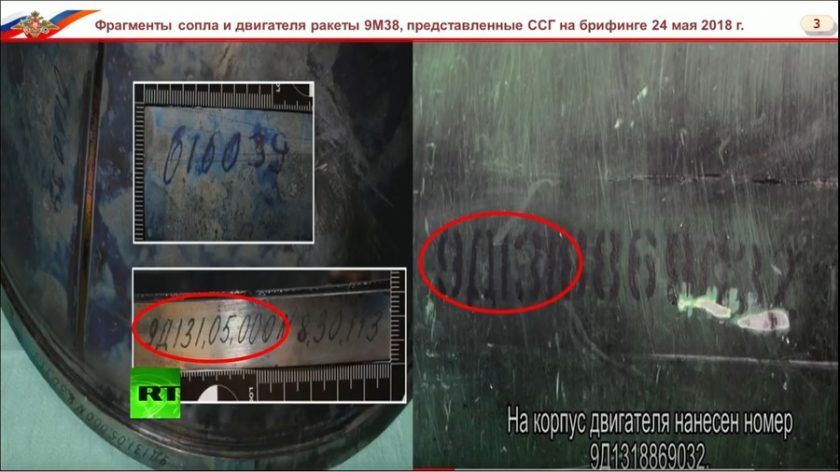
Serial number on engine and nozzle of the missile.
The missile was shipped from the plant on December 29, 1986 and delivered to military unit 20152 located in what is now Ukraine. It is now called 223rd anti-aircraft defense regiment of the Ukrainian armed forces, the report said. The unit took part in Kiev’s crackdown on rebels in eastern Ukraine in June 2014, the general said.
The evidence disproves the accusations by Ukraine and some other parties, which claim that a missile fired by a launcher, secretly delivered from Russia, was responsible for the downing of MH17, the Ministry of Defense report said. All the materials have been sent to the Dutch investigators, the Russian military added.

Missile shipment records found in Russia.
The Russian military also challenges video footage used by the UK-based group Bellingcat, which calls itself a citizen journalism organization, to back its allegations about the delivery of the Buk launcher from Russia. The Defense Ministry showed a video clip with some of the footage, highlighting inconsistencies, which it said proved that the footage had been manipulated to place images of the launcher into background which were not in the original.
The Bellingcat investigation was featured in the latest update by Dutch prosecutors involved in the MH17 investigation, prompting them to directly accuse Russia of providing the launcher and the missile. The Russian military said it decided after this to study the purported trail of photo and video evidence showing the path of the launcher in detail. The Russian video showed an example of how an Abrams tank can be shown to be carried by a trailer in the streets of Ukraine in the same way.

Analysis of Bellingcat footage by Russian experts.
The third part of the presentation was what the Russian officials called a record of intercepted communications of Ukrainian officials discussing, in 2016, the risk of flying through restricted airspace over Ukraine. Among a barrage of complaints one phrase says unless the restrictions are respected “we’ll f***ing f**k up another Malaysian Boeing”.
The Russian military say the complaints came from Col. Ruslan Grinchak, who serves in a brigade responsible for radar control in Ukrainian airspace. His unit tracked the MH17 flight in 2014, so he may have information which is not publicly available about the disaster, and his outburst may have been factual rather than hyperbolic, they suggested.
Gen. Igor Konashenkov, who hosted the briefing, said that Ukraine failed to provide radar data from its stations to the Dutch investigators. He also suggested that archive documents from the Ukrainian unit, which received the Buk missile back in 1986, would be of use to the probe, unless Kiev claims that they are no longer available. He stressed rules are in place which mean that such documents should still be stored in Ukraine.
The Russian military said they had no evidence to disprove a scenario, involving the Ukrainian rebels capturing the missile from the Ukrainian army, but pointed out that Ukrainian officials publicly denied anything like this had ever happened.
Malaysian Airlines flight MH17 was shot down over eastern Ukraine on July 17, 2014, falling in the rebel-held part of the country. The crash claimed the lives of 283 passengers and 15 crew members, most of them Dutch nationals. Russia was blamed by Western media in the first days after the tragedy, even before any evidence had been collected on the ground.
The Joint Investigation Team, which is lead by the Netherlands, includes Ukraine, but not Russia. Moscow believes that the investigation is biased, failing to obtain all necessary evidence from Ukraine and relying on questionable sources while ignoring evidence provided by Russia, which doesn’t fit the theory favored by Kiev. For instance, Moscow said a theory was never tested that the airliner could have been downed by a fighter jet spotted by Russian radar stations near flight MH17. The theory was later proven false by the discovery of debris from the Buk rocket.
Azov Sea Flashpoint: Russia, Ukraine Teetering on the Brink of War
By Peter KORZUN | Strategic Culture Foundation | 16.09.2018
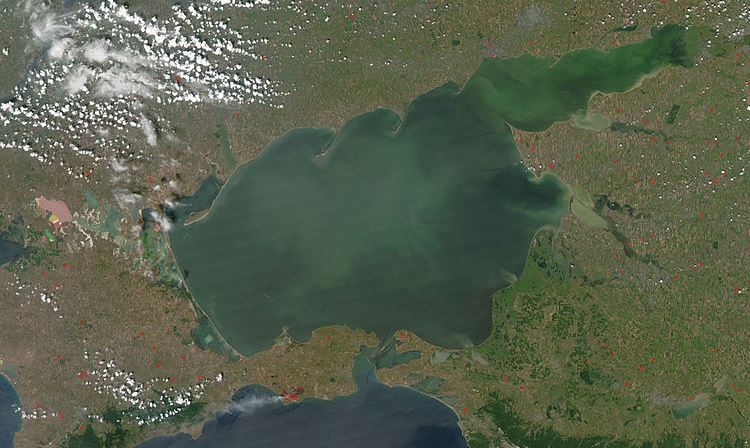
Ukraine has increased its military presence in the Azov Sea region. Ukraine’s National Security and Defense Council met on Sept. 7 and agreed to take a variety of steps to boost the country’s combat capabilities in the area, including the creation of a missile-equipped naval infantry group to counter potential amphibious attacks and naval shore bombardments. Ukraine’s Gurza-M-class armored artillery boats have been brought in to boost the naval component of the forces deployed in the region.
Russia and Ukraine enjoy free use of the Sea of Azov under the 2003 “Agreement between the Russian Federation and the Ukraine on cooperation in the use of the sea of Azov and the strait of Kerch.” The document is in place but it does not specify any precise border. The parties agree that the Sea of Azov and the Strait of Kerch are the internal waters of both Ukraine and Russia.
Talks have dragged on for a long time but have failed to produce a solution. Ukraine does not want to recognize Russia’s rights, which are based on the fact that Crimea has joined the Russian Federation. Moreover, Ukrainian authorities insist on their right to detain any ship traveling to or from Crimea without Kiev’s permission.
Ukraine is calling for the imposition of international sanctions against Russian Black Sea ports, due to what it calls the “blockade” of the Sea of Azov. It has already imposed punitive measures unilaterally. Tensions have heightened since March, when ships were detained and searched. On March 24, Ukrainian border guards stopped the Russian-flagged, Crimean-registered Nord fishing vessel in the Sea of Azov. The ship was hijacked. The crew members reported being interrogated and abused by Ukrainian authorities who held them accountable under domestic laws, not recognizing the crew as Russian citizens. The detained sailors were finally set free to return to Crimea without passports. Ukraine violated a number of international agreements and this marked the beginning of a campaign of provocative actions that has been waged ever since. Last month, the Russian Mekhanik Pogodin tanker was detained in the Ukrainian port of Kherson. Russia compared the move to the activities of Somali pirates.
The US is taking sides in order to ratchet up the tensions. The State Department has taken a deliberately provocative stance, urging Ukraine toward confrontation. Without bothering to study the details, it simply puts the blame on Russia as usual for anything that goes wrong. Washington is goading Ukraine into seeking a military solution, including such unrealistic but dangerous ideas as using the warships of NATO’s standing force to protect its shipping lanes, mining the Azov Sea, or using fast-moving attack vessels to encircle a large Russian naval asset from all directions like a wolf pack. This tactic was invented by German Admiral Karl Dönitz during WWII, when “wolf packs” of U-boats were used to attack capital ships. The very fact that such ideas have been generated and are floating around shows how unwise it is to abet Ukraine by throwing unconditional support behind it.
Stephen Blank of the American Foreign Policy Council, a leading US expert on Russia, believes that the US administration “should send anti-ship missiles available from or through the US-AGM-84 Harpoon Block II, AGM-158C LRASM A, and the Norwegian Naval Strike Missile” as well as “a viable launch platform and a targeting system, particularly a radar.” The author thinks this should be done right now, without delay. His article was published on Sept. 7 by the Atlantic Council, the prestigious think tank that advises the State Department and enjoys great influence among those who shape US foreign policy. In another article, Mr. Blanc calls for supplying Ukraine with platforms — older ships that have been decommissioned or are about to retire. Last month, Mykola Bielieskov, the Deputy Executive Director at the Institute of World Policy, called for fast-track shipments to Ukraine of the Harpoon Block II ER+ anti-ship missile, enabling it to attack Russian vessels. The idea of providing Ukraine with Island-class coast guard ships is under consideration by the US government. On Sept. 1, Kurt Volker, US Special Representative for Ukraine Negotiations, stated that the US administration “is ready to expand arms supplies to Ukraine in order to build up the country’s naval and air defense forces.”
The powers that be have failed to keep their promises and improve the lives of ordinary people in Ukraine. The presidential election will be held in March 2019. A threatening Russian bogeyman is needed to explain away the failures. The country’s economy and finances are in the doldrums and corruption is staggering. None of the problems have been solved and the West is getting tired of Ukraine. The fairy tale about Moscow’s “aggressive foreign policy” comes in handy right when the Ukrainian rulers need a scapegoat.
Nobody needs an armed conflict in the Azov Sea region. A number of countries are interested in protecting the right of free passage, enabling vessels to arrive at their destination ports without risk or delay. The region does not have to be a flashpoint. Russia and Ukraine could sit down at a round table to discuss controversial issues, as the 2003 agreement stipulates the parties should do in order to settle their disputes, should they have any, but that’s not what the State Department is calling for. The only option the US administration is considering is that of providing Ukraine with arms to fight Russia and then egging Kiev on to escalate the tensions. And those are already dangerously running high. A spark can ignite a big fire at any time if the problem is not addressed in a positive way without saber rattling. It’s a pity the US is playing such a destructive role. The time is right for Russian and Ukrainian experts and officials to set their differences aside and start talking to find a peaceful solution to this urgent problem.
Erdogan, Putin to Meet Monday in Sochi as Turkey Moves More Weapons into Syria
21st Century Wire | September 15, 2018
Turkey’s President Recep Tayyip Erdogan is scheduled to meet Russia’s President Vladimir Putin in Sochi on Monday, amid reports of a heavy Turkish arms drop into Syria in recent days.
The two leaders last met at a summit earlier this month in Tehran, and this next meeting will come just days after the Turkish army sent more ‘arms and ammunition’ into Syria’s Idlib and Hama provinces, according to a report by the Syrian Observatory for Human Rights (SOHR) released on Saturday.

The independent media outlet Muraselon is also citing multiple reports of both Turkish weapons and troops moving into these regions, including to areas under the control of the ‘rebel’ coalition National Liberation Front (NLF) – a collection of unsavory characters and the main rival of Hay’at Tahrir Al-Sham (HTS) in Idlib, according to IRIN:
Turkey’s favourite is the NLF, which is led by Fadlallah al-Hajji, a Muslim Brotherhood ally. The NLF includes Turkey-friendly Islamists like Ahrar al-Sham, the Noureddine al-Zengi Brigades, Failaq al-Sham, Jaish al-Ahrar, and groups that fought under the Free Syrian Army banner, like the Victory Army and the 2nd Coastal Division.
Big but brittle, the NLF is held together by Turkish sponsorship and shared enemies: al-Assad’s government, Syrian Kurdish groups, and hardline jihadists.
Turkey’s escalated military presence and heavy arms drop into known jihadist havens ahead of the upcoming Sochi meeting is unwelcome, and presents the potential risk for a military showdown in the future between Turkish and Syrian/Russian forces – something that all sides have warned against but Turkey’s apparent ‘double-dealing’ isn’t helping.
State Department Slams Announcement of Donbass Elections Slated for November 11
Sputnik – 13.09.2018
WASHINGTON – The United States is condemning the elections in the self-proclaimed Donetsk People’s Republic (DPR) and Luhansk People’s Republic (LPR) scheduled for November 11, US State Department spokesperson Heather Nauert said Wednesday.
“The United States condemns the announcement of a plan to conduct ‘elections’ in the so-called ‘Donetsk and Luhansk People’s Republics.’ Given the continued control of these territories by the Russian Federation, genuine elections are inconceivable, and grossly contravene Russia’s commitments under the Minsk agreements. By engineering phony procedures, Russia is once more demonstrating its disregard for international norms and is undermining efforts to achieve peace in eastern Ukraine. The so-called ‘people’s republics’ that Russia created have no place within the Ukrainian constitutional order,” Nauert said.
She pointed out that the United States remained fully committed to diplomatic efforts aimed at resolving the conflict in eastern Ukraine. “US support for Ukraine’s sovereignty and territorial integrity remains unwavering,” Nauert added.
The conflict in the eastern Ukrainian region of Donbass started in 2014, when Ukrainian authorities launched a military operation against the DPR and LPR that refused to recognize the new government in Kiev, which came to power after what they considered to be a coup. In February 2015, the warring parties signed the Minsk peace accords to end the fighting in the region, but the situation remained tense, with both parties accusing each other of ceasefire violations.
Last week, the DPR Operational Command’s deputy chief Eduard Basurin called on Kiev to to give up attempts to exacerbate the conflict. According to the official, the Ukrainian forces have deployed about 100 pieces of heavy weaponry near Kiev-controlled Novosilka settlement in Donbas, including 18 units of Grad and 12 units of Uragan multiple rocket launcher systems.
The DPR comand has said that Ukraine had already deployed over 12,000 troops to launch an offensive against the DPR forces in the direction of the city of Mariupol following the assassination of the republic’s leader, Alexander Zakharchenko. According to the command, the offensive is scheduled for September 14.
Russian Foreign Minister Sergey Lavrov has said that the Western countries were responsible for the 2014 overthrown of then-Ukrainian President Viktor Yanukovych, which triggered the military conflict in the country.
No Russian trace in Manafort case, but Moscow portrayed as villain – Lavrov
RT | September 12, 2018
Nothing in the charges against former US President Donald Trump’s campaign manager Paul Manafort suggests any ties to Russia, but US media are scapegoating Moscow anyway, the Russian foreign minister said.
Foreign Minister Sergey Lavrov was addressing young diplomats at a session of the Eastern Economic Forum (EEF) in Vladivostok on Wednesday, when he touched on the case of Manafort, originally investigated by Special Counsel Robert Mueller’s office as part of the wide-ranging Russia collusion probe.
Manafort has faced two separate trials, in Washington, DC and Virginia, after being charged with a list of offenses ranging from tax and bank fraud to witness tampering and unreported lobbying on behalf of Ukrainian government under the ousted President Viktor Yanukovich.
Last month, Manfort was found guilty of five counts of tax fraud, one count of hiding foreign bank accounts and two counts of bank fraud by a jury in Virginia. He faces seven separate charges in an upcoming trial in Washington. However, none of the allegations have anything to do with the initial purpose of the prosecution’s looking into his shady dealings – that is to find a proof of the Trump campaign’s collusion with the Kremlin.
The total lack of evidence did not stop the mainstream media from brazenly peddling the Russia narrative when the investigation was in its early stages, Lavrov noted.
“They began hyping up the case of Manafort, who was accused of being almost the main executioner of Kremlin’s sinister plot to stop Hillary Clinton from winning” the presidential elections, he said. “In the end, after months-long investigation, hearings, he was charged only with being an agent of the Ukrainian government and working in the interest of the Ukrainian government.”
However, the damage has already been done as ordinary Americans were made to believe that Russia is “a villain that runs everything in the US.”
The top Russian diplomat also took aim at America’s two-party system, arguing that “regrettably” it seemed that the decades-old system “glitched” during the 2016 elections, with the Democratic party that emerged on the losing end still trying to find those responsible for its stunning debacle outside the US.
Featured Video

Dan Dicks with James Corbett on Solutions Watch
or go to
Aletho News Archives – Video-Images
From the Archives
$1.5bn up in smoke: US THAAD missile stockpile dries up defending Israel against Iran
By Ivan Kesic | Press TV | July 2, 2025
According to American media, defense news outlets, and independent analysts, the 12-day Israeli military aggression against Iran significantly depleted the US stockpile of THAAD (Terminal High Altitude Area Defense) interceptor missiles.
Citing official sources, American magazine Newsweek reported on Friday that the US transferred a substantial portion of its advanced missile defense capabilities to support the Israeli regime, an effort with questionable results and a critical impact on US strategic reserves.
THAAD, developed by Lockheed Martin arms manufacturing company, is a key component of Israel’s multi-layered air defense architecture. It is designed to intercept medium-range ballistic missiles, including those launched from Iran and Yemen.
The US-made system is capable of targeting short-, medium-, and intermediate-range ballistic missiles during their terminal phase, whether inside or outside Earth’s atmosphere.
THAAD uses a “hit-to-kill” method, relying on kinetic energy rather than explosive warheads to destroy incoming threats, intercepting at altitudes of up to 150 km and ranges between 150-200 km.
Operated exclusively by American personnel, the US military maintains eight THAAD batteries with an estimated 350–400 interceptors in total. The eighth battery was activated during the June 20 Israeli aggression against Iran and is capable of intercepting hypersonic missiles. … continue
Blog Roll
 Aletho News
- While Gaza dominates the UN, these are the people keeping it alive
- New Report: “Scholasticide and Genocide in Gaza: Assessment, Testimonies and Legal Analysis”
- ‘THAAD Delusion’: Iran war exposes US missile shield limits – The Atlantic
- Moscow issues warning to NATO over Russian exclave
- Yes, the Iran war has destroyed Trump’s presidency
- The fallacy of US delusions about Iran’s economic collapse
- Hezbollah denies Syria cell link, warns of Israeli plan to sow discord
- The legacy of US sanctions, war, and occupation in Iraq
- Iraqi resistance group rejects disarmament, vows to maintain support for Lebanon
- Sheikh al-Asadi warns of Iraqi government compliance with US demands
- If Americans Knew
- Mamdani releases plan to combat antisemitism and hate crimes in New York City
- Iran’s Revolutionary Guards Publish Letter to the American People
- DMFI launches $1 million ad campaign supporting Virginia’s Elaine Luria
- US Senate blocks resolution seeking report on Americans killed by Israel
- Israeli Attacks Kill Ten Palestinians in Gaza
- Massacre at Minab: The School That Became a Grave
- Israeli media: The IDF Shows It Doesn’t Turn a Blind Eye; It Actively Emboldens Settler Havoc
- As settlers ravage West Bank, Israeli forces kill 10 in Gaza – Daily Update
- New Report: “Scholasticide and Genocide in Gaza: Assessment, Testimonies and Legal Analysis”
- Ex-Biden officials are desperate for a Gaza scapegoat
- No Tricks Zone
- Green Energy Debacle: German Expert Professor Fritz Vahrenholt Warns Of Severe Economic And Social Consequences
- Two More Paleo Reconstructions Affirm Meters-Higher Sea Levels Across Ireland, Brazil 7000-6000 Years Ago
- New Study: Earth And Venus Surface Warmth Largely Explained By Convection And Lapse Rate, Not CO2 Or Radiation
- 2025 Nature Paper Claiming Worsening Global Drought Gets RETRACTED …Heavily Flawed
- New Study: ‘Global Drought Shows No Detectable Recent Acceleration Under Climate Warming’
- Economic Masterminds: German Socialists Suggest Taxing Productivity Gains Stemming From Using AI
- The South China Sea Has Not Been Cooperating With The Climate Change Narrative
- Energy Crisis: Germany Enters Heating Season With Historically Low Gas Reserve Fill Levels
- New Study: The Antarctic Ice Sheet Gained Mass From 2020-2024 Due To Staggering Snow And Ice Accumulation
- Study: Ocean Heating Rates From Thousands Of Years Ago ‘Dwarf’ Modern Ocean Heating Rates

