‘Our build-up is defensive, Russia’s aggressive,’ says NATO after Putin’s remark – but is that fair?
RT | August 22, 2018
NATO claims its military buildup in Eastern Europe is justified as it deters Russia’s superior might. Yet, any Russian activity is overshadowed by the US-led bloc’s huge border drills, supposedly held to ‘counter’ Moscow’s moves.
“NATO’s actions are defensive, proportionate and fully in line with our international commitments,” the alliance’s spokeswoman Oana Lungescu told Reuters, commenting on NATO military activities. She further added that the troops deployed by the Alliance to Eastern Europe “cannot compare to the divisions deployed by Russia” on its western borders.
The rant was provoked by the words of Russian President Vladimir Putin, who rebuked NATO for building up its military infrastructure right on Russia’s doorstep. “We do not deploy our military contingents away from our borders and close to the NATO states, it is the NATO infrastructure that advances to our own borders,” Putin told journalists in Sochi.
It was the way this statement was put that apparently made NATO officials so angry that they even de facto claimed that their forces are no match to those of Russia. The comparison is not exactly true, as facts show that NATO’s buildup and military activities near Russian territory actually overshadow the Russian activity.
Less than a week ago, German media reported that Berlin sent as many as 8,000 soldiers and some 100 tanks to Norway in preparation for yet another NATO drill, this time dubbed Trident Juncture 2018 and scheduled for October-November. According to the Alliance, the exercise, which will focus on repelling an aggression of some unfriendly state as part of a collective defense scenario under Article 5 of the NATO treaty, will involve as many as 40,000 participants from more than 30 countries – more than any Russian military exercise conducted in recent years.
The “scariest” Russian war games, dubbed Zapad-2017, which even sparked media-fueled fears that it was a cover for an “invasion” of neighboring countries, involved only 12,700 troops, 70 military aircraft, 10 ships and some 680 ground vehicles. Almost immediately after those drills Poland hosted what it called “national” Dragon 17 exercises, involving contingents from the US, the UK, Germany, Lithuania, Latvia, Slovakia, Italy, Bulgaria, Romania, Georgia and Ukraine. Notably, the number of troops involved in Dragon 17 exceeded those of the Zapad-2017 contingent, with some 17,000 personnel and 3,500 hardware pieces involved.
The US-led bloc continues to intensify its military exercises in Eastern Europe. In less than three months, NATO conducted two major drills in the vicinity of Russian borders. In June, more than 18,000 soldiers from 19 countries took part in the two-week ‘Saber Strike’ exercise, held in Poland and the Baltic States. The drills were said to practice the deployment of military convoys to defend NATO’s eastern flank.
On August 20, Latvia hosted the biggest war games ever staged on its territory since the Baltic State gained independence. Some 10,000 troops from more than a dozen NATO countries are participating in the drills that will end on September 2. However, the military bloc continues to repeat its mantra that all those drills right on Russia’s doorstep are in no way aimed at “provoking” Russia.
As if that was not enough, NATO also beefed up its military contingent in Eastern Europe. In her statement to Reuters, Lungescu only mentioned “4,000 troops to the eastern part of the Alliance to deter any possible aggression” as if those troops were the only ones NATO recently sent to the region. She forgot to note that the US will soon double the number of its Marines stationed in Norway. Also left out were the missile defense installations in Poland and Romania that are equipped with Lockheed Martin Aegis Ashore systems, which are technically capable of carrying both interceptor missiles and Tomahawk missiles.
In October 2017, the US also sent a new mechanized brigade to Poland, effectively increasing the overall strength of its military group in the Eastern European state to the level of a mechanized division. The Russian Defense Ministry spokesman, Major General Igor Konashenkov, said at that time that the equipment of another US brigade, which had previously been stationed there “remained in place.”
He added that such a situation gives the US an opportunity to easily redeploy its trained military personnel from its German Rammstein base to Poland within just two hours. According to the Russian Defense Ministry, NATO has tripled its military presence on Russia’s western borders over the past five years, forcing Moscow to respond.
Meanwhile, Russia has not deployed any significant military forces to its western borders in recent years, except for the stationing of Iskander-M tactical missile systems in its western exclave of Kaliningrad in early 2018. However, it is Russia that NATO and the West so desperately seek to portray as a source of instability in the region. Moscow has repeatedly warned that increased NATO presence on its doorstep effectively contributes nothing to regional security and, to the contrary, undermines stability in Europe.
Putin: US establishment behind ‘senseless’ Russian sanctions, meeting with Trump ‘useful’
RT | August 22, 2018
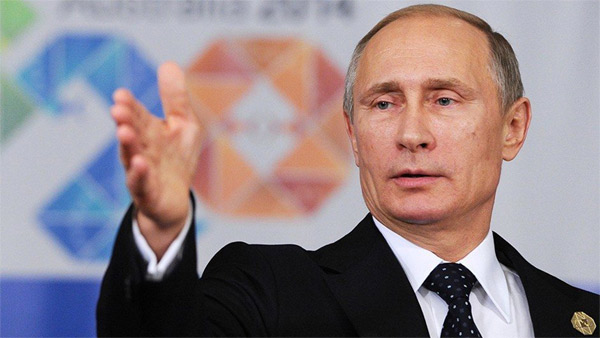
The position of US establishment is to blame for the counter-productive policy of sanctions against Russia, President Vladimir Putin said while describing his Helsinki meeting with President Donald Trump as “useful.”
“It’s not only about the position of the US President. It’s about the position of the so-called establishment, which is ruling [the US] in a broadest sense of the word,” Putin said.
Putin was responding to a question about his July meeting with Trump at a joint briefing with the Finnish President Sauli Niinistö near Sochi on Wednesday.
“As for our meeting with President Trump, I have a positive assessment of it and think that it was useful,” Putin said.
Calling the sanctions “counterproductive and senseless, especially regarding such country like Russia,” Putin added that he hopes “that the realization that this policy doesn’t have a future will someday come to our American partners and we’ll begin to cooperate in a normal manner.”
Putin said that he and Trump exchanged positions on the most pressing issues to each other in Finnish capital, adding that “an exchange of views, direct conversation is always very useful.”
“No one was expecting that during the two-hour talks it would be possible to resolve all of the issues that have been controversial until now,” he added.
As for Russia’s relations with Europe, Putin expressed hope that “something positive will be done for the sake of restoring normal Russia-EU relations” during the second part of 2019 when it will be Finland’s turn to head the European Union.
The Russian president said that his talks with Niinistö were “constructive,” while the Finnish leader was more poetic in his choice of words and described the Sochi meeting as “sunny.”
The two leaders agreed to boost cooperation in environmental protection and discussed the settlement of the Syrian and Ukrainian conflicts. Putin backed Niinistö’s proposal to increase flight safety over the Baltics and expressed commitment to working together with Helsinki in order to bolster security and stability in northern Europe.
He also called Russia “the definitive supplier of gas” to Europe, adding that the country was ready for fair competition in the area.
Russia rejects Facebook’s allegations of disinformation campaign
RT | August 22, 2018
Russia on Wednesday rejected allegations from Facebook that the country’s GRU military intelligence service had been using the social media site to run disinformation campaigns.
Facebook, Twitter, and Alphabet Inc collectively removed hundreds of accounts tied to an alleged Iranian propaganda operation on Tuesday, while Facebook took down a second campaign it said was linked to Russia, Reuters reports.
According to Kremlin spokesman Dmitry Peskov, Facebook’s Russia-related allegations made no sense to Moscow and said they looked similar to previous groundless allegations from other sources like Microsoft.
“They are all trying to outdo one another with their statements which all look like carbon copies of one another,” the spokesman said. “We do not understand on what they are based,” he said, adding that the allegations lack “supporting explanation.”
‘Wow effect’: Microsoft’s claims on alleged Russian hacking are a political stunt – Moscow
RT | August 21, 2018
Microsoft’s claims that Moscow-backed hackers are attacking US websites is simply a case of the tech giant joining the Washington-led ‘witch hunt’ on Russia, the foreign ministry said on Tuesday.
The company’s claims that the hacking group Fancy Bears is linked to the Russian government and is creating a number of “spear-phishing” websites lacks any substance as the company has offered no evidence to support this allegation, the Russian ministry said in a statement. Instead, Microsoft’s words were “clearly aimed at having a maximum political and public wow effect,” it added.
So-called “spear-phishing” sites are designed to mimic the pages of the US political institutions and think tanks, in an attempt to gather information from those who visit them.
The ministry denied Russia’s involvement in any hacking attacks on the US soil, including those which are allegedly aimed at disrupting any elections and the US congressional midterm vote in particular. “We do not know what Microsoft is even talking about,” the statement reads.
The tech giant’s move is apparently nothing but a “display of loyalty” to the US establishment, the ministry said, expressing regret that a major company, which has operated on the Russian market for years, eventually decided to “join the witch hunt,” which has “gripped Washington.”
The ministry went on to say that the reason US officials are unwilling to present any evidence of “Russian electronic interference” into American politics is simply because “this evidence does not and could not possibly exist.”
At the same time, the foreign ministry once again said that Moscow is ready to establish a bilateral working group on cybersecurity with the US to resolve any emerging issues in a timely and professional manner. Such proposals have been repeatedly made by Russia earlier but the US has been reluctant to support this initiative so far.
On Monday, Microsoft said in its blog post that it managed to thwart a number of hacking attempts by “a group known variously as Strontium, Fancy Bear and APT28”, which has been “widely associated” with Russia. It admitted, however, that it has “no evidence” that the domains were used in any successful attacks — and no evidence “to indicate the identity of the ultimate targets.”
In response, the Russian president’s spokesman, Dmitry Peskov, denounced the tech giant’s claims as “groundless”. He added that the Russian government does not know what kind of hackers Microsoft were referring to, and that there was “no basis” for the accusations.
A number of experts, whom RT reached out to, also questioned Microsoft’s ability to effectively establish the identity of the alleged hackers. They described the company’s statement as a “faith-based attribution.”
Treasury Unloads On Moscow: Washington Freezes Russian Assets In The US Worth Hundreds Of Millions
By Tyler Durden – Zero Hedge – 08/21/2018
Just hours after Microsoft said it had thwarted Russian intelligence attempts to hack two conservative think tanks and government sites used by Congressional staff, on Tuesday, the United States imposed new sanctions on two Russians and one Russian and one Slovakian firm under a U.S. program targeting malicious cyber-related activities.
In a statement on its website, the U.S. Treasury said the sanctioned firms – Saint Petersburg-based Vela-Marine Ltd and Slovakia-based Lacno S.R.O. – and the two individuals were linked to Divetechnoservices, a previously sanctioned entity.
Separately, speaking before the Senate Banking Committee, Sigal Mandelker, the Treasury’s top terror and financial intelligence official said that “the breadth and brazenness of Russia’s malign conduct demands a firm and vigorous response.”
Mandelker touted that the net worth of Oleg Deripaska had dropped by about 50%, and the share price of EN+ fell to $5.40 from $12.20 since the latest round of sanctions against Russia were imposed; she also noted that the net worth of Viktor Vekselberg fell by an estimated $3BN due to American penalties.
Mandelker also said that Russian-owned assets in the United States worth hundreds of millions of dollars have been frozen as part of Washington’s sanctions against Moscow, and told lawmakers that the US will not hesitate to bring economic pain to Russia if its conducts does not change.
“The actions of the US Treasury have had significant consequences for the financial interests of individuals and businesses that were affected, including the blocking of hundreds of millions of dollars of Russian assets in the United States,” Mandelker said. Her statement can be found here.
The Trump administration has sanctioned 217 Russian-related individuals and entities, including oil company Surgutneftegaz and power company EuroSibEnergo, since January 2017. Targets include heads of major state-owned banks and energy firms, and some of President Putin’s closest associates.
“As companies across the globe work to distance themselves from sanctioned Russian persons, our actions are imposing an unprecedented level of financial pressure on those supporting the Kremlin’s malign agenda and on key sectors of the Russian economy,” Mandelker said in the prepared remarks.
Finally, in Trump’s determination to show how “tough” he is on Russia, the U.S. also sanctioned owners of six Russian ships over claims they are helping transfer refined petroleum products to North Korean vessels, as tensions with both Moscow and Pyongyang intensify, Bloomberg reported.
The ships – and two Vladivostok-based shipping companies – violated U.S. and United Nations sanctions on North Korea, the Treasury Department said Tuesday in announcing the sanctions on its website. The U.S. is aiming to keep pressure on North Korean leader Kim Jong Un to denuclearize.
“Consequences for violating these sanctions will remain in place until we have achieved the final, fully verified denuclearization of North Korea,” Treasury Secretary Steven Mnuchin said in a statement.
In a separate announcement on Tuesday, Treasury also sanctioned two Russian individuals and two entities it said were making attempts to get around existing U.S. sanctions.
“The Treasury Department is disrupting Russian efforts to circumvent our sanctions,” said Mnuchin. “Today’s action against these deceptive actors is critical to ensure that the public is aware of the tactics undertaken by designated parties and that these actors remain blocked from the U.S. financial system.”
False Western Narratives have Deepened Russia-West Estrangement

Literally No Evidence is Behind the Skripal Poisoning.
By Tony Kevin | 21st Century Wire | August 17, 2018
We have a situation now in which two major world governments, UK and Russia, both nuclear powers and permanent members of the UNSC, are upholding entirely opposed and contradictory narratives on two issues – the alleged Salisbury/Amesbury Novichuk poisonings, and the alleged nerve gas attacks by Assad Government forces on 7 April in Douma, Syria (on basis of false White Helmets-staged evidence). The latter allegation led to a US/UK bombing attack on Syrian Air Force bases.
On both issues, the US and French governments – also UNSC members and nuclear powers – have in solidarity supported UK government- sourced narratives , though in the former case there has been no UK judicial process, and in the latter case OPCW inspectors have found no physical evidence of use of nerve agents in Douma, and nor do local people’s accounts support the allegations.
In the Salisbury case, OPCW technical reports made public in Moscow on 14 April by Russian Foreign Minister Lavrov, detailing results of the Skripal samples analysis by the OPCW Spiez Laboratory in Switzerland, support a finding that the Skripals were probably poisoned temporarily with non- lethal BZ toxin , found in the Skripal samples, and that quantities of Novichok ( A- 234) lethal toxin had twice been added to the samples before they passed from British Govt to OPCW custody, in two clumsy attempts some weeks apart to create a false Novichok chemical trail. Lavrov commented, in strong language for him, that the fact Spiez Lab found these two doses of A-234 in the samples “appears to be utterly suspicious.”
Nevertheless, two days later on 16 April, the OPCW Executive Council , under Western pressure, decided unprecedentedly not to release the full reports of the samples testing by the four OPCW laboratories in Switzerland, thereby casting serious doubt on the professional reputation of OPCW. See here and here.
The second document contained a manifestly untrue statement by Mr Marc-Michael Blum, the Head of the OPCW Laboratory and leader of the technical assistance team that was deployed to the United Kingdom, that:
“The Labs were able to confirm the identity of the chemical (Novichok, or A -234) by applying existing, well-established procedures. *** There was no other chemical that was identified by the Labs ***. The precursor of BZ that is referred to in the public statements, commonly known as 3Q, was contained in the control sample prepared by the OPCW Lab in accordance with the existing quality control procedures. Otherwise it has nothing to do with the samples collected by the OPCW Team in Salisbury. This chemical was reported back to the OPCW by the two designated labs and the findings are duly reflected in the report.”
This is simply laughable. The OPCW defence was that Britain had requested a very restricted test looking only for Novichok, and that it was therefore correct procedure for OPCW to withhold publication of the full laboratory results. So there is no official confirmation or denial of Lavrov’s statement that the Spiez Lab had found that A-234 had twice been improperly added to the Skripal samples. And a blatant lie was told on BZ.
Lavrov on 14 April had stood just short of accusing the UK government of concealing evidence and tampering with samples. But his imputation was very clear. Clearly he was appealing to Britain and the OPCW to do the right thing on 16 April. They did not do so. His words, recorded on the Russian MFA website, went unreported in the West. They are the essential basis of the Russian counter-narrative.
On the alleged use of CW in Douma, an alleged child victim Hassan Diab testified in The Hague three weeks later on 27 April that he had never been gassed, but he had been cruelly used in a White Helmets staged propaganda film.
Then, much later, the OPCW reported on 6 July their inspectors’ findings that they had not found any organophosphorous nerve agents or their degradation products in Douma.
These are facts. But it appears that facts no longer matter. In the UNSC, the weight of numbers is with the three Western permanent members and their allies. China has been circumspect on the issue, saying almost nothing except calling for proper procedures to be followed in OPCW.
Russia and China continue to have rights of veto on any future UNSC resolution that might try to condemn Russia for allegedly behaving as an international outlaw in these two contested matters.
Is there any legal way Russia could be expelled from the UNSC over either or both of these sets of allegations? America and Britain seem hell-bent now on portraying Russia as an international criminal, but surely this should carry no credibility now with the majority of the UNGA membership outside the compliant NATO/EU/Australia grouping.
There seems no way in which the facts of Salisbury/Amesbury can be publicly established, as long as the UK Government continues to suppress and tamper with evidence, and as long as its Western allies and the OPCW Executive continue to give to the UK Government cover and support. Only the election of a Corbyn Labour Government might offer prospect of change, because Corbyn is a decent man who would refuse to sustain a UK government lie.
Russia will continue to press for consular access to their citizens the Skripals. They cannot let the issue be forgotten. So it will go on being a cause of major Russia-UK tension and bad blood, as the histories of the two series of events recede into mythology and contested narratives, and as distracting myths and legends accumulate around Salisbury-Amesbury.
Now, the US government is resorting with increasing recklessness to unilateral sanctions outside the UN system, announcing two tranches of increasingly severe sanctions against Russia, in August and November, unless Russia admits its crimes and promises not to repeat them. Russia has of course rejected these demands out of hand, as internationally illegal and without any justification.
If the US pursues this course it will lead to further distancing between the US and Russian economies. As Lavrov points out, many other countries will draw their own conclusions about the US’s reliability as an economic partner and reserve currency.
The most likely medium-term scenario is continued simmering anger and resentment on both sides, encouraging further polarisation of a ‘3 versus 2’ situation in UNSC. But I don’t see how Russia could be expelled or suspended from the UNSC.
The current situation suits Western Russia-hating elites. It is in their interest to delay and impede any moves to Russia-West detente, keeping tensions high but at a level just short of war, and keeping Trump on a tight leash for as long as he remains US President. So far, sadly, it is all working out according to this plan.
***
Feature image taken from John Laurit’s blog.
Tony Kevin, former Australian diplomat and author of ‘Return to Moscow’ (2017, UWA Publishing)
Assessing US Marines Deployment to Norway: No Big Deal or Serious Threat to Russia?
By Arkady SAVITSKY | Strategic Culture Foundation | 17.08.2018
Norway has abandoned its traditional policy of “no foreign forces on our national soil.” On Aug. 15, the Norwegian defense ministry reported that the US will more than double (from 330 to more than 700) the number of Marines stationed in that country, in line with plans first outlined in June. The deployments to Norway are expected to last at least five years, compared with the former posting that ran for six months after the initial contingent arrived in 2017 and was then extended last June. A new military base at Setermoen will accommodate the US personnel this fall. The United States has expressed interest in building infrastructure to host up to four US fighter jets at a base 65 kilometers south of Oslo, as part of the European Reassurance Initiative (ERI).
The reinforcement comes ahead of a large-scale exercise dubbed Trident Juncture 18 — the biggest NATO maneuver in decades, involving 40,000 soldiers, 130 aircraft, and 70 vessels from more than 30 nations. That training event will be held from October to November in central and eastern Norway, the North Atlantic, and the Baltic Sea. Iceland, Sweden, and Finland will also take part.
According to the Norwegian government, the sole purpose of the American military presence is for training, there is no escalation involved in this whatsoever, and Russia has nothing to worry about. Foreign Minister Ine Eriksen Soereide previously told reporters that this decision did not constitute the establishment of a permanent US base in Norway and was not targeted at Russia.
Moscow issued a warning about the consequences such a move will entail. Are Russia’s concerns justified? After all, 700 soldiers are not a big deal for such a large country. They’ll finish their training, pick up some skiing skills, and leave. Is there really anything to worry about? Perhaps a more in-depth examination can provide an answer to this question.
The US Marines Corps is a service designed mainly for offensive operations. They are training to fight Russia under certain weather conditions. Once it has begun, such training becomes a routine part of the operational cycle. Whether you call it rotational or permanent, they’ll be there for years, ready to attack. It’s not just a few hundred servicemen, it’s an expeditionary force. They are in Norway to make sure that everything is in place to ensure a rapid reinforcement in order to launch offensive operations that include air support right upon arrival.
The cooperation between the US and Norway includes the exchange of intelligence, the purchase of weapons — including 52 F-35 aircraft and five Boeing P-8 Poseidon maritime patrol aircraft (MPA) — the use of Norwegian air bases, and the storage of military equipment in line with the Marine Corps Prepositioning Program-Norway (MCPP-N), which has been in effect since 2005. Actually, that project is a revival of a Cold War program that was launched in 1981 to preposition military equipment. Norway pays half of the program costs. Since 2014, it has been adjusted to meet the needs of the US Marine Corps. Their stockpiles have enough gear, vehicles, and ammunition to equip a force of more than 4,600 troops. According to the plans, there should be enough equipment and ammunition stored up to sustain a Marine Expeditionary Brigade (MEB) during combat. A MAB can consist of 8,000 to 16,000 Marines, or even more.
And it’s not just Norway. In May, US Marines from the 4th Tank Battalion withdrew tanks and weapons from storage caves in Norway to bring them to Finland during the Arrow 18 training exercise. That equipment was used in their maneuvers alongside the Finnish army. The US Marines in Norway could also be transported to Sweden. Such a scenario played out during the Swedish Aurora 17 exercise. As one can see, the Marines’ deployment in Norway is essential for providing US forces access from northern Scandinavia to the Baltic theater of operations.
Norway is part of an intelligence and missile-defense effort. The high-powered radar Globus 3 in Vardo is an example. The radar in Svalbard (above the Arctic Circle) is installed in violation of a 1925 treaty, which states that Svalbard has a demilitarized status. It can be used for missile-defense purposes. The US Poseidon MPA from Andøya monitor Russian submarine movements. In June, the US, UK, and Norway agreed to create a trilateral coalition on the basis of those planes that will conduct joint operations in the North Atlantic near Russia’s Northern Fleet naval bases.
The F-35 Lightnings purchased from the US are to be based in Ørland in southern Norway. They are nuclear-capable planes. The training provided by the American military to the Norwegian pilots is a violation of the 1968 Non-Proliferation Treaty (NPT) , which prohibits the transfer of nuclear weapons from nuclear-weapon states to other states. According to the treaty, non-nuclear-weapon states are not to receive nuclear weapons. Russia will never be sure the Norwegian F-35s aren’t carrying nuclear weapons.
The setting is important. The transformation of Norway into the tip of the knife for an attack on Russia is taking place amidst the speedy militarization of other Scandinavian countries, the Baltic states, and Poland. According to the Russian Defense Ministry, NATO has tripled its military presence on Russia’s western borders over the past five years, forcing Moscow to take retaliatory steps. The Norwegian government’s decision to extend and expand the Marines’ presence is part of NATO’s vigorous war preparations, making Norway a state on the front lines and the prime target for the Russian military.
US violated international law over Russian diplomatic missions, Moscow tells Washington
RT | August 17, 2018
Washington has violated international law with respect to Russian diplomatic missions in the US, the Russian Foreign Ministry said in a protest note filed to DC.
The ministry expressed “protest at the continued violation of international law by the US with regard to” Russian diplomatic missions and consulates in the US, according to a statement on its website.
The complaint concerns Russian diplomatic properties in Washington DC, San Francisco, and Seattle, as well as in the states of Maryland and New York.Moscow said that the “negative consequences” undermine not only US-Russian relations, but also “the principles of the sovereignty of states and international cooperation.”
Moscow said that it has a right to take “additional countermeasures” against US diplomatic property on Russian soil if the US “continues violations” against its facilities.
In a separate statement, also released on Friday, the Foreign Ministry urged the UN Secretary-General to look into the matter. The relevant letter to Antonio Guterres was sent on May 18, the ministry said.
The diplomatic spat between Moscow and Washington dates back to December 2016, when on New Year’s Eve, the outgoing Obama administration expelled Russian diplomats and closed two Russian diplomatic compounds in New York and Maryland.
Russia did not immediately retaliate as the new Trump administration was taking office. However, the downward trend in US-Russia ties persisted and, in the summer of 2017, Washington slapped a new round of sanctions on Moscow, which retaliated by ordering the US diplomatic mission to downsize.
In response, the US took new hostile action, shutting the Russian Consulate-General in San Francisco, as well as the country’s trade missions in Washington and New York.
In May this year, US authorities removed the Russian flag from the diplomatic compound in Seattle. The Russian embassy condemned this “unacceptable treatment” of the national symbol.
Cyprus Court Rejects Request to Ban Work With Russia on Browder Case – Reports
Sputnik – 03.08.2018
A Nicosia court on Friday turned down a request by Hermitage Capital Management for a ban on cooperation of Cypriot authorities with Russia in its investigation into William Browder’s fraudulent investment schemes involving offshore assets, local media reported.
Back in September, Hermitage Capital Management CEO Browder filed a request to a court in Cyprus asking an emergency injunction on the transfer of any data about his activities to Russia. In early October, Cyprus suspended cooperation with Moscow on the case, while the Russian Foreign Ministry expressed regret over it. In late October, a group of 17 members of the European Parliament sent a letter to the Cypriot government, asking not to cooperate with Russia on the probe.
During Friday’s hearing, the applicants sought to insist that Nicosia-Moscow cooperation could cause them irreparable damages, according to Cyprus Mail.
“It has not been shown that in case the Republic of Cyprus executes the particular request for legal assistance of the Russian Federation, the plaintiffs will suffer irreparable damage. Nor have they claimed of course that they have suffered that as a result of the execution of previous requests,” the judge said, as quoted by the newspaper.
The judge ruled that the applicants failed to provide sufficient evidence that they would suffer major damages and that the case could be politically motivated, the media outlet reported.
In 2013, Russia sentenced Browder in absentia to nine years in prison for tax evasion and falsely claiming tax breaks for hiring disabled persons. The court also ruled that Sergei Magnitsky, a tax and legal consultant for Hermitage Capital Management, who died in pretrial detention in Moscow in 2010, developed and implemented a tax evasion scheme while working for the businessman. Browder refuted the accusations, saying that he became a victim of a corruption scheme himself.
In February 2017, a Moscow court ruled to arrest Browder and his business partner Ivan Cherkasov, both charged with 4.2 billion rubles ($72.9 million) in unpaid taxes, in absentia. The United Kingdom, where the two have resided, has denied requests to have them extradited to Russia.
Russian Armaments Completely Adhere to International Law – Kremlin
Sputnik – 14.08.2018
MOSCOW – All new Russian armaments are consistent with the letter and spirit of international agreements, Russia has never violated them, Kremlin spokesman Dmitry Peskov said on Tuesday.
“The president has said that all new armaments are fully consistent with the spirit and letter of relevant international documents. Russia has never violated its obligations under international law and remains committed to them,” Peskov told reporters.
The spokesman stressed that the positioning of Russia as a threat to the United States is groundless, as the US defense budget has always exceeded that of Russia’s.
On Monday, US President Donald Trump signed the 2019 National Defense Authorization Act into law. According to the bill, the United States will discuss with Russia if the latter’s new strategic weapon systems, including the Sarmat missile system, the air-launched nuclear-powered cruise missile X-101, the unmanned underwater vehicle the US government calls “Status 6,” and the long-distance guided flight hypersonic glide vehicle Avangard, are in compliance with the New START treaty.
Featured Video

Dan Dicks with James Corbett on Solutions Watch
or go to
Aletho News Archives – Video-Images
From the Archives
$1.5bn up in smoke: US THAAD missile stockpile dries up defending Israel against Iran
By Ivan Kesic | Press TV | July 2, 2025
According to American media, defense news outlets, and independent analysts, the 12-day Israeli military aggression against Iran significantly depleted the US stockpile of THAAD (Terminal High Altitude Area Defense) interceptor missiles.
Citing official sources, American magazine Newsweek reported on Friday that the US transferred a substantial portion of its advanced missile defense capabilities to support the Israeli regime, an effort with questionable results and a critical impact on US strategic reserves.
THAAD, developed by Lockheed Martin arms manufacturing company, is a key component of Israel’s multi-layered air defense architecture. It is designed to intercept medium-range ballistic missiles, including those launched from Iran and Yemen.
The US-made system is capable of targeting short-, medium-, and intermediate-range ballistic missiles during their terminal phase, whether inside or outside Earth’s atmosphere.
THAAD uses a “hit-to-kill” method, relying on kinetic energy rather than explosive warheads to destroy incoming threats, intercepting at altitudes of up to 150 km and ranges between 150-200 km.
Operated exclusively by American personnel, the US military maintains eight THAAD batteries with an estimated 350–400 interceptors in total. The eighth battery was activated during the June 20 Israeli aggression against Iran and is capable of intercepting hypersonic missiles. … continue
Blog Roll
 Aletho News
- Zionist Bought Senate Blocks Information About American Citizens Killed By Israel
- While Gaza dominates the UN, these are the people keeping it alive
- New Report: “Scholasticide and Genocide in Gaza: Assessment, Testimonies and Legal Analysis”
- ‘THAAD Delusion’: Iran war exposes US missile shield limits – The Atlantic
- Moscow issues warning to NATO over Russian exclave
- Yes, the Iran war has destroyed Trump’s presidency
- The fallacy of US delusions about Iran’s economic collapse
- Hezbollah denies Syria cell link, warns of Israeli plan to sow discord
- The legacy of US sanctions, war, and occupation in Iraq
- Iraqi resistance group rejects disarmament, vows to maintain support for Lebanon
- If Americans Knew
- Mamdani releases plan to combat antisemitism and hate crimes in New York City
- Iran’s Revolutionary Guards Publish Letter to the American People
- DMFI launches $1 million ad campaign supporting Virginia’s Elaine Luria
- US Senate blocks resolution seeking report on Americans killed by Israel
- Israeli Attacks Kill Ten Palestinians in Gaza
- Massacre at Minab: The School That Became a Grave
- Israeli media: The IDF Shows It Doesn’t Turn a Blind Eye; It Actively Emboldens Settler Havoc
- As settlers ravage West Bank, Israeli forces kill 10 in Gaza – Daily Update
- New Report: “Scholasticide and Genocide in Gaza: Assessment, Testimonies and Legal Analysis”
- Ex-Biden officials are desperate for a Gaza scapegoat
- No Tricks Zone
- Green Energy Debacle: German Expert Professor Fritz Vahrenholt Warns Of Severe Economic And Social Consequences
- Two More Paleo Reconstructions Affirm Meters-Higher Sea Levels Across Ireland, Brazil 7000-6000 Years Ago
- New Study: Earth And Venus Surface Warmth Largely Explained By Convection And Lapse Rate, Not CO2 Or Radiation
- 2025 Nature Paper Claiming Worsening Global Drought Gets RETRACTED …Heavily Flawed
- New Study: ‘Global Drought Shows No Detectable Recent Acceleration Under Climate Warming’
- Economic Masterminds: German Socialists Suggest Taxing Productivity Gains Stemming From Using AI
- The South China Sea Has Not Been Cooperating With The Climate Change Narrative
- Energy Crisis: Germany Enters Heating Season With Historically Low Gas Reserve Fill Levels
- New Study: The Antarctic Ice Sheet Gained Mass From 2020-2024 Due To Staggering Snow And Ice Accumulation
- Study: Ocean Heating Rates From Thousands Of Years Ago ‘Dwarf’ Modern Ocean Heating Rates

