Graham, Menendez team up for bipartisan anti-Russia bill
RT | July 24, 2018
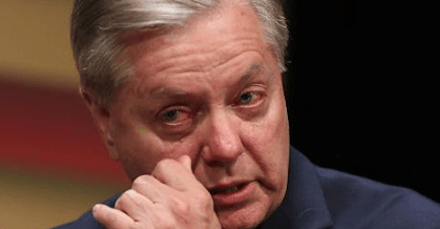
Senators Lindsey Graham (R-South Carolina) and Bob Menendez (D-New Jersey) are working on a draft law that would impose sanctions on Russian sovereign debt and demand Senate approval for US quitting NATO, among other things.
The two senators announced on Tuesday they will be introducing the new sanctions law “to ensure the maximum impact on the Kremlin’s campaign against our democracy and the rules-based international order.”
The US must make it clear it will “not waver in our rejection of [Russian President Vladimir Putin’s] effort to erode western democracy as a strategic imperative for Russia’s future,” Graham and Menendez said.
Although the bill is still being drafted, Graham and Menendez said it would include increased sanctions on Russian energy and financial sectors, “oligarchs and parastatal entities” and on sovereign debt as well as sanctions against “cyber actors in Russia.”
It will also establish a National Center to Respond to Russian Threats and a sanctions coordinator office at the State Department, demand reports on implementing the Countering America’s Adversaries Through Sanctions Act (CAATSA), and authorize financial aid to “bolster democratic institutions across Europe to defend against Russian interference.”
Last, but not least, the bill would impose a Senate approval requirement for US withdrawal from NATO.
Graham is an outspoken foreign policy hawk and long-time wingman of the Russia-obsessed Senator John McCain (R-Arizona). Last week, he called for the World Cup soccer ball, presented as a gift to President Donald Trump by his Russian counterpart at the summit in Helsinki, Finland to be examined for surveillance devices.
As the ranking member on the Senate Foreign Relations Committee, Menendez is a powerful voice among the Democrats, who continue blaming Russia for the outcome of the 2016 US presidential election.
It is unclear how much support the Graham-Menendez bill will get in the Senate. However, CAATSA was approved 98-2 last year.
Just last week, the Senate voted 98-0 on a nonbinding resolution expressing the sense that the “United States should refuse to make available any current or former diplomat, civil servant, political appointee, law enforcement official or member of the Armed Forces of the United States for questioning by the government or Vladimir Putin,” in response to false reports that former US ambassador to Russia Michael McFaul would be “handed over” to Moscow.
US Oil Companies Allegedly Lobbying Congress Not to Ramp Up Russia Sanctions
Sputnik – 21.07.2018
With this week’s US-Russia summit in Helsinki setting off a new wave of media speculation about Russia’s alleged meddling in the 2016 US election, the US Congress is mulling a new round of sanctions against Moscow.
The US oil industry, which is already feeling the pinch of Washington’s sanctions imposed upon Russia, is pushing against tighter sanctions on Moscow. They fear the new restrictions could impact their investments in the world’s biggest oil producing country, Reuters reported, citing congressional sources on Friday.
The US Congress is mulling over a bill which, if passed, would toughen sanctions on Russia if it transpires that Moscow’s alleged meddling in the US election had gone even further than initially believed, the agency wrote.
Even though most of the sources Reuters spoke to refused to name the companies coming out against new sanctions on Russia, one Senate aide said that the US-Russia Chamber of Commerce was raising concerns about the legislation.
The Texas-based chamber, which is a non-profit organization, brings together leading US oil and gas companies, such as Exxon Mobil, who has previously opposed anti-Russian sanctions, and Chevron.
Opponents claim sanctions unfairly penalize US firms while allowing their foreign rivals such as Royal Dutch Shell and BP to operate in Russia.
The Chamber and company representatives did not respond to requests for comment.
This year ExxonMobil will exit some joint oil ventures with Russia’s Rosneft citing Western sanctions first imposed in 2014 and further expanded by the US Congress in 2017.
Bending under pressure, ExxonMobil and its affiliates said they would abide by the legislators’ demands.
On June 17, 2018, Paul Ryan, Speaker of the US House of Representatives, said that Congress was ready to consider a new package of anti-Russian sanctions over Moscow’s alleged interference in the 2016 US election – a claim Russia has repeatedly denied.
America’s Derangement Syndrome a Danger to World Peace
Strategic Culture Foundation – 20.07.2018
It is significant that Presidents Putin and Trump have both spoken out against “haters” among America’s political establishment who would rather see conflict between Russia and the United States instead of a normalization of bilateral relations.
Following their landmark, successful summit this week in Helsinki, Putin and Trump separately made public comments deploring the hostile hysterical reaction emanating from broad sections of the US political establishment and its dutiful, controlled news media.
Speaking in Moscow to his diplomatic corps, President Putin warned that there were “powerful forces” within the US which are ready to sacrifice the interests of their country and indeed the interests of world peace in order to pursue selfish ambitions.
For his part, Trump also slammed opponents in the US who “hated” to see him having a good meeting with Putin. “They would rather see a major confrontation with Russia, even if that could lead to war,” said the American president.
That’s it in a nutshell. Rather than welcoming the opening of a cordial dialogue between the US and Russia, the American political establishment seems to desire the deepening of already dangerous tensions between the world’s two nuclear superpowers. If that’s not deranged, then what is?
Significantly, the hostile reaction was overwhelmingly on the American side. Russians, by and large, welcomed the long-overdue summit between Trump and Putin, and the potential beginning of a new spirit of dialogue and partnership on a range of urgent global problems. Problems including arms control, nuclear proliferation, and working out political settlement to conflicts in the Middle East, Ukraine and the Korea Peninsula.
Few people would believe that these problems can be resolved easily. But the main thing is that the leaders of the US and Russia are at least attempting to open a dialogue for understanding and political progress. That in itself is a breakthrough from the impasse in bilateral relations which have frozen into a new Cold War since the previous US administration.
We dare say that most citizens of the world would also endorse this effort by Trump and Putin at improving the relations between the US and Russia.
Significantly too, according to recent polls, most ordinary Americans seem to be agreeable or neutral about Trump’s diplomatic engagement with Russia. According to a Gallup poll out this week, the vast majority of US citizens are far more concerned by economic woes than they are by anything untoward in American-Russian relations.
Thus, what we are seeing in the explosion of hostility towards the Trump-Putin summit is twofold. It is an American phenomenon, and secondly, it is an angst that animates only the political class in Washington and the news media corporations. This constituency, it is fair to say, is an elite faction within the US, albeit extremely powerful, made up of Washington politicos, the state intelligence apparatus, the corporate media and think tanks, and the deep state establishment of imperial planners and strategists. In short, this constituency is what some observers call the “War Party” that transcends the US ruling class.
Any reasonable person would have to welcome the friendly rapport engendered between Trump and Putin, and at least their initial commitment to working together on major matters of global security. The dangerous impasse of recent years in which dialogue was absent must be overcome for the sake of world peace.
Nevertheless, what has become crystal clear this week following the Helsinki summit is the “War Party” within the US is more determined than ever to sabotage any rapprochement with Russia.
No sooner had Trump returned to the US, he was assailed with a tidal wave of vilification for having met Putin in a mutual, agreeable manner. The most disturbing aspect was the recurring slander denigrating Trump as a “traitor”. The hysterical name-calling was conveyed by all the major news media, citing former intelligence officials and politicians from both Democrat and Republican parties.
Which again shows that in the US there is really only one party, the War Party.
President Trump was evidently forced into making an embarrassing U-turn over his views expressed in Helsinki. He made an unconvincing disavowal of statements made alongside Putin. Trump had been pilloried for appearing to dismiss allegations of Russian interference in the US elections while he was in Helsinki. Within 24 hours, he was forced into making a retraction, saying that he did – kind of – believe that Russia had meddled in US democracy.
What Trump was subjected to by the US establishment was akin to the worst years of McCarthyite Red-Baiting as seen during the Cold War in the 1950s and 60s, when Americans were mercilessly humiliated and ostracized for being “Communist sympathizers”. Today, official American paranoia is back with a vengeance. In truth, it never went away.
To be fair to Trump he has not completely capitulated to the American derangement syndrome. He has since said that he is looking forward to holding a second meeting with his Russian counterpart and continuing their promises of partnership as announced in Helsinki.
However, it is instructive that the American president is, in effect, being held hostage by powerful elements in the US ruling class who view any kind of detente with Moscow as an unforgivable betrayal.
Trump’s instincts are correct that the whole so-called Russia-gate mania is a phony contrivance. That has been orchestrated by the US establishment based on its refusal to accept Trump’s democratic mandate, as well as being based on an abiding hostility towards Russia as an independent world power.
The object lesson here is that the scope for improving US-Russia relations is limited, in spite of Trump’s favorable personal inclinations.
An entrenched animosity towards Russia remains among the American War Party, and the current president has evidently little room for implementing his avowed policy of normalizing relations.
Russia therefore cannot place too much faith in making progress towards peaceful relations, because all-too apparently President Trump has actually very little freedom to exercise his democratic mandate. That is a damning indictment on the charade of American formal democracy. A president is elected partly on the basis of peaceful engagement, but the unelected powers-that-be have another agenda of conflict which they are pursuing come hell or high water.
What’s more, the American derangement syndrome is becoming even more virulent, as can be adjudged from this week’s hysterical backlash over the successful Helsinki summit.
Trump’s willingness for dialogue with Russia is a welcome development. But the far more disturbing development is the full-tilt belligerence and derangement on display among the American political class. This American political schizophrenia is a clear and present danger to world peace. American citizens are as much a victim of the madness as are Russians and the rest of the world.
One positive aspect of the new phase of Cold War is that before it was largely concealed, and deceived, as a simplistic bifurcated confrontation of Americans versus Russians. Today it is evidently a situation of an American deranged elite versus the rest of the world, with the latter including ordinary American citizens who have much more to gain from standing in solidarity with Russian citizens.
Closer ties with Ukraine, Georgia would have dire consequences for NATO: Putin
Press TV – July 19, 2018
Russian President Vladimir Putin has expressed his strong opposition to the expansion of the North Atlantic Treaty Organization (NATO) eastward, warning the US-led military alliance against unspecified consequences in case it seeks to forge closer ties with Ukraine and Georgia.
Addressing a meeting of Russian ambassadors and envoys in Moscow on Thursday, Putin said there was a need to rebuild trust in Europe, and that NATO’s attempts concerning deployment of military contingents and infrastructure near Russia’s western frontiers were not acceptable.
“We will respond appropriately to such aggressive steps, which pose a direct threat to Russia,” the Russian leader said.
He added, “Our colleagues, who are trying to aggravate the situation, seeking to include, among others, Ukraine and Georgia in the orbit of the alliance, should think about the possible consequences of such an irresponsible policy.”
Putin said he had discussed the matter with his US counterpart Donald Trump at a summit in the Finnish capital of Helsinki on Monday.
Russia and Georgia fought a war in August 2008 over the breakaway Georgian region of South Ossetia. Moscow continues to garrison troops there and to support another breakaway region, Abkhazia.
The strategic Black Sea peninsula of Crimea declared independence from Ukraine on March 17, 2014 and formally applied to become part of Russia following a referendum, in which 96.8 percent of participants voted in favor of the move.
After Crimea rejoined Russia, an armed conflict broke out in eastern Ukraine when Kiev launched military operations to quell pro-Russia sentiments there. Kiev accuses Moscow of involvement in the conflict. Russia, in return, has denied the charge.
The US and its Western allies have imposed several rounds of sanctions against Russia over its reunification with Crimea and the Ukrainian crisis, which has killed about 10,000 people since it began in 2014.
German soldiers attend a ceremony to welcome the German battalion being deployed to Lithuania as part of NATO deterrence measures against Russia in Rukla, Lithuania, on February 7, 2017. (Photo by Reuters)
Earlier this year, a senior member of the Italian Five Star Movement (M5S) and vice president of the European Parliament told Russia’s Sputnik news agency that the presence of NATO troops close to Russia’s borders contributes to an arms race, and maintains an atmosphere of mistrust between Moscow and the alliance.
Massimo Castaldo also called for the easing of tensions between NATO and Moscow.
“I think that we should bet on the gradual easing of tension, including with the help of signals that we send as NATO, hoping to restore useful and constructive relations [with Russia],” Castaldo pointed out.
Regional states muscle in to seek a bigger ‘say’ in Afghan conflict
By M.K. Bhadrakumar | Asia Times | July 19, 2018
A new strategic fault line appeared in the Afghan conflict last week when Islamabad hosted an unusual meeting of the heads of the intelligence agencies of Russia, China and Iran on July 11.
Moscow thoughtfully publicized the event both for its optics as well as to pre-empt misperceptions that some sort of zero-sum game might be afoot.
The focus was on joint measures to stop the terrorist group Islamic State Khorasan Province (IS-K) from threatening the territorial boundaries of the four regional states. In the Russian estimation, there could be up to 10,000 fighters in IS-K’s ranks already and the group is already active in nine of the 34 provinces in Afghanistan.
The four participating countries “reached understanding of the importance of coordinated steps to prevent the trickling of IS terrorists from Syria and Iraq to Afghanistan, where from they would pose risks for neighboring countries.” But they also “stressed the need for a more active inclusion of regional powers in the efforts” to end the war in Afghanistan.
Clearly, the leitmotif is in the latter claim by the regional states seeking a greater say in Afghan peace-making. Three related developments over the weekend also signal the new churning. One, the Chief of Staff of the Iranian Armed Forces, General Mohammad Baqeri, started a three-day visit to Islamabad on July 15 at the invitation of Pakistani army chief General Qamar Bajwa.
This is the first time since the Islamic Revolution of 1979 that a chief of staff of Iran’s armed forces visited Pakistan. No doubt, the visit signals Tehran’s appreciation that Pakistan is no longer in the US orbit. General Bajwa visited Tehran in November.
According to the Pakistani readout, General Bajwa noted that Pakistan’s military cooperation with Iran would have a “positive impact on peace and security in the region.” Later, General Baqeri told the Iranian media that the US and its allies seek to weaken security in the region and Iran and Pakistan are “duty-bound to take actions” to safeguard regional peace and security.
There is a history of cross-border terrorism from across the porous Pakistani border in which Tehran suspected the hidden hand of hostile powers. Therefore, today, the Iranian calculus prioritizes the “return” of Saudi Arabia and the United Arab Emirates to the Afghan chessboard recently, after a prolonged absence, given the geopolitical rivalries playing out in a diverse theatre across the Greater Middle East.
Curiously, although the newfound Saudi-Emirati pro-activism in Afghanistan is coinciding with the steady expansion of IS-K, the two Gulf states today are preoccupied with weakening the Taliban, whom they had mentored in an earlier era in the 1990s. The Kabul government approved on June 6 the deployment of UAE Special Forces to Afghanistan.
On July 11-12, Saudi Arabia hosted an Ulema conference in Jeddah and Mecca, which issued a ‘fatwa’ against the ‘jihad’ waged by the Afghan Taliban. Washington encouraged these parallel Saudi-Emirati moves, which implies a concerted attempt to weaken the Taliban whom the US military failed to defeat, with a view to force it to compromise.
However, on the contrary, a paradigm shift is under way in the regional perceptions regarding the Taliban. The special envoy of the Russian president on Afghanistan, Zamir Kabulov, disclosed on the weekend that Moscow proposes to invite the Taliban to the second round of the Russian regional initiative on Afghanistan, which is expected to be held sometime late in the summer.
Kabulov characterized the Taliban as a force that has “integrated” with the Afghan nation, and therefore, having a legitimacy, which in some respects even exceeds the Kabul government’s, and controlling more than half the territory of Afghanistan. Kabulov implicitly doubted the representative character of the present Afghan government.
Suffice to say that the Russian policy is incrementally redefining the battle lines in Afghanistan from ‘Taliban versus the Rest’ to ‘Afghanistan versus the IS-K.’ Conceivably, Iran, China and Pakistan are in harmony with the Russian thinking.
The heart of the matter is that while these regional states regard the Taliban as an Afghan movement indigenously rooted in traditional Islam and with a political agenda confined to their homeland, they abhor the IS-K as a brutal terrorist group weaned on Salafi-Wahhabist teaching which casts a seductive appeal to misguided Muslim youth worldwide.
However, in the final analysis, the above interplay needs to be juxtaposed with recent reports that President Trump may order a policy review of his one-year old Afghan strategy. In fact, the sudden visit of the US Secretary of State Mike Pompeo to Kabul on July 9 only reinforced that impression in the region. Unsurprisingly, Pompeo maintained while in Kabul that the Trump administration’s “strategy is working.”
But then, instead of heaping praise on the US military, he instead stressed the urgency of a peace process with the Taliban. Pompeo offered that the US will “support, facilitate and participate in these peace discussions.” He then added meaningfully: “We expect that these peace talks will include a discussion of the role of international actors and forces.”
Henningsen: ‘US Can Help Refugee Crisis By Lifting Sanctions and Getting Out of Syria’
21st Century Wire | July 18, 2018
One potentially positive outcome from Monday’s Trump-Putin Summit in Helsinki, Finland was a clear signal that both leaders have talked about cooperating in Syria, rather than treating each other as geopolitical adversaries at the expense of Syria’s own welfare.
While this has been received with fury by the US mainstream corporate media, pro-war Democrats and Neocon Republicans – it has been seen by the rest of the world as a much-needed diplomatic overture which could help to stabilize the situation, rather than exacerbate existing problems across the country and the Middle East in general. Russia’s Defense Ministry announced it is already prepared to ‘boost cooperation’ with the U.S. military in Syria, saying in a statement Tuesday that it’s ready for “practical implementation” of any memorandums of understanding reached between Trump and Putin, including the extension of the START arms control treaty.
21WIRE editor Patrick Henningsen spoke to RT International yesterday about what the US and its EU counterparts need to do to mitigate Europe’s Migrant Crisis as well as Syria and the Middle East’s refugee crisis – namely, lifting punitive joint US-EU economic sanctions on Syria, and also seeing the US end its illegal occupation with its Kurdish SDF proxy militias in northeastern Syria: Watch:
US arrest of Russian attempt to undermine Trump-Putin summit
Press TV – July 18, 2018
Russia’s Foreign Ministry says the arrest this week of a Russian national in the United States was a deliberate attempt to undermine a summit between President Vladimir Putin and his US counterpart Donald Trump in Helsinki, Finland.
Spokeswoman Maria Zakharova said Wednesday the detention of Maria Butina, which took place on Sunday, a day before the summit, had no grounds and was meant to affect the positive outcome of the summit.
Putin and Trump met in a freighted atmosphere amid criticism that Trump was approaching Russia at the expense of Washington’s allies in Europe. Trump is also accused of trying to cover up his alleged links to the Russians in the run-up to his presidency two years ago.
US authorities said Monday that they had charged Butina, 29, with conspiracy to act as an agent of the Russian government through establishing relationships and infiltrating organizations that have influence in US politics.
“Butina worked at the direction of a high-level official in the Russian government who was previously a member of the legislature of the Russian Federation and later became a top official at the Russian Central Bank,” said the US Department of Justice in a press release, adding, “This Russian official was sanctioned by the US Department of the Treasury, Office of Foreign Assets Control in April 2018.”
Zakharova dismissed the charges and said the arrest happened “with the obvious task of minimizing the positive effect” of the summit between Putin and Trump.
Both leaders have described their meeting as positive, saying it would help Moscow and Washington improve their strained relations.
The US and Russia have clashed on several issues over the past years, including Russia’s alleged interference in Ukraine, which Moscow denies, its military presence in Syria and allegations that the Kremlin meddled in the 2016 presidential election, which led to Trump’s victory.
While His Opponents Cry Treason Trump Sues for Peace
By Tom LUONGO | Strategic Culture Foundation | 18.07.2018
For the second time in as many months President Trump went against the grain of US foreign policy.
I will not mince words. I was hoping for more from the Trump-Putin Summit in Helsinki; something concrete. Even a small agreement about a quid pro quo in Syria would have been welcome.
But, given the level of histrionics on display in the US media and on the left I guess I should have tempered my expectations. Cries of Trump being guilty of ‘treason’ and ‘high crimes and misdemeanors’ are rampant.
And they aren’t going to stop.
Crying treason for opening up diplomatic contact with a foreign leader whom we are not at war with is beyond hyperbole. It is the height of insanity. And I don’t use that term lightly.
Trump’s opponents both from members of the Deep State and media as well as those citizens supporting ‘The Resistance’ are so unhinged they have become indistinguishable from Colonel Jack T. Ripper from Dr. Strangelove.
I swear I saw a tweet from Obama Administration CIA Director John Brennan discussing bodily fluids, but I may have misread it.
They have nurtured their own angst and denial at having lost an election they have erected a bogeyman in Vladimir Putin as the only way in which the disgusting Trump could possibly have won.
And the Deep State of permanent government has cultivated this psychological poison perfectly. Now there are truly millions of otherwise normal people frothing at the mouth about everything Trump does is proof that he is the puppet of Putin, his evil master.
This has placed them firmly in the camp of wanting perpetual, undeclared war with everyone Trump wants peace with.
All because they don’t have the emotional maturity to accept reality.
And Trump, never one to miss an opportunity to twist the knife, in a moment of near sublime statesmanship during the post-summit press conference declared, “I would rather take a political risk in pursuit of peace than to risk peace in pursuit of politics. I will not make decisions on foreign policy in a futile effort to appease partisan critics, the media, or Democrats who want to resist and obstruct.”
That statement won his candidates the mid-term elections and likely won him re-election in 2020. It’s a statement that he can campaign on and give not only his base a boost but convince even more of the political center to reject the insanity of the left and side with him.
After all, he just put something above politics and that something is the very thing that got him elected in the first place, peace.
And that is eternally to his credit.
It is also in stark contrast to his ill-conceived bombing of the Al-Shairat airbase while hosting Chinese Premier Xi Jinping in April of 2017. This was an act of pure political optics, designed to appease his virulent critics.
But, as he learned from that act and many others since then, nothing will appease these people than his removal from the office. The Resistance needs it to vindicate their descent into madness. The Deep State needs it to ensure the gravy train keeps flowing.
There are too many cozy relationships at risk, too many think tank jobs on the block, and too many weapons contracts at stake and too many more taxpayer-funded junkets to attend for Trump and Putin to remake the post-WWII political order.
Putin, for his part, was obviously firm in his dealings with Trump. There were many rumors of offers being made which were rejected. As myself and many others have pointed out, Trump didn’t have much to offer Putin in concrete terms on many of the outstanding issues of the day.
I believe the only thing they can agree on is that Syria is nearly settled in Assad’s favor and all that needs to be done now is convince the Israelis and Iran to behave themselves. In all of the furor over Trump’s meeting with Putin this tweet from uber-hawk and MIC-mouthpiece, Senator Lindsay Graham is the most telling.
“It is beyond absurd to believe that Russia will ‘police Iran’ or drive them out of Syria. Iran is Assad’s biggest ally – even more so than Russia. Russia policing Iran makes about as much sense as trusting Russia to police the removal/destruction of chemical weapons in Syria.” — Lindsay Graham, July 16th
No one that I know of other than myself and a very small handful of equally obscure political commentators have broached the subject of Russia policing Syria after the US picks up and leaves as any Grand Bargain for Middle East Peace.
Remember, Graham was just in Syria trying to drum up further support for Kurdish independence in a clear attempt to undermine what he just told everyone Trump’s plan was.
So, to me, this signals strongly that peace in Syria is what Trump and Putin discussed at length in their meeting and why the Deep State has so thoroughly gone off the deep end. Graham just told everyone what the plan is, folks.
And the plan is peace in the Middle East.
Trump and Putin both referenced working with Israeli Prime Minister Benjamin Netanyahu to craft a post-Civil War plan of action in Syria. Putin mentioned restoring Syria to the 1974 border of the Golan Heights while Trump made it clear he no longer wants our people there.
Moreover, Trump sent an envoy from the US to sit down and talk peace with the Taliban in Afghanistan, putting paid Secretary of State Mike Pompeo’s assertion that the US is ready to talk. Lindsay must be shaking in his thigh-highs over the prospect of this as well.
Remember, the US only negotiates when it knows it is losing. Empires dictate terms, they don’t sue for peace.
And that is exactly what Trump is beginning to do with Russia on a number of fronts across Central Asia. And for this he is being vilified by his opponents for being a traitor. A traitor to what?
Chaos.
US Media is Losing Its Mind Over Trump-Putin Press Conference
By Joe Lauria | Consortium News | July 16, 2018
The reaction of the U.S. establishment media and several political leaders to President Donald Trump’s press conference after his summit meeting with Russian President Vladimir Putin on Monday has been stunning.
Writing in The Atlantic, James Fallows said:
“There are exactly two possible explanations for the shameful performance the world witnessed on Monday, from a serving American president.
Either Donald Trump is flat-out an agent of Russian interests—maybe witting, maybe unwitting, from fear of blackmail, in hope of future deals, out of manly respect for Vladimir Putin, out of gratitude for Russia’s help during the election, out of pathetic inability to see beyond his 306 electoral votes. Whatever the exact mixture of motives might be, it doesn’t really matter.
Or he is so profoundly ignorant, insecure, and narcissistic that he did not realize that, at every step, he was advancing the line that Putin hoped he would advance, and the line that the American intelligence, defense, and law-enforcement agencies most dreaded.
Conscious tool. Useful idiot. Those are the choices, though both are possibly true, so that the main question is the proportions … never before have I seen an American president consistently, repeatedly, publicly, and shockingly advance the interests of another country over those of his own government and people.”
As soon as the press conference ended CNN cut to its panel with these words from TV personality Anderson Cooper: “You have been watching perhaps one of the most disgraceful performances by an American president at a summit in front of a Russian leader, surely, that I’ve ever seen.”
David Gergen, who for years has gotten away with portraying himself on TV as an impartial political sage, then told CNN viewers:
“I’ve never heard an American President talk that way but I think it is especially true that when he’s with someone like Putin, who is a thug, a world-class thug, that he sides with him again and again against his own country’s interests of his own institutions that he runs, that he’s in charge of the federal government, he’s in charge of these intelligence agencies, and he basically dismisses them and retreats into this, we’ve heard it before, but on the international stage to talk about Hillary Clinton’s computer server …”
“It’s embarrassing,” interjected Cooper.
“It’s embarrassing,” agreed Gergen.
White House correspondent Jim Acosta, ostensibly an objective reporter, then gave his opinion: “I think that sums it up nicely. This is the president of the United States essentially taking the word of the Russian president… over his own intelligence community. It was astonishing, just astonishing to be in the room with the U.S. president and the Russian president on this critical question of election interference, and to retreat back to these talking points about DNC servers and Hillary Clinton’s emails when he had a chance right there in front of the world to tell Vladimir Putin to stay the HELL out of American democracy, and he didn’t do it.”
In other words Trump should just shut up and not question a questionable indictment, which Acosta, like nearly all the media, treat as a conviction.
The Media’s Handlers
The media’s handlers were even worse than their assets. Former CIA director John Brennan tweeted: “Donald Trump’s press conference performance in Helsinki rises to & exceeds the threshold of ‘high crimes & misdemeanors,.’ It was nothing short of treasonous. Not only were Trump’s comments imbecilic, he is wholly in the pocket of Putin. Republican Patriots: Where are you???”
Here’s where the Republican Patriots are, Brennan: “That’s how a press conference sounds when an Asset stands next to his Handler,” former RNC Chairman Michael Steele tweeted.
Representative Liz Cheney, the daughter of the former vice president, said on Twitter: “As a member of the House Armed Services Committee, I am deeply troubled by President Trump’s defense of Putin against the intelligence agencies of the U.S. & his suggestion of moral equivalence between the U.S. and Russia. Russia poses a grave threat to our national security.”
All these were reactions to Trump expressing skepticism about the U.S. indictment on Friday of 12 Russian intelligence agents for allegedly interfering in the 2016 U.S. presidential election while he was standing next to Russian President Vladimir Putin at the press conference following their summit meeting in Helsinki.
“I will say this: I don’t see any reason why it would be” Russia, Trump said. “I have great confidence in my intelligence people, but I will tell you that President Putin was extremely strong and powerful in his denial today.”
The indictments, which are only unproven accusations, formally accused 12 members of the GRU, Russian military intelligence, of stealing Democratic Party emails in a hacking operation and giving the materials to WikiLeaks to publish in order to damage the candidacy of Trump’s opponent, Hillary Clinton. The indictments were announced on Friday, three days before the summit, with the clear intention of getting Trump to cancel it. He ignored cries from the media and Congress to do so.
Over the weekend Michael Smerconish on CNN actually said the indictments proved that Russia had committed a “terrorist attack” against the United States. This is in line with many pundits who are comparing this indictment, that will most likely never produce any evidence, to 9/11 and Pearl Harbor. The danger inherent in that thinking is clear.
Putin said the allegations are “utter nonsense, just like [Trump] recently mentioned.” He added: “The final conclusion in this kind of dispute can only be delivered by a trial, by the court. Not by the executive, by the law enforcement.” He could have added not by the media.
Trump reasonably questioned why the FBI never examined the computer servers of the Democratic National Committee to see whether there was a hack and who may have done it. Instead a private company, CrowdStrike, hired by the Democratic Party studied the server and within a day blamed Russia on very dubious grounds.
“Why haven’t they taken the server?” Trump asked. “Why was the FBI told to leave the office of the Democratic National Committee? I’ve been wondering that. I’ve been asking that for months and months and I’ve been tweeting it out and calling it out on social media. Where is the server? I want to know, where is the server and what is the server saying?”
But being a poor communicator, Trump then mentioned Clinton’s missing emails, allowing the media to conflate the two different servers, and be easily dismissed as Gergen did.
At the press conference, Putin offered to allow American investigators from the team of special counsel Robert Mueller, who put the indictment together, to travel to Russia and take part in interviews with the 12 accused Russian agents. He also offered to set up a joint cyber-security group to examine the evidence and asked that in return Russia be allowed to question persons of interest to Moscow in the United States.
“Let’s discuss the specific issues and not use the Russia and U.S. relationship as a loose change for this internal political struggle,” Putin said.
On CNN, Christiane Amanpour called Putin’s clear offer “obfuscation.”
Even if Trump agreed to this reasonable proposal it seems highly unlikely that his Justice Department will go along with it. Examination of whatever evidence they have to back up the indictment is not what the DOJ is after. As I wrote about the indictments in detail on Friday:
“The extremely remote possibility of convictions were not what Mueller was apparently after, but rather the public perception of Russia’s guilt resulting from fevered media coverage of what are after all only accusations, presented as though it is established fact. Once that impression is settled into the public consciousness, Mueller’s mission would appear to be accomplished.”
Still No ‘Collusion’
The indictments did not include any members of Trump’s campaign team for “colluding” with the alleged Russian hacking effort, which has been a core allegation throughout the two years of the so-called Russia-gate scandal. Those allegations are routinely reported in U.S. media as established fact, though there is still no evidence of collusion.
Trump emphasised that point in the press conference. “There was no collusion at all,” he said forcefully. “Everybody knows it.”
On this point corporate media has been more deluded than normal as they clutch for straws to prove the collusion theory. As one example of many across the media with the same theme, a New York Times story on Friday, headlined, “Trump Invited the Russians to Hack Clinton. Were They Listening?,” said Russia may have absurdly responded to Trump’s call at 10:30 a.m. on July 27, 2016 to hack Clinton’s private email server because it was “on or about” that day that Russia allegedly first made an attempt to hack Clinton’s personal emails, according to the indictment, which makes no connection between the two events.
If Russia is indeed guilty of remotely hacking the emails it would have had no evident need of assistance from anyone on the Trump team, let alone a public call from Trump on national TV to commence the operation.
More importantly, as Twitter handle “Representative Press” pointed out: “Trump’s July 27, 2016 call to find the missing 30,000 emails could not be a ‘call to hack Clinton’s server’ because at that point it was no longer online. Long before Trump’s statement, Clinton had already turned over her email server to the U.S. Department of Justice.” Either the indictment was talking about different servers or it is being intentionally misleading when it says “on or about July 27, 2016, the Conspirators attempted after hours to spearphish for the first time email accounts at a domain hosted by a third party provider and used by Clinton’s personal office.”
This crucial fact alone, that Clinton had turned over the server in 2015 so that no hack was possible, makes it impossible that Trump’s TV call could be seen as collusion. Only a desperate person would see it otherwise.
But there is a simple explanation why establishment journalists are in unison in their dominant Russian narrative: it is career suicide to question it.
As Samuel Johnson said as far back as 1745: “The greatest part of mankind have no other reason for their opinions than that they are in fashion …since vanity and credulity cooperate in its favour.”
Importance of US-Russia Relations
Trump said the unproven allegation of collusion “has had a negative impact upon the relationship of the two largest nuclear powers in the world. We have 90 percent of nuclear power between the two countries. It’s ridiculous. It’s ridiculous what’s going on with the probe.”
The American president said the U.S. has been “foolish” not to attempt dialogue with Russia before, to cooperate on a range of issues.
“As president, I cannot make decisions on foreign policy in a futile effort to appease partisan critics or the media or Democrats who want to do nothing but resist and obstruct,” Trump said. “Constructive dialogue between the United States and Russia forwards the opportunity to open new pathways toward peace and stability in our world. I would rather take a political risk in pursuit of peace than to risk peace in pursuit of politics.”
This main reason for summits between Russian and American leaders was also ignored: to use diplomacy to reduce dangerous tensions. “I really think the world wants to see us get along,” Trump said. “We are the two great nuclear powers. We have 90 percent of the nuclear. And that’s not a good thing, it’s a bad thing.”
Preventing good relations between the two countries appears to be the heart of the matter for U.S. intelligence and their media assets. So Trump was vilified for even trying.
Ignoring the Rest of the Story
Obsessed as they are with the “interference” story, the media virtually ignored the other crucial issues that came up at the summit, such as the Middle East.
Trump sort of thanked Russia for its efforts to defeat ISIS. “When you look at all of the progress that’s been made in certain sections with the eradication of ISIS, about 98 percent, 99 percent there, and other things that have taken place that we have done and that, frankly, Russia has helped us with in certain respects,” he said.
Trump here is falsely taking credit, as he has before, for defeating ISIS with only some “help” from Russia. In Iraq the U.S. led the way against ISIS coordinating the Iraqi and Kurdish security forces. But in the separate war against ISIS in Syria, Russia, the Syrian Arab Army, Kurdish forces, Iranian troops and Hizbullah militias were almost entirely responsible for ISIS’ defeat.
Also on Syria, Trump appeared to endorse what is being reported as a deal between Russia and Israel in which Israel would accept Bashar al-Assad remaining as Syrian president, while Russia would work on Iran to get it to remove its forces away from the northern Golan Heights, which Israel illegally considers its border with Syria.
After a meeting in Moscow last week with Putin, Israel Prime Minister Benjamin Netanyahu said he accepted Assad remaining in power.
“President Putin also is helping Israel,” Trump said at the press conference. “We both spoke with Bibi Netanyahu. They would like to do certain things with respect to Syria, having to do with the safety of Israel. In that respect, we absolutely would like to work in order to help Israel. Israel will be working with us. So both countries would work jointly.”
Trump also said that the U.S. and Russian militaries were coordinating in Syria, but he did not go as far as saying that they had agreed to fight together there, which has been a longstanding proposal of Putin’s dating back to September 2015, just before Moscow intervened militarily in the country.
“Our militaries have gotten along probably better than our political leaders for years,” Trump said. “Our militaries do get along very well. They do coordinate in Syria and other places.”
Trump said Russia and the U.S. should cooperate in humanitarian assistance in Syria.
“If we can do something to help the people of Syria get back into some form of shelter and on a humanitarian basis… that’s what the word was, a humanitarian basis,” he said. “I think both of us would be very interested in doing that.”
Putin said he had agreed on Sunday with French President Emmanuel Macron on a joint effort with Europe to deliver humanitarian aid. “On our behalf, we will provide military cargo aircraft to deliver humanitarian cargo. Today, I brought up this issue with President Trump. I think there’s plenty of things to look into,” Putin said.
Joe Lauria is editor-in-chief of Consortium News and a former correspondent for The Wall Street Journal, Boston Globe, Sunday Times of London and numerous other newspapers. He can be reached at joelauria@consortiumnews.com and followed on Twitter @unjoe .
Helsinki: What did Trump want from Putin, really?
By Denis Rancourt | Dissident Voice | July 16, 2018
I just did a live Sputnik International radio interview about the Trump-Putin summit in Helsinki. This is the essence of my answers.
Trump is the USA and the USA mainly wants two things from Russia.
First, it wants Russia’s credibility. In the words of Trump: “I really think the world wants to see us get along.”
USA world credibility has crashed after Iraq-Afghanistan-Libya. The USA is known to abandon its allies and to work for gain even at the price of making long-term enemies.
The USA is habituated to being the most powerful and the most powerful can afford to make enemies. But the world is changing. The new multipolarity is accompanied by greater risks if the USA insists on maintaining the same degree of dominance.
In the words of Trump “We have a world to run”. This means the USA can gain much from collaboration with Russia. But, as usual, this does not mean that Russia can draw benefit from any such collaboration, only avoid some otherwise imposed punishment (sanctions, blockades, military pressures).
Second, the USA desperately “needs” to prevent democratization of effective weapons that can defend against its military intimidation and destruction campaigns.
The USA needs to prevent the emerging nations that it traditionally exploits by military force and intimidation from acquiring air-defence systems, ballistic missiles capable of retaliation, and weapons that can target large ships such as aircraft carriers. Aircraft carriers are the main hardware of USA military projection.
North Korea, Iran and Russia itself represent possible vectors of the said democratization of military technology. An example is seen in Yemen, where ground-to-air defence missiles are transformed into ground-to-ground retaliatory missiles. If Yemen had secured better such technologies, it would be defending itself more effectively.
The same is true for Gaza. Increased military technology would allow proper defence and a balance that could produce negotiation rather than bulldozer displacement policies and genocidal destruction campaigns.
The USA and Israel are terrified at such prospects. Israel’s approach would be all-out USA-backed war against Iran. The USA approach is to threaten war but extract collaboration from Russia to control and prevent military advancement of the nations the USA wants to control, which resist its bribes and threats.
In all of this, the USA (the elite faction supporting Trump) has come to understand that it must revitalize the domestic USA and its middle-class, that a strong empire cannot have an empty core. Trump will do anything to achieve this, including ruffle allies and break long-standing agreements.
The USA wants a strong NATO that it controls. It wants more commitment from NATO members. That was Trump’s main message. It needs NATO to legitimize any “needed” military destruction campaigns in Africa, the Middle East and Asia. And it is prepared to use these strong NATO-club ties to extract relative advantages to re-build its domestic economy.
NATO is about: securing Europe against trade and co-development with Russia, legitimizing criminal wars of aggression in the service of the empire, and projecting power into Africa, the Middle East and Asia, for the benefit of the NATO-club members but mostly the USA. It also forces Russia to spend enormous resources on defence.
This is what Trump is doing with NATO, which has nothing to do with pleasing Putin.
Election interference, whether true or not, is just an ancillary USA domestic matter. Everyone knows it’s bullshit. Putin did not write the Clinton emails. Democracies claim to want “transparency”.
Crimea is also a non-issue. Crimea folks overwhelmingly wanted incorporation into Russia, following the Ukrainian meltdown and military violence. Everybody knows that. Compare Russia’s actions in Crimea to the NATO mass-crime that is Libya. There is no comparison.
Finally, whether our goodiness brains allow us to see it or not, from a geopolitical perspective, Trump is the “progressive” here that wants domestic development rather than solely all-out hawkish globalism irrespective of domestic hollowness. He also wants to negotiate with Russia to limit Iran rather than risk long-term world and USA consequences from a large-scale regional war, which the Clintonite crazies say they want.
Two related prior articles are:1 and2
- Denis Rancourt. “Cause of USA Meltdown and Collapse of Civil Rights”, Dissident Voice, September 7, 2017.
- Denis Rancourt. “Social Animals have Two Modes of Being”, Dissident Voice, July 2, 2018.
Featured Video

Dan Dicks with James Corbett on Solutions Watch
or go to
Aletho News Archives – Video-Images
From the Archives
$1.5bn up in smoke: US THAAD missile stockpile dries up defending Israel against Iran
By Ivan Kesic | Press TV | July 2, 2025
According to American media, defense news outlets, and independent analysts, the 12-day Israeli military aggression against Iran significantly depleted the US stockpile of THAAD (Terminal High Altitude Area Defense) interceptor missiles.
Citing official sources, American magazine Newsweek reported on Friday that the US transferred a substantial portion of its advanced missile defense capabilities to support the Israeli regime, an effort with questionable results and a critical impact on US strategic reserves.
THAAD, developed by Lockheed Martin arms manufacturing company, is a key component of Israel’s multi-layered air defense architecture. It is designed to intercept medium-range ballistic missiles, including those launched from Iran and Yemen.
The US-made system is capable of targeting short-, medium-, and intermediate-range ballistic missiles during their terminal phase, whether inside or outside Earth’s atmosphere.
THAAD uses a “hit-to-kill” method, relying on kinetic energy rather than explosive warheads to destroy incoming threats, intercepting at altitudes of up to 150 km and ranges between 150-200 km.
Operated exclusively by American personnel, the US military maintains eight THAAD batteries with an estimated 350–400 interceptors in total. The eighth battery was activated during the June 20 Israeli aggression against Iran and is capable of intercepting hypersonic missiles. … continue
Blog Roll
 Aletho News
- Zionist Bought Senate Blocks Information About American Citizens Killed By Israel
- While Gaza dominates the UN, these are the people keeping it alive
- New Report: “Scholasticide and Genocide in Gaza: Assessment, Testimonies and Legal Analysis”
- ‘THAAD Delusion’: Iran war exposes US missile shield limits – The Atlantic
- Moscow issues warning to NATO over Russian exclave
- Yes, the Iran war has destroyed Trump’s presidency
- The fallacy of US delusions about Iran’s economic collapse
- Hezbollah denies Syria cell link, warns of Israeli plan to sow discord
- The legacy of US sanctions, war, and occupation in Iraq
- Iraqi resistance group rejects disarmament, vows to maintain support for Lebanon
- If Americans Knew
- Mamdani releases plan to combat antisemitism and hate crimes in New York City
- Iran’s Revolutionary Guards Publish Letter to the American People
- DMFI launches $1 million ad campaign supporting Virginia’s Elaine Luria
- US Senate blocks resolution seeking report on Americans killed by Israel
- Israeli Attacks Kill Ten Palestinians in Gaza
- Massacre at Minab: The School That Became a Grave
- Israeli media: The IDF Shows It Doesn’t Turn a Blind Eye; It Actively Emboldens Settler Havoc
- As settlers ravage West Bank, Israeli forces kill 10 in Gaza – Daily Update
- New Report: “Scholasticide and Genocide in Gaza: Assessment, Testimonies and Legal Analysis”
- Ex-Biden officials are desperate for a Gaza scapegoat
- No Tricks Zone
- Green Energy Debacle: German Expert Professor Fritz Vahrenholt Warns Of Severe Economic And Social Consequences
- Two More Paleo Reconstructions Affirm Meters-Higher Sea Levels Across Ireland, Brazil 7000-6000 Years Ago
- New Study: Earth And Venus Surface Warmth Largely Explained By Convection And Lapse Rate, Not CO2 Or Radiation
- 2025 Nature Paper Claiming Worsening Global Drought Gets RETRACTED …Heavily Flawed
- New Study: ‘Global Drought Shows No Detectable Recent Acceleration Under Climate Warming’
- Economic Masterminds: German Socialists Suggest Taxing Productivity Gains Stemming From Using AI
- The South China Sea Has Not Been Cooperating With The Climate Change Narrative
- Energy Crisis: Germany Enters Heating Season With Historically Low Gas Reserve Fill Levels
- New Study: The Antarctic Ice Sheet Gained Mass From 2020-2024 Due To Staggering Snow And Ice Accumulation
- Study: Ocean Heating Rates From Thousands Of Years Ago ‘Dwarf’ Modern Ocean Heating Rates

