Marine Le Pen: Crimea Was Never Ukrainian, I Will Recognize Crimea as Part of Russia

American Herald Tribune | January 18, 2017
The French presidential candidate Marine Le Pen has reiterated her support for Russia’s claim on Crimea in a newspaper interview in which she made another decisive tilt towards Moscow.
With three months before France goes to the polls, the Front National leader said she recognised Crimea as being part of Russia and if elected, she would push for a dropping of sanctions against Russia which France had backed simply because it was following German orders.
She told the Russian newspaper, Izvestia, that the referendum in the peninsula in 2014 to become part of Russia showed the “agreement of the people to join Russia”.
“Ukraine’s ownership of Crimea was just an administrative issue from Soviet times, the peninsula was never Ukrainian,” she said.
“I regret that the referendum, organised as a demonstration of the will of the people of the peninsula, was not recognised by the international community and the UN.”
Le Pen had made the comments about Crimea on French television earlier in January after which the Ukrainian security service SBU proposed banning her from entering the country for five years.
She described sanctions against Russia as “senseless” and “a pretty stupid method of diplomacy” and that “all countries should show respect for each other, to negotiate on equal terms and to accept a compromise solution acceptable to all”.
“We don’t have to have a situation whereby the major powers impose their policies on other states, behaving like stubborn children,” she told the paper.
( Image Credit: European Parliament/ flickr).
‘Trump: Kremlin Candidate?’: BBC doc becomes MSM manual to ‘verified’ journalism
RT | January 17, 2017
The BBC’s flagship current affairs programme has aired an edition on the alleged financial ties between U.S. President-elect Donald Trump and Vladimir Putin. It also reports on whether Russia played a key role in Trump’s election success. Making its assumptions very clear, the BBC called the programme ‘The ‘Kremlin Candidate’. RT’s Ilya Petrenko explains how pulling-in the viewers often means rolling with the rumours.
Trump’s Remaking of US Foreign Policy
By Gilbert Doctorow | Consortium News | January 16, 2017
Over the weekend, President-elect Trump received two journalists from mainstream European print media — The Times of London and the German magazine Bild — for a joint interview in New York City’s Trump Tower. The event was videotaped and we are seeing some remarkable sound bites, particularly those of interest to the British and German publics.
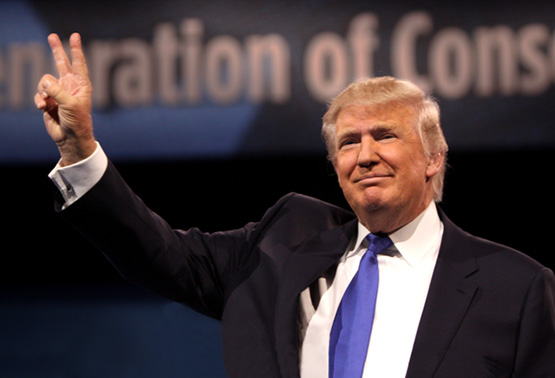
President-elect Donald J. Trump donaldjtrump.com
For the government of British Prime Minister Theresa May, nothing could have sounded sweeter than Donald Trump’s statement that she would be invited for talks in the White House shortly after he is sworn in on Jan. 20 and that he seeks very quickly to reach agreement on a bilateral free trade pact. The effect of the pledge itself, even ahead of its successful implementation, assures the British that the sting of severing ties with the European Union will be greatly offset by new commercial possibilities in the world’s biggest economy; in this way, it strengthens May’s hand enormously as she enters into talks with the E.U. leadership over the detailed terms of what will apparently be a “Hard Brexit.”
Further adding to her leverage with the E.U. were Trump’s remarks suggesting that the E.U. will face stern trade pressure, beginning with Germany and its automobile industry, to do more to manufacture in the U.S. That precisely raises the relative importance of the U.K. market, which the E.U. will otherwise lose if it imposes severe penalties on Britain in negotiations over Brexit.
For the general public’s consumption, Donald Trump used the interview to explain his special affection for Britain, speaking about his Scottish mother’s delight in the Queen and her watching every royal event on television for its unequaled pageantry. But we may expect that Prime Minister May will find there is a bill to pay for the “special relationship” with the U.S. under President Trump.
Rather than the British media’s early speculation that Prime Minister May would be the one to set the misguided Trump straight about the nefarious Vladimir Putin, she may now have to become a leading European advocate for détente with Russia at Trump’s behest. In this connection, British Foreign Minister Boris Johnson’s advice to Congress during his visit to Washington last week that Official Washington “stop demonizing Putin” may well have been a straw in the wind.
For the Germans, Trump also offered a bit of flattery, saying how much he respected their Chancellor Angela Merkel. However, as he went on, he virtually flattened the Iron Lady’s reputation by calling her open-door policy of admitting migrants into Germany and the E.U. a catastrophe. He noted that Merkel’s controversial position had swayed the election results in Britain on Brexit and may lead to the departure of other countries from the E.U. Given his staff’s consultation with Marine Le Pen, a visiting French candidate for the presidency from the right-wing Front National, Trump’s list surely includes France.
Finally, among the sound bites that will be featured in media coverage of the interview, we hear Donald Trump describe NATO as an outdated organization that needs overhaul. However, apart from his reiterated insistence that Member States must pay their fair share, which he claims only Britain and four others from the 28 Member States are currently doing, the interview offers no specifics on what kind structural change, if any, he seeks for NATO. We only hear that NATO has not been prepared to deal with the threat of international terrorism.
Views on Russia
But it was in another area, Trump’s remarks on Russia and the terms he named for possibly lifting sanctions, that we find convincing proof that the President-elect’s approach to foreign affairs is not just the sum of isolated tactical considerations but a complete reinvention of the guiding principles of U.S. foreign policy. What we are witnessing is a shift to a new strategic, geopolitical paradigm.
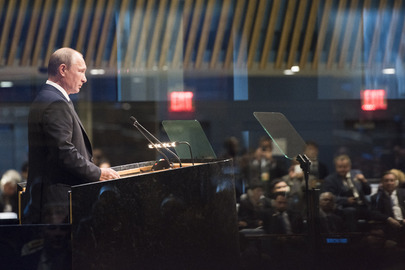
Russian President Vladimir Putin (UN Photo)
In the past couple of decades, going back to the second term of President Bill Clinton, the ideology of neoconservatism with its stress on “democracy promotion” as being the whole of national interest, dictated policy decisions that amounted to the tail wagging the dog. The Baltic States were admitted into NATO in its 2004 enlargement because they wanted it. The decision to station U.S., German and other NATO brigades in Poland and other states along the Russian border taken last July in Warsaw and implemented, in the case of Poland, by U.S. forces in the past several days, was justified by the anxiety of these countries over the possibility of Russian aggression, even though NATO’s action has been highly provocative vis-à-vis Russia and brought the major nuclear powers ever closer to direct confrontation.
In the interview, Trump changed entirely the metrics by which sanctions on Russia would be lifted. Instead of fulfillment of the Minsk Accords over Ukraine’s ethnic Russian Donbas region – which nationalist hardliners in Kiev had the power to block – Trump conditioned the relaxation of sanctions on progress in curbing the nuclear arms race and moving toward significant nuclear disarmament, issues that are fully within the power of the Kremlin to implement.
To be sure, these issues today are more complex than they were in the heyday of disarmament talks. The recent obstacles include the U.S. anti-ballistic missile installations in Poland and Romania, the forward stationing of NATO human and materiel resources in the former Warsaw Pact countries, and the standing invitations to Ukraine and Georgia to enter NATO. So any negotiations between Washington and Moscow will be very complex.
But Trump’s statement shows that he is focused on the big picture, on the triangular relationship between Washington, Moscow and Beijing that he believes to be of vital importance in keeping the peace globally, rather than on some amorphous reliance on expanding democracy globally on the unproven assumption that democracies among themselves are peace-loving.
These elements in Donald Trump’s thinking, quite unexpected in a businessman, bring him very close to the Realism of Richard Nixon and Henry Kissinger, while his setting nuclear disarmament as a key goal, aligns him with Ronald Reagan and — strange to say — with Barack Obama at the very start of his presidency.
If Donald Trump can stave off the jackals from the Western mainstream media and the U.S. foreign policy establishment – a combination that has formed a snarling circle around him even before he takes office – he may have a chance to make historic changes in international relations toward a more peaceful world.
Gilbert Doctorow is the European Coordinator of The American Committee for East West Accord Ltd. His latest book, Does Russia Have a Future? was published in August 2015.
Afghanistan: Obama Sends Marines to Take Part in America’s Longest Ever War
By Peter KORZUN | Strateic Culture Foundation | 16.01.2017
President Obama has decided to send 300 US Marines back into Afghanistan’s Helmand Province – the first time in three years that the US military has been sent into that conflict zone.
Almost all of Helmand’s districts, except for the provincial capital, Lashkar Gah, are either heavily embattled or fully controlled by the Taliban. The province is the leading opium producer in the country.
Despite all the promises to withdraw, 8,400 US troops will remain in Afghanistan as the president leaves office on January 20. If the US pulls out, the Afghan government will hardly be able to hold power.
American forces have been engaged in combat action there for over 15 years – the longest war waged by the United States – without end to hostilities in sight.
Around 200 NATO soldiers, mainly Italians, have also been deployed to Afghanistan’s volatile western province of Farah after attempts by Taliban fighters in recent months to overrun its capital city.
About a third of the country – more territory than at any time since 2001 – is either under insurgent control or in risk of coming under it. The Taliban forces have challenged Afghan security forces for a number of key cities in 2016. With fighting under way in 24 of the 34 provinces, the government’s ability to control the country is questioned.
Last December, General John Nicholson, the chief US and NATO commander in Afghanistan, said the government directly controls about 64 percent of the population of 30 million, down slightly from 68 percent earlier in 2016.
According to Robert Grenier who served as CIA’s top counter-terrorism official and was the station chief in Islamabad, Pakistan, from 1999 to 2002, there are significant parts of the country, particularly in the south and the east, where it seems inevitable that the Taliban will further consolidate their control. The Afghan forces had more than 15,000 casualties in the first eight months of 2016, including more than 5,500 deaths.
The administration in Kabul lacks unity while the clout of regional leaders and warlords is growing. The UN says 7 million people in Afghanistan need aid. 2.2 million of them suffer from malnutrition. Poverty and unemployment prompt young Afghans to join extremist groups.
After the Russian forces in Syria struck the oil infrastructure under the control of Islamic State (IS), the issue of controlling heroin routes in Afghanistan became even more important for the group. According to the Russian Federal Drug Control Service (FSKN), the IS militants make $1 billion a year from Afghan heroin. The possibility of alliance between the Taliban and IS is a real nightmare.
Afghan officials have approached Russia asking it to resume cooperation. Its representatives believe that the Shanghai Cooperation Organization (SCO) has a role to play in managing the crisis in the country. NATO officials have also made statements in support of resuming Russia-NATO cooperation in Afghanistan. The cooperation was suspended after Crimea became part of the Russian Federation in 2014.
Moscow allowed land transit though its territory of non-military freight from NATO and non-NATO ISAF (International Security Assistance Force) countries. NATO used the transit center near Ulyanovsk. The parties implemented a program of common training for the prevention of drug trade in Central Asia.
Russia sold military equipment and ammunition to support the NATO operations in Afghanistan. For instance, in 2010 NATO bought 31 Russian Mi-17 helicopters to refurbish them for the Afghan army.
Against the background of ballyhoo raised in the United States regarding the “threat” coming from Moscow, Washington has partially lifted sanctions against Russian cooperation with Afghanistan on helicopter maintenance. It was not the only time. The US has broken its own sanctions regime allowing the acquisition of Russian technology for its space program.
The Afghan government badly needs more Russian helicopters to repel Taliban and IS attacks. In 2016, it formally asked the Russian government to start the deliveries.
If Russia delivers its aviation equipment to Afghanistan, it will need to train Afghan personnel. Formally, that’s what US and NATO are doing in Afghanistan now- they are in the country on advising and training missions. In fact, it will mean the resumption of cooperation while carrying out the same mission.
Russian President Vladimir Putin has recently expressed concern over the situation in Afghanistan and called for taking urgent steps to tackle the problem. The instability in that country spreads to Central Asia posing a direct threat to Russia’s security. Roughly, 2,000 militants operating in the Afghan northern provinces come from the countries of the post-Soviet space.
There is a growing risk of extremist attacks on the states allied with Moscow. Fighters with combat experience received in Syria have already been spotted in the Uzbek Fergana Valley. The infiltration of Islamic State (IS) into Afghanistan threatens the Russian North Caucasus and the Volga region. Besides, Afghan heroin kills 25,000 Russians annually.
Afghanistan is a burning issue – a problem that only an international effort can solve. This is an issue of common interest for Russia and the Alliance. The situation in the country could be discussed within the framework of Russia-NATO Council. On January 4, the Russian Foreign Ministry made a very important statement saying Russia was ready to restore the relations with NATO. Afghanistan could become a starting point on the way of rebuilding the broken relationship.
Trump: US may lift Russian sanctions in exchange for nuclear reduction deal – Times, Bild
RT | January 16, 2017
US President-elect Donald Trump has hinted that the US could lift its sanctions against Russia, called Merkel’s migrant policy “a catastrophic mistake” and branded NATO “obsolete” in a new interview for The Times and Bild.
The interview was given in the President-elect’s office in Trump Tower, just days before his inauguration.
Trump was quite straightforward in speaking out in favor of some common ground with Moscow.
“They have sanctions on Russia — let’s see if we can make some good deals with Russia. For one thing, I think nuclear weapons should be way down and reduced very substantially,” Trump said to the two media outlets.
At the same time, sanctions aren’t affecting Russia well, [and] “something can happen that a lot of people are going to benefit,” he added.
Moving on to other topical issues, Trump slammed Angela Merkel’s migrant policy as “a catastrophic mistake,” saying that Germany shouldn’t have taken “all these illegals.”
“Nobody even knows where they come from,” Trump added.
Trump wasn’t optimistic about the fate of the EU, either, saying that there is basically one country that benefits from staying in the bloc.
“You look at the European Union and it’s Germany. Basically a vehicle for Germany. That’s why I thought the UK was so smart in getting out.”
Trump thinks it was the refugee influx that was “the final straw that broke the camel’s back” for the EU.
“I believe others will leave. I do think keeping it together is not going to be as easy as a lot of people think. And I think that if refugees keep pouring into different parts of Europe, it’s going to be very hard to keep it together because people are angry about it,” he said.
Another block that, according to Trump, has long outlived its usefulness, is NATO, as it is “obsolete,”“was designed many years ago” and some of its members aren’t paying in enough.
“The countries aren’t paying their fair share so we’re supposed to protect countries. There’s five countries that are paying what they’re supposed to. Five. It’s not much,” Trump said.
US policies came under fire afterward, with Trump branding the US-Iran nuclear agreement “one of the dumbest deals” he’s ever seen, and then calling the invasion of Iraq “possibly the worst decision, ever made in the history of our country. It’s like throwing rocks into a beehive.”
However, there was at least one thing Trump was very enthusiastic about – and that’s Brexit.
Citing the fall in the British pound, Trump said “business is unbelievable in a lot of parts of the UK, as you know. I think Brexit is going to end up being a great thing.”
Also, the president-elect said he was planning to make a trade deal with the UK “very quickly.”
“I’m a big fan of the UK, we’re going to work very hard to get it done properly.”
Last but not least, Trump was asked about his social media presence and whether he would tune it down after the inauguration. In short, the answer is no.
“@realDonaldTrump I think, I’ll keep it. I’ve got 46 million people right now — [on] including Facebook, Twitter and Instagram, so I’d rather just let that build up.”
And the tweeting is here to stay, the president-elect said.
“I thought I’d do less of it, but I’m covered so dishonestly by the press that I can put out Twitter – and it’s not 140, it’s now 280 – and as soon as I tweet it out — this morning on television, Fox — ‘Donald Trump, we have breaking news.’”
Read more:
Trump ready to look at currently ‘terrible’ US-Russia relations with ‘fresh eyes’ – Pence
Trump plans to hold summit with Putin in Reykjavik – report
RT | January 15, 2017
US President-Elect Donald Trump has told British officials that he wants to hold a summit with Russian President Vladimir Putin in Reykjavik, Iceland, the Sunday Times reported.
The meeting with Vladimir Putin is set to become Donald Trump’s first foreign trip, and the US leader will start working on an agreement limiting nuclear arms within a “reset” in US-Russian relations, according to the newspaper.
Sources close to the Russian Embassy in London said to The Sunday Times that Moscow would agree to a summit between Putin and Trump.
The meeting would come just over 30 years since the historic summit on October 11-12, 1986, between Ronald Reagan and Mikhail Gorbachev, the second in a series of meetings that relaunched the relationship between the United States and the Soviet Union.
The latest report comes just a day after Trump expressed openness to lifting the sanctions against Russia “under certain conditions.”
In an hour-long interview with the Wall Street Journal on Friday, Trump said he wants to keep the sanctions that the Obama administration recently imposed on Russia “at least for a period of time.”
However, Trump added that he would consider lifting the restrictions, depending on how helpful the Russians are in the fight against terrorism, as well as assisting with other goals that he feels are key to the US.
Transnistria and Donbass: Historical Parallels and Possible Similar Scenarios for the Future
By Halyna Mokrushyna | CounterPunch | January 13, 2017
On January 4, President Igor Dodon of Moldova met with Vadim Krasnoselskiy, the head of the unrecognized Pridnestrovian Moldavian Republic (Transnistria). The meeting took place in Bendery, on the right bank of Dniester river, on the territory of the Transnistria. It was initiated by the president of Moldova.
Igor Dodon was elected Moldovan president on November 13 on a platform advocating improved relations with Russia.
During the meeting, both sides established a good contact and expressed openness and willingness to compromise. Concrete decisions have been taken to improve relations between Moldova and Transnistria. “Citizens on both sides of the Dniester River (which runs through the territory of Moldova and the right (eastern) border of Transnistria) should see the concrete results during 2017,” stated President of Moldova Igor Dodon .
The president of Transnistria Vadim Krasnoselskiy stressed the importance of compromise with Moldova for people living on both sides. “We must create the conditions so that people are not held hostage to politics, so that decisions taken by politicians are for the benefit of the people. We must respect the people of Moldova and Transnistria and find a compromise in any case”, stated Vadim Krasnoselskiy.
During the meeting, the first in eight years, the presidents of Moldova and Trasnistria discussed a whole range of practical issues that have accumulated in recent years, including problems in education, registration of vehicles, communication, movement of citizens, rail transport, recognition of diplomas and car plates.
At the same time, political issues were not discussed. Recognition of the independence of the Pridnestrovian Moldavian Republic (PMR) by Chisinau remains the main bone of contention between the two republics. Chisinau designates PMR as the Transnistria autonomous territorial unit with special legal status. PMR is not recognized by any country, member of the UN, while the UN itself considers PMR to be part of Moldova.
PMR emerged as a reaction of the mostly Slavic population of this territory to the rise of pro-Romanian nationalism among ethnic Moldovans in the late 1980s, the period of Gorbachev’s perestroika and glasnost in Russia. The most prominent movement formed at that time, the Popular Front of Moldova, formulated three main demands: that Moldovan be declared the only state language, that the Moldovan language switch to use of the Latin alphabet instead of the Cyrillic one, and that Moldovan ethnic identity be recognized as identical to Romanian one. The radical factions of the Popular Front called for minority populations, particularly the Slavs (mainly Russians and Ukrainians) and Gagauz, to leave or be expelled from Moldova.
The Supreme Council of the Moldavian Soviet Socialist Republic followed through on main three demands: on August 31, 1989 it adopted Moldovan as the only official language, while retaining Russian for secondary purposes; it introduced the Latin alphabet; and it declared a shared Moldovan-Romanian linguistic identity. The publicly stated intentions of the Moldovan authorities to bring the country closer to Romania, as well as the ethnocentric rhetoric of the Popular Front, provoked serious concerns of ethnic minorities in the country. Transnistria’s population was predominantly Slav – 60% were Ukrainians and Russians, while less than 40% were ethnic Moldovans. The overall majority of the population, including some ethnic Moldovans, spoke Russian as their mother tongue.
The nationalist Popular Front won the first free parliamentary elections in the Moldavian SSR in the spring of 1990. On 2 September 1990, the Second Congress of the Peoples’ Representatives of Transnistria proclaimed the creation of the Pridnestrovian Moldavian Soviet Socialist Republic. Violence escalated when in October 1990, the Popular Front called for volunteers to form armed militias to stop an autonomy referendum in Gagauzia. In response, volunteer militias were formed in Transnistria.
Limited armed clashes between Transnistrian militia and Moldova started in November of 1990. Volunteers from Russia came to support Transnistrians. In early 1992, the fighting intensified. The former Soviet 14th Guards Army, stationed in Transnistiria, which remained neutral throughout the fighting, entered the conflict in its final stage, swearing allegiance to Transnistrian authorities and opening fire against Moldovan forces. A ceasefire agreement was signed on 21 July 1992 and has held to the present day.
The history of the emergence of the Pridnestrovian Moldavian Republic holds several striking similarities with the current conflict in Ukraine. There, the people of the Donetsk and Lugansk oblasts in eastern Ukraine rebelled against the nationalist rhetoric of the Euromaidan movement and the government brought to power through a coup d’état on February 21-22, 2014. One of the first steps of that government was to abolish the existing law on languages in Ukraine granting Russian a special status in Russian-speaking regions of Ukraine. Ukrainian is the only official language in Ukraine. Changes to the language law in 2013 granted Russian a special status in areas of majority or large minority Russian speakers, but the law was bitterly opposed by Ukrainian nationalists.
Another similarity is the linguistic profiles of Ukraine and Moldova. Like Transnistria, where the majority of population speaks Russian, Donetsk and Lugansk regions are the only regions of Ukraine, where Russian language is spoken by the large majority of the population. Population of these regions of Ukraine has always been close to Russia culturally, as with the population of Transnistria. Russian volunteers poured into Transnistria to help locals to defend their rights against Moldovan nationalism; in the same way 20 years later, Donetsk and Lugansk received the support of volunteers from Russia in their fight against Ukrainian nationalism and against a forceful integration into the European Union by the coup government that came to power in 2014. They wanted closer ties with Russia. However, Russia has not officially recognized the Donetsk and Lugansk People’s Republics, as it has not recognized the Pridnestrovian Moldavian Republic. Russia does provide extensive humanitarian assistance to both entities and maintains extensive economic and cultural relations.
Moldova has not officially recognized Transnistria. But at least it stopped waging war against against the breakaway republic, and it has settled into an uneasy coexistence. The relations between Moldova and Transnistria are often characterized as a “frozen conflict”. All attempts to find a formula for political settlement of the unrecognized status of the PMR between the PMR and Moldova have not produced any result.
Since independence in 1991, Moldova, like Ukraine some 20 years later, set out on a course of economic integration into the European Union. Even the so-called ‘pro-Russian’ Moldovan presidents over the years, such as Vladimir Voronin (2001-2009), followed this course very closely. For example, in 2003, Voronin refused to sign a memorandum proposed by the Russian Federation outlining plans for a unification of Moldova and the PMR into a federal state of Moldova. Voronin stated that since Moldova plans to join European Union, such a plan needed the approval of ‘European structures’, beginning with the Organization for Security and Cooperation in Europe’, and therefore he could not endorse it.
In the current conflict between Kyiv and Donetsk and Lugansk republics, Russian officials have stated on many occasions that the two republics (comprising the historic industrial region called ‘Donbass’) should be granted a large autonomy within a unitary Ukraine, in spite of the evident desire of the populations of the two breakaway republics to desire to integrate into the Russian Federation.
The ceasefire and political-settlement agreement signed in Minsk, Belarus on Feb 12, 2015 (termed ‘Minsk-2’, text here) with the endorsement of France, Germany, and Russia, outline beginning principles of this autonomy, but Kyiv has been stubbornly sabotaging the agreement.
The new president of Moldova, Igor Dodon, is proving himself a wiser and more mature politician compared to Ukrainian leaders, as shown by his visit to the Pridnestrovian Moldovan Republic. He declared that Moldova under his presidency will remain a neutral country, not choosing between European Union or Russia. The population of Moldova, like the population of Ukraine, has always been split in its political and cultural sympathies towards Europe and Russia. Most Moldovans and probably a majority of Ukrainians believe the best way to keep their country safe and whole is by preserving a neutral status between the EU and the Russia-dominated Eurasian Economic Union to the east. Dodon has demonstrated a practical approach of compromise and negotiation in the interests of the population of both Moldova and the PMR.
Kyiv should follow Dodon’s example because it is the only path to peace in Ukraine. Unfortunately, the current political regime in Kyiv is unlikely to do that. The news of Dodon’s meeting with the president of the PMR was not even reported by mainstream Ukrainian media.
The recent call of one of the richest Ukrainian oligarchs, Viktor Pinchuk, to make painful compromises with Russia and implement Minsk-2 and return to a neutral status for Ukraine to reach peace in Donbass, has been repudiated by Poroshenko’s administration. Konstantin Eliseev, the deputy head of the Presidential Administration, stated that Ukraine will never turn away from integration into the European Union and NATO . (See my Dec 31, 2016 article ‘ Prominent member of Ukraine’s elite issues call for peace in Donbass’.)
But to the ongoing consternation of officials of the Kyiv government, full membership of Ukraine in the European Union has always been treated cautiously and even reluctantly by European Union officials. They have used the idea to foment conflict between Ukraine and Russia, which is not the same as supporting and facilitation it, as Ukrainians are today learning.
Ukrainians blindly mistook a loose economic association with Europe as being a step toward an inevitable, full integration into the European Union. They naively hoped that the European Union will solve the economic disaster that the country became following independence in 1991, particularly following the failed ‘Orange Revolution’ of 2005 in which competing interests among the country’s economic elite fought for domination amidst a backdrop of deep, social protest by ordinary Ukrainians.
This blind, naïve hope has brought further economic disaster and civil war in Ukraine. The official Ukrainian propaganda blames Russia for all of the troubles beginning in 2013 and it refuses to recognize Kyiv’s fault in its unleashing of a so-called Anti-Terrorist Operation (complete with its own, catchy acronym—the ‘ATO’) against its own people. Kyiv relied heavily on U.S. support in the conflict with Russia. Now, that support may dwindle if President-elect Donald Trump carries through his various, offhand statements that he is interested in seeking improved relations with Russia.
Kyiv should review its categorical refusal to accommodate Donetsk and Lugansk if it wants to keep Donbass within Ukraine. Otherwise the Donetsk and Lugansk People’s Republics will follow the path of the Pridnestrovian Moldovan Republic in exercising a permanent autonomy. It is a very plausible scenario, given the fact that the conflict in Donbass has been frozen for more than two years and Ukraine continues to punish the two republics with unceasing artillery fire and a punishing economic blockade.
Halyna Mokrushyna is currently enrolled in the PhD program in Sociology at the University of Ottawa and a part-time professor. She holds a doctorate in linguistics and MA degree in communication. Her academic interests include: transitional justice; collective memory; ethnic studies; dissent movement in Ukraine; history of Ukraine; sociological thought. Her doctoral project deals with the memory of Stalinist purges in Ukraine. In the summer of 2013 she travelled to Lviv, Kyiv, Kharkiv and Donetsk to conduct her field research. She is currently working on completing her thesis. She can be reached at halouwins@gmail.com.
Russia has no compromising info on Trump or Clinton, report is ‘total bluff’ – Kremlin
RT | January 11, 2017
Moscow says documents alleging that Russia has compromising information on Donald Trump are a fabrication and a “total bluff.” Russia has never gathered information of this kind on either the US president-elect, or his former rival, Hillary Clinton.
“The Kremlin has no compromising information on Trump. This report does not correspond to reality and is nothing but an absolute fiction,” the deputy head of the Russian presidential administration, Dmitry Peskov, told reporters on Wednesday.
“This is a total bluff, an absolute fabrication, complete nonsense,” he said.
He reiterated that there is no compromising information on Hillary Clinton either, and that the Russian authorities do not accumulate this type of information.
“Of course not. The Kremlin does not collect compromising information. The Kremlin [and] the Russian president are engaged in building relationships with our foreign partners, firstly – in the interests of the Russian Federation, in the interests of the Russian people, secondly – in the interests of global peace, stability and security,” Peskov said.
On Tuesday, CNN published an article stating that US intelligence handed over a two-page synopsis of classified documents, which included claims that Russian operatives have compromising personal and financial information about Trump, to the president-elect and US President Barack Obama.
The information was included as an annex to a classified version of the report prepared by the Office of the Director of National Intelligence on Russian influence on the 2016 presidential election, according to CNN.
Buzzfeed picked up the story, publishing the entire dossier purportedly “prepared for political opponents of Trump by a person who is understood to be a former British intelligence agent.”
The most appalling part of the dossier was the claim that Donald Trump has “personal obsessions and sexual perversion,” including graphic sex acts, and a report that the president-elect once had Russian prostitutes urinate on each other in a hotel bed that the Obamas previously shared.
Apart from sex orgies, the dossier also suggests Russian officials offered the Republican real estate magnate lucrative deals in order to win influence over him ahead of the election.
The story exploded on Twitter with the hashtag #GoldenShowers shooting up the trending charts.
Later in the day, however, an anonymous member of the chatboard on 4chan posted a refutation of the now infamous “golden showers” story, calling it a hoax and “fanfiction.” He or she claimed that several months ago, the story was sent to Republican political strategist Rick Wilson, who proceeded to send it to the CIA, which then put it in their official classified intelligence report on the election.
Moscow considers the scandal a clear attempt to damage relations with Washington and the president-elect personally.
“This is an obvious attempt to harm our bilateral relations,” Peskov said.
“Pulp fiction, that’s what it is called in English. Of course, probably the best way to react would be accordingly – with a certain sense of humor.”
“Although there is a downside – indeed, there are those who are stirring up the hysteria, who go out of their way to maintain this state of a witch-hunt,” he added.
US senators introduce bill to impose new sanctions on Russia
Press TV – January 11, 2017
A bipartisan group of US senators has introduced legislation to impose sweeping new sanctions on Russia over its alleged attempts to interfere in the 2016 US presidential election.
Five Democrats and five Republicans unveiled the new punishments on Tuesday after the intelligence community concluded in a report that the Russian government had sought to influence the outcome of the November election through cyberhacking and a smear campaign.
The proposed legislation would solidify many of the sanctions President Barack Obama’s outgoing administration has imposed against Russia and limit President-elect Donald Trump’s ability to improve relations with Moscow.
The new sanctions include visa bans and financial asset freezes against those the US intelligence claimed were behind the cyberattacks against US Democratic organizations and officials.
The hacked emails, which were allegedly provided to WikiLeaks by individuals working for the Russian government, were a regular source of embarrassment to Democratic candidate Hillary Clinton during the presidential race and may have contributed to her defeat.
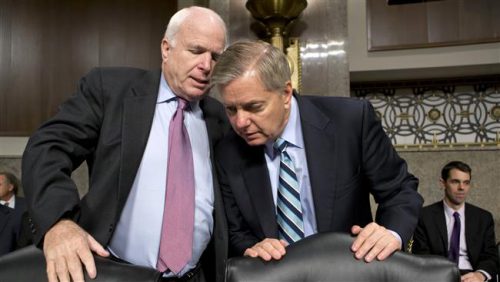
“We should all be alarmed by Russian attacks on our nation,” Sen. John McCain told reporters, as he criticized the Obama administration for a lack of a comprehensive strategy on cyber deterrence.
“This appearance of weakness has been provocative to our adversaries,” the Arizona Republican said.
Sen. Ben Cardin, the top Democrat on the Senate Foreign Relations Committee who co-sponsored the bill, said, “We have been attacked by Russia. It cannot be business as usual.”
The measure, called “Countering Russian Hostilities Act of 2017,” would also target Russia’s vast energy sector and companies that invest in or help develop its civil nuclear projects.
Republican Sen. Lindsey Graham said, as a co-sponsor of the bill, he was “not trying to undermine the legitimacy of President-elect Trump’s victory” by highlighting Russia’s intention to meddle in the US election. “My advice to him is that… it is now time to push back.”
Other Republican co-sponsors include Senators Marco Rubio of Florida, Rob Portman of Ohio and Ben Sasse of Nebraska.
The measure would give the White House the ability to waive the sanctions, however it would have to certify that Russia’s behavior has improved.
It was not clear on Tuesday whether the legislation was likely to pass in Congress in time for President Obama to sign it, or wait for Trump to take office on January 20.
Trump has repeatedly called for better relations with Russia, arguing that only “stupid” people or “fools” would think close ties were unwise.
The Republican president-elect has rejected the implications that Russia’s alleged hacking of Democratic offices helped him win the election.
Europe’s Mixed Feelings About Trump
By Andrew Spannaus | Consortium News | January 9, 2017
Few in Europe expected Donald Trump to win the U.S. Presidential elections last November. The picture painted by the media and political class was convincing: despite the pent-up anger being expressed through protest candidates, Hillary Clinton was headed towards a decisive victory, as the majority of Americans couldn’t stomach someone as outrageous and unconventional as the reality TV star turned politician.
That’s not what happened, of course, as Trump earned an Electoral College victory by winning enough votes in key Midwestern states that have suffered from a loss of manufacturing jobs in recent decades. His victory has shaken the Western world to its core, making it clear that business as usual is no longer possible in terms of both economic and foreign policy.
In Europe the signs of the anti-establishment sentiment that dominated the U.S. election campaign have been present for some time. The most obvious example was the Brexit vote in June 2016, in which the population of the United Kingdom voted to leave the European Union. But protest movements have actually been on the rise for several years now, driven by the same basic issues as in the United States: a sense of economic and social insecurity – accompanied by a rise in anti-immigrant sentiment – driven by an economic policy that has made life harder for the middle class while enriching those at the top.
The growing anger against the institutions of the European Union, considered the main culprit for the failed economic policies, has made the élites desperate for some sense of stability, to help them weather the storm. As a result, a potential Clinton victory was openly welcomed by most political leaders.
After Trump’s victory, there were numerous press reports of worries among European governments regarding the incoming Administration’s foreign policy. Trump is understandably seen as unpredictable, but the key point revolves around his attitude towards Russia, the same issue that is currently dominating the institutional fight in the United States right now.
Just after the election The New York Times ran a story entitled “For Europe, Trump’s Election is a Terrifying Disaster,” suggesting that under the new President, the United States may embrace authoritarianism and no longer defend democracy. It was a theme that other mainstream news outlets also pushed.
On Nov. 17, The Associated Press wrote: “NATO members and other European countries are worried that under Trump, the U.S. will stop trying to police Russia’s behavior the way it has under Obama. Most concerning to U.S. allies are Trump’s effusive comments about Russian President Vladimir Putin, one of the first world leaders he spoke to after winning the election.”
Seeing Benefits
While it is true that former Soviet bloc countries such as Poland and Latvia would prefer to maintain the current hardline position towards Russia, the reality is that the largest E.U. members – France, Italy and Germany – actually stand to benefit from the diplomatic approach promised by President-elect Trump.
This doesn’t mean they supported his candidacy, though. First of all, they were told that he couldn’t win; and second, a Trump victory would seem to encourage the anti-establishment movements already on the rise in Europe, which threaten both the E.U.’s status quo and the jobs of key leaders, including German Chancellor Angela Merkel.
Hillary Clinton was seen as representing continuity, and for the many politicians who seek to curry favor with the transatlantic elites, it was best to show their Clinton bona fides in view of the upcoming change in power. For example, Italian Prime Minister Matteo Renzi – now out of office due to a stinging anti-establishment vote in a referendum on proposed constitutional reforms – repeatedly broke diplomatic protocol and publicly criticized Trump during the election campaign.
However, over the course of 2016 it became clear that Clinton’s foreign policy was far more aggressive than Barack Obama’s, as the President had actually been seeking collaboration with Russia for several years on issues, such as constraining Iran’s nuclear program and negotiating an end to the Syrian conflict, despite heavy opposition from within his own administration.
Indeed Trump’s openness towards Vladimir Putin seems even more heretical now because most have chosen to forget that Obama himself had sought close cooperation with Putin on several key issues. For instance, Secretary of State John Kerry’s diplomacy last year on Syria almost succeeded in implementing intelligence sharing and joint airstrikes by the two powers, before being effectively thwarted by the Pentagon and other U.S. institutional opposition in September 2016.
Now Obama seems to have forgotten his former position, and decided to fully toe the anti-Russian line, apparently convinced that he must do his part in the campaign to weaken Trump and prevent him from being an effective president, even in areas where their positions are not far apart.
It is possible that Trump will accelerate the timid attempts of his predecessor to abandon the “regime change” policies that have led to numerous disasters in the Middle East, and heightened tensions with Russia. The President-elect seems determined to pursue this path more openly than Obama, who worked slowly towards this goal while seeking to placate his critics with more bellicose language in his public statements.
Doubts About the U.S. Hardline
Although European nations have been heavily involved in recent regime change adventures (the U.K. in Iraq and France in Libya, for example), there is a widespread preference in Western Europe for avoiding further conflict with Russia. The U.S. position on the events in Ukraine, for example, is often seen as one-sided, and the notion of NATO expansion to Russia’s borders seems like an unnecessary and dangerous provocation that can only makes things worse.
Western sanctions against Russia, and Russia’s retaliatory sanctions on food imports, have cost European economies over $100 billion in trade, according to some estimates, hitting the agricultural sector especially hard. In addition, Russia has been concluding more economic agreements with countries such as China, leading to fears of permanent consequences for Europe.
For this reason, France, Italy and Germany have all repeatedly stated their desire to reduce or remove the sanctions altogether. The hope is that an agreement can be reached to defuse tensions in Ukraine, based on support for the Kiev government but broad autonomy for the ethnic Russian areas in eastern Ukraine.
Despite this desire to head off further conflict, European governments are usually careful not to openly break with U.S. policy; they are key members of NATO and have no desire to distance themselves from the leader of the alliance. However, if Donald Trump follows through on his stated goal of working “together with Russia,” the countries of Western Europe in particular may welcome the opportunity to advance their own economic interests and avoid finding themselves in the middle of a new Cold War.
Andrew Spannaus is a freelance journalist and strategic analyst based in Milan, Italy. He is the founder of Transatlantico.info, that provides news, analysis and consulting to Italian institutions and businesses. His book on the U.S. elections Perchè vince Trump (Why Trump is Winning) was published in June 2016.
Featured Video
Can the U.S. Afford to Annihilate Iran?
or go to
Aletho News Archives – Video-Images
From the Archives
Sanctions, War and the Policy of Dual Containment
By SASAN FAYAZMANESH | March 17, 2008
It is now nearly three decades since the Unites States adopted the policy of dual containment of Iran and Iraq. While much has been written about the containment of Iraq, there has been very little in-depth analysis of this policy when it comes to Iran. In a book that is going to be released on March 31, 2008, entitled The United States and Iran: Sanctions, Wars and the Policy of Dual Containment (Routledge), I attempt to address this shortcoming by investigating when and why the US policy of containment of Iran came about, how it evolved, and where it stands today.[1] To the extent that Israel has been involved in US policy making, the study will also include the role that Israel has played in the containment of Iran. Also, since the fate of Iran has been inextricably linked to that of Iraq, occasionally the investigation will overlap with the containment of Iraq.
The policy of dual containment of Iran and Iraq originated during the Carter Administration, but it was not until the Clinton Administration that the expression “dual containment” became popular. … continue
Blog Roll
 Aletho News
- Can the U.S. Afford to Annihilate Iran? /Seyed M. Marandi
- Elmo Sold mRNA Jabs to Your Toddler. Now They Are “Off-Label.”
- British state targets Palestine Action with yet another crooked trial
- Americans are paying the price to preserve Israel’s nuclear hegemony
- Resistance factions are necessary to ensure a permanent US Iraq withdrawal
- How Israel destabilizes the Middle East: Denying sovereignty and the right to exist
- Europe’s Establishment Is Embracing War – and Losing Voters
- NATO chief advocates war of aggression
- No Vote, No Representation, No State: Democracy, Israeli Style
- Zionist Bought Senate Blocks Information About American Citizens Killed By Israel
- If Americans Knew
- Israeli Soldiers Abduct At Least 22 Across Occupied West Bank
- Eight Palestinians Killed in Israeli Attacks on Gaza
- Israeli former leaders and security chiefs threaten legal action over ‘Jewish terrorism’
- Israel map in LA Times ad includes all land from the river to the sea
- Inside Lebanon’s 200-page dossier on Israeli war crimes
- Flydubai, genocide, settler violence, Trump abuse of power to deport – Daily Update
- Counting Antisemitic Incidents: What the ADL Audit Reveals — and Obscures
- Mamdani releases plan to combat antisemitism and hate crimes in New York City
- Iran’s Revolutionary Guards Publish Letter to the American People
- DMFI launches $1 million ad campaign supporting Virginia’s Elaine Luria
- No Tricks Zone
- Green Energy Debacle: German Expert Professor Fritz Vahrenholt Warns Of Severe Economic And Social Consequences
- Two More Paleo Reconstructions Affirm Meters-Higher Sea Levels Across Ireland, Brazil 7000-6000 Years Ago
- New Study: Earth And Venus Surface Warmth Largely Explained By Convection And Lapse Rate, Not CO2 Or Radiation
- 2025 Nature Paper Claiming Worsening Global Drought Gets RETRACTED …Heavily Flawed
- New Study: ‘Global Drought Shows No Detectable Recent Acceleration Under Climate Warming’
- Economic Masterminds: German Socialists Suggest Taxing Productivity Gains Stemming From Using AI
- The South China Sea Has Not Been Cooperating With The Climate Change Narrative
- Energy Crisis: Germany Enters Heating Season With Historically Low Gas Reserve Fill Levels
- New Study: The Antarctic Ice Sheet Gained Mass From 2020-2024 Due To Staggering Snow And Ice Accumulation
- Study: Ocean Heating Rates From Thousands Of Years Ago ‘Dwarf’ Modern Ocean Heating Rates

