Lying and Looking Ridiculous
By Brian Cloughley | CounterPunch | December 30, 2016
The Nazi propagandist Josef Goebbels is generally thought to have said that “If you tell a lie big enough and keep repeating it, people will eventually come to believe it.” In fact he didn’t state that, exactly, but based his marketing of malevolence largely on the premise that “credibility alone must determine whether propaganda output should be true or false.” What he did say, however, was “the English follow the principle that when one lies, one should lie big, and stick to it. They keep up their lies, even at the risk of looking ridiculous.”
There is a problem, however, in that although lie-tellers are ridiculous in the eyes of those who know the facts, there are very many people who don’t know the facts because they are either deliberately kept in the dark or are so closed-minded as to be easy targets.
Not much has changed on the propaganda front in seventy-five years, and the malevolent Goebbels would feel familiar with modern developments as regards the Western Establishment’s campaign against President Putin and the movement towards Russia-America rapprochement, as seemingly signalled by President-elect Trump.
On December 16, for example, USA Today reported that “President-elect Donald Trump’s controversial soft spot for Russia is based on decades of courting wealthy Russians to buy condos in his luxury high-rises and invest in his other real estate ventures.”
This line of attack is intriguing because the high-circulation USA Today is owned by the Gannett Company, which “in 2010 increased executive salaries and bonuses . . . Bob Dickey, Gannett’s US newspapers division president, was paid $3.4 million in 2010, up from $1.9 million the previous year. The next year, the company laid off 700 U.S. employees to cut costs.” No luxury high-rises for Gannett employees, then, unless they’re in the top echelon. And although Gannett looks ridiculous—and hypocritical—there aren’t many people who care.
In Britain the Guardian, usually an objective source of news and comment, went with the flow of anti-Russia overkill and warned that “Alarm over the rise of Donald Trump reached a new pitch early this week as officials in Washington worried that the United States has elected a leader who may be uniquely blind to threats posed by Russia.” It didn’t mention what the threats might be, but did have the honesty to end with the words of President Putin that “as I have repeatedly said, it’s not our fault that Russian-American relations are in such a poor state. But Russia wants and is ready to restore fully fledged relations with the United States.”
Of course Russia wants to have good relations with other countries. Such a sensible approach results in commercial benefit and social harmony rather than disharmony and confrontation. But in the period when Russia was trying to rebuild from the dire days of Soviet ideology the West expanded the US-NATO military alliance to 28 countries from 16, and recently deployed US-NATO forward tactical headquarters, thousands of troops, and flights of combat and intelligence-gathering aircraft to countries on Russia’s borders.
As I noted a couple of weeks ago, “In Bulgaria, Estonia, Hungary, Latvia, Lithuania, Poland, Romania and Slovakia the Alliance has established ‘NATO Force Integration Units’ which are advanced military headquarters whose Mission is ‘to improve cooperation and coordination between NATO and national forces, and prepare and support exercises and any deployments needed’.”
Then some governments and their media became agitated when Russia deployed defensive weapons within its own territory in order to counter the US-NATO movement of armed forces up to is borders.
As reported by Britain’s ultra-right Daily Telegraph, owned by the creepy twin Barclay brothers who own London’s Ritz Hotel and many luxury high-rises (and hate the European Union, while living in the haven of tax-relaxed Monaco), NATO “described Moscow’s decision to send state-of-the-art Bastion missile-launchers to Kaliningrad, which borders Nato members Poland and Lithuania, as ‘aggressive military posturing’.” There was no mention made of President Putin’s explanation that Russia considers it important to take countermeasures against NATO’s expansion and “aim our missile systems at those facilities which we think pose a threat to us.”
As observed by Goebbels, the English propagandists “keep up their lies, even at the risk of looking ridiculous.” But you can fool a lot of the people a lot of the time.
Consistent with the Goebbels line of sticking to skewed presentation, Britain’s defence minister, Michael Fallon, a public figure of mixed repute (he is known for alcoholic capers and was found guilty of drunken driving as well as having swindled the Parliamentary expenses system out of thousands of pounds over many years), was reported by Reuters as declaring that the West had “to be strong against Russian aggression towards NATO . . . Russia is a strategic competitor to us in the West and we have to understand that.”
Fortunately, there are sounder and better informed people than the drunken fiddler Fallon, and one of these is the expert Peter Duncan of University College London whose more sober opinion is that “there is no reason for Russia to want to threaten the sovereignty of the Baltic states in the sense of trying to force them to leave NATO or still less to invade them . . . the Russian economy depends on a prosperous Western European economy.”
The Far-Right Western media ignored Professor Duncan’s balanced summation, just as it disregarded President Putin’s own assurance, given in a little-reported interview with Italy’s Il Corriere della Sera, that “I think that only an insane person and only in a dream can imagine that Russia would suddenly attack NATO.”
But it’s lies that matter when false dogma is being spread. The US-NATO military alliance doesn’t really believe that Russia is preparing to attack the Baltic States and on December 16 President Obama even informed the world media that in his opinion Russia is “a small country, they’re a weak country” which tends to contradict the propaganda line that Russia is a large country, a “strategic competitor” straining at the leash to invade the Baltic States and create mayhem around the world.
The fact that the US spends 596 billion dollars annually on armaments against Russia’s 66 billion is rarely mentioned (NATO as a whole spends 860 billion) except in reputable journals such as The Economist which on December 17, however, chose to pronounce that Mr Trump’s choice of Rex Tillerson to be Secretary of State “is disconcerting” because Mr Tillerson actually displayed “opposition to the sanctions imposed on Russia.”
The Western propaganda line is that everything Russia does is reprehensible to the point of evil, and that any westerner attempting to propose dialogue rather than confrontation is “disconcerting” at best, and in the eyes of the tabloid papers a raving traitor to the values of the plutocrats who own them.
The policies and aspirations of President Putin are being presented by the US-NATO military alliance as contrary to the interests of the Western powers, but no attention has been paid to such as Bill Clinton’s deputy secretary of state, the Russia specialist, Strobe Talbott, who stated the obvious when he observed that President Putin “basically wants to make Russia great again.” And he won’t do that by invading the Baltic States or any other country, as he and the West well know.
It’s unlikely that the anti-Russia warniks will stop lying and being hypocritical and ridiculous, but unfortunately they’ll continue to be believed by a significant number of their targets. The irony is that, as Goebbels didn’t say, “If you tell a lie big enough and keep repeating it, people will eventually come to believe it.”
Brian Cloughley writes about foreign policy and military affairs. He lives in Voutenay sur Cure, France.
Trump twits Obama’s bogus bear trap
By M K Bhadrakumar | Indian Punchline | December 30, 2016
While announcing a series of major sanctions against Russia on Thursday, US President Barack Obama cited two reasons for doing so – first, “aggressive harassment” of American diplomats by Russian security; and, second, “cyber operations aimed at the US election.” The formulation was kept vague.
The US and Russia maintain an intense and at times intrusive surveillance regime on each other’s diplomats. The action-reaction syndrome is so finely honed that it is predictable. If either side chooses to make a fuss about it, the intention can only be propagandistic. Therefore, the measures announced on Thursday by the US state department – expulsion of 35 Russian diplomats and shutting down 2 Russian compounds (dacha) – stand out as a political decision.
Perhaps, it is an excessive decision, which from an operational angle also aims at crippling the Russian embassy’s functioning. It stands to reason that by such an excessive decision, Obama guarantees that Russia has no choice but to retaliate. The tantalizing question here is whether that was also Obama’s intention. In the Russian-American diplomatic tango, there is always the risk of ‘loss of face’ and the relationship today has been highly personalized at the presidential level.
In diplomatic terms, such ruptures open wounds, which take time to heal. Obama probably estimated that the incoming president, Donald Trump, will be put at a severe disadvantage for the first few months of his presidency.
As for alleged hostile cyber operations by Russia, Obama has somewhat changed tack and decided to act without waiting for the inquiry report he had sought from the security agencies. Obama has sanctioned nine entities and individuals identified with the Russian foreign intelligence agency and military intelligence, besides declassifying the technical information relating to Russian modus operandi.
The two interesting dimensions to Obama’s statement are, one, his call on the US’ allies to “work together to oppose Russia’s efforts to undermine established norms of behaviour, and interfere with democratic governance”, and, two, his move to formally approach the US Congress, which is due to convene on January 3, to follow up on the issues of Russia’s interference.
What is Obama’s game plan? No doubt, it narrows down to laying down the trajectory for the US-Russia relationship beyond the Obama presidency. Obama’s exhortation to come to the barricades to confront Russia may not be found appealing by US’ allies. However, Obama may have better luck by using his political capital to consolidate a strong domestic opinion – among the elites and within the intelligence, military and foreign-policy community – that militates against any attempt by Trump to improve relations with Russia.
Obama has issued an executive order on the Russia sanctions that can always be nullified by Trump, but Obama is also “opening a file” in the US Congress. Obama probably estimates that Trump would lose his way in the labyrinth he is creating on the Hill. Clearly, Obama hopes to pit the Congress against Trump’s likely moves to improve relations with Russia.
Meanwhile, by drawing the intelligence agencies into the fracas, Obama greatly complicates the work for Trump. Spooks with bruised egos can make the ride uncomfortable for a political novice like Trump who never held a government position. Trump’s taunting reaction suggests that he understands Obama’s mind alright. In a sceptical tone, he asked for intelligence briefing:
- It’s time for our country to move on to bigger and better things. Nevertheless, in the interest of our country and its great people, I will meet with leaders of the intelligence community next week in order to be updated on the facts of this situation.
Given the time difference, Moscow’s reaction came swiftly at the level of presidential spokesman Dmitry Peskov. Moscow probably expected some provocative behaviour by Obama in the dying weeks of his presidency. Nonetheless, Moscow is surprised by Obama’s “absolutely unexpected display of aggression,” which is “unprecedented.” This is possibly a wry remark, considering that Russians generally regard Obama to be a timid personality.
To be sure, Russia will announce retaliatory measures, possibly this weekend itself. Peskov flagged the centrality of the principle of “reciprocity”. But in all likelihood, it will be a calibrated response, which, while aiming to “cause significant discomfort to the US side in the same areas” – to quote Peskov – will also “to a certain extent take into account” the political reality that Obama is a lame duck. Peskov gave a lucid interpretation to Obama’s game plan:
- We are convinced that such decisions by the incumbent (Obama) administration, which by the way has only three weeks of work remaining, pursue two goals: first is to further spoil the Russian-US relations, which are already at their lowest, and, apparently, to deal a blow to the foreign policy plans of the future administration of the US president-elect.
- However, the second matter is absolutely a domestic one and the Americans will have to sort out themselves how lawful this line of conduct is. A model of conduct is being forced on the future (US) administration and president-elect.
- What we do know is that there are attempts to impose a certain foreign policy direction on the new administration, to limit its freedom to make decisions and to somehow deprive it of its right to follow the path endorsed by the new president.
Moscow senses that Obama is setting a bear trap. The point is, there is a significant body of opinion in the US, which for the first time began acknowledging the imperatives of good relations with Russia. Having said that, a stormy 3-week period lies ahead. Make no mistake, Moscow will make Obama look unworthy of a Nobel.
Putin announced on Thursday the truce deal between theSyrian government and the opposition and their agreement to begin peace talks. The Obama administration has been kept out of the regional initiative. The stark message here is that Obama has been all along the problem rather than the solution in Syria.
Summing Up Russia’s Real Nuclear Fears
By Jonathan Marshall | Consortium News | December 29, 2016
The conflicts between Washington and Moscow keep on growing: Ukraine and Syria, rival war games, “hybrid” wars and “cyber-wars.” Talk of a new Cold War doesn’t do justice to the stakes.
“My bottom line is that the likelihood of a nuclear catastrophe today is greater than it was during the Cold War,” declares former U.S. Secretary of Defense William Perry.
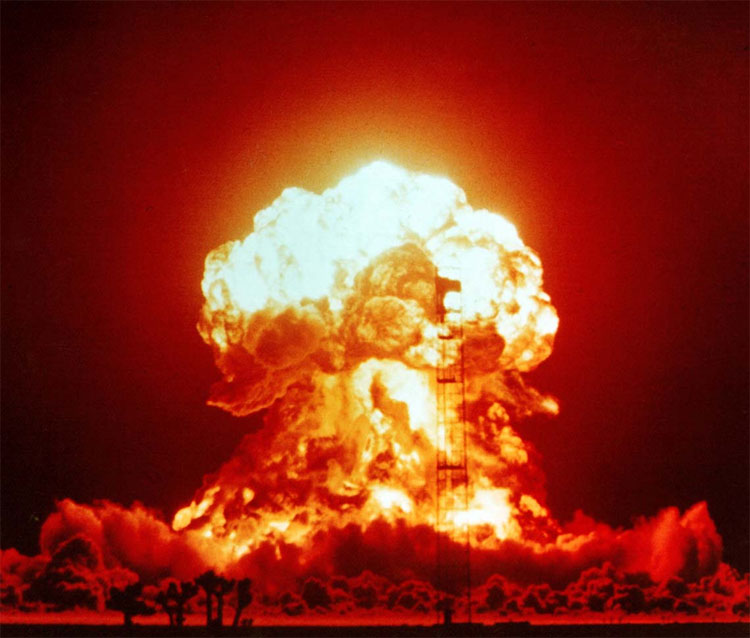
Nuclear test detonation in Nevada on April 18, 1953
If a new Trump administration wants to peacefully reset relations with Russia, there’s no better way to start than by canceling the deployment of costly new ballistic missile defense systems in Eastern Europe. One such system went live in Romania this May; another is slated to go live in Poland in 2018. Few U.S. actions have riled President Putin as much as this threat to erode Russia’s nuclear deterrent.
Only last month, at a meeting in Sochi with Russian military leaders to discuss advanced new weapons technology, Putin vowed, “We will continue to do all we need to ensure the strategic balance of forces. We view any attempts to change or dismantle it, as extremely dangerous. Our task is to effectively neutralize any military threats to Russia’s security, including those posed by the newly-deployed strategic missile defense systems.”
Putin accused unnamed countries — obviously led by the United States — of “nullifying” international agreements on missile defense “in an effort to gain unilateral advantages.”
Moscow has reacted to this perceived threat with more than mere words. It is developing new and deadlier nuclear missiles, including the SS-30, to counter U.S. defenses. It has rebuffed new arms control negotiations. And it has provocatively stationed nuclear-capable Iskander missiles in the Russian enclave of Kaliningrad to “target . . . the facilities that . . . start posing a threat to us,” as Putin put it last month.
If a new arms race is underway, it’s not for lack of warning. The Russians have voiced their concerns about missile defenses for years and years, without any serious acknowledgment from Washington. From their vantage point, the apparent bad faith of successive U.S. administrations, Democratic as well as Republican, is a flashing red light to which they had to respond.
Russia’s Nightmare
From the earliest days of President Reagan’s Strategic Defense (“Star Wars”) Initiative to make ballistic missiles “impotent and obsolete,” an alarmed Moscow has viewed U.S. efforts to build a missile shield as a long-term threat to their nuclear deterrent.
In 2002, President Bush one-upped Reagan and unilaterally canceled the Anti-Ballistic Missile Treaty of 1972. He did so after Russia’s foreign minister, Igor Ivanov, publicly pleaded with Washington not to terminate this landmark arms control agreement.
Writing in Foreign Affairs magazine, Ivanov warned that such a move would set back recent progress in Russian-U.S. relations and destroy “30 years of efforts by the world community” to reduce the danger of nuclear war. Russia would be forced, against its desire for international cooperation, to build up its own forces in response. The arms race would be back in full force — leaving the United States less secure, not more.
But with Russia still reeling from the neoliberal “shock therapy” that it suffered through during the 1990s, the neoconservatives (then in charge of U.S foreign policy) were confident of winning such an arms race. In 2002, President Bush adopted a National Security Strategy that explicitly called for U.S military superiority over every other power. To that end, he called on the Pentagon to develop a ground-based missile defense system within two years.
Since then, that program has lined the pockets of major U.S. military contractors without achieving any notable successes. Critics – including the U.S. General Accountability Office, National Academy of Sciences and Union of Concerned Scientists – have blasted the program for failing more than half of its operational tests. Today, after the expenditure of more than $40 billion, it enjoys bipartisan support mainly as a jobs program.
Russia fears, however, that it’s only a matter of time before the U.S. perfects its missile shield technology enough to erode the deterrent capabilities of Moscow’s nuclear arsenal.
Promoting U.S. Nuclear Primacy
That specter was highlighted in 2006 when two U.S. strategic arms experts declared in the pages of the establishment-oriented Foreign Affairs that the age of nuclear deterrence “is nearing an end. Today, for the first time in almost 50 years, the United States stands on the verge of attaining nuclear primacy. It will probably soon be possible for the United States to destroy the long-range nuclear arsenals of Russia or China with a first strike. . . . Unless they reverse course rapidly, Russia’s vulnerability will only increase over time.”
The authors, Keir A. Lieber and Daryl G. Press, added, “Washington’s pursuit of nuclear primacy helps explain its missile defense strategy.” Missile defense, they pointed out, is not the same as population defense. No conceivable defense could truly protect American cities against an all-out attack by Russia, or even China. Rather, a leaky shield “would be valuable primarily in an offensive context, not a defensive one — as an adjunct to a U.S. first-strike capability, not as a standalone shield.”
“If the United States launched a nuclear attack against Russia (or China),” they explained, “the targeted country would be left with a tiny surviving arsenal — if any at all. At that point, even a relatively modest or inefficient missile-defense system might well be enough to protect against any retaliatory strikes, because the devastated enemy would have so few warheads and decoys left.”
As if to make that scenario a reality, the Bush administration soon announced plans to install an anti-missile base in Poland and a radar control center in the Czech Republic — ostensibly to counter a nuclear threat from Iran. No matter that Iran had neither nuclear weapons nor long-range ballistic missiles — or that Washington had rebuffed Russia’s offer to cooperate on building missile defenses closer to Iran. No, Moscow was supposed to believe President Bush’s assurance that “Russia is not the enemy.”
Republican hawks in Congress didn’t get the message. Said Rep. Trent Franks of Arizona, “This is not just about missile defense; this is about demonstrating to Russia that America is still a nation of resolve . . . and we’re not going to let Russian expansionism intimidate everyone.”
Yet when Russian officials reacted with alarm, and warned of the potential for a “new Cold War,” American news accounts accused them of being “bellicose.”
Obama Blows Up the Reset Button
Taking office in 2009, President Obama promised a new era of nuclear sanity. Again, the Russians pleaded for an end to the missile defense program in Eastern Europe. Privately, they expressed a new and genuine concern — that a future U.S. administration could secretly fit interceptor rockets with nuclear warheads and use them to “decapitate” Russia’s top leadership with “virtually no warning time.” Russia’s response: retaliate at the first sign of an incoming strike, without hesitating to check if it’s a false alarm.
Obama and his team didn’t heed the warnings. Instead, they snubbed Putin — and the entire Russian leadership — by marching ahead with the missile shield deployment in Eastern Europe, still insulting Moscow’s intelligence with the pretense that it was a defense against Iran.
Obama’s “reset button” was the first casualty of his nuclear policy. In 2011, a despairing President Dmitry Medvedev warned that Russia would have no choice but to respond exactly as Putin has done, by upgrading the offensive capabilities of Russian nuclear missiles and deploying Iskander missiles in Kaliningrad. Still to come may be a Russian withdrawal from the New START treaty, which Secretary of State Hillary Clinton claimed as her greatest accomplishment in the field of arms control.
President Obama never intended to expand his limited missile defense program into an existential threat to Russia’s nuclear deterrent, but he opened that door. Exactly as Moscow has long feared, hawks in Congress now are chomping at the bit to spend what it takes to build an all-out missile defense system, which former Defense Secretary Robert Gates warned would be “enormously destabilizing not to mention unbelievably expensive.”
One 2003 study pegged the possible cost of a full defensive shield covering the United States at more than $1 trillion. But that’s a small price compared to what could happen if a jittery Russian military command, armed to the teeth with nuclear missiles set on hair-trigger alert to counter a successful U.S. first strike, receives a false warning of just such an attack. Such a scenario has happened more than once.
One of these days such a mistake may prompt an all-out Russian nuclear launch — and then, not even a full missile defense will spare the United States, and much of the world, from devastation.
There will be no partition of Syria
By Sharmine Narwani | RT | December 29, 2016
East Aleppo is liberated, and regime-change has lost its luster. It’s no surprise Syria’s foes are ready to promote the next big goal: partition. Like most Syrian conflict predictions, of which few have materialized, the ‘partition’ of Syria is not going to happen.
In February, when East Aleppo was still bulging with Western-trained, Al Qaeda-allied militants, Syrian President Bashar Assad was asked the question: “Do you think that you can regain control over all Syrian territory?”
Well, yes, said Assad: “This is a goal we are seeking to achieve without any hesitation. It makes no sense for us to say that we will give up any part.”
Western politicians were having none of that.
First up was US Secretary of State John Kerry who coyly informed the Senate Foreign Relations Committee that the Obama administration may have a Plan B up its sleeve for Syria: “it may be too late to keep it as a whole Syria if we wait much longer.”
Next, James Stavridis, former NATO Supreme Commander and head of the US European Command penned an article for Foreign Policy entitled It’s time to seriously consider partitioning Syria where he claimed: “Syria as a nation is increasingly a fiction.”
Then, CIA Director John Brennan joined the chorus: “There’s been so much blood spilled, I don’t know if we’re going to be able to get back to [a unified Syria] in my lifetime.”
But now the stinging defeat of Western-backed militants in East Aleppo has turned up the dial on the idea of breaking up Syria. Frantic neocons and liberal interventionists are piling in on the ‘partition’ punditry – with nary a backward glance to their five failed years of “Assad will fall” prognostications.
But Assad understands something that Western analysts, journalists and politicians cannot seem to grasp. Syria’s allies in this war – Iran, Hezbollah, Iraq, Russia, China – have maintained only two hard red lines throughout the conflict:
The first is that Assad can only be removed from office in a national election, by a Syrian majority.
The second is that Syria must stay whole.
Their logic was simple. Regime-change, remapping of borders, mercenary proxy armies, divide-and-rule… the old tricks of Western hegemons needed to stop in Syria. Otherwise, they would aggressively find their way to Moscow, Beijing and Tehran.
In short, a new world order would need to emerge from the ashes of the Syrian conflict, and for that to happen, allies would need to thoroughly defeat NATO-GCC objectives and maintain the territorial integrity and sovereignty of the Syrian state at all costs.

A calculated shift in the balance of power
By 2013, one could already predict the formation of a new security-focused Mideast alliance to combat the jihadi threat raging in Syria and its neighborhood. (see map above)
It was clear by then that the irregular wars waged by jihadists and their powerful foreign backers were going to force four states – Lebanon, Syria, Iraq and Iran – to cooperate militarily and politically to defeat Wahhabi-influenced terror groups in their midst. A ‘Security Arc’ would thus form to protect the territorial integrity of these four countries, and with it, a converging worldview that would set the stage for a new Mideast security structure.
Today, Lebanon and Iran have secure borders flanking either side of Syria and Iraq. Fighters and military advisers, intelligence, weapons transfers from all four states are in play, with increased, successful coordination on the ground and in the skies.
Russia and China have provided ‘great power’ cover for this new development – whether at the UN Security Council or via military, financial or diplomatic initiatives. Furthermore, galvanized by the ferocity of the fight over Syria, Tehran, Moscow and Beijing have advanced the new multilateral order they seek – bolstering their own regional security, deepening global alliances, forging new ones, and crafting political, security and financial institutions to compete with Western-dominated ones.
As the Security Arc succeeded in beating back extremist groups, it would be necessary for three critical neighboring states to gravitate toward participation in this new regional security architecture – Egypt, Turkey and Jordan – each for different reasons.
But the new adherents would be drawn to the security zone primarily because of the realization that a weakened central government and the fragmentation of Syria would blow back into their states and create the same conditions there: chaos, instability, terrorism.
Egypt: Under the rule of President Abdel Fattah el-Sisi, Egypt has drawn away from its Saudi patrons who have, alongside Qatar and Turkey, been major sponsors of extremism in both Syria and Iraq. Earlier this year, Sisi began to pivot away from Egypt’s traditional Western and regional allies and opened the door to further political, military and economic engagement with Syria, Iran, Russia and China.
SAIS-Johns Hopkins University Fellow Dr. Christina Lin explains: “Unlike Washington, Sisi sees Assad as a secular bulwark against Islamic extremism in the Levant. If Assad falls, Lebanon and Jordan would be next, and Egypt does not want to end up like Libya with the Brotherhood and other Islamists carving up the country.”
In the past few months, Egypt has pursued a diplomatic thaw with Iran, military cooperation with Syria, and publicly squabbled with Saudi Arabia. Furthermore, Sisi has been invited to sit at the Syrian peacemaking table by Iran and Russia, while in the background, China launches plans for a $60 billion infrastructure investment in cash-strapped Egypt.
Turkey: No state has been a bigger thorn in Damascus’ side than Turkey – financier, enabler, and mastermind of the militancy flowing across its southern border into war-torn Syria. But the Syrian conflict has crippled and exhausted Turkey, in turn, unleashing terror attacks in its cities, reviving its ‘Kurdish’ conflict, isolating its unpredictable President Recep Tayyip Erdogan, squeezing its economy, and triggering widespread domestic political strife.
So when the Russians reportedly tipped off Erdogan to an ill-fated coup attempt this summer – which Turks believe to be US-inspired – the Turkish president’s political orientation began to waver, and he began to inch toward a series of compromises with Iran and Russia on the Syrian conflict.
Erdogan’s first grand gesture to Tehran and Moscow was to peel away a layer of militants from embattled Aleppo, allowing the Syrian-allied forces to focus their military might on the Al-Qaeda-affiliated groups remaining in the eastern enclave. In the aftermath of Aleppo’s liberation, the Turks, Iranians and Russians met again to hammer out their next set of objectives, including a nationwide ceasefire – a move that sidelined Erdogan’s Western allies and highlighted the fact that nobody actually needs the US, UK or France at the Syrian negotiating table.
Jordan: For much of the Syrian conflict, Jordan’s interests were subverted by powerful patrons who turned the Hashemite Kingdom into a covert operations hub for Western special forces, GCC intel operatives and ‘rebel’ training centers. But in recent years, Jordan’s King Abdullah has been forced to disentangle his financially-strapped country from the consequences created by a huge influx of Syrian refugees and a terrifying surge in domestic radicalism. Consequently, Jordan has been quietly sharing intelligence with Syrian authorities to weaken the militancy in southern Syria and has effectively shut down their shared border.
The king himself has been engaging in some frenzied shuttle diplomacy with Russia and China to gain investment and political relevance, so Jordan is well-positioned to follow the lead of its larger neighbors when the regional balance of power shifts decisively in Syria’s favor.
Victors map the future, not the vanquished
The liberation of East Aleppo from Al-Qaeda-allied militants is a significant turning point in the war against Syria. All the major population/infrastructure areas that define the north-to-south western side of the country are now primarily in government hands.
Moreover, East Aleppo’s liberation serves as an important launching pad to cut off the vital Turkey-to-Mosul corridor that has funneled fighters, supplies and weapons to ISIS for years. Syrian troops and their allies will now be able to move east of the city to the Euphrates to sever this Turkish-ISIS lifeline.
With western Syrian hubs secured and militants severely crippled in the south, only the north-eastern areas present a challenge – but those are areas largely occupied by ISIS, where the final battles will be waged to rout the terror group.
So, what exactly do Americans want to partition – and why?
Recent wars in Afghanistan, Iraq, Yemen and Libya demonstrate clearly that a weak central authority only creates a political and security vacuum that extremists rush in to occupy. US President-Elect Donald Trump has himself said he prefers the rule of strongmen, rather than the instability that prevails with regime-change conflicts.
Any partition of Syria would, therefore, benefit ISIS and Al-Qaeda primarily – and all the parties know this.
The Security Arc states and their allies can ably eradicate the terrorism in their midst. Turkey and the United States still remain key irritants, each still vying, against their own security interests, to lay claim to north-eastern swathes of territory that hold some strategic interest.
Funnily enough, these interests pit the two NATO allies against each other. The US’ ‘Kurdish project’ has sent Erdogan fleeing toward the Iranians and Russians for help. It is ironic indeed that the West’s longtime efforts to sow discord between regional actors, sects, and ethnicities could now be reversed in one fell swoop by the US’ support for Kurdish nationalism. There is nothing more guaranteed to create common cause between Arabs, Iranians, and Turks than the unifying prospect of Kurdish statehood. Not even ISIS does that.
In the aftermath of the Aleppo victory, Assad once more addressed talk of partition: “This is the Western – with some regional countries – hope… If you look at the society today, the Syrian society is more unified than before the war… There’s no way that Syrians would accept that – I’m talking now about the vast majority of the Syrians… After nearly six years I can tell you the majority of the Syrians wouldn’t accept anything related to disintegration – on the contrary, as one Syria.”
He is right. For the more than 70 percent of Syrians living in government-controlled areas, the appetite for further conflict is nonexistent – and that’s what partition would mean: conflict. Furthermore, not just Syrians, but the whole of the Security Arc and their global allies are now hell bent on protecting themselves by destroying the terrorism that dwells in the remaining pockets of occupied territory. Like Assad – and much of Europe today – they know that you will never remove the security threat if you don’t rout them all and preserve the state.
In this security context, partition is out of the question. In the military context, a forced partition would require the commitment of troops stronger than the armies of Syria, Iran, Russia, Iraq, Egypt and Hezbollah combined – and that doesn’t exist. In the political context, the international appetite for an ‘imposed’ partition is nil.
So no, there will be no partition of Syria.
Sharmine Narwani is a commentator and analyst of Middle East geopolitics. She is a former senior associate at St. Antony’s College, Oxford University and has a master’s degree in International Relations from Columbia University. You can follow her on Twitter at @snarwani
Syrian army announces halt to fighting by midnight
Press TV – December 29, 2016
The Syrian military has announced a nationwide halt to fighting starting at midnight, in a move that could promote the diplomatic efforts aimed at ending years of Takfiri violence in the Arab state.
In a statement carried by Syrian state news agency SANA, the Syrian army said the ceasefire, will come into effect at 0000 GMT on December 30, does not include the Takfiri Daesh and Fateh al-Sham terror groups as well as their affiliates.
“The Army and the Armed Forces General Command on Thursday declared a comprehensive cessation of hostilities across all the territories of the Syrian Arab Republic starting at 00:00 on 30/12/2016 in the wake of the victories and advances achieved by the Syrian armed forces on more than a front,” read the statement.
“The ceasefire comes with the aim of creating suitable circumstances for supporting the political track of the crisis in Syria,” it added.
Earlier, Russian President Vladimir Putin said Damascus and foreign-backed militant groups had reached a truce deal brokered by Moscow and Ankara.
Putin said the agreement would be followed by peace talks between the government of Syrian President Bashar Assad and the foreign-backed opposition.
The Russian president also announced Moscow is set to scale down its military presence in Syria following the cessation of hostilities.
“I agree with the proposal from the Defense Ministry for the reduction of our military presence in Syria,” Putin said in televised comments.
Moscow will continue supporting Assad and “fighting international terrorism in Syria,” he said, adding that the Russian military will maintain its presence at an air base in Syria’s Latakia Province and the naval facility in the port city of Tartus.
The Russian head of state also said the agreement is the result of joint efforts by Russia, Turkey and Iran.
“We know that only recently there was a trilateral meeting in Moscow of the foreign ministers of Russia, Turkey, and Iran, where all of the nations made obligations not only to control, but also to act as guarantors of the peace process in Syria,” Putin said.
Putin further said he would contact his Iranian and Turkish counterparts to discuss further steps in the Syrian peace process.
Meanwhile, the so-called National Coalition, Syria’s main opposition bloc based in Turkey, said it backed the nationwide ceasefire.
“The National Coalition expresses support for the agreement and urges all parties to abide by it,” said the coalition spokesman, Ahmed Ramadan.
Separately, Turkey’s Foreign Ministry welcomed the truce, saying Ankara and Moscow will act as guarantors of the ceasefire in Syria.
“With this agreement, parties have agreed to cease all armed attacks, including aerial, and have promised not to expand the areas they control against each other,” the ministry said in a statement.
At the end of the December 20 trilateral meeting in Moscow, foreign ministers of Iran, Russia and Turkey issued a joint statement on the Syrian issue, in which they emphasized the need for expanding the Aleppo truce.
The three sides expressed “readiness to facilitate and become the guarantors of the prospective agreement being negotiated between the Syrian government and the opposition.”
The countrywide ceasefire came one week after the Syrian army announced full control over Aleppo when the last remaining militants were evacuated along with civilians from the eastern sector of city under a truce deal mediated by Ankara and Moscow.
US-Qatar Deal Threatens Russia: Reading News Between the Lines
By Alex GORKA | Strategic Culture Foundation | 28.12.2016
Washington boasts strong military presence in the Persian Gulf. Iran and Yemen are the only countries of the region that don’t host US military facilities. The American armed forces use large air installations in Qatar and expand operations in the United Arab Emirates (UAE) and Oman. Bahrain is home to the US Navy’s Fifth Fleet. The US has encouraged the Gulf Cooperation Council (GCC) member states to purchase and install the Patriot Advanced Capability-3 (PAC-3) and the Terminal High Altitude Area Defense (THAAD) advanced missile defense systems.
The US and the GCC countries underscored a commitment to build the defense system at a summit in May 2015. Formally, the «Iranian threat» was used as a pretext. A joint statement following the summit said that the GCC states were committed to developing a ballistic missile defense capability, including an early warning system, with US technical support. The development of a robust integrated BMD network across the region is a primary goal for the US military. It guarantees that the GCC security will depend on the United States.
On December 10, Secretary Ashton Carter told an audience at the International Institute of Strategic Studies (IISS) regional security conference in Manama, Bahrain, that an agreement had been reached to allow Qatar to purchase a long range early warning radar (EWR) from Raytheon. «We reached an agreement for Qatar to purchase a 5,000 km [range] early warning radar to enhance its missile defenses», the official announced.
In July 2013, the Defense Security Cooperation Agency notified Congress of a possible Foreign Military Sale to Qatar of A/N FPS-132 Block 5 Early Warning Radar (EWR) and associated equipment, parts, training and logistical support for an estimated cost of $1.1 billion.
According to Raytheon, the AN/FPS-132 system is designed to detect missile launches that take place thousands of miles away to provide advanced warning time to alert command and control centers and cue fire control systems. ‘This highly reliable radar requires very low manning, yet will operate 365 days a year, 24 hours a day, providing up to 360 degrees of coverage out to 5,000km,’ said Steve Sparagna, chief engineer for the AN/FPS-132 EWR. ‘It is the ideal sensor to deter and detect hostile missile launches.’
According to Michael Elleman, a senior fellow for missile defence with the IISS, the system in future can provide not only Qatar but a unified GCC ballistic missile defence system an early warning capability against any Iranian ballistic missile launches.
The AN/FPS-132 to be based in Qatar is a very special case. It is designed to be used as an early warning system against strategic offensive assets – something Iran does not possess. For instance, the radars of this type are located in Beale Air Force Base, California, RAF Fylingdales, the United Kingdom, and Thule Air Base, Greenland to operate in the Ground-based Midcourse Defense (GMD) BMD system (BMDS). Following formal Missile Defense Agency (MDA) ground test events in FY17/18, Clear and Cape Cod upgraded EWRs (UEWR) are scheduled to be BMDS certified in FY18/19, respectively.
The announced range of 5,000km (3,100mi) by far exceeds the requirement to counter a missile threat coming from Iran. There are radars with shorter range to support the PAC-3 and THAAD systems deployed by GCC countries. In theory, the truck-mounted AN/TPY-2 is the right system for the mission. It can spot a missile launch from hundreds of miles away. If it is effective enough to be stationed in South Korea to counter Pyongyang and monitor parts of China, why is it different in the case of Persian Gulf?
The deployment of AN/FPS-132 to Qatar is not needed to support NATO assets stationed in Europe against Iran. A high powered early warning X band radar is stationed in Malatya, Turkey to carry out the mission. It is operational since January 2012. There is no answer why exactly the AN/FPS-132 – the UEWR with such an impressive detection range – should be used to counter Iran from the Gulf. The distance from Qatar to Iran is just 821 kilometers (510mi). It takes roughly 1,700 km (1,056mi) to reach Turkmenistan from Qatar across the territory of Iran. The AN/TPY-2 covers the whole country. The radar’s estimated range is from 1,500km (932mi) to 3,000km (1,864mi). The maximum instrumented range is 2,000km (1242mi). Obviously, one does not need a radar with an operational range of 5,000km to counter a threat coming from Iran. There is no other reasonable explanation for the choice, except the fact that the AN/FPS-132 can monitor large chunks of Russian territory.
Janes, perhaps unwittingly, confirms the fact. It says, «Raytheon was awarded a USD2.4 billion contract in December 2014 to build Qatar an Air and Missile Defence Operations Centre (ADOC) that it said will «integrate US air defence systems – including Patriot, the Early Warning Radar, and THAAD – with European air defence systems and radars, and Qatar’s Air Operation Centre». It proves that the Qatar-based AN/FPS-132 UEWR is an element of the emerging US global BMDS created to counter Russian nuclear strategic forces.
The announcement of the US-Qatar deal is a demonstration of US adamant resolve to surround the Russian Federation with BMD sites and neutralize its capability to deliver a retaliatory strike if attacked. This is a very disturbing fact. Russia will not sit idle watching the developments. The US has just taken another provocative step to undermine Russia’s security and complicate the bilateral relations.
Who is Supporting ISIS-Daesh in Syria? Erdogan or Obama? NATO Military Alliance in Crisis
By Michel Chossudovsky | Global Research | December 28, 2016
In an unusual turn of events, Washington accuses Ankara of supporting the ISIS-Daesh.
And Turkey’s president Erdogan responds by accusing Washington of supporting ISIS-Daesh. “Now they give support to terrorist groups including Daesh, YPG, PYD. It’s very clear. We have confirmed evidence, with pictures, photos and videos.” said Erdogan.
And Washington responds “”he [Erdogan] continues to supply arms [into Syria] as well, with his ultimate aim [being] to go after the Kurds, and ISIS is secondary.”
While Washington has strongly denied Erdogan’s latest allegations, the structure of political and military alliances is in crisis.
Who is supporting the ISIS?
The fact of the matter is that both the US and Turkey provide covert support to the terrorists including ISIS-Daesh and Jabhat Al Nusra.
Both Turkey and the US have collaborated in supporting the ISIS-Daesh in Northern Syria.
From the very outset, the Islamic State has been supported (unofficially of course) by the broader US-NATO coalition which includes several NATO member countries (including the US, France, Britain as well as Turkey) and their Middle East allies including Saudi Arabia, Qatar and Israel.
What is of concern to Erdogan is that the US is ALSO supporting the Kurdish separatists YPG forces which have been combating the ISIS. And until recently Turkey has used the ISIS rebels to combat YPG forces, which are also supported by the US.
From the outset in 2011, the recruitment of jihadist mercenaries to be deployed in Syria was coordinated by NATO and the Turkish High Command. In this regard, Turkey has played a central role in relation to logistics, weapons supplies, recruitment and training, in close liaison with Washington and Brussels.
The Ankara government has also played a strategic role in protecting the movement of jihadist rebels and supplies across its border into Northern Syria
What is now occurring is a rift in the structure of military alliances, through the emergence of “cross-cutting coalitions”.
Turkey as a NATO member state is an ally of the US. But the US is now supporting the YPG which is fighting both the ISIS and Turkey.
In turn, Turkey, which is a staunch ally of the US is negotiating with Russia and Iran.
Already in May 2016, Erdogan accused US-NATO of supporting YPG forces:
“The support they give [US, NATO] to… the YPG (militia)… I condemn it,” Turkish President Recep Tayyip Erdogan said on Saturday during an airport ceremony in the Kurdish city of Diyarbakir. “Those who are our friends, who are with us in NATO… cannot, must not send their soldiers to Syria wearing YPG insignia.” (Ara News Network, May 28, 2016)
What is the underlying cause of this clash between the US and Turkey, which strikes at the very heart of the Atlantic Alliance?
Washington is firmly opposed to Erdogan’s territorial ambitions in Northern Syria. The US-NATO objective is to fragment both Syria and Iraq. Washington’s strategy in Northern Syria consists in supporting and controlling the Kurdish YPG separatists.
Mark Toner, the US State department spokesperson confirmed that Washington would continue to support the YPG “despite the Turkish government opposition towards Kurdish-US cooperation”. (See Ara New Network, December 27, 2016):
“… there are disagreements among members of the coalition as to how we proceed and with whom we’re cooperating on the ground? I’m not going to say that there aren’t. And obviously, Turkey’s made very clear their feelings about the YPG. We have also been equally clear, while we understand Turkey’s concerns, that we’re going to continue to work with the YPG as a part of the overarching Syrian Democratic Forces. So the YPG is not the sole group that we’re working with on the ground. We’re working with Syrian Arabs, Syrian Turkmen, and other groups that are fighting Daesh,”
Officially the US is fighting the ISIS, unofficially it is supporting it.
And now in an about turn, the ISIS which is integrated (covertly and unofficially) by Western special forces (often on contract to private mercenary companies) has turned against Turkey, a NATO member state. This action is largely on behalf of YPG forces, which are also fighting Turkish forces:
ISIS claims it has killed 70 Turkish soldiers during the conflict and just a few days ago the warped death cult released a video of two Turkish men being burned alive.
Turkey has rushed tanks and heavy weapons to its border and blamed the US-led coalition for inadequate air support after Erdogan’s forces which encountered deadly resistance from ISIS militants – 14 Turkish troops were killed. (Daily Express, December 27, 2016)
Cross-Cutting alliances
While Ankara accuses Washington, Moscow is playing at the diplomatic level a skillful “double game”: Foreign Minister Lavrov is talking to John Kerry on the one hand as well as negotiating with Ankara on the other hand.
On December 21, the Foreign Ministers of Russia, Iran and Turkey (See image below) met in Moscow “to draft a joint statement aimed at resolving the long term conflict in Syria.” (RT, December 22, 2016)
Moscow also intimated that other countries including Saudi Arabia would be invited to join this initiative. The underlying objective would be to weaken the allegiance of Saudi Arabia to the US.
It is “very important” that the statement by Moscow, Tehran and Ankara “contained an invitation to other countries that have influence ‘on the ground’ to join such efforts,” (RT, December 22, 2016)

According to media reports, Turkey has Moscow’s support in the siege of the Northern Syrian city of Al-Bab which has been under the clutch of the ISIS since 2013. Fierce fighting is ongoing. Ankara reported on December 26 that “the anti-ISIS coalition was making progress in al-Bab”.
Copyright © Prof Michel Chossudovsky, Global Research, 2016
Obama Defeatedly Uses the ‘Sanctions Muscle’ Against Russia
By Salman Rafi Sheikh – New Eastern Outlook – 28.12.2016
It seems hardly a coincidence that the US out-going president announced fresh sanctions on Russia just when the later was busy discussing a deal on Syria with Turkey and Iran in Moscow. Far from being just a sort of coincidence, the act is an apt reflection of the increasing American anger over its failure in Syria against Russia. According to Wall Street Journal, the Obama administration added on Tuesday, December 20, 2016, to its sanctions list Yevgeny Prigozhin, a Russian restaurateur who, according to Washington, has links to Russia’s Vladimir Putin and is the financial backer of ‘pro-Russian propaganda’ machinery. Obama’s sanctions prohibit Prigozhin from entering the US and conducting business with any American individuals or organizations. This act has come alongside new US Treasury sanctions imposed upon a number of other Russian individuals with connections to a bank US officials have said has ‘ties’ to Mr. Putin’s inner circle. Clearly, the Obama administration is busy casting Mr. Putin as a die-hard villain in its version of political and military history.
Besides the fact that it is an expression of frustration, it is also a fact that Washington has run out of ways to hit at Putin and time is running out for the lame duck president – almost three weeks left before Obama retires.
Without doubt, the Obama administration feels humiliated that Russia, Turkey and Iran have formed a platform to discuss a Syrian settlement, which excludes the US. Even if it is not a defeating humiliation, the situation developing within and outside Syria regarding a US-exclusive peace settlement is politically deeply damaging for the US both domestically and internationally.
Nothing perhaps could explain the damage the Obama administration has done to the US due to its dual policies with regard to Syria and the larger issue of terrorism than Senator John McCain’s recent statement in which he said that what is unfolding is “the predictable consequence of President Obama’s reckless policy of disengagement from the Middle East. And it is ironic that after touting the power of diplomacy for years, President Obama’s refusal to back diplomacy with strength has left the United States without even a seat at the diplomatic table.”
While McCain’s view represents the view of a hawkish club that exists within the US, it is far from true that the Obama administration did not support diplomacy with strength. Neither was the US disengaged from the Middle East during all these years nor was the Obama administration oblivious to the importance of bringing havoc to Syria, in the name of democracy, through proxy groups, some of which continue to receive support.
Yet, the situation now emerging out of the trilateral settlement among Russia, Iran and Turkey marks a direct opposite of what the US and its allies have been seeking in Syria for last five years or so. While the joint statement of the trilateral meeting has formalized a growing convergence between Moscow, Ankara and Tehran, the bottom line and what angers the US the most is their unequivocal support for a Syria that is not only sovereign, independent and united with its territorial integrity intact, but also is “multi-ethnic, multi-religious, non-sectarian, democratic and secular.”
At the core is all parties’ willingness to facilitate an intra-Syria dialogue and to be the guarantors of a prospective agreement between the Syrian government and the opposition. Following the Moscow meeting, at a joint press conference with his Turkish and Iranian colleagues, Russian Foreign Minister Sergey Lavrov made it clear that the new trilateral format will be the “most effective” charioteer henceforth in the intra-Syrian peace talks.
He said Russia, Turkey and Iran are “probably better prepared than others to contribute to the settlement of the Syrian crisis with real actions, not just words”.
The three countries have as such tactfully got rid of the US mentorship in Geneva by agreeing to hold the talks in Astana, Kazakhstan. Hence, the brewing domestic anger over the Obama administration and the consequent sanctions.
While Obama may just be able to pacify its supporters through these sanctions, he cannot certainly turn blind to the danger Europe is facing. This widening of American sanctions against Russia at a time when the bloody attacks in Ankara and Berlin should bring reasonable people together to fight the terrorist threat shows that Washington has completely lost its grip on reality and deliberately decided to turn blind to it. Yet the threat exists and continues to pose a major challenge to Europe’s security situation. The Obama administration’s stubbornness with regard to indiscriminately fighting terrorism and its undue insistence on Assad’s exit are directly contributing to the persistence of this threat and even its territorial expansion into other continents. To an extent, the US’ dualism has even cost it its erstwhile allies.
The US is losing its traditional grip over the Middle East and the Arab world. This is evident from the way Turkey, despite being a NATO member, has weaned itself away from the US-led block and adopted an alternative course of action. The Moscow meeting has clearly shown that Turkey has decided to bury its past Syria policies and expressed its willingness to chalk out a scheme that caters to the interests of all the actors involved. In the joint statement with Russia and Iran, Turkey implicitly accepts, notwithstanding the bargain that might have taken place among all the parties involved, that the toppling of the Assad regime is no longer the agenda in Syria.
While such an outcome and changed position of Turkey vis-à-vis Syria and Assad can be attributed to what it is likely to gain in terms of an assurance from Russia, Iran and Syria against the creation of an independent Kurdistan, it can equally be attributed to the failure of efforts, spanning over 5 years, to topple Assad.
While Turkey has finally come to terms, the US and its European and Arab allies continue to cling to the old agenda. In their calculations, they seem to continue to ignore the fact that Assad does enjoy significant local support. Had it not been for this support, he might have been toppled long before Russia entered the scene.
The Syrian minorities have backed him and fought for him out of sheer self-preservation. Having seen what happened to the Yazidis in Iraq when they were captured by brutal IS fighters, they know they are fighting for their lives, their homes and their wives and daughters. This is an element in Assad’s support that, thus far, has gone unrecognised in the West.
With Assad strong enough to claim its office, with Russia and Iran standing in Syria and with Turkey sliding over to Russia and Iran, the US’ credibility as a reliable security partner has been damaged to a great extent. Fresh sanctions on Russia are just yet another indication of the fact that the US is too weak to achieve its objectives through other means—something that is causing Arab states to re-think their traditional reliance on the US for their national security.
As against the Arab states’ current standing, Russian influence in the region is increasing and a number of other countries, such as Egypt and Israel, have shown their willingness to extend co-operation with Russia against terrorism. Importantly, this co-operation against terrorism is not mere co-operation’; it also signifies a potential rejection of the US version of terrorism according to which a terror group becomes ‘terrorist’ only when it starts hurting interests of the US and those of its allies.
Moscow weighs in on Obamaspeak, finally
By M K Bhadrakumar | Indian Punchline | December 25, 2016
Full eight weeks ago when I wrote that Russian President Vladimir Putin must have had a game plan by honouring Henry Kissinger as a member of the hallowed Russian Academy of Sciences, it was a mere hunch. (See my blog Russia honours American icon on US election eve.) Isn’t that what Kremlinology is all about – taking a blind shot and undeservedly hitting bull’s eye? Politico has a riveting story this weekend with the tell-all title Kissinger, a longtime Putin confidant, sidles up to Trump: America’s pre-eminent ex-diplomat gets back in the mix. Could he help broker a deal with Russia?
On a serious note, though, the stunning thing is Putin’s sensational admission – characteristically enough, in parenthesis – at his annual marathon press conference in Moscow on Friday, that he knew it in his bones that Donald Trump would win. This is what Putin said at the press conference:
- It seems to me that Reagan would be happy to see his party’s people winning everywhere, and would welcome the victory of the newly elected President (Trump) so adept at catching the public mood and who took precisely this direction and pressed onward to the very end, even when no one except us (Kremlin) believed he could win.
The press conference on Friday was payback time for all the fusillade fired at Russia and Putin personally through the past 5 -6 months from Washington, culminating in President Barack Obama’s unprecedented, finger-pointing at the Kremlin leader just a week ago, alleging he’d plotted Trump’s victory.
Putin fired back that Obama and his party men are shifting the blame for their own failures to Russia. He said the Democratic Party lost not only the presidential elections but also the Congressional elections and the Obama administration is responsible for the systemic reasons for it. Putin referred to the disconnect between the American political elites and the “broad popular masses”. He drew satisfaction that a substantial section of Americans shared Russian views on “the world’s organization”.
Putin said acerbically that a great Democratic president like FDR (“who knew how to unite the nation even during the Great Depression’s bleakest years”) would be turning in his grave. For, Putin added:
- Today’s (US) administration… is very clearly dividing the nation. The call for the electors not to vote for either candidate, in this case, not to vote for the President-elect, was quite simply a step towards dividing the nation. Two electors did decide not to vote for Trump, and four for Clinton, and here too they (Obama administration) lost. They are losing on all fronts and looking for scapegoats on whom to lay the blame. I think this is an affront to their own dignity. It is important to know how to lose gracefully.
- But it is very clear that the party which calls itself Democratic and will remain in power until January 20, I think, has forgotten the original meaning of its name. This is particularly so if you look at the absolutely shameless way they used administrative resources in their favour, and the calls to not accept the voters’ decision and appeals to the electors.
Putin defiantly challenged Obama to produce a shred of evidence regarding Russian hacking of the Democratic National Committee website. He then weighed in heavily:
- I think the most important thing is the information that the hackers revealed to the public. Did they compile or manipulate the data? No, they did not. What is the best proof that the hackers uncovered truthful information? The proof is that after the hackers demonstrated how public opinion had been manipulated within the Democratic Party, against one candidate rather than the other, against candidate Sanders, the Democratic National Committee Chairperson resigned. This means she admitted that the hackers revealed the truth. Instead of apologising to the voters and saying, ‘Forgive us, we will never do this again,’ they started yelling about who was behind the attacks. Is that important?
It is truly exceptional for a Kremlin leader to hold the torch light at the dysfunctional American system and to deliberate publicly in front of the western mediapersons on the deep-rooted rot in the US electoral politics. Arguably, Putin crossed the limits of diplomatic propriety. But then, Obama asked for a Christmas gift from the Kremlin before leaving the Oval Office by his own intemperate remarks about Putin ten days ago.
The Kremlin took a lot of nonsense from Obama over the years – much of it deliberately intended to humiliate the Russian elites, often personally mocking at Putin and lecturing at him and even commenting on his personal traits, and generally putting down Russia on the world stage as a failing state.
But, ironically, Obama ended up only contributing to Russia’s resurgence. History shows that Russia mobilises best under duress. But for such baptism under fire during Obama’s second term – US strategy to ‘isolate’ Russia, ‘regime change’ in Ukraine, western sanctions, deployment of ABM system in Central Europe, NATO forward deployments within 100 kilometers from St. Petersburg, et al – Russia might not have got its act together so comprehensively, as today. Putin’s extraordinary performance on Friday shows it. Read the transcript here.
When the guns fall silent in Syria
By M K Bhadrakumar | Indian Punchline | December 24, 2016
A Kremlin readout on the phone call made by President Vladimir Putin to Syrian President Bashar Al-Assad on Friday to formally congratulate the latter on the liberation of Aleppo, highlighted that the Russian leader “stressed that the main task now is to focus on furthering the peace process, in particular by signing an agreement on comprehensive resolution of the Syrian crisis.”
Putin’s remark is an important signpost of the way forward in Syria. Moscow disfavours continuation of military operations by the Syrian government forces to regain control of the entire country (which would be the likely preference of Damascus and Tehran) and prefers that conditions must be made available to open the peace track. At any rate, all 5 major cities in Syria and the entire Mediterranean coast, where the bulk of Syrian population is concentrated, is in government hands already and the opposition is left to hold Idlib and isolated pockets in the south and east, with supply lines under immense pressure.
A ceasefire all across Syria is in the making. This appears to be the understanding reached at the 2-track ‘trilateral’ of the foreign and defence ministers of Russia, Turkey and Iran which was held in Moscow on Tuesday. Interestingly, at a meeting in the Kremlin on Friday to report to Putin on the conclusion of the operations to liberate Aleppo and the successful downstream activities to evacuate civilians and render humanitarian assistance (in terms of a deal between Turkey, Russia and Iran), Defence Minister Sergei Shoigu also made a significant remark that “In our (military’s) opinion, we are close to reaching an agreement on a complete ceasefire across Syria.” Putin responded:
- Together with our partners from Iran and Turkey, and of course with the Syrian government, other countries in the region and all countries concerned, we will need to continue efforts to achieve a final settlement. We must make the greatest effort now to end hostilities everywhere in Syria, and we will, at least, do our sincerest best to achieve this goal.
Of course, the campaign against the Islamic State and the al-Qaeda affiliates will continue. A ceasefire all across Syria has been a key demand by Turkey. Interestingly, Putin referred to the objective of drawing “other countries in the region” (other than Turkey and Iran) into these processes. The reference is to Saudi Arabia and Qatar principally. Conceivably, Russian diplomacy is at work on this front.
Russian Deputy Foreign Minister Gennady Gatilov said he expected the peace talks to take place in Astana in mid-January. But TASS news agency quoted Kremlin spokesman Dmitry Peskov as saying: “I wouldn’t talk now about timing. Right now contacts are being made and preparation is under way for the meeting.” He said Putin would have a series of international telephone calls later to discuss the Astana talks.
Whether the Gulf sheikhs will be willing to drink from the chalice of poison remains to be seen. But what alternative is left for them now that the ‘regime change’ agenda in Syria is off the rails? Equally, a shift in Saudi and Qatari policies, away from further intervention in the Syrian conflict, will also at some point raise another ticklish question: What about the role of Hezbollah and other Shi’ite militia groups from Iran and Iraq who have been fighting in Syria? How an all-Syria ceasefire will be enforced remains to be seen.
Moscow’s objective will be to create new facts on the ground by the time the Trump administration shifts gear on Syria policies. Moscow has signalled on Friday that it is preparing for the long haul as well, with Putin signing a presidential decree ordering the signing of a deal with Syria that will “expand the territory” of Russia’s naval facility in Tartus and allow Russian warships into Syrian waters. The Soviet-era base is currently inadequate to serve most of the modern ships in the Russian Navy.
If the Syrian peace talks take off in the coming weeks, it will amount to a huge victory for Russia’s prestige in the Middle East and for Putin, in particular. But that is a big ‘if’. The good part is that with a relatively cooperative US administration settling down in Washington soon, which may be inclined to collaborate with Russia.
Trump & Kremlin united by common cause to ‘trash’ Americans – ex-US envoy to Russia
RT | December 24, 2016
Former US Ambassador to Russia Michael McFaul has accused US President-elect Donald Trump of teaming up with the Kremlin in an effort to “trash” Americans. McFaul has called on Republicans to “speak up.”
“Why is Trump so militantly against an investigation into Putin’s meddling in our elections?” McFaul wrote on Twitter on Friday. “What does he have to hide? This love fest is odd.”
Earlier this month, the former US ambassador to Russia even suggested registering RT and Sputnik news agency as “foreign agents,” claiming that they supported Donald Trump during the presidential elections.
“We know that Russian-government-controlled ‘media’ outlets such as RT and Sputnik campaigned openly for one candidate, Donald Trump,” McFaul wrote in his article for the Washington Post. While he accused the Russian news outlets of meddling in the US election, he offered no proof to support his claims.
Last month, McFaul was prohibited by the Russian Foreign Ministry from entering Russia for what it described as purposeful damage to relations between Moscow and Washington. In a Facebook post, he said that he was told he is “on the Kremlin’s sanctions list because of close affiliation with Obama” and “will take that as a compliment.”
Trump set off an avalanche of criticism after agreeing with the Russian leader’s assessment of the Democrats’ attempts to blame the 2016 election on external factors, instead of accepting it with dignity.
Brushing aside evidence-free claims that Russia interfered with the US election process, Russian President Vladimir Putin told journalists during his annual news conference in Moscow on Friday that the Democrats are exclusively responsible for their political failures.
“There are attempts by the Democrats and the current administration to blame their failures on external factors. The Democrats didn’t just lose the presidential election, but the House and the Senate as well. Did I do that as well? They need to learn to lose with dignity,” Putin said.
Reacting to Putin’s statement, Trump tweeted “So true!” triggering a cascade of criticism on Twitter in response, with social media users calling the next US president a traitor, embarrassment, Kremlin puppet, and in Vladimir Putin’s “back pocket.”
Featured Video
Can the U.S. Afford to Annihilate Iran?
or go to
Aletho News Archives – Video-Images
From the Archives
Sanctions, War and the Policy of Dual Containment
By SASAN FAYAZMANESH | March 17, 2008
It is now nearly three decades since the Unites States adopted the policy of dual containment of Iran and Iraq. While much has been written about the containment of Iraq, there has been very little in-depth analysis of this policy when it comes to Iran. In a book that is going to be released on March 31, 2008, entitled The United States and Iran: Sanctions, Wars and the Policy of Dual Containment (Routledge), I attempt to address this shortcoming by investigating when and why the US policy of containment of Iran came about, how it evolved, and where it stands today.[1] To the extent that Israel has been involved in US policy making, the study will also include the role that Israel has played in the containment of Iran. Also, since the fate of Iran has been inextricably linked to that of Iraq, occasionally the investigation will overlap with the containment of Iraq.
The policy of dual containment of Iran and Iraq originated during the Carter Administration, but it was not until the Clinton Administration that the expression “dual containment” became popular. … continue
Blog Roll
 Aletho News
- Can the U.S. Afford to Annihilate Iran? /Seyed M. Marandi
- Elmo Sold mRNA Jabs to Your Toddler. Now They Are “Off-Label.”
- British state targets Palestine Action with yet another crooked trial
- Americans are paying the price to preserve Israel’s nuclear hegemony
- Resistance factions are necessary to ensure a permanent US Iraq withdrawal
- How Israel destabilizes the Middle East: Denying sovereignty and the right to exist
- Europe’s Establishment Is Embracing War – and Losing Voters
- NATO chief advocates war of aggression
- No Vote, No Representation, No State: Democracy, Israeli Style
- Zionist Bought Senate Blocks Information About American Citizens Killed By Israel
- If Americans Knew
- Israeli Soldiers Abduct At Least 22 Across Occupied West Bank
- Eight Palestinians Killed in Israeli Attacks on Gaza
- Israeli former leaders and security chiefs threaten legal action over ‘Jewish terrorism’
- Israel map in LA Times ad includes all land from the river to the sea
- Inside Lebanon’s 200-page dossier on Israeli war crimes
- Flydubai, genocide, settler violence, Trump abuse of power to deport – Daily Update
- Counting Antisemitic Incidents: What the ADL Audit Reveals — and Obscures
- Mamdani releases plan to combat antisemitism and hate crimes in New York City
- Iran’s Revolutionary Guards Publish Letter to the American People
- DMFI launches $1 million ad campaign supporting Virginia’s Elaine Luria
- No Tricks Zone
- Green Energy Debacle: German Expert Professor Fritz Vahrenholt Warns Of Severe Economic And Social Consequences
- Two More Paleo Reconstructions Affirm Meters-Higher Sea Levels Across Ireland, Brazil 7000-6000 Years Ago
- New Study: Earth And Venus Surface Warmth Largely Explained By Convection And Lapse Rate, Not CO2 Or Radiation
- 2025 Nature Paper Claiming Worsening Global Drought Gets RETRACTED …Heavily Flawed
- New Study: ‘Global Drought Shows No Detectable Recent Acceleration Under Climate Warming’
- Economic Masterminds: German Socialists Suggest Taxing Productivity Gains Stemming From Using AI
- The South China Sea Has Not Been Cooperating With The Climate Change Narrative
- Energy Crisis: Germany Enters Heating Season With Historically Low Gas Reserve Fill Levels
- New Study: The Antarctic Ice Sheet Gained Mass From 2020-2024 Due To Staggering Snow And Ice Accumulation
- Study: Ocean Heating Rates From Thousands Of Years Ago ‘Dwarf’ Modern Ocean Heating Rates

