The recent Turkish coup attempt marks a turning point in NATO’s war on Syria. An emerging empire and portal to the orient, Turkey has always played a key role in NATO’s ‘Drang Nach Osten’- the drive to encircle Russia, destroy its client-states Syria and Ukraine and serve as a bulwark against other emerging powers such as Iran. But now it seems Turkey may no longer be carrying out its designated role.
Stratfor director George Friedman claims Turkey is now a world power, whose military is more powerful than the French or British. The US strategy for Europe was to force Turkish entry into the EU – most recently through weapons of mass migration. The policy worked in Turkey’s favour. But the British decision to exit the European Union changed the balance of power. Moscow took the opportunity to extend the hand of friendship once more to Ankara. Just before last week’s coup attempt, there were reports of a possible detente between Turkey and Syria.
US/Turkish relations have soured considerably since 2013 when U.S-based billionaire Fetullah Gulen fomented the Gesi Park protest movement against the Erdoğan regime. Though there was certainly popular discontent in the country with Erdoğan’s Islamisation policies and his support for terrorism in Syria, the Gesi Park protests were really about pushing Gulen’s attempt to destabilise the regime and take over. Fethullah Gulen is the founder of a vast empire of private prep schools throughout the world. He promotes an extremist form of Islam.
Though originally close to Erdoğan’s Justice and Development Party, Gulen’s movement Hizmat (service) is less nationalist and therefore more amenable to US/Zionist interests. The Gulenist network operates as a fifth column in Turkey, a para-state operating at the highest levels of the military, intelligence and judicial apparatuses. I was asked by Russian state media RT to comment on the Turkish shooting down of a Russian jet in November 2015. I said then that the Turkish government was acting against the national interest. It has since transpired that the attack was carried out by Gulenist military personnel, who have been prosecuted for the crime. President Erdoğan recently apologised to Russian President Vladimir Putin for the attack. In fact, Turkey had indicated on July 13th that it intended to normalise relations with Syria, thus ending the war against Assad. Contacts between Ankara and Damascus have been growing in recent months and it now looks like Russia and Turkey may have mended relations. Southstream, Russia’s plan to pipe oil to Europe through Turkey, had to be abandoned last year due to US pressure on Ankara. There is now a possibility of renegotiation recommencing between Moscow and Ankara. Recent Turkish/Iranian contacts also indicate that the Kurdish question is forcing Ankara to recalibrate its foreign policy.
The geopolitical theories of Greek Turkologist Dmitiry Kitsikis have had a major influence on Turkish foreign policy. Kitsikis is famous for promoting the notion of Turkey as a civilisation-state which naturally encompasses the region stretching from North Africa, through the Balkans and Eastern Europe; Kitsikis refers to this as the intermediate region. Turkey’s previous ‘good neighbourly’ policy seemed to be in accordance with Kitsikian geopolitics but was sabotaged by Ankara’s collaboration with U.S. chaos strategy in the Middle East.
U.S. policy towards Turkey has been to support the regime as a strong regional power to wield against Russia while at the same time supporting the Kurdish YPG (people’s defence units) in Syria. US support for the Kurds is part of the long-term geopolitical remodelling of the region – the creation of what former U.S. Secretary of State Condoleeza Rice at the start of the ‘Arab Spring’ uprisings in 2011 referred to as the “New Middle East”. The U.S and Israel want to carve out a Kurdistan in the region, which would become a client-state of Israel; thus providing the Zionist regime with an effective proxy army against its Arab enemies, once the Zionist Da’esh-fomented genocide has created the Lebensraum.
Erdoğan’s ambitions of reviving the Ottoman Empire in the Middle East threatens U.S. hegemony. The United States Navy rules the waves. The U.S will not allow another major maritime power to threaten its global control. Rapid economic growth and the paying off of its IMF debt in 2013 have seen Turkey emerge more and more as a strategic regional power with increasing independence and political assertiveness. Turkish investment in Africa has increased more than ten-fold since 2000. The Turks have been investing heavily in Somalia and have opened embassies all over Africa. Turkey is selling the notion of ‘virtuous power’ in Africa with infrastructural development projects and investments designed to compete with China and the United States. Turkish involvement in Somalia has turned the East African nation into a veritable client-state of the emerging Turkish Empire. In 2015, Turkey opened a military base in Somalia. Turkey will henceforth have a strategic reach in the Gulf of Aden, one of the most important oil choke-points in the world. Turkey also has plans to establish military bases in Azerbaijan, Qatar and Georgia.
Turkey also has a strategic relationship with Ethiopia where Chinese imperialism is currently outsourcing much of its industry. The result has been the U.S-backed ‘Oromo protest’ movement. The Turkish regime has been attempting to oust the presence of the Gulenist movement in many African countries by offering to supply Turkish state funds for education. A recent statement by a Turkish government spokesman alluded to Ankara’s desire to counter Western ‘neo-colonial’ interests in Africa. The statement clearly shows that Turkey intends to join the new ‘scramble for Africa’ as part of neo-ottoman imperialism.
Turkey’s drive for world power status, together with the decline of Europe as a political entity, means that Ankara will continue to flex its muscles in the international arena. The French Foreign Minister Jean-Marc Ayrault has said that Turkey is no longer a reliable partner in NATO’s fight against the Islamic State. Of course, Turkey was never a partner in the war against the Islamic State as the Turkish regime has been arming and training the Islamic State terrorists along with its NATO partners and has been caught in flagrante delicto on several occasions. But what the French Foreign Minister’s remarks mean is that Turkey may no longer be as sanguine in its support for terrorism in Syria, due to the West’s support for the Kurds, rapprochement with Moscow and Damascus, and now more than ever after the failed U.S.-backed coup attempt.
That the United States was behind the coup attempt there is little doubt, though some prominent analysts such as Thierry Meyssan disagree that the coup was orchestrated by Gulenists. Fetullah Gulen is known to be close to the CIA and the U.S. obmutescence during the coup was typical of standard procedure during U.S. covert regime change operations. While Erdoğan is unquestionably a war criminal, who is responsible for the deaths of hundreds of thousands of innocents in Syria and Libya, nonetheless, as in the case of former Iraqi president Saddam Hussein, the Turkish leader seems to have fallen out of favour in the West. The media have already begun the demonisation process, showing pictures of his opulent palaces etc.
Turkey will pay dearly for the folly of abandoning it’s ‘good neighbourly’ regional policy, which showed some promise until 2011. It had a glorious opportunity then to exercise ‘virtuous power’. Now, the country could be facing civil war. The purge of Gulenists in the Turkish regime has already led to hundreds of arrests of top military and government personnel. If Turkey is to emerge as a regional empire, it will have to leave the Zionist axis and find a solution to the Kurdish question in conjunction with Syria and Russia. It now looks like previous plans agreed upon by Ankara and Paris to carve out a Kurdish state in Northern Syria may be abandoned. As the French escalate bombing of Raqqa in Syria in the wake of the Nice terrorist psyops, Turkey is facing a real state of emergency.
The situation is further complicated by Israel’s stance towards the Turkish coup attempt and its aftermath. The Turkish regime thanked Israel for its help quashing the coup. Furthermore, relations between Tel Aviv and Ankara have improved, in spite of the current dispute with Washington. One should not overlook the fact that, although the Israeli Lobby exerts considerable control over U.S. foreign policy, Israel often adopts a friendlier attitude to many of America’s so-called enemies. Israel’s relationship with Belarus has been generally good, in spite of repeated U.S. aggression. Israel’s relationship with Azerbaijan for has been good, in spite of major diplomatic rows with the U.S, Israeli/Russian relations are far better than Moscow’s relationship with Washington. Israel has always had a more nuanced oriental policy than the U.S. The Israelis are masters at playing both sides off each other in conflicts. During the Iran/Iraq war of the 1980s, the U.S. supported Saddam Hussein’s regime while Israel covertly supplied Iran with weapons on U.S. approval. The aforementioned Stratfor director George Friedman has said that the Iran/Iraq war would be a model for dealing with the rise of Turkey as a world power.
The United States cannot tolerate the emergence of a major maritime power like Turkey which, since the Cold War, has been used as a tool against Russia. Turkey’s Incirlik Airbase holds up to 80 percent of Washington’s nuclear arsenal in Europe. Ankara’s shift in foreign policy would signal the end of America’s drive for ‘full spectrum dominance, creating the conditions for a new imperial configuration- a geopolitical reconfiguration one could imagine as falling in with conjectures of a Moscow/Constantinople axis or ‘Third Rome’.
It is possible that the U.S. already sees that a reconfiguration of imperialist alliances is necessary with the influential former U.S. National Security Advisor Zbigniew Bzrezinski advocating a detente in U.S. relations with Russia and China. What is clear is that the world imperialist system is going through seismic changes. What prospects these changes have for working-class liberation remain to be seen.
If Democracy has indeed been hacked – a number of major news outlets claim it’s not by social media or search engine manipulations – but in fact by Russians. This time cyber-attacks have reportedly targeted electoral systems in at least two American states.
And despite the fact that there’s almost no evidence to suggest Russia’s involvement, U.S. officials name anonymous FBI workers as sources in the media.
The Russian hacker trend in the U.S. has become so popular that even fashion magazine, ‘Glamour’, has picked up the story.
Russian President Vladimir Putin is to hold a series of high-profile meetings with Turkish, British and Saudi leaders, among others, as part of his schedule for attending a summit in China in early September.
Yury Ushakov, a Kremlin aide, told reporters on Tuesday that Putin will hold talks with Turkish President Recep Tayyip Erdogan on September 3, when he is in Hangzhou, China, for the summit of the group of 20 world major economies, known as G20.
Ushakov said Putin’s meeting with Erdogan will take place as the “process of normalization of relations between the two countries is under way.”
Russia downgraded ties with Turkey last November, when Ankara shot down a Russian jet near the Syrian border. Relations began to improve in July after Ankara offered an apology as demanded by Putin. The two met this month in Russia, with reports suggesting they narrowed gaps on the conflict in Syria.
Ushakov said Putin will also hold a meeting with Saudi Arabia’s powerful deputy crown prince, Mohammed bin Salman, to discuss the crisis in Syria. He would not elaborate but said the meeting will come on September 4, the day when the Russian president will also hold an important meeting with British Prime Minister Theresa May to discuss a need for “a new impetus in bilateral relations.”
The official said a trilateral meeting of leaders from Russia, Germany and France, which had previously been agreed to discuss the conflict in Ukraine, was called off and instead Putin would meet separately with French President Francois Hollande and German Chancellor Angela Merkel on September 4 and 5, respectively. He noted that the sensitive meeting on Ukraine was cancelled because of new tensions that have emerged over Crimea, a former Ukrainian territory which rejoined Russia following a referendum in 2015.
Putin will also hold a much-anticipated meeting with Egyptian President Abdel Fattah el-Sisi, who will be in China as a guest to G20, Ushakov said.
Interviewed by Ukrainian radio station Radio EC-Evropeiska Stantsiya on the eve of his departure earlier this week, the ambassador, who played a critical support role in the EuroMaidan riots which culminated in the February 2014 coup d’etat in Kiev, explained that Russia’s ostensible obligations under the Minsk agreements were in no way connected to European officials’ decision to prolong anti-Russian sanctions. Accordingly, Tombinski noted, the sanctions can be extended whether Russia ‘complies with its obligations’ or not.
The diplomat did not reveal what exactly those “obligations” might be, given that Moscow is not even a direct party to the conflict, but a mediator. Instead, he suggested that the sanctions were connected with Russia’s “aggression” against Ukraine and the “annexation” of Crimea, whose population voted overwhelmingly to break off from Kiev and rejoin Russia amid the instability that followed the 2014 coup.
Tombinski’s remarks, essentially revealing that EU sanctions against Russia might remain in place indefinitely, come at an unfortunate time for German Chancellor Angela Merkel.
A day prior to his comments, Merkel reiterated to Czech Prime Minister Bohuslav Sobotka the oft-used mantra that the EU’s sanctions were directly connected to Moscow living up to its commitments under Minsk.
Commenting on the apparent inconsistency between the talking points used by Brussels and Berlin, Azhdar Kurtov, a senior expert at the Russian Institute for Strategic Studies, told the Svobodnaya Pressa online paper that this not the first time Western leaders have effectively lied to Moscow about sanctions being connected to concrete actions.
In fact, he suggested, it’s become somewhat of a tradition.
“It’s worth recalling that during the Soviet period, there was a legislative amendment created by US congressmen which limited US trade with our country.” Called the Jackson-Vanik Amendment and in 1974, “it was approved in connection with alleged Soviet violations of the rights of citizens of Jewish nationality.”
“This piece of legislation remained in force several decades after the legal basis itself disappeared,” (and long after the Soviet Union itself ceased to exist). That law, Kurtov suggested, was never really connected to the persecution of Soviet Jews in the first place.
Now, the situation surrounding the modern-day anti-Russian sanctions is much the same, the expert suggested. “We’re seeing the same thing today. There is the formal aspect, linked to the fact that Russia is always being urged to ‘fulfill its obligations’, even though it is not even a subject to the Minsk agreements. But that’s not the main issue: even sticking to formalities, it’s necessary to read the text of these agreements. And that’s something no one wants to do, apparently.”
Kurtov pointed out that simply going back and reading the Minsk peace deal’s 13 points confirms that neither Moscow nor the self-declared Donbass republics are responsible for violating the agreement.
“These violations don’t exist because Minsk provides a coherent chain of actions [which must be fulfilled in order]. And this chain was broken – in the sense that it’s points were not carried out, not by the Donetsk or Lugansk republics, but by Kiev authorities. Therefore, even formally, there are simply no grounds for blaming Russia.”
In reality, the expert said, Western countries’ sanctions policy against Russia has never been about things like the alleged violation of human rights or failure to live up to some agreement. After all, Russian President Boris Yeltsin’s decision to fire into the Russian parliament in 1993 was, “from the perspective of refined Western democracy, a clear violation, for which sanctions could have followed, but they didn’t.This indicates that some other issues are at stake.”
“In my opinion, these circumstances are obvious: Russia has begun to consistently pursue an independent policy.”
Throughout the 1990s, Kurtov recalled, Russia held a pro-American line in international relations, and eagerly listened to Western advisors’ advice on reforming the economy, which virtually collapsed as a result. The country’s armed forces were degraded, the latest weapons systems systematically destroyed, and Moscow withdrew from the areas around the world traditionally considered part of its sphere of influence.
“Now, when we have begun consistently and firmly asserting our national interests, and have even come to serve as a kind of ‘guide’ to other countries wishing to do the same, the main blow [from the West] has been directed against us. Sanctions serve as one form of this kind of pressure. And so an excuse was invented – and more precisely, not invented but artificially constructed. After all, the coup in Kiev took place with the direct involvement of the West.”
Effectively, Kurtov suggested that the Ukrainian crisis beginning in 2014 “was just an excuse used to try to stop a trend that started in the early 2000s – the trend of Russia strengthening itself as an active player in global geopolitics.”
Of course, the analyst admitted that Western sanctions are harmful to Russia, insofar as they limit bilateral contacts, and damage economic and trade relations. On the other hand, Kurtov emphasized that Russia “must not allow the sanctions to string us along. It’s not necessary to fulfill their requirements, since new requirements will always appear in their place so long as their reasons are contrived and artificially constructed.”
Ultimately, the expert suggested that whatever else happens, Russia must push for cooperation on an equal basis, must strive “to make it so that the Russian position is properly understood not only by the political elites of other countries, but also by their people.”
For his part, Sergei Kalmykov, the deputy director of the Association of Military Diplomats, generally agreed with Kurtov’s assessment, suggesting that unfortunately, Washington “has always regarded Russia as a strategic adversary.”
“This has been the case not just for decades, but for over a century. It’s worth recalling that as soon as the Jackson-Vanik Amendment, which continued to function for an unjustifiably long period, was repealed [in late 2012], it was immediately replaced by the so-called Magnitsky Act. Now, the Magnitsky Act has faded into the background, because the ‘Crimean issue’ and the whole situation around Ukraine has taken its place.”
“What we’re seeing is a pure political con game – a con game which simply involves the juggling of a variety of motives and terminology, but which only has one goal: to prevent Russia from emerging as a leader in global geopolitics. And today the West is using any excuse to try to carry out this policy,” Kalmykov concluded.
US sanctions are threatening to derail Russian energy major Rosneft’s acquisition of a 49 percent stake in India’s Essar Oil, reports The Times of India.
The deal was curtailed by the US Treasury’s Office of Foreign Assets Control, according to the daily.
In July 2014, the Department of the Treasury included Rosneft on the list of sanctioned Russian companies after Washington accused Moscow of involvement in the military conflict in Eastern Ukraine and of annexing Crimea.
Indian banks, which invested over $5 billion into Essar Oil and currently hold 17 percent, expressed concerns over the deal due to fears of the potential consequences.
“We may have to review our exposure to Essar Oil if Rosneft comes on board,” said a top banker with a state-run lender, as quoted by The Times of India.
However, Essar Oil will reportedly try to push the deal with Rosneft through, allowing the Russian company to enter the Indian energy market.
Searching to expand cooperation with Russia beyond the traditional defense buyer-supplier relationship, New Delhi has invested over $5 billion in the Russian energy sector.
The Essar-Rosneft deal aims to open up India’s retail energy business to the world’s largest oil producer.
The deal was planned to be sealed by June. The Indian company had to reduce the share intended for sale by 25 percent, but the measure failed to change the situation.
Moreover, the sale of a 25 percent stake to the Dutch multinational trader Trafigura Group risks collapse due to the close ties with Rosneft. Trafigura handles much of the crude exported by Russia.
The major American news network claims that the FBI is looking toward Russia for hacking into the New York Times and other news organizations. Where CNN got this information is unknown.
Citing only anonymous sources, CNN released a report on Tuesday claiming that the FBI and other US security agencies are investigating a series of cyber breaches at various US media outlets, including the New York Times.
“Investigators so far believe that Russian intelligence is likely behind the attacks and that Russian hackers are targeting news organizations as part of a broader series of hacks that also have focused on Democratic Party organizations,” the report reads, citing, “US officials briefed on the matter.”
The identity of these officials remains unknown, as CNN notes that none of the principals involved have commented. While the FBI declined to comment, the New York Times released a vaguely-worded statement.
“Like most news organizations we are vigilant about guarding against attempts to hack into our systems,” said New York Times Co. spokeswoman Eileen Murphy.
“There are a variety of approaches we take, up to and including working with outside investigators and law enforcement. We won’t comment on any specific attempt to gain unauthorized access to The Times.”
The Russian government has become the scapegoat for a series of cyberattacks in recent months, including hacks into the computer networks of both major US political parties. Most recently, Moscow has been blamed for hacking into the US National Security Agency and stealing cyberweapons.
The accusations are never backed by evidence, and are often contradicted by shreds of inference. In the recent NSA hack, US government hacking tools acquired through the breach were put up for auction, suggesting that the perpetrators were not sponsored by a foreign government.
“A more logical explanation could also be insider theft,” James Bamford writes for Reuters, adding that it appeared the culprits were “more like hacktivists than Russian high command.”
“Rather than the NSA hacking tools being snatched as a result of a sophisticated cyber operation by Russia or some other nation, it seems more likely that an employee stole them.”
There is little evidence that Russia is responsible for the DNC hack that led to the release of internal emails by Wikileaks.
“Intelligence agencies have again pointed the finger at Russia for hacking into these emails,” Bamford says.
“Yet there has been no explanation as to how [Wikileaks founder Julian] Assange obtained them. He told NBC News, ‘There is no proof whatsoever’ that he obtained the emails from Russian intelligence. Moscow has also denied involvement.”
Russian, Chinese, Iranian or other foreign hackers are constantly blamed for online breaches of major US government or private corporation servers. However, despite making bold headlines, these accusations are rarely confirmed by facts and often are later quietly dismissed by intelligence officials and cyberexperts. Which doesn’t stop mainstream media from running with stories attributed to anonymous sources again and again.
The network has a history of jumping to conclusions on hacking stories. In the wake of the hack into Sony Pictures, CNN was quick to pin the blame on the North Korean government, but subsequent investigations have cast doubt on Pyongyang’s role. Similarly, CNN was one of the first to blame Russia for the breach of systems at the White House without any evidence.
Reading through a recent interview with former NATO secretary general Anders Fogh Rasmussen, it becomes clear that his world is one in which US foreign policy has only ever made us all safer and the biggest risk we now face is diminished US power.
The entire premise of his argument throughout the interview is that if the US steps back from playing global policeman, the “bad guys” will win. Simple as that.
Tempting Putin
The interview, which focuses on Donald Trump, opens with a question about Trump’s views regarding the NATO alliance and how the candidate sees the US’s role in the world. Rasmussen immediately declares he is “not taking sides” in the US election, but his attempt at neutrality goes swiftly out the window moments later when he complains that Trump is undermining “the credibility of the United States” and putting at stake America’s “role as the global superpower”. If Trump were to be elected, he laments, that could usher in “the end of the American-led world order”.
This would be very bad, he says, because if NATO is undermined by a Trump victory, then Vladimir Putin would “open a bottle of champagne” and be “tempted to test” the alliance. This assumes that Putin has simply been waiting in the wings for the 16 years that he has held positions of power for Donald Trump to come along so that he can invade Estonia for no reason. Because Rasmussen doesn’t give us a reason and we’re not supposed to ask. We’re just supposed to assume invading the Baltics is on Putin’s to-do list.
So, keeping with his policy of “not taking sides” Rasmussen then argues that Hillary Clinton would be “more determined to defend” the country’s NATO allies than Trump would. When asked whether eastern European nations are worried about Trump’s take-it-or-leave-it approach to NATO’s Article 5 (principle of collective defense) Rasmussen says they are indeed very concerned, particularly following “Russian aggression” against Ukraine. So concerned in fact, that only five of the 28 alliance members have reached the 2 percent of GDP benchmark that NATO requires. Now, this is either because they aren’t really as terrified of Russia as they claim, or that they’re simply taking the US for a ride — in which case, Trump might actually have a point about getting them to cough up before putting American lives in harm’s way to defend them.
It’s hybrid warfare, stupid!
Next up, Rasmussen is asked whether the threat environment for NATO has changed and how the alliance is dealing with the changes. Rasmussen here employs one of my favorite terms: “hybrid warfare”. It’s not just conventional warfare (tanks rolling across borders etc.) that eastern European nations need to be aware of, he says. It’s a whole load of other stuff, too. Like what? Well, sophisticated “disinformation campaigns” for one thing.
But the great thing about “hybrid warfare” is that when you use the term, you don’t really need to explain what you mean. Even NATO itself published an article about the fact that it can mean everything and nothing at the same time. Pretty nifty, right?
Moving on to Crimea, another victim of hybrid warfare. Trump isn’t too bothered by the fact that Crimea was annexed by/invaded by/reunited with Russia in 2014. That’s Europe’s business, he has said — and it shouldn’t prevent Washington and Moscow from getting along and working together on common threats like international terrorism. You don’t have to be a Trump fan to see the common sense in this, but it’s another no-no for Rasmussen.
Trump also hasn’t been so gung-ho about sending weapons to Ukraine. This is very scary and “disturbing” Rasmussen says, because if the US doesn’t support the government in Kiev, the West “risks losing a democratic Ukraine”.
Democracy and world peace
So, how is “democratic Ukraine” doing, then? Well, a few months ago The Guardianpublished an op-ed arguing that Ukraine was at risk of becoming not a democracy, but a “failed state”. Since the country’s democratic “revolution” in 2013, living standards have plummeted, as has the value of the country’s currency — and the government, ideologically driven to sever all ties with Russia, has pursued economic policies that “can only be termed suicidal”. But the solution is obviously to send them some new weapons. Regardless of whether you believe Russia has acted aggressively in Ukraine or not, this kind of thinking is simply delusional.
Next Rasmussen is asked about Trump’s “America first” campaign slogan, which he also doesn’t happen to like (surprise!). Using the term “America first” for an American presidential election is “out of touch” he says. How so? Well, of course it comes back to America’s role in the world again. You can’t use the term “America first” when you’re supposed to be “the world’s leader”. I swear, I’m not making this up.
After World War 2, Rasmussen tells us, the US established a “rules-based world order” and it has “served us very well” because “freedom has flourished” and we’ve seen “world peace”. All of this freedom and world peace (really?!) is now at stake… because of Donald Trump (are you sensing the “not taking sides” thing?). Anyway, I could list all of the occasions on which the US decided to flout its own “rules-based” order, but that would take too long.
If the US “retreats and retrenches” now, it will create a power vacuum that will be filled by “the bad guy,” Rasmussen warns. He doesn’t tell us who the bad guy is this time; he’s just there, malevolently waiting for Trump’s election. Trump needs to understand that the US has “special obligations” to “maintain world order” and “promote peace”. Not only this, but it’s the “only power on earth” with such a “destiny”.
Barack Obama has also been a disappointment to Rasmussen. He has been “too reluctant” to use American force around the world. Obama and Trump are proponents of a “less interventionist” movement in the world and this simply won’t do.
By the end, Rasmussen had lavished so much praise on the United States and its role and “destiny” in the world that I had forgotten he was not an American himself, but a Dane. The real kicker was when he dramatically pleaded with the next president: “We need a global policeman, and that policeman should be the United States. We don’t have any other.”
Could he really be so profoundly in awe of Washington and its power, or is this waxing lyrical about American destiny simply, as one writer put it, “the practiced gambit of a con man, who knows flattery is the surest means to success” ?
In July 2016, while swearing in 105 Polish soldiers being promoted to the rank of podporucznik (roughly equivalent to the rank of second lieutenant and a junior officer rank of the Polish Army), the Minister of National Defence for Poland, Antoni Macierewicz, announced Warsaw’s military plans for the near future:
– to increase the number of Polish troops from 100,000 to 150,000 by 2017;
– to set up 17 brigades, one in each of Poland’s 16 provinces and two in Mazovia Province (where Warsaw is situated);
– to urgently deploy new brigades in the provinces of Podlaskie, Podkarpackie and Lubelskie and four battalions in Białystok (on the border with Belarus), Lublin and Rzeszów (both on the border with Ukraine), and Siedlce (90 kilometres from Warsaw); and
– to set up territorial defence forces consisting of 35,000 volunteers, or 164 units, to assist the army.
The territorial defence forces will be the fifth branch of the Polish Armed Forces (after the Land Forces, the Navy, the Air Force, and the Special Forces).
Antoni Macierewicz said that an army of 150,000 is the minimum required for cooperation between Poland and its allies «in the event of a real threat to our independence». And in order to justify this militaristic itch to the Polish people, the defence minister added: «This threat is real and it is coming from the Russian government».
It is impossible to deny the achievements of the Polish authorities in whipping up war hysteria in the country, of course, but their role is ultimately secondary. The root cause should be sought in the work of leading Western think tanks.
The authors of a report published in July (2016) by the European Council on Foreign Relations entitled «An unpredictable Russia: the impact on Poland» are trying to make the Polish people believe that the risk posed by Russia is comparable with the threat of terrorism to Europe (!), that «Central and eastern Europe represents the testing ground for Vladimir Putin’s project to create a new world order». And this statement is presented as an axiom.
On 11 August, an article was published on the BBC’s website under the headline «The Polish paramilitaries preparing for war» which states that nearly 100,000 people have now joined paramilitary organisations in Poland and others are learning how to survive a possible invasion. US National Guard units will serve as the prototype for the territorial defence forces, which are to be an integral part of the Polish Armed Forces, and US instructors are involved in their training and indoctrination.
On 19 July 2016, the Atlantic Council presented a 25-page report entitled «Arming for deterrence. How Poland and NATO should counter a resurgent Russia», which is a kind of postscript to the alliance’s summit in July. Calling for a large-scale military build-up in NATO’s zone of responsibility, the report suggests that Poland should be regarded as a front-line bastion in a war with Russia.
Half of the report deals with recommendations to the Polish government regarding the militarisation of the country, with the clear aim of creating war hysteria among the population.
Thus, the Atlantic Council recommends that Warsaw should:
– issue a statement declaring that Poland will come to the aid of the Baltic States and Romania should they be attacked by Russia;
– publish a list of potential targets for Polish strikes in Russia, primarily in the Kaliningrad Oblast;
– enable Polish F-16s to be carriers of tactical nuclear ordnance;
– declare that, if attacked, Poland reserves the right to dispatch Special Operations Forces deep into Russian territory to carry out acts of sabotage;
– be prepared to destroy Russian infrastructure facilities using missiles; and
– announce that, if attacked by Russia, Poland reserves the right to deploy offensive cyber operations against such targets as the Moscow metro, the St. Petersburg power network, and the TV news channel RT.
Generally speaking, the list of recommendations in the report can reasonably be considered the ravings of a madman. This feeling is intensified by the name of the report’s author – retired British General Sir Richard Shirreff, who served as NATO’s deputy supreme allied commander in Europe between 2011 and 2014 and who has recently gained renown as a novelist.
In May this year, Sir Shirreff presented his book «2017: War with Russia» in London, in which the author states that war between Russia and the West is inevitable. The book opens with a colourful description of the beginning of the war, and this heart-rending scene was written with the firm belief that it would capture anyone’s imagination: Russian troops attack a school in Donetsk and kill around a hundred innocent children in order to blame it on the Ukrainian military and thus create a pretext for large-scale aggression against Ukraine and Europe, which has dropped its guard. Sir Shirreff himself called his work a «prophesy novel».
The politicians currently in power in Poland can boast about their supposed independence in international affairs as much as they like, but in reality, immersed in an atmosphere of hatred with their Russian neighbour, they can only dance obediently to the tune of gentlemen like the retired British General and aspiring novelist Richard Shirreff. And dances like that will never end well.
Former U.S. ally and current ally of the Houthi rebels, Ali Abdullah Saleh, said his future government would be ready to open naval and air bases for Russia.
A newly-formed governing council in Yemen could work with Russia to “fight terrorism” by allowing Moscow use of the war-torn country’s military bases, Yemen’s former president said on Sunday.
Ali Abdullah Saleh, a former counterterrorism ally of the U.S. who was toppled by mass protests in 2011, told state-owned channel Russia 24 that Yemen was ready to grant Moscow access to air and naval bases.
“In the fight against terrorism we reach out and offer all facilities. Our airports, our ports… We are ready to provide this to the Russian Federation,” Saleh said in an interview in Sanaa.
The ex-strongman may lack the clout to implement such an offer. But officials from the party he heads now run a political council that controls much of the country along with the Houthi movement. For the first time last week Iran let Russian jets take off from its territory to bomb armed groups in Syria.
Russia is the only major country that maintains a diplomatic presence in Yemen where a 16-month war between a Saudi-led coalition and the Houthi rebels has killed over 6,500 people and raised the prospect of famine in the Arab World’s poorest country.
The war has allowed Islamist militants including al-Qaida and the Islamic State group to flourish, even though the United States has for years launched drone strikes against groups in Yemen.
Russia abstained from a United Nations Security Council resolution in 2015 that imposed an arms embargo on the Houthi rebels.
Moscow’s relations with Yemen date back decades and until the break-up of the USSR, thousands of Soviet military advisers and trainers worked in the formerly-independent south.
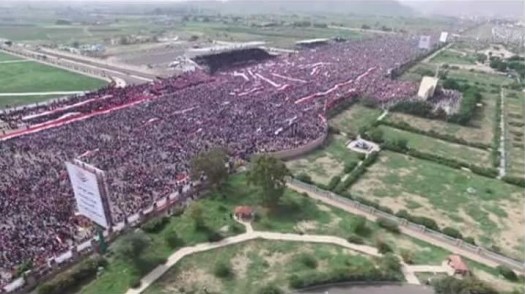
On Saturday tens of thousands of Yemenis rallied in the capital to show support for the Houthi-led bloc as the head of the group’s new governing council vowed to form a full government in the coming days.
Yemen’s former President Ali Abdullah Saleh says the new government in the country is ready to cooperate with Russia against terrorism by allowing Russian access to Yemeni military bases.
“Russia is the closest to us and we extend our hand to Russia to cooperate in the field of combating terrorism,” Saleh said in an interview with state-run Russia 24 TV channel on Sunday.
He said Yemen was ready to open the country’s military bases to Russia.
“We provide all the facilities in our bases, airports and sea ports. We are ready to provide all facilities to the Russian Federation,” he said.
He said, however, that such cooperation would not mean Russia would be fighting alongside Yemeni forces against Saudi forces waging war on Yemen.
‘Iran has no presence in Yemen’
Saleh also rejected claims that Iran is interfering in Yemen’s internal affairs.
He said Saudi Arabia has launched the war on Yemen under the pretext of defending Saudi national security against Iran, emphasizing that the pretext is “baseless.”
“Iran has no presence in Yemen at all,” he said, adding that, “The international intelligence services know that Iran is not present in Yemen.”
“We are not against Iran; Iran is an Islamic brotherly country. We don’t have any agreement or coalition with her currently,” he said, referring to Iran.
Yemen has seen almost daily military attacks by Saudi Arabia since late March 2015, with internal sources putting the toll from the bloody aggression at about 10,000.
In late July, Yemen’s Houthi Ansarullah movement and Saleh’s General People’s Congress party decided to establish the Supreme Political Council to run the country. It was formally launched on August 6, when the Houthis and Saleh’s faction announced that they both had an equal share in the 10-member body.
Is Crimea about to explode? The mainstream media reports that Russia has amassed troops on the border with Ukraine and may be spoiling for a fight. The Russians claim to have stopped a Ukrainian sabotage team that snuck into Crimea to attack key infrastructure. The Russian military is holding exercises in Crimea and Russian President Vladimir Putin made a visit to the peninsula at the end of the week.
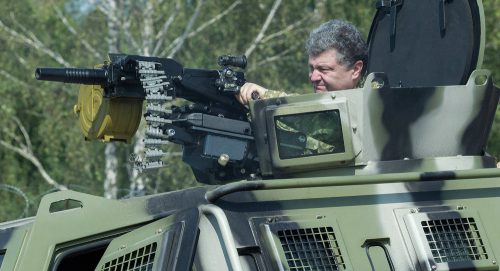
The Ukrainians have complained to their western supporters that a full-scale Russian invasion is coming, and Ukrainian President Petro Poroshenko said he may have to rule by martial law due to the Russian threat.
Though the US media pins the blame exclusively on Russia for these tensions, in reality there is plenty of blame to go around. We do know that the US government has been involved with “regime change” in Ukraine repeatedly since the break up of the Soviet Union. The US was deeply involved with the “Orange Revolution” that overthrew elected president Viktor Yanukovych in 2005. And we know that the US government was heavily involved in another coup that overthrew the same elected Yanukovych again in 2014.
How do we know that the US was behind the 2014 coup? For one, we have the intercepted telephone call between US Assistant Secretary of State Victoria Nuland and US Ambassador to Ukraine, Geoffrey Pyatt. In the recording, the two US officials are plotting to remove the elected government and discussing which US puppet they will put in place.
You would think such undiplomatic behavior could get diplomats fired, but sadly in today’s State Department it can actually get you promoted! Nuland is widely expected to get a big promotion – perhaps to even Secretary of State – in a Hillary Clinton administration, and Geoffrey Pyatt has just moved up to an Ambassadorship in Athens.
Ambassador Pyatt can’t seem to control himself: Just as tensions were peaking between Russia and Ukraine over Crimea this month, he published a series of Tweets urging Ukraine to take back Crimea. Is this how our diplomats overseas should be acting? Should they be promoting actions they know will lead to war?
When the mainstream media discusses Crimea they are all lock-step: that’s the peninsula Putin annexed. Never do they mention that there was a referendum in which the vast majority of the population (who are mostly ethnic Russians) voted to join Russia. The US media never reports on this referendum because it produced results that Washington doesn’t like. How arrogant it must sound to the rest of the world that Washington reserves the right to approve or disapprove elections thousands of miles away – meanwhile we find out from the DNC hacked files that we don’t have a lot of room to criticize elections overseas.
What should we do about Ukraine and Russia? We should stop egging Ukraine on, we should stop subsidizing the government in Kiev, we should stop NATO exercises on the Russian border, we should end sanctions, we should return to diplomacy, we should send the policy of “regime change” to the dustbin of history. The idea that we would be facing the prospect of World War III over which flag flies above a tiny finger of land that most US politicians couldn’t find on a map is utterly ridiculous. When are we going to come to our senses?
Iran is pitching its massive gas sector for trade with Asia where it sees a better market for exports than Europe.
“Gas prices are more attractive in East Asia than in Europe,” Deputy Petroleum Minister for trade and international affairs Amir-Hossein Zamaninia has said.
The country hopes to eventually export natural gas to East Asia, including Japan, he told the Kyodo news agency in an interview on Sunday.
Zamaninia held the prospect of Iran and Japan forming a long-term partnership for the supply of Iranian LNG to the Asian country.
“Japan has a great potential of becoming a major partner for Iran in developing its gas industry,” he said.
The two countries have a chequered history of trade relations. They had to ditch a massive petrochemical project in 1991 as the Iraqi war of 1980-1988 under former dictator Saddam Hussein dragged on.
In 2010, Japan’s state-owned Inpex walked out of an agreement to develop Iran’s South Azadegan oilfield under US pressures.
Tokyo, however, was among the first countries to rush through a series of measures to lift sanctions on Iran before a nuclear agreement with Tehran went into effect.
In August, Japan sent its State Minister of Economy, Trade and Industry Daishiro Yamagiwa to Tehran with executives from major trading houses such as Mitsubishi Corp., Mitsui & Co. and Itochu, as well as plant-engineering giant JGC and major banks.
Tehran accounted for 10% of Japan’s oil imports before sanctions cut them to five percent. Japan wants to raise the purchases to the previous level.
“Given that Iran’s oil and natural gas reserves are one of the world’s biggest, there is a possibility that Iran will play a part if Japan seeks to diversify its supply sources,” Kyodo quoted a Japanese gas and oil industry source as saying Sunday.
Zamaninia said Japanese companies are interested in being re-engaged in the Iranian energy sector, especially in the gas sector, adding he thinks Japan’s current policy seems to be focusing less on crude oil.
With more than 34 trillion cubic meters under its belt, Iran owns the world’s largest natural gas reserves but its share of the global trade in gas is less than one percent.
According to an Iranian energy official, natural gas will be the main fuel in the next 20 to 30 years. Zamaninia said within two to three years, Iran will be a major supplier of gas to its neighbors.
Currently, Turkey is Iran’s biggest customer with 30 million cubic meters a day of imports under a 25-year deal signed before the West imposed sanctions on Tehran.
Iran seeks to raise gas production to 1.2 billion cubic meters (bcm) a day in five years, from 800 million cubic meters now. Annual output totals 166 bcm, which is mostly used at home.
The country exports 10 bcm of gas per year. To put it in perspective, Russia exports about 150 billion cubic meters of gas a year.
South Pars in southern Iran is the world’s largest gas field which the country is developing in two dozen phases.
It provides feedstock for a number of petrochemical complexes in an area known the Pars Special Economic Energy Zone (PSEEZ) in Assaluyeh on the Persian Gulf coast.
Yoichi Yamamoto, adviser in charge of the Middle East at the Japan External Trade Organization in Tokyo, says petrochemical products, rather than natural gas itself, might be more attractive for Japanese companies for now.
“To transport gas across the sea, it is necessary to convert gas into liquefied natural gas and use special tankers, resulting in relatively large investment,” he told Kyodo.
“If Japanese companies are to form joint ventures or invest funds in the PSEEZ, petrochemical products produced there would be attractive,” he said.
“They cannot sell all the products in Japan. If they could draw up a business model in which they will sell the products also to third-party countries, I think it would be possible for them to invest,” he added.
The twenty-first century runs on it. Paediatric clinics. Cancer centres. Forensic laboratories. Family-planning counsel. It is used to explain illness, to assign blame, to foreclose questions. It protects the industries whose products and practices are what actually caused the harm.
It isn’t true.
In 2010, Jonathan Latham and Allison Wilson looked at over seven hundred genome-wide association studies covering some eighty common diseases. The genes the field had promised were not there. The field invented a term, “missing heritability”, to explain the absence, and has quietly worked to bury the finding ever since.
The Genetic Deception is a book about what Latham and Wilson found. What the field did with it. And what the public was told instead. … continue
This site is provided as a research and reference tool. Although we make every reasonable effort to ensure that the information and data provided at this site are useful, accurate, and current, we cannot guarantee that the information and data provided here will be error-free. By using this site, you assume all responsibility for and risk arising from your use of and reliance upon the contents of this site.
This site and the information available through it do not, and are not intended to constitute legal advice. Should you require legal advice, you should consult your own attorney.
Nothing within this site or linked to by this site constitutes investment advice or medical advice.
Materials accessible from or added to this site by third parties, such as comments posted, are strictly the responsibility of the third party who added such materials or made them accessible and we neither endorse nor undertake to control, monitor, edit or assume responsibility for any such third-party material.
The posting of stories, commentaries, reports, documents and links (embedded or otherwise) on this site does not in any way, shape or form, implied or otherwise, necessarily express or suggest endorsement or support of any of such posted material or parts therein.
The word “alleged” is deemed to occur before the word “fraud.” Since the rule of law still applies. To peasants, at least.
Fair Use
This site contains copyrighted material the use of which has not always been specifically authorized by the copyright owner. We are making such material available in our efforts to advance understanding of environmental, political, human rights, economic, democracy, scientific, and social justice issues, etc. We believe this constitutes a ‘fair use’ of any such copyrighted material as provided for in section 107 of the US Copyright Law. In accordance with Title 17 U.S.C. Section 107, the material on this site is distributed without profit to those who have expressed a prior interest in receiving the included information for research and educational purposes. For more info go to: http://www.law.cornell.edu/uscode/17/107.shtml. If you wish to use copyrighted material from this site for purposes of your own that go beyond ‘fair use’, you must obtain permission from the copyright owner.
DMCA Contact
This is information for anyone that wishes to challenge our “fair use” of copyrighted material.
If you are a legal copyright holder or a designated agent for such and you believe that content residing on or accessible through our website infringes a copyright and falls outside the boundaries of “Fair Use”, please send a notice of infringement by contacting atheonews@gmail.com.
We will respond and take necessary action immediately.
If notice is given of an alleged copyright violation we will act expeditiously to remove or disable access to the material(s) in question.
All 3rd party material posted on this website is copyright the respective owners / authors. Aletho News makes no claim of copyright on such material.