Russia-China military ties take a leap forward
By M K Bhadrakumar | India Punchline | September 11, 2016
The wrap on the long-awaited China-Russia naval exercise in the South China Sea has been lifted, finally. From what Beijing disclosed today regarding the eight-day exercise (codenamed Joint Sea-2016), beginning on September 12, it is anything but a routine exercise. Make no mistake, it marks a leap forward in Sino-Russian military ties and signals a significant show of strategic congruence.
The Chinese Navy spokesman revealed that the exercise will be held “off southern China’s Guangdong Province”, without elaborating. Both navies are deputing surface ships, submarines, fixed-wing aircraft, ship-borne helicopters marine corps and amphibious armored equipment for the exercise.
The announcement said the two navvies will “undertake defense, rescue, and anti-submarine operations, in addition to joint island seizing and other activities…(and) in particular, will carry out live-fire drills, sea crossing and island landing operations, and island defense and offense exercises among others”. (Global Times )
China’s South Sea Fleet and Russia’s Pacific Fleet will be the participants. The SSF, of course, plays a major role in the disputed waters of the South China Sea and, in fact, was instrumental in occupying the Paracel Islands in 1974.
The exercise is taking place against an extraordinary backdrop. Only six days ago, Russia came out with a stance on the South China Sea issue, which is completely to China’s satisfaction. It was hugely symbolic that President Vladimir Putin personally articulated it – and from Chinese soil, as he was leaving for home after the G20 summit in Hangzhou. Putin said in reply to a query from a journalist:
- I’ve developed a very good relationship based on trust with President Xi Jinping. I would say a friendly relationship. However, he has never – I would like to underscore this – he has never asked me to comment on this (South China Sea) issue or intervene in any way. Nothing of the kind has ever passed his lips. Nevertheless, of course, we have our own opinion on this. What is it? First of all, we do not interfere. We believe that interference by any power from outside the region will only hurt the resolution of these issues. I believe the involvement of any third-party powers from outside the region is detrimental and counterproductive. That’s my first point.
- Second, as far as the Hague Arbitration Court and its rulings are concerned, we agree with and support China’s position to not recognise the court’s ruling. And I’ll tell you why. It is not a political but a purely legal position. It is that any arbitration proceedings should be initiated by parties to a dispute while a court of arbitration should hear the arguments and positions of the parties to the dispute. As is known, China did not go the Hague Court of Arbitration and no one there listened to its position. So, how can these rulings be deemed fair? We support China’s position on the issue. (Kremlin website)
It is a calibrated stance that does not take any side on the disputes as such and simply ignored UNCLOS, et al, but it pointedly snubs Washington’s interference. It serves Beijing’s purpose, while for Moscow it no way jeopardises Russia’s developing strategic ties with Vietnam or with the ASEAN. Beijing is pleased. The Chinese Foreign Ministry lauded Putin’s remarks. (MFA)
Moscow and Beijing kept fine-tuning the details of the exercise, presumably taking into account the fluidity in the regional security. One reason could be the US’ decision to depute the nuclear-powered aircraft carrier USS Ronald Reagan to South Korea for a naval exercise in mid-October. The drill is projected as a show of strength to North Korea but it is being held at a time of heightened regional tensions over North Korea and the USS Reagan is part of a Japan-based American strike group and the only forward-deployed aircraft carrier in the region.
Interestingly, the visiting speaker of the upper house of Russia’s parliament Valentina Matviyenko stated in Beijing on Friday that Russia and China have identical positions on North Korea. A day later, on Saturday, Russian Foreign Ministry issued a joint appeal with China calling for avoidance of precipitate moves.
Putin’s remarks on South China Sea were by no means ex-tempore. The big question is whether Moscow and Beijing could be exploring the matrix of an alliance that is unlike a formal alliance but prepares them nonetheless to push back at a probable shift in the US’ policies in a pronounced interventionist direction and a greater readiness to use military power under the next US president. The deployment of the THAAD missile defence system in South Korea is a matter of common concern for Russia and China. Again, despite the seamless charm offensive by Prime Minister Shinzo Abe, Putin does not intend to make any territorial concessions to Japan over the Kuriles.
Indeed, the idea of a Sino-Russian alliance is not new. In 2014, Russian Defence Minister Sergei Shoigu explicitly aired the idea of a common front with China to fight terrorism and counter US-sponsored ‘color revolutions’. In a significant reference just before the visit to Hangzhou, Putin described Russia’s relations with China as “a comprehensive partnership and strategic cooperation”. Again, at the meeting with Putin in Hangzhou on September 4, Xi explicitly called for closer, tighter strategic alignment between the two countries. (Xinhua )
US Wants Respite, Not Ceasefire in Syria
By Finian Cunningham | Sputnik | September 11, 2016
Tough negotiations between America and Russia’s top diplomats have managed to produce a tentative ceasefire plan for Syria. But Washington doesn’t really want a ceasefire. More likely, a respite for its regime-change proxies.
After more than 13 hours of intense discussions in Geneva this weekend, on top of months of back-and-forth talks, US Secretary of State John Kerry and Russian Foreign Minister Sergey Lavrov emerged in a joint press conference to announce that a cessation in fighting would begin this week.
A previous attempt at implementing a truce back in February failed within days of that initiative because anti-government insurgents affiliated with the al-Qaeda terrorist network refused to abide by that earlier agreement.
There is no reason why this second ceasefire attempt should otherwise succeed in holding.
There may well be a temporary lull in violence simply because opposition militia will avail of the opportunity to regroup and repair. But the core of the insurgents are dominated by terrorist groups like Jabhat Fatah al Sham (formerly al-Nusra Front) and Daesh and numerous other affiliates.
These proscribed terror groups have no interest in negotiating a political transition in Syria with the incumbent government of President Bashar Assad. Their whole purpose is to overthrow the state and turn it into a so-called caliphate ruled by fear.
This gets to the kernel of why the ceasefire deal worked out by Kerry and Lavrov is fatally flawed.
Arguably, the Russian side is negotiating in good faith with the genuine intention of achieving a peaceful resolution to the nearly six-year-old conflict, which has resulted in 400,000 dead and millions displaced from their homes. But not so the American side.
We must always keep firmly in mind that the conflict in Syria was instigated in the first place by the US and other foreign powers for the objective of regime change against the Assad government – a long-time ally of Russia and Iran.
Recall that former French Foreign Minister Roland Dumas revealed in 2013 that the foreign conspiracy for regime change in Syria was hatched at least two years before the violence erupted in March 2011.
This US-led criminal agenda for regime change has not changed. When John Kerry talks about getting Russia to sign up to a “political transition” he means a process which will culminate in the ouster of the Assad government.
At the Geneva press conference this weekend, the US diplomat clearly said that he was coordinating his efforts with those of the exiled opposition group called the High Negotiations Committee. Days before, the Saudi-backed HNC unveiled yet another “vision” demanding “transition” and Assad’s departure.
On the Geneva meeting this weekend, the Washington Post reported: “Kerry acknowledged the truth of the Russian charge that some opposition groups are fighting in tandem with the [al-Nusra] Front and said it was incumbent on them to now make a choice.”
The paper also noted: “Both Kerry and Lavrov emphasized that outside supporters of all non-terrorist [sic] belligerents would have to bring their allies in line.”
Without this putative separation of “moderates” and “terrorists” then there can be no feasible premise for a substantive cessation of violence. The proposal for US and Russian forces to subsequently cooperate in carrying out air strikes against terror groups is therefore a non-starter.
The confidence for this assertion is because, as Kerry half-acknowledged, there is no distinction between “moderate rebels” and “terrorists”. They are all part of the same regime-change proxy army that the US and its NATO and regional allies orchestrated from the outset of this reprehensible conflict.
Expecting these proxies to somehow sort themselves into “good guys” and “bad guys” is a ludicrous conception of how and why the war was instigated and prosecuted.
Washington and the Western news media engage in euphemisms of how these groups are “intermingled”, “overlap” and “marbled”. But such attempts at differentiation are either deluded or deceitful. For virtually all the anti-government insurgents are integrated into the same terrorist front. That’s why months of Russian admonitions to the US to segregate its supposed moderates from the terrorists have resulted in no separation.
For John Kerry to propose at this late stage for “non-terrorist belligerents” to get onboard with the ceasefire is nothing but a cynical ruse.
So what is Washington really seeking? Part of the proposed deal involves Russian and Syrian forces calling off their offensive against eastern Aleppo – the so-called “lifting of the siege” and supplying “humanitarian aid” to insurgent-held areas.
Cynically, but realistically, those provisions are less about halting violence and humanitarian effort and more about giving the foreign-backed regime-change forces a much needed breathing space.
Ever since Russia sent its forces into Syria at the end of last year, the US-led regime-change war has turned into a losing campaign.
What Washington and its other foreign co-conspirators – Britain, France, Turkey, Israel and Saudi Arabia – badly need is to give their proxies a respite from the withering offensive of the Syrian army and its Russian, Iranian and Hezbollah allies.
A reasonable conjecture is that the Pentagon and CIA war planners – Kerry’s ultimate bosses – want a holding and reorganizing position until Hillary Clinton is elected as the new president. Lame-duck Obama has been too much of a ditherer and not sufficiently gung-ho about regime change in Syria.
Clinton, on the other hand, has vowed to step up American military intervention in Syria. She has called for setting up of no-fly zones and a tougher stance towards Assad and Russia.
But if Syrian and Russian forces continue their rate of attrition against the regime-change proxies, there may be little of these foreign assets left by the time Clinton takes office early next year. Hence, the insurgents must be salvaged from their precipitous defeat – and this is what really pertains to the “ceasefire” that Kerry has appeared so keen to accomplish.
The conjecture of a “holding, reorganizing position” also tallies with the recent invasion by Turkish military forces into northern Syria and the joint US-Turk annexation of territory. It suggests that a greater war effort for regime change is being anticipated for when Clinton takes office. (Assuming Donald Trump’s candidacy can be wrecked by the relentless US media vilification he is being subjected to.)
Which begs the question: why have Russia and the Syrian government apparently gone along with this latest ceasefire arrangement? If, that is, it is a cynical ruse for regime change?
Why don’t Syria and Russia just drive on with their very effective offensive to defeat the terrorist regime-change front?
Perhaps, Syria and Russia have their own calculations for regrouping and refining tactics for resuming even greater offensive power.
Or perhaps, Russia knows all too well, privately, that the Americans are full of claptrap. This latest ceasefire proposal has no chance of working because of the inherent flaws. But Russia’s international reputation has little to lose from “giving peace a chance”. [a likelier conjecture]
So, let Washington’s proposal for “separation” of insurgents fail, fail, and fail again, and let the world come to see the utter fallacy and criminality of American policy.
The trouble, however, is that more delay gives more leverage to a Clinton presidency and what promises to be a far more warmongering next White House administration.
Finian Cunningham is a Master’s graduate in Agricultural Chemistry and worked as a scientific editor for the Royal Society of Chemistry, Cambridge, England. For nearly 20 years, he worked as an editor and writer in major news media organisations, including The Mirror, Irish Times and Independent.
Exposing US-Funded “NGOs”
From Moscow to Myanmar, US-European funded organisations undermine the essential work of genuine NGOs
The New Atlas | August 9, 2016
A nongovernmental organisation (NGO) is described as a not-for-profit organisation independent from states and international governments. They are funded by donations and facilitated by volunteers drawn from the communities they serve.
Genuine NGOs fitting this description fulfil a vital role within the nations they work regarding issues including education, healthcare, the media, the environment, technology, and economic development.

They often perform their work in parallel with government organisations and may even cooperate with their national government. At other times, they provide a necessary but constructive check and balance to deficiencies present within a state.
However, NGOs can be abused. Foreign governments and financially motivated special interests can use the structure and appeal of NGOs as vectors to project unwarranted, coercive power and influence.
Funded not by the communities they claim to serve, but by these foreign interests, they often operate under the pretext of upholding the legitimate roles and responsibilities of genuine NGOs while in reality undermining a targeted nation’s government, its people, its institutions, and national peace and stability. Ironically, such organisations also undermine the perceived legitimacy and effectiveness of real NGOs.
Foreign interests seek to do this for a number of reasons including pressuring a targeted government to make concessions regarding bilateral relations, competing with and eventually overrunning state institutions, and even replacing a nation’s entire government.
How the US State Department Took Over Myanmar’s Ministry of Information
An extreme example of this can be seen in Southeast Asia’s Myanmar, where the Ministry of Information is now firmly under the control of Pe Myint, trained in “journalism” by a US government-funded organisation posing as an NGO, called the Indochina Media Memorial Foundation.
Pe Myint is also a member of a political party supported by a large collection of US and British funded organisations (National Endowment for Democracy (NED), Open Society, USAID, etc.), which in turn was propelled into power during recent elections also influenced heavily by organisations posing as NGOs funded by these same foreign interests.
Previously an independent institution of Myanmar, the Ministry of Information is now firmly under the influence of the US State Department. This may explain uncharacteristic comments regarding “substandard democracy” published by a national newspaper it controls directed at neighbouring Thailand ahead of the August 7, 2016 Thai referendum.
Henceforth, the Ministry has been made to serve the best interests of the United States, not Myanmar, indicated by the fact that its recent comments only risk jeopardising what would otherwise be constructive and beneficial bilateral relations with Thailand.
In this example, foreign-funded organisations not only pressured the government of Myanmar to accept the conditions in which a foreign-backed opposition came to power, but these foreign-funded organisations also helped create an entirely parallel government that are now overwriting Myanmar’s sovereignty.
Recognise the Threat
These foreign-funded organisations masquerading as NGOs are more than just foreign-funded “charities,” “rights advocates,” or “media platforms.” This can be discerned simply by examining the intermediary organisations providing these groups money and examining the special interests and agendas they in turn serve.
The United State National Endowment for Democracy (NED) for example, lists among its 2013 sponsors (.pdf) petrochemical giant Chevron, Wall Street’s Goldman Sachs, US State Department-connected and privacy usurping tech-giant Google and the US Chamber of Commerce which itself represents corporations ranging from defence contractors to oil companies to banks, as well as agricultural and pharmaceutical giants. Individual donors include pro-war Republican politicians including Frank Carlucci, Paula Dobriansky, Condoleezza Rice and Robert Zoellick.
 |
| (It would be exponentially more difficult for foreign funded organisatons posing as NGOs to attract volunteers and local support if the true nature of their funding was transparently and repeatedly disclosed to the communities they allegedly serve.) |
NED’s board of directors represents a similar and troubling convergence of special interests who directly contradict the alleged purpose of both NED itself, and the many organisations it funds around the world.
Unfortunately, many people who work for foreign-funded organisations posing as NGOs are unaware of such facts. Senior leadership of these organisations often go through great lengths to conceal their foreign funding to avoid scrutiny and even in some cases, to avoid properly paying people who are led to believe no funds are available and thus are asked to “volunteer” to help. Those few who are aware of this funding, are usually unaware of who and what NED and other organisations like them truly represent.
To put it simply, any organisation or institution serves only the interests of those who support it. An NGO supported by local donations and volunteers serves its local community. A foreign-funded organisation posing as an NGO serves foreign interests.
And simpler still, an organisation funded by a foreign government cannot possibly be characterised as “nongovernmental.” Even at face value, this notion strains credibility.
Case Study: Prachatai, Thailand
After being caught concealing foreign funding, Bangkok-based media platform Prachatai disclosed several million baht in US State Department funding, Open Society grants and funds from several European governments.
Remarkably, Prachatai was (and still is) soliciting donations on their website. They also have categorically failed to update their foreign funding in English (since their first and only disclosure in 2011) and have never disclosed their foreign funding to their Thai readers.
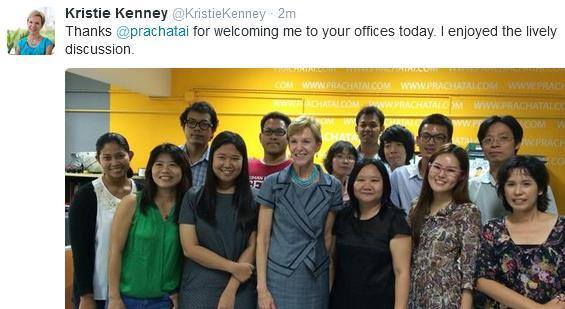 |
| (US Ambassor Kristie Kenney in US State Department-funded Prachatai’s office in Bangkok, Thailand.) |
Independent journalists attempting to ascertain the true depth of Prachatai’s connections to the US State Department were told that Prachatai had none, and that the money was provided to them unconditionally.
In reality, as revealed by Wikileaks, Prachatai’s staff remains in constant contact with the US Embassy in Bangkok, with US ambassadors and political counsellors making regular visits to their office off of Ratchada Road, and with Prachatai’s director Chiranuch Premchaiporn making regular, lengthy and detailed reports about Thailand’s internal political affairs to US Embassy staff.
In the infamous Cablegate leak, the US Embassy in Bangkok sent off as many as 7 cables regarding or referencing Prachatai and its activities within the country and in particular its defence of agitators attempting to undermine the nation’s institutions and political stability.
For the US State Department, Prachatai exists as a state-funded asset — a constant pressure point to extort concessions from the Thai government with and to coerce from them the settings in which US-backed political forces might take power.
Under the guise of defending “free speech” and “human rights,” Prachatai networks deeply with US-backed political party Pheu Thai, its street front the United Front for Democracy Against Dictatorship (UDD or “red shirts”) and a large number of other US-funded organisations posing as NGOs and academic associations — many of which share the office building Prachatai is currently based in.
Additionally, Prachatai communicates and coordinates regularly with foreign media staff based in Thailand, particularly those who gravitate around the swank Foreign Correspondents’ Club of Thailand clubhouse and bar in downtown Bangkok.
Together they stage public relations events aimed at portraying the current Thai government as overbearing, dictatorial and losing popularity and control. In reality, the events include the same handful of stand-ins and utilise intentionally deceptive methods to conflate the size and impact of each staged event.
By participating in such events, the foreign media betrays the principles it allegedly represent, creating the news rather than objectively covering it. For Prachatai, posing as an NGO but clearly functioning as an extension of US interests in Thailand, it too represents a betrayal of true, community-supported activism.
Ending the Charade
In all honesty Prachatai’s activities could easily be tolerated by the Thai government, if only for one concession — that Prachatai and other organisations like it fully and repeatedly disclosed in English and in Thai, their existence as foreign-funded government organisations rather than pose as a genuine NGO.
Since it has operated for years and failed to fulfil its own responsibilities toward transparency to the society it claims to serve, it may be time for Thailand to pass legislation to force foreign-funded organisations like Prachatai to come clean.
Other nations have adopted comprehensive legislation to help protect real NGOs from those with foreign funding merely posing as such.
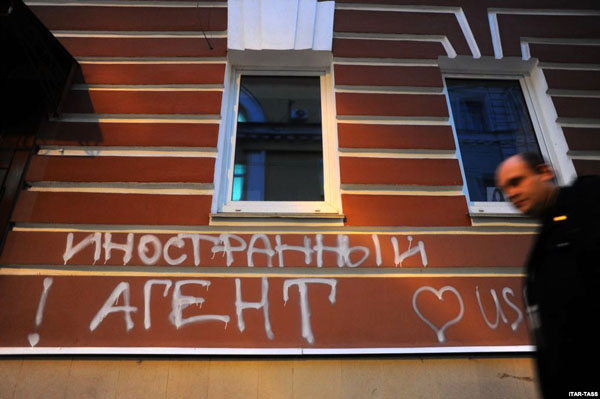
(The graffiti reads, “foreign agent,” written in Russian..)
In Russia, legislation now requires foreign-funded organisations to declare on all written material and verbally declare before all audio statements, their relationship with foreign interests. Those that fail to register as foreign-funded organisations or fail to disclose all of their funding, face liquidation.
While the US and the myriad organisations it was running in Moscow predictably decried the legislation as “oppressive,” some might appreciate the irony of “pro-democracy activists” resisting calls for greater transparency, a fundamental prerequisite for a democratic society.
Foreign-funded organisations posing as NGOs are more than a mere nuisance, or even simply a means by foreign governments and special interests to apply coercive pressure on a nation’s government and institutions. They represent a patient, concerted effort to compete with and eventually fully replace a nation’s existing sovereign institutions. This threat should not be underestimated nor should it be tolerated.
And beyond a threat to national security, these foreign-funded organisations attract and squander a nation’s human resources, while undermining the very legitimate and essential work performed by honest, locally-supported NGOs.
Top General Warns That NATO Wants to Turn Post-Soviet Space ‘Into Another Syria’
Sputnik – 08.09.2016
A top Russian general has voiced his frustration over NATO’s lack of cooperation with a Russian-led alliance involving countries from the former Soviet space, saying that the Western alliance doesn’t seem to want countries in the former USSR to ally with one another, allowing NATO pick them off one by one at their leisure.
Speaking at a press conference in Moscow on Wednesday, Col. Gen. Nikolai Bordyuzha, secretary general of the Collective Security Treaty Organization, a military alliance involving six post-Soviet states, including Russia, Belarus, Armenia, Kazakhstan, Kyrgyzstan and Tajikistan, had some harsh words for Russia’s NATO partners.
The North Atlantic Alliance, he said, has been consistently opposed to any military integration between Russia and its partners in the CSTO, and the reason is that NATO wants to deprive these countries of their collective security guarantees.
“Why do you think NATO does not cooperate with the CSTO?” the general asked. “It’s simple – they have no need to support processes of [defense] integration. This way, things will be like in Syria, and nobody will be able to let out a peep. The country is being pounded, and there’s no one to help them, since it didn’t have any allies. And this is the situation they want to create for us as well,” Bordyuzha said, referring to the members of the CSTO.
Furthermore, the officer warned that the Western media has been engaged in what he called campaign of information warfare against the CSTO. “They will tell lies all day, every day. Everything that is being said about the CSTO is presented in a way that’s the opposite to how things are in reality,” Bordyuzha noted. “This is done, for example, in order to ensure that Tajikistan was not together with Russia,” he added.
Ultimately, Bordyuzha suggested that the Western political, media and military effort’s “most important task is to splinter our unity, to separate our nations into our own ‘national apartments’, and to dictate their terms to everyone individually.”
In this scenario, the officer emphasized that while the CSTO has absolutely no plans to fight a war of aggression against NATO, neither does it fear an attack by the Western alliance. “That’s why the CSTO exists,” Bordyuzha quipped.
The Collective Security Treaty Organization, formed in 1992, shortly after the collapse of the Soviet Union, integrates the defense capabilities of six former Soviet republics, including Russia, Belarus, Armenia, Kazakhstan, Kyrgyzstan and Tajikistan. Afghanistan and Serbia became observers to the organization in 2013. Former members include Azerbaijan, Georgia and Uzbekistan.
Signatories to the alliance are not able to join other military alliances, and aggression against one member is considered aggression against all.
The CSTO holds yearly command exercises and drills to improve coordination between its states militaries, the most recent being Cooperation-2016, which took place last month in Russia’s Pskov region.
US expands list of sanctioned Russian firms
RT | September 7, 2016
The US Department of Commerce is expanding its blacklist of Russian companies and individuals over their alleged links to the Ukrainian conflict.
The list was published on the Federal Register’s website on Tuesday, and identifies “entities and other persons reasonably believed to be involved in, or that pose a significant risk of being or becoming involved in, activities that are contrary to the national security or foreign policy of the United States.”
The blacklist consists of 75 Russian companies and up to 37 individuals. Among the sanctioned companies are 11 Russian and international electronics firms including one of the largest Eastern European manufacturers of integrated circuits Angstrem Group, Foreign Economic Association, radio and microelectronics manufacturer Mikron.
Seven sanctioned companies are said to be directly involved in the construction of the 19 kilometer (11.8 miles) road and rail connection across the Kerch Strait, which connects the Black and the Azov Seas.
Last week, the US Treasury Department introduced sanctions related to the conflict in eastern Ukraine against 18 construction, transportation and defense entities operating in the Crimea, as well as dozens of Gazprom and Bank of Moscow subsidiaries. The list also included an additional 11 Crimean officials.
Gazprom said the new sanctions will not affect its business.
The US and EU imposed sanctions on Russia in 2014 after accusing Moscow of involvement in the conflict in eastern Ukraine and of annexing Crimea. The Kremlin has denied the accusations and responded with counter-measures, banning imports from the EU, US and others.
Historic Assad-Erdogan meeting by September’s end in Moscow
American Herald Tribune | September 5, 2016
Lebanese daily Assafir has recently published an article by journalist Mohammad Ballout. The article states that preparations and arrangements for an Assad-Erdogan meeting had begun since Erdogan’s visit to St. Petersburg on August 9th.
Interestingly, Erdogan’s visit also coincided with the visit of a senior Syrian delegation that included important security officials, including the head of the Syrian National Bureau General Ali Mamlouk, one of Assad’s most trusted advisors.
The article also states that the delegation’s visit taking place during Erdogan’s was no mere coincidence, and points to a very sharp turn that is about to take place in the Syrian War, in what is now its 5-year run.
The date of the final meeting between the two will apparently be set by General Mamlouk in his upcoming visit to Russia this Tuesday, whereat he is expected to meet with Russian and Turkish officials, whereas the actual agenda of the meet is to be finalized by Hakan Fidan, head of Turkish Intelligence.
The settlement proposed by Russia would include a tripartite national unity government that would include loyalists, independents, and representatives from the moderate Syrian opposition. They also offered the Saudis with an acceptable “out” by ruling out any major role to be played by Iran in the process.
The article also states that the Syrian delegation refused Turkey’s proposition of a sectarian division of government (akin to Lebanon), and instead proposed that Syrian President Bashar al-Assad would still preside over the most important ministries: Interior, Justice, Finance, Foreign Affairs, and Defense, whereas executive ministries would be shared with the opposition and the independents. Three vice presidents will also be selected from the three factions.
It has so also been agreed that after an 18-month period, some key constitutional amendments must take place (provided they do not alter any presidential powers), to be later followed by legislative and presidential elections.
Finally, The Syrian delegation has also made commitments to issue a general amnesty for all military defectors, provided they do not partake in any activities against the Syrian army.
Obama’s Final ‘Jihad’ in Asia
By Wayne MADSEN | Strategic Culture Foundation | 06.09.2016
President Barack Obama has opted to ratchet up military tensions in Asia as one of his last foreign policy acts as president of the United States. Using climate change and free trade backdrops at the G20 Summit in Hangzhou, China and the U.S.-ASEAN and East Asia Summits in Vientiane, Laos as mirages intended to mask his aggressive military posture in the Asia-Pacific region, Obama seeks to cement his «pivot to Asia». It is Obama’s sincere hope that his anticipated successor, his former Secretary of State, Hillary Clinton, will expand on the expansionistic and aggressive regional showdown with China and Russia that his administration launched with his Asia «pivot».
The ultra-protocol conscious Chinese threw diplomacy and decorum to the wind when Obama touched down at Hangzhou International Airport and his national security adviser Susan Rice and deputy national security adviser became embroiled in an argument with Chinese security personnel. When White House officials traveling with Obama began issuing orders to the Chinese personnel, one Chinese official yelled at them, «This is our country. This is our airport». It was as if the Chinese, realizing that this would be their last encounter with Obama as president, were letting him and his war hawk national security team know who was the boss as long as they were on Chinese soil. At least on the tarmac at Hangzhou International Airport, the Chinese swung Obama’s Asia «pivot» back to China.
It was an ignominious final «haj» for Obama’s anti-Chinese jihad. Obama began his presidency in 2009 with being awarded, incredibly prematurely as it turned out, the Nobel Peace Prize. For the Asia-Pacific region, Obama’s presidency would end with angry words between his aides and Chinese officials at a Chinese airport.
Obama began his journey as the host for Pacific Island leaders at the Central Intelligence Agency front, the East-West Center, which is located at his mother’s alma mater, the University of Hawai’i. Obama was the official host at the 2016 Pacific Islands Conference (PIC) of Leaders at the CIA-linked center. Obama’s speech before the leaders, many from small Pacific island states, focused primarily on global climate change. Obama also addressed the World Conservation Congress at their meeting in Hawai’i.
Obama was schooled in anti-Chinese bigotry and Cold War fear tactics by his CIA mother and right-wing fascist Indonesian army stepfather while a child in post-1965 coup Indonesia. Obama, who is fully aware that the blood of 800,000 to one million Indonesians, Communists and ethnic Chinese Indonesian nationals, flowed in the streets, canals, and rivers of Indonesia from 1965 to 1967, the year he and his mother arrived in the country, believes it his birthright and duty to continue his familial “jihads” against «Communist» China that were instilled in him as a child, teen, and college student by his CIA-connected parents.
Papua New Guinea’s Prime Minister, Peter O’Neill, tipped off the press about the real purpose of the PIC before he departed Port Moresby for Hawai’i. O’Neill, who is in charge of one of Papua New Guinea’s most corrupt governments since independence in 1975, said that “regional security” shared the bill with climate change at the Hawai’i conference. In addition to independent Pacific Island states, the PIC includes the U.S. territories of American Samoa, Guam, Northern Marianas, and the state of Hawai’i.
U.S. Army Assistant Chief of Staff Colonel Tom Hanson, a relatively low-level official to be issuing policy statements, gave an ultimatum to Australia just prior to Obama’s departure for Hawai’i and Asia. Hanson told the Australian Broadcasting Corporation, “I think the Australians need to make a choice … it’s very difficult to walk this fine line between balancing the alliance with the United States and the economic engagement with China.” The statement chilled U.S.-Australian relations prior to Obama’s meeting with Australian Prime Minister Malcom Turnbull at the G20 summit.
Also on Obama’s agenda was pressuring certain PIC leaders who have shown signs of resisting the political status quo imposed by Washington. Northern Marianas Governor Ralph Torres, a Republican, recently signed into law the Second Marianas Political Status Commission that seeks to re-evaluate the islands’ current neo-colonial status imposed by the agreement that transformed the Northern Marianas into a colony where Asian sweat shops predominate and where those of Northern Marianas descent have little say over their domestic affairs. The Pentagon wants to turn the island of Tinian into a live-fire range, a decision that imperils the 3,000 residents of the island.
Another U.S. colony, Guam, has seen the growth of a Commission on Decolonization and an Independence for Guahan Task Force. Guahan is the proper Chuukese name for Guam.
Obama, a product of U.S. imperialist control over Hawai’i, the importance of which for Washington is solely military, has done everything possible to subvert and suppress the anti-colonial aspirations of the Pacific islands under U.S. domination and political influence.
The Obama administration has also been exercising subtle pressure on the Federation of Micronesia, a quasi-independent former U.S. Trust Territory, to deter movements for independence from the island groups of Chuuk and Yap. Under the Compact of Free Association, the U.S. effectively controls Micronesia and reserves the right o build military bases, through the federal government of Micronesia located in Pohnpei. Chuuk and Yap accuse Pohnpei of ignoring their own interests. Similar neo-colonialist “compacts” are in effect with the other former U.S. trust territories of the Marshall Islands, where the U.S. maintains a missile test range, and Palau, where the U.S. would like to build a naval base.
After departing Hawai’i for Asia, Obama stopped at the U.S.-controlled Midway Island, where he expanded the Papahānaumokuākea National Monument, a major marine wildlife sanctuary. However, the national monument, in addition to being the world’s largest marine sanctuary, also extends the protected wildlife area to the limits of America’s exclusive economic zone (EEZ). Ironically, it was China’s extension of its EEZ around disputed islands in the South China Sea, that resulted in Obama ratcheting up regional military confrontation with China.
Obama’s visit to another monument on Midway Island, the one honoring America’s decisive defeat of Japan in the Battle of Midway of 1942, had little to do with protecting sea turtles, albatrosses, and tiger sharks and everything to do with proclaiming America’s resolve to maintain the Pacific Ocean as an «American lake». The message to China and Russia could not have been more stark regardless of the masking of Obama’s military message with climate change and environmental optics.
Obama’s marine conservation visit to Midway is also suspicious. Under Obama’s neo-Cold War tactics, the United States is reopening abandoned or expanding previously scaled-down military bases in Iceland, Greenland, the Aleutian Islands of Shemya and Attu, Guam, American Samoa, and the Philippines. Midway, a former U.S. base, may also be see a renewed active military presence as part of Obama’s jihads against China and Russia. Midway Atoll is literally owned by the U.S. Interior Department. However, Midway’s Henderson Field is maintained as an active airport — which was capable of landing Obama’s Air Force One Boeing 747 — by a private company, American Airports Corporation. The company operates a number of airports in the western United States that were used to film some of the most jingoistic U.S. television shows, including the CIA propaganda series «24» and the U.S. Navy puffery series «JAG».
Obama, whose presidency has been buoyed by money and sycophancy from Hollywood, perhaps sees himself as not only waging a personal jihad against China and Russia but as a future action film star. It is a preferable option since as a movie star, Obama will only be able to wage fictional wars on movie sets.
Obama makes disguised threat to Russia on cyber warfare
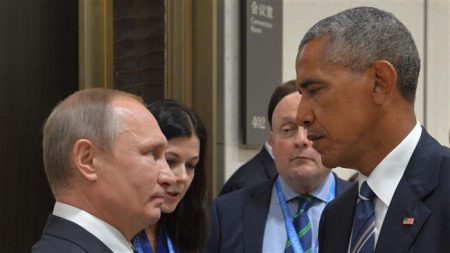
Russian President Vladimir Putin meets with his US counterpart Barack Obama on the sidelines of the G20 Leaders Summit in Hangzhou on September 5, 2016. (AFP)
Press TV – September 5, 2016
President Barack Obama has warned Russia that the United States has “more capacity than anybody” when it comes to cyber warfare, saying hack attacks can not become “wild, wild, West.”
Obama made the remarks to reporters following the G20 conference in Hangzhou, China. The issue of Russian hackers being implicated in breaching US cyberspace was a key issue at the summit.
Though Obama didn’t identify specific instances, he said, “We have had problems with cyber intrusions from Russia in the past” and that the goal is to not to duplicate a “cycle of escalation” that has occurred in arms races of the past.
“What we cannot do is have a situation where this becomes the wild, wild West, where countries that have significant cyber capacity start engaging in unhealthy competition or conflict through these means,” the president said.
Making a subtle threat to Russia, Obama added, “Look, we’re moving into a new era here where a number of countries have significant capacities. And frankly we’ve got more capacity than anybody, both offensively and defensively.”
US officials have blamed Russia for the recent hacking of the Democratic National Committee’s (DNC) servers, and law enforcement and intelligence agencies are reportedly concerned about the Kremlin trying to disrupt or undermine the presidential elections.
However, Russian Foreign Minister Sergei Lavrov has in the past rejected claims that Moscow was behind a recent hack of DNC servers.
In July, the WikiLeaks website released about 20,000 emails from the DNC, which showed that party leaders had purportedly sought to undermine the presidential campaign of Senator Bernie Sanders.
The revelation prompted DNC chairwoman Debbie Wasserman Schultz to announce her resignation.
The campaign of Democratic presidential nominee Hillary Clinton alleged that Russia had released the emails to influence the November presidential election.
Featured Video
Can the U.S. Afford to Annihilate Iran?
or go to
Aletho News Archives – Video-Images
Book Review
The Genetic Deception — now in paperback (Second Edition)
Lies are Unbekoming | October 2, 2026
The genes the field promised were never there.
The genetic story of disease is a cover story.
The twenty-first century runs on it. Paediatric clinics. Cancer centres. Forensic laboratories. Family-planning counsel. It is used to explain illness, to assign blame, to foreclose questions. It protects the industries whose products and practices are what actually caused the harm.
It isn’t true.
In 2010, Jonathan Latham and Allison Wilson looked at over seven hundred genome-wide association studies covering some eighty common diseases. The genes the field had promised were not there. The field invented a term, “missing heritability”, to explain the absence, and has quietly worked to bury the finding ever since.
The Genetic Deception is a book about what Latham and Wilson found. What the field did with it. And what the public was told instead. … continue
Blog Roll
 Aletho News
- Are Europe’s Smallest Nations Dragging the Continent into War?
- EU draws up contingency plans for possible Merz exit
- G7 caves to US blackmail, announces ‘massive’ release of diesel reserves
- Reporting of the RAF Fairford arrests blows the idea of a ‘free press’ out of the water
- US increasing Middle East military buildup – AP
- Flydubai scenario: Netanyahu’s plot to drag US to war with Iran, stay in power
- The Genetic Deception — now in paperback (Second Edition)
- Can the U.S. Afford to Annihilate Iran? /Seyed M. Marandi
- Elmo Sold mRNA Jabs to Your Toddler. Now They Are “Off-Label.”
- British state targets Palestine Action with yet another crooked trial
- If Americans Knew
- The Israeli Right Portrays Islam as Murderous. It Serves a Political Purpose
- Jordan Has Had Enough: King Abdullah’s Scathing Warning to Israel
- Israeli Colonizers (i.e. Settlers) Kill Palestinian Man Near Salfit
- New Google Maps images reveal massive scale of devastation in Gaza
- Jewish supremacy, anti-Palestinian bigotry on display in Israel – Daily Update
- Israeli Soldiers Abduct At Least 22 Across Occupied West Bank
- Eight Palestinians Killed in Israeli Attacks on Gaza
- Israeli former leaders and security chiefs threaten legal action over ‘Jewish terrorism’
- Israel map in LA Times ad includes all land from the river to the sea
- Inside Lebanon’s 200-page dossier on Israeli war crimes
- No Tricks Zone
- Green Energy Debacle: German Expert Professor Fritz Vahrenholt Warns Of Severe Economic And Social Consequences
- Two More Paleo Reconstructions Affirm Meters-Higher Sea Levels Across Ireland, Brazil 7000-6000 Years Ago
- New Study: Earth And Venus Surface Warmth Largely Explained By Convection And Lapse Rate, Not CO2 Or Radiation
- 2025 Nature Paper Claiming Worsening Global Drought Gets RETRACTED …Heavily Flawed
- New Study: ‘Global Drought Shows No Detectable Recent Acceleration Under Climate Warming’
- Economic Masterminds: German Socialists Suggest Taxing Productivity Gains Stemming From Using AI
- The South China Sea Has Not Been Cooperating With The Climate Change Narrative
- Energy Crisis: Germany Enters Heating Season With Historically Low Gas Reserve Fill Levels
- New Study: The Antarctic Ice Sheet Gained Mass From 2020-2024 Due To Staggering Snow And Ice Accumulation
- Study: Ocean Heating Rates From Thousands Of Years Ago ‘Dwarf’ Modern Ocean Heating Rates

