Turkey is key supplier of weapons, military hardware to ISIS – Russian envoy to UN
RT | April 1, 2016
Moscow has submitted data on Turkey’s illegal arms and military hardware supply to Islamic State in Syria to the UN Security Council. Supplies are supervised by the Turkish intelligence service, Russian UN envoy Vitaly Churkin said as cited by Russian media.
“The main supplier of weapons and military equipment to ISIL fighters is Turkey, which is doing so through non-governmental organizations. Work in this area is overseen by the National Intelligence Organization of Turkey,” Churkin wrote.
According to the envoy, transportation “mainly involves vehicles, including as part of humanitarian aid convoys.”
The letter mentioned several NGOs, which are funded from Turkish and foreign sources, which sent different cargo, including military equipment, to Syria last year.
“The Besar foundation (President — D. Şanlı) is most actively engaged in pursuing these objectives and, in 2015, formed around 50 convoys to the Turkmen areas of Bayırbucak and Kızıltepe (260 km north of Damascus),” Churkin stressed, adding that Iyilikder Foundation and The Foundation for Human Rights and Freedoms were also involved.
In total, the terrorists were delivered 2.5 thousand tons of ammonium nitrate (worth around $788,700), 456 tons of potassium nitrate ($468,700), 75 tons of aluminum powder ($496,500), sodium nitrate ($19,400), glycerin ($102,500) and nitric acid ($34,000 thousand) via Turkey in 2015, Churkin wrote.
Venezuela Faces Outside Threats, Says Russian Foreign Minister
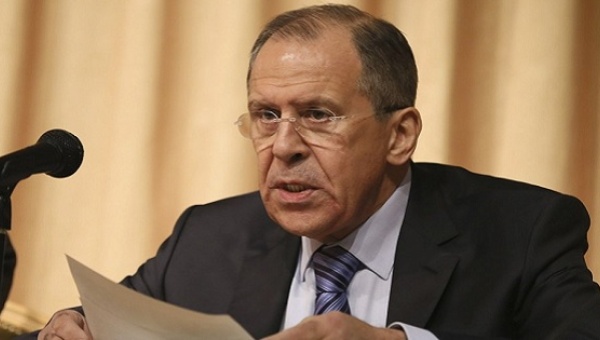
Russian Foreign Minister Lavrov reaffirms his country’s friendship with Venezuela. | Photo: PSUV
teleSUR – March 25, 2016
Russian Foreign Minister Sergei Lavrov said that his country has been closely following the situation in Venezuela and stressed that such is exacerbated by external interference.
“Venezuela is a friend country that they (opponents) are trying to destroy from outside,” Lavrov said Thursday during a meeting in Moscow with Venezuelan diplomats and Latin American students who are attending a course in diplomatic studies organized by the Russian Foreign Ministry.
At the meeting, the top diplomat explained the vision of Russia in Latin America and said he is pleased to see how Latin American countries have unanimously rejected coups led by right-wing opposition.
U.S. President Barack Obama issued an Executive Order March 9, 2015, declaring a “national emergency with respect to the unusual and extraordinary threat to the national security and foreign policy of the United States posed by the situation in Venezuela.” Obama then renewed that decree March 3, 2016, claiming that alleged conditions that prompted the first order had “not improved.”
All 33 members of the Community of Latin American and Caribbean States expressed their opposition to the U.S. government’s aggressive move and called for it to be reversed.
EU Urges UN to Join Anti-Russia Sanctions
By Alex GORKA – Strategic Culture Foundation – 23.03.2016
The European Union called on March 18 for more countries to impose sanctions on Russia over Crimea joining the Russian Federation two years ago.
In a statement issued on the anniversary of Crimea’s formal accession to Russia, the EU said it will maintain its sanctions that ban European companies from investing in Russian Black Sea oil and gas exploration.
«The European Union remains committed to fully implementing its non-recognition policy, including through restrictive measures», the European Council, which represents EU governments, said. «The EU calls again on UN member states to consider similar non-recognition measures».
Separately, NATO Secretary-General Jens Stoltenberg urged the EU and United States to maintain their broader economic sanctions against Russia over its support for self-declared republics in the eastern part of Ukraine. «It is important that we continue the economic sanctions», Stoltenberg told an event in Brussels.
The Crimean Peninsula became a part of the Russian Federation on March 18, 2014 after the referendum carried out on March 16 showed 97 percent of voters supported joining Russia.
The Kremlin responded by saying that the issue of Crimea could not be «a matter of negotiations or international contacts». «Our position is known: this is a region of the Russian Federation. Russia has not discussed and will never discuss its regions with anyone», President Vladimir Putin’s spokesman Dmitry Peskov said in a teleconference with reporters.
«In this case we should treat with respect the expression of the will of Crimean residents and the decision which was taken two years ago», he emphasized.
The 28-nation EU imposed its Crimea sanctions in July 2014 and then tightened them in December 2014, banning EU citizens from buying or financing companies in Crimea. The United States, Japan and some other major economies, including Australia and Canada, also imposed sanctions on Russia, whereas many other economically developed nations, like, for instance, China and Brazil, refused to join.
It should be noted that the extension of anti-Russian sanctions is a very much divisive issue inside the European Union.
Hungary and Italy said last week they would not agree to extend the EU’s toughest economic sanctions on Russia, the EU’s major energy supplier, without discussions before the summer.
Germany’s Economy Minister Sigmar Gabriel called on March 17 for the EU to try to create conditions by this summer to lift sanctions.
France’s Minister for the Economy, Industry and Digital Affairs Emmanuel Macron said in January that Paris will look to assist in the lifting of Western backed sanctions on Russia by the summer.
Serbia, a nation in talks on joining the EU, has firmly rejected the idea of joining the sanctions regime.
US Republican Senator John McCain has the reputation of hawk calling for getting tough on Russia. But even he had to admit the fact that the sanctions are becoming increasingly unpopular inside the EU. «I think there is clearly a lot of conversation amongst the Europeans about lifting the sanctions… There are many countries that are looking for the exit sign», the Senator said in February. «I have been hearing it for months, that there is enormous pressure in a lot of countries, particularly Germany, to lift the sanctions», he noted.
At that the prominent US politician believes it is up to Washington if and when the sanctions are eventually lifted, saying that the final decision will «to some degree depend on American leadership». Actually, the US right-wing politician openly stated the EU decision on the sanctions is made under US pressure.
Indeed, the EU is following the US. President Obama announced American sanctions against Russia are to be prolonged for another year on March 2.
The EU obediently chimed in 16 days later.
The attempts of the EU to influence other countries into joining the anti-Russia sanctions regime look especially ridiculous against the organization’s failure to make the tiny nation of San Marino, an enclaved microstate surrounded by Italy, comply with the EU’s demands. The republic is not officially part of the European Union and does not face Russia’s food embargo. According to Rossiyskaya Gazeta, a Russian government daily newspaper of record which publishes the official decrees, statements and documents of state bodies, San Marino and Russia signed an export agreement on March 18 during the International Economic Forum of CIS countries.
San Marino’s Minister of Regional Development and International Economic Cooperation Antonella Mularoni attended the forum. Now this European country will export to Russia a range of products, including Parmesan cheese and premium meat products like local Parma type ham. «There are 24 dairies in the republic, and a lot of enterprises engaged in meat smoking», the executive director of the national wholesalers association Vladimir Lishchuk told Rossiyskaya Gazeta. According to him, imports will take the place of illegal goods bypassing the Russian food embargo. Russia’s food safety watchdog Rosselkhoznadzor said it would monitor food imports from San Marino to prevent re-exports of sanctioned products from neighboring EU countries. Russia introduced the food embargo in August 2014 in response to Western sanctions. The ban applied to meat, poultry and fish, cheese, milk, fruit and vegetables from the United States, the EU, Australia, Canada, Norway, Japan and a number of other countries. According to Russia’s Ministry of Economic Development, the import of banned products has fallen by nearly half to $6 billion in the first six months of 2015. Overall imports from the EU have fallen by 45 percent.
Evidently, the EU’s call for UN members to join the sanctions is an effort doomed to go down the drain. The European Union has no leverage strong enough to make world nations comply.
The organization itself is not in a strong position. Looks like it has seen its best days. Brussels is facing a host of acute problems. Many of them seem to be a tall order, for instance: the flows of migrants, the economic inequality of the Union’s members, debt problem and the conflicting views of the UK and Germany on European integration, to name a few.
Doing away with the divisive issue of anti-Russia sanctions could provide an impetus to making progress in other fields, but Brussels prefers a different approach.
The EU statement shows the Union’s leadership is adamant in its desire to go down the slippery slope risking a revolt among the member-states with tensions running already high inside «the European family».
Mission Accomplished: Fallout Between Iran and Russia in Syria?
By Mahdi Darius NAZEMROAYA – Strategic Culture Foundation – 20.03.2016
Since the start of 2016 the mainstream media in the US and the countries that are in Washington’s sphere of influence have been talking about fallout between Russia and Iran over the conflict in Syria. These media reports continuously talk about Russia becoming afraid of Iran or vice-versa, Iran becoming afraid of Russia. These reports constantly talk about competition and rifts between the Iranian and Russian governments over Syria.
Here are two examples. The Financial Times reported that Iran should be afraid of Russia on February 24, 2016. A few weeks later, Bloomberg reported that the Russian military downsizing in Syria risks a rift with Iran in an article by Ilya Arkhipov, Dana Khraiche, and Henry Meyer, published on March 16, 2016.
For months, however, the steady streams of reports about a Russo-Iranian split have been utterly wrong. They are part of a campaign of misinformation (wrong information and analysis) and disinformation (propaganda). The relations between Moscow and Tehran are stable, and their cooperation is strategically oriented. In fact, Russia is supporting Iran against the US initiative at the United Nations Security Council to say that Iranian ballistic missile tests are a violation of Joint Comprehensive Action Plan (JCAP) signed between Iran and the US, Britain, France, Germany, China, and Russia (the P5+1 or EU3+3).
By the same token, other misleading and deceiving reports have been released about Iranian and Russian tensions. Some have been over the levels of Iranian oil production exports. Others have been about fallout between Moscow and Tehran over an Iranian transfer of Russian arms to Hezbollah in Lebanon. Many have also been about the deal and delivery of the Russian-manufactured S-300 anti-missile system to the Iranian military.
In regards to a Russo-Iranian rift over Iranian oil production, these reports focus on demands by Saudi Arabia and Russia that Iran cut back its oil production. Moscow, however, has said that Iran is a special cases and it understands that Iran is working to regain lost energy markets. It has exempted Iran from its call to cut back global oil exports under a global output freeze as part of an initiative to raise the price of oil. While visiting his counterpart in Tehran in mid-March 2016, Russian Energy Minister Alexander Novak even announced that the Russian government understands and accepts the Iranian position, which demands that Iran be allowed to regain its pre-sanction output levels.
In regards to Israeli media reports that there has been fallout between Iran and Russia over Russian arms being transferred to Hezbollah, no signs of this have manifested themselves empirically anywhere. The Russian government has made no statements against Iran. Nor have the Israeli reports been verified in any substantive way.
It was reported in Kuwait that the S-300 deal had been annulled on March 9, 2016. On the same day Sputnik interviewed an Iranian military spokesperson, who rejected the claim. While, from what the public knows, the delivery of the S-300 system to Iran by Russia has been delayed, this does not automatically insinuate tensions between Moscow and Tehran. Both Iranian and Russian officials have repeatedly denied reports saying that the deal has been cancelled. Delays have taken place due to legal provisions and technical matters, according to officials in Moscow and Tehran. Rostec, the government-owned national arms manufacturer of Russia, has even announced that the first orders of the S-300 will be delivered to Iran sometime running from August to September 2016.
Russo-Iranian Cooperation in Syria
About three weeks after a cease-fire agreement for Syria officially started (on February 27, 2016), Russian President Vladimir Putin announced that Russia would begin to partially withdraw from Syria on March 14, 2016. The next day the Russian military began downsizing its presence in Syria. This began being presented as a stumbling block between Tehran and the Kremlin.
Reports were published that claimed that Tehran was upset at the Russian move. The Russian withdrawal is portrayed in these reports as a surprise to the Iranian side. The Iranian government, however, has announced that the reduction of the Russian military force in Syria is a positive sign of success, which means that Iran and Russia have achieved their key objectives inside Syria. Moreover, if the Russian move hurt Iranian interests inside Syria, it would not have resulted in Israeli President Reuven Rivlin making a request on March 16, 2016 to Moscow to ensure that Iran and Lebanon’s Hezbollah do not benefit from the Russian decision to reduce its military presence.
Nor was Iran caught off guard by the Kremlin’s decision to reduce its military presence in Syria. Iranian and Russian generals and officials have been shuttling back and forth from one another’s capitals for months speaking on and strategizing over the conflict Syria. It is highly unlikely that Moscow’s decision to reconstitute its military position in Syria was not coordinated with either the Iranian or Syrian governments. Tehran, Moscow, and Damascus have been constantly consulting one another about the military operations in Syria.
If it was not for Iranian and Russian cooperation and resoluteness in Syria, the cease-fire agreement in Syria would not have materialized. The most recent wave of false reports about Russian and Iranian tensions in Syria are aimed at creating suspicion and managing the perception of US clients. This discourse is not only aimed at misleading people or targeting Iran and Russia, it is aimed at deceiving US clients and Syrian opposition figures in the Middle East about the reality of the situation on the ground in Syria, which is that the camps supported by the Iranians and the Russians in the Middle East are the ones on top.
Any ideas about some type of Russo-Iranian fallout are wishful thinking. Both powers are moving towards even deeper cooperation across the Eurasian landmass from the Mediterranean littoral and Iraq to the Caucasus and Central Asia. They are not only cooperating militarily together, but both Tehran and Moscow are also deepening their industrial, agricultural, financial, political, and economic ties too. This is no temporary alliance, but part of a long-term engagement and strategic partnership.
Soros Disruption: American-Style
By Wayne MADSEN – Strategic Culture Foundation – 20.03.2016
Eastern Europeans and Arabs are all-too-familiar with the political street hooliganism sponsored by global «provocateur» George Soros and his minions. Lately, middle-class Americans have had a taste of the type of violent protest provocations during the current US presidential campaign that have previously been visited upon governments from Macedonia and Moldova to Syria and Libya.
Recently, Donald Trump campaign rallies have seen highly-coordinated and well-planned political demonstrations in Chicago, Cleveland, St. Louis, Dayton, and other cities. The rallies were disrupted by highly-coordinated and well-planned protesters waving freshly-printed protest signs before awaiting television cameras. Such «rent-a-mob» actions are trademark signs of the involvement of George Soros and the «godfather» of political street violence, Gene Sharp, in disrupting the normal political process.
One of the favored methods proposed by Sharp and embraced by Soros-financed groups is the taunting of individuals. Sharp’s advice to taunt speakers is being played out in the US presidential campaign: «instead of predominantly silent and dignified behavior… people may mock and insult officials, either at a certain place or by following them for a period». Sharp suggests that taunting individuals, such as presidential candidates, be combined with a refusal to disperse when either asked or ordered to do so. Sharp claims that these methods are «non-violent». However, when the US Secret Service, charged with protecting presidential candidates from assassination or bodily harm, order protesters to leave a campaign venue and there is a subsequent refusal to do so, violence is a certainty.
Soros and Sharp honed their street revolution tactics on the streets of Belgrade in the Bulldozer Revolution that overthrew Serbian president Slobodan Milosevic on October 5, 2000. Two Soros-financed and Sharp-inspired groups, OPTOR! and the Center for Applied Nonviolent Action and Strategies (CANVAS), as well as their leader Srdja Popovic, a so-called «pro-democracy» agitator, have all been unmasked as US intelligence assets. Popovic has received funding from the CIA-linked US Institute of Peace, a creation of neo-conservatives to advance the type of undemocratic political street disruptions first seen in Serbia and that soon expanded to Ukraine, Georgia, Egypt, Venezuela, Russia, Macedonia, and other countries. Today, Soros-inspired political violence has targeted Trump rallies across the United States.
Popovic first began to infiltrate American politics by ostensibly supporting the Occupy Wall Street movement. As his ties to the CIA and Goldman Sachs later showed, his intent and that of his financiers were to derail the anti-capitalist popular movement.
Several veteran «agents provocateurs» of the Occupy Wall Street movement who are now part of the Bernie Sanders presidential campaign have been enlisted by groups like Unbound Philanthropy, an immigrant rights group, to disrupt Trump rallies. Together with the Soros-financed group Black Lives Matter, these professional street hooligans have carefully, and in compliance with the Sharp model, staged their demonstrations to achieve maximum media coverage while achieving the maximum level of disruption to the primary election process.
Unbound Philanthropy is funded by Obama’s deep-pocketed friend and frequent vacation host in Hawaii, William Reeves, a former JP Morgan executive who now heads up BlueCrest Capital. In some cases, the political protesters masquerade as Trump supporters by wearing pro-Trump shirts and hats in order to gain access to Trump campaign venues. This methodology of disruption employs another Sharp tactic, that of using false identities. Coupled with the tactic of «non-violent harassment» of individuals, the use of employing false identities to gain admittance to Trump rallies, followed by coordinated protests in the form of placard-waving «stand-ins», are textbook examples of Sharp tactics being employed with the financial support of Soros and his gang, which includes Reeves and pro-immigration Hispanic groups and Black Lives Matter. Many of the anti-Trump street actions are coordinated by MoveOn.org, another group financed principally by Soros and the Hyatt Hotels’ Pritzker family of Chicago. One member of the Pritzker family, Penny Pritzker, serves as the Secretary of Commerce in the Obama administration.
MoveOn.org, which has endorsed Sanders, is actually using its protests at Trump rallies as a fundraising gimmick. It promises to disrupt future Trump campaign rallies and it will use every weapon in the Sharp/Soros handbook.
Another Sharp/Soros tactic employed against Trump is the «speak-in». During a Trump campaign appearance in Dayton, a pro-Bernie Sanders protester jumped a barrier and rushed the stage in an attempt to grab the microphone from Trump. The Secret Service tackled the protester who was arrested by police. The protester previously took part in a 2015 protest at Wright State University in Dayton where he dragged a US flag on the ground. Destruction of property, including US flags, is another hallmark disruption tactic proposed by Sharp.
The Sharp definition of a «speak-in» is a «special form of nonviolent intervention… when actionists interrupt a meeting… or other gathering for the purpose of expressing viewpoints on issues which may or may not be related directly to the occasion». Soros classifies the action as «social intervention», with «psychological and physical aspects». Regardless of Sharp’s definition of such actions as «nonviolent», the Secret Service does not take lightly anyone lunging at a presidential candidate, especially after the assassination of candidate Robert F. Kennedy in Los Angeles in 1968 and the shooting and attempted assassination of candidate George Wallace in 1972. Soros’s operatives are dangerously playing with fire by bringing such violence-tinged street protest tactics to the American presidential political scene.
The stench of Popovic and Soros in the street operations against Trump, who has railed against Wall Street’s «free trade agreements» and neo-conservative «wars of choice», can be seen in the links between the street protest groups and corporate giants like Goldman Sachs.
Popovic and his CANVAS non-governmental organization (NGO) has received funding from a former Goldman Sachs executive named Muneer Satter.
Satter happened to work at Goldman Sachs with fellow corporate executive Heidi Cruz, the wife of Trump’s opponent for the Republican presidential nomination, Senator Ted Cruz of Texas. Although Satter retired from Goldman Sachs in 2012 he continues to serve as vice chairman of the Goldman Sachs Foundation. In 2012, the year that Satter retired from Goldman Sachs, the firm loaned more than $1 million to Cruz’s Texas US Senate campaign.
Satter also happens to be close to both President Barack Obama and anti-Trump GOP operative Karl Rove. Satter has donated to both Obama and Rove’s Crossroads political action committee. Satter was also the national finance co-chair of Mitt Romney’s 2008 and 2012 presidential campaigns.
This year, Satter joined the Senator Marco Rubio campaign as Illinois Finance Committee co-chairman. Such background players, Heidi Cruz and her Goldman Sachs friend Satter, as well as Rove, Romney, Reeves, Soros, the Pritzkers, and Popovic – a Central Intelligence Agency-linked foreign interloper in the United States political system – are the actual movers and shakers behind America’s presidential election. Their jobs and those of other deep-pocketed political financiers like Paul Singer, Haim Saban, Sheldon Adelson, Michael Bloomberg, Sam Zell, and Norman Braman, are to ensure that no «unfiltered outsiders» ever become the President of the United States. These and other wealthy backroom political maestros owe their undemocratic but massive political influence to insider politicians residing at 1600 Pennsylvania Avenue in Washington. They will do everything in their power to prevent an «unfiltered» candidate from becoming the next American president.
Australia Still Reluctant to Disclose MH17 Information
By James ONeill – New Eastern Outlook – 19.03.2016
When Malaysian Airlines Flight MH17 was shot down over Eastern Ukraine on 17 July 2014, Australian politicians and the mainstream media, especially the Murdoch newspapers, were quick to apportion blame. Responsibility for the disaster was immediately attributed to Russia, either directly or thorough Russian support for the so-called “separatists” in the Donbass region.
For the Australian politicians and media it was a case of “guilty as alleged” although at that time in the immediate aftermath of the disaster there was no evidence upon which to form any conclusions.
Three days after the crash the United States Secretary of State, John Kerry, appearing on NBC’s Meet the Press TV program said that the US had
“picked up the imagery of this launch. We know the trajectory. We know where it came from. We know the timing. And it was exactly at the time that this aircraft disappeared from the radar.”
Mr Kerry did not specify how the US had this information, but it was a reasonable inference at that time that the data had come from US satellites.
Since Mr Kerry’s remarks it has been established by independent investigators that the US had at least three satellites in geo-stationary orbit over Eastern Ukraine on 17 July 2014 Two of these satellites are of the SBIRS type (GEO-1 and GEO-2), and a Space Tracking and Surveillance System (STSS) satellite. Between them they are able to perform continuous surveillance of the area of interest.
Some commentators have endeavoured to downplay the significance of this by suggesting that factors such as cloud cover impeded surveillance capability. This is self-evidently nonsense. As one of their prime functions is to detect missile launches, their defensive capability would be hopelessly compromised if something as simple as cloud cover impeded their capacity to provide a timely warning of missile launches.
The capability of these satellites certainly includes the ability to detect and track the launch of a BUK missile, the weapon most commonly described as the cause of the disintegration of MH17. They can similarly track an air-to-air missile, which is the alternative hypothesis that has been advanced.
There has been a great deal of contradictory information from official sources about this satellite data, which is itself suspicious. For example, on 19 December 2015 the Dutch chief prosecutor and coordinator of the criminal investigation into the disaster, Mr Fred Westerbeke, told the Dutch daily newspaper NRC :
“Satellite images showing how on July 17 Flight MH17 was shot out of the sky by a rocket do not exist. There has been a misunderstanding about this… There is no conclusive evidence from intelligence services with the answers to all the questions.”
If Mr Westerbeke was correct, then it clearly contradicts the claims made by Mr Kerry 17 months earlier. But Mr Westerbeke then contradicted his own earlier statements in a letter to the families of the Dutch victims in February 2016. In that letter Mr Westerbeke stated:
“The US authorities have data generated by their own security forces, which could potentially provide information on a rocket trajectory. These data have been confidentially shared with the Dutch Military Intelligence and Security Service (DISS). The DISS and the Public Prosecutor are now investigating in what form the US state secret information can be used in the criminal investigation and what will be provided in a so-called official report to the Public Prosecution. That special report can be used as evidence by the Joint Investigation Team (JIT).”
It seems a reasonable inference on the basis of that statement that the secret US satellite data does disclose the required information. Specifically, it answers the major question: who fired the missile and from where?
The issue that is publically troubling the JIT is how to use sensitive intelligence data in a public forum such as a trial of accused persons. The undisclosed problem for the JIT is twofold. If, as is widely suspected, the satellite data show that the BUK missile was fired by Ukrainian forces, then that will contradict 20 months of relentless anti-Russian propaganda. The western media are not good at admitting the error of their ways.
The second problem is the agreement of 8 August 2014 whereby the members of the JIT agreed not to disclose any information unless all the parties agreed. As one of those parties, Ukraine, is a prime suspect, it is unlikely that the evidence will ever be revealed if it in fact implicates Ukraine.
It is still the case that the Australian government has never acknowledged the existence of the 8 August 2014 agreement. It has not bothered to tell the Australian public why it entered into such an agreement when the public interest would demand a transparent and full investigation of the worst disaster to be inflicted on Australians since the Bali bombings of 2002.
Given the existence of Mr Westerbeke’s letter to the families of Dutch victims it is difficult to understand why the Australian media are persisting with the claim that the Americans have refused to release the data. Paul Malone’s claim to that effect in the Canberra Times of 12 March 2016 is plainly wrong. It is possible of course that Mr Malone is aware of the facts, but the two problems identified above prevent him disclosing those facts.
Apart from detecting the launch of a missile, the satellite data can pinpoint the precise point from which the missile was fired. In the present case that is supremely important.
The Report of the Dutch Safety Board (DSB) into the MH17 disaster, published in October 2015 only went as far as to narrow the location of the launch site to an area of 320 square kilometers. This was territory contested by both Ukrainian and separatists forces. Despite the uncertainty and non-attribution of culpability in the DSB Report, Australian politicians falsely claimed that the report “proved” that Russian backed separatists were responsible.
Apart from a complete failure by the Australian media to correct this false information, they have also failed to address two further pieces of relevant evidence found in the DSB Report.
The first piece of evidence is found in the technical appendices of the DSB Report. Appendix T (from the Dutch Intelligence Services) has clearly not been read by any member of the Australian mainstream media. This appendix stated, inter alia:
- Although the separatists had captured a Ukrainian military base at Donetsk, the BUK systems located there were “not operational” and therefore “could not be used by the separatists.”
- Although there was information pointing to the fact that the separatists had been supplied with heavy weapons by the Russian Federation, there were no indications that these were powerful anti-aircraft systems.
- Although the separatists were trained to use weapons systems, there are no indications that they were being trained to use powerful anti-aircraft systems.
- There was no evidence of any intention by the separatists to shoot down a civil aircraft.
Reports in the mainstream media imply that the firing of a BUK missile is a matter of pointing it at the sky and pushing the proverbial button. As Appendix T makes clear however, extensive training in their use is required.
Not only must the crews be trained to a high level of proficiency, for which Appendix T notes there is no evidence in respect of the separatists, the firing of a BUK missile also requires the ancillary use of radar systems. Again, there is no evidence that the separatists had such radar equipment.
There was evidence however, that radar equipment of the Ukrainian armed forces was operational at the relevant time and in the relevant location. The Russian authorities at a press briefing given on 21 July 2014 disclosed this. Again, the Australian media ignored this evidence.
Contrary to the vague generality of the DSB Report as to the launch location, we have a report by the Russian manufacturer of the BUK missile, Almaz-Antey, released at the same time as the DSB Report.
Almaz-Antey produced a detailed analysis of the data. Their conclusion was that the BUK missile was launched from the Zaroschenskoe area, which was under the control of the Ukrainian armed forces at the time. This report has never been mentioned in the Australian mainstream media, probably because its conclusions do not fit the official narrative.
Thus, Mr Malone in the Canberra Times states that the JIT investigation is “widely expected” to “confirm that the missile was launched from separatist held territory.” It would only be “widely expected” by those reliant upon the constant stream of disinformation and concealment of evidence common to the mainstream media’s coverage of the MH17 disaster.
It was noted above that there was an alternative hypothesis about the cause of MH17’s crash, namely an air-to-air missile, presumably fired by one of the Ukrainian fighter aircraft identified in the area in the Russian briefing of 21 July 2014.
The Russian forensic expert Albert Naryshkin comprehensively advanced the air-to-air missile theory in July 2015. His report (available only in Russian) concluded that although the specific weapon could not be unequivocally identified, the specific nature of the missile damage to the aircraft meant that the most likely weapon was a Python air-to-air missile.
This particular weapon was adapted for use by the SU-25 Scorpion fighter that was the type of fighter observed by Russian radar data on 17 July 2014 and reported on at the 21 July 2014 briefing.
The merits or otherwise of this hypothesis are beyond the scope of this article. Suffice to say that it was not considered by the DSB and any mention of it is conspicuously absent from the Australian media.
Three further recent developments are worth noting. The first of these was the Coronial Inquest held in Melbourne in November 2015 in respect of the Australian victims. The inquest has been reported by John Helmer on his website. Suffice to note here that the coronial inquiry was deeply flawed. It was marked by secrecy, the suppression of evidence, conflicts of interest, and a manifest desire to simply parrot the official line regardless of other evidence that is progressively emerging.
It accepted without question the conclusions of the DSB Report, even though that Report is incomplete, does not ascribe culpability as it awaits the JIT investigation, and for the reasons mentioned below, is far from flawless.
The second development worth noting is that both the Dutch and the Russians have released letters addressed to the families of the victims.
The Russian statement is by the Deputy Head of the Federal Air Transport Agency of the Russian Federation, Oleg Storchevoy. Mr Storchevoy takes the opportunity to address some of the misinformation about what Russia has and has not done to assist the official inquiry.
He notes, for example, that Russian primary radar data was provided to the DSB, together with telephone conversations and other data, in August 2014. Russian primary radar data was in fact the only such data available, as the Ukrainians had for some reason switched off their radar at the critical time.
The Russian data supplied to the DSB confirmed increased activity by Ukrainian BUK missile systems within the conflict zone ahead of the tragedy. That evidence was ignored by the DSB.
It might be interpolated here that the separatists have no air force, so the need for anti-aircraft systems to be active remains obscure. No explanation has been forthcoming from the Ukrainians.
Mr Storchevoy also drew attention to the unprecedented cooperation offered by Almaz-Antey, the BUK manufacturer which again was ignored by the DSB.
Mr Storchevoy noted that Russia has repeatedly pointed out that the Dutch technical investigation was performed in an extremely non-transparent and biased manner. He said that the Dutch authorities should also explain how they distorted facts and concealed data, and ignored important data supplied by the Russians.
These and other questions posed by Mr Storchevoy are legitimate and deserve careful consideration and response. Perhaps needless to add, no report of Mr Storchevoy’s statement has appeared in the Australian mainstream media.
The second letter was written to the families of the Dutch victims by the head of the JIT inquiry, Mr Fred Westerbeke.
Mr Westerbeke’s letter discussed, inter alia, that conclusions about the technical analysis of the aircraft debris should be available in the latter half of 2016. Importantly, as noted above, he confirmed that the Americans had provided data about the missile trajectory although the form in which that data can be used is unsettled.
Mr Westerbeke also said that the analysis of other data, including intercepted telephone calls, location data from telephones, images (unspecified), witness statements and technical calculations would enable “certain inferences” to be drawn about the rocket’s track.
Reference was also made to the English blogger Eliot Higgins who operates under the name of “Bellingcat.” Despite repeated critical analysis of Higgins’ falsification of data and manifest other errors, he continues to be reported in the western mainstream media as a reliable source.
Why western intelligence agencies, with their vast resources, would defer to one man operating out of his house in Leicester is explicable only if Higgins is seen as a useful conduit for what is invariably anti-Russian propaganda.
Westerbeke obliquely dismisses Bellingcat as a resource, as “providing no evidence of direct involvement of members of a Russian unit” in the shoot down on MH17. The claim of Russian direct involvement is one of the more sensational of Bellingcat’s claims faithfully and uncritically reported in the western media.
In the light of the Westerbeke letter, the Australian Federal Police were asked whether they agreed with the contents of the Westerbeke letter. Westerbeke had signed the letter on behalf of the members of the JIT (which includes Australia).
They were also asked whether a similar letter would be sent to the Australian families. The AFP’s response was a non-answer, saying only that the queries had been forwarded to the JIT!
Information has also been sought from the Prime Minister’s on what compensation the Australian victim families might expect. Under the relevant Australian legislation victims of terrorism are eligible for compensation up to $75,000. That possibility was raised by a number of mainstream media outlets in Australia in July 2014. In order to be eligible the Prime Minister must declare that the deaths of the Australian citizens were as a result of a terrorist attack.
The government had announced on 9 October 2013 that payments would be made to the victim’s families of other terrorist attacks pursuant to the prime ministerial declaration. The payments have been applied retrospectively, starting with the events of 11 September 2001. To date there have been 10 such declarations, the latest being the Paris attacks of 13 November 2015.
The Australian government has not declared the shooting down of MH17 to be a terrorist act for the purposes of the legislation. The reasons for this are unknown, although comment has been sought from the Prime Minister’s office.
Australian victim families still have other remedies available under the provisions of the Montreal Convention of 1999. Under Article 21 of that Convention damages of (approximately) $215,000 are set.
Potential liability of the carrier, in this case Malaysian Airlines, is however unlimited unless it can prove that the death “was not due to the negligence or other wrongful act or omission of the carrier or its servants or agents.”
Given that the evidence appears to suggest that MH17 either flew over a war zone of its own volition or was directed to do so by Ukrainian air traffic control, discharging that onus may prove difficult.
Proceedings seeking various declarations have been launched in the New South Wales Supreme Court by Tim Lauschet (2015/210056) against Malaysian Airlines, but that case is still at a preliminary stage.
The only clear point to emerge in Australia in the 21 months since the disaster is that the government and the mainstream media are determined to, on the one hand deny the public vital information about the disaster, and on the other hand maintain the fiction that the disaster was the fault of Russian backed separatists.
That line serves to justify the sanctions imposed on Russia and the continuing demonization of President Putin. If only Prime Minister Turnbull’s plea for an intelligent and adult dialogue was sincere. If that were the case the Australian public would be better informed than they are. It seems a very vain hope.
James O’Neill is an Australian-based Barrister at Law.
Pentagon Drops the Ball Over Open Skies Treaty With Russia
Sputnik – 16.03.2016
US officials want Washington to deny Russia the right to observe strategic infrastructure facilities in the US from the air under the Open Skies Treaty.
At the center of their concerns is a new sensor suit installed on Tu-214OS, a special-purpose reconnaissance aircraft, used for such flights.
Some Congress and Pentagon representatives have already voiced concerns that Russia might use these flights to spy on American power plants, communications networks and other critical infrastructure.
“I cannot see why the United States would allow Russia to fly a surveillance plane with an advanced sensor over the United States to collect intelligence,” The New York Times quoted Representative Mac Thornberry, a Texas Republican who heads the House Armed Services Committee, as saying in a statement earlier in February.
His concerns are echoed by US Strategic Command (STRATCOM) Commander Adm. Cecil Haney:
“The treaty has become a critical component of Russia’s intelligence collection capability directed at the United States.” Defense One, the US defense and national security website, quotes him as saying.
“The Open Skies construct was designed for a different era…I’m very concerned about how it’s applied today,” adds Defense Intelligence Agency (DIA) Director Lt. Gen. Vincent Stewart.
Defense One, however has an answer to their concerns.
When the Treaty was first negotiated, the states involved all approved the use of panoramic and framing cameras using film, video cameras, infra-red line-scanning devices and sideways-looking synthetic aperture radar – all far less capable than what was then available to intelligence agencies, it explains.
The maximum ground resolution acceptable with treaty-approved cameras is 30 centimeters. Today, anyone can buy commercial satellite imagery with a resolution of 25 centimeters, it adds.
Russia recently requested to switch from wet-film cameras to digital sensors for its surveillance flights over the US.
The website says that the Treaty has provisions to upgrade and modernize sensors. Film has long ago given way to digital imagery. Treaty members have agreed to allow a digital electro-optical sensor package upgrade, but not to allow Open Skies flights to operate so that higher resolution can be obtained.
So why doesn’t the US military add its own digital sensors, questions the website?
“Because the Pentagon dropped the ball,” it explains.
“A policy directive to proceed with the upgrade was issued in 2012, but the Defense Department didn’t issue a request for proposal until 2015, and still hasn’t chosen a contractor. The issue isn’t money – perhaps $45 million. The problem is that Open Skies flights are a very low priority for the Pentagon.”
“At a time when the Pentagon is embarked on a new $3 billion initiative to reassure European friends and allies worried about Russian belligerence, it makes sense to speed up equipping the US Open Skies plane with digital imaging capabilities, rather than to complain about the disadvantages of mutual transparency,” it furthermore states.
Russia has for years conducted unarmed observation flights over the United States, just as the United States does over Russia, as part of the Open Skies Treaty, which was signed in 1992 by both nations as well as 32 other countries at the end of the Cold War, and entered into force a decade later.
Although the treaty and the flights, unfamiliar to most Americans, amount to officially sanctioned spying, their goal has been to foster transparency about military activity and to reduce the risk of war and miscalculation, especially in Europe.
“Amid last year’s rising tensions, the US Open Skies aircraft carried out twice as many overflights as its Russian counterpart,” Defense One says.
“US flights have strengthened ties between NATO members and have reassured non-NATO states around Russia’s periphery. Under the Treaty’s “ride-sharing” provision, US flights over Russia in 2015 carried crew members from Ukraine, Canada, France, Germany, the Czech Republic, Great Britain, Turkey, Italy and Romania.”
“Moreover, complaints about the new Russian advantage under Open Skies may be overblown and are certainly misdirected. The Kremlin isn’t the culprit in this case; the Pentagon is,” it says.
Russian officials confirmed the plans to equip surveillance planes with digital hardware but cited the obsolescence of wet-film equipment as a major reason behind the decision.
“We are switching to digital equipment because nearly nobody produces wet-film equipment any longer,’ said Mikhail Ulyanov, director of the Foreign Ministry Department for Non-Proliferation and Arms Control, in an interview to RBTH.
It also eliminates photochemical processes, allowing an operator onboard to observe terrain in real time, according to Vartan Shakhgedanov, chief design engineer of the new Russian system.
The system, specifically designed for Open Skies flights, includes two Tu-214ON planes produced by the Vega Radio Engineering Corporation (Vega) and the United Instrument Manufacturing Corporation (UIMC), two bodies within the Russian state corporation Rostec.
However, if Russia successfully upgrades its surveillance equipment, the US risks losing its advantage in what has so far been a relatively safe way to obtain strategic intelligence.
The new equipment meets criteria for film resolution set by the Open Skies Treaty, but is less clunky than its predecessor.
Rose Eilene Gottemoeller, the Under Secretary of State for Arms Control and International Security for the US State Department sought to temper concerns about Russian overflights, saying that what Moscow gains from the observation flights is “incremental” to what they collect through other means.
“One of the advantages of the Open Skies Treaty is that information — imagery — that is taken is shared openly among all the treaty parties,” she said at a joint hearing of the House Foreign Affairs and Armed Services committees back in December.
“So one of the advantages with the Open Skies Treaty is that we know exactly what the Russians are imaging, because they must share the imagery with us.”
US State Dept Pledges to Retain Sanctions Until Russia Returns Crimea
Sputnik — 16.03.2016
 Washington will not lift the sanctions imposed after the reunification of Crimea with Russia until Moscow decides to “return Crimea to Ukraine,” the spokesman for the US State Department said.
Crimea, which has a predominately ethnically-Russian population, seceded from Ukraine to rejoin Russia two years ago following a referendum on March 16 in which over 96 percent of voters supported the move.
“We will not accept the redrawing of borders by force in the 21st century. Sanctions related to Crimea will remain in place as long as the occupation continues. We again call on Russia to end that occupation and return Crimea to Ukraine,” John Kirby said in a statement Wednesday.
He added that Washington remains committed to “a united, sovereign Ukraine.”
In 2014, the United States, the European Union and some of their allies imposed a series of economic sanctions targeting key Russian sectors as well as a number of individuals and entities over Russia’s reunification with Crimea and its alleged interference in the conflict between Kiev and independence supporters in eastern Ukraine, denied by Moscow.
Featured Video

Diplomacy is Now a Crime in Britain / Ian Proud
or go to
Aletho News Archives – Video-Images
From the Archives
Genetic baloney in thick slices
MAYBE COULD BE INC.
By Jon Rappoport | No More Fake News | July 8, 2021
Gene research companies tend to come and go. They start out banging and popping like fireworks in the sky, and then they fade out—selling themselves to larger outfits who’ve hired better liars…
Once upon a time, it sounded easy. Start with a disease, find the gene responsible for the disease, and correct the problem.
Then, researchers wondered, was disease the result of one gene or a group of genes acting together?
Either way, the proof would be in devising cures for diseases using gene therapy. “Not yet, but soon…”
And regardless, the major need was: money. Lots and lots of money.
This need required good PR people. “We have to pump up the idea that we’re on the edge of tremendous breakthroughs. We’re always on that edge…”
This hype also needed to obscure the fact that there wasn’t (and isn’t) ANY gene cure for ANY disease. … continue
Blog Roll
 Aletho News
- Diplomacy is Now a Crime in Britain / Ian Proud
- UK Government Body Kept Files on People Criticizing Prevent Program
- US military withdrawal from Iraq and the collapse of US-Israeli hegemonic project in West Asia
- What does Europe want – a war with Russia?
- She Followed the Actual Data on COVID Vaccines and Masks — Her Career Took a Huge Hit
- Florida AG Sues Pfizer, Bourla Over Deceptive Marketing of COVID Vaccines
- Von der Leyen gifts her spin doctor a job for life
- 10K More U.S. Troops Deploy as Trump Weighs New Iran Strikes /Suliaman Ahmed
- Iranian crew declared Dena training vessel ‘unarmed’ to US warship before deadly torpedo strike: Report
- Iran’s NPT debate moves beyond parliament
- If Americans Knew
- An error has occurred; the feed is probably down. Try again later.
- No Tricks Zone
- Green Energy Debacle: German Expert Professor Fritz Vahrenholt Warns Of Severe Economic And Social Consequences
- Two More Paleo Reconstructions Affirm Meters-Higher Sea Levels Across Ireland, Brazil 7000-6000 Years Ago
- New Study: Earth And Venus Surface Warmth Largely Explained By Convection And Lapse Rate, Not CO2 Or Radiation
- 2025 Nature Paper Claiming Worsening Global Drought Gets RETRACTED …Heavily Flawed
- New Study: ‘Global Drought Shows No Detectable Recent Acceleration Under Climate Warming’
- Economic Masterminds: German Socialists Suggest Taxing Productivity Gains Stemming From Using AI
- The South China Sea Has Not Been Cooperating With The Climate Change Narrative
- Energy Crisis: Germany Enters Heating Season With Historically Low Gas Reserve Fill Levels
- New Study: The Antarctic Ice Sheet Gained Mass From 2020-2024 Due To Staggering Snow And Ice Accumulation
- Study: Ocean Heating Rates From Thousands Of Years Ago ‘Dwarf’ Modern Ocean Heating Rates

