Putin VS Erdogan: Syrian Kurds Seek Alliance With Russia
Sputnik – 10.10.2015
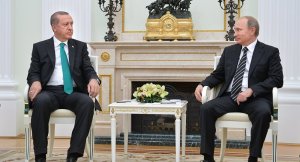 Syrian Kurds have expressed their willingness to cooperate with Russia. This would be a setback for the Turkish President Erdogan, who is seeking to destroy the Kurdistan Workers’ Party (PKK), DWN wrote.
In an interview with al-Monitor, the leader of the Syrian Kurds Salih Muslim announced his willingness to cooperate with Russia and Syrian President Bashar-al-Assad, the newspaper reported.
He said the Syrian Kurds are interested in cooperating with anyone who fights against ISIL. Moreover, Russia had promised the government in Damascus that it would respond to any Turkish intervention in Syria, which many Kurds are afraid of.
The US, in turn, has also been increasingly supportive of cooperation with the Russians. Many US officials believe that Russia could be helpful in their fight against ISIL, which turned out to be more difficult than expected.
However, Turkey fears that Russia’s potential support for the Kurds may lead to a situation in which a new Kurdish region would form along its southern borders and destabilize Turkey. This could result in a further downturn in the relations between Turkey and Russia, which have already deteriorated after an aviation incident at the Turkish border.
On October 3, a Russian Su-30 fighter jet had briefly crossed Turkish airspace due to poor weather conditions. Russian authorities officially apologized for the incident, saying it was a “misunderstanding,” and promised to avoid such incidents in the future.
Photo © Sputnik/ Alexei Druzhinin
Vice News, Sputnik and the Cold Nature of Proper-ganda
By Katerina Azarova – Sputnik – October 7, 2015
“Sputnik’s coverage is often completely at odds with how the same story is reported in the West”, writes Vice News reporter Justin Ling. He was specifically addressing our coverage of the Canadian election, but the sentiment is spot on. Thanks for getting us, Justin. That’s precisely what we’re trying to do here.
Vice, which started out as a Canadian magazine and grew into an international media empire, is known for its in-depth, yet highly comprehensible coverage of international news. So it’s flattering, I guess, that they would pay attention to our articles, albeit a little confusing as to why.
After diligently mentioning all the right buzzwords — “Kremlin” and “propaganda” – in the very first paragraphs, Justin moves on to say that Sputnik is “directly run by the Russian government” – but claims that information is “scrubbed daily from the news outlet’s Wikipedia page”. And it is bizzare.
Now, I know, and you know, that journalists rely on Wikipedia for a quick fact check or background details to a story. But I would never expect a reporter of Ling’s stature to be using Wikipedia as a news source. (No offence, Wikipedia).
I’ll admit, curiosity got the better of me and I, too, checked out Sputnik’s Wiki page.

Now, either our daily page-scrubbing service has gone on strike, or Wikipedia in Canada looks dramatically different to what we’re seeing in Russia. And the US. And the UK. I know, because I asked our hubs to check. What can I tell you, I’m a curious gal. … Full article
On British role in Syria and plans for FT reported ‘safe zones’
By Dr Alexander Yakovenko, Russian Ambassador to the United Kingdom | RT | October 8, 2015
Will Damascus request the British to assist in the same way, I don’t know. But there is another way for the British, and, in fact, everybody else, to carry out airstrikes against ISIS and other terrorists legitimately. It means a UN Security Council mandate, provided in response to the request of the Syrian Government. That is what we are now working on in New York. That is how the British could have their finger in the bombing pie in Syria. Russia is far from pulling this blanket upon herself. We want to work together.
There are other advantages of this course, besides establishing clear-cut objectives and terms of such collective intervention by the international community in Syria. We could agree, in the text of this resolution, on realistic and flexible enough modalities of a political settlement in Syria, which would allow those who left their country to come back and take part in its post-war reconstruction. The latter, by the way, could be a major source of economic growth in the region. What is equally important, this settlement will make it unnecessary for the EU to provide asylum to refugees from Syria.
I’ve read the said FT material. Some would say that it is very much in line with the backstabbing tradition of Western politics. I hope those plans were not serious on the part of our Anglo-American partners, who were able to see our preparations for airstrikes in Syria. The British have a signals intelligence post in Cyprus, just opposite our naval supply station in Syria, an equivalent of a 19th century coaling station. Perhaps, they just couldn’t say ‘no’ to their regional allies. But had it been true, it would have raised a host of serious issues. Because it would have been done behind our backs and in circumvention of the UN Security Council. Some seem eager to get NATO involved. The Alliance, until now, has been out of the picture in Syria, and for good reasons. Those plans, if implemented, would have brought about a de facto partition of Syria. More than that, our partners would have well found themselves in the position of protecting the terrorists.
It is a very dangerous idea. Some players might have harbored it. At least this would explain, why all of a sudden and from nowhere the tide of refugees in Europe this year. Quite likely it was meant to bring the EU on board as regards ‘safe zone’ plans. Now the migration crisis factor works for more realistic assumptions in Europe in respect of the political process in Syria, which cannot proceed while ISIS is there.
But let’s discuss things positively. Among those I can see close cooperation between the Russian and British military. Making common cause in Syria creates mutual trust, establishes mutual control, and provides incentives for both sides to be effective in doing its part of the job. We have just requested our Western partners provide us with their intelligence on the terrorist infrastructure in Syria, if they really think that we strike the wrong targets. We have also requested contact numbers of the Free Syrian Army to help bring it into a united effort to defeat terrorists.
And initial results of our strikes prove that they can be very effective if delivered in earnest, with no other objectives at the back of one’s mind. It also shows that the terrorists took their impunity for granted. In fact, it could be said that the anti-ISIS coalition of 60 (!) states presided over this outfit’s expansion for a whole year, rather than tried hard to stop and destroy it.
I am sure that thus there will be all the conditions in place for us to have a common view of the situation and make joint efforts on that basis. Among other things, it would have provided a welcome opportunity for our and the British military to be allies like we were in WWII. It would drastically change the terrorists’ calculus while doing the same to our relationship, which is in a very bad shape indeed.
Dr Alexander Yakovenko, Russian Ambassador to the United Kingdom of Great Britain and Northern Ireland, Deputy foreign minister (2005-2011). Follow him on Twitter @Amb_Yakovenko
Tehran Has No Info on Cruise Missiles Which Allegedly Landed in Iran
Sputnik – 08.10.2015
Iranian defense ministry believes reports on “fallen Russian cruise missiles” are part of the intensified western propaganda war, according to a source.
Tehran has denied US reports that four of Russia’s cruise missiles targeting ISIL actually fell to the ground in Iran, with the country’s defense ministry calling the accusations “psychological war.”
Russia’s Defense Ministry also refutes US media reports of an alleged incident involving cruise missiles which were fired at ISIL positions in Syria on October 7, stating that all missiles hit their designated targets.
“No matter how unpleasant and unexpected for our colleagues in the Pentagon and Langley was yesterday’s high-precision strike on Islamic State infrastructure in Syria, the fact remains that all missiles launched from our ships have found their targets,” ministry’s spokesman Maj. Gen. Igor Konashenkov said.
On Thursday, CNN reported that four of the 26 missiles fired from Russian warships in the Caspian Sea went off target and crashed in Iran. That report was based on anonymous Pentagon sources, who despite claiming to have evidence of the targeting malfunction, could not identify where, precisely, the missiles landed.
“In contrast to CNN we do not talk with reference to anonymous sources,” Konashenkov said. “We show the launch of our rockets and the targets they struck.”
Indeed, the Russian Defense Ministry has posted a number of videos to prove the accuracy of its targeting systems.
US slams Russia for striking terrorists
Press TV | October 7, 2015
The United States has condemned Russia for striking the Western-backed militants in Syria and denied that it is cooperating with Moscow in this regard.
Speaking at a press conference in Rome, Italy, on Wednesday, US Defense Secretary Ashton Carter called the airstrikes against terrorists “a fundamental mistake”.
“I have said before that we believed that Russia has the wrong strategy — they continue to hit targets that are not ISIL. We believe this is a fundamental mistake,” Carter claimed, using an acronym for the Daesh terrorist group.
“Despite what the Russians say we have not agreed to cooperate with Russia so long as they continue to pursue a mistaken strategy and hit these targets,” he added.
Earlier in the day, the Russian Defense Ministry said it was considering proposals from the US to coordinate operations against ISIL terrorists.
“On the whole, these proposals could be put in place,” defense Ministry spokesman Igor Konashenkov said.
He added that US and Russian military officials were discussing technical details on Wednesday.
“What we will do is continue basic, technical discussions on the professional safety procedures for our pilots flying above Syria,” Carter said.
“That’s it. We will keep the channel open because it’s a matter of safety for our pilots,” he added.
A new US intelligence assessment has found Russia has targeted militant groups backed by the Central Intelligence Agency (CIA) in Syria.
The assessment, shared by commanders on the ground, has led American officials to conclude that Russian warplanes have intentionally struck CIA-backed militants in a string of attacks running for days, the Wall Street Journal reported.
Meanwhile, US foreign policy expert Zbigniew Brzezinski, a strong supporter of the Obama administration, says the United States should retaliate if Russia does not stop bombing its assets in Syria.

Former US national security adviser Zbigniew Brzezinski
Moscow’s apparent decision to strike CIA-trained militants “at best” reflects “Russian military incompetence,” and worst, “evidence of a dangerous desire to highlight American political impotence,” Brzezinski, the national security adviser for former President Jimmy Carter, wrote in an article published by the Financial Times on Sunday.
He added that if Moscow continues to target these people, then Washington should retaliate against Russians.
Obama administration officials are debating how the United States can come to the aid of its proxy forces on the ground without risking a broader conflict, according to the Wall Street Journal.
US officials said Russia’s moves in Syria posed a direct challenge to the Obama administration’s foreign policy on the Middle East.
Iraq to officially request Russian military action against Daesh
Press TV | October 7, 2015
Iraq is planning to officially ask Russia for airstrikes against Daesh in a bid to purge the Takfiri militant group from the territories it controls in the west and north of the Arab country.
“We might be forced to ask Russia to launch airstrikes in Iraq soon. I think in the upcoming few days or weeks Iraq will be forced to ask Russia to launch airstrikes and that depends on their success in Syria,” the head of the Iraqi parliament’s defense and security committee, Hakim al-Zamili, said on Wednesday, urging Moscow to play a bigger role than the United States in fighting terrorists in Iraq.
Baghdad has long criticized the ineffectiveness of the aerial military campaign by Washington and its allies against alleged Daesh positions in Iraq. However, Moscow’s recent military intervention against the terrorists in Syria has raised hopes of a similar move in Iraq.
“We are seeking to see Russia have a bigger role in Iraq. … Yes, definitely a bigger role than the Americans,” Zamili said.
The senior Iraqi legislator also expressed hope that a newly-established security and intelligence-sharing command center which includes Iran, Iraq and Syria and Russia and is set to begin work in Iraq, could make the anti-Daesh battle more effective.
“We believe that this center will develop in the near future to be a joint operation command to lead the war against Daesh in Iraq,” he added.
Russia has been pounding the positions of Daesh and other militant groups in Syria for a week, a move which has clearly irritated the United States and other Western governments. Washington accuses Russia of targeting the so-called moderate militants in Syria, but Moscow denies the charges, saying it chooses its targets based on intelligence provided by the Syrian army. Russia has also sought to play down the significance of US-fabricated distinction between militants in Syria.
Earlier in the day, Russian officials said they would consider an airborne operation against Daesh Takfiri terrorists in Iraq if they received a formal request from the Arab country on the issue.
Valentina Matviyenko, the Russian Federation Council speaker, said Russian leaders would be open to study “the political and military expediency” of an operation in Iraq in case of official request by Iraq.
Obama Boots Syrian Peace Chance
By Robert Parry | Consortium News | October 6, 2015
President Barack Obama is turning his back on possibly the last best chance to resolve the bloody Syrian war because he fears a backlash from Official Washington’s powerful coalition of neoconservatives and “liberal interventionists” along with their foreign fellow-travelers: Israel, Turkey, Saudi Arabia, Qatar and other Gulf sheikdoms.
The route toward peace would be to collaborate with Russia and Iran to get Syrian President Bashar al-Assad to accept a power-sharing unity government that would fairly represent Syria’s major religious and ethnic groups – Christians, Alawites, Shiites and moderate Sunnis – along with a commitment for free, internationally monitored elections once adequate security is restored.
But for such an arrangement to work, Obama also would have to crack down aggressively on U.S. regional “allies” to ensure that they stopped funding, supplying and otherwise assisting the Sunni extremist forces including Al Qaeda’s Nusra Front and the Islamic State (or ISIS). Obama would have to confront the Sunni “allies” – including Saudi Arabia, Qatar and Turkey – as well as Israel.
His pressure would have to include stern action aimed at the global finances of the Gulf states – i.e., seizing their assets as punishment for their continuing support for terrorism – as well as similar sanctions against Turkey, possibly ousting it from NATO if it balked, and a withdrawal of political and financial support for Israel if it continued helping Nusra fighters and viewing Al Qaeda as the “lesser evil” in Syria. [See Consortiumnews.com’s “Al-Qaeda, Saudi Arabia and Israel.”]
Obama also would have to make it clear to Syria’s “moderate” Sunni politicians whom the U.S. government has been subsidizing for the past several years that they must sit down with Assad’s representatives and work out a unity government or the American largess would end.
This combination of strong international pressure on the Sunni terror infrastructure and strong-arming internal players in Syria into a unity government could isolate the Sunni extremists from Al Qaeda and the Islamic State and thus minimize the need for military strikes whether carried out by Russia (against both Al Qaeda and ISIS) or the U.S. coalition (focusing on ISIS).
And, the arrival of Russian military support for the Assad government – as well as the increased backing from Iran and Lebanon’s Hezbollah – represented the moment when the prospect for peace was brightest, whatever one thinks of those various players. However, instead of working with Russian President Vladimir Putin and Iranian President Hassan Rouhani, President Obama chose to bend to the pressures of Official Washington.
Appeasing the Warmongers
Thinking he had stretched the tolerance of neocons and liberal hawks as far as he could by pushing through the nuclear deal with Iran, Obama fell in line behind their propagandistic denunciations of Assad and Putin. Obama’s administration joined in promoting the new favorite “group think” of Washington – that Putin had promised to only bomb the Islamic State and then reneged by attacking “moderate” rebels and their more powerful ally, Al Qaeda’s Nusra Front.
Conveniently, this storyline doesn’t cite the wording of Putin’s supposed “promise” although some articles do mention him vowing to attack “terrorist” groups, which the mainstream U.S. news media has interpreted as the Islamic State only. But this odd framing accepts the breathtaking premise that Al Qaeda is no longer a terrorist organization – apparently rehabilitated by the fact that Israel has been helping Al Qaeda’s affiliate, the Nusra Front, along the Golan Heights and prefers it to Assad’s continued rule. [See Consortiumnews.com’s “Should US Ally with Al Qaeda in Syria?”]
Among the many purveyors of this “Putin lied” narrative is Washington Post columnist Richard Cohen, who on Tuesday repeated the canard that Putin had “promised” to strike only the Islamic State and then broke that promise. For good measure, Cohen added that the Russians had “invaded” Syria although they were formally invited by the recognized government of Syria.
“Yes, the Russians did invade,” Cohen wrote. “They sent war planes, mechanized units and even troops into Syria. They have begun bombing missions, apparently hitting insurgents seeking to topple Syrian leader Bashar al-Assad and not only, as Russian President Vladimir Putin promised, Islamic State units. Putin – surprise! – lied.”
Normally in journalism, before we accuse someone of lying, we show what they actually said and contrast it with the facts. But Official Washington has long since moved Putin into the free-fire zone of demonization. Anything can be said about him, whether based in reality or not, and anyone who objects to this “group think” is called a “Putin bootlicker” or a “Putin apologist.”
Thus, any reality-based skepticism is ruled out of the frame of debate. Such was the way that the United States plunged blindly into the Iraq War in 2003 when Saddam Hussein was the demonized figure and the Europeans who warned President George W. Bush not to invade were laughed at as “Euro-weenies.” American skeptics were “Saddam apologists.”
Inside-Out ‘Logic’
Cohen is back at it again in his Tuesday column, which – on the Internet – has the curious title “The High Cost of Avoiding War in Syria.” Cohen throws around the word “invasion” where Russia is involved – even when there was no “invasion” – but he advocates an actual U.S. invasion with cavalier hypocrisy.
Cohen slams Obama for not having established “a no-fly zone” in Syria earlier, which would have involved the United States bombing and destroying Syria’s air force, a clear act of aggression and an obvious boon to Al Qaeda and ISIS.
Cohen also says he was for “arming the rebels,” another violation of international law which – when tried by Obama to appease the drumbeat from Cohen and his ilk – led to many U.S.-trained and U.S.-armed rebels taking their equipment and skills to Al Qaeda and ISIS.
Yet, Cohen — on the prized opinion real estate of The Washington Post’s op-ed page and in his nationally syndicated column — unapologetically encourages an illegal invasion of another country while condemning Russia for doing the same except that Russia was following international law by working with the sovereign government of Syria and therefore has not “invaded” Syria.
We also are supposed to forget that Cohen’s ideas would benefit Sunni jihadists, such as the Al Qaeda-dominated “Army of Conquest” which could use the “no-fly zones” to mount a victorious offensive to capture Damascus and create a humanitarian crisis even worse than now.
Possibly with ISIS chopping off the heads of “infidels” – Christians, Alawites, Shiites, etc. – and with Al Qaeda having a new home in the center of the Middle East to plot terror strikes on the West, Cohen’s plan might necessitate a major U.S. military intervention that would get even more people killed and deal the final death blow to the American Republic.
In evaluating Cohen’s lame-brained double-think, it is worth remembering that he was one of the many U.S. opinion leaders who cheered on Secretary of State Colin Powell’s deceptive Iraq War speech to the United Nations on Feb. 5, 2003. Waving “we-love-Colin” pompoms alongside all his esteemed colleagues, Cohen laughed at anyone who still doubted that Saddam Hussein possessed hidden WMD stockpiles.
“The evidence he [Powell] presented to the United Nations – some of it circumstantial, some of it absolutely bone-chilling in its detail – had to prove to anyone that Iraq not only hasn’t accounted for its weapons of mass destruction but without a doubt still retains them,” Cohen wrote. “Only a fool – or possibly a Frenchman – could conclude otherwise.”
Ha-ha, did you get that clever line – “Only a fool – or possibly a Frenchman” – pretty funny except that by heaping ridicule on those of us who doubted Powell’s evidence, Cohen contributed to the deaths of some 4,500 U.S. soldiers, the slaughter of hundreds of thousands of Iraqis, the cost to U.S. taxpayers of more than $1 trillion, and chaos now spreading across not just the Middle East but into Europe.
In a normal place where there was some modicum of accountability, you would have expected Cohen to be banished to Storage Room B with his red stapler or worse. But no, Cohen is back running with the same juvenile in-crowd, behaving just as stupidly and just as recklessly as he has many times in the past.
Obama Intimidated
But the larger problem is that President Obama appears intimidated by this collection of know-it-alls who preen across the editorial pages of The Washington Post and The New York Times or who hold down prestigious “fellowships” at the Brookings Institution or other big-name think tanks or who self-identify as “human rights activists” advocating “humanitarian” wars.
Arguably, Obama has always had an outsized regard for people with establishment credentials. It is, after all, how he rose through the ranks as first an extremely bright academic and later a talented orator and politician. Without family connections or personal wealth, he needed the approval of various influential individuals. If he offended them in some way, he risked being pigeonholed as “an angry black man.”
Indeed, the comedy duo Key & Peele developed a series of funny skits with Jordan Peele playing the always proper and controlled Obama and Keegan-Michael Key as “anger translator Luther.” Obama even invited “Luther” to translate Obama’s speech to the 2015 White House Correspondents Dinner, except that by the end of that talk Obama was expressing his own anger and Luther peeled away.
The problem in the real world is that Obama remains cowed by the Important People of Washington – represented in that oh-so-important crowd at the dinner – and bows to their misguided thinking.
Obama also is facing a beefed-up lobbying operation for Saudi Arabia to go along with the always formidable Israel Lobby. The Intercept reported that in September the Saudi kingdom added to its large stable of thoroughbred influence-peddlers by signing “Edelman, the largest privately owned public relations agency in the world [and] the Podesta Group … a lobbying firm founded by Tony Podesta, a major fundraiser for the Hillary Clinton presidential campaign.”
Indeed, the repressive Saudi kingdom may need some special P.R. help as it prepares to behead Ali Mohammed al-Nimr whose body would then be attached to a cross or otherwise displayed in a crucifixion that would leave his corpse to rot for several days as a warning to others. Al-Nimr is a Shiite who at the age of 17 in 2012 participated in a pro-democracy demonstration that was viewed as an affront to the monarchy.
The Saudis also have been waging a ruthless air war against impoverished Yemen, attacking Houthis who stem from a branch of Shia Islam which Saudi Sunni Wahhabism considers apostasy. The Saudi bombing campaign, which recently killed some 131 celebrants at a wedding inside Yemen, gets intelligence and logistical support from the Obama administration even though the slaughter of Houthis has benefited their Yemeni rivals, “Al Qaeda in the Arabian Peninsula” who have gained ground behind the Saudi air offensive.
Diverting Attention
Yet, the Saudis’ P.R. battalions – along with the Israel Lobby – have kept Official Washington’s focus in other directions. Indeed, there are now so many false or dubious narratives dis-informing the capital’s “group think” that U.S. decisions are driven more by mythology than facts.
Obama could begin the process of restoring sanity to Washington by declassifying U.S. intelligence analyses on several key issues. For instance, Obama could release what’s now known about the Aug. 21, 2013 sarin gas attack outside Damascus.
After that attack, there was a rush to judgment at the State Department and within the mainstream U.S. news media to blame that atrocity on Assad’s forces, although I’m told that CIA analysts have since moved away from that view and now agree that the attack was likely a provocation designed to draw the U.S. military into the war on the side of the Sunni jihadists. [See Consortiumnews.com’s “The Collapsing Syria-Sarin Case.”]
Though Obama and other officials have dropped the sarin accusations from their public speeches – harping instead on “barrel bombs” as if those homemade weapons are some uniquely evil device – Obama has refused to retract the sarin allegations which helped shape the hyper-hostile “conventional wisdom” against Assad.
Similarly, Obama has withheld U.S. intelligence information about the July 17, 2014 shoot-down of Malaysia Airlines Flight 17 over eastern Ukraine, letting stand hasty accusations blaming Putin. Obama appears infatuated by the trendy concept of “strategic communications” or “Stratcom,” which blends psy-ops, propaganda and P.R. into one noxious brew to poison public opinion about one’s “enemy.”
With the recent Russian military intervention in Syria, Obama had the chance to correct the record on the sarin-gas attack and the MH-17 shoot-down but instead continued the “Stratcom” both in his United Nations speech and his news conference last Friday with more hyperbolic attacks against Assad and Putin. In doing so, Obama apparently bowed to the desired rhetoric of hardliners like U.S. Ambassador to the UN Samantha Power and the editorial-page masters of The Washington Post and The New York Times.
Obama may have hoped his harsh language would appease the neocons and their liberal-hawk pals, but the tough-guy rhetoric has only opened him up to new attacks over the disparity between his words and deeds. As the clueless columnist Richard Cohen wrote, “A no-fly zone needs to be established. It is not too late to do something. By doing so little, the United States has allowed others to do so much.” [Emphasis in original.]
In other words, Cohen appears to want the U.S. military to shoot down Russian planes over Syria, even though the Russians have been invited by the recognized government to be there and the U.S. has not. The minor complication of possible human extinction from a nuclear war apparently is of little consequence when compared to the street cred that one gets from such manly talk.
For Official Washington – and apparently Obama – the peace option is regarded as unacceptable, i.e., working with Russia and Iran to achieve a power-sharing unity government in Damascus (with the promise of elections as soon as possible) along with the United States demanding from its regional “allies” a complete shutdown of assistance to the Islamic State, Al Qaeda’s Nusra Front and all other Sunni jihadists.
That option would require Obama and the neocon/liberal-hawk cowboys to get down off their high horses, admit they have been tossing their lasso in the wrong direction – and compromise.
Investigative reporter Robert Parry broke many of the Iran-Contra stories for The Associated Press and Newsweek in the 1980s. You can buy his latest book, America’s Stolen Narrative, either in print here or as an e-book (from Amazon and barnesandnoble.com).
I Wish Nobody Was Bombing Syria
By Ron Paul | October 5, 2015
The US regime change policy for Syria has been a catastrophe. More than 200,000 killed and an entire country reduced to rubble at least partly because President Obama decided that “Assad has lost his legitimacy.” How is it that the president of a country 6,000 miles away has the authority to decide whether another leader belongs in office or not? What if Rouhani in Iran decided that Obama had lost his legitimacy for killing a number of American citizens by drone without charge or trial? Would we accept that?
At least three years of US efforts to train rebels to overthrow the Syrian government has produced, as General Lloyd Austin, Commander of US Central Command, testified last month, “four or five” trained and vetted “moderates” in Syria. The $500 million appropriated for this purpose has disappeared.
The neocon solution to this failure to overthrow Assad and “degrade and destroy” ISIS is to increase the bombing and lead a ground invasion of Syria. The confusing policy of fighting Assad and also fighting his enemies does not seem to bother the neocons. They want us to forget all about their recent failures in Libya and Iraq and to try the same failed strategy one more time.
But something dramatic happened last week. Russian president Vladimir Putin delivered a speech at the United Nations criticizing the US policy of partnering with one set of extremists – al-Qaeda and its allies – to attack both ISIS and Assad. “Do you realize now what you have done?” asked Putin.
Shortly after Putin’s UN speech, he requested and was granted authority from the Russian parliament to use force in Syria in response to the Syrian government’s request for assistance against the rebels. Russian fighters and bombers began flying sorties over Syria almost immediately. In less than a week of Russian bombing, considerable damage appears to have been done to both ISIS and to al-Qaeda affiliates – some of which are considered allies by the US and were actually trained by the CIA.
It may be tempting to cheer Russian military action in Syria, as it seems ISIS is finally suffering some considerable losses. Press reports suggest large numbers of desertions in their ranks after the Russian attacks. All of a sudden what looked to be an inevitable ISIS takeover of Syria once Assad was overthrown, seems far less likely with the Russians on the scene.
But I cannot cheer the bombs, whether they are Russian bombs or US bombs or French or British bombs. I do not believe a terrorist group created by foreign intervention in the region will be solved by more foreign intervention in the region. Bombs represent a total failure of policy. They destroy a country’s economy and infrastructure.
I wish the American people would finally demand that their government end its destructive policy of trying to change any regime that does not bow to Washington’s demands. I wish Congress respected our Constitution enough to demand that the president seek a declaration of war before attacking a foreign country. I wish President Bush and his neocon advisors had never decided to overthrow the Syrian government. I wish President Obama had fired the neocons who led him from one foolish intervention to another. I wish the CIA had not trained rebels to fight alongside al-Qaeda in Syria. I wish we would reject the shrill cries of the warmongers. I wish the US media was more than just a propaganda arm of the US government.
I am not thrilled that Russia is bombing Syria. I wish nobody was bombing Syria.
Assad: ‘West uses terrorism as new instrument to subjugate Middle East’
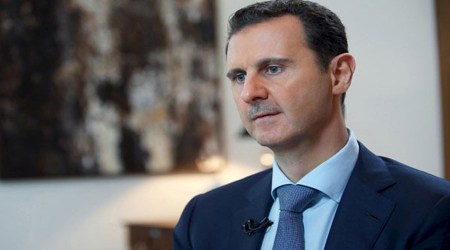
Syria’s President Bashar al-Assad © SANA / Reuters
RT | October 4, 2015
Western countries are using terrorism as an instrument of control, Syrian President Bashar Assad said in a recent interview. He also said that he is ready to step down if his departure is the solution to the four-year-long conflict.
“From the beginning it was clear to us that there were foreign hands behind terrorism in Syria,” Assad said in interview with Iran’s Habar TV.
President Assad thinks that the US-led coalition against Islamic State (IS, formerly ISIS/ISIL) is ineffective because the West does not want to defeat terrorist groups. In fact, it wants to preserve the balance between the warring sides to “perpetuate the process of erosion in Syria and Iraq and later other countries of the region, so that we all remain weak for decades and maybe generations.”
“How can the United States and its allies fight terrorism or ISIS in Syria and Iraq while their closest allies in the government of Erdogan and Davutoglu are supporting terrorists and enabling them to cross the borders and bring weapons, money and volunteers through Turkey?” he asked.
Since the US-led coalition was formed, terrorism expanded geographically and its recruits multiplied, the Syrian president said.
“God willing it [Syria, Iran and Hezbollah] will be able to defeat terrorism which is a new instrument for subjugating the region,” he stressed.
Unlike the US-led coalition, Russia together with Iran, Iraq and Syria have “great chances of success.”
“It must succeed. Otherwise, the whole region, not only one or two countries, will be destroyed,” Assad said.
Russia, as well the Soviet Union in the past, “[has] never tried to impose anything on Syria, especially in this crisis,” he said stressing that, as opposed to the US, Russia is against interference, hegemony and violations of the UN Charter.
‘If my departure is the solution, I will never hesitate to do that’
President Assad once again stated that he is ready for political dialogue with all Syrians – but not with foreign powers. “Any talk about the political system or the officials in this county is an internal Syrian affair,” he said.
“When the Syrian people decide that a certain individual should stay, he will stay; and when the Syrian people decide that he should go, he will go immediately,” the president said. “If my departure is the solution, I will never hesitate to do that,” he added.
Assad stressed that no state in the world conducts dialogue with terrorists and that they should be subject to the laws and brought to justice.
“However, the state might conduct dialogue with terrorists in one case, when the objective of the dialogue is for the individuals who carried out terrorist acts to lay down their arms and embrace the state and the law,” he added, noting that this has actually happened in Syria, with the government having held talks with various reconciliation-seeking groups, granting them amnesty and giving them an opportunity to go back to their normal lives.
36,000 troops, 200 aircraft & 60 vessels: NATO launches biggest war games in 13 years
RT | October 3, 2015
NATO has started its biggest exercise since 2002 with 36,000 international troops from 30 states, including non-NATO nations, participating in the drills which are taking place at sea, in the air and across the territory of three European states.
The alliance has kicked off its massive “Trident Juncture 2015” exercises which will last until November 16. Along with the NATO member states, seven more partner nations are participating in the drills: Australia, Austria, Bosnia and Herzegovina, Finland, the Former Yugoslav Republic of Macedonia, Sweden and Ukraine.
Some 36,000 troops as well as more than 60 warships and about 200 aircraft will participate in the drills which makes it the biggest since 2002 when about 40,000 troops took part in NATO’s “Strong Resolve” military exercise.
“The purpose of the exercise is to train and test the NATO Response Force, a highly ready and technologically advanced multinational force made up of land, air, maritime and Special Forces components,” said General Hans Lothar Domrose, the Commander of Joint Force Command Brunssum.
“Enhancing our response forces is a key part of NATO’s overall effort to adapt to emerging security challenges. TRJE15 [Trident Juncture 2015] has been designed to ensure that our concepts and procedures will work in the event of a real crisis because our job is to always be prepared to defend the people, territory, and values of this Alliance,” he added.
The drills will consist of two parts: the Command Post Exercise (CPX) for Strategic and Operational level staff, and the Live Exercise (LIVEX) for tactical level troop engagements.
The CPX, which will last until October 16, will include “training, evaluation and certification activities” of the command structure of the NATO Response Force. The European Union and the African Union are also going to participate in the CPX.
LIVEX will be held in Italy, Portugal and Spain between October 21 and November 6. NATO air forces, land forces as well as maritime forces will conduct a number of exercises – for example, responding to a simultaneous, wide-scale attack of a group of 20 enemy ships, numerous aircraft and four submarines.
In late August-September NATO conducted the greatest airborne drills in Europe since the end of the Cold War. About 5,000 soldiers from 11 NATO member states participated in the “simultaneous multinational airborne operations.”
NATO has significantly stepped up its military presence and activity along the Russian border, including in the Baltic states and eastern Europe, since Russia’s reunification with Crimea and the outbreak of conflict in eastern Ukraine, which the alliance blames on Moscow.
Russia views NATO’s ongoing expansion and constant military activity as hostile and destabilizing, repeatedly warning that Moscow will respond to NATO approaching Russian borders “accordingly.”
At ‘socialist’ conference in UK, invited speaker makes pitch for U.S./NATO arms to Kyiv regime
Pro-NATO, pro-U.S. ‘socialist’ scholar invited to speak at ‘Socialist Resistance’ conference in London.
New Cold War | October 2, 2015
The political group ‘Socialist Resistance’ in England held an education conference in London on Sept 26, 2015 featuring a Ukrainian diaspora scholar, Marko Bojcun, who delivered a strong message that the rightist, neo-conservative regime in Kyiv should be supported and that the United States and NATO should be pressured to provide more and heavier arms to it. His talk was titled ‘Russian imperialism today‘. The conference theme was ‘Imperialism, globalisation and climate change’.
Bojcun is Director of the Ukraine Centre, London Metropolitan University. He is a PhD university graduate in Canada. In April 2015, he co-signed an open letter appealing to President Petro Poroshenko not to sign into law anti-communist, thought-control measures which had been approved by the Ukrainian Rada. Poroshenko approved the laws. The result has been a harsh crackdown on political, press and other forms of expression in Ukraine as well as the banning of political parties. Among the parties banned by the Ministry of Justice of Ukraine have been the large Communist Party of Ukraine and two smaller parties calling themselves communist.
In his speech to the conference, Bojcun reviewed the current situation in the countries bordering, or close to, Russia. He reported favorably on the efforts of the U.S. and EU to “aid” these countries in the face of alleged Russian economic ‘pressure’ and ‘aggression’ against them. At the 23′ mark, he reports on the efforts of Western powers to help Azerbaijan “break out” of its economic ties to Russia. (Those trade and other ties, actually, are an important lifeline for the people of that country heavily dependent on oil revenues. Many Azeris live and work in Russia and send home their earnings.)
Bojcun dismissed the argument that NATO is engaged in a military buildup in eastern Europe and a threatening stance against Russia and he argued that NATO should be supplying many more weapons and other military aid to Kyiv. Referring to the NATO summit meeting in August 2014, he lamented that “Poroshenko came away with absolutely nothing that he asked for. He was not going to be armed.
“I know there are American advisers in Ukraine and there are some who are training [Ukrainian] forces there. But neither the U.S. nor NATO are supplying Ukraine with lethal weapons. Some NATO countries, very small countries such as Lithuania, have promised to. But this is really not serious.”
“NATO is concerned, first of all, with securing its own member states. It doesn’t have the capacity to do that, to my way of thinking, should Russia decide to make a move northward [??] to the Baltic states. That is a cause of great concern.”
Bojcun then argued it is Russia which is engaged in a military buildup in eastern Europe. “Russia, on the other hand, has military bases in eight of the former Soviet republics. Eight of them. And it has been building them since 2003…
“So, the Russian capacity to strike in the neighbourhood of Ukraine is far superior than the NATO one, and it is growing. One needs to take that into account.
“Looking into this long argument that has been made about NATO expansion into east-central Europe, I agree, NATO made an expansion into east-central Europe. But, that happened. We are into a period since the 2008 financial crisis and the Russo-Georgian War [2008] where the U.S. is really a reactive force and is not [reacting] in kind to the Russian military buildup.”
Also speaking on Ukraine at the same conference was Catherine Samary, a pro-Maidan French intellectual and leader of the Nouveau Parti Anticapitaliste (NPA) of France. Her talk was titled ‘Socialists’ attitudes to Russian expansionism’.
Socialist Resistance calls itself “An ecosocialist organisation opposed to imperialist wars and capitalism.”
The recordings of the two speeches are posted to the website of the rather mis-named ‘Ukraine Solidarity Campaign’ based in the UK. There is no broadcast of discussion by conference participants following the speech by Bojcun to know what, if any, disagreement with the speech was expressed by conference participants or by his conference co-speaker.
Marko Bojcun spoke in London on May 27, 2014. The talk took place two days after the presidential election in Ukraine. In his speech, Bojcun welcomed the election of Petro Poroshenko. He shared the platform with Gabriel Levy (pseudonym), a pro-Maidan writer who publishes People and Nature.
Featured Video

Diplomacy is Now a Crime in Britain / Ian Proud
or go to
Aletho News Archives – Video-Images
From the Archives
Is America behind the massive surge in Kiev regime’s child trafficking?
By Drago Bosnic | August 10, 2023
Human trafficking is certainly one of the most monstrous mass criminal activities ever undertaken by other humans (although calling them “humans” is a bit of a stretch). And yet, there’s a special kind of this deeply repulsive crime that pushes it to diabolical proportions – child trafficking. Underage kids, particularly those who were abandoned, sold or have very poor/abusive family backgrounds, are by far the most vulnerable group. The depraved criminals who engage in such illicit activities specifically target unfortunate children and given there are millions of them all around the globe, particularly in war-torn areas, the “recruitment pool” is effectively endless. Unfortunately, the demand on the black market also seems to be constant and growing, making it a very lucrative and appealing prospect for criminals. … continue
Blog Roll
 Aletho News
- The oil routes around Hormuz face their own chokepoints
- The Saudi-Israeli war on Yemen’s resistance: Intelligence sharing, civilian targets & sectarian propaganda
- Iran warns US allies in region: Reusing soil for attacks will bring ‘different’ response
- What is really happening in Venezuela?
- Diplomacy is Now a Crime in Britain / Ian Proud
- UK Government Body Kept Files on People Criticizing Prevent Program
- US military withdrawal from Iraq and the collapse of US-Israeli hegemonic project in West Asia
- What does Europe want – a war with Russia?
- She Followed the Actual Data on COVID Vaccines and Masks — Her Career Took a Huge Hit
- Florida AG Sues Pfizer, Bourla Over Deceptive Marketing of COVID Vaccines
- If Americans Knew
- Israel is squeezing the life out of Palestinians – Daily Update
- The Israeli Right Portrays Islam as Murderous. It Serves a Political Purpose
- Jordan Has Had Enough: King Abdullah’s Scathing Warning to Israel
- Israeli Colonizers (i.e. Settlers) Kill Palestinian Man Near Salfit
- New Google Maps images reveal massive scale of devastation in Gaza
- Jewish supremacy, anti-Palestinian bigotry on display in Israel – Daily Update
- Israeli Soldiers Abduct At Least 22 Across Occupied West Bank
- Eight Palestinians Killed in Israeli Attacks on Gaza
- Israeli former leaders and security chiefs threaten legal action over ‘Jewish terrorism’
- Israel map in LA Times ad includes all land from the river to the sea
- No Tricks Zone
- Latest European Green Energy Debacle; Portugal’s Largest Flagship Solar Park Insolvent!
- Green Energy Debacle: German Expert Professor Fritz Vahrenholt Warns Of Severe Economic And Social Consequences
- Two More Paleo Reconstructions Affirm Meters-Higher Sea Levels Across Ireland, Brazil 7000-6000 Years Ago
- New Study: Earth And Venus Surface Warmth Largely Explained By Convection And Lapse Rate, Not CO2 Or Radiation
- 2025 Nature Paper Claiming Worsening Global Drought Gets RETRACTED …Heavily Flawed
- New Study: ‘Global Drought Shows No Detectable Recent Acceleration Under Climate Warming’
- Economic Masterminds: German Socialists Suggest Taxing Productivity Gains Stemming From Using AI
- The South China Sea Has Not Been Cooperating With The Climate Change Narrative
- Energy Crisis: Germany Enters Heating Season With Historically Low Gas Reserve Fill Levels
- New Study: The Antarctic Ice Sheet Gained Mass From 2020-2024 Due To Staggering Snow And Ice Accumulation

