Japan Bank: US Sanctions Could Lead to Direct Ruble-Yen Swaps
Sputnik – 03.09.2015
VLADIVOSTOK – The Japan Bank for International Cooperation (JBIC) is turning to currency swaps as using the US dollar in transactions is difficult because of the Western anti-Russia sanctions, the bank’s senior managing director said answering a question from Sputnik.
“We’re now studying that [the effects of ruble devaluation]. We need some of the swap arrangements with the local banks. We are elaborating opportunities with Russian banks such as Gazprombank, VTB, VEB… Because of the US sanctions, we cannot use the US dollar anymore, we have to switch to other currencies,” Tadashi Maeda said on Thursday, speaking after a conference at the Eastern Economic Forum (EEF) in the Russian city of Vladivostok.
Commenting on the usage of the ruble in swaps, he noted that its interest rate is very high at the moment and this could “hinder” the swaps.
China launched swaps and forwards between the yuan and the Russian ruble in December 2014, making the ruble the 11th currency in the yuan swaps trading.
In October of last year, the Bank of Russia and the People’s Bank of China reached a three-year agreement on currency swaps worth more than $2.4 billion.
In April, Chinese Foreign Minister Wang Yi said that he expected the overall trade turnover between China and Russia to reach $100 billion in 2015.
Russia is currently holding the Eastern Economic Forum (EEF) in the city of Vladivostok.
This is the first time that Russia has decided to hold a forum in the Far East since the introduction of Western sanctions over Moscow’s alleged involvement in Ukraine’s internal conflict, something that Russia has repeatedly denied.
China is sending an official government delegation and members of its business community to the EEF.
NATO kicks off naval drills in Black Sea with Ukraine
RT | August 31, 2015
Ukraine is hosting naval military exercises in the Black Sea with NATO forces, involving 2,500 troops and some 150 military vehicles, from warships and helicopters to armored cars.
The host nation of Sea Breeze 2015 has deployed 1,000 troops, nine warships and eight aircraft for the drill. The US has sent 1,000 troops as well as five warships, two submarines and six aircraft.
The remaining 500 troops, six warships, three submarines and 6six aircraft were provided by Bulgaria, Germany, Greece, Italy, Romania, Turkey, the UK and the non-NATO nations Moldova and Sweden.
“The exercise is meant to boost trust and security in the region, [and to increase] the compatibility between the Ukrainian Navy and the navies of NATO members and partner countries,” the Ukrainian Defense Ministry said in a statement.
Sea Breeze is held in Ukraine’s Odessa and Nikolaevsk region not far from Russia’s Crimea, which Kiev and its foreign sponsors consider to be Ukrainian. It will last till mid-September. Ukraine will be participating in a total of 11 NATO drills in 2015.
NATO is also currently conducting another war game, called Swift Response, in Germany, Italy, Bulgaria and Romania. It is one of the largest such events since the Cold War and is planned to last until September 13. A separate exercise, called Simple Strike, is under way in the Baltic.
Russia has accepted over 1mn Ukrainian refugees forced out of homes by Donbass war
RT | August 28, 2015
Over 1 million people have moved to Russia from southeast Ukraine since the beginning of the armed conflict and about 600,000 of them decided never to return home, the head of the Federal Migration Service says.
Konstantin Romodanovsky said in an interview with Interfax that about 114,000 Ukrainian refugees took part in the government program of resettlement and received material aid and a short track in getting Russian citizenship.
Romodanovsky also said that the influx of refugees from Ukraine had led to improvement of Russians’ attitudes towards migrants in general. According to a recent poll conducted by the independent Levada research center, 41 percent of Russians hold that the best way to tackle illegal migration was to help the refugees find jobs and receive legal status – twice as many as the 19 percent who gave the same answer just one year back.
In the same interview, Romodanovsky said that his agency was actively fighting illegal migration and over the past 2 1/2 years they have managed to detain and send back about 1.5 million people who tried to get in to Russian territory by bypassing the rules.
In mid-June this year the UN High Commissioner for Refugees said that in 2014 the influx of Ukrainian citizens seeking refuge on Russian territory put the Russian Federation in first place in the world by number of asylum applications.
The UN confirmed that the military conflict in Ukraine’s Donbass region was the main reason for the surge in asylum applications. Over 271,000 requests came from Ukrainian citizens, making 99 percent of the total number, the report reads. The report also stated that Russian authorities proved to be much more tolerant in their approach to Ukrainian applicants than their colleagues from Western countries.
Russia and Belarus fulfilled 90 percent of the asylum requests while nations such as the UK, France, Poland or Finland accepted no more than 10 percent of Ukrainian asylum seekers. The US, Canada and Germany proved to be more hospitable, fulfilling between 35 and 65 percent of requests, but these numbers are still far lower than the Russian figures, wrote the UN researchers.
The report also stated that in 2014 Ukraine surpassed the previous years’ leader, Syria, by number of people who wanted to flee their homeland. About one-fifth of a total 1.47 million asylum requests was made by Ukrainians and 94 percent of these requests were made in Russia.
READ MORE: Russia had world’s highest number of asylum applications in 2014 – UN
Bernie Sanders’ Conservative Foreign Policy

By Margaret Kimberley | Black Agenda Report | August 26, 2015
It is obvious that Bernie Sanders functions as the political “sheepdog” of the 2016 presidential election. The sheepdog makes certain that otherwise disillusioned Democrats are energized enough to stay in line and support the eventual candidate, in this case Hillary Clinton. That is reason enough to oppose his campaign but it isn’t the only one. A hard look at Sanders on foreign policy issues shows that he is a progressive poseur, a phony, a conservative Democrat, and not a socialist by any means.
The Sanders website looks like every other candidate’s with a bio, donation information and of course “Bernie on the issues.” But it seems that Bernie doesn’t have any opinions on foreign policy because they are nowhere to be found. How can he be a serious presidential contender if he doesn’t discuss foreign policy? How does he differentiate himself from Hillary Clinton or Republicans if he won’t state for the record how his foreign policy differs from theirs? The truth is obvious. He isn’t a serious contender and his foreign policy views are no different from those of the other candidates.
Sanders’ candidacy is as grave a danger to the rest of the world as that of his rivals. In no way does he challenge the belief that the United States has the right to determine the fates of millions of people without regard to their human rights. He doesn’t believe that other nations have the right to oppose what the United States chooses to impose upon them.
Sanders makes quite a big deal about voting against the invasion of Iraq in 2002 and says he wants United States troops to leave that nation for good. But he never says that this intervention was wrong. He never said that the United States had no right to destroy that country or kill its people. He never said that these interventions are war crimes and violations of international law. Instead he speaks of the efficacy of particular interventions and how they impact Americans.
A presidential campaign should be an opportune moment to say that the Islamic State, ISIS, is a creation of the United States. Instead Sanders repeats that the United States must defeat this force but he only differs slightly in saying that he wants the Saudis to spend their money doing it. “I’ll be damned if kids in the state of Vermont – or taxpayers in the state of Vermont – have to defend the royal Saudi family, which is worth hundreds of billions of dollars.” That mealy mouthed opinion does nothing to end the premise of an American right to do what it wants anywhere in the world. Imagine if Sanders was willing to talk about support for jihadists going back nearly forty years and how each one delivers a more terrifying result.
In 2011 Obama was bombing Libya and planning to kill its president but Sanders didn’t see it as being particularly problematic. He repeated almost verbatim the rationales that assassinated a president and destroyed a nation. “Look, everybody understands Gaddafi is a thug and murderer. We want to see him go, but I think in the midst of two wars, I’m not quite sure we need a third war, and I hope the president tells us that our troops will be leaving there, that our military action will be ending very, very shortly.” Libya’s obliteration was no problem for Sanders as long as the process didn’t take very long.
In 2015 the Bernie Sanders foreign policy still does not digress from American political orthodoxy. He doesn’t question American policy towards Russia. “Well you totally isolate him [Putin] politically. You totally isolate him economically.” “Freeze assets that the Russian government has all over the world.” At no time did Sanders oppose the American policy of intervening in Ukraine and expanding NATO in eastern Europe, the actions which created the current confrontation with Russia. He doesn’t question why the United States has the right to dictate policy to another nation or interfere in its sphere of influence.
Sanders supports the Iran nuclear energy agreement with the P5+1 nations, but issues the same dishonest rationales about it expressed by president Obama. Sanders doesn’t say that Iran was never a nuclear power, an easily provable fact. He doesn’t question the sanctions which forced Iran to the table or point out that the 25 years of inspections called for in the agreement are a violation of Iran’s sovereignty. Instead he repeats the discredited mantra that the United States must make war in order to prevent Iran from becoming a nuclear nation when even the CIA said that it never had that capability.
The big elephant in the room, Israel, gets the standard Bernie Sanders treatment. When Israel killed 2,000 people in Gaza in 2014 he would only say that Israel “over reacted.” He didn’t like being questioned about his stance either. When protesters interrupted a speech he told them to shut up and repeated nonsense about Hamas missiles that rarely hit their targets while Israel massacred a civilian population.
When Sanders speaks out against American interventions he couches his opposition in terms of spending money at home instead of abroad. That is somewhat admirable, but there is no reason to cut the defense budget as he says he wants to do, if there is no change in how this country attempts to dominate the rest of the world.
The Sanders campaign may be an interesting footnote, but it won’t bring about needed conversation about United States imperialism. The supposedly socialist senator never even uses that word. There is blatant dishonesty in claiming to want a changed domestic policy in the United States without also changing foreign policy. The two are linked, and American workers can’t have a living wage or health care as long as imperialism goes unchecked. Liberals can’t claim superiority to followers of Donald Trump if they consent to war crimes and human rights violations. Their only requirement seems to be that Democrats ought to be in charge of the carnage. Sanders wouldn’t be a very good sheepdog if there weren’t so many willing sheep.
Margaret Kimberley can be reached via e-Mail at Margaret.Kimberley(at)BlackAgendaReport.com.
Who is doing the saber-rattling in Eastern Europe?
By Vladimir KOZIN | Oriental Review | August 25, 2015
Last week, NATO headquarters announced Exercise Swift Response-15, the largest Allied airborne training event on the European continent since the end of the Cold War. About 5,000 soldiers from 11 countries in the alliance will take part in the maneuvers, which will last until Sept. 13.
This is neither the first nor the last drill to be conducted by NATO, the largest military alliance in the world.
Over the past year and a half, NATO armed forces have almost doubled the number of military exercises they have staged near the Russian border: between 2012 and 2013 they conducted an average of 95 such training events per year, but there have already been 150 so far in 2015, and flights by reconnaissance aircraft along the Russian frontier have increased tenfold.
But in an attempt to unfairly place the blame on Russia for such exercises, the London-based European Leadership Network issued a report on Aug. 12 that uses a flawed methodology to compare one type of exercise held in Russia in 2015 with another kind of military drill organized by NATO this year. Criticism was only leveled at the large number of troops involved in the Russian exercise, because the alliance’s drill was smaller on that scale. The report’s purpose was obvious: to shift the entirety of the West’s own culpability for war preparations in Europe onto the Russians.
- First of all, it makes no sense to compare only two military drills conducted by opposing sides; one needs to take into account all the exercises that are being held, including the sum total of their scope and focus (the scenarios being rehearsed). In this regard, it should be noted that the aggregate number of NATO personnel taking part in the alliance’s military maneuvers is significantly greater than the estimate of troops involved in the Russian military exercises.
- Second, in regard to this matter, one must also acknowledge that it was not Russia who initiated this upsurge in military drills. The US and its closest NATO allies took that first step under contrived pretenses. For this reason, the European Leadership Network’s proposals to limit the number and scope of military exercises in Europe should be primarily directed at Washington and the alliance, not at Russia.
- Third, one cannot overlook the fact that many NATO members (the US, UK, France, Germany, and others) conduct their military drills far from their own borders. The Russian armed forces almost always oversee this training within their own country.
- Fourth, it should be noted that in addition to periodic military maneuvers, a special NATO Response Force has been created that will consist of up to 40,000 soldiers who can be quickly airlifted to wherever they need to be. In addition, the US Navy must now be able to instantly mobilize the resources to form “expeditionary forces” that can be rapidly deployed to any part of the world (for example, as part of a Marine brigade including up to 17 amphibious ships or a joint Marine Air-Ground Task Force with as many as 75,000 personnel). For comparison, a recent NATO Baltops naval exercise in the seas around northwestern Europe involved 49 warships and support vessels from 17 countries within the alliance.
- Fifth, it is important to note that while NATO has 24,000 combat aircraft and 800 ocean-going ships at its disposal, Russia does not own nearly so much equipment of that type. What’s more, the Pentagon is planning a further expansion of the forward deployment of its armed forces. That would station US troops, on a permanent or temporary basis, within more than 100 nations. There are plans to begin prepositioning weapons and military equipment in these countries, as is “needed to equip troops fighting in forward combat zones.”
- Sixth, during these military drills, the Pentagon is rehearsing scenarios for armed intervention intended to overthrow undesirable regimes. For example, throughout the post-war period, the United States and its allies have employed military force more than 50 times, and six times that has escalated into regional armed conflicts.
Even NATO’s leaders have acknowledged the alliance’s military buildup on Russia’s doorstep. According to NATO Secretary General Jens Stoltenberg, in 2014 these numbers have quintupled since 2013. And NATO member states’ naval operations have increased fourfold during this period.
In particular, the air forces of the 15 NATO countries that take part in the Baltic Air Policing operation over the Baltic states ramped up their activities more than 1,240 times (when calculated in flying hours) since it was launched 11 years ago. This operation is underway 24/7, year-round. Four of the types of planes used in this drill are considered “dual-capable” aircraft that can carry either conventional or tactical nuclear weapons.
At the same time the United States is refusing to adopt the new Treaty on Conventional Armed Forces in Europe (CFE), proposing to revive the former act, which also never went into effect through the fault of its NATO signatories. New talks on CFE-2 have not even begun. At the same time, eight additional military bases in Eastern and Southern Europe, as well as seven command and administrative centers, plus American heavy weaponry and AEW&C aircraft have been added to the 150 military bases belonging to the United States and its allies that are immediately adjacent or relatively close to Russia’s borders.
Without exception, every military exercise that the alliance has recently staged in Europe has had very focused objectives. They are rehearsing scenarios that test the use of the Rapid Reaction Force, which includes the transportation of personnel and heavy equipment over long distances, the interaction between different varieties and formats of armed forces, and the operational “coupling” between the command and control structures. There is no doubt that such exercises have an anti-Russian bias, mainly because, as already noted, they are primarily (up to 55%) conducted in zones adjacent to the Russian borders. For example, an exercise that included 140 armored vehicles and 1,400 troops near the Estonian city of Narva in February of this year was held only 300 meters away from the Russian border.
In mid-February of this year the Pentagon shipped twelve A-10 Thunderbolt II aircraft to Spangdahlem Air Base (Rhineland-Palatinate, Germany), which will be deployed in Eastern Europe. There is no doubt about the identity of the potential enemy. Eight of these aircraft were flown to the Ämari Air Base (Estonia) in June of this year. And five USAF B-52H and B-2 strategic heavy bombers were sent to RAF Fairford in Great Britain to participate in NATO military exercises.
In March of this year NATO organized the Joint Viking military exercises in northern Norway near the Russian border, which was an event unprecedented since 1990. Over 5,000 troops and 400 units of military equipment were involved. During these drills, the naval and air forces of the region’s NATO countries were placed on alert. The last time a similar drill was conducted was in 1967.
In March and April of 2015 the US, Swedish, and Finnish air forces directed military maneuvers near the Finnish town of Pori, flying sorties with Gripen, F-16, and Hornet fighter jets. In May, the air forces from eight NATO member states staged the Arctic Challenge Exercise in Norway, which included more than 100 aircraft. In early May of this year major military drills known as Siil-2015 were held in Estonia, involving 13,000 troops. This was the first time such large-scale drills had been conducted inside Estonia.
The Pentagon is planning to set up warehouses of military equipment in NATO’s eastern flank in order to conduct “ongoing exercises on a rotational basis.” For these purposes, 1,200 armored vehicles, including 250 Abrams tanks and Bradley Fighting Vehicles, as well as artillery systems, are to be stockpiled in Eastern Europe. US Secretary of Defense Ashton Carter claims that Estonia, Lithuania, Latvia, Bulgaria, Romania, and Poland have already agreed to house this military equipment within their borders. Some types of weaponry can also be stationed in Germany, where, just like after WWII, large numbers of American troops are already concentrated.
In light of the increased US military aid to the regime in Kiev that will be used in the genocide of Ukrainian citizens, these military preparations are taking on a plainly anti-Russian flavor.
Nor can we ignore America’s tactical nuclear weapons, which since the early 1950s have been deployed in four European countries (Belgium, Italy, the Netherlands, and Germany), as well as the Asian part of Turkey. Furthermore, a US missile defense system will be installed in Romania in 2015, and then another three years later in Poland. These military forces and infrastructures are certainly not aimed at Iran. So how should Russians react to all of this, and who is actually rattling his saber in Eastern Europe?
MH17 And Other Traps To Avoid
By Christopher Black – New Eastern Outlook – 25.08.2015
The propaganda machine in the west is once again ramping up and spewing out one false claim after another about the shoot down of MH17 last year over eastern Ukraine and each story is more absurd than the one before it. On the 13th of August the British newspaper, mistakenly called The Independent, made the bizarre claim that Russia has “stoked tensions with the West by burning Dutch flowers in what is regarded as a political statement over the investigation into the Malaysian Airlines flight disaster headed by The Netherlands.”
The Independent states that its source for this garbage rests on unnamed “critics” and then goes on to repeat the NATO party line that Russia is trying to block the facts from coming out.
Just two days before this the BBC claimed a leak from the Dutch investigation indicated Russian missile parts were found at the site. However they failed to mention later that Dutch investigators refuted this mysterious leak and stated their investigation did not conclude that at all. Both these stories made sure to repeat that Russia had blocked a UN tribunal from being formed to look into the crash and punish those responsible.
Dr. Alexander Yakovenko, the Russian Ambassador to the UK and former deputy foreign minister, captured the situation in this statement made on July 31, 2015, in regard to the call for a UN tribunal,
“Why the rush? Is it to help the investigation, or rather to replace it? Progress towards justice must be seen. So far, we have seen nothing. Our partners preferred to conduct a vote that is impossible to explain by any other motive than seeking a fresh pretext for pointing a finger at Russia. It is only to be regretted that the unity and authority of the Security Council has once again become hostage to political ambitions having nothing to do with either justice or a peaceful resolution of the crisis in Ukraine in its entirety. For its part, Russia will continue to seek both.”
He went on to correctly point out that the only ones blocking the findings of the investigation from coming out are the NATO countries and its ally Australia who refuse to release any of the findings of the investigators and have delayed the report until October of 2015. Russia is not blocking anything. It was the first country to demand a full and independent investigation into the matter and, to ensure that, helped to pushed through Security Council Resolution 2166 on July 21, 2014 that deplored the incident, stressed the need for a full, thorough and independent investigation in accordance with civil aviation guidelines, called for the involvement of the International Civil Aviation Organization, called for securing the crash site and safety of investigators and demanded that those responsible be held accountable.
What did the Americans and their puppets in Kiev do? Nothing except to launch an immediate and intense propaganda campaign against Russia going so far as to pin responsibility on President Putin personally. They even claimed that they had evidence. But they have produced none. Russia asked them for this purported evidence multiple times and each time they were met with silence followed by another volley of propaganda aimed at confusing the western public and covering up the fact that they do not want the Dutch report released for if that investigation had evidence that Russia was involved we can be sure it would have been plastered all over the mass media long ago, instead of these small leaks that drip out on a regular basis to keep the pot boiling.
While NATO engaged in propaganda games Russia insistently called for a transparent, independent and honest investigation, quickly supplied to the investigators its satellite and radar data, eyewitness reports, and technical information regarding Buk missile systems and offered to assist in the investigation. The Americans have said nothing about any of this information of course because all of it points to their allies in Kiev being responsible for the shoot down and because the United States was involved or became complicit by protecting its allies from facing responsibility for their actions.
As for the MH17 tribunal demanded by the probable culprits the United States and its dependencies in NATO and Kiev, Russia was correct to reject that demand and correct to veto the draft resolution.
There is no doubt whatsoever that the push by NATO countries for a UN tribunal to investigate and prosecute those responsible for the shoot down was an intentional provocation against Russia. There was no other purpose for this NATO initiative than to use it to demonize the Russian leadership, to increase the negative war propaganda being put out by the NATO alliance and ultimately to use it as justification for further aggression against the peoples of east Ukraine and Russia.
There must be no doubt in any reasonable person’s mind that the only result of the creation of such a tribunal by the Security Council was to be an indictment against President Putin himself accusing him of some type of command responsibility. Once Putin was indicted as a war criminal, the anti-Russian propaganda in the west would increase beyond even the intense levels it now has reached.
We saw what happened to President Milosevic of Yugoslavia when the Yugoslav tribunal indicted him with war crimes at a point during the NATO attack in 1999 when the French and Germans were looking for a political solution. The US driven indictment, arranged through their agent Louise Arbour, effectively killed a political solution since as Arbour stated, and I paraphrase, “you can’t negotiate with a war criminal.”
The same happened to Muammar Gaddafi. The International Criminal Court, again through its US marionettes in the prosecution, labelled him a war criminal and used it to justify their destruction of Libya. Both Milosevic and Gaddafi ended up dead at NATO’s hands.
What’s more the UN Charter does not give the Security Council the right or jurisdiction to create these ad hoc tribunals and in fact this possibility was explicitly excluded when the International Court of Justice was created which has very limited jurisdiction and none over criminal matters. Of course tribunals have been created as a matter of fact despite this problem but an illegal precedent is still illegal no matter how many times it is repeated.
It is clear that the ad hoc tribunals previously set up for Yugoslavia and Rwanda were set up during a period when Russia was under the sway of President Yeltsin and others willing to act in US interests without caring about the implications for Russian and world interests. Russia, and China lost all control over the funding, staffing and running of these tribunals from the very beginning which, from the personal experience of this writer and other defence counsel, are controlled at all levels by western intelligence assets.
The indictments and evidence at these tribunals are concocted against selected accused for three reason; to defame the leaders targeted, to justify the western aggression against these countries, and finally to cover up the real role of the west in these wars.
A further problem with the proposed MH17 tribunal was the claim that it was a matter under Chapter VII of the UN Charter, that is, a matter of international peace and security. The fact that the other ad hoc tribunals have been created under Chapter VII reveals their true political nature. But in the case of MH17, no such argument can be validly made since there has never been an example of a plane being brought down in any circumstances that has triggered the use of Chapter VII of the UN Charter. No call was made by anyone to create a UN tribunal with regard to the downing of the Iranian, Libyan and Korean airliners or even the downing of the plane carrying Dag Hammarskjold, the UN Secretary General, in 1961. It seems when western interests might be affected, the less that is known, the better.
But there was another problem with the proposal that reveals its true political nature. A court can only try those accused of a crime determined to have taken place and can only try accused against whom there is evidence. In regard to MH17 there is the NATO propaganda on one side claiming Donbass militias were involved, aided and abetted by Russia, but without any evidence of this being produced, and, on the other hand, evidence supplied by eye witnesses, air traffic controllers, Ukrainian military pilots and Russian radar plots that indicate that it was more likely shot down by a Ukrainian government Sukhoi jet fighter. In any case, whatever the facts really are, the investigation is not complete and not complete because the NATO alliance refuses to release information that is necessary to make a determination as to who is responsible and what their motives were.
Since NATO is not willing to offer this information to investigators now nor to make it public why would they do so if a tribunal were created? They would not. They would have used that tribunal as a forum to bash Russia, fabricate evidence and used it to justify even more western aggression.
The proposal was clearly a trap for Russia and so its veto of July 29th was welcome news. Russia will continue to face criticism from the usual suspects in NATO and more ravings by Samantha Power in the Security Council and more bizarre stories in the western press that it is trying to stop “justice” or is afraid of the investigation, but better to treat these false accusations with a dismissive wave of the hand than to have taken the bait and be faced with the constant harassment, and injustice that would have surely followed if such a tribunal had been approved.
But the constant propaganda clearly signals the intent of the NATO countries and that is to try to overthrow the government of Russia one way or another. Russia avoided the NATO tribunal trap, but there is no doubt that other traps will be set and one of them and perhaps the most important is the propaganda trap we in the west must learn to recognise and avoid so that we do not fall into the worst trap of all, supporting aggression that profits the few but risks the nuclear annihilation of us all.
Christopher Black is an international criminal lawyer based in Toronto, he is a member of the Law Society of Upper Canada and he is known for a number of high-profile cases involving human rights and war crimes.
‘Unacceptable’: Lavrov blasts Biden idea on splitting Iraq into parts
RT | August 24, 2015
The idea of partition for Iraq would never be agreed by Moscow, Russian FM Sergey Lavrov said, stressing that this kind of ‘state structure manipulation’ is obsolete and Iraqis should define the future of their country themselves.
“We would never adopt a position voiced without any constraint by US Vice President Joe Biden, who said directly that Iraq should be split into Shia and Sunni parts and that the Kurds should be given what they want,” Lavrov told the participants of the youth forum ‘Territory of meanings’ near Moscow.
Lavrov labeled Biden’s position as “highly irresponsible and what’s more important – unacceptable,” because someone from overseas is lecturing Iraqi people on what to do with their country.
“We won’t commit to such things, telling Sunnis to get out today and urging Shia to move on next time. This is ‘social engineering,’ state structure manipulation from far outside,” Lavrov said, stressing that the destructiveness of such a plan is obvious.
“We believe that Iraqis – Shia, Sunnis and Kurds – should decide for themselves how to live together,” said the head of the Russian Foreign Ministry.
Lavrov’s remarks come following reports that Vice President Joe Biden is “seriously deciding whether to jump into the Democratic presidential race.”
The idea of decentralizing Iraq was voiced by Biden as early as 2006, in his ‘Unity Through Autonomy in Iraq’ article for the New York Times.
In this article, Biden proposed the idea of Iraq’s federalization and autonomous regions in Iraq for Sunnis, Shia and Kurds.
In April 2015, the Office of the Vice President published Biden’s article ‘Remarks by Vice President Joe Biden on Iraq’ on the White House’s official website.
“We want what Iraqis want: a united, federal, and democratic Iraq that is defined by its own constitution where power is shared among all Iraqi communities, where a sovereign government exercises command and control over the forces in the field. And that’s overwhelmingly what the Iraqis want,” Biden wrote.
The US together with an international coalition waged war in Iraq in 2003, under the pretext of eliminating weapons of mass destruction developed by Saddam Hussein’s regime. After the regime was brought down, WMD were never found and the former ruler was hanged by the new Iraqi authorities on December 30, 2006.
The Iraqi war lasted until 2011 and claimed the lives of nearly 1.5 million Iraqis and at least 6,000 coalition soldiers. Many more were wounded on each side.
The civil war in Iraq that started immediately after the withdrawal of the occupation forces is still going on. Many thousands have perished in terror acts and skirmishes.
Today the situation in Iraq is deeply aggravated by the advancement of Islamic State (IS, formerly ISIS/ISIL). The militant group is steadily capturing Iraqi territory. A significant part of Islamic State’s military backbone reportedly consists of former high-ranking Iraqi soldiers, who lost their careers and jobs following the fall of the former regime.
US to deploy F-22 Raptor jets in Europe
RT | August 25, 2015
The US Air Force said its F-22 Raptor stealth fighters will be sent to Europe to show “commitment to the security and stability” of its allies. The Air Force Secretary tied the move to the US’ “approach to Russia,” linking it to the crisis in Ukraine.
The deployment, slated to occur “very soon,” was described as part of the “European Reassurance Initiative,” Air Force Secretary Deborah Lee James said at a Pentagon briefing on Monday. She added that it was “to support combatant commander requirements” in the region.
James said Russia’s “military activity” in Ukraine continued to be of great concern to the US and its European allies, and that the deployment of the F-22s was “certainly on the strong side of the coin.” She also quoted Defense Secretary Ash Carter, who said last week, “Our approach to Russia needs to be strong and it needs to be balanced.”
James told reporters that, for operational security reasons, “we cannot share with you the exact dates or locations of this deployment.”
The F-22 stealth fighter is a fifth generation aircraft capable of dropping precision bombs on targets from up to 15 miles away.
A reporter asked if the announcement was a message the Air Force was delivering to Russian President Vladimir Putin.
General Mark Welsh said the deployment to Europe was “just a continuation of deploying the F-22s everywhere we can to train with our partners,” and that it “was primarily for a major exercise, training with our European partners.” However, he added that the deployment would put F-22s “into facilities that we would potentially use in a conflict in Europe.”
The F-22 fighter’s deployment in Europe was first floated in June, when Secretary James listed Russia as the “biggest threat on my mind” when asked about the greatest threat faced by the US Air Force by a reporter at a Paris Air Show.
In February and March, the Air Force sent two units of A-10 and F-15C jets to Europe along with about 300 airmen to spend six months flying missions across the continent, according to airforcetimes.com. The US currently has 65,000 active-duty service members stationed in Europe, with the majority made up of airmen and soldiers.
News of the deployment comes as the US military is engaged with 11 NATO member states in a month-long war game. About 5,000 soldiers are participating in simultaneous airborne operations. One of the most anticipated drills will take place on August 26, when NATO planes will drop more than 1,000 paratroopers in the Hohenfels training area in Germany.
In Moscow, a member of the Russian Duma’s defense committee, Franz Klintsevich, said the Russian military is “closely monitoring” the situation and is ready to react in the case of any aggression. He said Moscow has been taking note of NATO’s buildup up of forces, as well as all of the West’s rhetoric concerning “Russian aggression.”
Former US Secretary of State Henry Kissinger, meanwhile, told The National Interest in an interview last week that “breaking Russia has become an objective [for US officials]; the long-range purpose should be to integrate it.”
“If we treat Russia seriously as a great power, we need at an early stage to determine whether their concerns can be reconciled with our necessities,” he said.
Kissinger laid blame for sparking the Ukrainian conflict at the door of the EU, which he said had proposed a trade deal in 2013 without considering how it would alienate Moscow and divide the Ukrainian people.
READ MORE:
NATO conducting biggest beef up of defenses since Cold War – alliance chief
New York Times is Crimea Tourism News for Dummies
By Phil Butler – New Eastern Outlook – 24.08.2015
A post by the New York Times this week, is a woeful reminder what poor losers Americans can be. Have a read here, and discover how low publisher Arthur Sulzberger’s newspaper has sunk. The latest formed and fashioned feature against Mr. Putin, it is a crummy bit of journalistic license entitled, “Russia’s Pitch to Vacationers: Crimea Is for Patriots.” […]
On August 19th a writer named Neil MacFarquhar skillfully crafted a story about tourism in Crimea. It is a story timed to coincide with the visit of Vladimir Putin, and Dmitry Medvedev to that peninsula on business, and for pleasure. Putin, with a multiplicity of missions there including efforts on behalf of the Russian Geographic Society, draws negative reportage from the NYTs daily. This time MacFarquhar ventures farther astray than most other NYTs writers though, as the author paints a grim, grimy, and gray touristic destination out of this resort area. Here’s a section of his dispatch on Russia tourism to Americans. Speaking of the coastal town of Saky, the writer explains:
“The dreary shoreline with its view of rusted dredging equipment was perhaps less appealing than previous holiday destinations in Turkey and Europe, she said, but patriotism drove her choice this summer.”
So there you have the framing of a horrid picture, one capitalized by a carefully chosen image of two elderly ladies sitting by what appears to be the seashore. Oh but wait, this story is intensely misleading, a lie, for all intents and purposes. If you research the images MacFarquhar uses, or maybe call friends in Crimea like I have, geography and reality will slap you awake from this gifted storyteller’s fairy tale. Right here it’s necessary to profile MacFarquhar for you, as the Moscow based has a habit of being where the action is, or where the New York Times wants it to be. A former United Nations bureau chief, MacFarquhar’s stories intriguingly coincide with upheaval and/or diatribe, against individuals portrayed as “enemies” of America.
An expert on the Middle East, wherever US military forces go around the 40th parallel North, Neil MacFarquhar offers up editorial support. When the US helped unseat Libya’s Col. Muammar el-Qaddafi, the New York Times reporter who spent part of his childhood in Libya was the “go to” man to tell America about the dictator’s violent death, and to help justify it. Over a year before the west alleged Syria’s leader Assad used chemical weapons at Ghouta against his own people, MacFarquhar was reporting for the NYTs on alleged Syrian threats to use such weapons. And if you follow that story from 2012, you’ll find a familiar face of Western hegemony cited too. MacFarquhar and one Victoria Nuland (of Ukraine infamy) do tend to occupy the same pages of the grand old New York Times fairly frequently. The fact is, anytime one of America’s “enemies” is in the crosshairs, MacFarquhar is there, start to finish, telling of the evil deeds, and then of the justifiable demise of tyrants. He helped paint the terror portrait of Iraq’s Saddam Hussein, and then wrote the man’s epitaph too. MacFarquhar profiled Osama Bin Laden on September 26th, 2001 right after the 9/11 attacks, and then profiled his possible successors for us.
I’m hesitant to go on here, for fear a good leader in Russia may be doomed just on account of being in the reports of this specter of the New York Times. Instead, maybe it’s better to announce the impending doom of Crimea tourism. Alas there is hope though, for my contacts on the ground there tell me business is booming! Let’s just hope the US State Department has not come up with some touristic alert to ruin Summer by the sea for Russians. If you’ll excuse the sarcasm briefly, MacFarquhar’s uncanny tendency of being surrounded with death and chaos is spooky indeed. Just how such a gifted writer came to discussing beach blanket bingo on the Black Sea, it baffles me actually. Instead, let’s move on to a bullshit finale to a story propped up by incorrect imagery, geography, and statistics.
The two images MacFarquhar uses to show us a pitiful Crimea touristic drought are all wrong. The two old ladies alone by the seaside, they are not actually on the sea. The ladies you see sitting, looking out across the water, they’re sitting the Sevastopol harbor, not exactly beach bunny Mecca, if you know what I mean. Rather than show New York Times readers the real beach of Saky, where his story is supposedly situated, it’s more appropriate somehow to show lonely old ladies marooned on one of the most industrialized harbors on the Black Sea. The misdirect is brilliant, if you want to paint Crimea as deserted of tourists, that is.
Skillfully, the veteran wordsmith draws the reader in. Illuminating “rusted” dredging equipment along the salt lake at Saky, MacFarquhar takes strategic advantage of a readership that has never laid eyes on the Black Sea, let alone mineral salt baths in Crimea. Being an expert on the Middle East, MacFarguhar has no doubt seen dredges on the Dead Sea, or along other ancient shorelines where therapy is sought? Maybe he’s unaware of the high concentrations of salt along these Crimean lakes’ shores, and of the effects of high saline concentrations on ferrous metals? No matter, the author’s second photo from clear across the peninsula, it shows an overweight sun bather choosing from empty beach chairs, his spot along a beach in Livadia, Crimea. Abandoned beach chairs in Livadia? “This cannot be right,” I thought.
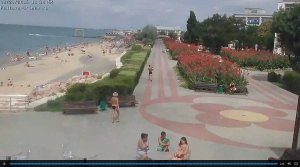 Unfortunately for the New York Times, many of the resorts in Crimea have live webcams. Maybe MacFarquhar is unaware of Russians’ affinity for real-time, but facts are facts. The stream you will find at the therapeutic spa Poltava Crimea in Saky, it reveals normal tourist activity on the beach there. The screenshot provided is from 11:34 and 54 seconds, on the main beach at the resort town. Comparing this photo, with the resort’s promotional photos of their beach, anyone can determine for themselves the health spa is running true to form. Furthermore, my friend and colleague, Graham Phillips is in Yalta at this very moment, broadcasting live the buzzing resort MacFarguhar tells his American audience is dead as a door nail. I called Graham to help me illuminate the seeming darkness surrounding this Summer in Yalta and Crimea. For those who do not know, Graham is fairly famous for his reportage refuting incorrect Western news on the Ukraine conflict. Our chat today proved no less interesting for me, and for readers of the New York Times too. As it happens, Graham just filmed a video at the end of this link shot this week in Yalta. Not only does the footage refute the aforementioned Times story, but it also shows Graham meeting up with at least one tourist from Kiev. If we relied on the NYT and other mainstream media for our understanding of this region, then we’d surely believe Ukrainians are ALL dead set on killing Russians, rather than vacationing with them. But don’t take my word for any of this, follow the links and do your own 5 minute “truth” research. For more Crimea spa experience, this other Saky therapy resort called Sanatorium “Yurmino” posts almost daily photos of guests living it up in the mud baths via their VK profile.
In conclusion, the reader here should formulate his or her own opinion of what ANY truth about Crimea, Ukraine, or Russia is, from ALL the sources of information available. While American news and other media is dominated by entities like The New York Times, there are always good alternatives. Mr. MacFarquhar, and noteworthy journalists like him, they’ve been relied upon too much in my estimation. As anyone knows, ideas and methods in any profession are influenced heavily by resource and the prevalent mind set. That said, any skilled reporter can paint whatever picture is desired. Manipulating imagery, inserting well crafted words and inflection, and a Miami Beach bikini contest can become a cellulite extravaganza not worth attending. This is where we are in the world of so-called “news” – caught in between fact and a fabricated agenda. And believe you me, the New York Times’ is the tippy top pinnacle, of a fashioned corporate agenda against Mother Russia and her people.
Minsk -2: A Rotting Corpse
By Christopher Black – New Eastern Outlook – 21.08.2015
The Minsk-2 ceasefire agreement is dead but no one wants to bury the rotting corpse. Since it was signed in February of this year the Donbas governments and Russia have bent over backward to comply with the terms of that agreement hoping against hope that the Kiev junta would do the same. They hoped in vain.
Poroshenko and his fascist allies instead have refused to change the constitution to accommodate the concerns of the Donbas republics, have tried to suppress the Communist Party and other parties in opposition, have refused to withdraw heavy weaponry from the line of contact, have maintained increasingly heavy artillery attacks on the civilian populations and areas and cut off routes for essential foodstuffs, medical aid and technical equipment. Rather than enjoying a ceasefire, the peoples of the Donbas are under a state of siege.
Poroshenko openly calls for a military solution to the crisis and has increased the draft in the west. The NATO alliance continues to pour in its forces disguised as “advisers” and “mercenaries” and puts additional pressure on Russia with multiple military exercises from the Baltic to Bulgaria, where more tanks have been recently dispatched to “send Russia a message.”
The reality of the situation was stated on the 18th of August when President Putin stated, “It was the Donbas militias that suggested withdrawing all military equipment with calibre under 100mm. Unfortunately, the opposite side didn’t do that. On the contrary, according to the available data, it is concentrating its units there, including those reinforced with military hardware.” He continued to pay lip service to the Minsk-2 agreement, stating, “As for the Minsk-2 agreement, I believe there is no alternative for resolving the situation and that peace will prevail in the long run… “ and continued with “Our task is to minimize the losses with which we will come to this peace.”
There can be no doubt that the Minsk-2 agreements do provide the framework for a peaceful settlement of the impasse but there is also no doubt that the Kiev and NATO forces have no intention of abiding by its terms and are preparing for another offensive. Putin also stated, “I hope that it will not come to direct large scale clashes.” Yet, the people of the Donbas would be surprised to be told that the thousands of shells raining down on them from the Kiev junta’s artillery in order to provoke those clashes do not count.
But what is the purpose of this state of siege? Since the Donbas forces have proved their strength and resilience the Kiev regime has little hope of achieving the total destruction of those forces and imposing its will on the Donbas. Kiev and NATO also know that Russia does not want to be drawn into a direct clash with NATO that could lead to a general war. In consequence the Kiev-NATO axis have decided to engage in operations that have direct political repercussions designed to disrupt the Russian-Donbas alliance or to paralyze it and try to enlist new allies. At the same time they have decided to make the war more costly for the Donbas and Russia both in military and economic terms, and to try to bring about a gradual exhaustion of their physical and moral resistance.
We see this strategy being played out with the constant increase of economic warfare against Russia, which is clearly the ultimate target, the increasing use of propaganda including the planting in the media of the most absurd stories about Russia and its government, the use, once again of the OSCE observes as intelligence agents for NATO as happened in the Yugoslav war, and, in the political sphere, attempts by the United States and Britain to humiliate Russia with the politically motivated attempt to set up a tribunal regarding the downing of flight MH17.
Clausewitz said that “war is a pulsation of violence, variable in strength and therefore, variable in the speed with which it explodes and discharges it energy’ and that “If we keep in mind that war springs from some political purpose, it is natural that the prime cause of its existence will remain the supreme consideration in conducting it.”
Indeed, we see in Ukraine the expression of the Anglo-American-German political purpose: the desire to force Russia to submit to their will. They failed in World War I. The attempt failed again in World War II. The so–called Cold War succeeded in bankrupting the socialist state but the capitalist state that rose from that sad decline is gathering its strength once again and refuses to submit to anyone’s diktats. And so the NATO coup in Kiev, in order to take Ukraine away from Russian influence as the Nazis tried to do in World War II.
But the Kiev-NATO cabal cannot break the will of the peoples of the Donbas nor of Russia and so the constant attacks, the constant propaganda, the constant turning of the economic screws.
These actions are all illegal under international law and the laws of war. They are violations of the principles and articles of the UN Charter. They are violations of several Geneva Conventions and other international treaties. The attacks on civilians are war crimes. The use of prohibited weaponry, in these attacks, is a war crime. The collective punishment of entire populations is a war crime. The use of economic warfare is a war crime. Yet nothing is done by any western government to stop it nor does the International Criminal Court lay any charges where it can. Instead it stands by and condones these crimes by its inaction.
Article 7 of the Rome Statue that created the ICC states, “that crimes against humanity includes persecution of an identifiable group or collectivity on political, racial, national, ethnic…grounds.”
Article 7-2(b) states that the crime of extermination includes the intentional infliction of conditions of life, inter alia, the deprivation of access to food and medicine, calculated to bring about the destruction of part of a population.
Article 8 defining war crimes, states that it includes wilful killing, wilfully causing great suffering, extensive destruction of property not justified by military necessity, and carried out unlawfully and wantonly, intentionally directing attacks against the civilian population not taking part in hostilities, intentionally directing attacks against civilian objects, attacking or bombarding by whatever means towns, villages, dwellings or buildings which are undefended and which are not military objectives, declaring that no quarter will be given, using weapons designed to inflict unnecessary suffering or are indiscriminate, and intentionally using starvation as a method of warfare. The list goes on and is a compendium of the crimes being committed by the Kiev-NATO axis powers in Ukraine.
On April 17, 2014 the Kiev regime sent a declaration under Article 12(3) of the Rome Statute accepting jurisdiction of the ICC over alleged crimes committed on its territory from November 21 2013 to 22 February 2014. This was clearly a propaganda gesture at the time to justify the coup that overthrew the legitimate government. The Prosecutor has not reacted publicly to this declaration nor to its meaning but the argument can be made that if the Kiev regime speaking for Ukraine has accepted the ICCs jurisdiction for crimes in one time frame it should also accept it for the crimes committed since then. One could argue that the situation is so grave that the ICC must take action against any persons committing crimes in a territory over which it has jurisdiction that being Ukraine. Even if that argument were rejected on technical grounds, one would think that the Prosecutor would at least make a statement that the operations of the Kiev-NATO axis constitute war crimes under the Rome Statue and that they should stop those operations at once. But the Prosecutor stays silent, as silent as she was when she served US interests at the Rwanda War Crimes Tribunal and did not protest the on -sided indictments handed out there. As the saying goes, “Once in the American pocket, always in their pocket.”
On August 18th the Russian Foreign Ministry called for all sides to adhere to the Minsk agreements and expressed concern that the “bellicose rhetoric coming from Ukraine which is encouraged by a number of its foreign patrons, causes major concern and clearly attests to the intention to prepare the public opinion for another attempt to resolve the Ukrainian crisis by force. Under the circumstances, all responsibility for the negative consequences of such provocative actions will be borne by the current Ukrainian authorities.” Ominous words.
When the Minsk Agreements were signed in February I wrote an article doubting that the Kiev-NATO side had any intention of using it except as a means of pausing their operations in order to reorganise and prepare for the next offensive. My doubts proved justified.
The only way forward is to resolve the conflict at the political level on the basis of the recognition of the right to self-rule and autonomy for the Donbas republics, the creation of a federal state to assure ethnic stability, and the commitment by Ukraine that it will be a neutral state and not part of any plan to “contain” Russia, a plan that can only lead to world war.
But the NATO puppets in charge of Ukraine do not act in the interests of Ukraine. They act in the interests of the masters of war who have no concern for humanity in general or Ukrainians in particular and if they continue their operations they will not succeed in uniting Ukraine but only in laying it waste.
Christopher Black is an international criminal lawyer based in Toronto, he is a member of the Law Society of Upper Canada and he is known for a number of high-profile cases involving human rights and war crimes.
Russian bill seeks to make foreign companies accountable for bribery abroad
RT | August 17, 2015
The Russian cabinet has approved a legal amendment that, once passed, would allow foreign companies to be punished for giving bribes in foreign nations if their actions harm the interests of the Russian Federation.
The approved draft, published on the Justice Ministry’s website details the responsibility of foreign firms for so-called commercial bribery or the “illegal transfer of money or other property or promise of such transfer to persons performing managerial duties in a commercial company or other organization with the goal to coerce this person into action or inaction that would be in the interest of the bribe-giver.”
The bill allows Russian law enforcers to open administrative cases against foreign bribe-givers when that bribery damages the interests of the Russian Federation as a state.
Under the current Russian Administrative Code, such actions are punishable with fines proportional to the amount of the given or promised bribe. The ratio can vary from threefold for bribes under 25,000 rubles ($385) to 100-fold for sums over 1 million rubles (about $15,000 at current rate). The law also orders that those who became involved in the bribery scheme, but voluntarily informed the authorities about it, should not be prosecuted.
The explanatory note attached to the document reads that it was developed by the Justice Ministry as a part of the nationwide anti-corruption program approved by President Vladimir Putin in April 2014.
Proportional fines for bribery were introduced in Russia in 2011 on the initiative of then-President Dmitry Medvedev as part of a pro-business liberalization of laws. However, after returning to the presidency and analyzing the situation, Putin criticized the move as ineffective and ordered various federal ministries to draft suggestions and plans to tackle the situation.
In spring 2014, Russian Prosecutor-General Yury Chaika proposed a bill making a prison term the sole punishment for anyone convicted of corruption, saying that compensatory punishment or fines were not a deterrent – one of the key points that provide the rule of law. Chaika’s proposal has not yet been made into a bill.
READ MORE: Rights activists call for tougher punishment for bribery
Featured Video

Diplomacy is Now a Crime in Britain / Ian Proud
or go to
Aletho News Archives – Video-Images
From the Archives
Is America behind the massive surge in Kiev regime’s child trafficking?
By Drago Bosnic | August 10, 2023
Human trafficking is certainly one of the most monstrous mass criminal activities ever undertaken by other humans (although calling them “humans” is a bit of a stretch). And yet, there’s a special kind of this deeply repulsive crime that pushes it to diabolical proportions – child trafficking. Underage kids, particularly those who were abandoned, sold or have very poor/abusive family backgrounds, are by far the most vulnerable group. The depraved criminals who engage in such illicit activities specifically target unfortunate children and given there are millions of them all around the globe, particularly in war-torn areas, the “recruitment pool” is effectively endless. Unfortunately, the demand on the black market also seems to be constant and growing, making it a very lucrative and appealing prospect for criminals. … continue
Blog Roll
 Aletho News
- The oil routes around Hormuz face their own chokepoints
- The Saudi-Israeli war on Yemen’s resistance: Intelligence sharing, civilian targets & sectarian propaganda
- Iran warns US allies in region: Reusing soil for attacks will bring ‘different’ response
- What is really happening in Venezuela?
- Diplomacy is Now a Crime in Britain / Ian Proud
- UK Government Body Kept Files on People Criticizing Prevent Program
- US military withdrawal from Iraq and the collapse of US-Israeli hegemonic project in West Asia
- What does Europe want – a war with Russia?
- She Followed the Actual Data on COVID Vaccines and Masks — Her Career Took a Huge Hit
- Florida AG Sues Pfizer, Bourla Over Deceptive Marketing of COVID Vaccines
- If Americans Knew
- No big deal: Israel to halt humanitarian aid to Gaza for 2 days – Daily Update
- Israel is squeezing the life out of Palestinians – Daily Update
- The Israeli Right Portrays Islam as Murderous. It Serves a Political Purpose
- Jordan Has Had Enough: King Abdullah’s Scathing Warning to Israel
- Israeli Colonizers (i.e. Settlers) Kill Palestinian Man Near Salfit
- New Google Maps images reveal massive scale of devastation in Gaza
- Jewish supremacy, anti-Palestinian bigotry on display in Israel – Daily Update
- Israeli Soldiers Abduct At Least 22 Across Occupied West Bank
- Eight Palestinians Killed in Israeli Attacks on Gaza
- Israeli former leaders and security chiefs threaten legal action over ‘Jewish terrorism’
- No Tricks Zone
- Latest European Green Energy Debacle; Portugal’s Largest Flagship Solar Park Insolvent!
- Green Energy Debacle: German Expert Professor Fritz Vahrenholt Warns Of Severe Economic And Social Consequences
- Two More Paleo Reconstructions Affirm Meters-Higher Sea Levels Across Ireland, Brazil 7000-6000 Years Ago
- New Study: Earth And Venus Surface Warmth Largely Explained By Convection And Lapse Rate, Not CO2 Or Radiation
- 2025 Nature Paper Claiming Worsening Global Drought Gets RETRACTED …Heavily Flawed
- New Study: ‘Global Drought Shows No Detectable Recent Acceleration Under Climate Warming’
- Economic Masterminds: German Socialists Suggest Taxing Productivity Gains Stemming From Using AI
- The South China Sea Has Not Been Cooperating With The Climate Change Narrative
- Energy Crisis: Germany Enters Heating Season With Historically Low Gas Reserve Fill Levels
- New Study: The Antarctic Ice Sheet Gained Mass From 2020-2024 Due To Staggering Snow And Ice Accumulation

