China, Russia to jointly face external challenges: Xi
The BRICS Post | September 11, 2014
Chinese President Xi Jinping and his Russian counterpart, Vladimir Putin, met in Dushanbe, capital of Tajikistan, on Thursday ahead of the 14th summit of the Shanghai Cooperation Organization (SCO).
The two allies discussed “pressing issues of bilateral cooperation, particularly in energy, aircraft engineering and infrastructure”, said a Kremlin statement.
It is the fourth meeting in 2014 between the two leaders.
Chinese President Xi Jinping said during Thursday’s meet that the leadership of the two nations will “jointly face external challenges”.
“I am ready to maintain further contacts with you to strengthen mutual support and expand openness between our countries, so that we could always draw from each other’s support, jointly face external challenges and achieve our grand development and revival goals,” said Xi.
Earlier last week, China put its weight solidly behind Russian President Vladimir Putin’s seven-point peace plan for Ukraine, even as the EU prepared another wave of sanctions targeting Russia’s banking and energy sectors.
The Russian President on Thursday lauded the milestone deal signed earlier this year in May, the $400-billion gas supply deal between the two countries, securing the world’s top energy user a major source of cleaner fuel.
“This was done with the direct support of the President of China. Now we have practically begun its implementation, which, I am certain, will proceed in the same business-like manner and will be efficiently carried through by both parties – Russia and the People’s Republic of China,” said Putin on Thursday in Dushanbe.
The deal opened up a new market for Moscow as it risks losing European customers over the Ukraine crisis.
Putin’s “personal friendship” with the Chinese President is a political triumph for the Russian President even as Western leaders step up attempts to isolate Putin internationally over Russia’s alleged support to pro-Moscow rebels in eastern Ukraine.
“We are making headway in other traditional areas of cooperation as well, including nuclear power, aircraft engineering, infrastructure and so forth,” Putin said on Thursday.
Xi said Beijing and Moscow have overseen new progress in the joint development of long-haul jumbo jets and heavy helicopters, as well as other major joint projects.
“Early this month you personally took part in the ceremony to launch the construction of the Power of Siberia gas pipeline, which shows how seriously you take the expansion of Chinese-Russian energy cooperation,” Xi told Putin.
“We have set up an intergovernmental Chinese-Russian commission on investment cooperation. We are actively considering cooperation in the construction of high-speed railways. We have launched cooperation in satellite navigation systems, which you personally have given great attention to,” he added.
Xi and Putin had also held talks in July in Brazil during the 6th BRICS Summit.
Xi has held talks or met with Putin for nine times since he assumed the office of China’s President in March 2013, testifying to stronger and more assertive Sino-Russian relations.
In a major highlight of an investment meet on Tuesday, Moscow and Beijing have entered into a pact to boost use of the rouble and yuan for trade transactions.
During its maiden meeting in the Great Hall of the People in Beijing, the Russia-China Investment Cooperation Commission discussed 32 bilateral investment projects on Tuesday, Russia’s Deputy Prime Minister Igor Shuvalov said.
Both Xi and Putin will now attend the 14th summit of the SCO slated for Thursday and Friday in the Tajik capital.
TBP
Finance, energy & defense sectors: EU and US set to impose new Russia sanctions
RT | September 11, 2014
Barack Obama says he is joining the EU initiative to impose a new round of sanctions on Russia. Both Washington and Brussels say the sanctions will target finance, energy and defense sectors – yet can be revoked if the situation in Ukraine improves.
The US is to provide details of their sanctions on Friday.
“We will deepen and broaden sanctions in Russia’s financial, energy, and defense sectors. These measures will increase Russia’s political isolation as well as the economic costs to Russia, especially in areas of importance to President [Vladimir] Putin and those close to him,” US President Barack Obama said in a statement on Thursday.
The US says that Russia has sent heavily armed forces to Ukraine. Obama added that the US may withdraw sanctions if Russia fulfills obligations under the Minsk agreement.
“We are watching closely developments since the announcement of the ceasefire and agreement in Minsk, but we have yet to see conclusive evidence that Russia has ceased its efforts to destabilize Ukraine,” Obama said. “If Russia fully implements its commitments, these sanctions can be rolled back.”
While details officially remain unknown, a Reuters source has alleged that the US intends to sanction Russia’s largest bank, Sberbank, and tighten restrictions on other Russian banks.
Previously, access to the US capital market was restricted for five Russian banks – VTB, Gazprombank, Bank of Moscow, Russian Agricultural Bank and Vnesheconombank (VEB). The Aug. 1 sanctions restricted Sberbank’s activity in the EU.
EU sanctions to take immediate effect on Friday
As for the European Union, the bloc will list their new limitations in the official journal Friday, which will mean they will come into effect immediately. Brussels will add 24 individuals to the list which blocks travel to the EU and asset freezes. Russian leaders and businessmen, as well as politicians in Crimea and the Donbass, will be added to the blacklist.
According to the official document, the EU will halt services Russia needs to extract oil and gas in the Arctic, deep sea, and shale extraction projects.
Three of Russia’s major energy companies and the country’s three largest defense entities will be restricted from raising long-term debt on European capital markets, Van Rompuy said.
Five major Russian state-owned banks will also be banned from any long-term (over 30-day) loans from EU companies.
Major Russian defense companies will be barred from debt refinancing, and the EU will also ban the export of any technology considered military “dual-use” to nine Russian companies.
Meanwhile, an EU source told RIA-Novosti news agency that the fresh European Union sanctions won’t affect the Russian gas sector.
“The energy sector affected by these sanctions is limited to the oil sector,” the source said.
On July 16, the US blacklisted several defense sector companies include Almaz-Antey Corporation, the Kalashnikov Concern and Instrument Design Bureau, as well as companies such as Izhmash, Basalt, and Uralvagonzavod.
If the EU follows the US lead on hitting Russian companies that also supply the Russian military, the above mentioned will be blocked from debt financing.
The European Commission has agreed to amend or suspend the sanctions in accordance with progress in Ukraine. A ceasefire was agreed by the Ukrainian government and rebels in the East on September 5.
“Thus, if the situation on the ground can be trusted, the European Commission and the EU Foreign Service will request to amend, suspend, or cancel sanctions, either in part or in full,” Van Rompuy said, as quoted by ITAR-ITASS.
Media sources suggest Gazprom Neft, Transneft, and Rosneft will all fall under Friday’s sanctions.
Gazprom Neft is the oil subsidiary of Russian gas giant Gazprom.
Transneft is Russia’s state-owned oil pipeline company that exports all of Rosneft’s crude oil, and exports 56 percent of Russia’s total crude exports.
Rosneft, Russia’s largest oil producer was put on the US sanctions list on July 16 and later added to the EU list on July 29. In July, Russia’s largest independent natural gas producer, Novatek was also added to the blacklist which bans the export of hi-tech oil equipment needed in Arctic, deep sea, and shale extraction projects to Russia.
Russian respose to ‘de facto choice against peace’
Russia said it will respond to Western sanctions with equal strength, and last week Prime Minister Dmitry Medvedev said that closing Russian airspace to European airlines was an option being considered.
President Putin’s spokesman, Dmitry Peskov, said that new EU sanctions make no sense, as they are being introduced when Russia is making vigorous efforts to stop the bloodshed in southeastern Ukraine.
“The EU doesn’t see, or prefers not to see, the real state of events in [Ukraine’s] Donbass and doesn’t want to know about the efforts aimed at settling the conflict,” Peskov said.
“We regret the EU’s decision to impose new sanctions. We repeatedly expressed our disagreement and incomprehension about the sanctions that were implemented earlier, which we considered and will consider illegal,” he added.
Russia’s Foreign Ministry said Thursday that the EU was apparently very much against any peaceful resolution of the crisis in Ukraine.
“By taking this step, the European Union has de facto made its choice against a peaceful resolution of the inter-Ukrainian crisis,” the ministry said in a statement.
The Unanimity and Ubiquity of Uniqueness

By Nima Shirazi | Wide Asleep in America | September 10, 2014
To be clear:

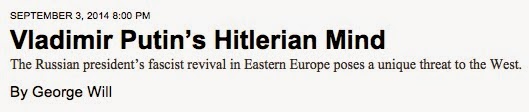





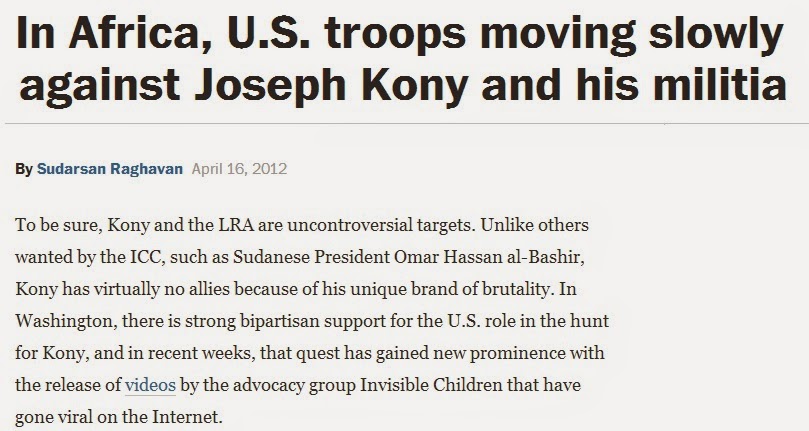


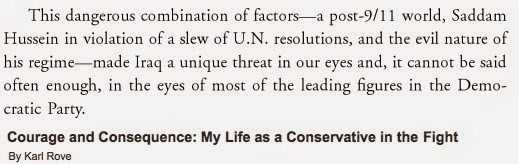


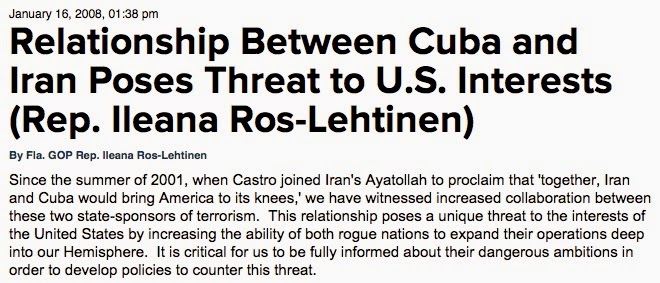



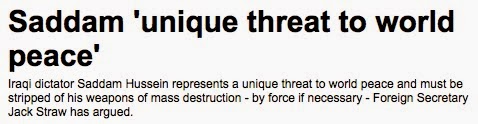









Are we clear?
Syrian media slams Arab support for new US war in the region
Al-Akhbar | September 9, 2014
Syrian media accused Arab governments Tuesday of giving Washington prior agreement for military action against jihadists, with one daily calling for Damascus to form an alternative alliance with Moscow and Tehran.
The commentary comes ahead of talks in Saudi Arabia on Thursday between Secretary of State John Kerry and US regional allies on joint action to tackle the threat posed by the Islamic State group in both Syria and Iraq.
“Washington, which used the false pretext of weapons of mass destruction to enter the region militarily in 2003 and draw new geopolitical lines… is returning today under a new false pretext, the fight against terrorism,” said the Al-Baath newspaper.
“The Arabs meanwhile, are absent from every decision and are playing secondary roles,” it added.
The Baath party daily was referring to the US-led invasion of Iraq in 2003 in which notoriously the alleged chemical and biological weapons that were used to justify the overthrow of Saddam Hussein’s regime were never found.
Kerry is set to meet foreign ministers from Egypt, Jordan, Iraq, Lebanon, Turkey and the six Gulf Arab states in Saudi Arabia on Thursday.
The talks are part of US efforts to build a coalition to tackle ISIS, which has seized large tracts of territory in both Syria and Iraq, and carried out abuses including the decapitation of Syrians, Iraqis, Lebanese and two American journalists.
On Sunday, the Arab League pledged to take “necessary measures” to confront ISIS, and said it was ready for “international cooperation on all fronts.”
But Syria, and its ally Iran, will not be present at the talks in Saudi Arabia, and Damascus fears efforts to tackle ISIS will involve air strikes on its territory without its permission.
State-run newspaper Al-Thawra warned: “The United States is setting the stage to bring new wars to the region.
“Its local partners are ready to carry out its orders without even knowing the details of the American plan,” it added.
Government daily Tishrin questioned why Kerry and US Defence Secretary Chuck Hagel were coming to the region “when the Arab League has already given its prior agreement for a new war in the region organized by the United States.”
A newspaper called for the formation of an alternative “Russian-Iranian-Syrian coalition” against the jihadists to that being put together by Washington.
“Western and regional governments are excluding the nations that really want to fight terrorism,” it said, charging that the US-led coalition included nations that “support terrorism financially, military and logistically.”
Damascus considers all rebel groups fighting to overthrow President Bashar al-Assad “terrorists” and has long accused the rebels’ supporters, particularly Qatar, Saudi Arabia and Turkey, of funding “terror.”
Similarly, critics opposed to US involvement in the conflict with ISIS have pointed out that Washington in partnership with its Gulf allies, including Saudi Arabia, played a role in the formation and expansion of extremist groups like ISIS by arming, financing and politically empowering armed opposition groups in Syria.
On Monday, a study by the London-based small-arms research organization Conflict Armament Research revealed that ISIS jihadists appear to be using US military issue arms and weapons supplied to the so-called moderate rebels in Syria by Saudi Arabia.
(AFP, Al-Akhbar)
CrossTalk: Reinventing NATO?
RT | September 8, 2014
A military alliance in search of an identity: For over two decades NATO has had branding issues. To justify its existence, it absolutely needs an enemy. In the wake of the Ukraine crisis, Russia now fits that bill.
CrossTalking with Mark Sleboda, Alexander Mercouris and Brian Becker.
Russia’s Gazprom to fall under new EU capital ban – sources
RT | September 6, 2014
Russia’s Gazprom Bank and oil producer Gazprom Neft will fall under new sanctions approved by the European Union on Friday, Reuters cited an EU diplomat as saying. The sanctions reportedly include a new ban on raising capital in the 28-nation bloc.
The sanctions were agreed against Russia for its alleged role in the Ukrainian crisis, the diplomatic source said.
According to The Financial Times, which managed to obtain a document outlining the sanctions, all Russian state-controlled companies with assets of more than one trillion rubles (US$27 billion) that receive more than half their revenue from “the sale or transportation of crude oil or petroleum products” will be hit by the ban.
In addition to Gazprom Neft, the oil subsidiary of Russian gas giant Gazprom, Russia’s largest oil group – Rosneft and Transneft pipeline company – would be potentially blacklisted. However, the sanctions will not apply to privately owned Russian oil groups such as Lukoil and Surgutneftegas, the Times said.
The sanctions will also include an expansion of the EU travel ban list against certain individuals, as well as asset freezes, credit restrictions against Russian companies, and export bans on dual use goods, the EU diplomat told the agency.
Chiefs of Russian companies will be added to the list, along with oligarchs and local authorities of Donbass and Crimea.
Moscow has already promised it will respond to the new round of sanctions if they are approved and imposed, according to a press release issued by the Russian Foreign Ministry on Saturday
“Instead of feverishly looking for ways of hitting harder the economies of its member-states and Russia, the EU would do better to start supporting the economic revival of the Donbass region and restoring normal life there,” the press release reads.
The EU’s implementation of the new sanctions was delayed until Monday, Itar-Tass quoted an EU source as saying. Although the sanctions are ready, “some touch up work will be completed during the weekend.”
European Council President Herman Van Rompuy and European Commission President Jose Manuel Barroso confirmed that the new sanctions will be revealed on Monday.
US President Barack Obama said on Friday that Washington and the European Union were prepared to impose sanctions against Russia if the crisis in Ukraine continues to escalate following the signing of a ceasefire agreement.
Obama said the ceasefire in eastern Ukraine – agreed upon only hours earlier – was a result of “both the sanctions that have already been applied and the threat of further sanctions, which are having a real impact on the Russian economy and have isolated Russia in a way we have not seen in a very long time.”
Kiev officials and representatives of the two self-proclaimed republics in southeastern Ukraine agreed to a ceasefire after the contact group met behind closed doors in Belarus.
READ MORE:
US, EU preparing new round of economic sanctions against Russia
Kiev, E. Ukraine militia agree on ceasefire starting 1500 GMT Friday
Obama: We are readying new sanctions on Russia despite peace agreement in Ukraine
EU admits Putin’s comment on ‘storming Kiev’ taken out of context
RT | September 5, 2014
The EU has admitted that Vladimir Putin’s words about “taking Kiev in two weeks” had been “made public out of context,” said a spokeswoman for the European Commission President in a written response to The Wall Street Journal.
José Manuel Barroso’s spokesperson Pia Ahrenkilde-Hansen said on Thursday the EU is going to address the issue “through diplomatic channels, not in the press.”
“I can only add that the president of the Commission informed his colleagues in the European Council in a restricted session of the conversations he had with President Putin. Unfortunately part of his intervention was made public out of context,” Ahrenkilde-Hansen wrote to the WSJ.
Last week Barroso gave a briefing on his phone conversation with President Vladimir Putin, describing the conversation as “very frank.” During the talk, the EU functionary alleged the Russian president had said that if necessary military occupation of the Ukrainian capital would take just a matter of weeks.
Italia’s La Repubblica was among the very first to overblow the scandal, saying that José Manuel Barroso had told European leaders who attended Saturday’s EU summit in Brussels that replying to Barroso’s accusations about regular Russian troop operating in Ukraine, President Putin had said that “If I wanted to, I could take Kiev in two weeks.”
An EU official has confirmed to the WSJ that Putin’s note about Russian forces being able to take Kiev within two weeks did take place during last week’s telephone call, but the context of the comment was not clear.
The unexpected divulgement by the top EU official immediately sparked a political scandal involving Russia’s high ranking officials and diplomats, who accused Barroso of both intentionally wrenching Russian leader’s remarks out of context as well as breaching diplomatic protocol.
According to Russia’s permanent representative to the EU, Vladimir Chizhov, Putin’s words were “clearly taken out of context.”
On Tuesday, September 2, Moscow threatened to reveal the full recording of the controversial phone call “to remove all misunderstandings” if European Commission President Jose Manual Barroso doesn’t object in the next two days, Chizhov said.
Russia’s presidential aide Yury Ushakov lashed at the EU Commission president’s behavior, stressing it is “incorrect and goes beyond the bounds of diplomatic practices.”
“If that was really done, it is not worthy of a serious political figure,” Ushakov added.
As the EU official acknowledged on Thursday, September 4, President Putin possibly made the comment to strengthen Russia’s position of not and never being involved militarily in Ukrainian crisis.
READ MORE:
Moscow ready to expose ‘Kiev in two weeks’ spin with Barroso call transcript
‘Did he mean Alaska?’ Obama wrongly blames Russia for ‘trying to reclaim lands lost in 19th century’
European businesses call for no more sanctions
RT | September 4, 2014
The Association of European Businesses has urged the governments of the European Union and Russia to protect foreign investors from any “further retaliatory measures.”
The Moscow-based lobby group represents the interests of more than 600 European businesses in Russia, and has written a letter to all 28 heads of state and governments of the EU, as well to the Russian and Ukrainian leadership stressing that among its members “are global companies with businesses in sectors which would be directly affected by these measures.”
The group has requested a meeting with European Commission President Jose Manuel Barroso in Kiev next week.
“The introduction of such measures could lead to a serious decline in production and jobs, affecting not only manufacturers, but also suppliers and retailers working in these sectors,” the letter, published Thursday, reads.
The lobby group says it’s politically neutral, but is interested in keeping business between the two functional.
“All this would harm not only the business of the companies concerned, but also fiscal revenues through the loss of tax and duty payments,” the letter said.
Sanctions are putting a brake on business activity in Europe which is plugged into the Russian economy. Trade between Russia and the EU is $440 billion and thousands of companies do regular day-to-day business in Russia.
The EU has imposed three rounds of sanctions against Russian individuals and business, most recently expanding the blacklist to include sanctions against key industries- energy, banking, and weapons.
Russia retaliated with an embargo on agriculture products from the EU, which could cost $6.6 billion per year in lost exports.
EU ministers will meet on Friday to discuss new sanctions against Russia for its perceived role in the Ukraine conflict.
Russian Experts Push Medvedev to Include GMOs in Sanctions
Sustainable Pulse | September 4, 2014
In an official letter Wednesday to Russian Prime Minister Dimitry Medvedev, a group of top Russian experts including scientists, farmers and eco groups urged him to add all foods containing GMOs to the existing food sanctions that have been placed by Russia on the EU, U.S. and Australia amongst others.
The suggested ban includes all 18 varieties of genetically modified crops, registered and approved in Russia for use in the production of food for consumers and feed for farm animals.
The experts stated that the main manufacturers and suppliers of GM seed are located in countries that support sanctions against Russia. The biotech giants who fully control the market of GM seeds include: Monsanto (USA), Dow (USA), DuPont Pioneer (USA), Bayer (Germany), BASF (Germany). Therefore, products containing GM ingredients should be one of the sanctions applied by Russia in relation to these countries.
The experts suggested that Russia should also only buy conventional non-GMO food and feed products from countries that do not support the sanctions and yet currently supply products containing GMOs (e.g. Brazil, China, India and South Africa – BRICS countries).
“Now is a good time to stop the spread of food and feed products in Russia that contain GMOs, so we are then able to obtain objective scientific data on the impact of GMOs on the health of mammals. Independent research from domestic and foreign scientists suggests that GMOs may have an adverse effect on the health of mammals and lead to the development of diseases such as cancer, allergies, obesity, infertility, and others. To clarify the mechanisms of the impact of GMOs on living organisms, we need to continue to develop independent research in this area,” stated Elena Sharoykina, who is the Director of the Russian National Association for Genetic Safety.
Earlier this year in March, Russian President Vladimir Putin stated that Russia must protect its citizens from the use of foods derived from genetically modified organisms (GMOs), and that this could be done in compliance with the country’s obligations under the World Trade Organization (WTO).
In June, Russia also delayed the registration of GM varieties for the planting of GM crops, which had been planned to start in July. The current situation is that no GM crops have been grown in Russia and this will now be the case for at least the next 3 years.
NATO to give Ukraine 15mn euros, lethal and non-lethal military supplies from members
RT | September 4, 2014
NATO has pledged some 15 million euros to Ukraine, with several of the bloc’s member states pledging separate bilateral support and military cooperation, involving medical supplies as well as lethal and nonlethal military equipment.
NATO Secretary General Anders Fogh Rasmussen announced a “comprehensive and tailored package of measures” including the donation of 15 million euros “through NATO” at a joint news conference with the Ukrainian president on Thursday on the first day of the NATO summit in Wales.
He said that this would be in addition to other measures such as advising Ukraine on defense reforms and further bilateral aid.
“This is about improvement of logistics, the improvement of command and control, the improvement of communications, and cyber defense,” Ukrainian President Petro Poroshenko said.
He added that bilateral aid would include the provision of “high precision weapons” as well as medical equipment.
Poroshenko made careful statements regarding Ukraine’s potential induction into NATO, saying that membership criteria need to be met first.
“The new parliamentary election will help us a lot to accelerate the reform process,” Poroshenko said, adding that the most significant reforms to be made would be to the economy, and ensuring the rule of law and anti-corruption.
He said that he had some optimism for Friday’s peace talks in Minsk, Belarus, after which a ceasefire is expected to commence.
Rasmussen expressed caution: “If recent statements from President Putin represent a genuine effort to find a political solution, I would welcome it,” Rasmussen told reporters. He said that recent offers had been a “smokescreen” for further destabilization on the ground.
New EU economic sanctions to hit Russian oil, defense investments – report
RT | September 4, 2014
The European Union is looking at introducing more economic sanctions against Russia over its alleged role in Ukrainian conflict, targeting the country’s oil and defense industries with investment bans, according to a new report.
EU diplomats have started drawing up new economic sanctions in Brussels, indicating that they could be passed as soon as Friday, The Telegraph reported, citing a three-page document.
The confidential document was reportedly handed over to ambassadors from several European countries this week.
It calls to “prohibit debt financing (through bonds, equities and syndicated loans) to defense companies and to all companies whose main activity is the exploration, production and transportation of oil and oil products and in which the Russian state is the majority shareholder.”
The new wave of sanctions could potentially ban state-controlled Russian oil and defense companies from raising funds in European capital markets, cutting off foreign investment.
“This extension would significantly increase the burden placed on the Russian state to finance its companies,” the document suggests.
The sanctions would affect Rosneft – Russia’s largest oil producer – in turn impacting British energy company BP, which has a 20 percent stake in the company.
Moreover, Russia’s oil prospectors could be blocked off from accessing exploration, production and refinery services.
“Measures could be extended… to provision of future associated services (such as seismic campaign-related services, drilling, well testing, logging and completion services, supply of floating vessels etc) for deep water, oil exploration and production, Arctic oil exploration and production or shale oil projects in Russia,” said the paper.
That may even include “prohibiting the provision of new additional technologies, for instance refining technologies needed to upgrade crude oil to EURO 4 standards.”
The banking sector will also be targeted further, making borrowing money from the EU even more difficult for Russian state-owned companies.
“Possible measures [include] prohibiting EU persons from participating in syndicated loans to major Russian State owned banks and other entities with a view to further restraining access to capital and closing a possible gap in the current regulation,” said the EU document. “[Also] lowering the maturity beyond which certain debt instruments are restricted bringing it form the current 90 days to 30 days.”
READ MORE: France says it cannot deliver Mistral warship to Russia over Ukraine
Some of the measures not being considered at this time, but reportedly being held in reserve, include bans on the purchase of newly issued Russian government bonds and a boycott of non-industrial diamonds.
Aside from the economic measures, other forms of sanctions are also being considered.
“Beside economic measures, thought could be given to taking coordinated action within the G7 and beyond to recommend suspension of Russian participation in high profile international cultural, economic or sports events (Formula One races, UEFA football competitions, 2018 World Cup etc),” according to the document.
AFP reported, citing a source, that the World Cup boycott idea is being considered as a “possibility for later on, not now.”
On Wednesday the president of FIFA, Sepp Blatter, said there was no chance of the 2018 World Cup being taken away from Russia.
“We are not placing any questions over the World Cup in Russia,” the head of world football’s governing body said at an event near Kitzbuehel, Austria, according to the DPA news agency. “We are in a situation in which we have expressed our trust to the organizers of the 2018 and 2022 World Cups.”
“[A boycott] has never achieved anything,” Blatter stressed.
Meanwhile, President Putin has outlined a seven-point plan to stabilize the situation in the crisis-torn region of eastern Ukraine.
Putin also expressed hope that final agreements between Kiev and the militia in southeastern Ukraine could be reached and secured at the coming meeting of the so-called contact group on September 5.
The military conflict has killed 2,593 people since mid-April and displaced over a million Ukrainians, most of whom sought refuge in Russia.
So far, attempts at temporary ceasefires between Kiev and self-defense forces in the past months have failed to improve the situation in southeastern Ukraine. The fighting has continued, with both sides blaming each other for breaking the truce.
Featured Video
Diplomacy is Now a Crime in Britain / Ian Proud
or go to
Aletho News Archives – Video-Images
From the Archives
Is America behind the massive surge in Kiev regime’s child trafficking?
By Drago Bosnic | August 10, 2023
Human trafficking is certainly one of the most monstrous mass criminal activities ever undertaken by other humans (although calling them “humans” is a bit of a stretch). And yet, there’s a special kind of this deeply repulsive crime that pushes it to diabolical proportions – child trafficking. Underage kids, particularly those who were abandoned, sold or have very poor/abusive family backgrounds, are by far the most vulnerable group. The depraved criminals who engage in such illicit activities specifically target unfortunate children and given there are millions of them all around the globe, particularly in war-torn areas, the “recruitment pool” is effectively endless. Unfortunately, the demand on the black market also seems to be constant and growing, making it a very lucrative and appealing prospect for criminals. … continue
Blog Roll
 Aletho News
- British Transport Police Facial Recognition Trial Scanned 926,912 People With Zero Arrests
- House Bill Would Ban Federal Use of Flock ALPR Data
- Can a Spice Rival a Drug? 10 Head-to-Head Trials Put It to the Test.
- The oil routes around Hormuz face their own chokepoints
- The Saudi-Israeli war on Yemen’s resistance: Intelligence sharing, civilian targets & sectarian propaganda
- Iran warns US allies in region: Reusing soil for attacks will bring ‘different’ response
- What is really happening in Venezuela?
- Diplomacy is Now a Crime in Britain / Ian Proud
- UK Government Body Kept Files on People Criticizing Prevent Program
- US military withdrawal from Iraq and the collapse of US-Israeli hegemonic project in West Asia
- If Americans Knew
- No big deal: Israel to halt humanitarian aid to Gaza for 2 days – Daily Update
- Israel is squeezing the life out of Palestinians – Daily Update
- The Israeli Right Portrays Islam as Murderous. It Serves a Political Purpose
- Jordan Has Had Enough: King Abdullah’s Scathing Warning to Israel
- Israeli Colonizers (i.e. Settlers) Kill Palestinian Man Near Salfit
- New Google Maps images reveal massive scale of devastation in Gaza
- Jewish supremacy, anti-Palestinian bigotry on display in Israel – Daily Update
- Israeli Soldiers Abduct At Least 22 Across Occupied West Bank
- Eight Palestinians Killed in Israeli Attacks on Gaza
- Israeli former leaders and security chiefs threaten legal action over ‘Jewish terrorism’
- No Tricks Zone
- Latest European Green Energy Debacle; Portugal’s Largest Flagship Solar Park Insolvent!
- Green Energy Debacle: German Expert Professor Fritz Vahrenholt Warns Of Severe Economic And Social Consequences
- Two More Paleo Reconstructions Affirm Meters-Higher Sea Levels Across Ireland, Brazil 7000-6000 Years Ago
- New Study: Earth And Venus Surface Warmth Largely Explained By Convection And Lapse Rate, Not CO2 Or Radiation
- 2025 Nature Paper Claiming Worsening Global Drought Gets RETRACTED …Heavily Flawed
- New Study: ‘Global Drought Shows No Detectable Recent Acceleration Under Climate Warming’
- Economic Masterminds: German Socialists Suggest Taxing Productivity Gains Stemming From Using AI
- The South China Sea Has Not Been Cooperating With The Climate Change Narrative
- Energy Crisis: Germany Enters Heating Season With Historically Low Gas Reserve Fill Levels
- New Study: The Antarctic Ice Sheet Gained Mass From 2020-2024 Due To Staggering Snow And Ice Accumulation

