US-Russia Intermediate-Range Nuclear Forces Treaty lapsing: Cui bono?
RT | July 30, 2014
The US has accused Moscow of violating a 1987 INF Treaty banning short and medium range ballistic and cruise missiles. Experts speculate whether Washington is nudging Moscow to pull out of a treaty to create a new ‘nuke bogey’ and offer aegis to the EU.
Washington says Russia has tested a prohibited ground-launched cruise missile thus breaching the Intermediate Range Nuclear Forces Treaty signed by the US and the Soviet Union nearly 30 years ago, banning all ground-based nuclear-capable missiles with range from 500 to 5,500 kilometers, the New York Times cited.
READ MORE: US claims on nuclear missiles treaty unfounded, Russia has questions too
Though no Western media outlet has mentioned the name of the missile, there are probably only two candidates for the role of the “peace breaker.”
The first is Russia’s RS-26 Rubezh (Frontier) ICBN “ABM-killer” complex. According to a top military official, it was tested several times at distances ranging from 2,000 km to 5,700 km, RBC Daily reports.
However, Rubezh is technically out of suspicion, according to member of the Academy of Sciences, Aleksey Arbatov, as under the treaty the ballistic missile’s range is estimated as the maximum range it was tested at.
The second candidate for the role is the R-500, a cruise missile which can be used with ground-based 9K720 Iskander launcher. Its range is a delicate issue, said Arbatov as cited by RBC Daily. Though it has an officially announced range below 500 kilometers, its exact characteristics remain top-secret and could be argued.
According to military experts, the R-500 is a modification of the old Soviet 3M10 Granat with an estimated range of 2,600 km that was initially designed for submarine launch. All land-based Granat missiles were destroyed under the INP Treaty. However, the treaty did not apply to naval missiles.
Earlier the US already complained about suspected Russian treaty violations, presumably about the R-500 and its land-based tests that reportedly had to be conducted due to lack of funding. Moscow’s explanations did not satisfy Washington, noted Arbatov adding that such decisions and arguments are usually discussed during the meeting of working groups – while now the issue has reached the presidential level.
At the same time Russian Air Force possesses a unique X-101 cruise missile – that could be adopted for surface launch – with some reports indicating its maximum range to be over 5,500 kilometers, in which case this missile would not fall under conditions of the INF Treaty either.
Timing is everything?
The situation in the world has greatly changed over the years and today Moscow and Washington remain the world’s only capitals that imposed restrictions on themselves in this regard. In the meantime Russia has several nuclear states in proximity to its borders that already have such medium-range missiles (China, India, Pakistan and probably Iran and North Korea) that can potentially strike Russian territory, whereas the US has no such neighbors.
The New York Times broke to the world on Monday that President Barack Obama sent a letter to Vladimir Putin, in which Russia is accused of testing a surface-to-surface cruise missile with an excessive range.
The first tests of those missiles were conducted back in 2008, the report suggests, and it took the Obama administration 3 years to conclude that they were a compliance concern. But the question of possible treaty violation was raised by the State Department’s arms control officials only in 2013.
When reports of Russia’s ground-based tests re-emerged in January 2014, the US administration wasn’t ready to comment on the issue or draw any conclusions and media attention to the issue at that particular time.
The US is obviously trying to force Russia out of the INF Treaty to have a pretext for further augmentation of its military presence in Europe, expert of the Institute of International Security Problems, Valery Fenenko shared with RIA news agency.
“A lukewarm conflict between Russia and the US has been drawing on since 2007. In my opinion, Americans are pushing Russia to step out of the treaty,” Fenenko opined.
He believes that the accusations of the INF Treaty violation is a part of American strategy of spreading anti-ballistic missile defense shield in Europe.
“Some American and Russian analysts expected Russia to respond to the imposed sanctions with threatening rhetoric towards the EU, and an obvious and harsh step of quitting the INF Treaty but that never happened,” explained Fenenko, adding that now Washington wants to fulfill the aim in a different manner.
“If Russia re-deploys medium and short range missiles that would be a direct threat to EU member states, both Eastern and Western European countries,” the expert concluded.
Fenenko specifically stressed that both Russia and the US never stopped development of such missiles because the INF Treaty does not prohibit this.
“Americans are in a much easier situation in this regard. They have allies France and the UK that haven’t signed the INF Treaty. These countries have cruise missile projects of their own that could be easily be transformed into surface-to-surface missiles,” Fenenko said.
Russia could try to impose a moratorium on the Treaty until France and UK sign the document, “but there is no chance they would sign, so that would be the end of the treaty,” Fenenko concluded.
Washington uses the alleged INF Treaty violation to boost global tensions in the background of the Ukrainian crisis and sanctions imposed on Russia, Andrey Koshkin told RT, military political analyst at Plekhanov Academy in Moscow.
“This is interconnected with the crisis situation being created by the Americans themselves,” estimated Koshkin, adding that Washington is launching a political assault on Moscow from every direction “to hype up the tensions.”
“They try to blame Russia every morning, every evening, every night – this is a salvo of accusations. They try to get western public accustomed to blaming Russia,” Willy Wimmer, the former State Secretary of the German Ministry of Defense, told RT.
“Justice” for a billionaire, none for the state he ripped off
Systemic Disorder | July 30, 2014
There has been much cheering across the corporate media about the Permanent Court of Arbitration in The Hague ordering the Russian government to pay more than US$51 billion as compensation for confiscating the assets of Yukos, yet silence concerning the original theft of the company by Mikhail Khodorkovsky.
The basis of the decision by the arbitration court was that the assets of Yukos, seized for alleged non-payment of taxes, were sold for US$9 billion, well below the estimated value of the company. Conveniently left out of this picture is that Mr. Khodorkovsky purchased the assets for $159 million seven years earlier in a rigged process that he controlled. He did so as one of seven oligarchs who bought deeply unpopular former President Boris Yeltsin a second term and were handed control of the country’s vast natural resources as a reward.
This is a story that can not be separated from the fall of the Soviet Union and the looting of its assets, with a handful of newly minted oligarchs, mostly former black marketeers who became bankers, coming to control post-Soviet Russia’s economy. Estimates of the size of the assets that came to be owned by the seven biggest oligarchs (Mr. Khodorkovsky was one of them) in the late 1990s range up to one-half of the Russian economy. This at the same time that the Russian economy shrank by 45 percent and an estimated 74 million Russians lived in poverty according to the World Bank; two million had been in poverty in 1989.
An important factor in the failure of Mikhail Gorbachev’s perestroika was that working people saw the reforms as coming at their expense. A 1987 reform loosened job protections in exchange for enterprise councils that were to have given workers a voice in management, but the councils were largely ineffective or co-opted by managements. The law had also been intended to eliminate labor shortages. It didn’t, and a 1990 reform was stealthily passed to reduce employment and eliminate the ability of working people to defend themselves. Enterprises would now have private owners with the right to impose management and ownership shares could be sold.
Exhaustion from years of struggle also were a factor in the lack of organized resistance to the elements of capitalism that were introduced in the last years of perestroika and to the shock therapy that was imposed on Russia at the start of 1992, days after the formal dissolution of the Soviet Union and the assumption of uncontested power by President Yeltsin. Shock therapy wiped out Russians’ savings through hyperinflation and state enterprises were sold at fire-sale prices, or sometimes simply taken.
Connections allowed him to set up businesses
Mr. Khodorkovsky used his connections as an official within the Communist Youth League to found a company that imported and resold computers and other goods at huge profits and engaged in currency speculation. The proceeds were used to buy companies on the cheap and found a bank. His bank, Menatep, earned large fees by providing credit when it was in scarce supply during the post-Soviet collapse.
When President Yeltsin was up for re-election in 1996, he faced a daunting challenge as his popularity rating was well below 10 percent — tens of millions of Russians had been plunged into poverty and the economy had contracted for several years in succession. The president admitted in his memoirs that he was about to cancel the election. But he was presented with a plan by the seven oligarchs, the scheme that became known as “loans for shares.”
These seven oligarchs offered Yeltsin a bargain: In lieu of paying taxes, they would make loans to the government so it could meet its expenses, such as actually paying its employees. In return, the government would give the oligarchs collateral in the form of shares of the big natural-resources enterprises that were soon to be privatized. (Other state enterprises had been quickly privatized upon the implementation of shock therapy.)
If the loans were repaid, the bankers would give the shares back. If not, the oligarchs would hold auctions to sell the collateral. The government had no ability to pay back these loans, but Yeltsin issued a decree sealing the deal in August 1995.
The oligarchs used their own banks to conduct the subsequent auctions, and, through a mix of rigged terms and conveniently closed airports, won them all at prices that were small fractions of the enterprises’ reasonable market value. These enterprises represented Russia’s enormous reserves of oil, nickel, aluminum and gold, and a minority share in the dominant gas company, Gazprom.
These seven oligarchs all became billionaires through the “loans for shares” scam. The oligarchs, who owned almost the entire Russia mass media, spent 33 times the legal limit on the election and provided 800 times more television coverage of Yeltsin than was provided to his opponents.
Mr. Khodorkovsky’s bank, Menatep, was put in charge of the auction of Yukos. It avoided competitive bidding, enabling his holding company to buy it for $159 million, only $9 million above the starting price. As long as Boris Yeltsin was president, the oligarchs could steal all they wanted. Nor did Western authorities complain about this; President Yeltsin’s bombardment and illegal disbanding of the Russian Parliament in 1993, resulting in more than 500 deaths, was celebrated as a democratic triumph. Indeed, the World Bank’s chief economist for Russia declared, “I’ve never had so much fun in my life.”
Corporate lawyers as arbitrators
The Permanent Court of Arbitration that handed down the $51 billion judgment is one of the international tribunals that hear investor-state disputes behind closed doors. As is customary with these bodies, the arbitrators are corporate lawyers appointed by governments.
In the Yukos case, each side could choose one of the three panelists who hear the case. The deciding panelist was Yves Fortier, a former chair of one of Canada’s biggest corporate law firms and of Alcan Inc., a mining company since bought by Rio Tinto, and a director of several other companies.
I see no sense in denying that politics were behind Mr. Khodorkovsky’s prison sentence and his loss of Yukos. But there can be no dispute that politics and shady dealing earned him his fortune in the first place. The gangster capitalism in which he excelled in the 1990s, cheered on by the West, was without mercy. Are there going to be outpourings of sympathy for the tens of millions of Russians immiserated so that the country’s Khodorkovskys could become billionaires? I think we already know the answer.
How sanctions will affect the West’s $35bn invested in Russian oil
RT | July 30, 2014
The US and EU have banned the export to Russia of hi-tech oil equipment needed in Arctic, deep sea, and shale extraction projects. This will leave Western companies, which have an estimated $35 billion invested in Russian oil, in a bind.
New stage three sanctions won’t immediately slash Russian oil production, which at 10.55 million barrels per day is the world’s largest, but could derail future foreign investment in Russia’s oil industry. Russia is home to the largest combined oil and gas reserves in the world.
The US and the 28 EU countries hope to influence Moscow’s foreign policy in eastern Ukraine.
New restrictions “will make it more difficult for Russia to develop its oil resources over the long term,” President Barack Obama said as he unveiled the new tough regime.
The sanctions will hit the heart of Russia’s economy- oil, but not touch the gas sector. Together, the two make up more than 50 percent of revenues for the Russian state. Russia has an estimated $7.5 trillion in oil and gas resources, many of which require Western oil technology to extract.
Obama said he wanted the sanctions “to bite.”
The sanctions won’t only bite at Russia, but Western oil companies like BP and ExxonMobil, and equipment suppliers may fall victim to the oil technology ban.
Introduction of EU sanctions against the Russian energy sector will drive up European energy prices, the Russian Foreign Ministry warned on Wednesday.
BP
BP is one of the most exposed to the Russian market, after the UK-based company bought a 19.75 percent stake in the state oil company Rosneft, a company already on Obama’s sanctions list.
Previously, BP insisted it was “business as usual” with Russia, but the sectoral sanctions could derail the company’s strategy in Russia, where it sources nearly one-third of its global oil production.
“Any future erosion of our relationship with Rosneft, or the impact of further economic sanctions, could adversely impact our business and strategic objectives in Russia, the level of our income, production and reserves, our investment in Rosneft and our reputation,” BP said on Wednesday, before the heavy-handed sanctions were announced.
The same day, the British energy company reported a big bump in second quarter profits, which rose 25.3 percent to $3.23 billion.
In June, Rosneft agreed to supply BP with up to 12 million tons of oil and oil products over 5 years. The deal assumes a prepayment of at least $1.5 billion.
ExxonMobil
ExxonMobil has been present in the Russian market for over 20 years. In partnership with Rosneft, the Texas-based oil major has many projects in Russia underway- including the $500 billion exploration of the Bazhenov oil field in Western Siberia, and a $15 billion liquefied natural gas terminal in Russia’s Far East.
If forced to quit Russia, Exxon could pull out as much as $1 billion in funds intended to go to offshore Arctic and fracking projects in Siberia, Bloomberg News reported.
After the sanctions were announced, Rosneft Chairman Alexander Nekipelov said ExxonMobil may suspend cooperation with Rosneft, but only in an extreme situation.
“As far as we know, Exxon does not have plans to stop cooperation with Rosneft, and we hope the situation will not go that far,” Nekipelov said.
“We are assessing the impact of the sanctions,” Alan Jeffers, an Exxon spokesman, told Bloomberg News via email.
Nekipelov said the American company doesn’t want to give up its joint projects with Rosneft- it has already invested too much.
In May, the two companies agreed on four Arctic exploration projects. Additionally, ExxonMobil and Rosneft will operate a new joint offshore drilling rig in the Kara Sea, where the two companies have rights to over 11.3 million acres of Russia’s Pacific Ocean waters. The company also has a substantial stake in the Far East Sakhalin oil project, which covers 85,000 acres.
Exxon CEO Rex Tillerson hasn’t made any official comment on the new sanctions.
Total
France’ oil major and largest company, Total, has huge operations in Russia, its fourth largest market. The morning after the sanctions, the group’s stock dipped 2.66 percent in Paris. On Wednesday, the company reported an estimated second quarter net profit drop of 12 percent
Total owns about 18 percent of Novatek, Russia’s second largest gas producer, which was affected in the previous round of US sanctions.
“We stopped buying shares in Novatek the day of the airplane accident after considering all the uncertainty that it created,” the French company’s CEO said in the earnings call on Wednesday.
Novatek leads the $27 billion Yamal LNG project with Total, along with China’s CNPC. The South-Tambeyskoye field has an estimated 492 billion cubic meters of proven gas reserves.
Russia is “a great oil and gas country and we’ll have to wait and see the nature of these new sanctions first,” the CEO said on Wednesday, adding it was a “crucial” market.
The project is highly dependent on US technology and will experience serious difficulties if sanctions are imposed.
Total expects its hydrocarbon production in Russia to rise to 400,000 barrels a day from 207,000 barrels in 2013.
Halliburton and Schlumberger
Blocking the exports of specific goods and technology to Russia is going to squeeze the world’s largest oil service and equipment companies- both US-based- which depend on Russia for sales.
Halliburton relies on Russia for 4-5 percent of global sales, and Schlumberger generates 5-6 percent, according to an estimate by RBC Capital Markets.
Both oilfield service groups, which provide Russia with horizontal drilling and hydraulic fracturing technology, could lose sales because of sanctions, but they won’t be driven out all together.
The stock price has dropped for both companies after the sanctions were announced- Halliburton is down 1.95 percent, and Schlumberger dipped 0.70 percent.
Dick Cheney, former US Vice President, and avid Russia critic, served as Halliburton’s CEO through 2000.
READ MORE: EU and US impose new round of sanctions on Russia over Ukraine
European Union agrees on Russian sectoral sanctions – top EU officials
RT | July 29, 2014
The EU has agreed on a new package of sanctions against Russia targeting the military, oil and finance sectors, according to a joint statement by the presidents of the EU Commission and Council.
All 28 member states agreed on the broader economic sanctions, which “will limit access to EU capital markets for Russian State-owned financial institutions, impose an embargo on trade in arms, establish an export ban for dual use goods for military end users, and curtail Russian access to sensitive technologies particularly in the field of the oil sector,” the statement says.
Fresh sanctions come amid the EU’s growing frustration with Russia’s alleged interference in eastern Ukraine, and is being fanned by the tragedy of the shooting down of MH17, which killed hundreds of EU citizens.
The tougher stance goes along with American foreign policy after the US issued a fresh round of sanctions against Russia on July 16.
Many worry that sanctions, which in the past haven’t proved a practical measure in punishing countries, will have a boomerang effect, and end up hurting Western markets more than Russia itself, particularly financial centers like London.
Worldwide, Russia ranks the fifth largest economy by purchasing power, and even after sanctions will remain a large and powerful international player.
Hague court had no authority in Yukos case, ruling politicized – Moscow
RT | July 28, 2014
The Hague’s arbitration court was not legally empowered to view the case of Yukos Oil Company v. Russia, and the court’s “one-sided” ruling disregards previous Strasbourg court decisions on the issue, the Russian Finance Ministry said in a statement.
Viewing the case, filed by shareholders of former Russian oil giant Yukos against the Russian government, was not in the jurisdiction of the Permanent Court of Arbitration (PCA) in the Hague, as Russia has not ratified the Energy Charter Treaty, the ministry said on Monday.
The statement, following the court’s sensational Monday ruling that ordered Russia to pay $50 billion in damages, also provided a detailed list of issues, which, according to the ministry, make the decision “opportunistic” and “politically biased.”
First of all, The Hague court ignored the previous decisions of the Strasbourg-based European Court of Human Rights (ECHR), which in September 2011 ruled that the Russian authorities had carried out “legitimate” and not politically motivated actions against Yukos “to counter the company’s tax evasion,” the ministry noted. The ruling contradicted Yukos shareholders’ claims that the company’s assets were purposefully expropriated by Moscow.
The Russian Finance Ministry meanwhile blasted the arbitration ruling as based on “one-sided investigation with one-sided application of evidence.”
The Hague court in effect reviewed the decisions of Russian courts on Yukos “as if the arbitration court was an additional authority for appealing the court orders,” the ministry said. It has made “theoretical speculations not supported by evidence” over the motivation of the Russian authorities’ actions in the case of Yukos, it added.
The international body failed to note that the people who controlled Yukos, including the oil tycoon Mikhail Khodorkovsky released from jail in December, were apparently aware of financial machinations aimed at a mass-scale tax evasion in favor of the company, the ministry stressed. The tax evasion scheme, which involved the creation of numerous bogus companies, was not properly considered in the court.
The arbitration court went as far as to judge “what Russian tax legislation should be like” as opposed to what it required in reality, the ministry said. The court refused to pass several controversial issues on taxes for review by Russian, UK or Cyprus competent authorities despite relying on the Energy Charter Treaty that outlines a need for such reviews, it added.
While in effect saying The Hague court decision was not legally binding for Moscow, the ministry added that “the Russian Federation will challenge the arbitration court’s decisions in the courts of the Netherlands.”
According to the ministry, “the arbitration court failed to approach the adjudication with common sense, which is required from the judges in such situations,” which resulted in an nonobjective and biased decision.
“Such an approach undermines the authority of the Arbitration court and the Energy Charter Treaty, which are being applied in increasingly politicized manner and, as in this case, have become the objects of abuse on behalf of domestic investors trying to evade taxes,” the ministry said.
ECHR is expected to announce a fresh decision on Yukos’ multi-billion dollar claim against Russia on Thursday, as the defunct company’s shareholders have filed a separate application with the Strasbourg court, Reuters reported.
Background: ‘Mega-arbitration’: Court orders Russia to pay $50bn in Yukos case
The US’ H17 End Game: Shadow NATO in Ukraine and Russia as a ‘State Sponsor of Terrorism’
By Andrew KORYBKO | Oriental Review | July 28, 2014
The Ukrainian Civil War took a violent and headline-grabbing international turn for the worst on 17 July following the downing of Flight MH17. Although it appears more and more likely that it was the Ukrainian Army that shot it down and not the anti-Kiev Resistance, pro-Western media has been aggressively pushing the narrative that Russia, specifically President Putin, was involved and has been suppressing evidence to the contrary. It has even gone as far as to infer that “Russian-backed separatists” carried out a “terrorist attack”, further upping the propaganda ante. The reason behind this massive information war is that the US wants to “isolate Russia” and expand NATO into Ukraine, something which it has largely been unable to successfully do up until this point. In fact, it appears as though the US is now readying to play its trump card – granting Ukraine major non-NATO ally status and declaring Russia as a “state sponsor of terrorism”, both of which would in turn advance NATO interests and threateningly force the EU to choose whether its destiny lies with the Atlantic or the Continent.
“Operation: Isolation” before Flight MH17
Prior to the downing of MH17, US-led sanctions against Russia were unsuccessful in isolating Moscow. The EU refused to enact any meaningful sanctions that would endanger its $330 billion yearly trade with Russia, thereby mitigating the US’ economic bullying efforts. In fact, the verbal threat of sanctions was actually beneficial for Russia since it motivated the country to look outside the West for future economic prospects. An historic gas deal with China was signed in May that was worth nearly half a trillion dollars, and in the same month, the Eurasian Economic Union was officially formed. Then, right before 17 July, Putin attended the BRICS conference in Brazil where he met with leaders representing nearly half of the world’s population, and they committed to creating the alternative BRICS Development Bank. Clearly, Russia wasn’t going to be isolated by the West.
All while this was happening, the US kept trying to find a backdoor way for incorporating Kiev’s armed forces into NATO, and it found it through its local lackey, Poland. A plan was concocted by Ukraine to create a joint brigade between it, Lithuania, and Poland, with Poland being the key NATO partner involved (Lithuania on its own is almost insignificant in international and military affairs of any kind). The importance here is that Kiev has been institutionalizing the relationship it has with its new strategic partner, Poland, also inviting its former overlord and mercenary-in-arms into the east to assist with “creating new jobs” (read: plundering) in Donbass. What is happening here is that even if the West was unsuccessful in isolating Russia, it could at the very least move as much of its influence eastward to the Russian frontier as it can in order to enact maximum pressure on Moscow.
The “Terrorist” Label and Shadow NATO
Almost immediately after it happened, the MH17 catastrophe was seized upon by Western political opportunists as valuable capital for their geostrategic game. As was mentioned in the first paragraph, pro-Western media outlets immediately laid the blame squarely at Putin’s feet, and this wasn’t coincidental. The objective in doing so has been to generate enough anti-Russian sentiment in Europe so as to justify mutually disadvantageous sanctions (more so for the socially and politically fractured EU, many of whose members are still in recession, than for the economically resolute Russia). The EU, and especially Germany, will only “shoot itself in the kneecaps” as either an emotional or forced response, as to do so under any normal circumstances would be absolutely unreasonable.
Thus, the “terrorist” label entered the discourse.
 It has now become popular for Western opinion makers to repeat the Kiev slur that the anti-coup Resistance are “terrorists”, emphasizing that they are “Russian-backed” and “supported by Putin”. It doesn’t matter that none of this is true – what is important is that it is repeated as loudly and as often as can be. The result is to acclimate the public into believing that Russia under Putin is a pariah state, much as Newsweek magazine tried to convince their audience with its last hate piece. Poroshenko has taken things even further, likening MH17 to Lockerbie and 9/11 and trying to get Donetsk and Lugansk’s governments on the international terrorist list.
It is only a short leap of “logic” to see the connection between Russia and Putin as terrorist sponsors and the US’ designation of state-sponsor-of-terrorism status onto the country. Such a step would lead to immediate US sanctions and intense pressure on the EU to cut off its major non-energy trade contacts with Russia and fiendishly move towards diversifying away from Russian gas (to say nothing of killing the South Stream project). The US will only take this extreme step if it is sure that it has more influence over Europe than Russia does and that Europe can be convinced to sacrifice its economic well-being for ideological and political reasons (which is not that far-off of a possibility for such an indoctrinated leadership).
Just as before the tragedy, it must be noted that the US is still pursuing the goal of shadow NATO integration with Ukraine parallel to isolating Russia. It is reported that it may be on the cusp of granting Ukraine major non-NATO ally status and even providing pinpoint precision intelligence for attacking anti-Kiev SAM sites. This could rapidly creep into something much more, per the Libya model, especially since US military advisors will be on the ground. Thus, in one fell swoop, by evoking the “terrorist” label, the US can ‘kill two birds with one stone’ – guilt/force the EU into “isolating Russia” (thereby isolating and harming itself as well) and swallow Ukraine into Shadow NATO.
Concluding Thoughts
The US has plainly demonstrated that it is salivating for a Cold War redux with Russia, and once more, Europe is caught in the middle. It is completely contrary to any of its interests for it to participate in this needless and aggressive geopolitical struggle, but as the EU seems wont to do nowadays, it may easily get sucked into it out of misguided ideological and political reasons dictated by the US. In fact, it may have little choice: the US could unilaterally declare Russia as a state sponsor of terrorism and then force the EU, whose largest export market is the US and with whom it is negotiating the Trans-Atlantic Trade and Investment Partnership (which European political elite naively believe will benefit them), into acquiescing to its military occupier’s demands. This wouldn’t “isolate” Russia, which has already made a strong push into the non-Western world since April, as much as it would isolate the EU, but ironically, this may even work in Washington’s favor by crippling its friendly economic rival and keeping it under its thumb for at least another decade.
Moreover, Russia as a “state sponsor of terrorism” would create a clear dividing line between the West and Russia and could give a renewed hybrid purpose to NATO. Whereas in the Cold War it was an anti-Russian organization and then in the “Global War on Terror” it nominally became an anti-terrorist organization, it may soon carry the new hybrid mission of containing a “terrorist-supporting” Russia. This would also provide enhanced justification to European populations for the deployment of even more US and NATO personnel in Eastern Europe, as well as deeper and faster Shadow NATO integration for Ukraine, Georgia, and Moldova, thereby laying the framework for a Western battering ram into Russia’s Near Abroad. All of this would rightfully alarm Russia, which would then defensively ramp up its multivector cooperation with ‘The Rest’ and BRICS. This would be especially so for its prized strategic partner and fellow Western target, China, potentially creating an eventual de-facto alliance between the two giants out of shared security concerns and transforming the Eurasian strategic landscape.
Andrew Korybko is the American political correspondent of Voice of Russia who currently lives and studies in Moscow, exclusively for ORIENTAL REVIEW.
Blaming Russia as ‘Flat Fact’
By Robert Parry | Consortium News | July 27, 2014
As nuclear-armed America hurtles into a completely avoidable crash with nuclear-armed Russia over Ukraine, you can now see the dangers of “information warfare” when facts give way to propaganda and the press fails to act as an impartial arbiter.
In this sorry affair, one of the worst offenders of journalistic principles has been the New York Times, generally regarded as America’s premier newspaper. During the Ukraine crisis, the Times has been little more than a propaganda conveyor belt delivering what the U.S. government wants out via shoddy and biased reporting from the likes of Michael R. Gordon and David Herszenhorn.
The Times reached what was arguably a new low on Sunday when it accepted as flat fact the still unproven point of how Malaysia Airlines Flight 17 was shot down. The Times dropped all attribution despite what appear to be growing – rather than diminishing – doubts about Official Washington’s narrative that Ukrainian rebels shot down the plane by using a powerful Russian-supplied Buk missile battery.
U.S. and Ukrainian government officials began pushing this narrative immediately after the plane went down on July 17 killing 298 people onboard. But the only evidence has been citations of “social media” and the snippet of an intercepted phone call containing possibly confused comments by Ukrainian rebels after the crash, suggesting that some rebels initially believed they had shot the plane down but later reversed that judgment.
A major problem with this evidence is that it assumes the rebels – or for that matter the Ukrainian armed forces – operate with precise command and control when the reality is that the soldiers on both sides are not very professional and function in even a deeper fog of war than might exist in other circumstances.
Missing Images
But an even bigger core problem for the U.S. narrative is that it is virtually inconceivable that American intelligence did not have satellite and other surveillance on eastern Ukraine at the time of the shoot-down. Yet the U.S. government has been unable (or unwilling) to supply a single piece of imagery showing the Russians supplying a Buk anti-aircraft missile battery to the rebels; the rebels transporting the missiles around eastern Ukraine; the rebels firing the fateful missile that allegedly brought down the Malaysian airliner; or the rebels then returning the missiles to Russia.
To accept Official Washington’s certainty about what it “knows” happened, you would have to believe that American spy satellites – considered the best in the world – could not detect 16-feet-tall missiles during their odyssey around Russia and eastern Ukraine. If that is indeed the case, the U.S. taxpayers should demand their billions upon billions of dollars back.
However, the failure of U.S. intelligence to release its satellite images of Buk missile batteries in eastern Ukraine is the “dog-not-barking” evidence that this crucial evidence to support the U.S. government’s allegations doesn’t exist. Can anyone believe that if U.S. satellite images showed the missiles crossing the border, being deployed by the rebels and then returning to Russia, that those images would not have been immediately declassified and shown to the world? In this case, the absence of evidence is evidence of absence – absence of U.S. evidence.
The U.S. government’s case also must overcome public remarks by senior U.S. military personnel at variance with the Obama administration’s claims of certainty. For instance, the Washington Post’s Craig Whitlock reported last Saturday that Air Force Gen. Philip M. Breedlove, U.S. commander of NATO forces in Europe, said last month that “We have not seen any of the [Russian] air-defense vehicles across the border yet.”
Whitlock also reported that “Rear Adm. John Kirby, the Pentagon press secretary, said defense officials could not point to specific evidence that an SA-11 [Buk] surface-to-air missile system had been transported from Russia into eastern Ukraine.”
There’s also the possibility that a Ukrainian government missile – either from its own Buk missile batteries fired from the ground or from a warplane in the sky – brought down the Malaysian plane. I was told by one source who had been briefed by U.S. intelligence analysts that some satellite images suggest that the missile battery was under the control of Ukrainian government troops but that the conclusion was not definitive.
Plus, there were reports from eyewitnesses in the area of the crash that at least one Ukrainian jet fighter closed on the civilian plane shortly before it went down. The Russian government also has cited radar data supposedly showing Ukrainian fighters in the vicinity.
Need for a Real Inquiry
What all this means is that a serious and impartial investigation is needed to determine who was at fault and to apportion accountability. But that inquiry is still underway with no formal conclusions.
So, in terms of journalistic professionalism, a news organization should treat the mystery of who shot down Flight 17 with doubt. Surely, no serious journalist would jump to the conclusion based on the dubious claims made by one side in a dispute while the other side is adamant in its denials, especially with the stakes so high in a tense confrontation between two nuclear powers.
But that is exactly what the Times did in describing new U.S. plans to escalate the confrontation by possibly supplying tactical intelligence to the Ukrainian army so it can more effectively wage war against eastern Ukrainian rebels.
On Sunday, the Times wrote: “At the core of the debate, said several [U.S.] officials — who, like others interviewed, spoke on the condition of anonymity because the policy deliberations are still in progress — is whether the American goal should be simply to shore up a Ukrainian government reeling from the separatist attacks, or to send a stern message to [Russian President Vladimir] Putin by aggressively helping Ukraine target the missiles Russia has provided. Those missiles have taken down at least five aircraft in the past 10 days, including Malaysia Airlines Flight 17.” [Emphasis added.]
The link provided by the Times’ online version of the story connects to an earlier Times’ story that attributed the accusations blaming Russia to U.S. “officials.” But this new story drops that attribution and simply accepts the claims as flat fact.
The danger of American “information warfare” that treats every development in the Ukraine crisis as an opportunity to blame Putin and ratchet up tensions with Russia has been apparent since the beginning of the Ukraine crisis – as has been the clear anti-Russian bias of the Times and virtually every other outlet of the mainstream U.S. news media. [See Consortiumnews.com’s “Will Ukraine Be NYT’s Waterloo?”]
Since the start of the crisis last year, U.S. officials and American-funded non-governmental organizations have not only pushed a one-sided story but have been pushing a dangerous agenda, seeking to create a collision between the United States and Russia and, more personally, between President Barack Obama and President Putin.
The vehicle for this head-on collision between Russia and the United States was the internal political disagreement in Ukraine over whether elected President Viktor Yanukovych should have accepted harsh International Monetary Fund austerity demands as the price for associating with the European Union or agree to a more generous offer from Russia.
Angered last September when Putin helped Obama avert a planned U.S. bombing campaign against Syria, American neocons were at the forefront of this strategy. Their principal need was to destroy the Putin-Obama collaboration, which also was instrumental in achieving a breakthrough on the Iran nuclear dispute (while the neocons were hoping that the U.S. military might bomb Iran, too).
So, on Sept. 26, 2013, Carl Gershman, a leading neocon and longtime president of the U.S.-funded National Endowment for Democracy, took to the op-ed page of the neocon-flagship Washington Post to urge the U.S. government to push European “free trade” agreements on Ukraine and other former Soviet states and thus counter Moscow’s efforts to maintain close relations with those countries.
The ultimate goal, according to Gershman, was isolating and possibly toppling Putin in Russia with Ukraine the key piece on this global chessboard. “Ukraine is the biggest prize,” Gershman wrote. “Russians, too, face a choice, and Putin may find himself on the losing end not just in the near abroad but within Russia itself.”
To give the United States more leverage inside Ukraine, Gershman’s NED paid for scores of projects, including training “activists” and supporting “journalists.” Rather than let the Ukrainian political process sort out this disagreement, U.S. officials, such as neocon Assistant Secretary of State Victoria Nuland and neocon Sen. John McCain, also intervened to encourage increasingly disruptive demonstrations seeking to overthrow Yanukovych when he opted for the Russian deal over the EU-IMF offer.
Though much of the ensuing violence was instigated by neo-Nazi militias that had moved to the front of the anti-Yanukovych protests, the U.S. government and its complicit news media blamed every act of violence on Yanukovych and the police, including a still mysterious sniper attack that left both protesters and police dead.
On Feb. 21, Yanukovych denied ordering any shootings and tried to stem the violence by signing an agreement brokered by three European nations to reduce his powers and hold early elections so he could be voted out of office. He also complied with a demand from Vice President Joe Biden to pull back Ukrainian police. Then, the trap sprang shut.
Neo-Nazi militias overran government buildings and forced Yanukovych and his officials to flee for their lives. The State Department quickly endorsed the coup regime – hastily formed by the remnants of the parliament – as “legitimate.” Besides passing bills offensive to ethnic Russians in the east, one of the parliament’s top priorities was to enact the IMF austerity plan.
White Hats/Black Hats
Though the major U.S. news media was aware of these facts – and indeed you could sometimes detect the reality by reading between the lines of dispatches from the field – the overriding U.S. narrative was that the coup-makers were the “white hats” and Yanukovych along with Putin were the “black hats.” Across the U.S. media, Putin was mocked for riding on a horse shirtless and other indiscretions. For the U.S. media, it was all lots of fun, as was the idea of reprising the Cold War with Moscow.
When the people of Crimea – many of whom were ethnic Russians – voted overwhelmingly to secede from Ukraine and rejoin Russia, the U.S. media declared the move a Russian “invasion” although the Russian troops were already in Ukraine as part of an agreement with previous Ukrainian governments.
Every development that could be hyped was hyped. There was virtually no nuance in the news reporting, a lack of professionalism led by the New York Times. Yet, the solution to the crisis was always relatively obvious: a federalized system that would allow the ethnic Russians in the east a measure of self-governance and permit Ukraine to have cordial economic relations with both the EU and Russia.
But replacement President Petro Poroshenko – elected when a secession fight was already underway in the east – refused to negotiate with the ethnic Russian rebels who had rejected the ouster of Yanukovych. Sensing enough political support inside the U.S. government, Poroshenko opted for a military solution.
It was in that context of a massive Ukrainian government assault on the east that Russia stepped up its military assistance to the beleaguered rebels, including the apparent provision of shoulder-fired anti-aircraft missiles to fend off Kiev’s air superiority. The rebels did succeed in shooting down some Ukrainian warplanes flying at altitudes far below the 33,000 feet of the Malaysia Airlines plane.
For a plane at that height to be shot down required a more powerful system, like the Buk anti-aircraft batteries or an air-to-air missile fired by a fighter jet. Which brings us to the mystery of what happened on the afternoon of July 17 and why it is so important to let a serious investigation evaluate all the available evidence and not to have a rush to judgment.
But the idea of doing an investigation first and drawing conclusions second is a concept that, apparently, neither the U.S. government nor the New York Times accepts. They would prefer to start with the conclusion and then make a serious investigation irrelevant, one more casualty of information warfare.
~
Investigative reporter Robert Parry broke many of the Iran-Contra stories for The Associated Press and Newsweek in the 1980s. You can buy his new book, America’s Stolen Narrative, either in print here or as an e-book (from Amazon and barnesandnoble.com).
International teams find ‘no violations’ by Russia along Ukrainian border
RT | July 27, 2014
Inspectors who came to check the state of Russian troops along the Ukrainian borders have found no violations, Russia’s Ministry of Defense said. This came as a response to the US alleging 15,000 Russian troops have amassed in the area.
“It has come to our attention that new allegations by top US officials as to the alleged amassing of Russian troops along the Ukrainian border have been voiced,” the statement by the Defense Ministry read, following allegations by the US Permanent Representative to NATO, Douglas Lute, and State Department spokeswoman, Marie Harf.
“The last four months have witnessed 18 separate inspections along the Ukrainian border with the Russian Federation, all in line with the Vienna Open Skies Treaty and the Vienna agreement of 2011.”
The statement goes on to list the international makeup of those inspections, which included representatives from the US, as well as NATO and Ukraine. The inspections also included flybys and visits to any military units that might have aroused suspicion.
“No instances of violations by Russia along the Ukrainian border had been registered by the inspectors,” adding that in spite of the above, “frequent action by the Ukrainian military taking place on the Russian border has hindered our own ability to perform similar inspections and flybys along our border.”
While no evidence of a Russian military buildup at Ukrainian border regions was registered, similar inspections in other regions, were they to be carried out, would undoubtedly find that the opposite is true for Ukrainian forces, who’ve had heavy equipment stationed there, firing regularly onto Russian settlements, the ministry states.
“Their actions have already led to casualties on our side,” the statement concludes.
Just on Friday, Ukraine’s army fired at least 45 mortar shells at targets located inside the Rostov-on-Don region, Russia’s border officials said. The barrage destroyed houses and forced an evacuation of civilians. Ukrainian officials denied responsibility, and say that it is Russia that has been using its artillery to support anti-Kiev militants in the Donetsk region across the border.
Shells from artillery fights in Ukraine have frequently landed on Russian territory since the beginning of summer. Earlier this week, a temporary refugee camp for Ukrainians fleeing the conflict was relocated further from the border, after several mortars landed nearby.
10 more questions Russian military pose to Ukraine, US over MH17 crash
RT | July 21, 2014
Russia has released military monitoring data, which shows Kiev military jets tracking the MH17 plane shortly before the crash – and posed yet another set of questions to Ukraine and the US over the circumstances of the tragedy.
Military officials – chief of General Staff of the Armed Forces Lt. Gen. Andrey Kartopolov and chief of the Air Force Main Staff Lt. Gen. Igor Makushev – posed a number of questions to Kiev and Washington concerning the possible causes of the catastrophe in Eastern Ukraine that killed almost 300 people last Thursday.
1. Why did the MH17 plane leave the international corridor?
“Please note that the plane stayed within the corridor until it reached Donetsk but then it deviated from the route to the north,” said Kartopolov.
2. Was MH17 leaving the route a navigation mistake or was the crew following instructions by Ukrainian air traffic controllers in Dnepropetrovsk?
“The maximum deviation from the left border of the corridor was 14 km. Following that, we can see the plane maneuvering to return to the corridor, yet the Malaysian crew did not get a chance to complete the maneuver. At 17.20, the plane began to lose speed, and at 17.23 it disappeared from Russian radars.”
3. Why was a large group of air defense systems deployed to the militia-held area if the self-defense forces have no planes?
“As far as we know, the Ukrainian military had three or four air defense battalions equipped with Buk-M1 SAM systems deployed in the vicinity of Donetsk on the day of the crash. This system is capable of hitting targets within the range of 35 km at the altitude of up to 22 km.”
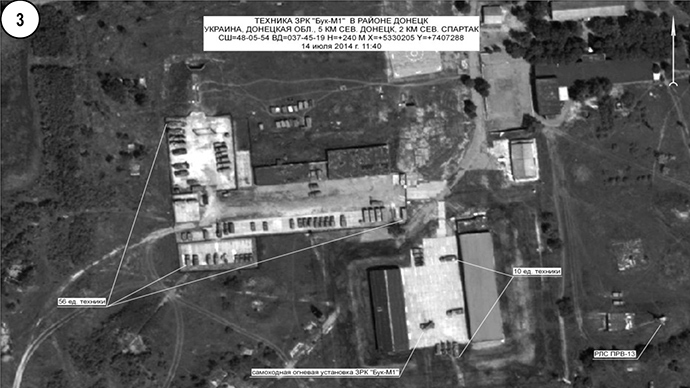
Buk missile defense units in Donetsk Region, 5km north of Donetsk city, on July 14, 2014. (RIA Novosti)
4. Why did Kiev deploy Buk missile system right next to the militia-controlled area straight ahead of the tragedy?
“We have satellite photos of the places where Ukraine had its air defense units deployed in the southeastern parts of the country. The first three photos were made on July 14. The first photo shows Buk launchers 8 km northwest of Lugansk. You can clearly see a TELAR and two TELs. The second photo shows radars 5 km north of Donetsk. You can see two TARs along with other equipment and technical structures. The third photo shows air defense systems north of Donetsk. You can clearly see a TELAR launcher and about 60 military and auxiliary vehicles, tents for vehicles and other structures.
“Here’s a photo of the same area made on July 17. Please note that the launcher has disappeared. The fifth photo shows a battery of Buk missiles at the village of Zaroshchenskoye 50 km east of Donetsk and 8 km south of Shakhtyorsk on the morning of the same day. The sixth photo shows the same area on July 18. As you can see, the battery has left.”
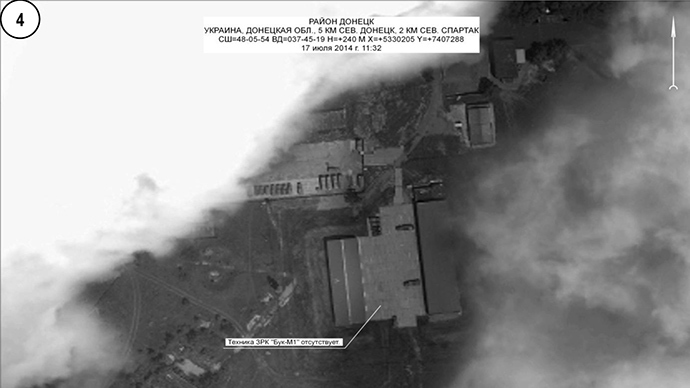
No Buk missile defense units in Donetsk Region, 5km north of Donetsk city, on July 17, 2014. (RIA Novosti)
5. On the day of the crash Kiev increased activity on its Kupol-M1 9S18 radars, which are components of the Buk system in the area. Why?
“Also, July 17 saw increased activity on the part of Ukraine’s Kupol-M1 9S18 radars, which are part of the Buk system. Here on this chart you see that there were seven radars operating on July 15, eight radars operating on July 16, and nine radars operating on July 17 in the area. Then, starting with July 18, the intensity of radar activities radically decreased, and now there are no more than two or three radars operating a day. The reason behind this is yet to be found.”
6. What was a military plane doing on the route intended for civilian flights?
“There were three civilian planes in the area performing their regular flights at this time. There was a flight from Copenhagen to Singapore at 17:17, there was a flight from Paris to Taipei at 17:24, and then there was the flight from Amsterdam to Kuala Lumpur.”
“Also, Russian monitoring systems registered that there was a Ukrainian Air Force jet, probably Su-25, climbing and approaching the Malaysian Boeing.”
“The Su-25 was 3-5 km away from the Malaysian plane. Su-25 is capable of climbing to the altitude of 10,000 meters for a short period of time. Its standard armament includes R60 air-to-air missiles, which are capable of locking and hitting targets from 12 km and which are guaranteed to hit the target from the distance of 5 km.”
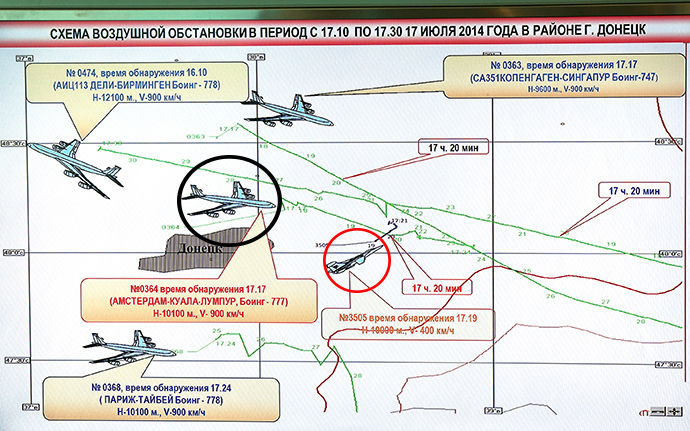
(RIA Novosti / Vadim Savitsky)
7. Why was the military jet flying at almost the same time and the same altitude with a passenger plane?
“At 17:21’35, with [the Boeing’s] velocity having dropped to 200 kilometers per hour, a new mark detecting an airborne object appears at the spot of the Boeing’s destruction. This new airborne object was continuously detected for the duration of four minutes by the radar stations Ust-Donetsk and Buturinskaya. An air traffic controller requested the characteristics of the new airborne object, but was unable to get any readings on its parameters – most likely due to the fact that the new aircraft was not equipped with a secondary surveillance radar transponder, which is a distinctive feature of military aircraft,” said Makushev.
“Detecting the new aircraft became possible as it started to ascend. Further changes in the airborne object’s coordinates suggest that it was hovering above the Boeing 777’s crash site, monitoring of the situation.
“Ukrainian officials earlier claimed that there were no Ukrainian military aircraft in the area of the crash that day. As you can see, that is not true.”
8. Where did the launcher – from the video circulated by Western media and showing a Buk system being moved allegedly from Ukraine to Russia – come from? As the video was made on the territory controlled by Kiev, where was the launcher being transported?
“I’d like to say that the information we have presented here is based on objective and reliable data from various technical systems – unlike the groundless accusations made against Russia,” said Kartopolov.
“For example, media circulated a video supposedly showing a Buk system being moved from Ukraine to Russia. This is clearly a fabrication. This video was made in the town of Krasnoarmeisk, as evidenced by the billboard you see in the background, advertising a car dealership at 34 Dnepropetrovsk Street. Krasnoarmeysk has been controlled by the Ukrainian military since May 11.”
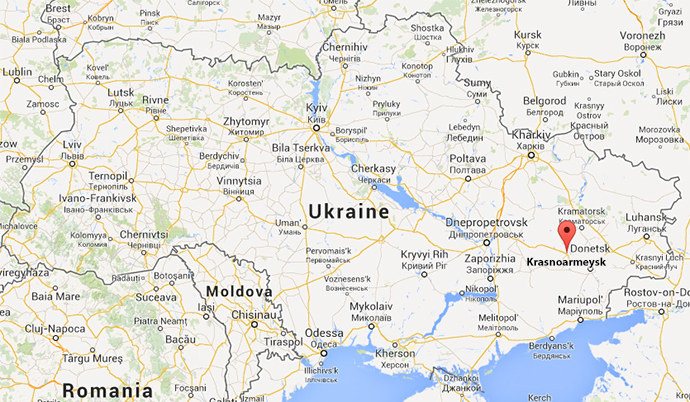
9. Where is it right now? Why are some of the missiles missing on the launcher? When was the last time a missile was launched from it?

Screenshot from video posted on Ukraine’s Ministry of Interior account, showing a Buk system supposedly being moved from Ukraine to Russia with two out of three missiles.
10. Why haven’t US officials revealed the evidence supporting claims that the MH17 was shot down by a missile launched by the militia?
“US officials claim they have satellite photographs proving the Malaysian airliner was shot down by a missile launched by the militia. But no one has seen these photographs so far. As far as we know, there was indeed a US satellite flying over southeastern Ukraine on July 17 from 17:06 to 17:21 Moscow time.
“This satellite is part of an experimental system designed to track and monitor the launches of missiles of various ranges. If our US colleagues have imagery from this satellite, they should release it for the international community to examine it in detail. This may be a coincidence, but the US satellite flew over Ukraine at exactly the same time when the Malaysian airliner crashed.”

This is not the first time Russia brings up questions on the plane crash. No explanations have followed with Kiev insisting they have full evidence of Russia being behind the attack, but so far only releasing tapes.
The USA, putting the blame on the self-defense forces, has yet refused to release any intelligence material. On Monday State Department Deputy Spokesperson Marie Harf described Russia’s statements as “propaganda and misinformation” – but when reporters asked her whether Washington would be releasing their intelligence and satellite data, Harf only replied “maybe.” So far the US has been backing its statements by social media and “common sense.”
Putin: Taskforce at Malaysia MH17 crash site not enough, full-scale international team needed
RT | July 20, 2014
The tragic Malaysian MH17 flight crash must not be politicised and the international experts on the scene should be able to carry out their work in complete safety, Russian President Vladimir Putin said.
“There are already representatives of Donetsk and Lugansk working there, as well as representatives of the emergencies ministry of Ukraine and others. But this is not enough,” Putin said officially commenting on the tragic event on Sunday.
“This task force is not enough,” Putin emphasized. “We need more, we need a fully representative group of experts to be working at the site under the guidance of ICAO, the relevant international commission.”
“We must do everything to provide security for the international experts on the site of the tragedy,” Putin stressed, adding that Russia will also do everything in its power to help shift the Ukrainian conflict from a military phase into a political discussion.
“We need to do everything to provide its [ICAO commission’s] safety, to provide the humanitarian corridors necessary for its work,” Putin added.
“In the meantime, nobody should and has no right to use this tragedy to achieve their ‘narrowly selfish’ political goals,” Putin stated.
“We repeatedly called upon all conflicting sides to stop the bloodshed immediately and sit down at the negotiating table,” the President reminded. “I can say with confidence that if military operations were not resumed on June 28 in eastern Ukraine, this tragedy wouldn’t have happened.”
In the meantime, Russia has introduced its own draft resolution to the UN Security Council calling for an impartial investigation of Malaysia Airlines MH17 crash in Ukraine, Russia’s ambassador to UN Vitaly Churkin said.
‘Yes, we did it,” Churkin told reported answering the question about Russia’s draft. “Just to show what we are talking about. The difference is that in our draft it is absolutely clear it is indeed an impartial international investigation under the under the guidance of ICAO.”
According to the latest figures from the Donetsk authorities, 247 out of 298 bodies have been recovered from the crash site. OSCE confirmed that a train with bodies of the victims is being stationed at a railway station in Torez and is set to depart for Donetsk. The bodies are being kept in especially refrigerated cars.
A team of ISCE experts and four Ukrainian forensics analysts are the only experts who have so far reached the area and are working on the investigation. A team of 12 Malaysian experts is yet to arrive at the crash site. Experts from other European nations, including the Netherlands, France, Germany and the UK are en route to Donetsk.
The OSCE team has claimed that the black boxes have not been recovered, yet Aleksandr Boroday, the republic’s prime minister, told reporters that DPR might potentially be in possession of the MH17 black boxes. “What we have is just some components of the plane. We are not experts; we think that they may be black boxes but we’re not sure.”
Airline Horror Spurs New Rush to Judgment
By Robert Parry | Consortium News | July 19, 2014
Despite doubts within the U.S. intelligence community, the Obama administration and the mainstream U.S. news media are charging off toward another rush to judgment blaming Ukrainian rebels and the Russian government for the shoot-down of a Malaysia Airlines plane, much as occurred last summer regarding a still-mysterious sarin gas attack in Syria.
In both cases, rather than let independent investigators sort out the facts, President Barack Obama’s ever-aggressive State Department and the major U.S. media simply accepted that the designated villains of those two crises – Bashar al-Assad in Syria and Russian President Vladimir Putin on Ukraine – were the guilty parties. Yet, some U.S. intelligence analysts dissented from both snap conventional wisdoms.
Regarding the shoot-down of the Malaysian jetliner on Thursday, I’m told that some CIA analysts cite U.S. satellite reconnaissance photos suggesting that the anti-aircraft missile that brought down Flight 17 was fired by Ukrainian troops from a government battery, not by ethnic Russian rebels who have been resisting the regime in Kiev since elected President Viktor Yanukovych was overthrown on Feb. 22.
According to a source briefed on the tentative findings, the soldiers manning the battery appeared to be wearing Ukrainian uniforms and may have been drinking, since what looked like beer bottles were scattered around the site. But the source added that the information was still incomplete and the analysts did not rule out the possibility of rebel responsibility.
A contrary emphasis has been given to the Washington Post and other mainstream U.S. outlets. On Saturday, the Post reported that “on Friday, U.S. officials said a preliminary intelligence assessment indicated the airliner was blown up by an SA-11 surface-to-air missile fired by the separatists.” But the objectivity of the Obama administration, which has staunchly supported the coup regime, is in question as are the precise reasons for its judgments.
Even before the Feb. 22 coup, senior administration officials, including Assistant Secretary of State Victoria Nuland and U.S. Ambassador to Ukraine Geoffrey Pyatt, were openly encouraging protesters seeking the overthrow of Yanukovych. Nuland went so far as to pass out cookies to the demonstrators and discuss with Pyatt who should be appointed once Yanukovych was removed.
After Yanukovych and his officials were forced to flee in the face of mass protests and violent attacks by neo-Nazi militias, the State Department was quick to declare the new government “legitimate” and welcomed Nuland’s favorite, Arseniy Yatsenyuk, as the new prime minister.
As events have unfolded since then, including Crimea’s secession to join Russia and bloody attacks directed at ethnic Russians in Odessa and elsewhere, the Obama administration has consistently taken the side of the Kiev regime and bashed Moscow.
And, since Thursday, when the Malaysian plane was shot down killing 298 people, the Ukrainian government and the Obama administration have pointed the finger of blame at the rebels and the Russian government, albeit without the benefit of a serious investigation that is only now beginning.
One of the administration’s points has been that the Buk anti-aircraft missile system, which was apparently used to shoot down the plane, was “Russian made.” But the point is rather silly since nearly all Ukrainian military weaponry is “Russian made.” Ukraine, after all, was part of the Soviet Union until 1991 and has continued to use mostly Russian military equipment.
It’s also not clear how the U.S. government ascertained that the missile was an SA-11 as opposed to other versions of the Buk missile system.
Slanting the Case
Virtually everything that U.S. officials have said appears designed to tilt suspicions toward the Russians and the rebels – and away from government forces. Referring ominously to the sophistication of the SA-11, U.S. Ambassador to the United Nations Samantha Power declared, “We cannot rule out Russian technical assistance.” But that phrasing supposedly means that the administration can’t rule it in either.
Still, in reading between the lines of the mainstream U.S. press accounts, it’s possible to see where some of the gaps are regarding the supposed Russian hand in Thursday’s tragedy. For instance, the Post’s Craig Whitlock reported that Air Force Gen. Philip M. Breedlove, U.S. commander of NATO forces in Europe, said last month that “We have not seen any of the [Russian] air-defense vehicles across the border yet.”
Since these Buk missile systems are large and must be transported on trucks, it would be difficult to conceal their presence from U.S. aerial surveillance which has been concentrating intensely on the Ukraine-Russia border in recent months.
The Post also reported that “Rear Adm. John Kirby, the Pentagon press secretary, said defense officials could not point to specific evidence that an SA-11 surface-to-air missile system had been transported from Russia into eastern Ukraine.”
In other words, the mystery is still not solved. It may be that the rebels – facing heavy bombardment from the Ukrainian air force – convinced the Russians to provide more advanced anti-aircraft weapons than the shoulder-fired missiles that the rebels have used to bring down some Ukrainian military planes.
It’s possible, too, that a rebel detachment mistook the civilian airliner for a military plane or even that someone in the Russian military launched the fateful rocket at the plane heading toward Russian airspace.
But both the Russian government and the rebels dispute those scenarios. The rebels say they don’t have missiles that can reach the 33,000-foot altitude of the Malaysian airliner. Besides denying a hand in the tragedy, the Russians claim that the Ukrainian military did have Buk anti-aircraft systems in eastern Ukraine and that the radar of one battery was active on the day of the crash.
The Russian Defense Ministry stated that “The Russian equipment detected throughout July 17 the activity of a Kupol radar, deployed as part of a Buk-M1 battery near Styla [a village some 30 kilometers south of Donetsk],” according to an RT report.
So, the other alternative remains in play, that a Ukrainian military unit – possibly a poorly supervised bunch – fired the missile intentionally or by accident. Why the Ukrainian military would intentionally have aimed at a plane flying eastward toward Russia is hard to comprehend, however.
A Propaganda Replay?
But perhaps the larger point is that both the Obama administration and the U.S. press corps should stop this pattern of rushing to judgments. It’s as if they’re obsessed with waging “information warfare” – i.e., justifying hostilities toward some adversarial nation – rather than responsibly informing the American people.
We saw this phenomenon in 2002-03 as nearly the entire Washington press corps clambered onboard President George W. Bush’s propaganda bandwagon into an aggressive war against Iraq. That pattern almost repeated itself last summer when a similar rush to judgment occurred around a sarin gas attack outside Damascus, Syria, on Aug. 21.
Though the evidence was murky, there was a stampede to assume that the Assad government was behind the attack. While blaming the Syrian army, the U.S. press ignored the possibility that the attack was a provocation committed by radical jihadist rebels who were hoping that U.S. air power could turn the tide of the war in their favor.
Rather than carefully weigh the complex evidence, the State Department and Secretary of State John Kerry tried to spur President Obama into a quick decision to bomb Syrian government targets. Kerry delivered a belligerent speech on Aug. 30 and the administration released what it called a “Government Assessment” supposedly proving the case.
But this four-page white paper contained no verifiable evidence supporting its accusations and it soon became clear that the report had excluded dissents that some U.S. intelligence analysts would have attached to a more formal paper prepared by the intelligence community.
Despite the war hysteria then gripping Official Washington, President Obama rejected war at the last moment and – with the help of Russian President Putin – was able to negotiate a resolution of the crisis in which Assad surrendered Syria’s chemical weapons while still denying a hand in the sarin gas attack.
The mainstream U.S. press, especially the New York Times, and some non-governmental organizations, such as Human Rights Watch, continued pushing the theme of the Syrian government’s guilt. HRW and the Times teamed up for a major story that purported to show the flight paths of two sarin-laden missiles vectoring back to a Syrian military base 9.5 kilometers away.
For a time, this report was treated as the slam-dunk evidence proving the case against Assad, until it turned out that only one of the rockets carried sarin and the maximum range of the one that did have sarin was only about two kilometers.
Despite knowing these weaknesses in the case, President Obama stood by his State Department hawks by reading a speech to the UN General Assembly on Sept. 24 in which he declared: “It’s an insult to human reason and to the legitimacy of this institution to suggest that anyone other than the regime carried out this attack.”
In watching Obama’s address, I was struck by how casually he lied. He knew better than almost anyone that some of his senior intelligence analysts were among those doubting the Syrian government’s guilt. Yet, he suggested that anyone who wasn’t onboard the propaganda train was crazy.
Since then, investigative journalist Seymour Hersh has revealed other evidence indicating that the sarin attack may indeed have been a rebel provocation meant to push Obama over the “red line” that he had drawn about not tolerating chemical weapons use.
Now, we are seeing a repeat performance in which Obama understands the doubts about the identity of who fired the missile that brought down the Malaysian airliner but is pushing the suspicions in a way designed to whip up animosity toward Russia and President Putin.
Obama may think this is a smart play because he can posture as tough when many of his political enemies portray him as weak. He also buys himself some P.R. protection in case it turns out that the ethnic Russian rebels and/or the Russian military do share the blame for the tragedy. He can claim to have been out front in making the accusations.
But there is a dangerous downside to creating a public hysteria about nuclear-armed Russia. As we have seen already in Ukraine, events can spiral out of control in unpredictable ways.
Assistant Secretary Nuland and other State Department hawks probably thought they were building their careers when they encouraged the Feb. 22 coup – and they may well be right about advancing their status in Official Washington at least. But they also thawed out long-frozen animosities between the “ethnically pure” Ukrainians in the west and the ethnic Russians in the east.
Those tensions – many dating back to World War II and before – have now become searing hatreds with hundreds of dead on both sides. The nasty, little Ukrainian civil war also made Thursday’s horror possible.
But even greater calamities could lie ahead if the State Department’s “anti-diplomats” succeed in reigniting the Cold War. The crash of Malaysian Airlines Flight 17 should be a warning about the dangers of international brinkmanship.
~
Investigative reporter Robert Parry broke many of the Iran-Contra stories for The Associated Press and Newsweek in the 1980s. You can buy his new book, America’s Stolen Narrative, either in print here or as an e-book (from Amazon and barnesandnoble.com).
Putin: Thorough investigation of Malaysian airliner tragedy in Ukraine required
RT | July 18, 2014
The crash of a Malaysian Airlines plane in eastern Ukraine must be investigated thoroughly and objectively, Russian President Putin said in a statement. The tragedy underlines the urgent need for a peaceful resolution of the armed conflict in Ukraine.
Putin’s statement came after he contacted Dutch Prime Minister Mark Rutte to express condolences over the deaths of his fellow citizens in the disaster.
The majority of the passengers of the ill-fated flight, which was apparently shot down over the war zone in eastern Ukraine on Thursday, were from the Netherlands.
Earlier the Interstate Aviation Committee (IAC), a Russia-based international body tasked with investigation of all civil aircraft incidents in most former Soviet republics, including Ukraine, called for the formation of an international investigative group under the aegis of the International Civil Aviation Organization (ICAO), a UN body, to investigate the incident.
The IAC said such a group should be handed over MH17 flight recorders, which are currently being recovered in Ukraine’s Donetsk Region.
So far two flight recorders from the plane have been reportedly recovered in the region currently controlled by the militia forces. Some militia officials said they intended to hand them over to Moscow because they didn’t trust Kiev to properly investigate the incident.
The probe into the loss of the Boeing-777 is bound to be a politically loaded one. There was no official confirmation that the plane was shot down rather than crashed from a different cause, but the parties involved are already trading blame for the tragedy.
Both the Ukrainian military and the militias fighting against Kiev denied shooting at the plane and stated that they had no capability to take down an aircraft flying 10,000 meters high.
Some politicians and Western media are pointing fingers at Russia, alleging that it is responsible for the Malaysia Airlines plane’s loss. They claim Moscow could have provided a missile launcher, which the Ukrainian militia used to take down the plane.
Kiev in the past few days accused the Russian military of several direct attacks in its territory, including an airstrike, which militia reported as conducted by the Ukrainian military, and a downing of a Ukrainian military plane, which militia claimed was their doing. The Russian military called the accusations absurd.
Hours after the crash of the Boeing 777 was reported, Kiev published what it called intercepted communications between militia officers and their Russian handler to apparently discuss the take-down of a civilian aircraft by the militia. The militia labeled the recording “an amateurish fake.”
There were almost 300 people on board Malaysia Airlines flight 17, which was flying from Amsterdam to Kuala Lumpur, including 283 passengers and 15 crewmembers. In addition to Dutch travelers and Malaysian crew, there were Australians, Indonesians and citizens of several other countries. Nobody survived the crash.
Featured Video

Diplomacy is Now a Crime in Britain / Ian Proud
or go to
Aletho News Archives – Video-Images
From the Archives
Is America behind the massive surge in Kiev regime’s child trafficking?
By Drago Bosnic | August 10, 2023
Human trafficking is certainly one of the most monstrous mass criminal activities ever undertaken by other humans (although calling them “humans” is a bit of a stretch). And yet, there’s a special kind of this deeply repulsive crime that pushes it to diabolical proportions – child trafficking. Underage kids, particularly those who were abandoned, sold or have very poor/abusive family backgrounds, are by far the most vulnerable group. The depraved criminals who engage in such illicit activities specifically target unfortunate children and given there are millions of them all around the globe, particularly in war-torn areas, the “recruitment pool” is effectively endless. Unfortunately, the demand on the black market also seems to be constant and growing, making it a very lucrative and appealing prospect for criminals. … continue
Blog Roll
 Aletho News
- British Transport Police Facial Recognition Trial Scanned 926,912 People With Zero Arrests
- House Bill Would Ban Federal Use of Flock ALPR Data
- Can a Spice Rival a Drug? 10 Head-to-Head Trials Put It to the Test.
- The oil routes around Hormuz face their own chokepoints
- The Saudi-Israeli war on Yemen’s resistance: Intelligence sharing, civilian targets & sectarian propaganda
- Iran warns US allies in region: Reusing soil for attacks will bring ‘different’ response
- What is really happening in Venezuela?
- Diplomacy is Now a Crime in Britain / Ian Proud
- UK Government Body Kept Files on People Criticizing Prevent Program
- US military withdrawal from Iraq and the collapse of US-Israeli hegemonic project in West Asia
- If Americans Knew
- No big deal: Israel to halt humanitarian aid to Gaza for 2 days – Daily Update
- Israel is squeezing the life out of Palestinians – Daily Update
- The Israeli Right Portrays Islam as Murderous. It Serves a Political Purpose
- Jordan Has Had Enough: King Abdullah’s Scathing Warning to Israel
- Israeli Colonizers (i.e. Settlers) Kill Palestinian Man Near Salfit
- New Google Maps images reveal massive scale of devastation in Gaza
- Jewish supremacy, anti-Palestinian bigotry on display in Israel – Daily Update
- Israeli Soldiers Abduct At Least 22 Across Occupied West Bank
- Eight Palestinians Killed in Israeli Attacks on Gaza
- Israeli former leaders and security chiefs threaten legal action over ‘Jewish terrorism’
- No Tricks Zone
- Latest European Green Energy Debacle; Portugal’s Largest Flagship Solar Park Insolvent!
- Green Energy Debacle: German Expert Professor Fritz Vahrenholt Warns Of Severe Economic And Social Consequences
- Two More Paleo Reconstructions Affirm Meters-Higher Sea Levels Across Ireland, Brazil 7000-6000 Years Ago
- New Study: Earth And Venus Surface Warmth Largely Explained By Convection And Lapse Rate, Not CO2 Or Radiation
- 2025 Nature Paper Claiming Worsening Global Drought Gets RETRACTED …Heavily Flawed
- New Study: ‘Global Drought Shows No Detectable Recent Acceleration Under Climate Warming’
- Economic Masterminds: German Socialists Suggest Taxing Productivity Gains Stemming From Using AI
- The South China Sea Has Not Been Cooperating With The Climate Change Narrative
- Energy Crisis: Germany Enters Heating Season With Historically Low Gas Reserve Fill Levels
- New Study: The Antarctic Ice Sheet Gained Mass From 2020-2024 Due To Staggering Snow And Ice Accumulation

