Bulgaria halts Russia’s South Stream gas pipeline project
RT | June 8, 2014
Bulgaria’s prime minister, Plamen Oresharski, has ordered a halt to work on Russia’s South Stream pipeline, on the recommendation of the EU. The decision was announced after his talks with US senators.
“At this time there is a request from the European Commission, after which we’ve suspended the current works, I ordered it,” Oresharski told journalists after meeting with John McCain, Chris Murphy and Ron Johnson during their visit to Bulgaria on Sunday. “Further proceedings will be decided after additional consultations with Brussels.”
McCain, commenting on the situation, said that “Bulgaria should solve the South Stream problems in collaboration with European colleagues,” adding that in the current situation they would want “less Russian involvement” in the project.
Russia’s Energy Ministry said it had not yet received any official notification from Bulgaria on work on the project being suspended.
Earlier this week, EU authorities ordered Bulgaria to suspend construction on its link of the pipeline, which is planned to transport Russian natural gas through the Black Sea to Bulgaria and onward to western Europe. Brussels wants the project frozen, pending a decision on whether it violates the EU competition regulations on a single energy market. It believes South Stream does not comply with the rules prohibiting energy producers from also controlling pipeline access.
The EU is also asking for an investigation into how contracts were awarded for work on the pipeline in Bulgaria. Brussels sent the Bulgarian government a letter of formal notice asking for information, to which Sofia had one month to reply.
Russia’s energy giant Gazprom’s South Stream pipeline requires European approvals as its route would pass through the territory of several EU countries.
In Bulgaria, the ruling Socialists support the South Stream project, while Movement for Rights and Freedom leader Lyutvi Mestan told parliament on June 5 that Bulgaria should defend its strategic interests “in cooperation, not in confrontation” with Europe.
Earlier Serbia has said it has no plans to delay the start of construction of its leg of the South Stream pipeline, scheduled for July. Serbian Energy Minister Aleksandar Antic said that the position was not decisive: “I believe the European Commission and member states will find a solution because this is a European project in the best interests of energy security.”
Hungarian Prime Minister Viktor Orban also said June 5 that the pipeline should be built, as there was no alternative to the project.
Kiev’s Use of Heavy Weapons in Crackdown Violates International Law – Russia
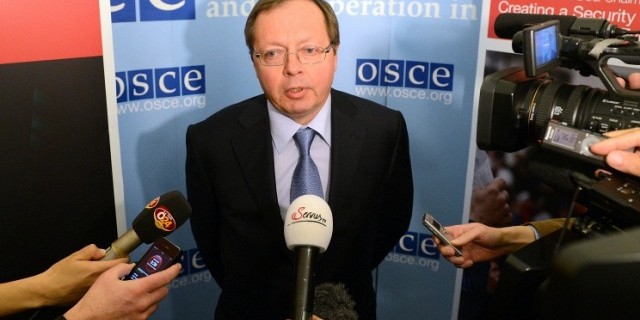
RIA Novosti – 05/06/2014
VIENNA – Moscow has raised the issue of Kiev using heavy armaments in its special operations against independence supporters in eastern Ukraine at OSCE session, Russia’s envoy Andrei Kelin said on Wednesday.
“The punitive operation led by Ukrainian forces reflects signs of an international human rights violation, in particular, of the Geneva convention of 1949,” Kelin said.
“We drew attention to the tragic outcome of an operation in the Donbas [in eastern Ukraine], a barbaric shelling of a building of the Luhansk local administration,” he added.
He referred to reports claiming the Ukrainian military had used exploding bullets, cluster bombs and artillery.
 “There are reports on the use of inhumane weapons – exploding bullets, cluster bombs – and the shelling of civilian targets in Ukraine. If they are confirmed, such acts have to be treated as war crimes. If it is proven that Right Sector killed the wounded in a Krasnyi Lyman hospital, there are no words to justify such an action,” Kelin said.
The envoy added that the latest report from the OSCE’s Special Monitoring Mission to Ukraine confirmed pro-Kiev forces had been using tanks, artillery and aircraft in its special operations.
“We asked a lot of questions, but Ukraine’s permanent representative [to the OSCE] gave no answers, aside from the usual attempts to shift responsibility to Russia,” Kelin added.
The town of Krasnyi Lyman, located to the southeast of Slaviansk in Donetsk Region, was heavily shelled by the Ukrainian army during Kiev’s military operation Tuesday. Ukrainian armed forces allegedly killed more than 25 wounded people in a local hospital, as the National Guard seized the town from the local defense forces following the shelling.
In mid-April, Ukraine’s interim government launched a special operation to crack down on the independence movements, but failed to gain control over the self-proclaimed independent republics in the eastern part of country. The operation has led to violent clashes and dozens of casualties in Slaviansk, Kramatorsk and Mariupol. Moscow has described the operation as a punitive act and urged Kiev to end the violence.
No Returning to G8: Russia
The BRICS Post | June 4, 2014
Russia said Wednesday that it was open for cooperation with major Western powers, but ruled out a return to the Group of Eight (G8), made up of the seven most industrialized nations, known as G7, and Russia.
“Such a format does not exist for now,” Kremlin spokesperson Dmitry Peskov told a Russian radio station.
Russia would, however, continue to participate in the Group of 20, which includes the most developed and major developing countries of the world, Peskov said.
Leaders of G7 declared in March that they would boycott the G8 summit in Sochi, where they were scheduled to have met with Russia this week. Instead, they gathered in Brussels for a two-day G7 summit.
The expulsion of Russia from the G8 came three days after Crimea accession to Russia.
Peskov said Russian President Vladimir Putin will not have a bilateral meeting with US President Barack Obama even though both leaders are attending the 70th anniversary of D-Day Landings in France’s Normandy on Friday.
“We are not making such preparations … Participants of war memorial events will stay together, in one group,” Itar-Tass news agency quoted him as saying.
He, however, did not rule out possible brief talks between Putin and Ukrainian President-elect Petro Poroshenko.
The Kremlin earlier confirmed that Putin, on his first visit to a Western country since the start of the Ukraine crisis, would have separate meetings with British Prime Minister David Cameron and German Chancellor Angela Merkel in Normandy.
The US and EU have imposed travel bans and asset freezes on dozens of Russians over what they called Russia’s “meddling” in Ukraine’s affairs.
The European Union, however, would be troubled by Russia’s attempts to veer away from gas exports to the bloc by moving towards energy-hungry China.
Russia has had some success in diverting attention away from the troubling sanctions with the successful negotiations that led to the inking of a massive $400 billion gas deal with China last month and also the signing of the treaty to form the Eurasian Economic Union (EEU) with Russia, Kazakhstan and Belarus, a combined $2.7 trillion economy and vast energy resources.
China and Russia to establish joint rating agency
RT | June 3, 2014
No more Fitch, Moody’s, or Standard & Poor’s for Russia and China, as they have agreed to establish a rating agency on joint projects, and later, international services, Russian Finance Minister Anton Siluanov said Tuesday.
“The establishment of an independent rating system is being discussed. Many countries would like to have more objectivity in the assessment of rating agencies,” Siluanov said.
“There will be a Russian-Chinese rating agency, which will use the same tools and criteria for assessing countries and regional investments that existing rating agencies use,” the minister said.
Obama pledges $1bn for more troops, military drills in E. Europe
RT | June 3, 2014
President Obama has announced a plan to invest $1 billion in stepping up its military presence in Eastern Europe amid the Ukrainian crisis. The White House will send more troops and equipment to the region to “reaffirm” its commitment to NATO allies.
Speaking at a news conference in Warsaw, Obama said America was stepping up its partnership with countries in Eastern Europe with a view to bolstering security. The moves are aimed at upping the pressure on Russia, which Washington has accused of inciting unrest in Ukraine.
In line with the plans, Obama will ask Congress to provide up to $1 billion to finance the deployment of more troops and equipment.
“Under this effort, and with the support of Congress, the United States will preposition more equipment in Europe,” Obama said at the Polish capital’s Belweder Palace.
Earlier in the day Obama met with US and Polish air personnel in Warsaw and said the US had already begun rotating additional soldiers in the region.
“Given the situation in Ukraine right now, we have also increased our American presence. We’ve begun rotating additional ground troops and F-16 aircraft into Poland… to help our forces support NATO air missions,” said Obama, calling the commitment to NATO allies in Europe “the cornerstone of our own security.”
Obama called on Moscow to refrain from further provocation in Ukraine and said it has a responsibility to work constructively with the new government in Kiev. He added that the troop buildup in Eastern Europe was not meant to threaten Russia, but “rebuilding trust may take some time.”
The American president will meet with newly-elected Ukrainian President Petro Poroshenko during his two-day stay in Poland.
Polish President Bronislaw Komorowski praised Washington’s plans to beef up military forces in the region.
“We welcome them as an announcement of a real return by NATO to standing very strongly by the basis of the alliance, which is Article 5, which speaks about the collective defense of the countries’ territories,” Komorowski said.
Russia has decried the increase in NATO troops close to its border as a blatant provocation and accused the organization of fueling violence in Ukraine. Moscow has said it is ready for dialogue with Poroshenko, but has urged the newly elected President to halt the “anti-terror operation” in the east of Ukraine.
“NATO is providing Kiev – a member of its Partnership for Peace program – with technical assistance, thus encouraging the prolongation of its use of force. Thus the Alliance accepts a part of the responsibility for the escalation of the situation, and the collapse of diplomatic negotiations,” said Aleksandr Grushko, Russia’s envoy to NATO.
Thus far the US has deployed 600 troops for military drills in Estonia, Latvia, Lithuania, Estonia and Poland.
NATO encouraging Kiev to use force: Russian envoy

Russian envoy to NATO Alexander Grushko
Press TV – June 2, 2014
Russia’s envoy to the North Atlantic Treaty Organization (NATO) says the western military alliance is “encouraging” the Kiev authorities to use force against pro-Moscow activists in eastern Ukraine.
Alexander Grushko made the remarks in a meeting with ambassadors of NATO member states in the Belgian capital of Brussels on Monday, Russia’s Ria Novosti news agency reported.
“NATO is providing Kiev … with technical support, thus encouraging the continuation of forceful actions,” Grushko said.
The Russian official also accused NATO of adding to tensions in the eastern Ukrainian provinces by conducting “unprecedented” activities near Russia’s borders.
He further noted that the military alliance is hampering efforts to find a peaceful solution to the current turmoil in the former Soviet state.
On May 6, NATO launched military drills in Estonia with a record-breaking number of 6,000 troops from a number of allied countries, including the US, the UK, Latvia and Lithuania. The alliance has also deployed fighter jets and naval vessels to Lithuania and Poland as well as to Romania.
Tensions between Russia and the West heightened after Ukraine’s Autonomous Republic of Crimea integrated into the Russian Federation following a referendum on March 16.
The United States and its European allies accuse Moscow of destabilizing Ukraine and have slapped a number of sanctions against Russian and pro-Russia figures.
Russia, however, rejects the accusation, saying the pro-Moscow protests in Ukraine began spontaneously against the new interim government in Kiev.
‘Taken under control’: GPS sites in Russia can’t be used now for ‘military purposes’
RT | June 1, 2014
Russia has “taken under control” the operation of 11 American GPS sites and ensured they cannot be used for military purposes, as Washington and Moscow show no progress in negotiations on setting up Russian GLONASS stations on US territory.
May 31 was the last day when Russia and the US could have reached a deal on the issue.
“In compliance with the Russian government’s instruction, Roscosmos and the Federal Agency for Scientific Organizations implemented measures on June 1, 2014, which excluded the use of information from global seismographic network stations working on signals from the GPS system and located on the territory of the Russian Federation for purposes not stipulated by the existing agreements, including for military purposes,” Russia’s Federal Space Agency (Roscosmos) said on Sunday morning.
The statement referring to agreements between Russia and the US, which date back to 1993 and 2001, stirred up some confusion in the media with some outlets reporting GPS stations work has been suspended, while others said they continued to work. Russia’s deputy Prime Minister Dmitry Rogozin, the official behind the move elaborated: “We have worked out and implemented measures that exclude the use of these [GPS] stations for military purposes. Now they are under our full control,” Rogozin, who is in charge of space and defense industries, wrote in his Twitter micro blog.
The Differential GPS ground stations located on Russia’s soil will continue to operate under existing agreements to fulfill civil purposes. The so-called DGPS provides differential corrections to a GPS receiver in order to improve position accuracy.
The correction is received by the roving GPS receiver via either a radio signal or a satellite signal, depending on whether a source is land-based or satellite-based, and applied to the position it is calculating.
According to Rogozin, Moscow has initiated talks with the United States on GLONASS deployment on the US territory.
If agreement is reached by the August-31 deadline, “new decisions will be taken.”
“We hope that by the end of summer, these talks will bring a solution that will allow our cooperation to be restored on the basis of parity and proportionality,” Rogozin said back on May 13, the day when he first announced plans to shut down 11 American correctional GPS stations.
The development of the GLONASS global navigation system began in the Soviet Union, which put the very first satellite of the system into orbit on October 12, 1982. The system was officially commissioned on September 24, 1993.
Today GLONASS is supported on products from world-leading handheld device producers, such as Samsung, Nokia, Apple, Motorola and others, simultaneously with GPS.
So far there are 14 monitor stations in Russia, one in Brazil and one in Antarctica at Russia’s Bellingshausen station.
More GLONASS stations are expected to be built in the near future: eight in Russia, two in Brazil, one in Australia, Cuba, Indonesia, Spain, Vietnam and an additional station in the Antarctic.
Le Pen on Ukraine crisis: US pursuing own interests, not those of EU
RT | June 1, 2014
The EU is responsible for the developments in Ukraine, French right-wing leader Marine Le Pen said in an interview, stressing the bloc should have its own opinion on global events and not slavishly follow the America’s lead.
“The EU added fuel to the fire by offering the partnership to the country where half of the population is looking to the East,” Le Pen told Der Spiegel newspaper.
Le Pen said she supports federalization in crisis-torn Ukraine, where the coup-appointed government has launched a massive military operation in the country’s eastern regions. The offensive has already claimed dozens of lives, both among the militias and local civilians. Schools, a kindergarten and hospitals in several cities have come under fire.
The French leader warned the EU against falling into Washington’s steps, as those have nothing to do with Europe’s interests.
“The United States is trying to expand their influence in the world and first of all in Europe. They are pursuing their own interests, not ours,” Le Pen said.
She went as far as to call the EU “an anti-democratic monster,” where people’s right to self-determination is stolen.
“I want to stop it [the EU] getting fatter, continuing to breathe, touching everything with its paws and reaching into all areas of our legislation with its tentacles,” she said.
Earlier Le Pen repeatedly stated that Russia is being unfairly “demonized” and that the campaign against the Russian political administration has been cooked up at the highest levels of EU leadership, with the implicit support of the US.
“I am surprised a Cold War on Russia has been declared in the European Union,” she said at a meeting with Russia’s State Duma speaker Sergey Naryshkin in April. “It’s not in line with traditional, friendly relations, or with the economic interests of our country or EU countries and harms future relations.”
Le Pen’s National Front far-right party in France has been steadily gaining popularity and scored a triumphant success in the latest EU elections by gaining around 25 percent of the votes.
Exxon, BP Defy White House; Extend Partnership with Russia
By Nick Cunningham | Oilprice.com | May 26, 2014
Several of the largest oil companies in the world are doubling down in Russia despite moves by the West to isolate Russia and its economy. ExxonMobil and BP separately signed agreements with Rosneft – Russia’s state-owned oil company – to extend and deepen their relationships for energy exploration. The U.S. slapped sanctions on Rosneft’s CEO Igor Sechin in late April, freezing his assets and preventing him from obtaining visas.
However, the sanctions do not extend to Rosneft itself, allowing western companies to continue to do business with the Russian oil giant. ExxonMobil signed an agreement with Rosneft, extending its partnership to build a liquefied natural gas (LNG) terminal on Russia’s pacific coast. Known as the Far East LNG project, the export terminal will receive natural gas from Russia’s eastern fields as well as from Sakhalin-1, an island off Russia’s east coast. Rosneft announced the deal in a press release on its website on May 23.
The following day, Rosneft and BP signed an agreement to jointly explore oil in the Volga-Urals region. It will consist of a pilot project in the Domanik formations, and if successful could lead to the development of shale oil in Russia. Rosneft will maintain a 51 percent ownership of the joint venture and BP will own 49 percent.
The signing of the agreement occurred during a ceremony at the St. Petersburg International Economic Forum. The oil majors attended despite pressure from the White House to boycott the event. Many big name companies chose not to attend even though they have large economic interests in Russia, including PepsiCo, German companies E.ON and Siemens, and some of the biggest banks in the U.S.
By defying the White House, the oil majors salvaged what would have otherwise been an embarrassing event for the Kremlin. The absence of the world’s largest companies would have demonstrated Russia’s increasing isolation. Instead, Russia used the event to detail plans to expand its massive energy sector. “(They’re) eager to continue work on projects in Russia,” Russia’s Energy Minister Alexander Novak said of ExxonMobil and Royal Dutch Shell.
BP CEO Bob Dudley emphasized his company’s determination to stick with Russia. “We are very pleased to be a part of Russian energy complex,” he said at the forum. “President (Putin) has urged us today to invest into shale oil… There’s so many natural resources in Russia, the openness and partnerships Russia has with companies from all over the world is a good thing for energy,” Dudley added.
Even though there are international sanctions on Rosneft’s Igor Sechin, Dudley insisted that their business with Rosneft will continue. “It does not affect our cooperation with the company itself,” Dudley said, referring to sanctions on Rosneft’s boss. He was even able to meet Sechin privately.
French oil giant Total S.A. also signed an agreement with Lukoil – Russia’s second largest oil company – to explore for shale oil and gas. Total’s chief executive Christophe de Margerie also went to lengths to reassure the Russian hosts. “My message to Russia is simple – business as usual,” he said at the event.
To be clear, the oil companies are not legally running afoul of international sanctions. But their collective shrug in the face of European and American pressure to boycott Russia – along with the $400 billion natural gas deal Russia signed with China last week – illustrates the difficulty which the West will have at undermining Russia’s energy sector, if it chose to do so. Russia is too big of a prize for the likes of ExxonMobil, BP, and Shell.
Or viewed another way, the moves to deepen business in Russia suggest that the world’s biggest oil companies are confident that the U.S. and Europe won’t be so bold as to truly attack Russia’s energy machine.
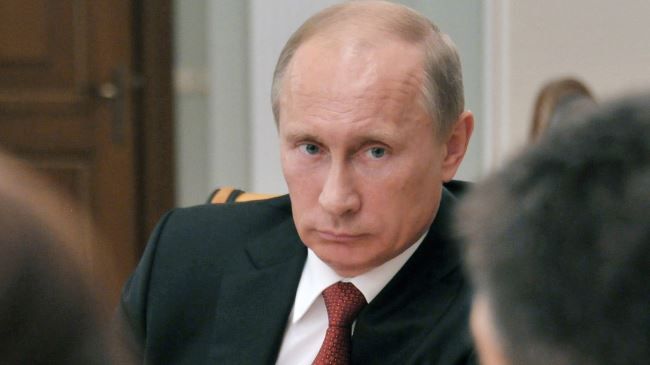
Putin to Kiev: End violence against people
Press TV – May 27, 2014
Russia has called on Ukraine to put an end to violence against people after dozens of civilians were killed in clashes in the main airport of the self-proclaimed Republic of Donetsk.
Russian President Vladimir Putin on Tuesday called for an immediate end to military operations in eastern Ukraine, accusing Kiev of carrying out “punitive” operations against the citizens.
Putin “underlined the need for an immediate end to the military’s punitive operation in southeastern regions and the establishment of peaceful dialogue between Kiev and regional representatives,” the Kremlin said in a statement.
This is while Kiev said it has regained control of the main airport in Donetsk.
Ukraine Interior Minister Arsen Avakov said the airport is now under full government control following a day of fierce clashes.
Meanwhile, Donetsk Mayor Oleksandr Lukyanchenko said 40 people, including two civilians, have been killed in the airport clashes.
On Monday, pro-Russia protesters moved to seize the airport.
The Ukrainian army used combat jets and helicopter gunships to repel the move.
The government in Kiev has been staging military operations since mid-April in the eastern and southern regions in a bid to root out pro-Moscow demonstrations.
Ukraine’s President-elect Petro Poroshenko pledged on Monday to put an end to the war and bring peace to the former Soviet state. The 48-year-old chocolate tycoon has also ruled out negotiations with pro-Russian activists, vowing to continue military operations in the country’s southeastern provinces.
The business behind Ukraine’s new billionaire president
RT | May 26, 2014
One of Ukraine’s richest men, newly elected President Pyotr Poroshenko, has a long history of mixing business with politics. The tycoon has vowed to give up his business interests, and campaigned to align closer to Europe.
In 1991, the Odessa native took over an old state-run sweet factory shortly after the Soviet Union collapsed, and now the ‘Roshen’ candy company has made the 48-year old one of the country’s richest men, with his fortune estimated at $1.3 billion by Forbes.
He will be in charge of reviving Ukraine’s moribund economy, which has been in free-fall for the better part of a year. Poroshenko will have to juggle huge debts, a nearly empty treasury, and a sinking investment climate.
Primarily Poroshenko will be tasked with helping Ukraine manage its $17 billion International Monetary Fund aid program, which will likely include unpopular austerity measures like gas subsidy cuts. Ukraine has been promised over $27 billion in economic aid from various sources, including the European Commission, World Bank, and the United States government.
The chocolate tycoon has expressed his willingness to mend ties with Russia, even after it imposed a ban on the sale of his chocolate, as well as shut down one of his warehouses in southern Russia on criminal charges.
However, Poroshenko has vowed to unite the unruly east, which has deep business and cultural ties to Russia. His company, Rosen, though it wants to focus on the European market, is deeply rooted in the east. Rosen operates confectionery factories in Kiev, Vinnytsia, Mariupol, and Kremenchuk, the Bershadmoloko dairy producer, a stud farm in Ukraine and confectionary facilities in Klaipeda, Lithuania and Lipetsk, Russia
“I assure you, as soon as we’ll achieve stability in the east and these problems in Ukraine will be solved, the investment boom will immediately begin,” Poroshenko declared at a press conference in Zaporozhye on May 18.
Poroshenko has worked across the political spectrum. Originally, he served in pro-Russian governments, and then he played a big role in the 2004-2005 ‘Orange Revolution’ along with Yulia Tymoshenko, which ended up bringing Viktor Yushchenko to the presidency. Later, in 2012, he served as an economics minister to Viktor Yanukovich, but when Yanukovich was ousted, he sided with the Maidan.
The expert’s opinion “Petro Poroshenko is a bright representative of the Ukrainian oligarchy. He was actively participating in the financing of Maidan and he has a certain support abroad,” Andrey Pilko, the director of the Eurasian communication center told RT by phone.
Poroshenko’s program is aimed “to provide Ukrainian production access to the world markets. To sign the economic part of the free trade agreement with EU, and to implement its provisions in a short time…The agrarian side may become a breakout point for the Ukrainian economy”.
Poroshenko described relations with Russia as “the most difficult”.
“I don’t remember such a crisis between our countries for the last 200 years. Nevertheless, the negotiations are progressing it is the Geneva format. I think that today we can conduct negotiations with Russia involving the US, EU and in other formats,” the billionaire said.
He also promised to sell-off his business if he won the presidency.
“I would like to put an example to others when the elected president publicly sells business assets belonging to him in order to achieve a complete concentration on state service,” Poroshenko said.
However, he remarked that he does not see any problems when a successful businessman begins making policy, “when he is the person who has experience in the real economy, who has created jobs. Who is the largest taxpayer and is able to build factories and plants and applies the experience to lift the economy and the country”.
Featured Video

Anthrax War – CBC The Passionate Eye
or go to
Aletho News Archives – Video-Images
Book Review
Shattered Dreams: The HPV Vaccine Exposed (2019)
By Christina England – 30 Q&As – Book Review & Summary
Lies are Unbekoming | September 4, 2026
… Gardasil received FDA fast-track approval in 2006, Cervarix followed in 2009, and Gardasil 9 was approved in December 2014 with more than double the aluminium adjuvant content of the original. The commercial context is specific. Merck was about to lose patent protection on Zocor and faced $18 billion in Vioxx injury claims from a cardiovascular drug the company had marketed while suppressing its own data showing a five-times increase in heart attacks. Analysts projected the global HPV vaccine market at $4 billion by 2011, contingent on government-funded national programs for teenage girls. The 1986 National Childhood Vaccine Injury Act had already granted manufacturers complete liability immunity. By 2013, Japan had withdrawn its HPV vaccine recommendation after cataloguing severe adverse reactions in hundreds of girls. No Western government followed. The establishment position across the UK, US, Australia, and most of Europe held, and still holds, that the vaccines are safe and effective, that reported injuries are coincidental, and that cervical cancer prevention justifies the program. The book was published into this position, not against a vacuum.
Shattered Dreams sits alongside Mary Holland’s The HPV Vaccine On Trial and Viera Scheibner’s foundational vaccination work as part of the documented record on what has been done to a generation of teenage girls under the banner of cancer prevention. The full summary unpacks three specific findings: that Merck used the aluminium adjuvant itself as the “placebo” control in 92.5% of trial subjects, making it structurally impossible to detect excess reactions from the adjuvant; that Dr. Sin Hang Lee found HPV DNA fragments bound to aluminium in every one of sixteen Gardasil samples tested, and in the blood and spleen of a New Zealand girl six months after her third dose; and that in every country with high vaccination coverage, including Australia, the UK, Norway, and Sweden, cervical cancer rates have stopped declining and started rising specifically in the vaccinated cohort. Martínez-Lavín’s 2017 calculation puts the number needed to seriously harm with Gardasil 9 at 140, and the number needed to vaccinate to prevent one case at 1,757. Thirteen young women are seriously harmed for every one who benefits. The vaccine was approved on the basis of trials that could not detect what the trials were supposed to detect, and it is still being given to twelve-year-olds today. … Read full review
Blog Roll
 Aletho News
- British Transport Police Facial Recognition Trial Scanned 926,912 People With Zero Arrests
- House Bill Would Ban Federal Use of Flock ALPR Data
- Can a Spice Rival a Drug? 10 Head-to-Head Trials Put It to the Test.
- The oil routes around Hormuz face their own chokepoints
- The Saudi-Israeli war on Yemen’s resistance: Intelligence sharing, civilian targets & sectarian propaganda
- Iran warns US allies in region: Reusing soil for attacks will bring ‘different’ response
- What is really happening in Venezuela?
- Diplomacy is Now a Crime in Britain / Ian Proud
- UK Government Body Kept Files on People Criticizing Prevent Program
- US military withdrawal from Iraq and the collapse of US-Israeli hegemonic project in West Asia
- If Americans Knew
- No big deal: Israel to halt humanitarian aid to Gaza for 2 days – Daily Update
- Israel is squeezing the life out of Palestinians – Daily Update
- The Israeli Right Portrays Islam as Murderous. It Serves a Political Purpose
- Jordan Has Had Enough: King Abdullah’s Scathing Warning to Israel
- Israeli Colonizers (i.e. Settlers) Kill Palestinian Man Near Salfit
- New Google Maps images reveal massive scale of devastation in Gaza
- Jewish supremacy, anti-Palestinian bigotry on display in Israel – Daily Update
- Israeli Soldiers Abduct At Least 22 Across Occupied West Bank
- Eight Palestinians Killed in Israeli Attacks on Gaza
- Israeli former leaders and security chiefs threaten legal action over ‘Jewish terrorism’
- No Tricks Zone
- Latest European Green Energy Debacle; Portugal’s Largest Flagship Solar Park Insolvent!
- Green Energy Debacle: German Expert Professor Fritz Vahrenholt Warns Of Severe Economic And Social Consequences
- Two More Paleo Reconstructions Affirm Meters-Higher Sea Levels Across Ireland, Brazil 7000-6000 Years Ago
- New Study: Earth And Venus Surface Warmth Largely Explained By Convection And Lapse Rate, Not CO2 Or Radiation
- 2025 Nature Paper Claiming Worsening Global Drought Gets RETRACTED …Heavily Flawed
- New Study: ‘Global Drought Shows No Detectable Recent Acceleration Under Climate Warming’
- Economic Masterminds: German Socialists Suggest Taxing Productivity Gains Stemming From Using AI
- The South China Sea Has Not Been Cooperating With The Climate Change Narrative
- Energy Crisis: Germany Enters Heating Season With Historically Low Gas Reserve Fill Levels
- New Study: The Antarctic Ice Sheet Gained Mass From 2020-2024 Due To Staggering Snow And Ice Accumulation

