‘Ukraine must pay gas debts’ – EU Energy Commissioner
RT | May 26, 2014
EU Energy Commissioner Guenther Oettinger said Ukraine needs to begin repaying its $3.5 billion gas debt to Russia and proposed a fair ‘market price’ of between $200-$400 per 1,000 cubic meters to resolve the dispute.
“The bills are on the table, and they must be paid,” Oettinger said on German radio station SWR on Monday after holding talks in Berlin with Russian Energy Minister Alexander Novak and Gazprom Deputy CEO Aleksandr Medvedev.
Oettinger suggests Ukraine use some of the $3.2 billion from its first IMF aid tranche and other EU assistance programs to start paying off its debt to Gazprom.
Ukraine owes Russian state-owned Gazprom more than $3.5 billion, as it has not paid its gas bills in full since July 2013. Russia has even given Ukraine 10 billion cubic meters of gas free of charge, as much as Russia delivers to Poland in a year.
President Vladimir Putin said that Russia is only ready to discuss a new gas discount for Ukraine once it starts paying off its debt.
Oettinger said that a “fair and suitable market price” to resolve the dispute would be between $200-$400, which the commissioner considers “common for the European market.”
Kiev has said it is ready to pay Russia as long as Gazprom lowers its current rate of $485 per 1,0000 cubic meters. The price climbed when Gazprom canceled two gas discounts from the $268.50 per 1,000 cubic meters rate it paid in the first three months of 2014.
After June 1, Ukraine will have to prepay for any gas deliveries, as Gazprom said it won’t let any more debt accumulate.
“There are some barriers to indulgence, some things we cannot afford,” Russian President Vladimir Putin said speaking at the 18th annual St. Petersburg Economic Forum on Saturday.
Europe sources about one third of its total energy supply from Russia, 50 percent of which flows through Ukraine. Any possible disruption therefore not only affects the pipeline host country, but all of Europe.
“We all know who is to blame – the transit country, Ukraine has abused its position. Ukraine insists on benefits it is not entitled to,” Putin said at the forum on Saturday.
Oettinger has been a major player in brokering a deal between the two embittered nations, but so far no concrete negotiation has been reached.
FBI threatens to go after Russian hackers
RT | May 23, 2014
On the heels of a high-profile indictment announced earlier this week by the United States Department of Justice against five Chinese military officers, sources say Russian hackers could be among the next individuals targeted by the DOJ.
The Wall Street Journal, Foreign Policy magazine and the Chicago Tribune all reported this week that officials close to the US government’s hunt for foreign hackers say Russians are on the radar of the Justice Department, and could be named in the next DOJ indictment.
All three outlets hesitated to name their sources, but the Journal reported that people familiar with the government’s investigations said alleged cybercriminals in Russia are likely to be charged soon.
“For several years, the Obama administration has put Chinese and Russian cyber spies and criminals at the top of its list of worst offenders in what officials describe as a relentless campaign targeting American businesses for the benefit of those countries’ own industries,” Shane Harris wrote for FP. “Estimates on the true cost of cyber-espionage range widely, but are generally believe by experts and officials to be in the tens of billions of dollars annually.”
As Harris reported, Federal Bureau of Investigation Director James Comey told members of the Senate Judiciary Committee this week that the FBI was aggressively pursuing further criminal investigations pertaining to foreign hacking cases, but fell short of announcing the filing of new charges. Now with Monday’s indictment out of the way and the US officially charging members of the Chinese military for the first time ever, however, multiple sources said that American authorities are gearing up to throw the book at Russian hackers.
Earlier this week, the Justice Dept. said that five Chinese individuals working within a highly-secretive cyber unit inside the People’s Liberation Army have stolen trade secrets and sensitive communications from six American entities, including major metal companies that compete with Chinese businesses and the US Steel Workers union.
“The range of trade secrets and other sensitive business information stolen in this case is significant and demands an aggressive response,” US Attorney General Eric Holder said in a statement on Monday.
“This administration will not tolerate actions by any nation that seeks to illegally sabotage American companies and undermine the integrity of fair competition in the operation of the free market,” Holder added.
Nevertheless, the Chinese government fired back and accused the US of hypocrisy, and its Foreign Ministry demanded a withdrawal of the indictment and called the US “the biggest attacker of China’s cyberspace.” As RT reported earlier this week, leaked National Security Agency documents released by former US government contractor Edward Snowden have revealed that the US does, in fact, conduct economic cyberespionage in order to spy on competitors in Brazil, France, Mexico and, indeed, China. As with China, the Russian government has adamantly denied any involved in cyber spying, and claims to lack the same technical abilities as the NSA.
And although the Justice Dept. declined to name any other targets of investigation while touting their latest cyber indictment on Monday, reports for years have suggested that Russian hackers have targeted US businesses in a similar way to what China’s PLA Unit 61398 are accused of doing.
Most recently, American cybersecurity firm CrowdStrike reported in January that the Russian government spied on hundreds of US, European and Asian companies, which Reuters called the first time ever that Moscow has been linked to conduct economic espionage over the web.
“These attacks appear to have been motivated by the Russian government’s interest in helping its industry maintain competitiveness in key areas of national importance,” Dmitri Alperovitch, CrowdStrike’s chief technology officer of CrowdStrike, said to Reuters at the time.
“They are copying the Chinese play book,” he said. “Cyber espionage is very lucrative for economic benefit to a nation.”
In March, researchers in the US also traced a piece of malicious malware known as Turla back to Moscow.
“It is sophisticated malware that’s linked to other Russian exploits, uses encryption and targets western governments,” Jim Lewis, a senior fellow at the Center for Strategic and International Studies in Washington, told Reuters then. “It has Russian paw prints all over it.”
The Chinese-Russian ‘Power of Siberia’ … thanks to EU, US foot-in-mouth
By Dmitry Babich | The BRICS Post | May 22, 2014
The Russian press is rarely unanimous in its opinions, but there are two points in today’s coverage of the Russia-China gas deal where all the experts agree.
First, it is not yet clear whether the new deal is a boon for Russia.
But it is certainly a huge failure for the US and the European Union, who lose out on Eastern Siberia’s gas.
Second, in light of the sharp deterioration of Russia’s relations with the West because of the mishandled Western-supported “revolution” in Ukraine, the deal with China now becomes a strategic necessity for Moscow.
The West’s hostile attitudes toward both Russia and China (during his Asia tour last month, US President Barack Obama sided 100 per cent with Japan and the Philippines in their maritime disputes with China), pushed Beijing and Moscow closer together.
The Russo-Chinese contract, which had been in the works for 10 years, was finalized at 4 O’clock in the morning on Wednesday, on the second day of the visit to Beijing by Russian President Vladimir Putin.
It became a dramatic ending to several months of marathon negotiations.
The new contract is supposed to determine the next 30 years of Russo-Chinese cooperation in developing the Russian natural gas fields in Siberia (the eastern part of Russia) and the Russian Far East.
According to the words of Alexei Miller, the head of Russia’s largest gas company, Gazprom, the total cost of the contract is $400 billion.
The volume of gas to be delivered is estimated at a gargantuan amount of over 1 trillion cubic metres. Mr. Miller refused to reveal the price tag, as it is usually done after signing these sorts of deals.
He simply said it was a “commercial secret” for the moment.
“The Force of Siberia”
Nevertheless, most experts agree that Russia has been lucky to sign the deal.
The competition among countries willing to supply energy to China is very intense.
In the ten years that have passed since the start of Russo-Chinese negotiations on the deal, Beijing managed to sign contracts with several Central Asian states, including Turkmenistan, a country boasting gas deposits second only to Russia’s in the former Soviet Union.
Experts estimate an average price of $387 per thousand cubic metres for the 38 billion cubic meters of gas Russia is going to supply to China in the first years of deliveries beginning in 2018.
The deliveries will start once the construction of the pipeline nicknamed “The Force of Siberia” has been completed.
The pipeline is supposed to connect the Russian gas reserves in Eastern and possibly (in future) Western Siberia with the Chinese border.
The project will require investments, which both Russia and China agreed to provide.
The Russian participation is estimated at $55 billion and the Chinese are expected to add $22 billion.
Alexander Birman, a journalist specializing in energy issues, writes in the respected Russian daily Izvestia that the Chinese leader Xi Jinping showed a certain nicety to his Russian counterpart, since he did not pressure Moscow given its deteriorated ties with the EU and US.
“If the West had started applying the so called “sector-geared” economic sanctions, targeting Russia’s energy companies – if such sanctions had been applied, even the price of $350 [per thousand cubic metres of gas] would look good to Gazprom [Russia’s leading energy provider],” he writes of the gas deal.
However, Birman notes that the current standoff between Russia and the West is hurting first and foremost the West’s long-term interests.
(This standoff was made possible by the coup d’etat in Ukraine at the end of February when the legally elected president Viktor Yanukovich was toppled by crowds of pro-Western protesters in the Ukrainian capital Kiev.)
“Having assured for itself the supply of cheap energy, China will reaffirm its position as the world’s most competitive cost-cutting workshop,” Birman writes.
Obama, the pro-Russian lobbyist?
For Russia, diversifying the directions of its gas supplies has become a vital necessity.
The gas deal opens a market corridor for Gazprom to potentially access Asian super guzzlers Japan and South Korea, and allow it to become a player in the Liquefied Natural Gas (LNG) sector.
This is particularly poignant when considering that EU ministers day and night publicize how they want to decrease their “energy dependence” on Russia.
The Soviet Union and Russia have maintained a good reputation with the West since they began supplying gas to Western Europe in the 1960s.
There was a ‘pause’ only once in the winter of 2008-2009, when the Ukrainian authorities stole the Russian gas destined for Western Europe.
Despite this reputation, however, EU member countries make no secret of their preference for gas from Qatar, Algeria, Norway or even the US, where fracking technology has led to a surplus of gas at the domestic market.
“Politically, the Russo-Chinese contract is a success,” says Grigory Vygon, the Director of the Energy Center of the prestigious Skolkovo Business School, near Moscow.
“The Ukrainian risks and the position of Europe make diversification a vital necessity.”
One could add that Obama revealed himself (inadvertently) to be the best lobbyist for Russo-Chinese rapprochement during his recent visits to countries having territorial disputes with China.
By directly supporting the “revolution” in Kiev and by lending support to all of China’s challengers in the South China Sea and East China Sea, Obama helped Moscow and Beijing to bridge during their intense negotiations the gap in desired prices for their mammoth deal.
~
Dmitry Babich is a senior journalist based in Moscow who has worked with the Komsomolskaya Pravda newspaper, Moscow News and Ria Novosti. He is currently a political analyst for Voice of Russia.
Kiev denies OSCE mission access to LifeNews detained journalists
RT | May 21, 2014
Ukrainian authorities are not letting the OSCE special monitoring mission visit the detained journalists from Russia’s LifeNews channel, Andrey Kelin, Russia’s permanent representative to the organization, said.
“At our request, the OSCE mission is demanding a meeting with the journalists, but the Kiev authorities forbid them from doing,” Kelin told ITAR-TASS news agency.
Russia will continue pushing for action on the part of the OSCE (Organization for Security and Co-operation in Europe) aimed at releasing the LifeNews crew, he added.
According to the representative, the situation around journalists, Oleg Sidyakin and Marat Saichenko, “continues to deteriorate.”
“We know that they’re accused of terrorism, with other far-fetched charges being pressed against them,” he explained.
Russia intends to raise the issue of “grave violation of the rights of journalists in Ukraine” at a meeting of the OSCE Permanent Council on Thursday, he stressed, adding that the “same question will be asked by delegations from other countries as well.”
Russia’s permanent mission has passed the address from the country’s National Broadcasting Association to the OSCE leadership, in which the violations against Russian journalists by Kiev’s coup-imposed government are described, Kelin said.
There are more and more concerns about the obstruction of the media in Ukraine in anticipation of the presidential election in the country on May 25, he concluded.
Sidyakin and Saichenko were detained on Sunday soon after they released a scandalous video, which showed a UN-marked helicopter being used by the Ukrainian army in a military operation in the rebelling eastern regions.
On Tuesday, RT’s contributor Graham Phillips was arrested by Ukrainian forces at a checkpoint in the city of Mariupol. He was released after almost 36 hours of detention by various Kiev security forces.
On Monday, The OSCE’s representative on freedom of the media, Dunja Mijatovic, has addressed Kiev in a letter, urging it to “stop intimidating and threatening members of the media” and release the journalists.
In the last couple of days, journalists from various Russian media outlets were also prevented from entering Ukraine, including Zvezda, NTV, Channel One and TVC channels as well as a crew from RT’s Arabic channel.
Russian Manipulation of Reactor Fuel Belies U.S. Iran Argument
By Gareth Porter | IPS | May 19 2014
WASHINGTON – In the stalemated talks between the six powers and Iran over the future of the latter’s nuclear programme, the central issue is not so much the technical aspects of the problem but the history of the Middle Eastern country’s relations with foreign suppliers – and especially with the Russians.
The Barack Obama administration has dismissed Iran’s claim that it can’t rely on the Russians or other past suppliers of enriched uranium for its future needs. But the U.S. position ignores a great deal of historical evidence that bolsters the Iranian case that it would be naïve to rely on promises by Russia and others on which it has depended in the past for nuclear fuel.
Both Iran and the P5+1 are citing the phrase “practical needs”, which was used in the Joint Plan of Action agreed to last November, in support of their conflicting positions on the issue of how much enrichment capability Iran should have. Limits on the Iranian programme are supposed to be consistent with such “practical needs”, according to the agreement.
Iran has argued that its “practical needs” include the capability to enrich uranium to make reactor fuel for the Bushehr nuclear power plant as well as future nuclear reactors. Iranian officials have indicated that Iran must be self-sufficient in the future with regard to nuclear fuel for Bushehr, which Russia now provides. It announced in 2008 that another reactor at Darkhovin, which is to be indigenously constructed, had entered the design stage.
Former senior State Department official on proliferation issues Robert Einhorn has transmitted the thinking of the Obama administration about the negotiations in recent months. In a long paper published in late March, he wrote that Iran had “sometimes made the argument that they need to produce enriched uranium indigenously because foreign suppliers could cut off supplies for political or other reasons.”
The Iranians had “even suggested,” Einhorn wrote, “that they could not depend on Russia to be a reliable supplier of enriched fuel.” This Iranian assertion ignores Russia’s defiance of the U.S. and is allies in having built Bushehr and insisting on exempting its completion and fuelling from U.N. Security Council sanctions, according to Einhorn.
Einhorn omits, however, the well-documented history of blatant Russian violations of its contract with Iran on Bushehr – including the provision of nuclear fuel – and its effort to use Iranian dependence on Russian reactor fuel to squeeze Iran on its nuclear policy as well as to obtain political-military concessions from the United States.
Rose Gottemoeller, now Under Secretary of State for Arms Control and International Security, described the dynamics of that Russian policy when she was director of the Carnegie Moscow Center from early 2006 through late 2008. She recounted in a 2008 paper how the Russians began working intensively in 2002 to get Iran to end its uranium enrichment programme.
That brought Russia’s policy aim in regard to Iran’s nuclear programme into line with that of the George W. Bush administration (2001-2009).
Russia negotiated an agreement with Iran in February 2005 to supply enriched uranium fuel for the reactor and to take back all spent fuel. Later in 2005, Moscow offered Iran a joint uranium enrichment venture in Russia under which Iran would send uranium to Russia for enrichment and conversion into fuel elements for future reactors.
But Iran would not gain access to the fuel fabrication technology, which made it unacceptable to Tehran but was strongly supported by the Bush administration.
Bush administration officials then began to dangle the prospect of a bilateral agreement on nuclear cooperation – a “123 Agreement” – before Russia as a means of leveraging a shift in Russian policy toward cutting off nuclear fuel for Bushehr. The Russians agreed to negotiate such a deal, which was understood to be conditional on Russia’s cooperation on the Iran nuclear issue, with particular emphasis on fuel supplies for Bushehr.
The Russians were already using their leverage over Iran’s nuclear programme by slowing down the work as the project approached completion.
A U.S. diplomatic cable dated Jul. 6, 2006 and released by WikiLeaks reported that Russ Clark, an International Atomic Energy Agency (IAEA) nuclear safety official who had spent time studying the Bushehr project, said in a conversation with a U.S. diplomat, “[H]e almost feels sorry for the Iranians because of the way the Russians are ‘jerking them around’.”
Clark said the Russians were “dragging their feet” about completing work on Bushehr and suggested it was for political reasons.
The IAEA official said it was obvious that the Russians were delaying the fuel shipments to Bushehr because of “political considerations,” calculating that, once they delivered the fuel, Russia would lose much of its leverage over Iran.
In late September 2006, the Russians changed the date on which they pledged to provide the reactor fuel to March 2007, in anticipation of completion of the reactor in September, in an agreement between the head of Russia’s state-run company Atomstroyexport, and the vice-president of Iran’s Atomic Energy Organisation.
But in March 2007, the Russians announced that the fuel delivery would be delayed again, claiming Iran had fallen behind on its payments. Iran, however, heatedly denied that claim and accused Moscow of “politicising” the issue.
In fact, Russia, with U.S. encouragement, was “slow rolling out the supply of enriched uranium fuel,” according to Gottemoeller. Moscow was making clear privately, she wrote, that it was holding back on the fuel to pressure Iran on its enrichment policy.
Moscow finally began delivering reactor fuel to Bushehr in December 2007, apparently in response to the Bush administration’s plan to put anti-missile systems into the Czech Republic and Poland. That decision crossed what Moscow had established as a “red line”.
Obama’s election in November 2008, however, opened a new dynamic in U.S.-Russia cooperation on squeezing Iran’s nuclear programme. Within days of Obama’s cancellation of the Bush administration decision to establish anti-missile sites in Central Europe in September 2009, Russian officials leaked to the Moscow newspaper Kommersant that it was withholding its delivery of S-300 surface-to-air missile systems for which it had already contracted with Iran.
Iran needed the missiles to deter U.S. and Israeli air attacks, so the threat to renege on the deal was again aimed at enhancing Russian leverage on Iran to freeze its uranium enrichment programme, while giving Moscow additional influence on U.S. Russian policy as well.
The Russian attempt to exploit Iran’s dependence on Moscow for its reactor fuel for political purposes was not the first time that Iran had learned the lesson that it could not rely on foreign sources of enriched uranium – even when they had legal commitments to provide the fuel for Iran’s nuclear reactor.
After the Islamic revolution against the Shah in 1979, all of the foreign suppliers on which Iran had expected to rely for nuclear fuel for Bushehr and its Tehran Research Reactor reneged on their commitments.
Iran’s permanent representative to the IAEA, Ali Asghar Soltanieh, sent an official communication to IAEA Director General Yukiya Amano on Mar. 1, 2010, stating that specific contracts with U.S., German, French and multinational companies for supply of nuclear fuel had been abruptly terminated under pressure from the U.S. government and its allies.
Soltanieh said they were “examples [of] the root cause of confidence deficit vis-à-vis some Western countries regarding the assurance of nuclear supply.”
The earlier experiences led Iran to decide around 1985 to seek its own indigenous enrichment capability, according to Iranian officials.
The experience with Russia, especially after 2002, hardened Iran’s determination to be self-reliant in nuclear fuel fabrication. The IAEA’s Clark told the U.S. diplomat in mid-2006 that, if the Russians did cut off their supply of fuel for Bushehr, the Iranians were prepared to make the fuel themselves.
It is not clear whether the Obama administration actually believes the official line that Iran should and must rely on Russia for nuclear fuel. But the history surrounding the issue suggests that Iran will not accept the solution on which the U.S. and its allies are now insisting.
~~~
Gareth Porter, an investigative historian and journalist specialising in U.S. national security policy, received the UK-based Gellhorn Prize for journalism for 2011 for articles on the U.S. war in Afghanistan. His new book “Manufactured Crisis: the Untold Story of the Iran Nuclear Scare”, was published Feb. 14.
Sanctions ‘sharp knife’ to business in Europe and America – Medvedev
RT | May 20, 2014
Economic sanctions against Russia will only bring the world closer to another Cold War, which is counterproductive and most of all hurts business in Europe and America, Prime Minister Dmitry Medvedev said in an interview with Bloomberg TV.
“Let’s be honest, the sanctions are a sharp knife; European business and American business don’t need them either. The only ones who want sanctions are politicians,” the Prime Minister said in the interview aired May 20.
“Basically we are slowly but surely approaching a second Cold War that nobody needs,” Medvedev said, as he says Russia prefers not to politicize trade and economic sanctions.
The Prime Minister said the degeneration of US-Russia relations were reminiscent of Soviet times during the Cuban missile crisis of Afghanistan war. The US launched sanctions against Russian politicians, which only further exacerbated diplomatic relations.
“You know to put it simply no one is happy about sanctions since they are always a sign of tense relations. We do not support sanctions. Moreover, you may have noticed that we have not commented on them a great deal or responded to them harshly, although we probably could cause some unpleasantness with the countries that are imposing those sanctions, but it’s bad for international economic relations, relations with Europe and the United States. It’s just bad,” Medvedev said.
The US and the EU have tightened sanctions against Russia, but Moscow maintains they are an outdated practice that will only backfire and hurt business and industry on all sides.
“The sanctions have not had a significant effect on us. That doesn’t mean that we are happy about them. Again, sanctions are a dead-end, and, in fact, everyone understands this – everyone, including businesses in Europe and America,” said Medvedev.
The US expanded its sanctions on April 28, which were shortly followed by a copy-paste EU version. All together, the sanctions target dozens of Russian politicians deemed critical in reuniting Crimea with Russia, 6 businessmen believed to be close to Putin’s inner circle, 3 banks and 17 companies.
Retaliatory sanctions
Moscow doesn’t rule out a set of counter sanctions to protect the Russian economy.
“Of course, there is a plan of action depending on how the situation will develop,” Medvedev said.
Retaliatory measures would be reciprocal and similar to those of the West.
“If we talk of a worst case scenario, despite the fact that we object to any sanctions, our package of retaliatory measures not only includes the measures towards a gradual improvement of the situation in our economy, but also measures that might target certain states,” the Prime Minister said.
Medvedev, who himself was responsible for the so-called reset between the US and Russia, said that he was disappointed in President Obama’s politics and that he could have acted with more political finesse.
“Once a new administration comes to power in the United States and a new president takes office after Obama, these sanctions will be forgotten. In the end, nobody stands to win,” Medvedev said.
In the same interview Prime Minister Medvedev discussed the landmark gas deal due to be signed on Tuesday by Gazprom CEO Aleksey Miller and his CNPC counterpart Zhou Jiping in Shanghai.
The West’s Non-Linear Warfare and the Right for the Rest to Resist
By Andrew Korybko | Oriental Review | May 19, 2014
Nearly two weeks ago, Peter Pomerantsev, writing for Foreign Affairs, published an article about “How Putin Is Reinventing Warfare”. He alleges that Russia is engaging in “non-linear warfare”, strongly alluding that this poses a threat to the West. If one can read between the lines of his biased and subjective approach, he is in actuality describing a very real and objective development – the restoration of Russian power and global standing. His ire is likely due to Russia now being able to deflect international information and media assaults against it and its policies and finally promote the truth. Pomerantsev then goes on a peculiar ranting spiel where he alleges a convoluted metaphor of Russia conspiring to be a “corporate raider”, an exercise in exasperation which will likely only reach those with pre-existing anti-Russian beliefs. It is the end of his article, however, that forms the basis of this response to it. Pomerantsev uses the analogy of the West’s “global village” versus Russia’s “non-linear warfare” to make his final point in throwing mud at Russia. In reality, there is not one “global village”, but rather, many regional civilizational villages that are experiencing Western raids and “non-linear warfare”, and they have finally started to band together to stop the marauders.
The liberal end of history (aka “the global village”) does not exist outside of ideological fantasy, and the world is instead divided into civilizational zones (regional villages) united around certain actors (Russia, China, Islamic pillars, the West). This forms the basis of the running metaphor that will be utilized below to advance the claim of the West waging non-linear warfare against the Rest.
Repeated raids from Western marauders and bandits, whose village is the only one seeking to expand, loot, and plunder, has resulted in parts of the other villages being burnt down. In the past decade, the Islamic village experienced this the worst, with conflagrations decimating its Afghan, Iraqi, Libyan, and now Syrian neighborhoods. Currently, the Eurasian village is having to deal with a fire in Ukraine, one that was purposely set to spread to the Russian core. However, as a result of these repeated raids, the regional villages have formed self-defense forces and are now working together to put out the fires and stop the raiding. Experience has taught them how to successfully resist and defy the Western village. In the real world, the success of international media firms (RT, Press TV, CCTV, Telesur) shows that media and information assaults can in fact be deflected and that perception management and national PR initiatives are not under the sole monopoly of the West.
Pomerantsev’s claims that “(economic) interconnection also means that Russia can get away with aggression” could not be more opposite to the truth. The Western village is actually two large ones, the US and the EU, and the American village grew out of the EU one and now controls its creator. In this case, the suburb controls the center, so to speak. It is the interconnection between the Eurasian (Russian) and EU villages that serves as the real check on further US aggression against the former. When not marauding and raiding, the Western village also tries to infiltrate the others via NGOs and Color Revolutions. Once it flips some members of the village and/or installs its pick as village leader, these turncoat individuals can “open the gates from within”, promote mutiny, and lead to the annexation of the village into the Western-dominated expanding sprawl.
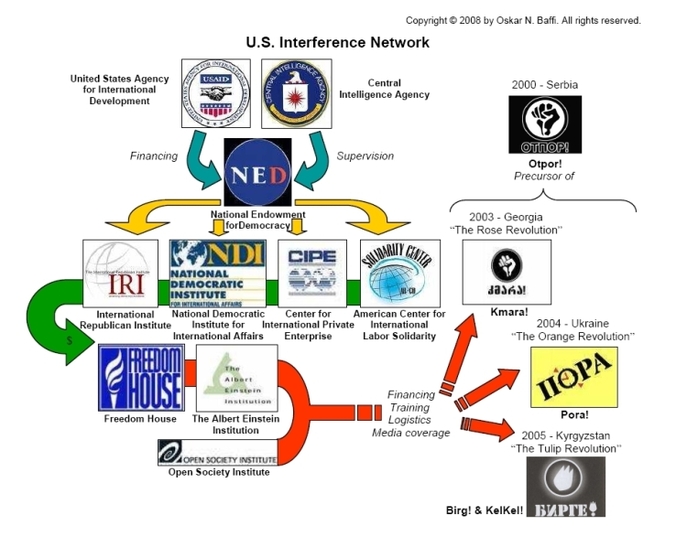
Pulling back from the metaphor, the Brzezinski Doctrine (“The Eurasian Balkans”) is the definition of non-linear warfare and subversive destabilization. It uses NGOs as destabilizing elements within the targeted states, and for this reason, foreign-funded NGOs are required to register as “foreign agents” inside the Russian Federation. Gene Sharp’s writings have also provided pivotal tactical advice in advancing the West’s non-linear warfare strategy. Taking the use of non-state actors even further, the West has a history of promoting militarized proxy groups to carry out its policies. This is most clearly seen in Kosovo, Afghanistan, Iraq, Libya, and Syria, although other countries have also been victims of this underhanded method of war. On the other hand, the West obviously engages in conventional warfare as well. Nowhere is this more evident than in the 2003 Iraq War. Mixing the two methods together is the new trend of American foreign policy. A non-linear campaign of militarized proxy destabilization culminated in a conventional NATO bombing in Libya. After this “success”, the West then turned its sights on Syria, but as a result of adroit Russian foreign policy maneuvers, non-linear warfare was stymied from mutating into its conventional form.
Pomerantsev’s article also uses fear mongering and heavy hype to scare the audience into thinking that Russia is proactively forming some kind of imaginary coalition against the West from within. If there happens to exist an overlap of perceived interests and objectives between Russia and domestic Western actors, it is because both parties arrived at the same conclusions after undergoing the same process – experiencing Western unipolar dominance and discriminatory targeting for two decades. For example, “Euro-scepticism” is also seen in Southeast Asia by the ASEAN members’ reluctance to form an EU-like union. The flower of New Leftism and resistance ideology in South America organically began to bloom in the 2000s, tended over by Hugo Chavez. In a similar fashion, the traditionally conservative societies of India, China, and Africa are just as disgusted as Russia’s by certain Western-centric values, such as the “bearded woman” of Eurovision. In laboratory conditions, the cause (Western dominance) has thus been proven to repeatedly result in similar effects all across the world, thereby confirming the hypothesis that Russia and others arrive at their conclusions on their own. There is no “contradictory kaleidoscope of messages”, as each actor’s resistance and defiance to the West, for various reasons and in differing forms, were a natural development.
To conclude, there are currently multiple civilizational liberation struggles playing out in the Pandora’s Box-setting of Western-led post-modernism. This is not a new page in the old historical story, but an absolutely new edition that is still being written. The Rest, absolutely diverse in their identity and overall mission, are coming together to stop the Western steamroller. They must work together to repel its aggression and safeguard the right to practice their identity and move forward with their historical mission as they individually deem fit. It is the democratic and sovereign choice of each civilization to be able to conduct itself how it pleases, but in order to get to that point, they must be liberated from the terror of the Western threat. These villages do not want to raze the Western one, so to speak, but they understand that the West will raze them if they can’t be annexed. In this manner, they are engaged in a do-or-die struggle, and at no time before in their histories has the situation been more dire. The Rest is slowly coalescing into providing a unified front against the Western menace, hoping to neutralize its raids and incursions so that they can once more go about their civilizational business in constructing and solidifying their societies. If, as Pomerantsev states, Russia and the Rest are anti-Western “raiders”, then yes, the future surely does belong to these resistant and defiant actors.
Andrew Korybko is the American Master’s Degree student at the Moscow State University of International Relations (MGIMO).
Ethnic Russians Are People, Too
By Robert Parry | Consortium News | May 13, 2014
So what does the New York Times have against Ukraine’s ethnic Russians? While the newspaper has fallen over itself insisting on the “legitimacy” of the coup regime in Kiev, despite its collaboration with neo-Nazis who spearheaded the Feb. 22 ouster of elected President Viktor Yanukovych, the Times editors can’t hurl enough insults at the ethnic Russians in the east who have resisted the regime’s authority.
For weeks, the Times has called the eastern Ukrainian rebel leaders “self-declared” and ridiculed the idea that there was any significant backing for the rejection of the Kiev-appointed regional leaders; all the trouble was simply stirred up by Vladimir Putin. Now, however, the referenda in the provinces of Donetsk and Luhansk have demonstrated what even a Times reporter acknowledged was “substantial popular support for the pro-Russian separatists in some areas.”
But the Times editors still won’t give up their prejudices. For instance, Tuesday’s lead editorial begins: “If there were questions about the legitimacy of the separatist referendums in eastern Ukraine, the farcical names of the entities on which people were asked to vote — the self-declared People’s Republics of Donetsk or Luhansk — surely answered them.”
So, the votes – and the desires – of eastern Ukrainians shouldn’t matter because the Times disapproves of “the farcical names of the entities” that people voted for.
The Times then suggests that violence that marred the referenda was the fault of the rebels, not the Kiev regime’s National Guard, which includes the neo-Nazi militias that threw fire bombs at police during the Maidan protests in February and are now carrying out the most lethal attacks against protesters in cities in the east and south.
Of course, according to the Times’ narrative, these neo-Nazis from western Ukraine don’t exist, so the violence must be palmed off on others or be treated like the natural occurrence of a spring thunderstorm. In Tuesday’s editorial, the Times wrote: “But the gathering rumble of violence accompanying the votes is serious and is driving the Ukrainian crisis in a direction that before long no one — not President Vladimir Putin of Russia, not authorities in Kiev, not the West — will be able to control.”
However, even the Times’ own field reporter noted that the violence during the referenda on Sunday was provoked by those new National Guard forces that attacked some polling places. The Times’ editors must assume that most of the newspaper’s readers aren’t paying close attention to the details.
The other part of the Times’ Ukraine narrative is that Putin provoked the unrest in Ukraine so he could seize territory, although no less an authority on power politics than former Secretary of State Henry Kissinger says that notion “isn’t possible,” adding that Putin simply was reacting to events that caught him off-guard as he was coming out of the Winter Olympics at Sochi.
Yet, the Times ignores this more realistic scenario – of a Western-pushed destabilization of the Yanukovych government that involved demands that Ukraine accept a harsh austerity plan from the International Monetary Fund and that spiraled into a violent “regime change” – and instead puts the blame on Putin, who – the Times says – must be told to get “his minions in southeastern Ukraine in line.”
Otherwise, the Times blusters “the European Union and the United States will impose sanctions that will cut Russia off for a long time from Western sources of technology, arms and finance.”
While the Times editorial accurately reflects the swaggering belligerence of Official Washington, the editors still refuse to see the Ukraine crisis in objective terms, in which both the western Ukrainians who favor closer ties with Europe and the eastern Ukrainians whose economy is dependent on trade with Russia have legitimate concerns.
The ethnic Russians in the east are not simply dupes who fall for clumsy propaganda and mindlessly follow the dictates of Vladimir Putin. They are human beings who have their own legitimate view of their political situation and who can make judgments about what course of action is best for their interests. As difficult as life in Ukraine is, it is sure to be worse once the IMF’s harsh austerity is imposed on the country’s population.
The Times and many others in the Western media insult these ethnic Russians with a disdainful treatment that treats them as lesser beings and assumes that only the pro-European Ukrainians in the west deserve respect for their opinions.
~
Investigative reporter Robert Parry broke many of the Iran-Contra stories for The Associated Press and Newsweek in the 1980s. You can buy his new book, America’s Stolen Narrative, either in print here or as an e-book (from Amazon and barnesandnoble.com).
Russia disappointed over additional EU sanctions
RT | May 13, 2014
Moscow expressed disappointment over the EU’s newly imposed sanctions against Russia, stressing that it is not worthy of the European Union.
“Instead of trying to solve the situation through de-escalation, disarmament of the Right Sector, improvement of dialogue between Kiev’s authorities and Ukrainian regions, EU colleagues are demonstrating a one-sided and one-dimensional policy, not worthy of the European Union,” Itar-Tass quoted Deputy Foreign Minister Sergey Ryabkov as saying.
Further sanctions were introduced on Monday following the results of referendums that have been announced in Donetsk and Lugansk Regions, showing the majority of voters support self-rule, amid an intensified military operation by Kiev which resulted in several deaths.
EU foreign ministers have expanded their sanctions over Russia’s actions in Ukraine, adding two Crimean companies and 13 people to the bloc’s blacklist, EU diplomats stated.
The sanctions will come into effect Tuesday. Earlier, 48 Russians and Ukrainians were targeted by EU asset freezes and visa bans over Crimea joining Russia in March.
Among the individuals banned entry to the EU are the chief prosecutor of Crimea and Internet sensation Natalia Poklonskaya and her colleague from Sevastopol, Igor Shevchenko. Also the list includes influential individuals such as the deputy head of the presidential administration, Vyacheslav Volodin, the Commander of airborne troops Vladimir Shamanov, State Duma deputy Vladimir Pligin, Crimean administration chiefs and six pro-autonomy activists in eastern Ukraine, reported Itar-Tass.
Following the referendum results, Donetsk People’s Republic has proclaimed itself a sovereign state and has asked Moscow to consider its accession into Russia, the Republic’s council said.
Russia is taking its time before reacting to Donetsk People’s Republic’s plea while calling for dialogue between Kiev and the eastern regions.
Moscow not in rush to respond Donetsk People’s Republic’s plea of accession
RT | May 12, 2014
Russia is taking its time before reacting to Donetsk People’s Republic’s plea to consider its accession into Russia while calling for dialogue between Kiev and the eastern regions.
The Russian president’s spokesman Dmitry Peskov has told Kommersant newspaper Russia does not yet have a response to the plea.
Earlier on Monday the Kremlin’s press service issued a statement, saying: “Moscow respects the will of the people in Donetsk and Lugansk and hopes that the practical realization of the outcome of the referendums will be carried out in a civilized manner.”
It stressed the necessity of a “dialogue between representatives of Kiev, Donetsk and Lugansk.”
On Monday, Donetsk People’s Republic proclaimed itself a sovereign state and asked Moscow to consider its accession into Russia, the Republic’s council said.
Earlier in the day, the results of referendums were announced in Donetsk and Lugansk Regions, showing the majority of voters support self-rule, amid an intensified military operation by Kiev which resulted in several deaths.
Experts on the issue have weighed in with their view on Russia’s response.
International legal expert Alexander Mercouris told RT that Moscow’s reaction was consistent with its previous policy on Ukraine.
“Moscow is following what has been its consistent policy right from the start, right from the moment when the coup took place in Kiev in February, which has been pressing for negotiations between Kiev and the actual true democratic representatives of the eastern regions in order to achieve constitutional change,” Mercouris told RT. “I do not think Moscow’s position has changed. But I think Moscow’s position may change in the future.”
International relations expert and senior lecturer at Moscow State University Mark Sleboda also told to RT that he does not view Moscow’s reaction as contradicting its previous stance.
“Moscow’s reaction to the referendum – they of course recommended that it be postponed, and they had a somewhat tepid reaction to it. But at the same time they did not completely disown it either,” Sleboda said.
“The first statement out of Moscow this morning that it looked forward to a dialogue between Donetsk, Lugansk and Kiev to resolve the situation and implement the people’s will was a very strong indication that Russia is still really trying for dialogue with Kiev,” Sleboda added.
Professor of History and Politics in Berlin Ronald Suni noted that Russia’s slow response will indeed provide room for international dialogue, which may help the situation.
“Vladimir Putin and his advisors decided a few days ago that we’ve got to pull back, that we’ve got to slow things down. That all these people acting in their own interest, out of their own emotions and passions could lead to some very dangerous situations – civil war or international war,” Suni told RT.
“So, why not postpone the referendum, which of course the locals did not want to do, recognize the May 25 elections, which part of Ukraine probably won’t do, and pull troops back from the frontier, which Putin did. Even so, these actions have not led to a response, on both sides it would allow for some kind of international negotiation,” he added.
Mercouris also explained the referendum results are a valid statement of opinion. “Yes, they were organized in great haste, in civil war, revolutionary conditions, but even people who are present, who are hostile to these referendums, from the Western media now accept that these are in fact representative of the powerful mass movement,” he said.
Sleboda stated that when examining Donetsk and Lugansk referendums, one must pay attention to three things. “One, the extremely large turnout, which is nearly impossible to deny. The overwhelming landslide victory – since the vote was essentially public with the glass ballot boxes and the Western journalists who served in place of international monitors, we could say, who clearly informally polled on the ground the strength of support for the independence vote.”
“And three, we have to remember that this did indeed happen under the barrel of a gun – but not the barrel of the gun of the self-defense forces, but under the barrel of the gun of this Kiev regime who was actually killing voters as they tried to vote against it on the referendum day,” he argued.
France refuses to block Mistral warship deal with Russia
RT | May 12, 2014
The French government has said that it will go ahead with 1.2 billion euro ($1.6 billion) contract to supply Russia with two Mistral helicopter carriers because cancelling the deal would harm Paris more than Moscow.
In the wake of the crisis in Ukraine, the United States had been pressing France as well as Britain and Germany to take a tougher line against Russia and cancel the Mistral contract.
But France refuses to link the helicopter carrier deal to the US/EU debate over tougher sanctions against Russia.
A French government official travelling with President Francoise Hollande in Azerbaijan Sunday, who asked not be named, told reporters that the contract was too big to cancel and that if France didn’t fulfill the order it would be hit with penalties.
“The Mistrals are not part of the third level of sanctions. They will be delivered. The contract has been paid and there would be financial penalties for not delivering it.
“It would be France that is penalized. It’s too easy to say France has to give up on the sale of the ships. We have done our part,” the official said.
President Hollande also said earlier on Saturday that the contract will go ahead.
“This contract was signed in 2011, it will be carried out. For the moment it is not in question,” President Hollande said on Saturday during a visit to German Chancellor Angela Merkel’s electoral district.
The Russian defense ministry warned Paris in March that it would have to repay the cost of the contract plus additional penalties if it cancelled the deal.
EU foreign ministers met in Brussels Monday and expanded their sanctions over Russia’s stance on the Ukrainian crisis, adding two Crimean companies and 13 people to the bloc’s blacklist, EU diplomats said.
They have threatened a further widening of sanction if the Ukrainian presidential elections do not go ahead on May 25.
US Secretary of State Victoria Nuland expressed concern over the deal on May 8 after US lawmakers had demanded more pressure be put on France to stop the contract.
“We have regularly and consistently expressed our concerns about this sale, even before we had the latest Russian actions, and we will continue to do so,” Nuland told the House Foreign Affairs Committee.
US Secretary of State John Kerry is due to meet the French Foreign Minister Laurent Fabius in Washington Tuesday and President Barak Obama is expected to raise the issue during a visit to France next month to commemorate the D-Day Normandy landings.
US officials have suggested France could sell the ships to another buyer or sell them without the advanced technology, although it is not at all clear at this late stage who the other buyer could be.
The French deal was Moscow’s first foreign arms purchase since the end of the Cold War and was hailed by then President Nicholas Sarkozy has an important step forward in French-Russian relations. The contract has created some 1,000 jobs in French shipyards.
The first of the two ships, the Vladivostok, is due to be delivered by November this year and the second, called Sevastopol, will arrive in St Petersburg for further fitting out with Russian weapons systems in November 2015 and will join the Pacific fleet in the second half of 2016.
The Mistral can carry up to 16 attack helicopters such as Russia’s Kamov Ka-50/52, more than 40 tanks or 70 motor vehicles and up to 700 troops. The ships for Russia have been modified from the version used by the French navy to operate in northern altitudes and ice covered seas.
The Russian navy will fit the ships with air defense systems and rapid fire artillery guns to allow them to go on combat missions with fewer escort vessels.
Featured Video
Anthrax War – CBC The Passionate Eye
or go to
Aletho News Archives – Video-Images
Book Review
Shattered Dreams: The HPV Vaccine Exposed (2019)
By Christina England – 30 Q&As – Book Review & Summary
Lies are Unbekoming | September 4, 2026
… Gardasil received FDA fast-track approval in 2006, Cervarix followed in 2009, and Gardasil 9 was approved in December 2014 with more than double the aluminium adjuvant content of the original. The commercial context is specific. Merck was about to lose patent protection on Zocor and faced $18 billion in Vioxx injury claims from a cardiovascular drug the company had marketed while suppressing its own data showing a five-times increase in heart attacks. Analysts projected the global HPV vaccine market at $4 billion by 2011, contingent on government-funded national programs for teenage girls. The 1986 National Childhood Vaccine Injury Act had already granted manufacturers complete liability immunity. By 2013, Japan had withdrawn its HPV vaccine recommendation after cataloguing severe adverse reactions in hundreds of girls. No Western government followed. The establishment position across the UK, US, Australia, and most of Europe held, and still holds, that the vaccines are safe and effective, that reported injuries are coincidental, and that cervical cancer prevention justifies the program. The book was published into this position, not against a vacuum.
Shattered Dreams sits alongside Mary Holland’s The HPV Vaccine On Trial and Viera Scheibner’s foundational vaccination work as part of the documented record on what has been done to a generation of teenage girls under the banner of cancer prevention. The full summary unpacks three specific findings: that Merck used the aluminium adjuvant itself as the “placebo” control in 92.5% of trial subjects, making it structurally impossible to detect excess reactions from the adjuvant; that Dr. Sin Hang Lee found HPV DNA fragments bound to aluminium in every one of sixteen Gardasil samples tested, and in the blood and spleen of a New Zealand girl six months after her third dose; and that in every country with high vaccination coverage, including Australia, the UK, Norway, and Sweden, cervical cancer rates have stopped declining and started rising specifically in the vaccinated cohort. Martínez-Lavín’s 2017 calculation puts the number needed to seriously harm with Gardasil 9 at 140, and the number needed to vaccinate to prevent one case at 1,757. Thirteen young women are seriously harmed for every one who benefits. The vaccine was approved on the basis of trials that could not detect what the trials were supposed to detect, and it is still being given to twelve-year-olds today. … Read full review
Blog Roll
 Aletho News
- Ukraine’s EU neighbors reject new plea from Kiev – Politico
- British Transport Police Facial Recognition Trial Scanned 926,912 People With Zero Arrests
- House Bill Would Ban Federal Use of Flock ALPR Data
- Can a Spice Rival a Drug? 10 Head-to-Head Trials Put It to the Test.
- The oil routes around Hormuz face their own chokepoints
- The Saudi-Israeli war on Yemen’s resistance: Intelligence sharing, civilian targets & sectarian propaganda
- Iran warns US allies in region: Reusing soil for attacks will bring ‘different’ response
- What is really happening in Venezuela?
- Diplomacy is Now a Crime in Britain / Ian Proud
- UK Government Body Kept Files on People Criticizing Prevent Program
- If Americans Knew
- No big deal: Israel to halt humanitarian aid to Gaza for 2 days – Daily Update
- Israel is squeezing the life out of Palestinians – Daily Update
- The Israeli Right Portrays Islam as Murderous. It Serves a Political Purpose
- Jordan Has Had Enough: King Abdullah’s Scathing Warning to Israel
- Israeli Colonizers (i.e. Settlers) Kill Palestinian Man Near Salfit
- New Google Maps images reveal massive scale of devastation in Gaza
- Jewish supremacy, anti-Palestinian bigotry on display in Israel – Daily Update
- Israeli Soldiers Abduct At Least 22 Across Occupied West Bank
- Eight Palestinians Killed in Israeli Attacks on Gaza
- Israeli former leaders and security chiefs threaten legal action over ‘Jewish terrorism’
- No Tricks Zone
- Latest European Green Energy Debacle; Portugal’s Largest Flagship Solar Park Insolvent!
- Green Energy Debacle: German Expert Professor Fritz Vahrenholt Warns Of Severe Economic And Social Consequences
- Two More Paleo Reconstructions Affirm Meters-Higher Sea Levels Across Ireland, Brazil 7000-6000 Years Ago
- New Study: Earth And Venus Surface Warmth Largely Explained By Convection And Lapse Rate, Not CO2 Or Radiation
- 2025 Nature Paper Claiming Worsening Global Drought Gets RETRACTED …Heavily Flawed
- New Study: ‘Global Drought Shows No Detectable Recent Acceleration Under Climate Warming’
- Economic Masterminds: German Socialists Suggest Taxing Productivity Gains Stemming From Using AI
- The South China Sea Has Not Been Cooperating With The Climate Change Narrative
- Energy Crisis: Germany Enters Heating Season With Historically Low Gas Reserve Fill Levels
- New Study: The Antarctic Ice Sheet Gained Mass From 2020-2024 Due To Staggering Snow And Ice Accumulation

