NGOs find loopholes in Foreign Agents’ Law, officials urge corrections
RT | June 13, 2013
Russian NGOs that receive funding from abroad have developed several methods that allow them to bypass the obligatory registration as ‘foreign agents’.
Currently the law obliges all NGOs engaged in political activities and receiving funding from abroad to register as “foreign agents”under threat of fines.
One possible option is to register an ordinary commercial company that would receive funds from abroad and employ NGO staff as workers to pay their salaries, Kommersant daily wrote quoting the head of a Russian NGO who spoke on the condition of total anonymity.
The source noted that about 15 Russian groups had already switched to this method.
Another possible loophole, suggested by the daily itself, is to set up an endowment that would properly register as a foreign agent and receive foreign funding which would then be transferred to one or several Russian groups, allowing them to skip the registration as they are formally sponsored by a Russian company.
The third way has been outlined in a recent report by the Civil Initiatives Committee, an influential expert group chaired by former finance minister Aleksey Kudrin, which said that under growing pressure Russian NGOs could re-register in neighboring states.
Some Russian officials already called for changes in the recently approved law, saying that the flaws of the original bill are being exposed as it is applied. Mikhail Fedotov, chairman of the Presidential Council on Human Rights, said that the practice was only showing one thing – that the law had been poorly written and that it was in need of corrections.
Fedotov added that the council had already prepared several suggestions on corrections, but he did not go into detail.
Deputy Prime Minister Arkady Dvorkovich has said that the law needs changes and called for activists to draft their amendments. But Dvorkovich added that the law is in force and must be observed by all members of the community until it is altered in the desired way.
Russia introduced the so-called Foreign Agents Law in November last year.
Prosecutors and the Justice Ministry launched a major nationwide program in March this year in order to check how the fresh law is being applied. The inspections caused protests from NGOs, rights activists and the international community, which claimed they were a form of government pressure on independent critics.
Russian officials, including the president, have repeatedly stated that the law is not banning any NGOs and simply requires disclosure of the sources of their income. Such transparency would give Russian citizens and voters some clues about possible motives of the groups’ political actions, the officials added.
Currently no organization is registered as a foreign agent in Russia.
US claims of Assad’s chemical weapons are lies – Pushkov
RT | June 14, 2013
A senior Russian MP holds that the recent White House statement of chemical weapons use by the Syrian government is as false as the notorious reports about Iraqi WMDs.
“The data about Assad’s use of chemical weapons is fabricated by the same facility that made up the lies about Saddam Hussein’s weapons of mass destruction. Obama is walking George W. Bush’s path,” the head of the Duma’s Foreign Affairs Committee Aleksey Pushkov tweeted.
The Russian MP was referring to the 2003 invasion in Iraq prompted by the US and UK claims that Saddam Hussein possessed weapons of mass destruction that threatened neighboring nations. The UN probe into the matter was underway as the invasion started and no traces of WMD have been discovered on Iraqi territory since the war ended, prompting accusations that the US administration and special services fabricated the data to get an excuse to start the conflict.
In comments to Russian news agencies Pushkov noted that the supplies of arms from the US to the Syrian rebels would hardly lead to the overthrow of President Bashar Assad’s regime. He added that the government in Syria is supported by “a significant, if not the larger, part of the population” and the Syrian military “show a high degree of resistance.”
Pushkov also forecast that the United States would now attempt to further escalate the situation.
“Now they are arming the rebels but then they will come to some form of direct military involvement. We cannot exclude the possibility of cruise missile strikes and if this measure brings no result – of direct military intervention,” he said.
The statement was made shortly after US authorities publicly announced that they had proof that pro-government forces used chemical weapons, like the nerve agent sarin in the Syrian conflict, killing at least 150 people. At the same time, the US side claimed that there was no proof about similar actions from the rebels’ side.
US Deputy National Security Advisor Ben Rhodes has told the press that President Barack Obama has decided to boost the US support to the Syrian opposition forces and that this would now include military support. The detailed orders will be issued within the nearest weeks after Obama consults with the Congress, the official added.
Earlier last week UK and France said that their probes into the alleged use of chemical weapons in Syria showed that the pro-government forces did it at least once causing casualties among rebels and called the international community for immediate action. Many officials, including top Russian politicians, noted that the impartiality of British and French researchers is under question and urged an independent probe.
The UN is currently preparing its own independent investigation, but it might take a long time. Syrian government has said it was ready to accept the UN delegation and help with the investigation.
In late March one of the conflicting parties in Syria allegedly used a sarin-charged missile near the city of Aleppo. The government and rebels now accuse each other of the attack that killed at least 25 people.
While the UK, France and now the United states accuse pro-Assad forces, Turkish media said in early June that the country’s security forces had found sarin gas in the homes of members of the Al-Qaeda-linked Al-Nusra Front – one of the main groups opposing the Syrian government.
Russian officials have repeatedly condemned the use of chemical weapons and urged an all-sided and unbiased research into all incidents connected with the issue.
Russia ranked world leader in shale oil reserves
RT | June 12, 2013
Russian shale oil reserves are estimated at 75 billion barrels, which puts the country on top of the global standings, followed by the US and China.
According to the report by the US Energy Information Administration (EIA), the estimated American shale gas resources equal 58 billion barrels, with third-place China having 32 billion barrels.
But it’s the Chinese, who hold the leadership in shale gas reserves, with 1,115 trillion cubic feet. 802 trillion cubic feet puts Argentina in second, with Algeria not far behind on 707 trillion cubic feet.
The US is fourth when it comes to shale gas (665 trillion cubic feet), while Russia is ninth with 285 trillion cubic feet.
The EIA’s report indicates that the worldwide resources of oil and gas from shale formations are greater than was previously thought.
The global shale oil resources are estimated at 345 billion barrels and shale gas – at 7,299 trillion cubic feet, which is a 10 per cent increase in comparison with the 2011 data.
According to EIA’s administrator, Adam Sieminski, the report shows “a significant potential for international shale oil and shale gas.”
The increase in estimates is explained by more countries joining the efforts to search for deposits, following the ‘Shale Revolution’ in the US.
“As shale oil and shale gas production has grown in the United States to become 30 percent of oil and 40 percent of natural gas total production, interest in the oil and natural gas resource potential of shale formations outside the United States has grown,” Adam Sieminski explained in a statement.
Also on Wednesday, British oil giants BP have Russia’s natural gas reserves estimate at 32.9 trillion cubic meters from 44.6 trillion in last year.
According to the company’s benchmark Statistical Review of World Energy, it’s Iran, who climbed to the top of the global standings, with the proven reserves of 33.6 trillion cubic meters.
BP said that this year they decided to adjust its estimates for the former Soviet Union states, including Russia, where data on reserves remains classified.
“Traditionally countries of the former Soviet Union had different criteria than used elsewhere. So we used a conversion factor to convert that from those countries where we don’t get direct data,” Christof Ruhl, BP’s chief economist, is cited as saying by Reuters. “In some countries, reserves are still a state secret, so we have to rely on these data.”
But Russia remains a much larger gas producer than Iran as the international sanctions prevent the Islamic Republic from exploiting its natural resources in full.
The estimate of gas reserves in the US where the energy industry has been transformed by shale oil and gas, due to lower prices and reduced drilling.
The American gas reserves ended 2012 at 8.5 trillion cubic meters, down 0.3 trillion from indications of 2011.
BP cut proven global gas reserves by nearly 21 trillion cubic meters from 208.4 trillion cubic last year to 187.3 trillion cubic meters as of end of 2012.
Related article
Russia slams the US for distorting results of trilateral talks on Syria
Press TV – June 7, 2013
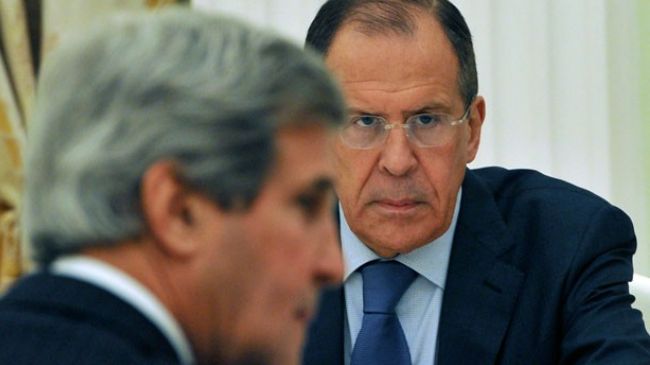
Russia’s foreign minister has censured the US Department of State officials for their ‘peculiar comment’ on the results of a trilateral meeting over Syria in Geneva.
The trilateral meeting on Wednesday was held with the participation of UN-Arab League Special Representative for Syria Lakhdar Brahimi and representatives from Russia and the United States. It served as a preparatory move to pave the way for the Geneva 2 talks on the issue of Syria.
During a Thursday press conference, Russian Foreign Minister Sergei Lavrov said, “I have heard that officials from the US Department of State have given a very peculiar comment on the results of yesterday’s meeting in Geneva between Russia, US, and UN.”
“In particular, the State Department representative stated that Russia, the United States and the United Nations agree that the goal of the new conference in Geneva must be the forming of a new transitional government in Syria. This really matches with what was written down last year,” he said.
“But, if the reports that I have received are true, the State Department went on to add that this should be a transitional government to which the current authorities in Damascus would hand over all their powers. If this was really said by the State Department, this is a very strong distortion of what the talks were about,” the Russian foreign minister added.
He made the remarks in response to an earlier statement by Jennifer Psaki, a spokesperson for the US Department of State, where she reportedly claimed that participants in the preparatory meeting had agreed that the forthcoming talks on Syria should focus on the formation of a transitional government, to which the current administration should give up all powers.
Lavrov further reiterated that Moscow would continue to push for Iran’s participation in the upcoming Geneva meeting despite opposition from some Western states.
Meanwhile, Brahimi has expressed hope that the Geneva conference would convene in July, as the preparatory meeting failed to set a date.
Russia has to react as NATO moves closer to its borders – Medvedev
RT | June 4, 2013
Russia cannot see NATO expansion towards its borders as positive, as under certain circumstances the possibility of military confrontation remains, the Russian PM has said at the Euro-Arctic Council’s forum.
When a reporter asked Dmitry Medvedev how the balance of forces in Europe will change if Sweden and Finland decide to enter NATO, the Russian Prime Minister answered that his country would have to react to such developments.
“This is their own business; they are making decisions in accordance with the national sovereignty doctrine. But we have to consider the fact that for us the NATO bloc is not simply some estranged organisation, but a structure with military potential,” the head of the Russian government said adding that under certain unfavorable scenarios this potential could be used against Russia.
“All new members of the North Atlantic alliance that appear in proximity of our state eventually do change the parity of the military force. And we have to react to this,” the top official noted.
At the same time, Medvedev told reporters that currently Russia and NATO have a working and effective body of cooperation – the Russia-NATO council.
The issue of NATO expansion towards Russian borders is also important as it is directly connected with the deployment of global missile defense system in NATO member countries, including former Warsaw Pact members, such as Poland and the Czech Republic. As US and NATO refused to provide Russia with legally binding guarantees that the ABM systems would not target Russian forces, Russia is opposing the move, warning of future tensions and the possibility of a new arms race.
Earlier this week US Secretary of State John Kerry spoke at a joint press conference with Poland’s Foreign Minister Radek Sikorski and said that his country was not making any concessions to Russia as it altered the plans to develop and run the missile defense system.
“The United States of America has made zero concessions to Russia with respect to missile defense,” news agencies quoted the top US diplomat as saying.
He added that the elements of the missile defense shield would be placed in Poland by 2018 and that this was part of NATO’s modernized approach to security.
The plans to deploy a missile defense system in NATO member-countries such as Poland and the Czech Republic caused strong protests from Russia and in 2008 then President Dmitry Medvedev announced that his country would deploy the newest Iskander ballistic missiles in the Kaliningrad Region – Russia’s westernmost exclave – and this move would render the planned defense system useless. In 2012 Russia allocated additional means to upgrade the Iskander systems announcing that this would allow the weapon to effectively counter the US anti-missile systems.
Russian media have reported that Iskander deployment to Kaliningrad should have started in the second half of 2012, but the military denied this and said it is still in the preparatory stage.
Gazprom may shelve Shtokman project as US shale revolution bites
RT | June 03, 2013
After years of failed attempts to start developing one of the world’s largest gas fields, Gazprom might delay the Shtokman project for decades. The shale revolution in the US – the project’s key export market – is undermining its profitability.
Development of the Shtokman gas condensate field in the Barents sea will most likely be postponed “for future generations,” Vedomosti daily quotes Andrey Kruglov, Gazprom deputy chairman. This week Russia’s gas monopoly is due to discuss the future of the world’s biggest gas deposits, where an estimated 3.9 trillion cubic metres of gas is held.
Experts say there’s no point in developing the field right now, as the project is difficult and costly and may fail to find sufficient demand.
US shale gas has definitely “undermined Shtokman that was oriented on the US market,” says Tatyana Mitrova, the head of Russia’s oil and gas development department at the Energy Research Institute of the Russian Academy of Sciences. “The deposit is difficult…the problem is that there’s really no other market left for Shtokman, after it became irrelevant for the US,” agrees Michael Korchyomkin, a director at East European Gas Analysis.
Having been developed at the beginning of this century, the production of shale gas in the US has significantly moved on. In 2010, shale gas represented more than 20% of the country’s gas production, according to the International Energy Agency (IEA). The agency also said that by 2035 around 40% of the world’s gas might be unconventional, and shale gas will by far be the greatest part of it.
“Gazprom has been trying to start developing the project for about 10 years. They planned to liquefy part of the extracted gas and deliver that to the US, and transport another part to Europe through a pipeline. The trans-Baltic Nord Stream pipeline was being built for that project,” Kruglov explained. Initially it was planned to start extracting gas from the Shtokman field this year. Its income and expense pro forma is estimated at $30 billion.
The South Kirinskoe deposit on the shelf of the Sea of Okhotks may become the alternative to the Shtokman field, according to Kruglov. It “has almost the same stock as the Shtokman has and is located much closer to the Asian Pacific markets.”
The Kirinskoe deposit is 28 km from the shore at a depth of 90 metres. Shtokman is 550 km away from the shore, at a depth of about 330 metres.
Vedomosti sources told the paper there were plans to develop the South Kirinskoe deposit earlier than Shtokman. It should become the base for a Gazprom LNG plant in Vladivostok, that is due to begin operating in 2018.
However, Grigory Birg, a co-director at Investcafe, remained skeptical, saying the new project will require huge investment and may face the same fate as the Shtokman project.
Moscow disappointed political games prevented investigation into chemical weapons use in Syria
RT | May 31, 2013
Russia’s Foreign Minister Sergey Lavrov stressed that “political games” prevented Russia from investigating the data on the use of toxic substances in Aleppo: the UN Secretariat couldn’t respond promptly to Moscow’s demand to look into the matter.
In March, the Syrian government invited the United Nations to investigate possible chemical weapons use in the Khan al-Assal area of rural Aleppo. Military experts and officials said a chemical agent, most likely sarin, was used in the attack which killed 26 people, including government forces.
Several countries, including Israel, the UK, France and the US – all vocal critics of Syrian President Bashar Assad – all claimed they had evidence that chemical weapons were used in Syria.
Damascus denied that a chemical attack was carried out by the Syrian army, blaming the rebels and Turkey for the incident: “The rocket came from a place controlled by the terrorists and which is located close to the Turkish territory. One can assume that the weapon came from Turkey,” Syrian Information Minister Omran al-Zoabi alleged in an interview with Interfax news agency.
Lavrov spoke following the reports that Turkish security forces found a 2kg cylinder with sarin gas after searching the homes of Syrian militants from the Al-Qaeda linked Al-Nusra Front who were previously detained.
The sarin gas was found in the homes of alleged Syrian militants, who were reportedly planning a terrorist attack on the southern Turkish city of Adana.
Russia expressed concern over the incident, urging for a thorough investigation into the matter.
Almost a month ago, the Syrian Deputy Foreign Minister Faisal Muqdad said that Damascus was ready to have the UN investigation team look into alleged chemical weapons use in Syria.
“We were ready and we are always ready, right now, to receive the delegation that was set up by [UN Secretary-General] Ban Ki-moon to investigate what happened in Khan al-Assal,” Muqdad said, referring to the March 19 incident near Aleppo.
Syrian rebels are accused of using a rocket with a chemical warhead, killing 25 people and injuring 86, according to SANA news agency.
The Syrian civil war has been raging for more than two years now, with more than 80,000 people killed, according to UN estimates.
In his latest statement on the matter, Lavrov noted the Russian government’s concern over the issue due to the chance of provocations around the situation.
Russia slams end of EU arms embargo, calls S-300s ‘stabilizing factor’ in Syria
RT | May 28, 2013
The failure of the European Union to agree on a new arms embargo for Syria is undermining the peace process, Moscow says. But the delivery of S-300 surface-to-air missiles may help restrain warmongers.
The comments come from Deputy Russian Foreign Minister Sergey Ryabkov, referring to the results of Monday’s meeting in Brussels. After a lengthy negotiating session, EU governments failed to resolve their differences and allowed a ban on arming the Syrian opposition to expire, with France and Britain scoring an apparent victory at the expense of EU unity.
The EU’s move, which the Russian diplomat branded as an “example of double standards”, opens the door for Britain and France to supply weapons to Syrian rebels fighting the regime of President Bashar Assad.
Criticizing Europe’s decision to open the way for potential arms shipments to Syrian rebels, Russia insists that its own sale of arms to the Syrian government helps the international effort to end the two-year-long conflict, the diplomat added. He was referring to the delivery of the advanced S-300 long-range air defense systems, which Russia is carrying out under a contract signed with Syria several years ago.
“Those systems by definition cannot be used by militant groups on the battlefield,” Ryabkov said. “We consider this delivery a factor of stabilization. We believe that moves like this one to a great degree restrain some hotheads from escalating the conflict to the international scale, from involving external forces.”
The S-300 is a series of Russian long-range surface-to-air missile systems designed to intercept ballistic missiles, regarded as the most potent weaponry of its class. The missiles are capable of engaging aerial targets as far away as 200km, depending on the version used.
Once the Russian SAM missiles are deployed by Syria, it will have a better control of its airspace. The country endured three airstrikes this year, which are widely thought to have been conducted by Israel, but were never officially confirmed as such.
Britain and France have made a commitment not to deliver arms to the Syrian opposition “at this stage,” an EU declaration said. EU officials, however, said the commitment effectively expires on August 1.
London and Paris have argued support for rebels fighting Assad by allowing EU arms deliveries, despite the fact that extremist elements are known to work alongside the rebels.
Other EU governments, led by Austria and Sweden, argued that sending more weapons to the region would increase violence and spread instability.
Russia’s envoy to NATO Aleksandr Grushko said that the abolition of the EU arms embargo on the Syrian opposition will only exacerbate armed conflict in that country.
“We need to refrain from taking steps that would be contrary to this logic. Such steps include armed or non-lethal support to the opposition. This just adds fuel to the fire,” Grushko said on Tuesday.
Meanwhile, Moscow and Washington remain undecided as to the content of a proposed international conference on Syria, according to Deputy Foreign Minister Sergey Ryabkov.
“There remains a gap between the positions of Russia and the US regarding some issues and aspects of this major international crisis,” he emphasized.
“And we, for our part, cannot agree to hold such events [the international conference on Syria] amid a situation where partners and possible participants in such a conference seek to impose solutions on the Syrian people from the outside, as well as predetermine the course of a transitional process, the parameters of which have not been determined yet,” Ryabkov said.
Related article
Over 70 states refuse to say yes to anti-Syria resolution
Press TV – May 16, 2013
More than 70 countries have refused to say yes to an Arab-backed resolution against Syria at the United Nations General Assembly.
Russia, China and Iran were among the 12 countries that opposed the resolution on Wednesday.
Russia called the resolution, co-sponsored by the United States, “counterproductive and irresponsible.”
The resolution was adopted by a vote of 107-12 with 59 abstentions. Argentina, Brazil, and more than a dozen other Latin American and Caribbean countries abstained from voting.
Russian Deputy Ambassador to the UN Alexander Pankin called the resolution “very harmful and destructive,” saying it disregards “illegal actions of the armed opposition.” He also accused the resolution’s Arab sponsors of attempting to replace the Syrian government instead of trying to find a political solution to the crisis in Syria.
Syrian Ambassador to the UN Bashar Ja’afari also stated that the resolution “seeks to escalate the crisis and fuel violence in Syria.”
The non-binding resolution, which was drafted by a number of Arab states, calls for a “political transition” and refers to the foreign-backed militants in Syria as “effective representative interlocutors” needed for the transition.
The Syria crisis began in March 2011, and many people, including large numbers of soldiers and security personnel, have been killed in the violence.
The Syrian government says that the chaos is being orchestrated from outside the country, and there are reports that a very large number of the militants are foreign nationals.
Damascus says the West and its regional allies, such as Qatar, Saudi Arabia, and Turkey, are supporting the militants.
In an interview recently broadcast on Turkish television, Syrian President Bashar al-Assad said that if the militants take power in Syria, they could destabilize the entire Middle East region for decades.
“If the unrest in Syria leads to the partitioning of the country, or if the terrorist forces take control… the situation will inevitably spill over into neighboring countries and create a domino effect throughout the Middle East and beyond,” he stated.
What the NYT Doesn’t Say About Washington’s Syrian Peace Plan
By Michael McGehee | NYTX | May 9, 2013
On page A12 of the May 8, 2013 edition of The New York Times is Steven Lee Myers and Rick Gladstone’s article “U.S. and Russia Plan Conference Aimed at Ending Syrian War,” which opens by stating that, “Russia and the United States announced on Tuesday that they would seek to convene an international conference within weeks aimed at ending the civil war in Syria, jointly intensifying their diplomatic pressure on the combatants to peacefully settle a conflict that has taken more than 70,000 lives and left millions displaced and desperate.” This is a most welcoming turn of events, especially for the people of Syria who have taken the brunt of the civil war, and hopefully the conference bears fruit quickly.
But—and there is one of these stubborn conjunctions—it is important for the purpose of history to note that for two years now the United States has blocked any peaceful resolution, and has instead pushed the conflict further and deeper into violence and war.
It is Russia who has long pushed for a political reconciliation.
In October 2011 RIA Novosti reported that “Moscow calls on the UN Security Council to continue the search for a balanced approach toward the political crisis in Syria based on a draft resolution prepared by Russia and China, Russia’s envoy to the UN said,” with the phrase “balanced” being a jab at how Washington and its allies have put all the requirements on the Syrian government to end violence, and not the rebel forces whom they have been backing.
Writing in December of 2011, Egypt Independent reported that, “Deputy Russian Foreign Minister Sergey Ryabkov on Monday emphasized the need for dialogue and reconciliation in Syria.”
Even in December of 2012 Voice of America reported that, “Russian Foreign Minister Sergei Lavrov has echoed a call from an international peace envoy to resolve Syria’s civil war through a government-backed national dialogue and political process.”
The New York Times also reported on Russian efforts that same month when they informed readers that, “Moscow has made a muscular push for a political solution in recent days.”
While it is inaccurate to imply that Russia’s search for “a political solution” was “in recent days,” it is more disturbing that phrases like “muscular push” are used to describe such an effort, while the “paper of record” has routinely tried to make a case for war (see here and here).
A month ago today (May 8, 2013) the Syrian rebels detonated a car bomb near a school in Damascus, killing 14, and wounding dozens of others. According to Reuters, “State television said the explosion had occurred near a school in Sabaa Bahrat, a heavily populated area that also houses the Central Bank and the Finance Ministry. It said 53 people were wounded.”
Washington failed to condemn the act of terror.
Likewise when Daily Mail ran an article last December with this headline: “Syria rebels ‘beheaded a Christian and fed him to the dogs’ as fears grow over Islamist atrocities.” Apparently there is no “red line” for the rebels to cross.
And there are dozens and dozens of similar incidents. Not once has Washington put pressure on the rebels to stop their senseless violence, or argued for an international force to intervene and defend the Syrian people from the terrorists. Nor have Western establishment pundits like Bill Keller argued for such things. And even though al Qaeda is active in the country, beheading so-called infidels, or that the Syrian rebels are likely using chemical weapons, Washington and its media parrots have instead favored escalation. Just over a week ago The New York Times reported that “The White House is once again considering supplying weapons to Syria’s armed opposition.” This comes after the car bombing across the street from a children’s school.
And now Washington wants peace, as Myers and Gladstone tell us that “The announcement appeared to signal a strong desire by both countries to halt what has been a dangerous escalation in the conflict.”
Perhaps it has become clear that the rebels cannot win this war on their own, and the only reasonable way Bashar Assad will be brought down is another U.S. war which will elevate the jihadis into power. Perhaps President Obama is imagining one of these rebel jihadis attacking an American embassy in Damascus, and the Republicans foaming at the mouth for another politicized inquiry into how such an attack could happen, as they currently are over the embassy attack in Benghazi, Libya last year.
Whatever the reasons for the turnaround it is gladly welcomed. The people of Syria deserve a rescue from the terror Washington, Turkey, Saudi Arabia, Qatar, and others, have unleashed on them. Though we should remain sober and note that the “conflict that has taken more than 70,000 lives and left millions displaced and desperate” is largely of Washington’s doings, and could have been avoided years ago if Uncle Sam followed the lead of Moscow and Bejing, both of whom had the “strong desire . . . to halt what has been a dangerous escalation in the conflict.”
We should also recall that The New York Times derided Russia for their “strong desire” and even went so far as to equate it with “effectively toss[ing] a life preserver to President Bashar al-Assad, seemingly unwilling to see a pivotal ally and once stalwart member of the socialist bloc sink beneath the waves of the Arab Spring.” Russia was just as clear then as they are now: they did not want to go along with efforts that would worsen the situation, but now that the situation has gotten considerably worse, and Washington is warming to the idea of a political solution, now The New York Times is presenting this as a positive development.
‘Israel trying to drag US into Syrian conflict’
RT | May 05, 2013
Israel’s reported second air strike on Syria in two days targeted a facility just outside the capital. But there was no escalation toward Israel to justify the attack – and Tel Aviv is only trying to drag the US into the conflict.
That’s the view of journalist and Middle East expert Ali Rizk, who told RT he believes the actions are Israel’s attempt to influence US Middle East policy.
RT: This isn’t just an isolated incident but a series of air offensives above a foreign territory. Why has Israel been so persistent despite the fact that such military action is a clear violation of international law?
Ali Rizk: I think you have to put all the pieces of the puzzle together. Remember that all of the furor and havoc about chemical weapons? Who was the one that made this first announcement…it was Itai Brun, the military intelligence Israeli official who made the announcement about Syria using chemical weapons from the very beginning, after President Obama had said time and again, “that is the red line.”
That didn’t succeed thus far in dragging the US to war against Syria so now I think we had two incidents.
There was a reported Israeli strike on a convoy and now we have indeed an Israeli strike on Jamraya. So I think we have a classical example of what we might call Israel trying to manipulate US policy in the Middle East, trying to drag Obama yet again into another confrontation.
I think that is the case which we have right now, once again. So Israel is going to continue with these practices until it drags the US into conflict.
Why? The reason being that the Syrian army has made military advancements very recently. It seems that Bashar Assad militarily has gained the upper hand so Israel realizes Assad won’t be going unless there’s outside intervention. So Israel is trying to drag the US by saying “If you don’t go in, then we shall wreak havoc. We shall go ahead with our own military escalation.”
RT: We’ve heard from commentators from Israel that the strikes are a balanced reaction. Do you agree?
AR: Balanced reaction to what? It’s in Israel’s interests for this to happen. Has there been any escalation against Israel for Israel to react? Has there been any military action, has Israel been attacked by any side, whether it be Hezbollah or Syria? Has Israel been attacked by any side whatsoever? Israel has not been attacked.
So we hear this talk about game-changing weapons. But that doesn’t give the right or justification for such escalation…I have to emphasize, the clear message if anyone had any doubts I think now it has become clear: Israel wants Bashar Assad to fall. That is Israel’s choice. Netanyahu himself has said time and again: “Syria is the linchpin between Iran and Hezbollah.”
RT: The Assad government, which has been portrayed as warring tyrant by many countries, has now become the victim of a powerful war machine. Could Lebanon’s Hezbollah and Iran weigh in if Syria did go to war with Israel?
AR: That’s the big question. The Hezbollah leader Sayyed Hassan Nasrallah made it clear and provides an answer to this question. In a speech last Thursday, he said that Syria’s real friends – meaning Hezbollah, Iran, and Russia – won’t allow Syria to fall into the hands of the US, Israel, or Al-Qaeda affiliates…
I think what you have now is that Iran and Hezbollah now have a new significant ally of real significant weight which is Russia, which is continuing to the Middle East scene once again. So I think that if we do have escalation, Iran will intervene, Hezbollah will intervene, and I think also we might speak about a Russian intervention or some kind of a Russia role because Russia clearly has been very much present and there saying “I am here and I have a significant say.”
Related article
- Israel Attempts to Provoke Hezbollah (alethonews.wordpress.com)
Gazprom eyes Japanese expansion
RT | April 30, 2013
Seeking to expand in its export markets, Russia’s gas major Gazprom is now looking to develop terminals to process liquefied natural gas as well as distribution networks in Japan.
Japan is largely dependent on gas exports, as the country consumes above 100 billion cubic metres of gas a year while producing domestically no more than 4 billion. Since the Fukushima disaster in 2011 Japan is seeing a greater need for gas.
After the incident, “of 50 nuclear power units, only two are working – that’s a large drop in power generation, we understand that perfectly,” said Russia’s President Vladimir Putin at a press conference following talks with Japanese Prime Minister Shinzo Abe.
Given Russia’s abundant hydrocarbon reserves, the country is quite “capable of providing for the growing consumption of hydrocarbons in Japan without harm to our traditional partners and without harm to our own consumers,” Putin added.
Russia supplies about 6.5 million tonnes of gas to Japan each year, which is about 8% of the total need of the Japanese.
Russia must need closer energy cooperation with Japan to back its Eastern Gas Program, which exports to Asian – Pacific countries, says Michael Korchyomkin, a director at East European Gas Analysis.
Among the joint gas projects between Russia and Japan are Vladivostok LNG and Sakhalin–2, an oil and gas joint venture between Gazprom, Shell and Japanese companies Mitsui and Mitsubishi.
Gazprom’s chances to successfully compete in regasification in Japan look slim, as currently the country processes about 250 bn of cubic metres of liquifed gas. So, new LNG terminals are unlikely to have a huge effect on the country’s economy, analysts say.
Further cooperation between Gazprom and Japan should deal mainly with the latest projects aimed at increasing Russian gas exports to Japan, says Grigory Birg, an analyst from Investcafe.
The Sakhalin – 2 project should be more attractive for the Japanese, as the prime costs there are acceptable, Korchyomkin added. The situation around the Vladivostok LNG plant, that’s due to start operations in 2018, so far looks vague. The price of gas produced there could rise too much – to as much as $700 per a thousand cubic metres, the expert concluded.
Pricing it in
At the moment the price issue remains a key one for the Japanese. “Cutting prices for the fuel bought abroad is an urgent task for our country,” said Toshimitsu Motegi, the Japanese Minister of Economy, Trade and Industry.
People in Japan pay about $550 per thousand cubic metres of gas, which compares to the average of $365 in Europe.
The Japanese have started to ask for lower prices, Valery Nesterov, an analyst at Sberbank Investment Research, told Kommersant daily. This isn’t surprising, as the number of similar requests has increased, adds Mariya Belova, a senior analyst at the energy sector at Moscow School of Management, Skolkovo. Rosneft and Novatek are among other Russian companies offering their LNG (liquefied natural gas) projects, and looking for possible delivery contracts to the country.
Featured Video

Anthrax War – CBC The Passionate Eye
or go to
Aletho News Archives – Video-Images
Book Review
Shattered Dreams: The HPV Vaccine Exposed (2019)
By Christina England – 30 Q&As – Book Review & Summary
Lies are Unbekoming | September 4, 2026
… Gardasil received FDA fast-track approval in 2006, Cervarix followed in 2009, and Gardasil 9 was approved in December 2014 with more than double the aluminium adjuvant content of the original. The commercial context is specific. Merck was about to lose patent protection on Zocor and faced $18 billion in Vioxx injury claims from a cardiovascular drug the company had marketed while suppressing its own data showing a five-times increase in heart attacks. Analysts projected the global HPV vaccine market at $4 billion by 2011, contingent on government-funded national programs for teenage girls. The 1986 National Childhood Vaccine Injury Act had already granted manufacturers complete liability immunity. By 2013, Japan had withdrawn its HPV vaccine recommendation after cataloguing severe adverse reactions in hundreds of girls. No Western government followed. The establishment position across the UK, US, Australia, and most of Europe held, and still holds, that the vaccines are safe and effective, that reported injuries are coincidental, and that cervical cancer prevention justifies the program. The book was published into this position, not against a vacuum.
Shattered Dreams sits alongside Mary Holland’s The HPV Vaccine On Trial and Viera Scheibner’s foundational vaccination work as part of the documented record on what has been done to a generation of teenage girls under the banner of cancer prevention. The full summary unpacks three specific findings: that Merck used the aluminium adjuvant itself as the “placebo” control in 92.5% of trial subjects, making it structurally impossible to detect excess reactions from the adjuvant; that Dr. Sin Hang Lee found HPV DNA fragments bound to aluminium in every one of sixteen Gardasil samples tested, and in the blood and spleen of a New Zealand girl six months after her third dose; and that in every country with high vaccination coverage, including Australia, the UK, Norway, and Sweden, cervical cancer rates have stopped declining and started rising specifically in the vaccinated cohort. Martínez-Lavín’s 2017 calculation puts the number needed to seriously harm with Gardasil 9 at 140, and the number needed to vaccinate to prevent one case at 1,757. Thirteen young women are seriously harmed for every one who benefits. The vaccine was approved on the basis of trials that could not detect what the trials were supposed to detect, and it is still being given to twelve-year-olds today. … Read full review
Blog Roll
 Aletho News
- The Five-Year Fuel Crisis: Why the World Economy Is Paying for a War It Thinks Is Ending
- Trump’s Big Bluff on Iran
- Swiss scammed out of millions by Ukraine-linked call centers – media
- Germany facing potential ‘violent conflict’ with Russia – spy chief
- Ukraine’s EU neighbors reject new plea from Kiev – Politico
- British Transport Police Facial Recognition Trial Scanned 926,912 People With Zero Arrests
- House Bill Would Ban Federal Use of Flock ALPR Data
- Can a Spice Rival a Drug? 10 Head-to-Head Trials Put It to the Test.
- The oil routes around Hormuz face their own chokepoints
- The Saudi-Israeli war on Yemen’s resistance: Intelligence sharing, civilian targets & sectarian propaganda
- If Americans Knew
- “We See Our Homes Now From A Satellite, Like Strangers”
- Watch “Gaza: Doctors Under Attack”, originally censored by BBC
- NAZA: Israeli embassies in UK and US promote rival documentary to challenge Gaza genocide allegations
- David Ellison appoints Israeli to lead merged Paramount-Warner studios
- Turkish Red Crescent helps elderly Gaza man walk again after Israel confiscates his prosthetic limb
- Four Palestinians Killed in Israeli Attacks in Gaza
- Two Palestinian youths killed and village razed as Israeli attacks on West Bank continue
- Two more Christian women innocent victims of Gaza raids
- Cruelty, Deprivation, Indignity: A Journalist’s 22 Months in Israeli Prison
- New IDF Website Frames Slain Gaza Journalists as Terrorists
- No Tricks Zone
- Latest European Green Energy Debacle; Portugal’s Largest Flagship Solar Park Insolvent!
- Green Energy Debacle: German Expert Professor Fritz Vahrenholt Warns Of Severe Economic And Social Consequences
- Two More Paleo Reconstructions Affirm Meters-Higher Sea Levels Across Ireland, Brazil 7000-6000 Years Ago
- New Study: Earth And Venus Surface Warmth Largely Explained By Convection And Lapse Rate, Not CO2 Or Radiation
- 2025 Nature Paper Claiming Worsening Global Drought Gets RETRACTED …Heavily Flawed
- New Study: ‘Global Drought Shows No Detectable Recent Acceleration Under Climate Warming’
- Economic Masterminds: German Socialists Suggest Taxing Productivity Gains Stemming From Using AI
- The South China Sea Has Not Been Cooperating With The Climate Change Narrative
- Energy Crisis: Germany Enters Heating Season With Historically Low Gas Reserve Fill Levels
- New Study: The Antarctic Ice Sheet Gained Mass From 2020-2024 Due To Staggering Snow And Ice Accumulation

