Russia sees no concession in US defense plan for Europe
Press TV – March 18, 2013
Russia says it saw ‘no concession’ in a decision by the United States to discard the final phase of Washington’s missile shield plan for Europe.
On Monday, Russian Deputy Foreign Minister Sergei Ryabkov said, “This is not a concession to Russia and we do not see it as such. Our objections remain.”
US Defense Secretary Chuck Hagel said on March 15 that Pentagon planned to set up 14 more missile interceptors by 2017 in the state of Alaska to add to the 30 interceptors already deployed along the western US coastline.
Ryabkov said Moscow believed that the additional interceptors in Alaska “significantly expand US capabilities in the area of missile defense,” and added, “We are not experiencing any euphoria about this.”
With this decision, Washington will not go through with the fourth phase of its missile defense deployments in Europe, which were planned to be in Poland.
Moscow has long opposed the disputed plan, arguing that the would-be missile system in its “back yard” is not to secure the European allies of the United Stated but is effectively aimed at Russia.
Meanwhile, Hagel has said that the decision is part of an overall restructuring of how Washington viewed missile defense and international threats.
It is reported that Ryabkov is to meet Rose Gottemoeller, the US under secretary of state for arms control and international security, in Geneva on Tuesday to further discuss the matter.
Jordan: A Limited Strategic Shift
By Elie Chalhoub | Al-Akhbar | February 27, 2013
Jordanian King Abdullah II’s recent visit to Moscow crowned a series of steps that Amman has been taking over the past few months, signalling a shift away from its traditional allies like Washington and Israel.
Until recently, Jordan was in the warm embrace of oil-rich Gulf Arab countries that, prepared to admit the Hashemite kingdom into their Gulf Cooperation Council (GCC), would then shower it with billions in aid.
This is while Amman offered the services of its security and intelligence forces, coordinating closely with both Washington and Tel Aviv in a variety of areas, not least of which the unfolding crisis in Syria.
According to informed sources, last July 2012, Amman hosted a gathering of security officials from the US, Qatar, and Israel, who recommended setting up training camps for Syrian opposition fighters near the Jordanian city of Irbid.
US Secretary of Defense Leon Panetta admitted as much when he acknowledged in October 2012 that dozens of American soldiers were deployed along the Jordanian-Syrian border, explaining that “these units are tasked with establishing a base in Jordan and to assist the Syrian refugees and Jordanian armed forces to confront the dangers stemming from Syria’s chemical weapons.”
In the last few months Amman has begun to reassess its alliances in light of the Syrian crisis, perhaps embarking on a process of strategic realignment, moving closer to Iraq and Russia, at the expense of its traditional allies.
The prospective threat posed by the powerful Jordanian Muslim Brotherhood and the more radical Islamist currents prompted the army and intelligence to convince the palace not to go along with Washington’s plan.
Amman even went so far as to completely close its border with Syria, preventing fighters and weapons from crossing it.
This came at a high cost for Jordan, as Saudi Arabia and Qatar – who were mobilizing all the forces they could muster against the Bashar al-Assad regime – to halt their support for the kingdom, causing a serious economic crisis in the country.
Iraq quickly moved in to try to fill the void and revive its once close ties with Jordan. An official visit to Amman by Iraqi Prime Minister Nouri al-Maliki at the end of 2012 led to the signing of several lucrative deals that would see cheap Iraqi oil once again flowing to Jordan.
As for Jordan’s relationship with Iran, “that’s a tough one for us,” says a high-level Jordanian security official, pointing out that the realignment underway may go far, “but it has its limits, for there are lines that cannot be crossed, and Iran lies outside these boundaries.”
In light of all this, King Abdullah II’s visit to Moscow on Tuesday, February 19 cannot in any way be seen simply as a routine call.
For its part, Jordan is seeking a counterbalance to US influence, for fear that Washington is preparing to force Amman into accepting a confederation with the Palestinians as a solution to the Arab-Israeli conflict.
Russia, on the other hand, sees this as an opportunity to bring Amman into its orbit, particularly on the Syrian question, where Moscow is in the process of pushing for a settlement.
Jordan’s diplomatic support in the Arab arena and the valuable intelligence it can provide on the Syrian opposition make it a critical resource for the Russians.
Pentagon study questions efficiency of US missile system in Europe
Press TV – February 9, 2013
Secret Pentagon studies have cast serious doubt on the effectiveness of the US-planned multi-billion-dollar missile system in Europe, congressional investigators say.
The classified studies by the Missile Defense Agency were summarized in a briefing for lawmakers by the Government Accountability Office (GAO), a congressional nonpartisan investigative body.
The GAO investigators said the briefing cast serious doubt on whether the system is capable of protecting Europe and US interests against potential missile attacks.
So far, the US has signed agreements for launching the missile system in Poland, Romania and Turkey.
The GAO briefing concluded that Romania was a poor location for an interceptor to protect the US interests.
The studies also expressed other concerns about the missile system, including production glitches, cost overruns as well as problems with radars and sensors that cannot distinguish between warheads and other objects.
Although military officials say the problems of the system can be overcome with difficulty, the governmental and scientific reports have expressed doubt on whether the system would ever work as planned.
While the Pentagon has embarked on giant budget cuts, the study is expected to prompt the Congress to reconsider the continuation of the multi-billion-dollar plan.
Republican lawmaker Michael Turner, who requested the GAO study, said the missile system might be useless, adding, “This report really confirms what I have said all along: that this was a hurried proposal by the president.”
The US plan for a missile system in Europe has been a bone of contention since former President George W. Bush’s tenure.
One the one hand, American critics said the plan was rushed and based on unproven technology. Russia, on the other hand, expressed concern that the plan sought to counter Russian missiles and undermine its nuclear deterrent power.
In his latest article on non-proliferation, the Executive Director of the US Arms Control Association Daryl Kimball urged the White House to delay plans for developing its missile interceptors in Europe as they merely prompt Russia to resist further cuts in its nuclear stockpile.
NATO to continue European missile plan despite Russian criticism
Press TV – February 3, 2013
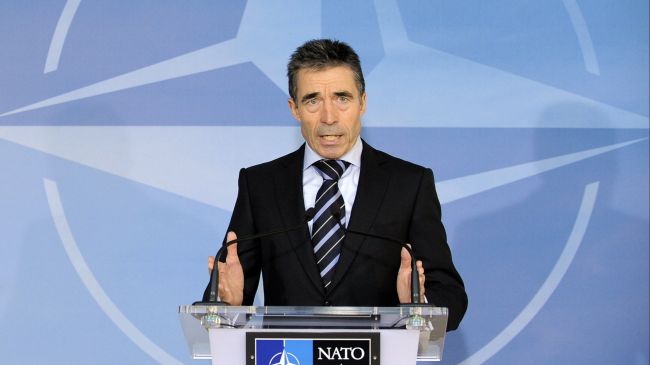 NATO says it will continue to install a missile system in Europe despite Russia’s opposition.
NATO Secretary General Anders Fogh Rasmussen made the announcement on the sidelines of the Munich Security Conference on Saturday.
“We have made clear from the outset that NATO has made the decision to establish a NATO missile defense system because it’s our obligation to ensure effective defense of our populations… Having said that, we have invited Russia to cooperate and… now it’s up to Russia to engage in that,” Rasmussen said.
Russian Foreign Minister Sergei Lavrov said earlier that the missile program was reminiscent of the Cold War.
“Officially, we have abandoned the mindset of the Cold War,” Lavrov said.
On January 27, Russian Prime Minister Dmitry Medvedev said he saw “no flexibility” in the ongoing dispute.
“If we talk about the subject itself, it is extremely difficult. And so far we don’t see any flexibility… There is no flexibility,” Medvedev added.
Related article
- Turkish protesters, angry at NATO missiles, attack German troops (alethonews.wordpress.com)
US says will quit joint rights working group with Russia
Press TV – January 26, 2013
The United States has announced it will withdraw from a joint rights working group with Russia.
“The working group was not working,” US State Department spokeswoman Victoria Nuland said on Friday.
The working group was part of the US-Russian Bilateral Presidential Commission established in 2009 by US President Barack Obama and his then-Russian counterpart Dmitry Medvedev to “reset” US-Russian ties.
Nuland said the Russian government’s recent restrictions on civil society prompted Washington to take the measure.
In July, Russia’s lower house of parliament passed a bill, forcing non-governmental organizations (NGO) involved in political activity with foreign financing to be classed as “foreign agents.”
The new legislation would force the NGOs to publish a report of their activities twice a year and carry out an annual financial audit.
“These new restrictions the Russian government is placing on civil society were increasingly calling into question whether maintaining this government-to-government mechanism was useful or appropriate,” she added.
However, Nuland said Washington would continue to work with Russia on different issues, including defense, counterterrorism, and nuclear security.
On Friday, Konstantin Dolgov, the Russian Foreign Ministry’s point man on human rights issues, said that the US State Department had not informed its counterparts in Moscow of the US withdrawal from the working group.
Nuland also lashed out at Russia’s lower house of parliament for passing a Friday draft law banning “homosexual propaganda.”
The United States is “deeply concerned” about the legislation, Nuland said.
Relations between Russia and the United States have deteriorated over the past months.
Last year, Washington angered Moscow by implementing the Magnitsky Act that imposed visa restrictions on and froze the US bank accounts of Russian officials who were allegedly linked to the death of Russian lawyer Magnitsky at a Russian prison in 2009.
Russia extends blacklist of American citizens
By Robert Bridge | RT | January 18, 2013
No longer limited to US citizens suspected of human rights abuses at the Guantanamo Bay detention facility, the updated list of Americans prohibited from entering Russia now includes new categories of individuals.
In December, the number of US citizens declared persona non grata in Russia stood at 11; now this number has been increased by 49 more people as new categories of individuals are added to the list, Aleksey Pushkov, the chairman of the State Duma Committee on Foreign Affairs, told reporters on Friday.
The new names, which contain both government officials and ordinary Americans, can be divided into three categories, Pushkov said.
The first category is comprised of “judges, investigators, secret service agents and Justice Department members” who are believed to be connected with the criminal prosecution and sentencing of Viktor Bout and Konstantin Yaroshenko, Russian nationals who were arrested by US officials, tried on American soil, and are now serving their prison sentences in the US.
Bout, a former Soviet officer who became the owner of an air transport company, was arrested in 2008 by US agents in Thailand. In November 2011, he was convicted by a jury in a New York federal court of intending to provide military weapons to the Revolutionary Armed Forces of Columbia (FARC), which the United States ranks as a terrorist organization, and conspiracy to kill US citizens. He was sentenced to 25 years in prison.
Bout has pleaded his innocent to all charges.
Yaroshenko, a pilot, was arrested in Liberia in 2010 and transported to America on charges of conspiring to smuggle cocaine into the US. He was sentenced to 20 years in prison.
The second category of individuals prohibited from entering the Russian Federation include US Senators who were responsible for initiating the so-called Magnitsky Act, which was signed into law by US President Barack Obama in December.
The new US legislation attempts to punish Russian nationals who Washington believes are responsible for the death of Sergey Magnitsky, who died in a detention facility in Moscow in 2009 awaiting a tax evasion investigation.
The final category of persona non grata individuals include American adoptive parents who were found guilty of abusing their adopted Russian children or guilty of their deaths.
On December 28, 2012, President Putin signed the Dima Yakovlev bill, named after a Russian orphan who died of heat stroke after being left in a car for an extended period by his American adoptive parents.
Judges who delivered “inadequate” verdicts on such cases, as well as psychiatrists who claimed that those children allegedly had congenital deficiencies that supposedly caused their deaths are also prohibited from entering Russia.
Related articles
- RT: Moscow responds to US Magnitsky Act with Dima Yakovlev Law (jhaines6.wordpress.com)
Russia-US spar over “seized” Jewish documents
RT | January 17, 2013
The Foreign Ministry has expressed outrage after a US court imposes a fine on Russia for its refusal to comply with a 2010 court order to return a collection of religious documents to a prominent US-based Jewish organization.
The move comes shortly after the Magnitsky Act, which saw US legislators attempting to exert pressure on Russia’s judicial system. A court in Washington is now attempting to penalize Russia for its possession of a collection of books, manuscripts and other Judaic documents.
According to the ruling, Russia would be required to pay $50,000 a day to Chabad Lubavitch, an Orthodox Jewish movement headquartered in New York City, until it releases the Schneerson Library, of which the Jewish group claims rightful ownership.
“It is outrageous that a Washington court has taken this unprecedented step fraught with most serious consequences as the imposition of a fine on a sovereign state,” the Russian Foreign Ministry said in a statement on Thursday.
The ministry statement slammed the US ruling as “exterritorial in nature,” and a violation of international law. Russia considers the ruling to be legally null and void, the statement added.
Meanwhile, the US Justice Department also spoke out against the decision, arguing the court cannot introduce sanctions of this type against Russia, and that such a move would further damage US-Russian relations.
Chabad Lubavitch claimed the Schneerson collection – which includes 12,000 books and 50,000 rare documents gathered since the 18th century by Rabbi Joseph I. Schneersohn and his descendants in the Russian city of Smolensk – was illegally seized during a wave of Soviet nationalization projects.
“The Schneerson Library has never belonged to the Chabad; it never left Russia, and was nationalized because there were no legal heirs in the Schneerson family,” the ministry said. “The ‘return’ of these books to the US is therefore not an issue in principle.”
Due to the controversial question regarding the ownership rights of the Schneerson Collection, Russian museums are hesitant to travel to the United States with any exhibitions for fear of them being held hostage in the court standoff.
Meanwhile, the head of Russia’s Jewish Congress has said that Russia should be compensated by the Americans “50,000 dollars plus one dollar a day” for saving the collection from the Nazis and handing the massive collection of documents over to the National Library, where “they are kept carefully and remain available to the general public,” Zinovy Kogan told Itar-Tass in an interview on Thursday.
We should be grateful (to Russia) for the rescued books, he added.
The rabbi also challenged claims on the collection by the Chabad Lubavitch movement, reminding that the books were written “long before the emergence of the Chabad Lubavitch movement.”
Why should the books be given away to them, he asked.
“It does not matter where the books are kept. What is really important is they are available to the public. The books that are kept at the Eastern Section of the Russian State Library are available. Everyone is free to order and have a copy. No problem. Books are not to be treated as idols. Books will be books. They are not to be kissed and worshiped, they are to be read and studied,” Kogan said.
The Russian State Library in the 1990s agreed to give 70 books from the Schneerson archive to the Federation of the Jewish Communities of Russia. They are now stored at the library of the Moscow Jewish Community Center in the Maryina Roshcha neighborhood.
Yitzhak Schneerson died in 1950. He left behind no instructions regarding the future of his vast library.
Norway is squeezing Russia out of European gas market
RT | January 17, 2013
Norway, Russia’s closest rival in the European gas market, seems to overtaking Russia’s Gazprom. Norway boasted record high exports in 2012, while Gazprom suffered the worst numbers in 10 years.
Norway increased its exports 16% in 2012 to reach 107.6bn cubic metres, according to Europe’s key statistics office Eurostat. This is “a record level, close to the Russian gas exports to Europe,” Michael Korchyomkin, head of East European Gas Analysis, told Kommersant daily.
During the same period, Russia’s gas giant Gazprom cut sales to Europe and Turkey by 8%, according to the company’s head Aleksey Miller. That’s the lowest export level for the last decade, Korchyomkin said.
At the moment Norway is breathing down Russia’s neck in its key European market – Germany. In 2011 Gazprom supplied 30bln cubic meters out of the total 80bn cubic meters of gas Germany consumes annually. Norway sold just a bit less – 28bn cubic meters. Norway’s Statoil accounts for about 70% of the country’s exports and in 2012 signed a 10 year contract to supply gas to Germany’s Wintershall.
Norway’s lower gas prices are another tool to win customers. The country’s Petroleum Ministry is suggesting charges for gas transportation in new contracts should be significantly cut, according to Reuters citing Norwegian Petroleum Minister Ola Borten Moe.The exact price cut remains unclear, with Kommersant daily assessing it at 7%.
Competitive pricing has become a crucial issue at a time when crisis – stricken Europe can’t afford huge bills.
On Thursday Gazprom 9M 2012 IFRS results showed things are not that rosy for Russia’s’ gas monopoly. The company’s profit for the period was down 12% year on year to $27.1bn, with the net sales of gas decreasing by 8% year on year, to about $61.4bn.
Net sales exclude the amounts paid by the company in form of value added tax and customs duties.
Earlier in the week Fitch rating agency predicted a further fall of sales for Gazprom in 2013, referring to weak economic conditions and slack demand.
Related article
Moscow, Beijing reconnect as reset with US fizzles
By Robert Bridge | RT | January 9, 2013
Russia and China, which share many of the same international concerns, are looking to fortify their strategic partnership.
At a time when the neighboring countries are beginning to feel the heat of the US military, it seems only natural that Moscow and Beijing are beginning to plant the seeds of a long-term strategic relationship.
Xi Jinping, the secretary-general of the Chinese Communist Party, underlined his country’s commitment to a Russian partnership when he noted that he and President Vladimir Putin “came to the unanimous conclusion” that a “comprehensive strategic partnership” between Moscow and Beijing remains the “top priority of their foreign policy.”
The comments were made on Tuesday during a visit to Beijing by Russian Security Council Secretary Nikolay Patrushev, who is participating in the eighth round of Russian-Chinese consultations on strategic security.
Xi Jingping, 59, who was sworn as the highest-ranking Communist official in November, echoed the sentiments of the Russian president, who noted at his recent Q&A session with international media that Russo-Chinese relations “have become one of the most important factors in the (realm of) international affairs.”
Given the geopolitical realities of the region, it should come as no surprise that Moscow and Beijing are looking to forge a strategic partnership.
Whereas China, traditionally an isolationist country that shuns bilateral alliances, rarely reveals its political hand, Russia made a leap of faith when it attempted to forge a so-called reset in relations with Washington. Today, the reset is in shambles, while many in Moscow accuse Washington of allowing the partnership to deteriorate.
Indeed, much of the blame for the Russia-US fallout is due to Washington’s plans to place a missile defense shield in Eastern Europe, just miles from the Russian border. NATO, originally declaring its intention to cooperate with Russia on the project, remains intransigent, while even refusing to provide Moscow with a legal guarantee that the system will never be aimed at Russian territory.
Moscow rightly warned its Western partners that without Russia’s participation in the system the strategic balance would be upset and there would be another arms race. Still, US and NATO officials have been reluctant to bring Russia on board, and this refusal has played havoc with Moscow’s and Washington’s efforts to nurture a reset between the former Cold War enemies.
In fact, given the current stalemate, the reset itself seems to have been merely a ploy to win Russia’s trust at the same time that a threatening military technology was being introduced courtesy of the Obama administration.
Meanwhile, China, which recently celebrated the launch of its first aircraft carrier (the US Navy already has six carriers assigned to the Pacific), is witnessing a growing US naval presence in the Pacific.
The US military brass announced in June that up to 60 per cent of the Navy’s fleet will be deployed to the Pacific by 2020.
At the same time, Moscow and Beijing hold similar positions on a variety of other international issues, including the situation in Syria, where militants are attempting to force President Bashar Assad from power. Russian and Chinese diplomats have called for a general ceasefire followed by negotiations, whereas the United States has thrown its weight behind the opposition.
“Moscow and Beijing both hold similar positions on the global hotspots, including in Syria, North Korea, Afghanistan and Iran,” Evgeny Bazhanov, president of the Diplomatic Academy of Russia’s Foreign Ministry, told RT in an earlier interview. “They are also both deeply suspicious of the US missile defense system.”
Finally, the China-Russia relationship is motivated by other factors aside from their increasing wariness of American geopolitical intentions.
For example, considering China’s exploding economy, Beijing requires a reliable flow of oil and gas. Russia, meanwhile, welcomes the opportunity to diversify its ample supply of natural resources.
Interstate consultations on strategic issues between Russia and China were launched in 2005.
Russia: No blue helmets should enter Syria
Press TV – December 18, 2012
Russia has opposed any possible deployment of United Nations peacekeepers in Syria.
Russian Deputy Foreign Minister Gennady Gatilov has been cited as saying, “There is neither peace [in Syria] for peacekeepers to keep, nor truce for them to monitor.”
The UN has been reportedly planning to deploy 10,000 peacekeepers inside Syria.
The Russian official has stated that “there is no clear separation line between the conflicting sides” in Syria.
Gatilov has also said Moscow would veto any UN Security Council resolution aimed at military intervention in Syria and criticized previous Security Council resolutions passed on the situations in Iraq and Libya, saying that those resolutions were misused to allow unilateral military interventions.
Syria has been experiencing unrest since mid-March 2011. Many people, including large numbers of Army and security personnel, have been killed in the violence.
The Syrian government says that the chaos is being orchestrated from outside the country, and there are reports that a very large number of the militants are foreign nationals.
Several international human rights organizations have accused the foreign-sponsored militants of committing war crimes.
Related articles
- Obama’s War on Syria and its Implications (alethonews.wordpress.com)
- UN contingency plan to deploy up to 10,000 peacekeepers in Syria – reports (rt.com)
US missile defense: ‘global, mobile and threatening’ – Russia
RT | October 18, 2012
NATO’s missile defense system presents a threat to Russia’s national security and may trigger the militarization of Europe, Deputy Prime Minister Dmitry Rogozin told a NATO Parliamentary Assembly delegation on Thursday.
“This missile defense concept is global and mobile, and it creates unpredictability,” Rogozin said at a meeting with NATO officials at the Federation Council. “That is the real Figaro; Figaro here and Figaro there.”
Rogozin said Moscow is “awaiting explanations from NATO and Washington concerning the real purpose [of the system],” he stressed.
The Deputy Prime Minister remarked on the military defense components “that are being deployed around Norway, the bases in Romania,” which are aimed at intercepting “strategic rockets according to speed, range and altitude characteristics.”
Rogozin then mentioned the US naval group – the core of European missile defense – which “may be deployed in European ports rather far from the Russian territory (such as a base in Spain).”
However, “the same fleet will invariably appear in our northern seas under particular circumstances.”
“The radius of use of these weapons makes them a real threat to us,” Rogozin noted. “The strategic potential of Russia is a guarantee of its sovereignty and independence.”
The US missile defense system, first shelved then repackaged under the Obama administration, has been a thorn in the side of the Russia-US reset. Indeed, Russia has warned that the issue has all the potential to escalate into another arms race.
If new threats to Russia’s strategic potential appear, Russia will simply have to consider the threatening prospect of a militarized Europe.
Rogozin implored the NATO delegation not to push Russia into a position where it will be forced to respond.
“We request you don’t do that,” he stressed. “The Russian response has a…political and diplomatic nature at the moment, but you will not like the technical response we may have to pursue under certain circumstances.”
Although the Vice Premier said Russia has no reason to fear for the security of its western borders, he acknowledged there are threats that both Russia and the European Union share alike.
“We see new threats arising in Russia and European countries and… these threats are practically identical to both you and us,” Rogozin told the NATO delegation. “Russia is not an exporter of such threats to NATO states, and we can hardly reproach NATO for the presence of such threats.”
Russia regards the European Union as its unconditional strategic partner and Moscow is not interested in any conflicts or controversies disrupting the bilateral partnership, he stressed.
“The 21st century should…represent the revival of Russia’s full-scale presence in Europe’s common political affairs, which would be of much benefit both for Russia and Europe,” he declared.
Related articles
Turkey endangered lives of Russians on Syria-bound plane – Foreign Ministry
RT | October 11, 2012
Ankara endangered Russians by diverting a flight from Moscow to Damascus, Russia’s Foreign Ministry said. Moscow expressed anger at not being informed that Russians were involved in the incident, and that their diplomats were denied access to them.
“We are troubled that the lives of the passengers aboard the plane, including 17 Russian citizens were put at risk by this inappropriate act. Turkey did not inform Russia that Russian citizens were among those detained on the plane. We found this out through the press,” Russian Foreign Ministry spokesperson Aleksandr Lukashevich said.
The Russian embassy in Turkey demanded access to the Russian citizens and dispatched consular officers and doctors to the Ankara airport. Turkish authorities, however, denied the Russian diplomats access to the passengers, in violation of the 1963 Vienna Convention on Consular Relations. The Russian nationals were detained in the airport for eight hours.
The Russian Foreign Ministry has demanded an explanation from Turkish authorities, and that Ankara take steps to prevent future such incidents.
Turkey defended the move by claiming that the plane could have carried “non-civilian cargo.”
“There were no arms and military equipment aboard the civilian aircraft – and could not be,” a source in Russia’s military industry told Interfax news agency.
Russia has maintained its military-technical cooperation with Syria, and that any arms or military equipment sales to Damascus are conducted according to established practice. The current law expressly forbids arms sales facilitated by civilian aircraft.
‘Air piracy’
Syrian transport minister Mahoumd Said said that Turkey’s detention of the passenger aircraft is tantamount to “air piracy,” and violates civil aviation treaties, Lebanon’s al-Manar TV channel reported.
Tensions between Turkey and Syria rose after a Syrian shell killed five civilians in the border town of Akcakale last week. Turkey returned fire and said it would retaliate against any future provocation originating in Syria. NATO supported Turkey’s move and pledged to defend the country should the Syrian conflict spill across the border.
Related articles
- NATO mortar ‘gift’ from Turkey to Syrian rebels – Turkish newspaper (alethonews.wordpress.com)
Featured Video

Anthrax War – CBC The Passionate Eye
or go to
Aletho News Archives – Video-Images
Book Review
Shattered Dreams: The HPV Vaccine Exposed (2019)
By Christina England – 30 Q&As – Book Review & Summary
Lies are Unbekoming | September 4, 2026
… Gardasil received FDA fast-track approval in 2006, Cervarix followed in 2009, and Gardasil 9 was approved in December 2014 with more than double the aluminium adjuvant content of the original. The commercial context is specific. Merck was about to lose patent protection on Zocor and faced $18 billion in Vioxx injury claims from a cardiovascular drug the company had marketed while suppressing its own data showing a five-times increase in heart attacks. Analysts projected the global HPV vaccine market at $4 billion by 2011, contingent on government-funded national programs for teenage girls. The 1986 National Childhood Vaccine Injury Act had already granted manufacturers complete liability immunity. By 2013, Japan had withdrawn its HPV vaccine recommendation after cataloguing severe adverse reactions in hundreds of girls. No Western government followed. The establishment position across the UK, US, Australia, and most of Europe held, and still holds, that the vaccines are safe and effective, that reported injuries are coincidental, and that cervical cancer prevention justifies the program. The book was published into this position, not against a vacuum.
Shattered Dreams sits alongside Mary Holland’s The HPV Vaccine On Trial and Viera Scheibner’s foundational vaccination work as part of the documented record on what has been done to a generation of teenage girls under the banner of cancer prevention. The full summary unpacks three specific findings: that Merck used the aluminium adjuvant itself as the “placebo” control in 92.5% of trial subjects, making it structurally impossible to detect excess reactions from the adjuvant; that Dr. Sin Hang Lee found HPV DNA fragments bound to aluminium in every one of sixteen Gardasil samples tested, and in the blood and spleen of a New Zealand girl six months after her third dose; and that in every country with high vaccination coverage, including Australia, the UK, Norway, and Sweden, cervical cancer rates have stopped declining and started rising specifically in the vaccinated cohort. Martínez-Lavín’s 2017 calculation puts the number needed to seriously harm with Gardasil 9 at 140, and the number needed to vaccinate to prevent one case at 1,757. Thirteen young women are seriously harmed for every one who benefits. The vaccine was approved on the basis of trials that could not detect what the trials were supposed to detect, and it is still being given to twelve-year-olds today. … Read full review
Blog Roll
 Aletho News
- Georgia’s Largest Healthcare System Will Fire Employees Who Refuse Flu Vaccine
- The Five-Year Fuel Crisis: Why the World Economy Is Paying for a War It Thinks Is Ending
- Trump’s Big Bluff on Iran
- Swiss scammed out of millions by Ukraine-linked call centers – media
- Germany facing potential ‘violent conflict’ with Russia – spy chief
- Ukraine’s EU neighbors reject new plea from Kiev – Politico
- British Transport Police Facial Recognition Trial Scanned 926,912 People With Zero Arrests
- House Bill Would Ban Federal Use of Flock ALPR Data
- Can a Spice Rival a Drug? 10 Head-to-Head Trials Put It to the Test.
- The oil routes around Hormuz face their own chokepoints
- If Americans Knew
- “We See Our Homes Now From A Satellite, Like Strangers”
- Watch “Gaza: Doctors Under Attack”, originally censored by BBC
- NAZA: Israeli embassies in UK and US promote rival documentary to challenge Gaza genocide allegations
- David Ellison appoints Israeli to lead merged Paramount-Warner studios
- Turkish Red Crescent helps elderly Gaza man walk again after Israel confiscates his prosthetic limb
- Four Palestinians Killed in Israeli Attacks in Gaza
- Two Palestinian youths killed and village razed as Israeli attacks on West Bank continue
- Two more Christian women victims of Israeli raids on Gaza
- Cruelty, Deprivation, Indignity: A Journalist’s 22 Months in Israeli Prison
- New IDF Website Frames Slain Gaza Journalists as Terrorists
- No Tricks Zone
- Latest European Green Energy Debacle; Portugal’s Largest Flagship Solar Park Insolvent!
- Green Energy Debacle: German Expert Professor Fritz Vahrenholt Warns Of Severe Economic And Social Consequences
- Two More Paleo Reconstructions Affirm Meters-Higher Sea Levels Across Ireland, Brazil 7000-6000 Years Ago
- New Study: Earth And Venus Surface Warmth Largely Explained By Convection And Lapse Rate, Not CO2 Or Radiation
- 2025 Nature Paper Claiming Worsening Global Drought Gets RETRACTED …Heavily Flawed
- New Study: ‘Global Drought Shows No Detectable Recent Acceleration Under Climate Warming’
- Economic Masterminds: German Socialists Suggest Taxing Productivity Gains Stemming From Using AI
- The South China Sea Has Not Been Cooperating With The Climate Change Narrative
- Energy Crisis: Germany Enters Heating Season With Historically Low Gas Reserve Fill Levels
- New Study: The Antarctic Ice Sheet Gained Mass From 2020-2024 Due To Staggering Snow And Ice Accumulation

