Germany studying request to return €300mn to Iran
Press TV -July 9, 2018
The German government is reportedly studying a request by Iran to withdraw €300 million from bank accounts held in Germany and transfer the cash to the Islamic Republic.
Unnamed officials in Berlin were quoted by Bild newspaper as saying that Tehran was seeking withdraw the funds from the Europaeisch-Iranische Handelsbank AG (eihbank) in order to satisfy part of its foreign currency needs when fresh US sanctions against its financial sector take effect.
The report added that Iran had told the German Financial Supervisory Authority (BaFin) that it needed the cash from the accounts “to pass on to Iranian citizens who require cash while travelling abroad, given their inability to access recognized credit cards”.
BaFin was now reviewing the request, which had been briefed to senior officials in the chancellery, foreign ministry and finance ministry, the newspaper added in its report as quoted by Reuters.
It further highlighted allegations by the US and Israel that Iran would try to use the cash for purposes other than satisfying its domestic needs. However, it cited unnamed German officials as saying that they had no indications of such plans.
In May, US President Donald Trump announced that he would pull America out of a 2015 nuclear agreement with Iran and re-impose the sanctions that the deal had envisaged to be lifted.
He has already emphasized that the sanctions which would be imposed on Iran would be “at the highest level”.
The sanctions would include a universal ban on Iran over buying or acquiring US dollars as well as restrictions over purchases of crude oil from the country and investing in its oil sector projects.
French shipping firm pulls out of Iran due to US sanctions threat
MEMO | July 7, 2018
French shipping group CMA CGM has decided to pull out of Iran following the Trump administration’s decision to renew sanctions on companies operating in the country, its chief executive said on Saturday.
Some other big shipping companies like A.P. Moller-Maersk have already said they would halt business ahead of a reimposition of sanctions following the United States’ decision to pull out of the 2015 Iran nuclear accord.
“Due to the Trump administration, we have decided to end our service for Iran,” CMA CGM chief Rodolphe Saade said during an economic conference in the southern French city of Aix-en-Provence.
“Our Chinese competitors are hesitating a little, so maybe they have a different relationship with Trump, but we apply the rules,” Saade said.
He added that his company’s cooperation agreement with local Iranian partner IRISL had been suspended and that the company did not want to fall foul of the rules given their large presence in the United States.
He also said that the company had so far not seen an impact of trade tensions between China and the United States on shipping volumes, but was making preparations with a close eye on China and southeast Asia in case the situation deteriorated.
In May, the European Union announced measures that would enable it to avoid US sanctions on Iran or possibly block them. The measures are designed to avoid tens of billions of dollars in losses for European companies, which invested in Iran in the wake of the agreement, signed in 2015. However, this hasn’t stopped many large European companies and insitutions from bowing to US pressure, including the EU’s own bank.
Giraldi: US Sanctions on China Over Trade With Iran May Trigger Chaos
Sputnik – 07.07.2018
WASHINGTON – Any move by US President Donald Trump to threaten economic sanctions on China for its trade with Iran could set off global chaos as support for such moves among US allies in Europe evaporates, former CIA officer Phil Giraldi told Sputnik.
“It will be interesting to see what happens when Washington tries to sanction the Central Bank of China over business dealings with Iran — utter chaos on top of the already existing trade war!” Giraldi said on Friday.
The participants in the Joint Comprehensive Plan of Action (JCPOA), also known as the Iran nuclear agreement, confirmed on Friday at the meeting of the JCPOA Joint Commission in Vienna the need to continue the full and effective implementation of the agreement.
The JCPOA participants including the United Kingdom, France and Germany affirmed their support for continued export of Iran’s oil and gas condensate, petroleum products and petrochemicals and for further trade with and investment in Iran, their joint statement said.
However, Giraldi cautioned that British Prime Minister Theresa May, German Chancellor Angela Merkel and French President Emmanuel Macron could face major pressure from Washington to scrap their ties to Iran, and that they might surrender to it.
“I think this is admirable, but it will come up against the hard reality of US sanctions if Trump pushes the issue, which I think he will do based on recent statements by [presidential adviser Rudy] Giuliani and [Secretary of State Mike] Pompeo that nothing short of regime change for Iran is envisioned by the White House,” he said.
Faced with such pressure, May, Merkel and Macron might yield to Washington’s demands, Giraldi advised.
“The Western Europeans will likely crumble because the threat of blocking them out of the US financial system would be too hard a pill to swallow if Trump really wants to make them squirm,” he said.
Giraldi pointed out he was concerned that the current major European leaders slacked the determination to stand up to trump for their nations’ best interests.
“Of course, the US economy will also suffer greatly, which will be a card they can play, but I do not see leaders of the caliber of Merkel, May and Macron fighting very hard on behalf of what they know to be right and correct relating to Iran,” he said.
Trump was listening to extremists on the Iran issue and was unlikely to change direction, Giraldi assessed.
“It comes down to Trump and his God-awful advisers wanting something much more than the Europeans do so they will give in. Russia and China will, of course, do the right thing,” he said.
Philip Giraldi is executive director of the Council for the National Interest, a group that advocates more even-handed US government policies in the Middle East.
Imperial Hubris Redefined
By Philip M. GIRALDI | Strategic Culture Foundation | 05.07.2018
There have been two developments in the past month that illustrate clearly what is wrong with the White House’s perception of America’s place in the world. Going far beyond the oft-repeated nonsense that the United States is somehow the “leader of the free world,” the Trump Administration has taken several positions that sustain the bizarre view that such leadership can only be exercised if the United States is completely dominant in all relevant areas. Beyond that, Washington is now also asserting that those who do not go along with the charade and abide by the rules laid down will be subject to punishment to force compliance.
The first issue has to do with outer space. There is an international treaty agreed to in 1967, the so-called Outer Space Treaty, which has been signed by 107 countries including most Europeans, Russia, China and the United States. Conventional weapons or electronic systems designed to protect orbiting satellites from attack are permitted over where the atmosphere ends 62 miles above the Earth’s surface, but outer space is supposed to be free to all. The treaty also forbids any colonization or appropriation of the moon or planets by any national authority.
President Donald Trump apparently is not familiar with the treaty. Speaking before an audience at the National Space Council on June 18th, he said that he was, on his own presidential authority “… hereby directing the Department of Defense and Pentagon to immediately begin the process necessary to establish a space force as the sixth branch of the armed forces… our destiny, beyond the Earth, is not only a matter of national identity, but a matter of national security. It is not enough to merely have an American presence in space. We must have American dominance in space.”
The idea that the US would seek to have a major presence in space would probably surprise no one, but Trump is saying something quite different. He is creating a military command for space, the moon and the planets and is intent on using that to support an offensive capability that provides dominance in those areas. As no one in his right mind would allow Washington to militarily dominate outer space based on its track record of irresponsible leadership since 9/11, the Trump proposal should be and will be opposed by virtually the entire world.
A fantasy of space dominance is a symptom of a governing class that cannot distinguish between what is important and what is not. It is rooted in a nation that has been constantly fed fear since 9/11 even though it is not threatened. Iran, the second issue surfaced recently, is part of that alleged threat matrix, with the United States and its barking dog Israel repeatedly claiming that the country is both a terrorism supporter and is involved in a secret nuclear weapons program. Both claims are basically false.
Trump has complied with Israel’s demands to withdraw from the Joint Comprehensive Plan of Action (JCPOA) restricting Iran’s nuclear program even though Tehran was in complete compliance. On June 26th, the White House announced Iran’s punishment, declaring that it would sanction anyone buying Iranian oil, starting on November 4th. The “zero tolerance” global Iranian oil ban deliberately seeks to devastate most sectors of the country’s economy to force it to comply with Israeli, Saudi and US demands that it should effectively disarm.
The threat of sanctions is blatant bullying as the United Nations and all other signatories of the JCPOA continue to support the agreement and have no reason to punish Iran, but there is also an appreciation that sanctions would include being blocked from US financial markets, meaning that the warning must be taken seriously. There are reports that a number of European and Asia refiners and their financial backers are already moving to cut purchases and exit the Iran market well before November.
But there also has been some pushback. Turkey is refusing to go along with the American demand and it is unlikely that China, Russia and India will comply, even if threatened with sanctions. If the European Community were to unite and develop a backbone to take a stand against submitting to US pressure it might actually force Washington to save face by issuing waivers to mitigate the impact of its demand.
There is no rational US interest that compels a hubristic American government to establish a space military or to create a global sanction against Iran, but it is clear that the Trump Administration does not care much for genuine interests as it huffs and puffs to show its power and determination. It is time for the rest of the world to wake up to the danger posed by Washington and mobilize to stand up against it.
Japan PM Abe cancels trip to Iran amid US pressure
RT | July 4, 2018
Japanese Prime Minister Shinzo Abe has reportedly abandoned plans to visit Iran later this month, amid increasing pressure from Washington aimed at isolating Tehran politically and economically.
According to Japanese media reports, Tokyo recently informed Tehran that Abe was cancelling talks with President Hassan Rouhani scheduled for mid-July. Abe’s trip would have marked the first time a Japanese leader had visited Tehran in 40 years.
Washington’s growing hostility towards Iran is believed to have played a deciding factor in the sudden change of travel plans. Openly declaring its desire to cut off Tehran’s oil revenues, the Trump administration is now pursuing a policy of economic strangulation, urging Japan and its other allies to stop buying Iranian crude oil entirely by November 4.
Japan has so far refused to comply with Washington’s demands, although Iranian crude currently only accounts for roughly five percent of the country’s total oil imports. It’s likely that Washington’s request to increase political and economic pressure on Tehran will be a major topic of discussion when US Secretary of State Mike Pompeo visits Tokyo for a two-day visit this weekend.
According to government sources who spoke to the Japan Times, Tokyo was still exploring the possibility of Abe visiting Iran, although much would depend on the state of relations between Washington and Tehran.
Still, there’s a chance that Japan will resist Trump’s strong-arming. A spokesman for the Japanese prime minister’s office told Reuters that Abe’s travel plans in the Middle East – where he is scheduled to visit Saudi Arabia and Egypt following stops in Brussels and Paris beginning July 11 – had not been finalized yet.
Trump was condemned by Washington’s allies after unilaterally withdrawing from the Iran nuclear deal in May. Soon after, he announced tough new sanctions targeting the country. The move has jeopardized the future of the landmark 2015 accord –which lifts international sanctions on Tehran in exchange for placing strict controls on the country’s nuclear capabilities. Europe has strenuously objected to the draconian measures, arguing that its firms would lose billions invested in Iran following the removal of sanctions in 2015.
Vienna Opposes US Anti-Iran Sanctions That Affect Austria – President
Sputnik – 04.07.2018
VIENNA – Vienna regrets Washington’s decision to reimpose sanctions on Iran as these restrictions violate international law and affect Austria due to their extraterritorial nature, Austrian President Alexander Van der Bellen said on Wednesday.
“Austria regrets the US pullout from the JCPOA. We also regret the US decision to reimpose sanctions on Iran. This does not concern the so-called primary sanctions against Iran, but the secondary sanctions which affect Austria, too. We believe that these secondary sanctions violate international law due to their extraterritorial nature,” Van der Bellen told reporters after his talks with Iranian President Hassan Rouhani in Vienna.
The European Commission supports this position against the United States’ decisions related to the JCPOA, the Austrian president added.
Rouhani on Future of JCPOA
His Iranian counterpart Hassan Rouhani, in his turn, said that Tehran would remain in the deal, provided that the country is able to benefit from it.
“We will not withdraw from the JCPOA if we are able to benefit from it,” Rouhani said after talks with his Austrian counterpart Alexander Van der Bellen.
Rouhani specified that Iran would stay in the deal if the remaining signatories to the agreement manage to ensure Iran’s interests after the US pullout from the agreement.
The Iranian president also stressed that the remaining signatories to the JCPOA had demonstrated firm political will.
Rouhani is currently on his European trip aimed at discussing the future of the JCPOA after the US withdrawal with EU member states. On Monday and Tuesday, the Iranian president visited Switzerland, after which he arrived in Austria.
EU officials have repeatedly criticized the extraterritorial nature of sanctions imposed by the United States on the countries considered by Washington as its adversaries.
After the US withdrawal from the JCPOA, other signatories — Iran, China, France, Russia, the United Kingdom, Germany, and the European Union – said they would abide by it. Moreover, EU leaders asked the United States to grant sanctions waivers to the bloc’s companies cooperating with Iran.
Iran will import goods only from countries that buy its oil – MP
RT | July 4, 2018
The Energy Committee of Iran has announced that Tehran will buy goods only from those nations which purchase Iranian oil. This follows the US demand from its allies to stop buying Iranian crude.
“We will carry out barter exchange of oil and goods, which means the purchase of goods will depend on the sale of oil,” representative of Iran’s Energy Committee Asadollah Karekhani told ILNA news agency.
“We want to inform our target markets and countries that buy oil from us that we’ll purchase goods from them only if they purchase our oil,” he said, noting that a working group is being formed on barter deals.
Last week, a senior US State Department official told reporters that Washington would try to convince its allies to completely stop buying oil from Iran by early November. Discussions are also being held with other countries, including China.
Iranian President Hassan Rouhani has warned that if the country’s crude oil exports were threatened, the rest of the Middle East’s would be as well.
“Assuming that Iran could become the only oil producer unable to export its oil is a wrong assumption … The United States will never be able to cut Iran’s oil revenues,” he said.
Iran is OPEC’s second-largest crude exporter with more than 2 million barrels a day.
Rouhani is currently in Europe to gather support ahead of a meeting later this week between Iran and the five global powers that are still party to the 2015 nuclear deal.
Bill Kristol Has Always Wanted to Rape Iran
By Caitlin Johnstone | American Herald Tribune | July 1, 2018
One year after the CIA escalated covert operations in Iran, the protests across that nation are reportedly beginning to get more violent. This is happening on the same day the Iranian terror cult MEK hosted Rudolph Giuliani and Newt Gingrich in a pro-regime change rally that was so sparsely attended that half the audience consisted of bused-in Europeans unaffiliated with the cause.
“We are now realistically being able to see an end to the regime in Iran,” said Giuliani, who earlier this year infamously led a “Regime change! Regime change!” chant at a related MEK event.
“The Mullahs must go, the Ayatollah must go, and they must be replaced by a democratic government which Madam Rajavi represents,” Giuliani said in reference to MEK cult leader Maryam Rajavi.
“Freedom is right around the corner,” added Giuliani, who is currently serving as President Trump’s lawyer. “Next year I want to have this convention in Tehran!”
So things appear to be escalating. We saw very similar situations in the lead-up to both Libya and Syria, right up to and including the shady ties with the suspiciously well-funded extremist group. We can expect the CIA operations, propaganda and psyops to combine with the effects of starvation sanctions in a way which leads to widespread chaos, which we can expect to see erupt into violence of disputed origin, which we can then expect to see blamed solely on Tehran, which we can then expect to see elicit calls for humanitarian interventionism. Just like Libya and Syria. If the formula ain’t broke, why fix it?
And the bloodthirsty warmongers of Washington couldn’t be more thrilled.
“A democratic Iran not only would free Iranians from repressive theocracy but produce closer ties between our two countries; real security, economic , and moral benefits for both Iranians and Americans,” contributed Michael McFaul, an ambassador to Russia during the Obama administration.
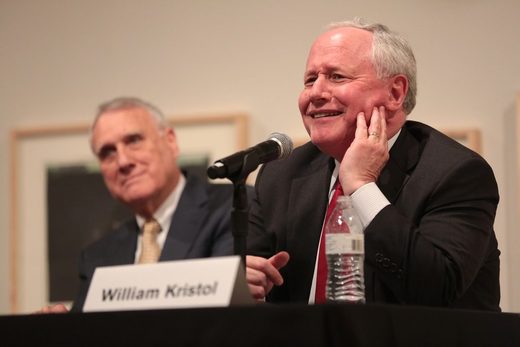
“Very true,” tweeted Iraq war architect and PNAC founder William Kristol. “And great to see a bipartisan consensus for regime change in Iran! (It would be happily ironic if, totally inadvertently, tough sanctions followed by the JCPOA followed by withdrawal from the deal caused so much whiplash that the regime crumbled.)”
The word “bipartisan” is a popular buzzword in establishment politics, because since the two-headed uniparty has worked so hard creating the illusion of opposition among its leaders and very real hatred across America’s fake political divide, the sight of these two groups getting together on something can be spun to give the impression that it must be a very commonsense and important pro-human agenda. Really, though, what it generally means in practice is neoconservative Republicans and neoconservative Democrats getting together to do something horrible.
Bill Kristol used his influence in the Bush administration to advance the agenda that his Project for the New American Century think tank had laid out several years earlier for US military-enforced planetary domination. It began with the catastrophic and unforgivable invasion of Iraq, but according to US General Wesley Clark the plan once if got through to the Pentagon was to take out six more governments after that: Syria, Lebanon, Libya, Somalia, Sudan, and, finishing off, Iran.
Kristol lost some credibility as the actual horror of what the Iraq invasion had unleashed upon the world began to really sink in to social consciousness, but since 2016 he has rehabilitated his image by forming a close anti-Trump alliance with the birthplace of neoconservatism: the Democratic Party. Kristol is now one of #Resistance Twitter’s most popular pundits and a regular guest analyst on liberal cable TV due to his staunch support for neoconservative policies that this administration claims to oppose, including escalations against Russia.
Bill Kristol wants to rape Iran. Bill Kristol has always wanted to rape Iran. Bill Kristol has advocated disastrous regime change intervention after disastrous regime change intervention throughout his entire corrupt, blood-soaked career, and he has always been wrong. Every single time. If the regime change cheerleading of this virulent Never-Trump neoconservative failmeister doesn’t tell Trump supporters that they’re on the wrong side of this issue, I don’t know what will.
Russian Envoy Bashes UN Top Political Official’s Report on Iran Nuclear Deal
Sputnik – 28.06.2018
Russia’s UN envoy Vassily Nebenzia on Wednesday lashed out at the UN under-secretary for political affairs for giving an “unbalanced” assessment of how Iran lived up to its nuclear commitments.
UN’s top political official Rosemary DiCarlo told the Security Council on Wednesday the Joint Comprehensive Plan of Action (JCPOA) was “at a crossroads” despite Iran’s “continued adherence” to its nuclear pledges.
“The report is openly imbalanced in nature and resembles more an unfounded series of accusations against Iran rather than an attempt to paint an objective picture of the situation,” Nebenzia said at a briefing.
He said DiCarlo’s approach was all the more incomprehensible since neither of the examples of alleged violations by Tehran was confirmed due to insufficient information.
“The report is a clear evidence of an unqualified compliance of Iran with commitments under the JCPOA which is consistently confirmed not just by IAE but by the UN secretariat as well, which – as the document tells us – has no verified proof of the opposite,” he stressed.
Russia insists, the diplomat added, that the UN should not reference information from open sources or unverified data provided by individual countries, especially when it was not provided to the Security Council.
The JCPOA was signed in 2015 by Iran, the European Union and the P5+1 group of countries comprising the United States, Russia, China, France and the United Kingdom plus Germany. Under the pact, Tehran agreed to scale down its nuclear program in return for sanctions easing.
US’ Iran Regime-Change Plan: Hit Economy, Orchestrate Protests, Engage MEK Cult to Chant “Democracy”
By Elliot Gabriel | Mint Press News | June 28, 2018
Iran’s latest wave of protests against the suffering state of the economy and the plunging value of the rial appeared to have come and gone by Wednesday, as crowds dissipated and businesses opened up shop following a two-day strike. While clashes between security forces and protesters during the protests were far from widespread, the very fact that the protests broke out hints at the extreme duress Iran is undergoing thanks to President Donald Trump’s renewed economic war on the country.
Judging by the enthusiastic response to the demonstrations in the U.S., Saudi, and Israeli press, anti-Iranian forces are clearly banking on the possibility that the sanctions that will soon be reimposed in the next several months could dislodge the Islamic Republic, clearing the way for a regime friendly to the West.
Thus we have witnessed anti-Iran publications like the Israeli Jerusalem Post frothing over with excitement over scenes of alleged Iranian citizens chanting “Death to Palestine,” “Let go of Syria – think about us,” and the much-beloved anti-Ayatollah Khamenei mainstay “Death to dictator.”
While videos from Iran depict what could very well be an organic groundswell of social protest against government policies, photos published in papers like the Post show a different story: middle-aged Persian men gripping English-language signs and the flags of the toppled Iranian monarchy, along placards bearing the portrait of an unlikely figure: the mustachioed, mysterious and long-disappeared charismatic cult leader who is considered an outlawed terrorist and traitor to the nation — Massoud Rajavi.
Rajavi was the leader of the group that lies at the center of the anti-Iran alliance’s “regime change” dreams: Mujahedin-e Khalq (MEK), or the People’s Mojahedin Organization of Iran (PMOI). A fanatical militant group whose title translates literally to the “The People’s Holy Warriors,” this eccentric left-nationalist, pseudo-religious cult has been led by Massoud’s wife, Maryam Rajavi, since the 1980s.
Formed in 1965, the group’s tortured history has seen it transformed from a movement of communist-influenced, Islamist-tinged anti-imperialists who carried out attacks on U.S. military officers in Iran into an authoritarian de facto mercenary army serving anyone opposed to the Islamic Republic – be it Saddam Hussein’s Iraq, Israel, or the United States.
The group wields major PR clout and outsized influence in Western capitals through countless front groups like the National Council of Resistance in Iran (NCRI), through which it depicts itself as “a political coalition that represents all of Iran’s religious, ethnic, and political groups proportionately;” stresses feminist, Islamist, free-speech and pro-free-market values; and is firmly “committed to a secular, democratic, non-nuclear republic” in Iran.
The RAND Corporation described the group as “skilled manipulators of public opinion,” but a cursory look at its publications shows a rather ham-fisted and self-celebratory pile of cultish jargon. Throughout the past week, publications like Iran Focus or Iran News Update – the latter of which bills itself as “Insider News & Analysis in Iran” – have pumped out articles boosting NCRI as “the only viable alternative to the Iranian regime” and claiming:
As protests in Iran continue to multiply and intensify, the regime’s claim to power is looking more and more tenuous. If the people were to overthrow their tyrannical government, the only democratic organization in the position to take over governance would be the NCRI … The regime’s reign of terror is at its close.”
The MEK was one of the first groups to be named a Foreign Terrorist Organization by the U.S. State Department, but its extreme opposition to the Islamic Republic of Iran and generous donations to politicians has led to its eventual delisting. The roster of politicians and influential figures tied to the MEK and its fronts spans much of the U.S. political spectrum, from the far right to the left-of-center.
Trump’s White House is a virtual all-star cast of MEK associates – explaining the administration’s frenzied push to scrap the nuclear deal and push to topple Tehran. Among the top supporters of MEK is White House National Security Advisor John Bolton, whose hatred of Iran’s government verges on the pathological.
A congressional foreign-policy aide who attended an Iranian New Year celebration hosted by an MEK front group told Foreign Policy magazine:
Bolton is positively predisposed to the MEK … they will have some access to this White House, [to say] the least.”
From revolutionary anti-imperialists to bizarre mercenary cult
The MEK once enjoyed a decently-sized support base within Iran and even played a role in the 1979 Iranian Revolution that overthrew U.S.-loyal Shah Reza Pahlevi and opened up a new period of national independence for the nation. Following the revolution, the group’s political struggles with the faction led by Ayatollah Ruhollah Khomeini and failure to secure widespread support led it to deploy its Shah-era “armed struggle,” or terrorist tactics, against officials and clergy loyal to Khomeini, claiming the lives of dozens of key figures in the newly-formed government.
The Mojahedin (jihadists), whom the Islamic Revolution’s leader regularly derided as monafeghin (hypocrites) – an allusion to those in the Quran who conspired against the Prophet while feigning loyalty – became the top enemies of the Islamic Republic.
Faced with the full brunt of the Islamic Republic’s retribution, the group fled to Iraq in the 1980s and became a virtual “Iranian Legion” for Saddam Hussein, who equipped the group with heavy armor, uniforms, and artillery so that it could fight alongside Iraqi forces during the Iran-Iraq war. Following the war, the self-styled “national liberation army” launched a series of cross-border raids against Iranian civilian and military targets, sacrificing nearly all of its remaining support among Iranians.
The drop in Iranian support led to a push to replenish MEK ranks by targeting family members, wealthy potential donors, and expatriate Iranians in Turkey and the United Arab Emirates. True to their form as a cult, the group promised to connect prospective recruits with a lifeline of assistance as the trade-off for their enlisting in the group.
According to the RAND Corporation:
Many were enticed not with promises of an opportunity to fight the IRI, but rather through promises of paid employment as translators, assistance in processing asylum requests, free visits to family members, public-health volunteer opportunities, and even marriage. All ‘recruits’ were brought into Iraq illegally and then required to hand over their identity documents for ‘safekeeping,’ effectively trapping them at MeK compounds. These findings suggest that many MeK recruits since 1986 were not true volunteers and have been kept at MeK camps in Iraq under duress.”
Watch | Cult of the Chameleon
Tens of thousands of the group’s members remained under the protection of the Iraqi dictator, even participating in the bloody massacres that followed the Shia Arab and Kurdish uprisings of 1991, until the fall of the Ba’athist regime in 2003 when the U.S.-led coalition bombed the Saddam loyalists’ camps.
Seeing continued use for the MEK for their own anti-Iran efforts, however, the U.S. placed 3,800 members of the group under protective custody at Camp Ashraf, the sprawling city-sized base built for them by Saddam. Those who escaped the group had to undergo cult deprogramming.
Watch | Introducing Camp Ashraf
According to RAND, the group – which claims to uphold women’s equality – ensured that lines were “painted down the middle of hallways separating them into men’s and women’s sides” at the camp, prior to their expulsion by Iraqi forces in 2013. Many were shipped by the U.S. to Albania, the only country willing to accept them.
Yet while a major portion of the group’s membership spent over three decades imprisoned in Ba’athist Iraqi camps near the border with Iran, a significant chunk of the group – such as leader Maryam Rajavi – nestled into the Iranian expatriate communities in Paris, Washington, and other capitals. The group spent decades relentlessly lobbying Western governments and lawmakers to support its attempts to bring “reform” to Iran, and has even furnished intelligence to U.S. and Israeli intelligence agencies in hopes to provide a casus belli for hostile policies and even military actions versus Tehran.
The “Iranian Resistance” wags the dog in Washington
In the U.S. capital, the group was enormously successful in its efforts to recruit an auxiliary brigade of highly influential top politicians to its cause. Even the far-right Washington Times, owned at the time by charismatic cult leader Reverend Sun Myung-Moon, issued glossy “special report” inserts hailing the militaristic group as the bringers of “freedom” to Iran. The publication included words of praise from Rep. John Lewis (D-GA), House Minority Leader Nancy Pelosi (D-CA), the late Saudi Prince Turki bin Faisal al-Saud, and Sen. John McCain (R-AZ), among many, many, others.
A brief list of these MEK supporters in the Republican Party reads like a who’s-who of anti-Iran officials from the neoconservative administrations of Presidents George W. Bush and Donald Trump:
- In 2000, future Bush administration attorney general and Republican then-Senator John Ashcroft intervened on behalf of MKO military commander Mahnaz Samadi, who has been detained by immigration authorities due to her failure to disclose past terrorist ties — hailing the former anti-Iran combatant as a “highly regarded human-rights activist” and a “powerful voice for democracy.”
- Former Pennsylvania Governor and first U.S. Secretary of Homeland Security Tom Ridge praised the National Council of Resistance in Iran as “the single most visible, most credible, and most effective democratic movement with a clear and specific program to bring a democratic Iran to existence,” led by the “steady hand and inspiring leadership” of cult leader Maryam Rajavi.
- Representative Ileana Ros-Lehtinen of Miami, Florida, who served as Chair of the House Foreign Affairs Committee, has been a major leader in legislation calling for regime-change measures against Cuba, Iran, Syria, and Venezuela, and even called for Fidel Castro’s assassination in 2006. In 2003, she came out in defense of MEK as a group that “loves the United States” and is an ally in the “war on terrorism.”
- Tea Party leader, Bush confidante and former House Majority Leader Dick Armey promoted the MEK while working for lobbying firm DLA Piper. Armey also represented Saeid Ghaemi, an Iranian expatriate in the U.S. who paid almost $910,000 to the lobbying firm “for Armey’s services bringing issues relating to Iran to the attention of Congress, the State Department, the Department of Defense, the White House, the National Security Council and the Department of Treasury.”
Watch | Giuliani Leads MEK “Regime Change” Chant
And then we have the top luminaries from President Donald Trump’s circle, including:
- Former New York City Mayor and top White House lawyer Rudy Giuliani, who co-signed a letter along with various bipartisan officials urging a newly-inaugurated Trump to “establish a dialogue” with NCRI, and was revealed to have been a paid advocate for the removal of MEK from the State Department terror group list. Giuliani has been an almost annual guest at MEK functions in Paris and a regular anti-Iranian voice on television. In 2015, Giuliani stood before a crowd of MEK supporters in Paris and shouted:
The ayatollah must go! Gone! Out! No more! I will not support anyone for president of the United States who isn’t clear on that slogan behind me. What does it say? It says regime change!”
- Trump adviser and GOP elder Newt Gingrich, who ripped on former President Obama for bowing to the king of Saudi Arabia, but was caught on camera bowing to Maryam Rajavi – whom the conservative ultra-patriot sees as an Iranian version of U.S. founding father George Washington.
- Transportation Secretary Elaine Chao, the elite Taiwanese-American wife of Senate Majority Leader Mitch McConnell, who has received honoraria in the amounts of $50,000 and $17,500 to speak for MEK front groups like the Iranian-American Cultural Association of Missouri and the NCRI. At the same Paris event attended by Giuliani, Chao sat as guest of honor alongside “president-elect” cult leader Rajavi before delivering a feminist-themed speech slamming Iran’s government.
And then, of course, there’s John Bolton, a ravening ultra-hawk with a nearly obsessive hatred of the Islamic Republic of Iran.
Speaking to Foreign Policy magazine, Carnegie Endowment for International Peace senior fellow Karim Sadjadpour commented:
I suspect Bolton’s interactions with the MEK were above all motivated by financial interests … The MEK may be a backward cult with little to offer, but they are the enemy of his enemy. And they pay handsomely.”
The same can likely be said about the rest of the elected “representatives”-for-hire in Washington, whose belief in the MEK’s ability to lead a post-IRI Iranian state is no doubt on par with their trust in the late Rev. Moon’s claims to be the one and only messiah.
While the hard-hit Iranian economy is likely to continue reeling, driving more protesters into the streets, one shouldn’t mistake their social demands or financial pain for a desire to subject themselves to a totalitarian cult with hardly a fraction of the support enjoyed by the Shia clergy helming the Islamic Republic — no matter the extent to which Washington and the Saudis attempt to foist the Rajavi group on the Iranian nation.
Yet despite the group’s dearth of political legitimacy, the congressional aide who spoke to FP understands why they remain a mainstay in the U.S. Capitol:
They’re useful as provocation … They’re useful as a signal to the Iranian government that we’re coming to get you.”
Elliott Gabriel is a former staff writer for teleSUR English and a MintPress News contributor based in Quito, Ecuador.
US Sanctions May Force India Out of Iran’s Chabahar Port With China More Than Able to Fill This Gap
By Adam Garrie | EurasiaFuture | June 27, 2018
Iran’s Chabahar Port on the Gulf of Oman represents the crowning achievement of Indo-Iranian cooperation in recent decades. The port itself represents the centre of the wider North-South Transport Corridor (NSTC) which will link India to Russia and the wider north-western Eurasian space via Iran and Azerbaijan. While under Premier Narendra Modi, India has sought to sell NSTC as an alternative to China’s One Belt–One Road and in particular as rival to the China-Pakistan Economic Corridor which links China to the wider Indian Ocean space via the Arabian Sea port at Gwadar, Iranian officials who themselves are eager participants in One Belt–One Road, have wisely distanced themselves from India’s zero-sum narrative on Chabahar and NSTC more widely.
Likewise, as Iranian relations with Pakistan continue to improve, it also remains clear that Iranian leaders are carefully avoiding being sucked into south Asia’s manifold rivalries by maintaining healthy ties with China, India and increasingly Pakistan simultaneously.
As it stands, Gwadar is a more substantial port vis-a-vis Chabahar in terms of its capacity and the fact that unlike the Indian built port in Iran, the Chinese built Gwadar is a Panamax deep water port. In this sense, both Gwadar and Chabahar could function together on the win-win model which would see some of the supplies shipped from China to Pakistan via Gwadar being routed on to Chabahar depending on their ultimate destination. Here one could see One Belt–One Road and the North South Transport Corridor functioning as integrated rather than as rival logistics networks – something that Pakistani officials recently spoke about with optimism.
Now though, India’s very presence in Chabahar may be impacted negatively as the US moves to sanction countries that conduct business with Iran. The US CAATSA sanctions aimed at Iran are back in the spotlight after the US withdrawal from the JPCOA (aka Iran nuclear deal) caused Washington to threaten many of its longstanding allies against conducting further business with Iran under the threat of so-called second party sanctions. These threats have most notably been aimed at the European Union, in spite of the fact that the bloc remains rhetorically adamant that it will continue to preserve the JCPOA without US involvement.
India has also come under threat of sanctions due to its healthy relationship with the Islamic Republic. The US has stated that it will sanction Indian companies who do business with Iran and this week, the US issued an even more specific threat to its Indian partner, stating that New Delhi will face sanctions if it continues to purchase Iranian oil.
Last month it was reported that international investors in Chabahar were beginning to show signs of nervousness in light of the new sanctions threats from Washington. As India is already facing tariffs on its exports to the United States while simultaneously cutting itself off from a would-be win-win Chinese partnership, India is scarcely in a position to economically leverage the United States which under Donald Trump has taken a merciless approach to conducting trade wars with allies as well as threatening partners with sanctions if they do business with countries including Russia, Iran and the DPRK (although this might soon change in the case of the DPRK).
This could mean that as the primary investor and operator of the Chabahar Port, India could find itself cut off from its own investment under the cloud of sanctions. If it comes to this and India is forced to either partially or even entirely withdraw from the Chabahar project, it would mean that Iran would seek a new international partner for the port.
The only realistic partner to take over Chabahar would be China, a nation with experience in port building and management, a country that has shown itself to be able to transact deals with Iran in spite of the attitude of Washington and a country that because of America’s own dependence on Chinese goods – is largely sanction proof for all practical purposes.
Not only could China help to revive the economic fortunes of Chabahar if India becomes frightened off due to threats from the United States, but China could actually help Chabahar to grow both infrastructurally and commercially by linking it into a uniformed trade route centred on the larger Gwadar port and existing One Belt–One Road lines of connectivity in the region. This would ultimately be a win-win for China, Iran and Pakistan.
If India were to abandon the underlying prejudices behind its zero-sum approach to antagonising both China and Pakistan, India could actually remain active in Chabahar as key player in a wider Sino-Iranian partnership which would necessarily also include Pakistan via CPEC. This could help to not only reduce tensions with India’s largest neighbours, but it could demonstrate that the only way for India to effectively leverage US threats of further tariffs and sanctions is by keeping at least one foot in China’s already open door.
However, given the attitude of the current Indian government, such a win-win model looks increasingly distant however theoretically attractive it might sound when analysed objectively. Because of this, the more likely scenario for Chabahar will be a short-term waiting game where India will see just how far the US is willing to punish its newfound south Asian partner due to its dealings with Iran.
If India’s involvement in Chabahar does come under a US financial attack, it is all but certain that India will minimise its involvement in the flagship project – thus paving the way for China to take over where India left off.
The choice for India therefore is three fold: New Delhi can simply hope for the best while possibly sweetening the deal by making concessions to the US over existing tariffs, India can bow out of Chabahar in order to possibly attain better trading relations with the US in the future or India can work with China to leverage the US over its anti-Iranian position.
At a time when the US is embracing unilateralism in its economic relations with the rest of the world – India must look realistically at its options, even if this means dropping its Sinophobic prejudices.
ATR gives up delivering planes to Iran: Report
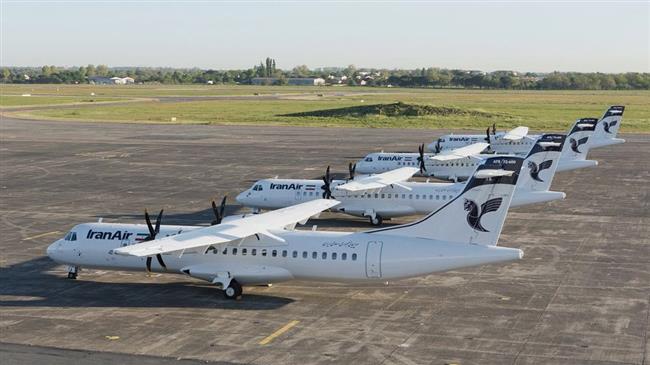
The first four of the 72-600 ATR turboprops landed in Tehran’s Mehrabad Airport in May 2017
Press TV – June 27, 2018
Regional aircraft manufacturer ATR says it must give up delivering the remaining aircraft ordered by Iran because of new US sanctions and that it will try to reclassify 12 aircraft if it does not obtain a waiver.
“In 2018, our delivery target could be impacted given the Iranian context,” ATR CEO Christian Scherer said in an interview published on LaTribune.fr.
IranAir, the national flag carrier, signed a contract to buy 20 planes from turboprop maker ATR in April 2017. The deal came after Iran signed contracts with Europe’s Airbus and US rival Boeing to purchase about 180 jets.
“Of the 80 planes we expected to deliver in 2018, there were 12 for Iran, that’s a lot,” said Scherer whose company is joint-owned by France-based Airbus and Leonardo of Italy.
Iran took delivery of the first four ATR aircraft last May, two more in September, beside another two in December, with the rest due to be handed over to the country by the end of 2018.
Scherer said the Iranians want to take delivery of the planes, “but ATR will not take any risk of falling out with US authorities and exposing our shareholders Leonardo and Airbus to US sanctions.”
He said two aircraft have already been completed, six are being assembled and the last four have been launched and “customized” for Iran, particularly with pressurization devices, to fly over mountainous areas.
As a result, “these devices will be harder to reclassify,” he continued. “We are working hard but we have no firm tracks yet.”
To still deliver to Iran, ATR is trying to get a waiver from the Americans, but Scherer said he was “not entirely confident” about it.
“The Americans have promised a three-month period (from May to August) to allow companies to deliver the materials that were in production” after US President Donald Trump’s announcement to reimpose sanctions on Tehran.
“For the aviation industry, this three-month period is ridiculously short,” Scherer said.
ATR, Scherer said, intends to rely on the help offered by the French government to protect companies.
“We want to use the help of the French government to negotiate the best possible licenses during this period of three months to be able to deliver the aircraft manufactured or being manufactured to cushion this shock, which in any case will hurt us a lot.”
He also hoped to continue business in Iran with “a new license to support our customer, and we want to play our role as an after-sales service provider.”
“Here too, the Americans have made a declaration of intent explaining that they will not endanger the public,” Scherer said.
“The Iranians were in discussion with us to continue to develop their fleet; we were not going to stop at the first 20 aircraft” ordered in total by Iran, he said. “It was just the beginning of a story,” he lamented.
IranAir’s deal with ATR includes options for a further 20 aircraft and a training program for Iranian pilots and engineers.
The 70-seat planes are aimed at underserved local economies, used in flights over a maximum distance of 1,528 kilometers.
Iran has also received three Airbus jets – one Airbus A321 and two Airbus A330s – and will get another by year-end, but US sanctions have put further deliveries in doubt.
The first Boeing was due in Iran around May 2018, but the company said early this month that it will not deliver any aircraft to Iran in light of US sanctions.
Boeing in December 2016 announced an agreement to sell 80 aircraft valued at $16.6 billion to IranAir. It also announced a contract in April 2017 to sell Iran Aseman Airlines 30 Boeing 737 MAX aircraft for $3 billion, with purchase rights for another 30 aircraft.
“We have not delivered any aircraft to Iran, and given we no longer have a license to sell to Iran at this time, we will not be delivering any aircraft,” a Boeing spokesman said.
Featured Video
Houthis Keep Advancing as the Red Sea Crisis Deepens
or go to
Aletho News Archives – Video-Images
From the Archives
Clash of Civilization, Iran Part II
By Jamal Kanj – Intifada-Palestine.com – January 14, 2011
Israel’s survival kit is: perpetuate conflict, insecurity to rationalize collective hate and finally playing victim.
Devoid of conflict, Israel implodes internally; without hate, Zionism loses its justification; and playing eternal victim to continue blackmailing the West. Absence of this holy trinity, Israel ceases to exist. … continue
Blog Roll
 Aletho News
- ‘We are not like everyone else’ laws that bind other nations do not apply to Israel, says Likud lawmaker
- Report: Saudi Arabia seeks allies’ assistance as missiles deplete amid war on Yemen
- Fuel Crisis Deepens: Pakistan Warns Tanker Attack in Red Sea Would Be an ‘Act of War’
- ‘Bucha massacre’ a false flag orchestrated by UK – Moscow
- China Rejects Outside Pressure on Trade Ties After New US Russia Sanctions Bill
- Houthis Keep Advancing as the Red Sea Crisis Deepens
- Iran spent $1 million to wipe out $30 billion in data center plans, and take down Amazon in the ME
- Zionist billionaire pressure to silence Macklemore sparks exodus from Ed Sheeran tour
- House Votes to End Iran War for Third Time
- North Korea Slams US Plan for ‘AUKUS 2.0’ with South Korea and Japan
- If Americans Knew
- Biden’s Genocide Accomplices Targeted by New Accountability Campaign
- AIPAC’s Network Has Already Spent $67.2 Million to Shape the Midterm Elections
- Jewish Supremacist Manufacturing a Civilizational Threat to License Bigotry
- US bans Palestinian president from speaking at the UN
- Israeli Forces Detain Journalist Alaa al-Rimawi amid Widespread West Bank Raids
- Even a pro-Israel Congress member has put a hold on 40,000 one-ton bombs to Israel
- As Gaza crumbles, Israel preps new ground invasion – Daily Update
- ‘We are not like everyone else’ laws that bind other nations do not apply to Israel, says Likud lawmaker
- Trump’s govt makes ‘treasonous’ claim of weapons shortages
- Palestinian-American Journalist Naqaa Hamed Imprisoned by Israeli Forces After Settlers Targeted Her
- No Tricks Zone
- New Study: ‘Global Drought Shows No Detectable Recent Acceleration Under Climate Warming’
- Economic Masterminds: German Socialists Suggest Taxing Productivity Gains Stemming From Using AI
- The South China Sea Has Not Been Cooperating With The Climate Change Narrative
- Energy Crisis: Germany Enters Heating Season With Historically Low Gas Reserve Fill Levels
- New Study: The Antarctic Ice Sheet Gained Mass From 2020-2024 Due To Staggering Snow And Ice Accumulation
- Study: Ocean Heating Rates From Thousands Of Years Ago ‘Dwarf’ Modern Ocean Heating Rates
- Climate Extremists Target, Attack Large-Scale Power Grid Infrastructure In Germany!
- New Study: Antarctic Ice Melt Has Contributed Less Than 1 Centimeter To Sea Level Rise In The Last 30 Years
- Fear Of Debate: Alarmist German Climate Scientist Calls On Mainstream Media To Discredit Skeptic Voices
- End-Of-August Arctic Sea Ice Extent Hasn’t Fallen In 20 Years, Official Data Show!
 Aletho News