US terror report on Iran a stupendous denial of Washington-Saudi terror reality
By Finian Cunningham | RT | June 7, 2016
Since 1984, the US has been labeling Iran a leading state sponsor of terrorism, a charge that was reiterated last week. However, global events explode Washington’s credibility and denial of reality.
Russia’s Defense Ministry, for example, this week reported that some 270 civilians were killed within 24 hours from shelling of Syria’s second city, Aleppo, by Al-Qaeda-affiliated terror groups.
Moscow said the surge in violence by these groups followed from the curbing of Russian air strikes at the request of Washington – purportedly to spare “moderate rebels” located in the same areas as Al-Qaeda terror brigades.
The latter include Jabhat al-Nusra and Islamic State (IS, formerly ISIS/ISIL), both of which are internationally proscribed by the United Nations Security Council.
As noted by former British ambassador to Syria, Peter Ford, the risible pretext of protecting “moderates” is a cynical cover for the unavoidable fact that the US is, in effect, siding with Al-Qaeda terrorism in Syria for the overthrow of the Assad government.
It has been reliably documented that the anti-government militia in Syria affiliated with Al-Qaeda, including Jaysh al-Islam and Ahrar al-Sham, are supported materially and politically by the governments of Saudi Arabia, Qatar and NATO-member Turkey – all close allies of Washington.
Also in the news, just as the latest US State Department report came out pillorying Iran over terrorism, the United Nations condemned the Saudi-led military coalition in Yemen for inflicting 60 percent of child deaths over the past year in the war-torn country.
The Saudi-led coalition includes the US and Britain which supplies warplanes and logistics for air raids purportedly aimed at defeating Houthi rebels who ousted the US-Saudi-backed regime in early 2015. The latest UN report also condemned the Saudi coalition for destroying hospitals and schools across Yemen, which had already been designated as the Arab region’s poorest country even before the US-Saudi military intervention began in March 2015.
Disgracefully, within days of the report being published UN Secretary General Ban Ki-Moon buckled under political pressure and removed Saudi Arabia and its coalition partners from a global blacklist of rights violations against children.
Nevertheless, while in Syria the terrorist campaign is being waged by Al-Qaeda-affiliated groups funded and weaponized indirectly by foreign governments. In Yemen a major part of the violence is attributable directly to the military forces of the same foreign governments. By any definition this is terrorism, either state-sponsored or state-directed.
In presenting its latest global terror report, the US State Department devotes the vast majority of its concern to the threat posed by Islamic State (also referred to as ISIL) and related Al-Qaeda franchises, such as Boko Haram in Nigeria and Al Shabaab in Somalia.
“ISIL remain the greatest terrorism threat globally,” said the US State Department, adding: “ISIL-aligned groups have established branches in parts of the Middle East, North Africa, West Africa, the Russian North Caucasus , and South Asia.”
In the US press briefing at least 95 per cent of the content was connected to Al-Qaeda-linked terror groups. Only about five per cent dealt with Iran and its alleged sponsorship of terrorism.
After detailing ISIS terrorism, the State Department then makes the discrepant assertion: “The United States continues to work to disrupt Iran’s support for terrorism. Iran remains the leading state sponsor of terrorism globally.”
If Iran is the “leading terror sponsor globally”, as Washington claims, then why is its latest global terror report preponderantly taken up with Al-Qaeda and various tentacle organizations?
Moreover, in the fleeting details on Iran in its report, the US bases its claim on the rather hackneyed allegation that “Iran continues to provide support to Hizballah [sic], Palestinian terrorist groups in Gaza, and various groups in Iraq and throughout the Middle East” as well as its support for “the Syrian regime.”
Iran scoffed at the allegations, saying that its support for Hezbollah in Lebanon and Hamas in Palestine is a legitimate alliance with liberation movements against US-backed Israeli state oppression.
As for Washington’s claim that Iranian support for Syria constitutes terror sponsorship, if it were a credible assessment then the US should at least be consistent in its logic and thereby should have included Russia in its latest terror report, given that Moscow is supporting the Syrian government militarily.
The US global terror report does not stand up to scrutiny. Its flagrant disconnect with reality betrays the study as having a political, or more bluntly, propaganda purpose.
The fact is that terrorist activity around the world is, by far, greatly more ascribed to Al-Qaeda-type groups. The US State Department says so itself. These groups are funded ideologically and logistically by Washington’s allies, principally Saudi Arabia. That connection of Saudi sponsorship of terror organizations has even been acknowledged previously by former US Secretary of State Hillary Clinton and the US Treasury Department, among other senior establishment sources.
Hezbollah’s, and by extension Iran’s, alleged involvement in terrorism is an equally politicized subject fraught with murky claims and counter-claims. The US and Israel designate Hezbollah as “terrorist” but the European Union and several European governments do not. Russia officially views Hezbollah as a legitimate political party, which is a member of Lebanon’s coalition government.
Washington’s antagonism to Hezbollah arises from a litany of alleged terrorist actions, including the bombing of a US marines barracks in Beirut in 1983, which killed 241 American troops – the single greatest US military loss since the Second World War.
Several US courts have convicted Hezbollah and Iran of involvement in the Beirut bomb massacre, as well as other atrocities in Lebanon. Hezbollah and Tehran reject many of these accusations. But even if there were some truth to the American claims, it could be reasonably argued that the actions constitute military combat, not terrorism. The US-backed Israeli invasions of Lebanon in 1982 and again in 2006 were themselves arguably acts of aggression, or state-terrorism.
Another disconnect in the latest US terror report highlighting Iran is the flurry of European trade agreements signed with Tehran since the conclusion of the international nuclear accord last year. Iranian Foreign Minister Mohammad Javad Zarif’s trip to Finland last week was but the latest in a host of renewed European relations.
If Iran were such a terrorist pariah, as Washington asserts, would European governments really be courting Tehran with evident diplomatic respect?
It is estimated the US owes Iran upwards of $100 billion in assets frozen since the Islamic revolution in 1979. The US is also accused of dragging its feet on implementing sanctions relief under the terms of the P5+1 nuclear accord that came into effect on January 16 this year.
It seems obvious that one way for Washington to procrastinate on implementing the nuclear accord and the financial rewards due to Iran from unfrozen assets and European trade deals would be for the US to maintain its narrative accusing Iran of “sponsoring terrorism”.
Despite Washington’s narrative sounding increasingly hollow and in denial of its own documented links to global terrorism.
America’s Two-Faced Policy on Iran
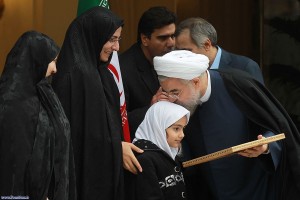
Iran’s President Hassan Rouhani celebrates the completion of an interim deal on Iran’s nuclear program by kissing the head of the daughter of an assassinated Iranian nuclear engineer
By Alastair Crooke | Consortium News | May 9, 2016
In an article entitled “Why America needs Iran in Iraq,” former U.S. Ambassador to Iraq Zalmay Khalilzad argues that “the chaos in Baghdad, culminating in the temporary occupation of the parliament by followers of Shiite Islamist cleric Muqtada al-Sadr, is undermining the war against the Islamic State; weakening Iraq’s economy; and accelerating the country’s disintegration.
“Without cooperation between the United States, Iran and Iraq’s top Shiite cleric, Ayatollah Sistani, the crisis could very well lead to the collapse of the entire political system set up in Iraq during the temporary U.S. occupation … To prevent this, Washington needs Tehran’s help. And Iran should be as motivated to seek stability [in Iraq] as much as Washington, because” Khalilzad asserts, “Iran, currently is losing favour in Iraq.”
Putting aside the questionable implication that Iran might somehow, through co-operation with America, raise its standing amongst Iraqis, Khalilzad’s presumption that Iran should now attend to America’s needs in Iraq, coupled with Secretary of State John Kerry’s insistence that Iran should help America to end the conflict in Syria too, throw into sharp relief the paradox inherent at the heart of U.S. diplomacy towards Iran, Russia (and China also).
This approach has been dubbed the “middle way” by former special adviser to the Assistant Secretary of State, Jeremy Shapiro: the U.S. Administration has no desire for an all-out confrontation with these three states. They are militarily hard nuts, and there is not much appetite for yet more military confrontation amongst a weary and wary American public (to the continuing frustration of the neocons).
More prosaically, the global financial system is now so brittle, so delicately poised, that it is not at all certain that the prospect of conflict would give the lift to America’s flagging economy that war generally is supposed to give. It might just snap the financial system, instead — hence the Middle Way.
Shapiro points out the obvious contradiction to this two-track approach: the U.S. no longer can ignore such powerful states. Its window of absolute, unchallenged, uni-polar power has passed. America needs the help of these states, but at the same time, it seeks precisely to counter these states’ potential to rival or limit American power in any way.
And America simply ignores the core complaints that fuel the tensions between itself and these states. It simply declines to address them. Shapiro concludes that this foreign policy approach is unsustainable, and bound to fail: “This dual-track approach, condemning Russia [or Iran] as an aggressor one day, [whilst] seeking to work with Moscow [or Tehran] the next … would [ultimately] force ever-greater confrontation.”
The ‘Middle Way’
In a sense, the U.S. approach towards Iran seems to be mirroring the so-called “middle way” policy which the U.S. Administration pursues towards Russia, whereby the putative “reset” with Russia was set aside (when President Vladimir Putin assumed the Presidency for the second time), and Obama – rather than seek outright confrontation with Russia – ruled that America however, would only co-operate with Russia when it suited it, but the U.S. would not deign to address Russia’s core issues of its “outsider” status in Europe, or its containment in Asia — or its concerns about a global order that was being used to corner Russia and to crush dissenter states who refused to enter the global order on America’s terms alone.
And Obama did little to drawback the NATO missile-march towards Russia’s borders (ostensibly, it may be recalled, to save Europe from Iranian missiles).
Ostensibly, too, the JCPOA (Joint Comprehensive Plan of Action) could have been America’s “reset” with Iran. Some, including a number of prominent Iranian politicians, thought it was.
But National Security Advisor Susan Rice was very explicit to Jeffrey Goldberg in The Atlantic that this was never intended: “It is assumed, at least among his critics, that Obama sought the Iran deal because he has a vision of a historic American-Persian rapprochement. But his desire for the nuclear agreement was born of pessimism as much as it was of optimism.
“The Iran deal was never primarily about trying to open a new era of relations between the U.S. and Iran,” Susan Rice told [Goldberg]. “It was far more pragmatic and minimalist. The aim was very simply to make a dangerous country substantially less dangerous. No one had any expectation that Iran would be a more benign actor.”
And so, we see a similar pattern, the possibility of a real “reset’ with Iran is pre-meditatively set aside (as per Rice), whilst the dual-track approach of condemning Iran for its ballistic missile tests (which have nothing to do with JCPOA), and its support for Hizbullah, are condemned one day, whilst Iran’s help in Iraq and Syria is being demanded on the next day.
At the same time, Iran’s core dispute with the U.S. – its complaints that exclusion from the international financial system is not being ameliorated as JCPOA was supposed so to do – are not being addressed. Rather they are being met with a shrug that implies “did they really expect anything else?”
Well, some (but by no means all) Iranian politicians had done just that: they had raised the Iranian public’s expectations that all sanctions – other than specific U.S. sanctions – would be lifted. They rather bet their credibility on it, as it were, and may pay a political price eventually.
And as NATO deploys a further 4,000 troops in the Baltic states and Poland, on Russia’s border, so too the U.S. Congress continues its figurative advance on Iran’s frontiers.
Here is Iran’s (conservative) Keyhan newspaper: “The draft of a new resolution has been presented to the US Congress in which Iran is accused of creating tension in the Persian Gulf, and the US Government has been urged to confront Iran and impose new sanctions against our country. Randy Forbes, a Republican member of the US House of Representatives, has drafted a resolution, which if passed by the Congress, condemns Iran’s military presence in the Persian Gulf as a provocation” (emphasis added)
Shapiro’s specific warning about the “middle way” approach was that “political and bureaucratic factors on both sides would force ever-greater confrontation.” But this is not the only risk, nor does it even constitute being the biggest risk (besides that of having undermined those in Iran and Russia who had put their “hat in the ring” of contemplating Entente with the United State).
America’s Bad Faith
Rather, it is by making this policy approach quite general to those states which have taken on themselves the burden of being the symbol for a non-Western, alternative vision (Russia, Iran and China, inter alia), that a perceived breach of the spirit of the JCPOA (at the least), will have wider repercussions.
Russia and China both spent political capital in order to help persuade Iran to sign up to the JCPOA: Will they not wonder whether America is to be trusted? China has complicated negotiations in hand with America on trade and financial issues, whilst Russia has been trying to resolve ballistic missile, as well as Ukraine sanctions issues, with America.
Is it not a straw in the wind for the consequences to this policy when a prominent Russian commentator, Fyodor Lukyanov, who is not at all hostile to rapprochement with the West, writes in End of the G8 Era that using Russia’s prospective inclusion in the G8 as an instrument of pressure on Russia is pointless?:
“The G8 reflected a certain period of history when Russia really wanted to be integrated into the so-called Extended West. Why it did not happen? Something went wrong? This is another topic. The most important thing is that it did not happen at all … it seemed (in the 1990s) that this membership would not mean just participation in yet another club, but a strategic decision aimed at the future.
“However, the desirable future did not come, and probably won’t come. It is obvious now, that the world does not develop in the direction of the Western model. So, now we have what we have, and there is no reason to restore the G8.”
May this general sentiment come to be reflected in Iran too, as the sanctions-lifting issue drags on? Did the U.S. then “win one over Iran” through the JCPOA accord – as the shrugs of U.S. shoulders at Iranian complaints, might imply? Was Iran just naïve? Did they really think that the U.S. was simply going to empower Iran financially?
It is pretty clear that the Supreme Leader understood the situation precisely — he had, after all some experience of U.S. non-compliance with agreements from the Lebanese hostage negotiations of the 1980s.
But what has Iran lost by the JCPOA? A few Iranians may have had their fingers burned in the process, but Iran achieved three important things: the world now knows that it was not Iran that was the impediment to a nuclear deal; the deal has transformed Iran’s public image – and created an opening – with the rest of the world (including Europe); and it has, in the process, constructed and strengthened strategic political and economic ties with Russia and China.
But most important of all, the rift within Iran that stemmed from the sense amongst some Iranian orientations, that President Ahmadinejad’s rhetoric was a principal obstacle to normalizing with the West, has been addressed: an Iranian government, with a Western-friendly face, has been given, and seen to have been given, the full chance to negotiate a solution to the nuclear issue. Whatever the final outcome, that boil has been lanced.
No, the Iranian leadership has not been naïve.
Alastair Crooke is a British diplomat who was a senior figure in British intelligence and in European Union diplomacy. He is the founder and director of the Conflicts Forum, which advocates for engagement between political Islam and the West.
US Republican lawmakers push Boeing to scrap any Iran deal
Press TV – May 4, 2016
Three US Republican lawmakers are pushing the American aerospace giant, Boeing, to refrain from getting into any deal with Iran.
In a letter to Boeing CEO Dennis Muilenburg, the Illinois Republican congressmen asked the company no to business with Tehran for any supply of planes and other services.
Congressmen Peter Roskam, Bob Dold and Randy Hultgren referred to a last July nuclear agreement between Iran and the permanent UN Security Council members plus Germany (P5+1) that removed anti-Iran sanctions in return for curbs on Tehran’s nuclear program, saying in their letter that any Iran deal with Boeing would be legal but “not right,” according to Fox News.
“This is not about doing what is legal – it is about doing what is right,” the letter said.
The Republican lawmakers reiterated US allegations of Iranian support for terror, telling Boeing that Iran’s Islamic Revolution Guards Corps (IRGC) can turn the planes into combat aircraft.
“We urge you not to be complicit in the likely conversion of Boeing aircraft to IRGC warplanes,” said the lawmakers.
Congressman Roskam, chairman of the US House Committee on Ways and Means Oversight, has been particularly vocal in his anti-Iran position, previously pushing for Europe’s multinational plane-maker Airbus to scuttle its $25 billion deal to sell 118 planes to Iran.
Roskam on Friday introduced an amendment to the National Defense Authorization Act, which would prohibit the US Department of Defense from awarding contracts to any entity that does business with Iran.
This is while Boeing is not alone in its interest in Iranian ventures. General Electric Co., among others, is also reportedly exploring business opportunities in Iran.
“Should any agreements be reached at some future point, they would be contingent on the approval of the US government,” Boeing said in a statement in April.
Last month, Iranian officials said Boeing had proposed to sell new models of its 737, 777 and 787 aircraft to Iran and promised after-sales support.
In late January, Iran’s Deputy Transport Minister Asghar Fakhrieh-Kashan said the country was planning to purchase over 100 planes from Boeing.
The official noted that Iran’s order list from the American company included 737s for domestic flights and two-aisle 777s for long-haul routes.
Iranian officials have already emphasized that the country will need to buy 500 commercial jets of various models for various short-, medium- and long-distance routes.
We don’t recognize US court ruling: Zarif
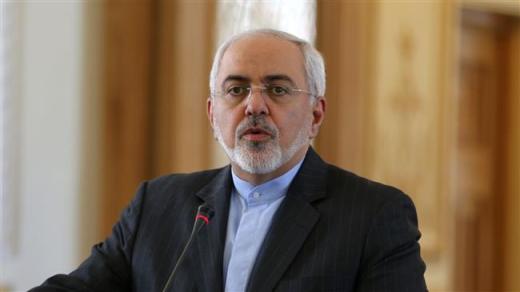
Iran’s Foreign Minister Mohammad Javad Zarif
Press TV – April 21, 2016
Iran’s foreign minister says the country refuses to recognize a recent ruling by the US Supreme Court, which authorizes the transfer of around USD two billion of frozen Iranian assets to the families of the victims of a 1983 bombing in Beirut.
Mohammad Javad Zarif made the remarks on Thursday in New York, where he has been staying since Monday to attend a UN debate on Sustainable Development Goals and the signing ceremony of the Paris climate change agreement as well as to meet foreign officials.
“As we [already] said, we do not recognize the court’s ruling and the US government knows this well,” he said, adding, “The US knows this well too that whatever action it takes with respect to Iran’s assets will make it accountable in the future and it should return these assets to Iran.”
On Wednesday, the tribunal ordered the sum be paid to the families of the victims of the explosion, which targeted a US Marine Corps barracks in the Lebanese capital, and other attacks blamed on Iran.
The assets belong to the Central Bank of Iran (CBI), which have been blocked under US sanctions.
“The ruling has mocked [international] law,” Iranian Foreign Ministry Spokesman Hossein Jaberi Ansari said earlier in the day, adding that it “amounts to appropriation of the Islamic Republic of Iran’s property” in the US.
Asked whether the matter will be brought up during a planned meeting between Zarif and his American counterpart, John Kerry, on Friday, the top Iranian diplomat said the meeting would only address Iran’s July 2015 nuclear agreement with the P5+1 countries and its proper implementation.
The historical nuclear deal, the Joint Comprehensive Plan of Action (JCPOA), was signed on July 14, 2015 following over two years of intensive talks between Iran and the five permanent members of the UN Security Council – the United States, Britain, France, Russia, and China – plus Germany.
“Our discussion at the meeting will follow up on previous negotiations over JCPOA. It has been agreed that the American side consider the points brought up by us during the previous meeting regarding the proper implementation of JCPOA and provide us with answers.”
The two officials held a closed-door meeting on Tuesday.
Iran Accuses US of Violating Nuclear Deal
By Stephen Lendman | April 16, 2016
America’s history shows trustworthiness isn’t its long suit, treaties and other deals agreed to systematically violated – culpability ignored or counterparties wrongfully blamed for its breaches.
After last year’s nuclear deal was consummated, Obama lied, saying “(h)istory shows that America must lead not just with our might, but with our principles. It shows we are stronger not when we are alone, but when we bring the world together.”
According to a complaint filed last August with the IAEA, Iran said Washington breached nuclear deal principles straightaway – three days after the deal was reached.
At the time, White House press secretary Josh Earnest said “(t)he military option… remain(s) on the table…enhanced because we’ve been spending (past) years gathering significantly more (intelligence) about Iran’s nuclear program.”
Tehran said this threat to use military force preemptively without just cause constitutes a “material breach of the commitments just undertaken.”
The agreement was never meant to be a vehicle to facilitate US spying on the Islamic Republic.
Iran “(r)ecall(ed) past instances, in which highly confidential information provided by the Islamic Republic of Iran to the Agency inspectors had been leaked, posing a grave threat to the national security of Iran… it is absolutely essential and imperative for the Agency to take immediate and urgent action to reject such flagrant abuses,” a statement said.
Washington used the nuclear deal to justify expanding its regional military footprint, increase aid to Israel and sell billions of dollars more weapons to Saudi Arabia and other Gulf states.
On Friday, Iranian central bank head Valiollah Seif accused US-led Western countries of locking Tehran out of the international financial system, another flagrant deal breach with likely more coming.
According to Seif, Western nuclear deal counterparties have done “almost nothing” to live up to provisions agreed on.
“(W)e are not able to use our frozen funds abroad.” Unless resolved, the deal “breaks up on its own terms,” he said without further elaboration.
White House press secretary Josh Earnest lied, claiming “(t)he United States, along with the rest of the international community, is committed to living up to our end of the bargain” – at the same time saying Washington has no intention of giving Tehran access to America’s financial system.
State Department spokesman admiral John Kirby compounded the Big Lie, claiming Washington fulfilled its part of the deal.
“There is no need to do more when we have met all of our commitments,” he disingenuously claimed.
It’s well known Iran’s nuclear program is peaceful with no military component and no known intention to have one.
Washington’s concerns otherwise were and remain red herring cover for its real aim – regime change, replacing Iran’s sovereign independence with puppet governance it controls.
Longstanding US hostility persists. Normalization remains unattainable as long as neocons infesting Washington, Israel and AIPAC reject it.
Stephen Lendman can be reached at lendmanstephen@sbcglobal.net.
His new book as editor and contributor is titled Flashpoint in Ukraine: US Drive for Hegemony Risks WW III.
UNSC resolution does not ban Su-30 fighter jet sales to Iran: Russia
Press TV – April 6, 2016
Russia has rejected a US claim that the sales of Sukhoi Su-30 fighter jets to Iran were prohibited under a United Nation Security Council resolution.
On Tuesday, the US Department of State Undersecretary for Political Affairs Thomas Shannon said Washington would use its veto power in the Security Council to block the possible sales of the fighter jets to Iran.
“The sale of Su-30 fighter aircraft is prohibited under UNSCR 2231 without the approval of the UN Security Council and we would block the approval of any sale of fighter aircraft under the restrictions,” Shannon said, referring to the UN resolution.
Head of the Russian Foreign Ministry’s department for non-proliferation and arms control, Mikhail Ulyanov, dismissed the claim.
“Such deliveries are not prohibited, they are allowed, and this follows from the text of the resolution,” the Interfax news agency quoted him as saying.
Resolution 2231, adopted by the Security Council on July 20, 2015, endorsed a nuclear agreement between Iran and the P5+1 group, comprising Russia, China, France, Britain, the US and Germany.
Shannon claimed that under the resolution, such weapon deliveries “require the submission of relevant notification to the Security Council and this notification’s endorsement by the Security Council.”
Ulyanov said Moscow has not forwarded such a notification to the Security Council so far.
Political analysts say Resolution 2231 does not prohibit Iran from buying fighter jets, and its language is not legally binding and cannot be enforced with punitive measures.
Su-30 is a multirole advanced fighter aircraft for all-weather, air-to-air and air-to-surface deep interdiction missions.
Iran and the P5+1 finalized the nuclear agreement, dubbed the Joint Comprehensive Plan of Action (JCPOA) in Vienna, Austria, in July last year. They started to implement the JCPOA on January 16, 2016.
On Tuesday, a senior Russian diplomat also said Moscow would begin the first shipment of its S-300 air defense missile systems to Iran in the coming days.
“I don’t know if this will happen today, but they (S-300 missiles) will be loaded (for shipment to Iran),” Interfax quoted Zamir Kabulov, a department chief at the Foreign Ministry, as saying.
US to block sale of Russian Su-30 aircraft to Iran: State Dept.
Press TV – April 5, 2016
The United States would use its veto power in the United Nations Security Council to block the sale of Russian Ru-30 fighter jets to Iran, the State Department says.
Department of State Under Secretary for Political Affairs Thomas Shannon made the announcement on Tuesday during a congressional hearing on Iran. “We would block the approval of fighter aircraft.”
Shannon told the Senate Foreign Relations Committee hearing that any such sale of fighter jets would have to be approved by the UN Security Council.
Su-30 is a multirole advanced fighter aircraft for all-weather, air-to-air and air-to-surface deep interdiction missions.
“The sale of Su-30 fighter aircraft is prohibited under UNSCR 2231 without the approval of the UN Security Council and we would block the approval of any sale of fighter aircraft under the restrictions,” Shannon said.
Shannon was referring to the UN Security Council Resolution 2231, adopted by the Security Council on July 20, 2015, which endorsed the nuclear agreement between Iran and the P5+1 group – Russia, China, France, Britain, the US and Germany.
The UN resolution calls upon Iran not to undertake any activity related to ballistic missiles designed to be capable of delivering nuclear weapons, including launches using such ballistic missile technology.
But according to diplomats, resolution 2231 does not prohibit Iran from buying fight jets, and the language of 2231 is not legally binding and cannot be enforced with punitive measures.
Iran and the P5+1 finalized the Joint Comprehensive Plan of Action (JCPOA) in Vienna, Austria, on July 14, 2015. They started to implement the JCPOA on January 16, 2016.
Under the agreement, limits are put on Iran’s nuclear activities in exchange for, among other things, the removal of all nuclear-related economic sanctions against the Islamic Republic.
Sen. Cardin demands renewal of anti-Iran sanctions: Jewish Telegraphic Agency
Press TV – April 4, 2016
US Democratic Senator Ben Cardin has pledged to get Congress to renew sanctions against Iran before the end of the year.
The pro-Israeli lawmaker on the Senate Foreign Relations Committee has told Jewish media that there is a general agreement to extend sanctions against Iran before they expire in December 2016.
“There’s general agreement we have to extend the sanctions against Iran, and we need to do it before they expire at the end of this year,” Cardin told Jewish Telegraphic Agency in a recent interview.
Cardin said he could get Democrats behind a simple reauthorization of sanctions, adding they are needed to remain in effect.
“Speaking as the ranking Democrat on the committee, and on behalf of the Democrats, we could get it done quickly if we were to just do that part,” he said, meaning a simple reauthorization of the sanctions, aka Iran Sanctions Act, which were passed in 1996 and reauthorized in 2006. The sanctions must be renewed every 10 years.
Last month, Cardin toured Israel, Saudi Arabia and Qatar, where he met with authorities expressing ‘concern’ over Iran’s growing influence in the region.
At the beginning of this year, US President Barack Obama signed an executive order, lifting the US economic sanctions on Iran after Tehran proved it had fulfilled its commitments undertaken in the Joint Comprehensive Plan of Action (JCPOA) – Iran’s nuclear agreement with the permanent UN Security Council members plus Germany (P5+1) signed last July.
Last month, a group of US Republican senators also introduced legislation to impose new sanctions against Iran over what legislators have described as Tehran’s “support for terrorism and human rights violations.”
With the ‘Iran Sanctions Act’ expiring at the end of this year, GOP senators are making every effort to reauthorize and impose more sanctions on Tehran on the pretext of terrorism, human rights issues, and ballistic missile tests.
Several Republican senators including Marco Rubio and Ted Cruz have signed the new bill, dubbed the “Iran Terrorism and Human Rights Sanctions Act of 2016.”
Pakistan and Saudi Arabia: the Balance of Relations
By Natalya Zamarayeva – New Eastern Outlook – 01.04.2016
For the second time in 2016, Pakistani Prime Minister, Mian Muhammad Nawaz Sharif, paid an official visit to Riyadh in March. He took part in the closing ceremony of the Northern Thunder military exercise in the Saudi desert. The intensity of the visits is dictated by the importance of the Kingdom of Saudi Arabia (KSA) in the foreign policy of Pakistan, as well as the need to maintain a balanced approach to the countries of the region as a whole, given the recent intensification of relations with Iran. It is noteworthy that it is also the second time that the Prime Minister was accompanied by Chief of Army Staff, General Raheel Sharif on a foreign trip to the KSA. Much remains yet to be clarified.
Military contacts between Islamabad and Riyadh have been maintained for several decades. The first bilateral agreements were signed back in the 60’s; in the 80’s, two teams of Pakistani ground troops were stationed in Saudi Arabia. In recent years, the commands of the two capitals hold annual joint military exercises, for example, Al Shihab-1 in 2015.
Despite the significant financial support from the KSA of social, economic, military and other projects in Pakistan, the relationship between the royal dynasty and the military and civil administration of Islamabad were not always smooth. The most recent failure occurred in March 2016. The royal family appealed to the Prime Minister, N. Sharif (and he publicly promised) to post part of the Pakistani army in the zone of military conflict in Yemen against Huthis Shiite in support of the KSA. But after ten days under the pretext of protecting only the holy places, the National Assembly of Pakistan (the lower house of parliament) refused. The Pakistani media wrote about a certain pressure the generals applied to parliamentarians.
The latest of Riyadh’s military appeals to Islamabad, announced in December 2015 as part of an alliance of 34 countries to combat the terrorist threat in the region, once again caused a lot of questions from the military leadership of Pakistan, as well as Malaysia and Lebanon about the goals and objectives of the new military campaign, the place and role of each participating country. For a long time, issues remained unclear related to the operational strategy, antiterrorist working methods, management, control and composition of the proposed cooperation. For two months, Islamabad did not comment. Sharif’s visit to Riyadh in March lifted the veil. According to the Pakistani media, Rawalpindi (the location of the Army headquarters) plans for its participation to include the exchange of intelligence information, the supply of military equipment and the development of counter-extremist propaganda.
Pakistan once again refused to participate in the armed conflict, putting forward several arguments: first, the reluctance to get involved in a so-called “foreign” war; secondly, the desire to avoid the explosion of separatist and sectarian movements within Pakistan; and thirdly, that new and promising markets (Iran) and possibilities are opening up, given the recent geopolitical developments in the region.
In the February issue of this year’s Pakistani military magazine Hilal, the author of the article entitled ‘Balanced Approach Towards the Middle East’ underlines the importance as never before, of the diplomatic efforts to solve the “raging” conflicts. It’s hard not to agree with Mr. Masood Khan and his statement: “it is not clear, in which direction the Middle East will move in 2016 … fine balancing is required … in order to prevent a major war in the region, protect our interests and save Pakistan from sectarian faults.” Thus, in contradiction to the centrifugal tendencies conducted by KSA in the vast region, Pakistan, on the contrary, promotes and supports centripetal forces. Its policy of non-participation in armed conflict puts obstacles in the way of splits, the formation of secessionist movements and / or fragmentation of its territory. Islamabad experienced the disease of separatism in 1971, allowing the separation of the Eastern Province and the proclamation of the independent Republic of Bangladesh on the territory in 1973.
At the same time, Pakistan is aware of the need to preserve traditional solidarity with the Saudi royal family, yet maintain that the time of its leadership in the region is in the past.
Islamabad is opening itself to radically new transnational projects of the 21st century in the region. Islamabad regards rapprochement with Tehran as a positive direction, despite the fact that, in general, Teheran’s step towards the Western world has made the region “feverish” (in the words of Mr. Masood Khan). In February 2016, Pakistan also lifted sanctions against Iran, supporting the decision of the “Six” (the permanent UN Security Council members and Germany). In addition to the prospective energy and hydrocarbon supplies to the country, Pakistan is set to earn a huge profit by using its strategic geographical position. The area will act as a transport bridge from the Chinese border and further to Central Asia, Iran, and then to the West under the revived China’s Silk Road project (one belt – one road). In February 2016, Beijing and Tehran signed a series of agreements.
Despite the fact that in January 2016 the Minister of Defense of the KSA rejected the mediation efforts of Pakistan in resolving the crisis with Iran (after the rift in diplomatic relations in early January 2016), Islamabad, for various reasons, remains one of Riyadh’s few opportunities to maintain civilized dialogue with Tehran and to stabilize the situation in the region.
The position of neutrality, which Pakistan upholds, and above all, the Army generals (given that the Pakistani army is one of the strongest in the region), is a guarantee their own security.
At the same time, the Northern Thunder military exercise (participated in by 21 states), led by the KSA, is a kind of demonstration of military force of the Sunni wing of Islam to the Shiites, in particular the leadership of Iran and the Yemeni Huthis.
The non-interference policy of a number of states in the region, in particular, Islamabad, is a deterrent to the further military ambitions of the new leaders of the Saudi dynasty and thus counteracts the emerging destabilization mechanisms. The Middle East will not sustain another armed conflict.
Natalia Zamaraeva, Ph.D (History), Senior Research Fellow, Pakistan section, Institute of Oriental Studies of the Russian Academy of Sciences.
Austria casts doubt on immediate bans lift from Iran
Press TV – March 30, 2016
Austrian President Heinz Fischer has cast doubt on the US and Western resolve for the immediate removal of all anti-Iran sanctions.
Fischer has told IRIB that it is unclear how long it will take for the West to lift sanctions on Iran.
Iran’s historic agreement last year with permanent UN Security Council members plus Germany (P5+1) went into force on January 16 to end 13-years of Western dispute over Tehran’s nuclear program and pave the way for the lifting of sanctions on the country.
But more than two months later, Iran is still awaiting the full opening of business transactions with some companies in the West as some banks are facing restrictions in the US on handling business with Tehran.
The Austrian leader said it was not up to a single country to lift all the sanctions, but that the United States had a part to play.
“Austria alone cannot lift the sanctions. The EU cannot do it alone too, but it is the international community that should do it,” Fischer said.
“The US also plays a role in this regard,” he added.
“A process for sanctions removal has begun, but I cannot make any predictions on how long this issue will last. I hope all sides fully adhere to the [nuclear] agreement.”
The Austrian president was answering a question on issues facing Iranian banks, some of which still seek to join the international payments system, SWIFT, for the resumption of foreign transfers.
The Austrian leader paid a visit to Tehran in September 2015 at the head of a 240-member delegation with the purpose of discussing ways to improve Tehran-Vienna relations.
Not all the banks in Iran have been able to reconnect to SWIFT since the lifting of sanctions was announced in January.
A senior Iranian official said last month that 26 Iranian banks have so far been reconnected to SWIFT after the removal of the economic sanctions against Iran in mid-January.
SWIFT – the Society for Worldwide Interbank Financial Telecommunication – is used by nearly every bank around the world to send payment messages that lead to the transfer of money across international borders. It provides a wide range of service including transmitting letters of credit, payments and securities transactions among 9,700 banks in 209 countries.
However, it became off limits to Iranian banks in 2012 after the implementation of the US-led sanctions against the country. Accordingly, around 30 Iranian banks were blocked from using SWIFT services, literally cutting off Iran from the global banking system.
US, three allies urge UN meeting on Iran missile tests
Press TV – March 30, 2016
The United States and some of its European allies have reportedly called for a meeting at the United Nations Security Council (UNSC) on Iran’s recent missile tests, which they claim were carried out in defiance of a UN resolution.
According to a letter reportedly obtained by Western news outlets on Tuesday, the US, Britain, France, and Germany have asked UN Secretary General Ban Ki-moon and Spain’s UN Ambassador Roman Oyarzun Marchesi for discussions on an “appropriate response” by the UNSC to Iran’s missile tests.
The four countries claimed that the missiles used in Iran’s recent tests were “inherently capable of delivering nuclear weapons” and were “inconsistent with” and “in defiance of” UNSC Resolution 2231 (2015), adopted last July to endorse a nuclear agreement between Iran and the P5+1 group of countries.
Spain has been assigned the task of coordinating UNSC discussions on Resolution 2231.
The claim comes even as Resolution 2231 does not prohibit Iran from testing missiles, and only “calls upon” the Islamic Republic to refrain from testing missiles “designed to be capable of” carrying nuclear warheads. Iran has made clear that it does not seek to build nuclear warheads to be carried on missiles and has put its atomic activities under unprecedented, enhanced international supervision under the nuclear deal with the P5+1.
On March 9, Iran’s Islamic Revolution Guards Corps (IRGC) successfully test-fired two ballistic missiles as part of measures to assess IRGC capabilities. The missiles, dubbed Qadr-H and Qadr-F, were fired during large-scale drills code-named Eqtedar-e-Velayat.
Iran fired another ballistic missile dubbed Qiam from silo-based launchers in different locations across the country on March 8.
A similar US-led bid against the Iranian missile tests failed in March, as other diplomats in a closed-door UNSC meeting on Iran back then made it clear that Resolution 2231 did not prohibit Iranian missile tests and thus a response was not warranted to such tests.
Russian Ambassador Vitaly Churkin reiterated that, in the view of veto-wielding Russia, Iran’s ballistic missile tests did not violate Resolution 2231.
In the new letter, the four countries refrained from using the term “violation,” saying instead that the Iranian missile tests were “in defiance of” the resolution. However carefully-worded, it is not clear what kind of legal action the four countries would want to be taken against Iran, as the Islamic Republic says it has not violated its commitments.
Resolution 2231 (2015), which endorses the Joint Comprehensive Plan of Action (JCPOA) — the Iran-P5+1 agreement — provides for the termination of the provisions of previous Security Council resolutions over the Iranian nuclear program.
Iran argues its missiles are defensive and designed to carry conventional explosives only.
Earlier this month, Iran’s Foreign Minister Mohammad Javad Zarif said the missiles are a means of defense. “We spent a fraction of any other country in the region on defense, and missiles are a means of defense that we require,” he said.
Tehran insists that given the deepening insecurity in the region and the fact that many countries are spending hefty sums on arms purchases, it needs to boost its defensive missile program.
The US, Britain, France, and Germany were, along with China and Russia, members of the P5+1. Iran and the six other countries started implementing the deal on January 16.
Featured Video
Houthis Keep Advancing as the Red Sea Crisis Deepens
or go to
Aletho News Archives – Video-Images
From the Archives
15 Saudi ‘hijackers’ were CIA agents working for US: Scholar
Press TV – April 13, 2016
Fifteen of the 9/11 “hijackers” from Saudi Arabia were CIA agents working for the United States government, which was seeking to destroy the Middle East for Israel and to double the American military budget, says Dr. Kevin Barrett, an American academic who has been studying the events of 9/11 since late 2003…. continue
Blog Roll
 Aletho News
- Russia Just Struck the Eyes of NATO’s War Machine in Ukraine
- Russia summons UK charge d’affaires over Kiev drone support
- NATO member warns bloc seeking pretext for war with Russia
- Macgregor: We Haven’t Seen the Worst of the Iran War Yet
- ‘We are not like everyone else’ laws that bind other nations do not apply to Israel, says Likud lawmaker
- Report: Saudi Arabia seeks allies’ assistance as missiles deplete amid war on Yemen
- Fuel Crisis Deepens: Pakistan Warns Tanker Attack in Red Sea Would Be an ‘Act of War’
- ‘Bucha massacre’ a false flag orchestrated by UK – Moscow
- China Rejects Outside Pressure on Trade Ties After New US Russia Sanctions Bill
- Houthis Keep Advancing as the Red Sea Crisis Deepens
- If Americans Knew
- Columbia Administered Fund Gives Big Money to Pro-Israel Groups
- Deportation Case of Palestinian Activist Salah Sarsour Tests First Amendment
- ‘We Will Not Forget’: Palestinians Mark 44 Years since Sabra and Shatila
- Why do we let Zionists decide what we can and can’t say?
- US welcomes Israeli, Iranian delegations to UN, but not Palestinians – Daily Update
- Biden’s Genocide Accomplices Targeted by New Accountability Campaign
- AIPAC’s Network Has Already Spent $67.2 Million to Shape the Midterm Elections
- Jewish Supremacist Manufacturing a Civilizational Threat to License Bigotry
- US bans Palestinian president from speaking at the UN
- Israeli Forces Detain Journalist Alaa al-Rimawi amid Widespread West Bank Raids
- No Tricks Zone
- New Study: ‘Global Drought Shows No Detectable Recent Acceleration Under Climate Warming’
- Economic Masterminds: German Socialists Suggest Taxing Productivity Gains Stemming From Using AI
- The South China Sea Has Not Been Cooperating With The Climate Change Narrative
- Energy Crisis: Germany Enters Heating Season With Historically Low Gas Reserve Fill Levels
- New Study: The Antarctic Ice Sheet Gained Mass From 2020-2024 Due To Staggering Snow And Ice Accumulation
- Study: Ocean Heating Rates From Thousands Of Years Ago ‘Dwarf’ Modern Ocean Heating Rates
- Climate Extremists Target, Attack Large-Scale Power Grid Infrastructure In Germany!
- New Study: Antarctic Ice Melt Has Contributed Less Than 1 Centimeter To Sea Level Rise In The Last 30 Years
- Fear Of Debate: Alarmist German Climate Scientist Calls On Mainstream Media To Discredit Skeptic Voices
- End-Of-August Arctic Sea Ice Extent Hasn’t Fallen In 20 Years, Official Data Show!
 Aletho News