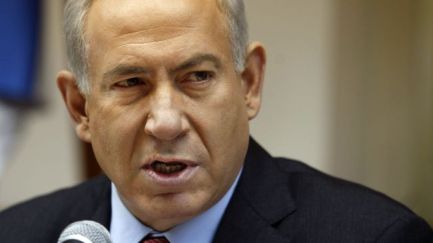
Israeli Prime Minister Benjamin Netanyahu called on Sunday for nations to continue boycotting Iran over its nuclear efforts after the election of a new president widely hailed as a moderate.
Netanyahu said it was Iran’s supreme leader, Ayatollah Ali Khamenei, and not the newly elected president, Hassan Rohani, who set a nuclear policy that has been challenged by tough economic sanctions and the prospect of military action.
“The international community must not give in to wishful thinking or temptation and loosen the pressure on Iran for it to stop its nuclear program,” the right-wing Netanyahu told his cabinet, according to a statement released by his office.
Israel, the Middle East’s only only nuclear power, has threatened to strike Iran over its nuclear program. It is also believed to be behind a string of assassinations targeting Iranian nuclear scientists over the past several years.
“The greater the pressure on Iran, the greater the chance of bringing a halt to the Iranian nuclear program, which remains the greatest threat to world peace,” Netanyahu said.
Iran insists its nuclear program is peaceful, and its main ally Russia has repeatedly said that there is no evidence to suggest otherwise.
Netanyahu’s remarks come one day after Israeli Defense Minister Moshe Yaalon called for tougher sanctions against Iran regardless of who is elected as its new president.
“We must toughen the sanctions against Iran and make this country understand that the military option remains on the table to halt the progress of its dangerous nuclear program,” Israeli radio quoted Yaalon as saying on a visit to the United States Saturday.
(Reuters, AFP, Al-Akhbar)
June 16, 2013
Posted by aletho |
Subjugation - Torture, Wars for Israel | Ali Khamenei, Benjamin Netanyahu, Hassan Rowhani, Iran, Israel, Middle East, Netanyahu, Sanctions against Iran, Zionism |
Leave a comment
Interview with Flynt Leverett by Kourosh Ziabari
If you regularly follow the headlines on the American and European radio stations, TV channels or newspapers, you come to believe that Iran’s nuclear program is the world’s most important, unsolvable and complicated problem. It’s been more than a decade that they have been incessantly talking of an Iranian threat that has endangered world peace and security. At the same time, they turn a blind eye to Israel’s nuclear arsenal and the fact that Israel is the sole possessor of nuclear weapons in the Middle East. The claim that Iran is trying to produce atomic weapons has laid the groundwork for the U.S. and its allies to impose harsh economic sanctions on Iran and damage Iran’s economy and trouble the daily lives of the ordinary Iranian people.
To study the different aspects of the sanctions imposed on Iran by the United States and the European Union, Iran Review has conducted a series of interviews with world-renowned political scientists, lawyers, journalists and authors and asked them some questions on the humanitarian and legal impacts of the sanctions, their compatibility with international law and the human right standards, etc.
Today’s interviewee is Prof. Flynt Leverett, a prominent Iran expert. Leverett is a professor of international affairs and law at Pennsylvania State University and co-author of “Going to Tehran: Why the United States Must Come to Terms with the Islamic Republic of Iran.” Prof. Leverett has written on Iran’s nuclear program extensively and is regularly interviewed by international media. What follows is the text of the interview.
Q: The United States claims that by imposing sanctions on Iran, it intends to prevent Tehran from acquiring nuclear weapons, but the sanctions have recently targeted the ordinary citizens and consumer goods and medicine. Why have the sanctions swiftly diverted from the issue of disarmament and are directed toward the daily life of the ordinary Iranian citizens?
A: This is the inevitable logic of sanctions. American and other Western officials declare that the targets of their sanctions policies are governments, not people. In reality, though, the point of sanctions is to make ordinary people in targeted countries miserable.
In the Western logic of sanctions, if enough ordinary people are made sufficiently miserable, then they will rise up and either force their governments to change policies that Washington views negatively or else force these governments from power. There is no other strategic rationale for sanctions.
Q: While the process of passing on Iran’s nuclear dossier to the Security Council was illegal, do the resolutions issued on this basis have a legal warranty?
A: A number of prominent international legal scholars have advanced a powerful argument, with which I agree, that the Security Council resolutions calling on Iran to stop enriching uranium are legally invalid. Article 25 of the UN Charter establishes a strong presumption that UN member states should comply with Security Council resolutions. But the same article also limits member states’ obligation in this regard to Security Council decisions “in accordance with the present charter.” Likewise, Article 24 of the Charter holds that, in discharging its duties, “the Security Council shall act in accordance with the purposes and principles of the United Nations.” (Those purposes and principles are presented in Articles 1 and 2 of the Charter.)
The Security Council resolutions calling on Iran to suspend uranium enrichment demand, in effect, that the Islamic Republic surrender what the Nuclear Non-Proliferation Treaty recognizes as signatories’ “inalienable right” to the peaceful use of nuclear technologies—including uranium enrichment. By adopting these resolutions, the Council was acting neither “in accordance with the [UN] Charter” nor “in accordance with the purposes and principles of the United Nations.” And that renders these resolutions invalid.
Q: Don’t you think that focusing the sanctions on basic staples and goods, especially medicines, is tantamount to a continued and systematic violation of the human rights?
A: The U.S. government claims that the sanctions are not focused on items like food and medicine—that there is an explicit exemption for food and medicine in the sanctions policy. But, as the question implies, this is, to say the least, hypocritical. Formally, there is an exemption in the sanctions for food and medicine. But, in practice, as long as banking sanctions deter Western and many other international banks from processing transactions with Iranian counter-parties—even for “permitted” items like medicines—the effect is to bar the export of medicines to Iran, with predictably tragic consequences.
This is both inhumane and illegal, on multiple levels. Besides the horrible impact of U.S.-instigated sanctions on ordinary Iranians, U.S. sanctions policy is a gross violation of international economic law. Most of the sanctions that are having such terrible effects on ordinary Iranians are not unilateral U.S. sanctions—which the Islamic Republic has been dealing with for decades—or multilateral sanctions authorized by the UN Security Council. Most of the sanctions that are creating real difficulties and hardships for Iranians are so-called “secondary” sanctions, whereby Washington threatens third-country entities doing perfectly lawful business with the Islamic Republic with punishment in the United States. In recent years, Congress has been regularly expanding and intensifying Iran-related secondary sanctions through laws that President Obama immediately signs and obediently implements.
Secondary sanctions clearly violate American commitments under the World Trade Organization (WTO), which allows members to cut trade with states they deem national security threats but not to sanction other members over lawful business conducted with third countries. If challenged on the issue in the WTO’s Dispute Resolution Mechanism, Washington would surely lose. That’s why U.S. administrations have been reluctant to impose secondary sanctions on non-U.S. entities transacting with Iran, and have done so pretty rarely. What Washington relies on is that, in many cases, the legal and reputational risks posed by the threat of U.S. secondary sanctions reduce the willingness of companies and banks in many countries to transact with Iran, with negative consequences for Iran’s economy and for many ordinary Iranians. It is the approach of a bully who does not believe he is constrained by the same laws that apply to others.
Q: It’s said that the sanctions that target ordinary civilians are a kind of collective punishment, and collective punishment is a crime according to the Nuremberg Tribunals. The Western states claim that they care for human rights, but they are behaving in such a hypocritical manner and punish the Iranian citizens for a crime they have not committed. What’s your viewpoint on that?
A: As a matter of policy, the United States is not and never has been interested in human rights in any sort of universal or objective way. The United States is only interested in the selective, instrumental exploitation of human rights concerns to undermine governments it does not like. As Washington has co-opted, and corrupted, the human rights agenda in this way, it has also undermined its credibility to address human rights in Iran or anywhere else. Moreover, as the question implies, America’s professed concern for human rights in Iran is especially hypocritical so long as the United States continues what I would call its “dirty war” against the Islamic Republic—including economic warfare targeting civilians (through sanctions), cyber-attacks, and support for groups doing things inside Iran that, in other places, Washington condemns as “terrorism.”
Q: It seems that the sanctions are not simply aimed at curbing Iran’s nuclear program but the main objective of the sanctions is seemingly to create social unrest in Iran which can finally lead to a regime change. So, what’s the message which the sanctions impart? Diplomacy or conspiracy?
A: Since the Iranian revolution, no American administration—not even that of Barack Hussein Obama—has been prepared to accept the Islamic Republic as a legitimate and enduring political entity, representing legitimate national interests. Every administration has seen the Islamic Republic as fragile and vulnerable to internal subversion, and has sought in various ways to encourage such subversion. Of course, it has not worked, but this outlook continues to dominate mainstream foreign policy discussions in the United States about Iran.
U.S. sanctions policy toward Iran needs to be seen in this context. The proposition that sanctions are somehow intended to promote a diplomatic “solution” is, to put it bluntly, dishonest. Consider the way that the sanctions have been drawn up. Even just a few years ago, most of them were imposed by executive orders, which are more or less at the discretion of the White House. Now, though, most of the sanctions have been written into law, which greatly reduces the President’s ability to pull back on them as part of a negotiating process, or to lift them even if Iran acceded to all U.S. demands on the nuclear issue.
Regarding this point, look at the language in current U.S. law on sanctions. Even if the Islamic Republic allowed the U.S. government to come in, dismantle every centrifuge in Iran, and take them back to the United States—like Qadhafi did in Libya—there would still be no legal basis for the President to lift sanctions. The law says that, in order for sanctions to be lifted, the President would also have to certify to Congress that Iran had stopped all dealings with resistance movements like Hizbullah and Hamas, which the United States persists in calling terrorist organizations, and that the Islamic Republic had effectively turned itself into a secular liberal “Republic of Iran” to meet U.S. standards on “human rights.”
That’s not a serious approach to diplomacy. The argument that sanctions are somehow meant to encourage a diplomatic outcome is detached from reality.
Q: Along with the expansion of sanctions, the resistance of the Iranian nation has increased, as well. Why haven’t the sanctions had the effects the West desires, whether in the political or social level?
A: There is no case in history in which sanctions have prompted a target population to rise up, overthrow their government, and replace it with a government prepared to adopt policies sought by the sanctioning power. That has literally never happened. Even in Iraq, where for twelve years the United States led the way in imposing sanctions so severe they killed more than a million Iraqis (half of them children), the population did not rise up to overthrow Saddam Hussein. That took a massive U.S. invasion—and even then, the United States did not get a “pro-American” government in Baghdad.
Beyond this history, the Islamic Republic, as I have come to understand it, is the product of a revolution that had, as one of its highest priorities, the restoration of Iran’s effective sovereignty and independence after a century and a half of domination by Western powers.
Q: The experts say that something around 15-20% of the current price of the oil is a result of the EU’s oil embargo against Iran. How much has the oil embargo influenced the EU’s economy in the current critical juncture?
A: In the late 1990s and early 2000s, when some European elites had serious ambitions for the European Union to emerge as an independent force in international affairs, capable of balancing the United States, European nations pursued an at least somewhat independent policy toward Iran. However, with the collapse of the EU’s constitutional project in the mid 2000s, European elites calculated that the next-best way for Europe to have influence in the Middle East is by helping the United States pursue its hegemonic ambitions in the region.
To understand what I am talking about, just look at the extraordinary shift in the Middle East policies of France and Germany. Both of those countries were absolutely right in anticipating what a strategic and moral disaster America’s 2003 invasion of Iraq would be, and in refusing to go along with the United States in this ill-conceived campaign. But within just a few years of having been right on Iraq—and having been proved right by events on the ground there—the French and German governments aligned themselves almost completely with Washington’s Middle East policies.
As a result of this shift, Europe has, over the last few years, almost completely subordinated its Iran policy to that of the United States—even though, as the question implies, this imposes additional costs on European economies at a time when those economies are already under significant strain. A few EU countries, like Sweden, continue trying, on the margins, to keep some element of rationality in European discussions on Iran, but they are fighting a losing battle.
Q: Currently a number of countries implement the sanctions for different reasons, but several others don’t, so the sanctions have practically turned into an economic opportunity for those countries which haven’t put into effect the sanctions because those countries that adopt the sanctions have deprived themselves of robust and profitable trade with Iran. Are the sanctions capable of curtailing or stopping Iran’s foreign trade?
A: I agree with the premise of the question. Those countries which comply with illegal U.S. secondary sanctions and limit their trade with the Islamic Republic are ultimately hurting themselves more than they may hurt Iran. Sanctions may distort Iran’s foreign trade to some degree, but they cannot stop it.
Q: Complementing the sanctions with valid threats of military strike and intelligence operations are among the most important advice given by Israel to Europe and the United States. How successful have these countries been in sabotaging Iran’s security?
A: They have not been successful at all. I hope that my country will not engage in overt military aggression against the Islamic Republic. If, however, the United States is so foolish as to launch another war in the Middle East, to disarm yet another Middle Eastern state of weapons of mass destruction it does not have, I believe that the blowback to U.S. interests in the region will be disastrous for America’s strategic position. The United States will be the big loser in such a war.
April 23, 2013
Posted by aletho |
Deception, Economics, Timeless or most popular, War Crimes | Flynt Leverett, Iran, Sanctions against Iran, United States, World Trade Organization |
Leave a comment
South Africa has lashed out at the United States and European Union for imposing oil sanctions on Iran over its nuclear energy program without first consulting major importers of the Iranian energy supplies.
South Africa’s Energy Minister Elizabeth Dipuo Peters, who is in India to attend the Clean Energy Ministerial (CEM) meeting, said that such decisions have geopolitical implications and mostly affect “the poorest of the poor” that are in dire need of energy supplies and have no alternative.
“When decisions are made at bilateral or unilateral levels that have serious geopolitical consequences, we need to engage seriously,” Peters said.
“When we had to look for crude of the kind we got from Iran, it came at a premium,” she added.
“It has a multiple knock-on effect, especially on the poorest. When these decisions are taken, they must always consider the impact and consequences of their decisions at the geopolitical level. Or at least involve other countries so that when the decision is made they can say South Africa is taking it consciously. They have calculated the impact on them but not on others,” the South African minister said.
At the beginning of 2012, the US and EU imposed new sanctions on Iran’s oil and financial sectors with the goal of preventing other countries from purchasing Iranian oil and conducting transactions with the Central Bank of Iran.
On October 15, 2012, the EU foreign ministers reached an agreement on another round of sanctions against Iran.
The sanctions have been imposed on Iran over the groundless charges of a potential military diversion in Iran’s nuclear energy program.
Iran rejects the unfounded allegations over its nuclear energy program, arguing that as a committed signatory to the Non-Proliferation Treaty (NPT) and a member of the International Atomic Energy Agency (IAEA), it has the right to use nuclear technology for peaceful purposes.
Peters said that that the petroleum industry is a victim of financial sanctions, which include US sanctions on dollar-denominated trading and EU sanctions on insurance for shipping companies.
She emphasized that the US 18-month exemption for Iran oil sanctions had not benefited South Africa because the EU has refused to grant waivers.
On December 8, 2012, the US added China, India, South Korea, Malaysia, Singapore, South Africa, Sri Lanka, Turkey, and Taiwan to the list of countries exempted from the sanctions for another six months.
April 19, 2013
Posted by aletho |
Economics, Wars for Israel | European Union, Iran, Press TV, Sanctions against Iran, South Africa, United States |
Leave a comment
Director of National Intelligence James Clapper and director of the Defense Intelligence Agency Army Lieutenant General Michael Flynn testified before the Senate Armed Services Committee today and reiterated the same assessment regarding Iran as was delivered in March 2013.
The exact same statements – verbatim – were included in Clapper’s unclassified report, including the assessment that “Iran is developing nuclear capabilities to enhance its security, prestige, and regional influence and give it the ability to develop nuclear weapons, should a decision be made to do so. We do not know if Iran will eventually decide to build nuclear weapons.”
Of course, as Clapper notes, Iran’s ability to potentially manufacture the components is inherent to its advanced nuclear infrastructure and is not an indication of an active nuclear weapons program, which all U.S. intelligence agencies agree Iran does not have.
As such, Clapper again reported to the Senate Committee, “Iran has the scientific, technical, and industrial capacity to eventually produce nuclear weapons. This makes the central issue its political will to do so.”
In his testimony, Clapper stated that, were the decision to weaponize its nuclear energy program to be made by Ayatollah Khamenei, Iran could theoretically reach a “breakout” point within “months, not years.” His report repeats the assessment, though, that “[d]espite this progress, we assess Iran could not divert safeguarded material and produce a weapon-worth of WGU before this activity is discovered.”
Again, undermining the bogus claims that Iran is an irrational and reckless actor, Clapper maintained the judgment that “Iran’s nuclear decision making is guided by a cost-benefit approach,” balancing its own domestic interests with “the international political and security environment.” Iran also has a defensive – not aggressive – military posture, one based on “its strategy to deter – and if necessary retaliate against – forces in the region, including US forces” were an attack on Iran to occur.
During questioning from Senators following his prepared remarks, Clapper admitted – as a number of recent independent reports have shown – that the increasingly harsh sanctions levied upon Iran have had no effect on the decision-making process of the Iranian leadership, yet have produced considerable damage to the Iranian economy and resulted in increased “inflation, unemployment, [and the] unavailability of commodities” for the Iranian people.
This, he said, is entirely the point. Responding to Maine Senator Angus King, who asked about the impact sanctions have on the Iranian government, Clapper explained that the intent of sanctions is to spark dissent and unrest in the Iranian population, effectively starting that Obama administration’s continued collective punishment of the Iranian people is a deliberate (and embarrassingly futile) tactic employed to foment regime change.
“What they do worry about though is sufficient restiveness in the street that would actually jeopardize the regime. I think they are concerned about that,” Clapper said of the Iranian leadership. It is no wonder, then, why Clapper refers in his own official report to the economic warfare waged against Iran as “regime threatening sanctions.”
Not mentioned in the session, of course, are the decades of repeated affirmations by senior Iranian officials that Iran rejects nuclear weapons on strategic, moral and religious grounds. Within the past six weeks, this position has been reiterated by Iran’s envoy to the IAEA Ali Asghar Soltanieh, President Ahmadinejad, and Ayatollah Khamenei himself.
Just two days ago, for instance, during a three-day diplomatic visit to Africa, Ahmadinejad declared, “The era of the atomic bomb is over. Atomic bombs are no longer useful and have no effect on political equations. Atomic bombs belong to the last century, and anyone who thinks he can rule the world by atomic bombs is a political fool,” according to a report by Iran’s state-run PressTV. He also pushed back the constant conflation in Western discourse of nuclear energy with nuclear weapons. “Nuclear energy is one thing and an atomic bomb is another. This useful energy must belong to all nations,” he stated.
Furthermore, reports that Iran has continued converting its stockpiled 19.75% enriched uranium into fuel plates for its cancer-treating medical research reactor gained absolutely no traction within the Committee or Clapper’s comments. For Congress, Iran is a threat simply by virtue of having independent political considerations, inalienable national rights and refusing to accept American hegemony over its own security interests.
South Carolina Senator Lindsey Graham, who spends most of his time advocating for new, illegal military adventures in the Middle East, presented this wholly disingenuous and misleading question to Clapper: “Over the last six months, as we’ve been imposing sanctions and been negotiating with the P5+1 regime, [does Iran] have more or less enriched uranium for a nuclear bomb?”
None of Iran’s enriched uranium is “for a nuclear bomb” insofar as it is all far from weapons-grade and under the safeguard and seal of the IAEA. Iran’s enriched uranium is no more “for a nuclear bomb” than Graham’s fanciest set of steak knives are for throat-slitting.
“Can I just say it’s more?,” Graham proffered, revealing that he already knew the answer he wanted to hear, at which point Clapper chimed in. “Not highly-enriched,” he said, “but up to the 20% level.” Graham was undeterred from his propagandizing and grandstanding. “Well, they’re marching in the wrong direction,” he said. “We talk, they enrich.” AIPAC poetry at its finest.
Shortly before ending the session, in response to questions from Connecticut Senator Richard Blumenthal, Clapper stated that the relationship between the American and Israeli intelligence communities – especially on the Iranian nuclear program – has “never been closer or more pervasive,” citing unprecedented levels of “intimacy.”
While each state continues to maintain its own unique sources for intelligence gathering, Clapper said, “generally speaking,” the United States and Israel are “on the same page” when it comes to Iran.
Pressing the issue on behalf of his AIPAC backers, Blumenthal asked whether all information is shared between the two nuclear-armed nations, at which point Clapper declined to agree completely.
“Pretty much,” he replied.
Why was Clapper being so cagey? An Associated Press report from last July seems to provide an answer:
Despite inarguable ties between the U.S. and its closest ally in the Middle East and despite statements from U.S. politicians trumpeting the friendship, U.S. national security officials consider Israel to be, at times, a frustrating ally and a genuine counterintelligence threat.
In fact, the AP states, “The CIA considers Israel its No. 1 counterintelligence threat” in the Middle East, meaning that the agency “believes that U.S. national secrets are safer from other Middle Eastern governments than from Israel.” This is unsurprising, of course, as “Israel’s foreign intelligence service, the Mossad, and its FBI equivalent, the Shin Bet, both considered among the best in the world, have been suspected of recruiting U.S. officials and trying to steal American secrets.”
Did any of that make it into Clapper’s “Worldwide Threat Assessment” today? No, of course not. Israel was only mentioned as a victim and an ally. One might think an untrustworthy, nuclear-armed serial aggressor, constantly threatening to drag the United States into an unprovoked military conflict with inevitable devastating consequences, all with the allegiance and blessing of Congress, would rank rather high on potential security threats to the United States.
But James Clapper isn’t allowed to say that.
April 18, 2013
Posted by aletho |
Timeless or most popular, Wars for Israel | AIPAC, Ali Asghar Soltanieh, Ali Khamenei, Economy of Iran, Iran, Israel, James R. Clapper, Sanctions against Iran, United States Senate Committee on Armed Services |
Leave a comment
MOSCOW – Moscow hopes proposals made by world mediators to Iran over its nuclear program could lay the foundation for negotiations on solving the problem, Deputy Foreign Minister Igor Morgulov said Wednesday.
Russia was “closely coordinating” with the P5+1 group, which includes China, France, Russia, the United Kingdom, the United States and Germany, on the Iranian nuclear issue, Morgulov told the Interfax news agency.
Moscow expected “an updated package of demands” given by the Sextet to Iran during the late February Almaty meeting could lay the foundation for “consistent progress” in the nuclear talks, Morgulov said.
The parties held expert-level nuclear talks in Istanbul in late March to discuss a revised proposal that asks Iran to suspend its enrichment of uranium and disable the underground Fordow facility in exchange for limited sanction relief.
The next round of nuclear talks is scheduled for April 5-6 in Almaty, Kazakhstan.
Russia believes a long-term settlement towards the Iranian nuclear issue should be based on the recognition of Iran’s “unconditional right to develop its civilian nuclear program,” Morgulov said.
Meanwhile, Russia highly values close dialogue with China over the Iranian nuclear program, as the two countries shared common positions in many aspects, he added.
Russia, together with China, believe the use of unilateral sanctions and political pressure on Iran only lead to a dead end, Morgulov said, adding that such moves were counterproductive and undermined diplomatic efforts in solving the problem.
April 4, 2013
Posted by aletho |
Aletho News | China, Iran, Russia, Sanctions against Iran, United States |
Leave a comment
A Chinese supertanker loaded crude from Iran’s largest export terminal in late March, for the first time since Europe enforced sanctions on Iranian oil shipment insurers in July 2012.
According to shipping data and a Chinese industry official, the Yuan Yang Hu supertanker, able to haul 2 million barrels of crude, docked at Kharg Island on March 20-21 and is currently en route to China.
The vessel is owned by Dalian Ocean, a subsidiary of state shipping giant China Ocean Shipping (Group) Company (COSCO).
At the beginning of 2012, the US and the European Union imposed new sanctions on Iran’s oil and financial sectors with the goal of preventing other countries from purchasing Iranian oil and conducting transactions with the Central Bank of Iran.
China has relied mainly on the National Iranian Tanker Company (NITC) to ship Iranian crude to Chinese refineries over the past nine months.
According to Chinese customs data, China imported about 410,000 bpd of Iranian crude in the first two months of 2013, a figure which is 3 percent higher than one year earlier.
The US has spearheaded several rounds of Western sanctions against Iran in recent years, based on the unfounded accusation that Iran is pursuing non-civilian objectives in its nuclear energy program.
Iran rejects the allegations, arguing that as a committed signatory to the Non-Proliferation Treaty (NPT) and a member of the International Atomic Energy Agency (IAEA), it has the right to use nuclear technology for peaceful purposes.
April 3, 2013
Posted by aletho |
Economics, Wars for Israel | China, European Union, Iran, National Iranian Tanker Company, Sanctions against Iran, United States |
Leave a comment
Deutsche Bank is bracing for more than 300 million euros (256 million pounds) in charges linked to suspect violations of U.S. sanctions on Iran, a German weekly reported on Sunday.
Deutsche Bank, Europe’s biggest bank by assets, on Wednesday increased its provisions for litigation by 600 million euros to 2.4 billion euros, citing mortgage-related lawsuits and other regulatory investigations, Reuters reported.
Without specifying its sources, magazine Der Spiegel said the money set aside could be a sign U.S. investigations of possible Iran-linked transactions had reached an advanced stage.
Deutsche Bank on Wednesday declined to lay out in detail why it had increased provisions. On Sunday, it would not comment on the magazine report.
The U.S. government is cracking down on foreign banks it accuses of undermining its effort to throttle Iran’s economy. In the most prominent case, London-based Standard Chartered last year agreed to pay $667 million (437 million pounds) to settle charges it violated sanctions against Iran and other countries.
Other lenders in the crosshairs of U.S. investigators include Commerzbank , Unicredit division HVB, and HSBC in Britain.
Der Spiegel said that apart from the Iran probe, Deutsche Bank’s 2.4-billion-euro legal provisioning included 500 million for a probe of suspected manipulation of interbank lending rates.
Several sources familiar with the investigation told Reuters on Thursday that German markets watchdog Bafin is set to rebuke Deutsche Bank over how it supervised its contribution to the setting of the lending rates.
March 28, 2013
Posted by aletho |
Economics, War Crimes, Wars for Israel | Deutsche Bank, Iran, Sanctions against Iran, Standard Chartered, Unicredit |
Leave a comment
The comprehensive economic sanctions imposed on Iraq by the UN Security Council in the 1990s fundamentally changed the way we think about sanctions. Sanctions had been seen as a middle route, which was nonviolent, yet more robust than diplomacy. But in Iraq, the humanitarian impact was devastating: child mortality spiked, malnutrition was widespread, the middle class disappeared, and critical infrastructure, such as electricity and water treatment, declined precipitously and never recovered. As the humanitarian crisis continued, activists, practitioners and scholars questioned the ethical legitimacy of sanctions.
The response was the development of targeted “smart” sanctions, which would ostensibly harm only the political or military leadership of the targeted state, or block prohibited goods, without impacting the civilian population. Targeted sanctions included arms embargoes, asset freezes of individual persons and companies, visa denials, and targeted trade sanctions, such as conflict diamonds. There were still unilateral measures that were patently indiscriminate, most prominently the U.S. embargo against Cuba. But by the late 1990s, the Security Council was no longer imposing new measures that were comprehensive.
In the last couple of years we have seen a return to aggressive, deeply damaging measures that are designed to cripple the target nation’s economy as a whole, particularly in the case of Iran. The U.S. sanctions on Iran have been extreme, broadly prohibiting trade, shipping, banking transactions, and investment in Iran’s energy sector. In the last few years we’ve seen the U.S. expand these prohibitions, to restrict not only American companies, but foreign banks and companies as well. The U.S. has aggressively prosecuted major global financial institutions for violations of U.S. sanctions law, and in the last two years there have been a number of cases where banks paid penalties on the order of half a billion dollars each.
Unsurprisingly, the result has been a considerable chilling effect: it is now common to see companies refusing to engage in any transactions at all with Iranian nationals, even for clearly legal purposes. For example, a Swiss organization, the GAVI Alliance, provides vaccines to developing countries. The GAVI Alliance is not subject to U.S. law, but its efforts to provide medical goods to Cuba and Sudan are hampered by U.S. restrictions on shipping companies. Canada’s TD Bank summarily closed down the accounts of Iranians residing legally in Canada. In the U.S., there are growing reports that Iranian-Americans, who in principle are permitted to send remittances to family members in Iran, cannot find any bank in the U.S. or elsewhere that will transfer the funds.
No one could plausibly claim that the U.S. sanctions on Iran are “smart” sanctions. They have crippled Iran’s ability to export oil, to buy gasoline, to import goods of all kinds, to extract and refine oil and natural gas, and to manufacture pharmaceuticals. The irony is that the UN Security Council measures on Iran are perceived to be narrowly crafted to avoid exactly this outcome. The Security Council resolutions only require member states to address cargo, technology, or financial transactions that could contribute to Iran’s nuclear program or ballistic missiles. No one would think that such a specific mandate could have humanitarian consequences—how can depriving a country of nuclear weapons affect education and food security?
But the resolutions contain “hooks” that are then invoked by U.S. allies to impose measures that mirror those of the United States, in a kind of dance of mutual deniability. The Security Council resolutions invite nations to “exercise vigilance” in their dealings with Iran, specifically with Iran’s Central Bank, and with two of its leading banks, Bank Saderat and Bank Melli. It is hard to imagine a term that is more vague and less informative than “exercise vigilance.” After all, we exercise vigilance every time we cross a street or lock a door. But a number of U.S. allies, known as the “like-minded” countries—the European Union, Canada, Australia, Japan, and South Korea—have invoked the call to “vigilance” as justification for imposing broad, damaging measures on Iran, approaching the blanket nature and severity of the U.S. sanctions. Last year, the EU cut off gasoline sales to Iran, and blocked Iranian access to European ports and shipping lines. SWIFT, the global hub for financial messaging critical for international commercial transactions, cut off access to Iran last year.
This disconnect between a seemingly narrow mandate and its broad application is far from a coincidence; it is a deliberate strategy that affords the international community mutual deniability. The EU and the “like-minded” countries can claim that they are not acting unilaterally; they are just being vigilant, as the Security Council has asked them to. At the same time, the Security Council can maintain that it has not imposed unreasonable measures on Iran; its sanctions only concern nuclear weapons and are meant to minimize the humanitarian damage.
In the end, the result is not so different than what we saw in Iraq two decades ago. If you cripple a nation’s access to shipping, energy, and banking, that will cripple its ability to provide health care, food security, electricity, transportation, and other basic needs of its population. The dance of mutual deniability may mean that it’s harder to see how the sanctions work. But that doesn’t mean they’re doing any less harm.
March 28, 2013
Posted by aletho |
Deception, Timeless or most popular, War Crimes | European Union, GAVI Alliance, Human rights, Iran, Iraq, Sanctions against Iran, United States |
Leave a comment
The British oil giant, British Petroleum (BP), may be forced to close down the Bruce natural gas field in the UK North Sea ahead of schedule as a result of the sanctions imposed against Iran.
Dow Jones reported on Tuesday that without gas from the adjoining Rhum field, of which the National Iranian Oil Company is a joint owner, BP might have to close down the Bruce field.
The British oil company halted operations at Rhum field in November 2010 after the West imposed illegal sanctions against Iran’s energy sector.
“The long-term future of the Bruce facilities is very closely tied to the ability to produce from Rhum. Given the uncertainties, we are considering what a decommissioning project would entail and how long it would take to execute,” a BP spokesman was quoted as saying.
Closing down the Bruce field would undermine the UK government’s attempts to strengthen its energy sector, which has been experiencing inflation due to “cold weather, and unexpected production and pipeline outages.”
Since the UN Security Council’s fourth round of sanctions against Iran in June 2010, the United States and its European allies have also separately imposed unilateral illegal sanctions against the Islamic Republic’s energy sector.
At the beginning of 2012, the United States and the European Union imposed new illegal sanctions on Iran’s oil and financial sectors with the goal of preventing other countries from purchasing Iranian oil and conducting transactions with the Central Bank of Iran. The sanctions came into force in early summer 2012.
The illegal US-engineered sanctions have been imposed based on the unfounded accusation that Iran is pursuing non-civilian objectives in its nuclear energy program.
Iran rejects the allegation, arguing that as a committed signatory to the Treaty on the Non-Proliferation of Nuclear Weapons (NPT) and a member of the International Atomic Energy Agency (IAEA), it has the right to use nuclear technology for peaceful purposes.
March 27, 2013
Posted by aletho |
Economics, Wars for Israel | Iran, Sanctions against Iran |
Leave a comment
India’s Petroleum and Natural Gas Minister M. Veerappa Moily has emphasized that his country will not halt imports of Iranian crude oil, rejecting recent Western news reports to the contrary.
While noting that unilateral anti-Iran sanctions by the US and the European Union have caused some difficulties for India in terms of insuring Iranian oil shipments, Moily told reporters in New Delhi that his country intends to establish a special fund for insuring oil imports originating from the Islamic Republic, IRNA reported on Tuesday.
The remarks by the Indian official came in response to the Western media reports on New Delhi’s decision to halt its Iranian oil purchases, which he strongly denied.
Meanwhile a deputy petroleum minister in India further reiterated that details of an insurance fund for Iranian oil shipments will be outlined in the near future, noting that the country’s national insurance companies, Oil India Development Board as well as major players in the nation’s oil industry will contribute funds to the insurance fund.
According to the report, Western media outlets, particularly Reuters have cited unnamed and unofficial sources in recent weeks who pointed to the possibility that India will soon halt its crude imports from Iran.
Indian officials, however, have insisted on continued oil imports from Iran while reiterating that they will not submit to the Western pressures on the issue, the report further adds.
India is among Asia’s major importers of energy, relying on the Islamic Republic to satisfy a portion of its energy requirements.
March 26, 2013
Posted by aletho |
Economics | European Union, India, Iran, Press TV, Sanctions against Iran, United States, Veerappa Moily |
Leave a comment
Did Somebody Blink?
On March 1, 2010, an essay in Haaretz titled “Who will blink first in Iran’s nuclear poker game?” stated that “Israel is on the verge of a preemptive war to try to foil Iran’s nuclear program.” So, the question was who would blink first? Would it be Iran that would give up its nuclear program? Would it be Israel that would be forced to withdraw its threat of military attack? Or would it be the US that would ratchet up the pressure on Iran to please Israel?
Similar arguments continued to appear in the next two years. For example, On March 2, 2012, in an interview titled “Between The U.S., Israel And Iran, Who Blinks First?” NPR asked Martin Indyk to elaborate on his comment in The New York Times that we “are now engaged in a three-way game of chicken, which makes blinking more dangerous than confrontation.” Indyk, the former executive director of the Israeli lobby group The Washington Institute for Near East Policy, advisor to President Clinton, and US Ambassador to Israel, answered:
Well, essentially we’re now in a vicious cycle. In order to calm the Israelis down and get them to back away from their intense interest in taking care of the [Iranian nuclear] program militarily, we are ratcheting up sanctions that essentially are aimed at Iran’s economic jugular. We are doing that on the theory that the more pressure we put on them, the more we bring their economy to its knees, the more likely the Iranians are to cry uncle, to blink, to say, OK, we’ll negotiate meaningful curbs on our nuclear program. . . And unless somebody blinks, I’m afraid it’s going to lead to a confrontation.
It seems that after many years of this “three-way game of chicken” somebody finally blinked; and that somebody was not Iran.
Last week, following a long hiatus and much anticipation, there was a meeting in Kazakhstan between Iran and the so-called P5+1, the five permanent members of the Security Council and Germany. Such meetings are usually shrouded in secrecy and it is often difficult to get an accurate picture of what goes on behind closed doors. For example, on February 27, 2013, after the conclusion of the two-day meeting, a press release was issued by “EU High Representative Catherine Ashton,” the convener of these meetings, which basically stated: “We put what we call a confidence building proposal on the table.”
What the proposal stated remained secret. However, from various reports in the US, Israeli, and Iranian media one could surmise that the US, which is the main force behind these meetings, advanced the following proposal. In exchange for some so-called sanction relief, Iran would: 1) “significantly restrict” its accumulation of 20% enriched uranium, but would keep sufficient amount to fuel its Tehran Research Reactor that produces isotope for medical purposes; 2) suspend enrichment at Fordow underground facility and accept conditions that “constrain” the ability to quickly resume enrichment at Fordow; and 3) allow more regular and thorough monitoring of its nuclear facilities by the International Atomic Energy Agency.
If what was reported were true, and if there were no deception involved, then the US had indeed blinked and had withdrawn its previous and punishing proposal, a proposal that is usually referred to as “stop, shut and ship.” The earlier proposal, as summarized by Ashton on June 19, 2012, demanded from Iran: “stopping 20 percent enrichment activities, shutting the Fordow nuclear facility and shipping out stockpiled 20 percent enriched nuclear materials.”
The latest P5+1 proposal not only did not ask for shutting down Fordow and stopping 20 percent enrichment, but would let Iran retain some of its medium level enriched uranium to make fuel. More importantly, the proposal would implicitly recognize the right of Iran to enrich uranium for civilian purposes, something that Iran has been asking for years and the US and Israel have consistently denied.
Understandably, the Iranian side was pleased and stated that on some points the P5+1 got closer to the Iranian perspective. Indeed, the US had, to the chagrin of The Washington Post editorial piece on February 28, 2013, “kowtowed,” or more accurately, blinked. But what about Israel, the third party in the “three-way game of chicken,” did it also blink?
The “stop, shut and ship” proposal was originally manufactured in Israel. On April 4, 2012, The Jerusalem Post reported that Israeli Defense Minister Ehud Barak “has held discussions with American and European officials in recent weeks with the goal of convincing them to set clear goals for the planned talks with Iran.” The report went on to say that according to Barak, Israel’s demands are: “1) [the] transfer of all uranium enriched to 20 percent—approximately 120 kg.—out of Iran to a third party country; 2) the transfer of the majority of the 5 tons of uranium enriched to 3.5% out of Iran, leaving just enough needed for energy purposes; 3) the closure of the Fordow enrichment facility, buried under a mountain near the city of Qom; [and] 4) the transfer of fuel rods from a third party country to Iran for the purpose of activating the Tehran Research Reactor.” The US slightly modified these demands and presented them at the P5+1 and Iran meeting in June 2012.
After the June meeting, Ha’aretz reported that “representatives of the powers are expected to fly to Israel and update its leaders” (June 18, 2012). On the same day Israeli Vice Prime Minister Moshe Yaalon tried to exert more pressure on the P5+1 by stating that Israel could find itself facing the dilemma of “a bomb, or to bomb” (Reuters). “Should that be the choice,” Yaalon, stated, “then bombing (Iran) is preferable to a bomb (in Iran’s hands). . . I hope we do not face that dilemma.”
Delivering the Israeli manufactured demands to Iran and then going to Israel to report on the Iranian reaction were not new. After the May meeting between Iran and the P5+1, Haaretz reported on May 25, 2012, that Wendy Sherman, the US representative at the meeting, went straight to Israel. As the report stated, Sherman was going to “update Israeli officials on the talks in Baghdad, and on preparations for the third round of talks in Moscow on June 18 and 19.” The report also stated that according to the State Department, Sherman will also “reaffirm our unshakable commitment to Israel’s security.”
The following day, on May 26, Haaretz published a more extensive piece about Sherman’s visit. It quoted an unnamed US official as saying: “We updated the Israelis in detail before we updated our own government.” He was also quoted as saying: “There are no gaps between the U.S. and Israel in anything related to talks between Iran and the six world powers over the future of Iran’s nuclear program. . . Even if we do not have the patience, we need to give diplomacy a chance before military action.” In addition, the report stated that Sherman arrived in Israel “along with officials from the White House National Security Council working on the Iran nuclear issue—Gary Seymour and Puneet Talwar.” “The American team,” the report went on to say, “had a three-hour meeting with Defense Minister Ehud Barak, with National Security advisor Yaakov Amidror, and a number of other senior Israeli officials who deal with the Iran issue.” Not surprisingly, Gary Samore, President Obama’s Coordinator for Weapons of Mass Destruction Counter-Terrorism and Arms Control, was one of the original founders of the Israeli lobby group “United Against Nuclear Iran.”
The February 2013 meeting between the P5+1 and Iran was also followed by a similar visit to Israel. On February 26, 2013, Haaretz reported that the “American administration, along with the U.K., France and Germany, are in close contact with Israel and have been coordinating with it ahead of the [P5+1] talks in Kazakhstan. Immediately after the talks, an American negotiating team headed by Wendy Sherman, the under secretary for political affairs, is expected to come to Jerusalem.” “Sherman,” the report went on to add, “intends to meet with National Security Adviser Yaakov Amidror, Foreign Ministry Director General for Strategic Affairs Jeremy Issacharoff and other high-ranking officials to update them about the content of the talks with Iran.” The report also stated: “Last week, Amidror visited Washington and discussed the Iranian nuclear program with his American counterpart, Thomas E. Donilon.”
Given the close coordination between the US and Israel, one has to conclude that not only the US, but also Israel blinked at the February 2013 meeting. This, of course, comes as no surprise, since Israeli officials, particularly Prime Minister Benjamin Netanyahu, had bluffed and blinked many times before. After many years of crying wolf and threatening Iran, Netanyahu’s most public blinking came on September 27, 2012, when he appeared before the UN General Assembly and held up a diagram of a cartoonish-looking bomb with a fuse and drew a redline on it at 90% enriched uranium. The bizarre spectacle, which was mocked by some as “Bibi’s Wiley E. Coyote-style cartoon bomb,” was not only the proverbial “one too many times” that Mr. Netanyahu had cried wolf, but it was also the beginning of the end of Israel’s intense and unsuccessful campaign to make the US attack Iran or intensify the sanctions. The “decisive year” of 2012, as Israeli newspaper Maariv pointed out, was passing “without decisiveness” (Reuters, September 28, 2012).
What made the US and Israel blink? The answer requires a detailed analysis of Obama Administration’s policy of “tough diplomacy,” an analysis that will appear in my forthcoming book. However, a short answer is that the US and Israel seem to have run out of options in overthrowing the current government in Iran and replacing it with a friendly regime. “Tough diplomacy”—which was formulated mostly by Dennis Ross, currently the counselor to The Washington Institute for Near East Policy, and formerly special assistant to President Obama—threw at Iran everything the US had in terms of sanctions, sabotage, cyber-attacks and possibly assassinations of the Iranian nuclear scientists. Yet, the last step in this policy, which was supposed to be a naval blockade of Iran and military attack, could not be taken. Why? Because in order to wage a war against Iran the economic conditions in that country must become as dismal as they were in Iraq before it was invaded; and that, at the present, is not the case. Even though the accumulated result of 33 years of sanctions against Iran, particularly the most brutal and unprecedented ones in the last 4 years, have helped to create massive hardship in Iran, there is no sign that the Iranian economy is actually collapsing. There are also hardly any Iranian entities or individuals left to sanction. The US and Israel seem to be coming to terms with the reality and beginning to blink.
Sasan Fayazmanesh is Professor Emeritus of Economics at California State University, Fresno. He can be reached at: sasan.fayazmanesh@gmail.com.
March 7, 2013
Posted by aletho |
Timeless or most popular, Wars for Israel | Catherine Ashton, International Atomic Energy Agency, Iran, Israel, Sanctions against Iran, United States, Washington Institute for Near East Policy, Wendy Sherman, Zionism |
Leave a comment
“Going to Tehran” arguably represents the most important work on the subject of U.S.-Iran relations to be published thus far.
Flynt Leverett and Hillary Mann Leverett tackle not only U.S. policy toward Iran but the broader context of Middle East policy with a systematic analytical perspective informed by personal experience, as well as very extensive documentation.
More importantly, however, their exposé required a degree of courage that may be unparalleled in the writing of former U.S. national security officials about issues on which they worked. They have chosen not just to criticise U.S. policy toward Iran but to analyse that policy as a problem of U.S. hegemony.
Their national security state credentials are impeccable. They both served at different times as senior coordinators dealing with Iran on the National Security Council Staff, and Hillary Mann Leverett was one of the few U.S. officials who have been authorised to negotiate with Iranian officials.
Both wrote memoranda in 2003 urging the George W. Bush administration to take the Iranian “roadmap” proposal for bilateral negotiations seriously but found policymakers either uninterested or powerless to influence the decision. Hillary Mann Leverett even has a connection with the powerful American Israel Public Affairs Committee (AIPAC), having interned with that lobby group as a youth.
After leaving the U.S. government in disagreement with U.S. policy toward Iran, the Leveretts did not follow the normal pattern of settling into the jobs where they would support the broad outlines of the U.S. role in world politics in return for comfortable incomes and continued access to power.
Instead, they have chosen to take a firm stand in opposition to U.S. policy toward Iran, criticising the policy of the Barack Obama administration as far more aggressive than is generally recognised. They went even farther, however, contesting the consensus view in Washington among policy wonks, news media and Iran human rights activists that President Mahmoud Ahmadinejad’s election in June 2009 was fraudulent.
The Leveretts’ uncompromising posture toward the policymaking system and those outside the government who support U.S. policy has made them extremely unpopular in Washington foreign policy elite circles. After talking to some of their antagonists, The New Republic even passed on the rumor that the Leveretts had become shills for oil companies and others who wanted to do business with Iran.
The problem for the establishment, however, is that they turned out to be immune to the blandishments that normally keep former officials either safely supportive or quiet on national security issues that call for heated debate.
In “Going to Tehran”, the Leveretts elaborate on the contrarian analysis they have been making on their blog (formerly “The Race for Iran” and now “Going to Tehran”) They take to task those supporting U.S. systematic pressures on Iran for substituting wishful thinking that most Iranians long for secular democracy, and offer a hard analysis of the history of the Iranian revolution.
In an analysis of the roots of the legitimacy of the Islamic regime, they point to evidence that the single most important factor that swept the Khomeini movement into power in 1979 was “the Shah’s indifference to the religious sensibilities of Iranians”. That point, which conflicts with just about everything that has appeared in the mass media on Iran for decades, certainly has far-reaching analytical significance.
The Leveretts’ 56-page review of the evidence regarding the legitimacy of the 2009 election emphasises polls done by U.S.-based Terror Free Tomorrow and World Public Opinon and Canadian-based Globe Scan and 10 surveys by the University of Tehran. All of the polls were consistent with one another and with official election data on both a wide margin of victory by Ahmadinejad and turnout rates.
The Leveretts also point out that the leading opposition candidate, Hossein Mir Mousavi, did not produce “a single one of his 40,676 observers to claim that the count at his or her station had been incorrect, and none came forward independently”.
“Going to Tehran” has chapters analysing Iran’s “Grand Strategy” and on the role of negotiating with the United States that debunk much of which passes for expert opinion in Washington’s think tank world. They view Iran’s nuclear programme as aimed at achieving the same status as Japan, Canada and other “threshold nuclear states” which have the capability to become nuclear powers but forego that option.
The Leveretts also point out that it is a status that is not forbidden by the nuclear non-proliferation treaty – much to the chagrin of the United States and its anti-Iran allies.
In a later chapter, they allude briefly to what is surely the best-kept secret about the Iranian nuclear programme and Iranian foreign policy: the Iranian leadership’s calculation that the enrichment programme is the only incentive the United States has to reach a strategic accommodation with Tehran. That one fact helps to explain most of the twists and turns in Iran’s nuclear programme and its nuclear diplomacy over the past decade.
One of the propaganda themes most popular inside the Washington beltway is that the Islamic regime in Iran cannot negotiate seriously with the United States because the survival of the regime depends on hostility toward the United States.
The Leveretts debunk that notion by detailing a series of episodes beginning with President Hashemi Rafsanjani’s effort to improve relations in 1991 and again in 1995 and Iran’s offer to cooperate against Al-Qaeda in Afghanistan and, more generally after 9/11, about which Hillary Mann Leverett had personal experience.
Finally, they provide the most detailed analysis available on the 2003 Iranian proposal for a “roadmap” for negotiations with the United States, which the Bush administration gave the back of its hand.
The central message of “Going to Tehran” is that the United States has been unwilling to let go of the demand for Iran’s subordination to dominant U.S. power in the region. The Leveretts identify the decisive turning point in the U.S. “quest for dominance in the Middle East” as the collapse of the Soviet Union, which they say “liberated the United States from balance of power constraints”.
They cite the recollection of senior advisers to Secretary of State James Baker that the George H. W. Bush administration considered engagement with Iran as part of a post-Gulf War strategy but decided in the aftermath of the Soviet adversary’s disappearance that “it didn’t need to”.
Subsequent U.S. policy in the region, including what former national security adviser Bent Scowcroft called “the nutty idea” of “dual containment” of Iraq and Iran, they argue, has flowed from the new incentive for Washington to maintain and enhance its dominance in the Middle East.
The authors offer a succinct analysis of the Clinton administration’s regional and Iran policies as precursors to Bush’s Iraq War and Iran regime change policy. Their account suggests that the role of Republican neoconservatives in those policies should not be exaggerated, and that more fundamental political-institutional interests were already pushing the U.S. national security state in that direction before 2001.
They analyse the Bush administration’s flirtation with regime change and the Obama administration’s less-than-half-hearted diplomatic engagement with Iran as both motivated by a refusal to budge from a stance of maintaining the status quo of U.S.-Israeli hegemony.
Consistent with but going beyond the Leveretts’ analysis is the Bush conviction that the U.S. invasion and occupation of Iraq had shaken the Iranians, and that there was no need to make the slightest concession to the regime. The Obama administration has apparently fallen into the same conceptual trap, believing that the United States and its allies have Iran by the throat because of its “crippling sanctions”.
Thanks to the Leveretts, opponents of U.S. policies of domination and intervention in the Middle East have a new and rich source of analysis to argue against those policies more effectively.
February 28, 2013
Posted by aletho |
Book Review, Progressive Hypocrite | Flynt Leverett, Iran, Middle East, Sanctions against Iran, United States |
Leave a comment

 Aletho News
 Aletho News