“The masters of the universe are Jews,” former US Senator declares in Israel
By Wyatt Reed – The Grayzone – April 28, 2025
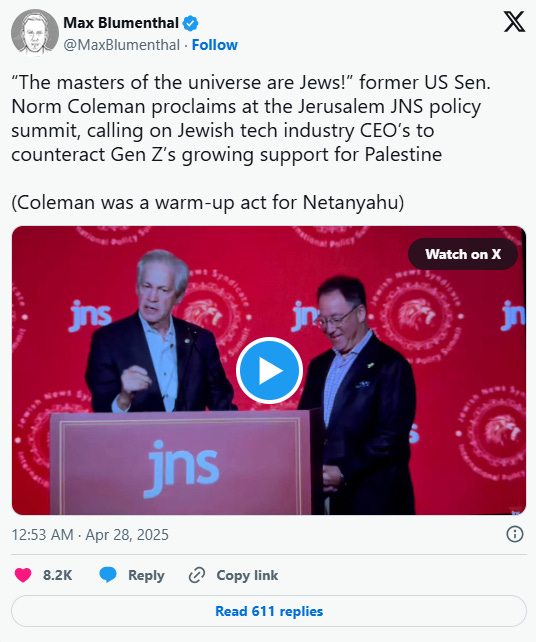
Ex-GOP Senator and Republican Jewish Coalition chair Norm Coleman proclaimed with a straight face that Jews control the world during a Jerusalem conference featuring a speech by Israeli PM Benjamin Netanyahu.
Former US Senator Norm Coleman has raised eyebrows by declaring that “the masters of the universe are Jews” at a major Zionist lobby event in Jerusalem. In an address to a summit hosted by the Adelson-funded Jewish News Syndicate on April 27, Coleman pointed to various major technology firms founded by Jews, suggesting the shared religion of the companies’ creators should translate into a greater zeal for censoring criticism of Israel.
“And when you think about it, the Masters of the Universe are Jews! We’ve got Altman at OpenAI, we’ve got [Facebook founder Mark] Zuckerberg, we’ve got [Google founder] Sergey Brin, we’ve got a group across the board. Jan Koum, y’know, founded WhatsApp. It’s us.”
The remarks came as Coleman lamented that pro-Israel propagandists are “losing the digital war” in battle for the hearts and minds of younger generations, and called for more stringent censorship of pro-Palestinian speech.
“A majority or Gen Z have an unfavorable impression of Israel. And, my friends, I think the reason for that is that we’re losing the digital war. They’re getting their information from TikTok, and… and we’re losing that war.”
As numerous polls show young Americans are increasingly skeptical of Israel – with a recent survey showing 71% of Democrats and 50% of Republicans under age 49 now hold an unfavorable view of Israel – establishment politicians have consistently blamed TikTok’s algorithm for the decline in enthusiasm for genocide. In February, the top Democrat on the Senate intelligence committee, Mark Warner, revealed that the bill forcing China’s ByteDance to sell TikTok was motivated by the visibility of pro-Palestine content on the app.
For Coleman, though, it appears this wasn’t enough. “We have to figure out a way to win the digital battle,” he told summit attendees. “We’ve got to get our digital sneakers on, so that the truth can prevail over the lies. And when we do that, the future of Israel will be stronger because a majority of all Americans will support Israel. We’ll make that happen, we have to make it happen. Thank you, Baruch hashem.”
Israeli Prime Minister Benjamin Netanyahu took the stage directly after Coleman’s speech, highlighting Tel Aviv’s interest in the event, which was billed as the “Inaugural JNS Policy Summit to address Israel’s pressing strategic issues.”
An archetypal neoconservative, Coleman started off as an anti-war activist who once worked as a roadie for Jethro Tull, and was suspended from Hofstra University for leading a sit-in. “I went to Woodstock, and I inhaled!” he boasted at the JNS summit. After first taking office as a member of the Democratic–Farmer–Labor Party, Coleman wound up narrowly losing his Senate seat to Al Franken in 2008 as a Republican.
In addition to serving as the national chairman of the Republican Jewish Coalition and founder of the Congressional Leadership Fund super PAC, Coleman now works as a top lobbyist for the Kingdom of Saudi Arabia.
‘A battle between right and wrong’: Houthi spokesman on confronting the US and Israel
The Grayzone | April 21, 2025
The Grayzone’s Max Blumenthal interviews Muhammad Al-Bukhaiti, senior political officer and spokesman for Ansar Allah (the Houthi movement), on Yemen’s direct confrontation with a US military machine which is hellbent on destroying its ability to resist Israel. In this third conversation between The Grayzone and Bukhaiti, the Ansar Allah spokesman explains why he believes his movement’s war with the US-Israeli axis is unlike any conflict that preceded it, and why he believes Yemen is engaged in a righteous battle despite the terrible toll its civilians have faced. This interview was translated by Hekmat Aboukhater.
Find more reporting at https://thegrayzone.com Support our original journalism at
Patreon:  / grayzone
Facebook:  / thegrayzone
Twitter:  / thegrayzonenews
Instagram:  / thegrayzonenews
If the US launches a ground operation against Yemen, it will backfire
By Robert Inlakesh | Al Mayadeen | April 21, 2025
Frustrated by its costly ongoing offensive campaign against Yemen, the Trump administration is said to be in talks to launch a ground effort aimed at seizing the strategic port city of Hodeidah, before effecting regime change in Sanaa. If this offensive does occur, it will result in a disastrous defeat for Washington.
In 2015, when then-US President Barack Obama backed the Saudi-led coalition’s war on Yemen, Riyadh had estimated that it would only take a few months to uproot the Ansar Allah leadership that had taken over Sanaa. Instead, they faced defeat after defeat at the hands of a highly-motivated armed force that received the backing of the majority of Yemen’s Armed Forces.
A decade later, despite the 2022 ceasefire, the conflict remains unresolved – and Ansar Allah’s power has only continued to grow. The movement that once seized control of Sanaa with the backing of key elements of the existing power structure, including segments of the military, was a shadow of what it has since become. Not only has it forged strong alliances with various tribal factions across Yemen, but it has also made leaps and bounds in developing both offensive and defensive weapons technologies.
The Yemeni Armed Forces that aligned with the Ansar Allah-led government proved capable of holding off the combined power of the Saudi-backed and UAE-backed Yemeni forces, in addition to various militant groups like Al-Qaeda and ISIS, also battling Saudi Arabia’s armed forces and later mercenary fighters from Sudan and elsewhere. They fought on the ground for years, amidst a US-Saudi blockade in the Red Sea, combined with US-British-Israeli logistical support being provided to their enemies, backing Riyadh’s air attacks against the country.
While managing to inflict countless defeats on what was supposed to be a militarily superior opposition – on paper – the Yemeni government in Sanaa continued to expand its power and territorial control in a country that has historically been divided between north and south.
In late 2021, game changing technological advances introduced a new dynamic to the conflict, ultimately pressuring the Saudi-led coalition to accept a UN mediated ceasefire proposal. By early 2022, after an expansion of the ground war the previous year, the Yemeni Armed Forces had launched a wave of successful drone and missile attacks at targets across the United Arab Emirates (UAE) and Saudi Arabia.
While Riyadh had been dealing with Ansar Allah’s drones and missiles for years by that point, it was clear that a significant technological advancement had occurred. And whereas the Saudi State had some capacity to absorb limited attacks on its vital infrastructure, the Emirati regime was far less equipped to withstand repeated blows from Yemen.
Abu Dhabi in particular cannot afford to absorb sustained waves of drone and missile attacks, especially if Dubai becomes a target. Unlike Saudi Arabia, the UAE is a tiny and vulnerable country. If Yemen decides to blanket them with strikes, their endeavors to diversify their economy will likely disintegrate, and no amount of deals with the US nor the Israelis can help them.
The claims that are being spread, particularly across Arabic language media, speculate that a Saudi-UAE backed force of about 80,000 soldiers is being amassed in order to launch an offensive aimed at seizing Hodeidah. Then, so goes the report, the US will offer air support and even launch a smaller ground attack to invade Yemen.
Donald Trump’s Vietnam?
Yemen was once dubbed Egypt’s Vietnam – and if the United States decides to launch a ground campaign there, the outcome is unlikely to align with President Donald Trump’s intentions. Already, the air campaign alone, which has to date killed around 150 civilians, has proven to be an embarrassing failure, costing US taxpayers billions of dollars with little to show in return.
Despite this war of aggression against Yemen being launched without a popular mandate, nor congressional approval, the US corporate media have largely chosen to ignore it. Yet, if Trump sends boots on the ground, Yemen will quickly dominate headlines, for the simple reason that US service members will start returning home in coffins.
So far, the Yemeni Armed Forces have limited their confrontations with the US’s naval fleets to defensive maneuvers, meaning that they have not been attempting to sink ships or aircraft carriers and are focused on defending their nation. If a large-scale ground operation is launched, the defensive posture will shift to one of offense.
The ground campaign will not only be costly and far from a walk in the park, the US will also endure direct hits to its vessels and significant casualties. Additionally, we should expect major attacks on both Saudi and Emirati infrastructure, which will disrupt oil markets. It is also very likely that US bases located in the Arabian Peninsula and beyond will come under attack.
Furthermore, we should probably expect occasional strikes against the Zionist regime that will be more intense than previous waves. If we begin to see the civilian death toll climb dramatically in Yemen, while the war is overtly an American-Zionist aggression, the way in which Ansar Allah will deal with it won’t be restricted any longer. On top of this, it could even end up uniting the people of Yemen to an even greater degree as a result, including factions and tribes that have always been at odds with Ansarallah.
Yemen is not Iran, but it has the capacity to inflict considerable losses on the US-allied regimes surrounding it and can target US forces directly. The question then becomes, can Riyadh and Abu Dhabi endure continuous barrages of munitions being fired towards them? Also, when the war lasts much longer than anticipated and the proxy ground force used to attack Yemen is suffering severe losses, as American soldiers return home in body bags, what will the strategy be then?
Will the 80,000 strong force continue to fight if they are suffering considerable losses, all in order to achieve a victory for Israeli strategic interests? Or will they begin to experience serious morale issues and defections? Will the US public be able to stomach the losses, and can the US military itself justify the loss of assets in a pointless fight to please their Zionist allies?
There will be no benefits to launching such an assault, and the US has not amassed nearly enough ground troops to launch a war alone. On every level, this would be a catastrophic strategic blunder. If they lose, this would be an embarrassment of historic proportions and nation-defining victory for the Sana’a government, despite the immense civilian suffering that will inevitably come from the war. All of this leaves out the potential involvement of other regional actors who may take advantage of the situation too.
If Trump decides to go ahead with such a conflict, in order to please his Zionist ally, it will greatly backfire. There will also be no way to hide the fact that he is working against US interests and sacrificing his own citizens in order to make the Israelis satisfied, without any real end goal or vision for victory.
Will Yemen turn its missiles on the UAE and Saudi Arabia?
By Bandar Hetar | The Cradle | April 16, 2025
The US war on Yemen, now in its second round, has passed the one-month mark with no clear gains and no timeline for success. What is emerging instead is the growing risk of escalation – one that could force regional players, particularly Saudi Arabia and the UAE, into direct confrontation.
Still, several factors may delay or even prevent such a scenario, much like what played out last year. Understanding where this war may be headed requires a clear grasp of the terrain: how Yemen views the conflict, how its Persian Gulf neighbors are reacting, and what could trigger a wider eruption or a negotiated backtrack.
Sanaa ties its military strategy to Gaza’s resistance
Even in western circles, there’s little dispute that the war on Yemen is now deeply intertwined with Israel’s brutal war on Gaza. Washington tried, under former US president Joe Biden, to separate the two. But the reality on the ground tells a different story – one where Sanaa’s military operations were in lockstep with events in Palestine.
That link became even clearer after the January 2025 ceasefire between Hamas and Israel, which prompted a pause in Yemen’s attacks – until Tel Aviv predictably walked back its commitments. US President Donald Trump’s return to the White House brought with it a resumption of strikes on Yemen, under the pretext of defending international shipping.
Yet those attacks would not have taken place had the US not already committed to shielding Israeli vessels. The new administration, unlike the last, makes no real attempt to disguise the overlap between the two fronts.
Yemen’s strategy has been clear from the outset: Its military activity is calibrated with the resistance in Gaza. Palestinian factions determine the pace of escalation or calm, while Yemen remains prepared to absorb the fallout.
Sanaa has paid a steep price for this stance. Washington has moved to freeze economic negotiations between Yemen and Saudi Arabia, effectively punishing the former for refusing to abandon its military support for Gaza. The US has dangled economic incentives in exchange for neutrality – offers readily accepted by Arab states across the region – but Sanaa has refused to fold.
Faced with a binary choice – either maintain its support for Palestine and accept a freeze on domestic arrangements, or open a second front with Riyadh and Abu Dhabi – Yemen chose to stay the course.
That decision was rooted in three core beliefs: that Palestine must be supported unconditionally, even if it means sacrificing urgent national interests; that Ansarallah’s political identity is grounded in opposition to Israeli hegemony and thus incompatible with any alignment with Persian Gulf normalization; and that Yemen must deny Washington and Tel Aviv the opportunity to distract it with side wars designed to weaken its strategic focus.
Gulf frustration builds over Yemen’s defiance
Arab coalition partners Saudi Arabia and the UAE have not taken kindly to Yemen’s decision. Both countries have used the moment to begin backpedaling on the April 2022 truce and to impose punitive costs on Sanaa for throwing its weight behind Gaza.
The optics have not favored either of the Gulf monarchies. Abu Dhabi is fully normalized with Israel, while Riyadh is edging ever closer. Yemen, meanwhile – still scarred from years of Saudi–Emirati aggression – has moved swiftly to back the Palestinian cause. The contrast could not be more stark: The Arab state most brutalized by Riyadh and Abu Dhabi is now standing up for Palestine while the aggressors look away.
Yemen’s stance also clashes with the broader geopolitical alignment of both Persian Gulf states, which remain deeply embedded in Washington’s orbit. But their frustration has remained mostly rhetorical.
Despite their roles in the so-called “Prosperity Guardian” alliance, neither Saudi Arabia nor the UAE has made major military moves against Yemen since the new round of US airstrikes began. Initially, Riyadh attempted to tie Yemen’s maritime operations in the Red Sea to the Gaza war, but that framing soon gave way to vague talk of threats to commercial shipping – code for backpedaling.
Saudi political messaging shifted sharply in January when it refused to take part in joint US–UK bombing raids. Its defense ministry moved quickly to deny reports that Saudi airspace had been opened for US strikes, and later distanced itself from any Israeli involvement. The message from Riyadh was clear: It does not want to be dragged into another full-scale war with Yemen – not now.
Yemen counters with a policy of containment
Despite Saudi Arabia’s retreat from its prior commitments, Yemen has actively encouraged Riyadh and Abu Dhabi to maintain a posture of neutrality. This is not out of optimism but pragmatism: Avoiding a wider war with the Persian Gulf would prevent a dangerous regional blowout. Sanaa’s goal has been to steer Saudi and Emirati decision-making away from military confrontation, proxy mobilization, or economic escalation.
That last point nearly tipped the balance in July 2024, when Riyadh instructed its puppet government in Aden to relocate Yemen’s central banks from Sanaa. It was a clear economic provocation – and a red line.
Within days, Ansarallah leader Abdul Malik al-Houthi delivered a sharp warning, framing the Saudi move as part of an Israeli–American playbook.
“The Americans are trying to entangle you [Saudi Arabia], and if you want that, then try it … The move towards aggressive escalation against our country is something we can never accept,” he revealed in a 7 July 2024 speech.
He warned Riyadh that falling for this trap would be “a terrible mistake and a great failure, and it is our natural right to counter any aggressive step.”
Sanaa responded with an unmistakable deterrent equation: “banks for banks, Riyadh Airport for Sanaa Airport, ports for ports.”
The Saudi maneuver may have been a test of Yemen’s resolve, possibly based on the assumption that Sanaa was too overextended – facing down a US-led coalition and spiraling domestic hardships – to respond decisively.
If so, Riyadh miscalculated. Houthi’s reply was blunt:
“This is not a matter of allowing you to destroy this people and push it to complete collapse so that no problems arise. Let a thousand problems arise. Let matters escalate as far as they may.”
No appetite in Riyadh or Abu Dhabi for a war without guarantees
The day after Houthi’s warning, massive protests erupted across Yemen. Millions marched in condemnation of Saudi provocations, offering the clearest signal yet that public opinion was firmly aligned behind the resistance – and willing to escalate.
Riyadh knows this. Even before the latest crisis, much of Yemeni society held Saudi Arabia and the UAE responsible for what even the UN called the world’s worst humanitarian disaster. Any new conflict would only deepen that anger.
Faced with the threat of direct retaliation, Riyadh backed off its banking gambit. The memory of past Yemeni strikes on Saudi oil facilities – particularly those between 2019 and 2021 –still haunts the Saudi leadership.
Today, Yemen’s capabilities have expanded. It now possesses hypersonic missiles and increasingly sophisticated drone technologies. And it is precisely because of these advances that Washington has failed to strong-arm the Gulf into renewed warfare. There are no meaningful US security guarantees on the table – nothing that would shield Saudi oil fields, critical infrastructure, or commercial shipping lanes from blowback.
The failures are already evident. The “Prosperity Guardian” coalition has done little to stop Yemeni strikes on Israeli-linked vessels, and US–UK airstrikes have failed to stem Yemen’s ability to hit deep inside Israel. These battlefield realities have changed the calculus in Riyadh and Abu Dhabi. Escalation, for now, is off the table.
Yemen’s red lines are expanding
That does not mean Washington has stopped trying to drag Saudi Arabia and the UAE into the fight. The Biden administration failed to do so. The Trump team, however, is seen as more aggressive and more likely to provide advanced weapons systems that might tempt Riyadh and Abu Dhabi to take the plunge.
There is also the perception among Gulf elites that this is a strategic opening: Syria’s collapse, Hezbollah’s supposed decline, and shifting regional dynamics may provide a rare window to redraw the map.
But for the Saudis, Yemen remains the central concern. A liberated, ideologically defiant state on their southern border is an existential threat – not only to security, but to the cultural rebranding project that the Kingdom has invested so heavily in. The UAE shares similar anxieties. A rising Yemeni Resistance Axis threatens its carefully curated image as a regional player in sync with Israeli and western interests.
That is why Sanaa has placed its forces on high alert. Ansarallah is monitoring every move by Riyadh, Abu Dhabi, and their local proxies – many of whom are eager to join the war. These groups have signaled readiness to participate in an international coalition to “protect shipping,” and have already held direct meetings with US military and political officials.
But the Sanaa government knows these factions would not act without orders. If they are mobilized for a broad ground offensive, Yemen will respond by targeting the powers behind them. Any ground war will be seen as a Saudi–Emirati initiative, not a local one. The same logic applies to renewed airstrikes or deeper economic war. These are Sanaa’s red lines.
A warning to the Axis of Normalization
Abdul Malik al-Houthi laid it out clearly during a 4 April address:
“I advise you all [Arab states neighboring Yemen], and we warn you at the same time: Do not get involved with the Americans in supporting the Israelis. The American enemy is in aggression against our country in support of the Israeli enemy. The battle is between us and the Israeli enemy.
The Americans support it, protect it, and back it. Do not get involved in supporting the Israeli enemy … any cooperation with the Americans in aggression against our country, in any form, is support for the Israeli enemy, it is cooperation with the Israeli enemy, it is conspiracy against the Palestinian cause.”
He went further:
“If you cooperate with the Americans: Either by allowing him to attack us from bases in your countries. Or with financial support. Or logistical support. Or information support. It is support for the Israeli enemy, advocacy for the Israeli enemy, and backing for the Israeli enemy.”
This was not just a warning. It was a strategic declaration. Any country crossing these lines will be treated as an active participant in the war – and subject to retaliation.
The message is aimed not just at Riyadh and Abu Dhabi, but at other Arab and African states that might be tempted to join the fray under the guise of “protecting international navigation.”
Yemen is preparing for all scenarios. It will not be caught off guard. And this time, it won’t be fighting alone.
US airstrikes in Yemen lay groundwork for ‘ground invasion’ by UAE-backed militias: Report
The Cradle | April 15, 2025
With US support, UAE proxy militias in Yemen are planning a ground offensive to take the port city of Hodeidah from the Ansarallah-led Yemeni government and armed forces, The Wall Street Journal (WSJ) reported on 15 April, in a move that would reignite the country’s devastating civil war.
“Private American security contractors provided advice to the Yemeni factions on a potential ground operation, people involved in the planning said. The United Arab Emirates, which supports these factions, raised the plan with American officials in recent weeks,” the WSJ wrote.
The ground offensive seeks to take advantage of the recent US bombing campaign targeting the Yemeni Armed Forces (YAF).
US officials speaking with the newspaper said Washington has launched more than 350 strikes during its current campaign against Yemen and claim that the YAF has been weakened as a result.
While the Ansarallah-led National Salvation Government controls Yemen’s most populous areas, including the capital, Sanaa, and the strategic port city of Hodeidah, other parts of the country have remained in control of UAE and Saudi-supported factions since the end of the civil war in 2022.
Under the plan being discussed, factions of the UAE-backed Southern Transitional Council (STC) would deploy their forces north to the western Yemeni coast and try to seize the Red Sea port of Hodeidah, pro-UAE Yemeni sources said.
If successful, the ground operation would push the YAF back from large parts of the coast from where they have launched attacks on Israeli-linked ships transiting the Red Sea.
The YAF began targeting Israeli-linked ships in November 2023 in response to Israel’s genocide of Palestinians in Gaza. The US launched a war against Yemen and the YAF on Israel’s behalf shortly thereafter.
Capturing Hodeidah would be a “major blow” to the Ansarallah-led Yemeni government, “depriving them of an economic lifeline while also cutting off their main route to receive arms from Iran,” the WSJ wrote.
“A major ground offensive risks reigniting a Yemeni civil war that has been dormant for years and that spurred a humanitarian crisis when a Saudi–Emirati coalition supported local ground forces with a bombing campaign,” the WSJ added.
Officials from Saudi Arabia, which supports another Yemeni faction, the Presidential Leadership Council (PLC), have privately said they will not join or help a ground offensive in Yemen.
During the civil war, the Saudi-led coalition, alongside the UAE, conducted a major bombing campaign in Yemen that killed nearly 15,000 people, while the Saudi navy blockaded Yemen’s major ports, causing a humanitarian crisis that killed hundreds of thousands more.
In 2018, the Saudi Kingdom launched three operations against Ansarallah in an attempt to capture Hodeidah, yet failed.
Ansarallah forces retaliated by launching ballistic missile and drone attacks on Saudi cities, including striking a Saudi Aramco oil storage facility in Jeddah, which threatened to devastate the kingdom’s oil production and exports.
The YAF also responded to the UAE’s aggression on Yemen by launching its first drone and missile attacks on Abu Dhabi in January 2022, targeting three oil trucks and an under-construction airport extension infrastructure.
Both the UAE and Saudi Arabia allegedly cooperated with and recruited fighters from the local Al-Qaeda affiliate, known as Al-Qaeda in the Arabian Peninsula (AQAP), to assist in their proxy war against Ansarallah.
Gulf-backed genocide: How Arab monarchies fuel Israel’s war machine
By Mawadda Iskandar | The Cradle | April 10, 2025
The Persian Gulf states’ silence – and in many cases, complicity – during Israel’s ongoing war on Gaza has not come as a shock. These governments, long detached from the Palestinian struggle, have for years cultivated warm, if discreet, ties with Tel Aviv.
While Bahrain and the UAE made normalization of ties with Tel Aviv official through the US-brokered 2020 Abraham Accords, other states like Saudi Arabia and Qatar have played quieter but equally pivotal roles. Riyadh, often described as the architect behind normalization, and Doha, hiding behind its “mediator” label, have each aided the occupation state in crucial ways.
Though much of this assistance remains behind the scenes, it has been repeatedly acknowledged by US and Israeli officials. During his first term, US President Donald Trump once warned that “Israel would be in big trouble without Saudi Arabia,” while Israeli Prime Minister Benjamin Netanyahu has said that Arab leaders now view Israel “not as their enemy, but their greatest ally,” adding that they “want to see us defeat Hamas.”
Such statements offer a glimpse into the vast, opaque network of regional cooperation propping up the occupation state’s war machine.
Economic complicity
Despite overwhelming popular support throughout the Arab world for Palestine, and growing calls for grassroots boycotts, Persian Gulf–Israeli trade has only surged. The UAE now ranks as Israel’s top Arab trade partner, while Bahrain’s commerce with Tel Aviv spiked by a staggering 950 percent during the first 10 months of the Gaza war.
Even amid war and boycott efforts, “kosher-certified” goods from Arab countries continue to enter Israeli markets. UAE-based brands like Al Barakah Dates and Hunter Foods, along with Saudi Arabia’s Durra (a sugar supplier), have maintained trade channels.
Qatar has exported crude materials for plastics used in Israeli industries. Bahrain went so far as to officially recognize goods produced in illegal West Bank settlements as Israeli in origin.
More insidiously, Persian Gulf investments are directly fueling Israeli settlement expansion. Saudi Arabia, the UAE, and Qatar have funneled money into Avenue Partners, a firm chaired by Trump’s son-in-law Jared Kushner, who remains involved in advising the Trump administration from afar.
That money flows into Phoenix Holdings, which finances key banks involved in settlement construction – Leumi, Hapoalim, and Discount Bank – as well as telecom firms like Cellcom and Partner, and construction companies like Electra and Shapir, all of which operate inside occupied Palestinian territory.
When Yemen’s blockade disrupted shipping lanes for Israeli-linked cargo in the Red Sea, cutting off 70 percent of Tel Aviv’s food imports, it was the Persian Gulf states that rushed to patch the breach. The UAE created an overland logistics corridor from Dubai to Tel Aviv via Saudi Arabia and Jordan, and Bahrain repurposed its ports to serve as alternate shipping hubs for Israeli goods arriving from India and China.
Military ties beneath the surface
From the earliest days of Israel’s onslaught on Gaza, the UAE has doubled down on its strategic military relationship with the occupation state. In 2024, Balkan Insight revealed that a UAE-linked firm, Yugoimport-SDPR, exported $17.1 million worth of weapons to Israel via military aircraft directly involved in bombing Gaza.
But the arms trade is only part of this treacherous picture. The UAE’s state-owned defense giant EDGE holds shares in Israeli military contractors like Rafael and Israel Aerospace Industries (IAI), companies that retrofit Emirati planes into military freighters. Abu Dhabi has also welcomed offices from Israeli weapons manufacturers like Bayt Systems and Third Eye Systems, and proudly hosted 34 Israeli defense firms at IDEX 2025 – a major arms expo used to secure deals with the occupation army.
Though not formally normalized, Saudi Arabia is militarizing its ties with Israel through indirect channels. One method: purchasing Israeli systems like the TOW missile through US-based subsidiaries of Elbit Systems. Another: acquiring surveillance drones from South Africa, which are disassembled and reassembled in the kingdom to mask their Israeli origins.
A recent anti-drone system – suspected to be designed by Israeli firm RADA – was spotted at the Royal Saudi Air Defense base in Tabuk, near King Faisal Air Base.
Meanwhile, Qatar has quietly boosted its military coordination with Tel Aviv. Doha continues to source spare parts for tanks, armored vehicles, and aerial tankers from Israeli suppliers, and its military has participated in joint drills involving Israel and other Persian Gulf states – including exercises in Greece held just over a week ago.
Logistical lifelines to Tel Aviv
Beyond military and economic ties, Persian Gulf states have facilitated the flow of weapons to Israel through logistical support channels. As the US ramped up its “unprecedented airlift” of tens of thousands of missiles, munitions, and Iron Dome components, the Gulf’s airspace and bases became critical.
US arms shipments passed through Saudi Arabia, Bahrain, Jordan, and especially Qatar, where the Al-Udeid Air Base – home to US Central Command – served as a hub for at least 18 documented transfers. Several were routed through Cyprus to avoid direct flight tracking.
In the UAE, Dubai International Airport became a waypoint for Israeli reservists flying in from Asia. Coordinated through the Israeli consulate in Dubai, these flights funneled soldiers into the war in Gaza. Emirati authorities also arranged leisure retreats for Israeli troops between deployments and allowed Jewish organizations in Dubai to send care packages to the occupation military.
Pipeline diplomacy and energy normalization
Earlier this month, as Trump prepared to visit Saudi Arabia seeking investment in US infrastructure, Israeli Energy Minister Eli Cohen unveiled plans for a regional oil pipeline stretching from Ashkelon to Saudi Arabia via Eilat.
The project falls under the India-Middle East-Europe Economic Corridor (IMEC), a US-backed alternative to China’s Belt and Road Initiative (BRI), with links running through the UAE, Jordan, and occupied Palestinian lands.
In a related move, Nasser bin Hamad Al Khalifa – son of the Bahraini king and chair of Bapco Energy – announced the sale of a pipeline stake to BlackRock, the US investment giant notorious for its financial ties to Israeli settlements. This deal cannot be separated from the broader normalization agenda.
Spycraft and surveillance
In one of the clearest signs of deepening security cooperation, Axios revealed a secret 2024 meeting in Bahrain between Israeli army chief Herzi Halevi and senior military officials from Bahrain, Saudi Arabia, the UAE, Jordan, and Egypt.
Overseen by US Central Command, the summit focused on countering Iranian retaliation and disrupting weapons flows to Gaza from resistance forces in Iraq and Yemen – operations that often transit through Persian Gulf-controlled airspace.
Bahrain’s role was particularly overt: Nasser bin Hamad openly declared his country’s commitment to disrupting Iranian response operations in coordination with the US Fifth Fleet stationed in Manama. Analysts now speculate that Tel Aviv could be granted permanent naval access to strategic Gulf waters.
This growing security convergence has also opened the door for Israeli tech to penetrate Persian Gulf infrastructure. Bahrain now relies on Israeli firms for anti-drone systems, satellite surveillance, and cybersecurity. One notable collaboration involves Bahraini company Crescent Technologies and Israeli cyber defense powerhouse CyberArk.
The UAE is pushing the envelope even further. Emirati firms have signed deals with XM Cyber – co-founded by a former Mossad chief – to secure national energy infrastructure. XM Cyber works in tandem with Rafael and other elite Israeli military firms as part of a consortium targeting sensitive Gulf markets, including oil, energy, and data. Meanwhile, Orpak Systems, another Israeli company, has quietly entered Arab oil sectors under nondescript branding to avoid detection.
Despite their public posturing and periodic statements of support for Palestine, the Persian Gulf states have quietly entrenched themselves in Tel Aviv’s war effort. Through investment flows, arms deals, intelligence cooperation, and energy infrastructure, they have become vital enablers of the genocide in Gaza.
This alliance – crafted in backrooms and sealed with economic interests – has allowed Israel to prosecute its war on Gaza with Gulf assistance at every logistical and financial juncture.
Far from being passive actors, these states are now active partners in a conflict that has devastated an entire people.
Talk of US-Iran war is all a load of baloney
By M. K. BHADRAKUMAR | Indian Punchline | March 26, 2025
The air is thick with the prognosis that a military confrontation between the US and Iran is now just a matter of time. Going by the pattern of such scare mongering in the past decades, Israeli media management skills are self-evident. There is a sense of de javu. Of course, therein lies the danger of miscalculations by the protagonists but that is unlikely to happen.
There are no takers among the regional states for a military conflagration in the Gulf region. The old US-led anti-Iran front has unravelled following the shift in the Iranian and Saudi policies towards reconciliation and amity and the display of strategic autonomy by even those countries who still remain close allies of the US (in particular, Saudi Arabia, the UAE, Qatar.)
In a recent interview with the famous American podcaster Tucker Carlson, Qatar’s Prime Minister and Minister of Foreign Affairs Sheikh Mohammed bin Abdulrahman Al Thani drew an apocalyptic scenario that his country and the Persian Gulf Arab states will run out of water within three days if Iran’s nuclear facilities are targeted by the US or Israel! Does that occur to anyone?
The big question is, what are the intentions of the Trump administration. An underlying assumption here is that President Donald Trump is under obligation to the Jewish-Israeli lobby who funded his election campaign to be supportive of Netanyahu all the way through thick and thin. This assumption is untested yet and may never be, perhaps, given Trump’s complex personality as a deal maker.
According to a recent poll from YouGov, 52% of Americans think Trump will have a shot at a third term; former White House strategist Steve Bannon is convinced that Trump will run and win in 2028. Indeed, Trump himself has not ruled out a 2028 White House bid. This is an X factor, given the historical legacy that the Iran question ultimately proved to be the nemesis of Jimmy Carter’s presidency. Trump, a connoisseur of past American presidencies, cannot be unaware that he ought to tread with great circumspection.
In an interview with Tucker Carlson last week, Trump’s Middle East special envoy Steve Witkoff underscored that regional stabilisation in West Asia demands addressing Iran. In his words, “I would say the goal begins with how do we deal with Iran? That’s the biggie. So the first is nuclear… If they were to have a bomb that would create North Korea in the GCC, we cannot have that… we can never allow someone to have a nuclear weapon and have outsized influence. That doesn’t work. So if we can solve for that, which I’m hopeful that we can.
“The next thing we need to deal with Iran is they’re being a benefactor of these proxy armies because we’ve proven that … they’re not really an existential risk… But if we can get these terrorist organisations eliminated as risks. Not existential, but still risks. They’re destabilising risks. Then we’ll normalise everywhere. I think Lebanon could normalise with Israel, literally normalise, meaning a peace treaty with the two countries. That’s really possible.
“Syria, too, the indications are that Jelani is a different person than he once was. And people do change. You at 55 are completely different than how you were at 35, that’s for sure… So maybe Jelani in Syria is a different guy. They’ve driven Iran out.
“Imagine if Lebanon normalises, Syria normalises, and the Saudis sign a normalisation treaty with Israel because there’s a peace in Gaza. They must have that as a — without question — as a prerequisite. That’s a condition precedent to Saudi normalising. But now you’d begin to have a GCC that all work together. I mean, that would be, it would be epic.”
Does this ‘big picture’ envisage the destruction of Iran as a prerequisite? Not even remotely. And if anyone should know what he is talking about, it is Witkoff.
Later, towards the end of the interview, Carlson drew out Witkoff specifically with regard to Trump’s recent communication addressed to Iran’s Supreme Leader Ayatollah Ali Khamenei. Excerpts of Witkoff’s remarks are reproduced below:
“Look, he [Trump] sent a letter to the Iranians. Usually it would be the Iranians sending a letter to him…They’re open to attack today. Yeah, they’re a small country compared to ours… If we used overwhelming force, it would be very, very bad for them…
“So under those circumstances, it would be natural for the Iranians to reach out to the President to say, I want to diplomatically solve this. Instead, it’s him doing that. Now, I can tell you that he’s not reaching out because he’s weak, because he is not a weak man. He is a strong man… Maybe the strongest man I’ve ever met in my life…
“So with that all said, he wrote that letter. And why did he write that letter? It roughly said, ‘I’m a president of peace. That’s what I want. There’s no reason for us to do this militarily. We should talk. We should clear up the misconceptions. We should create a verification program so that nobody worries about weaponisation of your nuclear material. And I’d like to get us to that place because the alternative is not a very good alternative.’ That’s a rough encapsulation of what was said…
“The Iranians have reached back out, and I’m not at liberty to talk about specifics, but clearly, through back channels, through multiple countries and multiple conduits, they’ve reached back out.
“I think that it has a real possibility of being solved diplomatically, not because I’ve talked to anybody in Iran, but just because I think logically it makes sense that it ought to be solved diplomatically. It should be.
“I think the President has acknowledged that he’s open to an opportunity to clean it all up with Iran, where they come back to the world and be a great nation once again and not have to be sanctioned and being able to grow their economy. Their economy—I mean, these are very smart people. Their economy was once a wonderful economy. They’re being strangled and suffocated today. There’s no need for that to happen.
“They can join the League of Nations and we can have a better relationship and grow that relationship… That’s the alternative he’s presenting… he wants to deal with Iran with respect. He wants to build trust with them if it’s possible. And that’s his directive to his administration. And hopefully, that will be met positively by the Iranians.
“And I’m certainly hopeful for it. I think anything can be solved with dialogue by clearing up misconception and miscommunication and disconnects between people… And the president is a president who doesn’t want to go to war, and he’ll use military action to stop a war … In this particular case, hopefully it won’t be necessary. Hopefully, we can do it at the negotiating table…”
Again, do such remarks sound like war mongering? Curiously, in the interview, Witkoff openly welcomed an opportunity to serve as Trump’s special envoy to Iran to navigate the dialogue and peaceful resolution of issues.
To my mind, Iranians understand the meaning of Trump’s letter. They are now in an engaging mood as back channels are clocking hours. A commentary by Nour News, a mouthpiece of the Iranian security establishment, rather playfully titled as Analysis of Trump’s Letter to Iran from a Game Theory Perspective, speaks for the mood in Tehran. Read it here.
Make no mistake that Iran and the US are seasoned adversaries who have absolute mastery over the guardrails that contain tensions from escalating in their complicated relationship.
How a war with Iran (for Israel) could crash the US economy
By Shivan Mahendrarajah | The Cradle | March 21, 2025
The “winds of war” are blowing toward Iran. This is the war for which Israeli donors Sheldon and Miriam Adelson, along with pro-Israel organizations such as AIPAC and the ADL, paid US President Donald Trump hundreds of millions of dollars over two election cycles.
But it’s not only the Israeli lobby banging the war drums; American Evangelicals – especially groups like “Christians United for Israel” – also support war, believing it will “save Israel” from the “Iranian menace.” Evangelical membership in the 119th Congress (2025–27) is high. War with Iran is not (yet) popular in the US, but – just as with Iraq – consent will be manufactured by Washington elites and the media.
Trump’s outreach to Russian President Vladimir Putin to resolve the Ukraine war partly aims to shift the Pentagon’s attention back to West Asia. He assumes that an early 2025 war with Iran will “save Israel” and secure his legacy, letting him focus on “America First” for the rest of his term.
But war with Iran could also backfire disastrously, sink his presidency, and derail the ambitions of 2028 Republican hopefuls like Marco Rubio and J.D. Vance. For starters, should the military campaign encounter any unforeseen backlash – which is highly likely, and the reason the Pentagon has assiduously avoided direct confrontation with Iran – the Democratic Party could retake both chambers of Congress after a US stock market crash and recession triggered by the war.
Iran’s military responses
Iranian leaders have vowed “devastating” retaliation for any attack on their soil. This would likely involve missile strikes against Israeli and US military targets – and possibly infrastructure and economic targets within the occupation state. If Israel uses tactical nuclear weapons against Iran’s nuclear facilities, Tehran will escalate further.
Whether or not nukes are used, war would shock the global economy, send oil prices soaring, and halt maritime traffic through the Strait of Hormuz. The greatest impact will fall on countries most dependent on West Asian oil.
The US economy may be less affected in the short term. Its stock markets, already down 10 percent since Trump’s return to the White House, would decline further – but Trump is gambling that households will not feel the pain. But if the Islamic Republic launches economic warfare that “brings the war home,” political dynamics will change.
Economic warfare
Most Americans are detached from the notion and consequences of war because, since the Civil War, US wars have been fought far from its borders. Even during the World Wars, though American families faced personal loss, the nation did not endure widespread suffering – unlike Britain, which imposed food rationing from 1939 to 1954.
The “Global War on Terror” impacted some communities, but not the country. US troops often joked in Iraq: “We’re at war; America’s at the mall.” Americans kept spending and enjoying life, while Iraqis and US occupation soldiers endured the brutal costs.
Iranian leadership understands this disconnect. The US stock market is a tempting target. In 1929, at the start of the Great Depression, just 2.5 percent of Americans owned stock. Today, about 61 percent of US adults – roughly 160 million people – own shares through private accounts, pension schemes, or retirement plans.
Factoring in children in such households, roughly 200 million Americans are exposed to market fluctuations. Trillions more dollars are invested by corporations, universities, and foreign institutions. The exposure is deep.
The US economy is fragile. Mark Zandi, Moody’s chief economist, warned that the risk of recession is “uncomfortably high and rising.” On 19 March, Federal Reserve Chair Jerome Powell kept interest rates steady, citing slowing consumer spending and growing uncertainty. Trump, fearing economic fallout, raged on Truth Social over the Fed’s refusal to cut rates. He announced retaliatory tariffs set to take effect on 2 April.
Household debt is rising – $18.04 trillion as of Q4 2024 – with increasing defaults on auto loans and credit cards. Americans, like the federal government, spend on credit. Investors borrow against their portfolios with margin loans. If stock values fall, forced selloffs to cover debts could intensify market collapse. “Margin calls” – demands for loan repayments – played a greater role in the ensuing economic turmoil than the 13 percent market drop on 28 October 1929.
The US economy is already strained, and consumers are over-leveraged. A large external shock could push it into a deep recession. Stock markets would plunge, wiping out pension savings and private wealth.
How far markets fall would depend on the force of Iran’s blow. The current 10 percent drop has already hurt. A deeper decline – say, 25 to 50 percent – would cripple the economy, spark layoffs and bankruptcies, and tighten credit. That would suppress consumer spending and crash the housing market, as in 2008.
Tehran’s targets
As Iranian leaders have often repeated, “If Iran cannot sell oil, no one will.” If US or Israeli forces strike Iranian tankers or infrastructure, Tehran is likely to target US economic interests and the oil sectors of any Persian Gulf Arab state that supports the attacks by allowing fighter jets, drones, or missiles to launch from their territories.
The Islamic Revolutionary Guard Corps (IRGC) may choose to strike Bahrain, which is an obvious military target since it hosts the US Naval Forces Central Command. In addition to military sites, Iran could target the Bahrain Petroleum Company’s refinery, which processes 270,000 barrels per day, along with its marine terminal and oil storage facilities.
The oil farm holds 14 million barrels – ample fuel for a dramatic strike. Iran could also destroy the King Fahd Causeway connecting Bahrain to Saudi Arabia to prevent Riyadh from sending ground troops to suppress unrest among Bahrain’s majority Shia population, as it did during the 2011 uprising.
In Iraq, too, US military bases will almost certainly come under fire. Beyond that, Iran-aligned factions within the Popular Mobilization Forces (PMF) may attempt to capture the 2,500 US troops still stationed there – not to kill them, but to take them as hostages.
Living captives would be far more valuable, creating a nightmare scenario for Trump and serving as a sharp reminder to Americans – who often forget the wars they once supported – that US troops remain in Iraq more than two decades after the 2003 invasion. These POWs would likely be scattered across the country, making coordinated rescue missions difficult and turning them into bargaining chips in any future negotiations.
Jordan, having allowed Israeli overflights last year in October during Iran’s retaliatory strikes and before that in April, is likely to do so again and could face significant retaliation. In addition to the Zarqa oil refinery, Iranian forces might strike political, military, and intelligence targets. Such attacks would certainly provoke unrest among Jordan’s population, the majority of whom are of Palestinian descent and already harbor grievances against their leadership for its collusion with Tel Aviv.
The UAE, if complicit in the attacks, could face military strikes on its energy infrastructure and power plants, as it experienced during its war with Yemen. The Emirates is particularly vulnerable due to its demographic makeup – about 88 percent of its population consists of foreign workers. If those workers flee following targeted attacks, the country’s economy would be brought to its knees.
Qatar and Oman are likely to be treated differently. Muscat, with its long-standing neutral foreign policy in the region, has maintained warm relations with Iran, and will not likely participate in a US military aggression. Doha also enjoys relatively good relations with Tehran, though it hosts the US Central Command’s (CENTCOM) Al-Udeid Air Base and worked to thwart Iranian interests in Syria. Iran might strike CENTCOM’s headquarters in West Asia, but is unlikely to target other Qatari assets.
Saudi Arabia presents a more complex scenario. Although both Russia and China have encouraged reconciliation between Iran and Saudi Arabia, the kingdom may not remain on the sidelines. If it does participate in hostilities, it would become a high-priority target.
Even if Riyadh stays neutral, Iran might still strike its East–West oil pipeline, which terminates at the port of Yanbu. That pipeline – built in 1982 to bypass the Persian Gulf – delivers over three million barrels per day to Europe.
Yanbu’s port, refinery, and export terminals, some of which are operated in partnership with western firms, would be natural targets. A simultaneous closure of the Strait of Hormuz and disruption of Red Sea traffic would block the export of roughly five million barrels per day. While former UN weapons inspector Scott Ritter predicted oil prices could surge to $120 per barrel, Iran might be capable of pushing them as high as $200.
China, when retaliating against Trump’s tariffs, acted strategically. It imports just 7 percent of its pork from the US, but most pork producers are in Republican “red states.” Targeting that sector hurt Trump’s base directly.
While spiking oil prices and global economic turmoil would harm Iran’s allies and the Global South, Iran’s adversaries in the US, UK, Israel, and EU stand to lose the most. If Iran wages a smart economic war, even Evangelicals may start caring more about their grocery bills than hastening the reconstruction of the “Third Temple” and other end-times prophecies.
Seyed Marandi: America Attacks Yemen – Has Trump Set Himself Up For Failure?
Glenn Diesen | March 19, 2025
Seyed Mohammad Marandi is a professor, analyst and advisor to Iran’s nuclear negotiation team
Follow me:
Substack: https://glenndiesen.substack.com/
X/Twitter: https://x.com/Glenn_DiesenPatreon:
Support the channel:
PayPal: https://www.paypal.com/paypalme/glenn…
Buy me a Coffee: buymeacoffee.com/gdieseng
Go Fund Me: https://gofund.me/09ea012f
Trump’s ingenuity vis-à-vis Russia, Iran
By M. K. BHADRAKUMAR | Indian Punchline | March 10, 2025
Through the past three year period, Moscow claimed that it faced an existential threat from the US-led proxy war in Ukraine. But in the past six weeks, this threat perception has largely dissipated. The US President Donald Trump has made a heroic attempt to change his country’s image to a portmanteau of ‘friend’ and ‘enemy’ with whom Moscow can be friendly despite the backlog of a fundamental dislike or suspicion.
Last week, Trump turned to the Iran question for what could be a potentially similar leap of faith. There are similarities in the two situations. Both Russian President Vladimir Putin and Iranian president Masoud Pezeshkian are quintessential nationalists and modernisers who are open to westernism. Both Russia and Iran face US sanctions. Both seek a rollback of sanctions that may open up opportunities to integrate their economies with the world market.
The Russian and Iranian elites alike can be described as ‘westernists’. Through their history, both Russia and Iran have experienced the West as a source of modernity to ‘upgrade’ their civilisation states. In such a paradigm, Trump is holding a stick in one hand and a carrot on the other, offering reconciliation or retribution depending on their choice. Is that a wise approach? Isn’t a reset without coercion possible at all?
In the Russian perception, the threat from the US has significantly eased lately, as the Trump administration unambiguously signalled a strategy to engage with Russia and normalise the relationship — even holding out the prospects for a mutually beneficial economic cooperation.
So far, Russia has had a roller coaster ride with Trump (who even threatened Russia with more sanctions) whose prescriptions of a ceasefire to bring the conflict in Ukraine to an end creates unease in the Russian mind. However, Trump also slammed the door shut on Ukraine’s NATO membership; rejected altogether any US military deployment in Ukraine; absolved Russia of responsibility for triggering the Ukraine conflict and instead placed the blame squarely on the Biden administration; openly acknowledged Russia’s desire for an end to the conflict; and took note of Moscow’s willingness to enter into negotiations — even conceded that the conflict itself is indeed a proxy war.
At a practical level, Trump signalled readiness to restore the normal functioning of the Russian embassy. If reports are to be believed, the two countries have frozen their offensive intelligence activities in cyber space.
Again, during the recent voting on a UN Security Council resolution on Ukraine, the US and Russia found themselves arrayed against Washington’s European allies who joined hands with Kiev. Presumably, Russian and American diplomats in New York made coordinated moves.
It comes as no surprise that there is panic in the European capitals and Kiev that Washington and Moscow are directly in contact and they are not in the loop. Even as the comfort level in Moscow has perceptively risen, the gloom in the European mind is only thickening, embodying the confusion and foreboding that permeated significant moments of their struggle.
All in all, Trump has conceded the legitimacy of the Russian position even before negotiations have commenced. Is an out-of-the-box thinking conceivable with regard to Iran as well?
In substantive terms, from the Russian perspective, the remaining ‘loose ends’ are: first, a regime change in Kiev that ensures the emergence of a neutral friendly neighbour; second, removal of US sanctions; and, third, talks on arms control and disarmament attuned to present-day conditions for ensuring European and global balance and stability.
As regards Iran, these are early days but a far less demanding situation prevails. True, the two countries have been locked in an adversarial relationship for decades. But it can be attributed entirely to the American interference in Iran’s politics, economy, society and culture; an unremitting mutual hostility was never the lodestar, historically.
A constituency of ‘westernists’ exists within Iran who root for normalisation with the US as the pathway leading to the country’s economic recovery. Of course, like in Russia, super hawks and dogmatists in Iran also have vested interests in the status quo. The military-industrial complex in both countries are an influential voice.
The big difference today is that the external environment in Eurasia thrives on US-Russia tensions whereas, the intra-regional alignments in the Gulf region are conducive to US-Iran detente. The Saudi-Iranian rapprochement, a steady and largely mellowing of Iran’s politics of resistance, Saudi Arabia’s abandonment of of jihadi groups as geopolitical tool and its refocus on development and reform as national strategies — all these mould the zeitgeist, which abhors US-Iran confrontation.
This historic transformation renders the old US strategy to isolate and ‘contain’ Iran rather obsolete. Meanwhile, there is a growing realisation within the US itself that American interests in West Asia no longer overlap Israel’s. Trump cannot but be conscious of it.
Equally, Iran’s deterrence capability today is a compelling reality. By attacking Iran, the US can at best score a pyrrhic victory at the cost of Israel’s destruction. Trump will find it impossible to extricate the US from the ensuing quagmire during his presidency, which, in fact, may define his legacy.
The US-Russia negotiations are likely to be protracted. Having come this far, Russia is in no mood to freeze the conflict till it takes full control of Donbass region — and, possibly, the eastern side of Dniepr river (including Odessa, Kharkhov, etc.) But in Iran’s case, time is running out. Something has to give way in another six months when the hourglass empties and the October deadline arrives for the snapback mechanism of the 2015 JCPOA to reimpose UN resolutions to “suspend all reprocessing, heavy water-related, and enrichment-related activities” by Tehran.
Trump will be called upon to take a momentous decision on Iran. Make no mistake, if push comes to shove, Tehran may quit the NPT altogether. Trump said Wednesday that he sent a letter to Ali Khamenei, Iran’s supreme leader, calling for an agreement to replace the JCPOA. He suggested, without specifics, that the issue could quickly lead to conflict with Iran, but also signalled that a nuclear deal with Iran could emerge in the near future.
Later on Friday, Trump told reporters in the Oval Office that the US is “down to the final moments” negotiating with Iran, and he hoped military intervention would prove unnecessary. As he put it, “It’s an interesting time in the history of the world. But we have a situation with Iran that something is going to happen very soon, very, very soon.
“You’ll be talking about that pretty soon, I guess. Hopefully, we can have a peace deal. I’m not speaking out of strength or weakness, I’m just saying I’d rather see a peace deal than the other. But the other will solve the problem. We’re at final moments. We can’t let them have a nuclear weapon.”
Trump aims at generating peace dividends out of any normalisation with Russia and Iran, two energy superpowers, that could give momentum to his MAGA project. But cobwebs must be swept away first. Myths and misconceptions have shaped contemporary Western thinking on Russia and Iran. Trump should not fall for the phobia of Russia’s ‘imperialistic’ ambitions or Iran’s ‘clandestine’ nuclear programme.
If the first one was the narrative of the liberal-globalist neocon camp, the second one is a fabrication by the Israeli lobby. Both are self-serving narratives. In the process, the difference between westernisation and modernisation got lost. Westernisation is the adoption of western culture and society, whereas, modernisation is the development of one’s own culture and society. Westernisation can at best be only a subprocess of modernisation in countries such as Russia and Iran.
Trump’s ingenuity, therefore, lies in ending the US’ proxy wars with Russia and Iran by creating synergy out of the Russian-Iranian strategic partnership. If the US’ proxy wars only has drawn Russia and Iran closer than ever in their turbulent history as quasi-allies lately, their common interest today also lies in Trump’s ingenuity to take help from Putin to normalise the US-Iran ties. If anyone can pull off such an audacious, magical rope trick, it is only Trump who can,
UK eyes intelligence alliance to share data with Ukraine
Al Mayadeen | March 9, 2025
The UK government is considering forming a new intelligence-sharing subgroup within the Five Eyes alliance in reaction to US President Donald Trump’s actions toward Ukraine, the Daily Mail reported on Sunday, citing anonymous defense officials.
The requests for the effort apparently arose after the US suspended information collaboration with Kiev and prevented the UK and other allies from sending American intelligence to Ukraine.
A new proposed subgroup would greenlight intelligence cooperation without a US veto, according to the British daily.
According to the Daily Mail, the new project is not about abandoning Five Eyes but rather about establishing a new Four Eyes suborganization within it.
Simultaneously, US allies are mulling lowering the intelligence they share with Washington, citing worries about the administration’s conciliatory attitude to Russia, according to NBC News.
These include “Israel” and Saudi Arabia, as well as Australia, the United Kingdom, Canada, and New Zealand, with the latter four being members of the US-led Five Eyes intelligence cooperation.
Officials in New Zealand, Australia, and Saudi Arabia declined to comment, while authorities in the United Kingdom, Canada, and “Israel” refuted the accusations.
The United States has temporarily suspended intelligence sharing with Ukraine following a notable rift between President Donald Trump and Ukrainian leader Volodymyr Zelensky, CIA Director John Ratcliffe confirmed on Wednesday.
The decision follows a public row between the two leaders during a meeting in the Oval Office last week, which also led to the suspension of critical US military aid to Ukraine.
Speaking to Fox Business, Ratcliffe stated that the pause in intelligence cooperation is linked to Trump’s concerns about Zelensky’s dedication to the peace process with Russia.
“President Trump had a real question about whether President Zelensky was committed to the peace process,” Ratcliffe said. He noted that the suspension is temporary and expressed confidence that the US would soon resume its close partnership with Ukraine.
For Ukraine, which is engaged in a war with Russia, US intelligence support is as vital as military supplies. The sudden halt in assistance has shocked many Ukrainians, who rely heavily on American backing in their war with Russia.
Trump displacement of Palestinians is unlikely, says former head of Saudi intelligence
MEMO | February 18, 2025
A former head of Saudi Arabian intelligence has ruled out the possibility of US President Donald Trump sending troops to “expel the Palestinians” from Gaza and liquidate the Palestinian cause. Prince Turki Al-Faisal called on people not to be disturbed by Trump’s statements.
He made his comment to Al-Arabiya channel on Sunday, adding that what Trump says is not necessarily what the world will do, because talk is easy, but action has its conditions.
“I doubt that [Trump] will consider sending an army to expel the Palestinians, so there is no need for confusion or chaos surrounding his statements,” said Al-Faisal. He described the comments as being suggestive of Trump’s “arrogance”.
The former Saudi official stressed the importance of a unified Arab position to confront the challenges related to the Palestinian issue. “If the Arabs stand as a group, no one will be able to influence it.”
Al-Faisal touched on this principle applying to the Palestinians as well. “It is better for our Palestinian brothers to leave the differences aside and to be one unit, rather than for things to be scattered as they are now. If there is a difference between the leaders, they must fix what is between them.”
Nevertheless, he insisted that a united Arab position is necessary even if the Palestinians differ. “This does not prevent the Arab world from taking clear, firm and strong positions, and the Arab world is required to stand as one unit.”
The prince described Israeli Prime Minister Benjamin Netanyahu’s statement about establishing a Palestinian state in Saudi Arabia as “disgusting arrogance”, and pointed out that the kingdom has already responded comprehensively to what was said.
Featured Video
BRITAIN’S WARNING: PREPARE FOR WAR
or go to
Aletho News Archives – Video-Images
From the Archives
British weapons and personnel doing much of the killing in Yemen
Press TV – June 18, 2019
A detailed report published by the Guardian newspaper has shown how Britain is massively contributing to Saudi Arabia’s devastating war on Yemen as it suggests that London is not only supplying the bombs that fall on Yemenis, but it provides the personnel and expertise that keep the war going.
The comprehensive report by Arron Merat published on Tuesday showed that Britain was doing much of the killing in Yemen as the country continues to provide Saudi Arabia with everything it needs to turn its southern impoverished neighbor into a graveyard.
“Every day Yemen is hit by British bombs – dropped by British planes that are flown by British-trained pilots and maintained and prepared inside Saudi Arabia by thousands of British contractors,” said Merat in the report. … continue
Blog Roll
 Aletho News
- Pentagon designates Chinese cultural centers national security threat
- Israel Demolishes Home Of Lebanese Journalist Whose Viral Film Exposed Pager Attack
- Record Oil, Empty Tanks: The UAE’s Miracle Recovery
- Burnham tackles Britain’s poverty with aggression in Yemen
- Peace in Ukraine: the easy way – or the hard way
- Trump & the Rrrrussians
- US taxpayer money laundered back through Ukraine – Musk
- Before COVID, an NIH lab chief proposed making a SARS-like bat virus more infectious
- Gates, Bourla on Trial in Netherlands Accused of ‘Great Reset’ Scheme at Vaccine Injury Hearing
- BRITAIN’S WARNING: PREPARE FOR WAR
- If Americans Knew
- An error has occurred; the feed is probably down. Try again later.
- No Tricks Zone
- Two New Studies Find Thwaites Glacier Melt Cannot Be Driven By Human Activity Or A Warming Ocean
- E-Cars Reduce CO2 Emissions By Only 41% Compared To Internal Combustion Engine Vehicles
- Predictions Made By Renowned Climate Professor Over Past Decades Have Been Proven To Be Poor
- New Study Suggests Large Regions Of The Pacific Ocean Have Been Cooling For The Last 80 Years
- Germany’s Green Energy Debacle: High Energy Costs Force Kahla Porzellan to Close After 182 Years!
- New Study: 50 Years Of The Most Aggressive ‘Net Zero’ Policies Can Only Affect The Global Climate By 0.03°C
- US September “Heat” Was No Record…Many Records Set Decades Ago
- Latest European Green Energy Debacle; Portugal’s Largest Flagship Solar Park Insolvent!
- Green Energy Debacle: German Expert Professor Fritz Vahrenholt Warns Of Severe Economic And Social Consequences
- Two More Paleo Reconstructions Affirm Meters-Higher Sea Levels Across Ireland, Brazil 7000-6000 Years Ago

