UK Labor chief urges end to arms supplies to Saudis
Press TV – March 24, 2016
UK Labor Party Leader Jeremy Corbyn says the British government should halt its arms sales to Saudi Arabia over the kingdom’s deadly military aggression against neighboring Yemen.
Corbyn said in a statement on Wednesday that the bombing campaign has been “a human rights tragedy and a violation of international law.”
“The British government should halt arms supplies to Saudi Arabia, now being used for this assault on its neighbor, and it should end its diplomatic and military support for the Saudi intervention,” he added in the statement.
The Labor chief further stressed that London should instead focus on promoting peace in Yemen and providing assistance to the people in the country, which has been under military attack by Saudi Arabia since late March 2015.
At least 8,400 people, among them over 2,230 children, have been killed and 16,000 others injured since March 2015. The strikes have also taken a heavy toll on the impoverished country’s facilities and infrastructure, destroying many hospitals, schools, and factories.
Corbyn has previously challenged the UK government over the issue of arms supplies to the Saudi regime which has been accused of “widespread and systematic” targeting of civilians in its aerial campaign in Yemen.
However, London has stood defiant against calls to suspend its arms sales to Saudi Arabia. In January, Prime Minister David Cameron claimed that the UK has “the strictest rules for arms exports of almost any country anywhere in the world.”
According to Amnesty International, the British government has sold 2,400 missiles and 58 warplanes to Saudi Arabia last year alone, enabling the regime to continue its war against Yemen.
British media reports say that the UK government has licensed £6.7 billion ($9.4 billion) of arms to Riyadh since Cameron came to power in 2010, including £2.8 billion ($3.9 billion) since the bombing of Yemen began.
Meanwhile, a powerful cross-party committee on arms exports has launched a full-scale investigation into British arms sales to Saudi Arabia.
“We have launched this inquiry to understand what role UK-made arms are playing in the ongoing conflict in Yemen,” said the arms control committee’s chairman, Chris White.
The Campaign Against Arms Trade (CAAT) has also brought a high court case against the British government, urging London to suspend all current export licenses and refuse all new licenses to Saudi Arabia.
Andrew Smith of CAAT slammed the UK for standing “shoulder to shoulder” with the Saudis throughout its bloody campaign in Yemen.
Yemen financial and food crisis
The Britain-based international charity group Oxfam said on Thursday that Yemen, the Arab Peninsula’s poorest nation, is in the grip of a looming famine in the face of a domestic financial crisis.
Half of the nation’s residents, or nearly 14.4 million people, already struggle to buy food and need assistance in a crisis going largely unheeded in the international community, it said in a report.
The global charity said the possibilities of tightening credit and a currency devaluation threaten Yemen which imports nearly all its food and needs a functioning economic system to fund those shipments.
The warning was issued after reports said Yemen’s Central Bank might cut credit lines that guarantee payment for incoming wheat and rice cargoes.
The Yemeni riyal also runs the risk of devaluation, which could in turn contribute to a rise in food prices in a poor country that imports nearly 90 percent of its food.
Yemeni men receive food aid provided by the World Food Program (WFP) to help families affected by the ongoing conflict, in the Yemeni capital Sana’a on March 16, 2016. (AFP photo)
“An invisible food crisis … risks turning famine warnings into a reality over the coming months,” Oxfam said.
Sajjad Mohamed Sajid, Oxfam’s country director in Yemen, said Yemenis cannot endure the rising prices for food if importers are unable to trade.
Saudi Arabia began a military campaign in Yemen a year ago with the aim of restoring former president Abd Rubbuh Mansur Hadi to power.
“A catastrophe on top of catastrophe … has created one of the biggest humanitarian emergencies in the world today,” Sajid said. “Yet most people are unaware of it.”
The charity reported instances of people eating only a meal a day in Ta’izz city, which is a regular target of Saudi attacks, and empty market stalls with no vegetables on display.
Is the ISIS Behind the Brussels Attacks? Who is Behind the ISIS?

By Prof Michel Chossudovsky | Global Research | March 22, 2016
Dramatic loss of life in the terror attacks in Brussels: 34 killed and more than 180 wounded according to the latest reports.
Prior to the conduct of a police investigation, in the hours following the attacks, the Western media went into overdrive, intimating without evidence that the Islamic State (ISIS) operating out of Raqqa, Northern Syria was responsible for the attacks.
According to the Independent “Isis supporters have been celebrating the Brussels attacks online [social media] as speculation mounts that the group is behind a wave of deadly attacks in the Belgian capital.”
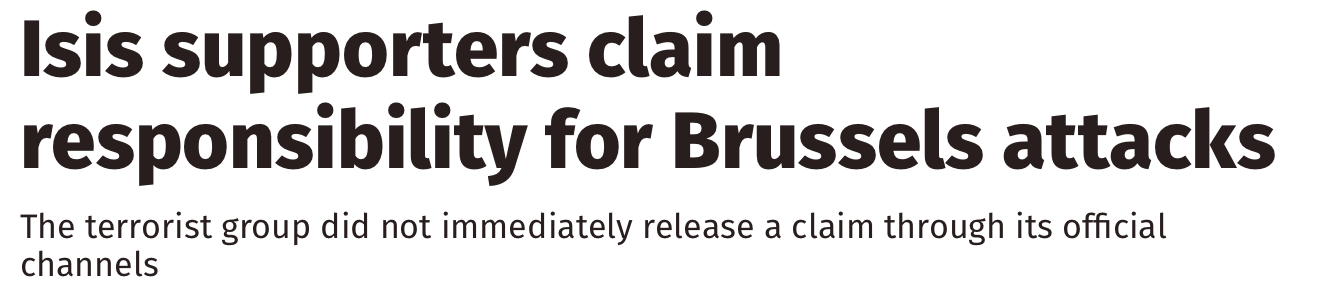
The report is based on information emanating from social media, which does not constitute a reliable source of information.
An unkown self-proclaimed news agency (Amaq Agency ) allegedly representing the ISIS provided the following report:
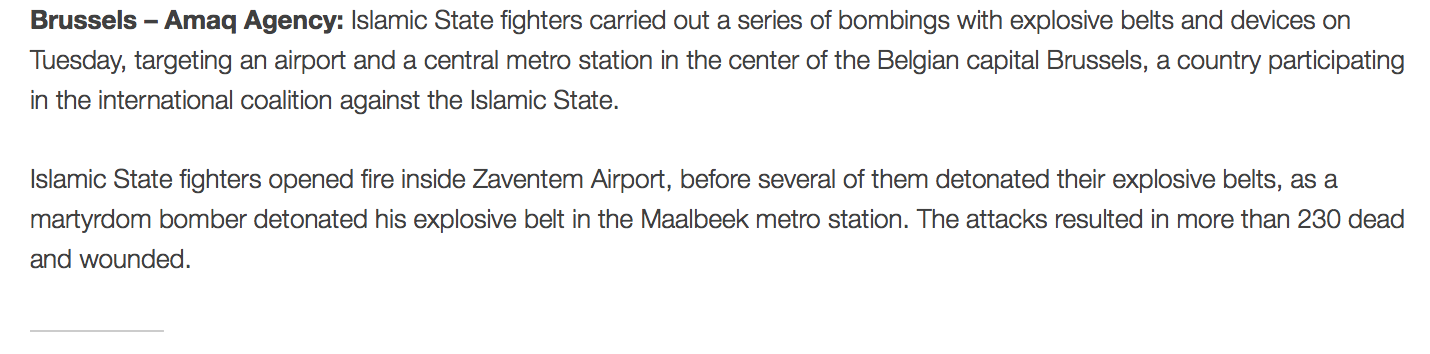
This mysterious agency was then immediately quoted by Reuters in an authoritative report.
In turn, alleged supporters of ISIS on twitter were quoted. According to the Jerusalem Post (March 21, 2016):
The “tears of joy” that were shed by ISIS supporters on Twitter are also related to the fact that the terrorists succeeded in paralyzing the activity in the airport attacked. One of ISIS’ main declared goals is to devastate the Western economy and replace the dollar with its own coin as the only international legal tender.
Who Controls the ISIS social media and twitter accounts?
Police and intelligence are often aware of the identity of ISIS social media, IP addresses, geographic location.
According to London’s Mirror (December 16, 2015):
Hackers have claimed that a number of Islamic State supporters’ social media accounts are being run from internet addresses linked to the [UK government] Department of Work and Pensions.
A group of four young computer experts who call themselves VandaSec have unearthed evidence indicating that at least three ISIS-supporting accounts can be traced back to the DWP.
Every computer and mobile phone logs onto the internet using an IP address, which is a type of identification number.
The hacking collective showed Mirror Online details of the IP addresses used by a trio of separate digital jihadis to access Twitter accounts, which have been used to spread extremist propaganda.
At first glance, the IP addresses seem to be based in Saudi Arabia, but upon further inspection using specialist tools they appeared to link back to the DWP. ..
[T]he British government sold on a large number of IP addresses to two Saudi Arabian firms.
After the sale completed in October of this year, they were used by extremists to spread their message of hate.
Jamie Turner, an expert from a firm called PCA Predict, discovered a record of the sale of IP addresses, and found a large number were transferred to Saudi Arabia in October of this year.
He told us it was likely the IP addresses could still be traced back to the DWP because records of the addresses had not yet been fully updated.

What the Daily Mirror report suggests (as well as other reports) is that the IP addresses of the ISIS are indirectly linked to the British government, i.e. 1) the identity of the ISIS social media is invariable known to police authorities, and 2) The ISIS social media are sponsored by Saudi Arabia, which is also involved in the recruitment and training of terrorists in liaison with US-NATO.
It is worth noting that the British government has acknowledged its responsibility:
The Cabinet Office has now admitted to selling the IP addresses on to Saudi Telecom and the Saudi-based Mobile Telecommunications Company earlier this year as part of a wider drive to get rid of a large number of the DWP’s IP addresses. (Mirror, op cit cit, emphasis added)
The State Sponsors of Terrorism
The events in Brussels raises the broader question: who is behind the ISIS?
Israel intelligence sources (DEBKA) in a 2011 report confirmed the role of NATO operating out of its Brussels headquarters and Turkey’s high command in the training and recruitment of terrorists:
NATO headquarters in Brussels and the Turkish high command are meanwhile drawing up plans for their first military step in Syria, which is to arm the rebels with weapons for combating the tanks and helicopters spearheading the Assad regime’s crackdown on dissent. … NATO strategists are thinking more in terms of pouring large quantities of anti-tank and anti-air rockets, mortars and heavy machine guns into the protest centers for beating back the government armored forces. (DEBKAfile, NATO to give rebels anti-tank weapons, August 14, 2011)
This initiative, which was also supported by Saudi Arabia and Qatar, involved a process of organized recruitment of thousands of jihadist “freedom fighters”, reminiscent of the enlistment of Mujahideen to wage the CIA’s jihad (holy war) in the heyday of the Soviet-Afghan war:
Also discussed in Brussels and Ankara, our sources report, is a campaign to enlist thousands of Muslim volunteers in Middle East countries and the Muslim world to fight alongside the Syrian rebels. The Turkish army would house these volunteers, train them and secure their passage into Syria. (Ibid, emphasis added)
These mercenaries were subsequently integrated into US and allied sponsored terrorist organizations including Al Nusrah and ISIS.
And then in August 2014, Obama launched his counter-terrorism campaign. Yet the evidence confirms that instead of destroying the ISIS, the US and its allies including Turkey, Saudi Arabia and Israel were in fact protecting the ISIS.
Again according to the Daily Mirror in a 2015 report, the counterterrorism campaign was conducive to ISIS doubling the territory under its control, until the launching of the Russian intervention in late September 2015.
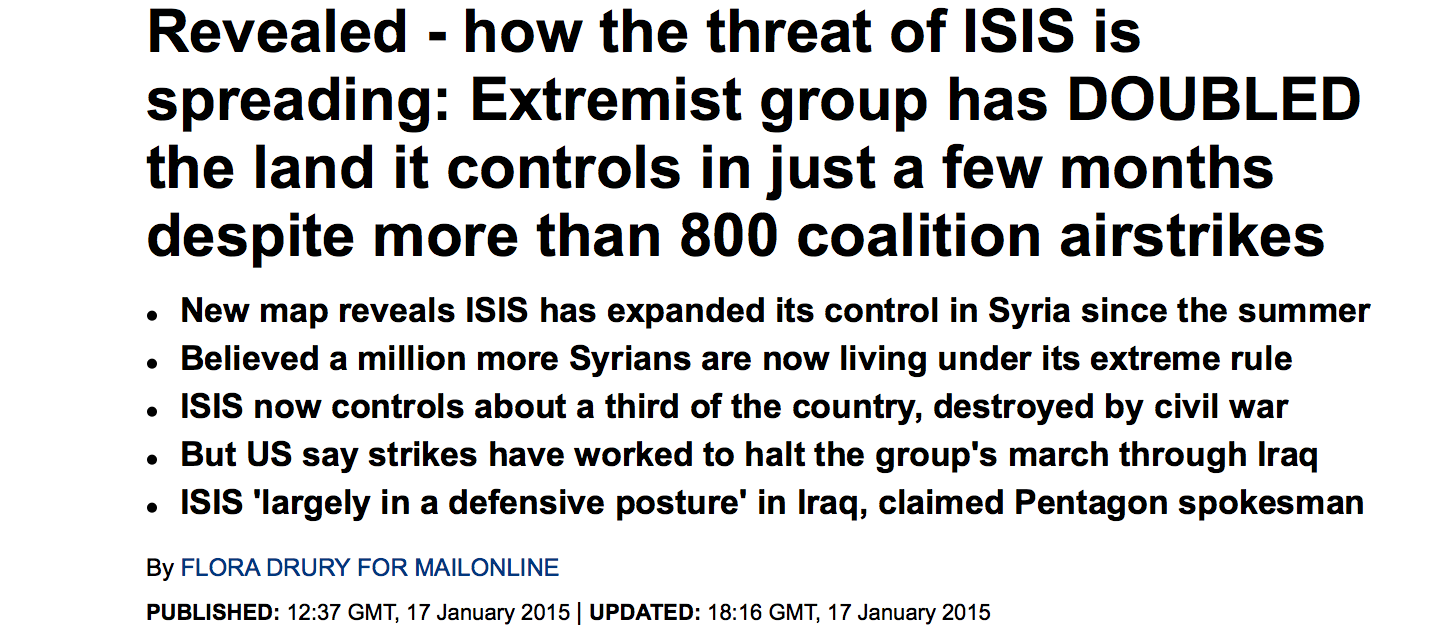
Sheer Incompetence of the US Air Force (doubtful) or Washington’s complicity in protecting the terrorists?
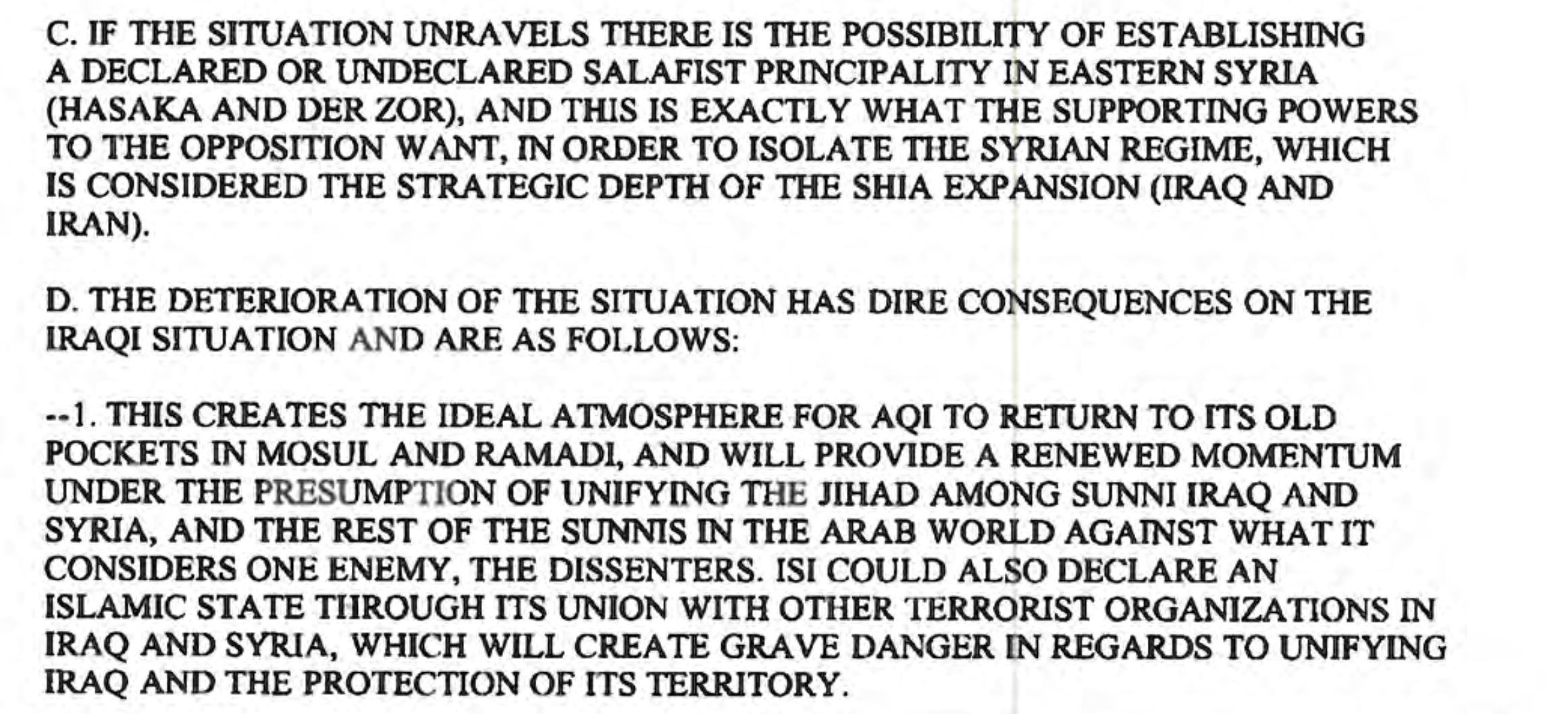
Recently the release of the Hillary Clinton email archive as well as leaked Pentagon documents confirm that the US and its allies were supportive of ISIS, which are according to press reports, the alleged architects of the Brussels attacks.
The 7-page Defense Intelligence Agency (DIA) document dated August of 2012, points to US complicity in supporting the creation of an Islamic State:
Saudi regime detains top Shia scholar in Eastern Province
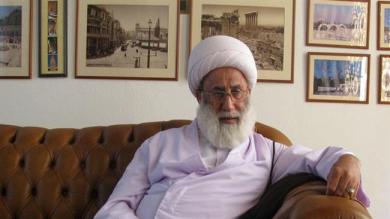
Senior Saudi cleric Ayatollah Hussein al-Radhi
Press TV – March 22, 2016
The Saudi regime’s security forces have arrested a prominent Shia cleric over his anti-regime comments as Riyadh continues its crackdown on the minority sect.
Media reports said on Tuesday that security forces arrested Ayatollah Hussein al-Radhi shortly after he led prayers in the al-Ahsa oasis region of Eastern Province.
The detention came after the senior cleric wrote an article in which he criticized the House of Saud for jailing and executing critics and dissidents, including Sheikh Nimr Baqir al-Nimr who was beheaded in January.
Al-Radi had also infuriated the monarchy by denouncing the ongoing deadly Saudi airstrikes which have claimed lives of more than 8,000 civilians in Yemen.
Riyadh has been under fire from international organizations and rights groups over the rising number of civilian casualties in Yemen. The United Nations Human Rights Council (UNHRC) has recently said that Saudi Arabia and its allies may be committing crimes against humanity due to their indiscriminate killing of civilians in Yemen.
The senior cleric had also strongly denounced a decision by the Saudi-led [Persian] Gulf Cooperation Council to brand Lebanon’s resistance movement Hezbollah as a terrorist organization.
Saudi Arabia has been denounced by rights groups for its grave human rights abuses and harsh crackdown on all forms of dissent.
The Shia-dominated Eastern Province has been the scene of peaceful demonstrations since February 2011.
Protesters have been demanding reforms, freedom of expression and the release of political prisoners. They want an end to economic and religious discrimination against the region.
Reports on protests in Qatif are scant, as Saudi authorities allow foreign news media to visit the region only if accompanied by government officials, claiming it is to ensure journalists’ safety.
Shia Muslims have long complained of entrenched discrimination in a country where the semi-official Wahhabi school condones violence against them. They face abuse from Wahhabi clerics, rarely get permits for places of worship and seldom get senior public sector jobs. Shia religious centers have also been target of a series of terror attacks across the region over the past few months.
Those basic complaints have over the years been aggravated by what residents across the Shia-majority call heavy-handed security measures against their community. They accuse the authorities of unfair detentions and punishments, shooting unarmed protesters and torturing suspects.
New US Training Program for Syrian Rebels ‘Just Another Waste of Money’
Sputnik – 20.03.2016
The US Defense Department reportedly plans to launch a new train-and-equip effort in Syria. The new effort will focus on preparing a small contingent of rebels outside Syria.
The rebels will reportedly be trained in infantry tactics and then sent back to their homeland. The spokesman for the US-led military operation against Daesh, Colonel Steve Warren, said the new effort was part of the Pentagon’s adjustments to the train-and-equip program built on prior experience.
However, many details about the new program remain unclear, including its cost, the number of fighters it aims to train as well as the exact date of its launch, according to Foreign Policy magazine.
Michael Maloof, former Pentagon official and senior security policy analyst in the office of the Secretary of Defense, was not too optimistic about the Pentagon’s ability to learn from the mistakes, saying that his hopes for the new programs were pretty low.
“The program is very vague, no details are being given as to where the training will be conducted and smaller contingents doesn’t necessarily mean a success. The problem has been as to who would be available to fight ISIS as opposed to wanting to take down the government of Syrian President Bashar Assad. That has been the problem. Also what countries would actually conduct the training, before it was Saudi Arabia, Jordan and Turkey? Those countries generally are against the government of Syria as it now stands.”
“It is going to be questionable as to how effective this so-called revised program is going to be. I don’t hold much hope for it and it’s just another waste of money frankly at this point,” Maloof said.
Talking about what the Pentagon’s exact goal was for launching this new train-and-equip program, the official said, “The concept is to fight ISIS, but in reality the people that they are recruiting are Sunnis, they are sympathetic to the Sunni ISIS fighters and even though they may not agree with them wholeheartedly, they are Sunnis and Sunnis will not be fighting Sunnis. That’s just the way it goes.”
He further spoke about the reluctance of Turkey in going after ISIS and instead are venting against the Kurds. “The consequences of these actions are questionable and the success is highly dubious and I don’t hold much faith in them.”
Maloof also discussed Saudi Arabia’s position in this situation. He said, “Saudi’s don’t like ISIS either but they are bank rolling, funding them outside the Kingdom but if they start pointing inward that’s another problem for them because ISIS is fundamentally against monarchy.”
Yemen Peace Talks Bear Fruit: Idea of Unity Government Agreed
Sputnik – 21.03.2016
Parties to the Yemeni military conflict agreed to hold a new round of peace talks in Kuwait and expressed their readiness to create a national unity government during a meeting in Sanaa, UN Special Envoy for Yemen Ismail Ould Cheikh Ahmed said Monday.
“Fruitful meetings in Sana, and agreement that Kuwait is a place of upcoming Yemeni negotiations…[Parties] agree on political solution and formation of a national unity government,” the special envoy wrote on his official Facebook page.
The date for a new round of intra-Yemeni talks has not yet been announced.
The first round of talks between Yemeni government representatives and Houthi rebels took place in Geneva in December 2015.
Yemen has been engulfed in a military conflict between the government headed by Abd Rabbuh Mansur Hadi and Shiite Houthi rebels, who have been supported by army units loyal to former President Ali Abdullah Saleh. Since late March 2015, a Saudi-led coalition has been carrying out airstrikes against Houthi positions at Hadi’s request.
Kuwait expels 14 people for links with Hezbollah: Report
Press TV – March 21, 2016
The Kuwaiti government has deported 11 Lebanese and three Iraqis on charges of having links to Lebanon’s resistance movement, Hezbollah, a report says.
The Kuwaiti Arabic daily al-Qabas quoted a security source as saying on Monday that the 14 people had been expelled on the order of the state security service.
The move came nearly three weeks after the [Persian] Gulf Cooperation Council ([P]GCC), under the influence of the Saudi regime, declared Hezbollah a “terrorist” organization. Arab League foreign ministers, except those of Iraq and Lebanon, later followed suit.
The [P]GCC – comprising Saudi Arabia, Qatar, the United Arab Emirates, Oman, Bahrain and Kuwait – however, did not provide any evidence for its allegation. This comes as the first three monarchies themselves stand accused of supporting extremists and terrorists in the region.
Describing the [P]GCC decision as “reckless and hostile,” Hezbollah blamed it on Saudi Arabia.
Elsewhere in its report, Qabas said that Kuwaiti security officials have prepared a list of “unwanted” Lebanese and Iraqi people, including advisers to big companies, to be expelled for “the public interest.”
The people will not be allowed to enter the [P]GCC member states after their deportation, the daily said.
Saudi airstrike on Yemeni market had no apparent military reason – UN
RT | March 18, 2016
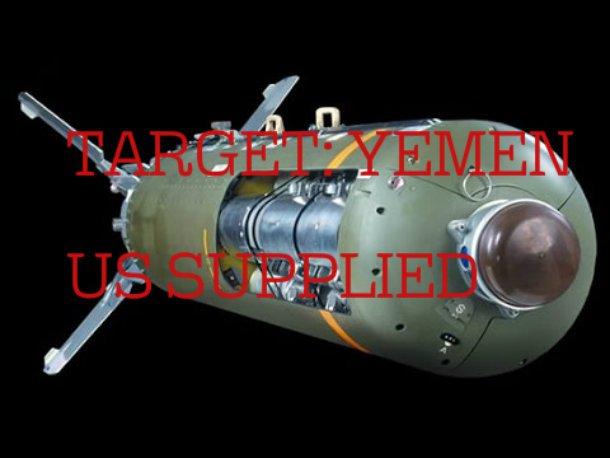
UN inspectors, who visited the Al Khamees market in north-western Yemen, where Saudi airstrikes killed over a hundred people this week, found no evidence that the attack could have any military goal.
The closest target of any value to justify the bombing is a small checkpoint some 250 meters from the market, which is manned by a small group of Houthis, UN High Commissioner for Human Rights Zeid Ra’ad Al Hussein said on Friday.
The market attack in Hajja Governorate on Wednesday was one of the deadliest incidents in Saudi Arabia’s year-long campaign in Yemen, Zeid said, describing it as “carnage.” The death toll was reported as 106 people, including 24 children. The high figures are explained by the timing of the airstrikes, which were delivered during the afternoon rush hour at the market. It serves as the main shopping destination for some 15 surrounding villages.
Since the Yemeni campaign was launched in March last year by the Saudi-led coalition of Arab nations, the UN has recorded just under 9,000 casualties in Yemen, including 3,218 civilians killed and a further 5,778 injured, Zeid said.
“Looking at the figures, it would seem that the coalition is responsible for twice as many civilian casualties as all other forces put together, virtually all as a result of airstrikes,” he said.
“They have hit markets, hospitals, clinics, schools, factories, wedding parties – and hundreds of private residences in villages, towns and cities including the capital Sana’a,” he added. “Despite plenty of international demarches, these awful incidents continue to occur with unacceptable regularity. In addition, despite public promises to investigate such incidents, we have yet to see progress in any such investigations.”
He warned that “we are possibly looking at the commission of international crimes by members of the Coalition.”
“I urge both sides to swallow their pride and bring this conflict to a halt,” Zeid said. “The people of Yemen have suffered enough. A very poor country is having its limited infrastructure decimated, and people are struggling desperately to survive.”
Earlier, the Al Khamees market bombing was condemned by UN Secretary General Ban Ki-moon and a number of international organizations. Saudi Arabia said it would scale down its aerial campaign in Yemen and focus on training Yemeni troops.
The campaign’s goal in Yemen was to push back Houthi rebels and forces loyal to former President Ali Abdullah Saleh and bring back to power exiled former President Abd Rabbuh Mansur Hadi.
Toll from Saudi raids on Yemen market hits 119: UN
Press TV – March 17, 2016
A senior UN official says the death toll from recent Saudi airstrikes on a crowded market in the Yemeni province of Hajjah has risen to nearly 120.
Meritxell Relano, deputy representative for the UN Children’s Fund (UNICEF) in Yemen, on Thursday put the number of people killed in the Tuesday’s air attacks on the northern province at 119.
The strikes took place in the northwest of the Yemeni capital Sana’a after two Saudi airstrikes hit al-Khamees market in the district of Mustaba on March 15.
The UN sources say the victims include at least 20 children. Many other Yemenis were injured in the deadly aerial raids in the troubled region.
The UN children’s agency in a statement strongly denounced the deadly airstrikes.
UN Secretary General Ban Ki-moon also on Wednesday described the Saudi aerial raids as “one of the deadliest “ since Riyadh launched a military campaign against the impoverished Arab country in March last year. The UN chief also demanded a probe into the deadly incident.
The world body has already warned of a “human catastrophe unfolding in Yemen.”
Meanwhile, General Ahmed al-Asiri, a Saudi military spokesman, said on Thursday that Riyadh will scale down combat operations in Yemen in an apparent bid to divert mounting criticism of the military aggression.
However, al-Asiri stressed that the kingdom will continue to provide air support to Yemen’s former regime loyalists battling Houthi Ansarullah fighters and allied army units on the ground.
Riyadh has been under fire by international organizations and rights groups over the rising number of civilian casualties in Yemen.
The Saudi military strikes were launched in a failed effort to undermine the popular Ansarullah movement and bring the former fugitive president back to power.
At least 8,400 people, among them 2,236 children, have been killed so far and 16,015 others have sustained injuries.
Syria, Iraq: Should Borders Be Redrawn to Partition Sovereign States?
By Alexander KUZNETSOV – Strategic Culture Foundation – 16.03.2016
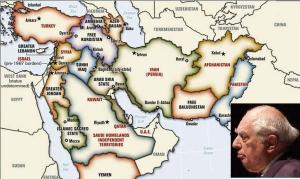 An article titled It’s Time to Seriously Consider Partitioning Syria published recently by Foreign Policy raises serious concerns.
The author writes that the war in Syria has devastated entire cities, the death toll is 470 thousand (there are no reliable statistics to confirm the figure) and 6 million people have become displaced. As a result, religious communities in Syria cannot live together in one state anymore. He believes that Syria should be divided into parts populated by Alawites (for some reason it includes Damascus) and Sunni Muslims. The options include a partition of the country into independent states or forming some kind of loose confederation like Bosnia and Herzegovina. James Stavridis is a four-star Admiral and former NATO Supreme Allied Commander, Europe. He is an influential person in military and political circles.
The Admiral made public his views on Syria soon after US State Secretary John Kerry referred to plan B in Syria in his testimony before the Senate Foreign Relations Committee on March 1.
According to the US top diplomat, he will move towards a plan B that could involve a partition of Syria if hostilities continue because the political forces cannot coexist in one state.
The idea of dividing Syria, Iraq and other states in the Middle East has been considered by US strategic thinkers since the 1980s. Bernard Lewis, the patriarch of American oriental studies, was the first to suggest it. For many years he has been a member of and consultant to the US Council on Foreign Relations (CFR). Formally an independent think tank, the Council exerts great influence on shaping US foreign policy.
In The Roots of Muslim Rage, an essay published in 1990, Bernard Lewis describes a ‘surge of hatred’ rising from the Islamic world that “becomes a rejection of Western civilization as such.” The thesis became influential.
The essay inspired Samuel Huntington, the author of the clash of civilizations hypothesis. Lewis is a widely read expert on the Middle East and is regarded as one of the West’s leading scholars specialized in that region. His advice has been frequently sought by policymakers, including the Bush Jr. administration in the early 2000s. Jacob Weisberg, a prominent US journalist, writes that Bernard Lewis was perhaps the most significant intellectual influence behind the invasion of Iraq in 2003.
In 1979, Bernard Lewis first unveiled his project aimed at reshaping the Middle East to the Bilderberg Meeting in Baden, Austria. The goal was to counter Iran after the Islamic revolution and the Soviet Union with its military deployed to Afghanistan the same year. According to him, the anti-Iranian policy was to include the incitement of an armed Sunni-Shia confrontation and support of the Muslim Brothers movement. The Soviet Union was to be countered by creating an «Arc of Crisis» in the vicinity of its borders. The national states of the Middle East were to be ‘Balkanized’ along religious, ethnic and sectarian lines.
The Lewis project was advanced further after the collapse of the Soviet Union. In 1992 the scholar’s article titled Rethinking the Middle East appeared in Foreign Affairs, the US leading forum for serious discussion of foreign policy and international affairs published by the Council on Foreign Relations.
There he presented a new map of the Middle East. The plan envisaged breaking Syria up into small fragments with the territories populated by the Druze and Alawites separated to become independent mini-states. Lewis wanted to establish new entities: a tiny state on the territory of Lebanon populated by Maronites, an independent Kurdistan comprising the Kurds-populated areas of Turkey, Iraq, Syria and Iran, an independent Shia state in Iraq, an Arab state in the Iranian province of Khuzestan – the major oil-producing region of Iran. The plans also envisaged the creation of independent Balochistan.
Bernard Lewis advocated a policy called ‘Lebanonization’. According to him, “A possibility, which could even be precipitated by Islamic fundamentalism, is what has late been fashionable to call ‘Lebanonization’. Most of the states of the Middle East – Egypt is an obvious exception – are of recent and artificial construction and are vulnerable to such a process. If the central power is sufficiently weakened, there is no real civil society to hold the polity together, no real sense of common identity… The state then disintegrates – as happened in Lebanon – into a chaos of squabbling, feuding, fighting sects, tribes, regions, and parties,” the scholar wrote.
The main goal of such projects is to prevent the emergence of regional forces able to challenge the hegemony of the United States [or Israel]. That’s what made the US add fuel to the fire of the Iran-Iraq war (1980-1988). Washington succeeded in making the war last for eight years. By provoking the hostilities, the US killed two birds with one stone: it prevented Iran from growing stronger and weakened Iraq ruled by the Arab Socialist Ba’ath Party.
The West launched Operation Desert Storm to keep Iraq weak. In 2003 it concocted a false pretext (the possession of weapons of mass destruction) to occupy Iraq and deprive it of sovereignty. By and large, the same fate awaited Syria.
In 1990 Syrian troops remained in Lebanon as peacekeepers in accordance with the Taif Agreement. The US gave its consent because Damascus took part in Operation Desert Storm against Iraq. Besides, the Syrian government of Hafez Assad effectively committed itself not to take hostile actions against Israel. In ten years the situation changed. Damascus launched the policy of strategic partnership with Iran. It supported the Lebanese Hezbollah movement. Washington changed its stance to say the Syrian military in Lebanon was an occupying force. Using the imposition of sanctions as a weapon, the United States made Syria withdraw from Lebanon. In 2011 the US started to undermine the Syria’s national sovereignty.
The most faithful US allies – Saudi Arabia for instance – have no guarantees they will not become part of such plans. Nowadays, the United States does not depend on the oil supplies from the Middle East. It has put an end to the policy of direct confrontation with Tehran. As a strategic partner, Riyadh is not as important as it used to be. It’s hardly a coincidence that US media outlets started to publish maps with Hejaz (a region in the west of present-day Saudi Arabia) drawn as part of Jordan with the eastern part of the Saudi Kingdom together with South Iraq shown as part of Shia Arab state. Actually, a genuine settlement to the problems faced by the Arab world is something quite opposite from what the United States has to offer.
The partition of the Middle East into tiny powerless states will give rise to new crises accompanied by ethnic and religious cleansing. It will lead to a ‘war of all against all’ (bellum omnium contra omnes) – the term coined by Thomas Hobbs.
In case of such a war, the small principalities will need someone for arbitration. Washington will offer itself for this role.
In the future, the creation of large Arab space (Grossraum) may lead the region out of the deep crisis it faces, but that’s a different and a very serious matter to be discussed some other time.
Ben Nayef is a worthy recipient of the Légion d’honneur!

By Gearóid Ó Colmáin | American Herald Tribune | March 14, 2016
The recent scandal in Paris concerning the decoration with the Légion d’honneur by the French government of Saudi Arabia’s Prince Mohammad Ben Nayef, highlights the importance of the absolutist Gulf Monarchy to France’s imperial strategy in the Middle East. The spurious left/right divide in French politics between the Socialist Party and the Republicans, is manifested in a Middle East geopolitics of the Socialist Party’s special relationship with Saudi Arabia, while UMP, formerly led by Nicolas Sarkozy, tends to favor Qatar, the irony being that Qatar is a tad more liberal than the ‘socialist’ backed Saudi behemoth.
While there was muted outrage in the French capital over the decision to honor Ben Nayef on his own request, in order to boost his international ‘credibility’, I believe the French government’s actions were perfectly logical and reasonable. Why wouldn’t the French government honor Saudi officials? Since the creation of a unified kingdom with British backing in 1932, the Saudi dictatorship has served its function well. It has, along with its sister Israel, constituted a bulwark against the two threats to Western, Zionist suzerainty in the Middle East and North Africa: Arab nationalism and revolutionary Shiism.
The Wahhabi regime does this by keeping so many of the Muslims of the former Ottoman Empire indoctrinated in an obscurantist death cult, under the supreme authority of a degenerate ruling caste who, instead of developing the industrial sector of their country so as to improve the lives of the poor, squander billions on Western arms deals in order to better oppress their own people and those of neighboring countries such as Yemen, who are attempting to emancipate themselves from the neocolonial yoke.
Relations between the Saudi monarchy and the French government are currently so good, the words ‘honey moon’, have been used to describe them. When President Holland visited Riyadh Just months after the Charlie Hebdo terrorist attacks in January 2015, French press pundits on the capitalist ‘left’ and ‘capitalist right’, were waxing lyrical about the ‘great friendship’ that exists between Saudi Arabia and France. In June 2015, the French government signed over 10,3 billion dollars in contracts with the Saudi regime in areas extending from military, aeronautics, health, transport and solar energy. This means that a sizable portion of the French bourgeoisie, what President Clemenceau once referred to as “the syndicate of interests”, are perfectly happy with the Franco-Saudi status quo.
French imperialism currently bears the distinction of having surpassed the United States in bellicosity. The French led the carpet bombing and destruction of Libya in 2011; they have led in the destruction of Syria too. In negotiations with Iran, the Quai d’Orsay was the most intransigent; this won it more favor with Riyadh. With US/Saudi relations strained, due to American détente with Iran, Paris is using Saudi insecurity about its future to gain more influence in the Arabian Peninsula.
The French government sold more arms than ever in 2015 and they intend to sell even more this year, thanks to the ‘honey moon’ relationship with the head chopping regime in Riyadh; a regime openly promoting the Wahhabi death cult all around the world, including in France’s sprawling proletarian banlieux, where mis-fortunate youths such as the infamous Kouachi brothers fall under their influence. The fact that the Saudi regime promotes and funds Takfiri terrorism is not a secret; US Vice President Joe Biden candidly admitted this to students at the Kennedy Business School in Harvard University in 2014.
While US presidential candidate Donald Trump, in what appeared to be a veiled critique of Israeli terrorism, recently declared that ‘everyone knows’ the Saudis are behind Takfiri terrorism.
In fact, it is regularly admitted by the French corporate and establishment media that the Saudis are funding terrorism in Syria and other countries, yet Riyadh remains the privileged partner of countries claiming to be fighting an international ‘war on terrorism’! None of this makes sense but, of course, that is because it doesn’t have to make sense. For this global war on terrorism is a war without a real enemy. The enemies are fabricated by the panoply of agencies that constitute the military-industrial-media-intelligence complex; a netherworld of special interests and high finance.
In this post-modern wasteland of consumerist meaninglessness and zero-consciousness, the terrorist is a shifting signifier. The ‘War on Terror’ narrative operates like Derridean deconstruction, whereby the terrorist is both real and unreal, present and absent, constantly deferred, displaced, with no essential being outside the labyrinthine obfuscations of the war on terror’s ever expanding mythos. And the political elites, who serve corporate and financial power, no longer care what the public thinks of them. They are now discretely admitting that the war on terror is a fraud, that the French government supports the most outrageous dictatorships on earth, that human rights, as Marx noted, signify nothing more than vile property rights ; that money is God and that they have nothing but snickering contempt for the French public.
Everything is now out in the open. We are governed by criminals and tyrants and they don’t mind us taking cognizance of that fact. Therefore, the media disclosure of emails showing how the French government attempted to play down the Légion d’honneur affair will not bother them. Speaking to France Inter last week, French Foreign Minister Jean-Marc Ayrault, said: ” Diplomacy can sometimes surprise us. One should see it like that” In other words, this is an affair of state and we have no duty to explain our policies to the public. Procul, procul, este profani! Be off, be gone, ye uninitiated!
In 1999, a relative of Ben Nayef was arrested in Paris in possession of 20 tons of cocaine. The Saudi prince was smuggling drugs from Latin America into Europe, in order to finance Al Qaeda terrorists in Afghanistan. The prince escaped to Saudi Arabia but was sentenced in absentia to ten years in prison by a French court. The fact that this convicted, felonious relative of Mohammad Ben Nayef was under the protection of the Saudi regime did not even enter into the agenda of the French delegation to Riyadh in 2015.
Why would it? Drug trafficking is a key component of class rule, constituting the carefully concealed underbelly of the global, capitalist system.
Drug dealers operating under the aegis of the French Socialist Party were responsible for crushing the massive French labor strikes of 1948, when there was a real chance of the French Communist Party, (PCF )taking power. In cahoots with the CIA, Socialist Mayor of Marseilles, Gaston Deferre used the drug trafficking mafia clans to crush the worker’s movement. Today, cities like Marseilles are awash with drugs, delinquency, and poverty. The workers are no longer organized as immigration keeps them disunited and demoralized, while Saudi princes party with their French counterparts along the French Riviera. Meanwhile, ‘socialist’ leaders meet farcically in Paris to discuss the “danger of the far right”, movements whose ranks are increasingly being filled with demoralized workers.
The Saudi prince deserves the Légion d’honneur, for the Saudi regime is a worthy partner of French imperialism. It is waging war against the Syrian people, waging war against the Yemeni people, and would soon be waging war against the Iranian people, were it not for the fact that Persia is capable of flattening it.
The Wahhabi regime poisons the minds of millions of young Muslims, diverting their social anger at the ruling class into sectarian hatred of their class allies, killing other poor Muslims and Christians instead of the tyrants spreading hate, oppression and permanent war. The Saudi regime is a Zionist entity, which wages permanent war on Muslims mostly, murdering and defaming them and sullying the Islam. For the deeply unpopular French regime instituting a police state, Saudi Arabia is a role model. In this sense, by bestowing the highest honors of the state on despot Mohammad Ben Nayef, the French government is revealing to the world the true meaning, the transcendental signification of their oft incanted ditty of ‘human rights’, ‘freedom’ and ‘democracy’.
Germany approves arms exports to Saudi Arabia
Press TV – March 14, 2016
According to disclosed data, the German government has approved several deals for the export of arms to countries in the Middle East, including Saudi Arabia as the kingdom continues its deadly aggression against the impoverished nation of Yemen.
According to an Economy Ministry letter seen by Reuters on Monday, the EU powerhouse will deliver 23 Airbus military helicopters to Riyadh.
In the letter to lawmakers in the economy committee of the lower house of the parliament, Economy Minister Sigmar Gabriel explained that the government’s Federal Security Council had also approved a deal by Heckler & Koch to deliver 130 machine pistols and automatic rifles to the United Arab Emirates and allowed Rheinmetall to export 65,000 mortar cartridges to the country.
The United Arab Emirates is among Saudi Arabia’s allies in their invasion against Yemen.
It also gave the green light for Heckler & Koch’s delivery of 660 machine guns, 660 additional gun barrels and 550 sub-machine guns to Oman.
The government also approved the delivery of five military helicopters by Airbus to Thailand and the export of nearly 490 machine pistols and automatic rifles by Heckler & Koch to Indonesia.
In January, Gabriel had said Germany may look harder at its arms exports to Saudi Arabia after the Persian Gulf kingdom carried out a mass execution causing international outcry.
Saudi Arabia is also widely believed to be financing to Takfiri militants wreaking havoc in the Middle East.
Riyadh has also been engaged in military operations in Yemen since late March last year. At least 8,400 people, among them 2,236 children, have been killed so far in the aggression and 16,015 others sustained injuries. Tens of Saudi solders as well as mercenary forces have been killed in the aggression.
Featured Video
John Mearsheimer: The Case for a Nuclear Iran
or go to
Aletho News Archives – Video-Images
From the Archives
Ethnic Cleansing in a Zionist Fairyland
By Vacy Vlazna | Palestine Chronicle | February 10, 2012
‘De-Arabizing the history of Palestine is another crucial element of the ethnic cleansing. 1500 years of Arab and Muslim rule and culture in Palestine are trivialized, evidence of its existence is being destroyed and all this is done to make the absurd connection between the ancient Hebrew civilization and today’s Israel. The most glaring example of this today is in Silwan, (Wadi Hilwe) a town adjacent to the Old City of Jerusalem with some 50,000 residents. Israel is expelling families from Silwan and destroying their homes because it claims that king David built a city there some 3000 years ago. Thousands of families will be made homeless so that Israel can build a park to commemorate a king that may or may not have lived 3000 years ago. Not a shred of historical evidence exists that can prove King David ever lived yet Palestinian men, women, children and the elderly along with their schools and mosques, churches and ancient cemeteries and any evidence of their existence must be destroyed and then denied so that Zionist claims to exclusive rights to the land may be substantiated.’ — Miko Peled, Israeli dissident.
Indeed, archaeology has become a state apparatus for the ethnic cleansing of Palestinians in the Zionist fairyland aka the City of David Archaeological Park located in the Palestinian village of Silwan in East Jerusalem.
East Jerusalem is the proclaimed capital of the proposed Palestine state. It was illegally annexed by Israel in the 1967 war. Prohibiting annexation of territories gained by military conquest is one of the major principles of international law. The international community does not recognise Israel’s annexation of East Jerusalem nevertheless over 50,000 illegal premises have been built for 250,000 illegal Israeli colonists.
The goal of the archaeological judaisation of Jerusalem is to transform Jerusalem into the City of David, the capital of Greater Israel by eradicating the mixed ethnic composition of the Palestinian and Jewish population of East Jerusalem to a solely Jewish identity and unifying East and West Jerusalem under Israeli sovereignty. … continue
Blog Roll
 Aletho News
- Daniel Davis: China & Russia Will Defend Iran
- The US’ self-directed ‘China nuclear threat’ will only be a waste of effort: Global Times editorial
- Female Iranian academic sentenced to 4 years in prison in France over protesting Israel’s genocide in Gaza
- US university cancels Palestine conference citing sanctions concerns
- Senate Majority Leader: Any War with Iran Should Result in Regime Change
- Iraqi Resistance warns of action if US forces remain
- China, Russia slam US threat, force against Iran ahead of talks
- US fears Iran war will ‘deplete’ air defenses stretched thin by Ukraine, Israel: Report
- Top AIs deploy nukes in 95% of war game simulations – study
- Could Hungary’s fight over oil change course of Ukraine War?
- If Americans Knew
- Israel warns of a Ramadan escalation — while doing everything to provoke one
- Democrats Should Release Their 2024 Election Autopsy – and Stop the Gaza Denial
- Israel responsible for 2/3 of press killings worldwide – Not a ceasefire Day 139
- Are the Jews indigenous to Palestine?
- AIPAC Wants to Kill a Bill that would Ensure Israel Complies with Ceasefire
- Former Israeli PM, in Epstein Files, Dreamed of Israeli Eugenics and Pretty Converts
- Israeli settlers join ‘safari’ tour of Palestinian prisoners
- Flooding in Gaza amid rumors of war; fire in West Bank – Not a ceasefire Day 138
- Fourteen Countries Condemn Huckabee’s Support for Israel Taking Over Most of the Middle East
- Israeli Soldiers Killed Gaza Aid Workers at Point Blank Range in 2025 Massacre: Report
- No Tricks Zone
- Surprising Discovery: Sahara Is Greening…Billions Of Trees Where Once Thought To Be Barren
- New Research Reaffirms Clouds, Aerosols, And Surface Solar Radiation Are ‘Driving The Climate System’
- Germany: Electric Car Catches Fire At Charging Station, Sets Off Local “Inferno”, Widespread Damage
- New Study: Canada’s New Brunswick Was 1°C Warmer Than Today During The Medieval Warm Period
- Coal Power Back In Trend As Globe Tries To Keep Pace With Growing Demand For Power
- New Study: A 4°C Warmer Beaufort Sea Had ‘No Sea Ice’ 11,700 – 8200 Years Ago
- Unfudging The Data: Dutch Meteorological Institute Reinstates Early 20th Centruy Heat Waves It Had Erased Earlier
- German Gas Crisis…Chancellor Merz Allegedly Bans Gas Debate Ahead of Elections!
- Pollen Reconstructions Show The Last Glacial’s Warming Events Were Global, 10x Greater Than Modern
- Germany’s Natural Gas Storage Level Dwindles To Just 28%… Increasingly Critical
 Aletho News