Pristina Snaps Up 200 Billion Euros’ Worth of Serbian Property in Kosovo
Sputnik – 20.03.2017
The authorities of the self-proclaimed Kosovo republic have decided to confiscate up to 200 billion euros’ worth of real estate of the former Yugoslavia’s Serbia and Kosovo Province, adding pressure to an already strained relationship between Pristina and Belgrade.
The Kosovo cadastral agency has been instructed to immediately register all real estate, amounting to more than 2 million square meters of buildings, including a ski resort and a mining complex, but also land, as the property of Kosovo.
Meanwhile, according to the Serbian cadaster agency, Serbian immovable property in Kosovo amounts to 1 million square meters and Serbian-owned enterprises in the region are valued at about 200 billion euros.
The region’s strategic natural resources “privatized” by the Pristina government include almost 15 billion tons of lignite and over 42 billion tons of lead and zinc.
Reacting to the news, Serbian First Deputy PM and Foreign Minister Ivica Dacic said the decision was “completely illegal, and unacceptable.”
No serious investor will spend money in Kosovo based on this decision of the government in Pristina — “because they won’t know whose property it is in the end,” he added.
According to the former head of the Kosovo cadastral agency, Slavica Radomirovic, 58 percent of industrial enterprises and real estate in Kosovo belong to Serbia and its citizens as proved by original documents taken out of the region after the 1999 war.
Radomirovic warned that the Kosovo authorities had prepared their own cadaster books based on forged data.
In an interview with Sputnik Serbia, Dusan Prorokovic, an expert with the Belgrade-based Strategic Alternative Fund, said that Pristina prefers to resolve all disputes with Belgrade by military force and that all it really wants is property.
“All they are doing was previously approved by the Obama Administration. They started with a demand for a Kosov army and within the next few weeks we could expect further such steps by Pristina. They know that the international community will look on as a new balance of forces is emerging in the Balkans,” he said.
Political analyst Dusan Janjic said that all this was a logical continuation of the EU-launched process of illegal privatization of Serbian property in Kosovo.
“Pristina is speeding up this whole process across the board. Just like its [Western] sponsors, it wants things like the army and property cut out for it before they start a dialogue in a new format,” he added.
Meanwhile, Kosovo Vice-Premier Branimir Stojanovic told the Serbian TV channel RTS that the decision to confiscate Serbian property in Kosovo was legally null and void and could seriously complicate relations with Belgrade.
He added that the decision was taken behind closed doors without asking the opinion of Serbian representatives in the regional parliament.
Kosovo unilaterally proclaimed independence from Serbia in 2008 and is recognized by over 100 UN member states. Serbia, as well as Russia, does not recognize Kosovo’s independence.
Belgrade Breathes Easier As Trump’s Win Marks End to Clinton-Era Interventionism
Sputnik – 22.01.2017
Donald Trump’s election victory has brought an end to the Clinton era of intervention in Serbia’s internal affairs, including the murky web of connections between NGO’s in the US and abroad, experts told Sputnik Srbija.
When the US election results were announced in November 8, representatives of Serbia’s NGO elite were in attendance at Belgrade’s Crown Plaza Hotel, where the US Embassy had organized a get-together.
In a straw poll conducted of those present, Hillary Clinton was the clear winner, and her defeat was greeted with disbelief and disappointment by those who have grown used to getting support from American government and non-government organizations.
Political analyst Branko Radun told Sputnik Srbija that supporters of Clinton among Serbia’s pressure groups can be divided into two groups – those who were thinking with their heads, and those who were thinking with their wallets.
“I would divide the pro-Clinton elite in two. The first group is parties, NGO’s, the media and individuals which are ideologically close to American liberals and Democrats and are connected with them in various ways, including ideologically. The second group is parties, organizations and individuals which following the overthrow of Milosevic got used to a situation whereby we have a pro-Clinton elite. In order to survive on the political scene, they made compromises and deals with domestic ‘Clintonistas’ and with the global elite, comprised above all of American Democrats, that liberal, pro-Soros global elite,” Radun said.
Radun said that changes to Serbia’s political situation will take some time to become clear.
“These changes will come in phases. Firstly, of course, there will be a change in the structure of the State Department, so those who have links there will immediately feel the change. Others, who may have ties to other structures, will feel the changes later. I think those changes don’t seem dramatic and visible at the moment.”
Analyst Dejan Vuk Stankovic said that Serbian NGO’s have had good reason to promote liberal American values in Serbia, thanks to funds from organizations such as US AID, the National Democratic Institute (NDI) and the International Republican Institute (IRI). The NDI and the IRI are affiliated with the Democratic and Republican parties, respectively.
“This is an interesting network of individuals, the non-governmental sector, some opposition parties, I would not rule out that there are also some people within the current governing structures. But in general, (they are) the post-Milosevic political elite and the remnants of their media and NGO, their open or hidden allies in the robes of civil society or independent societies of journalists, lawyers and so on,” Stankovic said.
“I think the choice of Trump is not good news for NGO beneficiaries of American grants. This does not mean that there won’t be any, there will be, but on a much smaller scale. I doubt that Trump will have any particular engagement with what Democrats were engaged in when in power. That political work which had various forms of subversion: the preparation for and the destruction of political regimes via the non-government sector with the help of opposition parties. I think Trump will put politics in some kind of official context, as a politician he will be without ideological vices. He will hold negotiations in the way in which business deals are made.”
Radun said that despite the disappointment in some quarters, a Clinton victory would not have benefited Serbia. In fact, a Clinton administration was likely to raise tensions in the Balkans by inflaming the situation in Kosovo and neighboring Bosnia.
“First of all, pressure on Republika Srpska would have increased and in the direction of its suppression. There would also have been an attempt to complete the constitution of Kosovo as an independent state. On the other hand, with Trump somehow we start from scratch. The situation is uncertain, but compared to the other side (Clinton), which would certainly have been negative, uncertainty is better because with uncertainty you have a chance,” said Radun.
How EU is Pressuring Serbia to Abandon Relationship With Russia
Sputnik | July 17, 2016
European Parliament rapporteur for Serbia David McAllister signaled Thursday that the EU remains committed to enlargement in the Western Balkans. However, Eurocrats regard the Russo-Serbian relationship as a stumbling block in Belgrade’s way to EU accession.
European Parliament rapporteur for Serbia David McAllister warned Belgrade Thursday that Serbia’s intention to maintain close relations with Russia would not be tolerated by Brussels in the long run.
“The European Parliament sent a signal to Serbia through its [January] resolution that a dual approach to Russia could not be tolerated in the long run,” McAllister said at the press conference in Belgrade dubbed “The European Union’s Global Strategy on Foreign and Security Policy and the Western Balkans,” as quoted by Balkan Insight.
McAllister also urged Belgrade to reduce its “dependency” on Russian oil and gas, claiming that Brussels wants to see Serbia abiding by the EU energy market rules.
Ahead of the conference McAllister clarified his position in an interview with Europe Western Balkans media outlet.
“The Serbia-Russia relations have often been debated. Serbia has traditionally strong economic, social and cultural ties with Russia,” he admitted.
However, he claimed that since Russia “unilaterally changes European borders” and tries to “expand its influence” over its neighbors, Belgrade “needs to make strong efforts in aligning its foreign and security policy to that of the EU, including the policy on Russia,” referring to the EU sanctions regime imposed on Moscow.
Much in the same vein Nathalie Tocci, adviser to EU Foreign Policy and Security Chief Federica Mogherini, described Serbia’s prospects for EU membership in her interview with Tanjug.rs:
“In the accession process, a country is expected to meet all accession criteria and align itself with common European rules through negotiations, which implies both foreign policy and security. In that regard, I see the relationship with Russia as the biggest challenge for Serbia — as it gets closer to EU membership, Serbia will be expected to also get closer to the EU in terms of its position regarding Russia, but that is something that cannot happen overnight,” she said as quoted by the media outlet.Nevertheless, the Serbian government does not want to abandon its ties with Moscow, insisting that it intends to maintain fruitful diplomatic relations with both Russia and the West.
“I… wish to underline that in the process of decision-making Serbia had a continued consistent stance that at this very stage of the accession process it could not uphold all EU decisions. In some cases Serbia did not align with the EU positions, respecting its national interest concerning the issue of preserving its territorial integrity and the need to maintain traditionally good relations with other partners as well, first and foremost with Russia and China,” Foreign Minister Ivica Dacic told the press conference on Thursday.
He stressed that Serbia has proven to be a “reliable and true” partner of the EU and bemoaned the fact that despite Belgrade’s strategic foreign policy orientation toward full EU membership, the process “has not had particularly live dynamics so far because in the last two years we opened only two negotiating chapters.”
At the conference Dacic underscored that the time has come to reexamine what was done to Serbia back in 1999, and threw into question Kosovo’s self-proclaimed sovereignty. He recalled that US Assistant Secretary of State told him that the US has been investing in Kosovo’s independence for 20 years.
“Then I think the mistakes must be sought not only in our system,” he stressed, as cited by B92.net.
He emphasized that neither Russia nor China recognize Kosovo’s independence.
Later, commenting on the EU officials’ remarks Dacic told Serbian daily newspaper Novosti, as cited by Balkan Insight: “It could not be expected from Serbia to introduce sanctions on its friends.”
In his interview with Sputnik former Serbian diplomat Zoran Milivojevic noted that Serbia has its own national interests and the right to protect them.
“There are no reasons [for Serbia] to reconsider its relation with other nations, especially with United Nations Security Council permanent members and traditional friends of Serbia, Russia or China,” Milivojevic told Sputnik.
The diplomat stressed that it is inappropriate for Brussels to set such conditions on the very early phases of Serbia-EU negotiations, referring to the fact that Belgrade and the EU are yet to discuss the 31st chapter of EU accession related to Serbia’s foreign policy. Only when the chapter is opened the issue of the Russo-Serbian should be brought into the spotlight, he stressed.
Russia Pushes Back on NATO Expansion
By Natylie Baldwin | Consortium News | July 9, 2016
Can Russian President Vladimir Putin turn the tables on NATO and the European Union in the Balkan states that are not yet members of the Atlanticist project? According to Filip Kovacevic, a political science professor who specializes in Russia and Eastern Europe, Putin has a plan. Some details were provided in an exclusive report in May on the nascent project by Russia to counter NATO expansion into the remaining Balkan countries that have not yet been swept into the Western alliance.
The plan has its origins in the grassroots movement that arose in the aftermath of the first Cold War, which called for non-alignment and cooperation with both East and West. Kovacevic describes the movement as follows:
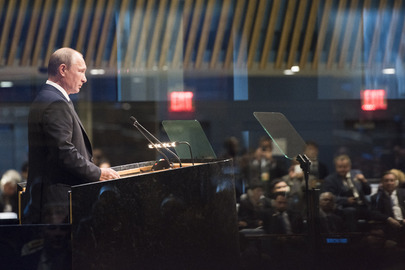
Putin addresses the UN, 09-28-15. (UN Photo)
Their members were generally young people who were enthusiastic, honest and genuinely committed to the public good, but were plagued by the lack of funding and faced with frequent media blackout and open discrimination. Nonetheless, their programs articulated the most promising and humane geopolitical vision for the Balkans. They conceptualized the Balkans as a territorial bridge between the West and the East rather than as the place of persistent confrontation, or the ‘line of fire’ as formulated by the U.S. Secretary of State John Kerry in 2015. They wanted the Balkans to become a force for peace and human dignity in the world. Their vision still remains the best option for the Balkans people.
This desire for non-alignment is understandable as a continuation of the policy of Tito’s Yugoslavia during the Cold War – the nation that several of the modern day Balkan states were a constituent part of. However, according to Kovacevic, these groups were easily overwhelmed, in terms of both financial and propaganda resources, in the 1990s by pro-NATO forces in the West.
In addition to providing resources to build up pro-NATO sentiment in the media and NGO sectors of these countries, financial resources and pressure was used to sway a large number of politicians to favor NATO membership, often in opposition to the general population’s views. Some of the unsavory forms of incentive or pressure include what amounts to blackmail and bribery, Kovacevic told me in an email interview:
This is a long-term process. In the U.S. intelligence community it is called ‘seeding.’ The intelligence scholar Roy Godson defines it as ‘identifying potential agents of influence’ at an early stage and then acting to advance their careers. This is typically done covertly, but there have been the historical examples of overt support. …
In the Balkans, the key role in the process of ‘seeding’ was accomplished by various institutes, conferences, retreats, grants, etc. For instance, I was told by a confidential source who participated in the same U.S.-NATO program, the long-time foreign minister and one-time prime minister of Montenegro, Igor Luksic, was a product of such a process. Luksic was chosen as a very young man to attend various conferences and retreats in Brussels and Washington and, after that, his political career really took off. All the while, he promoted the NATO agenda in Montenegro, even though this went against the will of the majority of the population.
Another example is Ranko Krivokapic who was the speaker of the Montenegrin Parliament for over a decade. He traveled on official business to the U.S. a few times every year and boasted to others that he had a lot of friends in the State Department and other institutions of the U.S. government. There are examples like these in Serbia, Macedonia, Croatia, etc. All over the Balkans.
There is also the fact the European Union has dovetailed its security arrangements to such an extent with NATO that new members are now virtually brought into the NATO structures by default. For example, Mahdi D. Nazemroaya, author of The Globalization of NATO, reports that the E.U.’s Security Strategy was absorbed into NATO during its annual summit in 2006. The emphasis of the summit was on securing energy resources with the goal of ‘co-managing the resources of the EU’s periphery from North Africa to the Caucuses.’ Also implied was the goal of redefining the E.U.’s security borders in synch with both Franco-German and Anglo-American economic and geopolitical interests.
Moreover, British Russia scholar Richard Sakwa, has pointed out that the security integration of the E.U. with NATO was further intensified with the ratification of the Treaty of Lisbon in 2007:
As for the comprehensive character, this is something that has been gaining in intensity in recent years as the foreign and security dimension of the E.U. has effectively merged with the Atlantic security community. The E.U.’s Common Foreign and Security Policy (CFSP) since the Treaty of Lisbon (the “Reform Treaty”) of 13 December 2007, which came into effect in 2009, is now in substance part of an Atlantic system. Acceding countries are now required to align their defense and security policy with that of NATO, resulting in the effective ‘militarization’ of the E.U.
At this point, the forces seeking a non-aligned bridge role for the Balkan states are still very much around, but have suffered marginalization due to lack of resources to take on the powerful and now entrenched pro-NATO political forces. However, with increasing discontent with the weak economic prospects in certain Balkan states, combined with increasing instability in the E.U., it is believed that there is an opening for growth of the movement.
Economic Conditions in the Balkans
The Balkan states comprise Romania, Bulgaria, Albania, Macedonia, Serbia, Kosovo, Montenegro, Bosnia-Herzegovina and Greece.
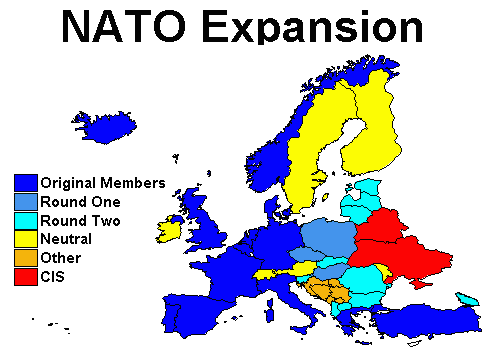
A map showing stages of NATO’s expansion. Dark blue showing original members; lighter blue the “round one” members; aqua the “round two” members; yellow represents neutral states; and brown and red otherwise aligned (including Ukraine, although that has changed since the 2014 U.S.-backed coup).
In 2007, Romania and Bulgaria became E.U. members (three years after joining NATO). Romania’s GDP has barely kept up with its 2008 rate and has a general unemployment rate of 6.4 percent, which sounds reasonable until you look at the youth unemployment rate of 21 percent, which doesn’t bode well.
Bulgaria, on the other hand, is not part of the Eurozone and has not adopted the euro as its currency. Its economic prospects since joining the E.U. have not been impressive either. In the midst of the financial crisis of 2009, its GDP contracted by 5.5 percent, with a current unemployment rate of 7 percent and youth unemployment at 17 percent. Bulgaria is also recognized as one of the union’s most corrupt countries.
Macedonia, Montenegro, Serbia, Kosovo, Bosnia-Herzegovina and Albania are all in the process of E.U. integration, with a supposed approval rate of 80-90 percent among the respective populations of these countries (except for Serbia), despite the virtual rape of Greece and the lackluster performance of Romania and Bulgaria.
It should be noted that all three Balkan nations that are actual E.U. members have higher emigration than immigration rates, another indication that accession to the E.U. doesn’t necessarily translate into a prosperous future for the average person, particularly the young.
There is also the instability highlighted by the British people’s vote to leave the E.U., spurred by disgust with austerity measures imposed by unaccountable bureaucrats in Brussels along with an influx of immigrants – one-third from these poorer E.U. nations – which adversely affect lower-wage natives.
Even if the E.U. had a better track record of effectiveness in terms of improving economic conditions for the masses, it would have a very tall order with some of the prospective Balkan states. Macedonia, for example, has an unemployment rate between 24 and 25 percent as of January 2016, although it has improved from the 2005 high of 37 percent. Despite this improvement, Macedonia still has one of the lowest GDPs in Europe and 72 percent of its citizens claimed they manage their household income only with “difficulty” or “great difficulty” in 2012.
Bosnia-Herzegovina is still feeling the effects of the war of 1992 to 1995 that included major physical destruction of infrastructure and the bottoming out of its GDP. It currently suffers an unemployment rate of 42-43 percent.
Kosovo, a state that owes its existence to a NATO intervention, has 33 percent unemployment, a high crime rate and increasing political violence due to ethnic tensions and a growing ultra-nationalist movement. The Council of Europe compared the government of Kosovo to a mafia state in a 2010 report which revealed trafficking in human organs as well as drugs and weapons throughout Eastern Europe, even implicating the then-prime minister in the operation.
Russia’s Opening
Kovacevic states that the Atlanticist project of E.U. austerity economics and the enabling of Washington’s destabilizing wars via NATO is starting to chip away at its popularity among Balkan populations. He also says Putin is prepared to take advantage of this opening and, since the outbreak of the Ukraine crisis, has turned his attention “to the Balkans with political force and funding not seen since the days of tsar Nicholas II.”
This attention has manifested in the Lovcen Declaration, which was signed on May 6, by members of Russia’s largest political party, United Russia, and the opposition Democratic People’s Party in Montenegro in the village of Njegusi. Kovacevic explains:
One of the most powerful political figures in Montenegro, the metropolitan Amfilohije, the chief bishop of the Serbian Orthodox Church in Montenegro, was present at the signing and gave his blessing. Though in the past Amfilohije has been known to support the authoritarian and pro-NATO prime minister Milo Djukanovic around the election time, he has always publicly opposed NATO membership and has given fiery speeches on its ‘evil nature’ to the point of accusing NATO for continuing Hitler’s anti-Slavic project.
Even more importantly, Amfilohije’s involvement with the Lovcen Declaration reveals one of the fundamental components of Putin’s overall geopolitical plan – the nurturing and intensification of the religious Christian Orthodox connection between the Russians and the Orthodox peoples of the Balkans. This includes not [only] the Serbs, Montenegrins and Macedonians, but also the Greeks and Bulgarians whose states are in NATO and whose religious ‘awakening’ can easily subvert NATO from the inside.
Criticism and minimization of the project have set the tone in Western media, to the extent that it has been covered at all, particularly in relation to utilizing an opposition party for significant influence. But Kovacevic argues that such a dismissive attitude is disingenuous:
[T]he very same method has been used by the U.S. and NATO intelligence services to control the governments of East-Central European states since the collapse of communism. Countless small parties with just a handful of parliamentary deputies were formed with the money coming from the various ‘black budgets’ with the task of entering the governing coalition and then steering the entire government in the direction charted by their foreign founders and mentors.
These parties have had minimal public legitimacy, but have made a great political impact with their ‘blackmail’ potential. As they also don’t cost very much, the CIA, the MI6, and the BND regularly create them for every new election cycle.
Now the Russians (primarily, the SVR and the GRU) are using the same rulebook for their own geopolitical interests. In addition, however, Putin’s grand design for the Balkans embodied in the ANS is also likely to prove durable not only because it builds on the traditional cultural and religious ties linking Russia and the Balkans, but also because it rides on the wave of the enormous present popular dissatisfaction with the neoliberal Atlanticist political and economic status quo.
The fact that this declaration was signed in Montenegro is most relevant due to the fact that the country has been officially invited to join NATO, whose subsequent membership is treated in the West as a fait accompli. However, accession requires consensus approval by all current NATO members – one member could veto the move before completion of the process as happened with Macedonia when Greece vetoed their membership aspirations in 2008 when an invitation was to be offered at the Bucharest Summit – as well as approval by the population of Montenegro.
Joining any alliance treaty is arguably something that affects national sovereignty, which requires a referendum as Kovacevic, who is Montenegrin, explains:
The corrupt government of Milo Djukanovic is trying to avoid a national referendum because it knows that it does not have a majority support for NATO. If given a choice, the people of Montenegro would reject the protocol. The Constitution requires a referendum for all matters that affect national sovereignty, but Djukanovic is arguing falsely that NATO membership leaves Montenegrin sovereignty intact.
Kovacevic predicts that a show-down over NATO membership could create instability in the country: “[I]f he [Djukanovic] tries to push this decision through the Parliament (which he no doubt will), wide-scale strikes and demonstrations may take place all over the country. Whoever is pushing Montenegro in NATO is dangerously destabilizing the country in mid-to-long term.
If that happens, Washington may find for the first time in recent memory that forcing instability on a smaller country may ultimately accrue benefits to another great power, helping to facilitate a shift in geopolitics that it didn’t bargain on. As Nazemroaya comments in his book:
The [NATO] alliance is increasingly being viewed as a geopolitical extension of America, an arm of the Pentagon, and a synonym for an evolving American Empire. … Ultimately, NATO is slated to become an institutionalized military force. … Nevertheless, for every action there is a reaction and NATO’s actions have given rise to opposing trends. The Atlantic Alliance is increasingly coming into contact with the zone of Eurasia that is in the process of emerging with its own ideas and alliance. What this will lead to next is the question of the century.
Natylie Baldwin is co-author of Ukraine: Zbig’s Grand Chessboard & How the West Was Checkmated, available from Tayen Lane Publishing. In October of 2015, she traveled to 6 cities in the Russian Federation and has written several articles based on her conversations and interviews with a cross-section of Russians.
Soros Disruption: American-Style
By Wayne MADSEN – Strategic Culture Foundation – 20.03.2016
Eastern Europeans and Arabs are all-too-familiar with the political street hooliganism sponsored by global «provocateur» George Soros and his minions. Lately, middle-class Americans have had a taste of the type of violent protest provocations during the current US presidential campaign that have previously been visited upon governments from Macedonia and Moldova to Syria and Libya.
Recently, Donald Trump campaign rallies have seen highly-coordinated and well-planned political demonstrations in Chicago, Cleveland, St. Louis, Dayton, and other cities. The rallies were disrupted by highly-coordinated and well-planned protesters waving freshly-printed protest signs before awaiting television cameras. Such «rent-a-mob» actions are trademark signs of the involvement of George Soros and the «godfather» of political street violence, Gene Sharp, in disrupting the normal political process.
One of the favored methods proposed by Sharp and embraced by Soros-financed groups is the taunting of individuals. Sharp’s advice to taunt speakers is being played out in the US presidential campaign: «instead of predominantly silent and dignified behavior… people may mock and insult officials, either at a certain place or by following them for a period». Sharp suggests that taunting individuals, such as presidential candidates, be combined with a refusal to disperse when either asked or ordered to do so. Sharp claims that these methods are «non-violent». However, when the US Secret Service, charged with protecting presidential candidates from assassination or bodily harm, order protesters to leave a campaign venue and there is a subsequent refusal to do so, violence is a certainty.
Soros and Sharp honed their street revolution tactics on the streets of Belgrade in the Bulldozer Revolution that overthrew Serbian president Slobodan Milosevic on October 5, 2000. Two Soros-financed and Sharp-inspired groups, OPTOR! and the Center for Applied Nonviolent Action and Strategies (CANVAS), as well as their leader Srdja Popovic, a so-called «pro-democracy» agitator, have all been unmasked as US intelligence assets. Popovic has received funding from the CIA-linked US Institute of Peace, a creation of neo-conservatives to advance the type of undemocratic political street disruptions first seen in Serbia and that soon expanded to Ukraine, Georgia, Egypt, Venezuela, Russia, Macedonia, and other countries. Today, Soros-inspired political violence has targeted Trump rallies across the United States.
Popovic first began to infiltrate American politics by ostensibly supporting the Occupy Wall Street movement. As his ties to the CIA and Goldman Sachs later showed, his intent and that of his financiers were to derail the anti-capitalist popular movement.
Several veteran «agents provocateurs» of the Occupy Wall Street movement who are now part of the Bernie Sanders presidential campaign have been enlisted by groups like Unbound Philanthropy, an immigrant rights group, to disrupt Trump rallies. Together with the Soros-financed group Black Lives Matter, these professional street hooligans have carefully, and in compliance with the Sharp model, staged their demonstrations to achieve maximum media coverage while achieving the maximum level of disruption to the primary election process.
Unbound Philanthropy is funded by Obama’s deep-pocketed friend and frequent vacation host in Hawaii, William Reeves, a former JP Morgan executive who now heads up BlueCrest Capital. In some cases, the political protesters masquerade as Trump supporters by wearing pro-Trump shirts and hats in order to gain access to Trump campaign venues. This methodology of disruption employs another Sharp tactic, that of using false identities. Coupled with the tactic of «non-violent harassment» of individuals, the use of employing false identities to gain admittance to Trump rallies, followed by coordinated protests in the form of placard-waving «stand-ins», are textbook examples of Sharp tactics being employed with the financial support of Soros and his gang, which includes Reeves and pro-immigration Hispanic groups and Black Lives Matter. Many of the anti-Trump street actions are coordinated by MoveOn.org, another group financed principally by Soros and the Hyatt Hotels’ Pritzker family of Chicago. One member of the Pritzker family, Penny Pritzker, serves as the Secretary of Commerce in the Obama administration.
MoveOn.org, which has endorsed Sanders, is actually using its protests at Trump rallies as a fundraising gimmick. It promises to disrupt future Trump campaign rallies and it will use every weapon in the Sharp/Soros handbook.
Another Sharp/Soros tactic employed against Trump is the «speak-in». During a Trump campaign appearance in Dayton, a pro-Bernie Sanders protester jumped a barrier and rushed the stage in an attempt to grab the microphone from Trump. The Secret Service tackled the protester who was arrested by police. The protester previously took part in a 2015 protest at Wright State University in Dayton where he dragged a US flag on the ground. Destruction of property, including US flags, is another hallmark disruption tactic proposed by Sharp.
The Sharp definition of a «speak-in» is a «special form of nonviolent intervention… when actionists interrupt a meeting… or other gathering for the purpose of expressing viewpoints on issues which may or may not be related directly to the occasion». Soros classifies the action as «social intervention», with «psychological and physical aspects». Regardless of Sharp’s definition of such actions as «nonviolent», the Secret Service does not take lightly anyone lunging at a presidential candidate, especially after the assassination of candidate Robert F. Kennedy in Los Angeles in 1968 and the shooting and attempted assassination of candidate George Wallace in 1972. Soros’s operatives are dangerously playing with fire by bringing such violence-tinged street protest tactics to the American presidential political scene.
The stench of Popovic and Soros in the street operations against Trump, who has railed against Wall Street’s «free trade agreements» and neo-conservative «wars of choice», can be seen in the links between the street protest groups and corporate giants like Goldman Sachs.
Popovic and his CANVAS non-governmental organization (NGO) has received funding from a former Goldman Sachs executive named Muneer Satter.
Satter happened to work at Goldman Sachs with fellow corporate executive Heidi Cruz, the wife of Trump’s opponent for the Republican presidential nomination, Senator Ted Cruz of Texas. Although Satter retired from Goldman Sachs in 2012 he continues to serve as vice chairman of the Goldman Sachs Foundation. In 2012, the year that Satter retired from Goldman Sachs, the firm loaned more than $1 million to Cruz’s Texas US Senate campaign.
Satter also happens to be close to both President Barack Obama and anti-Trump GOP operative Karl Rove. Satter has donated to both Obama and Rove’s Crossroads political action committee. Satter was also the national finance co-chair of Mitt Romney’s 2008 and 2012 presidential campaigns.
This year, Satter joined the Senator Marco Rubio campaign as Illinois Finance Committee co-chairman. Such background players, Heidi Cruz and her Goldman Sachs friend Satter, as well as Rove, Romney, Reeves, Soros, the Pritzkers, and Popovic – a Central Intelligence Agency-linked foreign interloper in the United States political system – are the actual movers and shakers behind America’s presidential election. Their jobs and those of other deep-pocketed political financiers like Paul Singer, Haim Saban, Sheldon Adelson, Michael Bloomberg, Sam Zell, and Norman Braman, are to ensure that no «unfiltered outsiders» ever become the President of the United States. These and other wealthy backroom political maestros owe their undemocratic but massive political influence to insider politicians residing at 1600 Pennsylvania Avenue in Washington. They will do everything in their power to prevent an «unfiltered» candidate from becoming the next American president.
Libya slams US airstrike on Sabratha as flagrant violation of sovereignty

© sabratha.gov
RT | February 20, 2016
The Libyan interim government has condemned the US airstrike on a suspected Islamic State training camp in Sabratha in which two abducted Serbian embassy staff were killed, calling the unsanctioned bombardment a grave violation of its sovereignty.
Libya’s interim government issued a statement saying that it “strongly condemns the airstrikes carried out by the US Air Force at certain positions in the town of Sabratha on Friday morning, February 19, 2016, without any coordination or consultation with the interim Libyan government.”
“Any interference, similar to the one that has taken place, will be considered an open and flagrant violation of the sovereignty of the Libyan state and international law,” the statement said.
The interim government said that it values the foreign assistance it receives in the war on terror, but added that “any military or political interference into Libyan affairs should be performed in a legal way through parliament and the newly formed government.”
In the statement, the government also said it “places the responsibility for the worsening of the domestic economic and social situation, as well as the security situation that contributed to the spread of these organizations (Islamic State) in our country, on the international community.”
The Friday airstrike carried out by the US in western Libya reportedly killed more than 40 people and was hailed as a major success by the Pentagon.
However, two Serbian hostages – embassy communications chief Sladjana Stankovic and her driver Jovica Stepic – also died in the bombardment, which came just as ransom negotiations had gotten underway with the kidnappers.
Serbian Prime Minister Aleksandar Vucic said that Belgrade “demanded explanations from the US about whether they knew that foreigners were present at the site. They said they didn’t.”
Stankovic and Stepic were abducted in the northwestern coastal city of Sabratha on November 8, 2015, when their car was hijacked by gunmen after becoming separated from a convoy carrying Serbia’s ambassador to Libya.
The circumstances of the two Serbs’ alleged deaths are reminiscent of those of Italian Giovanni Lo Porto and American Warren Weinstein, who were killed by an alleged US drone strike on a Taliban compound in January, 2015.
Obama Third President in a Row to Oversee Attack on a Hospital
By Steve Straehley | AllGov | October 12, 2015
 When the Médecins Sans Frontières hospital in Kunduz, Afghanistan was attacked on Oct. 3 by a U.S. AC-130 gunship, it was not a unique event. Hospitals have come under fire during conflicts presided over by the two previous presidents as well as Barack Obama.
The Geneva Convention, to which the United States is a signatory, prohibits the targeting of hospitals. “Civilian hospitals organized to give care to the wounded and sick, the infirm and maternity cases, may in no circumstances be the object of attack but shall at all times be respected and protected by the Parties to the conflict,” according to the treaty.
After the Kunduz attack, U.S. officials at first said Afghan forces had been taking fire from the building. Obama later apologized for the attack in which 22 patients and staff members were killed. Médecins Sans Frontières has called the attack a war crime and wants an independent investigation.
Hospitals also came under fire during the Iraq War under the George W. Bush administration. U.S. planes bombed a Baghdad maternity hospital in 2003, according to ThinkProgress. Several people were killed in the attack and 27 injured.
Nor were hospitals safe under Bill Clinton’s watch. NATO forces bombed a hospital in Belgrade, Serbia, in 1999, killing four. Technical problems were blamed for the attack. Also that year in Nis, Serbia, NATO dropped cluster bombs on an outdoor market and neighboring hospital, killing three in the hospital.
In 1993, U.S. and Turkish forces bombed the largest hospital in Mogadishu, Serbia, where Médecins Sans Frontières was working. Three patients were killed. The United Nations said the hospital was attacked because it was being used as a hideout by forces loyal to Gen. Mohammad Farah Aidid, the Somali military commander who had taken over the government in a coup.
Photo: Médecins Sans Frontières
Former CIA chief controls most of the media in Serbia – report
in NEWS | February 8, 2015
American Fund “KKR investment”, headed by former CIA chief General David Petraeus, from October 2013 until this day, in less than a year and a half, has put under its control a significant part of Serbian media, internet portal Vaseljenska reported.
Americans first bought SBB, the largest cable television network in Serbia, then became the owner of “Grand production” through which they exercise control over “Prva TV”, then they founded CNN outlet “TV N1″, bought shares of the internet portal of the Serbian daily Blic, and more recently, as some sources claim, in the greatest secrecy they bought one Belgrade daily.
The fact is that Americans can, over the largest cable operator “SBB” and their media, control the flow of information in Serbia and are in a position to fully create public opinion in Serbia.
As Internet portal Vaseljenska found out, “KKR investment” will in the next few months formally take over control of the daily newspapers in whose operations they have already pumped substantial financial resources.
“Although in this case we could possibly be talking about inappropriate concentration or even monopoly, Americans made the deal on taking over the newspaper. They are, in fact, convinced that no one in the [Serbian] government will be allowed to prohibit purchasing of another media …”, says a source for daily Informer.
Coincidentally or not, last year Serbia changed the law on information and enabled an owner to have both the electronic and print media, which had previously been forbidden to ensure media pluralism.
The Ministry of Culture and Information did not want to comment on findings, but only briefly said that “as of February 13 begins registration of a media under the new rules.”
Before he became head of “KKR investment”, David Petraeus was the director of the CIA, from September 2011 to November 2012. Prior to that, he served as a commander of international forces in Afghanistan and Iraq.
The American Aggression Enablement Act and the US’ Eurasian Thrust (I)
By Andrew KORYBKO | Oriental Review | August 1, 2014
Congressional Hawks have been peddling the idea of a “Russian Aggression Prevention Act” since the beginning of May, but it has only been during the recent media-inspired hysteria that it began to gain traction. If passed into law, it would amount to a sweeping NATO offensive across all of Russia’s former soviet western periphery and would be the first official act of the ‘New Cold War’. Much has been written about the overall thematic consequences for US-Russian relations by Paul Craig Roberts and Patrick Buchanan illustrating how the US plans to use the legislation to subvert the Russian government from within via its support for ‘NGOs’ (and the prioritized ‘refugee’ status for journalists, ‘dissidents’, and various activists that is included in the document). What has not been explored, however, are some of the finer, yet no less important, aspects of the Act’s implementation. Whether it be NATO expansion into the Balkans or the destabilization of the Caucasus, bill S. 2277 more accurately could be described as the American Aggression Enablement Act (AAEA), as it represents a surge of US offensive military capability against Russian interests in its western flank.
Part I: The NATO Tumor Grows
The AAEA represents the cancerous growth of NATO throughout all of its targeted territories. Some of its most important details are that the EU and NATO are working hand-in-hand, NATO aims to swallow the Balkans, and the Missile Defense Shield (MDS) is to proceed at full speed ahead, with all of the resultant consequences thereof.
Good Cop, Bad Cop:
Although not explicitly stated in the AAEA itself, if one steps back and examines the overall context of the document, it is obvious that the EU and NATO have been working in lockstep to advance each other’s goals. In fact, an overall pattern can be ascertained:
(1) The EU makes some form of outreach to the targeted state(s) (e.g. The Eastern Partnership)
(2) Economic links between the EU and the target are nominally institutionalized (e.g. an EU Association Agreement)
(3) Shadow NATO (via major non-NATO ally status) moves in to defend the economic integration process
The EU presents the friendly, ‘humanitarian’ face to disarm the targeted state’s population while Shadow NATO inconspicuously attempts to absorb the country. This is the tried-and-tested technique of ‘good cop, bad cop’.
The Balkans or Bust:
The US is aggressively promoting its Armed Forces and NATO’s expansion into the Balkans as part of the AAEA. It stipulates that Obama must increase military cooperation with Bosnia, Montenegro, Kosovo, Macedonia, and Serbia, besides Azerbaijan and prescribed major non-NATO allies Ukraine, Georgia, and Moldova. Although it is unlikely that Serbia will be integrated into the fold (it is a strong Russian ally and vividly remembers the bloody bombings of 1999), the move still represents a major expansion of US military influence in Europe. One must keep in mind that the formerly forgotten-about Balkans are now at the forefront of this ‘New Cold War’, with the US and some European actors trying to sabotage Russia’s South Stream gas project which, ironically, certain EU members had agreed to in the first place. Bosnia, Montenegro, Kosovo, and Macedonia are all entities abutting Serbia, which is planned to be one of the hubs of South Stream, so their inclusion into the enhanced NATO security framework suggested by the AAEA can be seen as surrounding Serbia prior to destabilizing it once more. In the context of bitter energy geopolitics, the US’ seemingly unexpected push into the Balkans makes absolute sense.
Missile Defense and NATO’s Northern Expansion:
Included in the AAEA is the directive to accelerate the rollout of the Missile Defense Shield (MDS). This was already envisioned to have land, sea, and space components per the phased adaptive approach framework. What makes the AAEA different, however, is that it wants to ‘poke Russia in the eyes’ and go forward with something that Moscow has already stated would certainly be a red line. Russia holds this stance because it believes that a MDS would neutralize its nuclear second-strike capability, thereby giving the US a monopoly on carrying out a nuclear first strike and shattering the mutual assured destruction concept that kept the peace between the two nuclear titans for decades.
Russia’s response thus far has been to deploy Iskander missiles to the Baltic enclave of Kaliningrad. One of the dual purposes of the US’ MDS is to goad Russia into taking more such defensive actions that could then be propagandized as ‘offensive’, thereby exaggerating ‘the Russian threat’ and contributing to fear mongering among the Swedish and Finnish citizenry. The end result is to push these countries deeper into the NATO apparatus. Finland has already said that it could hold a referendum on joining as early as April 2015 after the next round of parliamentary elections, with its Defense Minister already actively lobbying for this to happen. Sweden, on the other hand, already engages in such close cooperation with NATO that it’s already a shadow member in its own right, and Foreign Minister Carl Bildt is one of the most prominent Russophobic policy makers on the continent. Because of a joint agreement on military security, Finland can only join NATO together with Sweden, meaning that if any move is made, it would likely be a ‘double whammy’ to get the two states in at once. It goes without saying that if Russia would not allow NATO to be deployed in Georgia or Ukraine, it most definitely would not allow it to be deployed along the Russo-Finnish border, further increasing the chances of yet another crisis in NATO-Russian relations sometime down the line.
To be continued… Part II
Obama’s War On History

By Daniel McAdams | Ron Paul Institute | March 29, 2014
President Obama’s speech in Brussels this week was a shocking mélange of ignorance and arrogance masquerading as foreign policy.
Attempting to justify placing the US on war footing with Russia over the recent referendum in Crimea, the president stated:
Kosovo only left Serbia after a referendum was organized not outside the boundaries of international law, but in careful cooperation with the United Nations and with Kosovo’s neighbors. None of that even came close to happening in Crimea.
Of course anyone who followed the Kosovo fiasco knows that never happened. There was no such thing. Made up. The Kosovo parliament declared independence unilaterally backed up by US/NATO military power to ensure the change of borders.
The US press? Silent on this monumental display of ignorance by the US commander in chief.
Speaking of changing borders, Obama said:
…in the 21st century, the borders of Europe cannot be redrawn with force, that international law matters, that people and nations can make their own decisions about their future.
But that is just what the United States did 15 years ago this week via the 78 day bombing of Serbia to change the borders and extract Kosovo as an independent (though profoundly dysfunctional) state. The US bombing of Serbia was of course outside international law, as was US invasion and occupation of Iraq, attack and invasion of Afghanistan, invasion of Libya, bombing of Pakistan, Yemen, etc.
The president celebrated…
…the belief that through conscience and free will, each of us has the right to live as we choose, the belief that power is derived from the consent of the governed and that laws and institutions should be established to protect that understanding.
But in the modern world he champions — as opposed to his bad old system of using force to establish legitimacy — that consent of the governed is determined at the ballot box, rather than in burned-out buildings occupied by gangs of molotov cocktail throwing “activists.”
Indeed, as David Hendrickson recently wrote in the National Interest :
Americans have previously acknowledged a right of revolution in a circumstance where there has been no previous instance of an election and no possibility of one. But in a regime that has a constitution and that has prescribed rules for the transfer of power? Revolution in those circumstances has been generally seen as deeply illegitimate, and for the simple reason that once you depart from that rule you are in no man’s land.
So where Obama may see…
…the young people of Ukraine, who were determined to take back their future from a government rotted by corruption…
…the modern world he touts — free of the oppression where “order and progress can only come when individuals surrender their rights to an all-powerful sovereign” — can only be brought about by his own terms through the rule of law and respect of the sovereignty of all the people through a free and fair vote. Otherwise, logic is clear, we are precisely back in those bad old days where might makes right.
How can two contradictory concepts both be true at the same time?
The president claims to…
…believe in democracy, with elections that are free and fair, and independent judiciaries and opposition parties, civil society and uncensored information so that individuals can make their own choices.
All the while he champions a regime that came to power in Ukraine in the opposite manner from that which he recognizes as legitimate. Recognizing this fact depends not on whether one agrees with the political persuasion of the ancien or nouveau régime in Kiev.
The president displays another astonishing disconnect with historical reality when he claims that “even in Iraq, America sought to work within the international system.”
It is not apocryphal that the United States precisely violated international law in its attack on Iraq, as it ignored the United Nations Security Council and instead made its own ad hoc “coalition of the willing” which through sheer will of the US was supposedly granted some manner of legitimacy. As if from some magic fairy dust.
Or could it have been through the very notion condemned in Obama’s speech “that bigger nations can bully smaller ones to get their way – that recycled maxim that might makes right.”
What is perhaps most troubling is the president (and his advisors) have demostrated that the policies that may well determine whether we all will perish in a World War III are being made by people without even a passing familiarity with recent history. Those who would rather Tweet “selfies” like self-obsessed adolescents rather than open a history book.
Or, sadly perhaps, it is cynicism in the extreme: perhaps they do know better but count on the ignorance of the rest of us. Is that a safe bet?

Featured Video
10K More U.S. Troops Deploy as Trump Weighs New Iran Strikes
or go to
Aletho News Archives – Video-Images
From the Archives
Genetic baloney in thick slices
MAYBE COULD BE INC.
By Jon Rappoport | No More Fake News | July 8, 2021
Gene research companies tend to come and go. They start out banging and popping like fireworks in the sky, and then they fade out—selling themselves to larger outfits who’ve hired better liars…
Once upon a time, it sounded easy. Start with a disease, find the gene responsible for the disease, and correct the problem.
Then, researchers wondered, was disease the result of one gene or a group of genes acting together?
Either way, the proof would be in devising cures for diseases using gene therapy. “Not yet, but soon…”
And regardless, the major need was: money. Lots and lots of money.
This need required good PR people. “We have to pump up the idea that we’re on the edge of tremendous breakthroughs. We’re always on that edge…”
This hype also needed to obscure the fact that there wasn’t (and isn’t) ANY gene cure for ANY disease. … continue
Blog Roll
 Aletho News
- US military withdrawal from Iraq and the collapse of US-Israeli hegemonic project in West Asia
- What does Europe want – a war with Russia?
- She Followed the Actual Data on COVID Vaccines and Masks — Her Career Took a Huge Hit
- Florida AG Sues Pfizer, Bourla Over Deceptive Marketing of COVID Vaccines
- Von der Leyen gifts her spin doctor a job for life
- 10K More U.S. Troops Deploy as Trump Weighs New Iran Strikes /Suliaman Ahmed
- Iranian crew declared Dena training vessel ‘unarmed’ to US warship before deadly torpedo strike: Report
- Iran’s NPT debate moves beyond parliament
- Houthis condemn Saudi claims of attack on Medina
- Fatuous False Flags
- If Americans Knew
- Israel is squeezing the life out of Palestinians – Daily Update
- The Israeli Right Portrays Islam as Murderous. It Serves a Political Purpose
- Jordan Has Had Enough: King Abdullah’s Scathing Warning to Israel
- Israeli Colonizers (i.e. Settlers) Kill Palestinian Man Near Salfit
- New Google Maps images reveal massive scale of devastation in Gaza
- Jewish supremacy, anti-Palestinian bigotry on display in Israel – Daily Update
- Israeli Soldiers Abduct At Least 22 Across Occupied West Bank
- Eight Palestinians Killed in Israeli Attacks on Gaza
- Israeli former leaders and security chiefs threaten legal action over ‘Jewish terrorism’
- Israel map in LA Times ad includes all land from the river to the sea
- No Tricks Zone
- Green Energy Debacle: German Expert Professor Fritz Vahrenholt Warns Of Severe Economic And Social Consequences
- Two More Paleo Reconstructions Affirm Meters-Higher Sea Levels Across Ireland, Brazil 7000-6000 Years Ago
- New Study: Earth And Venus Surface Warmth Largely Explained By Convection And Lapse Rate, Not CO2 Or Radiation
- 2025 Nature Paper Claiming Worsening Global Drought Gets RETRACTED …Heavily Flawed
- New Study: ‘Global Drought Shows No Detectable Recent Acceleration Under Climate Warming’
- Economic Masterminds: German Socialists Suggest Taxing Productivity Gains Stemming From Using AI
- The South China Sea Has Not Been Cooperating With The Climate Change Narrative
- Energy Crisis: Germany Enters Heating Season With Historically Low Gas Reserve Fill Levels
- New Study: The Antarctic Ice Sheet Gained Mass From 2020-2024 Due To Staggering Snow And Ice Accumulation
- Study: Ocean Heating Rates From Thousands Of Years Ago ‘Dwarf’ Modern Ocean Heating Rates

