Qatar to loan South Sudan $100 million: official
Sudan Tribune | May 10, 2012
KHARTOUM – The government of South Sudan has managed to secure a total of $600 million in loans amid growing fears about how long the new nation’s economy can survive following its decision to halt its entire oil production this year.
Juba retaliated to Khartoum’s move of seizing part of its oil to make up for unpaid oil transportation fees. The two countries have negotiated at length without agreeing on how much landlocked South Sudan should pay for using the north’s oil infrastructure.
Sudan lost three-quarters of its roughly 500,000 bpd of crude oil output when South Sudan gained independence in July 2011 under a 2005 settlement that ended two decades of civil war.
This week the Sudanese finance minister said that Khartoum stands to lose $2.4 billion in revenues this year as a result of the oil dispute. Khartoum’s budget for this year had assumed it would receive around $36 per barrel in oil transit fees from South Sudan. However, Juba refuses to pay more than $1 a barrel.
A confidential document obtained by Sudan Tribune this week showed a senior World Bank official warning that South Sudan’s economy could go bankrupt as early as July due to the depletion of its foreign currency reserves.
But an official in Juba dismissed the fears and said that help is on the way.
South Sudan Deputy Finance Minister Marial Awou Yol told Bloomberg news that his country secured a $100 million line of credit from Qatar National Bank (QNB) and will receive a $500-million loan within a month from an unidentified provider. Loans are also being sought from countries including China.
“We have oil in the ground, we can mortgage this oil for money,” Yol said. Lines of credit will be used to give importers access to foreign currency to buy goods including fuel, and future loans will allow the government to release dollars into the economy to fight inflation, he said.
The official said the value of South Sudan’s pound is being affected by uncertainty about where the government will acquire foreign exchange after losing revenue from oil production.
“The system is being driven by speculation” and adjusting the official exchange rate to bring it in line with the black market would only create more uncertainty, he said. Instead, the government plans to stabilize the currency by injecting foreign exchange into the economy obtained from the loans it’s negotiating.
Related articles
- Sudan says Juba owes over $1 billion, says Heglig oil production to be boosted (alethonews.wordpress.com)
- South Sudan orders Sudanese oil workers to leave (alethonews.wordpress.com)
- South Darfur town falls to rebel group as Sudan army claims recapture of new area (alethonews.wordpress.com)
- South Sudan president in China seeking diplomatic support in conflict with Khartoum (alethonews.wordpress.com)
Sudan says Juba owes over $1 billion, says Heglig oil production to be boosted
Sudan Tribune | May 8, 2012
KHARTOUM – The Sudanese oil Minister Awad Ahmed al-Jaz today reiterated accusations that South Sudan deliberately planned to sabotage his country’s oil infrastructure to hurt its economy.
In a briefing to Sudanese national assembly, al-Jaz said that technical teams are still in the oil-rich town of Heglig assessing damage to oil facilities created by the brief occupation of South Sudan army (SPLA) last month.
He refused to give an estimate of the damages saying that his ministry is keen on providing “accurate and factual” information to lawmakers and prevent confusion among investors.
Nonetheless the oil minister gave some details of the physical damage which he said included fully blowing up the main electricity station, which produced 17 megawatts, by placing explosive devices between each machine and detonating it from a distance.
Al-Jaz also claimed that South Sudan ignited a fire in the main pipeline, destroyed tanks of crude which led to the flow of oil from the main processing center and bombed the main warehouse containing spare parts for machinery and installations.
The work was all done by foreign experts, al-Jaz said, brought by South Sudan government. He said that all the looting and sabotaging has been well documented and will be used in international legal proceedings against Juba.
A South Sudanese official had claimed that Sudan aerial bombardment created a large part of the damage in Heglig oil facilities.
Al-Jaz also informed the parliament that the capacity of Heglig oil field will increase to 80,000 barrels per day (bpd) from its optimal current levels of 55,000.
“We assure you the oil ministry is moving along in its programme for this year, to upgrade production and increase it from blocks 2 and 4, which represent the Heglig area, to a ceiling of 80,000 bpd of crude,” he said.
The government said last week it had begun pumping oil again after partial repairs to the Heglig facility, but it did not say how much oil was flowing or when full production could resume.
In a related issue, the oil minister alleged that South Sudan owes $1 billion for usage of the oil pipelines last year but did not elaborate.
Effective earlier this year, South Sudan shut down its entire oil production to stop Khartoum from seizing part of it to make up for what it calls unpaid fees for transit and use of its facilities. The two sides could not agree on what a fair charge should be for the service.
Khartoum wanted the South to pay $36 per barrel but Juba dismissed the figure and offered around $1.
The landlocked south can only export its crude through Sudan to a Red Sea terminal at port Sudan.
Related articles
- S. Sudan Withdraws from Heglig, Damages Revealed (alethonews.wordpress.com)
- South Sudan orders Sudanese oil workers to leave (alethonews.wordpress.com)
- Sudan says UNSC resolution contains positive elements (alethonews.wordpress.com)
- Sudan’s FM rejects Security Council involvement in talks with South Sudan (alethonews.wordpress.com)
- South Sudan president in China seeking diplomatic support in conflict with Khartoum (alethonews.wordpress.com)
South Darfur town falls to rebel group as Sudan army claims recapture of new area
Sudan Tribune | May 8, 2012
KHARTOUM – Rebel fighters belonging to the faction of Sudan Liberation Army led by Minni Minnawi (SLA-MM) managed to seize the town of Gereida in South Darfur from the hands of government troops, according to Sudanese MP.
Gereida is about 100 kilometers (60 miles) south of Nyala? the South Darfur state capital.
Yacoub Mohamed al-Malik, who represents the town in the national assembly, said that SLA-MM entered using 37 Toyota Land Cruiser vehicles at 3 p.m. inflicting unspecified human and material losses.
SLA-MM fighters attacked from southeast and engaged with an army garrison before proceeding to control the town, he said.
The MP claimed that buildings belonging to local government and police as well as the market were looted in the aftermath.
Eyewitnesses told Sudan Tribune that several people were injured and that the telecommunication tower was destroyed.
South Darfur government spokesperson Ahmed al-Tayeb accused South Sudan of supporting the assailants adding that the army fought fierce battles with SLA-MM.
SLA-MM confirmed the reports and revealed that other rebel groups took part.
“Today our joint troops took control of Gereida after fighting with [Sudan Armed Forces] SAF,” Abdullah Moursal, spokesman for SLA-MM told Agence France Presse.
“From our side there were four people wounded,” Moursal said, adding that the attack took place in conjunction with rebels of the SLA faction headed by Abdel-Wahid Nur (SLA-AW).
The two groups are part of the Sudan Revolutionary Front (SRF) which also includes Darfur Justice and Equality Movement (JEM) and Sudan People Liberation Movement North (SPLM-N).
The umbrella coalition has as its stated goal ??? toppling the Khartoum regime.
In a related issue, SAF has reportedly recaptured Kafan Dibi area in South Darfur on the borders with South Sudan from SRF and South Sudan’s SPLA.
The government sponsored Sudanese Media Center (SMC) website quoted South Darfur government spokesperson as saying that SAF inflicted heavy losses on the rebels.
Kafan Dabi is one of the border areas that are in dispute between Khartoum and Juba.
Related articles
- Sudan’s FM rejects Security Council involvement in talks with South Sudan (alethonews.wordpress.com)
Sudan says UNSC resolution contains positive elements
Sudan Tribune | May 2, 2012
WASHINGTON – The Sudanese government reacted with caution to the resolution adopted unanimously today by the United Nations Security Council (UNSC) saying it contains positive elements but vowed to review it carefully in order to determine its negotiating strategy with South Sudan.
Today’s decision directs Khartoum and Juba to inform the Chairperson of the African Union Commission and UNSC president in writing of their intention to commit to a cessation of hostilities including aerial bombardments within 48 hours.
The two sides must immediately withdraw their forces inside their respective borders without conditions and within a week activate the Joint Border Verification and Monitoring Mechanism (JBVMM) and the Safe Demilitarized Border Zone (SDBZ).
Also, withdrawal from the disputed border region of Abyei must be completed in two weeks in accordance with the June 2011 Agreement on Temporary Security and Administrative Arrangements for Abyei.
Furthermore, the two countries will return to the negotiating table in two weeks time to settle issues including oil, citizenship, border demarcation and Abyei. A four-month window was given to conclude the talks.
Talks on these contentious items is mediated by the African Union High-Level Implementation Panel (AUHIP) led by Thabo Mbeki but there was little success in achieving any breakthrough.
The panel managed to schedule a meeting between Sudanese president Omer Hassan al-Bashir and his southern counterpart Salva Kiir for April 3rd to seal framework agreements on borders and citizenship. However, clashes that erupted between the two countries in late March over the oil-rich region of Heglig inside South Kordofan led to the suspension of the summit.
Relations deeply deteriorated in early April after South Sudan army (SPLA) managed to occupy Heglig for 10 days before Sudan Armed Forces (SAF) reclaimed the area. Juba insists that it withdrew voluntarily and dismissed Khartoum assertions that they were expelled by force.
South Sudan claimed that Heglig is part of Unity state that was annexed to north Sudan several decades ago through an administrative decision. Heglig, which produces half of Sudan’s oil, saw its facilities severely damaged which Khartoum blamed on SPLA and vowed to sue it internationally.
The UNSC resolution passed today called for a fact finding effort to assess the losses including economic and humanitarian damage to oil facilities and other key infrastructure in and around Heglig.
Despite reservations expressed by China and Russia, the resolution maintained the threat of non-military measures against any side that fails to comply with council’s demands that were in essence part of the AU Peace and Security Council (AUPSC) roadmap endorsed last month.
“We are always very cautious about the use and threat of sanctions,” China’s U.N. Ambassador Li Baodong told the council.
“China has all along maintained that African issues should be settled by the Africans in African ways” Baodong added.
The Russian envoy expressed the same sentiment.
“The arsenal of political and diplomatic instruments for normalizing the situation has nowhere been exhausted,” Russia’s UN Ambassador Vitaly Churkin told the council.
“We consider sanctions as an extreme measure” he said
In Beijing, the United States Secretary of State Hillary Clinton praised China for backing the resolution.
“I’m pleased that China and the United States joined with a unified international community just hours ago to support a strong UN Security [Council] resolution that provides unambiguous support to the African Union roadmap,” Clinton said.
The Sudanese government criticized the AUPSC for requesting the blessings of the UNSC and warned against the attempt to override the African role by involving the UNSC. It said that the intervention by the world body will make political considerations and pre-established positions prevail over the requirements of peaceful settlements.
Last Sunday, the Sudanese foreign minister Ali Karti sent a letter to the AU declaring his country’s “preliminary” agreement with the roadmap while expressing several reservations that were not specified.
Karti traveled to Moscow this week to press Russia on Sudan’s point of view regarding the draft resolution. However, the Russian foreign minister Sergei Lavrov signaled his backing to the resolution despite expressing discomfort with including Article 41 of the UN charter.
Article 41 states that the UNSC may decide what measures – not involving the use of armed force – are to be employed to give effect to its decisions, and it may call on the Members of the United Nations to apply such measures.
These may include complete or partial interruption of economic relations and of rail, sea, air, postal, telegraphic, radio, and other means of communication, and the severance of diplomatic relations.
Sudan’s foreign ministry spokesperson Al-Obeid Marwih said that elements of the UNSC resolution related to condemning Heglig occupation and calling for assessing damage to oil facilities are positive.
Marwih noted that Sudan has no “fundamental objection” on the resolution as long as it is made on the basis of the AUPSC roadmap.
But the head of the ruling National Congress Party (NCP) parliamentary bloc Ghazi Salah al-Deen slammed the AUPSC communiqué saying that it equated between the victim and the villain.
“We cannot endorse any international decision denying the right of the Sudanese people,” Al-Deen told the legislative assembly.
Al-Deen, who also serves as Bashir’s adviser, said the labeling of Heglig as a disputed area is “malicious”.
Sudan’s ambassador Daffa-Alla Elhag Osman expressed disappointment with the resolution.
“It is notable that the resolution has disregarded the continuous aggression by South Sudan against Sudan,” Osman told the council.
“Peace … will only be achieved through halting all forms of support and sheltering of proxy rebel and armed groups espoused by the South Sudan,” he added.
But South Sudan’s Minister of Cabinet Affairs Deng Alor Kuol who attended the vote told the council that his government would comply with the resolution.
“It is my privilege to reaffirm to you that, in compliance with the decisions of the African Union Peace and Security Council, the UN Security Council’s Presidential Statement, and in the spirit of our commitment to peace, my government ordered the withdrawal of our police force from Abyei Area on 28 April 2012. We expect the international community to exert efforts to ensure the immediate and complete withdrawal of Sudan Armed Forces from Abyei Area,” Alor told the council.
As acknowledged formally by the African Union, my government is already committed to the cessation of hostilities and the resumption of negotiations under the auspices of the African Union High Implementation Panel. We welcome the decision of the African Union Peace and Security Council, and the commitment of the UN Security Council to the enhancement of the AUHIP led negotiations process through the active participation of the UN, the Chairman of IGAD and other international partners.”
“We appeal to the United Nations and its member states to urgently mobilize humanitarian assistance for the population affected by Sudan’s continuous aerial bombardment and ground incursions in northern states of South Sudan,” he said.
Alor told reporters that his country did not abandon claims to Heglig and stressed that the move on the region was in response to Khartoum’s aerial bombardments and ground incursions. He said the ownership of Heglig would be on the negotiating table.
The U.S. ambassador to the UN Susan Rice hailed the vote saying that it enforces a time frame to achieve results after years of talks.
“With this vote, the Council has clearly imposed tight deadlines for concrete action, in line with the African Union decision. This Council, especially those members with particular influence, including my own, must continue to press both parties to implement the African Union Roadmap by ending hostilities, ceasing cross-border attacks and movements, halting aerial bombardments, withdrawing all their forces from the border areas including Abyei, activating the necessary border security mechanisms, and ending support to rebel groups working against the other state,” she said.
“It is also essential that both parties return at once to the negotiating table under the auspices of the African Union High-level Implementation Panel to reach agreement on critical outstanding issues. We support the plans of the African Union to travel to Khartoum and Juba in the coming days to begin the process. This is ultimately the only way that further conflict can be avoided” Rice added.
She warned that the UNSC is willing to impose punitive measures if there is lack of progress.
“If the parties fail to take these steps promptly, this Council is united in its determination to hold both sides accountable. We stand ready to impose Chapter VII sanctions on either or both parties, as necessary,” the U.S. diplomat said.
But the Russian ambassador said that sanctions should not be used in relation to conflicts in the Sudanese states of South Kordofan and Blue Nile, where fighting has been raging since last year between Sudan’s army and rebels from Sudan People Liberation Movement North (SPLM-N) who want to topple to Khartoum government.
The resolution orders Khartoum and SPLM-N to cooperate with the mediation and use a June 2011 framework agreement as a basis for talks. The deal was signed by presidential assistant Nafie Ali Nafie only to be scrapped by Bashir himself later.
Related articles
- Sudan’s FM rejects Security Council involvement in talks with South Sudan (alethonews.wordpress.com)
- World demands South Sudan pullout of Heglig, end to Khartoum’s air raids (alethonews.wordpress.com)
- China, Russia resist West’s sanctions push for Sudan, South Sudan (chinadailymail.com)
Sudan’s FM rejects Security Council involvement in talks with South Sudan
Sudan Tribune | April 28, 2012
KHARTOUM — Sudanese foreign minister, Ali Ahmed Karti, on Saturday rejected the involvement of United Nations Security Council in the resolution of outstanding issues with the South Sudan.
Following the recent clashes between the two countries over Heglig, the African Union Peace and Security council adopted a seven point road map demanding the two countries to resume talks and to reach a negotiated settlement to all the pending matters within three months.
As requested by the African Union, the UN Security Council is considering a text of a resolution prepared by the Council chief for April US Ambassador Susan Rice who is seen as hostile to Khartoum.
The draft resolution allows the 15-member Council to “take appropriate additional measures” under article 41 of Chapter VII that allows to impose sanctions to give effect to its decisions.
These sanctions “may include complete or partial interruption of economic relations and of rail, sea, air, postal, telegraphic, radio, and other means of communication, and the severance of diplomatic relations,” as provided in the article 41.
“Sudan confirms that it rejects any efforts to disturb the African Union role and take the situation between Sudan and South Sudan to the UN Security Council,” Foreign Minister Ali Karti said.
The minister in a statement released Saturday renewed Sudan’s confidence in the African Union and its organs the Peace and Security Council and the high level mechanism headed by former South African president Thabo Mbeki.
“However, any action to abort this role, or skip it can not help us in laying the foundations of peace and security in Sudan, especially under the current situation,” the minister further emphasized.
Sudanese officials said recently that the settlement of security issues should be the first issue to discuss between the two countries before to tackle the other issues.
Presidential adviser Mustafa Osman Ismail said on Saturday that Sudan would resume the AU process on the outstanding issues with South Sudan only if Juba withdraw its militias from the Sudanese territory.
The official was referring to the combatants of Sudan People’s Liberation Movement – North (SPLM-N) who fight the Sudanese army in the Nuba Mountains, South Kordofan and Blue Nile.
The minister Karti said several days ago that Juba should stop its support to the rebel groups in the bordering areas.
The SPLM-N, and three Darfurian groups the Justice and Equality Movement, two factions of Sudan Liberation Movement led by Abdel Wahid al-Nur and Minni Minnawi sealed an alliance last November aiming to bring down the Sudanese regime.
Related articles
- World demands South Sudan pullout of Heglig, end to Khartoum’s air raids (alethonews.wordpress.com)
South Sudan orders Sudanese oil workers to leave
Sudan Tribune | April 24, 2012
KHARTOUM – South Sudan has ordered 154 northern Sudanese nationals working for Chinese-led oil consortium, Petrodar, to leave its territories within 3 days, drawing Beijing once again into Juba’s conflict with Khartoum.
The news was announced from Khartoum on Tuesday by the official spokesman of Sudan’s Foreign Ministry, Al-Obaid Adam Marawih, who also revealed they were already engaged in contacts with South Sudan’s foreign ministry to discuss the possibility of sending a plane from Khartoum to take them back home.
Marawih pointed out that the Sudanese staffers were working for Petrodar in Fulug oilfield in South Sudan’s Upper Nile State.
The tension and military confrontations currently dominating relations between Khartoum and Juba can be traced back in part to their failure to agree on terms of using Sudan-based pipelines to export South Sudan’s oil.
China, which is the biggest investor in the oil sector on both sides of the border, was embroiled in the conflict despite its policy of balancing relations between Khartoum and Juba.
In February, as the oil dispute intensified with Juba halting production, South Sudan expelled the head of Petrodar, accusing him of complicity in Khartoum’s confiscation of southern oil.
South Sudan’s President Salva Kiir is currently on a visit to China where he is planning to ask Beijing to fund an alternative pipeline for exporting southern oil.
Sudan’s President Omer Al-Bashir announced following the end of fighting with South Sudan’s army last week around the oil-producing area of Heglig that Khartoum will never allow the south to export its oil via Sudan again.
Related articles
- S. Sudan Withdraws from Heglig, Damages Revealed (alethonews.wordpress.com)
South Sudan president in China seeking diplomatic support in conflict with Khartoum
Sudan Tribune | April 24, 2012
KHARTOUM – The president of South Sudan Salva Kiir pleaded the case of his country with China saying that Khartoum has declared war on Juba as he started a five day visit to Beijing.
“It [this visit] comes at a very critical moment for the Republic of South Sudan because our neighbor in Khartoum has declared war on the Republic of South Sudan,” Kiir said during his meeting with China’s president Hu Jintao.
“I have undertaken this visit because of the great relationship that I value with China. China is one of our economic and strategic partners,” Kiir added.
Last Friday, the Sudanese army managed to recapture the oil-rich region of Heglig after South Sudan occupied it for 10 days sparking the worst military conflict between the two sides since the country split into north and south in July 2011.
On Monday witnesses and officials in South Sudan said that Khartoum’s air force carried out bombing raids in Unity states that fell on a market in Bentiu.
The escalation comes as a reflection of the failure of Khartoum and Juba to settle through negotiations a number of key post-independence items and particularly the issue of how much the landlocked south should pay to transport its oil through the north’s pipelines.
China has been the largest single importer of oil from Sudan prior to the south’s breakup. The latter took 75% of the country’s oil when it seceded.
But earlier this year South Sudan suspended its oil production after Sudan started taking part of the oil as payment in kind to make up for what it called unpaid fees.
Last February, Juba ordered Liu Yingcai, the head of the Chinese-Malaysian oil consortium Petrodar, out of the country and accused him of not honoring the terms of reference of the memorandum of understanding which they signed in December.
The latest Chinese customs data show crude imports from Sudan fell nearly 40 percent in January and February compared to a year earlier.
China made a failed attempt last December to mediate between the two countries on the oil issue. Following that, Beijing remained largely silent while calling on Khartoum and Juba to continue dialogue.
But last week, Sudan’s President Omer Hassan al-Bashir threatened to crush the “insect” government of the South, and said the time for talks was over.
The Chinese president appeared careful not to take sides on the Khartoum-Juba row and urged continuation of dialogue.
“The urgent task is to actively cooperate with the mediation efforts of the international community and halt armed conflict in the border areas,” Hu was quoted as telling Kiir during a meeting in Beijing.
“China sincerely hopes that South Sudan and Sudan can become good neighbors who coexist in amity and good partners who develop together,” Hu added.
Kiir and Hu witnessed the signing of several agreements between the two countries that cover humanitarian aid, solar energy and financial cooperation.
Gum Bol Noah,an official from Salva’s office, said China National Petroleum Corporation (CNPC) was willing to offer South Sudan technical support if Juba decided to build an alternative oil pipeline, making it less reliant on the pipeline running through Sudan.
Information Minister Barnaba Marial Benjamin confirmed to Dow Jones China’s interest in financing the project.
“The Chinese are already there and we will continue with them, no problem” Benjamin said.
“Everybody will apply and we will see who has the capacity and who can generate a good consortium of companies to create money” he added.
Kiir attended the opening ceremony of the South Sudanese embassy in Beijing yesterday and will meet Vice-Premier Li Keqiang today.
Related articles
- S. Sudan Withdraws from Heglig, Damages Revealed (alethonews.wordpress.com)
- World demands South Sudan pullout of Heglig, end to Khartoum’s air raids (alethonews.wordpress.com)
S. Sudan Withdraws from Heglig, Damages Revealed
Al-Manar | April 22, 2012
South Sudan’s army has completed its withdrawal from Sudan’s main Heglig oil field, the military said Sunday, but condemned the north for bombing the area.
Juba seized the flashpoint oil hub on April 10, claiming that Khartoum was using Heglig as a base to attack the South’s oil-producing Unity State.
Although South Sudan disputes it, Heglig is internationally regarded as part of Sudan.
The South’s Sudanese Peoples Liberation Army (SPLA) “completed its withdrawal from Heglig yesterday,” the South’s military spokesman Philip Aguer told AFP.
However, Sudan’s presidential assistant, Nafie Ali Nafie, has accused South Sudan’s government of deceiving its people by saying that its army withdrew from Heglig, Sudan Tribune reported.
Addressing a mobilization rally of Sufi groups in the capital Khartoum on Saturday, Nafie claimed that Juba had in fact pleaded with international mediators to stop Khartoum from shelling SPLA troops inside Heglig.
UN chief Ban Ki-Moon branded Juba’s 10-day occupation of the region illegal and US President Barack Obama has said the long-time rivals must negotiate to avoid further military escalation along their contested and volatile border.
For his part, The Sudanese First Vice President Ali Osman Taha ruled out quick return to negotiations with S. Sudan, suggesting that negotiations with the South are pointless.
In an interview with Blue Nile TV, Taha also accused Juba of launching economic war on Sudan when SPLA damaged the operating system software of Heglig oil facilities and set the main controls of the plants on fire. The details and scope of the destruction will be revealed in the coming hours, he added.
Sudan state TV aired footage from inside Heglig showing major destruction in the town while oil facilities were still burning and efforts were made to put out the fires.
The Washington-based Satellite Sentinel Project (SSP) said in a statement today that new satellite imagery revealed that a key part of the pipeline infrastructure was destroyed.
“The damage appears to be so severe, and in such a critical part of the oil infrastructure, that it would likely stop oil flow in the area,” SSP’s statement read.
The Heglig violence was the worst since South Sudan won independence in July after a 1983-2005 civil war in which about two million people died.
Tensions have gradually mounted over the disputed border and other unresolved issues.
Related articles
- World demands South Sudan pullout of Heglig, end to Khartoum’s air raids (alethonews.wordpress.com)
- ‘West waging economic war against Sudan’ (alethonews.wordpress.com)
‘West waging economic war against Sudan’
Sudan Tribune | April 17, 2012
KHARTOUM – A senior Sudanese official has accused Western countries of waging an economic war against his country and aiding neighbouring South Sudan in its alleged support of Sudanese rebels.
Nafie Ali Nafie, a Sudanese presidential assistant, said while addressing a rally in the capital Khartoum on Tuesday that the West is aware that “the rebels and mercenaries” had destroyed oil facilities in the Heglig area which was captured by South Sudan’s army last week.
“They [Western countries] believe this could weaken the Sudanese economy” he said before adding that the government knows how to run the battle and organise its priorities.
Heglig, which produces half of Sudan’s daily oil production of 115,000 barrels a day, was occupied by South Sudan’s army last week in the most dangerous escalation of military confrontations between the two neighbours since the south gained independence last year.
In his speech, Nafie said that Sudan must talk to its friends in the international arena in order to prevent Western countries from supporting Sudanese rebels of the Sudan People’s Liberation Movement North (SPLM-N) via the UN.
His statement appears to be related to international efforts spearheaded by the US to allow aid groups to the country’s border states of South Kordofan and Blue Nile, where Sudan’s army has been fighting SPLM-N rebels since last year.
Nafie went on to dismiss concerns that his government would use the war over Heglig as a pretext to increase repression of dissent but he put a caveat saying that Khartoum will not tolerate “traitors”
“There will be no curtailment of public liberties but traitors are entitled to no freedom” he declared.
Nafie further accused the Sudanese Revolutionary Forces (SRF), a rebel coalition including the SPLM-N, of occupying Heglig and then handing it over to the “enemy”, meaning South Sudan.
He described SRF’s supporters as “agents and traitors” and reiterated Khartoum’s commitment not to negotiate with South Sudan’s government.
He further sought to allay concerns that the government would terminate fuel subsidies against the background of losing Heglig’s oil, saying that such actions would only occur within calculated measures.
Sudan admitted this week that the loss of Heglig’s oil will affect government income but government officials said that plans have already been initiated to assimilate the deficit.
~
Sudan’s projected economic contraction in 2012 worse than expected
Sudan Tribune | April 17, 2012
WASHINGTON – The International Monetary Fund (IMF) on Tuesday revised down its forecast to Sudan’s economy to show a significant shrinkage in 2012.
According to the latest release of the World Economic Outlook (WEO), the East African nation achieved a -3.9% growth in 2011. The figure includes South Sudan only up until July 2011 when the country officially broke into two.
In 2012, Sudan’s economy will contract by -7.3% before improving in 2013 to -1.5% and to 1.7% in 2017.
The loss of oil-rich South Sudan last year meant that Sudan no longer has access to billions of dollars worth of crude reserves. Oil was the main source of foreign currency and revenues for Sudan prior to the country’s partition.
To make matters worse, South Sudan managed last week to take over one of Sudan’s major oilfields of Heglig in South Kordofan through a military occupation that took everyone by surprise. Analysts say that damages to the facilities in the area, which produces half Sudan’s oil, as a result of military operations means that production will not resume anytime soon.
Furthermore, landlocked South Sudan shut down its own roughly 350,000 barrels per day in January in a row over how much it should pay to export crude via Sudan. The latter has built in oil transit fees as part of its budget at the rate of $36 per barrel.
Khartoum has undertaken measures since last year in anticipation of the sharp curtailment in revenues. This includes cutting government spending, partially lifting subsidies and banning a wide range of imports to stop depletion of foreign currency reserves.
But nonetheless, food prices soared to unbearable levels for many citizens prompting limited demonstrations in the Sudanese capital last year. The exchange rate of the Sudanese pound also deteriorated to unprecedented levels amid sharp shortage in hard currency which further fueled price hikes.
The IMF projected consumer prices in Sudan to increase by 23.2% in 2012 and 26.0% in 2013, which is the highest in the Middle East region.
Sudan has turned to a number of friendly nations seeking help to shore up its budget deficits and boost its foreign currency reserves directly or through investments. So far only the Arab Gulf state of Qatar made a $2 billion pledge to assist in the form of buying Sudan government bonds and investments in several economic sectors.
Sudanese officials assert that their country will overcome the loss of oil revenue by exporting more gold and revamping the agricultural sector.
However, this week the Sudanese finance and national economy minister Ali Mahmood Abdel-Rasool said that the 2012 budget as it stands is unsustainable and needs to be amended.
The pro-government al-Rayaam newspaper reported that the Sudanese parliament is poised to approve a second round of lifting subsidies on fuel amid strong objections from the labour union.
Related articles
- World demands South Sudan pullout of Heglig, end to Khartoum’s air raids (alethonews.wordpress.com)
- South Sudan playing into the hands of foreign states: Bashir (alethonews.wordpress.com)
South Sudan playing into the hands of foreign states: Bashir
Press TV – April 12, 2012
Sudan’s President Omar al-Bashir has accused South Sudan of playing into the hands of foreigners by “choosing the path of war” as border tensions between the two neighbors keep escalating.
“Our brothers in South Sudan have chosen the path of war, implementing plans dictated by foreign parties who supported them during the civil war,” Bashir said on Thursday, referring to the country’s internal conflicts before South Sudan seceded from Sudan in July, 2011.
“War is not the interest of either South Sudan or Sudan but, unfortunately, our brothers in the South are thinking neither of the interests of Sudan or of South Sudan,” Bashir said.
The comments follow three days of heavy fighting between the two sides, in what some fear might lead to an all-out war.
Earlier on Thursday, Sudanese warplanes attacked a strategic bridge near the South Sudanese town of Bentiu.
On Tuesday, South Sudan seized the oil-producing border town of Heglig.
The take-over prompted Sudan to pull out of crisis talks led by the African Union. The talks aimed at resolving the protracted dispute with Juba over oil, border demarcation, contested areas and citizenship issues.
On Wednesday, South Sudan’s President Salva Kiir threatened to seize the disputed oil region of Abyei on the border with Sudan if the United Nations failed to pressure Sudanese forces out of the area.
The African Union has expressed deep concern over the escalating security situation on the contested border, calling for a troop pullout from border zones and the resolution of the problem through peaceful means.
Related articles
- South Sudan and Israel discuss bilateral cooperation (alethonews.wordpress.com)
Saudi Arabia gets two million acres from Sudan for tax-free farming
Sudan Tribune | April 9, 2012
KHARTOUM – A prominent Saudi businessman announced last week that the Sudanese government agreed to give his country two million acres of land as a farming investment that would allow the Arab Gulf state to ensure safe and steady food supply.
The chairman of the Jeddah Chamber of Commerce Saleh Kamel told the Saudi-based al-Sharq newspaper that the project, if successful, may allow Riyadh to achieve a food surplus that can be exported elsewhere.
Kamel disclosed that Khartoum will make the farmland a free zone that is not subject to any form of taxation or duties and is not covered by Sudanese laws.
The world’s largest oil exporter would no longer need to import food from Argentina, North America and Australia when the plantation scheme becomes fully operational, he added.
Since the 2007-2008 global food crisis, Saudi Arabia has been encouraging private and public firms to invest in farm projects abroad. In 2008, the government there also abandoned a 30-year self-sufficiency in wheat programme.
Saudi Arabia wants to build stocks of basic commodities such as wheat, rice, oil and sugar to avoid the implications of rising global food prices and also to meet the needs of a population that is growing at a rapid pace.
The government-owned Saudi Industrial Development Fund (SIDF) offers credit guarantees to companies wishing to invest in farming projects abroad.
Kamel explained the choice of East Sudan for launching the project is due to its proximity to Port Sudan which allows the products to be easily shipped to Saudi Arabia just across the Red Sea. He said that he would discuss the matter with the Saudi ministers of agriculture and finance.
“The return [on investment] of agriculture in Sudan will reach 15% of the capital in the first year, a return that is more than good and better than investing in any another business sector” he said.
It remains to be seen whether the Saudi farming venture will be successful. Saudi businessmen, including Kamel, have complained in the past that investing in Sudan faces too many hurdles.
Related articles
- Saudi-Sudan push to exploit Red Sea treasure (uwtreasures.wordpress.com)
Amnesty International, George Clooney and the Bidding of Empire
By JOHN VINCENT | CounterPunch | March 21, 2012
In March this year Frank S. Jannuzi was named Washington DC office head at Amnesty International USA (AIUSA). Frank, a former staffer with the Senate Foreign Relations Committee, is Hitachi International Affairs Fellow at the Council on Foreign Relations (CFR).
The Council on Foreign Relations (CFR), the most powerful foreign policy pressure group in the world. Over the years, CFR’s membership has included 22 US secretaries of state.
Those on CFR’s Board of Directors today include Robert E. Rubin, former CEO of Goldman Sachs, Secretary of the Treasury under Clinton and special advisor to the Obama Administration; Madeleine Albright, former Secretary of State who when on 60 Minutes was asked by Lesley Stahl on the effects of U.S. sanctions against Iraq: “We have heard that a half million children have died. I mean, that’s more children than died in Hiroshima. And, you know, is the price worth it?” Secretary of State Madeleine Albright replied: “I think this is a very hard choice, but the price–we think the price is worth it”; Peter G. Peterson, of the Peter G. Peterson Foundation, who has been pushing for the destruction of Social Security for over ten years; and Penny Pritzker, Chairman and CEO of PSP Capital, who besides being one of Chicago’s wealthiest women is also on the Chicago School Board closing public schools in the poorest parts of the city.
These are names not typically associated with humanitarian causes.
In taking his new position Jannuzi is quoted on AIUSA’s website as saying: “I am thrilled to be joining Amnesty International and look forward to connecting the passion and expertise of AIUSA with the policy-making community in Washington that I know well.”
And how might that work?
In a CFR moderated discussion George Clooney discussed the plight of the Sudanese in the Nuba Mountains who are caught up in the country’s civil war. Not surprising the area includes a proposed pipeline route that will carry oil to a seaport in the north.
So George gets arrested on Friday March 16th, and on Monday the 19th AIUSA begins an email campaign calling for Sudanese President al-Bashir to be brought to justice with the banner: What was actor George Clooney doing in jail, while Sudan’s president and indicted war crimes suspect Omar al-Bashir runs free?
Interestingly, March 16th was the day AIUSA announced Jannuzi’s new position with the organization.
So is AIUSA, along with George Clooney and Hollywood in general, supporting the CFR in their effort to manage the American peoples’ perceptions of Africa for the purpose of furthering their government’s foreign policy objectives in the region?
Why does AIUSA mount campaigns focused on Africa – Kony 2012, Sudan’s al-Bashir, and the investigation of civilian deaths in Libya – but not promote similar campaigns within the borders of the US calling for the arrest of its known war criminals?
And why doesn’t AIUSA mount campaigns to stop US humanitarian crimes before they occur? The Iran war is the next human rights catastrophe that will be unleashed on the world, but AIUSA isn’t trying to stop it. Why not?
Are AIUSA’s commendable humanitarian efforts being used as a screen for the organization’s work in the service of the American empire?
Featured Video
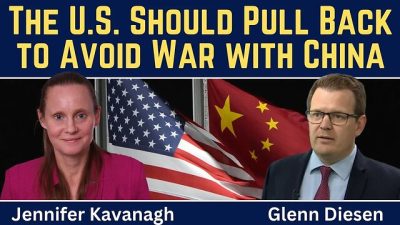
Why the U.S. Should Pull Back From the First Island Chain
or go to
Aletho News Archives – Video-Images
From the Archives
Only 19.7% of Americans agree with US State Dept on Israeli settlements
… Most American adults of voting age don’t appear willing to reject the applicability of international law to Israel’s ongoing colonization of occupied territories in East Jerusalem, the West Bank and Golan Heights. … Full article
Blog Roll
 Aletho News
- British Government Employees Were Fact-Checking the News at the BBC. Nobody Told You.
- Albania on fire: who’s behind the riots?
- Egypt’s Civil Democratic Movement rejects involvement in regional war
- Egypt collaborates with Israel to build ‘Green Rafah’ project over erased Palestinian city
- Rising fuel prices and shortages have helped drive ongoing protests and rioting in France
- Tokyo protests demand Takaichi’s resignation over support for ‘Israel’
- Jennifer Kavanagh: Why the U.S. Should Pull Back From the First Island Chain
- Yemen denounces international community’s silence on Saudi aggression, siege
- UAE and Saudi Arabia move toward renewed coordination against Sanaa
- How Iran’s two-week retaliatory strikes exposed cracks in US military architecture in Persian Gulf
- If Americans Knew
- More on how Bari Weiss is using CBS on behalf of Israel
- What the UK Is Doing to Pro-Palestine Novelist Sally Rooney Is an Act of Orwellian Villainy
- ‘We will build palaces for Jews in Gaza’: Right-wing activists establish new outpost near border
- ‘You see us burning, you stay silent’: Family’s agony over mother and sons burned to death in Gaza tent
- Israel keeps Palestinian journalist Bushra al-Tawil in isolation for 46 days
- US-Israel integration plan puts US military tech in Israel’s hands
- Israeli Strike Burns Gaza Mother Alive in Front of Toddler, ‘Without Generating Any Headlines’
- ‘The Israel Experience with Mike Huckabee’: The Ambassador’s Family Sells Trips to Israel
- As Gazans carry out mass burial, food insecurity is getting worse – Daily Update
- Israeli rabbi permits occupiers to steal Palestinian olive harvest in West Bank
- No Tricks Zone
- Predictions Made By Renowned Climate Proifessor Over Past Decades Have Been Proven To Be Poor
- New Study Suggests Large Regions Of The Pacific Ocean Have Been Cooling For The Last 80 Years
- Germany’s Green Energy Debacle: High Energy Costs Force Kahla Porzellan to Close After 182 Years!
- New Study: 50 Years Of The Most Aggressive ‘Net Zero’ Policies Can Only Affect The Global Climate By 0.03°C
- US September “Heat” Was No Record…Many Records Set Decades Ago
- Latest European Green Energy Debacle; Portugal’s Largest Flagship Solar Park Insolvent!
- Green Energy Debacle: German Expert Professor Fritz Vahrenholt Warns Of Severe Economic And Social Consequences
- Two More Paleo Reconstructions Affirm Meters-Higher Sea Levels Across Ireland, Brazil 7000-6000 Years Ago
- New Study: Earth And Venus Surface Warmth Largely Explained By Convection And Lapse Rate, Not CO2 Or Radiation
- 2025 Nature Paper Claiming Worsening Global Drought Gets RETRACTED …Heavily Flawed

