Moscow Concerned With Escalation of Tensions as ‘Israel’ Attacks Syria
Al-Manar | February 10, 2018
The Russian Foreign Ministry has called to respect Syria’s sovereignty and the territorial integrity of the countries in the Middle East following the aerial attacks of Israeli Occupation Forces against the targets in central Syria.
“Moscow is deeply concerned with the latest developments and attacks on Syria. The danger of the escalation of tensions within and around the de-escalation zones, which has become an important factor in reducing violence in Syria is of particular concern,” the Foreign Ministry said in a statement posted on its website.
The statement reads that the Syrian government forces “are complying with the existing arrangements to provide the consistent functioning of the de-escalation zone in the south-west of the country.”
“We urge all the involved parties to exercise restraint and avoid any steps that could lead to aggravation of the situation. We consider it necessary to unconditionally respect the sovereignty and territorial integrity of Syria and other countries of the region.”
The Reality Behind “Iranian Drone”
Al-Manar | February 10, 2018
Shortly before Syria downed an Israeli F16 fighter jet on Saturday, the occupation army claimed that an “Iranian drone” had violated the so-called “Israeli airspace”.
Tel Aviv aimed from this move to say that its strikes on military posts in Syria were just “defensive” or that they come in the context of “retaliation.”
However, the Command of Syria’s Allies dismissed such claims, stressing that the drone which the Zionist regime was talking about was operating over the Syrian airspace.
“Our drone took off from Tifur airport and was carrying out a normal anti-ISIL mission over Syrian Badiyah,” Syria’s Allies Command said in a statement.
“We hail the brave retaliation of Damascus,” the statement said referring to the downing of the Israeli F16.
It also vowed that any new Israeli aggression on Syria “won’t go unanswered.”
The Zionist entity tried since the first moment to justify its aggression on Syria. However, such claims were immediately refuted, in a clear message to the Zionist entity that says: “The era when you can strike Syria without any retaliation has gone!”
And this conclusion falls in line with Israeli daily Haaretz comments soon after the attack.
“Syrian President Bashar Assad has shifted from stage of threats to stage of action after his army regained control of 80% of Syria’s territory,” Haaretz said.
US-led coalition conducts ‘defensive’ airstrikes against Syrian forces
RT | February 7, 2018
The US-led coalition has carried out several “defensive” airstrikes on Syrian forces in retaliation for what they called an “unprovoked” attack on the so-called Syrian Democratic Forces (SDF) and foreign military “advisers.”
“In defense of Coalition and partner forces, the Coalition conducted strikes against attacking forces to repel the act of aggression against partners engaged in the Global Coalition’s defeat-Daesh (Islamic State, IS, formerly ISIS/ISIL) mission,” the Central Command said in a press release.
The retaliatory attack was carried out after Syrian “pro-regime forces initiated an unprovoked attack against well-established Syrian Democratic Forces headquarters,” the coalition claimed.
The US-led coalition has also firmly stressed its “non-negotiable right to act in self-defense,” since its service members are embedded with the “partners” on ground in Syria.
The confrontation reportedly took place some eight kilometers east of the Euphrates River “deconfliction line.” There were no immediate reports of casualties on either side.
Wednesday’s incident is the latest of its kind involving the US-supported rebels and Syrian government forces. Washington remains under the impression that the coalition air force and its “partners” are allowed to operate east of the Euphrates, while the Syrian forces should remain west of the imaginary demarcation line.
Damascus has repeatedly stated that the US coalition presence on its soil is an act of aggression and a violation of the country’s sovereignty. The Russian and Syrian air forces are the only ones officially allowed to operate in Syria. In fact, the government of Syria has repeatedly asked the United Nations to urge the US to leave, particularly following the virtual defeat of Islamic State terrorist group. However, US Secretary of State Rex Tillerson has instead promised that US troops will remain in Syria indefinitely to counter Syrian President Bashar Assad and Iran’s influence in the region.
The US-led coalition also mulled creating a 30,000-strong border force to secure control of the territory held by their partners in Syria. Since the force would include the Kurdish-dominated SDF alliance, the idea triggered a strong backlash from Turkey, forcing Ankara to initiate ‘Operation Olive Branch’ to secure a buffer “safe zone” in Syria.
Washington seems to have departed from its publicly stated goal of fighting Islamic State (IS, formerly ISIS/ISIL) and is ready to partition Syria, Russian Foreign Minister Sergey Lavrov warned earlier on Wednesday.
“It’s very likely that the Americans have taken a course of dividing the country. They just gave up their assurances, given to us, that the only goal of their presence in Syria – without an invitation of the legitimate government – was to defeat Islamic State and the terrorists,” Lavrov said.
“Now they are saying that they will keep their presence till they make sure a steady process of a political settlement in Syria starts, which will result in regime change,” the minister said during a conference in Sochi.
US eyes partitioning of Syria, gave up on promise that fighting ISIS ‘only goal’ – Lavrov
RT | February 7, 2018
The US appears to be aiming at dividing Syria, as US troops still linger in the country even after its promise to end the mission after driving out Islamic State fighters, Russian Foreign Minister Sergey Lavrov said.
“It’s very likely that the Americans have taken a course of dividing the country. They just gave up their assurances, given to us, that the only goal of their presence in Syria – without an invitation of the legitimate government – was to defeat Islamic State (IS, formerly ISIS) and the terrorists,” Lavrov said.
Regarding pledges to keep a limited military contingent in the war-town state, Lavrov says the US is not being open about their true objectives.
“Now [the Americans] are saying that they will keep their presence till they make sure a steady process of a political settlement in Syria starts, which will result in regime change,” the minister said during a conference in Sochi.
The foreign minister claimed there are “plans of virtual division of Syria.”
“We know of [them] and we will ask our American colleagues, how they are seeing [Syria’s division].”
The US has nearly 2,000 servicemen currently stationed in Syria. In December, the Pentagon announced the troops will remain on the ground for as long as needed “to support our partners and prevent the return of terrorist groups.” Secretary of State Rex Tillerson later reiterated the plan.
Although the Syrian government regards the deployment of US troops on its sovereign territory as “illegal,” Washington justifies its presence under the pretext of fighting IS militants.
Moscow, which operates in the country on the Syrian government’s request, insists that the US has no grounds to have a military presence in the country without the permission of the Syrian government.
Washington has also been arming and funding various groups under the banners of the Free Syrian Army (FSA) and the Kurdish-dominated Syrian Democratic Forces (SDF).
“The US, flirting with various segments of Syrian society that oppose the government with arms in their hands, may lead to very dangerous consequences,” Lavrov warned.
The Turkish-backed FSA is currently engaged in fighting with parts of the SDF forces, namely the Kurdish People’s Protection Units (YPG), in Afrin. These issues have caused serious tensions between Ankara and Washington.
Meanwhile, FSA is trying to persuade the US to revive the defunct CIA program which provided cash, weapons and instructors to “moderate” rebels, a high-ranking rebel official told Reuters.
Last July, the Trump administration reportedly ended the respective program launched back in 2013 during Barack Obama’s presidency.
Moscow has consistently warned against arming the so-called moderate rebel factions in Syria, pointing out that weapons supplied to them often fall into the hands of jihadist groups.
Rights groups allege that some rebel factions might have committed war crimes against civilians. In May 2016, Amnesty International said armed groups surrounding the Sheikh Maqsoud district near Aleppo “have repeatedly carried out indiscriminate attacks that have struck civilian homes, streets, markets and mosques, killing and injuring civilians and displaying a shameful disregard for human life.”
Read more:
How Al-Qaeda Ended Up With Anti-Aircraft Missiles: Here Is The Congressional Authorization
By Tyler Durden | Zero Hedge | February 6, 2018
After the terrorist group Hayat Tahrir al-Sham (HTS), a rebrand of Jabhat al-Nusra, which is the Syrian al-Qaeda affiliate, claimed responsibility for the dramatic downing of a Russian Su-25 fighter jet over Idlib in northwest Syria on Saturday – the first Russian plane downed in Syria since 2015 – a number of analysts have published articles asking the obvious million dollar question: where did al-Qaeda get the portable anti-aircraft missile system used in the attack?
Once such article in Al Monitor speculates on the following: “The three immediate questions that arose from the attack were how the downing was made possible, how the militants acquired the arms and whether there was a bigger-level player behind the attack.”
MANPADS are heat seeking shoulder fired missiles capable of hitting targets flying at anywhere between 10,000 and 15,000 feet.
And Al Monitor seems to answer its own question in the following when listing the array of allied groups now operating under the leadership of al-Qaeda (HTS) – among them groups previously “vetted” and approved to receive advanced weaponry by the CIA (specifically the TOW anti-tank missile):
Dozens of miles of Idlib province are contested among an array of groups, including the terrorist Hayat Tahrir al-Sham (HTS), a rebrand of Jabhat al-Nusra, which was affiliated with al-Qaeda; the Free Syrian Army; and its affiliate Jaish al-Nasr, which is considered a “moderate opposition group” that received weapons from the United States. Minutes after the downing of the Su-25, Alaa al-Hamwi, the military commander of Jaish al-Nasr’s aid defense battalion, claimed responsibility for the attack. Alaa argued that Jaish al-Nasr’s command supplied weapons to protect against the Russian air assault.
Later, however, HTS claimed responsibility for downing the plane.
Though US intelligence and defense officials have long denied that so-called “vetted” groups in Syria were recipients of anti-aircraft systems, rumors to the contrary have been persistent for years. The latest denial came immediately on the heels of Saturday’s Russian jet shoot down, which resulted in the death of the pilot on the ground as he came under fire by jihadists. Pentagon spokesman Maj. Adrian J.T. Rankine-Galloway told Russia’s TASS: “The United States have not provided any of its allied forces in Syria with anti-aircraft weapons.”
The Pentagon spokesman further said, according to RT, that the US-led coalition is currently not engaged in any operations in the area where the jet was downed Saturday, indicating the coalition’s combat efforts are “geographically orientated on the current fight with Islamic State (IS, formerly ISIS, ISIL) in eastern Syria.” Yet the statement clearly avoided any reference to past US programs to arm so-called “moderates” – whether through the secretive CIA program or DoD program. And this is to say nothing of allies like Saudi Arabia who worked closely with US intelligence for years in supplying weapons to anti-Assad militants.
But does anyone remember this? …from The Wall Street Journal all the way back in February of 2014, headlined Saudis Agree to Provide Syrian Rebels With Mobile Antiaircraft Missiles – U.S. Also Giving Fighters Millions of Dollars for Salaries
Washington’s Arab allies, disappointed with Syria peace talks, have agreed to provide rebels there with more sophisticated weaponry, including shoulder-fired missiles that can take down jets, according to Western and Arab diplomats and opposition figures.
Saudi Arabia has offered to give the opposition for the first time Chinese man-portable air defense systems, or Manpads, and antitank guided missiles from Russia, according to an Arab diplomat and several opposition figures with knowledge of the efforts. Saudi officials couldn’t be reached to comment.
The U.S. has long opposed arming rebels with antiaircraft missiles for fear they could fall into the hands of extremists who might use them against the West or commercial airlines. The Saudis have held off supplying them in the past because of U.S. opposition.
And also this March 2014 report from US government-funded Voice of America news:
Saudi Arabia reportedly is offering to provide Syrian rebels more sophisticated weapons, including shoulder-fired anti-aircraft missiles that can take down fighter planes and helicopter gunships. They could be a game changer in the Syrian civil war. Known as MANPADS or man-portable air defense systems, the shoulder-fired missiles are a highly-effective weapon.
Now, Saudi Arabia is offering to supply moderate rebels with these weapons. That could tip the balance on the battlefield.
… President Barack Obama is said to be rethinking U.S. strategy toward Syria. No doubt arming the Syrian rebels will be on the agenda when Obama travels to Saudi Arabia in late March.
Meanwhile, in February 2018 there’s this to consider…
Al-Qaeda controls a strip of land (Idlib province) not far from the Mediterranean coast, and has now clearly demonstrated the capability of shooting down aircraft.

In 2014 a historical first was reached: al-Qaeda established a foothold on the Mediterranean coast after it took the Syrian town of Kessab, but has since been pushed back into Idlib.
Al-Qaida’s flag now flies on the Mediterranean Sea https://t.co/Dhkv2Om23o
— Joshua Landis (@joshua_landis) March 29, 2014
However, al-Qaeda still remains a very short drive to the Mediterranean coast, with Syrian government territory in between.
MANPADS (“man-portable air-defense system”) have appeared on the Syrian battlefield in recent years in the hands armed opposition groups supported by the West and Gulf states, including various FSA and Islamist factions – some of which, as Al Monitor confirms, operate today in Idlib.
These groups have at various times filmed and demonstrated themselves to be in possession of these externally supplied MANPADS long before last weekend’s Russian jet downing. The portable systems are believed by analysts to have entered Syria in multiple waves via different routes and external sponsors, including old Soviet models shipped out of Libya, Chinese FN-6’s provided by Qatar, and through NATO member Turkey’s porous border with Syria. Some supplies were also likely gained through opposition takeovers of Syrian government storehouses as well as ISIS seizures of Iraqi government bases and equipment.
Most likely, United States intelligence operatives simply allowed its close allies like the Saudis and Turks to introduce MANPADS early on in the conflict to the Syrian battlefield. In this way the US could maintain “plausible deniability” as it is likely doing now after last weekend’s attack.
But a detail which has gone largely unnoticed since the Russian fighter downing is that Congress had already quietly laid the legal framework for US transfer of MANPADS to groups in Syria over a year ago as part of the Fiscal Year 2017 National Defense Authorization Act (the NDAA passed the House and Senate in the opening weeks of December 2016). The leading military news site SOFREP reported the authorization at the end of 2016, and described at the time that “Congress for the first time authorized the Department of Defense to provide vetted-Syrian rebels with anti-aircraft missiles.”
Concerning procedural rules, the NDAA requires that the Secretaries of Defense and State submit a formal request to Congress requesting the transfer of the anti-aircraft missiles systems to Syria, which must include the following according to the SOFREP report:
- A detailed description of each element of the vetted Syrian opposition receiving MANPADS
- The justification for providing those elements with MANPADS
- The number and type of MANPADS provided
- The logistics plan for resupplying approved elements with MANPADS
- The duration of support
And SOFREP included the following observation:
The inclusion of the provision represents a departure from previous versions of the NDAA. The original House bill specifically prohibited the transfer of MANPADS to “any entity” in Syria, while the Senate bill did not address it.
Though there was an attempt in March 2017 to roll back the authorization, nothing appears to have changed regarding MANPADS and Syria in the 2018 NDAA, which was signed into law by President Trump.
Here’s the law authorizing US transfer of MANPADS to Syria as contained in the 2018 National Defense Authorization Act (NDAA):

However, long before this formal NDAA legal framework was put into effect, it appears anti-aircraft systems were already being handed out among Syrian militant groups – again, likely through the Saudis or a third party US ally. In May 2016 we featured the following commentary:
Dr. Christina Lin, a leading scholar on jihadist groups, opens her April 8th commentary at Asia Times: “In a blunder reeking of the fallout caused by supplying Stinger anti-aircraft missiles to 1980s mujahideen in Afghanistan, civilian airline passengers are now under threat from Syrian jihadists armed with portable surface-to-air missiles (MANPADS).
Reports say some American-backed jihadi groups are being equipped with US-made MANPADS. Indications are they’re obtaining these advanced weapons either directly or indirectly from the US or its Mideast allies in connection with a recent escalation in the fighting in Syria.”
And further:
Dr. Lin quotes a Saudi official as saying (in Germany’s Spiegel), “We believe that introducing surface-to-air missiles in Syria is going to change the balance of power on the ground… just like surface-to-air missiles in Afghanistan were able to change the balance of power there.” He was referring there to this in 1979, where Obama’s friend Zbigniew Brzezinski explained why the Americans and the Saudis were supplying SAMs to the mujahideen who became al-Qaeda, and he was also referring to this in 1998, where Brzezinski, when asked whether he thought that arming those fundamentalist Sunnis had been a mistake, said that it certainly was not.
And an unpleasant reminder which bears repeating…
The threat of MANPADS taking out civilian passenger jets is very real, as history proves. The US Department of State counted that 40 civilian aircraft have been hit by MANPADS since the 1970s, which includes the complete downing of 28 civilian airliners resulting in over 800 fatalities. The State Department’s official report on MANPADS and civilian aircraft provides the following partial list of attacks on civilian aviation:
- March 12, 1975: A Douglas C-54D-5-DC passenger airliner, operated by Air Vietnam, crashed into Vietnamese territory after being hit by a MANPADS. All six crew members and 20 passengers were killed in the crash.
- September 3, 1978: An Air Rhodesia Vickers 782D Viscount passenger airliner crash landed after being hit by a MANPADS fired by forces from the Zimbabwe Peoples Revolution Army. Four crew members and 34 of the 56 passengers were killed in the crash.
- December 19, 1988: Two Douglas DC-7 spray aircraft en route from Senegal to Morocco, chartered by the U.S. Agency for International Development to eradicate locusts, were struck by MANPADS fired by POLISARIO militants in the Western Sahara. One DC-7 crashed killing all 5 crew members. The other DC-7 landed safely in Morocco.
- September 22, 1993: A Tupolev 154B aircraft operated by Transair Georgia was shot down by Abkhazian separatist forces, crashed onto the runway and caught fire, killing 108.
- April 6, 1994: A Dassault Mystère-Falcon 50 executive jet carrying the Presidents of Rwanda and Burundi and its French flight crew was shot down over Kigali, killing all aboard and sparking massive ethnic violence and regional conflict.
- October 10, 1998: A Boeing 727-30 Lignes Aeriennes Congolaises airliner was downed over the Democratic Republic of the Congo jungle by Tutsi militia, killing 41.
- December 26, 1998: A United Nations-chartered Lockheed C-130 Hercules transport was shot down over Angola by UNITA forces, killing 14.
- January 2, 1999: A United Nations Lockheed L-100-30 Hercules transport was shot down by UNITA forces in Angola, killing 9.
- November 28, 2002: Terrorists fired two MANPADS at an Arkia Airlines Boeing 757-3E7 with 271 passengers and crew as it took off from Mombasa, Kenya. Both missiles missed.
- November 22, 2003: A DHL Airbus A300B4-203F cargo jet transporting mail in Iraq was struck and damaged by a MANPADS. Though hit in the left fuel tank, the plane was able to return to the Baghdad airport and land safely.
- March 23, 2007: A Transaviaexport Ilyushin 76TD cargo plane was shot down over Mogadishu, Somalia, killing the entire crew of 11.
Who Is James Le Mesurier? – The Former British Army Officer Who Founded The White Helmets
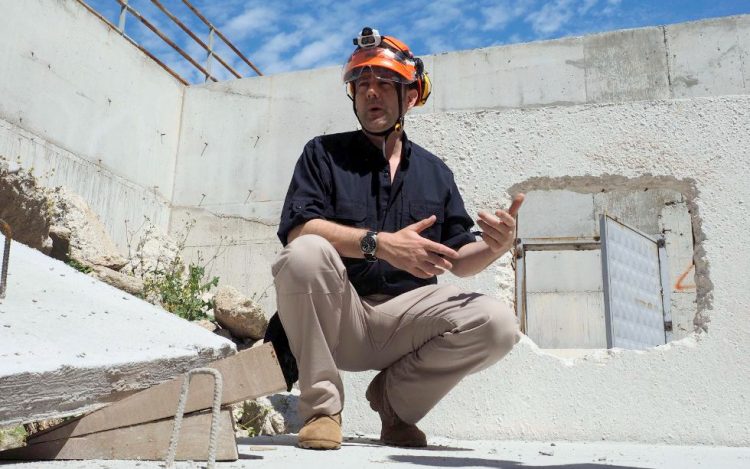
By John Wight | American Herald Tribune | February 6, 2018
Who is James Le Mesurier, the former British army officer and military contractor who founded the White Helmets, the civil defence organisation which operates exclusively in opposition-held parts of Syria? It is a question more and more people are asking as their role and function comes under increasing scrutiny.
Le Mesurier carries about him the inescapable whiff of Britain’s malign legacy and history of dirty wars, waged in Kenya, Aden, Ireland, Iraq, Libya, in other words wherever London’s blood-soaked imperialist foot has tread around the world. A product of Britain’s prestigious Royal Military Academy of officer training at Sandhurst, he served in various UK military/NATO military deployments over the past three decades, specifically Bosnia, Kosovo, Iraq and Lebanon.
In a short bio describing Le Mesurier’s work with the White Helmets, we are informed, “In addition to the White Helmets in Syria, Mayday is active in Mogadishu, developing the city’s emergency services network, and exploring the development of similar community-based resilience initiatives in other fragile and failing states (my emphasis).”
The question of why a given state becomes fragile and failing is of course neither asked nor explored, for doing so would dredge up the subject of imperialism, which for Western ideologues such as Mr Le Mesurier would be akin to a vampire being exposed to daylight.
In a wide ranging 2016 article, former US marine and UN weapons inspector, Scott Ritter, provides a forensic account of Le Mesurier’s background, including the time he spent in and around the murky world of private military contractors, who exist in the cracks of Western military deployments, able to operate beyond the inconvenient glare of public scrutiny and accountability.
Ritter writes:
“the organizational underpinnings of the White Helmets can be sourced to a March 2013 meeting in Istanbul between a retired British military officer, James Le Mesurier—who had experience in the murky world of private security companies and the shadowy confluence between national security and intelligence operations and international organizations—and representatives of the Syrian National Council (SNC) and the Qatari Red Crescent Society. Earlier that month, the SNC was given Syria’s seat in the Arab League at a meeting of the league held in Qatar.”
So here we have a civil defence organisation being established in Syria by an ex-British army officer, a man with a background in the shadowy world of private security, in conjunction with a Syrian opposition group in exile. This civil defence organization, the White Helmets, receives funding from an array of states with a clear agenda of regime change in Syria, evidenced in the material, financial and political support they have given various armed opposition groups involved in the conflict.
In a 2015 speech Le Mesurier provides a précis of the roots of the conflict in Syria, starting with in 2011 a “volunteer uprising against the ruthless dictator, Bashar al-Assad,” before going on the assert that in 2012 the Syrian state turned its weapons on its “own people.”
Glaringly absent from this Manichean narrative is the fact that by 2012 various Salafi-jihadi groups, their ranks filled by thousands of extremists from outwith Syria, were rampaging across the country slaughtering and raping and terrorizing the very “own people” the Syrian army and its allies have been fighting to protect, save and liberate from the clutches of this latter day Khmer Rouge. And lest anyone has forgotten, the Syrian Arab Army is indistinguishable from the Syrian people, considering that its soldiers are drawn from the non-sectarian and multi-religious mosaic that makes up Syrian society.
Returning to Scott Ritter: “In this day of social media, it didn’t take long for photographs and video clips of known White Helmet members, in their distinctive uniform, openly celebrating with Al Nusra fighters in the aftermath of Syrian government defeats, and even carrying weapons, something their status as neutral first responders strictly prohibits.”
From the White Helmets’ own website, the lack of neutrality Ritter asserts is unambiguously expressed with the statement posted on its front page by Raed Saleh, the operational head of the organisation and himself a figure of some controversy. Saleh writes, “the UN Security Council must follow on its demand to stop the barrel bombs, by introducing a ‘no-fly zone’ if necessary.”
The barrel bombs referred to by Saleh, and emphasised by Le Mesurier as emblematic of the brutality of the ‘Assad regime,’ are inarguably indiscriminate and illegal under international law. But if we are judging the merits or demerits of a given side in a given conflict based on the use of indiscriminate weapons alone then regime change in Washington, Tel Aviv and Riyadh is long overdue.
The brutality of the conflict in Syria is a reflection of the monumental stakes involved in the outcome. The conflict is in itself is a crime, but are we seriously suggesting that Libya is better, safer and more stable seven years on from the toppling and murder of its leader Muammar Gaddafi, courtesy of NATO aligning with various Libyan opposition factions, prime among them Islamists, in 2011? And are we seriously arguing that Syria’s fate would not be Libya’s fate in the event of the toppling of Bashar al-Assad? And, too, is anybody able to maintain with a straight face that Bashar al-Assad does not enjoy the solid support of the majority of the Syrian people, who understand that the conflict is not about saving their government but saving their country?
Scott Ritter again:
“the White Helmets function as an effective propaganda arm of the anti-Assad movement…With their training, equipment and logistical sustainment underwritten exclusively by donations from Western governments (primarily the U.S. and U.K.), the White Helmets serve as a virtual echo chamber for American and British politicians and officials.”
Given Le Mesurier’s background, along with the evidence of how the White Helmets operate, it is reasonable to assume that what we have is the cultivation of the very Third Force Washington and London have been extending themselves in trying to locate and sell as the ‘good guys’ since the conflict began, doing so with the objective of enlisting domestic public support for intervention and regime change in Damascus.
Of course, there is always the possibility that Mr Le Mesurier is sincere in his desire to alleviate the undoubted suffering of the Syrian people – though in his case clearly not all the Syrian people, what with White Helmets only functioning and operating in opposition controlled territory, places where neither he nor any Western supporter of the White Helmets would dare set foot, knowing the moment they did they would be abducted, tortured, and brutally murdered.
But if so, if Mr Le Mesurier is sincere, then he is Britain’s answer to Pyle, the idealistic and naïve American interventionist in French-occupied Vietnam created by Graham Greene in his classic novel The Quiet American. To wit:
“He was young and ignorant and silly and he got involved. He had no more of a notion than any of you what the whole affair’s about, and you gave him money and York Harding’s books on the East and said, ‘Go ahead. Win the East for democracy.’ He never saw anything he hadn’t heard in a lecture hall, and his writers and his lecturers made a fool of him.”
Mattis Threatens Military Action Over Syria Gas Attack Claims, Then Admits “No Evidence”
By Tyler Durden – Zero Hedge – 02/02/2018
Mattis Threatens Military Action Over Syria Gas Attack Claims, Then Admits “No Evidence”
“I don’t have the evidence,” Mattis said. “What I am saying is that other groups on the ground – NGOs, fighters on the ground – have said that sarin has been used, so we are looking for evidence.”
This week the American public was once again bombarded by fresh headlines alleging the Syrian government under President Bashar al-Assad gassed its own people. And in predictable fashion the usual threat of US military force soon followed.
Except of course rather than “alleging” a chemical incident, all the usual suspects from CNN pundits to State Department bureaucrats to Pentagon officials in typical fashion are opting for the simpler “Assad did it” narrative. State Department spokesperson Heather Nauert stated Thursday, “Russia is making the wrong choice by not exercising its unique influence. To allow the Syria regime to use chemical weapons against its own people is unconscionable. We will pursue accountability.”

The White Helmets published this photo on Thursday, claiming that its “volunteer was suffocated by the chlorine gas attack”. It appears that this is the “NGO” Defense Secretary Jim Mattis referenced on Friday to say “open sources” say Assad is using chemical weapons.
Nauert’s statement was a repeat of talking points from last week’s chemical attack claims, wherein both she and Secretary of State Rex Tillerson ultimately blamed Russia. But like with other recent chemical attack allegations, the claims couldn’t be more vague or poorly sourced, yet was still enough for U.S. officials to issue more direct threats of US military action against Assad.
While addressing the prior East Ghouta incident during a talk on January 23rd, Tillerson let slip that he didn’t actually know much about the supposed earlier January attack at all while still putting blame squarely on Syria and Russia, saying at the time, “Whoever conducted the attacks Russia ultimately bears responsibility for the victims in eastern Ghouta and countless other Syrians targeted with chemical weapons since Russia became involved in Syria.”
This week the “evidence” doesn’t appear to be any clearer or narrowed.
On Friday Defense Secretary Jim Mattis addressed the latest claims, confidently asserting the Syrian government had as a matter of routine used chlorine as a weapon against the remaining pockets of opposition areas of the country – specifically in the Damascus suburb of East Ghouta, but it appears at this point that even Reuters has suddenly found its journalistic skepticism… Yes, actual knowledge on whether or not there was even a chemical attack to begin with is indeed thin enough for Reuters to headline its own report with “Mattis says has no evidence of sarin gas used in Syria, but concerned”.
Mattis, in line with the rest of the administration – especially the State Department – did his best to paint a scenario of the case being all but certain that the Syrian Army has been using chlorine gas to attack civilians, while also suggesting Sarin may have been deployed as well, which could serve as a “red line” triggering US military attack on the Syrian government.
But Mattis was also forced to admit the following, according to Reuters :
Mattis, speaking with reporters, said the Syrian government had repeatedly used chlorine as a weapon. He stressed that the United States did not have evidence of sarin gas use.
“We are even more concerned about the possibility of sarin use, (but) I don’t have the evidence,” Mattis said. “What I am saying is that other groups on the ground – NGOs, fighters on the ground – have said that sarin has been used, so we are looking for evidence.”
And according to CNN, Mattis is now merely going on “open source” information, which essentially means anything from media reports to YouTube to Twitter to mere “opposition sources say…”. CNN reports the following:
“You have all seen how we reacted to that [referencing the April 2017 US airstrike], so they’d be ill advised to go back to violating the chemical convention”… Mattis acknowledged that the US has not seen direct evidence of the use of Sarin gas but pointed to open source reports. “I don’t have the evidence… We are looking for evidence. I don’t have evidence credible or uncredible.”
Like with previous allegations, US government officials are issuing threats of military action based on NGO’s and fighters on the ground.
In this case it once again appears to be the word of the White Helmets, which it seems just about every other week issue new and unverified claims of chemical weapons attacks by the Syrian government. As is now generally well-known the White Helmets are funded by US and UK governments to the tune of many tens of millions of dollars, and have further been frequently filmed and documented cooperating closely with al-Qaeda factions on the ground in Syria.
Indeed the group only operates in areas controlled by al-Qaeda (HTS) and other anti-government insurgents, especially in the locations of recent alleged attacks – Idlib and East Ghouta.
Now that unverified claims of chemical attack incidents in Syria (and their subsequent uncritical amplification by media and politicians) have become routine, the following somewhat obvious observations need to be recalled:
- The Assad government has long been winning the war, what incentive does it have to do the one thing (use CW) that would hasten its demise?
- The US is a party to the conflict, so its claims must be evaluated accordingly.
- The “NGOs and fighters on the ground” (in Mattis’ own words) are an even more direct party to the conflict.
- The only way anti-Assad fighters can survive at this point is by triggering massive US military intervention (by claiming “Assad is gassing his own people!”).
- The greater the momentum of Syria/Russia/Iran forces in defeating jihadists on Syrian territory, the more frequent the claims of chemical attacks become – issued from those very jihadists suffering near certain defeat.
- In the midst of a grinding 7-year long “fog of war” conflict involving constant claims and counterclaims, mere “open source” information means nothing in terms of proof or hard evidence.
- Al-Qaeda administers the locations from which chemical attack allegations are being made.
- US officials stand ready to make use of “chemical attack” claims with or without “evidence credible or uncredible” (in Mattis’ words) anytime further pressure needs to be applied toward Russia or Syria.
- Extraordinary claims demand extraordinary evidence (Iraq WMD anyone?).
For its part, Russia alongside the Syrian government and other regional allies have long accused the US of blindly trusting opposition sources inside Syria concerning claims of chemical weapons attacks, including the April 2017 incident in al-Qaeda controlled (HTS) Idlib, which resulted in the US attacking an airbase in central Syria.
Last October, the US State Department admitted that anti-Assad militant groups operating in Syria, especially in Idlib, possess and have used chemical weapons throughout the war – something which the US government previously said was impossible, as it consistently held the position that only the Assad government could be to blame.
Featured Video

Trita Parsi: Middle East Unraveling — Are We on the Path to World War?
or go to
Aletho News Archives – Video-Images
New Book
Trans agenda is ‘normalization of sadism’ – US author

RT | September 23, 2026
The US Democratic Party has embraced a transgender agenda that amounts to “the normalization of sadism,” author A.J. Rice has said, warning that radical trans policies would return if the party is allowed to regain power.
Speaking to RT’s America First host Scotty Nell Hughes about his new book, ‘The Curse of the Bearded Lady: How the Trans Mafia Whacked American Sanity’, Rice argued that activists have gained significant influence in schools, medicine, and corporate America while people who questioned the agenda have faced pressure to stay silent.
The author described the “trans mafia” as the sprawling network of people and institutions that have helped the movement gain influence. He singled out parts of academia, wealthy backers, and corporations, and stated that providers of transition-related treatment also have a financial incentive to keep young people in their care indefinitely.
Rice argued that the consequences of these policies ultimately fall on children who are being drawn toward gender-affirming medical treatments and on girls who are expected to share locker rooms or compete in sports with biological males.
He noted that while voters rejected the Democrats’ approach to gender in 2024, the party, which has been “captured by madness,” has since only doubled down and is seeking what is effectively “the normalization of sadism.” … Full report
Blog Roll
 Aletho News
- ‘We don’t seek permission to defend our country’: Snippets from President Pezeshkian’s UNGA address
- NATO chief wants Europeans to fight American wars [for Israel]
- German chemicals giant reveals details of downsizing
- Refaat Al-Areer Was The Canary In The Coal Mine In Israel’s War On The Truth
- Israeli election committee bars candidate from Knesset race over Gaza war opposition
- French-Lebanese man files war crimes complaint over Israeli attacks
- Mahan Air Flight Lands in China Despite US Threat against Iranian Airlines
- US eyes $10bn fund to rebuild war-battered Gulf infrastructure
- Trump meets Rodríguez near Maduro’s prison as Venezuela’s oil flows to US
- Trita Parsi: Middle East Unraveling — Are We on the Path to World War?
- If Americans Knew
- Caught on Tape: AIPAC CEO Boasted of Controlling Trump’s National Security Officials
- Why Hamas Attacked Israel in October 2023 – Israeli professor Ilan Pappé
- They see them, then kill them: Israeli quadcopters track, deliberately target civilians in Gaza
- Winter could turn Gaza’s treacherous, war-damaged buildings into deathtraps
- Majority of Democratic Voters Want to Prosecute Both Biden and Trump Administration Officials Over Gaza
- As Gaza languishes, world leaders gather at the UN – Daily Update
- Sanctions are collective punishment: immoral and self-defeating
- Phosphorus Munitions Fired by Israel Burn Groves, Orchards in Southern Lebanon
- Israel Carries Out New Ceasefire Violations Across Gaza
- AI – Emphasis on the ‘I’: Israel Is Funding AI Chatbot Propaganda
- No Tricks Zone
- New Study: Earth And Venus Surface Warmth Largely Explained By Convection And Lapse Rate, Not CO2 Or Radiation
- 2025 Nature Paper Claiming Worsening Global Drought Gets RETRACTED …Heavily Flawed
- New Study: ‘Global Drought Shows No Detectable Recent Acceleration Under Climate Warming’
- Economic Masterminds: German Socialists Suggest Taxing Productivity Gains Stemming From Using AI
- The South China Sea Has Not Been Cooperating With The Climate Change Narrative
- Energy Crisis: Germany Enters Heating Season With Historically Low Gas Reserve Fill Levels
- New Study: The Antarctic Ice Sheet Gained Mass From 2020-2024 Due To Staggering Snow And Ice Accumulation
- Study: Ocean Heating Rates From Thousands Of Years Ago ‘Dwarf’ Modern Ocean Heating Rates
- Climate Extremists Target, Attack Large-Scale Power Grid Infrastructure In Germany!
- New Study: Antarctic Ice Melt Has Contributed Less Than 1 Centimeter To Sea Level Rise In The Last 30 Years

