US deploys troops to occupied territories for joint war games with Israel
Press TV – February 2, 2018
The US has deployed military forces to the Israeli-occupied territories ahead of a joint war game with Tel Aviv as the regime ramps up its threats of a new war against Lebanon.
Israeli media outlets announced the arrival of the American troops on Thursday in preparation for the so-called Juniper Cobra biennial military drills, which will start next week.
The last edition of the drills enlisted more than 3,000 forces from the two sides.
The sources said the maneuvers simulate engagement with the countries lying to the north and south of the occupied territories, including Lebanon.
Israel and Lebanon are technically at war since 1967 when the regime occupied the country’s Shebaa Farms.
Israel staged two wholesale wars against Lebanon in 2000 and 2006 to defeat the country’s resistance movement of Hezbollah, which is Lebanon’s de facto military power.
Tel Aviv fell short of the ambition in both cases in the face of strong resistance by Hezbollah, backed by the national army, and instead saw its myth of invincibility being dealt a serious blow.
On Wednesday, the Israeli minister for military affairs, Avigdor Lieberman, renewed the threat of a new war against Lebanon, saying Beirut would “pay the full price” for its ties with Tehran in a future military offensive.
Lieberman also warned companies not to engage in oil and gas exploration activities with Lebanon.
Hezbollah responded by saying the group would “decisively confront any assault on our oil and gas rights.”
Prime Minister Sa’ad al-Hariri and other Lebanese statesmen also reacted, with Hariri saying Lieberman’s remarks were one of several “threatening messages” from Israel over the previous days.
Hariri had on January 25 called Israel the greatest threat to Lebanon’s stability amid similar indications that the regime could be contemplating new military offensive against his nation.
“The only threat I see is Israel taking some kind of action against Lebanon, out of a miscalculation,” Hariri told an audience at the World Economic Forum in Davos, Switzerland. “And this is the real threat, I believe. I think the other issues are challenges, yes … But when Israel decides to launch a war against Lebanon, this is something that is unexplainable,” he added.
Lieberman suggested that a war with Lebanon would also likely involve Syria.
“Israel’s northern front extends to Syria; it is not just Lebanon. I am not sure that the Syrian government can resist Hezbollah’s attempts to drag them into a war with Israel,” he said.
Hezbollah and Syria enjoy years-long experience of counter-terrorism cooperation. Hezbollah has been successfully lending battleground support to Syria during the latter’s operations against Takfiri militants.
The Top 10 Outrageous Things About ISIS the Western Mainstream Media Ignores
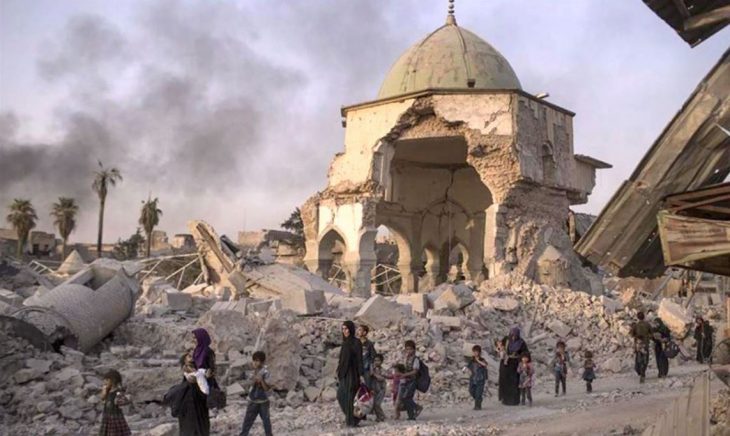
By Robert BRIDGE | Strategic Culture Foundation | 31.01.2018
Last week, the US said it was working to create “alternative government authorities” on Syrian territory. This latest move, aside from demonstrating once again that the US has no respect for Syria’s territorial integrity, indicates we may be seeing more from that group of mercenaries known as Islamic State.
Thus, it seems to be an appropriate time to reflect upon a set of very strange circumstances that led to the rise of this loathsome terrorist group. Here are the top 10 reasons, in no particular order, as to why we should be very suspicious about this group.
10. Convenient Timing
In late August 2013, the United States was on the verge of initiating a massive attack on the government of Syrian President Bashar Assad over a deadly chemical attack that had occurred in the town of Ghouta just days earlier. Although it would have made no sense for Assad to have resorted to such dirty tactics, Washington had found its casus belli. It should be noted that at this time the so-called Islamic State of Iraq and the Levant was largely unknown. That would change soon enough.
Meanwhile, a terrible thing happened on the way to this jolly little war. UK Prime Minister David Cameron suffered a stunning defeat in the House of Commons, voting down his effort to join the Americans in Syria. Apparently the British were America’s obedient poodle no longer.
The setback had an apparent sobering effect on Barack Obama, who suddenly – in a feigned nod to democratic procedure and all that – called for Congress to decide whether or not to use military force against Syrian. Tellingly, that vote never materialized.
What did materialize, however, and with alarming speed and viciousness, was a terrorist group that rose up like a phoenix from the ashes of Iraq known as Islamic State (ISIS), with evil designs to create an Islamic caliphate across a wide swath of Iraq and Syria.
In other words, the perfect casus belli for the US in Syria that would require no need for a vote from Congress.
9. Journalist Killings
As if to draw gratuitous attention to itself more than anything else, the Sunni terrorist group ISIS, under the leadership of one Abu Bakr al Baghdadi, began to grab world headlines not by its battlefield exploits, but by carrying out videotaped executions of Western journalists, as well as destroying cultural heritage sites. I still can’t help wondering: Why didn’t the group just let its fighting skills speak for itself? Why the apparent need for such outrageous publicity stunts? Was this compensation for something the group was desperately lacking?
In any case, starting in August 2014, almost one year to the day that Obama was forced to put the brakes on his Syrian attack, the beheadings began in earnest.
On August 19, US journalist James Foley, seen kneeling on the ground in some undetermined location next to his apparent executioner, ‘Jihadi John,’ reads out a short statement before being beheaded by his captor. However, Islamic State spared its audience the gore by not showing the moment of the actual beheading; the video only shows a head lying on a body following the purported act.
Even Western mainstream publications admitted that something didn’t seem quite right.
Under the headline, ‘Foley murder video may have been staged’ the Telegraph, a reputable British newspaper, interviewed forensic experts who called into question the moment in the video when Foley is allegedly being beheaded by his captor.
“After enhancements, the knife can be seen to be drawn across the upper neck at least six times, with no blood evidence to the point the picture fades to black,” the expert said.
Another expert who examined the video for the newspaper said: “I think it has been staged. My feeling is that the execution may have happened after the camera was stopped.”
Incredibly, every subsequent beheading video put out by Islamic State attracted the same amount of scepticism – not just from alternative websites, who were also noticing the many irregularities contained in the videos, but from mainstream media news sources.
Following the release of the video purported to show the beheading of Steve Sotloff, a journalist who worked with the Jerusalem Post, The Australian newspaper reported that “the apparent beheading on camera of a second US hostage by a man with a British accent was again staged, according to forensic analysis.”
Then there was the video of 21 Egyptian Coptic Christians, dressed in impeccably clean orange jumpsuits, being led along a Libyan beach by black-clad members of ISIS, all of whom appear to be members of some NBA basketball team.
Veryan Khan, editorial director of the Florida-based Terrorism Research & Analysis Consortium, told Fox News that “the speaker, “Jihad Joseph” is much larger than the sea in both the close up and wide shots, and his head is bizarrely out of proportion, meaning he was filmed indoors and the sea added behind him… In addition, the jihadists featured in the film look to be more than 7 feet tall, towering as much as two feet above their victims…”
In July 2015, yet another strange report emerged, CyberBerkut, a Ukrainian group of hackers, said it hacked John McCain’s laptop while he was on an official visit to Kiev around the first week of June 2015. In a report by TechWorm, what they purported to find was a fully staged production of an ISIS execution video, with an actor portraying an executioner who is holding a knife in preparation to behead the prisoner.
The authenticity of this video has not been independently verified.
None of this proves that the individuals in all of the ISIS beheading videos did not go on to meet some grisly fate. However, it seems worth noting that so many forensic experts have spoken out on the “staged” nature of these videos, and that the actual moment of execution during these film productions is never actually shown. Why would such a barbarous group of villains like ISIS need to script and censor their videos?
8. ISIS freedom of movement
Despite employing state-of-the-art fighter jets, like the F-16 Fighting Falcon and A-10 Warthog, the US campaign to destroy Islamic State was largely an exercise in utter futility. There is no other way to explain it. In June 2014, a convoy of hundreds of ISIS fighters drove through 200 km of the Syro-Arabian Desert in fresh-off-the-lot Toyota pickup trucks on the way to Syria. For any modern military, eliminating such a target would have been the equivalent of a lazy afternoon at the shooting range, or shooting fish in a barrel. The fact that these terrorists made it to Syria unmolested tells us everything we need to know about America’s real agenda.
“With state of the art jet fighter aircraft … it would have been – from a military standpoint – ‘a piece of cake’, a rapid and expedient surgical operation, which would have decimated the Islamic State convoys in a matter of hours,” Michel Chossudovsky wrote in Global Research.
“Instead what we have witnessed is an ongoing drawn out six months of relentless air raids and bombings, and the terrorist enemy is apparently still intact.”
“And we are led to believe that the Islamic State cannot be defeated by a powerful US led military coalition of 19 countries,” he added.
The only reasonable conclusion to make from all of this is that the air campaign was not designed to eliminate Islamic State.
In 2002, Rita Katz and Josh Devon founded Search for International Terrorist Entities Institute (SITE), which, according to its website, is “the world’s leading non-governmental counterterrorism organization specializing in tracking and analyzing online activity of the global extremist community.”
In 2006, in a New Yorker article entitled, “Private Jihad: How Rita Katz got into the spying business,” it was mentioned how SITE spoke directly with jihadists via various message boards:
“Katz has a testy relationship with the government, sometimes acting as a consultant and sometimes as an antagonist. About a year ago, a SITE staffer, under an alias, managed to join an exclusive jihadist message board that, among other things, served as a debarkation point for many would-be suicide bombers.
For months, the staffer pretended to be one of the jihadis, joining in chats and watching as other members posted the chilling messages known as “wills,” the final sign-offs before martyrdom. The staffer also passed along technical advice on how to keep the message board going.
When Katz called officials in Washington, she was reportedly met with resistance: ‘Oh, Rita, I’m not sure you should even be communicating with them—you might be providing material support!,” they told her.
In an interview with CNN, Katz admitted that her group was able to “beat [ISIS] with a release” of a video before it had even been disseminated.
https://www.youtube.com/watch?time_continue=68&v=5aNUm0Z_lXs
In 2007, SITE came under fire for obtaining an alleged Bin Laden video a month prior to its formal release.
Some have raised questions as to how this small group is able to do what the government has not been able to: track ISIS and other terrorist groups with uncanny efficiency.
6. Toyota Trucks
Watching mainstream media reports detail the adventures of Islamic State as they speed carefree across wide-open desert, beards blowing in the wind, one would be forgiven for thinking they were watching a Toyota commercial.
The Times of Israel went so far as to ridicule the leaders of the West for expressing such fear over these militants in their Toyotas like hell raising teenagers speeding around the parking lot of McDonald’s on a Friday night to impress their friends.
“It’s almost unbelievable,” Avi Issacharoff wrote. “They used to say in the IDF that ‘the man in the tank will win,’ justifying the preference for armor over infantry. Now we hear that, from a US source no less, ‘the man in the Toyota’ will defeat the West.”
Somehow we are expected to believe that these shiny new trucks, along with over 2,000 Humvee vehicles, fell into the terrorists’ control by winning some battles in Iraq, like in Mosul and Palmyra. That absurd explanation falls very wide of the mark and needs far more inquiry.
5. Drone attack on Russia
On New Year’s Eve and on January 6, 2018, Russia’s Khmeimim Airbase in Syria was attacked. The first incident involved militants armed with mortars that resulted in the death of two Russian soldiers and damage to several aircraft. The second attack involved a swarm of 13 drones armed with bomblets, which Russian forces countered by means of electronic warfare and air-defense systems. Around half of the drones were electronically hijacked by Russian forces, while the others were shot down without incident. Nevertheless, the attack required a high level of expertise from a “technologically advanced country,” according to Russia.
The United States countered the claim, suggesting that such technology can be easily purchased. Pentagon spokesman Maj. Adrian Rankin-Galloway said the “devices and technologies can easily be obtained in the open market.”
Meanwhile, however, President Putin never mentioned Islamic State when he discussed the incident with the media.
“Those aircraft were only camouflaged – I want to emphasize this – to look like handicraft production. In fact, it is quite obvious that there were elements of high-tech nature there,” the Russian leader said.
So are we expected to believe that Islamic State terrorists were able to buy these UAV drones, or is it more realistic to believe, along with the Russians, that some outside major power was needed to provide the know-how?
4. Never attacked mainland Israel
In March 2016, the warriors of Islamic State picked up their pens in an effort to explain away a question that has been perplexing many observers: why don’t they ever attack Israel?
In the article, translated by a group called MEMRI, the group said it holds to the position that the Palestinian cause does not take precedence over any other jihadi struggle.
“If we look at the reality of the world today, we will find that it is completely ruled by polytheism and its laws, except for the regions where Allah made it possible for the Islamic State to establish the religion…. Therefore, jihad in Palestine is equal to jihad elsewhere,” the article said.
“The apostate [tyrants] who rule the lands of Islam are graver infidels than [the Jews], and war against them takes precedence over war against the original infidels,” the article said, as reported in the Times of Israel.
Whatever the case may be, this seems to be the first time in modern history that a radical jihadist group has had no reason to quarrel with Israel.
3. Oil Export Business
After Islamic State managed to make it across the vast desert between Iraq and Syria without attracting so much as a damaged fender, it managed to do the unthinkable: it set up a very lucrative oil-export business practically overnight in the north of the country. And this was not some small-time operation.
According to one estimate, the motley crew of mercenaries was generating profits of more than £320million a year from oil exports, or about 40,000 barrels of crude every single day.
Are we really expected to believe that a 19-member military organization led by the United States was powerless to put this rag-tag operation out of business?
The reason why the story is so utterly preposterous is that Russia, in a matter of several days, was able to do what this multinational outfit could not do in over a year. In mid-November 2015, Russia had announced that it had destroyed in a matter of days some 500 fuel trucks – and there is plenty of videotape of the Russian attacks for the naysayers who doubt the Kremlin’s claim.
According to Russian General Staff spokesman Colonel General Andrey Kartapolov: “In just the first few days, our aviation has destroyed 500 fuel tanker trucks, which greatly reduced illegal oil export capabilities of the militants and, accordingly, their income from oil smuggling.”
2. Islamic State’s Israeli medical plan
In March 2015, The Wall Street Journal reported a rather stunning revelation that Israel was treating “Al-Qaeda fighters wounded in the Syria civil war.”
Since the outbreak of the Syrian civil war, Israel has provided medical assistance to nearly 2,000 Syrians.
The Wall Street Journal quoted “an Israeli military official” who said no questions were asked of the patients.
“We don’t ask who they are, we don’t do any screening,” the official said. “Once the treatment is done, we take them back to the border and they go on their way.”
Amos Yadlin, the former military intelligence chief, told the Journal that Hezbollah and Iran “are the major threat to Israel, much more than the radical Sunni Islamists, who are also an enemy.”
“Those Sunni elements who control some two-thirds to 90% of the border on the Golan aren’t attacking Israel. This gives you some basis to think that they understand who is their real enemy – maybe it isn’t Israel.”
The Jerusalem Post repeated a joke allegedly told by Syrian President Bashar Assad to Foreign Affairs, ‘How can you say that al-Qaida doesn’t have an air force? They have the Israeli air force… They are supporting the rebels in Syria. It is very clear.”
1. The Pentagon report that speak volumes
In May 2015, a declassified Pentagon document provided shocking evidence that the US-led campaign in Syria not only contributed directly to the rise of the Islamic State (IS), but that Washington was perfectly satisfied with such an outcome.
The US Defence Intelligence Agency (DIA) report, obtained by Judicial Watch, dated August 2012, states that the “major forces driving the insurgency in Syria” comprise “the Salafist, the Muslim Brotherhood, and AQI [al-Qaeda in Iraq].”
Furthermore, it states, these forces are being supported by a Western-led coalition – “The West, Gulf countries and Turkey support the opposition.”
It went on to predict that the takeover of Hasaka and Deir Ezzor would possibly create a militant Islamist political entity in eastern Syria:
“If the situation unravels there is the possibility of establishing a declared or undeclared Salafist Principality in eastern Syria (Hasak and Der Zor), and this is exactly what the supporting powers want, in order to isolate the Syrian regime, which is considered the strategic depth of the Shia expansion (Iraq and Iran).”
According to Nafeed Ahmez from Middle East Eye, “This extraordinary passage confirms that at least three years ago, the Pentagon anticipated the rise of a ‘Salafist Principality’ as a direct consequence of its Syria strategy – and that the ‘supporting powers’ behind the rebels ‘wanted’ this outcome ‘to isolate the Syrian regime,’ and weaken Shiite influence via Iraq and Iran.”
Let that sink in for a moment. The US-backed coalition, which seemed so inexplicably lacklustre in its fight against Islamic State, to the point where this group was actually able to open an oil export business, not to mention drive its Toyota trucks across wide-open desert unmolested, was more content to let a band of terrorists occupy Syria than the legitimate government in Damascus.
It seems safe to say, based on the findings of this incredible document, that such a rationale is exactly what guided Washington’s hand not only in Syria, but in other regime-change war zones, like Iraq and Libya. Democracy building was not the desired result in these fated places, but absolute chaos.
Tillerson’s Promise of More War in Syria Gets Warm Reception From Corporate Media

By Gregory Shupak | FAIR | January 29, 2018
In a speech at Stanford this month, US Secretary of State Rex Tillerson declared that America intends to keep military troops in Syria indefinitely, in pursuit of the US’s “key end states for Syria,” including “post-Assad leadership,” the marginalization of Iran and the elimination of “weapons of mass destruction” that the US claims Syria has.
Occupying a country without the permission of the host government, as America is doing in Syria, contravenes international law. Nor does the US have a legal right to pursue regime change in Syria. Yet multiple media outlets have praised Tillerson’s remarks.
Newsweek (1/19/18) ran an article from the Atlantic Council’s Frederic Hof that called Tillerson’s speech “a major improvement in the American approach to the crisis in Syria.” The piece concluded that “what Mr. Tillerson has articulated is more than good enough as a starting point for a policy reflecting American values and upholding American interests.”
The Washington Post editorial board (1/22/18) also endorsed American violation of international law, writing that
Tillerson bluntly recognized a truth that both President Trump and President Barack Obama attempted to dodge: that “it is crucial to our national defense to maintain a military and diplomatic presence in Syria, to help bring an end to that conflict, and assist the Syrian people . . . to achieve a new political future.”
The same paper’s Jennifer Rubin (1/23/18) wrote:
Belatedly, Tillerson has recognized (as critics of both Trump and President Barack Obama have long argued) that we do have a national interest in Syria, cannot tolerate the indefinite presence of Syrian President Bashar al-Assad and need to recognize that if we mean to check Iranian aggression, we will need to maintain a presence in Syria.
In Rubin’s conception, Iran’s presence in Syria—at the request of the recognized government—is “aggression,” whereas America’s is apparently legitimate.
The Atlantic (1/18/18) published a piece by Kori Schake, a self-identified supporter of “regime change [and] long-term military commitments.” Schake called Tillerson’s speech
both sensible and fanciful. It was sensible in that it gave a history of Syria’s grisly war, stated clearly America’s interest in continued involvement even as ISIS is defeated, and outlined policies consistent with those interests. It was fanciful in that the policies outlined would require a much greater measure of American involvement than has been in evidence by this administration—or were committed in yesterday’s speech—to succeed.
For Schake, the problem isn’t that the goal of America’s Syria policy is to illegally occupy a country and overthrow its government, while ratcheting up already dangerously high levels of hostility towards Iran and Russia. It’s that that the Trump administration isn’t doing enough to achieve this.
Meanwhile, accounts of Tillerson’s speech on CNN (1/18/18) and Buzzfeed (1/18/18) opt not to make any reference to the absence of a legal basis for what he describes. One of the few allusions of any kind to international law was a throwaway line in an AP report (1/24/18): “The Islamic State’s retreat also has forced the US to stretch thinner its legal rationale for operating in Syria.” What that rationale might consist of was not explained.
The Best Way to End War Is More War
Tillerson is proposing a prolongation and escalation of the war in Syria. The Syrian government will not passively allow itself to be removed by the US military, and neither will Syria’s allies from Russia, Iran and Hezbollah. So in practice, Tillerson’s policy means a wider, more dangerous conflict.
Yet the Newsweek piece (1/19/18) accepts that the plan is aimed at creating “conditions suitable for the return of refugees and internally displaced persons to their homes”—the opposite of what war produces.
Not only are media outlets failing to address the violence implicit in Tillerson’s policy, they are claiming the opposite and treating it as a plan for peace in Syria. These articles do not explain how a US-led regime change war will achieve that, instead of the years of war and slave markets such policies brought to Libya, or the half million to a million civilians killed in Iraq.
These publications take for granted that the US has a right to decide who governs Syria. For example, an Atlantic article by Paul McLeary (1/18/18) characterizes the US plan to maintain an occupying force in Syria and compel the ouster of its government as “nation-building,” though “nation-destroying” is probably more apt.
The Washington Post (1/22/18), similarly, echoes Tillerson’s claim that if the US were to “abandon” Syria, it would be “repeat[ing] the mistake the United States made in Iraq,” when “a premature departure . . . allowed Al Qaeda in Iraq to survive and eventually morph into ISIS.” The Post missed the possibility that the US’s “mistake” in Iraq was invading in the first place, one consequence of which was the birth of both Al Qaeda in Iraq and ISIS.
The paper also claims:
Critics predictably charge that Mr. Trump is launching another “endless war” in Syria. In fact, the administration has simply recognized reality: The United States cannot prevent a resurgence of Al Qaeda and the Islamic State, prevent Iran from building bases across Syria, or end a civil war that has sent millions of refugees toward Europe without maintaining control over forces and territory inside the country.
The editors go on to write that the Trump administration “has rightly absorbed the lesson that [America’s] way out [of Syria] starts with a serious and sustainable US commitment.”
In other words, the best way for the US to get out of Syria is to stay in Syria, and the best way to end the war in Syria is more war in Syria.
US blinks under Turkish pressure in Syria
By M.K. Bhadrakumar | Asia Times | January 28, 2018
The Turkish President Recep Erdogan gave a stark warning to the Trump administration on Friday by stating his intention to order an assault on the northern Syrian town of Manbij, roughly 40 km from the Turkish border and 100 km to the east of Afrin, where US forces are operating alongside Kurdish militia.
He said, “Operation Olive Branch will continue until it reaches its goals. We will rid Manbij of terrorists (read Kurds) … Our battles will continue until no terrorist is left right up to our (910-km) border with Iraq.”
The fact of the matter is that unlike Afrin, which is predominantly Kurdish, the ethnic composition of Manbij is diverse with Arabs, Circassians and Chechens forming majority. A Turkish assault on Manbij will expose the fundamental contradiction in the US strategy to align with Kurds in the multi-ethnic northern Syrian region to the east of the Euphrates, where Arabs dominate and tribal solidarity remains strong.
The Kurds consider this region as “historically Kurdish,” based on notions from the Middle Ages and Salah al-Din, but the ground reality is that they can never integrate such a large Arab population. Suffice to say, undermining the Kurdish gains in Manbij is not going to be difficult for Turkey and US forces are sure to get caught in the crossfire, since without direct US intervention, Kurds will be at a disadvantage.
Occupation of Afrin is not the Turkish objective. Turkey’s aim is to scatter the Kurds’ Rojava dream, which is based on a contiguous homeland across northern Syria up to the East Mediterranean. The western analysts’ prognosis of a “Turkish quagmire” in Afrin is far-fetched. Turkey understands that it is futile to conquer Afrin, a region of rugged mountains with hostile Kurdish population.
The Turkish Foreign Minister Mevlut Cavusoglu hinted at this when he said on Friday, “After clearing them (Kurds), we will hand the region over to its real owners; namely, we will hand it over to Syrians.” Cavusoglu meant the Arab population. Interestingly, Kurds in Afrin have sent feelers to Damascus to come and reclaim the lost territory.
Much depends on the Russian game plan. Russia is in a unique position of being on friendly terms with Turkey, Afrin Kurds and Damascus. Moscow may prefer that the Turks complete their mission in Afrin and move on to Manbij. That gives respite to the Syrian government forces to gain control of Idlib.
Turkey is signaling that it will risk confrontation with the US, if it must. Deputy Prime Minister Bekir Bozdag (who also officiates as the government spokesman) warned the Pentagon, “Those who support the terrorist organization will become a target in this battle. The United States needs to review its soldiers and elements giving support to terrorists on the ground in such a way as to avoid a confrontation with Turkey.”
Turkish Prime Minister Binali Yildirim also spoke on these lines: “A big country like the US has a huge army and potential, does it need terrorist organizations (for its operations in the region)? … This is clear hostility. Turkey will not allow this no matter who is behind it, regardless of its power and whatever the name it may have.”
To be sure, Turkey is relentlessly piling pressure and is not giving any wriggle room to Washington. The Trump administration is compelled to compromise. The National Security Advisor HR McMaster telephoned the Turkish presidential aide Ibrahim Kalin on Friday late evening to discuss Turkey’s “legitimate interests” and to convey that the US will not provide weapons to the Syrian Kurds anymore.
McMaster’s overture followed a telephone conversation on Friday between Erdogan and British Prime Minister Theresa May. Britain has a role to play in the Kurdish problem, historically. Besides, the controversial speech on Syria by US Secretary of State Rex Tillerson at Stanford University ten days ago, which was the tipping point, had a big British input – where he proclaimed that military presence in Syria would continue “indefinitely” and that Pentagon planned to train a 30,000-strong Kurdish security force on the Turkish border.
In immediate terms, the US and Britain’s priority is to disrupt Russia’s Syria talks in Sochi on January 29-30, which is expected to discuss a constitution for Syria. The West sees Turkey’s role as the last countervailing force to a Russian-imposed peace in Syria.
However, any compromise formula at this point may be too little, too late for Erdogan at this stage. For one thing, the ground situation has acquired a dynamic of its own. The Kurds are firing rockets at Turkey with impunity. The point is, PKK is not under US command. Erdogan rejected McMaster’s assurance and alleged that US arms are still “flowing” to the Kuridsh militia.
Foreign Minister Cavusoglu point blank demanded today that the US forces should withdraw from Manbij “immediately.” Complying with the Turkish demand will be very humiliating for the Pentagon. But what is the alternative?
The signs are that Erdogan has a deal already with the Kremlin. Russia is tacitly acceding to the Turkish drive to weaken Kurds. It’s a “win-win” situation for Moscow and Ankara. From the Russian viewpoint, the US strategy in Syria will reach a cul-de-sac if the Turks degrade its Kurdish allies. It must be factored in that Moscow suspects that the US masterminded the attack attack on the Russian base at Hmeimim on January 5. President Putin hinted at this and went on to point a finger at a calculated ploy to wreck Russian-Turkish relations.
As for Turkey, given the trust deficit in their relations after the failed coup against Erdogan in 2015 and the opaqueness of American intentions in Syria and Iraq, Turkey is barely tolerating the US military-intelligence presence along its sensitive southern borders. But Turkey cannot and will not make an outright demand for a US pullout from Syria, being NATO allies and all that.
On the other hand, if the US is neither able to protect its Kurdish allies nor to create new facts on the ground in northern Syria (to counter the expanding Iranian presence), and also lacks the capacity to leverage the policies of regional states, what is the logic of maintaining isolated pockets of military presence in northeastern Syria “indefinitely?”
Thus, by degrading the Kurdish militia and effectively destroying their utility to the US, Erdogan is killing two birds with one stone. Putin must be sensing that, too. Meanwhile, Russia is prevailing upon Tehran and Damascus to get on with life, leaving it to Erdogan to sort out the fate of the US presence in Syria.
Playing ‘Kurdish Card’ in Syria Backfires on US As Turks Move In
By James George JATRAS | Strategic Culture Foundation | 25.01.2018
What the result will be of Turkey’s offensive against the Kurdish-held enclave of Afrin in northwest Syria may not be clear for a while, but two things are already certain. Bad decisions in Washington provided the trigger, and Washington’s regional position will suffer as a result of Ankara’s Orwellian-named “Operation Olive Branch.”
The offensive is the latest twist from Turkey’s erratic and unpredictable leader, President Recep Tayyip Erdogan. Let’s recall that “Sultan” Erdogan was an early and active participant in what was supposed to have been a relatively easy regime change operation in Syria starting in 2011, on the pattern of NATO’s overthrow of Libya’s Muammar Qaddafi that same year. Turkey, with its lengthy border with Syria, was (and to some extent still is) a major supporter of al-Qaeda-linked jihadist groups in Syria, working with Saudi Arabia and Qatar under American guidance, with Israel as a silent partner. The appearance of ISIS (Daesh, ISIL) as an outgrowth of al-Qaeda in Iraq was a direct and foreseen consequence of that effort, as the Obama Administration was warned in 2012 by the U.S. Defense Intelligence Agency (DIA), then under the command of General Michael Flynn.
To the surprise of many, the Syrian government under President Bashar al-Assad didn’t just roll up and die but displayed an unexpected tenacity in defending that country’s secular, multi-religious society against outside efforts to impose a Wahhabist sectarian state. The clincher came with Russia’s September 2015 intervention, a distinctly unwelcome development for the “Assad must go!” crowd.
Two months later a crisis erupted between NATO-member Turkey and Russia when Turkish planes shot down a Russian Su-24 fighter (ostensibly for crossing into Turkish airspace) and ethnic Turkish (also called Turkmen) fighters murdered one of the two Russian airmen who parachuted from the plane. Perhaps Erdogan thought he could give Moscow a bloody nose and, with NATO’s backing him up, the Russians would turn tail and run. That didn’t happen, giving Erdogan reason to feel hung out to dry.
Then came the July 2016 coup attempt against Erdogan, orchestrated, he claims, by his former ally businessman, educator, and cleric Fethullah Gülen, resident in the U.S. Despite the deep freeze in Russia-Turkey ties since the Su-24 shootdown, Russian covert assistance reportedly was critical to saving Erdogan’s regime and perhaps his life. At the same time, his U.S. ally – which denies involvement in the coup attempt – still refuses to hand over Gülen, whose supporters in Turkey have been repressed in a massive purge of real or imagined opposition to Erdogan’s consolidation of power.
Internationally, the upshot of the coup’s failure was a turnaround in ties between Ankara and Moscow. In December 2016, Erdogan joined Russia and Iran, the principal supporters of the Syrian government against terrorists armed by Turkey among others, in the Astana peace process.
Erdogan, if not completely breaking with the anti-Assad coalition, at least started to hedge his bets, for example not reacting to the Syrian liberation of Aleppo from Ankara’s al-Qaeda clients. When Syrian forces relieved the ISIS siege of Deir ez-Zor in eastern Syria in late 2017, and the Syrian army linked up with the Iraqi army (supported by the U.S. and Iran) at their common border, ISIS was almost finished as a territorial “caliphate.” This in turn has allowed Damascus to shift its focus elsewhere, notably to al-Qaeda-held Idlib. This wasn’t yet the end of the Syrian war but the end was coming into view.
Or so it seemed – which brings us back to U.S. policy.
In July 2017, Ankara had leaked the existence of U.S. bases in Kurdish-held northwestern Syria. Not that it matters to anyone in Washington, this presence is totally illegal under both U.S. law (there’s no Congressional authorization) and international law, which in U.S. politics counts for nothing (no UN Security Council authorization, no self-defense justification, and of course no invitation from the Syrian government). The U.S. presence with the Kurds is positioned on the eastern bank of the Euphrates River, while the Russians and Syrians stay mainly on the western bank. Aside from some scary air incidents, it seems both sides seem to have been careful not to come into conflict.
If Washington had been content to leave it that, President Donald Trump – who had campaigned on a promise to “crush and destroy ISIS” – was in a great position to declare victory and get out. Keep in mind that despite ordering a demonstrative cruise missile strike on a Syrian air base in April 2017 (in reprisal for a chemical attack that almost certainly was not the work of the Syrian government), he had not indicated an appetite for digging deeper into an involvement in a conflict where he had once praised Assad, Russia, and Iran for fighting ISIS. He even reportedly cut off CIA aid to “rebels,” i.e., al-Qaeda, in July.
That was then, this is now. The U.S. is not leaving Syria. The globalists, generals, and other Swamp-monsters, plus their Israeli and Saudi pals, have won and “America First!” has lost. Recently Secretary of State Rex Tillerson announced a new “way forward” in Syria, which in effect is an old way backwards the Obama policy. There are five pillars:
- Defeat of ISIS and al-Qaeda. [The first is almost finished in Syria and Iraq, and regarding the second there seems to be some confusion about whose side we’ve been on for almost seven years];
- Assad must go [Seriously; the fact that regime change in Syria would mean curtains for the Christians evidently is of no concern in Washington];
- Block the Iranians [The “Shiite crescent” bogeyman is now a “northern arch”];
- Return of refugees to their homes [Is that why the U.S. and the EU maintain sanctions on government-held areas?]; and
- No weapons of mass destruction [Someone seems to have picked up by mistake the old talking points regarding Iraq, circa 2002].
The linchpin of this concept, if it can be called that, is using the Kurds as America’s boots on the ground. (It should be noted that when CIA assistance to its al-Qaeda clients was stopped last year, the Pentagon’s support for the Kurdish YPG (Yekîneyên Parastina Gel, “People’s Protection Units”) was maintained or stepped up; at the time the move seemed largely a bureaucratic tiff between Langley and DoD. Now however there are rumblings that the CIA aid spigot may be turned back on.) But for Erdogan, the icing on the cake was U.S. announcement of plans to create a 30,000 “Border Security Force.” For Turkey, this amounts to U.S. sponsorship, perhaps with partition of Syria in mind, of a Kurdish quasi-state comparable to Iraqi Kurdistan, in league with the Kurdish PKK (Partiya Karkerên Kurdistanê, “Kurdistan Workers Party”) – designated a terrorist group by the U.S., Turkey, and NATO. Hence Erdogan’s claim he is acting against a U.S.-armed “terror army,” which he vows to “strangle … before it’s even born.”
Perhaps U.S. officials thought they could manage Ankara’s response, or that the bombastic Erdogan was just bluffing. If so, they were mistaken. It now remains to be seen how far the Turks plan, or are able, to advance in Afrin. There is also speculation whether an assault may also be directed toward Manbij in the main, eastern Kurdish-held area known as Rojava, where some 2,000 or more American troops are present. In addition, Erdogan, who has progressively dismantled the Kemalist secular order in Turkey seems bent on whipping the offensive up as an Islamic ideological jihad in 90,000 mosques across the country.
Afrin, with its rough terrain, is a tough nut to crack. Manbij might be even harder and risk confrontation with the U.S. In either case the Kurds are fighting on their home turf against the Turkish army with their local Turkmen militia and al-Qaeda allies. Damascus reportedly has allowed Kurds from the main Rojava area they hold further east to cross government-held territory to reinforce Afrin. Meanwhile, the expectation of some Kurds that the United States would create a “no-fly zone” to defend them from America’s own NATO ally was comically unrealistic.
While it’s hard to say in the short term if the Turks or Kurds will come out ahead, there’s no doubt that strategically the big loser is the U.S. – and it’s a totally self-inflicted wound. If Trump had stuck to his original goal of just defeating ISIS, he could take credit for the efforts of the Syrian army and Russian air force and soon truthfully proclaim “Mission Accomplished” (in contrast to George W. Bush’s notorious Iraq declaration in 2003). But now, with the foolish adventure into which his generals (National Security Adviser H.R. McMaster, Defense Secretary James “Mad Dog” Mattis, and White House Chief of Staff John Kelly) have led him, with Tillerson’s agreement or acquiescence, he now has on his hands a conflict between our de jure NATO ally Turkey and our de facto ally, the Kurds.
If the Kurds win, Turkey is in effect lost to NATO – we’re close to that already. If Turkey wins, the misguided U.S. plan to stay in Syria is finished – a likely outcome anyway.
As far as the impact within Syria, the Kurds are about to find out, as did the Iraqi Kurds following their abortive independence declaration last year, that they likewise have pressed their luck too far and were foolish to count on “friends” in Washington, for whom they are disposable. In the end, the Turkish attack is likely to accelerate the Kurds’ outreach to Damascus, with whom they have never entirely burned their bridges.
Syria: West Obstructing Objective Chemical Probe Because It Reveals Collusion with Terrorists
Al-Manar | January 24, 2018
Damascus condemned as lies on Wednesday allegations made by US State Secretary and French Foreign Minister about the use of chemical weapons in Syria.
In remarks carried by Syria’s State news agency, SANA, an official source at the Syrian foreign ministry said the US-French allegations are part of a policy adopted by Washington and Paris which has been aimed at systematically targeting Damascus.
The source asserted that Syria has always been fully cooperative and provided all that is necessary to conduct an unbiased, objective, and professional investigation into the use of chemical weapons.
The Syrian cooperation was met on the other side by Western obstruction of the probe, the source said, adding that the West has exercised various types of pressure on investigation teams to politicize it.
“A transparent and objective investigation would not serve the West’s agenda in Syria; rather it will reveal its confirmed collusion with terrorist groups by covering up those groups’ use of chemical weapons in order to accuse the Syrian government of their use,” SANA quoted the Syrian official as saying.
“The history of the US and its Western cohorts is rife with such lies and fabrications, and what happened in Iraq hasn’t been forgotten.”
Meanwhile, the source stressed that “those who fabricate such lies and overstep the jurisdiction of the relevant international organizations and pressure them to serve their own agenda have no credibility or any moral and legal criteria to appoint themselves judges.”
DAMASCUS: Death in the Afternoon, Ignored by Corporate Media in the West
By Vanessa Beeley | 21st Century Wire | January 24, 2018
Two days ago, nine civilians, mostly schoolchildren were murdered by the US Coalition-financed terrorist factions embedded in the eastern suburbs of Damascus, in this instance East Ghouta. I was leaving the Bab Touma area of the Old City on the same day, less than ten minutes before the mortars mowed down excited children, leaving school and boarding their school buses. The following is my brief report on the event on Facebook:
“We were leaving Bab Touma this afternoon just as the schools finished for the afternoon, around 1.30pm. The streets were teeming with children of all ages, laughing and talking excitedly as they headed for the many school buses waiting for them. The car horns echoed around the streets from the impatient drivers packed into the narrow, cobbled streets.
It was wonderful to see all the colours of their coats and school bags. It was a warm day, the sun was bright and heightened the colour & clamour from these children. One little girl walked past the car giggling with her friend, her smile broke her face in two, it was so broad and expressive.
As we turned left towards Bab Sharki gate to leave the Old City..the children were still pouring onto the streets, walking hand in hand in front of the car, taking their time, gossiping & laughing in the sunshine.

Christine Hourani
About 10 minutes after we left the Old City gates, death struck these children in Bab Touma and Qasaa. Terrorists from East Ghouta fired mortars into these areas murdering 9 innocent children & adults. One young girl, Christine Hourani, who survived the blast risks her legs being amputated below the knee. She was a “lucky one”.

Her aunt, Berjo Alkhouri wrote on Facebook:
“I would like to make a special request from my heart and soul to all my friends and relatives to pray for my niece, my sister’s daughter, Christine Horani and for the Lord to heal her and to recover from her dreadful injury. She has been horrifically injured on her lower limbs by explosive missiles and bomb shells that have targeted the region of Bab Touma, Damascus, Syria while she was just going out of her school.
I also ask for prayers for her dear friend Pascal Al Khalil that has also been injured with her and I ask for God’s mercy on the blessed soul of her other friend Rita Al Eid that has sadly passed away yesterday and is a martyr of this horrific tragedy.”

Another young girl, Rita Eid (in the photo) was murdered…her father Nidal owns Ghassani supermarket where friends of mine buy their groceries.
Death stalks everyone in these streets every day. The smiles I saw just before the mortars rained down may have been crushed beneath the rubble. A child who left for school this morning, full of excitement, may never come back.

Teenager Mohamed Zafer – killed
What did these children do? How can it ever be called a “revolution” when these monsters in East Ghouta deliberately fire mortars into an area brimming with schoolchildren. It is a systematic massacre of Syrian civilians being carried out by the terrorists the US Coalition-of-terror finance, arm & paint as “freedom fighters”.
Where are these missiles coming from? How are these terrorists receiving supplies to manufacture bombs, yet claim they are starving?
As a dear friend said to me, “from the names of the dead and injured, over 80% are Christian, this is such a small community, everyone knows each other… ”
How much longer will we passively support what our governments are inflicting upon the Syrian people?”
Below is a photograph of three-year old Elias Khoury who was killed during this heinous attack by the terrorist factions that the Western corporate media insists upon calling “rebels” or “freedom fighters”.

The majority of the victims were schoolchildren but among the adults was school principal, Khaled Al Sakka.

Mike Raddie of BSNews wrote the following moving tribute to the victims of this latest in a long line of US Coalition-endorsed terrorist attacks on civilians in Damascus:
“Watching the news today I couldn’t help but shed a tear for the victims of yet another horrific terrorist attack – part of a seemingly unstoppable wave of Muslim Brotherhood-inspired and MI6 / CIA sustained political violence that has swept across Syria for over seven years. My sympathies go out to the families of those killed and the almost two dozen injured, some horrifically. The tears I shed were for the victims and their families obviously, but they were also tears caused by a despair and frustration I feel so deeply – why was this attack and its aftermath not covered by our TV news programmes? Why no mention of the atrocity on the evening bulletins of ITN or the BBC here in the UK? Why are some victims of gruesome terror undeserving of our attention?
I first heard of the tragedy via instant messenger, then I watched the aftermath online, read eyewitness accounts via Twitter and Facebook, then via email, interspersed with text messages received from friends. Feeling somewhat overwhelmed and unable to take it all in I decided to go for a walk.
Once out in the fresh early evening air I began to wonder whether it would have been possible to be in London, with our sophisticated 24-hour TV news machinery, and not hear about the gruesome attack had the victims been mostly westerners. Without doubt, that crucial fact would have merited a slot in the news schedule. We would have learned the victims’ names, seen harrowing reaction from their family and friends, heard about their hopes and dreams. Had westerners even been injured in the attack my neighbours who saw me out walking that evening would have been expressing righteous outrage rather than looking stupefied as I explained my unmistakable sadness. You see, western victims of terror are ‘worthy’ victims. In stark contrast, Syrian civilians, even women and children, are ‘unworthy’ victims especially so when their deaths and injuries are at the hands of extremists factions our government and its allies have been supporting. Like Yemen, Syria is a war ‘we’ wage but don’t see!
Al Nusra Front terrorists chose to strike at the heart of the old city, Bab Touma and Qassaa neighbourhoods, in the predominantly Christian district of Damascus. This is where I stayed on my two visits to Syria in 2016 and 2017. This is where I slept, ate and shopped, where my friends live and work, where people of all nationalities, religions and cultures come together. Sickeningly the attack took place just as children were leaving school for the afternoon. Several mortar shells fired by militants positioned in the Eastern Ghouta region struck just after 2 pm murdering nine innocent children & adults, including a 3-year-old boy, Elias Khoury. A source at Damascus police command center reported that many of the casualties occurred when a shell fell on a bus stop in the area.”
Pascale Al-Khalil, 16 years old. She was injured in the attack and is now receiving hospital treatment in Damascus.

Read on for the full article from Mike Raddie: The Machiavellian Determination of Victim Worthiness
US rejects Moscow-proposed UN mechanism to probe Syria chemical attacks based on facts
RT | January 23, 2018
The US has firmly rejected a Russian-drafted Security Council resolution seeking to establish an objective investigative mechanism to probe all allegations of chemical attacks in Syria “based on impeccable and irrefutable data.”
“We want to rise above the differences and propose [the] creation of a new international investigative body,” tasked with establishing facts and seeking those responsible for the use of chemical weapons in Syria “based on the impeccable and irrefutable data obtained in a transparent and credible way,” Russia’s permanent representative to the UN Vasily Nebenzia told the Security Council on Tuesday.
The mandate of the Joint Investigative Mechanism (JIM) of the UN and the Organization for the Prohibition of Chemical Weapons (OPCW) expired in November following a number of failed attempts by the UNSC to extend its authority. Moscow has repeatedly criticized JIM’s handling of the investigation of chemical attacks in Syria, including the April incident in Khan Shaykhun in Idlib province.
Moscow believes that JIM’s investigations were full of “systemic deficiencies” and speculations, lacked hard evidence, while its conclusions were often drawn from statements made by questionable sources. The main point of contention is that the team did not honor the basic chain-of-custody principle, which required OPCW to obtain on-site biomedical and environmental samples.
The United Nations Security Council meeting was called by Russia to discuss the situation in Syria, including fresh accusations against the Syrian government over an alleged chemical attack in a Damascus suburb.
US Ambassador to the UN Nikki Haley, however, fervently rejected the Russian proposal, shifting gears to accuse Moscow of trying to shield Bashar Assad from the alleged crimes the US continues to pin on him not bothering to back it with evidence.
“When Russia doesn’t like the facts, they try and distract the conversation. That’s because the facts come back over and over again to the truth Russia wants to hide – that the Assad regime continues to use chemical weapons against its own people,” Haley told the Security Council.
“The United States and the international community are not going to be fooled. We remain steadfast in pursuing accountability for those who use chemical weapons,” she said before leaving the meeting.
The immediate and passionate rejection of Moscow’s initiative is quite telling and proves that the establishment of a professional and independent investigative mechanism is the last thing Washington would like to see, Nebenzia noted.
“The fact that our resolution was outright dismissed says volumes. This once again reveals the truth, that we sadly already know. The United States of America does not need an independent, professional mechanism. Not only that you reveal the truth, but you show your true colors in front of the international community.”
Earlier on Tuesday during an international conference in Paris, US Secretary of State Rex Tillerson blamed the Syrian government for the alleged chemical incident in East Ghouta. Just ahead of the ‘International Partnership against Impunity for the Use of Chemical Weapons’ 24-nation meeting, reports surfaced of a possible chlorine gas attack on Monday, in which more than 20 civilians were allegedly injured. The reports have been produced by controversial pro-militant sources, namely the White Helmets and the UK-based Syrian Observatory for Human Rights (SOHR), and have not yet been independently verified.
The lack of evidence did not stop the top US diplomat directly accusing Russia of allowing chemical weapons-related incidents in Syria. “Whoever conducted the attacks Russia ultimately bears responsibility for the victims in eastern Ghouta and countless other Syrians targeted with chemical weapons since Russia became involved in Syria,” he stated.
Featured Video
Trita Parsi: Middle East Unraveling — Are We on the Path to World War?
or go to
Aletho News Archives – Video-Images
New Book
Trans agenda is ‘normalization of sadism’ – US author

RT | September 23, 2026
The US Democratic Party has embraced a transgender agenda that amounts to “the normalization of sadism,” author A.J. Rice has said, warning that radical trans policies would return if the party is allowed to regain power.
Speaking to RT’s America First host Scotty Nell Hughes about his new book, ‘The Curse of the Bearded Lady: How the Trans Mafia Whacked American Sanity’, Rice argued that activists have gained significant influence in schools, medicine, and corporate America while people who questioned the agenda have faced pressure to stay silent.
The author described the “trans mafia” as the sprawling network of people and institutions that have helped the movement gain influence. He singled out parts of academia, wealthy backers, and corporations, and stated that providers of transition-related treatment also have a financial incentive to keep young people in their care indefinitely.
Rice argued that the consequences of these policies ultimately fall on children who are being drawn toward gender-affirming medical treatments and on girls who are expected to share locker rooms or compete in sports with biological males.
He noted that while voters rejected the Democrats’ approach to gender in 2024, the party, which has been “captured by madness,” has since only doubled down and is seeking what is effectively “the normalization of sadism.” … Full report
Blog Roll
 Aletho News
- ‘We don’t seek permission to defend our country’: Snippets from President Pezeshkian’s UNGA address
- NATO chief wants Europeans to fight American wars [for Israel]
- German chemicals giant reveals details of downsizing
- Refaat Al-Areer Was The Canary In The Coal Mine In Israel’s War On The Truth
- Israeli election committee bars candidate from Knesset race over Gaza war opposition
- French-Lebanese man files war crimes complaint over Israeli attacks
- Mahan Air Flight Lands in China Despite US Threat against Iranian Airlines
- US eyes $10bn fund to rebuild war-battered Gulf infrastructure
- Trump meets Rodríguez near Maduro’s prison as Venezuela’s oil flows to US
- Trita Parsi: Middle East Unraveling — Are We on the Path to World War?
- If Americans Knew
- Caught on Tape: AIPAC CEO Boasted of Controlling Trump’s National Security Officials
- Why Hamas Attacked Israel in October 2023 – Israeli professor Ilan Pappé
- They see them, then kill them: Israeli quadcopters track, deliberately target civilians in Gaza
- Winter could turn Gaza’s treacherous, war-damaged buildings into deathtraps
- Majority of Democratic Voters Want to Prosecute Both Biden and Trump Administration Officials Over Gaza
- As Gaza languishes, world leaders gather at the UN – Daily Update
- Sanctions are collective punishment: immoral and self-defeating
- Phosphorus Munitions Fired by Israel Burn Groves, Orchards in Southern Lebanon
- Israel Carries Out New Ceasefire Violations Across Gaza
- AI – Emphasis on the ‘I’: Israel Is Funding AI Chatbot Propaganda
- No Tricks Zone
- New Study: Earth And Venus Surface Warmth Largely Explained By Convection And Lapse Rate, Not CO2 Or Radiation
- 2025 Nature Paper Claiming Worsening Global Drought Gets RETRACTED …Heavily Flawed
- New Study: ‘Global Drought Shows No Detectable Recent Acceleration Under Climate Warming’
- Economic Masterminds: German Socialists Suggest Taxing Productivity Gains Stemming From Using AI
- The South China Sea Has Not Been Cooperating With The Climate Change Narrative
- Energy Crisis: Germany Enters Heating Season With Historically Low Gas Reserve Fill Levels
- New Study: The Antarctic Ice Sheet Gained Mass From 2020-2024 Due To Staggering Snow And Ice Accumulation
- Study: Ocean Heating Rates From Thousands Of Years Ago ‘Dwarf’ Modern Ocean Heating Rates
- Climate Extremists Target, Attack Large-Scale Power Grid Infrastructure In Germany!
- New Study: Antarctic Ice Melt Has Contributed Less Than 1 Centimeter To Sea Level Rise In The Last 30 Years

