Destroying Syria
Why does Washington hate Bashar al-Assad?

By Philip Giraldi • Unz Review • January 23, 2018
The Donald Trump administration is planning to install a 30,000 strong armed “security force” in northern Syria along the borders with Turkey and Iraq. This presumably will tie together and support the remaining rag-tags of allegedly pro-democracy rebels and will fit in with existing and proposed U.S. bases. The maneuver is part of a broader plan to restructure Syria to suit the usual crop of neocon geniuses in Washington that have slithered their way back into the White House and National Security Council, to include renewed demands that the country’s President Bashar al-Assad “must go,” reiterated by Secretary of State Rex Tillerson last Wednesday. He said “But let us be clear: The United States will maintain a military presence in Syria, focused on ensuring ISIS cannot re-emerge.” Tillerson also claimed that remaining in Syria would prevent Iran from “reinforcing” its position inside Syria and would enable the eventual ouster of al-Assad, but he has also denied that Washington was creating a border force at all, yet another indication of the dysfunction in the White House.
A plan pulled together in Washington by people who should know better but seemingly don’t is hardly a blueprint for success, particularly as there is no path to anything approximating “victory” and no exit strategy. The Syrians have not been asked if they approve of an arrangement that will be put in place in their sovereign territory and the Turks have already bombed targets and sent troops and allied militias into the Afrin region, also a U.S. supported Kurdish enclave on the border. President Recep Tayyip Erdogan has indicated clearly that Ankara will disrupt any U.S. devised border arrangement. From the Turkish point of view the border security force, which reportedly will largely consist of Kurdish militiamen, will inevitably work in cooperation with the Kurdish terrorist group PKK which is active on the Turkish side of the border, in seeking to create an autonomous Kurdish state, which Turkey reasonably enough regards as an existential threat.
And then there is one other little complication, which is that the United States presence in Syria is completely illegal both under international law and under the U.S. government’s War Powers Act. Syria is a sovereign state with a recognized government and there is no U.N. or Congressional mandate that permits Washington to station its soldiers, Marines and airmen within the country’s borders. The argument that the recent Authorizations to Use Military Force (AUMF) permitted the activity because groups linked to al-Qaeda were active there and the local government was unable to expel them is only thinly credible as the U.S. has also attacked Syrian Army forces and the militiamen linked to Syria’s ally Iran. That constitutes a war crime.
Trump can under the War Powers Act take military action to counter an imminent threat, which was never the case from Syria in any event, but after 60 days he has to cease or desist or go to Congress for authorization up to and possibly including a declaration of war. The military offensive against Syria began under President Barack Obama and it is far beyond that two-month window already, so egregiously in violation that some Congressmen are actually beginning to take notice. Democratic Senator Tim Kaine of Virginia has demanded that no military initiatives in Syria be undertaken without a Senate vote. He said on Thursday that“I am deeply alarmed that yet again, the Trump administration continues to raise the risk of unnecessary war, disconnected from any firm policy objectives and core national security interests. To be clear, neither the 2001 or 2002 AUMFs provide authority to target Assad or Iranian proxies in Syria, and it is unacceptable for this action to be taken absent a vote and approval of Congress.”
The animus against Syria runs deep, to include questionable claims from generally hostile sources that al-Assad has deliberately massacred hundreds of thousands of his own people as well as dubious assertations about the use of chemical weapons that led to a U.S. cruise missile attack on a Syrian airbase in Shayrat. A perfect example of how brain dead the western media is over the issue was provided by last week’s article by David Brunnstrom of Reuters on the Tillerson speech, where he wrote “U.S. forces in Syria have already faced direct threats from Syrian and Iranian-backed forces, leading to the shoot-down of Iranian drones and a Syrian jet last year, as well as to tensions with Russia.” The uninformed reader would assume that Americans were the victims of an attack and aggression by Moscow whereas the reality is quite different. Iran and Russia are allies of the legitimate Syrian government that are in the country by invitation to help in its fight against groups that everyone acknowledges to be terrorists. The United States is there illegally and is as often as not using its proxies to fight the Syrian Army.
Syria-phobia goes back to the George W. Bush Administration in December 2003, when Congress passed the Syria Accountability Act, House Resolution 1828. Syria at that time was already in the cross-hairs of two principal American so-called allies in the region, Israel and Saudi Arabia. Both were actively working to destabilize the regime, though for different reasons. The Saudis were fearful of Iranian influence over Damascus but also had a religious agenda in that the secular Syrian regime was protective of religious minorities and was itself an offshoot of Shi’a Islam referred to as Alawites. The Saudis considered them to be heretics.
The Israelis for their part were enamored of the Yinon Plan of 1982 and the Clean Break proposals made in 1996 by a team of Jewish American neocons. Their intention was to transform most of Israel’s neighboring Arab states into warring tribes and ethnicities so they would no longer be a threat. Israeli leaders have stated openly that they would prefer continued chaos in Syria, which remains a prime target. Israel is, in fact, currently bombing Syrian Army positions, most recently near Damascus, while also supporting the ISIS and al-Nusra Front remnants.
The Syrian Accountability Act does indeed read at times like the completely bogus indictment of Saddam Hussein that had led to the invasion of Iraq earlier in 2003. It cites development of weapons of mass destruction and missiles, but its main focus is related to the alleged support of terrorist groups by Damascus. It “Declares the sense of Congress that the Government of Syria should immediately and unconditionally halt support for terrorism, permanently and openly declare its total renunciation of all forms of terrorism, and close all terrorist offices and facilities in Syria, including the offices of Hamas, Hizballah, the Popular Front for the Liberation of Palestine, and the Popular Front for the Liberation of Palestine-General Command.”
One might note that the groups cited by name are not identified as being a threat to the United States. Rather, they are organizations hostile to Israel, which suggests that the motivation for the bill was the usual dominant pro-Israeli sentiment in Congress. The bill’s sponsor was Eliot Engel of New York, a passionately pro-Israeli legislator.
Be that as it may, the drive to “get” Syria has remained a constant in American Foreign Policy to this day. When the U.S. still had an Embassy in Damascus, in December 2010 President Barack Obama maladroitly sent as Ambassador Robert Ford. Ford actively supported the large demonstrations by anti-regime Syrians inspired by the Arab Spring who were opposed to the al-Assad government and he might even have openly advocated an armed uprising, a bizarre interpretation of what Ambassadors are supposed to do in a foreign country. He once stated absurdly that if the U.S. had armed opponents of the regime, al-Qaeda groups would have been “unable to compete.” Ford was recalled a year later, after being pelted by tomatoes and eggs, over concerns that his remaining in country might not be safe, but the damage had been done and normal diplomatic relations between Damascus and Washington have never been restored.
The desire to bring about regime change in Damascus gathered considerable steam in 2011. Harsh government efforts to repress the demonstrations that did take place inevitably led to violence in both directions and the United States, Saudis and the Gulf States subsequently began to arm the rebels and support the formation of the Free Syrian Army, which Washington assured the American public consisted of only good people who wanted democracy and fundamental rights. To no one’s surprise many of the fledgling democrats accepted U.S. training and weapons before defecting to the al-Qaeda affiliate al-Nusra Front or to ISIS.
Currently, the reconstruction of Syria is proceeding. The Syrian Arab Army is wiping out the last few enclaves controlled by ISIS in Idlib Province and the so-called Syrian Civil War will soon be over but for the mopping up. Many internal refugees have returned to their homes after the government reasserted control and also thousands who fled overseas have reportedly come back. Note that they are returning to areas where the al-Assad government is firmly in charge, perhaps suggesting that, while there were legitimate grievances among the Syrian people, the propaganda insisting that most Syrians were opposed to the regime was grossly overstated. There is considerable evidence that Bashar al-Assad is actually supported by a large majority of the Syrian people, even among those who would welcome more democracy, because they know the alternative to him is chaos.
One would like to think that Syria might again be Syria but Washington is baying for blood and clearly would like to see a solution that involves a fragmentation of the state enabling containment and rollback of Iranian influence there while also satisfying both its clients Israel and the Saudis as well as creating a possible mini-state for the Kurds. The destruction of Syria and the Syrian people will just be regarded as collateral damage while building a new Middle East. Hopefully the Syrians, backed by Iran, Russia and China will prevent that from happening and as the U.S. did not directly engage in much of the hard fighting that destroyed ISIS, it thankfully has little leverage over what comes next.
Whether it is Riyadh or Tel Aviv leading Washington by the nose is somehow irrelevant as the blame for what is taking place is squarely on the White House. The United States has no coherent policy, nor any actual national interest in remaining in Syria, but the strange political alignments that appear to be playing out in and around the Oval Office have generated a desire to destroy a country and people that in no way threaten the U.S. Someone should remind the president that similar scenarios did not turn out very well in Afghanistan, Iraq and Libya. No one should expect that Syria will be any different.
Erdogan accuses allies of sending ‘thousands of planeloads’ and ‘truckloads of arms’ to Kurds
RT | January 21, 2018
Turkish President Recep Tayyip Erdogan has turned on Ankara’s allies, insinuating that the US in particular has been providing massive military support to Kurdish YPG in Syria.
In a speech to his ruling AK Party Erdogan said that ‘some allies’ of Turkey had provided the YPG Syrian Kurdish militia with 2,000 planeloads and 5,000 truckloads of weapons.
“Now, apart from 5,000 trucks, there are weapons and ammunition from around 2,000 planes.” the Turkish leader said. He also accused Ankara’s allies of dishonesty when they say that they do not provide weapons for “terrorists,” referring to Kurdish-linked YPG forces.
The president also vowed to hand over Afrin to its “real owners,” explaining that he aims to return 3.5 million refugees back to Syria from Turkey as soon as possible.
This weekend, Turkey began operation ‘Olive Branch’ against Kurdish forces in Afrin, deploying jets and land forces.
US caught in a cleft stick in northern Syria
By M K Bhadrakumar | Indian Punchline | January 20, 2018
The Syrian war is taking a momentous turn with a full-fledged Turkish military operation on the northern Syrian town of Afrin having begun on Saturday. President Recep Erdogan announced today that a ground operation has also been launched alongside artillery bombardment and air strikes. He said an operation against the town of Manbij, some 140 miles to the east, will follow later. (See the Google map here.)
Afrin and Manbij are presently controlled by the Syrian Kurdish forces aligned with the US. The US, which has 5 bases in northern Syria in the territories controlled by the Kurdish militia, has directly helped the occupation of Manbij by the Kurdish militia in 2016. Thus, the Turkish operation signifies a strategic defiance of the US. Washington had repeatedly urged Ankara against making any military moves against the Kurdish militia.
But what finally proved decisive seems to be the US plan to create a 30,000-strong Kurdish force in northern Syria with the intention to use it as a proxy. Erdogan senses that the US is going ahead with the project to create a Kurdish enclave in northern Syria along the Turkish border as a strategic hub for its future interventions in Syria and Iraq. Of course, such a Kurdistan enclave will pose a long-term national security threat to Turkey by giving fillip to Kurdish separatists in Turkey. Erdogan kept pleading with Washington not to align with the Kurds but to no avail and has now decided to take matters into his own hands.
Today’s development may well lead to a confrontation between the US and Turkey. The White House spokesperson had explicitly called on Turkey on Thursday not to undertake any military operations. State Secretary Rex Tillerson telephoned his Turkish counterpart Mevlut Cavusoglu on Saturday no sooner than it appeared that operations were imminent.
The stance of Iran and Russia is going to be crucial. Iran shares Turkey’s concerns about the US’ alliance with Kurds (who also have links with Israel) and regarding any Kurdistan in the region. Therefore, while Iran may express reservations about the Turkish operation (which is a violation of Syria’s sovereignty notionally), it is unlikely to act against Turkey.
Iran’s focus is on the ongoing Syrian government operations in the northwestern province of Idlib, which is hugely strategic, given its coastline along the Eastern Mediterranean. Russia too is currently focusing on the operations in Idlib, which is adjacent to Latakia province (also along the Eastern Mediterranean) where the Russian naval base at Tartus and the air base at Hmeimim are situated.
Conceivably, there is a tacit understanding that Turkey may not object (except, of course, verbally) to the Syrian operations (supported by the Iran-backed militia and Russia) to crush the al-Qaeda affiliates present in Idlib and secure the big province. The Iranian media reported today that Syrian government forces have captured the strategic Abu al-Dhohour airbase in southeastern Idlib from the al-Nusra Front (al-Qaeda affiliate) on Saturday afternoon.
As for the Russian stance, significantly, Erdogan deputed the Turkish Chief of General Staff Gen. Hulusi Akar and the head of the National Intelligence Organization Hakan Fidan to fly to Moscow on Wednesday to meet the Russian Chief of Staff Valery Gerasimov and the Russian intelligence. Clearly, a high degree of coordination between Moscow and Ankara went into Erdogan’s decision to order the Turkish military operation. Moscow has expressed concern about the Turkish operations and called for restraint but simultaneously also pulled back the Russian personnel in the vicinity of Afrin out of harm’s way.
There is no conceivable reason why Moscow should help the Americans — against the backdrop of the New Cold War. Interestingly, Russian Foreign Minister Sergey Lavrov hit hard at the US on Friday alleging that the US is balkanizing Syria. He said this at a press conference at the UN Headquarters in New York. To quote Lavrov, “US has been actually setting up alternative government bodies in large parts of Syria, which is contrary to the obligations in relation to Syria’s territorial integrity they have reaffirmed, committed to, particularly at the Security Council’s meetings. We are concerned about that.”
On January 15 at a news conference in Moscow, Lavrov did some plain-speaking:
We can see the aspirations not for settling the (Syrian) conflict as soon as possible, but for assisting those who would want to launch practical steps to change the regime… The actions, we can see now, demonstrate that the United States does not want to keep territorially integrated Syria. It was only yesterday that we heard a new initiative that the US wants to help the so called forces of democratic Syria to organize some border security zones. In fact, that means separation of a huge territory along the borders with Turkey and Iraq.
How does all this add up? To my mind, both Russia and Iran will simply sit back and watch as Erdogan goes about crushing the US’ main proxy (Kurdish militia) in northern Syria. Indeed, they have nothing to lose if a nasty showdown ensues between the US and Turkey, two big NATO powers. On the other hand, if Turkey succeeds in vanquishing the Kurdish militia, the US will have no option but to vacate northern Syria, which will also work to the advantage of Russia and Iran. Succinctly put, the Trump administration has bitten more than it could chew by its unwise decision to keep the US military presence in Syria indefinitely “to counter Assad, Iran.” Tehran knows fully well that if the US is forced to vacate Syria, the US-Israeli project against Iran will become a joke in the Middle East bazaar.
The coming weeks are going to be crucial. If the US appears helpless while Turkey crushes its allies in Syria, it will be a huge loss of face for the Trump administration regionally. Meanwhile, Turkey is actively cooperating with Russia in preparations for holding a Syrian National Dialogue (of government and opposition representatives) in Sochi on January 29-30. Russia now gets another opportunity to speed up the Syrian settlement.
US Attempts to Blame Syrian Gov’t for Chemical Attacks Unfounded – Russian MoD
Sputnik – 20.01.2018
The Russian Defense Ministry stated that the United States was ignoring the objective evidence of chemical weapons’ use by terrorists in Syria, targeted against the civilian population and the country’s government troops.
The ministry went on by saying that the US attempts to blame the Syrian government for the use of chemical weapons have never been grounded by any hard evidence.
“The US administration is at best not showing any interest and often ignores the objective factors of terrorists using poisonous substances while fighting against government forces and civilians,” the ministry said in a statement.
According to the Russian military, Washington has failed to fulfill their obligations on the destruction of chemical weapons, preserving at least 10% of their arsenal operational.
“Following our commitments under the Chemical Weapons Convention, Russia has eliminated its entire chemical warfare agents arsenal early, while the United States, using false pretexts, has at first halted and then completely stopped fulfilling its commitments due to a ‘lack of financing,’ still keeping around 10 percent of its arsenal in a combat ready condition,” the ministry added.
The statement was made after on Friday the US State Department said that Russia does everything to protect the government in Damascus despite the fact that the latter allegedly continues using chemical weapons.
Tillerson Unveils ‘New’ US Syria Plan: ‘Assad Must Go!’
By Daniel McAdams | Ron Paul Institute | January 17, 2018
Confirming that the US military presence inside Syria had little to do with fighting ISIS, US Secretary of State Rex Tillerson unveiled in detail today the real US strategy for Syria: overthrow of the Assad government.
In a speech at Stanford University’s Hoover Institution and introduced by President George W. Bush’s Secretary of State Condoleeza Rice, Secretary Tillerson vowed that the United States military would continue to occupy Syrian territory until three conditions are met:
First: ISIS must be destroyed.
This condition is made all the more problematic by the well-reported fact that it is the United States government that at every turn seems to pull ISIS chestnuts out of the fire. From handing them weapons to allowing them to escape when they are trapped in places like Raqqa, it almost seems like the US does not want to really see the end of ISIS.
Second: Assad must go.
Tillerson’s admission that this is a sine qua non for any US military departure from Syria confirms that the Trump foreign policy is no different from that of Hillary Clinton or her former boss, President Obama. Recall that as part of his “thank you” tour, President-elect Trump reiterated promises made by candidate Trump to break with the past:
We will pursue a new foreign policy that finally learns from the mistakes of the past. We will stop looking to topple regimes and overthrow governments. …In our dealings with other countries we will seek shared interests wherever possible…”
It is clear that he lied, as it is reported that he signed off on this new Syria strategy last month at a meeting of his National Security Council.
Secretary Tillerson said today that new elections should be held in Syria and that President Assad should lose:
The United States believes that free and transparent elections … will result in the permanent departure of Assad and his family from power… Assad’s regime is corrupt, and his methods of governance and economic development have increasingly excluded certain ethnic and religious groups… Such oppression cannot persist forever.
Tillerson’s speech reveals that the old myth about the Syrian people “rising up” to overthrow Assad is still very much viewed as Gospel truth in Washington:
…our expectation is that the desire for a return to normal life … will help rally the Syrian people and individuals within the regime to compel Assad to step down.
Translation: we are going to continue to make life miserable for you until you overthrow Assad. Then it will return to “normal.” Presumably the people of Syria understand what “normal” life after a US “liberation” looks like from examples like Libya, Iraq, and Ukraine.
Tillerson also made the bizarre assertion that US troops will remain in Syria to prevent the Syrian government from re-establishing control over the parts of Syria abandoned by a defeated ISIS. So the legitimate government of Syria will be prevented by an illegal United States military occupation from reclaiming its own territory? This is supposed to be a coherent policy?
Third: Refugees must be returned to Syria.
Secretary Tillerson said today at Stanford University:
America has an opportunity to help people who have suffered greatly. The safe and voluntary return of #Syrian refugees serves the security interests of the U.S. and our allies and partners. We must give Syrians a chance to return home and rebuild their lives.
But the one event that led to the biggest return of refugees back to Syria was violently opposed by the US government: the Syrian government’s liberation of east Aleppo from al-Qaeda control!
For additional consideration:
The US military is busy creating a 30,000-strong Kurdish militia to reportedly guard Syria’s borders with Turkey and Iraq. NATO-ally Turkey is violently opposing US moves to further arm Kurd groups that it considers terrorist.
The discredited “Free Syrian Army” (FSA) is back in Washington begging the Trump Administration to re-open the CIA weapons pipeline. The FSA is perhaps best known for immediately handing any weapons it gets from Washington directly to al-Qaeda in Syria. Will Trump’s neocon-filled ecosphere convince him to once again put some wind in al-Qaeda’s sails?
Will Congress awake from its slumber and finally dust off the part of the Constitution directing the Legislative Branch to decide on matters of war and peace? It’s probably an ill-advised bet, however there are a few whispers on Capitol Hill that a shift in US military focus from anti-ISIS to anti-Assad and anti-Iran might be slightly problematic.
Secretary of State Rex Tillerson has just unveiled a 100 percent neocon approved “new” US policy for Syria: No more pussyfooting around. We won’t abandon our project in Syria like Obama “abandoned” Libya (presumably, as the neocon myth goes, on the verge of becoming a new Switzerland after its “liberation” only to be thrust back into the mire by Obama’s premature withdrawal).
President Trump is set to out-neocon the neocons with this foolish and destructive policy. The showman is shown to be nothing but a fraud.
Copyright © 2018 by RonPaul Institute.
Turkish Army Shells Syrian YPG Positions
Press TV – January 19, 2018
Turkish Defense Minister Nurettin Canikli says no troops have gone into Syria’s Kurdish-controlled Afrin region but the operation has started “de facto” with cross-border shelling.
Canikli said in an interview with broadcaster AHaber Friday that Turkey was developing weapons systems against anti-tank missiles used by US-backed YPG militants.
He said the planned military operations in the northwestern Syrian region should be carried out with no delay to purge the territories of what he called terrorist elements.
Amid its rising tensions with the US, Turkey said Thursday it would seek Russia’s approval for the operation as the country’s Chief of Staff Hulusi Akar traveled to Moscow for negotiations.
Foreign Minister Mevlut Cavusoglu said Akar’s trip was part of boarder efforts by Ankara to coordinate the campaign with Russia.
He said the presence of Russian observers in Afrin was an issue that has to be discussed ahead of the operation.
“When we carry out an intervention, we need to coordinate on this, it should not impact the Russian observers,” said Cavusoglu, adding that the coordination will also cover the situation in Idlib, a militant-controlled region northwest of Syria where Turkey backs an array of anti-Damascus groups.
“We are meeting the Russians and Iran on the use of air space,” the top Turkish diplomat added.
Cavusoglu had earlier said the planned Syria operation may expand beyond Afrin to the nearby city of Manbij.
Washington angered Ankara earlier this week when it announced a plan to work with US-backed militants of the so-called Syrian Democratic Forces (SDF) to set up a new 30,000-strong “border security” force near the Turkish border.
The force would operate along the Turkish border with Iraq and within Syria along the Euphrates River.
Cavusoglu further reiterated Turkish concerns over Kurdish militant activities near its borders and said, “Our response to this is our legitimate right to retaliate. We told the United States this.”
The White House later denied the plan, with Secretary of State Tillerson saying that the issue, which has incensed its NATO ally Ankara, had been “misportrayed, misdescribed. Some people misspoke.”
Turkey said the denial was “important,” but that it “cannot remain silent in the face of any formation which will threaten its borders.”
Ankara views the Kurdish People’s Protection Units (YPG), an offshoot of SDF, a terrorist organization linked to the homegrown Kurdish Workers’ Party (PKK) militant group, which has been fighting for independence inside Turkey.
Wary of the YPG’s activities at its doorstep, Turkey has repeatedly called on the US to stop supporting the Kurdish militants and take back the arms it has supplied to them under the pretext of fighting the Daesh terror group.
However, Syria has censured both the American and Turkish plans for a fresh wave of unilateral military operations on its soil. Damascus views such measures as an assault on the country’s sovereignty.
The Syrian government has also indicated that it would shoot down any Turkish planes entering its skies.
Turkey, Iran and Russia are the guarantors of a countrywide ceasefire in Syria. The three have been mediating a peace process since January 2016 among Syria’s warring sides in Astana, Kazakhstan.
As part of the Astana format, four de-escalation zones have been established across Syria amid ongoing political efforts to find a peaceful solution to the conflict gripping the Arab country since 2011.
The zones have helped reduce fighting significantly, while giving Turkey a breath to beef up security along its southern borders.
Syria slams US military presence as ‘act of aggression’
Press TV – January 18, 2018
Syria has strongly condemned a US plan to maintain its military presence in the Arab country as interference in its internal affairs and a blatant violation of international law.
“The internal affairs in any country in the world is an exclusive right of the people of this country, thus nobody has the right to only give his opinion in that because this violates the international law and contradicts the most important theories of the constitutional law,” Syria’s state news agency, SANA, quoted a Foreign Ministry official as saying in a statement on Thursday.
The statement comes after US Secretary of State Rex Tillerson said US troops would stay in Syria for the foreseeable future to defeat terrorists, and added that the US would not fund the reconstruction of any part of Syria, where President Bashar al-Assad is in power.
According to figures the Pentagon released in December, there are at least 2,000 troops in Syria as well as a diplomatic presence in cities such as Kobani.
The Syrian statement further said US presence and all of Washington’s actions in the Arab country are aimed at protecting the Takfiri Daesh terrorist group, which was created by the former American administration.
The Damascus government “does not need a single dollar from the United States for reconstruction because this dollar is stained with the blood of the Syrians,” the statement added.
Turkey reacts to Tillerson denial
Meanwhile, Turkey said on Thursday that Washington’s denial that it intended to build a border force in Syria was “important,” but added that Ankara would not remain silent in the face of any force that threatened its borders.
Tillerson on Wednesday denied that the United States had any intention to build a Syria-Turkey border force, saying the issue, which has incensed Ankara, had been “misportrayed, misdescribed. Some people misspoke.”
“This statement is important but Turkey cannot remain silent in the face of any formation which will threaten its borders,” Turkish Justice Minister Abdulhamit Gul told broadcaster NTV.
On Sunday, the US announced that it will work, along with a coalition of its allies purportedly fighting Daesh, with US-backed militants of the so-called Syrian Democratic Forces (SDF) to set up a new 30,000-strong “border security” force that includes the Kurdish People’s Protection Units (YPG).
Turkey views the YPG as a terror organization and the Syrian branch of the outlawed Kurdish Workers’ Party (PKK).
The force would operate along the Turkish border with Iraq and within Syria along the Euphrates River.
Washington’s plan has drawn angry reactions from Syria, Turkey and Russia. Syria views the formation of such a border force as an assault on its sovereignty.
The US and its allies back militants fighting to topple the Syrian government. American warplanes have also been bombing Syria since September 2014 without any authorization from Damascus or a UN mandate.
The airstrikes have on many occasions resulted in civilian casualties, seriously damaged Syria’s infrastructure and failed to fulfill their declared aim of countering terror.
Turkey reacted angrily to Washington’s plan and warned it would not hesitate to take action in Afrin district and other regions across the border in Syria unless the United States withdrew support for YPG.
In August 2016, Turkey began a unilateral military intervention in northern Syria, code-named Operation Euphrates Shield. Ankara said the campaign was aimed at pushing Daesh terrorists from Turkey’s border with Syria and stopping the advance of Kurdish forces.
Turkey ended its Syria offensive in March 2017, but has kept its military presence there.
Syria has voiced strong opposition to both Turkish and American military actions on its soil, repeatedly calling on the two NATO allies to pull their forces out.
Monbiot Is a Hypocrite and a Bully
By Jonathan Cook | Dissident Voice | January 15, 2018
It is time for George Monbiot’s legion of supporters to call him out. Not only is he a hypocrite, but he is becoming an increasingly dangerous one.
Turning a blind eye to his behaviour, or worse excusing it, as too often happens, has only encouraged him to intensify his attacks on dissident writers, those who – whether right or wrong on any specific issue – are slowly helping us all to develop more critical perspectives on western foreign policy goals than has ever been possible before.
I do not lightly use such strong language against Monbiot, someone I once admired. But his column this week drips with hypocrisy as he accuses the right wing media of being the real villains when it comes to “no-platforming”. Monbiot writes:
But perhaps the real discomfort is that the worst no-platforming of all takes place within our newspapers. In the publications most obsessed with student silliness, there is no platform for socialism, no platform for environmentalism, no platform for those who might offend the interests of the proprietors. …
I believe that a healthy media organisation, like a healthy university, should admit a diversity of opinion. I want the other newspapers to keep publishing views with which I fiercely disagree. But they – and we – should also seek opposing views and publish them too, however uncomfortable this might be.
What free speech advocate would disagree with that? Except it is Monbiot himself who has been using his prominent platforms, at the Guardian and on social media, to discredit critical thinkers on the left – not with reasoned arguments, but by impugning their integrity.
Denied a platform
It started with his unsubstantiated claim that scholars like Noam Chomsky and the late Ed Herman, as well as the acclaimed journalist John Pilger, were “genocide deniers and belittlers”. It now focuses on childish insinuations that those who question the corporate media’s simplistic narrative on Syria are Assad apologists or in Vladimir Putin’s pay.
But worse than this, Monbiot is also conspiring – either actively or through his silence – to deny critics of his and the Guardian’s position on Syria the chance to set out their evidence in its pages.
The Guardian’s anti-democratic stance does not surprise me, as someone who worked there for many years. I found myself repeatedly no-platformed by the paper – even while on its staff – after I started taking an interest in the Israel-Palestine conflict and writing about the discomforting issue of what a Jewish state entails. My treatment is far from unique.
Now the paper is denying a platform to those who question simplistic and self-serving western narratives on Syria. And Monbiot is backing his employer to the hilt, even as he professes his commitment to the publication of views he fiercely disagrees with. That’s the dictionary definition of hypocrisy.
‘Selfless’ White Helmets?
The latest installment of the Guardian and Monbiot’s long-running battle to silence Syria dissidents arrived last month when Olivia Solon, the paper’s technology writer living in San Francisco, developed a sudden and unexpected expertise in a controversial Syrian group called the White Helmets.
In the western corporate media narrative, the White Helmets are a group of dedicated and selfless rescue workers. They are supposedly the humanitarians on whose behalf a western intervention in Syria would have been justified – before, that is, Syrian leader Bashar Assad queered their pitch by inviting in Russia.
However, there are problems with the White Helmets. They operate only in rebel – read: mainly al-Qaeda and ISIS-held – areas of Syria, and plenty of evidence shows that they are funded by the UK and US to advance both countries’ far-from-humanitarian policy objectives in Syria.
There are also strong indications that members of the White Helmets have been involved in war crimes, and that they have staged rescue operations as a part of a propaganda offensive designed to assist Islamic extremists trying to oust Assad. (Solon discounts this last claim. In doing so, she ignores several examples of such behaviour, concentrating instead on an improbable “mannequin challenge”, when the White Helmets supposedly froze their emergency operations, in the midst of rescue efforts, apparently as part of a peculiar publicity campaign.)
Guardian hatchet job
Whatever side one takes in this debate, one would imagine that Monbiot should have a clear agenda in support of hearing evidence from all sides. One might also imagine that he would want to distance himself from Solon’s efforts to tie criticism of the White Helmets to a supposed “fake news” crisis and paint those critical of the group as Putin-bots. According to Solon:
The way the Russian propaganda machine has targeted the White Helmets is a neat case study in the prevailing information wars. It exposes just how rumours, conspiracy theories and half-truths bubble to the top of YouTube, Google and Twitter search algorithms.
Those are the same algorithms that have been changed in recent months to make sure that prominent leftist websites are increasingly difficult to find on internet searches and their writers’ views effectively disappeared.
Yet Monbiot has been using social media to promote Solon’s cheerleading of the White Helmets and her hatchet job against on-the-ground journalists who have taken a far more critical view of the group.
As set out by Prof Tim Hayward, the Guardian’s response to criticism of Solon’s piece has been typical. The comments section below the article was hastily closed after many criticisms were voiced by readers. The journalists who were singled out for attack by Solon were denied a right of reply. A group of concerned academics led by Hayward who submitted their own article, which detailed publicly available evidence to counter Solon’s simplistic account of the White Helmets, were ignored. Meanwhile, the Guardian’s editors and the reader’s editor have ignored all efforts by these parties to contact them.
Given his claim to be an uncompromising defender of free speech and a fierce advocate of providing platforms to those who can back up their arguments with evidence, however discomforting, one might have assumed that Monbiot would at the very least have lobbied on behalf of Hayward and his fellow scholars. But not a bit of it. Yet again he has joined the dogs of the corporate media baying for blood. Instead he turned to Twitter to claim Hayward and Piers Robinson, an expert on propaganda, had “disgraced” themselves.
Undermining climate concerns
The many tens of thousands of leftists who defend Monbiot, or turn a blind eye to his hypocrisy, largely do so because of his record on the environment. But in practice they are enabling not only his increasingly overt incitement against critical thinkers, but also undermining the very cause his supporters believe he champions.
Climate breakdown is a global concern. Rewilding, bike-riding, protecting bees and polar bears, and developing new sustainable technologies are all vitally important. But such actions will amount to little if we fail to turn a highly sceptical eye on the activities of a western military-industrial complex ravaging the planet’s poorest regions.
These war industries fill their coffers by using weapons indiscriminately on “enemy” populations, spawning new and fiercer enemies – while often propping them up too – to generate endless wars. The consequences include massive displacements of these populations who then destabilise other regions, spreading the effect and creating new opportunities for the arms manufacturers, homeland security industries, and the financial industries that feed off them.
A true environmentalist has to look as critically at western policies in Iraq, Libya, Syria, Ukraine, Venezuela and many other areas of the globe as he does at UK policy in the Welsh hills and the Lake District.
All indications are that Monbiot lacks the experience, knowledge and skills to unravel the deceptions being perpetrated in the west’s proxy and not-so-proxy wars overseas. That is fair enough. What is not reasonable is that he should use his platforms to smear precisely those who can speak with a degree of authority and independence – and then conspire in denying them a platform to respond. That is the behaviour not only of a hypocrite, but of a bully too.
BBC Betrays the Most Basic Journalistic Principles When It Comes to Syria
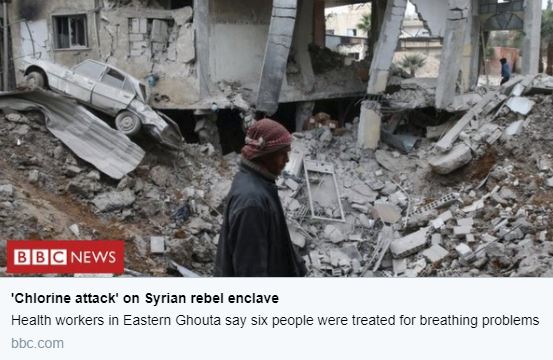
By Jeremy Salt | American Herald Tribune | January 15, 2018
Lies, deceit and forgeries have always been part of war, truth being ‘the first casualty.’ But in the past two decades the falsifications of war have reached unparalleled heights, thanks to technology. The lies told by the American, British, Australian and allied governments ahead of and during the attack on Iraq in 2003 reached heights which one would have thought could not be surpassed. But then came Libya and the black mercenaries, the soldiers fed Viagra, all lies. Topping this, for the past seven years, we have had Syria and its ‘revolution’, photo-shopped, faked and staged from beginning to end with the connivance of the mainstream media.
With isolated exceptions in the Anglo-American media (the US, Britain, France, Australia and Canada) there has been no reporting of the Syria crisis as such. There has only been propaganda, surging forward in wave after wave. It is not enough to say that the credibility of the media has never been lower. Insofar as these wars in the Middle East are concerned, with the exception of a tiny handful of correspondents who occasionally correct the imbalance, it has no credibility at all.
Relying on ‘rebels’ and ‘activists’ and refusing to air the perspective of the Syrian government the media has spun a web of deceit designed to justify and perpetuate ‘western’ aggression against yet another Arab country, this time not through an open military attack, as in Iraq or Libya, but through armed terrorist proxies who have carried out a campaign of murder and mayhem across the country.
There are no ‘moderates’ amongst these groups, not by any reasonable standards. The US Vice President Joe Biden let the cat out of the bag in 2014 when he said there were no moderates in their ranks. They might fight among themselves over territory, arms, money and control but they have the same ideology as the official enemy, of themselves and ‘western’ governments, the Islamic State: extirpation of the Shia and the Alawi and the establishment of a takfirist Islamic regime in Damascus top their agenda. This is what the ‘west’ is supporting in Syria.
The latest issue fed into the headlines is the ‘siege’ of the population of the East Ghouta region, on the outskirts of Damascus, by the ‘regime’, with harrowing stories of children starving or denied hospital care fed into the news cycle. The ‘regime’ is held responsible, not the Jaysh al Islam takfiri collective which John Kerry described in 2016 as a ‘sub group’ of the ISIS and Jabhat al Nusra. These groups, armed and financed by outside governments, including Saudi Arabia and Qatar, have taken over large parts of East Ghouta and are holding the population hostage. The Syrian government has the responsibility of suppressing them, and in the conflict civilians are dying. This is the cause of the ‘siege’ of East Ghouta and the notion that the people there genuinely support these takfiri groups is as fanciful as the idea that they did in East Aleppo. It was also presented by the media as being under siege by the ‘regime’ but when it was finally liberated from the takfiris its people were literally dancing in the streets with joy. It will be the same in East Ghouta when these groups are sent on their way.
Now we hearing that the ‘regime’ is using chemical weapons in East Ghouta. According to the BBC news web site (‘Syrian war: Reports of chlorine gas attack on rebel-held Eastern Ghouta’, January 13), ‘people’ in the region reported smelling gas after a missile attack. A ‘health worker’ was quoted. An ‘aid worker’ said ten hospitals were affected. There is nothing here of any substance, no evidence of a chlorine attack and no attempt by the BBC to confirm what it has been told.
The BBC makes marvellous wildlife documentaries and excellent feature films but in its reporting of the Syrian conflict it has completely betrayed the most basic journalistic principles of objectivity and balance. Along with the rest of the media it runs whatever the ‘rebels’ and ‘activists’ choose to tell it. The allegation that goes into the headlines, is not substantiated but fulfills the central task not of reporting but of smearing the Syrian government, which never gets the opportunity to state its case beyond ‘the Syrian regime denies the allegations.’ This symbiotic game between terrorist groups and the media has been in motion for the past seven years. Through its false reporting the media has supported the war on Syria and must share the responsibility for the massive death and destruction that has ensued.
Of all media outlets the BBC has less credibility than most when raising the issue of chemical weapons attacks. In 2013 it was involved in the fabrication of one such alleged attack, on a school in Aleppo. The children and young men moaning on the floor with shaving cream on their faces and theatrically created burns and patches of skin hanging from their bodies were ludicrously bad actors. ‘Dr. Roula’, the woman speaking to the camera, turned out to be Roula al Hallam, the daughter of a member of the Syrian opposition in exile. The precedent for this performance is the blubbering young woman who told the story of babies being thrown out of their incubators by Iraqi soldiers after the invasion of Kuwait in 1991. She turned out not to be a hospital nurse but the daughter of the Kuwaiti ambassador to the US. This piece of theatre was produced by a Washington PR firm.
‘Dr Roula’s’ original statement (August 29) that this seemed to be a napalm attack had been changed to ‘chemical weapon’ by the time it was broadcast a few hours later (August 30). The film was the same, she was the same ‘Dr Roula’ but the words coming out of her mouth were not the same.
The timing of this fabrication was central to the story. On August 21, the very same day that UN chemical weapons inspectors were arriving in Damascus, the Syrian government was accused of orchestrating a chemical weapons attack in the Ghouta region, outside the city, that allegedly killed hundreds of people. On August 26 the napalm/chemical weapons attack was allegedly carried out on the Aleppo school. On August 29/30 the allegations were broadcast twice by the BBC, with ‘napalm’ changed to ‘chemical weapon’ in the second broadcast. Later in the day (August 30) the House of Commons voted on military intervention in Syria. The Cameron government lost the vote but only narrowly (285-272). The fabricated BBC report seems to have been aired with the intention of pushing the Commons vote across the line.
The attack in the Ghouta region around Damascus was never followed up by the media once the Syrian government had been smeared and set up for military attack. The identity of the children whose bodies were shown (sometimes the same bodies in different locations) remains a mystery. They were used for propaganda before disappearing forever. The takfiris have recently massacred hundreds of Alawis in the Latakia governorate and had kidnapped scores of women and children: according to Mother Agnes, the nun who did what the media should have done by trying to find the truth, some of the mothers identified the children at Ghouta as theirs.
The evidence of scientists and journalists, notably Seymour Hersh, showed, with no room for doubt, that the chemicals were fired from positions held by the takfiris. Barrack Obama had declared that a chemical weapons attack would be his ‘red line’ and the takfiris had set out to push him across it. The apparent involvement of other governments in this provocation was something else the media did not follow up.
After the New Yorker showed no interest in his story, Hersh took it to the London Review of Books, where it was published. When he exposed the falsity of a second alleged attack, in Khan Shaikhun, in April, 2017, he had to find a publisher in Germany (Die Welt). The truth-telling Hersh found a rapidly diminishing appetite for his truths in the mainstream even though, without any doubt, he is an outstanding investigative reporter, all the way back to his exposure of the My Lai massacre during the US war on Vietnam (and neighboring countries). While Trump bombed a Syrian air base near Khan Shaikhun, Obama pulled back at the last minute. According to Hersh, senior intelligence figures knew the Syrian government was not behind the alleged chemical weapons attack near Damascus but ‘how can we help this guy Obama when he and his cronies in the White House make up the intelligence as they go along.’
The war on Syria goes on. It is not over as many have said: but for outside intervention it never would have started. Even though ISIS has been virtually destroyed in Syria, thus fulfilling the rationale for its forces being there, the US is refusing to leave. It has been playing a double game, declaring war on the ISIS while clandestinely cooperating with it in various ways. It wanted a Salafist principality in eastern Syria and the Islamic State gave it one. ISIS fighters criss-crossed the Syrian desert, towards Mosul and Palmyra, without the US intervening, although satellite reconnaissance would clearly have shown these lines of pickup trucks kicking up the summer dust. US Special Forces passed through Islamic State positions on the way to Deir al Zor, the US shipped takfiri fighters out of Raqqa with their families and the US has been training takfiris rebranded as ‘rebel’ fighters at its Al Tanf base.
Far from withdrawing from Syria the US is entrenching itself even deeper. It is not there for the Kurds or the good of the Syrian people. It is there for itself and most probably for Israel, which has spent the past year preparing for its next war, most probably against Lebanon in the first place, and admits to at least 100 missile strikes against Syria. The US is not leaving Afghanistan either. Indeed, it is not shutting down or drawing down anywhere, but strengthening its global position to cover any possibilities arising in its rivalry with Russia and China. This is the vise in which Syria is now caught.
The empty rhetoric of supporting only ‘rebels’ against terrorists continues. If the collective of takfiri groups known as Jaysh al Islam is not officially designated as a terrorist group that is because when Russia proposed, in November, 2016, that it be added to the UN sanctions list, the US, France and the UK used their vetoes to block the move. They provide the political support for this group, Saudi Arabia and other countries the money and the weaponry needed to hold the people of East Ghouta hostage. These are the real realities of the ‘siege’ of this district.
Jeremy Salt is a former journalist, turned academic. He is based in the Department of Political Science and Public Administration, Bilkent University, Ankara where he teaches courses in modern Middle Eastern history and propaganda. His most recent book is “The Unmaking of the Middle East. A History of Western Disorder in Arab Lands” (Berkeley: University of California Press, 2008.)
Featured Video

Trita Parsi: Middle East Unraveling — Are We on the Path to World War?
or go to
Aletho News Archives – Video-Images
New Book
Trans agenda is ‘normalization of sadism’ – US author

RT | September 23, 2026
The US Democratic Party has embraced a transgender agenda that amounts to “the normalization of sadism,” author A.J. Rice has said, warning that radical trans policies would return if the party is allowed to regain power.
Speaking to RT’s America First host Scotty Nell Hughes about his new book, ‘The Curse of the Bearded Lady: How the Trans Mafia Whacked American Sanity’, Rice argued that activists have gained significant influence in schools, medicine, and corporate America while people who questioned the agenda have faced pressure to stay silent.
The author described the “trans mafia” as the sprawling network of people and institutions that have helped the movement gain influence. He singled out parts of academia, wealthy backers, and corporations, and stated that providers of transition-related treatment also have a financial incentive to keep young people in their care indefinitely.
Rice argued that the consequences of these policies ultimately fall on children who are being drawn toward gender-affirming medical treatments and on girls who are expected to share locker rooms or compete in sports with biological males.
He noted that while voters rejected the Democrats’ approach to gender in 2024, the party, which has been “captured by madness,” has since only doubled down and is seeking what is effectively “the normalization of sadism.” … Full report
Blog Roll
 Aletho News
- ‘We don’t seek permission to defend our country’: Snippets from President Pezeshkian’s UNGA address
- NATO chief wants Europeans to fight American wars [for Israel]
- German chemicals giant reveals details of downsizing
- Refaat Al-Areer Was The Canary In The Coal Mine In Israel’s War On The Truth
- Israeli election committee bars candidate from Knesset race over Gaza war opposition
- French-Lebanese man files war crimes complaint over Israeli attacks
- Mahan Air Flight Lands in China Despite US Threat against Iranian Airlines
- US eyes $10bn fund to rebuild war-battered Gulf infrastructure
- Trump meets Rodríguez near Maduro’s prison as Venezuela’s oil flows to US
- Trita Parsi: Middle East Unraveling — Are We on the Path to World War?
- If Americans Knew
- An error has occurred; the feed is probably down. Try again later.
- No Tricks Zone
- New Study: Earth And Venus Surface Warmth Largely Explained By Convection And Lapse Rate, Not CO2 Or Radiation
- 2025 Nature Paper Claiming Worsening Global Drought Gets RETRACTED …Heavily Flawed
- New Study: ‘Global Drought Shows No Detectable Recent Acceleration Under Climate Warming’
- Economic Masterminds: German Socialists Suggest Taxing Productivity Gains Stemming From Using AI
- The South China Sea Has Not Been Cooperating With The Climate Change Narrative
- Energy Crisis: Germany Enters Heating Season With Historically Low Gas Reserve Fill Levels
- New Study: The Antarctic Ice Sheet Gained Mass From 2020-2024 Due To Staggering Snow And Ice Accumulation
- Study: Ocean Heating Rates From Thousands Of Years Ago ‘Dwarf’ Modern Ocean Heating Rates
- Climate Extremists Target, Attack Large-Scale Power Grid Infrastructure In Germany!
- New Study: Antarctic Ice Melt Has Contributed Less Than 1 Centimeter To Sea Level Rise In The Last 30 Years

