SYRIA: Game Over for Macron after Shameful UNGA Performance
By Bruno Guigue | 21st Century Wire | September 20, 2017
Before the UN General Assembly, you treated President Bashar al Assad as a criminal and declared that he should be held accountable to “international justice”. You have betrayed those who believed in a turn-around in your politics and you have brought this serious accusation against the legitimate leader of a UN member state.
Exactly what jurisdiction has empowered you, Mr Macron, to issue arrest warrants for foreign heads of state, who, by the way, could teach you a thing or two?
Who gives you the right, as a European head of state, representing the former colonial power in Syria (1920 – 1946), to hand out certificates for good or bad behaviour to your Middle Eastern counterparts?
This intervention is made all the more disturbing by the fact that you, like your predecessors, persevere with your complacency towards the petro-monarchies, to whom you sell arms that are used to massacre the courageous people of Yemen. You denounce the crimes you have attributed to the Syrian president, but you turn a blind eye to the head-choppers, the West’s beloved mercenaries. The 10,000 deaths in Yemen, the 500,000 children suffering from malnutrition, the terrifying cholera epidemic brought on by the Saudi bombardment, don’t trouble you, trigger no remorse and yet, you seriously want us to take notice of your indignation over Syria?
Everybody is aware that the Syrian conflict has caused tens of thousands of deaths, that the bloodbath gone on too long and that a political solution must be found, once the terrorist hordes are eliminated. As you speak, the Russians, Iranians and Turks are gathered in Astana to work towards this end. When you fling such accusations at Pres. Assad, what are you really talking about? From the very beginning of the “Arab Spring” in 2011, the anti-government protests were polluted by armed insurgents who opened fire on the security forces. The Arab Observer Mission was present from 24th December 2011 to 18th January 2012, at the behest of the Arab League. Despite Saudi pressure, their report denounces violence carried out by both sides. The myth of the peaceful uprising has long since evaporated Mr Macron, it’s time to bid farewell to this romantic fairytale.
This war was pre-fabricated by the sponsors of the “opposition”, in an attempt to destabilize the Syrian state. The Baathist government may have had shortcomings, but Syria was debt-free, a productive, multi-ethnic country where people of different faiths, lived, peacefully, side by side. The biggest demonstrations in 2011 were in favour of the Syrian government and the proposed reforms. To blame this government for the war that was started by a foreign-backed, armed uprising, is a distortion of reality. You pervert the facts to serve the narrative you wish to uphold. Mr Macron stop selectively determining the facts as you do, also, with the victims. Wars are cruel, this one is no exception. But who should bear responsibility, other than those who wanted to subjugate Damascus to Wahhabi Sharia law with the help of the US, France, Great Britain and the oil kingdoms.
Even in the statistics of the SOHR, an opposition-partisan organisation, 40% of the victims – since 2011 – were from the Syrian Arab Army, 35% the armed groups and 25% civilians caught in the crossfire of war. If a war could spare civilians, we would know about it. The war, supported by France in Yemen certainly doesn’t, neither does the US coalition bombing of Mosul or Raqqa. But accusing the Syrian Arab Army of deliberately committing crimes against its own people is an insult to common sense. This army is an army of conscripts, who defend their homeland against the tsunami of extremist militants. While you are safe at the UN, Mr Macron, “Assad’s soldiers” cross the Euphrates to settle his account with DAESH.
Of course, in this game of illusionists, you still hold the joker, you still have the chemical weapon “false flag” with which to feed the propaganda mill. Sticking to the CIA script of this novel, you even pretend to set a “red line”. The fact that an MIT (Massachusetts Institute of Technology) expert showed you that the August 2013 attack could only have come from terrorist held areas, is of no consequence to you. When the same US experts have denounced the Khan Sheikhoun (April 2017) alleged CW attack, blamed upon Damascus, you remain resolute. Have you even read the report by eminent American journalist, Seymour Hersch, which dismantles the western narrative of Syrian Arab Army chemical attacks?
Beware Mr Macron, this chemical weapon farce, the western propaganda mantra, is wearing thin. It even steals the crown from the lies of State, uttered by Colin Powell, brandishing his file at the UN Security Council. With each passing day, the chemical weapon lie loses its power to enchant. Those who still believe it are those who want to believe it, or who believe their own governments in the west would never lie to them. But the majority of the Syrian people don’t believe it, and that is what matters. When an area is liberated by the Syrian Arab Army, the refugees are returning home, life begins again and hope resurfaces. Making windmills with your insignificant arms at the UN wont change anything, and your inane chatter is already being drowned out by the media hubbub. Your so called “contact group”, Mr Macron, is already dead in the water and will disappear from our consciousness in under a week.
Who is still paying any attention to the French presidency? This presidency, regardless of who is in power, has demonized the Syrian government, brought traitors into Syria disguised as opposition, has condoned the brutality of the armed “moderates”, encouraged the influx of terrorists into Syria – terrorists who forced the French Lycee in Damascus to close its doors. This presidency has refused cooperation with Syrian forces & allies, it has delivered arms to the extremist groups, it has refused to fight DAESH when DAESH was threatening Damascus, it has called for the murder of a legitimate head of state, it has imposed an embargo on medicines for the Syrian people – this presidency has flouted international law and allied itself with the worst aspects of neo-colonialism. Nobody is listening to you.
By choosing to interfere in the affairs of sovereign states, France has relinquished its part in the game. Give up Mr Macron, you too are “out.”
Translation from the French, by Vanessa Beeley for 21st Century Wire.
***
Bruno Guigue is a French author and political analyst born in Toulouse 1962. Professor of philosophy and lecturer in international relations for higher education.
Russia warns US it will strike back if militia attacks in Syria don’t end
RT | September 21, 2017
Moscow has warned the US that if militias it supports in northeast Syria again attack positions of pro-government forces backed by Russia, the Russian military will use all its force to retaliate.
The troops of the Syrian Democratic Force (SDF), a predominantly Kurdish militia that receives support from the US military, have twice attacked positions of the Syrian Arab Army in the Deir ez-Zor governorate with mortar and rocket fire, according to the Russian Defense Ministry’s spokesman, Major General Igor Konashenkov.
“Russia unequivocally told the commanders of US forces in Al Udeid Airbase (Qatar) that it will not tolerate any shelling from the areas where the SDF are stationed,” Konashenkov said, adding that the attacks put at risk Russian military advisers embedded with Syrian government troops.
“Fire from positions in regions [controlled by the SDF] will be suppressed by all means necessary,” he stressed.
Konashenkov said Moscow suspected the SDF of colluding with the terrorist group Islamic State (IS, also known as ISIS/ISIL) in Deir ez-Zor rather than fighting it, as it claims to be. He said Russia had detected the transfer of SDF fighters from the IS stronghold of Raqqa, to join forces with the jihadists.
“SDF militants work to the same objectives as IS terrorists. Russian drones and intelligence have not recorded any confrontations between IS and the ‘third force,’ the SDF,” the Russian general said.
The statement said that the siege of Raqqa by the SDF has been halted, apparently in response to the latest advances by Syrian government forces in Deir ez-Zor, which is located to the east from Raqqa along the Euphrates River.
“The central parts of the former ISIL capital, which account for roughly 25 percent of the city, remain under full control of the terrorists,” Konashenkov remarked.
According to the statement, in the last 24 hours Syrian government troops “continued their offensive operation” to destroy the last “IS bridgehead” near the city of Deir ez-Zor, the provincial capital. Troops led by Syrian Army General Suheil al-Hassan liberated around 16 sq km of territory and two settlements on the western bank of the Euphrates River.
“More than 85 percent of Deir ez-Zor’s territory is under the full control of Syrian troops. Over the next week the city will be liberated completely,” Konashenkov said.
The city of Deir ez-Zor in eastern Syria was besieged by Islamic State in 2014. Syrian government forces lifted the blockade of the city in early September.
However, the liberation of Deir ez-Zor also triggered a confrontation between Syrian government forces and the US-backed SDF militants, the point of contention being control of Deir ez-Zor’s oil fields.
Following Damascus’s strategic victory, food, medicine and other essentials started to reach the city by convoy, where previously the inhabitants had to rely on air-drops.
The escalation of tension in eastern Syria is mirrored in the western Idlib governorate, where militant forces this week attacked Syrian positions in a designated de-escalation zone. The offensive threatened a unit of Russian military police, who were stationed in the area to monitor the ceasefire. Russia mounted an emergency rescue operation on Wednesday, in which three Russian special operations troops were injured. The Russian Defense Ministry claimed that the militants’ offensive had been instigated by US special services.
The Bana Alabed Psy-Op Proves The West Is Saturated In War Propaganda

By Caitlin Johnstone | The Last American Vagabond | September 18, 2017
If I could have everyone in the English-speaking world watch only one video on Youtube, it would without a doubt be a comedy bit performed by a funny-looking professional goofball on RT. I say in all seriousness that it could change the trajectory of our species on this planet.
The above segment is presented for an audience who showed up for a comedy show, but it also contains video evidence that should forever change the way they think about the media, their government, their nation, and everything they’ve been taught growing up about what their society is and how it works. So far this is probably the closest thing to mainstream coverage that the depravity of the Bana Alabed psy-op has received.
In the segment, Redacted Tonight’s John F. O’Donnell shows video footage of a seven year-old Syrian girl being “interviewed” by CNN’s conscience-free Alisyn Camerota, who as a side note recently had the gall to complain that she was suffering from “Russia fatigue” as a result of all the bogus Russia conspiracy theories with which her network has been relentlessly brutalizing the American psyche. O’Donnell then shows a clip illustrating that Bana does not in fact understand even the most rudimentary English, let alone the capacity for the geopolitical analysis demonstrated in the Camerota interview. It was scripted, and Bana was phonetically sounding out words that she did not understand in order to manufacture public support for more US interventionism in Syria.
The interview was scripted, and what for me is most shocking is that Alisyn Camerota necessarily had the other half of the script. Bana wouldn’t have been able to improvise answers to unscripted questions, so Camerota was necessarily knowingly acting out a staged, scripted scene and deceiving her audience about its nature. She lied to the American people for the most despicable reason imaginable, and exploited a little child to do it.
Here it is in full:
O’Donnell then goes on to describe how this despicable psy-op has been promoted across multiple platforms throughout the mainstream media, from CNN’s Jake Tapper to Time Magazine to a Simon & Schuster book deal. The plutocrats who control these powerful media corporations plainly want eyes on this girl, just not the kind of eyes that look with any degree of healthy skepticism.
The reason for all of this, of course, is that US hegemony is fully dependent on its massive military power. Since the heavily-armed American people would grow upset if they were told that the oligarchs who rule their country are spending an unfathomable amount of the nation’s money and resources trying to depose Bashar al-Assad because Syria occupies a crucial strategic location in US world dominance (risking a direct confrontation with the nuclear-armed Russia in the process), they make it about saving children instead. In 1990 a teenager gave false testimony about hospitalized babies being removed from incubators and left to die to manufacture support for US military involvement in the oil-rich Kuwait, and we’re seeing something very similar with Syria today. As Bana so often says, “Save the children of Syria.”
BANA ALABED: A Lost Childhood and a Future Jeopardized by Ongoing Child Exploitation https://t.co/VMEuvkls4N via @21WIRE @KhaledIskef
— vanessa beeley (@VanessaBeeley) July 19, 2017
//platform.twitter.com/widgets.js
I’m very excited to see what appears to be an increased effort to push awareness of the Bana Alabed psy-op into mainstream consciousness. It’s not enough to have this undeniable act of deceitful war propaganda being discussed by a few Syrian activists and the occasional segment on RT; mainstream America needs to be told about this. If we all make a whole lot of noise pointing to the indisputable facts outlined in the Redacted Tonight segment at the beginning of this article, eventually mainstream outlets will be forced to comment on it. Alisyn Camerota will be forced to answer questions about her participation in the staged interview. They’ll be forced to overextend themselves and make even more mistakes. The true face of the mass media propaganda machine will swing into the full focus of everyday Americans. This can change the world.
Please help make this happen. Share the links I’ve placed in this article, make your own videos, podcasts, articles and tweets. The propaganda machine made a very foolish mistake using something so easily debunked in its war efforts, and we need to capitalize on that mistake while they’re vulnerable. Shove this thing as hard as you can into mainstream consciousness in every way you can think of. The machine is weaker than it seems. We can bring it down.
Syrian troops will fight US-backed militia to free Arab country: Assad aide
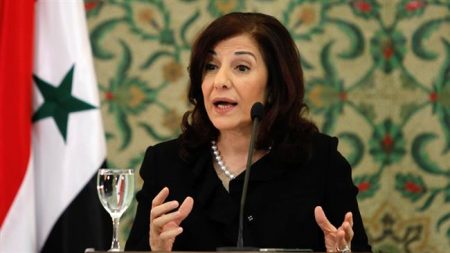
Syrian President Bashar al-Assad’s political and media adviser, Bouthaina Shaaban
Press TV – September 16, 2017
The political and media adviser to Syrian President Bashar al-Assad says government troops, backed by fighters from allied popular defense groups, will fight any force, including the US-backed militia, to fully liberate the Arab country plagued with terrorism for over six years.
“Whether it’s the Syrian Democratic Forces (SDF), or Daesh or any illegitimate foreign force in the country… we will fight and work against them so our land is freed completely from any aggressor,” said Bouthaina Shaaban in an exclusive interview with Lebanon-based Arabic-language al-Manar television network on Friday.
She added that the US-backed SDF forces had managed to capture areas in northeastern Syria from Daesh “without any fighting,” implying that the Takfiri militants were working hand in glove with the SDF to take oil-rich areas.
“But they will not get what they want,” the Syrian official added.
The SDF is a coalition of Kurdish and Arab fighters dominated by the Kurdish People’s Protection Units (YPG), which is in control of large parts of northeastern Syria for many years. The SDF forces have gained ground against Daesh in the northern city of Raqqah, the terror group’s de facto capital in the Arab country.
The US and its allies have been bombarding what they call Daesh positions inside Syria since September 2014 without any authorization from the Damascus government or a UN mandate. They also support some groups, such as the SDF, claiming that they help them in their alleged fight against Daesh terrorists.
Different foreign-backed terrorist groups have been wreaking havoc in Syria since 2011. The government controls the main urban centers in the west of the country and has recaptured much of the eastern desert from Daesh in recent months.
On Tuesday, Lieutenant General Aleksandr Lapin, the Russian chief of staff in Syria, announced that Damascus was in control of 85 percent of the Arab country’s territories. He added that Syrian forces must now purge terrorists from the country’s remaining 15 percent, which amounts to 27,000 square kilometers.
Time for All Palestinians and Their Supporters to Join the Resistance against Israel’s Cultural Offensives

By David Macilwain | American Herald Tribune | September 14, 2017
Before the launching of the war on Syria in 2011 by agents of the US and its Middle Eastern allies, the focus of my political activism was almost exclusively Palestine. “Self-radicalised” is a suitable descriptor for the slow awakening of my awareness of the way things were in the Israeli-occupied territory and the Arab and Islamic world around it.
As with many of my contemporaries, the 2003 attack on Iraq was a springboard in this radicalisation, not out of sympathy and understanding of Iraq but rather from antagonism to the US neo-con regime with its UK and Australian allies. Israel’s central role in orchestrating the attack on Iraq, as well as the pretext for it eighteen months earlier didn’t become clear – to me at least – until sometime later, when my antagonism began to concentrate on the Zionist State.
“Antagonism” doesn’t begin to describe the feelings that developed during Israel’s 26-day massacre of innocents of Gaza in 2009 however, nor the absolute disdain and disgust at Western leaders’ failure to condemn it. Notably too, the failure of Western media organisations to report the daily atrocities being committed by the IDF in Gaza revealed the extent of networks of propaganda support for the Zionist entity.
In the controversy that followed “Operation Cast Lead”, which finally came to an end just after Obama’s inauguration, it also became clear who was prepared to stand up for the people of Gaza and for Palestine and who was not. Many organisations we may have thought to be “impartial” turned out to be compromised when it came to Palestine, including the UN and NGOs like Amnesty International and Human Rights Watch. Their failure to react and respond appropriately to the terrible injustices and atrocities inflicted on the civilian population of Gaza, in the false name of fighting “Hamas terrorism”, gave huge impetus to the BDS movement. In the absence of any real condemnation of Israel’s barbarity, leave alone sanctions, or enforcement of outstanding UN resolutions, boycott and divestment became the only means to support Palestinians’ rights.
One could never say that the BDS campaign against Israel’s occupation was a success, though there were successes. In countries with a strong Israel lobby like the US, UK, Australia and France, the lobby’s fightback with both propaganda and legal instruments began almost before any real action could be taken, while Zionist infiltration and influence on government members made sure Israeli interests were protected. The associated academic and cultural boycott – PACBI – had more success in influencing public opinion, with the help of some great artists like Roger Waters and Ken Loach, but the fightback against them was even more intense, and continues to this day.
In an attempt to convince ourselves that something has been achieved over the last ten years, we may consider this reaction to the boycott campaigns as a recognition of their effectiveness – or at least potential effectiveness; the opinion of one influential celebrity can sometimes change the minds of millions.
But doesn’t Israel know this!
The truth is that the state of Israel is founded on something like the antithesis of a boycott campaign – as a state of mind cultivated with centuries of sectarian propaganda. How else could you create a whole society in which individuals believe themselves to be “exceptional” and racially superior to the native inhabitants of the land they are occupying by force? A society for which militant racism is the sine qua non of its nationhood and identity.
Not only have Israel’s leaders and educators achieved this “state of denial” amongst the Jewish citizens and the diaspora – with some important exceptions – but they have managed to maintain credibility as a “democratic” state with Western nations against all odds. It doesn’t seem to matter how many times one points out that a state defined as “Jewish” cannot also be democratic if some of its citizens are not Jewish.
The immediate and current context of this discussion is the fiesta of Zionist propaganda that just took place in London’s Roundhouse centre, called “TLV in LDN”, and the protest campaign against it by a group of artists, including those venerable veterans named above. But the context is rather different from that of ten years ago when the siege of Gaza began, following Hamas’ victory in Palestinian elections.
In fact it begins to look a little desperate, and the defence of this opinion-twisting offensive a bit hysterical. The “facts on the ground” created in what was once Palestine by the Zionist regime in those ten years now mean that Israel’s legitimacy can only be defended with increasingly shrill accusations and violence against Palestinians and their true supporters in the West.
But there may be another reason for the creators and defenders of “The Israel Project” to have a feeling of panic – such as that shown by Netanyahu on his recent visit to Sochi. As Sharmine Narwani has described, things are changing rapidly on Israel’s borders, with Jordan and Lebanon moving to restore relations with Damascus, and other sometime allies like Turkey and Egypt, and even the US seeking to cooperate with Russia and Iran.
There is also something happening within Palestine, as the new Hamas leadership seeks reconciliation with Syria and Iran – effectively returning to the position of ten years earlier, when Hamas leader Khalid Meshaal lived in Damascus, and Iran was a key mediator for the democratically elected Hamas government.
Most ironic however is the situation for so many supporters of the Palestinian struggle, who tragically had followed Hamas’ lead and deserted Syria in 2011. One can hardly understate the devastating effect on the Syrian conflict, and on Western perceptions of it from this historic rift in the Resistance. That section of Western society that showed most concern for Palestinians, including many solidarity groups as well as human rights NGOs was effectively duped into siding with Israel against Syria.
While this “kidnapping” of the most influential anti-war and anti-Zionist activist populations was achieved primarily thanks to propaganda from Al Jazeera and its Western media partners like the Guardian, the contribution from groups like Avaaz and Amnesty suggests another partner in the propaganda war on Syria.
Given the IDF’s vital support role for Al Qaeda groups in Southern Syria, we might safely assume that Israel’s misinformation industry has also been working overtime in pursuit of the state’s cynical and criminal objectives. One key event in the propaganda war on Syria supports that assumption – the “siege” of the Palestinian refugee camp of Yarmouk – whose reality was so twisted by “humanitarian” NGOs and even by the UNRWA as to portray Al Qaeda as defending innocent civilians against the Syrian Army. The object of that propaganda campaign was creating a pretext for “humanitarian intervention” to save starving Palestinians from the Syrian Government, when it was actually protecting them.
As Palestinians in the occupied territories and in Gaza increasingly now look to Syria and its allies for defence against the malevolence and lies of their oppressive occupier, it’s past time for their many genuine supporters and allies in the West to get on the right side of history and join the Resistance! And that resistance includes fighting off Israel’s ingeniously engineered “cultural offensives”.
Iran nuclear deal becomes an atomic cocktail
By M K Bhadrakumar | Indian Punchline | September 14, 2017
The unscheduled trip to Russia by Iranian Foreign Minister Mohammad Javad Zarif as the special envoy of President Hassan Rouhani and his meeting with President Vladimir Putin on Wednesday can be seen as indicative of an inflection point arising in regional and international security. There is growing concern that the Trump administration could be moving in the direction of reopening the US-Iran nuclear deal of July 2015.
During the campaign for the November election, candidate Trump disdainfully threatened to tear up the Iran accord. But as president, he has twice already certified to the US Congress that Iran is implementing its part of the deal. He is obliged to do it a third time by mid-October. Of course, Trump is not a stickler for consistency. He promised to wind up the Afghan war, but approved a strategy for open-ended war. Increasingly, he has exposed himself to be a man of straw.
All indications are that he doesn’t have the courage to upfront abandon the deal. So long as Tehran continues to observe the terms of the deal, Trump lacks an alibi to jettison it. Yet, he wants to resuscitate the sanctions regime of the past era so that Iran is deprived of the tangible benefits accruing to it legitimately under the nuclear deal, especially, as regards its integration with the world economy. This is one thing. Besides, the nuclear deal enjoys the overwhelming support of the world community. On the other hand, Trump is surrounded by “hawks” on Iran. The Israeli lobby also keeps him on a tight leash.
Hence Plan B. The White House recently deputed Nikki Haley, envoy to the UN, to Vienna to sound out the International Atomic Energy Agency about renegotiating the terms of the 2015 deal. Specifically, the White House would like to extend the scope of the IAEA inspection to also include, apart from Iran’s nuclear establishments, that country’s military bases.
Interestingly, the White House’ choice fell on Haley to undertake the mission to Vienna (rather than Secretary of State Rex Tillerson). It speaks of the backstage role of Jared Kushner, Trump’s son-in-law. Clearly, Israel is manipulating the Trump administration. Israel is paranoid that for the first time since the 1967 War, it has lost its pre-eminence militarily in the Middle East. The US and Israel’s defeat in the Syrian conflict brings about a historic shift in the military balance. Simply put, Israel lacks the capability to stop Iran’s inexorable surge as regional power. What is unfolding is a high-stakes game for Israel.
Tehran has made it clear that it is not open to renegotiation of the deal. Specifically, it rejects the notion that its military bases should be opened to allow foreigners to “inspect”. Simply put, Iran is unlikely to allow the US and Israeli spies masquerading as IAEA inspectors into its sensitive military installations.
Now, all indications are that the US is softening up the resistance of its European allies to the idea of reopening the 2015 nuclear deal. If past history is any evidence, it is a matter of time before the UK, France and Germany (who were part of the P5+1 negotiating with Iran) fall in line. Tillerson has called a meeting of his counterparts from the P5+1 and Iran for a meeting in New York on September 20 to broach the subject. A defining moment is approaching – least of all that Tillerson for the first time comes face to face with Zarif.
For Iran, the role of Russia and China will be of crucial importance. China may become wobbly when its self-interest is likely to be affected. The point is, all this ultimately would go into the alchemy of the ‘new type of relationship’ China hopes to work out with Trump. Also, Kushner happens to be Beijing’s point person in the White House. (China’s State Councilor Yang Jiechi met him Wednesday to discuss father-in-law’s state visit in November.)
After meeting Putin in Sochi, Zarif said that the discussion was “substantial and positive.” Zarif hinted that Russia also would agree that the 2015 nuclear deal is “non-negotiable and that all sides to the agreement must fulfil their obligations.” The situation developing around Iran will throw light on the ground realities as regards Iran’s integration into the Eurasian space. The Kremlin readout gave no details, but it stands to reason that given Russia’s quasi-alliance with Iran in regional politics, Zarif’s optimism is justified. Above all, Russia and Iran are working together as “guarantors” to stabilize the situation in Syria, as the latest development in regard of the de-escalation zone in Idlib in northern Syria highlights once again. To be sure, “multipolarity” in the world order is facing the litmus test.
6 MAJOR US foreign policy failures of the post-Cold War era
By Adam Garrie | The Duran | September 14, 2017
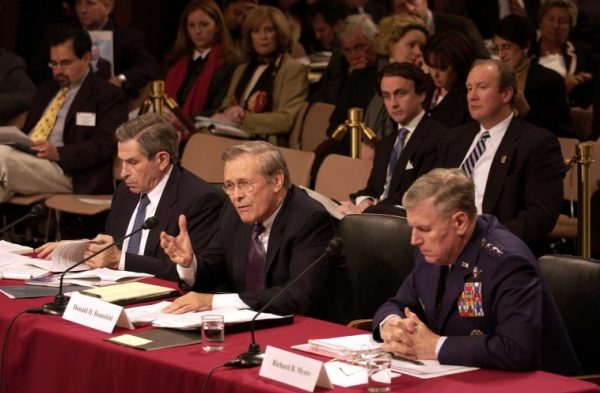
In the 1990s, US officials, all of whom would go on to serve in the George W. Bush White House, authored two short, but deeply important policy documents that have subsequently been the guiding force behind every major US foreign policy decision taken since the year 2000 and particularly since 9/11.
These documents include the Defense Planning Guidance for the 1994–99 fiscal years (more commonly known as the Wolfowitz Doctrine). This document, as the name implies was authored by George W. Bush’s deeply influential Deputy Defense Secretary Paul Wolfowitz as well as I. Lewis “Scooter” Libby, who served as an advisor to former US Vice President Dick Cheney.
The other major document, A Clean Break: A New Strategy for Securing the Realm, from 1996 was authored by former Chairman of the Defense Policy Board Advisory Committee in the administration of George W. Bush, Richard Norman Perle.
Both documents provide a simplistic but highly unambiguous blueprint for US foreign police in the Middle East, Russia’s near abroad and East Asia. The contents of the Wolfowitz Doctrine were first published by the New York Times in 1992 after they were leaked to the media. Shortly thereafter, many of the specific threats made in the document were re-written using broader language. In this sense, when comparing the official version with the leaked version, it reads in the manner of the proverbial ‘what I said versus what I meant’ adage.
By contrast, A Clean Break was written in 1996 as a kind of gift to Israeli Prime Minister Benjamin Netanyahu who apparently was not impressed with the document at the time. In spite of this, the US has implemented many of the recommendations in the document in spite of who was/is in power in Tel Aviv.
While many of the recommendations in both documents have indeed been implemented, their overall success rate has been staggeringly bad.
Below are major points from the documents followed by an assessment of their success or failure.
1. Regime change against Saddam Hussein’s Iraq (A Clean Break)
This objective is in many ways both the clearest initial success and also the most strident overall failure.
In 1996, Richard Perle suggested that removing Saddam Hussein from power would be good for the US and Israeli interest because it would weaken a powerful, large Arab state that had poor relations with the US since 1990 and historically poor relations with multiple regimes in Tel Aviv. While Iraq’s President was removed from power by illegal force in 2003, that which happened subsequently, did not deliver the outcome Perle had desired.
A Clean Break suggests that a post-Saddam Iraq could and should be ruled by a restored Hashemite dynasty, which was originally overthrown in 1958. Perle continues to suggest that Jordan, the last remaining Hashemite state in the Arab world, could work with Israel and the US to make this happen. Even more absurdly, Perle suggests that a Hashemite would-be union between Jordan and Iraq would be able to command more loyalty from Hezbollah supporters in Lebanon than Iran.
The realities could not be more different. After the illegal 2003 invasion of Iraq, the idea of restoring the Hashemite dynasty was never again floated in any serious forum, as the idea would be simply impossible to implement. There was no will among any major faction in Iraq to restore a monarchy that was overthrown in a revolution in 1958 that many Iraqis continue to look back on with national pride.
Ironically, the biggest Arab bulwark against a resurgent Iran was Saddam Hussein. In the 1980s, the future neo-cons realised this, though they seemingly ignored what they once knew, as early as in 1992.
Since Saddam Hussein’s removal from power and violent execution, Iraq’s majority Shi’a population have generally rallied around Iran politically, militarily and spiritually. Iraq has recently signed a defensive military pact with Iran and it is well known that many of the Shi’a volunteer brigades which are fighting ISIS in Iraq have received training and advice from Iranian experts.
While the US bases in Iraq make a US military presence closer to Iran than it was prior to 2003, by the same token Iran’s influence in the Arab world, especially in Iraq has grown substantially. In any case, the desired illegal ‘regime change’ war against Iran will likely never happen for two reasons. First of all, many in the Pentagon and in Washington moreover, realise that such a war would be an unmitigated disaster for the US and secondly, Iran has many influential international partners that it did not have in the 1990s, primarily Russia. Russia as well as China would not stand for a war on Iran in 2017.
In this sense, the US got very little of what it claimed it wanted in overthrowing Saddam apart from the weakening of a united Iraq.
2. ‘Containing’ Russia and China by preventing them from becoming superpowers (Wolfowitz Doctrine)
This policy has failed on every front. Since the rise of George W. Bush, the first White House adherent to the Wolfowitz Doctrine, Russia and China have risen to a status which means that there are three global superpowers, not the lone American superpower dreamt of by Wolfowitz and Libby.
China’s economic rise has fuelled a more robust stance from Beijing on global affairs. China now vigorously defends its claims in the South China Sea, has continually outflanked the US on the Korean issue, is engaged in the building of One Belt–One Road, the most wide reaching trade and commerce initiative in modern history and has opened its first military base overseas.
At the same time, the People’s Liberation Army continues its modernisation programme, making it as formidable a force which for all practical purposes, is as battle ready and capable as those of the US and Russia, countries which during the Cold War, had far superior armed forces to China.
Likewise, Russia’s return to superpower status, has been equally crushing in respect of the goals of Wolfowitz and Libby. Russia has not only strengthened old alliances but is now an important ally or partner to countries which were former Cold War opponents or otherwise non-aligned countries. This is true in respect of Russia’s alliances and partnerships with China, Pakistan, Turkey, Iran, Philippines and increasingly Indonesia. Russia is also becoming ever closer to South Korea and even Japan.
With Russia’s military now boasting modern defence systems which can rival those of the US and in many cases are objectively superior to those of the US, the idea that the US would prevent Russia from re-attaining super-power status and China emerging as a super-power has become a patent absurdity.
3. Containing Syria via Turkey and Jordan (A Clean Break)
For a while, this plan was implemented with some degree of success by the Obama administration. While Jordan never played a substantial part in the proxy wars on Syria, apart from being a NATO transport corridor, Turkey did help to undermine Syria’s sovereignty with its armed forces and its own proxies.
While relations between Turkey and Syria remain poor, relations between Turkey and the rest of its NATO ‘allies’ is also poor.
Turkey has quietly ceased its support for terrorist groups (aka the opposition) in Syria, is participating in the Astana Peace Process with long time Syrian allies Russia and Iran and is engaged in multiple trading and commercial deals with Russia, including the purchase of the Russian made S-400 missile defence system.
The overall result of Turkey’s participation in the Syrian conflict has been a strengthening of Turkey’s relationship with historical adversaries, Russia and Iran, something which has happened simultaneously to Turkey’s essentially dead relationship with the EU and its incredibly weakened relationship with the US.
All the while, Ba’athist Syria has emerged from the conflict victorious with its commitment to the Palestinian cause as strong as ever.
Far from being “contained”, Syria is now more admired throughout the wider world than at any time in the last three decades.
4. Molesting Russia’s borderlands (Wolfowitz Doctrine)
In the original text of the Wolfowitz Doctrine, there was a provision stating that the US must work to make sure that places like Ukraine and Belarus became part of the US economic and geo-political orbit, maintaining both “market economies” and “democracies”.
The 2014 US engineered coup against the legitimate government in Kiev was a knee-jerk US response to the fact that Ukrainian President Viktor Yanukovych rejected an economic association agreement with the EU, under the guise that the Ukrainian economy cannot afford to cut itself off from Russia.
Yanukovych was subsequently overthrown in a violent coup, and a neo-fascist pro-western regime was installed. However, this can hardly be considered a success as the sheer violence and incompetence of the current Kiev regime has made it so that Ukraine, a place whose borders were always dubious to begin with, will almost inevitably fracture into something unrecognisable.
Already, much of Donbass has been incorporated into the Donetsk and Lugansk People’s Republics that will never go back to Kiev rule and Crimea, whose relationship with Kiev was even more tenuous is now happily reunited with the rest of the Russian Federation.
Seeing the coup in Kiev, Belorussian President Alexander Lukashenko has pledged to crack down on any would be trouble-makers, all while remaining a committed albeit tantrum prone ally of Russia.
The only part of this element of the Wolfowitz Doctrine which has not been a failure has been the weaponisation of eastern Europe. The reason this has succeeded is due to the fact that Russia has no interest in invading eastern Europe. Russia has merely responded by building up its defences against NATO’s provocative weaponisation of Poland and the Baltic States.
5. Weakening Hezbollah (A Clean Break)
In 2017, Hezbollah is not only more popular than ever, but its militarily might is stronger than at any time in its history. Hezbollah’s role in fighting terrorism in Syria has won the party praise from groups in Lebanon that previously were never keen on Hezbollah, as well as individuals in the wider world who seek to build a genuine anti-terrorist coalition.
The conflict in Syria has drawn Iran, Iraq, Syria and southern Lebanon (the heartland of Hezbollah) closer together than they have ever been. This has in many ways been a result of the common cause of fighting groups like ISIS and al-Qaeda that bound them all together.
In 2006, Hezbollah dealt Israeli forces a major defeat in South Lebanon. Today, Hezbollah is even stronger and everyone in Israel is all too aware of this.
This was a major failure in respect of implementing the ‘destruction’ of Hezbollah advocated by Richard Perle.
6. North Korea not to be allowed nuclear weapons (Wolfowitz Doctrine)
The fact that North Korea just tested what is widely believed to be a hydrogen bomb, is a clear indication that this major goal of Wolfowitz and Libby has failed.
Beyond this, while Russia has condemned both North Korea and US led provocative acts on the Korean peninsula, Russian President Vladimir Putin has acknowledged that North Korea does have the right to self-defence, something which has become even more prescient after North Korea witnessed the destruction of Iraq and Libya which did not have weapons capable of deterring a US invasion.
Russia and China have clearly seized the initiative on the Korean issue. Apart from launching a disastrous war on North Korea, the US can now do little to change the realities in Pyongyang.
CONCLUSION:
The aggregate effect of this analysis indicates that the US is still highly capable of starting wars and igniting conflicts throughout the world, but that it is likewise hardly ever capable of winning these conflicts or even achieving a majority of its own stated goals.
As the two most revealing foreign policy documents from the US in the post-Cold War era, both the Wolfowitz Doctrine and A Clean Break have been abject failures. In many cases, in attempting to achieve the goals of these documents, the United States has ended up achieving the opposite.
The US is militarily strong, but strategically, diplomatically and geo-politically, it is actually close to impotent.
Israeli Media Begs US to Prepare For War With Syria, Russia, Iran
By Andrew Illingworth | Al Masdar News | September 9, 2017
BEIRUT, LEBANON – Israeli media has reached the new moral low of openly begging the United States to prepare for war in Syria even if it means coming into direct confrontation with major Syrian allies like Russia and Iran.
In a recent article titled “Why Israel needs to prepare America for the upcoming conflict in Syria,” Jerusalem Post writer Eric R. Mandel (an American Zionist) proposes that the US government and people must be made war-willing partners of Israel in the event of any future attack by the Israeli Defense Forces against Syrian, Russian and/ or Iranian military targets.
The article by Mandel is an outstanding example of how Israeli pro-war interest groups – speaking through right-wing Zionists in top American military and foreign policy circles – try to entice the US government and population into participating in wars that only benefit the hegemonic ambitions of Israel’s deep state.
At a time when violence in the Syrian conflict has reached an all time low due to the patient diplomatic efforts of Russia and Iran in establishing de-escalation zones, Mandel delivers a well-placed lie in his article that is designed to scare American audiences into supporting military actions that would effectively destroy such hard earned achievements towards peace.
The myth claimed by Mandel to be fact is that the Lebanese rebel movement Hezbollah completely controls the Lebanese government as well as a number of (unnamed) South American governments and that its own puppet master in this insidious conspiracy against Israel is Iran.
Indeed, Mandel’s lie is highly reminiscent of the now proven-to-be-nonsense ‘axis of evil’ conspiracy theory (in which Ba’athist Iraq, North Korea, Iran and Al-Qaeda were all in cahoots with one another) that was pushed by US politicians, and reverberated by the Western media, in order to justify the invasion of Iraq.
Israeli support for Kurdish statehood is a poisoned chalice
By Mahan Abedin | MEMO | September 12, 2107
With the referendum on proposed Kurdish independence just two weeks away, the stage is being set for the gravest political and potential military crisis in post-Baathist Iraq. Months of intense lobbying by Iranian, Turkish and even American officials and interlocutors has failed to dissuade the Iraqi Kurdish leadership from staging this catastrophically divisive referendum.
In his combative interview with the BBC, the president of the autonomous Iraqi Kurdistan region, Masoud Barzani, left no doubt that the referendum is the first formal step in the march toward full independence. More ominously, Barzani appeared to acknowledge that plans to officially annex Kirkuk may well spark a major war.
Every regional and extra-regional power, including the United States, is opposed to Kurdish statehood, with one exception. Israel. Whilst sections of the Iraqi Kurdish media are jubilant at this rhetorical support, Kurdish leaders will have to carefully weigh up the pros and cons of Israeli support before they formally declare statehood.
While Israel will undoubtedly prove a strong ally of an independent Kurdish state, it is the support it is willing to offer in the run-up to independence that will prove decisive. Even rhetorical Israeli support will drastically inflame the situation and bring the Kurds into armed conflict with the pro-Iranian Shia militias massed to the south of Kirkuk.
A peripheral policy
Israel’s support for nationalist Kurdish movements is strong and long-standing, dating back to the early 1960s. This policy is part of Israel’s “Alliance of the Periphery” doctrine, which in short amounts to developing strong ties to non-Arab states on the periphery of the Middle East with a view to combating the Arab boycott of the Jewish state.
Whilst the periphery doctrine was originally aimed at Turkey, Iran and Ethiopia, with time it expanded to incorporate non-state actors, principally the Kurds, whose quest for statehood Israel has consistently supported for decades.
Analysis centred on the putative “collapse” of the periphery doctrine is likely to prove premature. Whilst it is true that Turkey can no longer be regarded as a reliable Israeli partner, this will motivate Israeli strategists and operatives to seek out and develop new peripheral partners. Moreover, the peripheral policy survived its biggest crisis nearly forty years ago when almost overnight Iran went from an informal Israeli ally to the most vociferous enemy of the Jewish state.
Given this chequered history of missteps and strategic miscalculations, analysts are right to be wary of how useful this periphery doctrine is. However, as long as Israel’s occupation of Palestine continues to draw strong Arab, Muslim and broader international opposition, Israel will seek to identify and develop stealthy means by which to undermine, isolate and eventually exhaust this opposition.
It is in this context that leading Israeli strategists, including former foreign minister Shlomo Ben-Ami, push the case for Kurdish independence, primarily by trying to align Kurdish statehood with the interests of the United States and the West in general. This devious perspective is entirely in keeping with the perennial Israeli policy of equating its own core interests with that of the West. In this instance, Israeli diplomacy and wider lobbying efforts will try to sell Kurdish independence to policymakers in Washington, by presenting it as the best long-term strategy to contain Iranian influence in Iraq.
The road to war
Apart from strong rhetorical support, what practical steps can Israel take to support the Iraqi Kurdish quest for statehood? This is a vexing question, as on the face of it Israeli influence in Iraqi Kurdistan is practically non-existent. This author spent the first half of 2009 in Iraqi Kurdistan working as a journalist and despite widespread rumours didn’t uncover any evidence of Israeli involvement in Kurdish affairs.
Yet this influence surely exists, particularly at the security and intelligence level. It is in part due to the Israeli connection that the Kurdish intelligence agency, the Asayish, has developed into one of the most capable intelligence agencies in the Middle East. In keeping with Kurdish national aspirations, the Asayish has grown in reach and capability, not only spying on regional countries, but even managing to run modest operations as far afield as the United Kingdom.
Indeed, qualified Kurdish independence in Iraq now seems all but inevitable. This appears to be the assessment of US intelligence services, Washington’s stated opposition to the issue notwithstanding. Qualified independence in this context implies highly contested statehood, lacking widespread international support and drawing immediate internal and external opposition.
The most immediate opponents to Kurdish statehood in Iraq are the Shia paramilitary forces, who alongside their political patrons in Baghdad, have deep-seated interests in Kirkuk, which is home to a sizeable Shia Turkmen population. The collapse of the Iraqi army in the face of Daesh’s sweeping advance in June 2014 has significantly changed the military security landscape in Kirkuk and the immediate areas to the south, bringing the Kurdish Peshmerga and Shia paramilitaries into dangerously close proximity.
The Shia paramilitaries, organised as Popular Mobilisation Units, reportedly maintain six military bases close to Kirkuk and are poised to engage the Peshmerga militarily should the need arise. From a purely speculative point of view, limited military engagements may follow the independence referendum as a means of deterring the Kurdish leadership from taking further steps toward formal independence.
From a broader strategic perspective, Israeli support for the Kurdish cause is a poisoned chalice for Kurdish nationalists in so far as it makes a sustainable Kurdish state unacceptable to Iran and by extension to its Shia allies in Iraq. But judging from Masoud Barzani’s combative rhetoric, he appears to be willing to take the risk.
Read: Israeli flag will be raised in independent Kurdistan, claims prominent Likud member
Syrian conflict is ending but US stays put
By M K Bhadrakumar | Indian Punchline | September 11, 2017
The Syrian government forces have broken through the ISIS’ 3-year long siege of the air base in the eastern city of Dier Ezzor. The dramatic developments in the weekend signifies for all purposes the end of the conflict in Syria. The capture of the city itself is now a forgone conclusion and with that ISIS becomes a spent force in Syria.
The covert US operation to evacuate by helicopter the ISIS commanders in Dier Ezzor last week suggests that the Pentagon accepts that the ISIS saga is ending in Syria, finally. Presumably, the ISIS and its “advisors” will now be reassigned to new theatres – such as Afghanistan. The lingering question will be: Is the US winding up business in Syria? A Russian commentary seems to think so.
On the other hand, there are reports that the rebel forces supported by the US Special Forces (with air cover) are making a dash from northern Syria to take a piece of Dier Ezzor, leaving behind the unfinished business of capturing Raqqa, ISIS’ “capital”. This risks a potential flashpoint involving them and the Russia-supported government forces in a struggle for supremacy in eastern Syria. (Reuters )
At stake are two things – one, seizure of the vast oil fields that lie to the east and north of Dier Ezzor that are the jewel in the crown of the Syrian economy; two, control of the Syrian-Iraqi border along the Euphrates and down south across which a “land bridge” could potentially connect Damascus with Tehran via Baghdad. Thus, both in economic terms as well as for geopolitical reasons, the US (encouraged by Israel) is racing against time in the final phase of the conflict to establish a military presence in the eastern and south-eastern regions of Syria.
The geopolitical reasons are three-fold: a) US would seek a “say” in any Syrian settlement; b) US hopes to challenge Iran’s cascading influence in Syria and Lebanon; and, c) US feels obliged to be a provider of security for Israel. All three factors are inter-connected. The point is, as a report in the Times of Israel underscores, Israel understands its limitations in taking on the Iranian militarily on its own steam. Gen. Yair Golan, former deputy chief of staff in the Israeli military has been quoted as saying in a stunning speech at the Washington Institute of Near East Policy last Thursday,
- We (Israel) live in a world where we cannot operate alone not just because we have no expeditionary forces in Israel… And while we can achieve decisive victory over Hezbollah… and while we can defeat any Shia militia in Syria … we cannot fight Iran alone… So, all right, they could affect us, we could affect them. But it’s all about attrition… If you want to gain something which is deeper, we cannot do it alone. And this is a fact of life. It’s better to admit that. We need to know our limitations.
Suffice to say, Israel will not allow the Trump administration to countenance a total US troop withdrawal from Syria. Put differently, some sort of US presence along the eastern banks of the Euphrates is on the cards on Israel’s insistence. Read an opinion piece titled Trump’s Big Decision in Syria by David Ignatius in the Washington Post last week on the debate in Washington.
Will Russia accept such an outcome? Arguably, it may suit Russia if the US is present in the region in some token form, necessitating, in turn, some sort of continued engagement with Russia, which has always been Moscow’s strategic priority. What about Turkey? Indeed, continued US alliance with the Syria Kurdish militia can only lead to the eventual consolidation of a Kurdistan in northern Syria, which Ankara abhors. But on the other hand, Turkey takes care not to collide with the US in Syria. Equally, Iran’s approach also may not be to simply “sidestep” the token American presence of a few hundred soldiers from the Special Forces and concentrate instead on the serious business of expanding its regional influence in Syria and Lebanon. Indeed, the US is unlikely to directly challenge Russia or Iran in eastern Syria, either.
What matters will be the new facts on the ground. The Syrian government forces (backed by Iranian and Hezbollah militia and Russian air power) have an edge over the US-led thrust from the north of Dier Ezzor. The highway connecting Damascus with Dier Ezzor is open for the first time in years. The Syrian forces are occupying the strategic heights in the region. On the contrary, the US has no reliable local ally other than the Syrian Kurdish militia, who from now onward will be fighting in regions inhabited by Sunni Arab tribes that are even further beyond the borders of their traditional homeland in northern Syria.
In the final analysis, therefore, at some point wisdom will dawn on the Pentagon that it is foolhardy to dream about carving out a “zone of influence” within Syria. With Saudi Arabia Qatar closing shop in Syria, and Jordan coming to terms with the Syrian regime, the US is finding that it is pretty much alone in that desolate region in the middle of nowhere. Some Iranian reports suggest that even the British bulldog is pulling out.
Featured Video

Trita Parsi: Middle East Unraveling — Are We on the Path to World War?
or go to
Aletho News Archives – Video-Images
New Book
Trans agenda is ‘normalization of sadism’ – US author

RT | September 23, 2026
The US Democratic Party has embraced a transgender agenda that amounts to “the normalization of sadism,” author A.J. Rice has said, warning that radical trans policies would return if the party is allowed to regain power.
Speaking to RT’s America First host Scotty Nell Hughes about his new book, ‘The Curse of the Bearded Lady: How the Trans Mafia Whacked American Sanity’, Rice argued that activists have gained significant influence in schools, medicine, and corporate America while people who questioned the agenda have faced pressure to stay silent.
The author described the “trans mafia” as the sprawling network of people and institutions that have helped the movement gain influence. He singled out parts of academia, wealthy backers, and corporations, and stated that providers of transition-related treatment also have a financial incentive to keep young people in their care indefinitely.
Rice argued that the consequences of these policies ultimately fall on children who are being drawn toward gender-affirming medical treatments and on girls who are expected to share locker rooms or compete in sports with biological males.
He noted that while voters rejected the Democrats’ approach to gender in 2024, the party, which has been “captured by madness,” has since only doubled down and is seeking what is effectively “the normalization of sadism.” … Full report
Blog Roll
 Aletho News
- Integrity Initiative: UK-funded network framed dissent as Russian disinformation for years
- ‘We don’t seek permission to defend our country’: Snippets from President Pezeshkian’s UNGA address
- NATO chief wants Europeans to fight American wars [for Israel]
- German chemicals giant reveals details of downsizing
- Refaat Al-Areer Was The Canary In The Coal Mine In Israel’s War On The Truth
- Israeli election committee bars candidate from Knesset race over Gaza war opposition
- French-Lebanese man files war crimes complaint over Israeli attacks
- Mahan Air Flight Lands in China Despite US Threat against Iranian Airlines
- US eyes $10bn fund to rebuild war-battered Gulf infrastructure
- Trump meets Rodríguez near Maduro’s prison as Venezuela’s oil flows to US
- If Americans Knew
- Caught on Tape: AIPAC CEO Boasted of Controlling Trump’s National Security Officials
- Why Hamas Attacked Israel in October 2023 – Israeli professor Ilan Pappé
- They see them, then kill them: Israeli quadcopters track, deliberately target civilians in Gaza
- Winter could turn Gaza’s treacherous, war-damaged buildings into deathtraps
- Majority of Democratic Voters Want to Prosecute Both Biden and Trump Administration Officials Over Gaza
- As Gaza languishes, world leaders gather at the UN – Daily Update
- Sanctions are collective punishment: immoral and self-defeating
- Phosphorus Munitions Fired by Israel Burn Groves, Orchards in Southern Lebanon
- Israel Carries Out New Ceasefire Violations Across Gaza
- AI – Emphasis on the ‘I’: Israel Is Funding AI Chatbot Propaganda
- No Tricks Zone
- New Study: Earth And Venus Surface Warmth Largely Explained By Convection And Lapse Rate, Not CO2 Or Radiation
- 2025 Nature Paper Claiming Worsening Global Drought Gets RETRACTED …Heavily Flawed
- New Study: ‘Global Drought Shows No Detectable Recent Acceleration Under Climate Warming’
- Economic Masterminds: German Socialists Suggest Taxing Productivity Gains Stemming From Using AI
- The South China Sea Has Not Been Cooperating With The Climate Change Narrative
- Energy Crisis: Germany Enters Heating Season With Historically Low Gas Reserve Fill Levels
- New Study: The Antarctic Ice Sheet Gained Mass From 2020-2024 Due To Staggering Snow And Ice Accumulation
- Study: Ocean Heating Rates From Thousands Of Years Ago ‘Dwarf’ Modern Ocean Heating Rates
- Climate Extremists Target, Attack Large-Scale Power Grid Infrastructure In Germany!
- New Study: Antarctic Ice Melt Has Contributed Less Than 1 Centimeter To Sea Level Rise In The Last 30 Years

