Over 100 Trucks With US Supplies Cross Into Kurdish-Controlled Syrian Territory
Sputnik – 08.08.2017
The United States delivered 112 trucks with supplies, including military equipment, to the Kurdish-controlled areas of northeastern Syria, Turkish media reported Tuesday.
The Anadolu news agency reported that the media outlet’s correspondent had seen the convoy crossing into the territory of the Syrian Hasakah province on Monday night.
The news outlet added that the convoy included trucks, fuel tankers and low-loaders transporting Humvee vehicles and aimed to support the Syrian Kurdish Democratic Union Party (PYD), which Ankara considers to be a branch of the Kurdistan Workers’ Party (PKK), outlawed in Turkey.
This is not the first batch of US aid to the Kurdish groups, as over 900 trucks were already sent to the Kurdish-held areas of Syria on Monday, the news agency added.
Within the framework of the Syrian civil war, the Kurdish groups have been controlling vast parts of Syria in such provinces as Hasakah and Raqqa, after driving jihadists from those areas.
On May 9, US President Donald Trump approved a plan to arm Kurdish groups fighting the Daesh (outlawed in Russia). The Turkish government has protested the move as Ankara believes the Kurdish fighters can use the weapons against Turkey.
Dozens Reported Killed in US Airstrike on Iraqi Paramilitary Anti-Terror Force
Sputnik – August 8, 2017
The US air force has carried out an airstrike on an Iraqi militia unit called Seyid Suheda, which belongs to Iraq’s Popular Mobilization Units (PMU). The airstrike took place in Anbar province, close to Iraq’s border with Syria, Rudaw reports.
According to reports, 35 fighters were killed and 25 were injured in the airstrike on Monday night. PMU commanders are reportedly among the dead.
PMU commander Ali Hasim Huseyni confirmed the incident in conversation with Sputnik Turkiye.
“US planes bombed fighters of the Seyid Suheda unit. The wounded have been taken to various hospitals in Iraq for treatment. Some of them are in a serious condition. The region in which they were attacked is located on the Iraqi-Syrian border, 20 km from the city of El Baac. We strongly condemn this deliberate attack.”
The recent airstrike is not the first time that US forces have bombed pro-government fighters in Iraq. In October, an airstrike conducted by the US-led coalition in Iraq “most likely” killed around 20 pro-government Sunni tribal fighters south of Mosul, a defense official told AFP.
Iraq’s Popular Mobilization Units, or Hashd al Sha’ abi, comprise approximately 100,000 fighters who are mostly Shia. They have played a vital role in anti-terrorist operations in Mosul and elsewhere.
In November 2016, the Iraqi parliament gave the PMU the power of law enforcement agencies, which basically provides the militia with the same powers as the government army and police.
Last week, the PMU assisted the Iraqi army in launching an operation to retake the northwestern city of Tal Afar. Mostly populated by Sunni Turkmen, the city is the Daesh terrorist group’s last remaining stronghold in the country.
The US has also bombed militia fighting Daesh in neighboring Syria. On June 8, the US-led coalition bombed pro-Assad militia near al-Tanf in the area of a deconfliction zone following an alleged attack by a combat drone resulting in no coalition forces’ casualties. It was the third attack by the coalition on Damascus’ allies in the area. The coalition targeted a drone and trucks with weapons.
US-led coalition used banned white phosphorus on civilians in Syria – Damascus to UN
RT | August 6, 2017
The Syrian foreign ministry has, in correspondence to the United Nations, accused the US-led coalition of new atrocities against its civilians. It includes an attack on hospital in Raqqa and the use of “internationally banned white phosphorus munitions” against the Syrian people.
Renewing its calls to “immediately dissolve” the coalition which Damascus considers illegitimate, the ministry wrote two letters; one addressed to the UN Secretary General and the other to the Chairman of the UN Security Council, Syria’s state news agency SANA reported Sunday.
Citing the ministry statement, the report said the military alliance led by Washington had bombed residential neighborhoods and civilian houses, as well as destroying a national hospital in Raqqa, where the coalition is extensively backing the fight against the Islamic State (IS, formerly ISIS/ISIL) terrorist group.
Damascus also claimed the coalition had violated international humanitarian law by deploying white phosphorus munitions in its attacks which targeted “innocent Syrian people in the provinces of Raqqa, Hasaka, Aleppo, Deir Ezzor and other Syrian cities,” SANA reported.
Such actions represent war crimes and crimes against humanity, the agency cited the ministry as saying in its communication to the UN.
“Syria renews its call to immediately dissolve the coalition which was established outside the framework of the UN and without requesting permission from the Syrian government,” the statement added.
Responding to the allegations, the coalition said it “routinely conducts strikes” on IS terrorists in Raqqa and also uses white phosphorus in its operations, the US Combined Joint Task Force Operation Inherent Resolve (CJTF–OIR) acknowledged in an emailed statement to RT.
However, its deployment of the weapons is not against international norms, the joint task force claimed.
“In accordance with the law of armed conflict white phosphorus rounds are used for screening, obscuring, and marking in a way that fully considers the possible incidental effects on civilians and civilian structures,” the CJTF–OIR statement read.
It added that allegations of civilian casualties are being assessed and will be published in a monthly civilian casualty report.
On Saturday, a new series of attacks by the US-led coalition resulted in more civilian deaths in Raqqa, SANA reported. At least 43 civilians were reportedly killed and dozens more injured after airstrikes hit residential neighborhoods in the Syrian city, the news agency said. Mostly women, children and the elderly were among the victims, SANA added.
In its latest assessment of civilian casualties from airstrikes in Iraq and Syria released earlier this week, the US-led coalition claimed 624 people were “unintentionally killed” since the start of the campaign against IS in the region in 2014.
However, the UK-based Airwars group which monitors airstrikes and civilian casualties in Iraq, Libya and Syria based on open-source reports and military figures, contradict this claim. It suggests the civilian death toll in the bombing campaign is much higher. Data collated by the group indicates that more than 4,350 civilians have been killed in US-led military operations since June 2014.
Coalition hits Raqqah hospital with white phosphorus: Red Crescent official
Press TV – August 5, 2017
The US-led coalition purporting to be targeting Daesh in Syria is said to have hit the National Hospital in the northern city of Raqqah with internationally-banned white phosphorus bombs.
Dina al-Asa’ad, who is the deputy director of the Syrian Arab Red Crescent’s branch in the city, said coalition warplanes had struck the hospital on Thursday, the country’s official Syrian Arab News Agency said.
She said the aircraft also released more than 20 apparently conventional shells against the facility, which hit its interior, electricity generators, and ambulances.
The facility, she said, catered to the needs of more than 100,000 patients.
Al-Asa’ad also blamed the coalition, which has been bombing Syria-based targets since 2014, and the US-backed anti-Damascus so-called Syrian Democratic Forces (SDF) for leading a “scorched earth” policy against the city, rather than trying to liberate it.
She said the coalition and the SDF had laid waste to all of the city’s schools, mosques, bakeries, its sugar factory, and governmental buildings.
‘Coalition kills 30 civilians’
Meanwhile, Syrian government sources said at least 30 people had been killed in the latest attacks by the coalition in Raqqah.
The latest toll brought to over 65 the total number of civilians killed by US aerial raids on Raqqah since the beginning of the week.
Army gains
Separately, the Syrian army took control of the al-Madkhal neighborhood and Tantor Mountain in the city of al-Sukhnah in the central Syria Homs Province.
Backed by civil defense fighters, the army also made fresh gains in the southeastern Syria al-Suwayda Province near the Jordan-Syria borders, where it recaptured the al-Dhubi’aiyah, Ber al-Rafa’a, al-Hardiyah, and Wadi al-Sawt areas from the US-backed forces, a military source said.
Russia announces deal on safe zone in Syria’s Homs
Press TV – August 3, 2017
The Russian army says it has reached a deal with foreign-backed militants in Syria to create a new de-escalation zone in the country’s northern parts of Homs province.
Russian military spokesman Igor Konashenkov made the announcement on Thursday, saying that new safe zone will span 84 towns and villages populated by more than 147,000 people in Homs.
The official noted that a ceasefire was to take effect in the area at 12:00 p.m. local time (0900 GMT) on Thursday.
The zone is the third to be established in Syria under a Russian-led initiative aimed at halting clashes in four key conflict zones between Syrian government forces and anti-Damascus militants.
Last Saturday, the warring sides agreed on a deal declaring Eastern Ghouta as a de-escalation zone.
Russia, along with Iran and Turkey, brokered the deal for establishing four de-escalation zones in mainly militant-held areas of Syria during ceasefire talks in the Kazakh capital city of Astana in May.
The plan, which came into effect at midnight on May 5, calls for the cessation of hostilities between militant groups and Syrian government forces.
It covers the northwestern Syrian province of Idlib, northeastern areas of the western coastal province of Latakia, western areas of Aleppo province and northern parts of Hama province.
The parties to the Astana talks are now working on the details of the deal.
Syria has been fighting different foreign-sponsored militant and terrorist groups since March 2011. UN Special Envoy for Syria Staffan de Mistura estimated last August that more than 400,000 people had been killed in the crisis until then.
Trump Battles the CIA: The Korea Ban & Bad Signs in the Market
By Caleb Maupin – New Eastern Outlook – 02.08.2017
The ban on travel to the Democratic People’s Republic of Korea is primarily an attack on the people in the northern part of the Korean Peninsula. It is a move to further isolate the DPRK, and prevent tourist dollars from flowing in, while also preventing fraternization between Americans and citizens of the country. However, the State Department’s decision also has another target in the crosshairs, one much closer to Washington DC.
According to reports in the press, roughly 5,000 US citizens visit the DPRK each year. Most are tourist youth attracted to the mystique and adventure of traveling to a country so widely demonized in the US media. Communist organizations send political delegations and Christian sects such as the Mennonites often send missionaries and aid workers. However, one can be sure that among the 5,000 people who visit the country each year is more than a few American spies, posing as tourists.
When one looks over the recent history of Americans being arrested in North Korea prior to the tragic death of Otto Warmbier, the reasons for the arrest almost always indicate activities that could be described as espionage. Merrill Newman, for example, was a former member of the US military’s “White Tigers” division during the Korean War. The 85 year old man was arrested in the DPRK as he wore a ring with the insignia of this anti-DPRK fighting and intelligence unit. After being arrested he confessed to participating in some of the war crimes against the Korean people during the 1950-1953 war. Newman stated “I did not realize North Korea was still at war” after his eventual release.
The State Department ban on travel to the DPRK is far more extreme than the widely challenged ban on travel to Cuba, enacted as part of the blockade. Officials say that any American who visits DPRK will automatically have their passport invalidated. The constitutionality of such an extreme ban is likely to be challenged.
In the meantime, however, any efforts by the CIA to gather information inside North Korea, or to manipulate or maneuver within its internal affairs, are greatly limited.
Two divisions of the US Federal Government that have long been at odds in issues of foreign policy have been the military and the Central Intelligence Agency. The nature of the two entity’s work lays the basis for their constant disagreement and conflict. The new State Department policy has essentially declared that the DPRK will be handled with military operations, not with “color revolutions,” plots of a coup, manipulation of the youth, or the other shenanigans carried out by the intelligence agencies.
A Longstanding Fight – CIA vs. Pentagon
The US military brass is trained at West Point, and though a great deal of history and background is provided, the focus of their training is military science and the “art of war.” Meanwhile, the Central Intelligence Agency’s administrators come from Harvard, Yale, and Princeton, and are trained in the subtle art of expanding US influence and quietly neutralizing those who challenge it.
The favorite word of those who extol the military and disfavor the CIA is “strength.” The strategies favored by the Pentagon involve demoralizing opponents of US power with “shock and awe” style crushing of enemies. The mass bombing campaigns in Vietnam and Korea did not win credibility and respect for the US internationally, and this was not their intention. The same can be said for Bush’s unilateral invasion of Iraq. The Pentagon does not concern itself with winning friends and influencing people, but with blowing things up, and its favored foreign policy reflects this.
The CIA, on the other hand, tends to favor soft power, negotiations, and internal subversion of global rivals, all done covertly, with the USA looking like a benevolent “Mr. Nice Guy” on the surface. The CIA favors arming and training third party proxies to fight their enemies, while waging a fierce battle in the field of public relations and propaganda.
The clash between the military and the intelligence agencies has played out dramatically in recent US history. It is widely understood that John F. Kennedy began enacting policies that overwhelmingly favored the CIA prior to his death. Kennedy resisted the efforts to escalate military involvement in Vietnam, while funding and emphasizing CIA-linked operations like the Peace Corps. Kennedy’s often quoted the phrase “those who make peaceful revolution impossible make violent revolution inevitable” stated the CIA’s exact strategy for fighting Communism during the Cold War. The CIA favored “reforms” in US aligned third world regimes that made Marxist-Leninist revolution less appealing, while also presenting the US as a benevolent, charitable country that did not seek to intervene in other countries domestic affairs. The CIA worked to make sure that the hands of the USA during the rise of military dictatorships and the toppling of pro-Soviet world leaders were well hidden.
Prior to Kennedy’s assassination, a hard, right-wing mass movement against him, involving the John Birch Society and many Pentagon linked political figures, called the “Camelot” President a traitor and Soviet agent. Many sections of the military thought Kennedy’s “soft power” strategy for confronting Communism, and his ultimate refusal to invade Cuba with US troops after the CIA’s failed “Bay of Pigs” operation, showed weakness. Films like “Dr. Strangelove” widely mocked the well-known fanaticism of the military brass, which distrusted the intelligence agencies and the ability of politicians to make military decisions. Kennedy’s subtle alliance with the Civil Rights Movement, though inconsistent and widely criticized by activists, also threatened a military brass packed with the sons of wealthy southern families.
After the death of Kennedy, the US military seemed to be on top in the power struggle. Richard Nixon’s electoral victory in 1968, and his “secret plan” to win the Vietnam War with massive bombing, showed the military and its allies as the dominant force in setting policy.
But the demoralizing and unpopular war in Vietnam reversed this by the mid-1970s. Nixon found himself listening and depending more on the advice of Henry Kissinger, opening relations with the People’s Republic of China, and eventually being driven from office. Jimmy Carter took office in 1976 calling himself a “student” of CIA strategist Zbiegniew Brzezinski. Under Reagan, the CIA got stronger, with CIA chief George H.W. Bush rising to be Vice President and eventually Reagan’s successor as commander-in-chief.
The often repeated narrative that the US military’s escalation of the arms race was the key factor in defeating the USSR is said with absolute defensiveness by the Pentagon’s right-wing allies. Though the “strong man Reagan” explanation is more widely understood among the US public, within the circles of power in the USA, the CIA takes more credit.
Under the direction of Brzezinski, who boasted that he “gave the USSR a Vietnam” by funneling money and weapons to insurgents in what he called the “Afghan trap,” the CIA manipulated political situations in Eastern Europe causing unrest and a crisis that eventually toppled the USSR. The CIA widely credits itself for terminating the Soviet Union by manipulating internal problems and applying less blatant forms of external pressure.
The CIA is not a “Conservative” Organization
Many leftists and anti-war activists assume that the CIA is staffed with jingoistic conservatives due to the nature of the job. While the rank-and-file of “the company” may attract a more rightist crowd of Mormons and military types, the leaders of the CIA are not conservative in any sense of the word.
John Brennan, the director of the CIA under Barack Obama admits that he voted for Communist Party Presidential Candidate Gus Hall in the 1976 Presidential election. Brennan was stationed in Riyahl for many years, and at the time of his appointment, many voices came forward to allege that he had actually converted to the Wahabbi brand of Islam. The allegations remain unproven.
The CIA strategist who was most influential between the 1960s and the 1990s was Zbiegnew Brzezinski. To call Brzezinski conservative would be deeply mistaken. Zbeignew’s daughter, Mika Brzezinski is a host on liberal leaning MSNBC’s TV program “Morning Joe.”
Brzezinski developed the art of propaganda, presenting the USA to the world as the homeland of Beatles Music, the paintings of Jackson Pollack, and sexual hedonism. In Eastern Europe, Brzezinski’s policies convinced millions of alienated young people that overthrowing the Marxist-Leninist governments would transform their countries into Disneyland playgrounds packed with consumer goods and never ending rock and roll concerts.
In Afghanistan, Brzezinski worked with a young Saudi billionaire named Osama Bin Laden to fight against the People’s Democratic Party. With US made weapons and funding, complimented by heroin revenue, the insurgents poured acid on women’s faces and hanged literacy campaign volunteers. Brzezinski’s slick propaganda work convinced the world that these Wahabbi extremists were actually Che Guevara-esque freedom fighters, battling the “Soviet Empire” for freedom. CBS news was even caught airing staged, fake battle footage.
The figure known as George Soros has become a favored talking point of right-wing activists in the USA. They present him as the sinister bank-roller of leftist activism. Long before Soros was promoting Democrats and Liberals in the USA, he was bank-rolling CIA supported anti-Communist “color revolutions.” Soros is known to have funded anti-communist, pro-capitalist and pro-western protest movements in the USSR, Czechoslovakia, Yugoslavia, and elsewhere.
During the Cold War, the CIA launched a program called the “Congress for Cultural Freedom.” The program funded the art of Jackson Pollack, as well as the Trotskyist magazine Partisan Review. The CIA also launched a project called MK-Ultra which involved distributing hallucinogenic drugs on college campuses.
Obama’s Administration – The White House Stood With Langley
Barack Obama’s grandparents were prominent executives of the Bank of Hawaii. Obama’s grandmother Madelyn Dunham, actually became the first female Vice-President of the bank. The Bank of Hawaii was key in transferring money to US intelligence operations across Asia.
Obama’s mother, Ann Dunham, was married to Lolo Soetoro, a figure in Indonesia who openly supported the 1965 CIA backed coup d’etat against President Sukharno. Soetoro eventually became a military officer under US backed dictator Suharno. It should be noted that the 1965 coup, which Obama’s grandparent’s Bank of Hawaii was involved in financing, was particularly bloody, and involved mass slaughter of ethnically Chinese people. Some estimate that as many as 500,000 people died.
Obama’s family connections aside, his Presidency was very much favorable to the CIA’s strategy for international relations. Obama’s middle name is Hussein. He attended an Islamic elementary school as a child. Long before becoming President, Obama famously had a meeting with Palestinian scholar Edward Said. He maintained a hostile war of words with Israeli Prime Minister Benjamin Netanyahu.
One is reminded of how Napoleon Bonaparte sent out proclamations saying he was a Muslim as he attempted to seize Syria and Egypt for France. To the Arab world, a key region in US foreign policy strategy, Obama gave the illusion of possibly being a Muslim and an ally against Israel.
The fact that a dark skinned man, whose middle name was “Hussein” occupied the White House probably played a key role during the Arab Spring. The uprisings of youth in Islamic countries did not become a repeat of the 1979 Islamic Revolution of Iran, where western capitalism was replaced by a government proclaiming “war of poverty against wealthy” and “Not capitalism but Islam.”
The USA was able to maneuver within the Arab spring to topple the Islamic Socialist government of Libya, and to reduce the Baath Socialist country of Syria to civil war and chaos. Meanwhile, the US backed autocracies in Saudi Arabia, Bahrain, and elsewhere remained thoroughly intact. The continuation of the Yemeni revolution against a pro-Saudi regime now faces an onslaught of bombs and foreign troops.
The establishment of diplomatic relations between the USA and Cuba, with friendly words while intel operatives worked behind the scenes to plot social media unrest with a “Cuban Twitter,” fits the CIA playbook and strategy completely. The JCPOA negotiations with Iran fit into a similar strategy.
In the final weeks of the Obama administration, desperate “Mr. Nice Guy” maneuvers to increase the credibility of the USA on the global stage were carried out. John Kerry gave a speech criticizing Israel, and the US did not protect Israel from a harshly worded resolution at the UN Security Council.
Trump Stands With The Pentagon
Even before Trump took office, his presidential campaign was loaded with subtle hostility to the CIA. Trump castigated the results of US foreign policy, specifically in Syria and Libya where the CIA had been instrumental. During his debate with Hillary Clinton he criticized the funding of rebels in Syria. He repeatedly said that the policies of Obama and Secretary of State Hillary Clinton had created ISIS.
Trump repeated perspectives that would be popular with the military. The key word repeated in Trump’s foreign policy speeches was “strength.” The idea that a huge military budget and direct military interventions make the USA look stronger as a country has long been a talking point of the military brass, against proponents of soft-power and subtle influence.
At times, Trump seemed to be contradictory when talking about foreign policy. It is no secret that among rank-and-file soldiers, and the white, working class, rural communities they often originate in, right-wing isolationist sentiments are widespread. Trump appealed to those sentiments when talking about the bad results of “toppling regimes” and employing the slogan “America First.”
At the same time, he appealed to the Pentagon’s calls for strength, saying that Obama’s “red line” around chemical weapons had “meant nothing.” It may sound contradictory to favor isolationism, while criticizing a president for not making good on threats to attack a country, but it fits into his overall appeal to sentiments within the military.
At the same time that Trump critiqued foreign policy and echoed isolationist talking points, he consistently called for an increase in military spending. In Trump’s foreign policy rhetoric, the isolationism of rank and file soldiers, the Generals’ lust for strength, and the military-industrial complex’s desire for more profits were all re-assured.
The spat between Trump and the CIA is no secret, and is widely acknowledged, even in mainstream US media. The intelligence agencies continue to repeat, without proof, that Trump received assistance from “Russian meddling” in the 2016 elections. A series of leaks from within the administration have found their way to the press.
The Trump administration fought back first by dramatically crippling the CIA’s operations in the Middle East. The executive order banning travel from 6 countries was widely called a “Muslim ban” in the US press. In reality, it targeted all citizens, Muslim or not, from 6 specific countries. (Note: The ban originally included 7 countries, but Iraq was removed from the list.)
Sudan, Iran, Syria, Yemen, Libya, and Somalia are all the site of ongoing conflicts, and in each of these countries US intelligence agencies are working to influence and coordinate with certain forces. As was pointed out by an opponent of the ban on FOX news, the “travel ban” prevents the CIA from rewarding those who do its bidding with visas. A key “soft power” bribe has been taken away from the CIA for its operations in the Middle East.
Trump ultimately shut down the CIA’s training program for anti-government fighters in Syria, according to reports. Trump has accused Obama of wiretapping him during the Presidential campaign.
Trump has even discussed designating the Muslim Brotherhood, an organization that works closely with the CIA around the world, as a Foreign Terrorist Organization. The Muslim Brotherhood was key in undermining and fighting against Arab Socialism during the cold war. More recently, the Muslim Brotherhood was key in aiding US activities to manipulate the Arab spring, and the create turmoil in Libya and Syria.
The Turkish government, which draws its support from the Muslim Brotherhood, is far less friendly to the United States than just a few years ago. The current spat between Saudi Arabia and the Muslim Brotherhood-supporting state of Qatar may reflect difference within the power structure about relations to the Muslim Brotherhood and its use in the fight against independent governments.
Despite presenting himself as an isolationist, Trump ultimately did what Obama was unwilling to do, and launched direct US attacks on the Syrian government. Many in his base were furious, and even longtime hawks like Ann Coulter denounced Trump’s move. However, the more well connected members of the Republican establishment praised it, using the military’s favorite word, calling the bombing a demonstration of “strength.”
As Donald Trump remains President of the United States, the press is solidly against him. This should be no surprise as the US Central Intelligence Agency, not the Pentagon, is primarily involved with influencing media. From the days of “Project Mockingbird” to today, the CIA works very hard to influence and craft public opinion, especially on issues of foreign policy. The flow of ‘anonymous leaks’ from the intel community into the press reflects the longstanding relationship between the intelligence agencies and the media.
The Specter of Economic Crisis, Greatest Danger to Trump
 Right now, spending in the USA is down. Wal-Marts are shutting their doors, and suburban malls, which employed thousands, are becoming a thing of the past. The post-2008 “new normal” of low wage retail jobs replacing good paying jobs for the next generation is rapidly fading away, as retail itself is being pushed aside by online shopping. Jeff Bezos outstripped Bill Gates as the richest man in the United States in terms of directly traceable assets.
Meanwhile, home ownership is still declining. The basic ability of American families to own houses has widely been eroded, home ownership has not been restored to anywhere near the pre-2008 levels. In neighborhoods across the USA, family homes are not being resold to American families, but to renting institutions.
As property values remain low and home ownership drops in suburban and rural areas, another aspect of the “new normal,” the “prosperous urban centers” hopping with young workers in high tech jobs, are also seeing a new decline in property values. Unemployment is low, but so are wages.
In the unfolding atmosphere of eroded spending power and decreasing incomes, banks in the USA are now cutting back lending. When banks stop lending, it is generally based on an understanding that bad times are ahead and they may not be able to collect.
Between 2000 and 2008, Alan Greenspan and the Federal Reserve did everything possible to hold off a crash. Greenspan legalized all kinds of previously illegal credit card and housing mortgage lending, in order to keep the US public spending money they did not have. While the spending power of the US public was drastically reduced by deindustrialization, automation, and shifts in the global economy, Greenspan spent his final years working tireless to keep sales up. Many will recall how George W. Bush urged Americans who wanted to help their country in the aftermath of 9/11 to “go shopping.”
Greenspan’s maneuvers worked only until 2008. With deregulated banking laws, Americans could keep buying houses and maxing out their credit cards, keeping the economy that faced turmoil from 2001 afloat, until the “bubble burst.”
Alan Greenspan was a high ranking member of the Council on Foreign Relations, a think tank often described as “the CIA’s brain.” He did not make his decisions in isolation, but most likely consulted with other figures in the intelligence community about the need to hold off the crisis as long as possible. Greenspan’s decision to legalize credit and keep the public spending, and temporarily hold off the crisis, was not a decision he made by himself.
As the economy crashed and burned in 2007 and 2008, Bush and his cronies, widely viewed as soft on big money, packed their bags, and Barack Obama was able to ride to the White House almost on a white horse, presented as the savior who offered “hope and change.” Greenspan’s efforts did not prevent a the financial crisis, but enabled it to come at a more convenient time, with less political fallout.
However, the political situation facing the USA is far different today. The intelligence community and a large section of the rich and powerful are adamantly opposed to Donald Trump’s presidency, there may not be any specific motivation to work to hold off a financial catastrophe.
If a financial crash were to occur again, Donald Trump would be the ideal scapegoat. The fallout could be blamed on his unpopular presidency which is already routinely ridiculed and demonized by the press.
Will Trump Come Out On Top?
The fact that Trump’s “infrastructure week” contained so few concrete actions may not have hurt Trump at the moment, but a failure to vastly improve the lives of the rust-belt working class that voted for him could be the ultimate undoing of his presidency.
As Trump battles the intelligence community, and seems to side with the Pentagon, he is facing an uphill battle. Allies of the Pentagon brass are disappointed and opponents of Trump are emboldened. However, Trump has proven that he has the ability to unpredictably reverse circumstances that are hostile to him, and come out victorious. The unexpected 2016 elections results are the most concrete example.
If anything was proven by Trump’s surprise victory or the Brexit vote, as well as the rise of Jeremy Corbyn and Scottish Nationalism in the UK, it is that anti-establishment sentiments are stronger and deeper than ever in western countries. People in the west realize that things are deeply wrong and are looking for answers. The answers offered by the status quo, often answers that are engineered and delivered in coordination with the intelligence community, are proving to be unsatisfactory.
In the age of easy access to information, the intelligence community may have both an advantage and disadvantage in the face of their opponents in the US power structure. On the one hand, their deceptions and crafting of public opinion can be more widely and cheaply disseminated than ever before. However, an audience that once had nowhere else to look can easily find alternative views, and debunk their claims. The economic decline and rising police state repression are making the US public more and more partisan toward opposing the establishment and entrenched power that the CIA’s propaganda activities seek to defend.
Trump and his allies in the Pentagon are in a weaker position as they face off with the Intelligence Community, however, the underlying shift in public opinion and the changes in the global economy give them a competitive edge.
James Le Mesurier: The Former British Mercenary Who Founded The White Helmets

British ex-mercenary, and founder of the White Helmets, James Le Mesurier, pictured in Istanbul, Turkey. (Photo: Twitter/James Le Mesurier)
By Whitney Webb | Mint Press News | July 31, 2017
James Le Mesurier, a British ex-mercenary, founded the White Helmets in 2013. The group has been lauded for its “humanitarian” efforts in Syria, but they have actually functioned more as a logistics and propaganda arm of Syria’s al-Qaeda branch, complete with training from Le Mesurier.
Over the past two years, enlightening information has been revealed that thoroughly and unequivocally debunks the “humanitarianism” of the White Helmets in Syria, sometimes referred to as the Syrian Civil Defense.
Since they were founded in 2013, much of Western media has sought to elevate the White Helmets as the “bravest” and most heroic of Syrians. They have been the subject of a Netflix documentary, which won an Oscar, and has consistently been plastered across TV screens in surprisingly well-produced videos showing them removing children from rubble in war-torn areas claimed by Syria’s “rebels.”
However, missing from this unambiguously positive coverage has been the group’s ties to terrorist groups like al-Qaeda, their doctoring of footage, their role in executing civilians and their use of children – both dead and alive – as props for producing pro-intervention propaganda. Also absent is how the White Helmets have received over $123 million from 2013 to 2016 from the U.S. and UK governments, as well as Western NGOs and Gulf state monarchies.
While numerous articles have been devoted to dispelling the propaganda that surrounds the group and detailing their shady ties to known terrorist organizations like Syria’s al-Qaeda branch Al-Nusra Front, significantly less attention has been focused on how the group was created, particularly on the man who founded them – James Le Mesurier, a British private security specialist, and former British military intelligence officer.
Le Mesurier’s role in founding the White Helmets and propagating its mythology to a Western audience was exposed in 2015 thanks to the work of independent journalist Vanessa Beeley.
Beeley, who spoke to MintPress News at length for this report, notes that it was Le Mesurier’s “‘realization that humanitarian aid was more effective at maintaining war than an army” that spurred his creation of the organization in order “to maintain public support for another costly war in a country that is, in reality, posing little to no threat to mainland America” or its allies.
James Le Mesurier: from mercenary to “humanitarian”
Though mainstream narratives have suggested that the White Helmets were trained by the Red Cross, the White Helmets were actually founded in March 2013 by Le Mesurier. He, like many officers in the British military, attended the Royal Military Academy, where he graduated at the top of his class, receiving the Queen’s Medal.
He later served in the British Army and operated in a variety of theaters. Most notably, Le Mesurier served as intelligence coordinator for Pristina City in Kosovo soon after the NATO intervention that led to NATO being accused of war crimes for its targeting of thousands of civilians and media.

Having served the governments of the UK, US, UN and Gulf States, James Le Mesurier was able to very quickly garner financial support from fervent supporters of Syrian regime change. (Sofie Gran/Aspunvik)
By 2000, Le Mesurier left the army and went to work for the United Nations as he had “realized humanitarian aid was more effective” than an army in theaters of war during his time with the British military. He, again, served in a variety of locations, focusing on “delivering stabilization activities through security sector and democratization programs.” According to Le Mesurier, “stabilization activities” refers to the “framework for engagement in ‘fragile’ states” or, in other words, destabilized nations.
Prior to his founding of the White Helmets, Le Mesurier served as Vice President for Special Projects at the Olive Group, a private mercenary organization that has since merged with Blackwater-Academi into what is now known as Constellis Holdings. Then, in 2008, Le Mesurier left the Olive Group after he was appointed to the position of Principal at Good Harbor Consulting, chaired by Richard A. Clarke – a veteran of the U.S. national security establishment and the counter-terrorism “czar” under the Bush and Clinton administrations.
After joining Good Harbor, Le Mesurier became based in Abu Dhabi, where he specialized in risk management, emergency planning, and critical infrastructure protection. He trained a UAE gas field protection force and “ensured the safety” of the 2010 Gulf Cup in Yemen, a regional soccer tournament. But following this work, Le Mesurier claims to have become dissatisfied, wanting to have a more direct impact on the communities he worked in.
He told Men’s Journal in 2014 that it was the idea of using his military training to benefit civilians that truly enthused him: “the idea of being a civilian carrying a weapon and guiding a convoy in a conflict zone — that leaves me cold.”
White Helmets founded through Western funding
When it came time to found the White Helmets in March 2013, Le Mesurier seemed to have simply been in the right place at the right time. According to his own account, he founded the group in Turkey after being “compelled” by Syrians’ wartime stories.

James Le Mesurier in Istanbul, Turkey.
(Photo: Twitter/James Le Mesurier)
Despite founding the White Helmets in Turkey, he raised $300,000 in seed funding provided by the UK, the U.S. and Japan, which Le Mesurier apparently had no trouble scrounging up. The $123 million dollars that was funneled soon after to the organization by the U.S. and UK governments, along with Western NGOs and Qatar, dispels all notion of the organization’s alleged “impartiality” and “non-partisan” stance on the Syrian conflict stated on their website.
He then used it to train 25 “vetted” Syrians “to deal with the chaos erupting around them.” By September of that year, more than 700 “vetted” individuals were believed to have undergone training under Le Mesurier’s supervision.
However, Le Mesurier’s ties to British military intelligence, mercenary groups and involvement in “stabilization activities” and “democratization programs” suggest that his convenient appearance in Istanbul, Turkey is perhaps not too coincidental. As Beeley noted in an interview with MintPress : “there are very few coincidences in the multi-spectrum, hybrid war that has been waged against Syria by the U.S. coalition since 2011.”
Indeed, the White Helmets were founded when the West was losing on both the propaganda and military front regarding the push for regime change and foreign intervention in Syria. More specifically, as Beeley told MintPress, the group’s founding took place just after “the Syrian government had raised concerns about a terrorist chemical weapon attack in Khan Al Asal against the SAA [Syrian Arab Army].”
It should come as no surprise then that, since their founding, the White Helmets have been instrumental in blaming the Syrian government for any and all subsequent chemical weapons attacks in Syria, acting as both witnesses and responders to events that were later proven to be the work of the armed opposition in Syria or staged. As a result, Beeley argued that it’s well within reason to speculate that the White Helmets were explicitly founded with this purpose in mind.
However, it is Le Mesurier himself who shed light on why the White Helmets were formed at such a crucial point for the foreign-funded opposition. As Le Mesurier noted in a speech delivered on June 2015, in “fragile” (i.e. destabilized) states, security actors – such as mercenaries or foreign armies – have the lowest level of public trust. However, Le Mesurier states that in contrast, those professions with the highest level of public trust in such situations are firefighters, paramedics, rescue workers and other similar types of first responders.
Le Mesurier discusses the White Helmets in June 2015:
https://player.vimeo.com/video/132521006?color=c9ff23&title=0&byline=0&portrait=0
Le Mesurier, however, is not the only figure linked to the British military to take such a perspective. UK Admiral Sir Philip Jones, Chief of Naval Staff, stated last year that “the hard punch of military power is often delivered inside the kid glove of humanitarian relief.” It is for this reason that military actions sponsored by the United States and its allies for the past few decades have often been framed as “humanitarian interventions.”
Thus, the White Helmets were seen as a chance to reclaim the trust that the Syrian opposition fighters had lost, as news of their affiliation with terrorist groups began to spread.
In reclaiming that trust in Western audiences, the White Helmets have done nothing to ease the burden of war in Syria, but have fomented it by underpinning the very propaganda that has kept the conflict raging on for over six years, as well as undermined the ability of the Syrian and Russian governments to secure diplomatic alternatives to continued fighting.
Indeed, despite their claim of “impartiality,” the White Helmets were instrumental in Western attempts to bolster international support for Western intervention and a “no-fly zone” in Syria. However, such intervention will bring much more devastation to Syria, something the White Helmets profess to want to end.
Training the White Helmets
While the White Helmets have successfully been framed as a professionally-trained first responder group active in Syria, there is plenty of evidence suggesting that their training was entirely different. First responders and doctors in other countries have been skeptical about the “aid” the White Helmets have delivered.
For instance, Dr. Leif Elinder, a Swedish pediatrician, told the Indicter that “after examination of the video material [of the White Helmets], I found that the measures inflicted upon those children, some of them lifeless, are bizarre, non-medical, non-lifesaving, and even counterproductive in terms of life-saving purposes of children.”
Other medical doctors have stated that other procedures conducted by the White Helmets as seen in the previously mentioned Netflix documentary were performed so poorly they would have killed the children, who were already deceased when the footage was taken.
In addition, first responder groups have also found flaws with the White Helmet’s trained rescues. Questions have been raised such as: how did the White Helmets know the bodies would be exactly where they found them?; Why are no attacks heard or seen in White Helmet videos – only the “aftermath”?; and why have the White Helmets chosen to “recycle” footage of the people they are allegedly helping?
Thus, if the White Helmets were not actually trained in first aid – as the above suggests – what did Le Mesurier and his team actually train them to do?
According to Beeley, Le Mesurier trained the White Helmets as a military group, as they have been found “working side by side with the Nusra Front and other extremist groups such as Nour Al Din Zinki in East Aleppo, where their ‘humanitarian’ centers were invariably alongside Nusra Front or even in the same building.”
Noting the White Helmet’s lack of paramedic expertise and the numerous photographs showing them carrying weapons, she added that this “confirms that their role has been as military and logistical support for their Nusra Front colleagues.”
However, the training received by the White Helmets likely did not stop there.
Beeley strongly believes that they were given extensive training in the production of propaganda – specifically, trained in camerawork and video production in order to produce videos for the media. She noted that “the sheer number of cameras on site at any one of their rescue productions demonstrates that they are well versed in publicity craft.”
Furthermore, Beeley suggested that the White Helmet’s footage used in their documentary also proves this point:
“The Oscar-winning Netflix documentary that recorded their exploits was based entirely on footage taken by the White Helmets themselves and supplied to the producers of the movie who did not leave Turkey and were therefore unable to verify the authenticity of the footage. The quality of video supplied suggests that the White Helmets were using sophisticated equipment and had been well trained in its use.
Thus, this training has enabled the White Helmets to accomplish two major goals for the governments and organizations that have orchestrated its rise to prominence.
First, as Beeley pointed out, it has facilitated “further proxy military intervention and to incite pseudo-humanitarian outrage from the International community and western public.”
Second, it has allowed the atrocities of the extremist factions that work with the White Helmets to be camouflaged by the “humanitarianism” of the group, which has been instrumental in allowing foreign governments to continue arming and funding these extremist, terrorist organizations with complete impunity.
Le Mesurier, for his part, has apparently become tired of the limelight – perhaps as a result of the thorough debunking of the terrorist-linked organization he fostered. Though still listed as an employee of Good Harbor, Le Mesurier has removed himself from the site of MayDay Rescue, a White Helmets-linked organization he founded, and all mention of him has been erased from the White Helmets website.
Fateh al-Sham terrorist group releases three Hezbollah captives
Press TV – August 2, 2017
Three members of the Lebanon’s Hezbollah resistance movement have been set free by the Jabhat Fateh al-Sham Takfiri terrorist group in exchange of three of its members.
The Hezbollah fighters arrived in Lebanon late on Tuesday as part of a ceasefire agreement between both parties last week.
The first stage of the ceasefire, brokered by the national police and security force of Lebanon – Internal Security Forces Directorate, took effect on Sunday as both sides exchanged the bodies of fighters killed in clashes between them.
The truce was agreed after Hezbollah fighters dealt a heavy blow to the militants in Lebanon’s rugged Arsal region bordering Syria. At least 150 militants of the Takfiri group were killed in the Hezbollah operation aimed at preventing the spillover of the Syria war.
The ceasefire agreement involves the departure of all militants of the Jabhat Fateh al-Sham group from the region around Arsal along with any of the civilians, living in Arsal’s refugee camps, who wish to leave the border zone with them.
Hezbollah launched a major push on July 21 to clear both sides of Lebanon’s border with Syria of “armed terrorists.”
In August 2014, the Jabhat Fateh al-Sham and Daesh terrorist groups overran Lebanon’s northeastern border town of Arsal , killing a number of Lebanese forces. They took 30 soldiers hostage, most of whom have been released.
Since then, Hezbollah and the Lebanese military have been defending Lebanon on the country’s northeastern border.
Featured Video
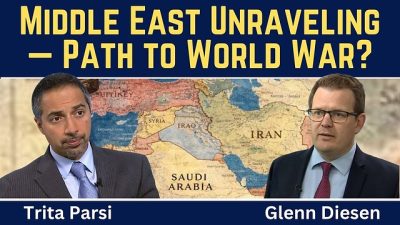
Trita Parsi: Middle East Unraveling — Are We on the Path to World War?
or go to
Aletho News Archives – Video-Images
From the Archives
Why Saudi Ties to 9/11 Mean U.S. Ties to 9/11
By Kevin Ryan | Dig Within | September 27, 2015
Media interest in Saudi Arabian connections to the crimes of 9/11 has centered on calls for the release of the 28 missing pages from the Joint Congressional Inquiry’s report. However, those calls focus on the question of hijacker financing and omit the most interesting links between the 9/11 attacks and Saudi Arabia—links that implicate powerful people in the United States. Here are twenty examples. … continue
Blog Roll
 Aletho News
- Integrity Initiative: UK-funded network framed dissent as Russian disinformation for years
- ‘We don’t seek permission to defend our country’: Snippets from President Pezeshkian’s UNGA address
- NATO chief wants Europeans to fight American wars [for Israel]
- German chemicals giant reveals details of downsizing
- Refaat Al-Areer Was The Canary In The Coal Mine In Israel’s War On The Truth
- Israeli election committee bars candidate from Knesset race over Gaza war opposition
- French-Lebanese man files war crimes complaint over Israeli attacks
- Mahan Air Flight Lands in China Despite US Threat against Iranian Airlines
- US eyes $10bn fund to rebuild war-battered Gulf infrastructure
- Trump meets Rodríguez near Maduro’s prison as Venezuela’s oil flows to US
- If Americans Knew
- Caught on Tape: AIPAC CEO Boasted of Controlling Trump’s National Security Officials
- Why Hamas Attacked Israel in October 2023 – Israeli professor Ilan Pappé
- They see them, then kill them: Israeli quadcopters track, deliberately target civilians in Gaza
- Winter could turn Gaza’s treacherous, war-damaged buildings into deathtraps
- Majority of Democratic Voters Want to Prosecute Both Biden and Trump Administration Officials Over Gaza
- As Gaza languishes, world leaders gather at the UN – Daily Update
- Sanctions are collective punishment: immoral and self-defeating
- Phosphorus Munitions Fired by Israel Burn Groves, Orchards in Southern Lebanon
- Israel Carries Out New Ceasefire Violations Across Gaza
- AI – Emphasis on the ‘I’: Israel Is Funding AI Chatbot Propaganda
- No Tricks Zone
- New Study: Earth And Venus Surface Warmth Largely Explained By Convection And Lapse Rate, Not CO2 Or Radiation
- 2025 Nature Paper Claiming Worsening Global Drought Gets RETRACTED …Heavily Flawed
- New Study: ‘Global Drought Shows No Detectable Recent Acceleration Under Climate Warming’
- Economic Masterminds: German Socialists Suggest Taxing Productivity Gains Stemming From Using AI
- The South China Sea Has Not Been Cooperating With The Climate Change Narrative
- Energy Crisis: Germany Enters Heating Season With Historically Low Gas Reserve Fill Levels
- New Study: The Antarctic Ice Sheet Gained Mass From 2020-2024 Due To Staggering Snow And Ice Accumulation
- Study: Ocean Heating Rates From Thousands Of Years Ago ‘Dwarf’ Modern Ocean Heating Rates
- Climate Extremists Target, Attack Large-Scale Power Grid Infrastructure In Germany!
- New Study: Antarctic Ice Melt Has Contributed Less Than 1 Centimeter To Sea Level Rise In The Last 30 Years

