Trump Should Veto Congress’ Foolish New Sanctions Bill
By Ron Paul | July 24, 2017
This week’s expected House vote to add more sanctions on Russia, Iran, and North Korea is a prime example of how little thought goes into US foreign policy. Sanctions have become kind of an automatic action the US government takes when it simply doesn’t know what else to do.
No matter what the problem, no matter where on earth it occurs, the answer from Washington is always sanctions. Sanctions are supposed to force governments to change policies and do what Washington tells them or face the wrath of their people. So the goal of sanctions is to make life as miserable as possible for civilians so they will try to overthrow their governments. Foreign leaders and the elites do not suffer under sanctions. This policy would be immoral even if it did work, but it does not.
Why is Congress so eager for more sanctions on Russia? The neocons and the media have designated Russia as the official enemy and the military industrial complex and other special interests want to continue getting rich terrifying Americans into believing the propaganda.
Why, just weeks after the White House affirmed that Iran is abiding by its obligations under the nuclear treaty, does Congress pass additional sanctions anyway? Washington blames Iran for “destabilizing” Syria and Iraq by helping them fight ISIS and al-Qaeda. Does this make any sense at all?
When is the last time Iran committed a terrorist act on our soil? It hasn’t. Yet we learned from the declassified 28 pages of the Congressional 9/11 report that Saudi Arabia was deeply involved in the 2001 attacks against Washington and New York. Who has funded al-Qaeda and ISIS in Syria for years? Saudi Arabia. Yet no one is talking about sanctions against that country. This is because sanctions are not about our security. They are about politics and special interests.
Why is Congress poised to add yet more sanctions on North Korea? Do they want the North Korean people to suffer more than they are already suffering? North Korea’s GDP is half that of Vermont – the US state with the lowest GDP! Does anyone believe they are about to invade us? There is much talk about North Korea’s ballistic missile program, but little talk about 30,000 US troops and weapons on North Korea’s border. For Washington, it’s never a threat if we do it to the other guy.
Here’s an alternative to doing the same thing over and over: Let’s take US troops out of North Korea after 70 years. The new South Korean president has proposed military talks with North Korea to try and reduce tensions. We should get out of the way and let them solve their own problems. If Iran and Russia want to fight ISIS and al-Qaeda at the invitation of their ally, Syria, why stand in the way? We can’t run the world. We are out of money.
President Trump was elected to pursue a new kind of foreign policy. If he means what he said on the campaign trail, he will veto this foolish sanctions bill and begin dismantling neocon control of his Administration.
Safe Zone: Russia Informs US, Jordan, Israel of Deploying Checkpoints in Syria
Sputnik – 24.07.2017
MOSCOW – Russia has informed the United States, Jordan and Israel ahead of deploying two checkpoints and 10 observation points along the so-called contact line in Syria, the Russian military said Monday.
Chief of the Main Operational Directorate of the Russian General Staff Col. Gen. Sergei Rudskoy said that the Russian military police established the posts along the southwestern de-escalation zone on July 21 and July 22.
“We informed our colleagues from the United States, Jordan and Israel through military diplomatic channels in advance of the deployment of the Russian control forces around the perimeter of the de-escalation zone in southern Syria,” Rudskoy said.
The checkpoints and observation posts, he noted, are aimed at “supporting the ceasefire regime, facilitating unhindered access of humanitarian supplies, the return of refugees and temporarily displaced persons.”
Rudskoy added that the nearest Russian military post to the contact line is 13 kilometers, or 8 miles, from the disengagement zone of the Israeli and Syrian forces near the Golan Heights.
John McCain and The Cancer of Conflict

By Patrick Henningsen | 21st Century Wire | July 21, 2017
This week some devastating news befell John Sidney McCain III.
On Wednesday, his staff announced that the US Senator had been diagnosed with a brain tumor called glioblastoma discovered during recent testing at the Mayo Clinic in Phoenix, Arizona.
Since then warm wishes and tributes have been pouring in for the former Republican Presidential candidate. Both the US media and political establishment have closed ranks and are rallying around the Senator to help soften the blow.
Putting previous feuds aside, President Donald Trump was magnanimous and cordial to the Arizona Senator, wishing him and his family the very best.” Melania and I send our thoughts and prayers to Senator McCain, Cindy, and their entire family,” said Trump. “Get well soon.”
Even former electoral rival President Barack Obama pitched in a little love for the 80 year old:
“John McCain is an American hero & one of the bravest fighters I’ve ever known. Cancer doesn’t know what it’s up against. Give it hell, John.”
Regarding McCain’s diagnosis, we all can acknowledge the difficulties and risks involved with various cancer treatments, especially with brain cancer. Likewise, nearly everyone these days can attest to losing a friend, a loved one or family member to the disease.
As with anyone suffering from this terrible condition, we wish the Senator well, along with a successful treatment and recovery.
Still, McCain has a lot in his favor. Unlike most Americans, he will not have to worry about his medical care, and will be receiving the best cancer treatment money can buy, if not the best in the world, and with absolutely no expense spared. In this way, the Senator is extremely fortunate.
And for those reasons, this is not an easy article to write. For fear of appearing too cruel in the face of his dramatic medical disclosure, one would be expected to suspend any political critique for now. Hence, the media has placed an unofficial moratorium on any negative coverage of McCain.
That said, he is a special case. As much as any political leader – he deserves to be panned, even under the present circumstances, because his geopolitical handiwork continues to cause havoc in certain corners of the world.
Cancer Treatment in Syria
Immediately after McCain’s major health announcement, the US mainstream media and Republicans began fretting over the prospect that his extended absence from the legislature might jeopardize his party’s ability to pass legislation to repeal the Affordable Care Act (commonly known as Obamacare).
With that in mind, maybe it’s worth asking: how many innocent Syrians have been denied basic medical treatment, supplies and pharmaceuticals as a result of the harsh US-led regime economic sanctions imposed on Syria? This brutal campaign of collective punishment has been led by US Senator John McCain.
Of course, the idea of sanctions as a form of economic warfare hardly registers in the West as being at all harmful to the population of Syria. “Sanctions? They’re not against the people of Syria, only against Assad.” That’s the general mainstream phantasm when it comes to sanctions, even though the official numbers show a vivid tale of devastation.
One can only imagine how many among Syria’s population of 20 million are no longer able to receive cancer treatment in Syria as a result of McCain’s insistence on punitive sanctions. Before the conflict in Syria began in 2011, citizens were able to get free medical treatment including high-end state-of-the-art cancer treatment (consider that one simple aspect of this war, as men like John McCain still claim to be delivering ‘freedom’ to the Syrian people by backing armed terrorist factions).
Before the terrorist forces occupied the eastern part of the city, Aleppo was home to one of the Middle East’s top cancer treatment centers, Al-Kindi Hospital. This is important because after McCain’s secret trip to the Aleppo area in May 2013, the very same ‘rebels’ he was cavorting with and supplying weapons to – the ‘Free Syrian Army’ (under the command of Jabbat al Nusra aka al Qaeda in Syria) would later order the bombing on this cancer treatment hospital.
Professor Tim Anderson explains the destruction of Al Kindi Hospital in December 2013, including the shameful spin applied after the fact by BBC and western mainstream media:
In an Orwellian revision of events the BBC (21 December 2013) reported the destruction of Al-Kindi with the headline: “Syria rebels take back strategic hospital in Aleppo”. The introduction claimed the “massive suicide lorry bomb” had managed “to seize back a strategic ruined hospital occupied by Assad loyalists.” Al-Kindi was said to have been “a disused building” and “according to an unconfirmed report, 35 rebels died in the attack”. In fact, these ‘rebels’ were a coalition of Free Syrian Army and Jabhat al Nusra, while the ‘Assad loyalists’ were the staff and security guards of a large public hospital.
Watch as McCain’s ‘freedom fighters’ in Syria drive a suicide truck bomb into the ground level of Al Kindi Cancer Treatment Center in Aleppo:
How many Syrian lives were needlessly cut short as a direct result of that bombing carried out by McCain’s own Free Syrian Army? For the cost of McCain’s treatment at the world-famous Mayo Clinic, who knows how many Syrians could have received desperately needed treatment at Al Kindi or other similarly crippled facilities in Syria? One hundred, or possibly one thousand?
Add to this, how many have died or suffer permanent health afflictions as a direct result of US economic sanctions which have crippled Syria’s own National Health Service? One hundred thousand, or maybe five hundred thousand? One million? One day, those figures will be recorded and we will have the answer.
The other piece of US legislation currently on the table which Republicans are desperate to pass is the $1-trillion US infrastructure spending package. Juxtapose that scene next to the systematic destruction of Syria’s infrastructure by US Coalition and Israeli airstrikes and destruction by proxy militant forces on the ground. Estimates for the cost to Syria range from $180 billion to $275 billion. If the conflict continues past 2020, then these numbers could easily double.
In spite of all this, John McCain claims to have no regrets about the damage that he and his fellow war hawks have inflicted on Syria.
The Cancer of Conflict
At the same time that political figures like Barrack Obama dutifully respect the official Washington line on John McCain as the consummate “Vietnam War hero”, very few in the establishment would dare to criticize the powerful Arizona Senator for his central role in engineering instability and violent conflict in foreign countries.

John McCain sneaks into Syria illegally in May 2013 to meet with known terrorists, promising them weapons and regime change by way US bombs would drop in the Fall of 2013.
Americans should be reminded that more than any other single US official, John McCain has been the driving force behind the training and arming of violent jihadist and terrorists fighting groups in Syria, and that those same terrorists have slaughtered tens of thousands of innocent civilians including women and children in Syria and beyond – all sacrificed at the altar of a US-led geopolitical power play in the Middle East, and in the name of Israeli ‘security interests.’
Back in 2012, a delusional McCain, along with another dotty war enthusiast, Connecticut Senator Joe Liberman, insisted that the US needed to arm the ‘rebels’ in Syria in order to “save lives.” Their statement read:
“The bloodshed must be stopped, and we should rule out no option that could help to save lives. We must consider, among other actions, providing opposition groups inside Syria, both political and military, with better means to organize their activities, to care for the wounded and find safe haven, to communicate securely, to defend themselves, and to fight back against Assad’s forces.”
 From the onset of hostilities in 2011, the bold-faced lie that McCain and partner Lindsey Graham have promulgated is that violent jihadists were nothing more than affable “moderate rebels.” That piece of Washington fiction has been widely discredited by now.
Later on in 2015, McCain announced that the US should be supplying stinger missiles to the so-called ‘rebels’ in Syria:
“We certainly did that in Afghanistan. After the Russians invaded Afghanistan, we provided them with surface-to-air capability. It’d be nice to give people that we train and equip and send them to fight the ability to defend themselves. That’s one of the fundamental principles of warfare as I understand it,” said McCain.
Soon after that statement, thousands of US-made TOW Missiles were smuggled into Syria and used by terrorists groups under the command umbrella of Al Nusra.
In her recent exposé for Trud Newspaper, Bulgarian journalist Dilyana Gaytandzhieva revealed the massive scale and scope of the illegal US-NATO weapons trafficking operation to arm thousands of terrorist fighters in Syria.
Despite the overwhelming destruction in Syria and the abject failure of his policies, McCain has never given up on the policy of illegal weapons trafficking in Syria. Just this week, McCain, Chairman of the Senate Armed Services Committee, openly protested against the Trump Administration’s latest announcement to bring an end to the CIA’s failed program of illegally arming and training ‘anti-Assad’ terrorists in Syria. Rather than admitting what everyone else in the world seems to know already – that the US “train and equip” program has been a debacle – instead he feigns defiance, while demonstrating a breathtaking level of ignorance by accusing the White House of being part of a Russian conspiracy:
“If these reports are true, the administration is playing right into the hands of Vladimir Putin.”
“Making any concession to Russia, absent a broader strategy for Syria, is irresponsible and short-sighted.”
When promoting their latest war, McCain is normally part of a tandem act, accompanied by his geomancing interest, South Carolina Senator Lindsey Graham, who arguably views the world through an even more deranged, albeit binary comic book prism:
“Breaking Syria apart from Iran could be as important to containing a nuclear Iran as sanctions.”
“If the Syrian regime is replaced with another form of government that doesn’t tie its future to the Iranians, the world is a better place.”
Like a world view gleaned straight from Ian Flemming’s Goldfinger.
In his seminal 2008 interview with McCain heading to the GOP presidential nomination, The Atlantic magazine’s Jeffrey Goldberg asked, “What do you think motivates Iran?”.… to which McCain replied:
“Hatred. I don’t try to divine people’s motives. I look at their actions and what they say. I don’t pretend to be an expert on the state of their emotions. I do know what their nation’s stated purpose is, I do know they continue in the development of nuclear weapons, and I know that they continue to support terrorists who are bent on the destruction of the state of Israel. You’ll have to ask someone who engages in this psycho stuff to talk about their emotions.”
McCain’s views on Iraq were even more disturbing, essentially surmising that the invasion and occupation was a good thing, and that we shouldn’t have left because ‘leaving Iraq gave rise to al Qaeda.’ OK. Admittedly, it’s a bit counter intuitive, but it works for neoconservatives.
These statements by McCain and Graham are not admissions made by normal well-adjusted individuals, but rather by cold, dark hearted sociopaths who generally view the lives of Arabs (along with Slavs, Russians and others) as necessary cannon fodder in the pursuit of military industrial profits for a select cadré of transnational corporate ‘defense’ contractors – whose interests Senator John McCain represents in his home state of Arizona; Boeing, Raytheon, Lockheed Martin, General Dynamics, and the list goes on, and on.
The geopolitical hubris doesn’t end there, as McCain still maintains – even after 6 years of absolute implosion of his own foreign policy agenda – that removing Syrian President Bashar al Assad from power is still a “key pillar” of the US strategy for Syria.
“The administration has yet to articulate its vision for Syria beyond the defeat of ISIL, let alone a comprehensive approach to the Middle East,” said McCain this week.
The reality, of course, is that ISIL/ISIS could have been defeated already had the US-led ‘Coalition’ and Israel not illegally intervened in Syria territory. Far from doing much to “defeat ISIS” since they have invaded Syrian airspace since 2014, the US has conveniently stretched-out the ‘ISIS problem’ through the extension of its own self-styled international mandate which was originally intended to serve as a precursor to the eventual break-up of Syria into federal states and ethnic cantons. This might explain McCain’s rush to enact regime change in Syria before lording over the eventual break-up of the sovereign nation-state.
All Things Russian
The other country which McCain is determined break is Russia.
“Vladimir Putin is a murder and a KGB thug,” crowed McCain on CNN last year, as he protested against positive statements about Russia made by then candidate Trump.
Suffice to say, he, along with the boards of Boeing, Raytheon, Lockheed Martin, are all extremely happy about NATO pressing right up against the Russian border in eastern Europe.
But 2013 was indeed a busy year for the Senator stirring up trouble internationally. As part of his opening gambit against Moscow, it was McCain who was the driving force behind the US-backed coup d’etat in Ukraine in February 2014 – which ultimately led to a bloody civil war which continues to this day in the Ukraine. Apparently, this was McCain’s way of ‘stopping Putin.’
His has a very dodgy track record; whether it’s NeoNazis, or Jihadi Terrorists, McCain seems always ready to do a deal with the devil, and that’s what makes him particularly dangerous.
Below we can see McCain helping to whip-up Nazi-linked, neofascist street mobs in Kiev helping to bring the ensuing junta into power. Some mainstream US pundits have claimed that this never happened, and that it’s just a conspiracy theory invented by ‘Russian propagandists’ to discredit McCain. Unfortunately for them – it is true, and here is the photo to prove it:

John McCain shares the stage in Kiev with Right Sector strongman, Oleg Tyhanbock, ahead of violent street protests in Ukraine in December of 2013, prior to the US-backed coup.
Looking back at his erratic and flippant behavior, attacking nearly anyone who even suggested détente with Russia or that supplying lethal arms to militants in Syria was a bad idea, it’s no surprise that cognizant onlookers have questioned whether or not McCain is in a normal frame of mind.
Frankly speaking, how could any one in their right mind be so consistently on the wrong side of every issue? How could any politician’s judgement be that poor? Unless there was something else going on below the surface…
The questions didn’t stop there. McCain’s performance during a recent Senate Intelligence Committee Hearing on “Russian Influence in US Elections” was an embarrassment. Onlookers were stunned when McCain lost the plot during the hearing when asking former FBI Director James Comey:
“Well, at least in the minds of this member, there’s a whole lot of questions remaining about what went on, particularly considering the fact that as you mentioned, it’s a “big deal” as to what went on during the campaign, so I’m glad you concluded that part of the investigation, but I think that the American people have a whole lot of questions out there, particularly since you just emphasized the role that Russia played.”
“And obviously she was a candidate for president at the time. So she was clearly involved in this whole situation where fake news, as you just described it, is a big deal took place. You’re going to have to help me out here. In other words, we’re complete, the investigation of anything former Secretary Clinton had to do with the campaign is over and we don’t have to worry about it anymore?”
… to which Comey replied:
“With respect to — I’m a little confused. With respect to Secretary Clinton, we investigated a criminal investigation with her use of a personal email server.”
McCain then finished digging his own hole by responding:
“So at the same time you made the announcement there would be no further charges brought against then-Secretary Clinton for any activities involved in the Russia involvement and our engagement and our election. I don’t quite understand how you can be done with that but not done with the whole investigation of their attempt to affect the out of come our election.”
It was clear McCain had no idea what was going on. At that point any reasonable person would have concluded that John McCain had in fact lost his mind – and was no longer fit to serve in public office. In fact, 21WIRE made this very same case back in 2013 after McCain was caught playing video poker on his iPhone during a Senate Committee where lawmakers were debating the very war of which he is a chief architect. Here is the photo:

As stunning displays of ignorance go, the video poker incident was one of McCain’s greatest ever, and certainly should have been a warning to everyone that this man had no business making military decisions, let alone litigating war and peace between nuclear superpowers like the United States and Russia.
Perhaps an announcement is forthcoming, but it’s surprising after being diagnosed with brain cancer at 80 years old – why McCain has not yet announced his resignation from office?
It’s fair to say that while this Senator is being treated in the world’s leading medical facilities, thousands of innocents will have died needlessly because of US sanctions and support for terrorists – all [supposedly] in the name of defense, energy and ever vast corporate profits. Strange as that might sound to some, for those who consider themselves members of a ruling elite and its mandarin management class, that is perfectly acceptable quid pro quo in 2017.
After World War II, the military industrial complex and the international arms trade has spread conflict like a disease across the planet, metastasizing in ways, in places, and on a scale which no one could have previously imagined before. Undoubtedly, over the last decade, John McCain has played a key role in spreading that anguish. For the people of Syria, Afghanistan and the Ukraine, that will be his legacy, not the chimerical image of a ‘maverick’ Senator or the ‘war hero.’
Once again, we implore the Senator to do the right thing by the American people and for those innocents around the world who have suffered at the hands of an arms industry whose interests John McCain represents.
Please retire.
It’s Time To Raise the Level of Public Debate about Syria
By Tim Hayward | July 22, 2017
These past six months I have been getting to know the inter-media. They’re not formally part of mainstream, and they’re not very social, so I call them inter-media. They are like the maintenance team for the mainstream. To explain this, I’ll first say how I came to meet them.
The context of these encounters is writing posts on Syria. Doing so, I rely entirely on what others say. But the fact that we hear directly contradictory narratives provides a rare opportunity to test whose tale is the truer. Lies, whatever some bluffers and braggers may think, are infinitely harder to sustain, over time, than is the truth.[1]
The impulse to write about Syria originated at a very specific moment, even if my curiosity had been piqued earlier by the Netflix White Helmets: Where are the fighters that are holding off the combined military might of Syria and Russia? How come they don’t mind you filming here? The moment, though, was when Eva Bartlett responded to a mainstream media critic’s question: “Sources on the ground? You don’t have them.” And when Eva pointed out that the White Helmets were embedded with the fighters, this simply made more sense than Netflix had. But then I learned “That woman has been debunked.” (Note the way she is spoken about.) So who by? Well, Snopes for one. Fine, but seriously? I was informed that the mainstream view was verified by Médecins Sans Frontières (MSF). Here, now, was a reputable organisation that actually had doctors there on the ground risking their lives to save others under very dangerous conditions. Except, as it turned out, they did not, and so I came to write my first blog on Syria.
(MSF had the good grace to accept that I’d identified a problem, and invited me to their annual research conference this year to discuss the issues involved in relying on secondhand testimony.)
Channel 4’s alleged debunking of Eva prompted a subsequent blog. That involved studying their output, which was revealed to include much more than some unreliable witness statements. If MSF’s misleading testimony might be attributable to an insufficiently accountable communications operation, Channel 4 appeared to be engaged in a systematic programme of disinformation. There seemed to be a conscious commitment to presenting part of the same alternative reality that White Helmets and Bana feature in. It all appears to be produced by the Aleppo Media Center, which is actually in Turkey, but Channel 4 got some bespoke pieces, like the ‘Inside Aleppo’ series, and not just syndicated stuff. Hence we find Channel 4’s Aleppo films winning awards, like Netflix did with the White Helmets.
(Hence the channel will not publicly address what some there privately acknowledge are valid questions. And when you think about the investment involved you can understand their reluctance.)
Reflect on what must be involved here, and you start to realise that such a coordinated effort must have a deep and extensive organisational basis that goes way beyond the specific organisations that retail the information. Consider the preparation, work, time, and resources, material and human, that go into producing even a single scene in a movie, and then, after a whole feature has been shot, the audience still knows it is just a movie, not real. How much more preparation and resource must go into not merely producing a movie but actually persuading the entire public that reality is like the movie.
Nor is the effort to build that wall of disinformation the end of the challenge. It will require constant maintenance, for any big structure is liable to stresses, and cracks will appear. Here is where you need people ready with some filler. This is where we meet the inter-media. More fleet-footed, less constrained, than straight up media channels, but more disciplined and very much less social than social media, they are something in between. Their function with respect to the dominant narrative seems to be akin to that of those hi-tech bacteria that mould themselves into ongoing repairs in cracked concrete: the inter-media are there to plug up the cracks where shafts of truth show through.
This week afforded some opportunities to encounter the inter-media at work. Early in the week, a great article by Piers Robinson was published in openDemocracy urging a more serious look at propaganda and its contribution to the regime change agenda that is destroying Syria. Getting published in this prominent outlet was something of an achievement, for reasons I’ll let one of the first responders illustrate:
“By amplifying this conspiracist drivel, you are polluting the public sphere. @OpenSociety & @boell_stiftung should reconsider their support”
That tweet has since been deleted, perhaps because its author agreed with me that it cast a worrying light on his idea of how public debate should be conducted, and on whose terms. But it had made me curious as to why the Heinrich Böll Foundation should have a particular interest in the matter[2] I only knew them as a research organisation linked to the German Greens. (I’d spoken myself at their headquarters one time in Berlin.) But now I was about to turn over another stone! A cursory look on twitter quickly turns up that Foundation’s Middle East communications person tweeting about Tim Anderson, a longstanding critic in relation to The Dirty War on Syria, and lecturer at Sidney University:
“When will @sydney_uni finally end this producer of #FakeNews contract? Smearing of civilians, pretending #Assad doesn’t use gas.”
Wow! She attacks a man’s reputation, campaigns for him to lose his job, and challenges academic freedom, while also asserting an unproven claim as if it were truth, all within 140 characters. I can see how she got the job as communications head.
Moving on from this inter-media filler of German precision we will shortly come to meet one with American pizzazz. But first there is some backstory to fill in, starting with some words of clarification.
I hope it was clear, when I a moment ago implied a certain admiration for the skills of the propagandist just mentioned, that I am not approving of what she uses them for. I should have been clearer on this score when giving credit to Bellingcat in a post last week. In order to establish that my engagement with him would follow academic norms, I exaggerated the courtesies.[3] This caused some genuine consternation amongst readers, given the awareness many have of Bellingcat’s role in the propagation of the US-UK narrative. A few individuals were so outraged that they launched a forceful public criticism at me.[4] Since the last thing I want to do is mislead people I revised the blog, stripping out the confusing niceties, in order to bring attention back to its actual point. I had already apologised.
That incident taught me a few things. One is that writing in public, unlike in academia, means being aware of a potentially wide readership, with a variety of backgrounds and perspectives. So I should take more care to say only what I mean. Something else I learned, though, is what wonderful people there are who share the kinds of concern that I’m working through in these posts. Many people who I had already instinctively felt trust in revealed a depth of solidarity and integrity that is simply humbling. I really want to thank you all for your words of support. Thank you, also, for urging everyone to settle any differences like friends.
Like friends. That this expression comes so spontaneously to mind is my most important lesson.[5] There is actually a group of friends who are bound by a few simple ties: a desire that what we learn about the world is the truth; a conviction that whatever pressures of life may drive human beings into conflict with one another, we should do everything in our power to deal with them without being pushed into wars. Our power may not be great as individuals, but we all partake of a power that is ultimately indomitable. As embodied creatures of this real world we have evolved with a deep commitment to pursuing truth. If our ancestors could not discern the difference between a snake and a stick, we would not be here. If we were not able to make correct judgements about myriad things every moment of our waking life, aware of it or not, we would not survive long. We have an instinct for seeking true knowledge. We are predisposed towards it. To those who want to obscure it, we will seem like partisans for the truth.
With this in mind, I return to the American intervention on my twitter feed this week. The twitter storm provoked by my being too polite to Bellingcat had been watched with some amusement by Higgins himself and some of his friends. Here is one of them:

I have anonymised this because, like the first tweet I quoted above, it comes from a person who works at a UK University. I highlight it not because I personally mind being grouped with the majority of people living in Syria who prefer their legitimate government to the murderous bands of foreign-backed sectarians attacking it. But it is intended as a smear, and for the sake of people who want to engage in constructive and serious debate, I shall stand up to this practice of the inter-media brigade of attacking any and every attempt at actual public debate about the truth in Syria (or, indeed, in many other places). If they want to behave like rude trolls, they’d best keep a respectful distance from academia when they do it. That is a message I would encourage them to embrace.
I don’t believe the public want to think their own or their children’s university education is entrusted to people who think it is appropriate public conduct to come out with productions like the follow up to that tweet. For in lieu of the requested apology from the waggish twitterer, there ensued a series of tweets including this flourish of creativity:

The inter-media brigade may think this is a bit of fun, a change from straight up abuse and intimidation (and from unreasoned dismissals such as we find with Padraig Reidy calling Piers Robinson’s piece in openDemocracy ‘disgraceful’ apparently because Piers has elsewhere defended Russia Today against irrational attacks). But I ask them, very seriously, what actually is there to be having fun about? Those who promote propaganda that has real consequences for real people should man up, and grow up, and own what they do.
Frankly, none of this should need saying, and I am not paid to be spending valuable time dealing with it. So to them I leave it at this: Meet us in an academic forum or on a public platform where norms of civil debate apply. You cannot have it both ways: you cannot go bruising it around the internet just making ad hominem slurs while also staking an implicit claim to academic backing.
As for friendly and open readers, especially beyond academia, I have this to say. If in resisting propaganda you get called partisans, then let it be so. We are partisans for the truth. And resistance will work. Perhaps the truth is ‘rarely pure and never simple’, but it is much less high-maintenance than the wall of misinformation that the inter-media team are perpetually trying to patch up, and it will out. Meanwhile, the resistance is growing.
And finally, just to illustrate the difference between the alternative reality and the world we live in, I leave you with a video released this week by the amazing journalist from Aleppo, Khaled Iskef. He shows us around the neighbourhood in Aleppo where the little Syrian girl called Bana actually lived, there alongside the HQs of the armed brigades whose men, alone, were able to make or send images from the place. You then get an idea of how the child used in the propaganda may have a true call on our human sympathies.
[1] I am willing to use the seemingly hyperbolic term ‘infinitely’ because the truth will be what it is forever, without any input from anyone, whereas a lie becomes increasingly high maintenance in the face of simple questioning. It is endlessly difficult to maintain the back story, and then the back story’s story, and so on, until the effort required to avoid self-contadiction simply becomes too much and the simple truth just comes out again, like a plant through cracked tarmac. That is why the propaganda campaign needs to be so vast and long term. It is a gargantuan feat that we only see the tip of. We see the movie, we don’t see the entire production process.
[2] A twitter contact, by way of answer, informed me that the ‘Heinrich-Böll-Stiftung was used by the CIA to influence culture in Europe. The financing was made via Ford Foundation’. She sent me this video link (in German). I have not investigated so I make no comment myself. A look at a longer sweep of tweets from the foundation’s spokesperson for Syria does reveal a pattern sufficiently familiar to anglophone inter-media agencies to warrant mentioning a possible concern here, but I emphasise the caveat that her twitter profile makes the disclaimer “Tweets my own”.
[3] In giving credit for his geolocation skills and responsiveness to my inquiries (which I’ve learned does not reflect everyone’s experience) I frankly laid it on too thick. It genuinely hadn’t occurred to me that anyone would think I misunderstood the nature of his operation, but that was my mistake. Notwithstanding my apologies, I can see my critics were justified in residual anger on the grounds that there would be readers at earlier stages of learning who could take it at face value. How much it then helped that those critics themselves proceeded to extract and broadcast precisely that misleading message, as if it really were my message to the world, I can only leave them to consider.
[4] I haven’t seen it myself, having opted out of interactions with its author and the initial instigator once it became evident they hadn’t accepted my apology. There have been replies on my behalf, and I also haven’t been reading these, but one was copied to me by a mutual friend on Facebook and I reproduce it below. One can tell from reading it that the debate had got heated, and such a forceful response needs to be seen in that context. Thank you, John Schoneboom, for your eloquent words:

[5] The people I owe thanks to are far more than I shall even try to mention, but there is one person I do want to thank by name. Like Eva, she gets subjected to vast amounts of abuse for reporting a counter-narrative from Syria. Also like Eva, she is more than strong enough to take it. But frankly, she shouldn’t have to, certainly not from anyone associated with a UK university. Vanessa Beeley, I believe, has done more good for the prospects of ordinary people living in Syria than any of her trolls and detractors. If anybody in academia says I am wrong about this, I am ready to listen, but let them speak in terms that meet the standards of academic discussion.

Amidst a cluster of (former) terrorist HQs.
US special operations chief confirms end of CIA support for anti-Assad forces in Syria
RT | July 21, 2017
A US army general has confirmed that Washington has decided to put an end to a CIA scheme to equip and train certain rebel groups fighting the government of Syrian President Bashar Assad. He insisted the policy shift had nothing to do with improving relations with Russia.
US Army General Raymond Thomas, head of the Special Operations Command, said the decision was “based on assessment of the program.”
“At least from what I know about that program and the decision to end it, (it was) absolutely not a sop to the Russians,” Thomas said at the Aspen Security Forum in Colorado on Friday.
Unnamed government sources told various media outlets last week that the decision to end the program had been partly due to the Trump administration wanting a better relationship with Russia.
The decision to terminate the program was reportedly taken by Trump in consultation with CIA Director Mike Pompeo and national security adviser H.R. McMaster ahead of his meeting with Russia’s President Vladimir Putin in Hamburg earlier this month.
But the end of the CIA’s Timber Sycamore strategy was not a precondition for the ceasefire deal reached between Putin and Trump on the sidelines of the G20 summit, the US officials insisted.
The covert CIA program began arming and training the so-called moderate Syrian opposition forces in 2013.
Two US officials who spoke on condition of anonymity with Reuters, pointed out that the covert CIA tactic had produced little success.
Russia has always warned against arming the so-called moderate opposition groups in Syria, underlining that weapons supplied to them often fall into the hands of jihadist groups.
The so-called moderate opposition has effectively ceased to exist in Syria, hijacked by armed extremists, Russia’s former UN ambassador told the General Assembly in December last year.
Having pointed to the scale of destruction in Syria, Vitaly Churkin, now late, said it was “a result of the mindless foreign policy of several international and regional players who once decided to change the leadership in Damascus and to redraw drastically the political, ethnic, confessional, and economic map of the region.”
But despite having “extensive financial, logistical, and propaganda support” from the outside, “the elusive concept of ‘moderate Syrian opposition’ has effectively failed,” the Russian diplomat then said.
American Armored Vehicles Are Pouring into Raqqa, But Who Are They For?
© East News/ Michael Curvin
Sputnik – 21.07.2017
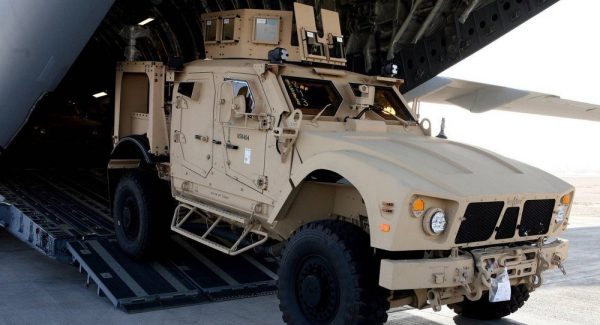
Footage has surfaced online depicting flatbed tracks laden with American armored military vehicles passing through Syria, with conflicting commentary claiming that the materiel was bound for use by either US-backed Syrian militant groups or US troops themselves fighting Daesh in the city of Raqqa.
The photos and videos were uploaded by Syrian Kurdish activists who are known affiliates of the Syrian Democratic Forces (SDF.) The vehicles included Mine-Resistant Ambush Protected (MRAP) vehicles, Mine-Resistant All Terrain Vehicles (M-ATVs) and armored bulldozers. They were mounted on the backs of flatbed trucks and were filmed passing through Qamishli, 170 miles northeast of Raqqa.
All three vehicle types were previously mentioned in Pentagon reports as assets being supplied to SDF fighters. “Up-armored vehicles have been delivered to the SDF and [Syrian Arab Coalition] as part of our existing authorities to enable them,” a spokesperson for US operations in Syria told Task & Purpose.
”Specifically, these vehicles will help them contend with [Daesh’s] IED threat in their current operation, and as they move to isolate [Raqqa].” Mine-resistant vehicles are deployed against areas known to hide improvised explosive devices, which are a major danger to American soldiers riding in armored vehicles. At least half of all US casualties in Iraq and Afghanistan have been attributed to IEDs.
However, the spokesperson went on to tell Task & Purpose that MRAPs and M-ATVs were “not part of the package that is divested to the SDF.” The Military Times noted that the M-ATVs were mounted with Common Remotely Operated Weapon Station (CROWs) systems, which allow for operators to fire the M-ATV’s mounted.50 cal machine gun without exposing themselves to enemy fire. CROWS systems also weren’t provided to SDF fighters.
Instead, the vehicles “are for use by the Coalition to protect our forces from IEDs.” In other words, the Pentagon claims these armored vehicles are for use by Western operators, not SDF militants.
Under the Trump administration, there has been an uptick in American support for the SDF, a coalition of various militias. Since June, the SDF have besieged Raqqa, Daesh’s final stronghold in Syria. Although Daesh has mounted intense resistance, the SDF has encircled the city and is slowly but surely gaining ground. The deeper the SDF go into the city, however, the stiffer the defenses they find awaiting them.
“The SDF has reportedly encountered intensified resistance and ‘better-emplaced defenses’ over the past four weeks following initial rapid gains in districts on the outskirts of [Raqqa],” read a new report from the Institute for the Study of War.
Although the US support for SDF operations is common knowledge, the Pentagon has been very cagey about providing details of American operations. They only directly confirmed the presence of US advisers in Raqqa five weeks into the siege, for instance.
The largest and most prominent militia among them are the Syrian Kurdish People’s Protection Units (YPG). Turkey, a nominal US ally, considers the YPG to be a terrorist group, which the US denies. The Syrian Kurds and the Turkish military have become increasingly belligerent to one another, with some exchanges of gunfire along the Syrian-Turkish border. Ankara has stated in no uncertain terms that they will never support a Kurdish state on their border.
The armored vehicles may then serve a purpose beyond helping to bring an end to the Daesh occupation. They may also be the Pentagon looking ahead to the wars of tomorrow.
US says Syria crisis needs political solution, Assad doesn’t have to go first
Press TV – July 21, 2017
US President Donald Trump’s homeland security and counterterrorism adviser says the US is seeking a political resolution to the conflict in Syria and won’t insist on Syrian President Bashar Assad’s immediate ouster.
Tom Bossert said Thursday there needs to be a political outcome in Syria, not a military-imposed one that has no political strategy to fill a void in leadership.
“I don’t think it’s important for us to say Assad must go first,” Bossert said at the Aspen Security Forum, an annual gathering of intelligence and national security officials and experts.
“The US would still like to see Assad go at some point. That would be our desired outcome,” he added.
The administration of former President Barack Obama had chanted “the Assad must go” mantra on major international forums for several years.
Bossert made the remarks following news reports that Trump had decided to end a covert CIA program that has been arming, training and funding anti-Damascus militants since 2013.
US officials said that ending the CIA operation reflects Trump’s interest in finding ways to work with Russia. Moscow had long pushed Washington to end the covert program, which was begun by the Obama administration to overthrow Assad.
However, the CIA effort had failed to achieve its goals and some US lawmakers had proposed cutting its budget. By some estimates, the CIA trained some 10,000 militants.
For years, Damascus has accused the US of supporting militants seeking to topple the government.
Despite halting the CIA program, the US is still militarily involved in Syria. In May, Trump authorized arming the so-called Syrian Democratic Forces — a Kurdish rebel group — using Department of Defense funds.
Since 2015, Russia has been conducting cruise missile strikes and aerial attacks against terrorist positions in Syria at a request from the Syrian government. The US has been leading dozens of its allies in a military mission purportedly aimed rooting out Daesh since 2014.
Deconstructing Trump’s Iran sanctions
By M K Bhadrakumar | Indian Punchline | July 20, 2017
There is an old impish yarn that Moses was stunned to see the two cats he’d put in the Ark trooping out with a bunch of kittens at the end of the tumultuous existential journey. Seeing the old sage’s puzzled look, the adult male shot back, ‘You thought we were fighting?’ This in some ways captures the noisy, implausible games that Iran and the United States play with each other, growling at each other and making us feel worried at times.
President Donald Trump is having a difficult time to differentiate his Iran policies from Barack Obama’s. The Trump administration has twice certified to the Congress that Iran is complying with the nuclear deal – an agreement he vowed to tear up. But, while doing so on Monday, with an eye on the Israeli lobby, it separately imposed sanctions against a clutch of Iranian personalities and entities – so that the optics look appropriately ‘tough’.
Tehran had conveyed a red line to Washington in the weekend that there shall be no sanctions against the Islamic Revolutionary Guards Corps (which is spearheading Iran’s operations against ISIS in Iraq and Syria). The Trump administration understood perfectly well what it implied – namely, that things can overnight hot up for the US on the ground on the Syrian-Iraqi theatre. (For the uninitiated, IRGC-backed militia and American military advisors tacitly collaborate in the liberation of Mosul.)
Tehran understands that Trump is a bluff master. Read the Iranian Foreign Ministry statement here. Clearly, no one is losing sleep in Tehran. Iran’s missile programme is indigenous; nor will US sanctions frighten IRGC’s elite Qud’s Force under the command of its charismatic general Qassem Soleimani to give up the ‘axis of resistance’ in Syria and Lebanon (and Gaza.)
In fact, Majlis passed a finance bill Tuesday increasing the budget allocation for the missile programme and Quds Force each by $260 million.
The Middle East is witnessing a long sunset of the US hegemony. And Iran senses it. So, Tehran is playing its cards astutely through an admixture of strategic defiance and taunts with unspoken overtures seeking meaningful conversation.
Read the transcript, here, of a fascinating interview by National Interest magazine with Iranian FM Mohammed Javed Zarif who is visiting New York. (Zarif already addressed the CFR and was interviewed by CNN’s Fareed Zakariah and the PBS, amongst others.)
Indeed, Zarif virtually choreographed an Iran policy for Trump. Look at his tantalizing remarks:
- “It took the U.S. longer to clear the purchase of Airbus airplanes than it took for the purchase of Boeing airplanes.”
- “If it comes to a major violation, or what in the terms of the nuclear deal is called significant nonperformance, then Iran has other options available, including withdrawing from the deal.”
- “We need to be more careful about the signaling, because we’ve seen that wrong signaling in the past few weeks in our region, particularly after the Riyadh summit, has caused a rather serious backlash in the region—not between U.S. allies and Iran, but among U.S. allies.”
- “At this stage we are content with simply implementing that (nuclear) agreement… we wanted that agreement to be the foundation and not the ceiling. But in order for that to serve as a solid foundation, we want to make sure that the obligations by all sides have been fully and faithfully implemented. And if we get that, then we have an opening to further progress.”
- “We don’t see the situation in our region as a winning or losing battle… we believe that the situation in today’s world is so interconnected that we cannot have winners and losers; we either win together or lose together. Obviously, if an administration or a government or a country defines its interests in terms of exclusion of others, then it is defining the problem in a way that is not amenable to a solution.”
- “We have had a consistent policy of fighting extremism and terrorism, whether it was in Afghanistan during the reign of the Taliban, or, even during the time that the United States was in occupation of Iraq, against terrorist elements who were instigating terror inside Iraq.”
- “Well, it all depends on the approach that the United States will try, the current administration will try to adopt vis-à-vis Iran. It has to look at Iran as the only country in the region where people stand in line for ten hours to vote. It has to put aside those self-serving assumptions that some members of this administration have repeatedly stated.”
- “We have a very sober understanding of the situation in the region where we are located, and we hope that the United States can also have such a sober understanding.”
Iran is doing just fine. The genius to optimally put diplomacy to use, with maximum cost-effectiveness, has been Iran’s strategic asset in the politics of the Middle East.
CONFIRMED: Trump’s cessation of arms to Salafists had nothing to do with Russia
By Adam Garrie | The Duran | July 20, 2017
Today, Russia’s Presidential spokesman Dmitry Peskov confirmed that the issue of America ceasing to arm Salafist jihadist groups in Syria such as the FSA was not discussed in any way during Donald Trump’s meeting with Vladimir Putin.
This conforms to the analysis first published yesterday in The Duran :
“While the Washington post calls this a win for Russia, in reality this will not directly effect Russia one way or another. It is however, a win for Syria.
By most reasonable accounts, the conflict in Syria could have ended far earlier if not for the CIA and other US actors arming, funding and training Salafist jihadist fighters in Syria (often referred to as moderate rebels by the western mainstream media).
As even the Washington Post admits, almost in a gloating fashion, arming such jihadists was a flagship policy of the United States under Barack Obama.
This will take a substantial deal of pressure off the Syrian Arab Army and their fight against remaining terrorists in Syria.
Ever since Trump took office, the general trajectory of US meddling in Syria shifted from arming jihadists to arming, funding and working in close military coordination with Kurdish forces.
Today’s revelation simply affirms what was long the apparent on the ground policy of the United States since February of 2017.
It is key to remember that even after this announcement, the US presence in Syria is still illegal according to international law…..
At present, there is no overt linkage to these events and Donald Trump’s meeting at the G20 summit with Vladimir Putin. …
This contradicts the assumptions made in the Washington Post that somehow the move was a “victory for Putin” or that it represented Trump capitulating to a Russian demand.
The Washington Post’s assertion that Trump’s decision was “sought by Moscow” is patently misleading and that is being charitable.
Furthermore, under Donald Trump, the United States was moving in this direction since February when it became clear that the new US administration sought to shift the focus of it’s Syria policy from arming jihadists to arming secular Kurdish forces, a move which is still illegal according to international law and opposed by a vast majority of Syrians.
While Russia, Syria and Iran have all warned that any state or non-state actors funding, arming or aiding Salafist terrorists under the guise that they are ‘moderate’ will harm Syrian and wider global security, Russia has not ever attempted to dictate US policy nor has Russia issued any threats or even suggestions to the United States on how to frame its foreign alliances.
Once again, western mainstream media totally distort Russia’s foreign policy statements in order to make Donald Trump look weak or compromised.
Featured Video
Trita Parsi: Middle East Unraveling — Are We on the Path to World War?
or go to
Aletho News Archives – Video-Images
From the Archives
Why Saudi Ties to 9/11 Mean U.S. Ties to 9/11
By Kevin Ryan | Dig Within | September 27, 2015
Media interest in Saudi Arabian connections to the crimes of 9/11 has centered on calls for the release of the 28 missing pages from the Joint Congressional Inquiry’s report. However, those calls focus on the question of hijacker financing and omit the most interesting links between the 9/11 attacks and Saudi Arabia—links that implicate powerful people in the United States. Here are twenty examples. … continue
Blog Roll
 Aletho News
- Neria Leiter Was A Legitimate Military Target
- Integrity Initiative: UK-funded network framed dissent as Russian disinformation for years
- ‘We don’t seek permission to defend our country’: Snippets from President Pezeshkian’s UNGA address
- NATO chief wants Europeans to fight American wars [for Israel]
- German chemicals giant reveals details of downsizing
- Refaat Al-Areer Was The Canary In The Coal Mine In Israel’s War On The Truth
- Israeli election committee bars candidate from Knesset race over Gaza war opposition
- French-Lebanese man files war crimes complaint over Israeli attacks
- Mahan Air Flight Lands in China Despite US Threat against Iranian Airlines
- US eyes $10bn fund to rebuild war-battered Gulf infrastructure
- If Americans Knew
- Caught on Tape: AIPAC CEO Boasted of Controlling Trump’s National Security Officials
- Why Hamas Attacked Israel in October 2023 – Israeli professor Ilan Pappé
- They see them, then kill them: Israeli quadcopters track, deliberately target civilians in Gaza
- Winter could turn Gaza’s treacherous, war-damaged buildings into deathtraps
- Majority of Democratic Voters Want to Prosecute Both Biden and Trump Administration Officials Over Gaza
- As Gaza languishes, world leaders gather at the UN – Daily Update
- Sanctions are collective punishment: immoral and self-defeating
- Phosphorus Munitions Fired by Israel Burn Groves, Orchards in Southern Lebanon
- Israel Carries Out New Ceasefire Violations Across Gaza
- AI – Emphasis on the ‘I’: Israel Is Funding AI Chatbot Propaganda
- No Tricks Zone
- New Study: Earth And Venus Surface Warmth Largely Explained By Convection And Lapse Rate, Not CO2 Or Radiation
- 2025 Nature Paper Claiming Worsening Global Drought Gets RETRACTED …Heavily Flawed
- New Study: ‘Global Drought Shows No Detectable Recent Acceleration Under Climate Warming’
- Economic Masterminds: German Socialists Suggest Taxing Productivity Gains Stemming From Using AI
- The South China Sea Has Not Been Cooperating With The Climate Change Narrative
- Energy Crisis: Germany Enters Heating Season With Historically Low Gas Reserve Fill Levels
- New Study: The Antarctic Ice Sheet Gained Mass From 2020-2024 Due To Staggering Snow And Ice Accumulation
- Study: Ocean Heating Rates From Thousands Of Years Ago ‘Dwarf’ Modern Ocean Heating Rates
- Climate Extremists Target, Attack Large-Scale Power Grid Infrastructure In Germany!
- New Study: Antarctic Ice Melt Has Contributed Less Than 1 Centimeter To Sea Level Rise In The Last 30 Years

