Neocons Point Housebroken Trump at Iran
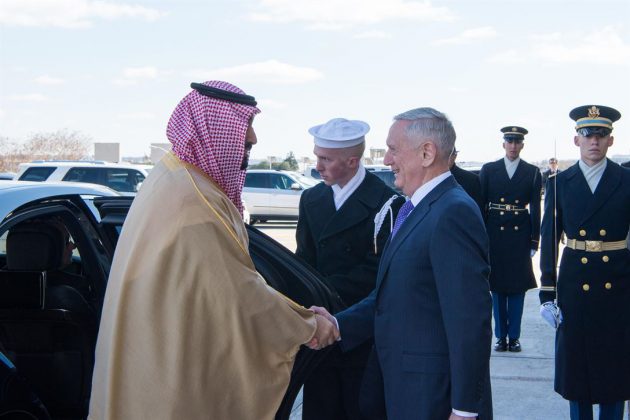
Defense Secretary Mattis welcomes Saudi Deputy Crown Prince and Defense Minister Mohammed bin Salman to the Pentagon, March 16, 2017. (DoD photo by Sgt. Amber I. Smith)
By Jonathan Marshall | Consortium News | April 15, 2017
The Trump administration’s growing use of military force in Syria, Iraq, and Yemen has neoconservative hawks rooting for armed confrontation with what they view as the root of all evil in the Middle East: Iran.
Many of these armchair warriors recently cheered President Trump’s decision to take on the Assad regime — and Moscow — by firing 59 Tomahawk cruise missile at a Syrian air base alleged to be the source of a chemical weapons attack. But they urged him to do more.
Weekly Standard editor William Kristol tweeted, “Punishing Assad for use of chemical weapons is good. Regime change in Iran is the prize.”
Kristol co-founded the infamous Project on the New American Century in 1997 to promote American “global hegemony” and “challenge regimes hostile to our interests and values.” It began lobbying for the overthrow of Saddam Hussein as early as 1998, but always kept Iran in its sights as well.
With Saddam dead and Syria’s Assad stripped of much of his power, Iran is now at the center of neocon crosshairs. Kristol linked his recent tweet to a Washington Post column by two stalwart advocates of ousting the mullahs in Tehran: Reuel Gerecht and Ray Takeyh.
Titled “How Trump Can Help Cripple the Iranian Regime,” their article called for putting the nuclear arms deal with Iran at risk in order to “stoke the volcano under Tehran and to challenge the regime.” The centerpiece of their bizarre argument was that the Iranian people would gratefully welcome the United States imposing “crippling sanctions” to destroy their economy in the name of “human rights.”
The authors were vague as to the details, but suggested that Iran’s ruling clerics would quickly succumb to a “popular rebellion” by “Iranian dissidents,” particularly if the United States sent “more American troops [to] both Syria and Iraq” to reinforce its message.
Gerecht, a died-in-the-wool neocon, was a former director of the Project for a New American Century’s Middle East Initiative. In 2001, he wrote, “Only a war against Saddam Hussein will decisively restore the awe that protects American interests abroad and citizens at home.”
In 2002, he further touted a U.S. invasion of Iraq as a way to “provoke riots in Iran — simultaneous uprisings in major cities that would simply be beyond the scope of regime-loyal specialized riot-control units.” Instead, the subsequent U.S. invasion backfired by putting a pro-Iran regime into power in Baghdad.
Iran in the Crosshairs
Today Gerecht is a senior fellow at the Foundation for Defense of Democracies, a neocon think tank dedicated to waging war against “militant Islam,” with a focus on Iran. Heavily funded by gambling magnate Sheldon Adelson, the Foundation was originally created to promote the agenda of hardline Israeli hawks.
The Foundation fought bitterly against the Iran nuclear deal, lest it open the door to a rapprochement between Washington and Tehran. Gerecht in particular demanded that the United States attack Iran rather than pursue diplomacy. “I’ve written about 25,000 words about bombing Iran,” he boasted in 2010. “Even my mom thinks I’ve gone too far.”
Gerecht’s side-kick, Ray Tayekh, is a senior fellow at the Council on Foreign Relations and was (briefly) an Iran adviser to Dennis Ross in Hillary Clinton’s State Department. A fierce critic of the nuclear deal, Tayekh joined the Iran Task Force of the right-wing Jewish Institute for National Security Affairs, which considers itself “the most influential group on the issue of U.S.-Israel military relations.” Tayekh has advocated covert support to Iranian dissidents, as well as to “Kurdish, Baluch, Arab, and other opposition groups fighting the regime.”
Regime change in Iran is the open goal of Prime Minister Netanyahu and other Israeli rightists. That’s why they consistently rejected findings by Israel’s intelligence community about the benefits to Israel’s security from the nuclear deal with Iran. By stoking opposition to the deal among their supporters in Congress, they aimed to kill any chance of cooperation between the United States and Iran.
Sen. Tom Cotton, R-Arkansas, said candidly, “the goal of our policy must be clear: regime change in Iran.”
Today the hardline Israeli/neocon agenda is still being pursued by hawks in Congress, who have introduced bills in both houses to ratchet up economic sanctions against Iran and designate a major branch of the country’s armed forces as a terrorist organization. If enacted — against the wishes of other signatories to the Iran nuclear deal — such measures could put the United States and Iran on a war footing.
Trump’s Team of Hawks
President Trump is unlikely to stand in their way. Ignoring the role of major Arab states in supporting such terrorist groups as al-Qaeda and ISIS, Trump named Iran “the number one terrorist state” and warned during his campaign that if Iranian patrol boats in the Persian Gulf continue to “make gestures that our people — that they shouldn’t be allowed to make, they will be shot out of the water.”
Trump has surrounded himself with anti-Iran hardliners who may be only too eager to give war a chance. His first national security adviser, retired Lt. Gen. Michael Flynn, co-authored a 2016 book with Michael Ledeen, a confidant of Israeli hawks and colleague of Gerecht at the Foundation for Defense of Democracy, on “How We Can Win the Global War Against Radical Islam and Its Allies.” Iran, of course, was their enemy number one.
Even with Flynn’s ouster, plenty of hawks remain. In recent congressional testimony, Army Gen. Joseph Votel, Commander of the U.S. Central Command, called Iran “the greatest long-term threat to stability” in the Middle East. He declared, “We need to look at opportunities where we can disrupt [Iran] through military means or other means their activities.”
Defense Secretary General James Mattis told a conference at the conservative Center for Strategic and International Studies in Washington last year, “Iran is not a nation-state; it’s a revolutionary cause devoted to mayhem.” The New York Times reported that Mattis “was so hawkish on Iran as head of United States Central Command from 2010 to 2013 that the Obama administration cut short his tour.”
Mattis reportedly came close to ordering an act of war against Iran in early February — the boarding of an Iranian ship to look for weapons headed for Houthi rebels in Yemen. Such an incident could escalate rapidly out of control if Iran chose to retaliate against U.S. vessels in the Persian Gulf.
Alternatives to Conflict
The United States has better policy options than continuing to treat Iran as part of the Axis of Evil. A report issued last fall by the National Iranian American Council recommended that Washington build on the success of the Iran nuclear deal by drawing Iran into regional peace settlements, deescalating our military presence in the Persian Gulf, and encouraging Iran and Saudi Arabia to resolve their differences without superpower intervention.
The report echoed the advice of a prominent neocon heretic, Zalmay Khalilzad, former U.S. ambassador to both Afghanistan and Iraq.
“As someone who has negotiated with Iran over the years perhaps more than any other U.S. diplomat,” he observed last year, “I disagree with those who argue that talks with Iran are akin to capitulation. I have seen little evidence that isolation has or will alter Tehran’s behavior in the right direction. Nor do I share the view that it is impossible to negotiate win-win deals with the Iranians.”
Noting Iran’s cooperation with the United States against Al Qaeda after 9/11, and its help brokering political compromises in Afghanistan and Iraq until the Bush administration refused further engagement, Khalilzad wrote, “Under the right conditions, which must include a hard-headed approach and tough actions to check Iran’s ambitions, Washington can benefit from bringing Iran into multilateral forums where the United States and its partners have the opportunity to narrow differences, create rules of the road and solve problems. Moreover, today we have little choice but to engage Iran on these broader issues, because no factor is shaping the order of the Middle East as much as the rivalry between Iran and its Sunni Arab neighbors.”
“If we do not undertake this work,” he warned, “the problems of the region — extremism, terrorism and regional conflict — will continue to bleed over into our part of the world, particularly if the Westphalian state system disintegrates even further into sectarian morass.”
Russia, Syria & Iran demand no further US strikes on Syria – foreign ministers

Foreign Ministers, Sergei Lavrov (C) of Russia, Walid al-Muallem (L) of Syria and Mohammad Javad Zarif of Iran attend a news conference in Moscow © Grigory Sisoev / Sputnik
RT | April 14, 2017
The US cruise missile attack on Syria was an act of international aggression, Russia, Syria and Iran have stated after a meeting of their foreign ministers in Moscow.
“We have reiterated our position and were united in stating that the attack was an act of aggression, which blatantly violated the principles of international law and the UN Charter,” Russian Foreign Minister Sergey Lavrov said.
“We call on the US and its allies to respect Syria’s sovereignty and refrain from actions similar to what happened on April 7, and which have serious ramification not only for regional, but also global security,” he added.
Lavrov was referring to the Tomahawk missile barrage fired by the US Navy at a Syrian airbase in Homs province. Washington ordered the attack after accusing Damascus of launching a chemical weapons attack at a rebel-held town in Idlib province from that airbase. Russia condemned the move, saying the US hadn’t offered any proof to pin the alleged chemical weapons incident on the Syrian Army.
Meeting with his Iranian and Syrian counterparts, Javad Zarif and Walid Muallem, on Friday, Lavrov pledged to continue Russia’s support of Damascus in fighting terrorism and restoring peace in Syria.
He added that Moscow suspects that the Idlib incident was a provocative act aimed at derailing negotiations between the Syrian government and so-called moderate rebel groups on a political transition in the country. Lavrov said the perpetrators of the deadly release of toxins must be found.
“We insist on a thorough, objective and unbiased investigation of the circumstance of the use of chemical substances in Khan Shaykhun on April 4,” he said, adding that the investigating team must include inspectors chosen from nations from different parts of the world to ensure its objectivity.
Muallem pledged full cooperation of Damascus in carrying out such a probe.
The Russian minister added that Moscow doubts the objectivity of the current mechanisms for investigating alleged use of chemical weapons in Syria, considering the difference in how the Organization for the Prohibition of Chemical Weapons (OPCW) handles reports by Damascus and by other parties.
“When accusations come against the Syrian government, the OPCW reacts in a matter of days and voices its concern. But they never go on the sites of incidents located in the regions controlled by the armed opposition, citing security issues,” he said. “We consider such analysis from a distance unacceptable.”
Lavrov also accused the US of reviving the Obama administration goal of toppling the Syrian government instead of seeking a political solution, citing the Tomahawk missile attack.
“Such acts of aggression are obviously meant to derail the peace process, which was endorsed in a unanimously adopted resolution of the UN Security Council and implies that the fate of Syria would be decided only by the Syrian people,” he said. “The action was obviously deviating from this basic concept and find new protects to aim for regime change.”
Lavrov said there is an increasing amount of evidence pointing to the conclusion that the chemical incident in Idlib province was staged to set up the Syrian government.
“Publications by professional experts, including some in the US and Britain, say there are too many inconsistencies and gaps in the version of events presented to justify the [US] aggression,” he said.
Zarif accused “certain countries” of hypocrisy, citing Iran’s history of suffering from chemical weapons attack by Saddam Hussein’s Iraq during the 1980s war. Declassified CIA files showed that the US was well aware that Saddam was using CWs against Iranians, but didn’t oppose it and even provided intelligence for such attacks.
READ MORE:
Lavrov says agreed with Tillerson no future US strikes on Syrian govt
White House claims on Syria chemical attack ‘obviously false’ – MIT professor
Tillerson in Moscow: False dawn in US-Russia ties?
By M K Bhadrakumar | Indian Punchline | April 13, 2017
The early reports on the US Secretary of State Rex Tillerson’s talks in Moscow on Wednesday have a positive ring but how far it is real, time only can tell. Indeed, almost in real time as soon as Tillerson’s all-important meeting in the Kremlin with President Vladimir Putin (which lasted for over two hours) got over, President Donald Trump remarked that from the feedback he got, “things went pretty well, better than expected.”
Trump noted that Tillerson had a “very successful meeting in Russia” as the “end result” will show – “which will be in a long period of time, perhaps.” Interestingly, Trump said this in the presence of the visiting NATO Secretary-General Jens Stoltenberg at the joint press conference in the White House, adding,
- It would be wonderful, as we were discussing just a little while ago (with Stoltenberg), if NATO and our country could get along with Russia. Right now, we’re not getting along with Russia at all. We may be at an all-time low in terms of a relationship with Russia. This has built for a long period of time. But we’re going to see what happens. Putin is the leader of Russia. Russia is a strong country. We’re a very, very strong country. We’re going to see how that all works out.
Make no mistake, Trump knows his job. He knows Stoltenberg’s mission was to amplify the cacophony over “Russian aggression”. So, perhaps, he deliberately went into a stream of consciousness:
- And I’ll also see about Putin over a period of time. It would be a fantastic thing if we got along with Putin and if we got along with Russia. And that could happen, and it may not happen, it may be just the opposite. I can only tell you what I would like to do. I would love to be able to get along with everybody. Right now, the world is a mess. But I think by the time we finish, I think it’s going to be a lot better place to live. And I can tell you that, speaking for myself, by the time I’m finished, it’s going to be a lot better place to live in — because right now it’s nasty.
Meanwhile, in Moscow, Russian Foreign Minister Sergey Lavrov described his negotiations with Tillerson as “substantial and very frank.” Obviously, there were sharp differences — future of Syrian President Bashar Al-Assad, for instance. He said Moscow is “realistic” that much effort is needed to overcome the obstacles in the Russia-US ties but “we seek to do that… (and Putin) reaffirmed our will to do that.”
Tillerson himself described the meeting with Putin as “productive” where they discussed “approaches to improving our channels of communication and there was a “lengthy exchange of views” regarding Syrian situation and “shared perspectives on possible ways forward.” Tillerson underscored that mutual trust is very low and the two countries have differences over a broad range of issues. He said,
- The world’s two foremost nuclear powers cannot have this kind of relationship… We need to attempt to put an end to this steady degradation, which is doing nothing to restore the trust between our two countries or to make progress on the issues of the greatest importance to both of us.
Unsurprisingly, Syria topped the agenda of talks. (Ukraine took a back seat, though.) The Russian side seems to have shown willingness to revive the “de-confliction” procedure in the military operations in Syria. The two sides agreed on an investigation by the OPCW at The Hague over the chemical attack in Idlib on April 4. Equally, US-Russia consultations will resume with a view to find a solution to the Syrian conflict.
Yet, reading the transcript of the Lavrov-Tillerson press conference in Moscow yesterday, the overpowering sense is one of deja vu. We’ve been there before, haven’t we? The issues and problems in the Russian-American relationship are so deep-rooted and are not only bilateral but also regional – and some even have global character. This is the main difference between what Trump is attempting with Russia and China respectively. Paradoxically, China-US issues are rather straightforward in comparison – identifiable, quantifiable, and possible to be prioritised – if only the rivalry could be overcome in “win-win” spirit.
Unlike with US-China relations, however, the diplomatic channels between Washington and Moscow are clogged, historically as well as thanks to the deliberate policy moves by the Barack Obama administration. The good part is that both Lavrov and Tillerson acknowledged the need to improve the state of affairs. Moscow is manifestly keen to have sustained dialogue, explore possibilities for cooperation, and even seeks “joint activities” (as Lavrov put it.) But it takes two to tango.
The Trump administration is far from stable and Russophobia is pervasive within the American establishment. Any significant improvement in the relations will take time. Tillerson himself somehow gives the impression of being too decent a fellow to elbow aside roughnecks like Senator John McCain. His influence within Trump’s foreign-policy team also remains unclear. To be sure, Russophobes will now begin sniping at the nascent beginning made by Tillerson in Moscow.
The Russian diplomacy needs to slow down on the American front a bit and work its way back and re-engage Europeans. The G7 meet in Luca on Tuesday showed that Germany and Italy understand the imperative need to work with Russia to find a solution to the Syrian conflict under UN auspices. Federico Mogherini, EU foreign policy chief, is due to visit Moscow on April 24.
Lavrov says agreed with Tillerson no future US strikes on Syrian government
RT | April 13, 2017
Moscow and Washington have reached an understanding that further US strikes similar to the one carried out against Syria’s Shayrat Air Base “should not occur again,” the Russian Foreign Minister Sergey Lavrov has said.
Lavrov emphasized that this issue was raised during his discussions with the US Secretary of State on Wednesday when Rex Tillerson was visiting Moscow.
“We have discussed this issue with the US Secretary of State in details yesterday and agreed upon the fact that a similar [strike] should not occur again,” he told journalists ahead of his meeting with his Syrian counterpart, Walid Muallem, in Moscow.
Lavrov further underlined that the US missile strike against the Shayrat Air Base played “a highly provocative role.”
He went on to say that the US confirmed its commitment to the idea that there is no other option of resolving the Syrian conflict other than political dialog, adding that this offers hope for the future of the peace process.
“It is encouraging to some extent that Rex Tillerson confirmed yesterday that [the US still holds] the opinion that there is no alternative to the political process [of the resolution of the Syrian crisis] despite all the recent negative developments,” he said.
A “right and responsible step” is how Lavrov described the Syrian government’s decision to invite experts from the Organization for the Prohibition of Chemical Weapons (OPCW) to conduct an investigation of the chemical weapon incident in Idlib province.
He said the “hysteria” around the alleged Idlib chemical weapons attack should not impede efforts made in Astana and Geneva, which are aimed at resolving the Syrian conflict.
The Russian Foreign Minister warned that there are forces still trying to “bust up the ceasefire regime brokered in Astana and welcomed by the UN Security Council.”
Earlier, Lavrov said that failing to institute an international inquiry into the chemical attack in Syria’s Idlib would mean that the international community is not interested in establishing the truth about the matter.
He reiterated that Moscow considers the US claims concerning the chemical weapons being used by the Syrian government “unfounded” and “lacking evidence,” speaking at the joint news conference with Tillerson on Wednesday following talks in Moscow.
Lavrov also denounced attempts to hamper cooperation between Russia and the US as “shortsighted.” The two diplomats also announced the creation of a joint expert group tasked with analyzing bilateral relations and addressing sources of mutual concern as they revealed plans to improve ties between Moscow and Washington.
Swedish NGO’s Head Receives Threats After Claiming White Helmets’ Video Fake
Sputnik – 12.04.2017
Marcello Ferrada de Noli, one of the leaders of the Swedish Doctors for Human Rights non-governmental organization (SWEDHR), said Wednesday he and his colleagues has been receiving threats following the release of their article exposing a purportedly staged video by White Helmets group, a volunteer rescue service operating in Syria.
In the beginning of March, the SWEDHR released an article claiming that the White Helmets’ video of a child reportedly treated after a chemical attack showed fake treatment, including an intracardiac injection done with an empty syringe, which would have killed a child if the baby had not already been dead.
“The threats I receive are anonymous, somewhat non-specific. I see them on Twitter, on social networks, my colleagues also receive them. I feel a lot of discomfort because of this. But I hope that my article, despite all this, will be seen by many people,” de Noli told Rossiya 24 broadcaster.
The professor said that he was simply making public his conclusions that he could prove openly and honestly.
De Noli added that the SWEDHR would continue its work.
Lavrov: Russian, Western Experts Should Make Up Syria Chemical Attack Probe Team
Sputnik – April 13, 2017
MOSCOW – Lavrov told reporters he “sufficiently convincingly” explained to US Secretary of State Rex Tillerson on Wednesday the reasons why a special independent UN and OPCW-based study should investigate the purported attack.
“But, considering the enormous very confrontational resonance surrounding what happened in Syria, we offered to complement these structures with professional inspectors in this field who would be invited from both Western countries, Russia, and regional countries,” Lavrov said.
He said “it seemed to me that Tillerson quite positively reacted to this idea.” Western countries’ reluctance to send experts to the site of a reported April 4 chemical attack in Syria’s Idlib province rely on “excuses” of purported dangers, he said.
Lavrov told a briefing that US, French and UK colleagues “do not pay attention to the fact that they need to visit not only the airfield they suspect was the place where chemical weapons were loaded onto planes, but also the place where these shells were struck.”
“They said ‘we do not know who controls this area, it is not safe to send inspectors there.’ These are all excuses,” he stressed.
Syrian opposition claimed on April 4 forces loyal to President Bashar Assad had used a chemical gas on people in the northwestern province, killing nearly 80 and injuring 200. Assad argued his government has no chemical weapons after agreeing to have them destroyed in 2013. He also ruled out having used chemicals against own people.
The Russian Defense Ministry said next day that the airstrike near Khan Shaykhun was carried out by Syrian aircraft, which struck a terrorist warehouse that stored chemical weapons slated for delivery to Iraq.
Macron, Hamon Should Quit Race After Backing US Syria Strikes – French Official
Sputnik – 13.04.2017
The US attack against a Syrian military airfield launched by President Donald Trump late last Thursday triggered criticism among such French presidential hopefuls as National Front (FN) party leader Marine Le Pen, leader of left-wing political movement Unsubmissive France Jean-Luc Melenchon and the president of Gaullist Arise France party Dupont-Aignan. Socialist Hamon and independent candidate Macron, on the other hand, have expressed their support for the US president’s action.
“Having criticized Trump before and after the election, [German Chancellor Angela] Merkel and [French President Francois] Hollande have approved of this attack, which is [Trump’s] most serious and most dangerous decision on the global scale. They have shown themselves to be completely irresponsible. The same applies to certain candidates at French presidential elections, like Hamon and Macron, the two former ministers of the socialist president. Their reaction is enough to disqualify them from assuming the office they seek, I believe,” Eric Anceau said.
Following the missile strikes, which killed seven people, according to the governor of Syria’s Homs province, Hollande in a joint statement with Merkel placed the blame for the latest developments in Syria on its President Bashar Assad, albeit without providing any evidence of his involvement in the attack.
According to Anceau, Trump’s hasty reaction to the chemical weapons incident is undoubtedly the most dangerous decision he has made since assuming office.
“When one is the head of the most powerful state in the world, one does not make decisions based on emotions, as he admitted to have done after having seen on TV all these dead bodies of children,” he said, adding that the Trump administration should have consulted the US Congress first.
“In his haste, he circumvented the US Congress, which, incidentally, says a lot about the state of the US democracy in particular and our democracies in general,” the spokesman added.
He underlined that unless the strike had an ulterior motive, such as “a desire to affirm one’s power” in regions where other world powers like Russia or Iran are present, Trump’s decision to strike Syria lacks logic.
Following the strikes, Dupont-Aignan, who according to recent polls enjoys support of some 3 percent of French voters, told the French daily Le Monde that the international community had no proof Assad ordered the chemical attack, and because of this, Trump had no reason to order the strike. At the same time, he pointed out that he would back a UN-led intervention in Syria if it is proved that the Syrian government was indeed responsible for the Idlib tragedy.
The Syrian government denied having chemical weapons, as it agreed for its entire stockpile to be destroyed under a 2013 US-Russian deal. The Organization for the Protection of Chemical Weapons confirmed in January 2016 that Syria’s chemical weapons arsenal was destroyed.
Lavrov Explains Why White House ‘Forced’ to Make Unfounded Anti-Russia Claims
Sputnik – 13.04.2017
MOSCOW – The White House is forced to make unfounded accusations against Russia because of pressure from US President Donald Trump’s opponents, Russian Foreign Minister Sergei Lavrov said Thursday.
Wednesday’s talks with US Secretary of State Rex Tillerson helped Washington better understand Russia’s stance and formulate approaches toward fruitful cooperation, Lavrov noted.
“The negotiations with Tillerson were not useless. They, in my opinion, helped the US administration better understand our position. This, in turn, is important for them to formulate their approaches to the issues on which Russia and the US can cooperate productively,” Lavrov told reporters.
“There is not a single fact, although under pressure from Trump’s opponents, the White House is forced to periodically make certain statements with unfounded accusations against us,” Lavrov said at a briefing with his counterpart from Bangladesh, Abul Hassan Mahmood.
On Wednesday, US Secretary of State Rex Tillerson and Russian Foreign Minister Sergei Lavrov emerged from a closed-door summit in the Kremlin to discuss their two-hour meeting with President Vladimir Putin. While the two sides agreed that they “understand each other better,” Moscow and Washington have distinctly different perspectives on what should take place in Syria, specifically as it pertains to Syrian President Bashar Assad’s claims to power.
Russia and the United States will embark on the practical formation of generally agreed dialogue mechanisms, he said.
“These agreements have been reached in principle, we will now probably start the practical formation of these dialogue mechanisms,” Lavrov told a briefing.
Addressing two-hour talks between Putin and Tillerson, Lavrov said “the results will probably not be soon.”
“But at least in operational terms, we agreed to establish dialogue on a number of issues,” Lavrov said.
These include, he said, “an inventory of the problems created by the previous administration in bilateral relations,” mechanisms for the implementation of existing military and political agreements, as well as mechanisms to narrow differences on regional crises, including in Syria.
Featured Video
Weaponized Journalism: 2021 Sayer Ji Interview with NPR
or go to
Aletho News Archives – Video-Images
From the Archives
How Rothschild Banking Clan Uses Its Vast Wealth to Influence World Events and Control Governments
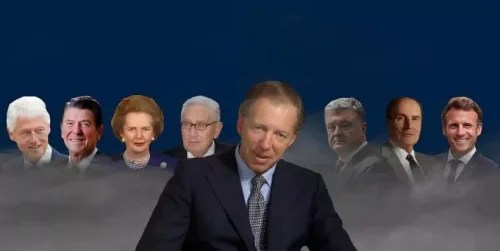
By Ilya Tsukanov – Sputnik – 15.09.2024
How powerful is the Rothschild banking family? How did they amass their fortune? Just how rich are they? Do they secretly control the world? Sputnik explores. … continue
Blog Roll
 Aletho News
- London tourism expo promotes Israeli agency linked to theft of Palestinian land
- Dockworkers launch global strike against Israeli and US military shipments
- Europe facing gas price shock – Gazprom chief
- Ukraine continues recruiting people with disabilities
- Weaponized Journalism: 2021 Sayer Ji Interview with NPR
- Beyond Netanyahu: what Israel’s election means for Palestinians
- Lithuania plans universal conscription
- Lies, Damn Lies, and Ukraine News
- Financial Times rejects Nordic demands to correct Putin call story – media
- The Case for Less Unity in Europe
- If Americans Knew
- An error has occurred; the feed is probably down. Try again later.
- No Tricks Zone
- Germany’s Green Energy Transition Becoming Increasingly Expensive…Another 6 Trillion Euros!
- Sudden Stratospheric Warming, Powerful El Niño Combination May Lead To Extreme Europe Cold, Energy Crisis!
- Two New Studies Find Thwaites Glacier Melt Cannot Be Driven By Human Activity Or A Warming Ocean
- E-Cars Reduce CO2 Emissions By Only 41% Compared To Internal Combustion Engine Vehicles
- Predictions Made By Renowned Climate Professor Over Past Decades Have Been Proven To Be Poor
- New Study Suggests Large Regions Of The Pacific Ocean Have Been Cooling For The Last 80 Years
- Germany’s Green Energy Debacle: High Energy Costs Force Kahla Porzellan to Close After 182 Years!
- New Study: 50 Years Of The Most Aggressive ‘Net Zero’ Policies Can Only Affect The Global Climate By 0.03°C
- US September “Heat” Was No Record…Many Records Set Decades Ago
- Latest European Green Energy Debacle; Portugal’s Largest Flagship Solar Park Insolvent!

