Westerners’ minds disoriented with fake news on Syria: Anthony Hall
Press TV – December 14, 2016
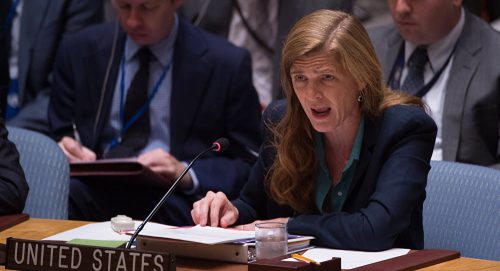
Russia’s UN Ambassador Vitaly Churkin has accused the United States, France and Britain of spreading fake news and and waging a psychological warfare over the situation in Syria’s Aleppo. The three countries have claimed that the Syrian government targeted civilians in eastern Aleppo, with US Ambassador to the UN Samantha Power accusing Syrian forces of killing some 80 civilians in the last few days.
Anthony Hall, editor-in-chief of the American Herald Tribune, believes Westerners’ minds are completely “disoriented” with a barrage of fake news, adding there has been an enormous psychological warfare campaign to totally confuse them about what is going on in Syria.
“And now in Aleppo we are presented with this image of rebels as if these are human rights activists who have just been standing there trying to bring about better human rights in Syria, ignoring the reality of this tremendous infusion of weaponry, of psychological warfare, of resources, Saudi Arabia’s role, Qatar’s role, NATO’s role in creating this whole confused situation in Syria,” he told Press TV on Wednesday.
By defeating the terrorists in Aleppo, he said, Russia demonstrated that the United States military campaign against Daesh is “phony”.
Less than a month ago, Syrian army forces, backed by Russian airstrikes, started a wholesale push to drive the militants out of their stronghold in the city’s eastern side, making great strides in the process.
Hall said there is overwhelming evidence that Daesh is a creation of the same process that created al-Qaeda and an extension of 9/11 wars.
According to the analyst, the “Angelo-American Zionist empire” is seeking to divide and break up the Middle East so that Israel can thrive and continue its expansionary policies towards a greater Israel.
Since March 2011, Syria has been hit by militancy it blames on some Western states and their regional allies. The Syrian Observatory for Human Rights and UN have put the death toll from the Syria conflict at more than 300,000 and 400,000, respectively.
Bipartisan War
A new study urges more U.S. interventions
By Philip Giraldi • Unz Review • December 13, 2016
The Establishment and Realist foreign policy communities in the United States often seem separated by language which leads them to talk past each other. When a realist or Libertarian talks about non-intervention or restraint in foreign policy, as Ron Paul did in 2008 and 2012, the Establishment response is to denounce isolationism. As Dr. Paul noted during his campaigns, non-interventionism and isolationism have nothing to do with each other as a country that does not meddle in the affairs of others can nevertheless be accessible and open in dealing with other nations in many other ways. Non-interventionists are fond of quoting George Washington’s Farewell Address, in which he recommended that “The great rule of conduct for us in regard to foreign nations is in extending our commercial relations, to have with them as little political connection as possible… Harmony, liberal intercourse with all nations, are recommended by policy, humanity, and interest.” Establishment pundits tend to dismiss that “little political connection” bit, preferring instead to warn how detachment from foreign politics might lead to the rise of a new Adolph Hitler.
I was reminded of the language barrier while reading the Atlantic Council’s Middle East Strategy Task Force report, which appeared on November 30th. The report, which promises a new “Compact for the Middle East” while also asserting that “isolationism is a dangerous delusion,” might be regarded as a quintessential document laying out the Establishment position on what should be done in the region. It is ostensibly the product of two co-chairs, Madeleine Albright and Stephen Hadley, but it is also credited to an Executive Team headed by Executive Director Stephen Grand and Deputy Executive Director Jessica Ashooh, who in all probability were responsible for the actual drafting and editing.
The report also appears to have numerous high profile advisers who might or might not have had some hand in the final product. Running through the list of associates in the project which appears at the end of the report, one notes immediately that there is no individual or group identified that would contest the notion that the U.S. must have a leadership role in the Middle East. Indeed, many of those named derive considerable status from being part or supportive of America’s engagement in the region.
I would unambiguously describe Albright and Hadley as interventionists, a label that they might object to. Albright was Bill Clinton’s aggressive Secretary of State who is famous for her endorsement of American exceptionalism, stating that “We are the indispensable nation. We stand tall and we see further than other countries into the future…” She also is notorious for her approval of sanctions on Iraq that might have killed 500,000 children as “I think this is a very hard choice, but the price — we think the price is worth it” and she also once asked Colin Powell “What’s the point of having this superb military that you’re always talking about if we can’t use it?”
Stephen Hadley was the hawkish National Security Advisor under George W. Bush. He was one of the most outspoken advocates of military action against Iraq. During the essentially phony Syrian chemical weapons crisis in September 2013, he appeared on the media advocating attacking Syria with missiles. At the time, he was on the board at Raytheon and owned 11,477 shares of stock, which some considered to be a conflict of interest.
Albright and Hadley clearly were selected as co-Chairs to make the report bipartisan, an imperative for the Atlantic Council, which prides itself on being non-political, describing itself in its website as “a nonpartisan organization that promotes constructive U.S. leadership and engagement in international affairs based on the central role of the Atlantic community.” That self-definition suggests active engagement by the United States that goes well beyond George Washington’s advice. And if you look at the list of the Council’s executives and review their writings you will be able to confirm that they are pretty much inside the Beltway status quo in terms of supporting an assertive U.S. role in world affairs.
Albright and Hadley brought with them a certain point of view which was certainly recognized by the initiators of the project and one might assume that the Atlantic Council pretty much knew what the report would endorse even before it was written. The report, which runs to 105 pages, explores what it describes as a new strategic vision for the Middle East that will “change the political trajectory of the region.” It goes something like this: the states in the region must work together to create a “positive vision for their societies” to include “unlock[ing] the region’s rich, but largely untapped, human capital – especially the underutilized talents of youth and women.” Meanwhile, outside forces like the United States would have the responsibility of taking the lead to wind down the “violent conflicts” that have rocked the region. That means that the local governments will be responsible for haggling their way to some kind of acceptable modus vivendi while the U.S. must become more deeply involved militarily and using intelligence resources to stabilize Syria, Yemen and Libya.
In the case of Syria, which is the focus of the report, the argument is made that Bashar al-Assad’s reactionary regime is the root cause of the violence that has cost more than 200,000 lives and dislocated at least a third of the country’s population. This assessment is not necessarily universally accepted since 80% of the Syrian population lives in areas controlled by the government, which is about to increase its dominance by taking all of Aleppo, and there are no reports of civilians fleeing en masse to the greater freedom afforded by the rebel held areas, rather the reverse being true.
The report recommends using the U.S. military to establish safe areas in Syria to protect civilian populations, to include no-fly zones, which would bring about direct contact with the air forces of both Damascus and Moscow. It explicitly calls for direct military action against Syrian government forces including the employment of “air power, stand-off weapons, covert measures and enhanced support for opposition forces to break the current siege of Aleppo and frustrate Assad’s attempts to consolidate control over western Syria’s population centers.”
This judgment has been overtaken by events, but the co-authors do not really discuss what such an intervention would mean as it would involve the United States in an actual war based on executive fiat without any declaration from Congress. It also ignores reality on the ground, to include some politico-military reliance on the mythical moderate rebels while choosing not to recognize that the U.S. military is the intruder in Syria which, like it or not, has a legitimate government and a legal ally in Russia. The possibility of a second war with Russia is largely ignored in the report though there is an assumption that military pressure from the U.S. would push Damascus and Moscow towards a “political settlement” of the conflict after Russia becomes convinced through the assertion of American military power that “defeat, or stalemate, not victory, are the only realistic military outcomes.”
The report was initially intended to serve as a bipartisan rebuke to the current Barack Obama policy which limits direct American involvement in the conflict. Written before the presidential election, the co-authors could not have anticipated a Donald Trump victory, but they might be hoping that the report would serve as a guideline for the new administration. Hopefully they will be wrong in that expectation, but it is difficult at this point to see where the next White House will be going with its Middle Eastern policy.
There are a number of things wrong with the report from my perspective. Most significant, it assigns to the United States the responsibility to set and enforce standards of governance in parts of the world where the American people have little in the way of actual interests. The report refers to this oversight role as part of “enabling American global military operations,” an odd objective and also a point at which the language and perceptual problems come in – I am hearing intervention, which has been a failed policy since 2001, where Albright and Hadley construe a humanitarian mission based on American interests. They also have difficulty in conceptualizing that what they describe as the “debilitating cycle of conflict” in the Middle East might actually have been caused in large part by Washington’s involvement in that region, starting with the invasion of Iraq in 2003.
Second, the authors assume that the countries in the region, all of which have disparate interests, will act in good faith to support the “unlocking of the region’s human potential,” as the report enthuses, as part of its “positive vision.” It sounds good and probably is pleasing to globalists, but I would be skeptical of any kumbaya moments that require bringing together players like Saudi Arabia, Egypt and Turkey into one harmonic movement to better everyone in the region. Such pie in the sky is not even close to credible.
Third, when the report was issued Stephen Hadley told Reuters that “It may not work. But one of the things we know is that what’s going on now isn’t working.” No, it isn’t, but that might be based on a faulty assessment of the nature of the conflict. And this is thin gruel indeed to use as justification for going to war against Syria and possibly Russia.
One of the report’s obvious weaknesses derives from its Establishment-centric worldview. It calls for building stronger political institutions among the Palestinians in order to achieve a two-state solution without any serious examination of what the Israeli occupation is doing or not doing to impede any real movement in that direction. It treats Iran as an enemy of the “positive vision” that is “interfering” with its neighbors with the U.S. willing to “deter and contain Iran’s hegemonic activity,” making any real progress towards regional rapprochement unlikely. It sees a liberal democratic solution to all ills and judges multifaceted regional conflicts in purely “us against them” terms, favoring its “friends and allies” against the numerous other forces that are not on the same page.
The Atlantic Council’s Middle East Strategy Task Force Final Report argues that a transformation of the entire region, starting with establishment of security by replacing al-Assad and defeating ISIS, is both desirable and attainable. And it is an enterprise that has to be left to local players for the necessary social and political constructs with the U.S. providing leadership and direction, particularly when it comes to repressing “violent conflicts.” It is a utopian vision of what might be but one has to be concerned that the simplistic application of military force as a remedy for the regional cycle of violence ignores the probability that the reliance on such a solution in the first place has been a key element in the evolution of the current instability. That Syria will be fixed by coming in with force majeure on the side of what is being promoted as a progressive and humanitarian alternative to Bashar al-Assad borders on the ridiculous, but it is characteristic of the default position that many in Washington adopt when considering how to solve the problems in the Middle East.
Russian Reconciliation Center evacuated 50,000 civilians from E. Aleppo in past 2 days – MoD
RT | December 10, 2016
Over the past 48 hours, up to 50,000 people have been evacuated from eastern Aleppo, Russian Defense Ministry spokesperson Major General Igor Konashenkov has reported.
“More than 20,000 residents left eastern Aleppo in the first part of Saturday, and 1,217 militants laid down their weapons,” Konashenkov said.
“The Russian Center for Reconciliation, through humanitarian corridors near Karim El-Hun and Mahayar, has organized the evacuation of civilians from the eastern parts of Aleppo to the safe areas of the city,” Konashenkov added.
“We warn terrorists and militants of the so-called ‘moderate opposition,’ and also their patrons: Do not attempt any provocations, especially attacks on civilians leaving through humanitarian corridors,” the Russian Defense Ministry statement says.
Konashenkov also addressed those who, over the past few months, have declared their readiness to send humanitarian aid to Aleppo.
“Representatives of the US, UK, France, Canada, the European Union, and international organizations: Over the past two days, nearly 50,000 civilians have been evacuated by the Russian Reconciliation Center from the eastern parts of Aleppo. They are in need of the humanitarian assistance you promised. It is time to check the validity of your intentions.”
The statement added that the Syrian government now controls 93 percent of Aleppo, and the civilians who exited eastern Aleppo have been placed in special humanitarian centers where they are provided with hot food and medical help.
The Russian Reconciliation Center is monitoring the evacuation of civilians from the blocked districts round-the-clock with the use of drones.
Earlier this week, Moscow slammed a statement by EU foreign policy chief Federica Mogherini, who said the EU was the only party providing aid to Syria.
“It’s outrageous twisting of facts which ignores what Russia has been doing for a long time,” Russian Deputy Foreign Minister Sergey Ryabkov said on Thursday.
The Russian Foreign Ministry noted that Russia, “unlike other international players, has been actively supplying thousands of tons of humanitarian aid to various regions across Syria, including the liberated areas in eastern Aleppo, at the risk of Russian military lives.
“If the high representative [Mogherini] means providing assistance to terrorists and extremists, then we don’t participate in this, indeed,” the statement added.
Last week, British Prime Minister Theresa May’s spokeswoman claimed that Russia was blocking aid intended for Aleppo’s civilian population.
“The Syrian regime and their influencers [Russia, among others] are preventing aid” from reaching the city, the Daily Mail quoted her as saying.
“It seems that the UK government has lost an objective view of what is happening in Syria, including Aleppo, due to Russophobia,” Konashenkov responded, noting that the UK has not sent “a single gram of flour, any medicine or blankets to help” civilians in Aleppo during the entire Syrian conflict.
“If the UK government really wants to send humanitarian aid to residents in the eastern neighborhoods [of Aleppo], it has all the conditions for doing this, just tell us where it [the aid] has been held up,” he added.
Read more:
East Aleppo civilians report torture, executions by ‘moderate opposition’ – Russian military
To err is Human, to Intervene and Destroy is Policy
By Salman Rafi Sheikh | New Eastern Outlook | 09.12.2016
The nature of international politics is often considered to be such that it continuously defies clear and absolute judgement; however, notwithstanding the complexity of inter-state relations, very often we come across such instances where understanding of the policy of a state, or of an alliance, does not defy understanding and judgement. From the very beginning of the crisis, it has been absolutely clear that the US and its allies are pursuing a regime-change policy in Syria—a policy that not only is still valid but also continues to define their strategy. Materialization of this objective pits the US against Syria and its allies and engages both parties in war—and in war soldiers are killed. Therefore, the US clarification about striking Syrian soldiers due to the so-called “human error” is only an attempt on its part to mystify the actual nature of its objectives in Syria. Nothing else can better explain the strike that killed around 80 soldiers than the fundamental reason for the US’ military engagement in Syria i.e., execution of regime change policy in Syria.
While one strike in itself was, and always is, far from sufficient to achieve this objective, a strike, however, does convey to its targets and to those who observe it the objective being pursued. In this case, the immediate objective was to inflict heavy damage on the Syrian army and render it vulnerable to attacks by other, western supported, militant groups. The objective was, to an extent, achieved. This is evident from the developments taking place immediately after the US-led strike. A weakened Syrian army unit enabled an ISIS advance on a hill overlooking the air base, which was specifically targeted by the US-led coalition. While the objective of this co-ordinated operation was to quickly capture the base, it was thwarted by timely action on the part of Russian warplanes that were called in to hit ISIS positions.
Had the attack been successful, it might have caused massive destruction. ISIS had, prior to the attack by the coalition, repeatedly attacked and failed to capture the government-held air base, which is an isolated enclave deep in extremist-held territory. The government controls the air base and parts of Dayr az Zawr city, while ISIS controls the entire province by the same name. An ISIS advance in Dayr az Zawr would have, and would still, endanger the lives of tens of thousands of civilians living in government-held areas and force the Syrian army out of the territory.
What would have such a scenario implied for the over-all situation of Syria is not so difficult to grasp. While the US has now stated it “regrets” the bombing, it has not, in any way, apologized to Syria for this wanton act of mayhem, thus confirming its unchanged position vis-à-vis Syria, which continues to remain a clear cut target of the regime-change conspiracy—a policy that has been applied by NATO in many countries since the end of the Second World War. The most recent cases of Afghanistan, Iraq, Libya and Syria confirm that this policy has remained unchanged.
The latest confirmation to the unabated continuation of this policy has come from one of the most important NATO allies, Turkey. On November 29, Turkey’s self-styled “caliph” said, reiterating NATO’s long held objective, that the Turkish military had launched its operations in Syria to end the rule of (the cruel) Syrian President Bashar al-Assad.
He further said, “Why did we enter? We do not have an eye on Syrian soil. The issue is to provide lands to their real owners. That is to say we are there for the establishment of justice. We entered there to end the rule of the tyrant al-Assad who terrorizes with state terror. [We didn’t enter] for any other reason.”
While this statement has come as a surprise to Russia, leading Kremlin spokesman Dmitry Peskov to say that they were hoping “our Turkish partners will provide us with some kind of explanation about this”, the move itself not only largely reflects the dual game Turkey is playing in Syria but also shows how the former fundamentally continues to adhere to NATO’s central objective in Syria, thus debunking the myth of Turkey’ estrangement with the US or the EU or the NATO itself.
The tacit continuity of co-operation between Turkey and the US is not limited to the perusal of identical objectives. On the contrary, it is co-operation on the ground that speaks volumes about Turkey’s actual position and policy vis-à-vis Syria. For instance, Turkey’s operation Euphrates Shield, which begun in August and which is supposedly aimed at rolling back ISIS from the Syrian region bordering Turkey, had actually begun, succeeded and territorially spread under the protection, assistance and advice provided by the US military. The US advisers assisted the operation from inside Turkey, while US warplanes conducted airstrikes alongside Turkish ones in support of the offensive. Could we still say that Turkey and the US were, or are, on a collision course since the failed coup attempt in Turkey in July 2016?
This co-ordinated attack was followed, in September, by a welcome note by the NATO chief about Turkey’s enhanced role in Syria against “terrorism” and attacks of all kinds.
The continued co-operation between Turkey, which had initially officially sent troops to Syria to fight ISIS, and the US and Erdogan’s recent claim that they are in Syria to send Assad home unambiguously show the way this alliance is working in the region. With Turkey’s operation Euphrates Shield expanding into operation occupation, and with Turkey equally seeking to enlist US support to capture al-Bab, there remains hardly any room to doubt that the US and Turkey are seeking to achieve what the ISIS had earlier achieved, and then lost, in terms of capturing Syrian territory.
With ISIS being itself unable to withhold the Syrian offensive being backed the Russian forces and Iran backed militias, Turkey and the US, as also their Arab and Western allies, were left with no other choice but to directly intervene in Syria to deny the Syrian army the opportunity to have the whole of Syria under its control.
This being the case-scenario of Syria, the Pentagon’s clarification about the September strike being a result of “human error” is erroneous. What, on the contrary, perfectly corresponds with the US policy and objectives it is pursuing in Syria is not this clarification but the strike itself—something that, had it been successful, might have allowed IS to bring an entire province under its sole control and considerably damage the Syrian army.
What this scenario reveals is that the earlier policy of bringing regime change in Syria through proxy groups is now being replaced by a policy of direct intervention and gradual insertion of NATO in the conflict via Turkey. Conflict in Syria is therefore not ending, only its dynamics are changing from in-direct to direct intervention.
2017 NDAA ups aid to Ukraine, gives arms to Syrian rebels & lets Trump sanction the world
RT | December 8, 2016
Congress has authorized $618.7 billion for the 2017 military budget. The bill ups aid to Ukraine by $50 million and allows the transfer of missiles to Syrian rebels. However, it omits controversial provisions about drafting women or religious exemptions for contractors.
The 2017 National Defense Authorization Act (NDAA) passed in the Senate on Thursday with 92 votes in favor and seven opposing. It already cleared the House last Friday in a 375-34 vote. With the annexes, appendices and the conference report harmonizing the two chambers’ versions, the final document is 3,076 pages long.
Absent from the NDAA is the proposal to allow female Americans to register for the Selective Service system, which replaced the Vietnam War-era draft but currently only applies to men aged 18-25. That proposal was sent to the Government Accountability Office for further study.
Lawmakers also abandoned the so-called Russell Amendment, which would have created a religious freedom exemption from the Obama administration executive order mandating nondiscrimination from federal contractors. Obama threatened to veto the bill with this amendment.
Buried in the bill, in Section 1224, was the provision to allow Man-Portable Air Defense Systems (MANPADS) to Syrian rebels appropriately vetted by US intelligence. The law requires the Pentagon and the State Department to file extensive documentation with Congress, including details of the weaponry provided, the recipient’s location and the intelligence assessment, including “a description of the alignment of such element within the broader conflict in Syria.” The report would need to include a justification for supplying the MANPADs, “including an explanation of the purpose and expected employment of such systems.”
“We appreciate the bicameral and bipartisan support in the US Congress for Ukraine in our fight against the ongoing Russian aggression,” Ukraine’s embassy in Washington said on Thursday, commenting on the fact that the NDAA increased military aid to the government in Kiev to $350 million, $50 million more than in 2016.
What could potentially have the biggest long-term impact is the provision allowing the application of the 2012 “Magnitsky Act” to anyone in the world, rather than just the Russian Federation and Moldova.
Sections 1261-65 authorize the US president to sanction anyone responsible for “extrajudicial killings, torture, or other gross violations of internationally recognized human rights committed against individuals in any foreign country” who seek to expose illegal activity carried out by government officials” or to “obtain, exercise, defend, or promote internationally recognized human rights and freedoms.”
Authorized sanctions include denying entry to the US or revoking an existing US visa; seizure of any property and interests that are located in the US “or come within the possession or control of a United States person.” The provision would sunset six years after the NDAA’s enactment.
Of further interest are the provisions allowing the establishment of the US Cyber Command as a fully separate combat command (Section 923), capping the size of the National Security Council staff at 200 – down from 400 or so it currently employs (Section 1085).
The NDAA maintained the prohibition of using any funds to close the detention camp at Guantanamo Bay, Cuba, or transfer any of the remaining 59 detainees onto US soil.
Obama grants waiver for military support of foreign fighters in Syria – White House
RT | December 8, 2016
President Barack Obama has ordered a waiver of restrictions on military aid for foreign forces in Syria, deeming it “essential to the national security interests” of the US to allow exceptions from provisions in the four-decades-old Arms Export Control Act.
A White House press release Thursday announced that foreign fighters in Syria supporting US special operations “to combat terrorism in Syria” would be excused from restrictions on military assistance.
“I hereby determine that the transaction, encompassing the provision of defense articles and services to foreign forces, irregular forces, groups, or individuals engaged in supporting or facilitating ongoing U.S. military operations to counter terrorism in Syria, is essential to the national security interests of the United States,” President Obama affirmed in the presidential determination and waiver.
The order delegates responsibility to the US secretary of state to work with and report to Congress on weapons export proposals, requiring 15 days of notice before they are authorized.
Obama announced a similar waiver of the Arms Export Control Act in September 2013, following the Ghouta chemical attack in August of that year. That order facilitated the transfer of US military weaponry to “select vetted members” of opposition forces battling Syrian President Bashar al-Assad, while Thursday’s order appears less narrow in scope.
The challenge of differentiating between terrorist forces, such as Al-Nusra, and more moderate forces in Syria has been acknowledged by press secretaries in recent State Department briefings.
Featured Video

EUROPE FEARS RUSSIA’S NEXT MOVE / Ian Proud
or go to
Aletho News Archives – Video-Images
New Book
New Book: No Autoimmunity The Body Doesn’t Attack Itself
Lies are Unbekoming | September 24, 2026
 The label for Humira, once the best-selling drug in the world, lists its risks in plain print. One of them, in the label’s own words, is new “autoimmune” disease.
A drug prescribed for a condition labelled autoimmune carries a warning that it can cause a condition labelled autoimmune. That contradiction sits in every box, on a folded paper almost nobody reads.
My new book starts there.
No Autoimmunity: The Body Doesn’t Attack Itself
For seventy years, “your body is attacking itself, and we don’t know why” has ended the conversation for people diagnosed with multiple sclerosis, lupus, rheumatoid arthritis, Hashimoto’s, Type 1 diabetes, Crohn’s and psoriasis. More than eighty conditions now carry the autoimmune label. The diagnosis comes with a prescription for life. It almost never comes with a question about cause.
This book asks the question and answers it from the framework’s own records: its drug labels, its journals, its regulatory filings, and its own experiments. … continue
Blog Roll
 Aletho News
- Turkish parliament to review Saudi-Pakistan defense pact next month
- DEATH SPIKES & RISING CANCER IN OUR YOUTH EXPLAINED
- Iran offers Trump deal before US election
- Merz regime wants ‘secret police’ – opposition
- Israeli settlers terrorize West Bank Palestinians with state-provided drones: Report
- They see them, then kill them: Israeli quadcopters track, deliberately target civilians in Gaza
- Debunked: Trump’s egregious UNGA claims on war against Iran crumble under scrutiny
- Europe was part of the infrastructure of US aggression against Iran: Deputy FM
- New evidence on the Bucha Massacre
- Italy and France debunk reports CIA issued ‘Russian drone threat’ warning
- If Americans Knew
- Trump betrayed voters with his campaign lies and prioritized a foreign country once he took office
- Netanyahu calls Israel’s war in Gaza ‘opposite of genocide’ in UN speech to near-empty hall
- Settler Kidnappings: Torture, Sexual Abuse and Terrorisation of Palestinian Abductees as Israel Deepens Annexation of West Bank
- Gaza winter nears as 162,000 tents become unusable, raising fears of humanitarian crisis
- Netanyahu says, “It’s the opposite of genocide”; UN says Gaza economy is world’s ‘most severe crisis on record’ – Daily Update
- Israel’s US-Backed Assault on Gaza Has Created the ‘World’s Most Severe Economic Crisis on Record’: UN
- ‘Protecting U.S. Citizens’… From Israel
- ‘This is where I live now, the back of a truck’: a day in the life of a grandmother in Gaza
- In UN Speech, Iran’s President Displays Pictures of Children Killed by US, Brings Attention to Israel’s Nuclear Arsenal
- Israel displaces hundreds of Palestinians amid wave of demolitions in West Bank
- No Tricks Zone
- New Study: Earth And Venus Surface Warmth Largely Explained By Convection And Lapse Rate, Not CO2 Or Radiation
- 2025 Nature Paper Claiming Worsening Global Drought Gets RETRACTED …Heavily Flawed
- New Study: ‘Global Drought Shows No Detectable Recent Acceleration Under Climate Warming’
- Economic Masterminds: German Socialists Suggest Taxing Productivity Gains Stemming From Using AI
- The South China Sea Has Not Been Cooperating With The Climate Change Narrative
- Energy Crisis: Germany Enters Heating Season With Historically Low Gas Reserve Fill Levels
- New Study: The Antarctic Ice Sheet Gained Mass From 2020-2024 Due To Staggering Snow And Ice Accumulation
- Study: Ocean Heating Rates From Thousands Of Years Ago ‘Dwarf’ Modern Ocean Heating Rates
- Climate Extremists Target, Attack Large-Scale Power Grid Infrastructure In Germany!
- New Study: Antarctic Ice Melt Has Contributed Less Than 1 Centimeter To Sea Level Rise In The Last 30 Years

