UN resolution demanding that Israel rescind its Golan annexation decision

Inside Syria Media Center | December 8, 2016
The UN General Assembly (UNGA) reiterated its demand that Israel comply with the Security Council resolutions, particularly resolution no. 497 for 1981 which declared Israel’s decision of 14 December 1981 to impose its laws and jurisdiction on the Syrian Golan as “null and void and without international legal effect”.
During a session on Tuesday, the UNGA adopted a resolution titled “Occupied Syrian Golan” after it was endorsed by the Special Political and Decolonization Committee (the Fourth Committee).
The resolution was adopted with 163 in favor out of 193 countries, 1 against (Israel), and a number of abstentions, including the US and Canada.
The resolution called upon Israel to rescind its decision of annexing the occupied Golan, and to desist from changing the physical character, demographic composition, institutional structure and legal status of the occupied Syrian Golan, as these measures are null and void, asserting that all relevant provisions of the Regulations annexed to the Hague Convention of 1907, and the Geneva Convention relative to the Protection of Civilian Persons in Time of War, continued to apply to the Syrian territory occupied by Israel since 1967.
It also called upon Israel to desist from imposing Israeli citizenship and identity cards on Syrian citizens and to stop its provocative measures against them.
The resolution called upon the UN member states to not recognize the Israeli measures and procedures adopted in the occupied Syrian Golan as they constitute a breach of the international law.
Moscow slams West for staying silent on Russian hospital bombing
RT | December 5, 2016
The Russian Foreign Ministry has criticized western leaders after none appeared to condemn the shelling of a mobile Russian hospital by militants in Syria. Two Russian medics were killed after around a dozen of shells hit the facility in Aleppo.
“On December 5, a Russian military medic died as a mortar shell fired by militants directly hit the reception ward of a Russian mobile military hospital set up in Aleppo. Two medical specialists were also severely injured and one of them later died,” the ministry said.
“However, no words of condemnation can be heard from western capitals,” it added, criticizing western governments for their “politicized approach” to the assessment of the situation in Syria.
“We call on our partners to abandon the politicized approach and finally join the counter-terrorist efforts in Syria as well as the search for a political solution to the Syrian crisis” instead of waging a smear campaign in the media, the ministry said in its statement.
It then went on to criticize Paris and London, saying they are waging a “propaganda campaign” – in particular over the delivery of humanitarian aid.
“Our ‘concerned’ French and British colleagues cannot but know that such aid is already rendered to the Aleppo residents … by the Russian side through the Russian Reconciliation Center in Syria and the Russian Emergencies Ministry,” the foreign ministry said.
It also slammed western governments for their repeated calls to stop the government operation in Eastern Aleppo, which “increasingly resembles the last desperate attempt to shield and save the terrorists and extremists supervised by [the West], who are on the losing side in the Aleppo [battle].”
The ministry said again that armed groups that the West attempts to support “use civilians as human shields, [and] shell and mine civilian infrastructure and humanitarian corridors.”
About 11 shells landed on the territory of the Russian hospital leading to its total destruction, Vladimir Savchenko, the head of the Russian Reconciliation Center in Syria told journalists earlier on Monday.
The Russian Defense Ministry urged for the international community to condemn the attack and said that the incident would be investigated and all responsible would be held to account.
The ministry also said that it attributes blame for the hospital shelling to “terrorists and their patrons in the US, the UK and France.”
“It is beyond doubt that the shelling was conducted by the ‘opposition’ militants. Moscow understands who gave the Syrian militants the coordinates of the Russian hospital right at the moment when it started working,” the Defense Ministry’s spokesman, Major General Igor Konashenkov said.
The US State Department, which is usually quick to comment on reports of attacks on medical facilities in Syria, found it difficult to confirm and therefore specifically condemn the shelling of the Russian hospital.
“I’ve seen the reports we’ve not been able to confirm; it’s difficult to do obviously, given the fighting and given our lack of access to what’s happening on the ground,” spokesperson Mark Toner told RT’s Gayane Chichakyan. “But to answer your question – of course we condemn any attack on a hospital or healthcare facility.”
RT has requested comment on the shelling of the Russian hospital from the office of the UN High Commissioner for Human Rights, as well as the Red Cross, Human Rights Watch, Human Rights First, and Amnesty International.
In response to a request from RT, Amnesty International said it is trying to check whether it is “able to comment on this.”
“But usually if we have not documented and been able to verify details for ourselves it can be tricky for us to provide a comment on specific attacks,” the emailed response reads.
“Repeated attacks on healthcare and other civilian infrastructure throughout Aleppo” indicated that “all sides to the conflict in Syria are failing in their duties to respect and protect healthcare workers, patients and hospitals, and to distinguish between them and military objectives,” the Red Cross told RT in a comment following the shelling of the hospital.
“Healthcare infrastructure, medical personnel and the sick and wounded are protected under international humanitarian law (IHL). They must not be attacked,” the Red Cross stressed, adding that “when hospitals come under fire, countless numbers of people are deprived of life-saving healthcare.”
‘Opposition backers bear responsibility for militants’ attack on Russian hospital in Aleppo’

© Lizzie Phelan / Twitter
RT | December 5, 2016
Syrian opposition supporters bear responsibility for the casualties from the shelling of a Russian mobile military hospital, said writer Abdel Bari Atwan. It seems the rebels have been given advanced weapons particularly for such attacks, he added.
Extremists have shelled a Russian military hospital in Aleppo, killing two paramedics and injuring several service personnel. An RT Arabic producer was also wounded in the leg in the attack.
The attack on the Russian military hospital comes as the Russian Foreign Minister disclosed some of the details of the terms for the withdrawal of militants from eastern Aleppo proposed by US Secretary of State John Kerry.
RT: What do you think of the attack’s timing, as it came after Russia and the US agreed on the terms of withdrawal for the militants in eastern Aleppo amid huge gains by the Syrian army in the city?
Abdel Bari Atwan: I believe the Aleppo battle is nearing its end. The Syrian army is controlling more than 60 percent of the eastern quarters of Aleppo. Now the negotiation is on its way between Russia and the US to evacuate the armed men – whatever they are, Islamist or moderate, to declare the end of the war in that part of Syria. The situation is moving towards the entrance of the Syrian government and their allies, Russian allies in particular. So it is a matter of time. I wouldn’t be surprised if the whole of Aleppo surrenders before the end of this year…
RT: Russia’s Defense Ministry said it knows where the so-called ‘opposition’ got the coordinates of the hospital.* Do you think it’s fair that both the militants and their backers are blamed?
ABA: … A week ago there were huge cries from the West, the US, all the Arab countries who are supporting the armed opposition about hospitals in Aleppo, or eastern Aleppo in particular, [being] bombed by Russian and by Syrians warplanes. Despite the denial, they still continue to blame the Russian and the Syrian warplanes. Now we can see that a Russian hospital that is taking care of injured people in that part of the world is bombed.
I do agree that definitely, the backers of this armed opposition bears the responsibility for these kinds of casualties…Also, it seems that the rebels received highly advanced weapons in order to carry out this kind of attack deliberately against the hospital, which is a new chapter of escalation…. The armed opposition is like a wounded tiger now, they are hitting everywhere, and they are trying to kill as many as they can, or destroy as much as they can from the Syrian side and the Russian side. It is obvious, but I believe their days are numbered in that part of Aleppo.
* “Without any doubt, the shelling was carried out by militants from the opposition. We understand where they got the exact coordinates of a specific Russian hospital from, the moment it started working. This means the responsibility for the deaths and injuries of our paramedics who were helping the children of Aleppo lies not only with the militants. The blood of our service personnel is also on the hands of those who created, fostered and armed these animals, calling them ‘opposition’ to justify this to their conscience and voters” — Igor Konashenkov, Russian Defense Ministry spokesperson.
Denmark Leaves the US-led Coalition
Inside Syria Media Center – December 3, 2016
At a meeting with the Parliamentary Committee on Foreign Policy the Defense Minister of Denmark, Anders Samuelsen, said that Denmark would not renew a six-month mission of 7 F-16 fighters of Royal Air Force, participating in the US-led coalition’ operation against ISIS terrorists in Syria and Iraq.
The decision was made just a few days after the Pentagon announced that the September air strike in Deir ez-Zor, which led to serious casualties among the Syrian army soldiers had been caused by a series of human errors, inaccurate information, intelligence and problems with communication.
We can assume that, in this way, Denmark has expressed its disagreement with the fact that Washington so easily named the “human factor” as the main cause of incident, rather than to identify the real perpetrators of it.
Iran sends 3rd consignment of relief aid to Aleppo
Press TV – December 2, 2016
The Islamic Republic of Iran has dispatched its third consignment of humanitarian aid to war-ravaged people in Syria’s northwestern city of Aleppo.
The head of the Relief and Rescue Organization of the Iranian Red Crescent Society (IRCS), Morteza Salimi, told IRIB that the shipment included 150,000 food cans.
He added that two consignments of relief aid, weighing about 80 tonnes, have already been sent to the crisis-hit city over the past two days. They included tents, blankets and oil heaters.
The IRCS official noted that Iran has so far dispatched 28,000 blankets, 400 tents, 800 rugs, 5,000 oil heaters, 1,400 boxes of dried bread, eight tonnes of medicines, 700 sets of dishware and 165,000 food cans to people in Aleppo.
The UN Syria humanitarian advisor, Jan Egeland, said in the Swiss city of Geneva on Thursday that Russia has proposed setting up four humanitarian corridors to militant-held eastern Aleppo in a bid to let in aid and facilitate evacuations from the battered Syrian city.
Egeland further estimated at least 400 injured people are in need of urgent medical evacuation, adding that talks will be held on using “these corridors to get medical supplies and food in.”
By Wednesday, some 18,000 people had entered Aleppo’s government-controlled areas while about 8,500 had crossed into Sheikh Maqsoud, a Kurdish-held Aleppo district, the UN official said.
Over the past few days, about 30,000 people have received aid after fleeing eastern Aleppo, taking the total number of displaced people in the city to over 400,000, he said.
In another development on Thursday, the International Committee of the Red Cross (ICRC) announced that it was discussing with the Syrian government the issue of gaining access to people fleeing eastern Aleppo.
Dominik Stillhart, director of ICRC operations worldwide, said the Geneva-based humanitarian institution was in touch with all sides to be able to deliver supplies to trapped civilians and to evacuate the wounded.
Saudi-Iranian reconciliation is within sight
By M K Bhadrakumar | Indian Punchline | December 2, 2016
A side-effect of Donald Trump’s election as president could be the improvement in Saudi-Iranian ties. Of course, cynics may argue that it is about time the relationship got better, because it can’t get any worse – short of war. But the Trump factor becomes a stimulus in a positive direction.
Broadly, the US policy (which Hillary Clinton would have happily continued) of playing Saudi Arabia against Iran on the one hand and nudging the Arab allies and Israel to form a united regional front under American leadership on the other hand, is ending. It was a hopeless strategy to begin with, and Trump will not waste time in resuscitating it on its death bed.
Egypt’s recent ‘defection’ to the Russian-Iranian camp in the Syrian conflict (which also anticipates the Trump presidency, by the way), lethally wounds the myth of Arab unity against Iran, which Saudis had been fostering. Interestingly, Egyptian foreign minister Sameh Shoukry is in New York where he met Vice President–elect Mike Pence on Thursday to hand over a letter from President Abdel Fatah el-Sisi to Trump. At the same time, Sisi himself is on a visit to the UAE (which is mediating in the Saudi-Egyptian rift.) Egypt anticipates an easing of tensions between Saudi Arabia and Iran and is positioning itself.
For the Saudi regime, a Trump presidency means that it is losing the war in Syria. The blow to Saudi prestige on the Arab Street, regionally and internationally is enormous. But Saudis are preparing for the eventuality of President Bashar al-Assad remaining in power and the Syrian rebels facing the existential choice of surrendering and accepting the fait accompli (or meeting physical extinction.) The secret talks in Ankara, which have now come to light, between the rebel leadership with Russian intelligence and diplomats underscore that Aleppo is about to fall to the government forces and the war is over.
The ending of the war on such terms constitutes a big victory for Iran. This raises the question: Are the Saudis on a course correction themselves? There is growing evidence that this may be so.
First came the election of Michel Aoun as the new President of Lebanon on October 31, ending two years of deadlock. Aoun is very close to Hezbollah. (Iranian FM Mohammad Zarif was the first foreign dignitary to visit Beirut to congratulate Aoun.) Clearly, in the complicated political tug of war in Lebanon, Saudis appear to have simply retrenched, which facilitated Aoun’s election, piloted by Iran and the Hezbollah.
The consolidation in Lebanon and the sight of victory in the Syrian war (plus the incipient signs of a warming up with Egypt) would significantly strengthen Iran’s hand in regional politics. But, strangely, there is no triumphalism in Tehran. In the normal course, Tehran could have called the Saudis ‘losers’, but that is not happening.
Now comes the thunderbolt — OPEC oil production cut deal in Geneva on Wednesday. Admittedly, the oil market is unpredictable, the role of the US shale industry is uncertain and the OPEC deal needs to be firmed up at the December meeting in Moscow between the cartel and non-OPEC oil producers. But the bottom line nonetheless is that the deal is the final product of a big Saudi concession to Iran. Put differently, if the Saudis had dug in and refused to exempt Iran as a special case from the production cut, the deal wouldn’t have come through.
The OPEC deal signifies a tectonic shift in the Saudi-Iranian equations, which is below the radar as of now. It is not only about big money, but also the return of Iran to OPEC’s cockpit — indeed, about OPEC’s future itself. True, the Russians played a forceful role behind the scenes to bridge the gap between Riyadh and Tehran and push them to come closer. True, again, Saudis are in serious financial difficulty and the OPEC deal is expected to bring in more income out of a rise in oil price. However, in the final analysis, the Saudis did accommodate Iran’s demand that a restoration of the pre-sanctions OPEC production quota is its national prerogative and it must be exempted from any production cut. (NBC News gives a riveting account of how it all happened — How Putin, Khamenei, and a Saudi Prince Made the OPEC Deal.)
It is this shift in the Saudi mindset — away from the dogged attitude that Iran must be relentlessly punished even if that were to mean inflicting on itself a few bleeding self-wounds — that catches attention. Again, on Iran’s part too, it is this strangest of strange behaviour – total absence of triumphalism that the Saudis blinked in Geneva – is highly significant.
Simply put, taken together with the happenings in Lebanon, Iran is careering away from anti-Saudi grandstanding and rhetoric. Indeed, a similar roll back is discernible on the Saudi side also lately. (The Asharq al-Awsat newspaper recently replaced its editor-in-chief; Prince Turki bin Faisal has said Trump should not abandon the Iran nuclear deal.)
These are early days, but signs are that there is a thaw in the Saudi-Iranian ties. Given the Middle Eastern political culture, Saudi Arabia and Iran could be moving toward a modus vivendi sooner than one would have expected. Yemen will be the litmus test of a rapprochement.
Human Rights Watch Purposefully Mistranslated Syrian Leaflet to Aleppo Rebels
By Prof. As’ad AbuKhalil – The Angry Arab News Service – November 30, 2016
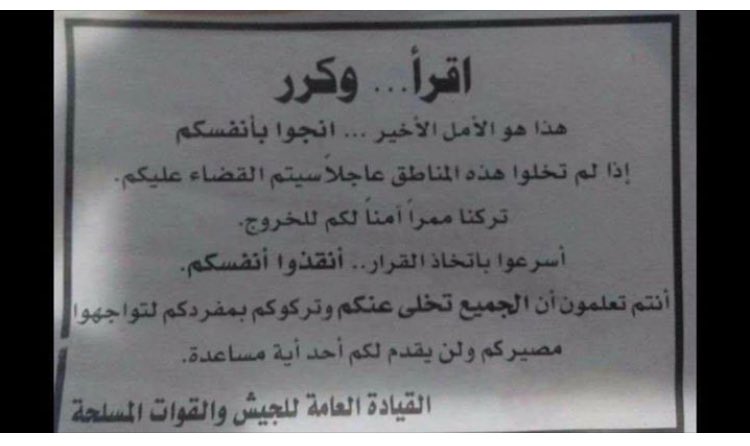
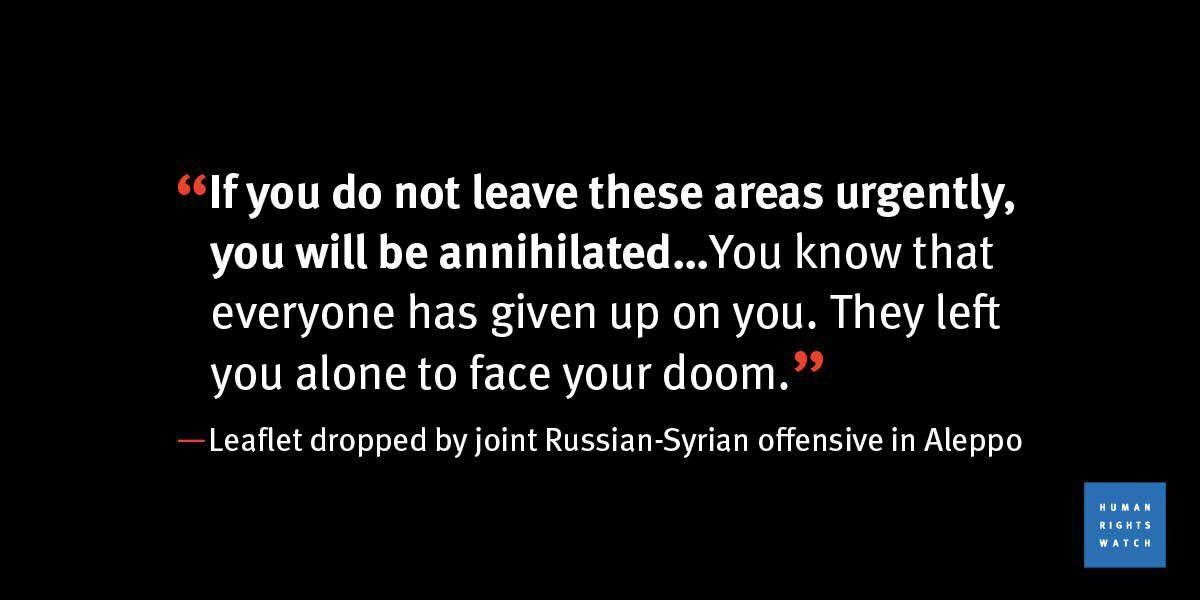
Rami Jarrah (who is widely cited as an authority by mainstream Western media) posted the Arabic leaflet dropped by Syrian government forces and the English translation by Human Rights Watch, which has been widely circulated.
I will provide to you my translation of the original Arabic and you judge how reliable the translation by Human Rights Watch is. [Moreover they have shortened the text of the message]
The Arabic says (in full):
“Read and Repeat. This is the last hope. Save yourselves.
If you don’t evacuate those areas soon, you shall be finished off (or vanquished or destroyed).
WE have provided you with a safe passage to exit. Take your decision fast. Save yourselves.
You know that all have abandoned you and left you by yourselves to face your destiny and they won’t provide you with any help. General Command of the army and armed forces.”
PS The word annihilation is very specific and has an equal Arabic equivalent “Ibadah” which does not appear in the original Arabic.
CONFIRMED: Russia negotiates with Turkey for surrender of Jihadis in east Aleppo
By Alexander Mercouris | The Duran | December 1, 2016
The Financial Times provides confirmation that as claimed by The Duran in early November Turkey is brokering talks between Russia and the Jihadis in eastern Aleppo for them to surrender the eastern districts of the city.
Back on 2nd November 2016 I wrote a piece for The Duran in which I said that all diplomatic contacts with the US over Syria having completely failed, the Russians were trying to negotiate the surrender of eastern Aleppo with Turkey.
This is what I said:
“Having despaired of getting the US to separate Al-Qaeda/Jabhat Al-Nusra from the other Jihadis in Aleppo, and getting them to withdraw, it is likely the Russians are trying to agree the same thing with the Turks. Indeed [General] Gerasimov’s [Russia’s Chief of General Staff] comments today essentially say as much.”
Today there is confirmation from the Financial Times that such talks in Ankara are indeed underway. Here is what it reports:
“Syrian rebels are in secret talks with Russia to end the fighting in Aleppo, according to opposition figures, a development that shows how the US could become sidelined in some of the Middle East’s most pivotal conflicts.
Four opposition members from rebel-held northern Syria told the Financial Times that Turkey has been brokering talks in Ankara with Moscow, whose military intervention last year on the side of President Bashar al-Assad helped turn the five-year civil war in the regime’s favour. Russia is now backing regime efforts to recapture the rebel’s last urban stronghold in Syria’s second city of Aleppo.
“The Russians and Turks are talking without the US now. It [Washington] is completely shut out of these talks, and doesn’t even know what’s going on in Ankara,” said one opposition figure, who asked not to be identified because of the sensitivity of the negotiations.”
Importantly the Russians are not denying the talks. Maria Zakharova, the Russian Foreign Ministry’s formidable spokeswoman, responded to questions by the Financial Times about the talks as follows
“Washington isolated itself. We’ve been negotiating with the [Syrian] opposition in Turkey for years — it’s not news.”
The Financial Times misunderstands the negotiations which are underway. It quotes Charles Lister, a Syria expert at the Middle East Institute in Washington, as explaining Russia’s intentions in this way
“Russia is hedging its bets. It would prefer to make a deal with the opposition. If Aleppo were to fall, the Syrian regime would need so many troops to hold the city that its forces would be left thin elsewhere in the country — or dependent on Iranian help, which Moscow would prefer to avoid.”
This is certainly wrong. As The Duran has been reporting ever since September, the consistent Russian demand, and the key provision of the unsuccessful Kerry-Lavrov agreement of September, is that all the Jihadis fighters must quit eastern Aleppo, which must be surrendered to the government.
It should hardly need saying that Aleppo would be far more defensible without any Jihadi fighters there, rather than with Jihadi fighters owing allegiance to terrorist organisations like Al-Qaeda and ISIS still in control of some of the eastern districts of the city.
Charles Lister’s analysis is I am sorry to say just another example of the wishful thinking and failure to assess realities in Syria objectively which has beset Western understanding of the conflict in Syria since its start. … Full article
Nothing Important Happened in Syria on Tuesday, Nov. 29
By Paul Larudee | Dissident Voice | November 30, 2016
On Tuesday, Nov. 29, 2016, after more than five years of fighting in Aleppo, Syrian government forces recaptured a major portion of the “rebel” enclave often called “east Aleppo”.
It now should be called “southeast Aleppo”, and soon perhaps just “Aleppo”. Thousands of grateful Syrian civilians ran into the arms of the soldiers, and were provided with food, shelter, transportation, medical services, and other needs.
They recounted horror stories of how the “rebels”, under the leadership of the extremist al-Qaeda affiliate Jabhat al-Nusra (AKA Jabhat Fateh al-Sham), denied them food and water and shot at them when they tried to leave (after confiscating their mobile phones so that no one could hear their story). Nevertheless, hundreds of fighters decided to accept the government offer of amnesty, and laid down their arms, while the rest retreated into the shrinking enclave.
The main water pumping station for the entire city had been in this liberated section of the city, and government engineers promise that service will soon be restored for the first time in many years.
It is a major turning point in the Syrian war, signaling the beginning of the end for efforts by the US, NATO and the Arabian monarchies to create “regime change” and a failed state in place of the secular government supported by the vast majority of Syrian citizens.
But apparently none of this is of any importance. After following what I thought were exciting developments through Twitter, Facebook, RT, and various alternative media sites, I flipped through the evening news of the three major US television networks (ABC, NBC & CBS) to see what sort of coverage they might have. I was expecting denunciations, accusations of Russian and Syrian atrocities, and the usual lies and distortions.
Instead, I found nothing at all. There was no coverage of Syria. Apparently, nothing of any consequence had happened. Instead, there was a story about how a group of US workers had won the lottery and had all become millionaires.
Silly me! I had thought it was a historic turning point. I can only imagine that the lavishly funded Aleppo Media Center and White Helmets “impartial” “volunteer” organizations were too busy running for their lives, along with their head-chopping heroes, to concoct their stories and stage their imitation rescue and black flag operations, and distribute them to the western media. Without these sources, the corporate media were left with nothing to report except stories that contradicted everything they had been reporting for months and years.
Silence is golden.
Paul Larudee is one of the founders of the Free Gaza and Free Palestine Movements and an organizer in the International Solidarity Movement.
‘Hermon National Park’ land appropriation and settlement expansion condemned by human rights group
Al-Marsad | November 28, 2016
Human rights organisation Al-Marsad has written to the EU, European governments and the Permanent Members of the UN Security Council regarding the approval last month by the Israeli government to expand the largest illegal Israeli settlement in the Occupied Syrian Golan by 1,600 settlements units; and the planned appropriation of Syrian land under the guise of the ‘Hermon National Park’ plan. The letter is available here.
In October, the Israeli Finance Ministry approved plans for the construction of 1,600 settlement units in the illegal Israeli settlement of Katzrin. With a population of 8,000, Katzrin is the largest Israeli settlement in the Occupied Syrian Golan. It was built over the destroyed Syrian villages of Qasrin, Shqef and Sanawber whose inhabitants were either forced to leave their homes by the Israeli army or were displaced by fighting during the Israeli occupation in 1967.
Katzrin is also home to various settlement businesses that illegally exploit the natural resources of the Occupied Syrian Golan, such as the Golan Heights Winery and Eden Springs / May Eden mineral water. In addition, Afek, an Israeli oil company that is illegally conducting oil exploration in the Occupied Syrian Golan, has an office in Katzrin. Afek is owned by a US company, Genie Energy, that includes Rupert Murdoch, Dick Cheney and James Woolsey (former head of the CIA) on its advisory board.
Furthermore, this announcement follows approval by the Israeli government in 2014 for a $108 million investment to establish 750 Israeli settlement ‘farming estates’ on 7,100 acres of land in the Occupied Syrian Golan.
Meanwhile, under the guise of the ‘Hermon National Park’ plan the Israeli authorities are seeking to appropriate 25,000 acres of land that have been used by the residents of Syrian villages, Majdal Shams and Ein Qynia, since Ottoman rule for agriculture and housing. If approved the ‘Hermon National Park’ plan would, in particular, surround Majdal Shams in the north and west. Therefore, the only area available for urban expansion of the village would be agricultural land in the south – a main source of livelihood for the local Syrian population. It is not possible to expand the village to the east given its close proximity to the fortified ceasefire line.
The designation of land by the Israeli authorities as a ‘national park’, ‘abandoned property’ or for ‘military or public needs’ is a regularly used tactic to either prevent the expansion of Syrian and Palestinian communities under occupation, or to appropriate land for settlement construction.
Therefore, Al-Marsad:
• Calls on the international community to strongly condemn plans for the construction of 1600 settlement units in the illegal settlement of Katzrin and the planned expropriation of Syrian land under the guise of the ‘Hermon National Park’ plan; and obtain binding commitments from Israel that it will stop these activities.
• Invites foreign governments and international organisations to send fact-finding missions to the Occupied Syrian Golan to witness firsthand the deteriorating human rights situation.
Al-Marsad is an independent, not-for-profit, legal human rights organisation – it is the only human rights organisation operating in the Occupied Syrian Golan. For additional information, please contact marsad@golan-marsad.org or researcher.almarsad@gmail.com.
Kosovo Spent IMF Funds on Pensions for Veterans Now Fighting for Daesh
Sputnik – 30.11.2016
Over the past two decades, the Kosovar government has spent over $2 billion on payments to former members of the Kosovo Liberation Army (KLA) paramilitary organization. Kosovo received the money from the United States and the European Union and since 2009 mostly from the International Monetary Fund (IMF).
The Kosovo Liberation Army was formed during the mid-1990s by Kosovo Albanians seeking independence from Serbia and the creation of a monoethnic state. Kosovo declared its independence from Serbia in 2008.
There have been numerous reports of abuses and war crimes committed by KLA members during the 1998-1999 Kosovo war, including massacres of civilians, prisons camps, allegations of organ theft etc. A special court in The Hague has been established to investigate those crimes. According to different estimates, currently at least 500 KLA veterans are fighting in the ranks of Daesh in Syria.
“Compared to the entire population of Kosovo, this number is the fifth-largest among other European countries. Many of the KLA veterans fighting for Daesh receive payments from the Kosovar budget which [is] regularly funded by the US, the EU and the IMF,” journalist Brankica Ristic wrote for Sputnik Serbia.
Currently, there are 46,000 KLA veterans in Kosovo. A list was made up to identify those who deserve pensions from the budget. The IMF unveiled €106 million ($113 million) for the initiative.
The first payments were made in 2015. Some 12,000 former KLA members, who fought against the Yugoslavian government and law enforcement agencies in the 1990s, received €170 ($181) each.
However, since that time the number of officially registered veterans has increased fourfold. Pristina had to ask the IMF to unveil more funds. The Kosovar budget for 2017 is €2 billion ($2.1 billion), including money to transform the Kosovo security forces into full-fledged armed forces, which will be funded by the IMF. However, the IMF does not want to give money for pensions for 46,000 KLA veterans. The fund asked Pristina to clarify the number of veterans. The government hopes that if the IMF rejects giving the money the US could do [so]. But the victory of Donald Trump in the US presidential election has put this into question.
“After the 1999 war Kosovo received $3.8 billion of international aid. According to different sources, between 2000 and 2010 the region received up to $40 billion. Part of this money could have been paid to those fighting now in the ranks of Daesh,” the journalist wrote.
Featured Video

EUROPE FEARS RUSSIA’S NEXT MOVE / Ian Proud
or go to
Aletho News Archives – Video-Images
New Book
New Book: No Autoimmunity The Body Doesn’t Attack Itself
Lies are Unbekoming | September 24, 2026
 The label for Humira, once the best-selling drug in the world, lists its risks in plain print. One of them, in the label’s own words, is new “autoimmune” disease.
A drug prescribed for a condition labelled autoimmune carries a warning that it can cause a condition labelled autoimmune. That contradiction sits in every box, on a folded paper almost nobody reads.
My new book starts there.
No Autoimmunity: The Body Doesn’t Attack Itself
For seventy years, “your body is attacking itself, and we don’t know why” has ended the conversation for people diagnosed with multiple sclerosis, lupus, rheumatoid arthritis, Hashimoto’s, Type 1 diabetes, Crohn’s and psoriasis. More than eighty conditions now carry the autoimmune label. The diagnosis comes with a prescription for life. It almost never comes with a question about cause.
This book asks the question and answers it from the framework’s own records: its drug labels, its journals, its regulatory filings, and its own experiments. … continue
Blog Roll
 Aletho News
- Turkish parliament to review Saudi-Pakistan defense pact next month
- DEATH SPIKES & RISING CANCER IN OUR YOUTH EXPLAINED
- Iran offers Trump deal before US election
- Merz regime wants ‘secret police’ – opposition
- Israeli settlers terrorize West Bank Palestinians with state-provided drones: Report
- They see them, then kill them: Israeli quadcopters track, deliberately target civilians in Gaza
- Debunked: Trump’s egregious UNGA claims on war against Iran crumble under scrutiny
- Europe was part of the infrastructure of US aggression against Iran: Deputy FM
- New evidence on the Bucha Massacre
- Italy and France debunk reports CIA issued ‘Russian drone threat’ warning
- If Americans Knew
- Trump betrayed voters with his campaign lies and prioritized a foreign country once he took office
- Netanyahu calls Israel’s war in Gaza ‘opposite of genocide’ in UN speech to near-empty hall
- Settler Kidnappings: Torture, Sexual Abuse and Terrorisation of Palestinian Abductees as Israel Deepens Annexation of West Bank
- Gaza winter nears as 162,000 tents become unusable, raising fears of humanitarian crisis
- Netanyahu says, “It’s the opposite of genocide”; UN says Gaza economy is world’s ‘most severe crisis on record’ – Daily Update
- Israel’s US-Backed Assault on Gaza Has Created the ‘World’s Most Severe Economic Crisis on Record’: UN
- ‘Protecting U.S. Citizens’… From Israel
- ‘This is where I live now, the back of a truck’: a day in the life of a grandmother in Gaza
- In UN Speech, Iran’s President Displays Pictures of Children Killed by US, Brings Attention to Israel’s Nuclear Arsenal
- Israel displaces hundreds of Palestinians amid wave of demolitions in West Bank
- No Tricks Zone
- New Study: Earth And Venus Surface Warmth Largely Explained By Convection And Lapse Rate, Not CO2 Or Radiation
- 2025 Nature Paper Claiming Worsening Global Drought Gets RETRACTED …Heavily Flawed
- New Study: ‘Global Drought Shows No Detectable Recent Acceleration Under Climate Warming’
- Economic Masterminds: German Socialists Suggest Taxing Productivity Gains Stemming From Using AI
- The South China Sea Has Not Been Cooperating With The Climate Change Narrative
- Energy Crisis: Germany Enters Heating Season With Historically Low Gas Reserve Fill Levels
- New Study: The Antarctic Ice Sheet Gained Mass From 2020-2024 Due To Staggering Snow And Ice Accumulation
- Study: Ocean Heating Rates From Thousands Of Years Ago ‘Dwarf’ Modern Ocean Heating Rates
- Climate Extremists Target, Attack Large-Scale Power Grid Infrastructure In Germany!
- New Study: Antarctic Ice Melt Has Contributed Less Than 1 Centimeter To Sea Level Rise In The Last 30 Years

