UN, US Fail to Offer Humanitarian Aid to 90,000 Freed Aleppo Citizens
Sputnik – 30.11.2016
The United States, the United Kingdom, France and the United Nations have not yet offered humanitarian relief to 90,000 Aleppo citizens, liberated from militants two days ago, the Russian Defense Ministry’s spokesman said Wednesday.
“Two days after over 90,000 Aleppo residents were freed from terrorists, no offer of humanitarian assistance came from the office of UN envoy for Syria Staffan de Mistura, the British and French Foreign Ministries or the US State Department,” the ministry’s spokesman Maj. Gen. Igor Konashenkov said.
Konashenkov reminded about the previous US, UK, UN and French demands to provide humanitarian access to eastern Aleppo when it was held by the militants.
“Apparently, the [humanitarian] assistance was destined for certain other people living in the eastern parts of Aleppo,” Konashenkov said highlighting the absence of the above-mentioned sides’ interest in providing civilians with humanitarian aid after all the necessary conditions for the aid delivery had been created.
On Tuesday, the Russian Defense Ministry said that the Syrian government forces had cleared almost half of eastern Aleppo from militant strongholds, liberating tens of thousands local residents.
Despite Rapprochement, Turkey-Russia Relations Remain Uneasy Over Syria
By Salman Rafi Sheikh – New Eastern Outlook – 30.11.2016
While a year has passed since Turkey shot down a Russian jet in Syria and while a few months have passed since the beginning of rapprochement between both countries that includes co-operation in Syria and co-operation in the field of energy, their bi-lateral ties remain uneasy—a situation that largely owes its existence to the still-lingering disagreement over Syria, particularly the future of Assad, and the dual role Turkey happens to be playing there. On the one hand, it has sent its own troops to supposedly fight the Islamic State, and on the other, there are on the ground proxy groups who are receiving support from Turkey. Therefore, while Turkey has repeatedly said that it “respects” Syria’s territorial integrity and sovereignty, it continues to support these “rebel” groups who are in Syria, first and foremost, to oust the Syrian president and to contain the Syrian Kurds—something that not only is a violation of Syrian sovereignty but also pits Turkey against Syria and Russia in the region.
As such, while Turkey rhetorically respects Syria’s territorial integrity, it has still created a “safe zone” inside Syria, in the name of creating a shield against the Islamic State’s incursions into Turkey, and is pushing for bringing more of the Syrian territory under its direct control—a step that is akin to a de facto territorial disintegration of Syria due to a foreign (Turkish) occupation. Hence, the contention that while Turkey may not actually be seeking to create a permanent “zone” in Syria—something that Turkey and Russia have developed some understanding about —Turkey certainly has not changed its mind towards Assad’s future as Syria’s president (read: Turkish Foreign Minister, Mevlut Cavusoglu recently acknowledged in an interview that Turkey and Russia have disagreement over Assad’s future). This un-changed position makes Turkey more of a NATO ally, which it is by all means, and less of a partner of Syria and Russia against terrorism.
What the current nature of relationship between Turkey and Russia implies is that it is yet to convert itself into a full-fledged strategic alliance. Although we have seen a lot of progress towards normalization, this normalization is of tactical nature only wherein Russia appears to be an important actor for Turkey to neutralize the prospects of Kurds, who are being continuously supported by the US, establishing their own state i.e., Kurdistan. Besides it, Turkey also sees in Russia an opportunity to counter-balance its relations with the US and EU and send them a signal that it does have other ‘avenues of support.’
That Turkey’s rapprochement with Russia is of tactical nature only is also evident from the fact that this rapprochement and normalization has not so far created any rupture in NATO. This normalization is likely to stay what it actually is i.e., normalization and, as such, least likely to turn into a strategic re-alignment, although earlier signs had shown that it was not an impossibility.
What impedes this transformation is, as stated above, Turkey’s contradictory dual role in Syria, where it is carrying on NATO’s agenda of ousting Assad and where it is also seemingly targeting IS along with Russia and Syria.
What such a position further implies is that Turkey is tapping into both blocks to take advantage of its geographical location and achieve all of its major objectives i.e., oust Assad and roll back Kurds to other side of Euphrates river. While Turkey does aim at both targets, this perusal puts it in a conflicting position vis-à-vis Syria. Some recent incidents strongly indicate the potential of this conflicting position to transform into yet another war.
For instance, the advance by largely Turkmen and Arab rebels backed by Turkey towards al-Bab, the last urban stronghold of Islamic State in the northern Aleppo countryside, potentially pits them against both Kurdish fighters and Syrian government forces, leading to clashes between them.
Al-Bab is of particular strategic importance to Turkey because Kurdish-dominated militias have also been pursuing a campaign to seize it. Ankara is determined to prevent Kurdish forces from joining up cantons they control along the Turkish border. Turkey is backing the Syrian rebels with troops, tanks and artillery, as well as reconnaissance flights along the border.
However, while Turkey is out there to prevent the Kurds from having any territory under their control in Syria, Syria itself is not ready to ‘host’ Turkish troops on its territory. This has created the threat of direct clashes occurring between them. In fact, such incidents have already started to occur.
On last Friday, the Turkish military said that Thursday, November 24, air strike, which killed three of its soldiers, was thought to have been carried out by the Syrian air force. It would be the first time Turkish soldiers have died at the hands of Syrian government forces. Turkish President Tayyip Erdogan discussed this attack on Turkish troops in Syria with his Russian counterpart Vladimir Putin on Friday as Turkish-backed rebels pressed an offensive to take the Syrian city of al-Bab, a report from Turkey’s state-run Anadolu Agency stated.
While no major dispute of diplomatic and military nature has so far been reported developing between Turkey and Russia, this incident unambiguously underlines the fundamental disagreement both have in Syria.
Therefore, it is not energy-co-operation merely that would determine the future of their bi-lateral relations. While co-operation in this field required normalization, which they have already achieved, it is also quite clear today that the transformation of this normalization into a strategic realignment depends upon how smoothly both countries resolve their differences over Syria. In the coming months, the progress of the operation, as well as the battle for Aleppo, will become the decisive points in setting the trajectory of their bilateral relations.
Salman Rafi Sheikh is a research-analyst of International Relations and Pakistan’s foreign and domestic affairs.
Erdogan’s Statements Contradict with Earlier Russia-Turkey Agreements: Diplomat
Sputnik – November 30, 2016
Turkish President’s intention to depose Syrian leader contradict with previously reached agreements between Russia and Turkey, Russian Deputy Foreign Minister Mikhail Bogdanov said Wednesday.
Turkish President Tayyip Erdogan’s statements on his intention to depose Syrian President Bashar Assad run counter to earlier reached agreements between Russia and Turkey, Russian Deputy Foreign Minister Mikhail Bogdanov said Wednesday.
“This runs counter to all agreements. First, Resolution 2254, Resolution 2268, decisions of the Vienna format, Lausanne format. We have been participating in these formats jointly with Turkey,” Bogdanov told reporters.
Erdogan said Tuesday the Turkish armed forces’ military operation in Syria is designed to put an end to the rule of President Bashar Assad.
Erdogan: Turkish forces are in Syria to end Assad’s rule
RT | November 29, 2016
 Recep Tayyip Erdogan has said that the Turkish Army has entered Syria to end the rule of Syrian President Bashar Assad, whom he accused of terrorism and causing the deaths of thousands of Syrians.
“We entered [Syria] to end the rule of the tyrant al-Assad who terrorizes with state terror. [We didn’t enter] for any other reason,” the Turkish president said at the first Inter-Parliamentary Jerusalem Platform Symposium in Istanbul, as quoted by Hurriyet daily.
Erdogan said that Turkey has no territorial claims in Syria, but instead wants to hand over power to the Syrian population, adding that Ankara is seeking to restore “justice.”
“Why did we enter? We do not have an eye on Syrian soil. The issue is to provide lands to their real owners. That is to say we are there for the establishment of justice,” he said.
He went on to say that “in his estimation” almost 1 million people have died in the conflict in Syria, although no monitoring group has provided any similar figures. The latest UN estimate stands at 400,000 people killed in the five-year civil war.
Erdogan said that Turkey could not “endure” the unending killing of civilians and “had to enter Syria together with the Free Syrian Army.”
The Turkish leader also accused the UN of inability to influence the situation in Syria and said that the organization is ineffective in its current state.
“The world is bigger than five,” he said, referring to the number of permanent members on the UN Security Council, as reported by Hurriyet.
Twenty Buses Carrying Militants Go out of Western Ghouta towards Idlib

Buses carrying militants in Homs
Al-Manar | November 29, 2016
Twenty buses carrying militants left Khan El-Sheikh area in western Ghouta of Damascus toward Idlib city on Monday after they handed over their weapons, Hezbollah Military Media Bureau said in a statement.
“300 Kalashnikov guns were handed over to the Syrian army as another five buses transferred families from the same area toward Zakiya region,” the statement read.
The Military Media said that all gunmen will be gradually transferred by Tuesday in accordance with the deal between the national military and allied forces, and the armed groups operating in Khan El-Sheikh, Zakiya, Moqailabiyah and Taibeh.
What Will Canada’s Military Involvement in Iraq Lead To
Inside Syria Media Center – November 24, 2016
According to Reuters, about 200 Canadian commandos are actively involved in the ground operation to recapture Mosul from ISIS rule. According to Michael Rouleau, Canadian Special Forces Commander, troops are engaged in a ‘substantial’ number of clashes with terrorists which continues to rise.
Why is Canada sending troops to Iraq? What are the results desired by the Canadian government? And what is it willing to sacrifice?
First, Ottawa claims that by doing so it protects itself against terrorism. Former foreign minister Rob Nicholson stressed the need to weaken and destabilize ISIS in 2015. However neither airstrikes in Iraq and Syria nor coalition’s participation in Mosul mincing machine will lead to eradication of terrorism. The example of the Taliban in Afghanistan clearly demonstrates that large-scale fighting will be followed by long and bloody guerrilla war, in which Canada could get stuck with no end in sight.
Second, we should analyze the aftermath of ISIS defeat in Iraq and Syria. This question has no clear-cut answer. In theory the Canadian military presence in Iraq helps the Iraqi government to regain control over the country. In practice Ottawa is cooperating with the Kurds, who are planning to establish their own independent state on the territory of Iraq, Syria and Turkey. These aspirations could further destabilize the region.
Third, it is unclear whether Canada is ready to confront the Islamic State on a global scale. ISIS is conducting subversive activities in Lebanon, Afghanistan, Algeria, Pakistan, Libya, Egypt, Yemen, Nigeria, as well as in the countries of Southeast Asia in addition to Syria and Iraq. Consequently, it will require much more effort than just sending a few hundred soldiers to take part in an operation with controversial results for the complete elimination of the Islamic State.
Fourth, the situation in Syria and Iraq resembles a scenario that has repeatedly led to disastrous consequences in the Middle East. For example, the Western overthrow of Saddam Hussein in Iraq in fact led to the creation of ISIS. NATO’s invasion in Libya has practically ruined the country, led to fierce carnage over Muammar Gaddafi and contributed to the rapid spread of terrorist groups throughout North Africa not mentioning numerous victims among the civilian population.
Fifth, judging by the events in Mosul, one could argue that the operation would require a considerable amount of money. Despite the fact that the military operation in Iraq has already hit the budget of the country, Canada is going to allocate approximately $305.9 million extra towards extension, refocusing and carrying out the mission. This includes $41.9 million to be allocated for redeployment of personnel and equipment in 2016-17.
In addition, Canadian military’s participation in missions abroad comes with casualties. According to The Department of National Defense and the Canadian Armed Forces, 162 soldiers were killed in Afghanistan with more than two thousand injured. During the ten years of military presence in Afghanistan the Government invested more than $11 billion in the operation.
It is obvious that in the absence of a clear military strategy and achievable goals the situation in Iraq can become a second Afghanistan for Ottawa. Instead of solving internal problems, by supporting the international coalition Canada dared to get involved in another endless armed conflict. The leadership of the country once again has not consulted the opinion of its citizens sending dozens of soldiers to death and destroying the state budget.
Kerry makes ‘unbelievable effort’ to save Syrian rebels from Trump, Russia confirms
RT | November 28, 2016
US Secretary of State John Kerry has significantly intensified contacts with Russia on Syria, the Kremlin confirmed, substantiating a report that Kerry wants to seal a deal with Moscow before Donald Trump assumes the US presidency in January.
The report, by Washington Post columnist Josh Rogin, says Kerry is taking a last-ditch effort to stop the Syrian operation in eastern Aleppo, because the Trump administration may be “squarely on the side of dictator [Syrian President] Bashar al-Assad.”
Russian presidential aide Yury Ushakov confirmed that Kerry has lately intensified contacts with his Russian counterpart Sergey Lavrov on Syria.
“This [effort] could be called unbelievable, in terms that there have never been so many phone calls between the Secretary of State and Russia’s FM which were focused on discussing a single issue – Syria,” he told journalists. Ushakov refrained from commenting on whether there was any progress on it.
According to the Post piece, which cites four unnamed US officials with the knowledge of the situation, Kerry hopes to seal a localized ceasefire in Aleppo by offering to separate members of the so-called moderate opposition from terrorist groups like Jabhat Fatah al-Sham (formerly Al-Nusra Front). The report says Kerry brought in other nations like Turkey, Saudi Arabia, Qatar and at times Iran in a bid to seal the deal.
“Officials acknowledge that a frustrated Kerry still has not been given authority by the White House to bring any meaningful pressure to bear against Assad or Russia, placing him in a weak negotiating position. The prospect of Hillary Clinton being elected president gave Kerry some leverage, because she was expected to pursue a more hawkish Syria policy,” Rogin wrote.
A ceasefire in Aleppo on Kerry’s terms may be a hard bargain to sell. For once, Russia insists that US failure to separate moderates from terrorists, which was a key point of the truce negotiated by Moscow and Washington in September, was the reason that ceasefire collapsed.
The Syrian government operation to retake eastern Aleppo from armed groups also appears to be progressing, with latest reports saying that the militants lost a third of their territories to the advancing army. Stopping the siege now may give those fighters time to regroup, rearm and mount a counteroffensive.
Moscow appears to be reluctant to strike any significant deal with the outgoing administration and is waiting for Trump to present all the key figures in his future government.
“We will patiently wait for that team to take their seats and then we are interested in having intensive dialogue with them,” Ushakov said.
Democracy Now! Criminal Cheerleaders for US-NATO-GCC’s Perpetual Conflict and Bloodshed in Syria
By Vanessa Beeley | 21st Century Wire | November 26, 2016
“A closer look at what Goodman’s “Democracy Now!” is reporting on Syria shows that the purported critical broadcaster has become a purveyor of Western government propaganda. While the mainstream media’s propaganda function is obvious to the informed public, Goodman’s “Democracy Now!” plays a more subtle role. Camouflaged with the trappings of critical, independent journalism, “Democracy Now!” serves to sow powerful seeds of misinformation in a way that the “compromised” mainstream media cannot.” ~ Finian Cunningham 2012
“As the United Nations says nearly 1 million Syrians are living under siege and the last remaining hospitals in eastern Aleppo have been destroyed.” ~ Democracy Now! November 2016
Last night, Democracy Now! released a report that was breathtaking in the saturation of NATO aligned propaganda in this one segment out of their almost six year criminal, media campaign against Syria and the sovereign will of its people. In the first line alone, we have the ubiquitous and now hugely discredited description of the “last remaining hospitals in eastern Aleppo”.
The East Aleppo “last hospital” litany has become synonymous with corporate media lies. It’s duplicitous and misleading use is clearly demonstrated by this short video collection of the many mainstream media reports on the “last hospital” rendering these corporate media accounts questionable and far from credible.
A search on Twitter under the hashtag “last hospital” reveals the extent of the mockery of the mainstream media narrative that has risen to an unprecedented level of outright lies in line with the US coalition frustration at the Syrian Arab Army allied advances towards the full liberation of East Aleppo from the clutches of over 22 brigades of assorted US, UK, EU, Turkish, Gulf State-funded & armed militants and mercenary gangs under the leadership of Nusra Front, the Al Qaeda terrorist affiliate in Syria.

Collection of corporate media tweets amplifying the “last hospital” narrative in East Aleppo. (Collage created by @Navsteva)

“Nothing Short of a Slaughter“: 1 Million Syrians in Aleppo Under Siege with No Hospital, Food”
This is the already misleading headline of the Democracy Now! report. Interviewer, Nermeen Shaikh interviews guests, Bassam Haddad, director of the Middle East and Islamic Studies program at George Mason University, and Dr. Zaher Sahloul, founder of the American Relief Coalition for Syria and senior adviser and former president of the Syrian American Medical Society.
The following are the ten main points put forward by these two guests, points that are questionable, and yet go unchallenged by Shaikh:

1: East Aleppo contains 300,000 people, of which 100,000 are children
2: These people are under siege, starving & without medicine for the last four and half months, due to the Syrian “regime” and allies.
3: Every 17 hours right now in Aleppo, “health care facilities” are being targeted. In the last 144 days, there were 143 attacks on health care facilities across Syria. One third of these attacks were in the “city of Aleppo”, so 48 attacks in last four and a half months.

4: The daily massacre and maiming of Syrian civilians in West Aleppo by the militant factions in East Aleppo pales into “insignificance” when compared to the “brutal bombardment of eastern Aleppo and the almost total destruction of life”
5: The Syrian “regime” is “focused” upon re-conquering the whole of Syria in its entirety.
6: Al Nusra are not in East Aleppo except maybe a “few fighters”
7: The population of East Aleppo was 1.5 million before the crisis. Now it is 300,000 so majority have fled to Turkey, Europe or elsewhere inside Syria. Any other place in Syria is dangerous. If they go to government controlled areas they risk being “tortured or detained”. So, the civilians in East Aleppo cannot leave because there is nowhere safe for them.
8: The Syrian “regime” is conducting an ethnic cleansing operation by evacuating “rebels” from liberated areas such as East Aleppo, Homs, Daraya.
9: There is a rift between the US think tanks who support the Syrian “revolution” in order to ensure Israel’s security in the region and the true “revolution” supporters who are interested primarily in the well being of all Syrians. “A rift that should have existed from the very beginning for the sake of building a healthier, independent and democratic uprising in Syria against a dictatorial regime.” ~ Bassam Haddad
10: President Elect, Donald Trump’s stated support for Syrian President Bashar Al Assad, is the “final nail in the coffin of the aspiration of the Syrian people, the young people of Syria, who rose up in the beginning of this five years ago for freedoms and liberties that we enjoy and we all support.” ~ Dr Zaher Sahloul

Democracy Now!’s Fake Objectivity
Yet again, Democracy Now! give their guests a protected platform to present a very partisan and biased view of events in Syria. Not once does Shaikh proffer an alternative view to that which is being presented by the show’s guests. On the contrary, she positively reinforces their narrative with the use of her own rhetoric and terms such as “annihilation and war crimes” directed against the Syrian government and allies, in the opening statement of the interview.
“The second implication is that this neutral voice, without a discipline of verification, creates a veneer covering something hollow. Journalists who select sources to express what is really their own point of view, and then use the neutral voice to make it seem objective, are engaged in a form of deception. This damages the credibility of the craft by making it seem unprincipled, dishonest, and biased.” ~ The American Press Institute. (Emphasis added)
Shaikh even fails to question the contradiction of her own introduction by Sahloul. Sahloul states that Al Nusra barely exist in East Aleppo. In her introduction, Shaikh alludes to the UN suggestion that the Syrian government should permit autonomy for East Aleppo provided the “jihadist fighters linked to al-Qaeda (Al Nusra) withdrew and the fighting stopped.”
Shaikh fails in her assumed role as an independent and objective reporter. She fails to ask the most basic questions that would deconstruct the narrative being projected by her guests. She fails to debate. She succeeds only in giving credibility to an incredible account of the situation in East Aleppo, an account that is flatly denied by recent visitors to Aleppo such as independent journalists & researchers, Eva Bartlett, Tom Duggan and the author of this article, Vanessa Beeley.
Continue reading – How a Genuinely Objective Journalist should have Responded
Fake News Alert: CNN Finally Admits White Helmets Staged Fake Video
By Tony Cartalucci – Land Destroyer – November 27, 2016
CNN, among many other establishment media platforms, has long promoted the US-European funded “Syrian Civil Defence” also known as the “White Helmets.”
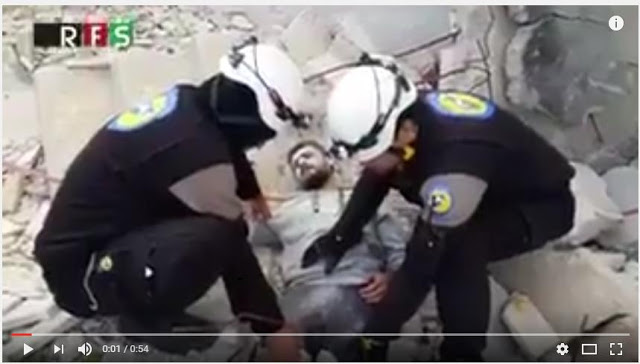
Yet on November 25, they published an article titled, “Syria’s White Helmets apologize for Mannequin Challenge video,” in which they admit:
It’s a familiar scene: Syria Civil Defence, also known as the “White Helmets,” rushing to rescue a man covered in rubble, but unlike thousands of other videos from Aleppo, this one is staged.
CNN would continue by claiming:
The nearly one-minute long video has been the subject of criticism on social media. On Wednesday Syria Civil Defence released a statement calling it an “error of judgment”.
“This video and the related posts were recorded by RFS media with Syria Civil Defence volunteers, who hoped to create a connection between the horror of Syria and the outside world using the viral ‘Mannequin challenge.’ This was an error of judgment, and we apologize on behalf of the volunteers involved,” the statement read.
Ignored by both the “White Helmets'” and RFS’ as well as CNN’s explanation of the video is the fact that the now admittedly staged video – besides the “mannequin challenge” style – is virtually indistinguishable from the “thousands of other videos from Aleppo” cited by CNN.
Just like “thousands of other videos from Aleppo” cited by CNN, the “victim” being “rescued” by the “White Helmets” is covered in dust and what appears to be blood, but otherwise uninjured. Unlike in a real bombing, those “rescued” by the “White Helmet” have their limbs intact, no deep, visible wounds, and lack any of the burns or trauma associated with weaponry used in modern combat.
It is unlikely that out of the “thousands of other videos from Aleppo” cited by CNN, none of them would feature actual trauma, and instead feature only the dust and fake “blood” covered “victims” as seen in the recent, admittedly staged video, as well as during recently staged protests in Europe.
Would CNN Have Covered “White Helmet” Deceit Without Alternative Media’s Coverage?
Of course, the alternative media has been exposing the “White Helmets” for years as perhaps one of the largest, most complex war propaganda operations conceived thus far by Western powers in their bid to sway public opinion amid regime change efforts in Syria.
 |
| Image: RSF’s “apology” lacks conviction, but is full of excuses and blame. |
When the recent “mannequin challenge” video was uploaded, it was the alternative media that caught it, reported on it, and brought viral attention to it. It was the alternative media that exposed the fact that a supposed “rescue organization” was staging fake videos for war propaganda value – in possible violation of the Geneva Convention, and certainly in violation of basic ethical concerns.
It was only after the alternative media raised these concerns and cornered RFS and the “White Helmets” that establishment media platforms like CNN finally reacted to a story it likely would have otherwise ignored.
It is no wonder then, why establishment media platforms like CNN, the Washington Post, and others are so passionately opposed to the alternative media – they are no longer setting the agenda, and are instead forced to react. Real journalism equates to reporting and honestly analyzing world events rather than contriving and spinning them – for CNN and others, they no longer possess the freedom to do the latter without consequence.
For the alternative media, successes like this, and the fact that establishment Western media has all but declared war on the alternative media should highlight the value of honest journalism and analysis. It should also be a constant reminder that fact-driven media will always win out over agenda-driven media. For the alternative media to continue to grow and be successful, it must reaffirm its dedication to fact-driven media no matter how tempting it is to do otherwise.
Israeli military court jails two Syrians for blocking ambulance carrying Nusra militants
Press TV – November 25, 2016
An Israeli court has handed down prison sentences to two Syrians living in the occupied Golan Heights for blocking an Israeli ambulance transporting militants operating in Syria for treatment.
The military court on Thursday sentenced Amal Abu Saleh to seven years and eight months in jail and a fine of more than 3,000 dollars, Syria’s official news agency SANA reported.
Bashira Mahmoud, the other Syrian, was sentenced to 22 months in prison. She was also fined 1,000 dollars.
According to the report, Israeli forces arrested the two along with 24 others in June 2015, when residents of the village of Majdal Shams blocked the ambulance and prevented it from transporting two injured terrorists with the Takfiri Jabhat Fateh al-Sham militant group, formerly known as al-Nusra Front.
The Israeli regime later released the detainees except the two. Bashira has been under house arrest since July 2016.
Sheikh Nazih Abu Saleh, Amal’s uncle, said the court ruling was “hostile.” He added that the residents of the occupied Golan Heights have the right to block the transport of al-Nusra terrorists for treatment in Israeli hospitals.
Ahmed Sheikh Abdul Qader, the governor of the city of Quneitra in southwestern Syria that borders Golan, slammed the “provocative” court ruling, calling on human rights organizations to force the Israeli regime to release Syrians held in its prisons.
Syria says Israel and its Western and regional allies are aiding Takfiri terrorist groups operating inside the Arab country.
In December 2015, the Daily Mail said the Israeli regime had saved the lives of over 2,000 Takfiri militants at the cost of about 13 million dollars since 2013.
The Syrian army has several times seized huge quantities of Israeli-made weapons and advanced military equipment from the foreign-backed militants inside Syria.
In February 2014, photos of Israeli Prime Minister Benjamin Netanyahu were released, showing him visiting injured militants at a field hospital in Israel.
Congressional Hawks Rush to Intensify War in Syria
By Rick Sterling | Dissident Voice | November 21, 2016
Hawks pass HR5732
Late in the day Tuesday November 15, Congress convened in special session. With normal rules suspended, they passed House Resolution 5732 the “Caesar Syria Civilian Protection Act”. The resolution calls for intensifying already harsh sanctions on Syria, assessing implementation of No Fly Zone in Syria and escalating efforts to press criminal charges against Syrian officials. HR5732 claims to promote a negotiated settlement in Syria but, as analyzed by Friends Committee for National Legislation, imposes preconditions which would actually make that more difficult.
There was 40 minutes of “debate” with six representatives (Royce, Engel, Ros-Lehtinen, Kildee, Smith, and Curbelo) speaking in favor of the resolution. There were few other Congressional representatives present in Congress. The House Foreign Affairs Committee stated that the resolution was passed “unanimously” without mentioning the special conditions.
The “Non Controversial” Resolution that could lead to World War III
According to wikipedia “Suspension of the rules is a procedure generally used to quickly pass non-controversial bills in the United States House of Representatives …. such as naming Post Offices…” In this case, the resolution calls for evaluating and developing plans for a “No Fly Zone” which is an act of war. This is obviously controversial and it seems clear the resolution should have been debated and discussed under normal rules with a normal amount of Congressional presence and debate.
The motivation for bypassing normal rules and rushing the bill through without debate was articulated by the bill’s author and ranking Democrat Eliot Engel: “We cannot delay action on Syria any further…. if we don’t get this legislation across the finish line in the next few weeks, we are back to square one.” The current urgency may be related to the election results since Trump has spoken out against “regime change” foreign policy. As much as they are critical of Obama for not doing more, Congressional neoconservatives are concerned about the prospect of a President who might move toward peace and away from war.
The Caesar Fraud
HR5732 is titled the “Caesar Syria Civilian Protection Act”. Foreign Affairs Committee Chair Ed Royce (R-Ca) explained that the resolution is named after “the brave Syrian defector known to the world as Caesar, who testified to us the shocking scale of torture being carried out within the prisons of Syria.”
In reality, the Caesar story was a grand deception involving the CIA with funding from Qatar to sabotage the 2014 Geneva negotiations. The 55,000 photos which were said to show 11,000 torture victims have never been publicly revealed. Only a tiny number of photos have been publicized. However, in 2015 Human Rights Watch was granted access to view the entire set. They revealed that almost one half the photos show the opposite of what was claimed: instead of victims tortured by the Syrian government, they actually show dead Syrian soldiers and civilian victims of car bombs and other terror attacks! The “Caesar” story, replete with masked ‘defector’, was one of the early propaganda hoaxes regarding Syria.
False Claims that the US has been doing nothing
One of the big lies regarding Syria is that the US has been inactive. Royce says:
The administration has decided not to decide. And that itself, unfortunately, has set a course where here we sit and watch and the violence only worsens. Mr. Speaker, America has been sitting back and watching these atrocities for far too long. Vital U.S. national security interests are at stake.
The ranking Democrat Eliot Engel said:
Four years ago I thought we should have aided the Free Syrian Army. They came to us in Washington and begged us for help… they were simply looking for weaponry. I really believe if we had given it to them, the situation in Syria would have been different today.
This is nonsense. The US was actively coordinating, training and supplying armed opposition groups beginning in late 2011. When the Qadaffi government was toppled in Fall 2011, the CIA oversaw the theft of the Libyan armories and shipment of weapons to Syrian armed opposition as documented in the Defense Intelligence Agency report of October 2012.
These weapons transfers were secret. For the public record it was acknowledged that the US was supplying communications equipment to the armed opposition while Saudi Arabia and Qatar were supplying weaponry. This is one reason that Saudi purchases of weapons skyrocketed during this time period; they were buying weapons to replace those being shipped to the armed opposition in Syria. It was very profitable for US arms manufacturers.
Huge weapons transfers to the armed opposition in Syria have continued to the present. This past Spring, Janes Defense reported the details of a U.S. delivery of 2.2 million pounds of ammunition, rocket launchers and other weaponry to the armed opposition.
Claims that the US has been inactive are baseless. In reality the US has done everything short of a direct attack on Syria. And the US military is starting to cross that barrier. On September 17 the US air coalition did a direct attack on the Syrian Army in Deir Ezzor, killing 80 Syrian soldiers and enabling ISIS to launch an attack on the position. Claims that it was a “mistake” are highly dubious.
The claims by Congressional hawks that the US has been ‘inactive’ in the Syrian conflict are part of the false narrative suggesting the US must “do something” which leads to a No Fly Zone and full scale war. Ironically, these calls for war are masked as “humanitarian”. And never do the proponents bring up the case of Libya where the US and NATO “did something”: destroyed the government and left chaos.
Congress as a Fact-Free House of Propaganda
With only a handful of representatives present and no debate, the six Congress members engaged in unrestrained propaganda and misinformation. The leading Democrat, Eliot Engel, said “We’re going into the New Year 2017, Assad still clings to power, at the expense of killing millions of his citizens.” That number is way off anyone’s charts.
Rep Kildee said “The world has witnessed this terrible tragedy unfold before our eyes. Nearly half a million Syrians killed. Not soldiers – men, women, children killed.”
The official text of the resolution says,
It is the sense of Congress that–
(1) Bashar al-Assad’s murderous actions against the people of Syria have caused the deaths of more than 400,000 civilians…
The above accusations – from “millions of citizens” to “half a million” to “400,000 civilians” – are all preposterous lies.
Credible estimates of casualties in the Syrian conflict range from 300,000 to 420,000. The opposition supporting Syrian Observatory for Human Rights estimates the documented 2011-2016 death toll as follows:
killed pro Syrian forces – 108,000
killed anti government forces – 105,000
killed civilians – 89,000
In contrast with Congressional and media claims, civilians comprise a minority of the total death count and the largest casualty group is those fighting in defense of the the Syrian state. These facts are ignored and never mentioned because they point to the reality versus the propaganda narrative which allows the USA and allies to continue funding terrorism and a war of aggression against Syria.
The Congressional speakers were in full self-righteous mode as they accused the Syrian government of “committing crimes against humanity and war crimes against civilians including murder, torture and rape. No one has been spared from this targeting, even children.” A naive listener would never know that the Syrian government is primarily fighting the Syrian branch of Al Qaeda including thousands of foreigners supplied and paid by foreign governments.
The Congressional speakers go on to accuse the Syrian military of “targeting” hospitals, schools and markets. A critical listener might ask why they would do that instead of targeting the Al Qaeda terrorists and their allies who launch dozens and sometimes hundreds of hell cannon missiles into government held Aleppo every day.
The Congressional propaganda fest would not be complete without mention of the “White Helmets.” House Foreign Affairs Committee Chairman Ed Royce said:
We (previously) heard the testimony of Raed Saleh of the Syrian White Helmets. These are the doctors, nurses and volunteers who actually, when the bombs come, run towards the areas that have been hit in order to try to get the injured civilians medical treatment… They have lost over 600 doctors and nurses.
This is more Congressional nonsense. There are no nurses or doctors associated with the White Helmets. The organization was created by the USA and UK and heavily promoted by a “shady PR firm.” The White Helmets operate solely in areas controlled by Nusra and associated terrorist groups. They do some rescue work in the conflict zone but their main role is in the information war manipulating public opinion. The White Helmets actively promote US/NATO intervention through a No Fly Zone. Recently the White Helmets has become a major source of claims of innocent civilian victims in east Aleppo. Given the clear history of the White Helmets, these claims should be treated with skepticism. What exactly is the evidence? The same skepticism needs to be applied to video and other reports from the Aleppo Media Center. AMC is a creation of the Syrian Expatriates Organization whose address on K Street, Washington DC indicates it is a US marketing operation.
What is really going on?
The campaign to overthrow the Syrian government is failing and there is possibility of a victory for the Syrian government and allies. The previous flood of international jihadi recruits has dried up. The Syrian Army and allies are gaining ground militarily and negotiating settlements or re-locations with “rebels” who previously terrorized Homs, Darraya (outer Damascus) and elsewhere. In Aleppo the Syrian army and allies are tightening the noose around the armed opposition in east Aleppo.
This has caused alarm among neoconservative lawmakers devoted to Israel, Saudi Arabia and U.S. empire. They are desperate to prevent the Syrian government from finally eliminating the terrorist groups which the West and allies have promoted for the past 5+ years.
“Pro Israel” groups have been major campaigners for passage of HR5732. The name of Simon Wiesenthal is even invoked in the resolution. With crocodile tears fully flowing, Rabbi Lee Bycel wrote “Where is the Conscience of the World?” as he questioned why the “humanitarian” HR5732 was not passed earlier.
Israeli interests are one of the primary forces sustaining and promoting the conflict. Syria is officially at war with Israel which continues to occupy the Syrian Golan Heights; Syria has been a key ally of the Lebanese resistance; and Syria has maintained its alliance with Iran. In 2010 Secretary of State Clinton urged Syria to break relations with Hezbollah, reduce relations with Iran and come to settlement with Israel. The Syrian refusal to comply with these Washington demands was instrumental in solidifying Washington’s hostility.
Congressional proponents of HR5732 make clear the international dimension of the conflict. Royce explains “It is Russia, it is Hezbollah, that are the primary movers of death and destruction… it is the IRGC fighters from Iran.” Engel echoes the same message: “Yes, we want to go after Assad’s partners in violence… along with Iranian and Hezbollah forces”.
These statements are in contrast with the analysis of some writers who believe Israel is not deeply opposed to the Damascus government. For example, Phyllis Bennis recently wrote that belief in an “arc of resistance” has been “long debunked” and that “the Syrian regime …. often plays a useful role for US and Israeli interests.”
It’s remarkable that this faulty analysis continues to be propounded. In words and deeds Israel has made its position on Syria crystal clear. Israeli Ambassador Michael Oren explained in an interview:
We always wanted [President] Bashar Assad to go, we always preferred the bad guys who weren’t backed by Iran to the bad guys who were backed by Iran … the greatest danger to Israel is by the strategic arc that extends from Tehran, to Damascus to Beirut. And we saw the Assad regime as the keystone in that arc.
These statements have been fully backed up by Israeli actions bombing Syrian positions in southern Syria and providing medical treatment for Nusra/Al Qaeda and other armed opposition fighters.
What Will Happen Now?
If the Syrian government and allies continue to advance in Aleppo, Deir Ezzor, outer Damascus and the south, the situation will come to a head. The enemies of Syria – predominately the USA, Gulf Countries, NATO and Israel – will come to a decision point. Do they intervene directly or do they allow their regime project to collapse?
HR5732 is an effort to prepare for direct intervention and aggression.
One thing is clear from the experience of Libya: Neoconservatives do not care if they leave a country in chaos. The main objective is to destabilize and overthrow a government which is too independent. If the USA and allies cannot dominate the country, then at least they can destroy the contrary authority and leave chaos.
What is at stake in Syria is whether the USA and allies Israel, Saudi Arabia, etc. are able to destroy the last secular and independent Arab country in the region and whether the US goal of being the sole superpower in the world prevails.
The rushed passing of HR5732 without debate is indicative that:
* “regime change” proponents have not given up their war on Syria
* they seek to escalate US aggression.
* the US Congress is a venue where blatant lies are said with impunity and where violent actions are advanced behind a cynical and amoral veneer of “humanitarianism” and crocodile tears.
Rick Sterling is an investigative journalist and member of Syria Solidarity Movement. He can be reached at rsterling1@gmail.com.
Featured Video

Death Spikes & Rising Cancer In Our Youth Explained
or go to
Aletho News Archives – Video-Images
From the Archives
Politicians lie
By Mazin Qumsiyeh | Popular Resistance | August 18, 2013
There is no way to say this truth nicely: Politicians lie. That includes Japanese, American, Egyptian, Israeli, and Palestinian politicians! Is there something more common sense than that? Yet, so many citizens around the world believe their own politicians or wistfully acknowledge lies but think it is part of the job needed to run things. They believe even when politicians contradict themselves blatantly. This phenomenon is rather remarkable. It is a dissonance and disconnect from reality that many seem oblivious to. It is very dangerous because it can lead to accepting rationales for going to war. These can be deadly wars that lead to millions of lives lost as happened in what was called World War 1 and WW2. Even when incredible and declassified evidence abound, politicians continue to lie and old mythologies refuse to die. Here are just a few of the countless lies told to us over the past few decades… continue
Blog Roll
 Aletho News
- Turkish parliament to review Saudi-Pakistan defense pact next month
- DEATH SPIKES & RISING CANCER IN OUR YOUTH EXPLAINED
- Iran offers Trump deal before US election
- Merz regime wants ‘secret police’ – opposition
- Israeli settlers terrorize West Bank Palestinians with state-provided drones: Report
- They see them, then kill them: Israeli quadcopters track, deliberately target civilians in Gaza
- Debunked: Trump’s egregious UNGA claims on war against Iran crumble under scrutiny
- Europe was part of the infrastructure of US aggression against Iran: Deputy FM
- New evidence on the Bucha Massacre
- Italy and France debunk reports CIA issued ‘Russian drone threat’ warning
- If Americans Knew
- An error has occurred; the feed is probably down. Try again later.
- No Tricks Zone
- New Study: Earth And Venus Surface Warmth Largely Explained By Convection And Lapse Rate, Not CO2 Or Radiation
- 2025 Nature Paper Claiming Worsening Global Drought Gets RETRACTED …Heavily Flawed
- New Study: ‘Global Drought Shows No Detectable Recent Acceleration Under Climate Warming’
- Economic Masterminds: German Socialists Suggest Taxing Productivity Gains Stemming From Using AI
- The South China Sea Has Not Been Cooperating With The Climate Change Narrative
- Energy Crisis: Germany Enters Heating Season With Historically Low Gas Reserve Fill Levels
- New Study: The Antarctic Ice Sheet Gained Mass From 2020-2024 Due To Staggering Snow And Ice Accumulation
- Study: Ocean Heating Rates From Thousands Of Years Ago ‘Dwarf’ Modern Ocean Heating Rates
- Climate Extremists Target, Attack Large-Scale Power Grid Infrastructure In Germany!
- New Study: Antarctic Ice Melt Has Contributed Less Than 1 Centimeter To Sea Level Rise In The Last 30 Years

