Wealthy Gulf states may arm Syrian rebels to ‘get the Russians to back off’ – US officials
RT | September 27, 2016
With the Syria ceasefire in tatters, there is a growing possibility that wealthy Gulf states might arm Syrian rebels, looking to shield themselves from Syrian and Russian warplanes, with shoulder-fired anti-aircraft missiles, according to a report.
One US official, speaking on condition of anonymity, told Reuters that Washington has kept high numbers of man-portable air defense systems (MANPADS), considered to be a threat to low-flying aircraft, out of Syria by uniting Western and Arab allies behind sending training and infantry weapons to moderate opposition groups while the US conducted talks with Russia.
Fed up with dancing to Washington’s tune, Gulf allies or Turkey may sooner or later silently agree to wealthy individuals supplying MANPADS to opposition groups in Syria, another US official said.
“The Saudis have always thought that the way to get the Russians to back off is what worked in Afghanistan 30 years ago – negating their air power by giving MANPADS to the Mujahideen,” an unnamed US official told Reuters.
“So far, we’ve been able to convince them that the risks of that are much higher today because we’re not dealing with a Soviet Union in retreat, but a Russian leader who’s bent on rebuilding Russian power and less likely to flinch,” the official added, referring to Russian President Vladimir Putin.
Asked if Washington planned to do “anything other than pursue a diplomatic solution” to halt the violence in Syria, State Department spokesman Mark Toner said anyone pouring more weapons into the conflict will only add more fuel to the fire.
“I think that those who may be deluded into thinking there’s a military solution also have to realize, and we’ve alluded to this before, that there are those – and not the United States – but there are those who back various groups and opposition groups within Syria who also may seek to arm them. And again, what you have as a result is just an escalation in what is already horrific fighting. As I said, things could go from bad to much worse,” Toner said.
Another administration official, who spoke on condition of anonymity to Reuters, noted, however: “The opposition has a right to defend itself and they will not be left defenseless in the face of this indiscriminate bombardment.”
The official stated that some other US “allies and partners” have been also involved in the US-Russia talks on the conflict in Syria.
“We don’t believe they will take lightly to the kind of outrages we’ve seen in the last 72 hours,” the administration official said, noting that he would not comment on “the specific capability that might be brought into the fight.”
On Monday, the German newspaper Kölner Stadt-Anzeiger published an interview with an Al-Nusra commander in Syria, identified as “Abu Al-Ezz,” who said that US allies were providing Al-Nusra with tanks and artillery.
“The Americans are on our side,” Al-Ezz reportedly said, adding that Al-Nusra has allegedly been receiving funding from Saudi Arabia, Qatar and Kuwait, and has obtained tanks and artillery from Libya via Turkey. The group especially appreciated the US-supplied TOW anti-tank missiles, he alleged.
While admitting that its allies in the region may be arming Al-Nusra militants, the US government has categorically denied that it is providing any aid to them.
“That’s complete poppycock. Whatever he’s saying, no.
“We would never provide Nusra with any kind of assistance at all,” State Department spokesman Toner told reporters on Monday.
Asked why the US has been unable to persuade the “moderate opposition” in Syria to separate itself from Al-Nusra, Toner replied that it was the rebels’ responsibility, and that they would need a seven-day ceasefire to do so.
Tensions escalated after US-led coalition jets bombed Syrian government forces’ positions near the eastern city of Deir ez-Zor, killing 62 troops on September 17. The incident dealt a serious blow to the Syrian ceasefire deal, which Moscow and Washington agreed to earlier this month, with the Syrian Army General Command saying the airstrike “paved the way” for Islamic State (IS, formerly ISIS/ISIL) militants.
The bombing was stopped only after the Russian military contacted the US side several times, saying that they were attacking the wrong targets.
Washington acknowledged the airstrike against the Syrian troops and even apologized for the mistake.
The speaker of the People’s Council of Syria said on Monday that Damascus has a recording of conversations between the American military and Islamic State terrorists ahead of the US-led coalition airstrike that hit Syrian troops near Deir ez-Zor.
“The Syrian Army intercepted the communications between the Americans and Daesh [Arabic pejorative for Islamic State] ahead of the attack on Deir ez-Zor,” Hadiya Khalaf Abbas said, as cited by Sputnik Arabic.
During his speech at the UN General Assembly over the weekend, Syrian Foreign Minister Walid Muallem also stated that the bombing of Syrian troops by the US-led coalition was a deliberate attack, not a mistake as Washington claims.
On September 19, a humanitarian convoy consisting of 31 trucks was attacked while heading to Aleppo. According to the Red Cross, 20 civilians and one aid worker died as a result. Initial reports by the organization claimed the convoy had been targeted by an airstrike. The US State Department was quick to blame Damascus and Moscow for the attack which led the UN to suspend aid deliveries to Syria. The day after the attack, the UN backtracked on its earlier claims that the convoy was hit by military planes.
The Russian Defense Ministry stated that Russian and Syrian warplanes did not launch airstrikes on the aid convoy that was attacked en route to Aleppo. The ministry added that only militants who control the area had information regarding the location of the convoy.
Read more:
‘Americans are on our side’: Al-Nusra commander says US arming jihadists via 3rd countries
‘World Powers Responsible for Migrant Crisis Must Help Lebanon’

© Sputnik/ Zahraa Al-Amir
Sputnik – 26.09.2016
The international community bears responsibility for what is happening in Syria and should do more to help Lebanon hosting a huge Syrian population, an adviser to the Lebanese Democratic Party (LDP) leader told Sputnik.
“They are giving us nothing absolutely… even though the international community is the one responsible now for what is happening to Syria and in Syria,” Saleem Hamadeh said.
Lebanon, alongside Jordan and Turkey, has been a key destination for thousands of Syrian refugees fleeing the five-year-long war in the country.
According to Hamadeh, Lebanon now hosts around 1,750,000 Syrians, which is a third of its own population.
“I think that international community should give us support in this, financial support and give us direct path on how to deal with this serious issue which will affect the demography of the Lebanese people and our country,” Dr. Hamadeh said.
There are concerns that many Syrians plan to stay in Lebanon after the Syrian crisis has been resolved, the adviser to the LDP president said. The UN relief agency for Palestinian refugees, UNRWA, estimates that Palestinians living in Lebanese refugee camps make up 10 percent of the country’s population.
US not arming Nusra, but our allies might – State Dept
RT | September 26, 2016
Al-Nusra Front is a terrorist group and the US will never provide it with any aid, said the State Department, reacting to revelations in a German newspaper – while admitting that unnamed US allies might be backing the jihadist militants in Syria.
On Monday, the German newspaper Kölner Stadt-Anzeiger published an interview with an Al-Nusra commander in Syria, identified only as “Abu Al-Ezz.” In the interview, conducted 10 days ago outside of Aleppo, Al-Ezz said that US allies were providing Al-Nusra with tanks and artillery.
“The Americans are on our side,” Al-Ezz reportedly said.
The US government has categorically denied providing any aid to Al-Nusra, while admitting awareness that its allies in the region may be arming the militants.
“That’s complete poppycock,” State Department spokesman Mark Toner told reporters at the press briefing Monday. “Whatever he’s saying, no.”
“We would never provide Nusra with any kind of assistance at all,” Toner continued, explaining that the group is a designated foreign terrorist organization.
Asked why the US has been unable to persuade the “moderate opposition” in Syria from separating itself from Al-Nusra, Toner replied it was the rebels’ responsibility, and that they would need a seven-day ceasefire to do so.
He blamed the Syrian government offensive against East Aleppo, which he said would drive “some of those forces, not all of them” into the arms of Al-Nusra. If the Syrian government continues to insist on the military solution, “there are those – not the US – who back various opposition groups in Syria, who might also seek to arm them,” and that would lead to escalation, Toner said.
Asked to clarify if that meant that US allies might be arming Al-Nusra, Toner replied that “countries that support the opposition may want to supply them with assistance.”
Al-Nusra has been receiving funding from Saudi Arabia, Qatar and Kuwait, and has obtained tanks and artillery from Libya via Turkey, according to what the commander, Al-Ezz, told the German newspaper. The group especially appreciated the US-supplied TOW anti-tank missiles.
“The missiles were given directly to us,” he said. “They were delivered to a certain group.”
The issue of Al-Nusra receiving outside aid was brought up by Russia’s ambassador to the UN, Vitaly Churkin, at the special session of the Security Council on Sunday.
“They are armed by tanks, APCs, field artillery, multiple rocket launchers… All of this has been received by them and is still being shipped to them by generous Western backers, with the US, presumably, turning a blind eye,” Churkin said.
“We have to see proof that there is a genuine desire to separate US-allied rebel groups from the Al-Nusra Front, then destroy the Al-Nusra Front and bring the opposition into a political process. Otherwise our suspicions that this was only meant to shield the Al-Nusra Front would only grow stronger,” the Russian envoy added, referring to the ceasefire agreed between Moscow and Washington that collapsed last week.
On Monday, however, the State Department talked about expecting “significant gestures” from Russia or the Syrian government to “restore their credibility” so the talks might continue, suggesting that the Syrian government should stand down its air force and cease the offensive on East Aleppo.
“The ball is somewhat in Russia’s court right now,” said Toner. However, he said the US was not ready to walk away from the talks. “If you’re asking about the legendary Plan B, we’re not there yet.”
Russian Foreign Minister Sergey Lavrov shrugged off the US rhetoric about Aleppo, however, pointing out that it was the US airstrike against the Syrian Army position besieged by Islamic State (IS, formerly ISIS/ISIL) that ended the ceasefire.
“I would like to emphasize that the Americans and their Western allies, for one thing, want to distract public attention from what had happened in Deir ez-Zor,” Lavrov told NTV on Monday.
Read more:
West still arming Al-Nusra in Syria, peace almost impossible – Russia’s UN envoy
The Hillary Clinton Presidency has Already Begun as Lame Ducks Promote Her War
By Diana Johnstone | CounterPunch | September 26, 2016
If the British Empire was built on the playing fields of Eton, United States world hegemony gets its training in Hollywood studios and advertising agencies. Selling your product, or yourself, by looking sincere is a cultivated American art. Current top U.S. leaders are expert practitioners.
In the space of a few days, Samantha Power, John Kerry, and Barack Obama all turned in war-winning performances.
Three Deadly U.S. Blows to Hopes of Peace In Syria
Last August 8, on that serious think tank the Charlie Rose show, former acting CIA director Michael Morell said that U.S. policy in Syria should be to make Iran and Russia “pay a price”. Russians and Iranians should be killed “covertly, so you don’t tell the world about it”, he said. Morell proposed that U.S. forces begin bombing Syrian government installations, in order to “scare Assad”. Probably angling for a good job next year, he is on record supporting Hillary Clinton as a “highly qualified commander in chief” and a “strong proponent of a more aggressive approach” in Syria.
Act I – An Act of War
Then, on Saturday, September 17, the U.S. Air Force did exactly what that CIA insider had called for. In sustained air strikes, four U.S. jets bombed a key Syrian Army position that had been defending the town of Deir ez-Zor from ISIS/Daech fighters. More than sixty Syrian soldiers were killed and over a hundred wounded. Daesh forces immediately took advantage of the strikes to overrun the government position. In effect, the U.S. Air Force acted as air cover for the Islamic fanatics U.S. to advance against the legitimate army of Syria.
This was not only a violation of the cease-fire painstakingly worked out by Russian foreign minister Sergei Lavrov and U.S. Secretary of State John Kerry. It was an open military aggression by the United States on the territory of a sovereign state.
The Russians immediately called an emergency session of the United Nations Security Council to respond to this deadly violation of the truce supposedly intended to facilitate peace negotiations and humanitarian aid. When Russian ambassador Vitaly Churkin took the floor to speak, his American counterpart, Samantha Power, draped in her long red mane, walked out to give a press conference that clearly illustrated the difference between Russian and U.S. diplomacy.
Churkin, like Lavrov a few days later, cited facts and analysed the situation rationally. Samantha Power put on a show of evasion and insults.
Why all the fuss? was her opening theme. After all, we halted the attack when we were informed that “it was possible we might be hitting Syrian regime personnel and vehicles”, she stated, adding that “if” we did so, “that was not our intention”. That should settle the question; who could believe that the United States might deliberately attack the regime their politicians have been saying “must go”?
The best defense is offensive, and Power can be most offensive:
“Even by Russia’s standards, tonight’s stunt – replete with moralism and grandstanding is uniquely cynical and hypocritical”, she declared.
Samantha Power, that conniving arriviste whose carefully constructed career has been built on moralism, grandstanding, cynicism and hypocrisy, had all the nerve in the world to turn these epithets against the prime target of her own habitual moralism, grandstanding, cynicism and hypocrisy.
If the air strikes hadn’t been enough to destroy Russian confidence in dealing with the United States, Samantha Power’s contemptuous reaction was sure to do the trick.
Act II – Change the Subject
Next ploy: change the subject. Our little accidental bombing is nothing, Power implied, compared to the alleged fact that “since 2011 the Assad regime has intentionally been striking civilian targets with horrifying, predictable regularity”. Here is the core of the Samantha Power fraud, containing two elements:
1/ While good-hearted bumbling America occasionally kills a few people by accident, the others do it all the time and above all intentionally.
2/ Killing civilians is what war is all about. War is not about battles between armed forces for control of territory. It is not about geopolitical power struggles. It is about “civilian victims”.
At the close of her stunt, grandstanding and scoring cheap points, Samantha Power exhorted Russia “to stop the cheap point scoring and the grandstanding and the stunts and focus on what matters, which is implementation of something we negotiated in good faith with them.” Good faith? They are supposed to believe we negotiated “in good faith” an agreement which we just flagrantly destroyed?
Lo and behold, only two days after the U.S. bombing of Deie ez-Zor, the subject was definitively changed when an international humanitarian aid convoy was attacked on its way to Aleppo. Twenty aid workers were killed and the aid mission was halted. Without waiting for any evidence, the unanimous cry went up from Washington that “the Russians did it!”
In the U.N. Security Council this time, John Kerry took the stage. Again, the critical point was the contrast between what we certainly did and what they allegedly did. Yes, we committed “a terrible accident”. But what they (allegedly) did was worse.
“I got to tell you, people running around with guns on the ground, from the air, is a very different thing from trucks in a convoy with big UN markings all over them,” Kerry declared. He was implying that the difference was between an understandable accident, whose victims were “running around with guns”, and an attack on civilians. Yes, but in war, attacking soldiers is the whole point. It can make a difference in the outcome. Hitting an aid convoy is “collateral damage”, as the U.S. calls it when the bombs are American. By bombing Deir ez-Zor, the United States was taking part in a war in which Syria is fighting for its life.
It cannot be ruled out that Syrian forces attacked the aid convoy because the truce was already broken at Deir ez-Zor and they believed it concealed weapons being transported to Daesh. Such things happen. Or the attack could have been carried out by rebels as an act of propaganda, a “false flag”, designed precisely to be used to accuse the adversary. Such things also happen.
It has already been established by careful research that the notorious Al Ghouta chemical weapons attack, attributed to Assad, was almost certainly carried out by rebels precisely in order to incite the United States to cross the “red line” set by President Obama and bomb Damascus. The War Party which by now controls the Pentagon, much of the State Department, most of Congress, as well as leading media and think tanks, has been castigating Obama ever since for not having seized that opportunity to wage a full-scale “regime change” war against Syria. The critics have never forgiven Obama for accepting the Russian proposal to use the occasion to rid Syria of its chemical arsenal, instead of overthrowing the Syrian government.
But in recent weeks, as the Hillary Clinton campaign grows more frantic, Obama himself has joined the War Party.
Act III – Wallow in Sentimentality
On September 20, President Obama used a Leaders Summit on Refugees to portray the Syrian episode in what increasingly appears to be World War III as a sentimental children’s story. Obama read the letter from 6-year-old Alex, who lives in Scarsdale, New York, expressing his wish to adopt Omran Daqneesh, the bewildered 5-year-old boy with a mop of dusty hair whose photo sitting in an orange ambulance seat was iconized across the world. The letter, provided to mass media by the White House, with its childish writing but nearly perfect spelling, was full of touching details about butterfly collections and shared toys. Obama read the letter, as people reached for Kleenexes all over the country, and then commented:
“Those are the words of a six-year-old boy – a young child you has not learned to be cynical, or suspicious, or fearful of other people because of where they come from, how they look, or how they pray. We should all be more like Alex. Imagine what the world would look like if we were.”
The little boys are very cute, very sweet. Fortunately, Omran Daneesh’s parents are alive, so there is no need to adopt him. Many other children are dead, notably in Yemen, killed by Washington’s ally Saudi Arabia with arms provided by the United States. Too late to adopt them.
“We should all be more like Alex”, Obama tells his good people. Imagine indeed, if all Americans were as innocent and naïve as six-year-old children. And indeed, that seems to be the goal of government propaganda.
This propagandistic heartstring tugging is aimed at distracting from U.S. involvement in a long-term joint criminal enterprise to overthrow a government that indeed did not discriminate against people because of “how they pray”, and replace it by fanatics who are ready to behead people because of “how they pray”.
An infantilized public will believe that “geopolitics” and “national sovereignty” are just big words that don’t mean anything. An infantilized public will believe that when the United States goes to war, it is all about protecting little children from their bad, mean dictators, whose only aspiration is to “bomb their own people”. They will believe that the world out there is Little Red Riding Hood, threatened by the Big Bad Wolf, and that there really is a Santa Claus.
It will never occur to an infantilized public that the war to destroy Syria has been planned for years – even though someone like General Wesley Clark revealed this years ago. Or that it is carried out to eliminate Israel’s enemies, keep Arabs busy killing each other, and incidentally help Saudi Arabia spread its Wahhabite fanaticism. No, that will never occur to them.
They won’t even notice that the Obama administration has now effectively given up any effort to justify the Nobel Peace Prize so foolishly bestowed on the apprentice president, and is now engaged in a scenario designed to prepare for Hillary’s next successful regime change war in Syria.
And it won’t occur to them that the photo of the little boy in the orange seat was quite deliberately iconized by Western media as part of the campaign promoting the Islamic rebel-connected “White Helmets” for the future Nobel Peace Prize.
Another subtle step in demonizing the “Assad regime” before Hillary takes over to administer the planned coup de grace. The future chuckler-in-chief is looking forward to seeing another head fall. This is called “smart power”.
 Diana Johnstone is the author of Fools’ Crusade: Yugoslavia, NATO, and Western Delusions. Her new book is Queen of Chaos: the Misadventures of Hillary Clinton. She can be reached at diana.johnstone@wanadoo.fr
Syrian and Palestinian Units liberate Handarat Refugee Camp from Jabhat Fatah Al-Sham
nsnbc – September 24, 2016
Units of the Syrian Arab Army (SAA) supported by the Palestinian Liwa Al-Quds liberated the Palestinian Handarat refugee camp in Aleppo province from Jabhat Fatah al-Sham, formerly known as Jabhat al-Nusrah.
The Handarat refugee camp is located 13 kilometers northeast of the city of Aleppo. The 14 Palestinian refugee camps, including Handarat were reluctantly drawn into the war in Syria after its onset in 2011.
Jabhat Fatah al-Sham, formerly known as Jabhat al-Nusrah, conceded that the Syrian Arab Army and fighters from the Palestinian Liwa al-Quds had succeeded to seize the camp. The insurgents reported that the Syian – Palestinian ground troops were supported by Syrian as well as Russian air cover.
Bomb squads and engineers are currently in the process of clearing Handarat for boobie traps, mine, improvised explosive devices and other hazards left behind by the insurgents or caused by the fighting; Anong others, unexploded ordinance.
The liberation of the Handarat camp from Jabhat Fatah al-Sham and associated insurgents consolidates the Syrian government’s control over the Castello road and thus also consolidates the siege on insurgent trapped inside the city of Aleppo. The Castello road has previously been used as one of the main supply routes to areas under the control of insurgents in Aleppo province.
In the beginning of August 2016 insurgents, primarily backed by Turkey, Qatar and the USA, took control of the entire Handarat camp after heavy and protracted battles with the Syrian Arab Amy and Palestinian fighters.
The camp has a strategic importance as it overlooks several rebel-held areas in eastern Aleppo, which has become under tight government siege after the Syrian army captured Castello.
The Syrian Defense Ministry announced Thursday the commencement of a new offensive against rebel-held areas in eastern Aleppo, urging the civilians to leave immediately and the rebels to lay down their weapons. On Friday, Syrian warplanes dropped leaflets over eastern Aleppo, renewing calls on civilians to stay away from the rebel positions and advising the rebels to surrender.
The renewed escalation in Aleppo came just days after a Russian-U.S. brokered truce expired last Monday with no extension, due to the rising tension between Russia and the United States.
The Syrian army stated that the rebels violated the week-long truce over 300 times, adding that the U.S.-led coalition struck positions of the Syrian army during the truce in Deir Ez-Zour, killing 90 soldiers, which was deemed by Russia as the biggest violation to the truce.
The U.S.-led attack on Syrian army positions in Deir al-Zour (Deir Ez-Zor) was the first since the coalition started operations in Syria two years ago. Washington said the attack was “unintentional,” a claim totally rejected by the Syrian government, with President Bashar al-Assad saying the U.S.-led coalition intentionally struck the Syrian army posts in Deir Ez-Zor.
Israel wants Syria destroyed as presaged by the Oded Yinon plan
By Mark Taliano | American Herald Tribune | September 25, 2016
Before the externally-orchestrated dirty war on Syria started with the externally-orchestrated “Arab Spring” psy op; before the “peaceful protestors” shot the unarmed Syrian security forces; and before the West armed, trained and funded the international mercenary cannibals who loot, rape, and plunder; Syria was an oasis of civilization surrounded by imperial puppet states.
Syria was prosperous, with a growing economy. It had food sovereignty, with a “strategic” stock of millions of tons of high quality wheat , not the “Franken-food” bio-tech variety; it had a strong central bank with no usurious IMF loans; it had a popular, reformer President; it had a mostly well-educated, secular, pluralist, forward-looking population; and it was the fourth safest country in the world.
After almost six years of illegal war launched by some of the most militarily advanced countries, and years of illegal sanctions imposed by these same criminal governments – including Canada’s puppet government – Syria is still standing strong. It still has a popular, elected President and government. And it is still a beacon of civilization.
Despite the collective punishment of sanctions and the terror of war, Syrians remain defiant. Arabi Shaher exemplified this defiance when he said,” Do whatever you like, this is our country; it will remain our country.” He, like many Syrians, sees through the lies. And his appraisal of the root cause of the war is openly shared by many Syrians: Israel.
Israel and its allies “benefit” from a balkanized and destroyed Syria. Even conflicting pipeline interests are subordinated by Israel’s perceived needs as presaged by the Oded Yinon plan. Syrians commonly report that Israel first and foremost, and its allies, are the number one agents driving the current holocaust. These interests are said to subordinate the “oil” interests. Same in Iraq.
Not surprisingly, Syria, ranked among the top five countries in terms of safety before the war, is now a war zone on about 2,000 fronts, but life goes on for all Syrians.
Despite the Western assaults on Syria, Syria still provides free health care and schooling for all in government –controlled areas, even as terrorists teach children to be “child soldiers”, and to adopt the degenerate Wahhabi ideology that violently excludes all other ideologies and religions.
All of the violence, including the daily exposure to bombings, is currently being “normalized”. Outsiders report that when a mortar bomb strikes nearby, Syrian pedestrians barely notice, and continue on their way. The trauma of the war will present challenges for years to come.
Despite, or maybe because of its challenges, Syria treats all of its inhabitants – regardless of their country of origin – as Syrians.
“Wesam”, a man born to Palestinian refugees, explains that Palestinian refugees have the same rights as Syrians. They can buy a home, they can buy land, and they can legally work in Syria. In contrast, he explains that Palestinian refugees have no rights in neighbouring Lebanon; they cannot work legally, and they cannot buy a home outside of the refugee camp.

And so life goes on in Syria. The West is doing everything that it can to change this – economic sanctions, mercenary terrorists, bombing grain silos, bombing Syrian Arab Army (SAA) positions, disinformation warfare – but it isn’t working.
Damascus, one of the oldest continuously-inhabited cities in the world, is strong. Observers mistakenly thought that the capital would fall within months, but it hasn’t happened yet, and it is unlikely to happen at all.
Syria has strong institutions, a strong army, and strong allies. It also has a strong civilizing core. Syria’s victory will be everyone’s victory.
Another Kerry Rush to Judgment on Syria
By Robert Parry | Consortium News | September 24, 2016
Secretary of State John Kerry has engaged in another rush to judgment blaming the Russians for an attack on a United Nations relief convoy in Syria before any thorough investigation could be conducted and thus prejudicing whatever might follow, as he did with the Syrian sarin case in 2013 and the shoot-down of Malaysia Airlines Flight 17 in 2014.
Eager to go on the propaganda offensive – especially after a U.S. military airstrike last Saturday killed scores of Syrian soldiers who were battling the Islamic State in eastern Syria – Kerry pounced on an initial report that the attack on the convoy on Monday was an airstrike and then insisted that the Russians must have been responsible because one of their jets was supposedly in the area.
But the United Nations – and I’m told CIA analysts – have not ruled out the possibility that the convoy was instead hit by a surface-to-surface missile. On Friday, a source briefed by U.S. intelligence said one fear is that the jihadist group, Ahrar al-Sham, which has fought alongside Al Qaeda’s Nusra Front but is deemed to be part of the “moderate” opposition, may have used a U.S.-supplied TOW missile in the attack.
Ahrar al-Sham, like some other jihadist groups seeking to overthrow the Syrian government, has objected to limited cease-fires arranged by the Russians and the Americans, which still allowed attacks on its ally, the recently rebranded Nusra Front. Ahrar al-Sham thus had a motive for destroying the aid convoy, an act which indeed has upended efforts to negotiate an end to the five-year-old conflict and led to bloody new attacks inside the embattled city of Aleppo on Friday.
Another possibility was that a Syrian government warplane was targeting a rebel artillery piece traveling alongside the convoy and struck the convoy by accident. But the assignment of blame required additional investigation, as other international officials acknowledged.
On Tuesday, a day before Kerry’s outburst, the U.N. revised its initial statement citing an airstrike, with Jens Laerke, a humanitarian affairs representative for the U.N., saying: “We are not in a position to determine whether these were in fact airstrikes. We are in a position to say that the convoy was attacked.” He called the earlier reference to an airstrike a drafting error.
Nevertheless, on Wednesday, Kerry made his high-profile denunciation of the Russians at the U.N. Security Council, the same venue where Secretary of State Colin Powell in 2003 presented a false case against Iraq for possessing hidden stockpiles of WMD. In fiery comments, Kerry accused Russian Foreign Minister Sergey Lavrov of living “in a parallel universe” in denying Russian responsibility.
“The eyewitnesses will tell you what happened,” Kerry said. “The place turned into hell and fighter jets were in the sky.”
Yet, the two points don’t necessarily connect. Just because there are jets in the sky doesn’t mean they fired the rocket that struck the convoy. They might have, but to determine that – and if so, who was flying the jet that fired the missile – requires more thorough study.
Kerry also sought to excuse the U.S. airstrike near Deir ez-Zor last Saturday that killed some 62 Syrian soldiers, saying: “We did it, a terrible accident. And within moments of it happening, we acknowledged it. … But I got to tell you, people running around with guns on the ground, from the air, is a very different thing from trucks in a convoy with big U.N. markings all over them.”
But what Kerry ignored was the fact that the United States has no legal authority to be conducting military operations inside Syria, attacks supposedly targeting the terrorist Islamic State but lacking the approval of the Syrian government. In other words, under international law, any such U.S. attacks are acts of aggression and thus war crimes.
The mainstream U.S. news media, however, has little regard for international law, at least when the U.S. government is violating it, nor particular care for factual details. Despite the U.N.’s uncertainty about what struck the convoy, The New York Times continued to report the airstrike as a flat fact.
On Thursday, the Times wrote, “a convoy of trucks taking aid to the besieged of Aleppo was destroyed in a deadly airstrike.” Strangely, later in the article, the Times does note that “the United Nations has not confirmed what struck its trucks.”
A History of Prejudgment
Kerry also has a history of jumping ahead of a story and then going silent when further information is developed.
On Aug. 30, 2013, Kerry gave a thunderous speech virtually declaring war on Syria for supposedly launching a sarin gas attack outside Damascus on Aug. 21, 2013, that killed hundreds of people. On Aug. 31, however, President Obama pulled the rug out from under Kerry by shelving plans for a retaliatory bombing campaign, in part, because U.S. and British intelligence analysts expressed doubts that the Syrian government was responsible.
Later, evidence built up supporting a counter thesis that the sarin attack was launched by Syrian rebels trying to draw the U.S. military into the conflict on their side. In other words, Kerry almost put the U.S. government in position of aiding Al Qaeda or the Islamic State overrunning Damascus under dubious if not false pretenses. [See Consortiunews.com’s “The Collapsing Syria Sarin Case.”]
But U.N. investigators have remained under intense pressure to give the U.S. government something so it can keep alive the theme of Syria’s government using chemical weapons, even after Syria agreed to surrender all its chemical weapons in 2013. The U.N. did so in late August in blaming the Syrian government for two thinly evidenced cases of jerry-rigged chlorine bombs, after brushing aside witness testimony that rebels were staging such attacks for propaganda purposes.
Regarding the sarin case, the U.S. government never formally recanted Kerry’s rush to judgment allowing the conventional wisdom inside Official Washington (and its compliant mainstream media) to remain that Obama failed to enforce his “red line” against use of chemical weapons.
Kerry was at it again just three days after Malaysia Airlines Flight 17 was shot down over eastern Ukraine on July 17, 2014, insisting that the U.S. government had radar and other conclusive evidence showing exactly where the missile was fired and making clear that Russian-backed rebels were responsible with the Russians also at fault for giving the rebels the anti-aircraft weapon.
However, after CIA and other Western intelligence analysts had more time to review what actually happened – and found that only Ukrainian government forces had anti-aircraft missiles in the area capable of shooting down a plane at 33,000 feet – the U.S. government went silent, refusing to make public its evidence but keeping alive the impression that the Russians were at fault.
With the U.S. government keeping its key evidence secret, the Dutch-led investigations into the crash have floundered. Last October, the Dutch Safety Board could only put the likely missile firing position within a 320-square-kilometer area including land held by both the rebels and the government. [See Consortiumnews.com’s “The Ever Curiouser MH-17 Case.”]
On Sept. 28, a Dutch-led-but-Ukrainian-dominated Joint Investigation Committee (JIT) is scheduled to release a report that is supposed to finally say where the missile was fired, more than two years after the tragedy. Given the influence of Ukraine’s SBU intelligence service over JIT, the likelihood is that the report will try to keep alive the impression that the ethnic Russian rebels were responsible.
A source who’s been following the investigation said the Dutch have resisted the outright falsification of the findings because many of the 298 victims were Dutch citizens and the victims’ families have been pressing for all sides – the United States, Ukraine and Russia – to supply whatever evidence they can. But the Western demands for propaganda to support the New Cold War with Russia are strong.
Syria has become another battlefield in that information war with tragic events being used as propaganda clubs by the various sides to beat one another, rather than moments for careful review of the evidence and assessment of accountability.
Part of this propaganda overload results from the U.S. government and various Western non-governmental organizations funding and training activists in the art of using social media for propaganda purposes. While these activists report on some real events, they also slant their coverage to advance their agenda of “regime change” in Syria.
The problem is compounded because the Western mainstream media has taken up Syrian “regime change” as a beloved cause rather than a topic for objective reporting. The New York Times and other major news outlets rely credulously on anti-government activists, such as the White Helmets and the Syrian Observatory for Human Rights, for information about what’s happening on the ground with statements from the Syrian or Russian governments treated with open disdain.
The larger tragedy of exploiting these human tragedies for propaganda purposes – whether the sarin attack, the MH-17 shoot-down or now the convoy bombing – is that these deaths of innocents become just excuses to inflict more deaths and ultimately to push the world closer to a new world war.
Syria FM censures exploiting humanitarian sufferings of Syrians
Press TV – September 24, 2016
Syrian Foreign Minister Walid al-Muallem has censured certain governments in the Middle East and the West for taking advantage of the humanitarian sufferings of Syrians to reach their political objectives.
In an address to the 71st session of the United Nations General Assembly in New York on Saturday, Muallem said Syria was being constantly blamed for the deterioration of the humanitarian situation in the country, especially in the war-ravaged northern part, regardless of the fact that certain states favored the continued humanitarian catastrophe to advance their own objectives.
The Syrian foreign minister said Western governments continued to accuse the Syrian military of resorting to siege and starvation as a tactic of war, but at the same time supported militants to use people most affected by the conflict as human shields.
Muallem said Syria would spare no effort to put an end to the sufferings of Syrians and give them back their dignity. He also stated that the country faced a tough task of coping with systematic destruction by foreign-backed militants.
Israeli regime supporting terrorists
Elsewhere in his remarks, Muallem said Syria’s confrontation with mercenary terrorism was not new as the country had long confronted the terrorism of Israel, which occupied the Golan Heights in 1967.
He said Israel was intervening militarily and directly in Syria to assist terrorists operating in the Golan Heights.
The top Syrian diplomat called on the international community to pressure Israel to conform to UN resolutions that guarantee Syria’s sovereignty over Golan.
“We hope that the UN could regain the trust of the people through upholding its Charter, which guarantees the protection of the country’s sovereignty,” Muallem stated.
‘Recent US airstrike was intentional’
Muallem rejected claims by the United States that an airstrike a week ago on a Syrian army base in the east of the country was a mistake, saying the strike, which killed over 80 Syrian soldiers, was “intentional.”
“The Syrian government holds the United States fully responsible for this aggression, because facts show that it was an intentional attack, and not an error, even if the United States claims otherwise,” the Syrian foreign minister said.
Muallem reiterated Syria’s commitment to moving forward with the UN-led peace process, saying, however, that the complicity of the US and its allies with the Takfiri Daesh terrorists and other militants was a major obstacle to honoring pledges on the cessation of hostilities.
On September 9, Russia and the United States agreed on a milestone deal on the crisis in Syria after some 13 hours of marathon talks in the Swiss city of Geneva. The deal, which went into effect on September 12 and was initially agreed to last seven days, called for increased humanitarian aid for those trapped inside the northwestern city of Aleppo.
The Syrian army announced an end to the week-long ceasefire on September 19, when US-led coalition warplanes attacked a Syrian army base and an aid convoy was hit near the city.
President al-Assad’s interview given to Associated Press
SANA | September 22, 2016
Damascus – President Bashar al-Assad gave an interview to Associated Press published Thursday, following is the full text:
Journalist: President Assad, thank you very much for this opportunity to be interviewed by the Associated Press.
President Assad: You are most welcome in Syria.
Question 1: I will start by talking about the ceasefire in Syria. Russia, the US, and several countries say a ceasefire could be revived despite the recent violence and the recrimination. Do you agree, and are you prepared to try again?
President Assad: We announced that we are ready to be committed to any halt of operations, or if you want to call it ceasefire, but it’s not about Syria or Russia; it’s about the United States and the terrorist groups that have been affiliated to ISIS and al-Nusra and Al Qaeda, and to the United States and to Turkey and to Saudi Arabia. They announced publicly that they are not committed, and this is not the first attempt to have a halt of operations in Syria. The first attempt was in last February, and didn’t work, I think, because of the United States, and I believe that the United States is not genuine regarding having a cessation of violence in Syria.
Question 2: Do you believe there could ever be a joint US-Russian military partnership against the militants, as outlined in the deal?
President Assad: Again, practically, yes, but in reality, no, because the United States doesn’t have the will to work against al-Nusra or even ISIS, because they believe that this is a card they can use for their own agenda. If they attack al-Nusra or ISIS, they will lose a very important card regarding the situation in Syria. So, I don’t believe the United States will be ready to join Russia in fighting terrorists in Syria.
Question 3: This week, the US has said the coalition attack on Syrian troops was an accident. Do you accept that explanation?
President Assad: No, no. It’s not, because it wasn’t an accident by one airplane for once, let’s say. It was four airplanes that kept attacking the position of the Syrian troops for nearly one hour, or a little bit more than one hour. You don’t commit a mistake for more than one hour. This is first. Second, they weren’t attacking a building in a quartier; they were attacking a huge place constituted of many hills, and there was not terrorist adjacent to the Syrian troops there. At the same time, the ISIS troops or the ISIS militants attacked right away after the American strike. How could they know that the Americans are going to attack that position in order to gather their militants to attack right away and to capture it one hour after the strike? So it was definitely intentional, not unintentional as they claimed.
Question 4: Did Syria or Russia launch the attack on the Red Crescent convoy this week, and should Moscow be held responsible, as the White House has said?
President Assad: No, first of all, there have been tens, maybe, of convoys from different organizations around the world, coming to different areas in Syria for the last few years. It has never happened before, so why to happen now, either by the Russians or the Syrians? No, it’s a claim. And regarding the claim of the White House yesterday, accusing either the Syrians or the Russians. In that regard, I would say whatever the American officials said about the conflicts in Syria in general has no credibility. Whatever they say, it’s just lies and, let’s say, bubbles, has no foundation on the ground.
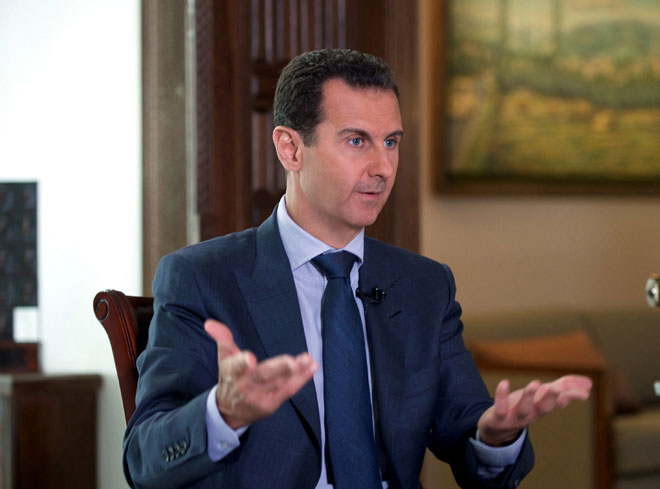
Question 5: So what happened to the convoy? Who should be held responsible?
President Assad: Those convoys were in the area of the militants, the area under the control of the terrorists. That’s what they should accuse first: the people or the militants, the terrorists who are responsible for the security of this convoy. So, we don’t have any idea about what happened. The only thing that we saw was a video of a burnt car, destroyed trucks, nothing else.
Question 6: Several eyewitnesses have told AP that 20 missiles were launched against the convoy. There is footage of torn bodies. This does not seem as though it would be anything but an attack from the air. Eyewitnesses are also talking about barrel bombs, and as you are aware, your administration has been accused of using barrel bombs in some circumstances. You still think this was an attack from the ground by rebels?
President Assad: Yeah, first of all, even the United Nations said that there were no airstrikes against that convoy. That was yesterday. Second, at the same time of that event, the terrorists were attacking the Syrian troops by missiles. They launched missile attacks, we didn’t respond. Third, you cannot talk about eyewitnesses for such judgment or accusation. What are the credibility of those eyewitnesses, who are they? We don’t know.
Question 7: We have eyewitnesses that were relatives, we have the White Helmets, we have many people saying that they witnessed helicopters in the air. Now, only the Syrians and the Russians have helicopters. Are you saying this is just invented?
President Assad: Those witnesses only appear when there’s an accusation against the Syrian Army or the Russian, but when the terrorists commit a crime or massacre or anything, you don’t see any witnesses, and you don’t hear about those White Helmets. So, what a coincidence. No, actually, we don’t have any interest in doing so for one reason: because if we attack any convoy that’s going to the civilians, we are working for the interest of the terrorists, that will play into their hands directly, in that regard we are pushing the civilians toward the terrorists, we put them in their laps, and we are providing the terrorists with a good incubator, something we wouldn’t do. This is first. Second, we are, as a government, as officials, we are committed morally toward the Syrian people, morally, constitutionally, and legally, to help them in every aspect to have the basic needs for their livelihood.
Question 8: Your administration has denied the use of chemical weapons, of barrel bombs, despite testimony and video and the results of a UN investigation. We also are hearing similar denials about airstrikes on civilians and medical workers. Can this all be false allegations by your opponents?
President Assad: First of all, the first incident of gas use in Syria was in Aleppo about more than three years ago, and we were the ones who invited the United Nations to send a delegation for investigations about the use of chemical weapons, and the United States objected and opposed that action for one reason; because if there’s investigations, they’re going to discover that the terrorists used gas, not the Syrian Army. In that regard, in that case, the United States won’t be able to accuse Syria. That’s why they were opposing that delegation. In every incident, we asked the United Nations to send a delegation, and we are still insisting on that position, that they have to send delegations to make investigation, but the United States is opposing. So, actually, if we’ve been using that, we wouldn’t ask for investigation.
Question 9: To the international community, it seems as though none of the charges or accusations stick, that everything is denied, everything here is ok, by your administration. Do you not feel that that undermines the credibility? In other instances, the Americans for example admitted the attack on the Syrian military was a mistake. Now, you don’t accept that, but from the Syrian administration, all the international community hears is denial.
President Assad: Regarding which issue?
Question 10: Regarding the accusations of violations of human rights, of barrel bombs…
President Assad: Look, if you want to talk about mistakes, every country has mistakes, every government has mistakes, every person has mistakes. When you have a war, you have more mistakes. That’s the natural thing. But the accusations have no foundation regarding Syria. When they talk about barrel bombs, what are barrel bombs?
It’s just a title they use in order to show something which is very evil that could kill people indiscriminately, and as I said, because in the media “when it bleeds, it leads.” They don’t talk about bombs; they call it barrel bombs. A bomb is a bomb, what’s the difference between different kinds of bombs? All bombs are to kill, but it’s about how to use it. When you use an armament, you use it to defend the civilians. You kill terrorists in order to defend civilians. That’s the natural role of any army in the world. When you have terrorists, you don’t throw at them balloons or you don’t use rubber sticks, for example. You have to use armaments. So, it’s not about what the kind of armament, it’s about how to use it, and they want to use it that time to accuse the Syrian Army of killing civilians. We don’t kill civilians, because we don’t have the moral incentive, we don’t have the interest to kill civilians. It’s our people, who support us. If you want to kill the Syrian people, who’s going to support us as a government, as officials? No one. So, in reality, you cannot withstand for five years and more against all those countries, the West, and the Gulf states, the petrodollars, and all this propaganda, the strongest media corporations around the world, if you don’t have the support of your own people. That’s against the reality. So, no, we don’t use it. I wouldn’t say that we don’t have mistakes. Again, that many mistakes that have been committed by individuals, but there’s a difference between a mistake or even a crime that’s been committed by an individual, and between a policy of crime that’s been implemented or adopted by a government. We don’t have such a policy.
Question 11: And yet the hundreds of thousands of Syrians who are fleeing the country, many drowning on the way, many of them say they are fleeing your forces. What exactly are they fleeing if this campaign doesn’t exist, if this campaign of violence, indiscriminate against them…?
President Assad: You have to look at the reality in Syria. Whenever we liberate any city or village from the terrorists, the civilians will go back to the city, while they flee that city when the terrorists attack that area, the opposite. So, they flee, first of all, the war itself; they flee the area under the control of the terrorists, they flee the difficult situation because of the embargo by the West on Syria. So, many people, they flee not the war itself, but the consequences of the war, because they want to live, they want to have the basic needs for their livelihood, they don’t have it. They have to flee these circumstances, not necessarily the security situation itself. So, you have different reasons for the people or the refugees to leave Syria. Many many of them supported the government in the recent elections, the presidential elections, in different countries. So, that’s not true that they left Syria because of the government, and those accusations mean that the government is killing the people, while the terrorists, mainly Al Qaeda and al-Nusra and other Al Qaeda-affiliated organizations or groups protected the civilians. Is that the accusation? No-one can believe it, actually.
Question 12: Let’s turn our attention to the people that can’t flee, the people who are in besieged cities around Syria. For example, Aleppo. To go back to the ceasefire agreement, aid was supposed to get into the city, but you did not hold up your end of the agreement. Why was that, and how can you really justify withholding aid to cities?
President Assad: Again, if we talk about the last few years, many aid convoys came to different cities, so why does the Syrian government prevent a convoy from coming to Aleppo for example, while allowing the others to reach other areas? This is contradiction, you cannot explain it, it’s not palatable. This is first. Second, if you look at the others areas under the control of the terrorists, we’re still sending vaccines from the Syrian government’s budget, we’re still sending salaries to the employees from the Syrian government’s budget. So, how can we do this and at the same time push the people toward starvation in other areas? More importantly, the terrorists who left liberated areas under what you call reconciliation or certain agreements in different areas, they left to fight with other terrorists in Syria while they send their families to live under the supervision of the government. Why didn’t we put those families to starvation? So, this is contradicting, I mean what you’re talking about is contradicting the reality, and we don’t contradict ourselves.

Question 13: But the world saw the reality of Aleppo. There were UN convoys of aid that were not allowed into the city. Are you denying that that was the case?
President Assad: The situation has been like this for years now. If there’s really a siege around the city of Aleppo, people would have been dead by now. This is first. Second, more importantly, they’ve been shelling the neighboring areas and the positions of the Syrian Army for years, non-stop shelling of mortars and different kinds of lethal bombs. How could they be starving while at the same time they can have armaments? How can we prevent the food and the medical aid from reaching that area and we cannot stop the armaments form reaching that area, which is not logical?
Question 14: So what is your message to the people to Aleppo, who are saying the opposite, that they are hungry, that they are suffering malnutrition, that there are no doctors, that doctors have been targeted and killed in airstrikes, that they are under siege and they are dying? What is your message to them?
President Assad: You can’t say “the people of Aleppo” because the majority of the people of Aleppo are living in the area under the control of the government, so you cannot talk about the people of Aleppo. If you want to talk about some who allegedly are claiming this, we tell them how could you still be alive? Why don’t you have, for example, an epidemic, if you don’t have doctors? How could you say that we attacked, they accuse Syria of attacking hospitals, so you have hospitals and you have doctors and you have everything. How could you have them? How could you have armaments? That’s the question. How can you get armaments to your people, if you claim that you have people and grassroots while you don’t have food? They have to explain; I don’t have to explain. The reality is telling.
Question 15: Yet, they say the opposite. They say they are surviving on whatever they can, on meager means, and they are a city under siege. You do not accept that Aleppo is a city under siege with people starving and hungry?
President Assad: Again, how can I prevent the food, and not prevent the armament? Logically, how? If I can prevent food, I should be able to prevent armaments. If I don’t prevent armaments, that means everything else will pass to Aleppo.
Question 16: Have you been to Aleppo recently? Will you go to Aleppo?
President Assad: Of course I will go.
Question 17: And how does it feel for you to see the devastation in parts of what was known as the jewel of Syria?
President Assad: Devastation is painful, of course, but we can rebuild our country. We’re going to do that. Someday the war will stop. The most painful is the devastation of the society, the killing, the blood-shedding, something we live with every hour and every day. But how would I think? I think when I see those pictures how would Western officials feel when they look at this devastation and these killing pictures and they know that their hands are stained with their blood, that they committed the crime directly in killing those people and destroying our civilization. That’s what I think about.
Question 18: Yet, to the outside world, it feels as though the end justifies any means in your war on terror. Do you accept that?
President Assad: They don’t have morals, of course. This is a Machiavellian principle; the end justifies the means. We don’t accept it, no. Your policy should be a mixture between your interests and how you reach your ends, but based on values. It cannot be only the end justifies the means, because for the criminals, ends justify the means, for thieves, for every illegal and immoral action, the end justifies the means. That’s exactly what you mentioned in your question, this is the base, the foundation of the Western policy around the world these days.
Question 19: What is your message to the Syrians who have fled the country? Some of them didn’t make it, others did. Do you call on them to come back, do you expect them to come back?
President Assad: Of course. It’s a loss, it’s a great loss. The worst loss for any country is not the infrastructure or the buildings or the material loss; actually, it’s the human resources loss, something we want to see coming back to Syria, and I’m sure that the majority of those Syrians who left Syria, they will go back when the security and when the life goes back to its normality and the minimal requirements for livelihood will be affordable to them, they will go back. I am not worried about this.
Question 20: Do you have any expectation of when that will happen, when Syria will be pacified to some degree that they can come back?
President Assad: If we look at it according to the internal Syrian factors, I would say it’s very soon, a few months, and I’m sure about that, I’m not exaggerating, but when you talk about it as part of a global conflict and a regional conflict, when you have many external factors that you don’t control, it’s going to drag on and no-one in this world can tell you when but the countries, the governments, the officials who support directly the terrorists. Only they know, because they know when they’re going to stop supporting those terrorists, and this is where the situation in Syria is going to be solved without any real obstacles.
Question 21: So, let’s just dwell on that point for a moment. Do you believe that within a couple of months the situation in Syria will have dramatically changed in your favor to the point that refugees can come back?
President Assad: No, because I don’t believe that in a couple of months Erdogan and the United States regime, and the Western regimes in general, and of course Saudi Arabia and Qatar, are going to stop the support of the terrorists. I don’t see it in the next two months.
Question 22: So how can you really incite Syrians to come back in two months as you said?
President Assad: I said if there are no external factors. I said if you look at it as an isolated case, as a Syrian case, which is theoretical, I mean, this is where you can say that in few months you can solve it. But now you’re talking about an arena which is part of the international and regional arena, not isolated. So, this is why I said no-one has the answer when will it end.
Question 23: It’s now one year since Russia got involved in the war. Before the intervention you were losing territory and control. Did you ever feel like you were losing the war?
President Assad: We didn’t look at it that way, to lose the war, because whenever you have Syrians working with the terrorists, it’s a loss. How to lose the war, this is hypothetical question, to be frank. It’s not about your feeling; it’s about the reality. In the war, you lose areas, but you recapture another area. So, it is difficult to tell whether you are losing or gaining or it was a standstill. No-one has this answer. But definitely, after the Russian intervention and supporting the Syrian Army, legally of course, we felt much much better. We captured many main cities, many main positions at the expense of the terrorists’ areas.

Question 24: Even if you were to win the war, what would be left of your country and Syrian society? Will you have to think again about the prospect of a partition in Syria?
President Assad: No, we never thought about it, and the majority in Syria don’t believe in this, and I don’t think the reality, in spite of this savage war, has created the atmosphere for such partition. Actually, in many areas, the social situation is much better, because when you want to talk about partition you need to find these borders between the social communities. You cannot have partition only on political bases or geographic bases. It should be social first of all when the communities do not live with each other. As a result of the war, many Syrians understand that the only way to protect your country is to live with each other with integration, not only in coexistence, which is actually more precise to call cohabitation, when people interact and integrate with each other on daily basis in every detail. So, I think in this regard I am more assured that Syria will be more unified. So, the only problem now that we face is not the partition, but terrorism.
Question 25: And yet you are not seen as a unifying force in Syria; people think that the society is torn apart. Just to use one example, on a personal level, you trained as a doctor and yet your administration stands accused of targeting medical and rescue workers as they race to save lives. How do you make peace with this?
And is this a society that, after suffering such consequences, can really just forget the past and move on?
President Assad: I cannot answer that question while it’s filled with misinformation. Let us correct it first. We don’t attack any hospital. Again, as I said, this is against our interests. If you put aside the morals, that we do not do it morally, if I put it aside, I am talking about now, let’s say, the ends justify the means, if I want to use it, we don’t have interest. This is how we can help the terrorists if we attack hospitals, schools, and things like this. Of course, whenever you have a war, the civilians and the innocents will pay the price. That’s in any war, any war is a bad war. There is no good war. In any war, people will pay the price, but I’m talking about the policy of the government, of the army; we don’t attack any hospital. We don’t have any interest in attacking hospitals. So, what is the other part of the question? Sorry, to remind me.
Question 26: That’s ok, that fits into the general question, but I would like to follow up with: others say the opposite, including medical workers and including the Syrian White Helmets. If you value their work, racing to the scene of whatever it may, to try and save lives, does that mean you would support the recent nomination of the White Helmets for a Nobel Peace Prize?
President Assad: It is not about the White Helmets, whether they are credible or not, because some organizations are politicized, but they use different humanitarian masks and umbrellas just to implement certain agenda. But, generally if you want to talk about the humanitarian support, how can I attack hospitals while I am sending vaccines, for example? Just explain it. You tell me two different things, two contradicting things; one that I am talking about is reality, because everybody knows that we are sending vaccines, the other one is that we are attacking hospitals. They do not match.
Question 27: Would you support them for a Nobel Peace Prize?
President Assad: Who?
Question 28: The White Helmets.
President Assad: What did they achieve in Syria? And how un-politicized is the Nobel Prize? That’s the other question. So, if I get an answer to these two questions, I can answer you. But I would only give a prize to whoever works for the peace in Syria, first of all by stopping the terrorists from flowing towards Syria, only.
Question 29: My last question: The US election is now just a few weeks away. How do you expect that a Clinton or Trump presidency would differ in terms of US policy towards Syria, and specifically towards you?
President Assad: The problem with every American candidate regarding the presidency, I am not talking only about this campaign or elections, but generally, that they say something during the campaign and they do the opposite after the campaign. As we see now the American officials, they say something in the morning and they do the opposite in the evening. So, you cannot judge those people according to what they say. You cannot take them at their words, to be frank. We don’t listen to their statements, we don’t care about it, we don’t believe it. We have to wait till they become presidents, we have to watch their policy and their actions and their behaviors. We do not have a lot of expectations, we never had. We have hopes that we can see rational American presidents; fair, obey the international law, deal with other countries according to mutual respect, parity, etc., but we all know that this is only wishful thinking and fantasy.
Journalist: Thank very much, President Assad.
President Assad: Thank you.
White Helmets Deceive “Right Livelihood” and CodePink
By Rick Sterling | Dissident Voice | September 23, 2016
Manipulation of public perception has risen to a new level with the emergence of powerful social media. Facebook, Twitter and Google are multibillion dollar corporate giants hugely influencing public understanding. Social media campaigns include paid ‘boosting’ of Facebook posts, paid promotion of Tweets, and biased results from search engines. Marketing and advertising companies use social media to promote their clients. U.S. foreign policy managers hire these companies to influence public perception to support U.S. foreign policy goals. For example, Secretary of State Hillary Clinton made sure that Twitter was primed for street protests in Iran following the 2009 election. She insured that Twitter was ready to spread and manage news of protests following the election and strange killing of a young woman. (p 423, Hard Choices hardback).
The results of media manipulation can be seen in the widespread misunderstanding of the conflict in Syria. One element of propaganda around Syria is the demonization of the Syrian government and leadership. Influenced by the mainstream and much alternative media, most in the West do not know that Bashar al Assad is popular with most Syrians. There were three contestants in the Syrian presidential election of June 2014. Turnout was 73% of the registered voters, with 88% voting for Assad. In Beirut, the streets were clogged with tens of thousands of Syrian refugees marching through the city to vote at the Syrian Embassy. Hundreds of Syrian citizens from the USA and other western countries flew to Syria to vote because Syrian Embassies in Washington and other western capitals were shut down. While John Kerry was condemning the Syrian election as a “farce” before it had even happened, a marketing company known as The Syria Campaign waged a campaign to block knowledge of the Syrian election. Along with demonizing President Assad, they launched a campaign which led to Facebook censoring information about the Syrian election.
The Syria Campaign was created by a larger company named “Purpose”. According to their own website they “incubated” The Syria Campaign.
The major achievement of The Syria Campaign has been the branding and promotion of the “White Helmets”. The “White Helmets”, also known as “Syria Civil Defense”, began with a British military contractor, James LeMesurier, giving some rescue training to Syrians in Turkey. Funding was provided by the US and UK. They appropriated the name from a real Syria Civil Defense.
The “White Helmets” are marketed in the West as civilian volunteers doing rescue work. On 22 September 2016 it was announced that the Right Livelihood Award, the so called “Alternative Nobel Prize”, is being given to the US/UK created White Helmets “for their outstanding bravery, compassion and humanitarian engagement in rescuing civilians from the destruction of the Syrian civil war.”
The Right Livelihood organizers may come to regret their selection of the White Helmets because the group is not who they claim to be. In fact, the White Helmets are largely a propaganda tool promoting western intervention against Syria. Unlike a legitimate rescue organization such as the Red Cross or Red Crescent, the “White Helmets” only work in areas controlled by the armed opposition. As shown in this video, the White Helmets pick up the bodies of individuals executed by the terrorists, they claim to be unarmed but are not, and they falsely claim to be neutral. Many of the videos from AlQaeda/terrorist dominated areas of Syria have the “White Helmets” logo because the White Helmets work in alliance with them. This primarily is a media marketing tool to raise public support for continuing the support to the armed opposition as well as the demonization of the Syrian government.
The Rights Livelihood press release says the White Helmets “remain outspoken in calling for an end to hostilities in the country.” That is false. The White Helmets actively call for US/NATO intervention through a “No Fly Zone” which would begin with attacks and destruction of anti-aircraft positions. Taking over the skies above another country is an act of war as confirmed by US General Dempsey. The White Helmets have never criticized or called for the end of funding to extremist organizations including Nusra/AlQaeda. On the contrary, White Helmets is generally embedded with this organization which is defined as “terrorist” by even the USA. That is likely why the head of the White Helmets, Raed Saleh, was denied entry to the USA.
The foreign and marketing company origins of the White Helmets was exposed over one and a half years ago. Since then, Vanessa Beeley has revealed the organization in more depth in articles such as “Who Are the White Helmets?” and “War by Way of Deception“.
Despite these exposes, understanding of the White Helmets is limited. Many liberal and progressive people have uncritically accepted the propaganda and misinformation around Syria. Much of the progressive media has effectively blocked or censored critical examinations amid a flood of propaganda about “barrel bombs” dropped by the ‘brutal dictator” and his “regime”.
In the last week, Netflix started showing a 40 minute documentary movie about the “White Helmets”. It is actually a promotion video. A substantial portion of it takes place in Turkey where we see trainees in hotel rooms making impassioned phone calls to inquire about their family in Syria. The “family values” theme is evident throughout. It’s a good marketing angle, especially effective with females. The political message of the video is also clear: after a bombing attack “It’s the Russians …. they say they are fighting ISIS but they are targeting civilians”. The movie includes video previously promoted by the White Helmets such as the “Miracle Baby” rescue. It’s debatable whether this incident is real or staged. The video includes self promoting proclamations such as “You are real heroes”. While no doubt there are some real rescues in the midst of war, many of the videos purporting to show the heroes at work have an unrealistic and contrived look to them as revealed here.
“Alternative media” in the West has sadly echoed mainstream media regarding the Syria conflict. The result is that many progressive individuals and groups are confused or worse. For example, the activist group CodePink recently issued a media release promoting the Netflix White Helmets propaganda video.
The White Helmets video is produced by Grain Media and Violet Films/Ultra-Violet Consulting. The latter advertises itself as a marketing corporation specializing in social media management, grant writing, crowd building and campaign implementation. The only question is who paid them to produce this video.
There is growing resistance to this manipulation and deception. In response to a petition to give the Nobel Peace Prize to the White Helmets, there is a counter petition at Change.org. The Right Livelihood Awards have just been announced and there will soon be a petition demanding retraction of the award to the White Helmets.
The story of the White Helmets is principally a “feel good” hoax to manipulate public perception about the conflict in Syria and continue the drive for “regime change”. That’s why big money was paid to “Purpose” to “incubate” The Syria Campaign to brand and promote the White Helmets using Facebook, Twitter, etc. That’s why big money was paid to create a self-promotional documentary. The judges at Rights Livelihood were probably influenced by the documentary since critical examination of facts around Syria is so rare. It’s a sad commentary on the media. As Stephen Kinzer recently said,
“Coverage of the Syrian war will be remembered as one of the most shameful episodes in the history of the American press.”

 UK Contractor
 White Helmets and Nusra


 White Helmets After Execution
 PurposeIncubation The Syrian Campaign
Rick Sterling is a retired aerospace engineer who now does research/writing on international issues. He can be reached at rsterling1@gmail.com.
Featured Video
Death Spikes & Rising Cancer In Our Youth Explained
or go to
Aletho News Archives – Video-Images
From the Archives
Politicians lie
By Mazin Qumsiyeh | Popular Resistance | August 18, 2013
There is no way to say this truth nicely: Politicians lie. That includes Japanese, American, Egyptian, Israeli, and Palestinian politicians! Is there something more common sense than that? Yet, so many citizens around the world believe their own politicians or wistfully acknowledge lies but think it is part of the job needed to run things. They believe even when politicians contradict themselves blatantly. This phenomenon is rather remarkable. It is a dissonance and disconnect from reality that many seem oblivious to. It is very dangerous because it can lead to accepting rationales for going to war. These can be deadly wars that lead to millions of lives lost as happened in what was called World War 1 and WW2. Even when incredible and declassified evidence abound, politicians continue to lie and old mythologies refuse to die. Here are just a few of the countless lies told to us over the past few decades… continue
Blog Roll
 Aletho News
- Ukrainian Soldiers, Potential Mercenaries: Have Gun, Will Travel!
- Burnham’s UN debut… A masterclass in British disinformation
- Iran flights continue despite US aviation sanctions
- Global Tipping Points Lead the World Into a State of Entropy
- The day-after at the White House: USA and Xi Jinping
- The Geopolitical Balance in the Red Sea: The UAE Being Displaced by New Players
- Iraqi resistance group vows to stage airport sit-ins over Iran aerial blockade
- Turkish parliament to review Saudi-Pakistan defense pact next month
- DEATH SPIKES & RISING CANCER IN OUR YOUTH EXPLAINED
- Iran offers Trump deal before US election
- If Americans Knew
- Deconstructing Netanyahu’s pants-on-fire UN rant – Daily Update
- Trump betrayed voters with his campaign lies and prioritized a foreign country once he took office
- Netanyahu calls Israel’s war in Gaza ‘opposite of genocide’ in UN speech to near-empty hall
- Settler Kidnappings: Torture, Sexual Abuse and Terrorisation of Palestinian Abductees as Israel Deepens Annexation of West Bank
- Gaza winter nears as 162,000 tents become unusable, raising fears of humanitarian crisis
- Netanyahu says, “It’s the opposite of genocide”; UN says Gaza economy is world’s ‘most severe crisis on record’ – Daily Update
- Israel’s US-Backed Assault on Gaza Has Created the ‘World’s Most Severe Economic Crisis on Record’: UN
- ‘Protecting U.S. Citizens’… From Israel
- ‘This is where I live now, the back of a truck’: a day in the life of a grandmother in Gaza
- In UN Speech, Iran’s President Displays Pictures of Children Killed by US, Brings Attention to Israel’s Nuclear Arsenal
- No Tricks Zone
- New Study: Earth And Venus Surface Warmth Largely Explained By Convection And Lapse Rate, Not CO2 Or Radiation
- 2025 Nature Paper Claiming Worsening Global Drought Gets RETRACTED …Heavily Flawed
- New Study: ‘Global Drought Shows No Detectable Recent Acceleration Under Climate Warming’
- Economic Masterminds: German Socialists Suggest Taxing Productivity Gains Stemming From Using AI
- The South China Sea Has Not Been Cooperating With The Climate Change Narrative
- Energy Crisis: Germany Enters Heating Season With Historically Low Gas Reserve Fill Levels
- New Study: The Antarctic Ice Sheet Gained Mass From 2020-2024 Due To Staggering Snow And Ice Accumulation
- Study: Ocean Heating Rates From Thousands Of Years Ago ‘Dwarf’ Modern Ocean Heating Rates
- Climate Extremists Target, Attack Large-Scale Power Grid Infrastructure In Germany!
- New Study: Antarctic Ice Melt Has Contributed Less Than 1 Centimeter To Sea Level Rise In The Last 30 Years

