Israel: ‘Je Suis Hypocrite’

By Rasha B. Foda • SHAREverything • January 12, 2015
 It is no small irony that the West, who now so vociferously speak against the so-called “intolerance of Islam” (while practicing their own censorship), should seek comfort and support from Israelis, of all people, who now too eagerly sing the hymns of free speech, while being one of the most egregious perpetrators of violence against journalists the world has ever known. Indeed, last year alone, Israelis achieved the dubious honor of being named the world’s second most lethal state against journalists, according to the watchdog Reporters Without Borders. And that’s no small accomplishment given that thanks to ISIS, only war-torn Syria beat Israel, and apparently only because Syria is engulfed in armed conflict all year round, whereas all 15 journalists killed by Israel in 2014 (only 7 of which Reporters counted as having been killed on duty) were killed during the 50 days of Operation “Protective Edge.”
So basically, Israel is second only to ISIS, who they could have beat had their Operation against Gaza lasted a little longer. Meanwhile, israel never did anything to punish the IDF soldier who killed Welsh cameraman, producer, and director James Miller almost 11 years ago.
The documentary which Miller was making on the day of his death (Death in Gaza, released by HBO in 2004) depicts Miller and his colleagues leaving the home of a Palestinian family in the Rafah refugee camp after dark, carrying a white flag. They had walked about 20 metres from the veranda when the first shot rang out.[15] For 13 seconds, there was silence broken only by Shah’s cry: “We are British journalists.” Then came the second shot, which killed Miller. He was shot in the front of his neck.[15]

That is one strange bedfellow to choose in championing the cause of free speech for journalists.
Iran FM rejects Der Spiegel claims as ‘ridiculous’
Press TV – January 11, 2015
Iranian Foreign Minister Mohammad Javad Zarif has rejected as “ridiculous” a report by the website of Germany’s Der Spiegel weekly claiming that Tehran is helping Syria build nuclear weapons.
Speaking at a Sunday news conference with visiting Cypriot Foreign Minister Ioannis Kasoulides in Tehran, Zarif said such claims are part of a scaremongering campaign targeting the Islamic Republic’s peaceful nuclear work, paving the way for adopting wrong policies vis-à-vis Syria.
In an article published on Friday, Der Spiegel claimed that the government of Syrian President Bashar al-Assad is making efforts to build nuclear bombs, adding that Damascus may be getting assistance from the Islamic Republic to produce nuclear arms.
The top Iranian diplomat further described the claims as “ridiculous” and said such reports are aimed at inciting fears and promoting Iranophobia in the international community.
Iran has repeatedly voiced opposition to the possession of nuclear weapons either on its soil or anywhere else in the world, said Zarif, adding that Tehran favors the removal of all nuclear arms as they are to the detriment of everyone.
“Based on the fatwa by Leader [of the Islamic Revolution Ayatollah Seyyed Ali Khamenei], we have never been and will never be after nuclear weapons,” added the Iranian foreign minister.
The United States, Israel and some of their allies have repeatedly accused Iran of pursuing non-civilian objectives in its nuclear energy program.
Iran strongly rejects the allegations that it is seeking to develop nuclear weapons. Tehran says it needs the nuclear program for peaceful purposes, including generating electricity and producing radio-isotopes for medical purposes.
Charlie Hebdo Massacre: Another Staged Event to Incite War and Destroy Freedom?
By Brandon Martinez | Non-Aligned Media | January 11, 2015
The “Islamists” strike again – at least that’s what those who stand behind the latest outrage in Paris want us to believe.
On Wednesday, two masked gunmen wielding AK-47s stormed the headquarters of Charlie Hebdo, a satirical newspaper based in Paris, France, assassinating the entire leadership of the paper. Twelve people were killed in the ensuing rampage, mostly Charlie Hebdo employees and a few policemen. Days later, four more random civilians were gunned down at a kosher supermarket by two other militants allegedly connected to the shooters in Paris.
Sporadically shouting “Allah Akbar” throughout the duration of their onslaught, the two attackers were caught on video making a spectacle of themselves as they paraded down the Paris street guns blazing. It is typically unusual for terrorists to immediately make it known who they are and what they stand for before concluding their dirty work, an anomaly the mainstream media refuses to emphasize for obvious reasons.
Other anomalies are cause for skepticism. How did the terrorists get ahold of military-grade weaponry undetected? Journalist Gearoid O Colmain told Russia Today that the two deceased suspects, French-born Said and Cherif Kouachi, had received military training from militants in Syria and had also traveled to Yemen to meet with al-Qaeda leaders there. And yet the pair was able to return to France without interference from authorities. Other reports indicate that the brothers were known and being monitored by French intelligence, but were still able to obtain the necessary armaments to conduct Wednesday’s attack without a hiccup.
In a Jan. 8 article, Sputnik News reported: “Said and Cherif Kouachi, two brothers in their 30s who are suspected of committing the [Charlie Hebdo] terror attack, have been known to France’s General Directorate for Internal Security and the prefecture of Police of Paris, Le Point news magazine said Thursday.” The Sputnik article further revealed that in 2008 Cherif Kouachi had been arrested and sentenced to a prison term of three years for attempting to recruit others to fight for al-Qaeda in Iraq.
Others contend some aspects of the Paris shooting were completely staged like a scene from a Hollywood action movie. Ali Şahin, a Turkish MEP and member of the ruling AKP party, echoed this view, citing the mysterious absence of street traffic where the shooting took place, and the odd lack of blood or recoil when a Paris cop was shot point blank by one of the gunmen.
In an op-ed for Press TV, analyst Kevin Barrett calls into question the dubious story that authorities found IDs left behind in the terrorists’ get-away car, which led police to quickly identify the suspects. Barrett contends that such a ‘mistake’ would not be made by sophisticated terrorists, but rather bears the markings of a false flag deception aimed at implicating Muslims.
“Al-Qaeda in Yemen” is officially being blamed for the Charlie Hebdo massacre, an unusual detour from ISIS or ‘Islamic State’ (IS) as it is now called, which has been the go-to bogeyman for neoconservative talking heads on the mass media for months.
According to a Fox News report, “Cherif Kouachi told a French TV station before Friday’s raid at an industrial park that he was sent by Al Qaeda in Yemen and had been financed by the cleric Anwar al-Awlaki.” The same report goes on to admit that al-Awlaki was “killed by a U.S. airstrike in Yemen in 2011,” but failed to explain how a dead man was able to finance and direct an attack four years after his death.
Many questions about the Paris attack remain and will likely go unanswered by the subservient sell-outs who populate mainstream media outlets.
Western Foreign Policy and Muslim Discontent
Even if we were to presuppose that a group of Muslims carried out a terrorist attack like the one we saw in Paris, one question journalists and reporters should be asking is ‘why would Muslims be angry enough to want to harm France and its citizens?’ To evade this essential line of inquiry, the prevailing script contends that it was Charlie Hebdo’s anti-Islamic cartoons, which depict Islam’s prophet Mohammed in a derogatory manner, that motivated the attack, and nothing else — a convenient narrative for France’s political class whose militaristic foreign policy warrants scrutiny.
Following the lead of Washington and Tel Aviv, France has as of late pursued staunchly anti-Muslim foreign policies, yet it befuddles journalists to ask why Muslims are upset with the present pro-American, pro-Israeli puppet regime in Paris?
It cannot be overlooked that America and France led the NATO onslaught against Libya in 2011, bombarding civilians and infrastructure in the name of “liberating” the predominately Muslim North African country from a ‘dictator.’ Thanks to the US, Britain, France, Canada and other rogue states, Libya – once a boon of progress in an otherwise bleak part of the world – is now a failed state plagued by terrorism and civil war. The stability and prosperity that Libyans once enjoyed under Gaddafi is nothing but a distant memory as the country is teetering on collapse whilst NATO-backed Takfiri gangs and warlords wrestle for control of Tripoli.
Many have also forgotten that the French invaded Mali, a Muslim-majority country in West Africa, in January of 2013 to put down the rise of armed groups opposed to France’s puppet regime in Bamako. Add to that France’s unyielding support of Israel and its terroristic policies against the Palestinians.
In the case of real Muslim violence directed at France and other NATO member states, it would be wise to broach the underlying causes of Muslim discontent, rather than objectifying it with stale neocon propaganda memes about ’72 virgins in heaven’ and other inanities.
Could it be that the Muslim world has suffered a litany of Western military invasions over the past few decades, causing the deaths and displacement of a few million Muslims, which may lie behind the deep-seated consternation and disdain emanating from that part of the world? Or do they simply ‘hate us for our freedoms,’ as neocon warmongers and Zionists assure us?
An average intellect could easily deduce the above puzzle, but those are queries that few in the degenerated ‘mainstream’ dare to raise with any serious vigor.
Islamic Extremism: A Manufactured Enemy?
So now we’ve seen attacks in Ottawa, Sydney and Paris within a relatively short period of time. Is it reasonable to believe that this recent string of ‘lone-wolf jihadist’ attacks across the West have been organic occurrences, cooked up in the deranged minds of mad-men? Or is there something more sinister at work?
Many analysts are questioning the dubious timing and nature of all of these incidents, which come at just the right moment to lend credence to the US-led coalition against ISIS. It is nothing short of miraculous that just as various Western countries gear up for military strikes against ISIS in Iraq and Syria, ‘terror incidents’ hit their respective homelands right on cue to give the politicians their belated ‘casus belli’ for joining the campaign to be rid of ISIS.
In any case, the West’s crusade against ISIS is as counterfeit as it is comical. The West’s ‘fight against ISIS’ is not truly aimed at combatting the militant group, but rather at destabilizing the region as a whole to further weaken and disorientate Israel’s rivals. Al-Qaeda, ISIS, al-Nusra Front — they are all outgrowths of the same poisonous American-Zionist imperial tree. Washington and Tel Aviv have routinely sponsored Takfiri zealots against regimes they seek to depose, the latest victims being Bashar al-Assad in Syria and Muammar Gaddafi in Libya. These armed radical groups have served a two-tiered purpose for their clandestine backers in America and Israel: firstly, they provide a pretext for the US and its lapdogs to invade the Middle East; secondly, they act as scare-crows to corral public opinion behind the interventions, providing a replenishing source of patsies and dupes that can take the fall for false flag attacks engineered by the state.
After each and every one of these terror events, Western governments have immediately enacted legislation which increases the powers of the secret services and police, effectively establishing a police/surveillance state aimed at cracking down on civilian dissent against government policies. Extirpating the ‘war on terror’s’ critics at home, while attacking Israel’s enemies abroad – what a perfect brew for the masterminds of this global strategy of tension operating under the guise of ‘Jihadism.’
“Free Speech” to Bash Muslims, but not Zionists
In response to the atrocity in Paris, French politicians and other Western leaders have been pontificating about Western ‘values’ and have selectively invoked ‘freedom of speech.’ “We live in a free and open democracy which has freedom of speech,” the West’s dishonest leaders say. “Radical Muslims don’t believe in ‘our values,’ hence the necessity to fight them overseas” is the standard establishment talking point, trotted out time and again by the professional script readers fronting as presidents and prime ministers.
The hypocrisy is stunning. Like most of Europe today, France is certainly not a bastion of freedom of speech, having implemented numerous draconian laws over the years, especially the infamous “Gayssot Act” which criminalizes opinions that contradict official World War II and ‘holocaust’ historiography. French revisionists such as Robert Faurisson, Vincent Reynouard and others who have questioned the “Six Million” mythology have been jailed and fined extortionate amounts of money by the French state for their dissident historical viewpoints. The existence of such repressive laws in France unveils the duplicity of the newfound love of free speech being expressed by the likes of French President Francois Hollande and his ministers.
Taking a page out of Stalin’s playbook, the French regime recently banned pro-Palestine protests, even going so far as to prosecute a number of prominent pro-Palestinian activists as “hate criminals.” And while France’s reprobate leaders fully sanction and even encourage satirical assaults upon Islam and Muslims in the name of “free speech” – not to mention lobbing bombs on Muslims in places like Libya and Mali – these same miscreants have outlawed any parodying of Zionism and Jewish privilege.
While championing Charlie Hebdo’s anti-Muslim cartoons as “free expression,” France’s mealy-mouthed political class have simultaneously led a ceaseless witch-hunt against French comedian Dieudonne, whose anti-Zionist parodies have angered the country’s Jewish ruling class. French authorities have enacted stiff bans against the wildly popular Dieudonne, preventing him from performing at public venues across the country under penalty of prison time and fines. Britain too has banned the comic from entering that country on the grounds that his famous “Quenelle” gesture resembles a Nazi salute and is therefore ‘anti-Semitic.’
In reference to Dieudonne, French President Francois Hollande himself pledged to use every means at the disposal of his government to “fight against the sarcasm of those who purport to be humorists but who are actually professional anti-Semites.” In Hollande’s Orwellian France, “free speech” is reserved only for those who defame Islam, whereas critics of Zionism and Jewish exceptionalism are first stigmatized and then criminalized – a tribute to the real power behind the throne of that once-free country.
Copyright 2015 Brandon Martinez
US, allies must be held accountable for ISIL terrorism: Analyst
Press TV – January 9, 2015
The United States and its allies should be held responsible for the ongoing ISIL terror activities in various parts of the world, the Imam of Masjid al-Islam in Washington tells Press TV.
Imam Abdul Alim Musa, who is a strong critic of US support for terrorism, said in an interview with Press TV that the American administration, the Israeli regime and the Al Saud monarchy must held accountable for ISIL terror operations because “they created these groups from very beginning.”
The analyst further stressed that the American Central Intelligence Agency (CIA), Israel’s Mossad spy agency and the Saudi regime have been deeply involved in creation of the ISIL Takfiri group.
Musa further said the US and its western allies were using Zionist and Wahhabi ideologies to fuel terrorism, adding, “The origin of these groups is mainly Saudi Arabia.”
The analyst added that the Western countries have a long history of supporting the terrorists fighting against the government of President Bashar al-Assad in Syria.
The backers and controllers of the ISIL extremist group are using it to “promote Islamophobia” and “launch invasions,” the analyst said.
The ISIL militants have seized large swathes of land in Syria and Iraq. They have been carrying out heinous crimes against all communities in both neighboring Arab states.
Commenting on a recent terrorist attack targeting a French magazine, the Muslim scholar said the French support for anti-Syria militants and Paris’ pro-invasion policies were partly to blame for the deadly raid.
On Wednesday, masked gunmen stormed into the Parisian headquarters of the satirical weekly, Charlie Hebdo, gunning down a dozen people, including eight journalists, two police officers, a maintenance worker and a visitor.
Paris has been among the staunch supporters of the Takfiri militants operating against the Damascus government since March 2011.
CIA’s Hidden Hand in ‘Democracy’ Groups
By Robert Parry | Consortium News | January 8, 2015
Freedom House and the National Endowment for Democracy stress their commitment to freedom of thought and democracy, but both cooperated with a CIA-organized propaganda operation in the 1980s, according to documents released by Ronald Reagan’s presidential library.
One document showed senior Freedom House official Leo Cherne clearing a draft manuscript on political conditions in El Salvador with CIA Director William Casey and promising that Freedom House would make requested editorial “corrections and changes” – and even send over the editor for consultation with whomever Casey assigned to review the paper.
In a “Dear Bill” letter dated June 24, 1981, Cherne wrote: “I am enclosing a copy of the draft manuscript by Bruce McColm, Freedom House’s resident specialist on Central America and the Caribbean. This manuscript on El Salvador was the one I had urged be prepared and in the haste to do so as rapidly as possible, it is quite rough. You had mentioned that the facts could be checked for meticulous accuracy within the government and this would be very helpful. …
“If there are any questions about the McColm manuscript, I suggest that whomever is working on it contact Richard Salzmann at the Research Institute [an organization where Cherne was executive director]. He is Editor-in-Chief at the Institute and the Chairman of the Freedom House’s Salvador Committee. He will make sure that the corrections and changes get to Rita Freedman who will also be working with him. If there is any benefit to be gained from Salzmann’s coming down at any point to talk to that person, he is available to do so.”
Cherne, who was chairman of Freedom House’s executive committee, also joined in angling for financial support from a propaganda program that Casey initiated in 1982 under one of the CIA’s top covert action specialists, Walter Raymond Jr., who was moved to President Ronald Reagan’s National Security Council staff.
In an Aug. 9, 1982 letter to Raymond, Freedom House executive director Leonard R. Sussman wrote that “Leo Cherne has asked me to send these copies of Freedom Appeals. He has probably told you we have had to cut back this project to meet financial realities. … We would, of course, want to expand the project once again when, as and if the funds become available. Offshoots of that project appear in newspapers, magazines, books and on broadcast services here and abroad. It’s a significant, unique channel of communication” – precisely the focus of Raymond’s work.
According to the documents, Freedom House remained near the top of Casey’s thinking when it came to the most effective way to deliver his hardline policy message to the American people in ways they would be inclined to accept, i.e., coming from ostensibly independent sources with no apparent ties to the government.
On Nov. 4, 1982, Raymond wrote to NSC Advisor William Clark about the “Democracy Initiative and Information Programs,” stating that “Bill Casey asked me to pass on the following thought concerning your meeting with [right-wing billionaire] Dick Scaife, Dave Abshire [then a member of the President’s Foreign Intelligence Advisory Board], and Co.
“Casey had lunch with them today and discussed the need to get moving in the general area of supporting our friends around the world. By this definition he is including both ‘building democracy’ … and helping invigorate international media programs. The DCI [Casey] is also concerned about strengthening public information organizations in the United States such as Freedom House. …
“A critical piece of the puzzle is a serious effort to raise private funds to generate momentum. Casey’s talk with Scaife and Co. suggests they would be very willing to cooperate. … Suggest that you note White House interest in private support for the Democracy initiative.”
The importance of the CIA and White House secretly arranging private funds was that these supposedly independent voices would then reinforce and validate the administration’s foreign policy arguments with a public that would assume the endorsements were based on the merits of the White House positions, not influenced by money changing hands.
In effect, like snake-oil salesmen who plant a few cohorts in the audience to whip up excitement for the cure-all elixir, Reagan administration propagandists salted some well-paid “private” individuals around Washington to echo White House propaganda “themes.”
In a Jan. 25, 1983 memo, Raymond wrote, “We will move out immediately in our parallel effort to generate private support” for “public diplomacy” operations. Then, on May 20, 1983, Raymond recounted in another memo that $400,000 had been raised from private donors brought to the White House Situation Room by U.S. Information Agency Director Charles Wick. According to that memo, the money was divided among several organizations, including Freedom House and Accuracy in Media, a right-wing media attack organization.
When I wrote about that memo in my 1992 book, Fooling America, Freedom House denied receiving any White House money or collaborating with any CIA/NSC propaganda campaign. In a letter, Freedom House’s Sussman called Raymond “a second-hand source” and insisted that “this organization did not need any special funding to take positions … on any foreign-policy issues.”
But it made little sense that Raymond would have lied to a superior in an internal memo. And clearly, Freedom House remained central to the Reagan administration’s schemes for aiding groups supportive of its Central American policies, particularly the CIA-organized Contra war against the leftist Sandinista regime in Nicaragua.
In an Aug. 9, 1983 memo, Raymond outlined plans to arrange private backing for that effort. He said USIA Director Wick “via [Australian publishing magnate Rupert] Murdock [sic], may be able to draw down added funds” to support pro-Reagan initiatives. Raymond recommended “funding via Freedom House or some other structure that has credibility in the political center.” [For more details, see Consortiumnews.com’s “Murdoch, Scaife and CIA Propaganda.”]
Questions of Legality
Raymond remained a CIA officer until April 1983 when he resigned so – in his words – “there would be no question whatsoever of any contamination of this” propaganda operation to woo the American people into supporting Reagan’s policies.
But Raymond, who had been one of the CIA’s top propaganda and disinformation specialists, continued to act toward the U.S. public much like a CIA officer would in directing a propaganda operation in a hostile foreign country.
Raymond fretted, too, about the legality of Casey’s role in the effort to influence U.S. public opinion because of the legal prohibition against the CIA influencing U.S. policies and politics. Raymond confided in one memo that it was important “to get [Casey] out of the loop,” but Casey never backed off and Raymond continued to send progress reports to his old boss well into 1986.
It was “the kind of thing which [Casey] had a broad catholic interest in,” Raymond said during his Iran-Contra deposition in 1987. He then offered the excuse that Casey undertook this apparently illegal interference in domestic affairs “not so much in his CIA hat, but in his adviser to the president hat.”
As the Casey-Raymond propaganda operation expanded during the last half of Reagan’s first term, Freedom House continued to keep Raymond abreast of its work on Central America, with its attitudes dovetailing with Reagan administration’s policies particularly in condemning Nicaragua’s Sandinista government.
Freedom House also kept its hand out for funding. On Sept. 15, 1984, Bruce McColm – writing from Freedom House’s Center for Caribbean and Central American Studies – sent Raymond “a short proposal for the Center’s Nicaragua project 1984-85. The project combines elements of the oral history proposal with the publication of The Nicaraguan Papers,” a book that would disparage Sandinista ideology and practices.
“Maintaining the oral history part of the project adds to the overall costs; but preliminary discussions with film makers have given me the idea that an Improper Conduct-type of documentary could be made based on these materials,” McColm wrote, referring to a 1984 film that offered a scathing critique of Fidel Castro’s Cuba.
“Such a film would have to be the work of a respected Latin American filmmaker or a European. American-made films on Central America are simply too abrasive ideologically and artistically poor.”
McColm’s three-page letter reads much like a book or movie pitch, trying to interest Raymond in financing the project: “The Nicaraguan Papers will also be readily accessible to the general reader, the journalist, opinion-maker, the academic and the like. The book would be distributed fairly broadly to these sectors and I am sure will be extremely useful.
“They already constitute a form of Freedom House samizdat, since I’ve been distributing them to journalists for the past two years as I’ve received them from disaffected Nicaraguans.”
McColm proposed a face-to-face meeting with Raymond in Washington and attached a six-page grant proposal seeking $134,100.
According to the grant proposal, the project would include “free distribution to members of Congress and key public officials; distribution of galleys in advance of publication for maximum publicity and timely reviews in newspapers and current affairs magazines; press conferences at Freedom House in New York and at the National Press Club in Washington, D.C.; op-ed circulation to more than 100 newspapers …; distribution of a Spanish-language edition through Hispanic organizations in the United States and in Latin America; arrangement of European distribution through Freedom House contacts.”
The documents that I found at the Reagan library do not indicate what subsequently happened to this proposal. McColm did not respond to an email request for comment about the Nicaraguan Papers plan or Cherne’s earlier letter to Casey about editing McComb’s manuscript. Raymond died in 2003; Cherne died in 1999; and Casey died in 1987.
But it is clear that Freedom House became a major recipient of funds from the National Endowment for Democracy, which Casey and Raymond helped create in 1983.
Financing Propaganda
In 1983, Casey and Raymond focused on creating a funding mechanism to support Freedom House and other outside groups that would engage in propaganda and political action that the CIA had historically organized and paid for covertly. The idea emerged for a congressionally funded entity that would serve as a conduit for this money.
But Casey recognized the need to hide the strings being pulled by the CIA. “Obviously we here [at CIA] should not get out front in the development of such an organization, nor should we appear to be a sponsor or advocate,” Casey said in one undated letter to then-White House counselor Edwin Meese III – as Casey urged creation of a “National Endowment.”
A document in Raymond’s files offered examples of what would be funded, including “Grenada — 50 K — To the only organized opposition to the Marxist government of Maurice Bishop (The Seaman and Waterfront Workers Union). A supplemental 50 K to support free TV activity outside Grenada” and “Nicaragua — $750 K to support an array of independent trade union activity, agricultural cooperatives.”
The National Endowment for Democracy took shape in late 1983 as Congress decided to also set aside pots of money — within NED — for the Republican and Democratic parties and for organized labor, creating enough bipartisan largesse that passage was assured.
But some in Congress thought it was important to wall the NED off from any association with the CIA, so a provision was included to bar the participation of any current or former CIA official, according to one congressional aide who helped write the legislation.
This aide told me that one night late in the 1983 session, as the bill was about to go to the House floor, the CIA’s congressional liaison came pounding at the door to the office of Rep. Dante Fascell, a senior Democrat on the House Foreign Affairs Committee and a chief sponsor of the bill.
The frantic CIA official conveyed a single message from CIA Director Casey: the language barring the participation of CIA personnel must be struck from the bill, the aide recalled, noting that Fascell consented to the demand, not fully recognizing its significance.
What the documents at the Reagan library now make clear is that lifting the ban enabled Raymond and Casey to stay active shaping the decisions of the new funding mechanism.
The aide said Fascell also consented to the Reagan administration’s choice of Carl Gershman to head the National Endowment for Democracy, again not recognizing how this decision would affect the future of the new entity and American foreign policy.
Gershman, who had followed the classic neoconservative path from youthful socialism to fierce anticommunism, became NED’s first (and, to this day, only) president. Though NED is technically independent of U.S. foreign policy, Gershman in the early years coordinated decisions on grants with Raymond at the NSC.
For instance, on Jan. 2, 1985, Raymond wrote to two NSC Asian experts that “Carl Gershman has called concerning a possible grant to the Chinese Alliance for Democracy (CAD). I am concerned about the political dimension to this request. We should not find ourselves in a position where we have to respond to pressure, but this request poses a real problem to Carl.
“Senator [Orrin] Hatch, as you know, is a member of the board. Secondly, NED has already given a major grant for a related Chinese program.”
Besides clearing aside political obstacles for Gershman, Raymond also urged NED to give money to Freedom House in a June 21, 1985 letter obtained by Professor John Nichols of Pennsylvania State University.
A Tag Team
From the start, NED became a major benefactor for Freedom House, beginning with a $200,000 grant in 1984 to build “a network of democratic opinion-makers.” In NED’s first four years, from 1984 and 1988, it lavished $2.6 million on Freedom House, accounting for more than one-third of its total income, according to a study by the liberal Council on Hemispheric Affairs that was entitled “Freedom House: Portrait of a Pass-Through.”
Over the ensuing three decades, Freedom House has become almost an NED subsidiary, often joining NED in holding policy conferences and issuing position papers, both organizations pushing primarily a neoconservative agenda, challenging countries deemed insufficiently “free,” including Syria, Ukraine (in 2014) and Russia.
Indeed, NED and Freedom House often work as a kind of tag-team with NED financing “non-governmental organizations” inside targeted countries and Freedom House berating those governments if they crack down on U.S.-funded NGOs.
For instance, on Nov. 16, 2012, NED and Freedom House joined together to denounce legislation passed by the Russian parliament that required recipients of foreign political money to register with the government.
Or, as NED and Freedom House framed the issue: the Russian Duma sought to “restrict human rights and the activities of civil society organizations and their ability to receive support from abroad. … Changes to Russia’s NGO legislation will soon require civil society organizations receiving foreign funds to choose between registering as ‘foreign agents’ or facing significant financial penalties and potential criminal charges.”
Of course, the United States has a nearly identical Foreign Agent Registration Act that likewise requires entities that receive foreign funding and seek to influence U.S. government policy to register with the Justice Department or face possible fines or imprisonment.
But the Russian law would impede NED’s efforts to destabilize the Russian government through funding of political activists, journalists and civic organizations, so it was denounced as an infringement of human rights and helped justify Freedom House’s rating of Russia as “not free.”
The Russian government’s concerns were not entirely paranoid. On Sept. 26, 2013, Gershman, in effect, charted the course for the crisis in Ukraine and the greater neocon goal of regime change in Russia. In a Washington Post op-ed, Gershman called Ukraine “the biggest prize” and explained how pulling it into the Western camp could contribute to the ultimate defeat of Russian President Vladimir Putin.
“Ukraine’s choice to join Europe will accelerate the demise of the ideology of Russian imperialism that Putin represents,” Gershman wrote. “Russians, too, face a choice, and Putin may find himself on the losing end not just in the near abroad but within Russia itself.”
With NED’s budget now exceeding $100 million a year — and with many NGOs headquartered in Washington — Gershman has attained the status of a major paymaster for the neocon movement with his words carrying extra clout because he can fund or de-fund many a project.
Thus, three decades after CIA Director William Casey and his propaganda specialist Walter Raymond Jr. struggled to arrange funding for Freedom House and other organizations that would promote an interventionist agenda, their brainchild – the National Endowment for Democracy – was still around picking up those tabs.
[For more details, see Consortiumnews.com’s “The Victory of Perception Management” and “Murdoch, Scaife and CIA Propaganda” or Robert Parry’s Lost History.]
~
Investigative reporter Robert Parry broke many of the Iran-Contra stories for The Associated Press and Newsweek in the 1980s. You can buy his latest book, America’s Stolen Narrative, either in print here or as an e-book (from Amazon and barnesandnoble.com).
France, Islam and Violence: Who Planted the Seeds?
By Robert Fantina | Aletho News | January 8, 2015
This week, France experienced a horrific incident when twelve people, staff members and visitors of a magazine were shot and killed. The world naturally condemns this violent act, mourns the loss of the dead and offers condolences to their loved ones.
That said, it is necessary to put this situation in its proper perspective. The targeted magazine, Charlie Hebdo, has a record of publishing satirical pieces about Islam that Muslims find extremely offensive. This does not, of course, mean that any magazine shouldn’t publish articles that someone might find offensive; doing so would put all magazines out of business. Yet those offended can take legal action against such occurrences. For example, in 2006 the Union of French Islamic Organizations sued Charlie Hebdo, charging racism. Although the executive editor was acquitted of the charge, the lawsuit itself was a reasonable response by the Islamic community.
In 2012, another series of derogatory cartoons appeared in the magazine, shortly after a company in the United States produced an anti-Islam film called ‘Innocence of Muslims’. This movie was met with several protest demonstrations in France, another viable, legal and peaceful response by the Muslim community. Such demonstrations against a variety of movies and issues are commonplace, but France took an unusual turn in response to these; it banned them. “I have issued instructions so that this does not happen again. These protests are forbidden.” So said French Interior Minister Manuel Valls in an interview with France 2 television network.
So Muslims who only want their religion and lifestyle to be accurately portrayed in the media, and who want to protest the twisted lies that are sometimes presented in books, magazines or movies, are denied any public way of doing so. Oh, they can still write letters to the editors of magazines and newspapers, but in any real democracy, they would be able to protest in a manner that would at least begin to approach the level of publicity that the offending item had garnered. Letters to the editor are not the same as movies in theaters.
Let us look a little deeper at the most recent unspeakable act of violence. By all accounts, the men who invaded the offices of Charlie Hebdo were well-trained and well-armed. This was, apparently, not some ragtag group that stole a few guns and shot their way into the office. Evidence suggests that the three men responsible for the shooting recently returned from Syria, where they were fighting with rebel groups there. So where might they have been trained, and who might have financed their training?
It has been widely reported that Syrian rebels have been trained by the United States, the United Kingdom, and France. This is not without historical precedent, and one need look no farther than the U.S. for some examples. During the Russian war against Afghanistan, the U.S. armed and trained the Taliban, looking for some group that could successfully oppose the Soviets. Fast forward two decades, the Taliban is in power in Afghanistan, and this resulted in the longest war in U.S. history, as the U.S. moved to remove the Taliban from power.
Has France been guilty of the same thing? By arming and training fighters, then preventing Muslims from exercising their democratic right to protest, France, perhaps, paved the way for the recent attack on Charlie Hebdo. It provided known radicals with the skills required to kill, and the tools to do so. It fanned the flame of anger by condoning the criticism and mocking of Islam, certainly allowed in any democratic nation, but then prevented Muslims from exercising their democratic right to protest.
None of this justifies the violence that was perpetrated on January 7. But for anyone to imply that this represents Islam, or to consider that France was an innocent bystander, minding its own business when terrorists suddenly invaded, is simply so shortsighted as to be ridiculous.
During the 2008 U.S. presidential campaign, Representative Ron Paul (R- Texas) said that terrorism resulted at least in part from U.S. policies in the Middle East. Former New York City mayor and Republican presidential candidate wannabe Rudy Giuliani was greatly angered by this statement, and said, in response: “They hate us for our freedoms”. According to Mr. Giuliani, repeated bombing of cities, support for the vicious, apartheid regime of Israel, financing the unspeakable suffering of the Palestinians, invading Iraq, sanctioning Iran, etc., all do nothing to spark hatred for the U.S. No, said he, ‘they hate us for our freedoms’.
Might France now have fallen into the same self-created trap? Does France not recognize any part it might have played in this act of terrorism? Does it consider itself at all culpable? Or, in true, U.S. fashion, does it simply say that Muslims are evil people who hate all that is good and just in the world, as represented, of course, by France? So what if Muslims aren’t allowed to protest insults to their religion? What does that have to do with anything?
Terrorism anywhere in the world must be stopped, whether perpetrated by radicals in a magazine office in France, by IDF (Israel Defense Forces) terrorists in Palestine, or U.S. terrorists in Yemen. Yet when terrorism is met by terrorism, looking for any different motivation is counterproductive. When Israel says that it is merely defending itself from rocket fire from Gaza, the constant terrorism that Gazans experience on a daily basis from Israel must not be ignored. When the U.S. is the target of any attack, the indiscriminate killing of men, women and children by bombs dropped by drones must be considered in the motivation. And France, too, is not exempt; its policies may stimulate hatred and hostility, which results in acts of violence.
Goliath can only assault David for so long, before he falls to the inevitable. Any nation, France, the U.S. , Israel or any other, can only discriminate against, assault, torture and kill people for so long before their victims and their victims’ sympathizers say ‘enough’, and take action. The better course would be for these world powers to show genuine, unconditional concern for the basic human rights of everyone on the planet, and act accordingly. Until that happens, such actions as those perpetrated in Paris this week, must be expected.
The Fantasy of an Iran-US Partnership
By Seyed Mohammad Marandi | Tehran Times | January 6, 2015
Western pundits who blithely assert that the Islamic Republic of Iran can or will cooperate with the United States in Iraq against ISIL ignore a basic problem; how can the US be a serious partner in fighting a terrorist movement that Washington may have played a critical role in creating?
When US Vice-President Joe Biden told an American university audience in October that Turkey, the UAE and Saudi Arabia are responsible for arming al-Nusra, ISIL, and other al-Qaeda-rooted extremists in Syria and that there is no “moderate middle” in the country, there was (as most non-Americans expected) little coverage of this stunning admission in the US mainstream media.
Indeed, what little coverage there was focused on Biden’s subsequent apologies to Turkish, Emirati, and Saudi leaders for having made such comments in the first place.
Predictably, there was no follow-up reporting in The New York Times reminding Americans that the US is itself complicit in funding and arming extremists in Syria.
CIA producing weapons
In early 2013, the newspaper reported what many in the region already knew; that since the beginning of 2012, the CIA had been deeply involved in procuring weapons for anti-Assad forces, airlifting arms to Jordanian and Turkish airports, and “vetting” rebel commanders – all to help US allies “support the lethal side of the civil war”. Other reports pointed out that these shipments were actually paid for by US allies, at the bidding of the Obama administration.
But, after the Biden revelation, the so-called “newspaper of record” made no reference to how the US, in violation of international law, helped to facilitate the Syrian civil war – and, in the process, to enable the rise of ISIL.
Western-backed extremism is neither a new nor regionally-bound concept. Whether it is the “Contra” rebels in Nicaragua or al-Qaeda-like groups in Afghanistan, the objective has always been to achieve strategic objectives through the infliction of mass suffering – for, in the “free and civilised world” of the US and its allies, the utopian end too often justifies the Mephistophelean means.
More recently, an important footnote to the Libyan civil war was the involvement of Abdul Hakim Belhaj, previously the leader of the Libyan Islamic Fighting Group as well as an al-Qaeda member.
He was one of many Libyan militants influenced by a takfiri (apostate) ideology; the groups with which he was affiliated were designated as terrorist organisations by the US State Department.
Nevertheless, he, along with other like-minded militants, became central components in the efforts of western and Arab-backed anti-Gaddafi forces to capture Tripoli, the Libyan capital.
Western willingness to cooperate with al-Qaeda (or “former” al-Qaeda) militants in Libya was a major turning point. Even the subsequent death of the US ambassador to Libya did not change US policy in this regard. Belhaj became the representative of Libya’s interim president after Gaddafi’s overthrow (before the complete ruin of the country).
More importantly, the willingness of the US and European and “Middle Eastern” allies to embrace al-Qaeda-like militants took US and western foreign policy in the region back to what it had been before the September 11, 2001 attacks – a policy of cooperation with violent extremists to undermine regional actors the West considers problematic.
Monster they created
This policy quickly expanded from Libya to Syria and the repercussions are being felt today in countries like Pakistan, Nigeria, Australia, and China.
After Gaddafi’s overthrow, Turkey – a NATO member – allegedly helped Belhaj to meet with leaders of the so-called “Free Syrian Army” in Istanbul and along the Syrian-Turkish border. In the meetings the former al-Qaeda leader discussed supporting the FSA with money, weapons, and fighters, at a time when the CIA was a major conduit for the transfer of weapons from Libya to Syria.
While Belhaj was just one of many al-Qaeda affiliates involved in violent anti-government campaigns in both Libya and Syria, his openly acknowledged role underscores how the supposedly “moderate” FSA was, from early on in the Syrian civil war, as Iran repeatedly warned, deeply associated with and infiltrated by extremists.
US arms sales hit record levels
Over time, the problem grew so large with ISIL’s rise that it became impossible to hide the monster that the US and its allies had created. And so, Washington launched yet another chapter in its never-ending post-9/11 “war on terror”.
Notwithstanding Washington’s professed determination to degrade and, ultimately, to destroy ISIL, Iran remains profoundly skeptical of US intentions.
Even after dramatic gains by ISIL in Iraq and the formation of a US-led coalition of the guilty to fight it, this coalition has, on average, carried out just nine airstrikes per day in both Iraq and Syria.
In comparison, western reports indicate that, in the same period, the Syrian air force alone has at times carried out up to 200 strikes in 36 hours. Even as these largely inconsequential US-led airstrikes are carried out in Iraq and Syria, some regional players continue to provide extensive logistical support to ISIL; along Syria’s borders with Jordan and the Israeli regime, the Nusra Front continues to collaborate with other extremist militias backed by foreign (including western) powers.
In light of these realities, Iranians – who have been indispensable in preventing the fall of Damascus, Baghdad, Aleppo, and Erbil – simply do not buy the argument that a repentant US is now waging a real war against ISIL, the Nusra Front, and other extremist organisations in Iraq and Syria.
Rather, Iranians see the evidence as pointing to a complex (yet foolish) policy undertaken by Washington and its allies for the purpose of “containing” the Islamic Republic.
What, then, would be the justification – under such circumstances and as Iranian allies are successfully pushing back extremists in Iraq and Syria – for the Islamic Republic to cooperate with the US in Iraq?
No matter how much some may try to tempt it, Iran will not play Faust to America’s Mephistopheles.
Seyed Mohammad Marandi is professor of North American Studies and dean of the Faculty of World Studies at the University of Tehran. He can be reached at mmarandi@ut.ac.ir.
McCain & other top officials accused of illegally visiting Syria
RT | January 6, 2015
Several senior US and French officials, including US Senator John McCain, entered Syria illegally – without proper visas – on separate occasions, thus violating the country’s sovereignty, Syria said in a complaint submitted to the United Nations.
The list of officials also included former French Foreign Minister Bernard Kouchner and former US diplomat Peter Galbraith, according to a letter dated December 30 cited by Reuters and AFP.
In the letter, Syria’s UN ambassador Bashar Ja’afari urged UN Secretary-General Ban Ki-moon and the Security Council to put additional pressure on governments to implement “the necessary measures against their nationals who enter Syrian territory illegally.”
“Such actions are a blatant violation of Syria’s sovereignty and of the resolutions of the Security Council concerning Syria,” Ja’afari said.
The letter included complaints from “certain journalists and prominent figures” entering Syria illegally, pointing out McCain’s visit to the country in June 2013, as well as Kouchner’s visit in November 2014 and Galbraith’s in December 2014, along with other US political and military leaders.
Former Kuwaiti politician Walid Tabtabai is also mentioned as making an illegal visit in September 2013.
At the time, McCain’s spokesperson only confirmed that the former Republican presidential candidate visited Syria in May 2013 to meet with Syrian rebels.
McCain responded to the complaint by downplaying the accusations, and in turn accusing Syrian President Bashar Assad of the “massacre” of his own people.
“It is a sad but unsurprising truth that the Assad regime is less concerned with its massacre of more than 200,000 men, women and children than it is my visit with those brave Syrians fighting for their freedom and dignity,” McCain’s statement said. “The fact that the international community has done virtually nothing to bring down this terrible regime despite its atrocities is a stain on our collective moral conscience.”
According to earlier media reports, McCain crossed into Syria in May 2013 from Turkey with General Salem Idris, who was in charge of the Supreme Military Council of the Free Syrian Army, and stayed there for several hours before returning.
During the visit, the senator met with leaders of Free Syrian Army units in Turkey and Syria.
McCain’s visit created a media storm, especially after a picture surfaced of him posing with allegedly IslamicState-linked jihadists (formerly ISIS/ISIL).
The original claim came from Kentucky Republican Senator Rand Paul, who accused McCain of unknowingly meeting with Islamic State fighters.
Among the Senator’s other controversial visits was a trip to Ukraine in December 2013 amid mass anti-government protests. During the visit, McCain met with Ukrainian opposition leaders in the country’s capital of Kiev, voicing his support for the protests, adding that he saw Ukraine’s future with Europe.
Also, back in 2011, McCain visited Benghazi to meet the Libyan rebels, calling them “my heroes.” McCain boldly stated that the fall of the ousted Libyan leader Muammar Gaddafi would inspire people all over world – including in Russia – which raised eyebrows globally.
“We believe very strongly that the people of Libya today are inspiring the people in Tehran, in Damascus, and even in Beijing and Moscow,” said McCain.
McCain’s travel tendencies landed him on Russia’s black list in March, part of Russia’s retaliation against US-led sanctions. The list bans the Senator along with other individuals from traveling to Russia as well as freezes any of his assets there.
Turkey, US set to train “moderate” Syria rebels as SNC rules out Moscow talks
Al-Akhbar | January 5, 2015
Turkey and the United States aim to finalize an agreement on equipping and training the so-called “moderate” Syrian rebels this month, a senior Turkish foreign ministry official said Monday.
Meanwhile, Syria’s Turkey-based opposition, the Syrian National Coalition (SNC), ruled out taking part in a Russian-led bid for new talks to end the Syrian conflict.
The training is expected to start in March, simultaneously with similar programs in Jordan and Saudi Arabia, the Turkish official said.
The aim is to train 15,000 Syrian rebels over three years.
“Around 1,500 to 2,000 people are expected to be trained in Turkey (in the first year),” the official said, adding that a “limited number” of US soldiers would come to Turkey to help carry out the training jointly with Turkish colleagues.
The training, which the US says is part of its campaign to battle the Islamic State of Iraq and Syria (ISIS) militants, is planned to take place at a base in the central Turkish city of Kirsehir.
In October of last year, John Allen, a senior US official, said that his country does not expect the Free Syrian Army (FSA) it trains to fight ISIS militants to also take on Syrian Arab Army forces, but sees them as a crucial part of a political solution to end the war.
“There is not going to be a military solution here,” he added.
The FSA is a term used to describe dozens of armed groups fighting the Syrian army to overthrow President Bashar al-Assad but with little or no central command. They have been widely outgunned by Islamist insurgents such as ISIS.
The plans gained momentum in November 2014 when Britain announced it would also make “a significant contribution” to equip and train the so-called “moderate” Syrian opposition to defeat the ISIS group as well as the Syrian army.
Foreign Secretary Philip Hammond said that “the UK is helping the opposition establish security and governance, and to deliver essential services. This includes life-saving search and rescue training, helping Syrians whose homes have been reduced to rubble by the regime’s bombs.
“We are providing non-lethal equipment and the UK expects to make a significant contribution to the US-led Train and Equip program,” Hammond said in the statement, adding that “Assad can play no future role in Syria.”
Meanwhile, Gulf state Qatar, with the help of the US, has already been covertly training the so-called “moderate” Syria rebels to fight the Syrian army and ISIS group as well as other extremist groups for over a year, sources claimed in November.
The camp, south of the capital between Saudi Arabia’s border and Udeid area, the largest US air base in the Middle East, is being used to train the Free Syrian Army (FSA) militants and other so-called “moderate” rebels, the sources said.
Reuters could not independently identify the participants in the program or witness activity inside the base, which lies in a military zone guarded by Qatari special forces and marked on signposts as a restricted area.
But Syrian rebel sources said training in Qatar has included rebels affiliated to the FSA from northern Syria.
The sources said the effort had been running for nearly a year, although it was too small to have a significant impact on the battlefield, and some rebels complained of not being taught advanced techniques.
The training is in line with Qatar’s constant meddling in regional affairs.
Small groups of 12 to 20 militants are identified in Syria and screened by the Central Intelligence Agency (CIA), the sources said.
Once cleared of links with jihadist factions, they travel to Turkey and are then flown to Doha and driven to the base, though it wasn’t clear how the militants are ‘cleared’ of jihadist links.
Rebel fighters have voiced frustration with the US-led approach to fighting ISIS. They say Washington and its Arab allies are too focused on quashing the militant group at the expense of confronting Syrian army, which many rebels still see as the ultimate “enemy.”
ISIS militants have seized large swathes of territory in Syria and around one third of Iraq. They seized Mosul, Iraq’s second-largest city, in June last year.
Turkey has been a reluctant partner in the US-led coalition against the insurgents, refusing a frontline military role despite its 1,200 km (750-mile) border with Iraq and Syria.
But it agreed in principle to train and equip Syrian rebels and is already training Kurdish peshmerga fighters in northern Iraq. Ankara has signalled that it is ready to extend similar assistance to the Iraqi army and send arms.
The US decision to train and equip rebel groups in Syria was criticized by several renowned officials who warned of dire consequences.
Former US Congressman Ron Paul, an outspoken anti-interventionist, denounced in an interview with Russia Today the plans, noting that these Western-backed forces have been “helpful to ISIS.”
“The FSA turned over the weapons, that we (the US) sent them, to ISIS,” Paul said. “It is pretty well recorded that for $50,000 the FSA turned over one of the two American journalists to ISIS.”
In an article, Dennis Kucinich quoted historian Alastair Crooke who described “moderate” rebels in Syria as being “rarer than a mythical unicorn,” and warned that “funding Syrian rebels will precipitate a new and wider war in the Middle East.”
“Saudi Arabia, which, with Qatar funded the jihadists in Syria, is now offering to ‘train’ the rebels,” which means that “the sponsors of radical jihadists are going to train ‘moderate’ jihadists,” Kucinich added.
Kucinich also described the US Treasury as becoming the “piggy bank” of ISIS.
“The US has supplied weapons to the Iraqi government and to Syrian rebels which have ended up in the hands of ISIS,” he explained. “As a result, the US Air Force has been bombing Humvees and armored troop carriers purchased with US taxpayer money.”
SNC refuses to take part in Moscow talks
Khaled Khoja, who was elected early on Monday to head the SNC opposition grouping, said Moscow’s proposal was impossible.
“The dialogue with the regime that Moscow is calling for is out of the question,” he said at a news conference in Istanbul, where the Coalition is based.
“We can’t sit at the same table as the regime… except in a negotiating framework intended to achieve a peaceful transition of power and the formation of a transitional body with full powers,” he said.
Russia, a key ally of Assad, has been trying to relaunch peace talks that would include meetings between delegates of the regime and the fractured opposition.
It has invited 28 opposition figures, including members of the tolerated domestic opposition as well as individual coalition members, to Moscow later this month.
Among them are Hadi al-Bahra, whom Khoja succeeded on Monday, and two other previous Coalition chiefs, Moaz al-Khatib and Abdel Basset Sida.
It remains unclear whether the coalition will prohibit its members, who have been invited by Moscow, from attending the talks.
(AFP, Al-Akhbar)
Who are the real human traffickers?
By FINIAN CUNNINGHAM | Press TV | January 4, 2015
This week saw yet another ship-load of refugees marooned on the Mediterranean high seas trying to make their way to “fortress Europe”.
Some 360 people, including pregnant women and children, nearly lost their lives as the cargo ship they were onboard made its perilous way towards the southern Italian rocky coast. The crew had reportedly jumped ship, leaving the “ghost vessel” to its fate.
The Western media were quick to condemn “heartless” human traffickers who abandoned those onboard to a possible watery grave. As it turned out, the freighter-turned-refugee ship was salvaged by the Italian coastguard and all lives were saved.
It was the third such incident in the past two weeks. On December 21 another drifting ship packed with some 400 refugees had to be dramatically rescued at sea and steered to safe mooring in the Sicilian port of Augusta. Again, as in the incident this week, human traffickers had abandoned the ship and left those onboard at the mercy of the seas.
Of course, criminal gangs that prey on refugees are the immediate culprits. It is estimated that unscrupulous traffickers can buy a decrepit cargo ship for a few hundred thousand dollars, pack it with hundreds of desperate refugees and make off with millions of dollars in extortionate passage fees. Nice profit for very dirty work.
Many of the would-be refugees never make it to mainland Europe. Over the past year, some 3,000 people have perished in the Mediterranean onboard rickety vessels that were far from seaworthy. The Italian coastguard has plucked 160,000 people from the sea in the last year alone – a figure that has escalated on previous years and underlines the crisis of immigrants trying to reach Europe.
But who, ultimately, is to blame for this crisis? Why have numbers of desperate refugees willing to risk their lives trying to reach Europe suddenly exploded?
Refugees coming from North Africa to Europe across the Mediterranean is not a new phenomenon. But what is significant about the latest surge in numbers is that most of the refugees are from Syria and Iraq, according to the United Nations and other monitoring groups.
Of the 360 onboard the ship rescued this week off Italy’s Calabrian coast most were from Syria. The same goes for the other two vessels salvaged in the past fortnight.
The crisis of immigrants trying – and dying – to reach Europe is thus a direct consequence of the conflicts raging in Syria and Iraq. Millions of people are fleeing from violence in those two countries. Their homes destroyed, their families butchered, their livelihoods decimated, who can blame those people for trying to seek refuge?
But who should we blame, ultimately, for this appalling humanitarian situation? ISIS terrorists, human traffickers? Well, to a degree, yes. But the real culpability lies squarely with the European governments who in league with Washington have covertly launched a criminal regime-change war in Syria since March 2011.
Britain and France, in particular, are the two European powers that have, along with their American ally, fomented and fuelled the conflict in Syria to overthrow the government of President Bashar al Assad. Over the past four years that country has been turned into a charnel house by these Western governments supporting a network of international mercenaries for the illegal objective of regime change.
Now these same Western powers have launched air strikes on Syria and Iraq – with the stated purpose of “wiping out” the so-called Islamic State mercenaries that they unleashed in the first place.
The humanitarian consequences should be obvious – except to the Western media, who try to disinform on the iniquitous cause-and-effect. Millions of Syrians and Iraqis are fleeing from the mayhem that Western powers have engendered, as they desperately seek relative safety in Europe, crossing hell and high water if that’s what it takes.
The humanitarian disaster unfolding in the Mediterranean is the tragic blowback of covert state-sponsored terrorism by the US, Britain and France in the Middle East. That’s the bottom line no matter how the Western media try to dissimulate it.
To the burgeoning numbers risking their lives attempting to cross the Mediterranean are nationals from Libya, Palestine, and the African countries of Mali, Niger, and the Central African Republic – all countries where US-led NATO powers have directly fuelled violence.
So, let’s not be distracted by Western media hype about anonymous “heartless human traffickers” abandoning “ghost ships” of refugees on the rocks of European coastlines.
The real heartless human traffickers are the governments responsible for creating the flood of refugees from the Middle East and Africa in the first place.
This is a crisis made in Washington, London and Paris.
Ironically, and sickeningly, it is the British and French governments who are the most strident in the European Union wanting to take a tough line on refusing entry of refugees into Europe. The Italian government to its credit last year ran an emergency naval rescue program, Mare Nostra, “Our Seas”, that saved the lives of many. That program had to be jettisoned at the end of last year because of a monthly cost of EURO 10 million to Rome.
Britain and France refused to contribute financial support and the Italian rescue response had to be terminated. The London government said the Italian naval operation was acting as a “pull factor” in encouraging would-be refugees to take to boats.
More pertinent is not “pull factors” but instead to understand the “push factors” for the flow of refugees. The biggest push factor in Europe for the immigration crisis is the British and French governments sowing deadly conflict in the Middle East and Africa that forces refugees out of their countries.
The real human traffickers are not anonymous low-level scumbag criminal gangs. The really big scumbag ones sit in plush government offices in London and Paris.
Glimpse into 2014 struggles draws image of upcoming year
By Roqayah Chamseddine | Al-Akhbar | December 31, 2014
This year was a powerful amalgamation of torment, dissent, and small victories – a mixture of struggles, oftentimes intersecting, which will shape the new year.
Resistance across Egypt, against the torrent of brutal authoritarianism, is ongoing, and the battle that is being waged against the Sisi regime, which is still netting protesters and attempting to expand its security forces, has not dimmed. This week, 24 protesters, including Yara Sallam, Transitional Justice Officer at the Egyptian Initiative for Personal Rights (EIPR), were sentenced to two years imprisonment after being charged under Egypt’s restrictive assembly law. This signifies not a deviation from the Mubarak-era suppression but a sustained follow-through, and arguably at times the actions of Abdel Fattah el-Sisi’s illegitimate government have outdone even Mubarak’s. Under the current regime a more brazenly Zionist Egypt has taken center stage, making life for Palestinians in Gaza, many of whom are internally displaced, a living nightmare as they watch another Arab regime collude with the occupier, preventing them from having access to education, healthcare and going as far as to plan the demolition of 1,000 homes in order to expand the Rafah border, forcing many, who are still healing from the latest Gaza war, deeper into the throes of despair.
The displacement of the Palestinians converges with another cruelty – the displacement of the Syrian people. Syrians have been forced into refugee tents by unwavering violence, not only from inside and above but from host countries who are preventing them from having access to proper medical care, work and housing. Lebanon, which is now home to the largest Syrian refugee presence, over 1.1 million according to UNHCR, has unleashed its own brutality against the Syrian people; from the sexual abuse of Syrian women, violence against Syrian workers, to incomprehensible living arrangements by greedy landlords who are looking to profit off misery. To make matters worse, Syrians are also facing ISIS, which threatens to destroy any viable resolution to the conflict, and seeks to expand a violent pseudo-state by indiscriminately targeting anyone deemed a threat, as ISIS is composed of equal opportunity destroyers.
In Bahrain the long shadow of despotism reaches far into the streets, generously filling the jail cells with people like women’s rights activist Zainab al-Khawaja, recently sentenced to three years in prison after she ripped up a photo of King Hamad bin Isa al-Khalifa, and Ghada Jamsheer, head of the Women’s Petition Committee, who has been under house arrest since December 19, facing at least 12 charges. Al-Khawaja and Jamsheer are not the only women in the region facing an all-encompassing totalitarian state. In Saudi Arabia, 25-year-old Loujain al-Hathloul, who called for women to join the October 26 movement to end, among other things, the absurd restrictions on driving by taking to the roads, was arrested for doing just that. Al-Hathloul and 33-year-old Maysa al-Amoudi were arrested November 30, al-Hathloul for attempting to drive from the United Arab Emirates to Saudi Arabia and al-Amoudi after she arrived to support her.
At the forefront of the greater campaign for women’s rights are organizations in the region that challenge patriarchy, heteronormativity, and imperialism such as Beirut-based Nasawiya and Lebanon’s secular Lebanese civil society organization KAFA (Enough). Nasawiya, working alongside other local groups, have been involved in the fight against Lebanon’s nationality laws, sectarianism, and domestic violence. A domestic violence law, the first of its kind in Lebanon, passed by Lebanon’s parliament on April 1, after a strong, year-long campaign lead by KAFA. KAFA, which works tirelessly to not only provide domestic abuse victims and abusers with counseling, but child protection services, has criticized legislators for not focusing more on women, though despite the laws shortcomings many are calling this a step forward and women’s right activists in Lebanon are promising to continue the fight so as to bring about even more impactful, long-lasting change.
Nasawiya and KAFA have long challenged local discourse regarding not only Lebanese women but migrant domestic workers in Lebanon, and provide migrants with social and legal counseling. A recent publication by KAFA, “If Not For The System,” reveals the stories of women migrant workers in Lebanon, in both English and Arabic, and the exploitation they face as they navigate the oftentimes racist and abusive landscape. Lebanon’s migrant workers, who already face physical abuse at the hands of those they work for, are now struggling even harder to make a living if they are found to be Syrian, as many Syrians are now facing the obstacle of a war being waged against their identities, as they are being senselessly blamed for violent extremism in the country. In Qatar we also see the horrific crimes being committed against migrant workers. In a report released in May the Qatari government admitted to some 1,000 migrant deaths, at least one a day, in the last two years alone. Six months after this report was published, and after promising to reform its abominable system, “only a handful of the limited measures announced in May have even been partially implemented,” according to Sherif Elsayid-Ali, Amnesty International’s head of refugee and migrant rights.
It is difficult to read into the future, despite the imprints left behind this year, like a constellation of stains on the inside of a coffee cup. But one can hope that the minor victories for rights that were attained this year – despite the major setbacks – can set the tone for the coming years and forge a more auspicious new year for all.
Roqayah Chamseddine is a Sydney based Lebanese-American journalist and commentator. She tweets @roqchams and writes ‘Letters From the Underground.‘
America stumbles through another year, spreading chaos and trivia everywhere in its path
By John Chuckman | Aletho News | December 30, 2014
The Palestinians are seeking a vote in the United Nations’ Security Council on a resolution favoring their statehood, unquestionably a reasonable proposal in the minds of most of the world’s people. Of course, the United States, a permanent member of the Security Council, would automatically veto such a resolution, as it vetoes all efforts to restore order to the chaos of the Middle East. And of course, were such a resolution somehow miraculously to pass, Israel would simply ignore it, as it has ignored a long list of binding UN resolutions. But a veto and certain contempt are not enough for an upright, God-fearing Southern gentleman like US Senator Lindsey Graham. He busied himself recently with threatening America’s withholding funds from a United Nations that gets involved in the “peace process.” Imagine, the United Nations getting involved in peace? That is a chilling thought. Since the United States has a history of withholding its UN dues against its solemn treaty obligations to bully its way to certain changes, such threats do carry weight.
Senator Graham, regarded neither as an idealist nor a voice for peace, is only doing what so many American politicians do under the unbelievably corrupt, money-drenched American election system, and that is to make ridiculous public statements about the Middle East in return for generous dollops of campaign funds from the world’s most tireless political lobby, that for Israel. You might think that the lobby itself would tire of funding backwater blowhards demanding the other ninety-five percent of humanity play the game by America’s rules or America is picking up its marbles or chips or whatever and going home, but clearly it does not.
“The peace process” is the longest running farce on the planet, continuing for nearly fifty years. It might have been funny in the vein of The Mouse That Roared, but there is nothing remotely funny in the killing of thousands of people and the extreme abuse and hopelessness of millions. You just could not make a worse hash of a diplomatic and human welfare situation than America has made in the Middle East. And the situation has only intensified in its cruelty and injustice. Today, Israel openly and regularly steals homes in East Jerusalem and the West Bank. It threatens ancient Muslim shrines and desecrates some of them. It has savaged Gaza, the world’s largest open-air prison camp, twice, killing close to four thousand including nearly a thousand children. It has attempted to starve Gaza’s people out with a years-long embargo, and is making ugly noises about still another invasion. It is about to steal Syrian oil on the occupied Golan Heights, drilling there illegally, and it is busy arranging the theft of offshore natural gas that belongs to Gaza and Lebanon. It does all of this with complete impunity and not even a cross word from the likes of Senator Graham. I do think the Middle East provides the strongest possible evidence of the complete unsuitability of the United States to play a dominant role in international affairs. It is genuinely a case of the inmates running the asylum.
In another example of chaos mixed with farce, the United States pretends to fight ISIS in Iraq and Syria, and while that charade continues, planes loaded with American weapons keep flying out of Turkey to make the seeming lunatics even stronger. Indeed, the various ragtag factions trying to overthrow the Syrian government, cutthroats assembled by the US and its friends from all corners of the globe in a kind of hellish foreign legion, announced a new alliance, so telling Washington’s approved terrorists in the conflict from those who haven’t made the cut is more difficult than ever. Recently, one or another of the lunatic mobs shot down two fighter jets, and how do you think they managed that without American anti-aircraft missiles? Turkey’s certifiably unbalanced president, Tayyip Erdoğan, one day makes fiery speeches threatening Israel (to please the poor fools voting for him) and the next makes new secret deals with Israel. Remember, this is a man who just built a one-thousand room palace for himself – yes, that’s right, exactly one thousand rooms – and it is the ugliest, most pointless large structure built since the early Soviet era, a kind of gigantic sprawling warehouse incrusted with jewels and filled with porcelain.
Well, dippiness is no barrier to membership in a secret club in the region which includes the UAE, Saudia Arabia, and Israel, all lovingly assisted by the US. They are all governments who regard change as desirable only when it results in an even more rigid status quo, as in Egypt. Never mind the welfare of the region’s people or democracy or human rights or national boundaries. These guys resemble twelfth century lords seeing paupers cross their paths: they run them down and proceed to a rollicking good dinner in the great hall. The club is all about security for hereditary monarchs, security for America’s crusader fortress colony in the Middle East, and security for helper states in the American agenda. We’ve had many reports recently of secret air-freight flights between Tel Aviv and Abu Dhabi. We also have reports of flights out of Turkey into Syria. The never explained events at Benghazi were undoubtedly blowback from an operation collecting unemployed thugs and arms for secret shipment to Turkey and then into Syria. Saudi Arabia is voluntarily taking a bath by pushing oil prices down, a favor to the US and Israel and Turkey and a way of hurting Russia, Iran, Syria, and even Venezuela – all current members in good standing of Captain America’s ever-changing galaxy of villains – aka, the Axis of Evil. The US is willing to sacrifice for the time being its booming shale oil industry, whose more costly production requires higher prices than Saudi conventional crude, in return for the Saudi sacrifice.
Since both countries are desperate to hurt Russia, Iran, and Syria, the deal is a marriage made in Realpolitik heaven. Russia has helped Syria and does business with Iran, while Saudi Arabia and Israel hate Iran and Syria. The US has made a large investment in toppling Syria for Israel’s benefit, but the plan has been thwarted by Syrian endurance and Russian help. The plan also overlooked the loyalty of important Syrian societal groups to President Assad, but America often overlooks details as it attempts to reshape the world to its liking with bombs. Of course, there was also the precedent of Iraq, a bloody fiasco that achieved nothing but a million deaths and splintering a country into pieces. That splintering, by the way, continues with the ISIS fiasco: Iraq’s Kurds are being used against ISIS to strengthen their own region’s quasi-independence from Iraq.
The chaos the secret club-member countries have created in Syria – perhaps 200,000 killed and a couple of million refugees – appears not to bother them in the least, just so many paupers in the roadway when galloping home to dinner at the great hall. The victims do provide useful free material for the propaganda war being waged, the understanding implicit in America’s and Canada’s and Europe’s press being always that President Assad is responsible for the catastrophe. The US, and cheerleaders on the sidelines like Canada’s current dismal right-wing government, are doing virtually nothing for the refugees, or for the many civilians crippled or wounded. Ironically, Israel actually accepts for treatment in its northern medical facilities some of the very fanatics wounded in the dirty work. After all, it is ultimately Israel’s dirty work they do, regardless of their fanaticism. It’s a phenomenon we might call selective terrorism: fanatical killers who do America’s work, or Israel’s, are not treated as terrorists at all. No matter how many women and children you kill, no matter how many places you bomb, you only become a terrorist if you oppose the interests of America or Israel.
The toll in killed and wounded and homeless in Eastern Ukraine continues to mount. New punitive measures come regularly from Kiev, undoubtedly with American advice about possible vulnerabilities – after all, a top cabinet minister in the coup-created government is American. Only the other day we read reports of Ukrainian militia-types, the kind of right-wing thugs who helped the US overthrow an elected government in Kiev, blocking food traffic into the East. Attempting to starve people into submission is defined in international law as a war crime, but we hear no word of concern from America, just as we heard no word of concern for Israel’s original blockade of Gaza which actually included a calculated level of calories intended to just keep the population alive (since modified under intense secret international pressure).
In all these induced chaotic situations, we hear little or nothing from the UN, an institution which should be among the first condemning aggressive behavior. But the UN, despite the many differing private views of its members, is now in all official capacities under the thumb of the US. Its current Secretary-General, Ban Ki-moon, a candidate favored by America, is ineffectual and behaves at times almost as though he headed an organization having nothing to do with peace or human rights.
Well, there is some intimidating history. Boutros Boutros-Ghali was the only UN secretary-general not to be elected to a second term in office, and the reason was an American plan to be rid of him, one of Madeleine Albright’s glorious career achievements. America vetoed his second term because it was most unhappy when he did not embrace the bombing of Bosnia, and they disliked other of his views which tended to be thoughtful and compassionate. Earlier, Secretary-General Dag Hammarskjöld, a much admired man, was assassinated in an engineered plane crash, said to have been the work of Belgian mining companies unhappy with the UN’s policies in Congo, a place the mining companies had drained of wealth for decades of brutal exploitation, but I think it unlikely anything of that nature happened without at least a nod of approval from Washington, which after all was a major customer for the products of Congo.
The evidence is piling up, despite delays and many irregularities in the official investigation into the crash of airline Flight MH-17 in Ukraine, that a Ukrainian pilot deliberately shot the plane down. His fighter jet is said to have been armed with air-to-air missiles on take-off, something completely out-of-the-ordinary in the conflict since Eastern Ukrainians have no air force. It returned, according to an eye-witness, with no missiles and the pilot muttering cryptic phrases. Of course, this would be the kind of act you might expect from people who used sniper rifles earlier this year to kill many hundreds of civilians in Maidan, the central square of Kiev, in order to terrorize the population and start the coup. But where is America’s voice in these grotesque doings? As Russia has patiently pointed out, an American spy satellite was virtually overhead at the time of the crash, so definitive evidence exists without a doubt but is not produced. But then neither is it produced for the destruction of Flight MH-370 in the Indian Ocean, an event it is virtually certain was the work of American forces at the secret Diego Garcia base as the plane came their way for whatever unknown reason.
The irregularities around Flight MH-17’s investigation include Malaysia, owners of the airline, being excluded from the group conducting the investigation and include the fact that segments of the wreckage were left behind at the crash site, and that after taking a very long time to get there in the first place, making manipulation of forensic evidence possible and even likely. We also have the absence of any American satellite or radar records, and we have not a word about the autopsy on the pilot, something which might solve the entire mystery, as from the discovery of Ukrainian missile fragments in his body.
What kind of world do we want to live in? One where coups and civil wars are engineered for the pleasure of others? One where airliners full of people are shot down deliberately? This is the chaos, and just part of it, America has bestowed upon us in the twenty-first century. I won’t even go into the financial tsunami it created in 2008 with the same lack of caution for others and concern about doing things correctly. The full impact of that has yet to strike us all.
But America brings laughable trivia, too. The President of the United States spending time and breath on the hacking of a private company’s web site? A Japanese company, no less? And turning the relatively trivial business of hacking, which happens every day now somewhere, into an international incident by blaming, almost certainly incorrectly, North Korea?
The President said the FBI had investigated and assured him that North Korea was responsible. What he didn’t tell us was that the FBI has a decades-long record of being wrong, seriously wrong, a great deal of the time. Given the FBI’s history, it certainly is in the running for the title of Most Incompetent Security Organization in the Western World, although, like other national security institutions in the United States, it is grossly over-funded with money gushing out like water from broken plumbing. Americans pay more per unit of misinformation than likely any other people on the planet.
Anyone familiar with the record of the FBI listens to assurances like the President’s with a sarcastic smile at best (see FOOTNOTE for a partial list of the FBI’s viciousness and incompetence over the years). Shortly after the president’s silly words, we had several world-class tech experts tell us why it could not have been North Korea, and I’ll take bets against the FBI on this one from anyone.
It likely was someone at Sony doing a publicity stunt to promote what by all reports is a dud of a film, but why should the man with the biggest job in the world join in? Consider also the fact that if you make what can be viewed as a threatening comment or presentation of any kind against the President of the United States, you will be visited and interviewed by the Secret Service, who will then keep you on file permanently. Why is it okay to make a movie about the assassination of North Korea’s president then, the subject of The Interview ? Sony certainly has a right to do stupidly foolish things, but it is more than a little muddled for the President, eagerly, to support it. Will he now address the rights of porn actors in California to work without condoms?
As I write this, a British newspaper reports that some Sony employees have been quietly dismissed. Reported also is the discovery of a web site strongly suggesting disgruntled employees. See what I mean about America overlooking the facts before it acts?
FOOTNOTE ON HOW WRONG AND DISHONEST THE FBI HAS BEEN: The FBI was wrong in claiming there was no such thing as the Mafia, something J. Edgar Hoover insisted for many years while he gambled at their racetracks and stayed at their resorts for free, some biographers believing Hoover had been compromised by the Mafia with photos of his secret gay, cross-dressing life. The FBI was wrong in focusing huge resources for many years on the pathetic American Communist Party, half of whose small membership is said to have consisted of FBI agents. The FBI was wrong about the threat of Albert Einstein, seeking his extradition for a time and checking the contents of his garbage to his dying day. The FBI was wrong about the danger of Dr. Martin Luther King, and it played judge and jury with his personal life. The FBI was wrong about Dr. Wen Ho Lee of Los Alamos being a spy, although it ruined his career. The FBI was wrong about the crash of TWA Flight 800, taking an inordinate amount of time trying to let public interest cool and avoid the obvious fact that the crash was an accidental shoot-down by the American military, there being a radar track showing something like a missile rising towards the plane. Despite its vast resources, the FBI never saw 9/11 coming. One of its own senior agents, Robert Hanssen, was one of the more damaging spies of modern times, a man whose carelessness in many details, classic indicators of a paid spy, went unnoticed for years. The FBI was wrong in the Atlanta Olympic bombing, ruining the life of another innocent man. It couldn’t have been more wrong in its handling of the sad kooks at Waco, effectively murdering them all. So, too, at the Ruby Ridge standoff where an FBI sniper killed a woman and her child needlessly. The FBI Crime Labs were cited in the 1990s by the Inspector General for misconduct and manipulating evidence, something many had suspected for years. The FBI specialized for years in hurting the reputations of those it didn’t like or those it merely suspected, as by asking questions at their place of work and neighborhood, not have any proof of wrong-doing. The FBI, at least under J. Edgar Hoover, held career-threatening information obtained by spying over the heads of many prominent congressmen and government leaders, effectively blackmailing them to do its bidding. It did the same with non-government officials where it felt so inclined. The FBI was wrong about the assassination of President Kennedy, it being the only investigative agency for the lamentable, embarrassing Warren Commission, thereby assuming at least equal responsibility for its inaccurate, dishonest report. Indeed, the FBI did not reveal at the time that Oswald secretly worked for them as a paid informant (since documented). It also lied about evidence a senior FBI agent destroyed after the assassination, a note Oswald had written.
Featured Video
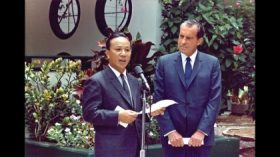
The American Retreat from Vietnam
or go to
Aletho News Archives – Video-Images
From the Archives
Secret document reveals plans for civil war in Lebanon, Israeli false flags, and invasion
By Randi Nord | Geopolitics Alert | April 5, 2019
Beirut – During his visit with US Secretary of State, Mike Pompeo, Lebanese President Michael Aoun reportedly received a US-Israeli document detailing plans for creating a civil war in Lebanon with covert false flag operations and possible Israeli invasion.
Although the source of the document is Israeli and created in partnership with Washington, no one knows who presented it to Aoun. The Lebanese TV station, Al-Jadeed, initially reported the document on Lebanese TV and a video on its website. Geopolitics Alert translated the report for this article. … continue
Blog Roll
 Aletho News
- America’s Greenland deal has a radioactive backstory
- The RAF Fairford ‘terror plot’: Unpacking escalation in the UK echo-chamber
- EU Council Advances Chat Control 2.0 Scanning Proposal
- Ex-Greek MEP files complaint against Israeli spyware firm over alleged Pegasus surveillance
- Troubling ideas throughout the Torah, Talmud, Mishneh Torah and Tanya
- ‘Grave, alarming’: Iran mission on Trump’s UNGA ‘annihilation’ threats
- Najaf airport to reopen to Iranian flights within 24 hours: Ambassador
- From ‘How Will This End For Iran’ to ‘When America Walks Away’: A tale of two Economist covers
- Tehran blasts ‘baseless’ speculation linking Iran to alleged bomb plot at UK air base
- The Rise And… Rise Of ‘Color Revolutions’
- If Americans Knew
- Israel’s siege signals another cruel winter for 1.8 million Gazans – Daily Update
- Netanyahu Asked UAE Leader to Deny Report on Oct. 7 Warning in Secret Visit, Sources Say
- CNN Chief Int’l Correspondent Clarissa Ward on Journalists in Gaza
- Democratic Party Consultants Surround Troy Jackson with Pro-Israel Donors
- Christian Leader Responds To Netanyahu’s Claims Regarding Palestinian Christians
- In Gaza, ‘Whoever Survives the Bombing Won’t Survive the Rubble’
- Israel kills more Palestinians, amid push to resettle Gaza – Daily Update
- Israel forces Gazans to live in constant peril – Daily Update
- Deconstructing Netanyahu’s pants-on-fire UN rant – Daily Update
- Trump betrayed voters with his campaign lies and prioritized a foreign country once he took office
- No Tricks Zone
- New Study: Earth And Venus Surface Warmth Largely Explained By Convection And Lapse Rate, Not CO2 Or Radiation
- 2025 Nature Paper Claiming Worsening Global Drought Gets RETRACTED …Heavily Flawed
- New Study: ‘Global Drought Shows No Detectable Recent Acceleration Under Climate Warming’
- Economic Masterminds: German Socialists Suggest Taxing Productivity Gains Stemming From Using AI
- The South China Sea Has Not Been Cooperating With The Climate Change Narrative
- Energy Crisis: Germany Enters Heating Season With Historically Low Gas Reserve Fill Levels
- New Study: The Antarctic Ice Sheet Gained Mass From 2020-2024 Due To Staggering Snow And Ice Accumulation
- Study: Ocean Heating Rates From Thousands Of Years Ago ‘Dwarf’ Modern Ocean Heating Rates
- Climate Extremists Target, Attack Large-Scale Power Grid Infrastructure In Germany!
- New Study: Antarctic Ice Melt Has Contributed Less Than 1 Centimeter To Sea Level Rise In The Last 30 Years

