“Time Is Running Out” – Syria Edition
By Nima Shirazi | Wide Asleep in America | October 30, 2014
In mainstream political commentary, urgency is key. When crises arise – or linger – those in the media, in tandem with politicians and think tank apparatchiks, urge the government to do something, to act, oftentimes by military means. Drop bombs here! Send weapons to those groups there!
In his latest column for The Daily Beast, veteran journalist and Voice of America broadcaster Jamie Dettmer reports that the Obama administration’s plan to train and arm rebels in Syria to defeat ISIS and, consequently, force Bashar al-Assad to negotiate an end to the ongoing civil war is effectively a fantasy.
“The rebels are squabbling among themselves as suspicions rage about American designs and intentions,” Dettmer writes, adding later that “rebel commanders” complain “that U.S. neglect and Washington’s refusal to arm them with advanced weaponry deprived them of the leverage to discipline fighters and to keep them loyal and to halt defections to jihadist groups.”
So what does Dettmer propose? Well, nothing at all. But his headline writers, in their infinite wisdom and perhaps most favored refrain, insist that “time is running out.”
Of course, when there’s no real plan, military solution, or political will to solve an international conundrum or overcome an diplomatic impasse, rhetorical expediency tells us that time is always running out. We’ve heard it for decades from Afghanistan to Iran to Iraq to Lebanon to Palestine. Shout it from the rooftops: Time is running out!
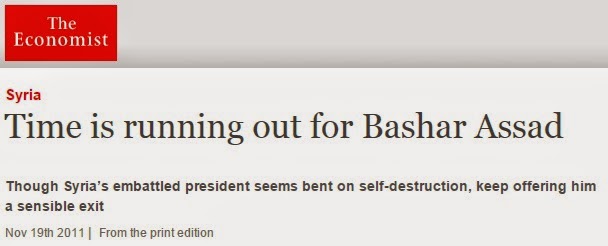
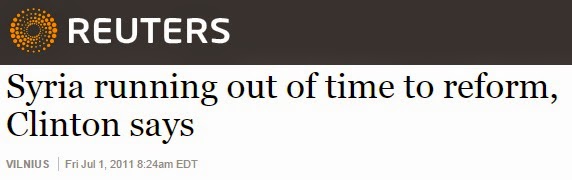
For over three years, we’ve heard the same about Syria. Here are some highlights:
The Daily Beast, October 30, 2014:

The Hill, October 1 , 2014:

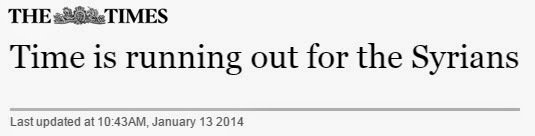
The Times (UK), January 13, 2014:
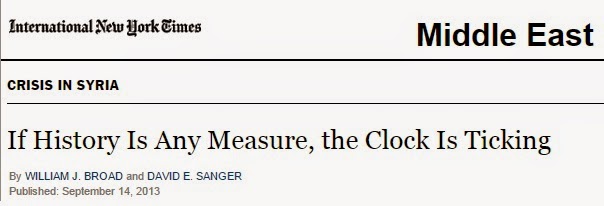
New York Times, September 14, 2013:
The Hill, September 3, 2013:

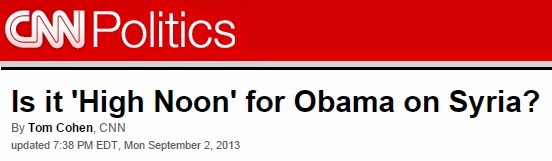
CNN, September 2, 2013:
CNN, August 22, 2013:

CNN, July 3, 2013:

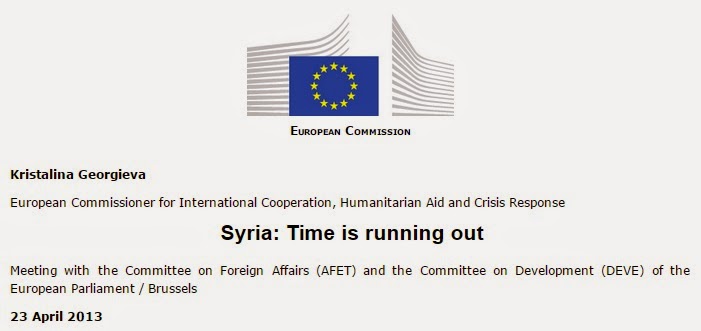
European Commission, April 23, 2013:
Washington Post, March 18, 2013:

Foreign Policy, December 19, 2012:

Ha’aretz, August 7, 2012:

National Journal, August 6 2012:
NBC Nightly News, July 8, 2012:

ABC News, June 30, 2012:
Reuters, May 31, 2012:

Associated Press, April 25, 2012:
Los Angeles Times, April 8, 2012:

The Times of Israel, February 24, 2012:

New York Times, February 6, 2012:
The Economist, November 19, 2011:
Reuters, July 1, 2011:
*****
Treating Putin Like a Lunatic
By Robert Parry | Consortium News | October 25, 2014
When reading the New York Times on many foreign policy issues, it doesn’t take a savant to figure out what the newspaper’s bias is. Anything, for instance, relating to Russian President Vladimir Putin drips of contempt and hostility.
Rather than offer the Times’ readers an objective or even slightly fair-minded account of Putin’s remarks, we are fed a steady diet of highly prejudicial language, such as we find in Saturday’s article about Putin’s comments at a conference in which he noted U.S. contributions to chaos in countries, such as Afghanistan, Iraq, Libya, Syria and Ukraine.
That Putin is correct appears almost irrelevant to the Times, which simply writes that Putin “unleashed perhaps his strongest diatribe against the United States yet” with his goal “to sell Moscow’s view that American meddling has sparked most of the world’s recent crises.”
Rather than address the merits of Putin’s critique, the Times’ article by Neil MacFarquhar uncritically cites the “group think” of Official Washington: “Russia is often accused of provoking the crisis in Ukraine by annexing Crimea, and of prolonging the agony in Syria by helping to crush a popular uprising against President Bashar al-Assad, Moscow’s last major Arab ally. Some analysts have suggested that Mr. Putin seeks to restore the lost power and influence of the Soviet Union, or even the Russian Empire, in a bid to prolong his own rule.”
Yes, “some analysts” can be cited to support nearly any claim no matter how wrongheaded, or you can use the passive tense – “is often accused” – to present any charge no matter how unfair. But a more realistic summary of the various crises afflicting the world would note that Putin is correct when he describes past U.S. backing for various extremists, from Islamic fundamentalists in the Middle East and Central Asia to neo-Nazis in Ukraine.
For example, during the 1980s, the Reagan administration consciously encouraged Islamic fundamentalism as a strategy to cause trouble for “atheistic communism” in Afghanistan and in the Muslim provinces of the Soviet Union.
To overthrow a Soviet-backed government in Afghanistan, the CIA and its Saudi collaborators financed the mujahedeen “holy warriors” who counted among their supporters Saudi extremist Osama bin Laden. Some of those Islamists later blended into the Taliban and al-Qaeda with dire consequences for the United States on Sept. 11, 2001.
By invading Iraq in 2003, President George W. Bush toppled a secular dictator, Saddam Hussein, but saw him replaced by what amounted to a Shiite theocracy which pushed Iraq’s Sunni minority into the arms of “Al-Qaeda in Iraq,” which has since rebranded itself as the Islamic State of Iraq and Syria or simply the Islamic State. Those extremists now control large swaths of Iraq and Syria and have massacred religious minorities and Western hostages, prompting another U.S. military intervention.
Obama’s Interventions
In Libya in 2011, President Barack Obama acquiesced to demands from “liberal interventionists” in his administration and authorized an air war to overthrow another secular autocrat, Muammar Gaddafi, whose ouster and murder have sent Libya spiraling into political chaos amid warring Islamist militias. It turns out Gaddafi was not wrong when he warned of Islamist terrorists operating around Benghazi.
Similarly, Official Washington’s embrace of protests and violence aimed at removing another secular Arab leader, Syria’s Bashar al-Assad, contributed to the bloody civil war that has devastated that country and created fertile ground for the Islamic State and the Nusra Front, the official al-Qaeda affiliate.
Though Obama balked at demands from neocons and “liberal interventionists” that he launch an air war against the Syrian military in 2013, he did authorize secret shipments of weapons and training for the supposedly “moderate” Syrian rebels who have generally sided with Islamist fighters affiliated with al-Qaeda and the Islamic State.
Many of these same neocons and “liberal interventionists” have been eager to ratchet up the confrontation with Iran over its nuclear program, including neocon dreams to “bomb, bomb, bomb Iran,” also a desire of hardliners in Israel.
In some of these crises, one of the few international leaders who has cooperated with Obama to tamp down tensions has been Putin, who helped negotiate conflict-avoiding agreements with Syria and Iran. But those peaceful interventions made Putin an inviting target for the neocons who began in fall 2013 arranging a coup d’etat in Ukraine on Russia’s border.
As Obama and Putin each paid too little attention to these maneuvers, neocons such as National Endowment for Democracy president Carl Gershman, Sen. John McCain, R-Arizona, and Assistant Secretary of State for European Affairs Victoria Nuland went to work on the Ukrainian coup.
However to actually overthrow Ukraine’s elected President Viktor Yanukovych, the coup makers had to collaborate with neo-Nazi militias which were organized in western Ukraine and dispatched to Kiev where they provided the muscle for the Maidan uprising. Neo-Nazi leaders were given several ministries in the new government, and neo-Nazi militants were incorporated into the National Guard and “volunteer” militias dispatched to crush the ethnic Russian resistance in the east.
Putin for the Status Quo
The underlying reality of the Ukraine crisis was that Putin actually supported the country’s status quo, i.e. maintaining the elected president and the constitutional process. It was the United States along with the European Union that sought to topple the existing system and pull Ukraine from Russia’s orbit into the West’s.
Whatever one thinks about the merits of that change, it is factually wrong to accuse Putin of initiating the Ukraine crisis or to extrapolate from Official Washington’s false conventional wisdom and conclude that Putin is a new Hitler, an aggressor seeking to reestablish the Soviet Union or the Russian Empire.
But the Times and other major U.S. news outlets have wedded themselves to that propaganda theme and now cannot deviate from it. So, when Putin states the obvious – that the U.S. has meddled in the affairs of other nations and that Russia did not pick the fight over Ukraine – his comments must be treated like the ravings of a lunatic unleashing some “diatribe.”
Among Putin’s ranting was his observation, according to the Times article, that “the United States supports ‘dubious’ groups ranging from ‘open neo-fascists to Islamic radicals.’
“‘Why do they support such people,’ he asked the annual gathering known as the Valdai Club, which met this year in the southern resort town of Sochi. ‘They do this because they decide to use them as instruments along the way in achieving their goals, but then burn their fingers and recoil.’
“The goal of the United States, he said, was to try to create a unipolar world in which American interests went unchallenged. …
“Mr. Putin … specifically denied trying to restore the Russian Empire. He argued Russia was compelled to intervene in Ukraine because that country was in the midst of a ‘civilized dialogue’ over its political future when the West staged a coup to oust the president last February, pushing the country into chaos and civil war.
“‘We did not start this,’ he said. ‘Statements that Russia is trying to reinstate some sort of empire, that it is encroaching on the sovereignty of its neighbors, are groundless.’”
Of course, all the “smart people” of Official Washington know how to react to such statements from Putin, with a snicker and a roll of the eyes. After all, they’ve been reading the narratives of these crises as fictionalized by the New York Times, the Washington Post, etc.
Rationality and realism seem to have lost any place in the workings of the mainstream U.S. news media.
~
Investigative reporter Robert Parry broke many of the Iran-Contra stories for The Associated Press and Newsweek in the 1980s. You can buy his new book, America’s Stolen Narrative, either in print here or as an e-book (from Amazon and barnesandnoble.com).
Middle East borders bound to change: Israel minister
Press TV – October 24, 2014
Israeli Minister for Military Affairs Moshe Ya’alon says the borders of many Middle Eastern countries are bound to change in the future as a result of recent developments in the region.
The Israeli minister said in a recent interview with the US-based National Public Radio (NPR) that the current borders would change in the coming years, as some have “been changed already.”
The Israeli minister added that the borders of some countries in the region were artificially drawn by the West.
“Libya was a new creation, a Western creation as a result of World War I. Syria, Iraq, the same — artificial nation-states — and what we see now is a collapse of this Western idea,” he stated.
However, Ya’alon said the borders of some nations, including the Egyptian border with Israel, would remain unchanged.
“We have to distinguish between countries like Egypt, with their history. Egypt will stay Egypt,” said Ya’alon.
The minister did not say whether the borders of Israel, also drawn by Western powers after World War I, would change or not.
Regarding the right to return for Palestinian refugees, Ya’alon said Tel Aviv could not allow such a move, as it would keep the Israeli-Palestinian conflict alive “forever.”
He also said that the insistence to remove Israeli settlers from the West Bank amounts to ethnic cleansing.
The Israeli regime expelled more than 700,000 people from their homeland after it occupied Palestine in 1948.
Israeli forces have wiped nearly 500 Palestinian villages and towns off the map, leaving an estimated total of 4.7 million Palestinian refugees hoping for an eventual return to their homeland more than six decades later.
Since 1948, the Israeli regime has denied Palestinian refugees the right of return, despite United Nations’ resolutions and international laws that uphold the people’s right to return to their homeland.
Tel Aviv has built over 120 illegal settlements built since the occupation of the Palestinian territories of the West Bank and East al-Quds.
Syria Lambasts Alliance for Terrorism
October 21, 2014
Dr. Bashar al-Jaafari at the UN: “In Golan terrorists get paid ransom by Qatar with the help of Israel”.
Press TV reporter killed in Turkey car crash after ‘spying accusations’

RT | October 20, 2014
A Lebanese-American reporter working for Iranian channel, Press TV, Serena Shim has been killed in a car crash in Turkey, following her reports of accusations from Turkey’s intelligence agency that she had been “spying.”
“Our correspondent Serena Shim has been killed near the Turkey-Syria border. Serena was killed in a reported car accident when she was returning from a report scene…their car collided with a heavy vehicle,” a Press TV broadcast stated on Monday. Shim had also been the mother of two young children.
The driver of the vehicle was subsequently arrested, according to Turkish news agency Hurriyet, citing the Turkish Doğan News Agency. Press TV disputed this, alleging that both driver and vehicle have disappeared.
Press TV has additionally expressed suspicion, implying that it may not have been an accident. “Just a couple of days ago she had been threatened by Turkish intelligence,” the broadcast said.
Shim had been returning to her hotel after reporting from Suruç – a rural district near the Syrian border, where a many foreign journalists are based. They are covering news from the Syrian northeastern border town of Kobani, under siege by Islamic State militants for the past month due to its strategic importance.
She had expressed fears for her own safety; her death came a day after she reported receiving threats from the Turkish intelligence agency (MİT), saying they had accused her of spying.
“The Turkish intelligence agency has now accused our correspondent Serena Shim of being a spy,” said a Press TV report on Saturday.
“I’m very surprised at this accusation – I even thought of approaching Turkish intelligence because I have nothing to hide,” Shim said in the broadcast on Saturday.
“I am a bit worried, because… Turkey has been labeled by Reporters Without Borders as the largest prison for journalists…so I am frightened about what they might use against me,” she said.
Shim had been reporting that IS militants had crossed the border from Turkey into Syria in trucks apparently affiliated with NGOs, some of which allegedly bore World Food Organization symbols. She claimed that she had received images from Islamic militants crossing the Turkish border and was one of the few reporters focusing on the matter.
“We were some of the first people on the ground –if not the first people – to get that story of… militants going in through the Turkish border… I’ve got images of them in World Food Organization trucks. It was very apparent that they were militants by their beards, by the clothes they wore, and they were going in there with NGO trucks,” she said.
National Service is Anti-Liberty and Un-American
By Ron Paul | October 19, 2014
Former Clinton Administration Labor Secretary Robert Reich recently called on the government to force young people to spend two years either “serving” in the military or performing some other type of government-directed “community service.” Neoconservative Senator John McCain has introduced legislation creating a mandatory national service program very similar to Reich’s proposal. It is not surprising that both a prominent progressive and a leading neocon would support mandatory national service, as this is an issue that has long united authoritarians on the left and right.
Proponents of national service claim that young people have a moral obligation to give something back to society. But giving the government power to decide our moral obligations is an invitation to totalitarianism.
Mandatory national service is not just anti-liberty, it is un-American. Whether or not they admit it, supporters of mandatory national service do not believe that individuals have “inalienable rights.” Instead, they believe that rights are gifts from the government, and, since government is the source of our rights, government can abridge or even take away those rights whenever Congress decides.
Mandatory national service also undermines private charitable institutions. In a free society, many people will give their time or money to service projects to help better their communities, working with religious or civic associations. But in a society with government-enforced national service, these associations are likely to become more reliant on government-supplied forced labor. They will then begin to tailor their programs to satisfy the demands of government bureaucrats instead of the needs of the community.
The very worst form of national service is, of course, the military draft, which forces young people to kill or be killed on government orders. The draft lowers the cost of an interventionist foreign policy because government need not compete with private employers for recruits. Anyone who refuses a draft notice runs the risk of being jailed, so government can provide lower pay and benefits to draftees than to volunteers.
As the burden of our hyper-interventionist foreign policy increases, it is increasingly likely that there will be serious attempts to reinstate the military draft. General Martin Dempsey, the chairman of the Joint Chiefs of Staff, continues to suggest that US troops on the ground may be needed to fight “Operation Inherent Resolve” in Iraq and Syria. A major escalation requiring a large US troop deployment will likely add pressure to consider a military draft.
The only real way the American people can protect their children from the military draft is to demand an end to the foreign policy that sees the US military as the solution to any and every problem — from ISIS to Ebola — anywhere in the world.
Some who share my opposition to a militaristic foreign policy support the draft because they think a draft will increase public opposition to war. However, the existence of a draft did not stop the American government from launching unconstitutional wars in Vietnam and Korea. While the draft did play a role in mobilizing political opposition to Vietnam, it took almost a decade and the death of thousands of American draftees for that opposition to reach critical mass.
It is baffling that conservatives who (properly) oppose raising taxes would support any form of national service, including the military draft. It is similarly baffling that liberals who oppose government interference with our personal lives would support mandatory national service. Mandatory national service is a totalitarian policy that should be rejected by all who value liberty.
Syrian Kurds Refuse To Fight Assad Army: Kurdish Leader
RIA Novosti | October 13, 2014
ANKARA – Kurds are not going to fight alongside Turkey against Syrian President Bashar Assad in Syria, Syrian Kurds leader Salih Muslim said in an interview with the Hurriyet newspaper Monday.
“Do you want us to fight against them in Damascus and be a soldier there instead of you? We will not do that. We have stopped being soldiers for others, which Kurds have done throughout history,” he said as quoted by Hurriyet.
Salih Muslim also commented on the situation in the Syrian border town of Kobani, which has been under attack by Islamic State (IS) militants for weeks now. Kurds living in the city have repeatedly asked Turkey for help, however Ankara has refused to intervene in the conflict.
“They [Turkish authorities] do not need to give anything else but anti-tank weapons if they really want to help our people in the region,” he stated.
The Kurdish leader added that he will see a single-sided establishment of buffer zones in northern Syria proposed by Turkey as an occupation. However, he stated that if the zone is established in accordance with international agreements, then he would not raise any objections.
For the past several weeks, the IS militants have besieged Kobani, one of the largest towns in the Kurdish region of Syria bordering Turkey. More than 400 people have died in clashes between the IS and Kurdish fighters in Kobani, according to the UK-based Syrian Observatory for Human Rights. Some 200,000 refugees have crossed into Turkey to flee the IS threat.
The Islamic State is a Sunni jihadist group that has been fighting the Syrian government since 2012. In June 2014, it launched an offensive in Iraq, seizing vast areas in both countries and announcing the establishment of an Islamic caliphate on the territories under its control.
Urgent: Right-Left Alliance Needed to Stop This War!
By David Swanson | Ron Paul Institute | October 8, 2014
Last year, public pressure played a big role in stopping US missile strikes on Syria. The biggest difference between then and now was that televisions weren’t telling people that ISIS might be coming to their neighborhood to behead them. There were other, smaller differences as well: Britain’s opposition, Russia’s opposition, and the difficulty of explaining to Americans that it now made sense to join a war on the same side as al Qaeda.
But there’s another big difference between last year and this year. Last year was not a Congressional election year. With elections coming this November, Congress declared an early vacation in September and fled town in order to avoid voting a new war up or down. It did this while fully aware that the President would proceed with the war illegally. Most Congress members, including House Speaker John Boehner and Senate Leader Harry Reid, believe that by allowing a war to happen without explicitly voting for or against it they can best win our votes for re-election without offending their funders.
Congress members have good reason to think that way. Numerous organizations and individuals are dumping endless energy and resources into trying to elect either Democrats or Republicans, regardless of their policies. Big groups on the left have told me that they will not have any time for opposing war until the elections are over, at which point they’ll be happy to “hold accountable” any of the Democrats they’ve just reelected. There are organizations who do the same thing for Republicans.
When war was made the top election issue in exit polls in 2006, Democrats took power and their leader in the House, Rahm Emanuel, openly told the Washington Post that they would keep the war in Iraq going in order to campaign against it again in 2008. And so they did. Republicans elected opposing war in 2010 have been more rhetorical than substantive in their “opposition.”
The current war, and the endless war it is part of, must be opposed by people across the political spectrum who put peace ahead of party. ISIS has a one-hour video asking for this war. Giving it to them, and boosting their recruitment, is insanity. Ending insane policies is not a left or right position. This is a war that involves bombing the opposite side in Syria from the side we were told we had to bomb a year ago, and simultaneously arming the same side that the U.S. government is bombing. This is madness. To allow this to continue while mumbling the obvious truth that “there is no military solution” is too great an evil to fit into any lesser-evil electoral calculation.
This war is killing civilians in such large numbers that the White House has announced that restrictions on killing civilians will not be followed. This war is being used to strip away our rights at home. It’s draining our economy. It’s impoverishing us — primarily by justifying the routine annual spending of roughly $1 trillion on war preparations. It’s endangering us by generating further hatred. And all of this destruction, with no up-side to be found, is driven by irrational fear that has people telling pollsters they believe this war will endanger them and they’re in favor of it.
According to the Congressional Research Service 79% of weapons shipments to Middle Eastern countries are from the United States, not counting arms given to allies of ISIS or used by the US military. Rather than arming this region to the teeth and joining in wars with US weapons on both sides, the United States could arrange for and lead an arms embargo. It could also provide restitution for what it has done in recent years, including the destruction of Iraq that allowed the creation of ISIS. Making restitution in the form of actual aid (as opposed to “military aid”) would cost a lot less than lobbing $2 million missiles at people who view them as recruitment posters and tickets to martyrdom. That shift would also begin to make the United States liked rather than hated.
We won’t get there unless people whose souls are un-owned by political parties take over town hall meetings and let Congress members know that they must work to end this war if they want to earn our votes.
Erdogan’s expansionist dreams in Syria
Press TV – October 9, 2014
The policies of the Turkish government and President Recep Tayyip Erdogan are becoming more and more dangerous both in Syria and the whole Middle East.
Ankara has not only been promoting terrorist and extremist groups, alongside its sole ally in the region, Qatar, but it is now preparing an invasion of northern Syria.
Erdogan thinks that he has the right to invade and occupy territories of Turkey’s neighbors and ignore and violate the sovereignty of these Arab countries. He has supported terrorist organizations in Syria and allowed illegal oil trading by these groups, ignored Baghdad’s sovereignty over the Iraqi Kurdistan and its resources and insulted the Egyptian president in the United Nations.
The Erdogan government has long been a key supporter of ISIL, al-Nusra Front and some other terrorist organizations. However, Ankara is now trying to use ISIL advances towards its border as a pretext to illegally send troops to occupy a part of the northern Syrian territory without the authorization of the Syrian government. This is clearly a war act.
Turkish propaganda is invoking a false excuse, the humanitarian protection for Kurds fleeing the advance of ISIL, to promote the creation of a buffer zone and a no-fly zone in Syria.
The objective of this strategy is to weaken the Syrian state and give the Ankara-backed opposition armed groups a sanctuary from which they can launch attacks on the Syrian army and where the Turkish forces can train them.
On his return from New York, Erdogan unveiled some of the plans of the Turkish leadership, which explain the situation prevailing in northern Syria. “We must look to the events in Syria, not only from the angle of terrorism, but also from the angle of the Syrian regime”, he said.
He openly called for the creation of a buffer zone and a no-fly zone in northern Syria, while criticizing Germany’s decision to provide Peshmerga Kurdish forces fighting against ISIL in Iraq with arms, claiming that they could end up in the hands of terrorist organizations, according to the Turkish classification, such as PKK.
That is, from Erdogan’s point of view, the main enemy is not ISIL but the Syrian government and PKK, which are both fighting the ISIL terrorists.
It is noteworthy to point out that the Turkish foreign minister, Mevlut Cavusoglu, has also claimed that Turkey opposes supplying the Iraqi army with weapons, because “95 percent” of the soldiers are Shiites, according to him.
Recently, Abdulkadir Selvi, journalist in the newspaper Yeni Safak, which is considered a leading pro-Erdogan outlet, said that Turkey will not take part in any air war or ground war with the coalition against ISIL in order to press the US to establish a buffer zone in Syria or allow Turkey to do so with its own warplanes and troops.
Erdogan is now using the events in the Kurdish town of Kobani to increase this pressure: If you do not allow me to send troops to Syria, Kobani will fall. This is Erdogan’s new strategy.
According to several media, Syrian Kurds are denouncing Erdogan’s plans. One of them, Binici Ibrahim, member of the Popular Democratic Party (HDP), has blamed Ankara for the situation in northern Syria due to its support for ISIL “The Turkish authorities are partly responsible for this situation. They protect ISIL, which is a terrorist organization”, Binici said, “Today they prevent young Kurds from returning to Syria to defend their territory.” “The Turkish government does not want to defend our city”, accused Mehmet Eminakma, another young HDP activist. “It crazily supports ISIL and not the Syrian people.”
Therefore, Ankara is trying to prevent young Syrian Kurds living in Turkey from returning and fighting against ISIL in order to create a humanitarian crisis and press ahead with its plans.
Facing this blackmail, the strategy of the Obama Administration is not clear. US Secretary of State, John Kerry, has said that stopping ISIL terrorists in Kobani is not a priority because “the strategic objective of the US war is to attack ISIS infrastructure”.
This could mean that Washington understands the Turkish game and is unwilling to fall into the trap.
Nevertheless, on October 8, US Secretary of State John Kerry claimed that the UK and the US were “ready to examine the Turkish idea of setting up a buffer zone in Syria to protect refugees fleeing ISIL violence.” Kerry made the announcement in a joint press conference with British Foreign Secretary Philip Hammond in Washington DC.
“The buffer zone is an idea that is out there. It is worth examining. It is worth looking at very, very closely,” said Kerry. The US Secretary of State added that creating a buffer zone will be one of the issues General John Allen, President Barack Obama’s anti-ISIL envoy, will be discussing with Turkish officials during an upcoming meeting in Turkey.
Some months ago, Turkey sent some troops to protect the Tomb of Suleiman Shah, located 33 km from the border. According to Turkish media, the convoy entered the Syrian territory without asking permission of Damascus. The excuse was some alleged links between the site and the Ottoman history. If such an argument was acceptable, dozens of countries could use a similar pretext to invade other neighbouring states.
Obstacles for a Turkish intervention
However, there are some obstacles for a possible Turkish intervention. First of all, Syrian and Arab peoples remember the Ottoman occupation and they do not want to see the Turks return. Erdogan’s policies have outraged not only Syria and Iraq but also other states of the region. In fact, Jordan’s alleged decision to suspend its participation in the airstrikes in Syria has been linked by some Arab media to Turkish actions in this country.
Other countries, such as Egypt and United Arab Emirates, do not want a Turkish intervention in Syria either. They think that Turkish government, alongside with Qatar, is trying to mobilize its allies of the Muslim Brotherhood in northern Syria and this is a clear threat for these countries, which are battling this group in their territories.
Even Saudi Arabia, despite its hostility towards the Syrian government, will not likely be happy either, as the Saudi regime does not want a more powerful Brotherhood-supporting Turkey in the region.
Secondly, Syria and Iraq have rejected any military Turkish interference. Iraqi Prime Minister Haydar Abadi reiterated on October 7 to his Turkish counterpart, Ahmed Davutoglu, that Iraq rejects any ground intervention of foreign forces in his country under the pretext of fighting ISIL. Syria has also warned that any Turkish military deployment in its territory would be an “act of aggression”.
Thirdly, Iran and Russia have clearly stated that Syria is a red line and any aggression against Syria would violate their principles and interests. Russia will certainly block any project in the UN Security Council to create a buffer or a no-fly zone. Both countries would also respond to such a Turkish action. Russia has recently sent a new warship to the Mediterranean and has held military maneuvers in the Caspian Sea alongside with Iran in order to send a signal to Turkey.
In Turkey, a large part of the population strongly rejects Erdogan’s policies in the Middle East. Major Turkish opposition parties opposed a motion by AKP (Erdogan’s party) aimed at authorizing a military intervention in Syria and Iraq. The Republican People’s Party and Freedom and Democracy Party said that such a step would be “unacceptable”.
There have also been demonstrations in Istanbul and other cities against the government’s interference in Syria and its support for ISIL. On October 5th, 10,000 people marched in Istanbul behind banners proclaiming “ISIL killer; AKP accomplice”.
For the West, Erdogan’s Turkey is becoming a serious problem too. Turkey, a NATO member, is one of the main supporters of extremism in the Middle East, and its imperialist “neo-Otoman” dreams are endangering the whole region and feeding terrorism everywhere. Thus, it is not surprising that Erdogan has become the new hero of the extremist sites and forums in Internet.
However, a Turkish intervention in Syria would have dire consequences for both Erdogan and Turkey. He will soon discover everyone is against him and such a step would renew the fear of “the Otoman resurgence” among the Arab peoples. Therefore, it would become the last nail of the coffin of the Turkish leadership’s ambitions in the Middle East.
New Horizon Conference: Meeting of Minds in Tehran
By Eric Walberg | Dissident Voice | October 8, 2014
The 2nd conference “New Horizon: the International Conference of Independent Thinkers” was held in Tehran, September 29–October 1 2014, including over 30 journalists, writers and academics from around the world presenting papers and arguing issues of world geopolitics, with a focus on the Middle East. I came from Canada, along with University of Lethbridge Globalization Studies Professor Anthony Hall, author of Earth into Property: Colonization, Decolonization, and Capitalism (2010). It was greeted in western media by hysterical denunciations; firstly, by the American Jewish Committee which accused it of “promoting hatred of Jews and Israel”, and the Anti-Defamation League which accused it of “promoting anti-Semitic propaganda”. The conference almost didn’t take place at all, having been officially cancelled, supposedly as a gesture to the West, after the new Iranian President Hassan Rouhani was elected last year. But after a flood of criticism on Iranian websites sympathetic to the organizers, the Iranian Foreign Ministry reversed itself. Nader Talebzadeh, the principle organizer, had had to lobby hard to reinstate the conference, calling the cancellation of the conference “a major mistake on the part of our government”.
“Have our leaders given in so much to the world that they are even afraid of a conference that might hurt Mr Obama’s feelings?” asked one blogger sarcastically.
The 1st New Horizon Conference in September 2012 was denounced in the West when it was addressed by the previous president Mahmoud Ahmedinejad, probably best remembered in the West for his 2005 soundbyte that Israel should be “wiped off the map”, referring to Ayatollah Khomeini’s prediction that “the regime occupying Jerusalem must vanish from the page of time.” The translation of the Persian text was later corrected but this was ignored in the West, where Ahmedinejad was further accused of “holocaust denial” for suggesting the figure of six million as the number of Jews who died in the holocaust was exaggerated, and he was mocked for suggesting that 9/11 was a conspiracy.
Indeed, most Iranians see 9/11 as involving some degree of conspiracy by the US and/or Israel, but then so do, for instance, 55% of Egyptians. So, not surprisingly, prominent at the New Horizon Conference this year was the world’s leading 9/11 conspiracy theorist, France’s Theirry Meyssan, who in 2002 published what is still considered the classic work on the topic, 9/11: The Big Lie (L’Effroyable imposture), translated into 28 languages, arguing that the attacks were organized by a faction of “the US military industrial complex in order to impose a military regime.” Meyssan also argues that the attack against the Pentagon was not carried out by a commercial airliner but by a missile. Also present was American filmmaker Art Olivier, who produced the feature film Operation Terror (2012), whose scenario followed Meyssan’s.
In a YouGov poll last year, 60% of Americans rejected the official explanation as published in the 9/11 Commission Report (2004), so Meyssan’s call for a UN investigation of 9/11 and the recent petition signed by 100,000 New Yorkers for an investigation of the collapse of World Trade Center building 7 are surely legitimate, though they have been blocked by politicians as “absolutely ridiculous” and “wild fantasies”.
Iran’s current President Rouhani was not associated directly with this year’s conference. Instead he was embroiled in a controversy with UK Prime Minister David Cameron, who both extended his hand in friendship to Rouhani at the UN General Assembly in a “historic meeting”, and then slapped him in the face from the UN General Assembly podium, attacking Iran for its “support for terrorist organizations, its nuclear program, its treatment of its people”, calling it “part of the problem in the Middle East”.
“On the contrary,” said a peeved Rouhani in his address to the UN, blaming the West and Saudi Arabia for sowing the seeds of extremism in the Middle East with “strategic blunders” that have given rise to the Islamic State and other violent jihadist groups. He also criticized the West’s sanctions on Iran’s nuclear program and reiterated his government’s desire to resolve the dispute, stating that no cooperation with the West against ISIS is possible until the sanctions are lifted. He called Cameron’s comments at the UN “wrong and unacceptable.”
Appropriately, the New Horizon Conference opened with the book launch of the Persian edition of US journalist Gareth Porter’s Manufactured Crisis: The Untold Story of the Iran Nuclear Scare (2014). Porter told me:
Through painstaking checking with experts and an IAEA official, I discovered that the documents submitted to the IAEA, which supposed showed Iranian plans to put nuclear warheads on their missiles, were fabricated by the terrorist group People’s Mojahedin of Iran and were passed on the IAEA by Mossad. They were contradictory—clearly doctored blueprints for an obsolete missile system.
Porter was awarded the UK Gellhorn Prize for investigative journalism in 2012 for exposing official lies concerning US policies in Afghanistan and Pakistan. With this latest expose, Porter did for the Iranian nuclear dossier what he and others did after 2003 in exposing the lies that prompted the US invasion of Iraq.
The sessions were varied. “The Gaza War and the BDS Movement Strategies” was addressed by Code Pink activist Medea Benjamin, who has been arrested dozens of time for her plucky protests at Congressional hearings against the war in Iraq, and who famously interrupted a speech by President Barack Obama in May 2013 protesting his continued use of drones against civilians. (She is barred from entering Canada.) Benjamin suggested a new project to highlight illegal Israeli settlements: activists hope to target one of the largest US-based real estate firms, RE/MAX, which “operates in over 90 countries, including Israel, where it sells homes complete with swimming pools in the West Bank to Israeli settlers in defiance of international law.” Every Sunday tens of thousands of “open houses” are held by RE/MAX around the world. Benjamin hopes activists will picket these open houses to embarrass RE/MAX into ceasing their West Bank activities. A session on Islam and the West, “Postsecularism and its Discontents”, emphasized the importance of ethics in Islamic civilization which makes subservience to market diktat unacceptable, and is a major stumbling block to understanding between the West and the Muslim world. “There is no teleology in western society, no guiding morality, only an obsession with materialism, with logos,” argued organizer Arash Darya-Bandari. “We believe it is necessary to control the negative tendencies in culture, such as pornography, alcohol, drugs, prostitution, to strive towards a more moral and justice society.”
“The ‘Islamic’ State Meme, its Precursors, and the US-Israel-Saudi Triangle” heard frontline reports from Meyssan and others about the intentional destruction of the Iraqi and Syrian states by the invasion of Iraq and ongoing western and Israeli support for insurgents in Syria, directly resulting in ISIS’s phenomenal success. “The West has abetted Sunni-Shia differences in the process to keep Muslims divided and allow continued western penetration and control of the growing chaos there,” charged Meyssan. Rouhani’s comment at the UN—“Certain intelligence agencies [who] have put blades in the hands of madmen, who now spare no one,”—is hard to argue with.
In the session “The Israeli Lobby in England”, Stephen Sizer, Anglican vicar and author of Christian Zionism—Road Map to Armageddon? (2004), explained that the vast majority of Zionists are not Jewish, but Christian. This prompted him in 2006 to draft what became known as the Jerusalem Declaration on Christian Zionism, signed by four of the Heads of Churches, declaring Christian Zionism a heretical belief, both immoral and a contradiction of faith. The rector of the University of Middlesex was pressured to rescind Sizer’s PhD but the examination committee wouldn’t budge. Nor has Sizer been cowed by constant harassment, including a break-in and the theft of his computer. At the same time, on his visits to Tehran, Sizer lobbies on behalf of Iranian religious minorities and always brings Persian-language New Testaments as “gifts”. “My intent is to show the Iranians that genuine Christians are not a threat to anyone, but bring the message of peace and love.”
Contrary to the shrill cries in the western media that the conference was anti-Semitic, it was unique in my experience in addressing Zionism and US imperialism forthrightly and intelligently, without a hint of racism. The issue of anti-Semitism was addressed and dismissed, as “There is no issue with Jewish people or the Jewish religion,” explained Darya-Bandari, “but rather with Zionism, that secular distortion of Judaism that itself is racist, and has been used as a pretext to dispossess and kill Palestinians.”
The American Defense League loudly attacked the conference for focusing on Zionist control of western media and the outsize influence of the Zionist Lobby in the US and around the world. So what’s wrong with that? There is more than enough documented proof of this, as I discover when I researched Postmodern Imperialism. The ADL labelled several of the delegates as anti-Semitic, including ex-US Marine Ken O’Keefe, who has led several relief convoys to Gaza, has appeared several times on BBC’s Hardtalk in support of Gaza, and famously renounced his US citizenship in view of US crimes around the world. It should be remembered that the ADL was successfully sued in the 1990s for false accusations of anti-Semitism.
The conference issued a resolution condemning ISIS, Zionism, US unconditional support of Israel, Islamophobia, and calling for activism locally to boycott Israeli goods and to promote understanding between the West and the Muslim world, and to fight sectarianism. “This was a great opportunity to meet anti-imperialist activists from around the world, to bring Russians, Poles, western Europeans, North Americans together with Iranians and other Muslims, both Sunni and Shia, in a forum without sectarianism, truly supporting peace and understanding,” said delegate Mateusz Piskorski, director of the European Centre of Geopolitical Analysis in Warsaw and former MP in the Polish Sejm.
~
Featured Video

The American Retreat from Vietnam
or go to
Aletho News Archives – Video-Images
From the Archives
Secret document reveals plans for civil war in Lebanon, Israeli false flags, and invasion
By Randi Nord | Geopolitics Alert | April 5, 2019
Beirut – During his visit with US Secretary of State, Mike Pompeo, Lebanese President Michael Aoun reportedly received a US-Israeli document detailing plans for creating a civil war in Lebanon with covert false flag operations and possible Israeli invasion.
Although the source of the document is Israeli and created in partnership with Washington, no one knows who presented it to Aoun. The Lebanese TV station, Al-Jadeed, initially reported the document on Lebanese TV and a video on its website. Geopolitics Alert translated the report for this article. … continue
Blog Roll
 Aletho News
- ‘Distance yourselves from Israel’: IRGC urges US population to question govt policies
- America’s Greenland deal has a radioactive backstory
- The RAF Fairford ‘terror plot’: Unpacking escalation in the UK echo-chamber
- EU Council Advances Chat Control 2.0 Scanning Proposal
- Ex-Greek MEP files complaint against Israeli spyware firm over alleged Pegasus surveillance
- Troubling ideas throughout the Torah, Talmud, Mishneh Torah and Tanya
- ‘Grave, alarming’: Iran mission on Trump’s UNGA ‘annihilation’ threats
- Najaf airport to reopen to Iranian flights within 24 hours: Ambassador
- From ‘How Will This End For Iran’ to ‘When America Walks Away’: A tale of two Economist covers
- Tehran blasts ‘baseless’ speculation linking Iran to alleged bomb plot at UK air base
- If Americans Knew
- Israel Has Kidnapped Another American Teenager
- US arms sales to Israel worth $21.6 billion in 20 months
- Three Palestinians Killed in Israeli Attacks on Gaza
- Revealed: German “Anti-Semitism Expert” Driving Crackdown on Palestine Solidarity is Former Israeli Spy
- Egypt’s Warning to Israel Before Oct 7
- Israel’s siege signals another cruel winter for 1.8 million Gazans – Daily Update
- Netanyahu Asked UAE Leader to Deny Report on Oct. 7 Warning in Secret Visit, Sources Say
- CNN Chief Int’l Correspondent Clarissa Ward on Journalists in Gaza
- Democratic Party Consultants Surround Troy Jackson with Pro-Israel Donors
- Christian Leader Responds To Netanyahu’s Claims Regarding Palestinian Christians
- No Tricks Zone
- New Study: Earth And Venus Surface Warmth Largely Explained By Convection And Lapse Rate, Not CO2 Or Radiation
- 2025 Nature Paper Claiming Worsening Global Drought Gets RETRACTED …Heavily Flawed
- New Study: ‘Global Drought Shows No Detectable Recent Acceleration Under Climate Warming’
- Economic Masterminds: German Socialists Suggest Taxing Productivity Gains Stemming From Using AI
- The South China Sea Has Not Been Cooperating With The Climate Change Narrative
- Energy Crisis: Germany Enters Heating Season With Historically Low Gas Reserve Fill Levels
- New Study: The Antarctic Ice Sheet Gained Mass From 2020-2024 Due To Staggering Snow And Ice Accumulation
- Study: Ocean Heating Rates From Thousands Of Years Ago ‘Dwarf’ Modern Ocean Heating Rates
- Climate Extremists Target, Attack Large-Scale Power Grid Infrastructure In Germany!
- New Study: Antarctic Ice Melt Has Contributed Less Than 1 Centimeter To Sea Level Rise In The Last 30 Years

