Obama ‘should be grateful’ for face-saving chance to backpedal on Syria
RT | September 10, 2013
President Obama should curb threats of a US military strike on Syria by joining Russia’s “face-saving” proposal for Damascus to give control of its chemical weapons to the international community, independent researcher Soraya Sepahpour-Ulrich told RT.
Sepahpour-Ulrich said that Russia’s proposal allows Obama and America “to save face,” given the fact that a military strike on Syria would be “contrary to the people’s will” and receive little international support.
RT: Do you think this nascent solution is something that can actually lead to a workable compromise?
Soraya Sepahpour-Ulrich: It could. It’s a face-saving out for Mr. Obama, really. Because he doesn’t have the support to go to war, and if he chooses to go over the people of the United States, the majority of whom disapprove of this war, and the strikes, then he’s turning his back on democracy, and they always say in America they want to export democracy to other countries. So this is a blatant violation and goes contrary to the people’s will. And I think the proposal is really being very kind to Mr. Obama, giving him a way out.
RT: Why do you think Russia’s proposal to put Syria’s chemical stockpiles under international control received a positive response so quickly?
SSU: I think it was very positive because, well, for one, Assad doesn’t want war, he doesn’t want his people to die because there are lobby groups in Washington pushing for war. So I think he was happy to accept that. And I think the other countries, although Kerry and Obama are skeptical, they do not want this war. They do not want to go to this war. They do not have the support they hoped to have and yet they have those red lines that they have drawn which in fact were violated back in May. That’s when the United Nations said they thought the rebels were responsible and they didn’t act on it. But then to have painted themselves in a corner and this gives them the way out. It helps America, of course, its allies are happy not to go to war. It might be a win-win situation for all.
RT: The president has recently come out in some interviews saying this could be a positive step in the right direction, but we haven’t heard any assertive decision on his part. How do you think his quick his repositioning on the subject can be explained?
SSU: I think when he saw there is absolutely no support at all whatsoever, I mean even if Congress did vote for him to carry out these strikes, again, Congress would’ve been acting against the will of the people. America’s really onstage right now for the whole world to see. Not from a degree of, perhaps, hypocrisy, but the fact that it’s not really a promoter of democracy anywhere. And I think that this is a face-saving way for Obama to back-pedal on his position, and he should be very grateful that this solution was offered.
RT: Many legislators we’ve heard from say they were relieved by this talk of a compromise. Do you think they were looking forward to a vote on this subject?
SSU: I think they were very apprehensive because on the other hand, any legislator that would not have acted out the people’s will and had voted for war to please the lobby groups – no matter how much money the lobby would have actually put into their re-election – they would still need the vote of the people. So they were in a dilemma as well. I think the whole country, the whole nation was in a dilemma. And this really was a very clever way of avoiding all sorts of conflicts and casualties and allowing America to save face.
CBS’s Face the Nation: Blatant Pro-Israel Pro-War Bias Revealed
By Michael Gillespie | Dissident Voice | September 9, 2013
CBS’s Face the Nation host Bob Schieffer brought together this morning what he characterized as “one of our best panels of analysts ever,” a group of five supposed experts, to discuss President Obama’s plan to launch military action against Syria: the Washington Post‘s Bob Woodward, the Weekly Standard‘s Bill Kristol, the New York Times‘ David Sanger, the Washington Post‘s David Ignatius, and the American Enterprise Institute (AEI)’s Danielle Pletka. Schieffer presented this group as if his audience might expect it to represent a range of views. Nothing could be further from the truth.
Daniel Pletka is vice president of AEI, a neoconservative think tank that was instrumental in dragging the US into the hideously expensive and stunningly counterproductive war in Iraq. Several AEI scholars—including Richard Perle and Michael Ledeen—were associated with war profiteering and the phony intelligence used by pro-Israel neoconservative operatives inside the Bush/Cheney administration to stampede the USA into war in Iraq. Pletka was last in the news for smearing the then-Secretary of Defense nominee, former Senator (R-NE) and decorated Vietnam War veteran Chuck Hagel, as an anti-Semite. (Secretary of Defense Hagel is reported to be privately unenthusiastic about plans for military action against Syria.)
David Ignatius routinely defends Israel and champions proposed Israeli solutions to the Israel-Palestine conflict without letting facts get in the way. In 2009, Ignatius caused an international incident that adversely affected Turkish-Israeli relations when, during a panel discussion about the 2008-2009 Gaza War at the World Economic Forum in Davos, Switzerland, he allowed Israeli President Shimon Peres to speak twice as long as the other participants and then attempted to silence Turkish Prime Minister Recip Tayyip Erdogan. The panel featured two heads of state, the U.N. secretary-general, and the secretary of the Arab League, and it dealt with an extremely sensitive issue. In allowing Peres to go last, giving him twice as much time to speak, and then repeatedly attempting to cut off Erdogan’s response, Ignatius showcased his pro-Israel bias on a world stage.
David Sanger has long propagandized for a US war against Iran in the pages of the New York Times. According to SourceWatch: “A few days after Ehud Barak, the Israeli Defense minister, admitted that Iran was not pursuing a nuclear weapons program, the New York Times ran a series of articles slighting Barak’s assertion all the way to confirming the opposite, i.e., that Iran was actually pursuing such weapons program. Sanger was key in the NYT’s drum beating.” Ray McGovern, a former CIA senior officer who briefed several US presidents, had this to say about Sanger’s articles: “Next it was time for the Times to trot out David Sanger from the Washington bullpen. Many will remember him as one of the Times’ stenographers/cheerleaders for the Bush/Cheney attack on Iraq in March 2003. An effusive hawk on Iran also, Sanger was promoted to a position as chief Washington correspondent, apparently for services rendered. In his Jan. 22 article, ‘Confronting Iran in a Year of Elections,’ Sanger pulls out all the stops, even resurrecting Condoleezza Rice’s “mushroom cloud” to scare all of us—and, not least, the Iranians.”
Bill Kristol is the chairman and co-founder of the Project for the New American Century (PNAC) and a board member of the Emergency Committee for Israel. Author David Corn has referred to Kristol as “the No. 1 cheerleader for the Iraq War.” Kristol was one of the architects of the blueprint for regime change and “creative destruction” in the Middle East dreamed up by PNAC. Kristol signed the September 20, 2001, PNAC letter endorsing President George W. Bush’s “admirable commitment to ‘lead the world to victory’ in the war against terrorism.” Kristol said in a January 14, 2003, PBS Frontline interview “that the significance of President George W. Bush’s State of the Union address in 2002 (the ‘axis of evil’ speech) is too easily forgotten—that it was a rare moment, ‘the creation of a new American foreign policy’—and that Bush deserves credit for realizing very quickly after Sept. 11 that his presidency would be judged by how he handled the post-9/11 threat of weapons of mass destruction.” Weapons of mass destruction that, as it happened, could not be found because they did not exist.
Bob Woodward is yet another pro-Israel propagandist for executive power and for war. Andrew Bacevich, an accomplished author, Professor of International Relations and History at Boston University, and a retired career officer in the United States Army has described Woodward this way: “Once a serious journalist, the Washington Post’s Bob Woodward now makes a very fine living as chief gossip-monger of the governing class. … Back in 2002, for example, during the run-up to the invasion of Iraq, Woodward treated us to Bush at War. Based on interviews with unidentified officials close to President George W. Bush, the book offered a portrait of the president-as-resolute-war-leader that put him in a league with Abraham Lincoln and Franklin Roosevelt. But the book’s real juice came from what it revealed about events behind the scenes. ‘Bush’s war cabinet is riven with feuding,’ reported the Times of London, which credited Woodward with revealing ‘the furious arguments and personal animosity’ that divided Bush’s lieutenants. Of course, the problem with the Bush administration wasn’t that folks on the inside didn’t play nice with one another. No, the problem was that the president and his inner circle committed a long series of catastrophic errors that produced an unnecessary and grotesquely mismanaged war,” wrote Bacevich. Somehow, Woodward missed all of that and a great deal more. “That war has cost the country dearly—although the people who engineered that catastrophe, many of them having pocketed handsome advances on their forthcoming memoirs, continue to manage quite well, thank you,” declared Bacevich.
This then is “one of our best panels of analysts ever,” according to Bob Schieffer, who once might have rightly claimed to be something other than a stooge for the Israeli foreign ministry. What CBS’s collection of well-heeled pro-Israel propagandists all agree on is this: The US government should launch military action in Syria in order to maintain political and military pressure on Iran, which Israel views as enemy No. 1 (though Iran has not attacked another country in well over 200 years).
One detail the panelists didn’t mention is that Syria is in the Russian sphere of influence and Russia has warships stationed in the eastern Mediterranean off the coast of Syria. Another thing the panelists didn’t mention is that Israeli air and sea forces attacked a lightly armed US Navy signals intelligence vessel, the USS Liberty, in the eastern Mediterranean on June 8, 1967, killing 34 US personnel and wounding 171. Nor did the panelists mention that in the middle 1980s Israeli spies handling an American-Jewish traitor, Jonathan Pollard, stole thousands of highly classified intelligence documents from the US Navy counter-terrorism intelligence facility where Pollard was employed, or that Israel provided many of those documents to the Soviet Union causing great harm to US intelligence capabilities and interests.
What CBS panelists didn’t say is that Syria is the next stop on Israel’s road to a US war against Iran. What they dare not say is that a US attack on Syria might well draw the USA into a much wider war in a region already severely destabilized by more than a decade of enormously expensive, ill-conceived, poorly managed, hideously destructive, and extraordinarily counterproductive US military actions undertaken largely at the insistence of pro-Israel neoconservatives whose wildly inordinate influence over the Washington foreign policy establishment poses an imminent threat to a great many legitimate US national interests, if not to the uninterrupted progress of human civilization.
~
Michael Gillespie, in addition to his regular freelance work for Washington Report on Middle East Affairs, is also a contributing editor and the Des Moines, IA correspondent for The Independent Monitor, the national newspaper of Arab Americans, published by Sami Mashney in Anaheim, CA.
Related article
- Neocons Take Flight Over Syria (lobelog.com)
Syria: Fate of Historic Christian Town Still Unknown

Maaloula is considered a heritage site by UNESCO, where a number of ancient Christian churches and monasteries are located. (Photo: Marwan Tahtah)
By Abdel Rahim Assi | Al-Akhbar | September 9, 2013
Reports coming out of the ancient Christian town of Maaloula remain unclear as to whether the Syrian army has in fact regained control after radical Islamists entered it last week.
Until Sunday, September 8, news reports of Maaloula conflicted each other. Some reports suggested that the hardline al-Nusra Front managed to filter back into the town after the Syrian military claimed it had expelled the militants and re-established security. Yet the town’s representative in the Syrian parliament, Maria Saadeh, explained that the army had in fact regained control of Maaloula after having been forced to retreat briefly for “tactical reasons.”
The number of casualties cited has ranged between four and 20 dead, in addition to four to 15 kidnapped locals.
Saadeh added that most of the residents are still in their homes, reluctant to leave due to the presence of snipers dug into the cliffs that surround the town, although some women and elderly people did manage to leave when the army first entered the area.
Maaloula is considered a heritage site by UNESCO, where a number of ancient Christian churches and monasteries are located. The town lies over 40 km from Damascus near the Lebanese border. Saadeh noted that some reports of the fighters’ targets were exaggerated, while confirming that at least two historic churches were heavily damaged.
The MP insisted that the attack on the town was not essential from a military point of view, saying that the fighters could have easily bypassed it in order to carry out attacks on army checkpoints in the area. But, she says, they wanted to enter Maaloula to vandalize and destroy it, adding that many residents confirmed to her that the fighters they saw were of foreign nationalities, including Chechens and Libyans.
She said that targeting the historic town was part of a larger plan to drive Christians out of Syria, pointing to many examples such as the attacks on a number of Christian areas in Damascus, Homs, and the Jazira area in the north.
By assaulting such a symbol of Christianity in the area as Maaloula, she maintained, the fighters are sending a message to the community that they must leave Syria, after having driven them out of Iraq over the last decade. Saadeh completely rejected European offers of refuge to Syria’s Christians, insisting that they have no intention of abandoning the deep roots and heritage that connect them to the Levant.
Israel’s Lobbyists Pushing Hard for another War in the Middle East
By Jeremy Salt | Palestine Chronicle | September 8, 2013
Ankara – Two million refugees out of Syria, some of them Palestinian refugees from 1948 and 1967 and some Iraqi refugees from 2004. They are the consequences of war and yet the raging beast that is devouring the Middle East is still not satiated. Another war looms. Another country already devastated is to be shattered by missile attacks. Who wants this war: who could want it? Who could even think of avenging the dead by calling for more killing?
It is not the people of the world. All polls show they are against it. Not just the people of Latin America, Africa, the Indian subcontinent, southeast Asia and China but the American people, the British people, the French people and the Turkish people. It is only the politicians who want this war: Obama, Kerry, Hagel, McCain and others in the US; Cameron and Hague in Britain; Hollande in France; and Erdogan in Turkey. None of them has any proof of their accusation that the Syrian army used chemical weapons around Damascus, but proof is beside the point. Their Muslim contras have failed to destroy the government in Damascus and now in the chemical weapons attack they have their pretext for doing the job themselves.
The US administration is now deciding how long this attack should last. Should it be a few days, or a few months? Should it be aimed at just punishing the ‘regime’ or should it be aimed at destroying it altogether, which seems to be the emerging consensus? They are talking this over confidently, almost nonchalantly, McCain playing poker on his mobile phone because he is so bored, as though their missile attacks on other countries have lulled them into thinking that their military power is so great they could not possibly be hurt themselves.
Erdogan wants a ‘Kosovo-style’ aerial campaign. In 1999, NATO aircraft flew more than 38,000 ‘sorties’ over Yugoslavia, of which number 10,484 were strike attacks. Operation Allied Force lasted for 78 days, not the 30 days claimed by Kerry when being questioned by the Senate committee which finally voted for war on Syria. In 2011 NATO launched Operation Unified Protector against Libya ‘to protect the people from attack or threat of attack.’ This particular ‘operation’ lasted for seven months, during which 26,500 ‘sorties’ were flown, 9700 of them strike sorties. Even the National Transitional Council, the incoming government after the destruction of the government in Tripoli, said 25,000 people had been killed. A similar operation over Syria, a country much better able to defend itself, and with powerful allies besides, would cause enormous further destruction and the death of many thousands of people. This is the meaning of ‘Kosovo-style’ aerial warfare. In fact, what is shaping up is even worse, an air war that will have more in common with Iraq than the bombing of Yugoslavia. The targets and objectives are being expanded all the time.
Saudi Arabia has no politicians and no public opinion polls which would tell us what the Saudi people think of their government and its role in the destruction of Syria. The only country in which the government and the people are clearly united in their support for an attack on Syria is Israel. Polls show that nearly 70 per cent of Jewish Israelis – Palestinians are fully against it – are in favor of the US striking Syria, while thinking that Israel should stay out unless Syria or Hezbollah retaliate with strikes against Israeli targets. The British vote against war and Obama’s hesitation forced Israel and its lobbyists in the US to break cover, ending the silly pretense that Israel is not involved in Syria and does not really care who wins. David Horowitz, the former editor of the Jerusalem Post, wrote an infuriated piece about ‘how a perfect storm of British ineptitude and gutlessness sent the wrong message to the butcher of Damascus and left Israel more certain than ever that it can rely only on itself.’ The novelist Noah Beck accused Obama of being spineless. Others in the media called him weak and unreliable. By ‘blinking’, he had sent a dangerous message to ‘cruel regimes’ and terrorists everywhere. Debkafile, an outlet for disinformation and other scrapings from the floor of Israeli intelligence, echoed this line. Obama’s ‘about turn’ had let Iran, Syria and Hezbollah ‘off the hook ’, creating a ‘military nightmare’ for Israel, Jordan and Turkey.
The same lines of attack and support were duplicated by Israel’s formal and informal lobbyists in the US. Charles Krauthammer of the Washington Post sneered at Obama for hesitating: ‘Perhaps we should be publishing the exact time the bombs will fall lest we disrupt dinner in Damascus’. Wrote William Kristol in the Weekly Standard: ‘Is President Obama going wobbly on Syria? No. He’s always been wobbly on Syria – and on pretty much everything else … the worst outcome would be for Obama not to call Congress back or not to act at all but to falter and retreat. For his retreat would be America’s retreat and his humiliation America’s humiliation.’ Kristol’s stablemate, Thomas Donnelly, thought Obama content ‘‘to see Assad kill his own people – which he has done in the tens if not hundreds of thousands – as long as Assad doesn’t use chemical weapons’. Thomas Friedman wrote in the New York Times that the most likely option for Syria was partition, ‘with the pro-Assad, predominantly Alawite Syrians controlling one region and the Sunni and Kurdish Syrians controlling the rest.’ The fragmentation of Syria on ethno-religious lines, of course, has been a Zionist objective for decades. No mention by Friedman of the Druze, but never mind that: in the interim, America’s best option is not the launching of Cruise missiles ‘but an increase in the training and arming of the Free Syrian Army – including the antitank and antiaircraft weapons it’s long sought.’ Friedman thought this might increase the influence on the ground of the ‘more moderate groups over the jihadist ones.’
At the Washington Institute for Near East Policy, the entire stable was off and running. ‘Forget the red line and engage in Syria,’ wrote David Schenker, as if the US has not been intensely engaged in Syria for the past three years, fomenting the violence which has built up to the present catastrophic situation. Wrote Robert Satloff: ‘Given the strategic stakes at play in Syria which touches [sic.] on every key American interest in the region, the wiser course of action is to take the opportunity of the Assad regime’s flagrant violation of global norms to take action that hastens the end of Assad’s regime … this will also enhance the credibility of the president’s commitment to prevent Iran’s acquisition of a nuclear weapons capability.’ Michael Herzog thought the US could learn from Israeli air attacks on Syria: ‘In Israel’s experience Assad has proven to be a rational (if ruthless) actor. He was deterred from responding to recent and past strikes because he did not want to invite the consequences of Israeli military might. Therefore, the United States has a good chance of deterring him as well.’
In Commentary, Max Boot called on the US to use air power in cooperation with ground action by ‘vetted’ rebel forces to ‘cripple and ultimately bring down Assad’s regime, making impossible further atrocities such as the use of chemical weapons.’ How these forces are to be ‘vetted’ and how they, rather than the Islamist groups who are doing most of the fighting, could bring down the ‘regime’ Boot does not say, most probably because he doesn’t know. Daniel Pipes, the long-term advocate of Israeli violence in the Middle East, writing in National Review online, wanted not a ‘limited’ strike but something that would do real damage and brings the ‘regime’ down.
Outside these journals and the think tanks, former ‘government advisers’ and ‘foreign policy experts’ signed a petition calling for ‘direct military strikes against the pillars of the Assad regime’. Many of the names will be familiar from the Project for the New American Century and plans laid long ago for a series of wars in the Middle East: Elliott Abrams, Fouad Ajami, Gary Bauer, Max Boot, Ellen Bork, Eliot A. Cohen, Paula Dobriansky, Thomas Donnelly, Douglas Feith, Reuel Marc Gerecht, Robert Kagan, William Kristol, Bernard-Henri Levy, Michael Makovsky, Joshua Muravchik, Martin Peretz, Karl Rove, Randy Scheunemann, Leon Wieseltier and Radwan Ziadeh.
AIPAC and the Jewish organizations piled the pressure on Congress and the White House. AIPAC’s statement on Syria stressed the sending of a ‘forceful message of resolve to Iran and Hizbullah’ at a time ‘Iran is racing towards obtaining nuclear capability.’ The Politico website quoted unnamed AIPAC officials as saying that ‘some 250 Jewish leaders and AIPAC activists will storm the halls on Capitol Hill beginning next week to persuade lawmakers that Congress must adopt the resolution or risk emboldening Iran’s efforts to build a nuclear weapon … they are expected to lobby virtually every member of Congress’. Their ‘stepped-up involvement’ comes at a welcome time for the White House, wrote the Politico correspondent, given its difficulty in securing support for the resolution. The two top Republican leaders in the Senate, minority leader Mitch McConnell and minority whip John Cornyn, had already been urged ‘by top Jewish donors and AIPAC allies’ to back the war resolution.
The Conference of Presidents of Major Jewish Organizations called for an attack that would demonstrate ‘accountability’ to ‘those who possess weapons of mass destruction, particularly Iran and Hezbollah.’ Morris Amitay of the pro-Israel Washington Political Action Committee thought that ‘for our [United States] credibility we have to do something.’ Bloomberg reported the Republican Jewish Coalition as sending an ‘action alert’ to its 45,000 members ‘directing them to tell Congress to authorize force.’ The same message of support for an attack was sent out by the National Jewish Democratic Council and Abe Foxman of the so-called Anti-Defamation League, who stressed that while ‘he’s not doing this for Israel,’ the attack may have serious consequences for Israel.
With the exception of the Foxman statement, these organizations carefully kept any mention of Israel out of their public statements. In off the record discussions, however, it was the central concern. On August 30 Obama had a conference call with 1,000 rabbis, with Syria, ‘at the White House’s request,’ according to Bloomberg, being the first question asked. Iran was not mentioned either but, said a leading rabbi from New York, ‘we have a strong stake in the world taking seriously our insistence that weapons of mass destruction should not proliferate’. Bloomberg quoted Obama as ‘arguing’ that ‘a military response is necessary to uphold a longstanding international ban on the use of chemical weapons use and to deter Assad from using them again on his own people or such neighbors as Israel and Jordan.’ Of course, this was not an argument at all but Obama telling the rabbis what they wanted to hear. In a separate approach, 17 leading rabbis ‘covering the religious and political spectrum’, according to the Jewish Telegraphic Agency, sent a letter to Congress calling on it to authorize force against Syria. The language could scarcely be more Orwellian: ‘Through this act, Congress has the capacity to save thousands of lives.’
Another conference call was held between representatives of the Conference of Presidents of Major Jewish Organizations and White House deputy national security advisors Tony Blinken and Ben Rhodes. The representatives waited until Blinken and Rhodes were ‘off the call’ before advising constituent organizations ‘not to make their statements ‘Israel-centric’,’ according to the Jewish Telegraphic Agency. A powerful figure wheeled out by the lobby is Sheldon Adelson, the casino billionaire who funds settlement in Jerusalem and on the West Bank and spent (along with his wife) $93 million trying to see Obama defeated in the presidential election last year. Adelson is a board member of the Republican Jewish Coalition and supports the pressure it is putting on Congress to authorize a military attack on Syria.
The carefully crafted outlines of this deceitful campaign are very evident:
1. This is not about Israel
2. This is about America’s national interest.
3. This is about punishing a government which has used chemical weapons on its own people.
4. This is about saving lives
5. This is about a government that has no respect for international law and norms.
6. This is about sending a ‘forceful message of resolve to Hezbollah and Iran.’
7. This is about showing that Obama’s red lines are not empty threats.
Obama’s own ‘full court press strategy’ includes interviews with six television anchors ahead of the congressional vote. The moment Obama said everything AIPAC wanted to hear during the primaries was the moment he took the first step into the tight corner in which he now finds himself. This is now a global confrontation with a lot at stake besides Israel’s interests, but it is pushing as hard as it can to make sure this war goes ahead. Like David Cameron, a congressional vote against war will allow Obama to back out of the corner by saying that the American people have spoken and he cannot take them into war against their wishes. Will he do that, or is really going to plunge his country into war irrespective of what Congress or the American people think? By the end of the coming week we should have the answer.
– Jeremy Salt is an associate professor of Middle Eastern history and politics at Bilkent University in Ankara, Turkey.
Related articles
Bye, Bye, American Pie: US intransigence in the face of a war-weary world
US intransigence in the face of a war-weary world will mean the end of the country as we know it
By Daniel Patrick Welch | September 4, 2013
 It actually shouldn’t be that much of a shock. For the last twelve years at least, Americans have watched their country drift into the shadows of international law abroad and onto the shoals of fascism at home. Inexorably, the weight of imperial overstretch has crippled an economy already on a constant war footing and led to the steady erosion of civil liberties once taken for granted.
At one point, Democrats cried out in (what turns out to be mock) horror when one of the Bushmen smirked at the Geneva Convention as ‘quaint.’ Outrageous! Squeaked the remnants of an American “Left.” No more. As drones are poised to darken the skies like a plague of locusts, intelligence agencies can read all of our communications even as we write them, and the general criminalization of dissent has accelerated without objection because, after all, the guy doing it has a -D after his name.
And now, nary a peep from so-called ‘progressives’ in Congress as a Democrat and his lurking, smooth-talking Consigliore use the same lies and fabrications to shove yet another war down our throats, all neatly packaged in Red, White and Blue, the specter of National Security—in short, the same old bullshit we’ve heard before.
But it’s not the same—that’s the point. And it’s a shame the fools in congress are too stupid (most of them, apparently) to see it. Showing the delusional thinking that is now seemingly required to hold and keep public office, one particularly deranged congresswoman actually told Wolf Blitzer that “dozens” of countries stood ready to support the US’ aggressive war against Syria, though she couldn’t name them offhand. Debbie Wasserman Schultz actually said “I mean we have, from the briefings that I’ve received, there are dozens of countries who are going to stand with the United States, who will engage with us on military action and also that back us up.”
Oh, okay then. Micronesia will send staples, and Samoa is serving drinks. The problem is that, inside the bubble of American “thought,” these people really think that mobilizing the ‘international community’ is the same a papering an audience for a bad musical on a weeknight. It is all just a cynical farce to them. They don’t know, or don’t care, that the whole world sees this for the fraud that it is. The Obama regime is about to make the biggest mistake in history.
This is not hyperbole. Bush had far more support going into Iraq, and Saddam had far less. His case for war, filled with lies and fabricated ‘evidence’ and ginned up ‘intelligence’ findings, is far better than the US’ current position—a complete crock of shit to the whole world, but that somehow smells like roses to the US Congress. The government has ceased to function as a representative body, and is completely divorced from the interests of the American people. Don’t want to trust such a judgment to an old commie like me? Take it from a former president—Jimmy Carter. Mr. Peanut himself admitted there is ‘no functioning democracy’ currently in the US. The arrogance of Obama’s War Council is stunning. Russia, China, and Iran have given repeated warnings—stern, clear, and unequivocal, against such an illegal and foolhardy course of action. The world has had it with American intransigence. It makes no difference whether an illegal war of aggression is ‘authorized’ by a compliant US Congress. Zero.
No matter what happens from here on out, the balance of power is already shifting, away from the US and its vassal states toward BRICS and the nations of the Global South. Even if the US regime does not attack (in itself a poor choice of words since it has been arming and funding foreign mercenaries in Syria for over two years), a too-patient world is ready to muzzle the rabid dog that is the US. China, while keeping mostly cool, has let it be known that if a strike does go ahead, that others should offer assistance to resist. This is as clear a shot across the bow as there is, and should give US warmakers pause.
What it means is that Syria, as a sovereign state, is justified in calling on its allies for help, by which it means Iran and its store of Russian Sunburn missiles, or Hezbollah and its own Chinese C-802 missiles, or Russia itself with its S300, S400 & S500 missiles. This is the real red line, and the US already crossed it in Libya. Putin has said that the Americans are acting like a monkey with a grenade in the Middle East. To put a finer zoological point on it, the Panda and the Bear are not fooling around. They have decided, and rightly so, that the US is too dangerous and must be stopped. If Obama goes ahead with this maniacal and murderous plan, China, Russia, Iran and Hezbollah will help Syria sink a few US destroyers, sending hundreds and perhaps thousands of kids to the bottom of the Mediterranean—they have as much as said so. They—not the US—will be within their rights and within international law to do so.
Mourn now, not later. And mourn at least equally for the kids your kids kill and for your kids who are killed in return. Don’t go running for the flag or screaming for revenge. Don’t accuse those of us who shouted from the rooftops of being un-American, or try to bully us into abandoning our principles and join the call for blood. This is wrong. It is illegal. It is as predictable as it is preventable. Even some tepid ‘antiwar’ types have it wrong when they say the US can’t be the world’s policeman. This misses the mark: the real point is that we have no moral authority to do so, and the whole world knows it. The criminal cabal in Washington is so obsessed with its own greatness that is has stood history on its head. In his long, insidious career of lies and obfuscation, Merchant of Death John Kerry finally got something inadvertently right: this *is* a Munich moment. But of course, true to form, he has it backwards. And Chamberlain‘s first name is not Neville, it’s Vlad. And he may give Obama and his henchmen a Nuremberg Moment.
Writer, singer, linguist and activist Daniel Patrick Welch lives and writes in Salem, Massachusetts, with his wife, Julia. Together they run The Greenhouse School. Translations of articles are available in over two dozen languages.
Related articles
- Yes, Syria and Hezbollah Will Hit Israel if US Strikes (alethonews.wordpress.com)
- Obama’s Limited Strikes Plan Faces Risks of Escalation (bloomberg.com)
Latin American States Denounce Any Possible Aggression against Syria
Al-Manar | September 8, 2013
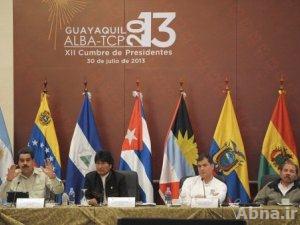 The nine Latin American states (ALBA) have condemned any possible aggression against Syria and announced the dispatching of humanitarian aid to the Syrian refugees in Lebanon.
“The Bolivarian alliance council in American denounces any possible strike against Syria,” ALBA Secretary General said in a statement from Venezuela.
“ALBA asks the U.S. to refrain from launching a military aggression against the Syrian people and government,” he added, accusing the US administration of resorting to the same strategies that it used in Iraq, Afghanistan and Egypt.
ALBA further decided to dispatch humanitarian aid, including foodstuffs, to the Syrian refugees in Lebanon.
Related articles
- At least one Syrian becomes a refugee every 15 seconds – expert (voiceofrussia.com)
- Lebanon opposes military attack against Syria: FM (theiranproject.com)
Congress Denied Syrian Facts, Too
By Robert Parry | Consortium News | September 7, 2013
A U.S. congressman who has read the Obama administration’s classified version of intelligence on the alleged Syrian poison gas attack says the report is only 12 pages – just three times longer than the sketchy unclassified public version – and is supported by no additional hard evidence.
Rep. Alan Grayson, D-Florida, a member of the House Foreign Affairs Committee, also said the House Intelligence Committee had to make a formal request to the administration for “the underlying intelligence reports” and he is unaware if those details have been forthcoming, suggesting that the classified report – like the unclassified version – is more a set of assertions than a presentation of evidence.
“We have reached the point where the classified information system prevents even trusted members of Congress, who have security clearances, from learning essential facts, and then inhibits them from discussing and debating what they do know,” Grayson wrote in an op-ed for the New York Times on Saturday.
“And this extends to matters of war and peace, money and blood. The ‘security state’ is drowning in its own phlegm. My position is simple: if the administration wants me to vote for war, on this occasion or on any other, then I need to know all the facts. And I’m not the only one who feels that way.”
As I wrote a week ago, after examining the four-page unclassified summary, there was not a single fact that could be checked independently. It was a “dodgy dossier” similar to the ones in 2002-2003 that led the United States into the Iraq War. The only difference was that the Bush administration actually provided more checkable information than the Obama administration did, although much of the Bush data ultimately didn’t check out.
It appears that the chief lesson learned by the Obama administration was to release even less information about Syria’s alleged chemical weapons attack on Aug. 21 than the Bush administration did about Iraq’s alleged WMD. The case against Syria has relied almost exclusively on assertions, such as the bellowing from Secretary of State John Kerry that the Syrian government sure did commit the crime, just trust us.
The Obama administration’s limited-hangout strategy seems to have worked pretty well at least inside the Establishment, but it’s floundering elsewhere around the United States. It appears that many Americans share the skepticism of Rep. Grayson and a few other members of Congress who have bothered to descend into the intelligence committee vaults to read the 12-page classified summary for themselves.
Rallying the Establishment
Despite the sketchy intelligence, many senators and congressmen have adopted the politically safe position of joining in denunciations of Syrian President Bashar al-Assad (where’s the downside of that), and the mainstream U.S. news media has largely taken to writing down the administration’s disputed claims about Syria as “flat fact.”
For instance, the New York Times editorial on Saturday accepts without caveat that there was “a poison gas attack by President Bashar al-Assad’s regime that killed more than 1,400 people last month,” yet those supposed “facts” are all in dispute, including the total number who apparently died from chemical exposure. It was the U.S. white paper that presented the claim of “1,429” people killed without explaining the provenance of that strangely precise number.
The New York Times editorial also reprises the false narrative that Russian President Vladimir Putin and Syria’s Assad are to blame for the absence of peace negotiations, although the Times’ own reporters from the field have written repeatedly that it has been the U.S.-backed rebels who have refused to join peace talks in Geneva. [See Consortiumnews.com’s “Getting Syria-ous About Peace Talks.”]
Nevertheless, the Times editorial states, “it was the height of cynicism for Mr. Putin to talk about the need for a Syrian political settlement, which he has done little to advance.” One has to wonder if the Times’ editors consider it their “patriotic” duty to mislead the American people, again.
Increasingly, President Barack Obama’s case for a limited war against Syria is looking like a nightmarish replay of President George W. Bush’s mendacious arguments for war against Iraq. There are even uses of the same techniques, such as putting incriminating words in the mouths of “enemy” officials.
On Feb. 5, 2003, before the United Nations Security Council, Secretary of State Colin Powell needled some intercepted quotes from Iraqi military officers to make some innocuous comments about inspecting weapons sites into proof they were hiding caches of chemical weapons from UN inspectors. Powell’s scam was exposed when the State Department released the actual transcripts of the conversations without some of the incriminating words that Powell had added.
Then, on Aug. 30, 2013, when the Obama administration released its “Government Assessment” of Syria’s alleged poison gas attack, the white paper stated, “We intercepted communications involving a senior official intimately familiar with the offensive who confirmed that chemical weapons were used by the regime on August 21 and was concerned with the U.N. inspectors obtaining evidence.”
However, the identity of the “senior official” was not included, nor was the direct quote cited. The report claimed concerns about protecting “sources and methods” in explaining why more details weren’t provided, but everyone in the world knows the United States has the capability to intercept phone calls.
Reasons for Secrecy?
So, why didn’t the Obama administration go at least as far as the Bush administration did in putting out transcripts of these phone intercepts? A reasonable suspicion must be that the actual words of the conversation – and possibly other conversations – would have indicated that the Syrian high command was caught off guard by the Aug. 21 events, that the Syrian government was scrambling to figure out what had happened and why, that the intercepts were less incriminating than the paraphrase of them.
That fuller story might well have undercut the U.S. case for taking military action. So, the administration’s white paper left out conversations reflecting the Syrian government’s confusion. The white paper didn’t even bother to put in the actual quote from the one “senior official” who supposedly “confirmed” the chemical weapons use.
Indeed, although the white paper states that its conclusions were derived from “human, signals, and geospatial intelligence as well as a significant body of open source reporting,” none of that intelligence was spelled out in the unclassified version. It is now unclear how much more detail was provided in the 12-page classified version that Rep. Grayson read.
In his op-ed, Grayson wrote, “The first [unclassified version] enumerates only the evidence in favor of an attack. I’m not allowed to tell you what’s in the classified summary, but you can draw your own conclusion. On Thursday I asked the House Intelligence Committee staff whether there was any other documentation available, classified or unclassified. Their answer was ‘no.’”
So, what is one to make of this pathetic replay of events from a decade ago in which the White House and intelligence community make sweeping claims without presenting real evidence and the major U.S. news outlets simply adopt the government’s uncorroborated claims as true?
One might have thought that the Obama administration – understanding the public skepticism after the disastrous Iraq War – would have gone to extra lengths to lay out all the facts to the American people, rather than try to slip by with another “dodgy dossier” and excuses about the need to keep all the evidence secret.
President Obama seems to believe that “transparency” means having some members of Congress interrupt their busy schedules of endless fundraising to troop down to the intelligence committee vaults and read some pre-packaged intelligence without the benefit of any note-taking or the ability to check out what they’ve seen, let alone the right to discuss it publicly.
In my 35-plus years covering Congress, I can tell you that perhaps the body’s greatest weakness – amid many, many weaknesses – is its ability to investigate national security claims emanating from the Executive Branch.
Beyond all the limitations of what members of Congress are allowed to see and under what circumstances, there is the reality that anyone who takes on the intelligence community too aggressively can expect to be pilloried as “unpatriotic” or accused of being an “apologist” for some unsavory dictator.
Soon, the troublesome member can expect hostile opinion pieces showing up in his local newspapers and money pouring into the campaign coffers of some electoral challenger. So, there is no political upside in performing this sort of difficult oversight and there is plenty of downside.
And once an administration has staked its credibility on some dubious assertion, all the public can expect is more of a sales job, a task that President Obama himself is expected to undertake in a speech to the nation on Tuesday. That is why the Obama administration would have been wise to have developed a much fuller intelligence assessment of what happened on Aug. 21 and then presented the evidence as fully as possible.
In the days of the Internet and Twitter – and after the bitter experience of the Iraq War – it is a dubious proposition that the White House can rely on national politicians and Establishment news outlets to whip the public up for another military adventure without presenting a comprehensive set of facts.
~
Investigative reporter Robert Parry broke many of the Iran-Contra stories for The Associated Press and Newsweek in the 1980s. You can buy his new book, America’s Stolen Narrative, either in print here or as an e-book (from Amazon and barnesandnoble.com).
When It Comes to State Violence, Too Much Is Never Enough
By Jim Naureckas | FAIR | August 30, 2013
Time magazine’s Michael Crowley (9/9/13) offers an analysis of how the Syrian situation reflects on Barack Obama’s presidency:
Whatever comes of Obama’s confrontation with Assad, an even more dangerous confrontation lies in wait–the one with Iran. If another round of negotiations with Tehran should fail, Obama may soon be obliged to make good on his vow to stop Iran from developing a nuclear weapon. “I will not hesitate to use force when it is necessary to defend the United States and its interests,” Obama told the American Israel Public Affairs Committee in March 2012.
But to his critics, Obama does hesitate, and trouble follows as a result. With more than three years left in his presidency, he has the opportunity to reverse that impression. Success in Syria and then Iran could vindicate him, and failure could be crushing. “The risk is that, if things in the Middle East continue to spiral, that will become his legacy,” says Brian Katulis, a former Obama campaign adviser now with the Center for American Progress.
Obama does “hesitate to use force”–is that his problem? Since 2009, US drone strikes have killed more than 2000 people in Pakistan, including 240 civilians, 62 of them children. Since Obama took office, they’ve killed more than 400 in Yemen; drone deaths in Somalia are harder to quantify.
Obama roughly tripled the number of U.S. troops in Afghanistan, from 33,000 to 98,000 (Think Progress, 6/22/11). In 2011, he sent naval and air forces into battle to overthrow the government of Libya’s Moammar Gaddafi. In Iraq, Obama tried and failed to keep tens of thousands of troops in the country beyond the withdrawal deadline negotiated by the Bush administration (New York Times, 10/22/11).
This is a record that would not seem to indicate a particular hesitancy to use force. Oddly, Crowley acknowledges much of this: “Obama …sent more troops to Afghanistan, escalated drone strikes against Al-Qaeda terrorists,” he writes. But his military actions are presented as a sign of his unwillingness to take military action: “In Libya, he at first stood by as rebels fighting Muammar Gaddafi’s forces found themselves outgunned and on the run.”
No matter how many wars you engage in–Obama has had six so far–there are always wars you could have started but didn’t. Crowley seems to be suggesting that those unfought wars ought to take the blame for any problems Obama leaves behind.
Related article
Obama fails to rally international support for his war plans
Press TV – September 7, 2013
US President Barack Obama has failed to rally international support for conducting military strikes on Syria after two days of lobbying in Russia.
Obama, who arrived in St. Petersburg on Thursday to attend the Group of 20 summit, could not persuade foreign leaders to support his war plans as they urged him not to launch any attack without the United Nations’ permission.
During a long debate, Obama and his Russian counterpart Vladimir V. Putin each argued their positions on the issue.
Putin argued that a majority of the leaders, including the leaders of China, India, Indonesia, Argentina, Brazil, Italy, Germany and South Africa, oppose a military strike independent of the United Nations.
Not only did the Russian president oppose military action against Syria, but he also rejected Washington and its allies’ allegations that the Syrian government used chemical weapons in an attack last month.
“We hear each other and understand the arguments,” Putin said. “We simply don’t agree with them. I don’t agree with his arguments and he doesn’t agree with mine, but we hear and try to analyze.”
The only members of the Group of 20 nations which supported Obama were Canada, France, Saudi Arabia and Turkey, Putin added.
Nevertheless, Obama’s national security adviser, Susan Rice, said Australia, Britain, Italy, Japan, Spain and South Korea could also be added to the list of US allies supporting an attack on Syria.
The US president’s failure to rally international support for his war plans against Syria will make it even more difficult for him to convince US lawmakers and voters to support a strike on Syria.
Obama himself said that he had a “hard sell” and that he might not succeed in winning over the US public which, according to polls, still opposes a strike.
Obama said that he would lay out his case during an address on Tuesday before Congress votes on a resolution authorizing his administration to attack Syria.
According to a whip count by Think Progress, an overwhelming majority of the members of the US House of Representatives are either undecided or likely to vote against a US attack on the Middle Eastern country.
Related articles
- Obama rejects G20 calls to abandon Syria strike plan (timesofindia.indiatimes.com)
- Reuters: Obama ‘Appeared Isolated in St. Petersburg’ at G20 Summit (breitbart.com)
Mind the gap! Democratic deficit in UK, US has never been bigger
By Neil Clark | RT | September 6, 2013
The issue of Syria has demonstrated the massive gap that has opened up between the elite and ordinary people in both the US and Britain.
Poll after poll after poll shows very large majorities against strikes on Syria. People are war-weary, and the last thing they want is for their countries to become embroiled in another Middle-East war.
One Congressman in the US tweeted earlier this week that he had asked 200 people if they supported strikes on Syria and only four said ‘Yes’– that’s just 2 percent. Another said that 99 percent of calls to his office were against military action.
Let’s get one thing straight: the only people who are keen on war with Syria in the US and UK are the elites. Ordinary people on both sides of the Atlantic want absolutely nothing to do with it.
In Britain, the overwhelming majority of people were delighted that our parliament voted against war last week and that enough of our legislators finally listened to the people to defeat the serial warmongers.
A BBC poll showed that 71 percent of people thought parliament had made the right decision. Yet our neocon/’liberal interventionist’ elite is furious that legislators listened to the views of ordinary members of the public and not them. “You’re a disgrace,” screeched neocon Minister Michael Gove at MPs who voted against the government. Behaving like spoilt brats having a temper tantrum because they were not allowed to get their own way, the Permanent War brigade have been calling for a “second vote” in parliament, showing arrogant contempt for the views of the majority of ordinary people who don’t want war with Syria.
Neocon historian Andrew Roberts threw a hissy fit in a newspaper column last Sunday, attacking the “hideously amoral selfishness” of “new Britain” for not supporting war with Syria. Serial warmonger and drama queen Lord Paddy Ashdown declared “In 50 years trying to serve my country I have never felt so depressed/ashamed” – after parliament finally listened to public opinion and not to warmongers like Ashdown.
Nick Cohen, poster boy for Britain’s pro-war faux-left tweeted “Can’t help thinking that the British parliament’s vote will be remembered as a low and mean point in our history.” Have you got that? Parliament listening to ordinary members of the public is a “low and mean point.” Such is the fundamentally undemocratic neocon/liberal interventionist mindset, which says that no point of view on foreign policy counts except their own and that of their neocon pals.
Since last week’s parliamentary vote, UK establishment figures have been lining up to give Ed Miliband, the Labour leader, a jolly good thrashing for daring to defy the War Party’s line on Syria. Writing in The Times, aptly described as ‘The Warmongers Gazette’ by anti-war conservative writer Peter Hitchens, David Aaronovitch called Miliband a ‘political vulture’. Aaronovitch’s attack on Miliband was hailed as ‘devastating’ by Ian Katz, the editor of Newsnight, the BBC’s flagship Current Affairs program, which wheeled out a ‘Dr. Rola’ from ‘Hand in Hand For Syria’ to criticize Miliband’s failure to back the government.
Since the vote Newsnight has promoted a series of pro-intervention figures, seemingly desperate to try and get us plebs to change our minds. What part of ‘WE DON’T WANT WAR WITH SYRIA’ do our elite not understand? Now the high priest of ‘Liberal Interventionism’, the multi-millionaire war criminal Tony Blair, has joined the ‘Get Miliband’ lynch mob, saying that he was “disappointed” that parliament hadn’t supported the government, adding, “This is something where I just have to disagree with the leadership of the [Labour] party.”
For our neocon/liberal interventionist elite, Miliband is a shocker, a bounder, a rotter, and a ‘political vulture’. But most ordinary people in Britain are very pleased that he and his party listened to the public and opposed the government on Syria. You’d never have known it from listening to neocon newspaper columns, but after last week’s vote, bookmakers shortened the odds of Labour winning the next election to 8-13.
If Miliband and his party had voted the way the neocons wanted, then it’s highly likely that earlier this week US and British forces would have launched their attack on Syria. Which is why of course the Permanent War gang are so angry with him.
The pro-war lobby may be numerically tiny, but in both the US and UK it is massively overrepresented in the mainstream media. Despite the Iraq debacle, the same columnists who urged on that particular catastrophe, are still in front of their keyboards, propagandizing for yet another Middle East ‘intervention’, and are still treated with enormous deference whenever they appear on the likes of CNN or the BBC. Which is very, very often.
“Did you know there are people who supported the Iraq War getting invited on news programs to talk about Syria?” tweets comedy writer Graham Linehan. S’TRUE!!!
The disproportionate voice that necons and ‘liberal interventionists’ have in the UK and US media makes it appear that their views are more widely held in the public at large than they are. But in fact their extremist pro-war views are very rarely found outside elite, Establishment circles.
The gap between the elites in the US and the UK is now larger than at any time in the last 100 years. If we do go to war with Syria, despite the overwhelming public opposition, then it will show that democracy is well and truly dead in both our countries.
Are we countries where the views of the majority are listened to, or are we countries where a tiny, unrepresentative, pro-war clique always gets their way? We’re about to find out.
 Neil Clark is a journalist, writer and broadcaster. His award winning blog can be found at www.neilclark66.blogspot.com. Follow him on Twitter
Related articles
Featured Video
Dan Dicks with James Corbett on Solutions Watch
or go to
Aletho News Archives – Video-Images
From the Archives
Secret document reveals plans for civil war in Lebanon, Israeli false flags, and invasion
By Randi Nord | Geopolitics Alert | April 5, 2019
Beirut – During his visit with US Secretary of State, Mike Pompeo, Lebanese President Michael Aoun reportedly received a US-Israeli document detailing plans for creating a civil war in Lebanon with covert false flag operations and possible Israeli invasion.
Although the source of the document is Israeli and created in partnership with Washington, no one knows who presented it to Aoun. The Lebanese TV station, Al-Jadeed, initially reported the document on Lebanese TV and a video on its website. Geopolitics Alert translated the report for this article. … continue
Blog Roll
 Aletho News
- Sheikh al-Asadi warns of Iraqi government compliance with US demands
- How to MAKE THE CONSPIRATORS PAY for their crimes! Dan Dicks with James Corbett on Solutions Watch
- There’s a drought in academia: A drought in honest research on the subject of drought and other weather extremes
- Department of War Awards $20.7 Billion Contract to Raytheon for Air-to-Air Missiles
- ‘Distance yourselves from Israel’: IRGC urges US population to question govt policies
- America’s Greenland deal has a radioactive backstory
- The RAF Fairford ‘terror plot’: Unpacking escalation in the UK echo-chamber
- EU Council Advances Chat Control 2.0 Scanning Proposal
- Ex-Greek MEP files complaint against Israeli spyware firm over alleged Pegasus surveillance
- Troubling ideas throughout the Torah, Talmud, Mishneh Torah and Tanya
- If Americans Knew
- New Report: “Scholasticide and Genocide in Gaza: Assessment, Testimonies and Legal Analysis”
- Ex-Biden officials are desperate for a Gaza scapegoat
- Israeli “settlers” Invade Al-Aqsa; Pour Boiling Water on 75-Year-Old
- Israel Has Kidnapped Another American Teenager
- US arms sales to Israel worth $21.6 billion in 20 months
- Three Palestinians Killed in Israeli Attacks on Gaza
- Revealed: German “Anti-Semitism Expert” Driving Crackdown on Palestine Solidarity is Former Israeli Spy
- Egypt’s Warning to Israel Before Oct 7
- Israel’s siege signals another cruel winter for 1.8 million Gazans – Daily Update
- Netanyahu Asked UAE Leader to Deny Report on Oct. 7 Warning in Secret Visit, Sources Say
- No Tricks Zone
- Two More Paleo Reconstructions Affirm Meters-Higher Sea Levels Across Ireland, Brazil 7000-6000 Years Ago
- New Study: Earth And Venus Surface Warmth Largely Explained By Convection And Lapse Rate, Not CO2 Or Radiation
- 2025 Nature Paper Claiming Worsening Global Drought Gets RETRACTED …Heavily Flawed
- New Study: ‘Global Drought Shows No Detectable Recent Acceleration Under Climate Warming’
- Economic Masterminds: German Socialists Suggest Taxing Productivity Gains Stemming From Using AI
- The South China Sea Has Not Been Cooperating With The Climate Change Narrative
- Energy Crisis: Germany Enters Heating Season With Historically Low Gas Reserve Fill Levels
- New Study: The Antarctic Ice Sheet Gained Mass From 2020-2024 Due To Staggering Snow And Ice Accumulation
- Study: Ocean Heating Rates From Thousands Of Years Ago ‘Dwarf’ Modern Ocean Heating Rates
- Climate Extremists Target, Attack Large-Scale Power Grid Infrastructure In Germany!

