Qatar seeks to send Yemen’s military elite to fight alongside the Free Syrian Army
Yemen Post | May 27, 2013
Qatar which has been a staunch supporter of the Free Syrian Army against President Bashar al-Assad in Syria is now looking to enroll Yemen’s military elite to fight alongside other Arab-backed militias in a bid to offset Assad’s recent advances against the opposition.
Yemen Republican Guards, Yemen’s best of the best, the very units which were meant to ward off former President Ali Abdullah Saleh’s foes are now being bid for by foreign powers in a regional effort to depose Syria’s regime.
Faced with the very possibility that Assad could after all outrun his enemies, strong of the support of Iran and the Hezbollah and restore his hold over the country, the Free Syrian Army has turned to his sponsors for support, awaiting more troops and more weapons.
While regional powers have committed money and military equipment, as well as allowed volunteers to cross over onto Syria to swell the resistance ranks, none has so far agreed to commit men to the conflict, a move which would equate to a declaration of war against the Syrian regime.
Qatar is now looking to by-pass the hurdle by sending Yemen Republican Guards to the front. Of course the men would go in their civilian capacity, hired as mercenaries by the State of Qatar.
According to local newspapers, Qatar would be looking to enroll 10,000 soldiers.
Military officials have warned that such a move would leave Yemen vulnerable, its defenses weakened.
Russia slams end of EU arms embargo, calls S-300s ‘stabilizing factor’ in Syria
RT | May 28, 2013
The failure of the European Union to agree on a new arms embargo for Syria is undermining the peace process, Moscow says. But the delivery of S-300 surface-to-air missiles may help restrain warmongers.
The comments come from Deputy Russian Foreign Minister Sergey Ryabkov, referring to the results of Monday’s meeting in Brussels. After a lengthy negotiating session, EU governments failed to resolve their differences and allowed a ban on arming the Syrian opposition to expire, with France and Britain scoring an apparent victory at the expense of EU unity.
The EU’s move, which the Russian diplomat branded as an “example of double standards”, opens the door for Britain and France to supply weapons to Syrian rebels fighting the regime of President Bashar Assad.
Criticizing Europe’s decision to open the way for potential arms shipments to Syrian rebels, Russia insists that its own sale of arms to the Syrian government helps the international effort to end the two-year-long conflict, the diplomat added. He was referring to the delivery of the advanced S-300 long-range air defense systems, which Russia is carrying out under a contract signed with Syria several years ago.
“Those systems by definition cannot be used by militant groups on the battlefield,” Ryabkov said. “We consider this delivery a factor of stabilization. We believe that moves like this one to a great degree restrain some hotheads from escalating the conflict to the international scale, from involving external forces.”
The S-300 is a series of Russian long-range surface-to-air missile systems designed to intercept ballistic missiles, regarded as the most potent weaponry of its class. The missiles are capable of engaging aerial targets as far away as 200km, depending on the version used.
Once the Russian SAM missiles are deployed by Syria, it will have a better control of its airspace. The country endured three airstrikes this year, which are widely thought to have been conducted by Israel, but were never officially confirmed as such.
Britain and France have made a commitment not to deliver arms to the Syrian opposition “at this stage,” an EU declaration said. EU officials, however, said the commitment effectively expires on August 1.
London and Paris have argued support for rebels fighting Assad by allowing EU arms deliveries, despite the fact that extremist elements are known to work alongside the rebels.
Other EU governments, led by Austria and Sweden, argued that sending more weapons to the region would increase violence and spread instability.
Russia’s envoy to NATO Aleksandr Grushko said that the abolition of the EU arms embargo on the Syrian opposition will only exacerbate armed conflict in that country.
“We need to refrain from taking steps that would be contrary to this logic. Such steps include armed or non-lethal support to the opposition. This just adds fuel to the fire,” Grushko said on Tuesday.
Meanwhile, Moscow and Washington remain undecided as to the content of a proposed international conference on Syria, according to Deputy Foreign Minister Sergey Ryabkov.
“There remains a gap between the positions of Russia and the US regarding some issues and aspects of this major international crisis,” he emphasized.
“And we, for our part, cannot agree to hold such events [the international conference on Syria] amid a situation where partners and possible participants in such a conference seek to impose solutions on the Syrian people from the outside, as well as predetermine the course of a transitional process, the parameters of which have not been determined yet,” Ryabkov said.
Related article
EU Continues with US-Led Sanctions against Syrians as It Scraps Arms Embargo
By Franklin Lamb | Al-Manar | May 28, 2013
Beirut – Under withering pressure from Washington and the UK, the European Union met this week to decide whether to increase the pressure on the Syrian public by repealing the March 2011 arms embargo that was intended to prohibit arms shipments to Syria and whether or not to continue economic sanctions against the Syrian public.
On 5/27/13 it decided to open the flood gate of arms flow into Syria and to keep the civilian targeting economic sanctions in place.
Lobbying for scrapping the arms embargo, set to expire at midnight on 31 May, had reached nearly historic intensity at EU HQ in Brussels, London and Washington. Recently, the US State Department demanded that every one of the 27 European Ambassadors posted in the US appear at the State Department for “consultations to avoid any misunderstandings about what the White House was expecting at the upcoming EU meeting.”
US Secretary of State John Kerry had been urging the EU to gut the arms embargo so as to expedite weapon shipments to the rebels. It currently appears that Britain now has the support of France, Italy and Spain, while Germany appears neutral and Austria, Finland, Sweden and the Czech Republic are still opposed. “Fine for him to say, but what is Washington willing to do?” one European foreign minister opposed to lifting the ban put it to BBC correspondent Lyse Doucet.
This week’s EU meeting, which was postponed three months ago, raised again the obligation of the international community to respect the laws of armed conflict and the Geneva Convention with respect to protecting the civilian population during armed conflicts and virtually every other international humanitarian law requirement.
For the American administration, designing and applying economic sanctions in order to pressure a population to break with its government to achieve regime change or any other political objective, as in the case of both Syria and Iran are fundamentally illegal under US law.
Just as soon as a group of Syrian-Americans and/or Iranian-American file a class action lawsuit in US Federal District Court ( the Court will have in persona and subject matter jurisdiction and the Plaintiffs will have standing to sue, given that they are American citizens) and the day after filing when they would no doubt file a Motion petitioning the Court for an Interim Measure of Protection (injunction) immediately freezing and lifting the US-led sanctions against the two countries civilian population, pending the final Court (Jury Trial) on the merits, the Obama administration is going to face serious judicial challenges to its outlawry.
William Hague, the UK Defense Minister, was quite active the past several days supporting the various Syrian militias’ arguments including: “The EU arms embargo must be lifted because the current economic sanctions regime is ineffective.” Presumably the right honorable gentleman means by “ineffective” that these brutal sanctions have not broken the will of the populations to settle their own affairs without transparent foreign interference. This is true if by “effective” Hague means that the US-led sanctions, that target Syria’s civilian population for purely political purposes of regime change, will cause the people of Syria, who unlike their leaders, are the ones directly affected by the sanctions to revolt over the lack of medicines and food stuffs plus inflation at the grocery stores.
Mr. Hague surely must be aware that very rarely, if ever at all in history, have civilian targeted sanctions designed to cause hardships among a nation’s population for purely political purposes actually broken the population such that they turned against their governments. Both the Syrian and Iranian sanctions have confirmed history’s instruction that the civilian targeting sanctions imposed from outside tend to have the exact opposite intended effect. This is true particularly modernly with more available information, and that the populations turn not against their national governments but rather against those foreign governments viewed as being responsible for these crimes.
The British, French, Turks and the Americans (the latter, not actually an EU member but then, who would know from its involvements in EU deliberations?) were the zealots in Brussels advocating amendment of the imposed arms embargo so that weapons can be sent to “moderate” forces in these countries largely nurtured and sustained “opposition”.
The UK Defense Minister gave his colleagues repeated assurances that weapons would be supplied only “under carefully controlled circumstances” and with clear commitments from the opposition… We have to be open to every way of strengthening moderates and saving lives rather than the current trajectory of extremism and murder.” The assurances have apparently convinced very few.
Unanimity was needed to repeal the embargo and several countries were opposed. So it was allowed to lapse. One Austrian official told the BBC that allowing lethal weapons to be sent into a war zone “would turn EU policy on its head.” Another European diplomat insisted that “It would be the first conflict where we pretend we could create peace by delivering arms,” the diplomat said. “If you pretend to know where the weapons will end up, then it would be the first war in history where this is possible. We have seen it in Bosnia, Afghanistan and Iraq. Weapons don’t disappear; they pop up where they are needed.”
Oxfam warned before and after the vote of “devastating consequences” if the embargo ends.”There are no easy answers when trying to stop the bloodshed in Syria, but sending more arms and ammunition clearly isn’t one of them,” the aid agency’s head of arms control, Anna Macdonald told the media this week.
The result of the predicted 5/27/13 European Union meeting prevented the renewal of the arms embargo on Syria, raising the possibility of a new flow of weapons to various jihadist militias working with Qatar and Saudi Arabia, among others, to bring down the government of President Bashar al-Assad.
Sustaining a personal rebuke of sorts given that the EU did not affirmatively oppose the embargo as he had hoped, William Hague, the British foreign secretary, told the media after more than 12 hours of stormy talks: “While we have no immediate plans to send arms to Syria, it gives us the flexibility to respond in the future if the situation continues to deteriorate and worsen,”
As a claimed safeguard of some kind, according to EU officials, the European Union declared that member states who might wish to send weapons to Syrian rebels “shall assess the export license applications on a case-by-case basis” in line with the organization’s rules on exports of military technology and equipment.
Some of the 27 EU countries are now even more concerned that anti-aircraft and anti-tank weapons given to “moderate” militiamen (per Libya?) would end up Lord knows where, in the hands of salafist, jihadist-takfiri militants, including those from the al-Nusra Front, which has pledged fealty to al-Qaeda in Iraq.
The current embargo includes the following:
- Ban on export/import of arms and equipment for internal repression since May 2011All Syrian cargo planes banned from EU airports
- All Syrian cargo planes banned from EU airports
- EU states obliged to inspect Syria-bound ships or planes suspected of carrying arms
- Assets freeze on 54 groups and 179 people responsible for or involved in repression [many who are not involved in decision making are included-ed]
- Export ban on technical monitoring equipment
In February this year, EU foreign ministers agreed to enable any EU member state to provide non-lethal military equipment “for the protection of civilians” or for the opposition forces, “which the Union accepts as legitimate representatives of the Syrian people”.
As is its habit recently, the European External Action Service (EEAS), the EU’s diplomatic service, has spoken on both sides of this critical issue. On the one hand it has cautioned against “any counterproductive move” that could harm the prospects of the Geneva conference and suggests extending the embargo to allow “more time for reflection”. On the other suggesting that lifting the arms embargo would only prolong the war.
The practice of targeting a civilian population by outsiders in order to achieve political objectives such as regime change is fast heading for the dustbin of history given its blatant violation of all norms of international humanitarian law and common decency reflected in the values of most societies.
This week revealed on which side of history the European Union has chosen to anchor itself on the issue of targeting civilian populations in a blatant attempt to achieve regime change. It affirmatively voted “to renew all the economic sanctions already in place against the Syrian government.”
One imagines, as surely the EU is aware, that officials are not suffering much from the economic sanctions, but rather it is exactly those the EU claims to want to help, who will continue to suffer rises in the cost of living generally as well as the sanctions causing shortages of medicines and medical equipment as well as specialized cancer treatments and other medicines for seriously ill drug-dependant citizens.
Related article
- EU nations split over Syria weapons embargo (morningstaronline.co.uk)
Hezbollah Intervention in Syria Redraws Political Map
By Ibrahim al-Amin | Al-Akhbar | May 27, 2013
Relations between the Bashar al-Assad regime in Damascus and the Lebanese Resistance had already reached a high-level of coordination and mutual support even before the outbreak of the Syrian crisis. At the time, the two allies tended to respect each others’ boundaries, recognizing each other’s key roles in the region.
The onset of the Syrian crisis only served to further intertwine their interests as both became targets of the Syrian opposition and their regional and international backers.
In the early stages of the uprising, Hezbollah tried to play the role of mediator, seeking ways to open up channels between the regime and the opposition. But quickly, developments – like Israel’s growing involvement in the crisis – prompted a qualitative change in the relationship between Damascus and the Lebanese Resistance.
Assad’s response to the latest Israeli attacks on Damascus would have not meant much if it did not also have the strong support of Hezbollah, Iran, and even Russia – with the Resistance openly declaring its willingness to take part in any effort to ward off Tel Aviv’s threats.
This could lead Hezbollah’s Lebanese opponents to exploit mounting sectarian tensions, particularly in Sidon and Tripoli, in order to turn up the pressure on the Resistance and its popular base.
Although Hezbollah’s Secretary General Hassan Nasrallah justified in detail his party’s involvement in Syria, he did not mention – for his own reasons – that the role of the Resistance in Syria’s internal front is not without its limits, and largely depends on the course of events there.
The party has already declared that one of its goals is to push those forces that pose a threat to the Resistance away from Syrian areas adjacent to the Lebanese border. However, when it comes to confrontation with Israel, we can expect an increased and ongoing role for Hezbollah, particularly in the occupied Golan Heights.
Price of Involvement
As for the price that Hezbollah is likely to pay for its involvement, the two rockets that struck southern Beirut on Sunday morning are but a sign that there are those preparing for a campaign of terror against the Resistance.
It is difficult to foresee the trajectory of events after Nasrallah’s call to arms alongside the Syrian regime, but early signs suggest that the coming period will be one of heightened tensions among Lebanon’s political forces, particularly as the dream of toppling Assad is slowly fading away.
This could lead Hezbollah’s Lebanese opponents to exploit mounting sectarian tensions, particularly in Sidon and Tripoli, in order to turn up the pressure on the Resistance and its popular base.
The concern here is that the country’s internal security services have shown themselves to be completely ineffective in diffusing Tripoli’s interminable sectarian violence. So what if it is discovered that the Future Movement, and those powers behind them, hold sway over the state’s internal security forces.
Finally, I invite everyone to take a different approach to the crisis facing our region: To the extent that the Americans, Europeans, and those Arabs in their service succeed in reviving the colonial legacy of division and warfare among the Arabs, this will automatically raise the question of different kind of unity for the other side, which could lead to surprising results that no one could have expected.
Let us dream and hope!
Ibrahim al-Amin is editor-in-chief of Al-Akhbar.
Syrian TV reporter killed by rebel sniper near Qusair
RT | May 27, 2013
Yara Abbas, a prominent female Syrian war reporter, was killed in the country’s west, Syrian officials confirmed. The country remains a dangerous place for journalists, especially as some rebel groups reportedly target them for assassination.
Abbas, 26, who worked for the privately-owned Damascus-based Al-Ikhbariyah TV (Syrian News Channel), was killed by sniper fire in a rebel attack not far from the Dabaa air base. The country’s Information Ministry offered no further details, but the pro-rebel Syrian Observatory for Human Rights claimed that several members of her TV crew were also wounded in the attack.
The base is located near the town of Qusair in Homs Province, an area near the Lebanese border that is the site of intense ongoing fighting between the Syrian army and rebel fighters.
More than 150 reporters have been killed in the Syrian conflict as of April 2013, the Union of Syrian Journalists reported. The majority of the victims were civilian journalists or local freelancers working for professional media.
Outlets that have lost staffers in the violence include French TV station France 2, French magazine Assaut, British newspaper the Sunday Times, Japanese news agency the Japan Press, Qatari TV station Al Jazeera, Iraqi newspaper Al-Thawra and Iran’s Press TV, as well as Syria’s Al-Ikhbariyah TV, Addounia TV and Sana news agency.

Yara Abbas at work. Screenshot from youtube.com @podrouga
Reporters also risk kidnap in Syria, as was the case with NBC News journalist Richard Engel and Russian-Ukrainian civilian journalist Ankhar Kochneva.
Some rebel groups specifically target journalists who work for government-affiliated outlets and international media, RT reporters were told by colleagues in Syria.
“I received confirmed news that some of the armed opposition forces are looking after the journalists working with international TV stations. This armed group is collecting a list of names. Mine is one of them. They are going to collect information about them from the Internet and keep them for future trials or assassination. You know for sure that the websites of RT, CCTV and Iran TV will be the first to be checked,” a local reporter told RT on condition of anonymity.
The ongoing civil war in Syria has claimed tens of thousands lives so far, with the UN estimating that more than 80,000 people have died in the violence.
Related article
- Journalist: Yara Abbas killed by NATO mercenary fire in Qusair, Syria (pennyforyourthoughts2.blogspot.com)
Have Washington and Tel Aviv Miscalculated Events in al-Qusayr?
By Franklin Lamb | Al-Manar | May 27, 2013
Homs Province, Syria – During a tour of some of the neighborhoods in Homs, Syria’s third largest city after Aleppo and Damascus, with a pre-conflict population of approximately 800,000 (nearly half Homs residents have fled over the past two years) located maybe about 22 miles NE of the current hot-spot of al-Qusayr, this observer engaged in a few interesting conversations. More accurately labeled diatribes–with some long bearded Sunni fundamentalists who claimed they came from Jabhat al Nusra, aka Jabhat an-Nuṣrah li-Ahl ash-Shām, “Front of Defense for the People of Greater Syria”), and were preparing to return to al Qusayr to fight “the deniers of Allah”!
It is the strategic crossroads town of al-Qusayr, and its environs, which whoever controls, can block supplies and reinforcements to and from Damascus and locations north and east. For those seeking the ouster of Syria’s government, including NATO countries led by Washington, were their “allies” to lose control of al-Qusayr it would mean the cutting off of supplies from along the Lebanese border, from which most of the local opposition’s weapons flow and fighters have been smuggled over the past 26 months. If the Assad regime forces regain control of the city, Washington believes they will move north and conquer current opposition positions in Homs and Rastan, both areas being dependent on support from Lebanon and al-Qusayr. Some analysts are saying this morning, with perhaps a bit of hyperbole that as al-Qusayr goes so goes Syria and the National Lebanese Resistance, led by Hezbollah.
If government forces can retake the city it will put an end to the Saudi-Qatari green light, in exchange for controlling al-Qusayr, of the setting up of a Salafist emirate in the area which would constitute a threat to the nearly two dozen Shia Lebanese inhabited villages of the Hermel region. If the Syrian army re-takes al-Qusayr, it would also avoid the likelihood of a full-fledged sectarian war on both sides of the border.
Meeting with a few self-proclaimed al Nusra Front militiaman last week, in Homs, one who spoke excellent British English, they had plenty to say to this observer about current events in al Qusayr to which they planned to return the next day to fight enemies “by all means Allah gives us”. One added, when asked if they had confronted Hezbollah: “Of course but Hezbollah can’t defeat us. Eventually they will withdraw from Syria on orders from Tehran. But first enshallah we will bleed Hezbollah with thousands of cut throats”, he boasted raucously as nearby kids cheered and gave V for victory signs, smiles, giggles and cackling all around.
Such Jihadist rants are music to more than a few US congressional and White House ears these days, as once more in this region, a major US-Israeli carefully calibrated regime change project, appears to be falling short.
This week, the US Senate Foreign Relations Committee voted overwhelmingly to arm elements of the Syrian opposition with a recommendation to “provide defense articles, defense services, and military training” directly to the opposition throughout Syria, who naturally, will “have been properly and fully vetted and share common values and interests with the United States”. History teaches that the vetting part would not happen if the scheme is implemented, despite only a few in Congress objecting.
Perhaps lacking some of his father Ron Paul’s insights into US hegemonic plans for this region, Senator Rand Paul did object to the measure and he fumed at his colleagues: “This is an important moment. You will be funding, today, the allies of al Qaeda. It’s an irony you cannot overcome.”
According to the Hill Rag weekly, veteran war-hawks Senators John McCain and Lindsay Graham, flashed a knowing smile but gave no rebuttal, perhaps realizing that Senator Paul is a bit untutored on the reality of current Obama Administration policy in Syria generally, and for al-Qusayr, in particular.
Contrary to the shock and anger expressed by Senator Paul, American policy in Syria is to de facto assist allies of al Qaeda including the US “Terrorist-listed” Al-Nusra Front as well as anti-Iran, anti-Shia and anti-Hezbollah groups gathering near al-Qusayr. These groups currently include, but are not limited to, Ahl al-Athr Brigade, Ahrar al-Sham, Basha’ir al-Nasr Brigades, Commandos Brigades, Fajr al-Islam Brigades, Independent Farouq Brigades, Khalid bin al-Waleed Brigade, Liwa al-Haq, Liwa al-Sadiq, Al-Nour Brigade, Al-Qusayr Brigade, Suqur al-Fatah, Al-Wadi Brigades, Al-Waleed Brigades and the 77th Brigade among the scores of other Jihadist cells currently operating in, near, or rushing to, al-Qusayr.
Their victory according to US Senate sources would be a severe blow and challenge to Iran’s rising influence in the region and Iran’s leadership of the increasing regional and global resistance to the Zionist occupiers of Palestine in favor of the full right to return of every ethnically cleansed Palestinian refugee.
While Congress was considering what else to do to help the “rebels”, on 5/22/13, no fewer than 11 so-called “World powers” foreign ministers, including Turkey and Jordan, met in Amman to condemn, with straight faces, even, tongues in cheek, the “flagrant intervention” in Syria by Hezbollah and Iranian fighters.” They urged their immediate withdrawal from the war-torn country. In a joint statement, the “Friends of Syria” group called “for the immediate withdrawal of Hezbollah and Iranian fighters, and other regime allied foreign fighters from Syrian territory.”
Not one peep of course, about the Salafist-Jihadist-Takfuri fighters from more than 30 countries now ravaging Syria’s population. The truth of the matter is that the governments represented by their foreign ministers this week in Amman, will follow the US lead which means they will assist, despite some cautionary public words, virtually any ally of al-Qaeda whose fighting in Syria may be seen as weakening the Assad government and its supporters in Iran and Lebanon.
According to one long-term Congressional aid to a prominent Democratic Senator from the West Coast, while the Amman gathering described Hezbollah’s armed presence in Syria as “a threat to regional stability”, the White House could not be more pleased that Hezbollah is in al-Qusayr. When pressed via email for elaboration, the Middle East specialist offered the view that the White House agrees with Israel that al-Qusayr may become Hezbollah’s Dien Bein Phu and the Syrian conflict could well turn into Iran’s “Vietnam”. “Quite a few folks around here (Capitol Hill) think al-Qusayr will remove Hezbollah from the list of current threats to Israel. And the longer they keep themselves bogged down in quick-sand over there the better for Washington and Tel Aviv. Hopefully they will remain in al-Qusayr for a long hot summer and gut their ranks in South Lebanon via battle field attrition and Israel can make its move and administer a coup de grace.”
The staffer followed up with another email with only one short sentence and a smiley:
“Of course the White House and its concrete wall-solid ally might be wrong!”
The dangers for Hezbollah are obvious – that it may be drawn ever deeper into a bottomless pit of conflict in Syria that could leave it severely depleted and prey to a hoped for death-blow from Israel.
Hezbollah Secretary-General Hassan Nasrallah and other party officials have dismissed that possibility.
The next few weeks may tell.
Franklin Lamb is doing research in Syria and Lebanon and can be reached c/o fplamb@gmail.com
What an Anonymous U.S. Official Says About Iranians in Syria
By Peter Hart | FAIR | May 22, 2013
The Washington Post’s Anne Gearan reports today (5/22/13) that Iran is in the thick of the Syria war, according to an anonymous U.S. official:
Iran has sent soldiers to Syria to fight alongside forces loyal to President Bashar al-Assad and those of the Lebanon-based Hezbollah militia, a senior State Department official said Tuesday.
An unknown number of Iranians are fighting in Syria, the official said, citing accounts from members of the opposition Free Syrian Army, which is backed by the United States. The official spoke on the condition of anonymity to preview a strategy session that Secretary of State John F. Kerry is to hold Wednesday with key supporters of the Syrian opposition.
The rationale for granting anonymity–a privilege that outlets are supposed to extend only rarely–is curious; it’s not clear why the government would need to say things anonymously in order “to preview a strategy session” about Syria.
Even more curious, though, is whether or not the source in question actually said this. At EA Worldview (5/22/13), Scott Lucas took a look at the briefing that produced the story, and what the State Department official actually said was this:
It is the most visible effort we have seen of Hezbollah to engage directly in the fighting in Syria as a foreign force. We understand there are also Iranians up there. That is what the Free Syrian Army commanders are telling us. I think this is an important thing to note, the direct implication of foreigners fighting on Syrian soil now for the regime.
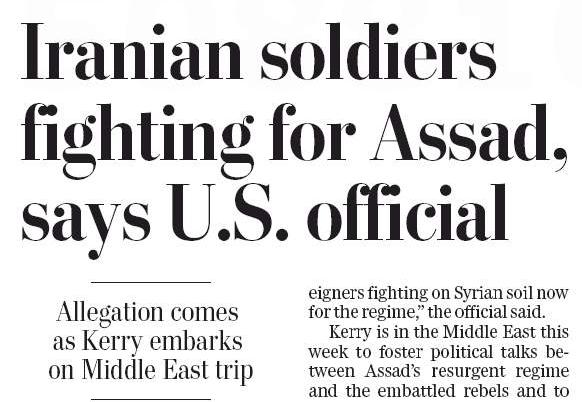 Suggesting that the Free Syrian Army believes Iranians are in Syria–which is probably true–is not the same thing as saying “Iran has sent soldiers to Syria” to fight on Assad’s behalf. And in answering followup questions, the anonymous State Department official admits that “to be very frank, I don’t have any estimates of numbers and I don’t know that they are directly involved in the fighting.” The source also says the Iranians “could be doing a little of both advising and fighting” and that “the reports that we’re getting… are not consistent.”
But Gearan’s question at the briefing would strongly suggest that she was pushing a stronger line about Iranian involvement than the anonymous source:
Are we now, based on your earlier comments about Iranian fighters being involved, looking at a proxy war? I mean, you’re talking about arming the rebels on one side, and the Iranians are clearly arming the others and fighting on behalf of the others on the other side. Are we now basically in a war with Iran?
The source doesn’t go as far out on this issue as Gearan’s question was pushing. But it didn’t really matter. As you can see in the pages of the Washington Post, an official Iranian role in the fighting was treated almost like a fact–which might be the point of having anonymous briefings like this.
Iran dismisses claims about military presence in Syria
Press TV – May 24, 2013
An Iranian deputy foreign minister has rejected claims about Tehran’s military presence in Syria, dismissing the allegations as a “blame game” orchestrated by the Syrian opposition groups.
“Iranian forces have never been, and are not present in Syria, and I deny this claim,” Iranian Deputy Foreign Minister for Asia-Pacific Affairs Abbas Araqchi said in Ankara on Thursday.
“The real enemies of Syria make such claims to provoke that country’s people [against Iran] and divert developments [in Syria] in the wrong direction,” said Araqchi, who is also Iran’s Foreign Ministry spokesman.
He emphasized that the crisis in Syria cannot be resolved through military means, adding that the unrest in the Arab country should be resolved politically. … Full article
Israel prepared to launch war on Syria: Israeli commander
Press TV – May 23, 2013
An Israeli military commander says Tel Aviv is prepared to carry out an attack on Syria if the government of Syrian President Bashar al-Assad collapses.
On Wednesday, Israeli Major General Amir Eshel said the Tel Aviv regime might launch a sudden war on Syria should Damascus fall.
“We have to be ready for any scenario, at a few hours’ notice,” Eshel stated.
He also said that the Israeli regime would even prepare for a “protracted” war with a “post-Assad Syria.”
The recent Israeli threat is seen as part of the Western-backed efforts to set up the scene for a military intervention in Syria.
The Tel Aviv regime has already carried out three air strikes on Syria.
On May 5, Syria said the Israeli regime had carried out an airstrike targeting a research center in a suburb of Damascus, following heavy losses inflicted upon al-Qaeda-affiliated groups by the Syrian army. According to Syrian media reports, the strike hit the Jamraya Research Center. The Jamraya facility had been targeted in another Israeli airstrike in January.
The May 5 Israeli aggression was Tel Aviv’s second strike on Syria in three days.
Turmoil has gripped Syria for over two years, and many people, including large numbers of Syrian soldiers and security personnel, have been killed in the foreign-sponsored militancy.
Western powers and their regional allies including the Israeli regime, Turkey, Saudi Arabia and Qatar are partners in supporting the militant groups in Syria.
Related article
NYT’s Apologia for Syrian Rebel War Crimes?
By Michael McGehee · NYTX · May 21, 2013
On May 15, 2013 The New York Times published “Islamist Rebels Execute Pro-Government Fighters in Raqqa” under their “Watching Syria’s War” section. The page shows a grisly video of three blindfolded men being executed by apparent members of Islamic State of Iraq and al-Sham, an al Qaeda-linked group from Iraq now operating in Syria.
The first peculiar thing on the NYT page is that the foreign group and its link to al-Qaeda is not mentioned beyond the statement that, “A video posted online on Tuesday claims to show rebels from the Islamic State in Iraq and Syria executing three government army officers in retaliation for recent mass killings in Baniyas and Homs said to have been committed by government forces.”
Then there is the claim that the group was “executing three government army officers,” or “Pro-Government fighters.”
The first question that emerges comes from their own admission: “We do not know the identity of the three men executed in this video.”
Then how does the “paper of record” know they were “government army officers”?
Two of the men are dressed in civilian clothing and the third man dressed in what looks to be camouflage.
What about the “judgment” the man reads before they are executed?
The NYT page doesn’t provide any translation, though it is readily available online, as with these two slightly different translations here and here. Selections from the “judgement,” reviewed below, suggest a different possible reason for their execution.
The men are never identified as soldiers, or government officers of any kind. The only reference to them is their religious sect: Nusayri/Alawite. And when the judgment is read the rebels do not attribute the crimes they are seeking revenge for to three blindfolded men, but to the Syrian government in general.
The man reading the judgement says in the first link above: “As a response from us to these crimes . . . We intend to get closer to Allah with these Nusayri (Alawite) villains…”
And in the second version: “our answer to their crimes committed, and in revenge to the Free women of Banyas and Homs . . . [is] to get closer to God Almighty, with those coward Alawites.”
Rather than looking like an execution of “fighters,” the judgment gives the impression that the men are being executed for their religious beliefs; that three Alawite men were rounded up and killed as some kind of religious offering.
Readers of The New York Times should be asking how the Times can claim the men executed were “Pro-Government Fighters,” or “government army officers,” when they themselves admit that they “do not know the identity of the three men executed in this video,” and when the “judgment” read aloud identifies the three men in civilian clothing simply by their religious sect.
Readers should also ask why, regardless of whether the men were military officers or civilians, they did not bother to mention the execution was a blatant war crime. Because considering the baseless claims and particular omissions it looks like the NYT is playing apologia for the rebels.
Related articles
- New York Times, sarin and skepticism
- NYT Runs Editorial Demanding Cuts in Social Security and Medicare in News Section
- Mainstream Media in America and Britain Repeat the Same Mistakes in Covering Iran That They Made on Iraq
- What the NYT Doesn’t Say About Washington’s Syrian Peace Plan
- The New York Times on Venezuela and Honduras: A Case of Journalistic Misconduct
- NYT on Chemical Weapons and War in Syria
The Syrian Crisis: The Option
By Jeremy Salt | Palestine Chronicle | May 18 2013
Ankara – While all options are said to be still on the table, Barack Obama is clearly backing away from any deeper involvement in Syria now that it is clear that nothing but direct intervention is going to bring down the government in Damascus. In the past few months alone the armed groups have lost thousands of men. Although the conflict will grind on for some time yet, the Syrian military is steadily closing down the insurgency.
The sponsors of this adventure are in complete disarray. Like the Syrian National Council before it, the Syrian National Coalition has imploded. Muadh al Khatib is now a voice from the margins. Ghassan Hittu is the only person in the world who is the prime minister of a committee. These people are a completely lost cause.
In the real world and not the world of delusions there is horror at the video showing a ‘rebel’ commander cutting the heart out of the body of a dead soldier and biting into it. Perhaps it was the lungs or the liver. The media seems to be uncertain but somehow getting the organ right seems to be important. Far from denying this gory act, its perpetrator owned up to it before boasting of how he had sawed the bodies of captured shabiha into pieces.
Cannibalism appears to be a first but otherwise there is not much that the psychopaths inside the armed groups have not done in Syria. Or are people who can do such things not to be called psychopaths? They are the best people, after all, to fight such a vicious conflict. The self-styled Free Syrian Army says it will hunt down the man who cut out the soldier’s heart. Good. It can also hunt down the throat-cutters and the ‘rebels’ who have cut people’s heads off. It can hunt down the men who killed public servants before flinging their bodies from the top of the post office building in Al Bab. It can hunt down their comrades in arms who deliberately target civilians with car bombs. It can hunt down the murderers of the imam and 50 worshipers in the Damascus mosque and it can hunt down all the rapists and kidnappers, including the Chechens who abducted the two bishops still being held in Aleppo while the Christian leaders of western governments look the other way. In its hunting for all the individuals who have tainted its glorious reputation, the FSA won’t have to look far because many come from its own ranks. There is no shortage of evidence. The media is awash with gory mobile phone and video footage of the handiwork of these men because they take pride in their bravery and want the world to see. These are the people Saudi Arabia and Qatar have been arming and funding to take over Syria.
This is the reality behind the false narrative spun by the media for the past two years. It has regurgitated every lie and exaggeration of ‘activists’ and the so-called Syrian Observatory for Human Rights, according to which the Syrian ‘regime’ was about to fall any minute and every atrocity was actually the work of the Syrian military. With the exception of a few reports filed recently by Robert Fisk, virtually no one in the media mainstream has reported the fighting from the perspective of the Syrian government and army. Reporters were moved across borders by the armed groups and reported only their version of events. This is like relying on reporters embedded with the US army for an accurate account of what was happening in Iraq. And, again like Iraq, the same propaganda is being repeated about chemical weapons.
Finally, reality has had to take hold. It is not the ‘regime’ or the army which is on the point of collapse but the insurgency. Only direct armed intervention is going to save it and against the successes of the Syrian army and solid Russian support for the Syrian government this is extremely unlikely. Obama is being pushed to ‘do more’ but is showing no inclination to be sucked any deeper into this mess. The others will do nothing without the US taking the lead. Germany is against involvement and Austria has said that supplying arms to the ‘rebels’, which Britain has wanted to do, when the EU embargo ends on May 31 would be a violation of international law.
This week the spotlight has been on Turkey’s Prime Minister, Recep Tayyip Erdogan, and his trip to Washington to discuss Syria with Barack Obama. Turkey’s role in the unfolding of the Syrian conflict has been central. Saudi Arabia, Qatar and Libya supplied the money and arms but it was Turkey whose territory was opened up to the mobilization of armed men crossing the border to bring down the ‘regime.’ Erdogan has not stepped back an inch from the position he took against Bashar al Assad more than two years ago. The only clear case of a chemical weapons attack has been the chlorine-based compound packed into a warhead and fired at a Syrian army checkpoint at Khan al Assal, killing a number of soldiers and civilians. Erdogan, however, is maintaining that it is the Syrian army that has used chemical weapons and by doing so has crossed Obama’s ‘red line. ’ Asked shortly before he left for Washington whether he would support a no-fly zone he replied: ‘Right from the beginning we would say yes.’
Last week cars packed with more than one ton of C4 and TNT were exploded in the Hatay province border town of Reyhanli. At least 51 people were killed. The destruction was massive. The municipality building and dozens of shops were obliterated. In the aftermath, cars with Syrian number plates were smashed and Syrian refugees attacked by enraged local people. As they milled around the destruction they cursed Erdogan. The atrocity followed a pattern that is familiar to Syrians: one bomb going off and then others exploding after people had gathered around the site of the first one, maximizing the death toll.
Notwithstanding the accusations of the Turkish government that this was the work of a terrorist group collaborating with the Syrian mukhabarat (intelligence), only the armed groups or one of the governments backing them would have a clear reason for setting up this outrage. The Syrian army is rolling up the insurgency, the ‘traitors’ council’ based in Doha has imploded and the Americans and Russians are sitting down to talk. The attack was very clearly designed to pull Turkey directly into the conflict across the border.
The attack on Reyhanli came a week after Israel launched a series of savage air attacks on Syria. This was not a one-off missile strike. Two attacks in three days, lasting for hours and with massive ordinance being dropped around Damascus, suggest that the aim was to provoke a Syrian response, opening the door to a general war in which Iran could be attacked. Israel claimed that the target was a shipment of missiles bound for Hizbullah but while a research station and a military food production plant were hit there was no evidence of any missiles being destroyed. The attacks appear to have been a strategic and political failure. In the aftermath Putin gave Netanyahu a dressing down and punished him either by supplying or threatening to supply Syria with advanced S300 anti-aircraft missiles. It is a measure of Israel’s arrogance that it insisted that it would launch further attacks if necessary and would destroy the Syrian government if it dared to retaliate.
Obama is now under pressure at home to ‘do more’. In Washington the same people who called for war on Iraq are now calling for widening the conflict in Syria. Senator Bob Menendez, a strong supporter of Israel, like virtually all congressmen and women, has introduced a bill calling on the administration to supply the ‘rebels’ with arms (as if it were not already doing that covertly or through support for arms being supplied by Saudi Arabia and Qatar). Former New York Times editor Bill Keller supported the war on Iraq and also wants the US to arm the ‘rebels’ and ‘defend the civilians being slaughtered in their homes’ in Syria. He is not talking about the civilians who have been slaughtered by the armed groups, of course.
The Washington Post has been forced to admit that the Syrian army is winning this conflict but is still nonplussed at the unfavorable turns of events. ‘What if the US doesn’t intervene in Syria?’ it asks, before providing the answers. Syria will fracture along sectarian lines, with Jabhat al Nusra taking over the north and ‘remnants of the regime’ taking strips of the west. Sectarian warfare will spread to Iraq – as if it has not already as a consequence of US intervention – and Lebanon. Chemical weapons would be up for grabs, ‘probably forcing further interventions by Israel in order to prevent their acquisition by Hizbullah or Al Qaida’. If the US does not intervene to prevent all of this Turkey and Saudi Arabia ‘could conclude that the United States is no longer a reliable ally.’
There are other more likely answers to ‘what will happen’. This is that the Syrian army will eventually drive the surviving ‘rebels’ out of the country and Bashar will come out of this more popular than ever because he saw off the greatest challenge to the Syrian state in its history. Elections will be held in 2014 and he will be elected president with 75 per cent of the vote. This at least is what the CIA is predicting.
Erdogan came to Washington also wanting Obama to ‘do more’, but clearly the US president does not want to do much if anything more. The Turkish media reported that Obama said Assad ‘must’ go but this was not what he said. He chose his words carefully. In his press conference with Erdogan he did not say that said Assad ‘must’ go but that he ‘needs’ to go and ‘needs’ to transfer power to a transitional body. The difference is all-important. Personally, Obama will not want to end his presidency stuck in an unwinnable and unpopular war, one, furthermore, that could quickly shift from regional to global crisis. A recent Pew poll shows that the American people have had enough of wars in the Middle East and the talks between Kerry and Lavrov indicate that this time, having allowed the Geneva agreement of July, 2012, to fall flat, the US is serious about reaching a negotiated end to this crisis even if others aren’t. If there is any danger of the US position being derailed, it will mostly likely arise within the ranks of its friends and allies.
– Jeremy Salt is an associate professor of Middle Eastern history and politics at Bilkent University in Ankara, Turkey.
Featured Video
No Vote, No Representation, No State: Democracy, Israeli Style
or go to
Aletho News Archives – Video-Images
From the Archives
Sanctions, War and the Policy of Dual Containment
By SASAN FAYAZMANESH | March 17, 2008
It is now nearly three decades since the Unites States adopted the policy of dual containment of Iran and Iraq. While much has been written about the containment of Iraq, there has been very little in-depth analysis of this policy when it comes to Iran. In a book that is going to be released on March 31, 2008, entitled The United States and Iran: Sanctions, Wars and the Policy of Dual Containment (Routledge), I attempt to address this shortcoming by investigating when and why the US policy of containment of Iran came about, how it evolved, and where it stands today.[1] To the extent that Israel has been involved in US policy making, the study will also include the role that Israel has played in the containment of Iran. Also, since the fate of Iran has been inextricably linked to that of Iraq, occasionally the investigation will overlap with the containment of Iraq.
The policy of dual containment of Iran and Iraq originated during the Carter Administration, but it was not until the Clinton Administration that the expression “dual containment” became popular. … continue
Blog Roll
 Aletho News
- How Israel destabilizes the Middle East: Denying sovereignty and the right to exist
- Europe’s Establishment Is Embracing War – and Losing Voters
- NATO chief advocates war of aggression
- No Vote, No Representation, No State: Democracy, Israeli Style
- Zionist Bought Senate Blocks Information About American Citizens Killed By Israel
- While Gaza dominates the UN, these are the people keeping it alive
- New Report: “Scholasticide and Genocide in Gaza: Assessment, Testimonies and Legal Analysis”
- ‘THAAD Delusion’: Iran war exposes US missile shield limits – The Atlantic
- Moscow issues warning to NATO over Russian exclave
- Yes, the Iran war has destroyed Trump’s presidency
- If Americans Knew
- Inside Lebanon’s 200-page dossier on Israeli war crimes
- Flydubai, genocide, settler violence, Trump abuse of power to deport – Daily Update
- Counting Antisemitic Incidents: What the ADL Audit Reveals — and Obscures
- Mamdani releases plan to combat antisemitism and hate crimes in New York City
- Iran’s Revolutionary Guards Publish Letter to the American People
- DMFI launches $1 million ad campaign supporting Virginia’s Elaine Luria
- US Senate blocks resolution seeking report on Americans killed by Israel
- Israeli Attacks Kill Ten Palestinians in Gaza
- Massacre at Minab: The School That Became a Grave
- Israeli media: The IDF Shows It Doesn’t Turn a Blind Eye; It Actively Emboldens Settler Havoc
- No Tricks Zone
- Green Energy Debacle: German Expert Professor Fritz Vahrenholt Warns Of Severe Economic And Social Consequences
- Two More Paleo Reconstructions Affirm Meters-Higher Sea Levels Across Ireland, Brazil 7000-6000 Years Ago
- New Study: Earth And Venus Surface Warmth Largely Explained By Convection And Lapse Rate, Not CO2 Or Radiation
- 2025 Nature Paper Claiming Worsening Global Drought Gets RETRACTED …Heavily Flawed
- New Study: ‘Global Drought Shows No Detectable Recent Acceleration Under Climate Warming’
- Economic Masterminds: German Socialists Suggest Taxing Productivity Gains Stemming From Using AI
- The South China Sea Has Not Been Cooperating With The Climate Change Narrative
- Energy Crisis: Germany Enters Heating Season With Historically Low Gas Reserve Fill Levels
- New Study: The Antarctic Ice Sheet Gained Mass From 2020-2024 Due To Staggering Snow And Ice Accumulation
- Study: Ocean Heating Rates From Thousands Of Years Ago ‘Dwarf’ Modern Ocean Heating Rates

