New York Times, sarin and skepticism
Iraq Then, Syria Now?
FAIR | May 15, 2013
During the run-up to the Iraq War, the New York Times amplified erroneous official claims about weapons of mass destruction (FAIR Action Alert, 9/8/06). Looking at the paper’s coverage of allegations of chemical weapons use by Syria, some of the same patterns are clear: an over-reliance on official sources and the downplaying of critical or skeptical analysis of the available intelligence.
In “Syria Faces New Claim on Chemical Arms” (4/19/13), the paper told readers that, according to anonymous diplomats, Britain and France had sent letters to the United Nations about “credible evidence” against Syria regarding chemical weapon use. On April 24, the Times reported that Israel had “evidence that the Syrian government repeatedly used chemical weapons last month.”
The next day (4/25/13), the Times reported that, according to an unnamed “senior official,” the White House “shares the suspicions of several of its allies that the Syrian government has used chemical weapons.” The article spoke of the “mounting pressure to act against Syria,” adding, “Some analysts say they worry that if the United States waits too long, it will embolden President Bashar al-Assad.”
And then on April 26, under the headline “White House Says Syria Has Used Chemical Arms,” the Times reported:
The White House, in a letter to Congressional leaders, said the nation’s intelligence agencies assessed ”with varying degrees of confidence” that the government of President Bashar al-Assad had used the chemical agent sarin on a small scale.
The story included a source, Sen. Dianne Feinstein (D.-Calif.), who presented the intelligence as more definitive: She “said the agencies actually expressed more certainty about the use of these weapons than the White House indicated in its letter.”
An April 27 Times report warned that there were dangers in waiting too long to respond to the charges that Syria has used chemical weapons:
If the president waits for courtroom levels of proof, what has been a few dozen deaths from chemical weapons–in a war that has claimed more than 70,000 lives–could multiply.
In following days, the accusations of chemical weapons use were presented uncritically as the premise for political stories: pondering how the White House would “respond to growing evidence that Syrian officials have used chemical weapons” (4/28/13) or noting Republican attacks on the White House following “revelations last week that the Syrian president, Bashar al-Assad, is believed to have used chemical weapons against his own people” (4/29/13).
On May 5, the Times was again weighing in on the political ramifications:
Confronted with evidence that chemical weapons have been used in Syria, President Obama now finds himself in a geopolitical box, his credibility at stake with frustratingly few good options.
Then, on May 5 came an unusual shift: Carla Del Ponte, a member of a United Nations team investigating human rights abuses in the Syrian civil war, claimed that the UN had collected evidence that chemical weapons had been used in Syria–but by the rebels, not by the government.
After running a Reuters dispatch on May 6, the Times published its own piece on May 7, a report that talked about “new questions about the use of chemical weapons.” But the emphasis was clearly on rebutting the charges: The paper reported that the White House had “cast doubt on an assertion by a United Nations official that the Syrian rebels…had used the nerve agent sarin.” The piece included three U.S. sources–one named, two unnamed–who questioned the Del Ponte claims.
The article went on to reiterate that the White House was weighing other options based on “its conclusion that there was a strong likelihood that the Assad government has used chemical weapons on its citizens.”
Outside the New York Times, though, doubts about the evidence pointing to Syrian use of poison gas were evident from the very start. McClatchy’s Jonathan Landay (4/26/13) reported that one source characterized the U.S. intelligence as “tiny little data points” that were of “low to moderate” confidence.
An April 30 report from GlobalPost noted that a “spent canister” at the scene of one attack “and the symptoms displayed by the victims are inconsistent with a chemical weapon such as sarin gas.” A subsequent GlobalPost dispatch (5/5/13) reported that blood samples tested in Turkey were not turning up evidence of sarin exposure.
NBC reporter Richard Engel (5/8/13) traveled to Syria with rebel forces to examine evidence they had collected. He seemed to concur with the GlobalPost reports that the chemical exposure could very well have been from a type of tear gas.
By May 7, McClatchy was reporting that the case was looking weaker, noting that
no concrete proof has emerged, and some headline-grabbing claims have been discredited or contested. Officials worldwide now admit that no allegations rise to the level of certainty…..Existing evidence casts more doubt on claims of chemical weapons use than it does to help build a case that one or both sides of the conflict have employed them.
It is clear that the Times has promoted a storyline that treats the chemical weapons claims as more definitive than they are, and has given scant attention to subsequent revelations about the evidence.
In a recent column (5/5/13), Times public editor Margaret Sullivan argued that the paper still faces problems with its credibility based on its reporting about Iraq’s weapons of mass destruction over 10 years ago. The Times “pledged more skeptical and rigorous reporting” going forward, and Sullivan argues that the Times “has taken important steps” in that direction.
But does the paper’s handling of the Syria chemical weapons stories demonstrate that the paper has learned lessons? Or is it repeating the same mistakes?
ACTION:
Ask the New York Times public editor to evaluate the paper’s reporting on Syria and chemical weapons.
CONTACT:
New York Times
Margaret Sullivan, Public Editor
public@nytimes.com
Over 70 states refuse to say yes to anti-Syria resolution
Press TV – May 16, 2013
More than 70 countries have refused to say yes to an Arab-backed resolution against Syria at the United Nations General Assembly.
Russia, China and Iran were among the 12 countries that opposed the resolution on Wednesday.
Russia called the resolution, co-sponsored by the United States, “counterproductive and irresponsible.”
The resolution was adopted by a vote of 107-12 with 59 abstentions. Argentina, Brazil, and more than a dozen other Latin American and Caribbean countries abstained from voting.
Russian Deputy Ambassador to the UN Alexander Pankin called the resolution “very harmful and destructive,” saying it disregards “illegal actions of the armed opposition.” He also accused the resolution’s Arab sponsors of attempting to replace the Syrian government instead of trying to find a political solution to the crisis in Syria.
Syrian Ambassador to the UN Bashar Ja’afari also stated that the resolution “seeks to escalate the crisis and fuel violence in Syria.”
The non-binding resolution, which was drafted by a number of Arab states, calls for a “political transition” and refers to the foreign-backed militants in Syria as “effective representative interlocutors” needed for the transition.
The Syria crisis began in March 2011, and many people, including large numbers of soldiers and security personnel, have been killed in the violence.
The Syrian government says that the chaos is being orchestrated from outside the country, and there are reports that a very large number of the militants are foreign nationals.
Damascus says the West and its regional allies, such as Qatar, Saudi Arabia, and Turkey, are supporting the militants.
In an interview recently broadcast on Turkish television, Syrian President Bashar al-Assad said that if the militants take power in Syria, they could destabilize the entire Middle East region for decades.
“If the unrest in Syria leads to the partitioning of the country, or if the terrorist forces take control… the situation will inevitably spill over into neighboring countries and create a domino effect throughout the Middle East and beyond,” he stated.
Asking Amnesty International to Oppose War
By David Swanson | War Is A Crime | May 7, 2013
Some human rights groups, especially Amnesty International, seem to have forgotten an important human right: peace. A petition has been launched to remind them.

These organizations are not the warmongers. They do tremendously great work addressing some of the symptoms of warmaking, including imprisonment and torture. But, because they avoid taking any position on war, and because of an apparent bias in favor of U.S. military intervention, they sometimes find themselves effectively promoting war and all the horrors that come with it. At Nuremberg to initiate a war of aggression was called the supreme international crime “encompassing the evil of the whole.” Yet human rights groups are often on the wrong side of the fundamental question of war.
Amnesty International (AI) promoted the babies-taken-from-incubators hoax that helped launch the 1991 war on Iraq. AI has upheld the pretense that the US/NATO occupation of Afghanistan is about women’s rights. And now Amnesty International is highlighting warmaking in Syria’s civil war by one side only:
“Our team of researchers on the ground found evidence that government forces bombed entire neighborhoods and targeted residential areas with long-range surface-to-surface missiles,” said an AI fundraising email on April 29th that made no mention of abuses committed by Syrian rebels supported by the U.S. and its allies.
This one-sided treatment by a group supposedly dedicated to all humans fuels the fires of a wider war from which the people of Syria can only suffer.
The email continued: “Amnesty has a strong track record of using our on-the-ground findings to pressure governments and the United Nations Security Council to hold those responsible for the slaughter of civilians accountable.”
Does it? When the United States kills civilians in Iraq or Afghanistan or Libya, AI’s silence has often been deafening. Shouldn’t a human rights group press for an end to the killing of all humans by all parties?
While many good individuals who work for human rights groups like AI oppose wars, these organizations officially ignore President Eisenhower’s warning and a half-century of evidence regarding the power of the military industrial complex — and they ignore the criminality of war under the U.S. Constitution, the U.N. Charter, the Kellogg-Briand Pact and other laws.
These groups accept the existence of war (when not encouraging it) and then focus on specific crimes and abuses within the larger war-making enterprise. They promote the idea that human rights are governed by two sets of laws, one in peace and another weaker set in war. Voices for the human right to peace are missing and badly needed, as “humanitarianism” and “the right to protect” are used as excuses for war and intervention.
Amnesty International opposes imprisonment without trial and other abuses unless they adhere to the “laws of war,” which is why AI is not opposing the outrageous charges leveled against Bradley Manning. Killing is opposed unless it adheres to the “laws of war.” Under this standard, we pretend not to know whether blowing families up with drones is legal or not as long as the memos purporting to legalize it are kept hidden.
Groups like Amnesty oppose particular weapons, including the development of fully autonomous weapons (drones that fly themselves). No one in their right mind would oppose that step. But surely the human right not to be blown up does not vanish if the button is pushed by a person instead of an autonomous robot. Other organizations are pushing to ban all weaponized drones from the world.
Human rights groups should join the peace movement in targeting war and militarism itself, rather than just some of its symptoms. Amnesty International and all groups favoring human rights should be asked to oppose a U.S. escalation of war on Syria.
Related articles
BBC Helps Pave Road to War on Syria
News Unspun | May 8, 2013
The Syrian conflict has been accompanied by a distinct media narrative. Within this narrative – which poses a binary division between the forces engaged in the conflict, identifying the players as good (the rebels, who must receive ‘our’ support) and bad (the government) – the role the West must play is that of potential saviour, whose aim is to cautiously observe the conflict so that it may intervene to ‘fix’ the situation, as The Guardian’s Simon Tisdall put it:
So what can Obama do? As Vladimir Putin was expected to make plain to John Kerry in Moscow on Tuesday, he cannot count on Russian (or, therefore, Chinese or UN security council) support to fix Syria.
This sentiment, that the West can put right the Syrian situation, is inherent to most reporting of the conflict. The BBC recently reported that ‘the pressure to act has intensified in recent days after emerging evidence that Syria has used chemical weapons such as the nerve gas sarin’. This statement presents the existence of a ‘pressure to act’ as a given, though the source of such pressure is unidentified. From where is this pressure emerging? As a BBC report points out, public opinion in France, the UK, the US, and Germany is by majority opposed to the possibility of intervention in the conflict through sending arms and military supplies to the Syrian opposition. The BBC is not then speaking on behalf of the public majority. Pressure towards military intervention, to some extent considered a desirable option by the UK government (if it can ‘achieve the result [they] want’, as Cameron put it in an interview with Nick Robinson), is, however, increasingly mounting within the media itself.
Chemical Weapons ‘Evidence’
It is also important to note that the ’emerging evidence’ referred to above is not conclusive despite the wording of this report. The BBC reported again on Monday 6 May that ‘Western powers have said their own investigations have found evidence that government forces have used chemical weapons’. Again, this is simply not the case. ‘Western powers’, regardless of their true intentions, have in fact been very cautious in public about how precisely they present their claims, underscoring the lack of conclusive evidence they have found and that there exists the possibility that chemical weapons had been used by the Syrian government. This misrepresentation by the BBC emerges in a context in which the use of chemical weapons has been signified by the UK and US as the point at which they may become militarily involved in the Syrian conflict. As such these details, so easily misrepresented by the BBC, are of high consequence.
(There are other examples of BBC reports dangerously getting important facts wrong about such issues: just over a year ago, for example, a BBC news report stated that the ‘International Atomic Energy Agency (IAEA) released a report with new evidence showing Iran was secretly working towards obtaining a nuclear weapon’ – in this case the report said no such thing.)
Journalists Pushing for Intervention
In recent reports, certain BBC journalists have appeared more hawkish than government officials themselves. Take for example a question put to Cameron by the BBC’s Nick Robinson:
Do you ever fear that a terrible thing is happening in our world and that Western leaders cannot or will not act because of a fear of another Iraq?
Cameron responded with ‘I do worry about that’, before clarifying that what he has concluded from the ‘Iraq lesson’ is that the UK should only enter into conflicts it can win, that ‘the ability is there’. This is at a far remove from the implication of Robinson’s question that past ‘mistakes’ might prevent the West from playing a righteous humanitarian role. Yet Robinson’s leading question provides the basis for the seemingly unambiguous headline: ‘Cameron fears Iraq effect holding West back in Syria’.
There is a prevailing trend of journalists taking up the position of presenting the case for military intervention in Syria and proactively pushing government representatives to commit to intentions for military action. On the Andrew Marr show on 5 May Jeremy Vine asked Defence Secretary Phillip Hammond a number of questions which demonstrated this pressure by the media for the UK to become involved in the Syrian conflict. When Hammond appeared cautious regarding the prospect of military intervention, stating that the UK would need to engage in discussion with the UK’s ‘allies and partners’, Vine admonished, ‘you’re talking about having a series of meetings’. Another brief exchange emphasises Vine’s apparent desire to see the UK intervene:
Phillip Hammond: ‘Frankly that [the potential use of chemical weapons] is not what’s delivering the tally of 70,000 that have been killed… the majority of these people have been killed by conventional weapons’.
Jeremy Vine: ‘More reason to do something then…’
These comments reflect the consistency of BBC reporting which seems aimed towards creating a case for war. When Carla Del Ponte, of the UN’s Independent International Commission of Inquiry on Syria, told reporters that there were ‘strong, concrete suspicions’ that the rebels – perhaps not as virtuous as would be convenient for States considering providing military support – may have used chemical weapons, the tone of BBC reporting did not suggest that the pressure for military action should be alleviated.
Analysis of Attacks on Syria: Real and Imagined
Taking the case a step further, Jonathan Marcus, the BBC’s diplomatic correspondent, discussed the various ways in which the US could attack Syria. His assessment reads more like a military strategy report than an analysis of events for a news provider. Surgical airstrikes, Marcus said, ‘could be carried out by cruise missiles launched from aircraft well outside Syrian airspace or from warships or submarines in the Mediterranean’, while a wider air campaign, ‘might have to be preceded by a significant effort to destroy missiles, associated radars and command systems and might well involve losses’. Why it is in the public interest that such analysis is brought to us by journalists is unclear. Through Marcus’s piece, which is nothing more than speculation of military strategy on an as yet non-existent, illegal military intervention, the idea of an attack on Syria from outside is normalised further.
The reporting on the air strikes that Israel has carried out on Syria also reveals how normalised warfare has become in BBC reporting, with very little discussion of casualties or of the chaos inflicted on the people who were bombed. What was important, in this story, it seems, is that Israel was protecting itself from weapons that were supposedly being transported. This is summed up in the BBC’s Q&A page on the Israeli airstrikes: in answer to the question ‘Why would Israel attack?’ we are told that ‘the statements from unnamed officials suggest Israel’s actions are defensive.’ If the Syrian government had, for example, attacked the Israeli air force within Israel, to prevent airstrikes on its own territory, it is extremely unlikely that this would be overwhelmingly reported as an act of defence. Yet when Israel bombs another country, BBC journalists and editors happily report such actions as ‘defensive’ measures.
Jonathan Marcus writes that Israel’s airstrikes are ‘designed to send a powerful signal’ (the headline: ‘Israeli air strikes: A warning to Syria’s Assad’). It is worth at this point noting that following the last Israel attack on Syria, in early 2013, Marcus also wrote that this was ‘in one sense pre-emptive, but also a warning’. It was also portrayed as a ‘signal’. That such attacks are continuously reported as warnings and signals, as seemingly rational, and therefore it seems permissible, actions, goes further to normalise them. We might wonder how many attacks Israel would have to inflict on another country before Jonathan Marcus stops referring to the attacks as ‘signals’ and ‘warnings’?
In their seeming urgency to present a case for war, BBC reporters have neglected factual accuracy of reported events. Scepticism towards the unsupported claims of Western governments, insistence upon proof, is also lacking. We are presented with a simplified narrative, of ‘good versus evil’, in which the possibility of misconduct on both sides of the conflict is considered improbable. This style of reporting very much takes its lead from the positions of Western governments. Whitehouse spokesman Jay Carney outlined the position of the US: ‘We are highly sceptical of suggestions that the opposition could have or did use chemical weapons. We find it highly likely that any chemical weapon use that has taken place in Syria was done by the Assad regime, and that remains our position’. The supposed instincts of the US or UK government, despite the inconclusive nature of the evidence, as to the righteousness of the Syrian rebels is not proof of the reality and should not be considered by journalists as such.
Related article
What the NYT Doesn’t Say About Washington’s Syrian Peace Plan
By Michael McGehee | NYTX | May 9, 2013
On page A12 of the May 8, 2013 edition of The New York Times is Steven Lee Myers and Rick Gladstone’s article “U.S. and Russia Plan Conference Aimed at Ending Syrian War,” which opens by stating that, “Russia and the United States announced on Tuesday that they would seek to convene an international conference within weeks aimed at ending the civil war in Syria, jointly intensifying their diplomatic pressure on the combatants to peacefully settle a conflict that has taken more than 70,000 lives and left millions displaced and desperate.” This is a most welcoming turn of events, especially for the people of Syria who have taken the brunt of the civil war, and hopefully the conference bears fruit quickly.
But—and there is one of these stubborn conjunctions—it is important for the purpose of history to note that for two years now the United States has blocked any peaceful resolution, and has instead pushed the conflict further and deeper into violence and war.
It is Russia who has long pushed for a political reconciliation.
In October 2011 RIA Novosti reported that “Moscow calls on the UN Security Council to continue the search for a balanced approach toward the political crisis in Syria based on a draft resolution prepared by Russia and China, Russia’s envoy to the UN said,” with the phrase “balanced” being a jab at how Washington and its allies have put all the requirements on the Syrian government to end violence, and not the rebel forces whom they have been backing.
Writing in December of 2011, Egypt Independent reported that, “Deputy Russian Foreign Minister Sergey Ryabkov on Monday emphasized the need for dialogue and reconciliation in Syria.”
Even in December of 2012 Voice of America reported that, “Russian Foreign Minister Sergei Lavrov has echoed a call from an international peace envoy to resolve Syria’s civil war through a government-backed national dialogue and political process.”
The New York Times also reported on Russian efforts that same month when they informed readers that, “Moscow has made a muscular push for a political solution in recent days.”
While it is inaccurate to imply that Russia’s search for “a political solution” was “in recent days,” it is more disturbing that phrases like “muscular push” are used to describe such an effort, while the “paper of record” has routinely tried to make a case for war (see here and here).
A month ago today (May 8, 2013) the Syrian rebels detonated a car bomb near a school in Damascus, killing 14, and wounding dozens of others. According to Reuters, “State television said the explosion had occurred near a school in Sabaa Bahrat, a heavily populated area that also houses the Central Bank and the Finance Ministry. It said 53 people were wounded.”
Washington failed to condemn the act of terror.
Likewise when Daily Mail ran an article last December with this headline: “Syria rebels ‘beheaded a Christian and fed him to the dogs’ as fears grow over Islamist atrocities.” Apparently there is no “red line” for the rebels to cross.
And there are dozens and dozens of similar incidents. Not once has Washington put pressure on the rebels to stop their senseless violence, or argued for an international force to intervene and defend the Syrian people from the terrorists. Nor have Western establishment pundits like Bill Keller argued for such things. And even though al Qaeda is active in the country, beheading so-called infidels, or that the Syrian rebels are likely using chemical weapons, Washington and its media parrots have instead favored escalation. Just over a week ago The New York Times reported that “The White House is once again considering supplying weapons to Syria’s armed opposition.” This comes after the car bombing across the street from a children’s school.
And now Washington wants peace, as Myers and Gladstone tell us that “The announcement appeared to signal a strong desire by both countries to halt what has been a dangerous escalation in the conflict.”
Perhaps it has become clear that the rebels cannot win this war on their own, and the only reasonable way Bashar Assad will be brought down is another U.S. war which will elevate the jihadis into power. Perhaps President Obama is imagining one of these rebel jihadis attacking an American embassy in Damascus, and the Republicans foaming at the mouth for another politicized inquiry into how such an attack could happen, as they currently are over the embassy attack in Benghazi, Libya last year.
Whatever the reasons for the turnaround it is gladly welcomed. The people of Syria deserve a rescue from the terror Washington, Turkey, Saudi Arabia, Qatar, and others, have unleashed on them. Though we should remain sober and note that the “conflict that has taken more than 70,000 lives and left millions displaced and desperate” is largely of Washington’s doings, and could have been avoided years ago if Uncle Sam followed the lead of Moscow and Bejing, both of whom had the “strong desire . . . to halt what has been a dangerous escalation in the conflict.”
We should also recall that The New York Times derided Russia for their “strong desire” and even went so far as to equate it with “effectively toss[ing] a life preserver to President Bashar al-Assad, seemingly unwilling to see a pivotal ally and once stalwart member of the socialist bloc sink beneath the waves of the Arab Spring.” Russia was just as clear then as they are now: they did not want to go along with efforts that would worsen the situation, but now that the situation has gotten considerably worse, and Washington is warming to the idea of a political solution, now The New York Times is presenting this as a positive development.
Militants capture UN peacekeepers in Golan Heights
Press TV – May 7, 2013
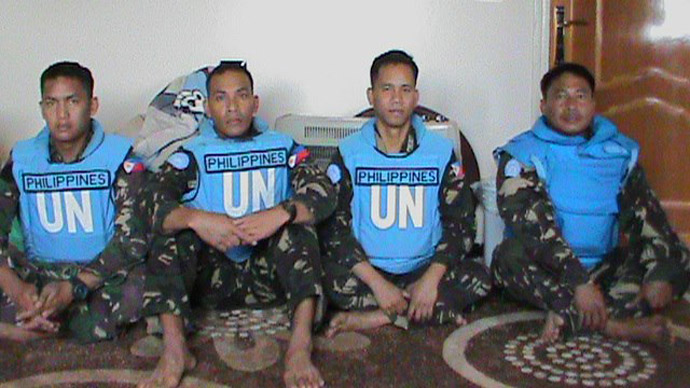
Militants fighting against the Syrian government have abducted a group of UN peacekeepers monitoring the ceasefire line between Syria and the Israeli-occupied Golan Heights.
According to Reuter’s news agency, a militant group operating in Syria issued a statement on Tuesday saying it was holding the four peacekeepers.
The statement said the peacekeepers were being held for their own safety because of clashes in the separation zone between Syria and the Israeli-occupied heights.
A picture accompanying the statement shows four peacekeepers wearing light-blue UN flak jackets marked “Philippines.”
It is the second time that foreign-backed militants fighting against the government of President Bashar al-Assad seize UN troops in the Syrian side of the Golan Heights.
In March, anti-Syria militants detained 21 Filipino peacekeepers in the same region. They were released after three days.
Syria has been experiencing unrest since March 2011. Many people, including large numbers of security personnel, have been killed in the violence.
Damascus says the chaos is being orchestrated from outside the country, and there are reports that a very large number of the insurgents are foreign nationals.
Several international human rights organizations have accused foreign-sponsored militants of committing war crimes.
NYT on Chemical Weapons and War in Syria
By Michael McGehee | NYTX | May 6, 2013
“We have been very clear to the Assad regime but also to other players on the ground that a red line for us is, we start seeing a whole bunch of weapons moving around or being utilized.” — Obama Threatens Force Against Syria, The New York Times, August 21, 2012
When President Obama spoke these words last August he might have dug himself a hole twice as deep as the one he was in last week.
As four NYT journalists reported on Sunday’s front page article “Off-the-Cuff Obama Line Put U.S. in Bind on Syria”: “Confronted with evidence that chemical weapons have been used in Syria, President Obama now finds himself in a geopolitical box, his credibility at stake with frustratingly few good options.”
If there will be any effort to hold Mr. Obama’s feet to the fire the heat just got hotter.
Buried on page A9 of Monday’s edition of “the paper of record” was a statement by Carla del Ponte, a United Nations human rights investigator looking into the claims that chemical weapons were used in Syria:
The United Nations independent commission of inquiry on Syria has not yet seen evidence of government forces using chemical weapons, which are banned under international law, said Carla Del Ponte, a commission member.
“Our investigators have been in neighboring countries interviewing victims, doctors and field hospitals,” Ms. Del Ponte said in an interview with Swiss-Italian television. “According to their report of last week, which I have seen, there are strong, concrete suspicions but not yet incontrovertible proof of the use of sarin gas, from the way the victims were treated.”
“This was use on the part of the opposition, the rebels, not by the government authorities,” she added, speaking in Italian.
Question: Will President Obama hold the rebels accountable for crossing his red line?
In his own words he did say that he has “been very clear to the Assad regime but also to other players on the ground” [emphasis added] that the use of chemical weapons is a red line that even the Times saw last summer as a threat of force.
The question is not likely to be answered in the affirmative. This is the politics of war. For more than two years the rebels have been carrying out terrorist bombings, grisly executions, and other assorted attacks that would likely have had Washington and its allies foaming at the mouths were it the Assad regime who was the perpetrator.
Washington has failed to join the Syrian government in their own War on Terror, even though al Qaeda is active in the country. And it just goes to show as one more example: when al Qaeda is used as a boogeyman for war we should not take the pretext seriously, as in the case of Mali. If al Qaeda is on the same side as Uncle Sam, as they were in Afghanistan in the 1980s, the Balkans in the 1990s, Libya in 2011, and now Syria, then there will be no drone attacks on the terrorists.
And now we see al Qaeda-linked terrorists suspected of using chemical weapons. Don’t look for the U.S. to come to the defense of the Syrian government.
Already we can see the change of attitude reflected at The New York Times.
Not two weeks ago, on April 26, 2013, it was front page news at the NYT that “White House Says It Believes Syria Has Used Chemical Arms.”
From that moment the story became a sensation. It fit well into the parameters of the propaganda system. An official enemy who we are actively trying to overthrow may have used chemical weapons and provided a clear pretext for force. Here comes the march to war.
But when UN investigators looked into the matter and reported that “Syrian Rebels May Have Used Sarin,” the story fell from grace and was pushed to page A9.
This differential treatment signals the death of the “red line” story, which is too bad because it would have been interesting to see The New York Times, or anyone in the mainstream media, investigate how Syrian rebels could have gotten a hold of sarin, especially considering a former Bush official has openly considered the idea of Israel being behind the attack.
The differential treatment may possibly throw a wrench in the drive to war . . . for now. Because, also on page A9 of Monday’s edition of The New York Times is “Attacks on Syria Fuel Debate Over U.S.-Led Airstrikes,” a report of an Israeli attack in Syria:
WASHINGTON — The apparent ease with which Israel struck missile sites and, by Syrian accounts, a major military research center near Damascus in recent days has stoked debate in Washington about whether American-led airstrikes are the logical next step to cripple President Bashar al-Assad’s ability to counter the rebel forces or use chemical weapons.
That option was already being debated in secret by the United States, Britain and France in the days leading to the Israeli strikes, according to American and foreign officials involved in the discussions. On Sunday, Senator John McCain, who has long advocated a much deeper American role in the Syrian civil war, argued that the Israeli attacks, at least one of which appears to have been launched from outside Syrian airspace, weakens the argument that Syria’s air defense system would be a major challenge.
“The Israelis seem to be able to penetrate it fairly easily,” Mr. McCain said on “Fox News Sunday.”
While attacks in Syria might be easier than previously suspected, the justifications for war received a setback. But if history is any guide this is only a minor and temporary one.
Lebanon asks UN to censure Israel for violating its sovereignty
Press TV – May 7, 2013
Lebanon has asked the United Nations Security Council to condemn Israel for violating its sovereignty by air, sea, and land.
In a letter to the UN Security Council, Lebanon urged the 15-member body to “compel Israel to halt its violations of Lebanon’s sovereignty by air, sea and land, and carry out all its obligations in accordance with Resolution 1701,” Reuters reported on Monday.
UN Security Council Resolution 1701, which brokered a ceasefire in the war of aggression Israel launched against Lebanon in 2006, calls on Israel to respect Lebanon’s sovereignty and territorial integrity.
“The Israeli Air Force continues to violate Lebanese airspace and in the previous days intensified its circuits above Lebanon. This constitutes a disgraceful violation of (Lebanon’s) sovereignty,” the letter said.
On Friday and Sunday, Israeli warplanes carried out two airstrikes on Syria. The Syrian government called the attacks a “flagrant violation of international law.”
On Sunday, Lebanese President Michel Sleiman condemned the Israeli airstrikes on Syria. A statement issued by Lebanon’s presidential office read: “Sleiman strongly condemned Israel’s aggression on Syrian sites [which it carried out] by violating Lebanese airspace to carry out these attacks.”
“This act is not unusual for a mutual enemy [such as Israel] whose policy is based on aggression that takes advantage of the circumstances Syria is going through to carry out its aggression just as it used to do in Lebanon during its days of crisis,” the statement added.
Lebanese caretaker Prime Minister Najib Miqati also denounced the strikes, saying they “underscored once again Israel’s aggressive intentions.”
“[The strikes] fall within the series of continuous aerial violations of Lebanon’s sovereignty and its threats against Lebanon,” he said in a statement issued on Sunday.
The Syrian Foreign Ministry has sent letters to the UN Security Council stating that Israel’s aggression shows the links between Tel Aviv and terrorist groups operating in Syria, including the al-Qaeda-linked al-Nusra Front.
Syrian Information Minister Omran al-Zoabi told reporters in Damascus on Sunday that Syria had the right and the duty to defend its people by all available means and it would not give in to Israeli acts of aggression.
The Israeli attacks on Syria have made the Middle East more dangerous, the Syrian information minister stated.
Related articles
Pro-Israeli US senator pushes bill requiring military aid to Syria insurgents
Press TV – May 7, 2013
Despite recent findings of a UN probe team that foreign-backed insurgents in Syria have used chemical agents in the country, a top US senator has introduced a bill requiring the Obama administration to supply lethal weapons to the anti-Damascus militant gangs.
Democratic Chairman of US Senate Foreign Relations Committee Robert Menedez, well known for his pro-Israeli views and positions, introduced the legislation to his committee on Monday, which would explicitly allow Washington to provide arms and military training to the militant gangs that include al-Qaeda-linked terrorist elements.
The move came on the heels of unprovoked Israeli aerial and missile attacks against Syria in recent days, in a flagrant violation of international law, and a report by a UN investigation team that pointed to “strong, concrete suspicions” of chemical weapons use by foreign-backed Syrian opposition forces that are engaged in a US-led move to overthrow the government of President Bashar al-Assad.
Carla Del Ponte, a member of the UN commission probing the alleged use of the nerve gas sarin in Syria, announced on Sunday that the country’s opposition forces, and not the Assad regime, were behind the use of chemical weapons.
There are “strong, concrete suspicions but not yet incontrovertible proof” of sarin gas being used “on the part of the opposition, the rebels, not by the government authorities,” she reportedly told a Swiss-Italian television outlet.
Meanwhile, Menendez, a New York Democrat who was recently investigated for ties and accepting campaign funds and bribes from a criminal enterprise in Florida, claimed in a statement that “the Assad regime has crossed a red line that forces us to consider all options.”
He further called for clear measures by Washington to tip the military balance in favor of the anti-Damascus militant gangs in line with the recent aggression by the Zionist regime.
“The greatest humanitarian crisis in the world is unfolding in and around Syria, and the US must play a role in tipping the scales toward opposition groups and working to build a free Syria,” Menendez further claimed.
Such remarks come while Menendez, along with several other pro-Israeli Republican and Democratic lawmakers in the US Congress have been urging the Obama administration to intervene in Syria in support of the insurgents and in a bid to remove President Assad from power.
Furthermore, Menendez is also among those American lawmakers that recently pushed a resolution calling for US backing of the Tel Aviv regime in case it decides to wage a military action against the Islamic Republic of Iran.
This is while the Iranian authorities have made clear that in case the Zionist regime dared to attack the country in any way, major Israeli cities will be “razed to the ground” in response and retaliatory measures against US interests would extend far beyond the immediate region.
The US Senate is to consider the draft bill introduced by Menendez next week. In order for the bill to become law, it has to first be approved by the committee, win passage on the floors of the House and the Senate and then signed by President Barack Obama.
Related articles
Syria: a Toast to Israeli State Terrorism
By Julie Webb-Pullman | Palestine Chronicle | May 6 2013

Made in the USA. (Photo: Julie Webb-Pullman)
While the United States peddled the threat of chemical weapon use to justify its arming of the ‘opposition’ in Syria, Israel destroyed a chemical research facility near Damascus which was allegedly developing such weapons – thus unleashing every single potentially-poisonous particle on the Syrian public.
Thus guaranteeing that regardless of whether there actually were chemical weapons being developed or manufactured, regardless of whether the Assad regime actually was intending to use them against the Syrian people, the Syrian people now HAVE been exposed – and in a totally uncontrolled fashion – to not only the known toxic effects of whatever was in the facility, but also to the unknown effects of the random mixing of such chemicals under conditions of extreme heat, and their dissemination who knows how far, causing who knows what extent of environmental and health damage.
Assad mustn’t be permitted to do it – but Israel can – and with US blessing.
Israel’s “right to defend its interests,” Obama immediately called it.
Others would call it a cold-blooded murderous attack on the Syrian civilian population.
Others would call it terrorism.
State terrorism.
Since the Twin Towers attacks in 2001, the use of pre-emptive strikes by both the US and Israel to ‘counter terrorism’ or ‘defend security interests’ have escalated to become the single most potent military threat to civilians anywhere on the planet.
Massacre after massacre of civilians by drones, by rockets, by misguided ‘targeted assassinations’ in Afghanistan, Gaza, Yemen, Saudi Arabia, Pakistan – the list goes on. The list of perpetrators, however, is short – only two. The United States and Israel.
Are such peremptory attacks permissible in international law?
No – international law is very clear on this. Article 51 of the United Nations Charter only allows military actions in self-defence when under direct attack.
Did Syria attack Israel?
No.
Did Syria make any kind of threatening military action towards Israel?
No.
Israel carried out an indefensible-in-international-law military strike in Syria causing direct – and very real – harm to a large civilian population.
A more clear – and potent – case of state terrorism would be hard to find.
Did the US condemn this act, which exposed Syrians to the very harm Obama was trumpeting around the world his intention to protect them from?
No.
He defended Israel’s attack.
A more clear – and potent – case of abject hypocrUSAy would be hard to find.
If the world is not to degenerate into a complete USraeli military dictatorship, the international community must act immediately to curtail this latest slide down the slippery slope of human rights derogation, where notions such as international law and due process are merely quaint antiquities, and self-determination a notion reserved solely for Yanqui and Zionist imperialists – or it won’t just be the end of the alphabet we have reached.
And for those in the US who doubt your country’s role in Israeli military activities, take a look at where your tax-dollars are going. Take a look at this photograph (above) of the remains of the rocket fired by an Israeli military plane at a building housing media agencies in Gaza in November 2012, destroying civilian property and persons. YOU are financing these atrocities. Yes, YOU.
You – and the United Nations – should be reminded of the UN General Assembly’s Measures to prevent and combat terrorism contained in the Global Counter-Terrorism Strategy of 2006, where it stated its resolve to “… find, deny safe haven and bring to justice, on the basis of the principle of extradite or prosecute, any person who supports, facilitates, participates or attempts to participate in the financing, planning, preparation or perpetration of terrorist acts…”
The world is waiting – especially all the Syrians just exposed to the cocktail of chemicals the US was claiming to protect them from, while defending Israel’s right to toast them.
– Julie Webb-Pullman is a New Zealand activist and writer currently based in Gaza. She has written on social and political justice issues for New Zealand Independent News website SCOOP since 2003, as well as for websites in Australia, Canada, the US, and Latin America, and participated in several human rights observation missions.
Related articles
Featured Video
No Vote, No Representation, No State: Democracy, Israeli Style
or go to
Aletho News Archives – Video-Images
From the Archives
Sanctions, War and the Policy of Dual Containment
By SASAN FAYAZMANESH | March 17, 2008
It is now nearly three decades since the Unites States adopted the policy of dual containment of Iran and Iraq. While much has been written about the containment of Iraq, there has been very little in-depth analysis of this policy when it comes to Iran. In a book that is going to be released on March 31, 2008, entitled The United States and Iran: Sanctions, Wars and the Policy of Dual Containment (Routledge), I attempt to address this shortcoming by investigating when and why the US policy of containment of Iran came about, how it evolved, and where it stands today.[1] To the extent that Israel has been involved in US policy making, the study will also include the role that Israel has played in the containment of Iran. Also, since the fate of Iran has been inextricably linked to that of Iraq, occasionally the investigation will overlap with the containment of Iraq.
The policy of dual containment of Iran and Iraq originated during the Carter Administration, but it was not until the Clinton Administration that the expression “dual containment” became popular. … continue
Blog Roll
 Aletho News
- How Israel destabilizes the Middle East: Denying sovereignty and the right to exist
- Europe’s Establishment Is Embracing War – and Losing Voters
- NATO chief advocates war of aggression
- No Vote, No Representation, No State: Democracy, Israeli Style
- Zionist Bought Senate Blocks Information About American Citizens Killed By Israel
- While Gaza dominates the UN, these are the people keeping it alive
- New Report: “Scholasticide and Genocide in Gaza: Assessment, Testimonies and Legal Analysis”
- ‘THAAD Delusion’: Iran war exposes US missile shield limits – The Atlantic
- Moscow issues warning to NATO over Russian exclave
- Yes, the Iran war has destroyed Trump’s presidency
- If Americans Knew
- Israel map in LA Times ad includes all land from the river to the sea
- Inside Lebanon’s 200-page dossier on Israeli war crimes
- Flydubai, genocide, settler violence, Trump abuse of power to deport – Daily Update
- Counting Antisemitic Incidents: What the ADL Audit Reveals — and Obscures
- Mamdani releases plan to combat antisemitism and hate crimes in New York City
- Iran’s Revolutionary Guards Publish Letter to the American People
- DMFI launches $1 million ad campaign supporting Virginia’s Elaine Luria
- US Senate blocks resolution seeking report on Americans killed by Israel
- Israeli Attacks Kill Ten Palestinians in Gaza
- Massacre at Minab: The School That Became a Grave
- No Tricks Zone
- Green Energy Debacle: German Expert Professor Fritz Vahrenholt Warns Of Severe Economic And Social Consequences
- Two More Paleo Reconstructions Affirm Meters-Higher Sea Levels Across Ireland, Brazil 7000-6000 Years Ago
- New Study: Earth And Venus Surface Warmth Largely Explained By Convection And Lapse Rate, Not CO2 Or Radiation
- 2025 Nature Paper Claiming Worsening Global Drought Gets RETRACTED …Heavily Flawed
- New Study: ‘Global Drought Shows No Detectable Recent Acceleration Under Climate Warming’
- Economic Masterminds: German Socialists Suggest Taxing Productivity Gains Stemming From Using AI
- The South China Sea Has Not Been Cooperating With The Climate Change Narrative
- Energy Crisis: Germany Enters Heating Season With Historically Low Gas Reserve Fill Levels
- New Study: The Antarctic Ice Sheet Gained Mass From 2020-2024 Due To Staggering Snow And Ice Accumulation
- Study: Ocean Heating Rates From Thousands Of Years Ago ‘Dwarf’ Modern Ocean Heating Rates

